

- Industry Size (2026)
- USD 6.37 Bn
- Forecast (2036)
- USD 11.51 Bn
- CAGR (2026 to 2036)
- 6.1%
Measurement Technology in Downstream Processing Market Size, Market Forecast and Outlook By FMI
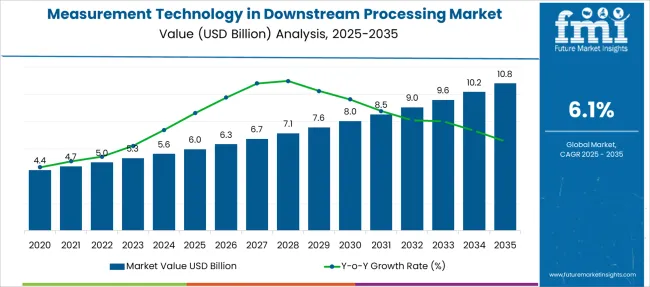
The measurement technology in downstream processing market was valued at USD 6.00 billion in 2025, projected to reach USD 6.37 billion in 2026, and is forecast to expand to USD 11.51 billion by 2036 at a 6.1% CAGR. Expanding biopharmaceutical manufacturing capacity, tightening process analytical technology requirements, and the transition toward continuous and single-use downstream processing are driving procurement cycles for inline and at-line measurement systems. Process development scientists designing purification trains for monoclonal antibody and cell therapy products treat measurement technology as a yield-critical infrastructure layer that enables real-time process control and regulatory compliance with ICH Q8-Q12 quality-by-design frameworks.
Summary of Measurement Technology in Downstream Processing Market
- Market Overview
- The measurement technology in downstream processing market is valued at USD 6.00 billion in 2025 and is projected to reach USD 11.51 billion by 2036.
- The industry is expected to grow at a 6.1% CAGR from 2026 to 2036, creating an incremental opportunity of USD 5.14 billion.
- The market is a bioprocessing instrumentation category where single-use sensor compatibility, PAT framework compliance, and inline measurement accuracy define competitive positioning.
- Demand and Growth Drivers
- Demand is accelerating as biopharmaceutical manufacturers expand downstream processing capacity for monoclonal antibody, cell therapy, and gene therapy products.
- The transition to single-use downstream processing is driving procurement of disposable sensor assemblies that eliminate cleaning validation in multi-product facilities.
- FDA process analytical technology guidance and ICH quality-by-design frameworks are mandating inline measurement capability in GMP purification environments.
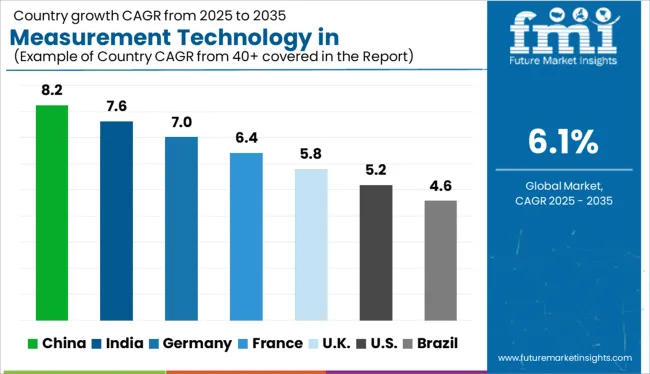
- Among key countries, China leads at 8.2% CAGR, followed by India at 7.6%, Germany at 7.0%, and France at 6.4%.
- Product and Segment View
- The market includes sensors (pH, DO, conductivity, cell density), sensor housings, transmitters and controllers, cables and connectors, and buffers and reagents for downstream bioprocessing measurement.
- Applications span chromatography monitoring, tangential flow filtration control, viral inactivation verification, formulation parameter tracking, and fill-finish process monitoring.
- Sensors lead by Product with 35.7% share in 2026, forming the foundational instrumentation layer across all downstream unit operations.
- Single-use leads by Modality with 61.4% share in 2026, driven by the biopharmaceutical industry shift toward disposable processing assemblies.
- Pharmaceutical and Biotechnology Companies lead by End User with 47.2% share in 2026, driven by biologics pipeline expansion and GMP manufacturing capacity growth.
- Geography and Competitive Outlook
- China and India are the fastest-growing markets driven by biopharmaceutical manufacturing capacity expansion, while North America and Europe sustain demand through process analytical technology mandate compliance.
- Contract manufacturing organization growth across Asia Pacific is creating parallel demand for multi-product-compatible measurement infrastructure.
- Competition is shaped by product performance, technical capability, and distribution reach, with key players including Sartorius AG, Applikon Biotechnology Inc., Broadley-James Corporation, Thermo Fisher Scientific Inc., Hamilton Company, Waters Corporation, PreSens Precision Sensing GmbH, PendoTECH LLC, Endress+Hauser AG, Mettler-Toledo International Inc., Metroglas AG, Madison, YSI, Evoqua.
- Analyst Opinion at FMI
- FMI is of the opinion that the measurement technology in downstream processing market is structurally linked to biologics manufacturing capacity expansion and PAT framework enforcement, where each new GMP purification train requires a complete inline measurement instrumentation layer. Sensor suppliers that lack single-use product formats validated for gamma irradiation sterilization face exclusion from the fastest-growing biopharmaceutical manufacturing segment.
- Strategic Implications / Executive Takeaways
- Sensor manufacturers must develop single-use measurement probes validated for gamma irradiation sterilization to qualify for disposable bioprocessing system integration.
- Biopharmaceutical manufacturers should standardize inline measurement platforms across process development and GMP scales to accelerate technology transfer timelines.
- CMO facility planners must specify multi-product-compatible measurement systems with rapid changeover capability to maximize asset utilization across client programs.
Measurement Technology in Downstream Processing Market Key Takeaways
| Metric | Details |
|---|---|
| Industry Size (2026) | USD 6.37 billion |
| Industry Value (2036) | USD 11.51 billion |
| CAGR (2026-2036) | 6.1% |
Source: Future Market Insights, 2026
Sensors retain the lead position at 35.7% share in 2026 as pH, dissolved oxygen, conductivity, and cell density measurement probes form the foundational instrumentation layer across chromatography, filtration, and formulation unit operations. Single-use modality commands 61.4% share, reflecting the biopharmaceutical industry transition toward disposable sensor assemblies that eliminate cleaning validation and cross-contamination risk in multi-product facilities. Pharmaceutical and biotechnology companies account for 47.2% of end-user demand as biologics pipeline expansion creates parallel demand for downstream process monitoring across clinical and commercial manufacturing scales. As per FMI, the convergence of FDA process analytical technology guidance, EMA continuous manufacturing frameworks, and ICH quality-by-design principles is expanding the installed base of inline measurement systems beyond process development into GMP production environments.
All key markets reflect differentiated growth trajectories. China advances at 8.2% driven by biopharmaceutical manufacturing capacity expansion under national biosecurity investment programs. India advances at 7.6% fueled by contract manufacturing organization growth and biologics production scale-up. Germany advances at 7.0% supported by biopharma process intensification programs and PAT compliance requirements. France advances at 6.4% sustained by vaccine manufacturing investment and continuous bioprocessing adoption. UK advances at 5.8% anchored by cell and gene therapy manufacturing infrastructure development. USA advances at 5.2% maintained by the largest biologics manufacturing installed base and FDA PAT enforcement. Brazil advances at 4.6% supported by expanding vaccine production capacity and biosimilar manufacturing investment.
Measurement Technology in Downstream Processing Market Definition
Measurement Technology in Downstream Processing represents the instrumentation systems used to monitor, control, and optimize purification and formulation unit operations in biopharmaceutical, food and beverage, and industrial biotechnology manufacturing. The market encompasses sensors (pH, dissolved oxygen, conductivity, cell density), sensor housings, transmitters, controllers, cables, connectors, and buffers/reagents in single-use and reusable formats deployed across chromatography, filtration, viral inactivation, and fill-finish operations.
Measurement Technology in Downstream Processing Market Inclusions
Market scope includes sensors, sensor housings, transmitters, controllers, cables, connectors, and buffers/reagents in single-use and reusable formats for downstream bioprocessing. Global and regional market sizes, forecast period 2026 to 2036, and segment breakdowns by Product, Modality, and End User are fully covered.
Measurement Technology in Downstream Processing Market Exclusions
The scope excludes upstream bioreactor monitoring systems, standalone laboratory analytical instruments (HPLC, mass spectrometry), and general-purpose industrial process control hardware. Disposable bioreactor bags and tubing assemblies without integrated measurement capability are omitted.
Measurement Technology in Downstream Processing Market Research Methodology
Primary Research
Analysts engaged with procurement managers, technical specification leads, and operations directors across key end-use segments to map decision gates triggering equipment and service upgrades.
Desk Research
Data collection aggregated regulatory compliance timelines, standards body publication schedules, industry association reports, and publicly filed corporate disclosures.
Market-Sizing and Forecasting
Baseline values derive from bottom-up aggregation of product shipment volumes, service contract values, and consumption data, applying region-specific adoption curves to project future demand.
Data Validation and Update Cycle
Projections are tested against publicly reported expenditure guidance from leading industry participants and validated through cross-referencing with regulatory filing data and trade association statistics.
Measurement technology in downstream processing market Outlook
| Data Points | Market Insights |
|---|---|
| Market Value 2026 | USD 4.7 billion |
| Global Market Value (2026) | USD 5.0 billion |
| Forecasted Global Market Value (2036) | USD 7.2 billion |
| Market Growth Rate 2026 to 2036 | 6.1% |
| Top 5 Countries % Share | 58.3% |
| Key Players | Companies are like Applikon Biotechnology Inc.; Sartorius AG; Broadley-James Corporation; Thermo Fisher Scientific Inc.; Hamilton Company give 8% market share. |
2021 to 2025 Measurement technology in downstream processing market Demand Outlook Compared to 2026 to 2036 Forecast
There is a high demand for high precision, continuous feedback sensors in bioprocessing to get precise results. Several standard operating procedures (SOPs) call for continuous feedback and process control for measuring key parameters such as pH, DO, temperature etc. This create demand for sensors in measurement technology in downstream processing market.
New and innovative sensor technologies and smart bioprocess control equipment can enhance process development at the bench or lab scale and lead to a better route to scale up operations. In larger scale operations, especially in commercial manufacturing, GMP regulations apply due to which process deviations can result in significant losses to revenue and production thus creating the need for precise measuring devices.
Therefore, the use of improved sensor technology is crucial in optimizing processing parameters and thus is likely to drive the growth of measurement technology in downstream processing market.
Considering this, it is expected for the global measurement technology in downstream processing market to grow at a CAGR of 6.1% through 2035.
Which Factors Are Restraining Demand for Measurement technology in downstream processing market?
High failure rates in conventional sensors limiting use in large-scale applications is expected to hamper the growth of market over the forecast period. Conventional sensors such as electrochemical DO probes have exhibited high failure rates due to deposition at the membrane where process liquid contact occurs.
Continuous biopharmaceutical manufacturing may be consistent with FDA’s Quality by Design (QbD) efforts, but there is still untapped potential for manufacturers of bioprocessing equipment to improve product quality assurance.
Sensors contributes in providing product quality, lowering the manufacturing cycle time, and reducing capital costs & time by stabilizing bioprocessing operations. So, failure of this sensors may result in declining the market growth to some extent for the Measurement technology in downstream processing market.
Country-wise Insights
What Makes the USA a Large Market for Measurement technology in downstream processing market?
The USA is estimated to account for over 95.3% of the North America measurement technology in downstream processing market demand in 2026. High adoption rate of automated in bioprocessing system.
Many bioprocessing vendors in USA are adopting developed technologies that typically address automation challenges, extending from software development and integration, to continuous process. Accessibility of technical resources and an enhanced knowledge to improve the quality of research and success rates, thereby bringing more novel therapeutics to the market.
Why is Germany Considered a Lucrative in Measurement technology in downstream process market?
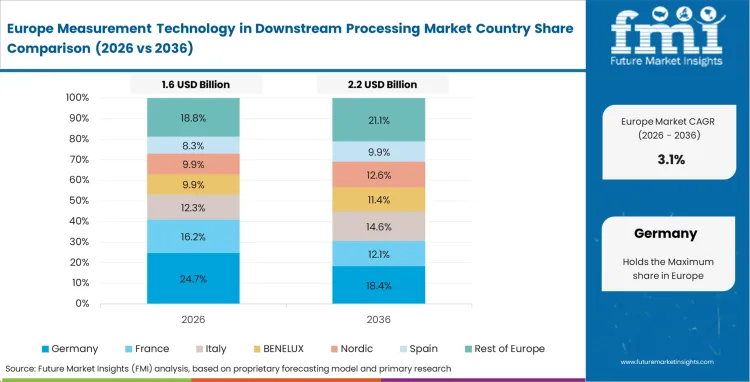
Germany is estimated to account for 34.5% market share in Europe in 2026. Factors such as increase in presence of research and development program, adequate research infrastructure with satisfactory results for biologics is boosting the demand for measurement technology in downstream processing market in Germany.
To enable collaboration and cross-functional research and development, several different for-profit and not-for-profit agencies have come forth to bringing innovative therapeutic biological options for chronic disease. This bring positive growth for market in Germany.
What are the Factors Fueling the Demand for measurement technology in downstream processing market in China?
China is estimated to account for 49.8% of the East Asia market by 2026 owing to shift of investment in R&D and technology, especially in the life sciences, from North America and Europe to Asia Pacific.
China government have started taking initiatives to support growth of the local biotechnology industry by offering tax exclusions for R&D, increased budgets and funding’s. So more focus is generated to develop effective measuring tool for biological products for measurement technology in downstream processing market.
How will the Measurement technology in downstream processing market growth Across India?
Demand for measurement technology in downstream processing market in India is expected to rise at an impressive growth opportunities with 9.6% CAGR over the forecast period.
Developing countries like India have ample qualified manpower and skilled labor at reasonable costs thereby raising the scope for attracting outsourcing of biotechnology projects this is responsible for the growth of the market in India.
Category-wise Insights
Demand for Sensors to continue gaining Traction by Product?
By Product, the sensors segment is anticipated to hold the maximum share of 49.8% in 2026. Sensors play important role in biological production and technological advancement in sensor which will give boost to market.
Life science and downstream processing technology have moved to a great extent of sensing and automated process control as new technologies including wireless sensors such as VisiPro DO sensor, Contactless optical DO sensors etc. are introduced in the market. This provides huge opportunity for product business to existing players in the market
This advanced sensors are highly adopted by researcher and biopharmaceutical companies, due to which there is a significant demand for sensors over the forecast period.
Why Single-use by modality have high adoption?
Demand for single-use by modality are expected to rise at an impressive 6.9% CAGR over the forecast period. Due to its numerous advantage of single-use unit measurement technology in downstream processing for step by steps detection in various analytical system as well as optimization, and elimination of standardization steps, the market is witness growth during the forecast period.
Moreover, single-use measuring products are rapidly becoming commonplace at not just the lab or bench scale, but also at commercial scale due to ease of use and limited potential for cross-contamination which give global traction to measurement technology in downstream processing market.
Which End User will hold the most of the market share?
By end user, pharmaceutical & biotechnology company segment lead the market with market share of 42.8% in 2026. Most of the pharma and biopharma players focus in collaboration with research institutes to increase their product portfolio.
Moreover, most of companies’ revenue is spend towardss research and development department where measuring tool is highly used. So, large biopharmaceutical companies hold large share in measurement technology in downstream processing market.
Competitive Landscape
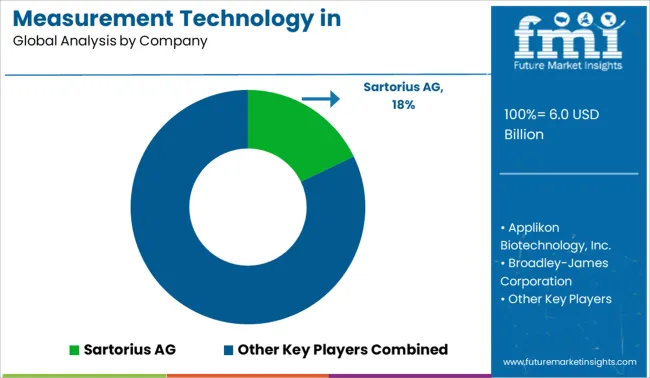
Companies operating in the measurement technology in downstream processing market devices are actively seeking to strengthen their position through expansion, and merger & acquisition, with established as well as emerging market players.
Some of the recent instances include:
- In April 2025, Thermo Fisher Scientific Acquired PPD, Inc., a Leading Clinical Research Organization to Further expands service offering to pharma and biotech customers.
- In 2025, Sartorius strengthens its product portfolio with respect to cell and gene therapy by acquiring a key stake in CellGenix.
Scope of the Report
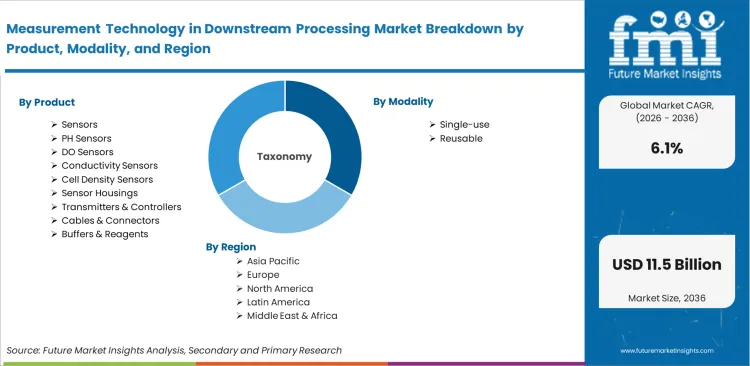
| Metric | Value |
|---|---|
| Quantitative Units | USD 6.37 billion to USD 11.51 billion, at a CAGR of 6.1% |
| Market Definition | Measurement Technology in Downstream Processing represents the instrumentation systems used to monitor, control, and optimize purification and formulation unit operations in biopharmaceutical, food and beverage, and industrial biotechnology manufacturing. The market encompasses sensors (pH, dissolved oxygen, conductivity, cell density), sensor housings, transmitters, controllers, cables, connectors, and buffers/reagents in single-use and reusable formats deployed across chromatography, filtration, viral inactivation, and fill-finish operations. |
| Segmentation | Product: Sensors, PH Sensors, DO Sensors, Conductivity Sensors, Cell Density Sensors, Sensor Housings, Transmitters & Controllers, Cables & Connectors, Buffers & Reagents; Modality: Single-use, Reusable; End User: Pharmaceutical & Biotechnology Companies, Food & Beverage Companies, Contract Manufacturing Organizations, Academic & Research Institutes, Others |
| Regions Covered | North America, Latin America, Europe, East Asia, South Asia, Oceania, Middle East & Africa |
| Countries Covered | China, India, Germany, France, UK, USA, Brazil, and 40 plus countries |
| Key Companies Profiled | Sartorius AG, Applikon Biotechnology Inc., Broadley-James Corporation, Thermo Fisher Scientific Inc., Hamilton Company, Waters Corporation, PreSens Precision Sensing GmbH, PendoTECH LLC, Endress+Hauser AG, Mettler-Toledo International Inc., Metroglas AG, Madison, YSI, Evoqua |
| Forecast Period | 2026 to 2036 |
| Approach | Forecasting models apply a hybrid bottom-up and top-down methodology starting with installed base metrics and cross-validating projections against primary research and public disclosure data. |
Measurement technology in downstream processing market by Category
By Product:
- Sensors
- pH Sensors
- Optical
- Electrochemical
- DO Sensors
- Optical
- Eelctrochemical
- Conductivity Sensors
- Cell Density Sensors
- pH Sensors
- Sensor Housings
- Transmitters & Controllers
- Cables & Connectors
- Buffers & Reagents
By Modality:
- Single-use
- Reusable
By End User:
- Pharmaceutical & Biotechnology Companies
- Food & Beverage Companies
- Contract Manufacturing Organizations
- Academic & Research Institutes
- Others
By Region:
- North America
- Latin America
- Western Europe
- Eastern Europe
- Asia-Pacific excluding Japan
- Japan
- Middle East & Africa
Bibliography
1. USA Food and Drug Administration. (2025). Guidance for Industry: Process Analytical Technology Framework. FDA.
2. European Medicines Agency. (2025). Guideline on Real-Time Release Testing. EMA.
3. International Council for Harmonisation. (2025). ICH Q8(R2): Pharmaceutical Development. ICH.
4. International Society for Pharmaceutical Engineering. (2025). ISPE Good Practice Guide: Process Analytical Technology. ISPE.
5. Bio-Process Systems Alliance. (2025). Single-Use Technology: Industry Practices and Supplier Survey. BPSA.
6. Parenteral Drug Association. (2025). PDA Technical Report: Process Validation for Biotechnology Products. PDA.
This bibliography is provided for reader reference. The full Future Market Insights report contains the complete reference list with primary research documentation.
This Report Addresses
- Market sizing and quantitative forecast metrics detailing expenditure dedicated to measurement technology in downstream processing across major sectors through 2036.
- Segmentation analysis mapping adoption velocity of specific product categories and evaluating factors driving segment preferences.
- Regional deployment intelligence comparing growth strategies across key geographies.
- Regulatory compliance assessment analyzing how standards and mandates influence procurement timelines.
- Competitive posture evaluation tracking market consolidation and shifts in supplier qualification.
- Capital project strategic guidance defining procurement specifications for next-generation requirements.
- Supply chain vulnerability analysis identifying bottlenecks that extend procurement timelines.
- Custom data delivery formats encompassing interactive dashboards, raw Excel datasets, and PDF narrative reports.
Frequently Asked Questions
How large is the demand for Measurement Technology in Downstream Processing in the global market in 2026?
Demand for Measurement Technology in Downstream Processing in the global market is estimated to be valued at USD 6.37 billion in 2026.
What will be the market size of Measurement Technology in Downstream Processing in the global market by 2036?
Market size for Measurement Technology in Downstream Processing is projected to reach USD 11.51 billion by 2036.
What is the expected demand growth for Measurement Technology in Downstream Processing between 2026 and 2036?
Demand for Measurement Technology in Downstream Processing is expected to grow at a CAGR of 6.1% between 2026 and 2036.
Which Product is poised to lead global sales by 2026?
Sensors accounts for 35.7% share in 2026.
How significant is Single-use in driving Measurement Technology in Downstream Processing adoption in 2026?
Single-use represents 61.4% of segment share in 2026.
What is China's growth outlook in this report?
China is projected to grow at a CAGR of 8.2% during 2026 to 2036.
What is Measurement Technology in Downstream Processing and what is it mainly used for?
Measurement Technology in Downstream Processing represents the instrumentation systems used to monitor, control, and optimize purification and formulation unit operations in biopharmaceutical, food and beverage, and industrial biotechnology manufacturing. The market encompasses sensors (pH, dissolved oxygen, conductivity, cell density), sensor housings, transmitters, controllers, cables, connectors, and buffers/reagents in single-use and reusable formats deployed across chromatography, filtration, viral inactivation, and fill-finish operations.
What is included in the scope of this Measurement Technology in Downstream Processing report?
Market scope includes sensors, sensor housings, transmitters, controllers, cables, connectors, and buffers/reagents in single-use and reusable formats for downstream bioprocessing. Global and regional market sizes, forecast period 2026 to 2036, and segment breakdowns by Product, Modality, and End User are fully covered.
Preview the report firsthand - request a free sample
Get SampleGet the brochure for pricing and purchase details.
Get PDFTable of Content
- Executive Summary
- Global Market Outlook
- Demand-side Trends
- Supply-side Trends
- Technology Roadmap Analysis
- Analysis and Recommendations
- Market Overview
- Market Coverage / Taxonomy
- Market Definition / Scope / Limitations
- Research Methodology
- Chapter Orientation
- Analytical Lens and Working Hypotheses
- Market Structure, Signals, and Trend Drivers
- Benchmarking and Cross-market Comparability
- Market Sizing, Forecasting, and Opportunity Mapping
- Research Design and Evidence Framework
- Desk Research Programme (Secondary Evidence)
- Company Annual and Sustainability Reports
- Peer-reviewed Journals and Academic Literature
- Corporate Websites, Product Literature, and Technical Notes
- Earnings Decks and Investor Briefings
- Statutory Filings and Regulatory Disclosures
- Technical White Papers and Standards Notes
- Trade Journals, Industry Magazines, and Analyst Briefs
- Conference Proceedings, Webinars, and Seminar Materials
- Government Statistics Portals and Public Data Releases
- Press Releases and Reputable Media Coverage
- Specialist Newsletters and Curated Briefings
- Sector Databases and Reference Repositories
- FMI Internal Proprietary Databases and Historical Market Datasets
- Subscription Datasets and Paid Sources
- Social Channels, Communities, and Digital Listening Inputs
- Additional Desk Sources
- Expert Input and Fieldwork (Primary Evidence)
- Primary Modes
- Qualitative Interviews and Expert Elicitation
- Quantitative Surveys and Structured Data Capture
- Blended Approach
- Why Primary Evidence is Used
- Field Techniques
- Interviews
- Surveys
- Focus Groups
- Observational and In-context Research
- Social and Community Interactions
- Stakeholder Universe Engaged
- C-suite Leaders
- Board Members
- Presidents and Vice Presidents
- R&D and Innovation Heads
- Technical Specialists
- Domain Subject-matter Experts
- Scientists
- Physicians and Other Healthcare Professionals
- Governance, Ethics, and Data Stewardship
- Research Ethics
- Data Integrity and Handling
- Primary Modes
- Tooling, Models, and Reference Databases
- Desk Research Programme (Secondary Evidence)
- Data Engineering and Model Build
- Data Acquisition and Ingestion
- Cleaning, Normalisation, and Verification
- Synthesis, Triangulation, and Analysis
- Quality Assurance and Audit Trail
- Market Background
- Market Dynamics
- Drivers
- Restraints
- Opportunity
- Trends
- Scenario Forecast
- Demand in Optimistic Scenario
- Demand in Likely Scenario
- Demand in Conservative Scenario
- Opportunity Map Analysis
- Product Life Cycle Analysis
- Supply Chain Analysis
- Investment Feasibility Matrix
- Value Chain Analysis
- PESTLE and Porter’s Analysis
- Regulatory Landscape
- Regional Parent Market Outlook
- Production and Consumption Statistics
- Import and Export Statistics
- Market Dynamics
- Global Market Analysis 2021 to 2025 and Forecast, 2026 to 2036
- Historical Market Size Value (USD Million) Analysis, 2021 to 2025
- Current and Future Market Size Value (USD Million) Projections, 2026 to 2036
- Y-o-Y Growth Trend Analysis
- Absolute $ Opportunity Analysis
- Global Market Pricing Analysis 2021 to 2025 and Forecast 2026 to 2036
- Global Market Analysis 2021 to 2025 and Forecast 2026 to 2036, By Product
- Introduction / Key Findings
- Historical Market Size Value (USD Million) Analysis By Product , 2021 to 2025
- Current and Future Market Size Value (USD Million) Analysis and Forecast By Product , 2026 to 2036
- Sensors
- PH Sensors
- DO Sensors
- Conductivity Sensors
- Cell Density Sensors
- Sensor Housings
- Transmitters & Controllers
- Cables & Connectors
- Buffers & Reagents
- Sensors
- Y-o-Y Growth Trend Analysis By Product , 2021 to 2025
- Absolute $ Opportunity Analysis By Product , 2026 to 2036
- Global Market Analysis 2021 to 2025 and Forecast 2026 to 2036, By Modality
- Introduction / Key Findings
- Historical Market Size Value (USD Million) Analysis By Modality, 2021 to 2025
- Current and Future Market Size Value (USD Million) Analysis and Forecast By Modality, 2026 to 2036
- Single-use
- Reusable
- Single-use
- Y-o-Y Growth Trend Analysis By Modality, 2021 to 2025
- Absolute $ Opportunity Analysis By Modality, 2026 to 2036
- Global Market Analysis 2021 to 2025 and Forecast 2026 to 2036, By End User
- Introduction / Key Findings
- Historical Market Size Value (USD Million) Analysis By End User, 2021 to 2025
- Current and Future Market Size Value (USD Million) Analysis and Forecast By End User, 2026 to 2036
- Pharmaceutical & Biotechnology Companies
- Food & Beverage Companies
- Contract Manufacturing Organizations
- Academic & Research Institutes
- Others
- Pharmaceutical & Biotechnology Companies
- Y-o-Y Growth Trend Analysis By End User, 2021 to 2025
- Absolute $ Opportunity Analysis By End User, 2026 to 2036
- Global Market Analysis 2021 to 2025 and Forecast 2026 to 2036, By Region
- Introduction
- Historical Market Size Value (USD Million) Analysis By Region, 2021 to 2025
- Current Market Size Value (USD Million) Analysis and Forecast By Region, 2026 to 2036
- North America
- Latin America
- Western Europe
- Eastern Europe
- East Asia
- South Asia and Pacific
- Middle East & Africa
- Market Attractiveness Analysis By Region
- North America Market Analysis 2021 to 2025 and Forecast 2026 to 2036, By Country
- Historical Market Size Value (USD Million) Trend Analysis By Market Taxonomy, 2021 to 2025
- Market Size Value (USD Million) Forecast By Market Taxonomy, 2026 to 2036
- By Country
- USA
- Canada
- Mexico
- By Product
- By Modality
- By End User
- By Country
- Market Attractiveness Analysis
- By Country
- By Product
- By Modality
- By End User
- Key Takeaways
- Latin America Market Analysis 2021 to 2025 and Forecast 2026 to 2036, By Country
- Historical Market Size Value (USD Million) Trend Analysis By Market Taxonomy, 2021 to 2025
- Market Size Value (USD Million) Forecast By Market Taxonomy, 2026 to 2036
- By Country
- Brazil
- Chile
- Rest of Latin America
- By Product
- By Modality
- By End User
- By Country
- Market Attractiveness Analysis
- By Country
- By Product
- By Modality
- By End User
- Key Takeaways
- Western Europe Market Analysis 2021 to 2025 and Forecast 2026 to 2036, By Country
- Historical Market Size Value (USD Million) Trend Analysis By Market Taxonomy, 2021 to 2025
- Market Size Value (USD Million) Forecast By Market Taxonomy, 2026 to 2036
- By Country
- Germany
- UK
- Italy
- Spain
- France
- Nordic
- BENELUX
- Rest of Western Europe
- By Product
- By Modality
- By End User
- By Country
- Market Attractiveness Analysis
- By Country
- By Product
- By Modality
- By End User
- Key Takeaways
- Eastern Europe Market Analysis 2021 to 2025 and Forecast 2026 to 2036, By Country
- Historical Market Size Value (USD Million) Trend Analysis By Market Taxonomy, 2021 to 2025
- Market Size Value (USD Million) Forecast By Market Taxonomy, 2026 to 2036
- By Country
- Russia
- Poland
- Hungary
- Balkan & Baltic
- Rest of Eastern Europe
- By Product
- By Modality
- By End User
- By Country
- Market Attractiveness Analysis
- By Country
- By Product
- By Modality
- By End User
- Key Takeaways
- East Asia Market Analysis 2021 to 2025 and Forecast 2026 to 2036, By Country
- Historical Market Size Value (USD Million) Trend Analysis By Market Taxonomy, 2021 to 2025
- Market Size Value (USD Million) Forecast By Market Taxonomy, 2026 to 2036
- By Country
- China
- Japan
- South Korea
- By Product
- By Modality
- By End User
- By Country
- Market Attractiveness Analysis
- By Country
- By Product
- By Modality
- By End User
- Key Takeaways
- South Asia and Pacific Market Analysis 2021 to 2025 and Forecast 2026 to 2036, By Country
- Historical Market Size Value (USD Million) Trend Analysis By Market Taxonomy, 2021 to 2025
- Market Size Value (USD Million) Forecast By Market Taxonomy, 2026 to 2036
- By Country
- India
- ASEAN
- Australia & New Zealand
- Rest of South Asia and Pacific
- By Product
- By Modality
- By End User
- By Country
- Market Attractiveness Analysis
- By Country
- By Product
- By Modality
- By End User
- Key Takeaways
- Middle East & Africa Market Analysis 2021 to 2025 and Forecast 2026 to 2036, By Country
- Historical Market Size Value (USD Million) Trend Analysis By Market Taxonomy, 2021 to 2025
- Market Size Value (USD Million) Forecast By Market Taxonomy, 2026 to 2036
- By Country
- Kingdom of Saudi Arabia
- Other GCC Countries
- Turkiye
- South Africa
- Other African Union
- Rest of Middle East & Africa
- By Product
- By Modality
- By End User
- By Country
- Market Attractiveness Analysis
- By Country
- By Product
- By Modality
- By End User
- Key Takeaways
- Key Countries Market Analysis
- USA
- Pricing Analysis
- Market Share Analysis, 2025
- By Product
- By Modality
- By End User
- Canada
- Pricing Analysis
- Market Share Analysis, 2025
- By Product
- By Modality
- By End User
- Mexico
- Pricing Analysis
- Market Share Analysis, 2025
- By Product
- By Modality
- By End User
- Brazil
- Pricing Analysis
- Market Share Analysis, 2025
- By Product
- By Modality
- By End User
- Chile
- Pricing Analysis
- Market Share Analysis, 2025
- By Product
- By Modality
- By End User
- Germany
- Pricing Analysis
- Market Share Analysis, 2025
- By Product
- By Modality
- By End User
- UK
- Pricing Analysis
- Market Share Analysis, 2025
- By Product
- By Modality
- By End User
- Italy
- Pricing Analysis
- Market Share Analysis, 2025
- By Product
- By Modality
- By End User
- Spain
- Pricing Analysis
- Market Share Analysis, 2025
- By Product
- By Modality
- By End User
- France
- Pricing Analysis
- Market Share Analysis, 2025
- By Product
- By Modality
- By End User
- India
- Pricing Analysis
- Market Share Analysis, 2025
- By Product
- By Modality
- By End User
- ASEAN
- Pricing Analysis
- Market Share Analysis, 2025
- By Product
- By Modality
- By End User
- Australia & New Zealand
- Pricing Analysis
- Market Share Analysis, 2025
- By Product
- By Modality
- By End User
- China
- Pricing Analysis
- Market Share Analysis, 2025
- By Product
- By Modality
- By End User
- Japan
- Pricing Analysis
- Market Share Analysis, 2025
- By Product
- By Modality
- By End User
- South Korea
- Pricing Analysis
- Market Share Analysis, 2025
- By Product
- By Modality
- By End User
- Russia
- Pricing Analysis
- Market Share Analysis, 2025
- By Product
- By Modality
- By End User
- Poland
- Pricing Analysis
- Market Share Analysis, 2025
- By Product
- By Modality
- By End User
- Hungary
- Pricing Analysis
- Market Share Analysis, 2025
- By Product
- By Modality
- By End User
- Kingdom of Saudi Arabia
- Pricing Analysis
- Market Share Analysis, 2025
- By Product
- By Modality
- By End User
- Turkiye
- Pricing Analysis
- Market Share Analysis, 2025
- By Product
- By Modality
- By End User
- South Africa
- Pricing Analysis
- Market Share Analysis, 2025
- By Product
- By Modality
- By End User
- USA
- Market Structure Analysis
- Competition Dashboard
- Competition Benchmarking
- Market Share Analysis of Top Players
- By Regional
- By Product
- By Modality
- By End User
- Competition Analysis
- Competition Deep Dive
- Sartorius AG
- Overview
- Product Portfolio
- Profitability by Market Segments (Product/Age /Sales Channel/Region)
- Sales Footprint
- Strategy Overview
- Marketing Strategy
- Product Strategy
- Channel Strategy
- Applikon Biotechnology Inc.
- Broadley-James Corporation
- Thermo Fisher Scientific Inc.
- Hamilton Company
- Waters Corporation
- PreSens Precision Sensing GmbH
- PendoTECH LLC
- Endress+Hauser AG
- Mettler-Toledo International Inc.
- Metroglas AG
- Madison
- YSI
- Evoqua
- Sensorex
- Forbes
- Sartorius AG
- Competition Deep Dive
- Assumptions & Acronyms Used


