

- Market Size (2026)
- USD 4.2 Bn
- Forecast (2036)
- USD 13.6 Bn
- CAGR (2026 to 2036)
- 12.5%
How big is Single-Use Downstream Bioprocessing Market in 2026?
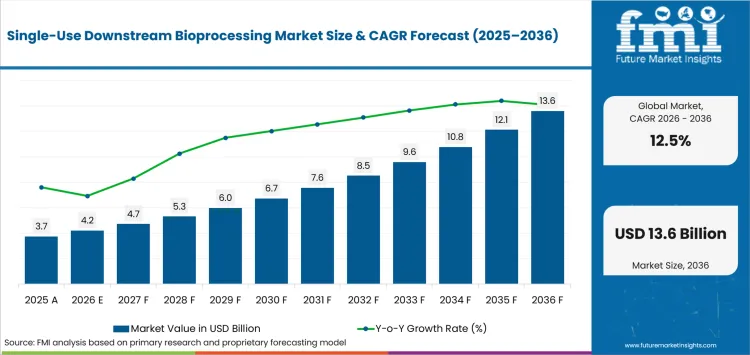
USD 4.2 billion in 2026 and USD 13.6 billion by 2036 at a 12.5% CAGR.
Demand for single-use downstream bioprocessing is projected to expand at a 12.5% CAGR from 2026 to 2036, increasing from USD 4.2 billion in 2026 to USD 13.6 billion by 2036. The market covers disposable filtration, chromatography, sampling and connection technologies used after cell harvest to clarify, purify, concentrate and exchange buffers for biologic products.
The commercial case rests on faster setup and closed product-contact paths, but every disposable component still requires qualification. USA Food and Drug Administration guidance treats supplier changes, material changes and extensions of disposable-material use as manufacturing changes that require assessment and suitable reporting. Buyers therefore examine change notifications, component traceability and supply support before extending one platform across sites.
Key Takeaways of Single-Use Downstream Bioprocessing Market
- Flexible downstream capacity is gaining importance as multiproduct facilities move more biologics through shared equipment frames and disposable flow paths.
- Single-use filtration systems are projected to lead product type demand with 32.0% share in 2026 because filtration appears across clarification, concentration and polishing.
- Commercial-scale operations are estimated to account for 52.0% share in 2026 as manufacturers standardize qualified assemblies for repeated production campaigns.
- Monoclonal antibodies are forecast to represent 38.0% of application demand in 2026 due to established capture and polishing sequences.
- Material changes and supply interruptions can trigger requalification work, which makes change control a central purchasing requirement.
- Sartorius AG, Cytiva, Merck KGaA, Thermo Fisher Scientific Inc. and Repligen Corporation offer broad downstream portfolios, while specialist suppliers focus on filtration and fluid management.
Analyst Perspective
"Scale does not remove the need for qualification. Buyers will favor single-use downstream platforms that keep flow paths consistent from process development through commercial purification and provide change-control evidence for each product-contact component."
- Anurag Sharma, Principal Consultant, Future Market Insights
How is the Single-Use Downstream Bioprocessing Market segmented?
The single-use downstream bioprocessing market is segmented by product type, scale of operation, application, end user, workflow and region.
The market is organized around five operating decisions. Product type defines the disposable hardware and consumables used in a process. Scale of operation determines flow rate and batch requirements. Application changes the purification challenge, while end-user type shapes qualification ownership. Workflow identifies where filtration, chromatography, concentration or buffer exchange creates demand.
Why do single-use filtration systems lead demand within the product type category?
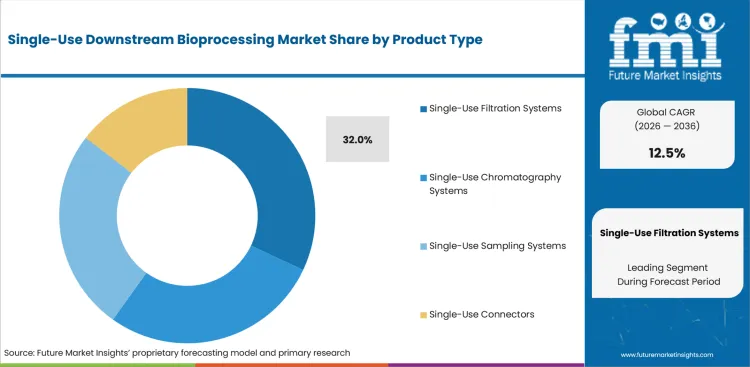
Filtration systems support clarification and membrane separation before or after chromatography. Single-use chromatography systems, sampling systems and connectors remain important, but filtration appears across more unit operations and protects later purification steps.
- Based on product type, single-use filtration systems are projected to account for 32.0% share in 2026 because depth and membrane filtration can be deployed across clarification, concentration and final polishing.
- Depth filters reduce particulate load before columns and sterile filters, while disposable membrane assemblies shorten changeover work in multiproduct facilities. Chromatography, sampling and connector platforms retain demand where closed transfer and rapid setup are required.
Why do Commercial-scale operations lead demand within the scale of Operation category?
Commercial production requires repeatable component specifications and dependable supply across long campaign schedules. Clinical and preclinical work uses smaller configurations, but these stages often establish the materials and connections carried into later manufacturing.
- Commercial-scale operations are projected to hold 52.0% share in 2026 due to repeated biologic production and the need to standardize qualified flow paths across batches.
- Large-scale biopharmaceutical manufacturing favors scalable filtration and chromatography platforms. Phase I to III work and early process development continue to support clinical and preclinical demand through smaller equipment sets.
Why do Monoclonal antibodies lead demand within the Application category?
Monoclonal antibody purification follows established capture and polishing sequences that can use prepacked columns, membrane chromatography and disposable filtration. Recombinant proteins, vaccines and cell and gene therapies require different impurity controls, which sustains demand for specialized configurations.
- Monoclonal antibodies are expected to lead the application category with 38.0% share in 2026 because antibody purification uses repeatable capture, filtration and polishing steps.
- Protein A capture creates a large installed workflow for single-use technologies. Viral filtration and vector processing extend demand across vaccine and cell and gene therapy applications.
Why do Biopharmaceutical manufacturers lead demand within the End-user category?
In-house and integrated biopharmaceutical producers control process validation across development and commercial operations. CMOs and CDMOs use modular equipment for several clients, while academic and clinical institutes adopt smaller systems for research and translational work.
- Biopharmaceutical manufacturers are forecast to account for 49.0% share in 2026 due to repeated demand for qualified consumables across integrated production networks.
- CMOs and CDMOs require platforms that can be reconfigured between projects. Universities and clinical research centers use smaller assemblies where fixed cleaning infrastructure is limited or process changes are frequent.
Why does purification lead demand within the workflow category?
Purification concentrates value in chromatography and affinity capture after clarification. Filtration, concentration and buffer exchange remain essential because they condition the product for each subsequent step and support final formulation requirements.
- Purification is projected to lead workflow demand with 35.0% share in 2026 as chromatography and affinity capture remain central to biologic recovery.
- Depth filtration and ultrafiltration or diafiltration support clarification, concentration and buffer exchange. Suppliers that connect these steps through disposable flow paths can reduce manual transfers and simplify equipment turnover.
What are the drivers, restraints and opportunities in the Single-Use Downstream Bioprocessing Market?
Multiproduct facilities expand demand for flexible downstream capacity, while material-change qualification slows adoption as connected filtration and chromatography create a route to process intensification.
- Driver: Disposable flow paths support faster setup across changing products and batch sizes without a fixed clean-in-place system for every unit operation.
- Restraint: Changes in films, tubing, membranes or suppliers can trigger material assessment and regulatory reporting work.
- Opportunity: Connected chromatography, filtration and ultrafiltration or diafiltration can reduce manual transfers within one controlled process architecture.
Multiproduct facilities gain value when one equipment frame accepts qualified disposable assemblies for different campaigns. The benefit is strongest when manufacturers need to move from process development to commercial production without redesigning each connection and control point. Demand therefore favors systems with repeatable specifications and a clear scale-up path.
The principal restraint is evidence continuity across product-contact materials. FDA guidance identifies supplier changes and material changes as events that can require assessment and postapproval reporting. Procurement decisions therefore extend beyond unit price to change notification, alternate-source planning and batch-level traceability.
The opportunity lies in connected downstream processing. Sartorius and Cytiva have published work on linking membrane chromatography, filtration and concentration steps through single-use flow paths. Commercial adoption will depend on consistent product quality across the complete process rather than isolated device performance.
Which country CAGRs are included in the Single-Use Downstream Bioprocessing Market?
| Country | CAGR |
|---|---|
| South Korea | 13.5% |
| Japan | 12.8% |
| Australia | 12.7% |
| United Kingdom | 12.6% |
| Germany | 12.4% |
| Canada | 12.3% |
| United States | 12.2% |
How do country-level CAGRs compare in the Single-Use Downstream Bioprocessing Market?
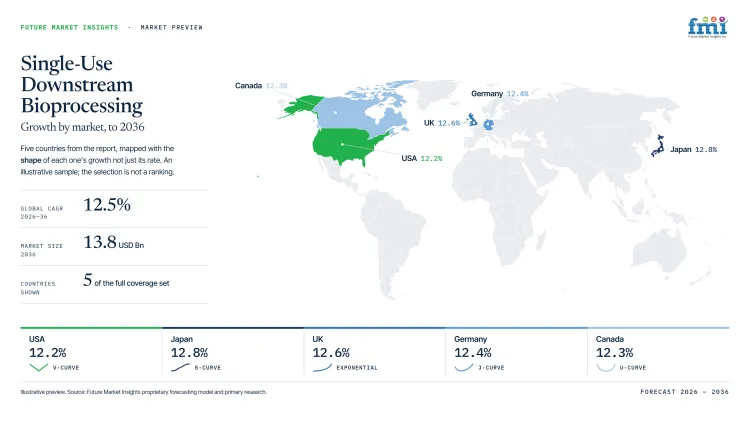
The seven country CAGRs span 1.3 percentage points, ranging from 12.2% to 13.5% through 2036. The narrow spread masks different manufacturing footprints, qualification requirements and service expectations.
- South Korea leads at 13.5% as large CDMO clusters and expanding biopharmaceutical capacity raise demand for commercial filtration and purification systems.
- Japan is projected at 12.8%, supported by a national bioeconomy strategy that places biomanufacturing among its priority industries.
- Australia follows at 12.7% as research translation and emerging local manufacturing favor flexible systems that can move from development into clinical production.
- The United Kingdom is forecast at 12.6% as its life sciences plan supports manufacturing scale-up and faster facility commissioning.
- Germany is projected at 12.4%, with established pharmaceutical engineering offset by demanding documentation and lifecycle change control.
- Canada is estimated at 12.3% as public investment expands domestic vaccine and therapeutics capacity across new facilities.
- The United States is forecast at 12.2%; broad platform availability supports adoption, while FDA change-control expectations lengthen qualification work.
Comparable growth rates can still create different entry conditions. Local service capacity, consumable availability and the treatment of material changes determine how quickly a platform can move into routine production.
Country-wise Analysis
- South Korea is forecast to expand at a 13.5% CAGR through 2036. Invest Korea reports that Songdo biopharmaceutical production capacity is expected to exceed 2.14 million liters by 2030, which supports demand for commercial filtration and purification systems with rapid local service.
- Japan is projected to grow at a 12.8% CAGR through 2036. The Ministry of Economy, Trade and Industry notes that the 2024 Bioeconomy Strategy positions biomanufacturing as a key pillar, raising the value of material traceability and local technical support.
- Australia is estimated to advance at a 12.7% CAGR through 2036. The National Health and Medical Research Strategy 2026-2036 emphasizes research translation and commercialization, favoring flexible systems that can serve research and clinical production without large fixed infrastructure.
- The United Kingdom is forecast to rise at a 12.6% CAGR through 2036. The Life Sciences Sector Plan supports advanced manufacturing and domestic scale-up, creating opportunities for suppliers that can provide qualified consumables and application support during commercial transfer.
- Germany is projected to record a 12.4% CAGR through 2036. The federal Pharma Strategy seeks to strengthen the operating environment for pharmaceutical production, while rigorous documentation increases the value of stable component specifications.
- Canada is estimated to expand at a 12.3% CAGR through 2036. The Government of Canada reports more than C$2.5 billion, about USD 1.8 billion, invested across 43 new or expanded biomanufacturing and life sciences projects since March 2020, supporting demand for systems that scale from clinical work to commercial batches.
- The United States is forecast to grow at a 12.2% CAGR through 2036. FDA guidance requires controlled assessment of disposable-material and supplier changes, so qualification files and change-notification discipline remain central to commercial adoption.
Who are the notable companies in the Single-Use Downstream Bioprocessing Market?
Sartorius AG, Cytiva (a Danaher operating company), Merck KGaA, Thermo Fisher Scientific Inc., Repligen Corporation, 3M Company, Avantor, Inc., Meissner Filtration Products, Inc., Corning Incorporated and Eppendorf SE are active in the market.
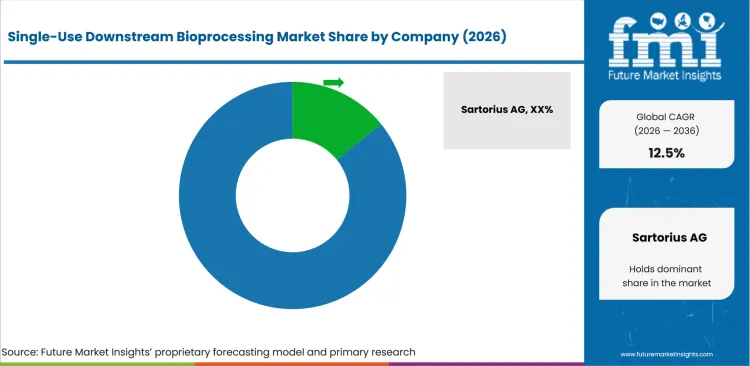
Competition includes integrated bioprocess platform suppliers and specialists in filtration or fluid management. Portfolio fit depends on the downstream steps covered, the consistency of product-contact materials and the support available during scale-up.
- Sartorius AG, Cytiva, Merck KGaA and Thermo Fisher Scientific Inc. offer combinations of filtration, chromatography and disposable fluid-path technologies.
- Repligen Corporation, 3M Company and Meissner Filtration Products, Inc. focus on high-value filtration, purification or single-use assembly requirements.
- Avantor, Inc., Corning Incorporated and Eppendorf SE support fluid handling or adjacent equipment used in development and downstream workflows.
Competitive Benchmarking: Single-Use Downstream Bioprocessing Market
| Company | Downstream Portfolio Breadth | Filtration Capability | Chromatography and Fluid Management | Geographic Reach |
|---|---|---|---|---|
| Sartorius AG | High | High | High | Global |
| Cytiva (Danaher Corporation) | High | High | High | Global |
| Merck KGaA | High | High | High | Global |
| Thermo Fisher Scientific Inc. | High | Medium | High | Global |
| Repligen Corporation | High | High | High | Global |
| 3M Company | Medium | High | Medium | Global |
| Avantor, Inc. | Medium | Medium | High | Global |
| Meissner Filtration Products, Inc. | Medium | High | High | Global |
| Corning Incorporated | Low | Low | Medium | Global |
| Eppendorf SE | Low | Low | Medium | Global |
Scoring basis: Downstream portfolio breadth is High when official product evidence covers at least three downstream unit operations, Medium when coverage is concentrated in two areas and Low when the offer is mainly adjacent. Filtration capability is High for several process-scale filtration families, Medium for one broad family and Low for limited direct evidence. Chromatography and fluid management is High for verified systems, resins, columns or assemblies across more than one workflow, Medium for one principal platform and Low for adjacent support. Geographic reach reflects documented commercial coverage and does not imply market-share leadership.
Key Developments in the Single-Use Downstream Bioprocessing Market
- In April 2026, Merck KGaA completed the acquisition of JSR Life Sciences' chromatography business, adding Amsphere Protein A resins and related capabilities.
- In April 2026, Repligen Corporation opened a European Training and Innovation Center in Breda to expand customer access to chromatography and filtration technologies.
- In December 2025, Repligen Corporation introduced three chromatography resins for viral-vector and other new-modality purification workflows.
Key Players in the Single-Use Downstream Bioprocessing Market
Integrated Downstream Platform Suppliers
- Sartorius AG
- Cytiva (Danaher Corporation)
- Merck KGaA
- Thermo Fisher Scientific Inc.
Filtration and Purification Specialists
- Repligen Corporation
- 3M Company
- Meissner Filtration Products, Inc.
Fluid Management and Adjacent Single-Use Suppliers
- Avantor, Inc.
- Corning Incorporated
- Eppendorf SE
Other Participants
- Others
Single-Use Downstream Bioprocessing Market - Report Scope
| Coverage field | Report scope |
|---|---|
| Market breakdown | By product type, scale of operation, application, end user, workflow and region. |
| Quantitative Units | USD billion. |
| Market Definition | Single-use systems and consumables used after cell harvest for filtration, chromatography, sampling, connection, purification, concentration and buffer exchange. |
| Regions Covered | North America, Latin America, Western Europe, Eastern Europe, East Asia, South Asia and Pacific, and Middle East and Africa. |
| Countries Covered | United States, Japan, Germany, United Kingdom, Canada, Australia and South Korea. |
| Key Companies | Sartorius AG, Cytiva, Merck KGaA, Thermo Fisher Scientific Inc., Repligen Corporation, 3M Company, Avantor, Inc., Meissner Filtration Products, Inc., Corning Incorporated and Eppendorf SE. |
| Forecast Period | 2026 to 2036. |
| Approach | Primary and secondary research with market triangulation. |
Single-Use Downstream Bioprocessing Market - Research Methodology
| Method | Approach |
|---|---|
| Primary Research | FMI analysts gathered input from manufacturers, distributors, end users and technical specialists. Interviews examined purchasing criteria, qualification work, supply continuity, scale-up support and barriers to routine adoption. |
| Desk Research | Desk research covered regulatory guidance, government strategies, company filings, product documentation, technical literature and official corporate announcements. Sources were checked for date, geographic relevance and fit with the market definition. |
| Market Sizing and Forecasting | The model combined the baseline value with segment structure, pricing and volume indicators, adoption levels, company activity and country demand conditions. Regional and segment estimates were reconciled before the final market total was calculated. |
| Data Validation | Estimates were checked against independent public indicators, company activity and findings from primary interviews. Adjacent products, overlapping revenues and unsupported claims were excluded to reduce double counting. |
Single-Use Downstream Bioprocessing Market by Segments
Single-Use Downstream Bioprocessing Market segmented by Product Type:
- Single-Use Filtration Systems
- Single-Use Depth Filtration
- Single-Use Membrane Filtration
- Single-Use Chromatography Systems
- Single-Use Chromatography Columns
- Single-Use Membrane Chromatography
- Single-Use Sampling Systems
- Single-Use Sampling Bags
- Single-Use Sampling Devices
- Single-Use Connectors
- Aseptic Connectors
- Sterile Connectors
Single-Use Downstream Bioprocessing Market segmented by Scale of Operation:
- Commercial-Scale Operations
- Large-Scale Biopharmaceutical Manufacturing
- Commercial Drug Production
- Clinical-Scale Operations
- Phase I-II Manufacturing
- Phase III Manufacturing
- Preclinical-Scale Operations
- Preclinical Drug Development
- Early Process Development
Single-Use Downstream Bioprocessing Market segmented by Application:
- Monoclonal Antibodies
- Antibody Purification
- Antibody Filtration
- Recombinant Proteins
- Protein Purification
- Protein Concentration
- Vaccines
- Viral Filtration
- Vaccine Purification
- Cell & Gene Therapies
- Cell Therapy Processing
- Gene Therapy Vector Processing
Single-Use Downstream Bioprocessing Market segmented by End User:
- Biopharmaceutical Manufacturers
- In-House Biopharmaceutical Manufacturers
- Integrated Biopharmaceutical Producers
- CMOs & CDMOs
- Contract Manufacturing Organizations
- Contract Development & Manufacturing Organizations
- Academic & Clinical Research Institutes
- Universities
- Clinical Research Centers
- Others
- Government Research Institutes
- Specialized Biotechnology Laboratories
Single-Use Downstream Bioprocessing Market segmented by Workflow:
- Purification
- Chromatography
- Affinity Purification
- Filtration
- Depth Filtration
- Ultrafiltration & Diafiltration
- Concentration
- Ultrafiltration
- Centrifugal Concentration
- Buffer Exchange
- Diafiltration
- Buffer Preparation & Exchange
Single-Use Downstream Bioprocessing Market by Region:
- North America
- United States
- Canada
- Mexico
- Latin America
- Brazil
- Chile
- Rest of Latin America
- Western Europe
- Germany
- United Kingdom
- Italy
- Spain
- France
- Nordics
- Benelux
- Rest of Western Europe
- Eastern Europe
- Russia
- Poland
- Hungary
- Balkan and Baltic States
- Rest of Eastern Europe
- East Asia
- China
- Japan
- South Korea
- South Asia and Pacific
- India
- ASEAN
- Australia and New Zealand
- Rest of South Asia and Pacific
- Middle East and Africa
- Kingdom of Saudi Arabia
- Other GCC Countries
- Türkiye
- South Africa
- Other African Union Countries
- Rest of Middle East and Africa
Research Sources and Bibliography
- USA Food and Drug Administration. (July 2022). Changes to Disposable Manufacturing Materials: Questions and Answers, Guidance for Industry.
- Sartorius AG. (September 18, 2023). Downstream Bioprocessing: It's Time to Get Connected.
- Sartorius AG. (2025). Streamlining Purification: A Fully Connected Downstream Process.
- Cytiva. (February 28, 2025). Supply of Single-Use Technologies.
- Cytiva. (May 2, 2023). Cytiva and Pall Life Sciences Complete Integration.
- Merck KGaA. (April 1, 2026). Merck Completes Acquisition of JSR Life Sciences' Chromatography Business.
- Merck KGaA. (2026). Mobius FlexReady Solutions.
- Thermo Fisher Scientific Inc. (2025). DynaChrom Single-Use Chromatography System.
- Repligen Corporation. (April 17, 2026). Repligen Opens European Training and Innovation Center in Breda.
- Repligen Corporation. (December 16, 2025). Repligen Introduces Next-Generation Chromatography Resins to Advance New-Modality Workflows.
- Invest Korea. (April 9, 2026). Korea's Bio Clusters Leap Toward a Global Bio Hub.
- Japan Ministry of Economy, Trade and Industry, Kansai Bureau. (2025). Life Sciences.
- Australian Government Department of Health, Disability and Ageing. (May 18, 2026). National Health and Medical Research Strategy 2026-2036.
- Government of the United Kingdom. (July 16, 2025; updated July 9, 2026). Life Sciences Sector Plan.
- German Federal Ministry for Economic Affairs and Climate Action. (November 17, 2023). Pharma Strategy Paper.
- Government of Canada. (September 19, 2025). Government of Canada Announces Major Milestone in the Canadian Biomanufacturing Sector.
- Bank of Canada. (2026). Daily Exchange Rates.
- Meissner Filtration Products, Inc. (2026). Single-Use Systems.
This bibliography is provided for reader reference and is not exhaustive. The full report contains the complete reference list and detailed citations.
This Report Answers
- How large is the single-use downstream bioprocessing market in 2026 and 2036?
- Which product type holds the leading share in 2026?
- How does scale of operation shape single-use downstream demand?
- Which application leads market demand in 2026?
- How do end-user and workflow choices affect purchasing requirements?
- Which operating factors drive adoption across commercial bioprocessing facilities?
- How do country growth rates compare through 2036?
- Which companies serve the single-use downstream bioprocessing market?
Frequently Asked Questions
How big is the single-use downstream bioprocessing market in 2026?
USD 4.2 billion represents the market value in 2026. Demand is projected to reach USD 13.6 billion by 2036 as manufacturers expand disposable filtration, chromatography and fluid-path use across biologic production.
What is the CAGR of the single-use downstream bioprocessing market from 2026 to 2036?
A 12.5% CAGR is projected from 2026 to 2036. Growth depends on flexible manufacturing capacity, qualified product-contact materials and reliable consumable supply across clinical and commercial operations.
Which product type is projected to account for 32.0% of the market?
Single-use filtration systems are projected to account for 32.0% of product type demand in 2026. Their use across clarification, concentration and polishing gives filtration broader workflow coverage than a single purification device.
How much will the single-use downstream bioprocessing market add between 2026 and 2036?
USD 9.6 billion is expected to be added between 2026 and 2036. The increase reflects broader deployment of disposable flow paths across filtration, chromatography, sampling and connection steps.
Which companies are active in the single-use downstream bioprocessing market?
Ten active companies include Sartorius AG, Cytiva, Merck KGaA, Thermo Fisher Scientific Inc., Repligen Corporation, 3M Company, Avantor, Inc., Meissner Filtration Products, Inc., Corning Incorporated and Eppendorf SE. Their portfolios span integrated downstream platforms, specialized filtration and fluid-management support.
Preview the report firsthand - request a free sample
Get SampleGet the brochure for pricing and purchase details.
Get PDFTable of Content
- Key Takeaways
- Market Size and CAGR
- Top Growth Driver
- Fastest Growing Segment
- Leading Region
- Key Companies
- Emerging Opportunities
- Executive Summary
- Global Market Outlook
- Demand-side Trends
- Supply-side Trends
- Technology Roadmap Analysis
- Analysis and Recommendations
- Analyst Perspective (What is happening? Why now? What should investors know?)
- Key Questions Answered
- How large is the market?
- What is the CAGR?
- What are key trends?
- Which region dominates?
- Who are the leaders?
- Market Overview
- Market Coverage / Taxonomy
- Market Definition / Scope / Limitations
- Research Methodology
- Chapter Orientation
- Analytical Lens and Working Hypotheses
- Market Structure, Signals, and Trend Drivers
- Benchmarking and Cross-market Comparability
- Market Sizing, Forecasting, and Opportunity Mapping
- Research Design and Evidence Framework
- Desk Research Programme (Secondary Evidence)
- Expert Input and Fieldwork (Primary Evidence)
- Tooling, Models, and Reference Databases
- Data Engineering and Model Build
- Quality Assurance and Audit Trail
- Market Background
- Market Dynamics (Drivers, Restraints, Opportunity, Trends)
- Scenario Forecast (Optimistic, Likely, Conservative)
- Impact Analysis
- AI Impact
- Sustainability Impact
- Regulatory Impact
- Technology Impact
- Consumer / Buyer Analysis
- Purchase Drivers
- Adoption Barriers
- Buyer Journey
- Opportunity Map Analysis
- Product Life Cycle Analysis
- Supply Chain Analysis
- Investment Feasibility Matrix
- Value Chain Analysis
- PESTLE and Porter's Analysis
- Regulatory Landscape
- Regional Parent Market Outlook
- Production and Consumption Statistics
- Import and Export Statistics
- Global Market Analysis and Forecast, 2021 to 2036
- Historical Market Size Value (USD Billion) Analysis, 2021 to 2025
- Current and Future Market Size Value (USD Billion) Projections, 2026 to 2036
- Y-o-Y Growth Trend Analysis
- Absolute $ Opportunity Analysis
- Global Market Pricing Analysis, 2021 to 2036
- Global Market Analysis and Forecast, By Product Type, 2021 to 2036
- Introduction / Key Findings
- Historical Market Size Value (USD Billion) Analysis By Product Type, 2021 to 2025
- Current and Future Market Size Value (USD Billion) Analysis and Forecast By Product Type, 2026 to 2036
- Single-Use Filtration Systems
- Single-Use Depth Filtration
- Single-Use Membrane Filtration
- Single-Use Chromatography Systems
- Single-Use Chromatography Columns
- Single-Use Membrane Chromatography
- Single-Use Sampling Systems
- Single-Use Sampling Bags
- Single-Use Sampling Devices
- Single-Use Connectors
- Aseptic Connectors
- Sterile Connectors
- Single-Use Filtration Systems
- Y-o-Y Growth Trend Analysis By Product Type, 2021 to 2025
- Absolute $ Opportunity Analysis By Product Type, 2026 to 2036
- Global Market Analysis and Forecast, By Scale of Operation, 2021 to 2036
- Introduction / Key Findings
- Historical Market Size Value (USD Billion) Analysis By Scale of Operation, 2021 to 2025
- Current and Future Market Size Value (USD Billion) Analysis and Forecast By Scale of Operation, 2026 to 2036
- Commercial-Scale Operations
- Large-Scale Biopharmaceutical Manufacturing
- Commercial Drug Production
- Clinical-Scale Operations
- Phase I-II Manufacturing
- Phase III Manufacturing
- Preclinical-Scale Operations
- Preclinical Drug Development
- Early Process Development
- Commercial-Scale Operations
- Y-o-Y Growth Trend Analysis By Scale of Operation, 2021 to 2025
- Absolute $ Opportunity Analysis By Scale of Operation, 2026 to 2036
- Global Market Analysis and Forecast, By Application, 2021 to 2036
- Introduction / Key Findings
- Historical Market Size Value (USD Billion) Analysis By Application, 2021 to 2025
- Current and Future Market Size Value (USD Billion) Analysis and Forecast By Application, 2026 to 2036
- Monoclonal Antibodies
- Antibody Purification
- Antibody Filtration
- Recombinant Proteins
- Protein Purification
- Protein Concentration
- Vaccines
- Viral Filtration
- Vaccine Purification
- Cell & Gene Therapies
- Cell Therapy Processing
- Gene Therapy Vector Processing
- Monoclonal Antibodies
- Y-o-Y Growth Trend Analysis By Application, 2021 to 2025
- Absolute $ Opportunity Analysis By Application, 2026 to 2036
- Global Market Analysis and Forecast, By End User, 2021 to 2036
- Introduction / Key Findings
- Historical Market Size Value (USD Billion) Analysis By End User, 2021 to 2025
- Current and Future Market Size Value (USD Billion) Analysis and Forecast By End User, 2026 to 2036
- Biopharmaceutical Manufacturers
- In-House Biopharmaceutical Manufacturers
- Integrated Biopharmaceutical Producers
- CMOs & CDMOs
- Contract Manufacturing Organizations
- Contract Development & Manufacturing Organizations
- Academic & Clinical Research Institutes
- Universities
- Clinical Research Centers
- Others
- Government Research Institutes
- Specialized Biotechnology Laboratories
- Biopharmaceutical Manufacturers
- Y-o-Y Growth Trend Analysis By End User, 2021 to 2025
- Absolute $ Opportunity Analysis By End User, 2026 to 2036
- Global Market Analysis and Forecast, By Workflow, 2021 to 2036
- Introduction / Key Findings
- Historical Market Size Value (USD Billion) Analysis By Workflow, 2021 to 2025
- Current and Future Market Size Value (USD Billion) Analysis and Forecast By Workflow, 2026 to 2036
- Purification
- Chromatography
- Affinity Purification
- Filtration
- Depth Filtration
- Ultrafiltration & Diafiltration
- Concentration
- Ultrafiltration
- Centrifugal Concentration
- Buffer Exchange
- Diafiltration
- Buffer Preparation & Exchange
- Purification
- Y-o-Y Growth Trend Analysis By Workflow, 2021 to 2025
- Absolute $ Opportunity Analysis By Workflow, 2026 to 2036
- Global Market Analysis and Forecast, By Region, 2021 to 2036
- Introduction
- Historical Market Size Value (USD Billion) Analysis By Region, 2021 to 2025
- Current Market Size Value (USD Billion) Analysis and Forecast By Region, 2026 to 2036
- North America
- Latin America
- Western Europe
- Eastern Europe
- East Asia
- South Asia and Pacific
- Middle East & Africa
- Market Attractiveness Analysis By Region
- North America Market Analysis and Forecast, By Country, 2021 to 2036
- Historical Market Size Value (USD Billion) Trend Analysis By Market Taxonomy, 2021 to 2025
- Market Size Value (USD Billion) Forecast By Market Taxonomy, 2026 to 2036
- By Country
- USA
- Canada
- By Product Type
- By Scale of Operation
- By Application
- By End User
- By Workflow
- By Country
- Market Attractiveness Analysis
- By Country
- By Product Type
- By Scale of Operation
- By Application
- By End User
- By Workflow
- Key Takeaways
- Latin America Market Analysis and Forecast, By Country
- Historical Market Size Value (USD Billion) Trend Analysis By Market Taxonomy, 2021 to 2025
- Market Size Value (USD Billion) Forecast By Market Taxonomy, 2026 to 2036
- By Country
- Brazil
- Mexico
- Chile
- Rest of Latin America
- By Product Type
- By Scale of Operation
- By Application
- By End User
- By Workflow
- By Country
- Market Attractiveness Analysis
- By Country
- By Product Type
- By Scale of Operation
- By Application
- By End User
- By Workflow
- Key Takeaways
- Western Europe Market Analysis and Forecast, By Country
- Historical Market Size Value (USD Billion) Trend Analysis By Market Taxonomy, 2021 to 2025
- Market Size Value (USD Billion) Forecast By Market Taxonomy, 2026 to 2036
- By Country
- Germany
- UK
- Italy
- Spain
- France
- Nordic
- BENELUX
- Rest of Western Europe
- By Product Type
- By Scale of Operation
- By Application
- By End User
- By Workflow
- By Country
- Market Attractiveness Analysis
- By Country
- By Product Type
- By Scale of Operation
- By Application
- By End User
- By Workflow
- Key Takeaways
- Eastern Europe Market Analysis and Forecast, By Country
- Historical Market Size Value (USD Billion) Trend Analysis By Market Taxonomy, 2021 to 2025
- Market Size Value (USD Billion) Forecast By Market Taxonomy, 2026 to 2036
- By Country
- Russia
- Poland
- Hungary
- Balkan & Baltic
- Rest of Eastern Europe
- By Product Type
- By Scale of Operation
- By Application
- By End User
- By Workflow
- By Country
- Market Attractiveness Analysis
- By Country
- By Product Type
- By Scale of Operation
- By Application
- By End User
- By Workflow
- Key Takeaways
- East Asia Market Analysis and Forecast, By Country
- Historical Market Size Value (USD Billion) Trend Analysis By Market Taxonomy, 2021 to 2025
- Market Size Value (USD Billion) Forecast By Market Taxonomy, 2026 to 2036
- By Country
- China
- Japan
- South Korea
- By Product Type
- By Scale of Operation
- By Application
- By End User
- By Workflow
- By Country
- Market Attractiveness Analysis
- By Country
- By Product Type
- By Scale of Operation
- By Application
- By End User
- By Workflow
- Key Takeaways
- South Asia and Pacific Market Analysis and Forecast, By Country
- Historical Market Size Value (USD Billion) Trend Analysis By Market Taxonomy, 2021 to 2025
- Market Size Value (USD Billion) Forecast By Market Taxonomy, 2026 to 2036
- By Country
- India
- ASEAN
- Australia & New Zealand
- Rest of South Asia and Pacific
- By Product Type
- By Scale of Operation
- By Application
- By End User
- By Workflow
- By Country
- Market Attractiveness Analysis
- By Country
- By Product Type
- By Scale of Operation
- By Application
- By End User
- By Workflow
- Key Takeaways
- Middle East & Africa Market Analysis and Forecast, By Country
- Historical Market Size Value (USD Billion) Trend Analysis By Market Taxonomy, 2021 to 2025
- Market Size Value (USD Billion) Forecast By Market Taxonomy, 2026 to 2036
- By Country
- Kingdom of Saudi Arabia
- Other GCC Countries
- Türkiye
- South Africa
- Other African Union
- Rest of Middle East & Africa
- By Product Type
- By Scale of Operation
- By Application
- By End User
- By Workflow
- By Country
- Market Attractiveness Analysis
- By Country
- By Product Type
- By Scale of Operation
- By Application
- By End User
- By Workflow
- Key Takeaways
- Key Countries Market Analysis
- USA
- Pricing Analysis
- Market Share Analysis, 2025
- By Product Type
- By Scale of Operation
- By Application
- By End User
- By Workflow
- Canada
- Pricing Analysis
- Market Share Analysis, 2025
- By Product Type
- By Scale of Operation
- By Application
- By End User
- By Workflow
- Mexico
- Pricing Analysis
- Market Share Analysis, 2025
- By Product Type
- By Scale of Operation
- By Application
- By End User
- By Workflow
- Brazil
- Pricing Analysis
- Market Share Analysis, 2025
- By Product Type
- By Scale of Operation
- By Application
- By End User
- By Workflow
- Chile
- Pricing Analysis
- Market Share Analysis, 2025
- By Product Type
- By Scale of Operation
- By Application
- By End User
- By Workflow
- Germany
- Pricing Analysis
- Market Share Analysis, 2025
- By Product Type
- By Scale of Operation
- By Application
- By End User
- By Workflow
- UK
- Pricing Analysis
- Market Share Analysis, 2025
- By Product Type
- By Scale of Operation
- By Application
- By End User
- By Workflow
- Italy
- Pricing Analysis
- Market Share Analysis, 2025
- By Product Type
- By Scale of Operation
- By Application
- By End User
- By Workflow
- Spain
- Pricing Analysis
- Market Share Analysis, 2025
- By Product Type
- By Scale of Operation
- By Application
- By End User
- By Workflow
- France
- Pricing Analysis
- Market Share Analysis, 2025
- By Product Type
- By Scale of Operation
- By Application
- By End User
- By Workflow
- India
- Pricing Analysis
- Market Share Analysis, 2025
- By Product Type
- By Scale of Operation
- By Application
- By End User
- By Workflow
- ASEAN
- Pricing Analysis
- Market Share Analysis, 2025
- By Product Type
- By Scale of Operation
- By Application
- By End User
- By Workflow
- Australia & New Zealand
- Pricing Analysis
- Market Share Analysis, 2025
- By Product Type
- By Scale of Operation
- By Application
- By End User
- By Workflow
- China
- Pricing Analysis
- Market Share Analysis, 2025
- By Product Type
- By Scale of Operation
- By Application
- By End User
- By Workflow
- Japan
- Pricing Analysis
- Market Share Analysis, 2025
- By Product Type
- By Scale of Operation
- By Application
- By End User
- By Workflow
- South Korea
- Pricing Analysis
- Market Share Analysis, 2025
- By Product Type
- By Scale of Operation
- By Application
- By End User
- By Workflow
- Russia
- Pricing Analysis
- Market Share Analysis, 2025
- By Product Type
- By Scale of Operation
- By Application
- By End User
- By Workflow
- Poland
- Pricing Analysis
- Market Share Analysis, 2025
- By Product Type
- By Scale of Operation
- By Application
- By End User
- By Workflow
- Hungary
- Pricing Analysis
- Market Share Analysis, 2025
- By Product Type
- By Scale of Operation
- By Application
- By End User
- By Workflow
- Kingdom of Saudi Arabia
- Pricing Analysis
- Market Share Analysis, 2025
- By Product Type
- By Scale of Operation
- By Application
- By End User
- By Workflow
- Türkiye
- Pricing Analysis
- Market Share Analysis, 2025
- By Product Type
- By Scale of Operation
- By Application
- By End User
- By Workflow
- South Africa
- Pricing Analysis
- Market Share Analysis, 2025
- By Product Type
- By Scale of Operation
- By Application
- By End User
- By Workflow
- USA
- Market Structure Analysis
- Competition Dashboard
- Competition Benchmarking
- Market Share Analysis of Top Players
- By Regional
- By Product Type
- By Scale of Operation
- By Application
- By End User
- By Workflow
- Emerging Startups
- Innovation Benchmarking
- Competition Analysis
- Competition Deep Dive
- Sartorius AG
- Overview
- Product Portfolio
- Profitability by Market Segments
- Sales Footprint
- Strategy Overview
- Marketing Strategy
- Product Strategy
- Channel Strategy
- Danaher Corporation
- Merck KGaA
- Thermo Fisher Scientific Inc.
- Repligen Corporation
- 3M Company
- Avantor, Inc.
- Pall Corporation
- Corning Incorporated
- Eppendorf SE
- Others
- Sartorius AG
- Case Studies
- Success Stories
- Recent Developments
- Competition Deep Dive
- Assumptions & Acronyms Used


