

- Market Size (2026)
- USD 135.8 Mn
- Forecast (2036)
- USD 449.0 Mn
- CAGR (2026 to 2036)
- 12.7%
How big is Megawatt AI Rack Load Emulation Systems Market in 2026?
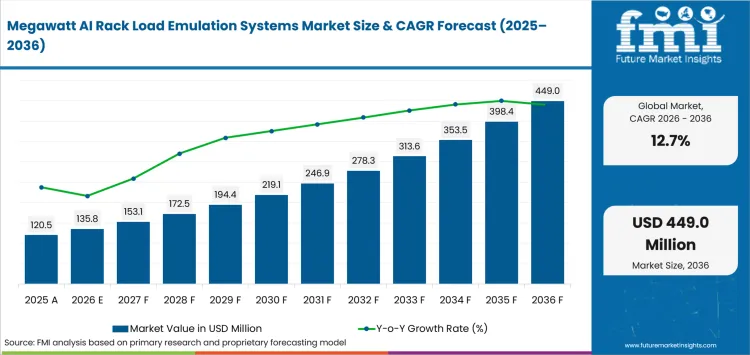
USD 135.8 Million in 2026 and USD 449.0 Million by 2036 at a 12.7% CAGR.
Megawatt AI Rack Load Emulation Systems revenue is projected to rise from USD 135.8 million in 2026 to USD 449.0 million by 2036 at a 12.7% CAGR. The market expands as AI infrastructure moves beyond conventional generator testing toward commissioning programs that reproduce concentrated electrical demand and liquid-cooling heat loads before accelerators arrive. The USA Department of Energy reported in December 2024 that data centers used about 4.4% of USA electricity in 2023 and could account for 6.7% to 12.0% by 2028. NVIDIA also documented a 120 kW cooling requirement for the GB200 NVL72 rack in October 2024. Those conditions raise the value of proving the power path, cooling loop and failover behavior under controlled load before production compute is exposed to commissioning faults.
Key Takeaways
- Rising rack power and liquid-cooling density are pushing commissioning toward controlled electrical and thermal emulation before live AI hardware is installed.
- Rack-integrated systems account for 31.0% of System Configuration in 2026, as they allow testing to take place at the same physical location where high-density compute will operate.
- Load emulation & qualification holds 29.0% of Functional Use in 2026, reflecting the need to reproduce controlled loads before performance and reliability checks can begin.
- The 251-500 kW band accounts for 32.0% of AI Rack Density in 2026, covering a practical range between current high-density deployments and emerging rack designs above 500 kW.
- Hyperscale AI data centers hold 46.0% of Data Center Type in 2026, where repeated commissioning across large rack fleets makes late power or cooling defects more costly.
- Direct enterprise contracts account for 42.0% of Commercial Model in 2026, as site-specific voltage, cooling and acceptance requirements often require close coordination with the supplier.
- Site integration remains a constraint, while shared controls, telemetry and modular deployment can make rack and pod testing more repeatable across large commissioning programs.
- Avtron Power Solutions, Crestchic Loadbanks and Mosebach Manufacturing are the notable companies profiled in the market.
Analyst Perspective
“Megawatt AI rack testing is becoming a commissioning control point because rack power, liquid cooling and acceptance evidence now have to be proven together before accelerators arrive. Suppliers that combine realistic high-density load creation with repeatable multi-unit controls can reduce handover risk across phased AI data center builds.”
- Sudip saha, Principal Consultant, Future Market Insights
How is the Megawatt AI Rack Load Emulation Systems Market segmented?
The market is segmented by System Configuration, Functional Use, AI Rack Density, Data Center Type, and Commercial Model.
The market is segmented by System Configuration into Rack-Integrated Systems, Portable / Lab Systems, Pod-Level Systems, and Facility-Scale Systems; by Functional Use into Load Emulation & Qualification, Telemetry & Instrumentation, Performance Verification, Reliability Testing, and Safety / Compliance; by AI Rack Density into 251-500 kW, 100-250 kW, Below 100 kW, and Above 500 kW; by Data Center Type into Hyperscale AI Data Centers, Colocation AI Facilities, Enterprise Private AI, and HPC & Research Centers; and by Commercial Model into Direct Enterprise Contract, System Integrator / EPC-Led, Subscription / License, and Managed-Service Contract.
Why does 251-500 kW lead the AI Rack Density category?
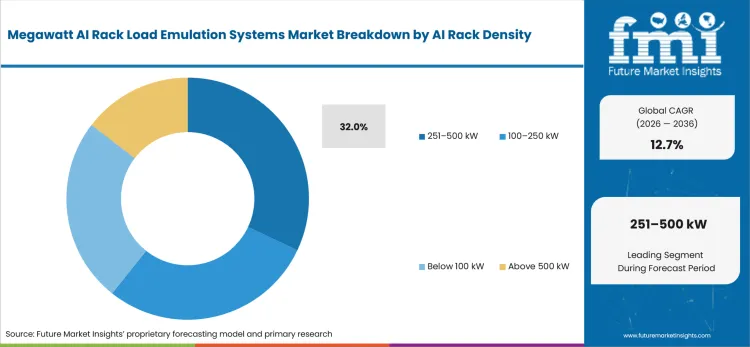
The 251-500 kW range occupies a practical transition zone between established high-density commissioning methods and the next wave of rack or pod designs above 500 kW. Equipment in this band can validate dense AI zones without always requiring a facility-scale assembly, while preserving headroom for staged configurations. The shift is closely related to wider AI liquid cooling adoption because the test platform increasingly has to create both electrical load and a realistic heat-removal condition.
- The 251-500 kW band holds 32.0% share in 2026 because it covers high-density rack and pod tests while preserving practical mobility and phased deployment options.
- Avtron Power Solutions launched a 500 kW LC-20 liquid-cooled load bank in October 2024 with 5 kW resolution and network control for up to 200 liquid-cooled or air-cooled load banks.
Why does Rack-integrated systems lead the System Configuration category?
Rack-integrated systems align the test load with the physical zone that will later hold high-density compute. That helps commissioning teams observe localized power distribution and cooling behavior rather than validating only a distant generator or switchboard. Rack-form emulators can be moved through rows or pods and can reproduce heat close to future liquid-cooled interfaces. This requirement is increasingly connected with hotspot cooling as operators address more concentrated thermal loads at the rack level.
- Rack-integrated systems account for 31.0% share in 2026 because they reduce the gap between facility acceptance testing and live IT conditions at the intended rack position.
- NVIDIA stated on October 15, 2024 that the GB200 NVL72 design required 120 kW of cooling capacity in a single rack and used direct liquid cooling with a higher-capacity bus bar.
Why does Load emulation & qualification lead the Functional Use category?
Load emulation & qualification leads because commissioning is the gate through which new electrical and cooling infrastructure must pass before production hardware is energized. Engineers need a controllable substitute for the future AI workload so they can apply steps, ramps and sustained loads while observing voltage and thermal response. This activity also sits alongside broader power management workflows because test outcomes are most useful when load behavior, switching events and measured performance can be reviewed together.
- Load emulation & qualification represents 29.0% share in 2026 because controlled loading is the primary test action required before telemetry, performance verification or reliability evidence can be generated.
- Avtron Power Solutions introduced SIGMA Unity in November 2024 with grouped control, automated load testing, data capture and customizable scripts across compatible load-bank equipment.
Why does Hyperscale AI data centers lead the Data Center Type category?
Hyperscale AI data centers combine high rack counts, concentrated power and repeated commissioning cycles. A late defect at an electrical or cooling interface can affect many racks and delay deployment of expensive accelerators. These operators therefore have an incentive to qualify power paths and cooling readiness before live IT is installed. Colocation facilities face similar requirements for AI halls, while private enterprise and research centers often deploy fewer racks or more specialized workloads.
- Hyperscale AI data centers account for 46.0% share in 2026 because repeated power, cooling and acceptance tests must be executed across a wider deployment envelope.
- Abu Dhabi Media Office announced on May 22, 2025 that Stargate UAE would be a 1 GW compute cluster inside a planned 5 GW UAE-US AI campus, with the first 200 MW cluster expected to go live in 2026.
Why does Direct enterprise contract lead the Commercial Model category?
Direct enterprise contracts fit projects where the load profile must be engineered around site voltage, cooling connections and the commissioning sequence. The buyer is aligning equipment configuration with an acceptance plan and construction schedule rather than purchasing resistance capacity in isolation. Integrator-led procurement remains relevant when testing is bundled into a wider EPC scope, while service and subscription structures can reduce ownership burden for intermittent use. Direct engagement remains prominent where hyperscale and large colocation buyers require technical coordination across multiple systems.
- Direct enterprise contract holds 42.0% share in 2026 because high-density projects require configuration decisions closely tied to facility design, field logistics and commissioning schedules.
- Crestchic states that it supports data center load testing through both equipment sales and rental operations, giving buyers a route to match ownership or temporary deployment needs to project cadence.
What are the drivers, restraints, and opportunities in the Megawatt AI Rack Load Emulation Systems Market?
Higher AI rack density raises the value of realistic pre-live testing, while site-specific power and cooling integration increases deployment effort and networked modular platforms create a route to repeatable commissioning at greater scale.
- Driver: higher rack power and liquid-cooling density increase the value of electrical and thermal emulation before expensive AI hardware is energized.
- Restraint: power connections, coolant interfaces, physical handling and safety procedures make high-capacity emulators more demanding to qualify and deploy.
- Opportunity: modular load banks with shared controls and telemetry can turn fragmented rack tests into repeatable pod- or facility-level commissioning programs.
AI hardware is concentrating more electrical demand inside each rack. NVIDIA documented a 120 kW cooling requirement and direct liquid cooling for the GB200 NVL72 design in October 2024. The USA Department of Energy has separately projected a sharp rise in data-center electricity demand through 2028. This makes data center power readiness a direct commissioning concern: teams need to exercise the same power path that will feed the AI rack while checking the associated thermal response before production hardware is exposed to faults.
The principal restraint appears during site qualification and setup. A megawatt-class program must match available voltage and current, and liquid-cooled units depend on compatible flow, pressure and temperature conditions. Crestchic described flow, pressure and thermal-shock protection in its March 2026 platform launch. Germany also applies PUE and energy-reuse requirements to new data centers under Section 11 of the Energy Efficiency Act. The engineering burden extends into coolant fluids selection and loop compatibility, so buyers need test equipment that can be integrated without adding avoidable commissioning delay.
The opportunity is to turn high-density load emulation into a coordinated commissioning workflow rather than treating each load bank as a separate test device. Avtron’s SIGMA Unity supports grouped control and automated test scripts, while Crestchic said in March 2026 that its platform could coordinate up to 240 load banks across air-cooled and liquid-cooled configurations. Shared controls can reduce repeated setup, standardize test sequences and create a more consistent acceptance record as commissioning expands from individual racks to pods and larger facility blocks.
Which country CAGRs are profiled in the Megawatt AI Rack Load Emulation Systems Market?
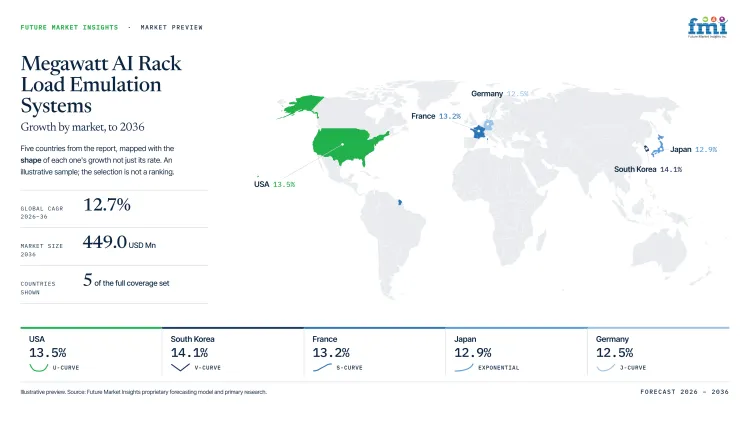
| Country | CAGR, 2026-2036 |
|---|---|
| USA | 13.5% |
| South Korea | 14.1% |
| Japan | 12.8% |
| France | 13.2% |
| Germany | 12.5% |
| UAE | 13.8% |
How do country-level CAGRs compare in the Megawatt AI Rack Load Emulation Systems Market?
The six profiled country growth rates span 12.5% to 14.1% from 2026 to 2036. The difference reflects deployment pace and infrastructure sequencing rather than absolute national market size. Supplier opportunity also depends on project phasing, rack density, grid readiness, cooling architecture and local engineering support.
- USA: a large installed data-center base and rising electricity demand increase the need for scalable commissioning capacity, while grid and interconnection schedules can determine when testing occurs.
- South Korea: national GPU expansion and policy support for power supply and site allocation create concentrated requirements for high-density commissioning.
- Japan: coordinated planning of compute, electricity and communications infrastructure favors disciplined commissioning that can fit constrained sites and scheduled utility readiness.
- France: identified data-center sites and accelerated connection procedures support project flow, but grid-connection sequencing remains important to equipment deployment timing.
- Germany: formal efficiency, measurement and heat-reuse requirements increase the value of test records that describe electrical and thermal behavior during acceptance.
- UAE: very large AI campus projects create a need for repeatable tests across staged blocks of power and cooling infrastructure.
The full regional scope covers North America, Latin America, Western Europe, Eastern Europe, East Asia, South Asia and Pacific, and Middle East and Africa, with additional country markets included within those regions.
Country-wise Analysis
- USA: Demand for Megawatt AI Rack Load Emulation Systems in the USA is forecast to expand at 13.5% CAGR from 2026 to 2036. The USA Department of Energy reported on December 20, 2024 that data centers used about 4.4% of national electricity in 2023 and could reach 6.7% to 12.0% by 2028. Buyers increasingly need scalable test equipment and field support that can mobilize when power paths and cooling systems are ready for integrated acceptance.
- South Korea: Adoption of Megawatt AI Rack Load Emulation Systems in South Korea is forecast to rise at 14.1% CAGR from 2026 to 2036. The Ministry of Science and ICT announced on February 20, 2025 a goal to secure 18,000 high-performance GPUs by the first half of 2026 and outlined policy support for electricity supply and site allocation. Suppliers need high-density products, local engineering coordination and deployment models that fit concentrated public-private AI build programs.
- Japan: Adoption of Megawatt AI Rack Load Emulation Systems in Japan is forecast to expand at 12.8% CAGR from 2026 to 2036. Japan's Ministry of Economy, Trade and Industry published Report 1.0 of the Public-Private Advisory Council on Watt-Bit Collaboration on June 12, 2025 in response to rising AI and data-center demand. Suppliers can differentiate through compact deployment, adaptable electrical interfaces and repeatable commissioning procedures that fit coordinated power and communications planning.
- France: Sales of Megawatt AI Rack Load Emulation Systems in France are forecast to rise at 13.2% CAGR from 2026 to 2036. The French Ministry for the Economy stated on May 21, 2025 that 28 additional potential data-center sites had been identified and that an accelerated RTE connection procedure had begun with four sites. Flexible scheduling and high-capacity equipment can support phased electrical and cooling acceptance as sites move into commissioning.
- Germany: Demand for Megawatt AI Rack Load Emulation Systems in Germany is forecast to expand at 12.5% CAGR from 2026 to 2036. Section 11 of the Energy Efficiency Act applies a PUE threshold of 1.2 to new data centers entering operation from July 1, 2026 and sets staged energy-reuse requirements. On June 24, 2026 the Federal Cabinet approved a draft reform intended to make parts of the framework more practical, including a longer transition period for new data centers. Suppliers can support operators with measurement-rich tests that document power and thermal behavior without increasing setup complexity.
- UAE: Adoption of Megawatt AI Rack Load Emulation Systems in the UAE is forecast to rise at 13.8% CAGR from 2026 to 2036. Abu Dhabi Media Office announced on May 22, 2025 that Stargate UAE would be a 1 GW compute cluster inside a planned 5 GW AI campus, with the first 200 MW cluster expected to go live in 2026. Clustered control, liquid-cooling emulation and scalable field support suit the phased delivery model of such campuses.
Who are the notable companies in the Megawatt AI Rack Load Emulation Systems Market?
Avtron Power Solutions, Crestchic Loadbanks, and Mosebach Manufacturing are the notable companies profiled in this market.
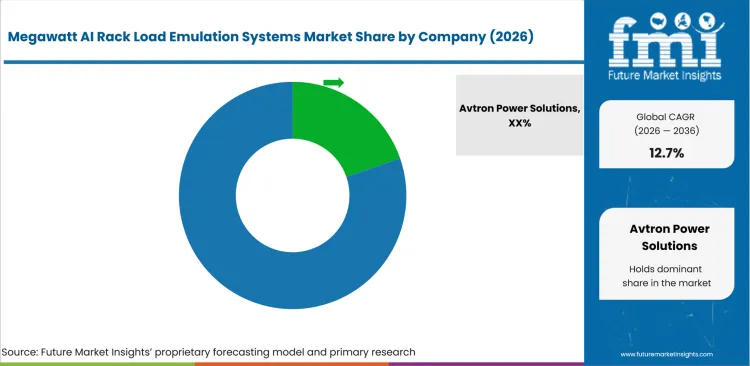
Competition is differentiated less by basic resistive loading and more by how closely a supplier can reproduce modern data-center commissioning conditions. Avtron combines high-capacity and liquid-cooled load banks with networked controls. Crestchic pairs data-center-focused products with sale and rental deployment. Mosebach focuses on configurable server-rack load banks and multi-unit control. Buyers therefore compare rack realism, liquid-cooling capability, control scalability and the availability of engineering support at the project location.
- Integrated commissioning platform: Avtron Power Solutions combines high-capacity load banks, liquid-cooled models and SIGMA controls for coordinated testing.
- Sale-and-rental deployment: Crestchic Loadbanks supports data-center commissioning through rack-focused equipment, liquid-cooled load banks and an international office network.
- Rack-level configurable hardware: Mosebach Manufacturing supplies SR-family server-rack load banks plus custom and multi-unit control options for data-center testing.
Competitive Benchmarking: Megawatt AI Rack Load Emulation Systems Market
| Company | Rack / Facility Emulation | Liquid-Cooled High-Density Testing | Multi-Unit Control | Commercial / Delivery Position |
|---|---|---|---|---|
| Avtron Power Solutions | Rack, pod and facility testing through networked load-bank configurations | LC35 at 500 kW; LC20 available at 500 kW and 720 kW | Control of up to 250 Avtron liquid-cooled and air-cooled load banks on the 2026 models | Direct equipment and support for data-center commissioning |
| Crestchic Loadbanks | Server-emulation and facility load-bank configurations | 600 kW platform, up to 648 kW at 415 V | Control software supports clusters of up to 240 load banks | Equipment sales and rental deployment across multiple regions |
| Mosebach Manufacturing | SR-family data-center server-rack load banks with configurable voltage and power options | Rack-focused resistive load-bank portfolio | Multi-unit controllers for groups of 10, 20 or up to 500 load banks | Direct and custom-engineered load-bank supply |
Benchmarking compares observable rack fit, liquid-cooled capacity, multi-unit control and deployment model. These dimensions matter because AI commissioning programs need equipment that can match the electrical and thermal interface at the test location, repeat a defined acceptance sequence and scale across more than one rack or project phase.
Key Developments in the Megawatt AI Rack Load Emulation Systems Market
- In January 2026, Avtron Power Solutions expanded its liquid-cooled range with a 500 kW CE-rated LC35 and a 720 kW LC20 configuration. The company stated that both models were designed for commissioning and maintaining liquid-cooled data centers, and each can connect and control up to 250 Avtron liquid-cooled or air-cooled load banks. The development increases single-unit capacity while keeping a networked route to pod- and facility-level testing.
- In March 2026, Crestchic Loadbanks unveiled a 600 kW liquid-cooled load bank for high-density data-center commissioning. The platform delivers up to 648 kW at 415 V, incorporates hydraulic instrumentation and can be clustered with up to 240 load banks through Crestchic control software. The launch expands buyer choice for validating liquid-cooling infrastructure before live AI hardware is installed.
Key Players in the Megawatt AI Rack Load Emulation Systems Market
Networked High-Density Commissioning Platforms
- Avtron Power Solutions
Sale-and-Rental Load Testing
- Crestchic Loadbanks
Rack-Level Custom Load Emulation
- Mosebach Manufacturing
Megawatt AI Rack Load Emulation Systems Market - Report Scope
| Coverage field | Report scope |
|---|---|
| Market breakdown | System Configuration; Functional Use; AI Rack Density; Data Center Type; Commercial Model; Region |
| Quantitative units | USD Million |
| Market definition | Revenue from megawatt AI rack load emulation systems sold for electrical, thermal and commissioning test use within the stated segmentation universe. Downstream finished-product revenue and adjacent or substitute product revenue are excluded. |
| Regions covered | North America; Latin America; Western Europe; Eastern Europe; East Asia; South Asia and Pacific; Middle East and Africa |
| Countries covered | USA, South Korea, Japan, France, Germany, UAE, and more than twenty-four additional countries in the full report |
| Key companies profiled | Avtron Power Solutions; Crestchic Loadbanks; Mosebach Manufacturing |
| Forecast period | 2026 to 2036 |
| Approach | Hybrid bottom-up and top-down market sizing with supplier activity, commissioning demand, rack-density transitions and buyer deployment patterns considered within the defined market boundary. |
Megawatt AI Rack Load Emulation Systems Market - Research Methodology
| Method | Approach |
|---|---|
| Primary Research | Structured discussions with manufacturers, system integrators, commissioning specialists, data-center operators, procurement teams and subject-matter experts focus on product configuration, use cases, buying criteria, deployment timing and adoption barriers. |
| Desk Research | Government publications, statutes, company filings, official company announcements and technical product documentation are used to assess infrastructure mechanisms, product capability and competitive activity. |
| Market Sizing and Forecasting | Supplier-side revenue indicators are combined with demand-side commissioning activity. Forecast assumptions consider AI rack-density progression, liquid-cooling adoption, data-center build schedules, testing intensity and commercial-model differences. |
| Data Validation | Inputs are cross-checked across multiple source types. The market boundary excludes downstream finished-product revenue and adjacent load-testing categories outside the defined AI rack and data-center use case. |
Megawatt AI Rack Load Emulation Systems Market by Segments
Megawatt AI Rack Load Emulation Systems Market segmented by System Configuration:
- Rack-integrated systems
- Portable / lab systems
- Pod-level systems
- Facility-scale systems
Megawatt AI Rack Load Emulation Systems Market segmented by Functional Use:
- Load emulation & qualification
- Telemetry & instrumentation
- Performance verification
- Reliability testing
- Safety/compliance
Megawatt AI Rack Load Emulation Systems Market segmented by AI Rack Density:
- 251-500 kW
- 100-250 kW
- Below 100 kW
- Above 500 kW
Megawatt AI Rack Load Emulation Systems Market segmented by Data Center Type:
- Hyperscale AI data centers
- Colocation AI facilities
- Enterprise private AI
- HPC & research centers
Megawatt AI Rack Load Emulation Systems Market segmented by Commercial Model:
- Direct enterprise contract
- System integrator / EPC-led
- Subscription / license
- Managed-service contract
Megawatt AI Rack Load Emulation Systems Market by Region
- North America
- United States
- Canada
- Latin America
- Brazil
- Mexico
- Argentina
- Chile
- Western Europe
- Germany
- France
- United Kingdom
- Italy
- Spain
- Benelux
- Nordics
- Eastern Europe
- Poland
- Czech Republic
- Romania
- Hungary
- East Asia
- China
- Japan
- South Korea
- South Asia and Pacific
- India
- ASEAN
- Australia and New Zealand
- Middle East and Africa
- GCC Countries
- South Africa
- Türkiye
- Israel
Research Sources and Bibliography
- USA Department of Energy (2024, December 20). DOE Releases New Report Evaluating Increase in Electricity Demand from Data Centers.
- Ministry of Science and ICT, Republic of Korea (2025, February 20). Korea to Expand AI Computing Infrastructure to Strengthen National AI Capabilities and Achieve Global Leadership.
- Ministry of Economy, Trade and Industry, Japan (2025, June 12). Report 1.0 of the Public-Private Advisory Council on Watt-Bit Collaboration.
- French Ministry for the Economy (2025, May 21). IA : des investissements records annoncés lors du Sommet Choose France 2025.
- Federal Ministry of Justice, Germany (accessed 2026, August 26). Energy Efficiency Act, Section 11: Climate-Neutral Data Centers.
- German Federal Government (2026, June 24). Weniger Bürokratie, mehr Energieeffizienz.
- Abu Dhabi Media Office (2025, May 22). Global Tech Alliance Launches 'Stargate UAE'.
- NVIDIA (2024, October 15). NVIDIA Contributes NVIDIA GB200 NVL72 Designs to Open Compute Project.
- Avtron Power Solutions (2024, October 15). Avtron Power Solutions Unveils Industry Leading Liquid Cooled Load Bank to Meet Growing Data Center Demands.
- Avtron Power Solutions (2024, November 26). Avtron Launches SIGMA Unity: The Ultimate Solution for Advanced Load Bank Testing.
- Avtron Power Solutions (2026, January 13). Avtron Power Solutions Expands Liquid Cooled Load Bank Portfolio with New LC35 and LC20 High-Capacity Models.
- Crestchic Loadbanks (2026, March 4). Crestchic Unveils 600kW Liquid Cooled Loadbank at Data Centre World, London.
- Mosebach Manufacturing Company (accessed 2026, August 26). Data Center Load Bank.
- Mosebach Manufacturing Company (accessed 2026, August 26). Multi-Unit Controllers.
This bibliography is provided for reader reference and is not exhaustive. The full report contains the complete reference list and detailed citations.
This Report Answers
- How does demand change as AI rack power density and liquid cooling increase?
- Why do Rack-integrated systems hold the leading position in System Configuration?
- How does Load emulation & qualification influence demand for instrumentation and reporting?
- Why does the 251-500 kW range remain central to high-density commissioning?
- How do infrastructure mechanisms differ across the USA, South Korea, Japan, France, Germany and UAE?
- How do Avtron Power Solutions, Crestchic Loadbanks and Mosebach Manufacturing differ in product and delivery roles?
- Which integration and qualification frictions can slow adoption of high-capacity rack load emulation?
- What should data-center commissioning teams evaluate before purchasing a megawatt-class load emulation system?
Frequently Asked Questions
What is the Megawatt AI Rack Load Emulation Systems Market worth in 2026?
The market is valued at USD 135.8 Million in 2026.
What CAGR is expected for the Megawatt AI Rack Load Emulation Systems Market from 2026 to 2036?
The market is forecast to expand at a 12.7% CAGR from 2026 to 2036.
Which System Configuration segment leads in 2026?
Rack-integrated systems lead System Configuration with a 31.0% share in 2026.
What is the incremental market opportunity between 2026 and 2036?
The market adds approximately USD 313.2 Million in value between 2026 and 2036, based on the difference between the two forecast-year market values.
Which companies are profiled in the Megawatt AI Rack Load Emulation Systems Market?
Avtron Power Solutions, Crestchic Loadbanks and Mosebach Manufacturing are the companies profiled in this market.
Preview the report firsthand - request a free sample
Get SampleGet the brochure for pricing and purchase details.
Get PDFTable of Content
- Key Takeaways
- Market Size and CAGR
- Top Growth Driver
- Fastest Growing Segment
- Leading Region
- Key Companies
- Emerging Opportunities
- Executive Summary
- Global Market Outlook
- Demand-side Trends
- Supply-side Trends
- Technology Roadmap Analysis
- Analysis and Recommendations
- Analyst Perspective (What is happening? Why now? What should investors know?)
- Key Questions Answered
- How large is the market?
- What is the CAGR?
- What are key trends?
- Which region dominates?
- Who are the leaders?
- Market Overview
- Market Coverage / Taxonomy
- Market Definition / Scope / Limitations
- Research Methodology
- Chapter Orientation
- Analytical Lens and Working Hypotheses
- Market Structure, Signals, and Trend Drivers
- Benchmarking and Cross-market Comparability
- Market Sizing, Forecasting, and Opportunity Mapping
- Research Design and Evidence Framework
- Desk Research Programme (Secondary Evidence)
- Expert Input and Fieldwork (Primary Evidence)
- Tooling, Models, and Reference Databases
- Data Engineering and Model Build
- Quality Assurance and Audit Trail
- Market Background
- Market Dynamics (Drivers, Restraints, Opportunity, Trends)
- Scenario Forecast (Optimistic, Likely, Conservative)
- Impact Analysis
- AI Impact
- Sustainability Impact
- Regulatory Impact
- Technology Impact
- Consumer / Buyer Analysis
- Purchase Drivers
- Adoption Barriers
- Buyer Journey
- Opportunity Map Analysis
- Product Life Cycle Analysis
- Supply Chain Analysis
- Investment Feasibility Matrix
- Value Chain Analysis
- PESTLE and Porter's Analysis
- Regulatory Landscape
- Regional Parent Market Outlook
- Production and Consumption Statistics
- Import and Export Statistics
- Global Market Analysis and Forecast, 2021 to 2036
- Historical Market Size Value (USD Million) Analysis, 2021 to 2025
- Current and Future Market Size Value (USD Million) Projections, 2026 to 2036
- Y-o-Y Growth Trend Analysis
- Absolute $ Opportunity Analysis
- Global Market Pricing Analysis, 2021 to 2036
- Global Market Analysis and Forecast, By System Configuration, 2021 to 2036
- Introduction / Key Findings
- Historical Market Size Value (USD Million) Analysis By System Configuration, 2021 to 2025
- Current and Future Market Size Value (USD Million) Analysis and Forecast By System Configuration, 2026 to 2036
- Rack-integrated systems
- Portable / lab systems
- Pod-level systems
- Facility-scale systems
- Rack-integrated systems
- Y-o-Y Growth Trend Analysis By System Configuration, 2021 to 2025
- Absolute $ Opportunity Analysis By System Configuration, 2026 to 2036
- Global Market Analysis and Forecast, By Functional Use, 2021 to 2036
- Introduction / Key Findings
- Historical Market Size Value (USD Million) Analysis By Functional Use, 2021 to 2025
- Current and Future Market Size Value (USD Million) Analysis and Forecast By Functional Use, 2026 to 2036
- Load emulation & qualification
- Telemetry & instrumentation
- Performance verification
- Reliability testing
- Safety/compliance
- Load emulation & qualification
- Y-o-Y Growth Trend Analysis By Functional Use, 2021 to 2025
- Absolute $ Opportunity Analysis By Functional Use, 2026 to 2036
- Global Market Analysis and Forecast, By AI Rack Density, 2021 to 2036
- Introduction / Key Findings
- Historical Market Size Value (USD Million) Analysis By AI Rack Density, 2021 to 2025
- Current and Future Market Size Value (USD Million) Analysis and Forecast By AI Rack Density, 2026 to 2036
- 251–500 kW
- 100–250 kW
- Below 100 kW
- Above 500 kW
- 251–500 kW
- Y-o-Y Growth Trend Analysis By AI Rack Density, 2021 to 2025
- Absolute $ Opportunity Analysis By AI Rack Density, 2026 to 2036
- Global Market Analysis and Forecast, By Data Center Type, 2021 to 2036
- Introduction / Key Findings
- Historical Market Size Value (USD Million) Analysis By Data Center Type, 2021 to 2025
- Current and Future Market Size Value (USD Million) Analysis and Forecast By Data Center Type, 2026 to 2036
- Hyperscale AI data centers
- Colocation AI facilities
- Enterprise private AI
- HPC & research centers
- Hyperscale AI data centers
- Y-o-Y Growth Trend Analysis By Data Center Type, 2021 to 2025
- Absolute $ Opportunity Analysis By Data Center Type, 2026 to 2036
- Global Market Analysis and Forecast, By Commercial Model, 2021 to 2036
- Introduction / Key Findings
- Historical Market Size Value (USD Million) Analysis By Commercial Model, 2021 to 2025
- Current and Future Market Size Value (USD Million) Analysis and Forecast By Commercial Model, 2026 to 2036
- Direct enterprise contract
- System integrator / EPC-led
- Subscription / license
- Managed-service contract
- Direct enterprise contract
- Y-o-Y Growth Trend Analysis By Commercial Model, 2021 to 2025
- Absolute $ Opportunity Analysis By Commercial Model, 2026 to 2036
- Global Market Analysis and Forecast, By Region, 2021 to 2036
- Introduction
- Historical Market Size Value (USD Million) Analysis By Region, 2021 to 2025
- Current Market Size Value (USD Million) Analysis and Forecast By Region, 2026 to 2036
- North America
- Latin America
- Western Europe
- Eastern Europe
- East Asia
- South Asia and Pacific
- Middle East & Africa
- Market Attractiveness Analysis By Region
- North America Market Analysis and Forecast, By Country, 2021 to 2036
- Historical Market Size Value (USD Million) Trend Analysis By Market Taxonomy, 2021 to 2025
- Market Size Value (USD Million) Forecast By Market Taxonomy, 2026 to 2036
- By Country
- USA
- Canada
- By System Configuration
- By Functional Use
- By AI Rack Density
- By Data Center Type
- By Commercial Model
- By Country
- Market Attractiveness Analysis
- By Country
- By System Configuration
- By Functional Use
- By AI Rack Density
- By Data Center Type
- By Commercial Model
- Key Takeaways
- Latin America Market Analysis and Forecast, By Country
- Historical Market Size Value (USD Million) Trend Analysis By Market Taxonomy, 2021 to 2025
- Market Size Value (USD Million) Forecast By Market Taxonomy, 2026 to 2036
- By Country
- Brazil
- Mexico
- Chile
- Rest of Latin America
- By System Configuration
- By Functional Use
- By AI Rack Density
- By Data Center Type
- By Commercial Model
- By Country
- Market Attractiveness Analysis
- By Country
- By System Configuration
- By Functional Use
- By AI Rack Density
- By Data Center Type
- By Commercial Model
- Key Takeaways
- Western Europe Market Analysis and Forecast, By Country
- Historical Market Size Value (USD Million) Trend Analysis By Market Taxonomy, 2021 to 2025
- Market Size Value (USD Million) Forecast By Market Taxonomy, 2026 to 2036
- By Country
- Germany
- UK
- Italy
- Spain
- France
- Nordic
- BENELUX
- Rest of Western Europe
- By System Configuration
- By Functional Use
- By AI Rack Density
- By Data Center Type
- By Commercial Model
- By Country
- Market Attractiveness Analysis
- By Country
- By System Configuration
- By Functional Use
- By AI Rack Density
- By Data Center Type
- By Commercial Model
- Key Takeaways
- Eastern Europe Market Analysis and Forecast, By Country
- Historical Market Size Value (USD Million) Trend Analysis By Market Taxonomy, 2021 to 2025
- Market Size Value (USD Million) Forecast By Market Taxonomy, 2026 to 2036
- By Country
- Russia
- Poland
- Hungary
- Balkan & Baltic
- Rest of Eastern Europe
- By System Configuration
- By Functional Use
- By AI Rack Density
- By Data Center Type
- By Commercial Model
- By Country
- Market Attractiveness Analysis
- By Country
- By System Configuration
- By Functional Use
- By AI Rack Density
- By Data Center Type
- By Commercial Model
- Key Takeaways
- East Asia Market Analysis and Forecast, By Country
- Historical Market Size Value (USD Million) Trend Analysis By Market Taxonomy, 2021 to 2025
- Market Size Value (USD Million) Forecast By Market Taxonomy, 2026 to 2036
- By Country
- China
- Japan
- South Korea
- By System Configuration
- By Functional Use
- By AI Rack Density
- By Data Center Type
- By Commercial Model
- By Country
- Market Attractiveness Analysis
- By Country
- By System Configuration
- By Functional Use
- By AI Rack Density
- By Data Center Type
- By Commercial Model
- Key Takeaways
- South Asia and Pacific Market Analysis and Forecast, By Country
- Historical Market Size Value (USD Million) Trend Analysis By Market Taxonomy, 2021 to 2025
- Market Size Value (USD Million) Forecast By Market Taxonomy, 2026 to 2036
- By Country
- India
- ASEAN
- Australia & New Zealand
- Rest of South Asia and Pacific
- By System Configuration
- By Functional Use
- By AI Rack Density
- By Data Center Type
- By Commercial Model
- By Country
- Market Attractiveness Analysis
- By Country
- By System Configuration
- By Functional Use
- By AI Rack Density
- By Data Center Type
- By Commercial Model
- Key Takeaways
- Middle East & Africa Market Analysis and Forecast, By Country
- Historical Market Size Value (USD Million) Trend Analysis By Market Taxonomy, 2021 to 2025
- Market Size Value (USD Million) Forecast By Market Taxonomy, 2026 to 2036
- By Country
- Kingdom of Saudi Arabia
- Other GCC Countries
- Türkiye
- South Africa
- Other African Union
- Rest of Middle East & Africa
- By System Configuration
- By Functional Use
- By AI Rack Density
- By Data Center Type
- By Commercial Model
- By Country
- Market Attractiveness Analysis
- By Country
- By System Configuration
- By Functional Use
- By AI Rack Density
- By Data Center Type
- By Commercial Model
- Key Takeaways
- Key Countries Market Analysis
- USA
- Pricing Analysis
- Market Share Analysis, 2025
- By System Configuration
- By Functional Use
- By AI Rack Density
- By Data Center Type
- By Commercial Model
- Canada
- Pricing Analysis
- Market Share Analysis, 2025
- By System Configuration
- By Functional Use
- By AI Rack Density
- By Data Center Type
- By Commercial Model
- Mexico
- Pricing Analysis
- Market Share Analysis, 2025
- By System Configuration
- By Functional Use
- By AI Rack Density
- By Data Center Type
- By Commercial Model
- Brazil
- Pricing Analysis
- Market Share Analysis, 2025
- By System Configuration
- By Functional Use
- By AI Rack Density
- By Data Center Type
- By Commercial Model
- Chile
- Pricing Analysis
- Market Share Analysis, 2025
- By System Configuration
- By Functional Use
- By AI Rack Density
- By Data Center Type
- By Commercial Model
- Germany
- Pricing Analysis
- Market Share Analysis, 2025
- By System Configuration
- By Functional Use
- By AI Rack Density
- By Data Center Type
- By Commercial Model
- UK
- Pricing Analysis
- Market Share Analysis, 2025
- By System Configuration
- By Functional Use
- By AI Rack Density
- By Data Center Type
- By Commercial Model
- Italy
- Pricing Analysis
- Market Share Analysis, 2025
- By System Configuration
- By Functional Use
- By AI Rack Density
- By Data Center Type
- By Commercial Model
- Spain
- Pricing Analysis
- Market Share Analysis, 2025
- By System Configuration
- By Functional Use
- By AI Rack Density
- By Data Center Type
- By Commercial Model
- France
- Pricing Analysis
- Market Share Analysis, 2025
- By System Configuration
- By Functional Use
- By AI Rack Density
- By Data Center Type
- By Commercial Model
- India
- Pricing Analysis
- Market Share Analysis, 2025
- By System Configuration
- By Functional Use
- By AI Rack Density
- By Data Center Type
- By Commercial Model
- ASEAN
- Pricing Analysis
- Market Share Analysis, 2025
- By System Configuration
- By Functional Use
- By AI Rack Density
- By Data Center Type
- By Commercial Model
- Australia & New Zealand
- Pricing Analysis
- Market Share Analysis, 2025
- By System Configuration
- By Functional Use
- By AI Rack Density
- By Data Center Type
- By Commercial Model
- China
- Pricing Analysis
- Market Share Analysis, 2025
- By System Configuration
- By Functional Use
- By AI Rack Density
- By Data Center Type
- By Commercial Model
- Japan
- Pricing Analysis
- Market Share Analysis, 2025
- By System Configuration
- By Functional Use
- By AI Rack Density
- By Data Center Type
- By Commercial Model
- South Korea
- Pricing Analysis
- Market Share Analysis, 2025
- By System Configuration
- By Functional Use
- By AI Rack Density
- By Data Center Type
- By Commercial Model
- Russia
- Pricing Analysis
- Market Share Analysis, 2025
- By System Configuration
- By Functional Use
- By AI Rack Density
- By Data Center Type
- By Commercial Model
- Poland
- Pricing Analysis
- Market Share Analysis, 2025
- By System Configuration
- By Functional Use
- By AI Rack Density
- By Data Center Type
- By Commercial Model
- Hungary
- Pricing Analysis
- Market Share Analysis, 2025
- By System Configuration
- By Functional Use
- By AI Rack Density
- By Data Center Type
- By Commercial Model
- Kingdom of Saudi Arabia
- Pricing Analysis
- Market Share Analysis, 2025
- By System Configuration
- By Functional Use
- By AI Rack Density
- By Data Center Type
- By Commercial Model
- Türkiye
- Pricing Analysis
- Market Share Analysis, 2025
- By System Configuration
- By Functional Use
- By AI Rack Density
- By Data Center Type
- By Commercial Model
- South Africa
- Pricing Analysis
- Market Share Analysis, 2025
- By System Configuration
- By Functional Use
- By AI Rack Density
- By Data Center Type
- By Commercial Model
- USA
- Market Structure Analysis
- Competition Dashboard
- Competition Benchmarking
- Market Share Analysis of Top Players
- By Regional
- By System Configuration
- By Functional Use
- By AI Rack Density
- By Data Center Type
- By Commercial Model
- Emerging Startups
- Innovation Benchmarking
- Competition Analysis
- Competition Deep Dive
- Avtron Power Solutions
- Overview
- Product Portfolio
- Profitability by Market Segments
- Sales Footprint
- Strategy Overview
- Marketing Strategy
- Product Strategy
- Channel Strategy
- Crestchic Loadbanks
- Mosebach Manufacturing
- Avtron Power Solutions
- Case Studies
- Success Stories
- Recent Developments
- Competition Deep Dive
- Assumptions & Acronyms Used


