

- Market Size (2026)
- USD 530.0 Mn
- Forecast (2036)
- USD 2278.3 Mn
- CAGR (2026 to 2036)
- 15.7%
Menstrual Health Wearable Market Summary
The menstrual health wearables market is projected to rise at a 15.7% CAGR from 2026 to 2036. Buyers spent USD 458.1 million on these devices in 2025 and will spend USD 530.0 million in 2026, a figure set to climb to USD 2,278.3 million by 2036.
FMI's study of the market indicates that menstrual health wearables are moving out of a small femtech niche and into the rings, watches and bands that buyers already wear overnight. Valued at USD 530.0 million in 2026, the market will reach USD 2,278.3 million by 2036 at a 15.7% CAGR, as device makers are adding cycle features and cycle-app brands are adding their own hardware. Oura was raising about USD 875 million at a valuation of about USD 10.9 billion in September 2025, after selling 5.5 million rings in total and earning USD 500 million in revenue in 2024 [1]. In January 2026, Natural Cycles, which had more than five million registered users, launched its overnight NC° Band and folded the USD 129.99 device into a USD 149.99 annual plan [2]. This bundling of hardware into subscriptions is expected to keep device sales growing faster than the wider wearables category through the forecast period.
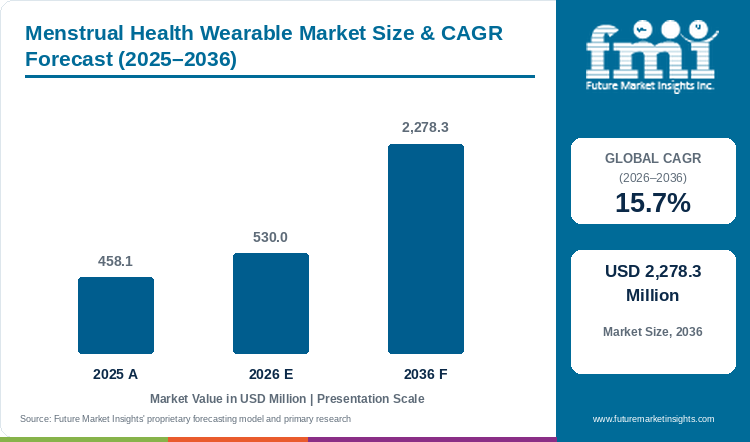
Table 1: Market Size and Forecast for the Menstrual Health Wearable Market (USD million), 2025-2036
| Market size and forecast | Value |
|---|---|
| 2025 market size | USD 458.1 million |
| Estimated market size in 2026 | USD 530.0 million |
| Projected market size by 2036 | USD 2,278.3 million |
| CAGR (2026-2036) | 15.7% |
| Added revenue, 2026 to 2036 | USD 1,748.3 million |
Key Market Trends & Insights
- Cycle-tracking wearables generate 45.0% of product type revenue in 2026, ahead of pain relief devices, fertility monitors and smart menstrual products.
- Temperature and heart rate sensing brings in 52.9% of technology revenue in 2026, well ahead of electrical stimulation, hormone sensing and flow sensing.
- Within applications, cycle tracking and prediction earns the largest slice, at 44.2% of revenue in 2026.
- Online retail carries 64.7% of sales channel revenue in 2026, leaving pharmacies and specialty channels with the remainder.
Regional Highlights
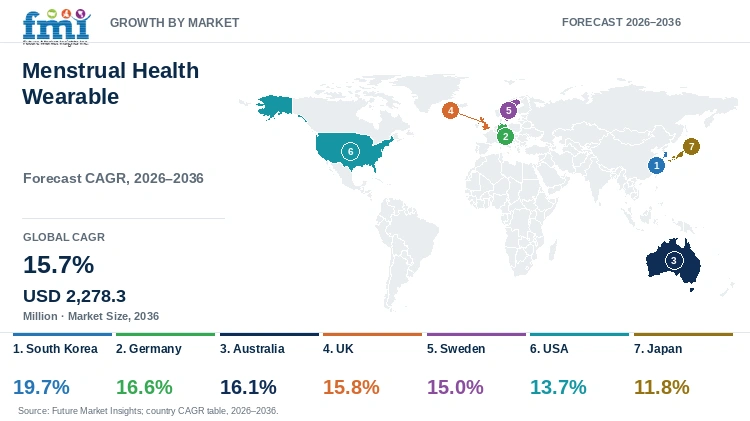
Growth will be quickest in South Korea, where revenue is set to climb at 19.7% CAGR from 2026 to 2036, while Germany at 16.6% and Australia at 16.1% will form the next tier. Japan, at 11.8%, is expected to post the slowest rise among the seven profiled countries.
Market Evidence
Cycle tracking is becoming a standard feature on mass-market watches and rings, which is widening the buyer base well beyond specialist fertility brands. In April 2023, Samsung added skin-temperature cycle tracking, powered by Natural Cycles, to the Galaxy Watch5 in 32 countries [3], and in July 2024 it priced its first Galaxy Ring at USD 399 with cycle tracking based on skin temperature during sleep [4]. Apple brought wrist temperature sensing and retrospective ovulation estimates to the lower-priced Apple Watch SE 3, starting at USD 249, in September 2025 [5]. As these features reach cheaper models, sales of cycle-capable smart rings and watches will keep cycle-tracking wearables at the front of product type revenue.
Partner deals are carrying women's health apps onto hardware made by other brands, due to which online checkout and app activation are becoming the main sales route. In March 2026, Garmin opened the Natural Cycles birth control app to the fēnix 8, Forerunner 570, Forerunner 970, Venu 4 and Venu X1 in markets including the USA, UK, EU, Canada, Australia and Brazil [6]. Oura, which began selling rings and its sizing kit through Amazon in the USA in March 2024 and in the UK from October 2024 [7], requires an Oura membership at USD 5.99 a month alongside a separate Natural Cycles plan for the same integration [8]. This partner model is expected to hold online retail at 64.7% of 2026 sales while lifting the number of compatible devices sold each year.
Spending today is small next to the number of women who could use these devices, which leaves room for pain relief and condition monitoring to grow alongside cycle tracking. WHO estimated that 1.9 billion women worldwide were of reproductive age (15 to 49) in 2021 [9], and that endometriosis affects about 10% of them, or roughly 190 million women [10]. Among more than 50,000 participants in Apple's Women's Health Study, 16.4% showed cycle deviations and more than 60% of those logging symptoms recorded cramps, bloating or tiredness [11]. Demand for symptom logging and wearable pain relief is therefore expected to rise as more women look for drug-free options for recurring period pain.
Sellers are using regulatory clearance to stand out, while data and advertising rules are tightening. Natural Cycles, first authorised through the FDA De Novo route in August 2018 [12], gained further 510(k) clearances in July 2024 and March 2025 [13] [14], and an over-the-counter menstrual relief TENS stimulator from Well-Life Healthcare was cleared in October 2024 [15]. In April 2024, the FTC extended its Health Breach Notification Rule to health apps not covered by HIPAA, with notice within 60 days and FTC reporting for breaches affecting 500 or more people [16]. Brands with cleared claims and clear data handling will win more buyer trust, as unsupported claims are drawing penalties such as the TGA's six infringement notices totalling AUD 82,632 against Ovira over an analgesic TENS system [17].
Device platforms and local approvals, more than population size, are deciding where sales rise fastest. South Korea is projected to grow at 19.7% CAGR, as Samsung released skin-temperature cycle tracking there first in 2023 [3] and Natural Cycles lists South Korea among its seven authorised regions [6]. Germany will follow at 16.6% CAGR, where condoms overtook the pill as the most used contraceptive at 53% in 2023 and 61% of adults said hormonal methods harm body and mind [18], which is drawing interest toward non-hormonal cycle tools. Australia is set to grow at 16.1% as Garmin's Natural Cycles integration covers the country [6]. However, the USA at 13.7% and Japan at 11.8% will grow more slowly from more mature smart ring and watch bases.
Table 2: Supporting Industry Indicators for the Menstrual Health Wearable Market (mixed units), mixed years
| Indicator | Data point | Why it matters | Source |
|---|---|---|---|
| Smart ring scale (result) | Oura sold 5.5 million rings in total, earned USD 500 million revenue in 2024 and was valued at about USD 10.9 billion (Sep 2025) | Large installed base that can carry cycle features | [1] |
| Bundled device pricing (result) | NC° Band valued at USD 129.99 and included in a USD 149.99 annual plan; more than 5 million registered users (Jan 2026) | Turns app users into device buyers | [2] |
| Platform reach (result) | Samsung skin-temperature cycle tracking on Galaxy Watch5 in 32 countries (Apr 2023) | Makes cycle tracking a standard watch feature | [3] |
| Partner reach (result) | Natural Cycles on 5 Garmin watch lines in the USA, UK, EU, Canada, Australia, Brazil, Norway, Singapore and Switzerland (Mar 2026) | Extends app reach without new hardware | [6] |
| Entry-level hardware (result) | Apple Watch SE 3 from USD 249 with wrist temperature and retrospective ovulation estimates (Sep 2025) | Lowers the price of cycle-capable devices | [5] |
| Women of reproductive age | 1.9 billion women aged 15 to 49 in 2021 | Sizes the long-term user pool | [9] |
| Endometriosis prevalence | About 10% of reproductive-age women, roughly 190 million | Supports pain relief and condition tracking demand | [10] |
| Cycle irregularity (study result) | 16.4% cycle deviations; more than 60% of symptom loggers record cramps, bloating or tiredness; 50,000+ participants | Supports prediction and symptom logging | [11] |
| Regulatory clearances (approvals) | Natural Cycles De Novo (Aug 2018) and 510(k)s (Jul 2024, Mar 2025); OTC menstrual relief TENS cleared (Oct 2024) | Supports medical-grade claims | [12] [13] [14] [15] |
| Privacy rule (US) | Health apps outside HIPAA covered; notice within 60 days; FTC told of breaches of 500 or more (Apr 2024) | Raises data protection costs and buyer trust | [16] |
| Advertising enforcement (Australia) | Six infringement notices totalling AUD 82,632 to Ovira over a TENS system | Limits disease claims for pain devices | [17] |
Implied Device Volume and Spend per Woman Analysis
Dividing FMI's market value by typical list prices gives a sense of the unit sales behind it (calculated). At the Oura Ring 4 starting price of USD 349 [19], the 2026 value of USD 530.0 million equals about 1.52 million devices, at the Galaxy Ring price of USD 399 [4] about 1.33 million, at the Apple Watch SE 3 starting price of USD 249 [5] about 2.13 million, and at the NC° Band value of USD 129.99 [2] about 4.08 million. Oura alone sold about 3 million rings in the year to September 2025 [1], which shows that the market counts only the menstrual-health share of multipurpose devices; at the 45.0% cycle-tracking wearables share, USD 238.5 million of 2026 value equals about 0.68 million ring-priced units (calculated). By 2036, the USD 2,278.3 million value will equal 5.7 to 17.5 million devices across these price points (calculated).
Spread across the 1.9 billion women of reproductive age counted by WHO [9], the 2026 market is worth about USD 0.28 per woman, rising to about USD 1.20 per woman at the 2036 value on the same 2021 population base (calculated). Spending per woman is therefore still very low, which means growth will depend on converting existing ring and watch owners, and the roughly 190 million women with endometriosis [10], into paying users of cycle and pain-relief hardware.
Table 3: Implied Device Volumes and Spend per Woman for the Menstrual Health Wearable Market (USD; million units), 2026 and 2036
| Device or measure | List price or base | Implied units, 2026 (million) | Implied units, 2036 (million) | Source |
|---|---|---|---|---|
| Oura Ring 4 | USD 349 | 1.52 | 6.53 | [19]; Calculated |
| Samsung Galaxy Ring | USD 399 | 1.33 | 5.71 | [4]; Calculated |
| Apple Watch SE 3 | USD 249 | 2.13 | 9.15 | [5]; Calculated |
| Natural Cycles NC° Band | USD 129.99 | 4.08 | 17.53 | [2]; Calculated |
| Market value per woman aged 15 to 49 | 1.9 billion women (2021) | USD 0.28 | USD 1.20 | [9]; FMI; Calculated |
Analyst Perspective
"Commercial durability in this market will depend on whether women keep wearing the device every night and understand the decision it supports. With cycle-tracking wearables already holding 45.0% of product type revenue in 2026, the next wave of growth will go to brands that pair comfortable hardware with cleared, clearly labelled use claims."
- Anurag Sharma, Principal Analyst at Future Market Insights
How is the Menstrual Health Wearable Market Segmented?
The menstrual health wearable market is split into product type, technology, application, sales channel and region.
Product types include cycle-tracking wearables such as smart rings, wristbands and smartwatches, period pain relief devices such as wearable TENS and heat pads, fertility and ovulation monitors, and smart menstrual products such as sensor cups and flow-tracking underwear. Technologies cover temperature and heart rate sensing, electrical stimulation, biochemical and hormone sensing, and flow and fluid sensing. Applications span cycle tracking and prediction, pain management, fertility planning and health condition monitoring such as PCOS and perimenopause tracking, while sales channels include online retail, pharmacies and drugstores, and specialty and clinical channels. Regional coverage includes North America, Latin America, Western Europe, Eastern Europe, East Asia, South Asia and Pacific, and the Middle East and Africa.
Why Do Cycle-Tracking Wearables Lead the Menstrual Health Wearable Market by Product Type?
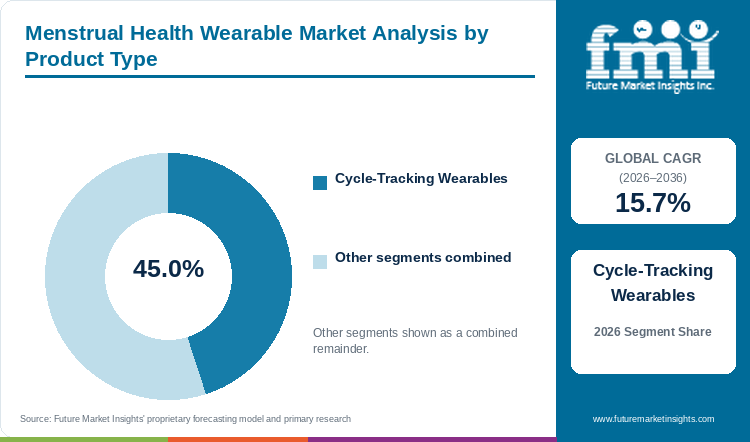
Cycle-tracking wearables are set to hold 45.0% of market share by product type in 2026.
Cycle-tracking wearables will account for 45.0% of product type revenue in 2026, as rings and watches are worn every day and night rather than only during a period or a fertility window. Oura's Ring 4, launched in October 2024 from USD 349 with recessed sensors, sizes 4 to 15 and a Fertile Window feature [19], shows that makers are pairing comfort with cycle features to keep users wearing the device. Period pain relief devices, fertility and ovulation monitors and smart menstrual products serve narrower moments of need, so they are expected to grow from smaller bases while rings and watches keep the lead.
- Cycle-tracking wearables will hold 45.0% of product type revenue in 2026, equal to about USD 238.5 million of the USD 530.0 million market (calculated).
- In January 2025, Samsung added Galaxy Ring sizes 14 and 15 and said the ring would expand from 38 to 53 markets [20].
Why Does Temperature and Heart Rate Sensing Lead the Menstrual Health Wearable Market by Technology?
Temperature and heart rate sensing will account for 52.9% of technology revenue in 2026.
Temperature and heart rate sensing will hold 52.9% of technology revenue in 2026, as these sensors are already built into mainstream rings, bands and watches and can take readings every night with no test strips. Natural Cycles' NC° Band, launched in January 2026, records overnight skin temperature, heart rate and movement from the inner wrist during sleep [2]. Hormone sensing is still at the research stage, as Caltech reported a wearable sweat patch for estradiol in September 2023 that also measured sweat pH, salt and skin temperature to calibrate readings [21], while electrical stimulation and flow sensing serve pain relief and smart menstrual products, so temperature-based tracking is expected to stay ahead through the forecast period.
- Temperature and heart rate sensing will hold 52.9% of technology revenue in 2026, or about USD 280.4 million (calculated).
- In April 2023, Samsung began estimating basal body temperature from skin temperature during sleep on the Galaxy Watch5, using Natural Cycles technology [3].
Why Does Cycle Tracking and Prediction Lead the Menstrual Health Wearable Market by Application?
Cycle tracking and prediction is expected to capture 44.2% of application revenue in 2026.
Cycle tracking and prediction will account for 44.2% of application revenue in 2026, as period timing is useful to every user whether or not she is planning a pregnancy, and the feature pairs easily with digital health tracking apps. Oura's December 2025 update extended period and fertile window predictions to 12 months and said period predictions six days ahead became 29% more accurate overall [22], while Apple states that its Cycle Tracking should not be used for birth control or to diagnose a health condition [23]. Pain management, fertility planning and health condition monitoring need stronger evidence and approvals, so they are expected to grow from smaller bases as more products gain clearance.
- Cycle tracking and prediction will hold 44.2% of application revenue in 2026, ahead of pain management, fertility planning and condition monitoring (FMI).
- In July 2026, Tempdrop updated its app so that symptoms added to the chart display automatically on the main calendar view [24].
Why Does Online Retail Lead the Menstrual Health Wearable Market by Sales Channel?
Online retail is projected to command 64.7% of sales channel revenue in 2026.
Online retail will capture 64.7% of sales in 2026, as these devices need sizing, app set-up and subscriptions that fit naturally into an online checkout. Oura began selling rings and its sizing kit through its Amazon brand store in the USA in March 2024 [7], and Natural Cycles now includes its NC° Band in a USD 149.99 annual plan bought online [2]. Pharmacies and drugstores will stay important for pain-relief devices, as NHS guidance lists online shops, pharmacies and electrical stores as places to buy or hire a TENS machine [25], while specialty and clinical channels serve buyers who want professional advice.
- Online retail will hold 64.7% of sales channel revenue in 2026, or about USD 342.9 million (calculated).
- In February 2025, Samsung began Galaxy Ring sales in Japan through its online shop, Amazon Japan, Yodobashi Camera, Bic Camera and its Harajuku and Osaka showrooms [26].
What are the Drivers, Restraints, and Opportunities in the Menstrual Health Wearable Market?
Passive overnight measurement is driving repeat use, while use limits and claim rules are slowing adoption; validated hormone sensing and pain relief offer the next growth opening.
- Driver: Overnight sensing in rings, bands and watches is removing the daily manual temperature routine and keeping users engaged.
- Restraint: Cycle predictions do not equal cleared contraception or diagnosis, and advertising and privacy rules limit what sellers can claim.
- Opportunity: Validated hormone sensing and cleared over-the-counter pain relief can extend the market beyond temperature-based tracking.
Passive recording is removing work from a recurring routine, which is the main reason buyers are keeping these devices on. Natural Cycles positioned its NC° Band as a sleep-worn alternative to its thermometer that detects sleep automatically [2], and Oura said in February 2025 that its Readiness Score now accounts for cycle-related shifts, cutting disproportionately low luteal-phase scores by 81% [27]. Sales of overnight wearables are therefore expected to grow as long as comfort and data transfer keep users wearing the device across the whole cycle.
The main restraint appears when a buyer expects a device to make a decision it is not cleared for. Apple tells users that Cycle Tracking should not be used as birth control and that its data should not be used to diagnose a health condition [23], while Samsung's Galaxy Watch5 feature is limited to users aged 18 or older and is not for contraception [3]. In Australia, the TGA issued six infringement notices totalling AUD 82,632 after Ovira allegedly promoted a TENS system for serious conditions including endometriosis without approval [17]. These limits will narrow the claims that retailers can make, which is expected to slow conversion for brands without cleared indications.
Hormone sensing and cleared pain relief offer a different opening, one that moves the category closer to regulated wearable medical devices. Caltech's September 2023 sweat patch measured estradiol, which the team said is about 50 times less concentrated in sweat than in blood and rises about tenfold from menstruation to ovulation [21], showing technical promise but not yet a commercial product. In October 2024, the FDA cleared Well-Life Healthcare's over-the-counter menstrual relief TENS stimulator [15], and Myoovi is selling its TENS and heat Device 2.0 at GBP 79.99 with 30 intensity levels in the UK [28]. Partnerships between sensor developers and cycle platforms, together with more cleared pain devices, are expected to widen the market over the forecast period.
Which Country CAGRs are Profiled in the Menstrual Health Wearable Market?
Table 4: Country CAGRs for the Menstrual Health Wearable Market (%), 2026-2036
| Country | CAGR, 2026 to 2036 |
|---|---|
| South Korea | 19.7% |
| Germany | 16.6% |
| Australia | 16.1% |
| UK | 15.8% |
| Sweden | 15.0% |
| USA | 13.7% |
| Japan | 11.8% |
How do Country-level CAGRs Compare in the Menstrual Health Wearable Market?
South Korea leads the profiled countries at 19.7%, as a strong local smartwatch base is giving cycle features a fast route to buyers. Germany at 16.6%, Australia at 16.1% and the UK at 15.8% form a middle band where interest in non-hormonal options, partner app launches and pharmacy access for pain devices are lifting demand. Sweden at 15.0% sits close to the global 15.7% rate, while the USA at 13.7% and Japan at 11.8% will grow more slowly, as both start from larger or more mature ring and watch bases where growth depends on upgrades rather than first purchases. The spread between the fastest and slowest country is 7.9 percentage points.
- Early access to Samsung's skin-temperature cycle tracking and a local authorisation for Natural Cycles are supporting fast uptake in South Korea, which will grow at 19.7% CAGR.
- Growing doubts about hormonal contraception are drawing German buyers toward non-hormonal cycle tools, and Germany is set to grow at 16.6% CAGR.
- Australia will grow at 16.1% CAGR as new partner app routes widen choice, while advertising rules are shaping the claims sellers make for pain devices.
- Online and pharmacy routes for TENS devices are supporting sales of period pain wearables in the UK, where revenue is projected to rise at 15.8% CAGR.
- With a home-grown cycle-app leader and strong digital health use, Sweden is expected to grow at 15.0% CAGR, close to the global rate.
- A large, more mature device base and tighter health data rules are holding growth in the USA to 13.7% CAGR.
- Japan will grow at 11.8% CAGR, the slowest pace, as smart ring retail is still building and sales depend on in-store fitting and trial.
The full report extends menstrual health wearable estimates to more than 25 countries and country groups across seven regions.
Country Outlook
- In April 2023, Samsung released skin-temperature cycle tracking on the Galaxy Watch5 first in Korea, the USA and Europe [3], which gives South Korean buyers a ready platform, and demand there will grow at 19.7% CAGR.
- Germany's BZgA reported in November 2023 that condoms had overtaken the pill as the most used contraceptive at 53% and that 61% of adults saw negative effects from hormonal methods [18], which supports interest in non-hormonal cycle tools as German demand grows at 16.6% CAGR.
- Garmin's March 2026 move to make the Natural Cycles birth control app available on selected watches in Australia [6] added a new device route, and Australian demand is set to grow at 16.1% CAGR.
- In the UK, the NHS reviewed guidance in February 2025 that lists online shops and pharmacies as places to buy or hire TENS machines and names period pain among the uses [25], which supports pain wearable sales as UK demand rises at 15.8% CAGR.
- Stockholm-based Natural Cycles Nordic AB received another FDA 510(k) clearance in March 2025 [14], which strengthens its home-market brand in Sweden as it adds devices, and Swedish demand will grow at 15.0% CAGR.
- For the USA, the FTC's April 2024 final Health Breach Notification Rule for health apps outside HIPAA [16] raised data-handling expectations for connected devices, and US demand is projected to grow at 13.7% CAGR.
- Samsung began Galaxy Ring sales in Japan in February 2025 at JPY 63,690 through online and physical stores [26], which gives buyers a place to try on rings, while Japanese demand will grow at 11.8% CAGR.
Who are the Leading Companies in the Menstrual Health Wearable Market?
Oura Health Oy, Natural Cycles Nordic AB, Apple Inc., Samsung Electronics Co., Ltd. and Myoovi Ltd. are among the leading suppliers across integrated cycle platforms, dedicated fertility measurement and wearable menstrual pain relief.
Competition is splitting into three product jobs, namely integrated wellness platforms that add cycle features to rings and watches, dedicated fertility brands that sell measurement and interpretation, and pain-relief brands that sell a wearable treatment during symptoms. Oura's scale gives it a lead among rings, with 5.5 million rings sold and USD 500 million in 2024 revenue [1], while Natural Cycles is widening its device options by launching its own NC° Band [2] and integrating with Garmin watches [6]. In pain relief, Myoovi is reporting more than 80,000 customers for its TENS devices [28], and competition is expected to sharpen as more over-the-counter menstrual TENS devices gain FDA clearance [15].
- Oura Health Oy, Apple Inc., Samsung Electronics Co., Ltd. and Bellabeat, Inc. form the integrated cycle and wellness platform group, adding cycle tracking and symptom logs to broader ring, watch and tracker experiences.
- In dedicated fertility measurement and interpretation, Natural Cycles Nordic AB, Tempdrop Ltd. and Ava AG focus on overnight temperature or physiological readings and fertile-window interpretation, each with its own intended-use limits.
- Wearable menstrual pain relief is served by iPulse Medical Ltd. (Livia), Ovira Pty Ltd and Myoovi Ltd., which offer TENS-based devices, with Myoovi also adding heat, although Ovira's current wearable range was not confirmed.
Competitive Benchmarking
Table 5: Competitive Benchmarking for the Menstrual Health Wearable Market (qualitative ratings), 2026
| Company | Passive Cycle Measurement | Fertility Decision Support | Menstrual Pain Modality | Geographic Reach |
|---|---|---|---|---|
| Oura Health Oy | High | High | Unscored | USA and UK (Amazon retail) |
| Natural Cycles Nordic AB | High | High | Unscored | USA, EU, UK, Canada, Australia, Brazil, Singapore, South Korea |
| Tempdrop Ltd. | Medium | Medium | Unscored | USA and EU direct shipping; UK and Ireland distributor |
| Ava AG | High | High | Unscored | USA, Canada and selected European markets |
| iPulse Medical Ltd. | Unscored | Unscored | Medium | USA device listing; wider reach not confirmed |
| Ovira Pty Ltd | Unscored | Unscored | Unscored | Australia (historical TENS activity) |
| Myoovi Ltd. | Unscored | Unscored | High | UK direct offer |
| Apple Inc. | High | Medium | Unscored | USA and international markets; ovulation estimates only in certain countries |
| Samsung Electronics Co., Ltd. | High | Medium | Unscored | South Korea, USA, Europe, Japan and other Galaxy markets |
| Bellabeat, Inc. | Medium | Medium | Unscored | USA and EU shipping |
Passive Cycle Measurement is rated High for overnight temperature plus other body signals in a cycle-capable product and Medium for a narrower temperature or tracker-and-diary set-up, Fertility Decision Support is High for forward-looking fertile-window predictions or a cleared fertility workflow and Medium for after-the-fact estimates or period charts, Menstrual Pain Modality is High for combined stimulation and heat and Medium for a single wearable treatment, and Unscored means public information was not available, with all ratings describing documented product scope rather than clinical performance or regulatory equivalence.
Key Developments
- In January 2026, Natural Cycles Nordic AB launched the NC° Band, a sleep-worn wrist device valued at USD 129.99 that is included in its USD 149.99 annual plan in select markets [2].
- In March 2026, Garmin made the Natural Cycles birth control app available on the fēnix 8, Forerunner 570, Forerunner 970, Venu 4 and Venu X1 in nine markets including the USA and EU [6].
- In December 2025, Oura Health Oy extended Cycle Insights period and fertile window predictions to 12 months, reporting 29% more accurate period predictions six days ahead [22].
- In September 2025, Apple Inc. introduced Apple Watch SE 3 from USD 249 with wrist temperature sensing and retrospective ovulation estimates [5].
- In July 2026, Tempdrop Ltd. redesigned its fertility wheel and began showing logged symptoms on the main calendar view [24].
Key Players
Integrated cycle and wellness platforms
- Oura Health Oy
- Apple Inc.
- Samsung Electronics Co., Ltd.
- Bellabeat, Inc.
Dedicated fertility measurement and interpretation
- Natural Cycles Nordic AB
- Tempdrop Ltd.
- Ava AG
Wearable menstrual pain relief
- iPulse Medical Ltd.
- Ovira Pty Ltd
- Myoovi Ltd.
Report Scope and Methodology
Table 6: Report Scope for the Menstrual Health Wearable Market (descriptive), 2025-2036
| Coverage field | Report scope |
|---|---|
| Market breakdown | Product Type; Technology; Application; Sales Channel; Region |
| Quantitative units | USD Million |
| Market definition | Revenue from wearable devices sold for menstrual cycle tracking, menstrual pain relief, fertility monitoring or sensor-enabled menstrual-fluid measurement. Multipurpose hardware counts only its menstrual-health share, and bundled software is counted once. Standalone software subscriptions, accessory-only sales, ordinary menstrual products, general wellness hardware without a menstrual function and clinical services are excluded. |
| Regions covered | North America; Latin America; Western Europe; Eastern Europe; East Asia; South Asia and Pacific; Middle East and Africa |
| Countries covered | South Korea; Germany; Australia; UK; Sweden; USA; Japan |
| Key companies profiled | Oura Health Oy; Natural Cycles Nordic AB; Tempdrop Ltd.; Ava AG; iPulse Medical Ltd.; Ovira Pty Ltd; Myoovi Ltd.; Apple Inc.; Samsung Electronics Co., Ltd.; Bellabeat, Inc. |
| Forecast period | 2026 to 2036 |
| Approach | Primary and secondary research with market triangulation |
Research Methodology
Table 7: Research Methodology for the Menstrual Health Wearable Market (descriptive), 2025-2036
| Method | Approach |
|---|---|
| Primary research | FMI analysts interviewed manufacturers, technology developers, distributors, end users, procurement teams and subject-matter experts on buying decisions, product evaluation, adoption barriers, approval needs, pricing and support expectations, and on the evidence needed before a trial becomes regular purchasing. |
| Desk research | Desk research covered government statistics, regulatory publications, trade data, industry associations, technical literature, standards, company filings, product information and official company announcements, checked for relevance, date, geography and fit with the market scope. |
| Market sizing and forecasting | The model combined the baseline value with historical performance, segment structure, pricing and volume indicators, adoption levels, company participation and country demand, with forecast assumptions for economic activity, regulation, technology adoption, buying cycles and supply. Segment and regional estimates were reconciled before the final total was set. |
| Data validation | Estimates were checked against public data, company activity, trade patterns, industry developments and interview findings, and tested against the market boundary to exclude adjacent categories, unsupported claims and overlapping revenues. |
Menstrual Health Wearable Market by Segments
Menstrual Health Wearable Market Segmented by Product Type
- Cycle-Tracking Wearables
- Smart Rings
- Wristbands and Smartwatches
- Period Pain Relief Devices
- Wearable TENS Devices
- Heat Therapy Wearables
- Fertility and Ovulation Monitors
- Overnight Skin Temperature Sensors
- Wearable Hormone Sensors
- Smart Menstrual Products
- Sensor-Enabled Menstrual Cups
- Flow-Tracking Underwear and Pads
Menstrual Health Wearable Market Segmented by Technology
- Temperature and Heart Rate Sensing
- Continuous Skin Temperature
- Heart Rate Variability Tracking
- Electrical Stimulation
- Transcutaneous Electrical Nerve Stimulation
- Microcurrent Therapy
- Biochemical and Hormone Sensing
- Sweat and Saliva Hormone Sensors
- Electrochemical Biomarker Patches
- Flow and Fluid Sensing
- Capacitive Flow Sensors
- Smart Absorbent Materials
Menstrual Health Wearable Market Segmented by Application
- Cycle Tracking and Prediction
- Period Prediction
- Symptom Logging and Insights
- Pain Management
- Dysmenorrhea Relief
- Endometriosis Pain Support
- Fertility Planning
- Conception Support
- Natural Contraception Support
- Health Condition Monitoring
- PCOS Monitoring
- Perimenopause Transition Tracking
Menstrual Health Wearable Market Segmented by Sales Channel
- Online Retail
- Brand-Owned D2C Websites
- E-Commerce Marketplaces
- Pharmacies and Drugstores
- Chain Pharmacies
- Independent Pharmacies
- Specialty and Clinical Channels
- Femtech Specialty Retailers
- Gynecology Clinic Prescriptions
Menstrual Health Wearable Market Segmented by Region
- North America
- Latin America
- Western Europe
- Eastern Europe
- East Asia
- South Asia and Pacific
- Middle East and Africa
Research Sources and Bibliography
- [1] Fortune (2025, September 23). Oura Ring maker to become $11 billion company with latest raise.
- [2] Natural Cycles (2026, January 19). Natural Cycles Launches NC° Band, a Wearable Designed for Natural Cycles That Offers a Seamless Measuring Experience.
- [3] Samsung Electronics (2023, April 19). Skin Temperature-Based Cycle Tracking Now Available on Galaxy Watch5 Series in 32 Countries.
- [4] TechCrunch (2024, July 10). Samsung's Galaxy Ring, its first smart ring, arrives July 24 for $399.
- [5] Apple Inc. (2025, September 9). Apple introduces Apple Watch SE 3.
- [6] Garmin Ltd. (2026, March 31). Natural Cycles integration unlocks FDA-cleared birth control app for users with select Garmin smartwatches.
- [7] Oura Health Oy (2024, March 7). ŌURA Announces Availability in Amazon Stores.
- [8] Oura Health Oy (n.d.). Oura x Natural Cycles.
- [9] World Health Organization (2025, July 3). Family planning/contraception methods (fact sheet).
- [10] World Health Organization (2025, October 15). Endometriosis (fact sheet).
- [11] Apple Inc. (2023, March 2). Preliminary findings from the Apple Women's Health Study help advance the conversation and science around menstrual cycles.
- [12] U.S. Food and Drug Administration (2018, August 10). De Novo Classification Request DEN170052: Natural Cycles.
- [13] U.S. Food and Drug Administration (2024, July 11). 510(k) Premarket Notification K241006: Natural Cycles.
- [14] U.S. Food and Drug Administration (2025, March 21). 510(k) Premarket Notification K250561: Natural Cycles.
- [15] U.S. Food and Drug Administration (2024, October 18). 510(k) Premarket Notification K233054: Well-Life Pain Relief (Menstrual Plus) Electrical Stimulator.
- [16] U.S. Federal Trade Commission (2024, April 26). FTC Finalizes Changes to the Health Breach Notification Rule.
- [17] Therapeutic Goods Administration (n.d.). Ovira Pty Ltd fined for alleged unlawful advertising of a health product.
- [18] Federal Centre for Health Education (BZgA) (2023, November 16). Kondom löst Pille als Verhütungsmittel Nummer eins ab [Condom replaces the pill as the number one contraceptive].
- [19] Oura Health Oy (2024, October 3). Discover the Brand-New Oura Ring 4.
- [20] Samsung Electronics (2025, January 13). Samsung Leads Sleep Technology With Galaxy Ring Expansion and Samsung Health App Update.
- [21] California Institute of Technology (2023, September 28). Wearable Patch Wirelessly Monitors Estrogen in Sweat.
- [22] Oura Health Oy (Katie McMillan) (2025, December 5). Oura Cycle Insights Update: Faster, More Accurate Period & Ovulation Tracking.
- [23] Apple Inc. (2026, September 14). Track your period with Cycle Tracking.
- [24] Tempdrop Ltd. (2026, September 27). What's new in the Tempdrop app.
- [25] NHS (2025, February 14). Transcutaneous electrical nerve stimulation (TENS).
- [26] Samsung Electronics Japan (2025, February 14). 「Samsung Galaxy Ring」本日発売 [Samsung Galaxy Ring goes on sale today].
- [27] Oura Health Oy (2025, February 26). Oura's Readiness Score Now Takes Cycles Into Account.
- [28] Myoovi Ltd. (n.d.). Myoovi period pain relief (product store).
This bibliography is provided for reader reference and is not exhaustive. The full report contains the complete reference list and detailed citations.
This Report Answers
- What is the size of the menstrual health wearable market in 2026, and what value is forecast for 2036?
- Which needs, from cycle tracking to period pain relief, are driving device purchases?
- Why do cycle-tracking wearables lead the product type category?
- Why does temperature and heart rate sensing lead the technology category?
- Which sales channels carry most device sales, and why?
- Which profiled countries will grow fastest from 2026 to 2036?
- Which companies lead cycle platforms, dedicated fertility monitoring and wearable pain relief?
- What approvals, claim limits and privacy rules affect sellers?
Frequently Asked Questions
How Big Is the Menstrual Health Wearable Market Expected to Be in 2026?
The menstrual health wearable market is valued at USD 530.0 million in 2026. It will reach USD 2,278.3 million by 2036, as cycle features spread across rings, bands and watches.
What Is the CAGR of the Menstrual Health Wearable Market from 2026 to 2036?
The market is projected to grow at a 15.7% CAGR from 2026 to 2036. Added value over the period will be about USD 1,748.3 million (calculated).
Which Product Type Leads the Menstrual Health Wearable Market?
Cycle-tracking wearables lead with 45.0% of product type revenue in 2026. Rings and watches worn every night give users a reason to keep the device on across the whole cycle.
Which Technology and Application Segments Lead the Menstrual Health Wearable Market?
Temperature and heart rate sensing leads technology with 52.9%, and cycle tracking and prediction leads application with 44.2% in 2026. Online retail leads sales channels with 64.7%.
Which Country Is Growing Fastest in the Menstrual Health Wearable Market?
South Korea has the highest profiled CAGR at 19.7% from 2026 to 2036. Germany at 16.6% and Australia at 16.1% follow.
What Is the Key Restraint in the Menstrual Health Wearable Market?
Cycle predictions do not equal cleared contraception or diagnosis, and Apple states that its Cycle Tracking should not be used as birth control [23]. Advertising and privacy rules, such as the FTC's 2024 Health Breach Notification Rule [16], also limit what sellers can claim.
Who Are the Key Companies in the Menstrual Health Wearable Market?
Key companies include Oura Health Oy, Natural Cycles Nordic AB, Tempdrop Ltd., Ava AG, iPulse Medical Ltd., Ovira Pty Ltd, Myoovi Ltd., Apple Inc., Samsung Electronics Co., Ltd. and Bellabeat, Inc. They compete across integrated cycle platforms, dedicated fertility measurement and wearable pain relief.
Preview the report firsthand - request a free sample
Get SampleGet the brochure for pricing and purchase details.
Get PDFTable of Content
- Key Takeaways
- Market Size and CAGR
- Top Growth Driver
- Fastest Growing Segment
- Leading Region
- Key Companies
- Emerging Opportunities
- Executive Summary
- Global Market Outlook
- Demand-side Trends
- Supply-side Trends
- Technology Roadmap Analysis
- Analysis and Recommendations
- Analyst Perspective (What is happening? Why now? What should investors know?)
- Key Questions Answered
- How large is the market?
- What is the CAGR?
- What are key trends?
- Which region dominates?
- Who are the leaders?
- Market Overview
- Market Coverage / Taxonomy
- Market Definition / Scope / Limitations
- Research Methodology
- Chapter Orientation
- Analytical Lens and Working Hypotheses
- Market Structure, Signals, and Trend Drivers
- Benchmarking and Cross-market Comparability
- Market Sizing, Forecasting, and Opportunity Mapping
- Research Design and Evidence Framework
- Desk Research Programme (Secondary Evidence)
- Expert Input and Fieldwork (Primary Evidence)
- Tooling, Models, and Reference Databases
- Data Engineering and Model Build
- Quality Assurance and Audit Trail
- Market Background
- Market Dynamics (Drivers, Restraints, Opportunity, Trends)
- Scenario Forecast (Optimistic, Likely, Conservative)
- Impact Analysis
- AI Impact
- Sustainability Impact
- Regulatory Impact
- Technology Impact
- Consumer / Buyer Analysis
- Purchase Drivers
- Adoption Barriers
- Buyer Journey
- Opportunity Map Analysis
- Product Life Cycle Analysis
- Supply Chain Analysis
- Investment Feasibility Matrix
- Value Chain Analysis
- PESTLE and Porter's Analysis
- Regulatory Landscape
- Regional Parent Market Outlook
- Production and Consumption Statistics
- Import and Export Statistics
- Global Market Analysis and Forecast, 2021 to 2036
- Historical Market Size Value (USD Million) Analysis, 2021 to 2025
- Current and Future Market Size Value (USD Million) Projections, 2026 to 2036
- Y-o-Y Growth Trend Analysis
- Absolute $ Opportunity Analysis
- Global Market Pricing Analysis, 2021 to 2036
- Global Market Analysis and Forecast, By Product Type, 2021 to 2036
- Introduction / Key Findings
- Historical Market Size Value (USD Million) Analysis By Product Type, 2021 to 2025
- Current and Future Market Size Value (USD Million) Analysis and Forecast By Product Type, 2026 to 2036
- Cycle-Tracking Wearables
- Smart Rings
- Wristbands and Smartwatches
- Period Pain Relief Devices
- Wearable TENS Devices
- Heat Therapy Wearables
- Fertility and Ovulation Monitors
- Overnight Skin Temperature Sensors
- Wearable Hormone Sensors
- Smart Menstrual Products
- Sensor-Enabled Menstrual Cups
- Flow-Tracking Underwear and Pads
- Y-o-Y Growth Trend Analysis By Product Type, 2021 to 2025
- Absolute $ Opportunity Analysis By Product Type, 2026 to 2036
- Global Market Analysis and Forecast, By Technology, 2021 to 2036
- Introduction / Key Findings
- Historical Market Size Value (USD Million) Analysis By Technology, 2021 to 2025
- Current and Future Market Size Value (USD Million) Analysis and Forecast By Technology, 2026 to 2036
- Temperature and Heart Rate Sensing
- Continuous Skin Temperature
- Heart Rate Variability Tracking
- Electrical Stimulation
- Transcutaneous Electrical Nerve Stimulation
- Microcurrent Therapy
- Biochemical and Hormone Sensing
- Sweat and Saliva Hormone Sensors
- Electrochemical Biomarker Patches
- Flow and Fluid Sensing
- Capacitive Flow Sensors
- Smart Absorbent Materials
- Y-o-Y Growth Trend Analysis By Technology, 2021 to 2025
- Absolute $ Opportunity Analysis By Technology, 2026 to 2036
- Global Market Analysis and Forecast, By Application, 2021 to 2036
- Introduction / Key Findings
- Historical Market Size Value (USD Million) Analysis By Application, 2021 to 2025
- Current and Future Market Size Value (USD Million) Analysis and Forecast By Application, 2026 to 2036
- Cycle Tracking and Prediction
- Period Prediction
- Symptom Logging and Insights
- Pain Management
- Dysmenorrhea Relief
- Endometriosis Pain Support
- Fertility Planning
- Conception Support
- Natural Contraception Support
- Health Condition Monitoring
- PCOS Monitoring
- Perimenopause Transition Tracking
- Y-o-Y Growth Trend Analysis By Application, 2021 to 2025
- Absolute $ Opportunity Analysis By Application, 2026 to 2036
- Global Market Analysis and Forecast, By Sales Channel, 2021 to 2036
- Introduction / Key Findings
- Historical Market Size Value (USD Million) Analysis By Sales Channel, 2021 to 2025
- Current and Future Market Size Value (USD Million) Analysis and Forecast By Sales Channel, 2026 to 2036
- Online Retail
- Brand-Owned D2C Websites
- E-Commerce Marketplaces
- Pharmacies and Drugstores
- Chain Pharmacies
- Independent Pharmacies
- Specialty and Clinical Channels
- Femtech Specialty Retailers
- Gynecology Clinic Prescriptions
- Y-o-Y Growth Trend Analysis By Sales Channel, 2021 to 2025
- Absolute $ Opportunity Analysis By Sales Channel, 2026 to 2036
- Global Market Analysis and Forecast, By Region, 2021 to 2036
- Introduction
- Historical Market Size Value (USD Million) Analysis By Region, 2021 to 2025
- Current Market Size Value (USD Million) Analysis and Forecast By Region, 2026 to 2036
- North America
- Latin America
- Western Europe
- Eastern Europe
- East Asia
- South Asia and Pacific
- Middle East and Africa
- Market Attractiveness Analysis By Region
- North America Market Analysis and Forecast, By Country, 2021 to 2036
- Historical Market Size Value (USD Million) Trend Analysis By Market Taxonomy, 2021 to 2025
- Market Size Value (USD Million) Forecast By Market Taxonomy, 2026 to 2036
- By Country
- By Product Type
- By Technology
- By Application
- By Sales Channel
- Market Attractiveness Analysis
- By Country
- By Product Type
- By Technology
- By Application
- By Sales Channel
- Key Takeaways
- Latin America Market Analysis and Forecast, By Country
- Historical Market Size Value (USD Million) Trend Analysis By Market Taxonomy, 2021 to 2025
- Market Size Value (USD Million) Forecast By Market Taxonomy, 2026 to 2036
- By Country
- By Product Type
- By Technology
- By Application
- By Sales Channel
- Market Attractiveness Analysis
- By Country
- By Product Type
- By Technology
- By Application
- By Sales Channel
- Key Takeaways
- Western Europe Market Analysis and Forecast, By Country
- Historical Market Size Value (USD Million) Trend Analysis By Market Taxonomy, 2021 to 2025
- Market Size Value (USD Million) Forecast By Market Taxonomy, 2026 to 2036
- By Country
- By Product Type
- By Technology
- By Application
- By Sales Channel
- Market Attractiveness Analysis
- By Country
- By Product Type
- By Technology
- By Application
- By Sales Channel
- Key Takeaways
- Eastern Europe Market Analysis and Forecast, By Country
- Historical Market Size Value (USD Million) Trend Analysis By Market Taxonomy, 2021 to 2025
- Market Size Value (USD Million) Forecast By Market Taxonomy, 2026 to 2036
- By Country
- By Product Type
- By Technology
- By Application
- By Sales Channel
- Market Attractiveness Analysis
- By Country
- By Product Type
- By Technology
- By Application
- By Sales Channel
- Key Takeaways
- East Asia Market Analysis and Forecast, By Country
- Historical Market Size Value (USD Million) Trend Analysis By Market Taxonomy, 2021 to 2025
- Market Size Value (USD Million) Forecast By Market Taxonomy, 2026 to 2036
- By Country
- By Product Type
- By Technology
- By Application
- By Sales Channel
- Market Attractiveness Analysis
- By Country
- By Product Type
- By Technology
- By Application
- By Sales Channel
- Key Takeaways
- South Asia and Pacific Market Analysis and Forecast, By Country
- Historical Market Size Value (USD Million) Trend Analysis By Market Taxonomy, 2021 to 2025
- Market Size Value (USD Million) Forecast By Market Taxonomy, 2026 to 2036
- By Country
- By Product Type
- By Technology
- By Application
- By Sales Channel
- Market Attractiveness Analysis
- By Country
- By Product Type
- By Technology
- By Application
- By Sales Channel
- Key Takeaways
- Middle East and Africa Market Analysis and Forecast, By Country
- Historical Market Size Value (USD Million) Trend Analysis By Market Taxonomy, 2021 to 2025
- Market Size Value (USD Million) Forecast By Market Taxonomy, 2026 to 2036
- By Country
- By Product Type
- By Technology
- By Application
- By Sales Channel
- Market Attractiveness Analysis
- By Country
- By Product Type
- By Technology
- By Application
- By Sales Channel
- Key Takeaways
- Key Countries Market Analysis
- South Korea
- Pricing Analysis
- Market Share Analysis, 2025
- By Product Type
- By Technology
- By Application
- By Sales Channel
- Germany
- Pricing Analysis
- Market Share Analysis, 2025
- By Product Type
- By Technology
- By Application
- By Sales Channel
- Australia
- Pricing Analysis
- Market Share Analysis, 2025
- By Product Type
- By Technology
- By Application
- By Sales Channel
- UK
- Pricing Analysis
- Market Share Analysis, 2025
- By Product Type
- By Technology
- By Application
- By Sales Channel
- Sweden
- Pricing Analysis
- Market Share Analysis, 2025
- By Product Type
- By Technology
- By Application
- By Sales Channel
- USA
- Pricing Analysis
- Market Share Analysis, 2025
- By Product Type
- By Technology
- By Application
- By Sales Channel
- Japan
- Pricing Analysis
- Market Share Analysis, 2025
- By Product Type
- By Technology
- By Application
- By Sales Channel
- South Korea
- Market Structure Analysis
- Competition Dashboard
- Competition Benchmarking
- Market Share Analysis of Top Players
- By Regional
- By Product Type
- By Technology
- By Application
- By Sales Channel
- Emerging Startups
- Innovation Benchmarking
- Competition Analysis
- Competition Deep Dive
- Oura Health Oy
- Overview
- Product Portfolio
- Profitability by Market Segments
- Sales Footprint
- Strategy Overview
- Marketing Strategy
- Product Strategy
- Channel Strategy
- Natural Cycles Nordic AB
- Tempdrop Ltd.
- Ava AG
- iPulse Medical Ltd.
- Ovira Pty Ltd
- Myoovi Ltd.
- Apple Inc.
- Samsung Electronics Co., Ltd.
- Bellabeat, Inc.
- Oura Health Oy
- Case Studies
- Success Stories
- Recent Developments
- Competition Deep Dive
- Assumptions & Acronyms Used


