

- Market Size (2026)
- USD 1426.1 Mn
- Forecast (2036)
- USD 4049.4 Mn
- CAGR (2026 to 2036)
- 11.0%
How big is Professional Health Monitoring Wearables Market in 2026?
USD 1426.1 million in 2026 and USD 4049.4 million by 2036 at an 11.0% CAGR.
Demand for professional health monitoring wearables is forecast to expand at 11.0% CAGR over the assessment period, with valuation rising from USD 1426.1 million in 2026 to USD 4049.4 million by 2036. Hospitals and specialty clinics create spending by extending observation beyond scheduled visits through services that retain responsibility for clinical interpretation and follow-up. Professional programs combine wearable medical devices with secure transmission so measured changes reach the clinical service responsible for action. Specialized biosensor platforms extend the range of physiological signals available across managed research and clinical care pathways. The FDA issued draft guidance in January 2025 for artificial intelligence-enabled device software functions across the complete product lifecycle. FDA expectations raise the documentation burden for wearable platforms that interpret measurements or prioritize clinical attention.
Country adoption follows different payment rules and service models even though every program needs reliable measurements and accountable clinical action. United States providers can use separate Medicare payment components but must document device supply and professional review throughout each billing period. British health systems can organize monitoring through public pathways that place equipment and staff-response costs inside fixed local budgets. German and other European programs also face expanding expectations for electronic health data access and interoperable record systems. The European Commission published Regulation (EU) 2025/327 in March 2025 and began a phased transition toward the European Health Data Space. Japanese and South Korean deployments require local approval support plus dependable service routes for portable medical devices across several care settings. Manufacturers gain durable contracts by matching national clinical ownership and technical coverage instead of relying on consumer availability alone.
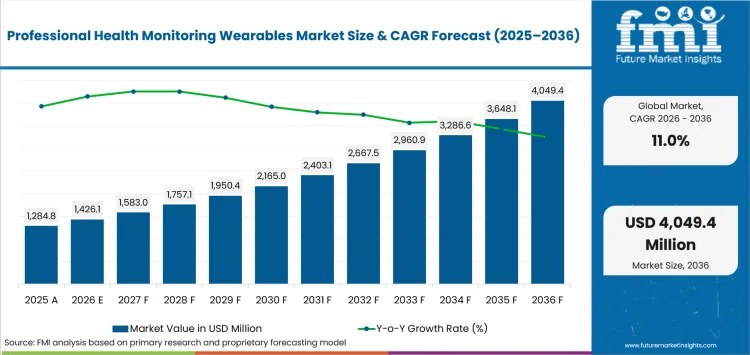
Key Takeaways of Professional Health Monitoring Wearables Market
- Demand for professional health monitoring wearables is driven by measurements that inform specific clinical decisions and assigned follow-up responsibilities, particularly across chronic disease management programs.
- By format, smartwatches hold the largest share at 37.0% in 2026, as familiar interfaces combine several measurements within one device.
- Remote patient monitoring is the dominant application segment, holding 42.4% share in 2026, reflecting distributed measurements that support professional review beyond care facilities.
- Hospitals lead the end-user category with 38.9% share in 2026, supported by specialist operating routines for monitored discharge and follow-up programs.
- Cardiac monitoring captures 34.8% share in 2026, attributable to its role in rhythm assessment and treatment decisions.
- South Korea, Germany, and Japan post CAGRs of 13.5%, 12.8%, and 12.1% respectively through 2036, while the UK and USA follow different commercial routes shaped by public planning and insurance-based reimbursement structures.
- Competition centers on Apple, Samsung, Google, Garmin, Abbott, Dexcom, Philips, and BioIntelliSense, with vendors differentiating through broad consumer wearable ecosystems, prescription-linked sensor platforms, and provider-managed monitoring services.
Analyst Perspective
"The professional healthcare wearables market is increasingly evaluated through its impact on clinical workflows rather than data collection alone. Healthcare providers are assessing whether wearable platforms improve care coordination, enable timely intervention, and fit established monitoring pathways without increasing operational burden. Long-term market growth will favor manufacturers that combine validated measurement performance with scalable service models, clear clinical accountability, and integration that translates patient data into actionable care decisions."
- Anurag Sharma, Principal Analyst at Future Market Insights
Source: FMI's proprietary forecasting model and primary research
How is the professional health monitoring wearables market segmented?
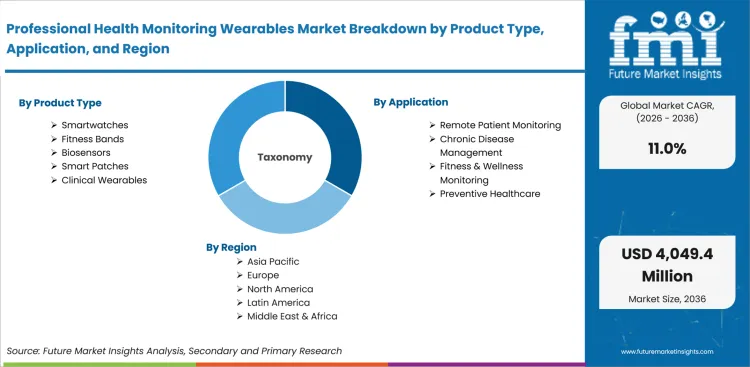
The professional health monitoring wearables market is segmented by product type, application, end user, monitoring parameter, and region.
The segmentation framework separates physical device formats from professional activities that use measurements for accountable health decisions. Product type covers smartwatches and fitness bands alongside biosensors and smart patches plus clinical wearable systems. Application categories distinguish remote patient monitoring from chronic disease management and preventive or wellness programs. End-user analysis compares hospitals and clinics with home healthcare settings as well as ambulatory care centers. Monitoring parameters separate cardiac and blood oxygen measurements from sleep and activity plus multi-parameter observation. Regional analysis compares approval structures and reimbursement routes together with the technical support required for professional deployment.
How do Smartwatches shape demand within the Product Type category?
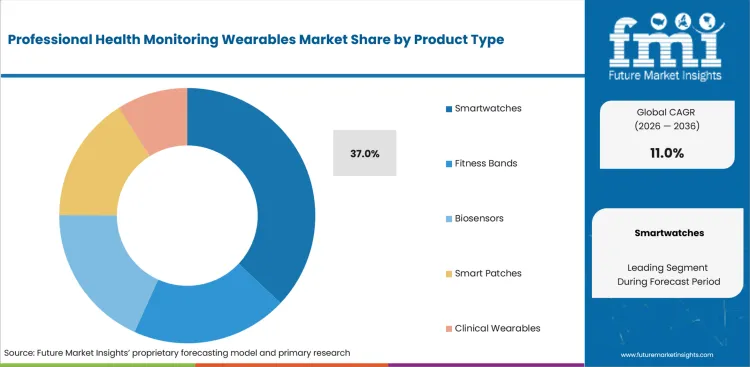
Professional smartwatch adoption depends on sensor outputs fitting a defined care or research protocol instead of remaining isolated wellness readings. Research teams need consent controls and dependable longitudinal data access together with instructions for abnormal results. Garmin announced a King’s College London collaboration in September 2025 that may equip up to 40,000 adult participants with wearable devices. The collaboration places wearable computing devices inside structured maternal health research that requires consistent data capture across a large international cohort.
- Within product type, smartwatches hold 37.0% share in 2026, attributable to familiar interfaces and several measurements within one wearable format. Their position reduces device burden across broad observation programs but regulated functions must remain available throughout each target country.
- Research institutions favor smartwatches with dependable battery life and controlled data access across large participant groups. Clinical teams need clear measurement limits and a documented response pathway to prevent familiar design from replacing validation during professional studies or routine monitoring programs.
How does Remote Patient Monitoring shape demand within the Application category?
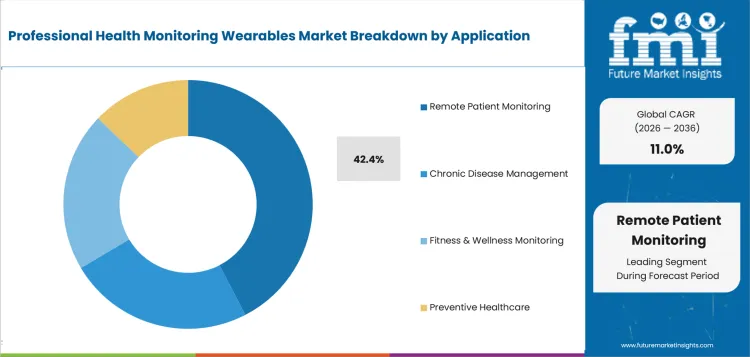
Remote patient monitoring connects home measurements with professional review across acute and chronic care pathways. Commercial value depends on setup support and repeated data transmission rather than device supply alone. A viable service also assigns clinical staff to missing readings and material changes throughout each monitoring period. Device training and communication support must remain available as patients use equipment across different home environments.
- By application, remote patient monitoring represents 42.4% share in 2026, supported by its direct link between distributed measurements and clinical management. Remote patient monitoring systems support recurring service revenue through required documentation of device supply and professional review across each covered period.
- Chronic care services adopt remote monitoring to follow blood pressure and glucose trends between scheduled appointments. The HHS Office of Inspector General reported in August 2025 that Medicare payments for remote patient monitoring exceeded USD 500 million during 2024. Funded services therefore need strong billing records and assigned clinical review for incomplete or concerning measurements.
How do Hospitals shape demand within the End User category?
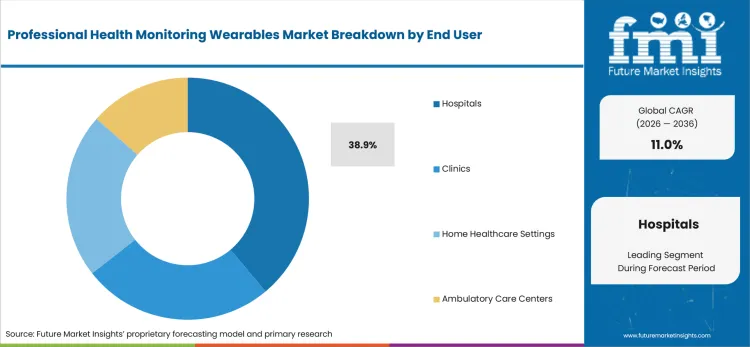
Hospitals use professional wearables across wards and discharge pathways that cannot depend on occasional manual observations alone. Commercial programs often combine a monitoring platform with equipment management and clinical support across complex hospital networks. Adoption depends on reliable assignment of devices and alerts among departments that share patients but follow different escalation routines. Comparable patient monitoring devices gain value through integration and service responsibilities that remain clear during deployment.
- Hospitals account for 38.9% share in 2026, driven by specialist workflows and discharge programs across several departments. NHS England updated its virtual ward guide in November 2025 and described wearables that transmit continuous vital signs into clinical dashboards. Central oversight supports larger patient groups as alerts reach established records and assigned escalation teams.
- Hospital adoption begins with pathways that have clear admission criteria and measurable capacity constraints across routine operations. Local training and equipment replacement routes become essential as deployment expands beyond one ward or specialty. Health systems also need explicit alert ownership so added monitoring does not increase unresolved clinical workload.
How does Cardiac Monitoring shape demand within the Monitoring Parameter category?
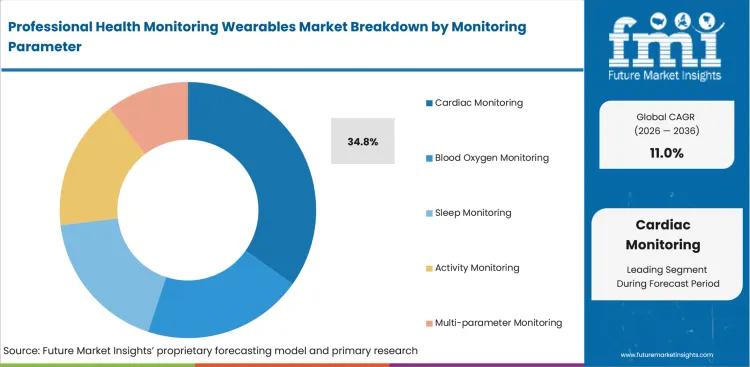
Cardiac monitoring requires dependable rhythm data plus prompt review whenever a detected change may affect treatment. Hospital and ambulatory programs also need alarm controls that limit unnecessary interruptions during routine care. Philips introduced a telemetry platform in September 2025 that links a wearable monitor with central surveillance and mobile clinical workflows. The same portfolio supports cardiac monitoring for up to thirty days following discharge through an ambulatory service pathway. Continuous observation therefore requires workflow support alongside sensing hardware and a defined clinical review schedule across continuous cardiac monitors.
- In 2026, cardiac monitoring captures 34.8% share, owing to its direct relationship with rhythm assessment and treatment decisions. Wearable systems maintain observation during movement and recovery but commercial value depends on alerts reaching trained staff with authority to respond.
- Cardiology teams adopt wearable monitoring to investigate intermittent symptoms that may not appear during a brief clinical examination. Extended observation improves the chance of capturing relevant events during normal daily activity and overnight rest. Excess alarms and unreliable connectivity can increase workload without improving diagnostic confidence or patient safety.
What are the drivers, restraints, and opportunities in the Professional Health Monitoring Wearables Market?
Professional wearables gain commercial value from repeated clinical evidence and clearly assigned response duties across active care pathways. Cybersecurity requirements and staff workload can delay adoption across connected care programs with limited technical support.
- Driver: Established monitoring programs create demand for repeated measurements between scheduled appointments and formal clinical reviews.
- Restraint: Connected medical devices require cybersecurity controls and sustained maintenance across software updates and changing network environments.
- Opportunity: Interoperable monitoring can reduce manual data entry and place wearable results inside clinical records used for routine decisions.
Repeated physiological measurements create revenue only if a covered service pays for device setup and professional review. CMS updated its remote patient monitoring guidance in May 2026 and described payment components for device setup and connected device supply. The guidance also covers treatment management performed by clinical staff following remote collection of physiological information. Qualified wearable programs gain a direct service route but retain documentation and patient connectivity requirements. Manufacturers therefore need implementation support that fits billing rules and protects consistent data transmission throughout each monitored period.
Cybersecurity limits adoption if health systems cannot assess software components and update responsibilities across connected medical devices. The FDA issued final guidance in February 2026 covering cybersecurity design and premarket documentation for devices with cyber risk. The guidance also explains manufacturer responsibilities for cyber devices under Section 524B of the federal statute. Manufacturers need update plans and service ownership that remain practical throughout the deployed product life. Independent connectivity testing systems can support technical validation without replacing regulatory duties or continuing manufacturer maintenance responsibilities.
Interoperability creates an opening by reducing manual order entry and fragmented review across ambulatory cardiac monitoring pathways. Philips announced a collaboration with Epic in July 2025 that places cardiac monitor ordering and ECG result review within the Aura diagnostics platform. The connection can automate patient activation and charting to reduce administrative work for cardiology services managing large ambulatory caseloads. Related remote healthcare services become easier to scale as measurements and reports enter systems already used by clinical staff. Companies can compete through dependable implementation that reduces administrative work instead of relying on sensor specifications alone.
Which country CAGRs are profiled in the Professional Health Monitoring Wearables Market?
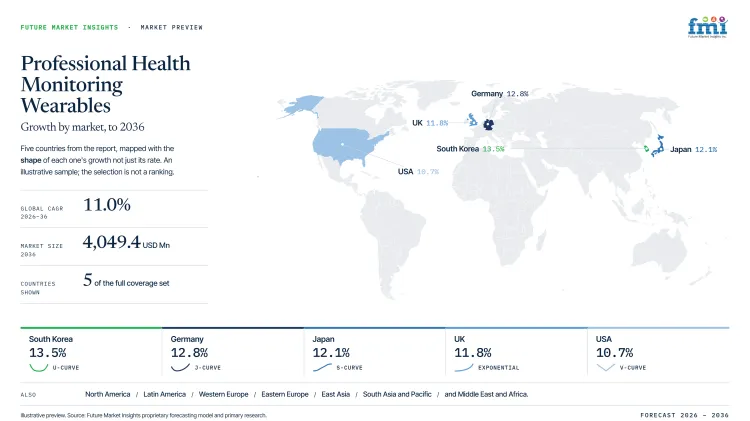
| Country | CAGR |
|---|---|
| USA | 10.7% |
| UK | 11.8% |
| Germany | 12.8% |
| Japan | 12.1% |
| South Korea | 13.5% |
How do country-level CAGRs compare in the Professional Health Monitoring Wearables Market?
The country comparison forms a gradual range with no sharp break between the national growth positions. South Korea and Germany occupy the upper band with rates above 12.5% during the forecast period. Japan sits 0.7 percentage point below Germany despite a materially different service and approval structure. The UK remains close to Japan and the USA anchors the lower boundary through established remote monitoring payment routes. The complete spread measures 2.8 percentage points and indicates varied entry conditions rather than separated demand cycles.
- South Korea combines the upper forecast position with dense digital infrastructure and formal procedures for digital medical products. Commercial preparation must address local classification and dependable technical support across hospital networks with demanding response expectations.
- Germany remains close to South Korea through a reimbursement structure that can support defined cardiac telemonitoring pathways. Wearable programs need precise product boundaries, as software reimbursement routes do not automatically cover connected hardware within every cardiac telemonitoring pathway.
- Japan occupies the middle band as approved wearable functions expand within a system that requires local regulatory representation. Companies also need Japanese-language training and service coverage that can reach providers beyond major cities.
- The UK follows Japan closely through public care pathways that can coordinate monitoring across hospital and community services. Fixed budgets and local staffing capacity can slow expansion despite national support for home-based monitoring.
- The USA records the lower displayed rate but benefits from established payment components and large provider networks. Billing oversight and documentation remain material requirements for programs serving patient panels across several provider networks.
Similar forecast rates can conceal different reimbursement rules and product classifications across national commercial settings. The full report covers North America and Latin America together with Europe and East Asia. Coverage also extends across South Asia and Oceania together with the Middle East and Africa.
Country-wise Analysis
- United States health systems can operate home monitoring programs through care coordinators who review patient data between visits. Demand for professional health monitoring wearables is forecast to advance at 10.7% CAGR through 2036, supported by assigned clinical oversight between scheduled visits. The Department of Veterans Affairs updated its Palo Alto home telehealth program in January 2026 and described registered nurses monitoring blood pressure and heart rate as well as blood sugar. Assigned clinical ownership creates a direct adoption enabler for chronic care programs with repeated home measurements. Programs depend on secure connectivity and patient participation across homes with different technical support needs. Manufacturers need simple setup and reliable service records that fit each provider’s operating and compliance structure.
- English care networks can coordinate monitoring across hospitals and community services through nationally supported digital pathways. The Department of Health and Social Care and NHS England announced remote monitoring pilots in November 2025 that could free about 500,000 appointments annually at full operation. Professional health monitoring wearables are forecast to expand at 11.8% CAGR over the assessment period, aided by national pilots that connect hospital and community monitoring. National sponsorship creates a direct adoption route with measurable service-capacity goals across regional networks and several specialties. Local trusts must fund devices and clinical response within constrained operating budgets for each specialty. Companies need deployment support and escalation rules that match each specialty pathway and regional service capacity.
- German cardiac services operate inside a reimbursement system that assigns defined roles to physicians and telemedical centers. Demand for professional health monitoring wearables is estimated to record 12.8% CAGR across the ten-year forecast window, attributable to formal coverage for eligible cardiac monitoring equipment. Connected hardware must fit the covered pathway, as software reimbursement does not automatically include every monitoring device. The National Association of Statutory Health Insurance Physicians introduced EBM allowance 40909 in June 2025 for required transmitters used in cardiac telemonitoring services. The rule lets physicians and telemedical centers contract directly with manufacturers for eligible monitoring equipment. Coverage remains limited to named services and includes equipment support costs within the defined reimbursement allowance. Manufacturers therefore need precise classification and replacement plans that remain consistent with the reimbursed cardiac pathway.
- Japanese wearable programs require local approval support and Japanese-language service across providers with unequal specialist access. Professional health monitoring wearables are projected to rise at 12.1% CAGR during the forecast period, supported by regulated pathways for approved wearable functions. PMDA records show that Garmin’s ECG application received Japanese approval on April 23, 2025 as a home electrocardiograph program. The same official record identifies Garmin Japan as the local marketing authorization holder for the application. The approval provides a direct route for regulated smartwatch functions but does not establish service coverage across smaller cities. Manufacturers need local representation and dependable maintenance that protects clinical continuity beyond major urban centers.
- South Korean hospitals operate inside dense digital infrastructure and a national framework for digital medical products. Professional health monitoring wearables are forecast to rise at 13.5% CAGR over the forecast period, aided by clearer authorization procedures for digital medical products. Commercial entry depends on local classification and technical support for hospital networks with demanding response expectations. The Ministry of Food and Drug Safety issued Notice 2025-25 in April 2025 for authorization and review procedures covering digital medical products. The framework supports clearer regulatory planning but does not remove product-specific documentation or applicable review duties. Local partners remain important for training and maintenance across hospitals that expect rapid technical response.
Who are the notable companies in the Professional Health Monitoring Wearables Market?
Apple, Google (Fitbit), Garmin, Samsung Electronics, Abbott, Dexcom, Philips, BioIntelliSense, Masimo, and Biobeat are the notable companies shaping this market.
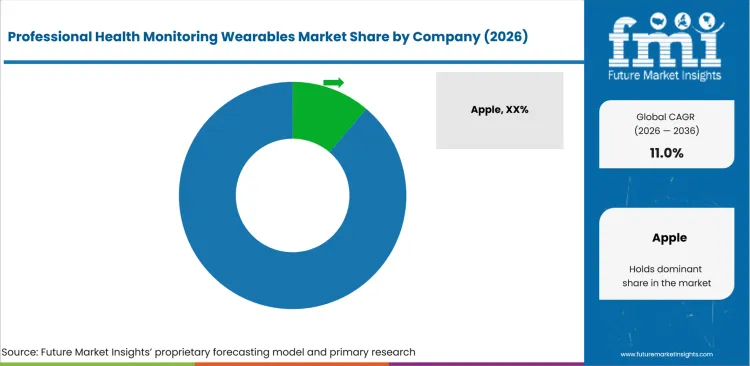
The competitive field combines wrist-worn ecosystems with prescription sensors and provider-managed monitoring platforms that solve different clinical problems. Apple and Samsung offer selected regulated measurements within broad smartwatch portfolios used across several national markets. Google and Garmin provide longitudinal data access for connected applications and structured research programs involving wearable measurements. Abbott and Dexcom link prescription glucose sensors with professional review tools, whereas Philips and BioIntelliSense manage continuous monitoring workflows across facility and home settings. Google announced in May 2026 that the Fitbit application would become Google Health and combine wearable data with connected applications plus medical records. The announced structure expands data aggregation but Google describes several coaching functions as wellness services rather than medical care.
- Apple and Samsung focus on wrist-worn devices that combine several daily health measurements within familiar consumer hardware. Google and Garmin add data services that support longitudinal research and connected monitoring applications across several settings. Professional selection depends on regulated feature availability and controlled sharing within each intended country and clinical program.
- Abbott and Dexcom focus on prescription glucose sensing with platforms designed for clinical review and patient sharing. Their continuous glucose monitoring systems serve a defined diabetes management pathway rather than broad wellness observation. Biobeat extends prescription-grade monitoring into cuffless ambulatory blood pressure measurement and supplies reports for professional review.
- Philips provides hospital and ambulatory monitoring through connected clinical platforms that coordinate measurements across care settings. BioIntelliSense supports multi-parameter wearable monitoring through provider dashboards for diverse facility and home-based clinical programs. Masimo supplies hospital wearable monitoring, whereas Biobeat provides cuffless blood pressure measurement for professional review through a separate ambulatory pathway. Selection depends on service coverage together with workflow integration and validated performance across representative operating conditions.
Competitive Benchmarking: Professional Health Monitoring Wearables Market
| Company | Regulated Sensing | Clinical Data Workflow | Professional Monitoring Breadth | Geographic Reach |
|---|---|---|---|---|
| Apple | High | Medium | Medium | Selected markets |
| Google (Fitbit) | Medium | Medium | Medium | Multi-region |
| Garmin | Medium | Medium | Medium | Multi-region |
| Samsung Electronics | High | Medium | Medium | Selected markets |
| Abbott | High | High | Medium | Multi-region |
| Philips | High | High | High | Global |
| Dexcom | High | High | Medium | Multi-region |
| BioIntelliSense | High | High | High | United States |
Key Developments in the Professional Health Monitoring Wearables Market
- In September 2025, Apple: Updated software platforms added FDA-cleared hypertension notifications on supported Apple Watch models. The function reviews optical heart sensor data for patterns associated with chronic high blood pressure and advises eligible users to seek clinical evaluation. Regional availability depends on local authorization and compatible hardware, and the feature remains an aid rather than a replacement for clinical blood pressure assessment.
- In January 2025, Garmin: The ECG App expanded to compatible smartwatches in Australia and the European Union following regional regulatory authorizations. Garmin described the application as its first smartwatch feature categorized as a medical device within those regions. The expansion widened access to thirty-second ECG recordings and shareable reports, but device and country limitations remained part of the authorized use conditions throughout the newly covered regions.
- In April 2025, Dexcom: The FDA cleared Dexcom G7 15 Day for adults aged eighteen years and older with diabetes in the United States and authorized up to fifteen and one-half days of wear. The sensor connects with Dexcom Clarity so professional teams can review prescription glucose information within an established clinical workflow. Longer wear reduces replacement frequency across the approved sensor period and may simplify recurring device supply for eligible adults.
- In June 2026, Masimo: FDA 510(k) clearance added an opioid-induced respiratory depression detection capability to the Radius VSM wearable continuous patient monitor. The feature analyzes continuous physiological data from the smartSET pulse oximetry platform to identify patterns linked with respiratory compromise in hospitalized patients receiving opioid therapy. The clearance expands clinical capability within a provider-managed wearable system but requires integration with hospital response protocols and staff oversight.
Key Players in the Professional Health Monitoring Wearables Market
Consumer Wearable Platforms
- Apple
- Google (Fitbit)
- Garmin
- Samsung Electronics
Prescription Sensor Companies
- Abbott
- Dexcom
- Biobeat
Provider-Managed Monitoring Companies
- Philips
- BioIntelliSense
- Masimo
Professional Health Monitoring Wearables Market - Report Scope
| Coverage field | Report scope |
|---|---|
| Market breakdown | Product type, application, end user, monitoring parameter, and region. |
| Market Definition | Professional wearable devices and associated platforms used to collect physiological data within clinical research or provider-managed monitoring pathways. |
| Regions Covered | North America, Latin America, Western Europe, Eastern Europe, East Asia, South Asia and Pacific, and Middle East and Africa. |
| Countries Covered | 30+ countries including USA, Canada, Brazil, Mexico, Germany, UK, France, Italy, Spain, Japan, China, South Korea, India, Australia, and GCC countries. |
| Key Companies Profiled | Apple, Google (Fitbit), Garmin, Samsung Electronics, Abbott, Dexcom, Philips, BioIntelliSense, Masimo, and Biobeat |
| Forecast Period | 2026 to 2036. |
| Approach | Hybrid bottom-up and top-down market sizing supported by primary interviews and official desk research. |
Professional Health Monitoring Wearables Market - Research Methodology
| Method | Approach |
|---|---|
| Primary Research | FMI analysts conducted structured interviews with wearable manufacturers and clinical platform developers across service and distribution channels. The research also covered hospital digital health teams and subject-matter experts involved in professional monitoring decisions. Interview questions examined product evaluation and implementation barriers together with regulatory requirements and commercial support expectations. The research assessed the clinical evidence and service support needed to convert initial trials into recurring purchasing programs. |
| Desk Research | Desk research examined government statistics and regulatory publications alongside standards and recognized industry association material. Company filings and official announcements established product status and current commercial participation inside the market scope. Technical literature and product information clarified measured capabilities without treating laboratory performance as evidence of commercial adoption. The research also separated current product availability from dated company actions and historical regulatory approvals across the assessment period. |
| Market Sizing and Forecasting | The market model combined the baseline value with historical performance and the defined segment structure. Pricing and volume indicators were assessed alongside adoption levels and current company participation across countries. Forecast assumptions considered economic activity and regulatory developments together with technology adoption and purchasing cycles. Supply availability and barriers to wider use shaped the country and segment forecasts through 2036. Segment and regional estimates were reconciled across the complete model before the final total was calculated. |
| Data Validation | Market estimates were compared with official statistics and current company activity across relevant healthcare settings and countries. Product availability and regulatory status provided additional context for commercial participation within the assessment period. Validation confirmed that products and services belonged inside the market boundary with their associated applications and revenue. Adjacent categories and overlapping revenue streams were excluded to maintain consistent segment and country totals. |
Professional Health Monitoring Wearables Market by Segments
Professional Health Monitoring Wearables Market segmented by Product Type:
- Smartwatches
- Fitness Bands
- Biosensors
- Smart Patches
- Clinical Wearables
Professional Health Monitoring Wearables Market segmented by Application:
- Remote Patient Monitoring
- Chronic Disease Management
- Fitness and Wellness Monitoring
- Preventive Healthcare
Professional Health Monitoring Wearables Market segmented by End User:
- Hospitals
- Clinics
- Home Healthcare Settings
- Ambulatory Care Centers
Professional Health Monitoring Wearables Market segmented by Monitoring Parameter:
- Cardiac Monitoring
- Blood Oxygen Monitoring
- Sleep Monitoring
- Activity Monitoring
- Multi-parameter Monitoring
Professional Health Monitoring Wearables Market by Region:
- North America
- USA
- Canada
- Latin America
- Brazil
- Mexico
- Argentina
- Western Europe
- Germany
- UK
- France
- Italy
- Spain
- BENELUX
- Nordics
- Eastern Europe
- Russia
- Poland
- Czech Republic
- Hungary
- East Asia
- China
- Japan
- South Korea
- South Asia and Pacific
- India
- ASEAN
- Australia and New Zealand
- Middle East and Africa
- GCC Countries
- South Africa
- Türkiye
- Israel
Research Sources and Bibliography
- USA Food and Drug Administration. (2025, January 7).
- European Commission, Directorate-General for Health and Food Safety. (2025, March 5).
- Garmin. (2025, September 17).
- USA Department of Health and Human Services, Office of Inspector General. (2025, August 25).
- NHS England. (2025, November 3).
- Philips. (2025, September 4).
- Centers for Medicare & Medicaid Services. (2026, May 13).
- USA Food and Drug Administration. (2026, February 3).
- Philips. (2025, July 24).
- USA Department of Veterans Affairs. (2026, January 22).
- Department of Health and Social Care and NHS England. (2025, November 6).
- Kassenärztliche Bundesvereinigung. (2025, June 26).
- Pharmaceuticals and Medical Devices Agency. (n.d.).
- Ministry of Food and Drug Safety. (2025, April 15).
- Google. (2026, May 7).
- Apple. (2025, September 15).
- Garmin. (2025, January 15).
- Dexcom. (2025, April 10).
- Masimo. (2026, June 22). Masimo receives FDA 510(k) clearance for AI-enabled opioid-induced respiratory depression (OIRD) detection on Radius VSM® to help identify respiratory risk sooner.
- Apple. (2025, October 2).
- Samsung Electronics. (n.d.).
This Report Answers
- How large is the professional health monitoring wearables market in 2026 and what valuation is forecast for 2036?
- Which product type and application segments hold the largest estimated shares during the 2026 assessment year?
- How do hospitals and cardiac monitoring contribute to professional wearable adoption within specific care programs?
- Which clinical and operational conditions support demand for remote patient monitoring programs within healthcare systems?
- How do cybersecurity duties and record integration influence commercial adoption in connected medical device programs?
- Which country growth rates are profiled and what local conditions shape their different commercial routes?
- How do notable companies compare on regulated sensing and clinical data integration as well as monitoring breadth and reach?
- Which current company developments affect regulated features and clinical research uses for professional wearable platforms?
- What market definition and research approach support the forecast and segment structure presented in this report?
Frequently Asked Questions
What is driving growth in the professional health monitoring wearables market?
Chronic care programs need dependable measurements between scheduled appointments and specialist reviews across defined patient groups. Professional wearables support that need by transmitting physiological data into funded monitoring pathways with assigned clinical response duties.
Who are the key players in the professional health monitoring wearables market?
Apple and Samsung provide broad smartwatch platforms alongside Google and Garmin services for research data and selected regulated functions. Abbott and Dexcom specialize in prescription glucose monitoring, whereas Philips and BioIntelliSense support provider-managed observation across facilities and homes.
What is a notable restraint in the professional health monitoring wearables market?
Cybersecurity duties and unclear alert ownership can delay adoption across connected medical device programs and provider networks. Health systems need workable update plans plus clinical response rules that remain effective throughout routine deployment and maintenance periods.
Why should executives track the professional health monitoring wearables market?
Professional wearables can extend clinical observation beyond facilities and reduce dependence on isolated appointments during ongoing care. Executives should track whether programs improve service capacity and timely response without adding unmanaged alerts or unsupported operating costs.
What business problem does the professional health monitoring wearables market address?
The market addresses information gaps between scheduled visits that can hide meaningful physiological changes during daily activity. Professional wearables connect repeated measurements with defined clinical review so care teams can respond before the next appointment.
What should healthcare organizations evaluate in the professional health monitoring wearables market?
Health systems should evaluate measurement accuracy and alert handling as separate operating capabilities during representative clinical use. Evaluation should also cover record integration and training plus maintenance support across representative patient groups and normal service conditions.
What limits return on investment in the professional health monitoring wearables market?
Low patient adherence and unassigned alert responsibility can weaken returns from otherwise capable professional wearable devices. Integration costs also rise if staff must copy measurements across separate clinical systems during routine monitoring activities.
What supports long-term commercial confidence in the professional health monitoring wearables market?
Validated measurements and dependable service coverage support confidence during larger professional wearable deployments across several facilities. Long-term confidence also requires secure updates and clear clinical ownership plus evidence that monitoring changes treatment or service capacity.
Preview the report firsthand - request a free sample
Get SampleGet the brochure for pricing and purchase details.
Get PDFTable of Content
- Key Takeaways
- Market Size and CAGR
- Top Growth Driver
- Fastest Growing Segment
- Leading Region
- Key Companies
- Emerging Opportunities
- Executive Summary
- Global Market Outlook
- Demand-side Trends
- Supply-side Trends
- Technology Roadmap Analysis
- Analysis and Recommendations
- Analyst Perspective (What is happening? Why now? What should investors know?)
- Key Questions Answered
- How large is the market?
- What is the CAGR?
- What are key trends?
- Which region dominates?
- Who are the leaders?
- Market Overview
- Market Coverage / Taxonomy
- Market Definition / Scope / Limitations
- Research Methodology
- Chapter Orientation
- Analytical Lens and Working Hypotheses
- Market Structure, Signals, and Trend Drivers
- Benchmarking and Cross-market Comparability
- Market Sizing, Forecasting, and Opportunity Mapping
- Research Design and Evidence Framework
- Desk Research Programme (Secondary Evidence)
- Expert Input and Fieldwork (Primary Evidence)
- Tooling, Models, and Reference Databases
- Data Engineering and Model Build
- Quality Assurance and Audit Trail
- Market Background
- Market Dynamics (Drivers, Restraints, Opportunity, Trends)
- Scenario Forecast (Optimistic, Likely, Conservative)
- Impact Analysis
- AI Impact
- Sustainability Impact
- Regulatory Impact
- Technology Impact
- Consumer / Buyer Analysis
- Purchase Drivers
- Adoption Barriers
- Buyer Journey
- Opportunity Map Analysis
- Product Life Cycle Analysis
- Supply Chain Analysis
- Investment Feasibility Matrix
- Value Chain Analysis
- PESTLE and Porter's Analysis
- Regulatory Landscape
- Regional Parent Market Outlook
- Production and Consumption Statistics
- Import and Export Statistics
- Global Market Analysis and Forecast, 2021 to 2036
- Historical Market Size Value (USD Million) Analysis, 2021 to 2025
- Current and Future Market Size Value (USD Million) Projections, 2026 to 2036
- Y-o-Y Growth Trend Analysis
- Absolute $ Opportunity Analysis
- Global Market Pricing Analysis, 2021 to 2036
- Global Market Analysis and Forecast, By Product Type, 2021 to 2036
- Introduction / Key Findings
- Historical Market Size Value (USD Million) Analysis By Product Type, 2021 to 2025
- Current and Future Market Size Value (USD Million) Analysis and Forecast By Product Type, 2026 to 2036
- Smartwatches
- Fitness Bands
- Biosensors
- Smart Patches
- Clinical Wearables
- Smartwatches
- Y-o-Y Growth Trend Analysis By Product Type, 2021 to 2025
- Absolute $ Opportunity Analysis By Product Type, 2026 to 2036
- Global Market Analysis and Forecast, By Application, 2021 to 2036
- Introduction / Key Findings
- Historical Market Size Value (USD Million) Analysis By Application, 2021 to 2025
- Current and Future Market Size Value (USD Million) Analysis and Forecast By Application, 2026 to 2036
- Remote Patient Monitoring
- Chronic Disease Management
- Fitness & Wellness Monitoring
- Preventive Healthcare
- Remote Patient Monitoring
- Y-o-Y Growth Trend Analysis By Application, 2021 to 2025
- Absolute $ Opportunity Analysis By Application, 2026 to 2036
- Global Market Analysis and Forecast, By End User, 2021 to 2036
- Introduction / Key Findings
- Historical Market Size Value (USD Million) Analysis By End User, 2021 to 2025
- Current and Future Market Size Value (USD Million) Analysis and Forecast By End User, 2026 to 2036
- Hospitals
- Clinics
- Home Healthcare Settings
- Ambulatory Care Centers
- Hospitals
- Y-o-Y Growth Trend Analysis By End User, 2021 to 2025
- Absolute $ Opportunity Analysis By End User, 2026 to 2036
- Global Market Analysis and Forecast, By Monitoring Parameter, 2021 to 2036
- Introduction / Key Findings
- Historical Market Size Value (USD Million) Analysis By Monitoring Parameter, 2021 to 2025
- Current and Future Market Size Value (USD Million) Analysis and Forecast By Monitoring Parameter, 2026 to 2036
- Cardiac Monitoring
- Blood Oxygen Monitoring
- Sleep Monitoring
- Activity Monitoring
- Multi-parameter Monitoring
- Cardiac Monitoring
- Y-o-Y Growth Trend Analysis By Monitoring Parameter, 2021 to 2025
- Absolute $ Opportunity Analysis By Monitoring Parameter, 2026 to 2036
- Global Market Analysis and Forecast, By Region, 2021 to 2036
- Introduction
- Historical Market Size Value (USD Million) Analysis By Region, 2021 to 2025
- Current Market Size Value (USD Million) Analysis and Forecast By Region, 2026 to 2036
- North America
- Latin America
- Western Europe
- Eastern Europe
- East Asia
- South Asia and Pacific
- Middle East & Africa
- Market Attractiveness Analysis By Region
- North America Market Analysis and Forecast, By Country, 2021 to 2036
- Historical Market Size Value (USD Million) Trend Analysis By Market Taxonomy, 2021 to 2025
- Market Size Value (USD Million) Forecast By Market Taxonomy, 2026 to 2036
- By Country
- USA
- Canada
- By Product Type
- By Application
- By End User
- By Monitoring Parameter
- By Country
- Market Attractiveness Analysis
- By Country
- By Product Type
- By Application
- By End User
- By Monitoring Parameter
- Key Takeaways
- Latin America Market Analysis and Forecast, By Country
- Historical Market Size Value (USD Million) Trend Analysis By Market Taxonomy, 2021 to 2025
- Market Size Value (USD Million) Forecast By Market Taxonomy, 2026 to 2036
- By Country
- Brazil
- Mexico
- Chile
- Rest of Latin America
- By Product Type
- By Application
- By End User
- By Monitoring Parameter
- By Country
- Market Attractiveness Analysis
- By Country
- By Product Type
- By Application
- By End User
- By Monitoring Parameter
- Key Takeaways
- Western Europe Market Analysis and Forecast, By Country
- Historical Market Size Value (USD Million) Trend Analysis By Market Taxonomy, 2021 to 2025
- Market Size Value (USD Million) Forecast By Market Taxonomy, 2026 to 2036
- By Country
- Germany
- UK
- Italy
- Spain
- France
- Nordic
- BENELUX
- Rest of Western Europe
- By Product Type
- By Application
- By End User
- By Monitoring Parameter
- By Country
- Market Attractiveness Analysis
- By Country
- By Product Type
- By Application
- By End User
- By Monitoring Parameter
- Key Takeaways
- Eastern Europe Market Analysis and Forecast, By Country
- Historical Market Size Value (USD Million) Trend Analysis By Market Taxonomy, 2021 to 2025
- Market Size Value (USD Million) Forecast By Market Taxonomy, 2026 to 2036
- By Country
- Russia
- Poland
- Hungary
- Balkan & Baltic
- Rest of Eastern Europe
- By Product Type
- By Application
- By End User
- By Monitoring Parameter
- By Country
- Market Attractiveness Analysis
- By Country
- By Product Type
- By Application
- By End User
- By Monitoring Parameter
- Key Takeaways
- East Asia Market Analysis and Forecast, By Country
- Historical Market Size Value (USD Million) Trend Analysis By Market Taxonomy, 2021 to 2025
- Market Size Value (USD Million) Forecast By Market Taxonomy, 2026 to 2036
- By Country
- China
- Japan
- South Korea
- By Product Type
- By Application
- By End User
- By Monitoring Parameter
- By Country
- Market Attractiveness Analysis
- By Country
- By Product Type
- By Application
- By End User
- By Monitoring Parameter
- Key Takeaways
- South Asia and Pacific Market Analysis and Forecast, By Country
- Historical Market Size Value (USD Million) Trend Analysis By Market Taxonomy, 2021 to 2025
- Market Size Value (USD Million) Forecast By Market Taxonomy, 2026 to 2036
- By Country
- India
- ASEAN
- Australia & New Zealand
- Rest of South Asia and Pacific
- By Product Type
- By Application
- By End User
- By Monitoring Parameter
- By Country
- Market Attractiveness Analysis
- By Country
- By Product Type
- By Application
- By End User
- By Monitoring Parameter
- Key Takeaways
- Middle East & Africa Market Analysis and Forecast, By Country
- Historical Market Size Value (USD Million) Trend Analysis By Market Taxonomy, 2021 to 2025
- Market Size Value (USD Million) Forecast By Market Taxonomy, 2026 to 2036
- By Country
- Kingdom of Saudi Arabia
- Other GCC Countries
- Türkiye
- South Africa
- Other African Union
- Rest of Middle East & Africa
- By Product Type
- By Application
- By End User
- By Monitoring Parameter
- By Country
- Market Attractiveness Analysis
- By Country
- By Product Type
- By Application
- By End User
- By Monitoring Parameter
- Key Takeaways
- Key Countries Market Analysis
- USA
- Pricing Analysis
- Market Share Analysis, 2025
- By Product Type
- By Application
- By End User
- By Monitoring Parameter
- Canada
- Pricing Analysis
- Market Share Analysis, 2025
- By Product Type
- By Application
- By End User
- By Monitoring Parameter
- Mexico
- Pricing Analysis
- Market Share Analysis, 2025
- By Product Type
- By Application
- By End User
- By Monitoring Parameter
- Brazil
- Pricing Analysis
- Market Share Analysis, 2025
- By Product Type
- By Application
- By End User
- By Monitoring Parameter
- Chile
- Pricing Analysis
- Market Share Analysis, 2025
- By Product Type
- By Application
- By End User
- By Monitoring Parameter
- Germany
- Pricing Analysis
- Market Share Analysis, 2025
- By Product Type
- By Application
- By End User
- By Monitoring Parameter
- UK
- Pricing Analysis
- Market Share Analysis, 2025
- By Product Type
- By Application
- By End User
- By Monitoring Parameter
- Italy
- Pricing Analysis
- Market Share Analysis, 2025
- By Product Type
- By Application
- By End User
- By Monitoring Parameter
- Spain
- Pricing Analysis
- Market Share Analysis, 2025
- By Product Type
- By Application
- By End User
- By Monitoring Parameter
- France
- Pricing Analysis
- Market Share Analysis, 2025
- By Product Type
- By Application
- By End User
- By Monitoring Parameter
- India
- Pricing Analysis
- Market Share Analysis, 2025
- By Product Type
- By Application
- By End User
- By Monitoring Parameter
- ASEAN
- Pricing Analysis
- Market Share Analysis, 2025
- By Product Type
- By Application
- By End User
- By Monitoring Parameter
- Australia & New Zealand
- Pricing Analysis
- Market Share Analysis, 2025
- By Product Type
- By Application
- By End User
- By Monitoring Parameter
- China
- Pricing Analysis
- Market Share Analysis, 2025
- By Product Type
- By Application
- By End User
- By Monitoring Parameter
- Japan
- Pricing Analysis
- Market Share Analysis, 2025
- By Product Type
- By Application
- By End User
- By Monitoring Parameter
- South Korea
- Pricing Analysis
- Market Share Analysis, 2025
- By Product Type
- By Application
- By End User
- By Monitoring Parameter
- Russia
- Pricing Analysis
- Market Share Analysis, 2025
- By Product Type
- By Application
- By End User
- By Monitoring Parameter
- Poland
- Pricing Analysis
- Market Share Analysis, 2025
- By Product Type
- By Application
- By End User
- By Monitoring Parameter
- Hungary
- Pricing Analysis
- Market Share Analysis, 2025
- By Product Type
- By Application
- By End User
- By Monitoring Parameter
- Kingdom of Saudi Arabia
- Pricing Analysis
- Market Share Analysis, 2025
- By Product Type
- By Application
- By End User
- By Monitoring Parameter
- Türkiye
- Pricing Analysis
- Market Share Analysis, 2025
- By Product Type
- By Application
- By End User
- By Monitoring Parameter
- South Africa
- Pricing Analysis
- Market Share Analysis, 2025
- By Product Type
- By Application
- By End User
- By Monitoring Parameter
- USA
- Market Structure Analysis
- Competition Dashboard
- Competition Benchmarking
- Market Share Analysis of Top Players
- By Regional
- By Product Type
- By Application
- By End User
- By Monitoring Parameter
- Emerging Startups
- Innovation Benchmarking
- Competition Analysis
- Competition Deep Dive
- Apple
- Overview
- Product Portfolio
- Profitability by Market Segments
- Sales Footprint
- Strategy Overview
- Marketing Strategy
- Product Strategy
- Channel Strategy
- Fitbit
- Garmin
- Samsung Electronics
- Medtronic
- Abbott
- Philips
- Dexcom
- Biobeat
- BioIntelliSense
- Apple
- Case Studies
- Success Stories
- Recent Developments
- Competition Deep Dive
- Assumptions & Acronyms Used


