

- Market Size (2026)
- USD 116.0 Mn
- Forecast (2036)
- USD 259.9 Mn
- CAGR (2026 to 2036)
- 8.4%
Metal Casting Porosity Vision Inspection Market Size, Market Forecast and Outlook By FMI
USD 116.0 million in 2026 and USD 259.9 million by 2036 at an 8.4% CAGR.
The metal casting porosity vision inspection market is predicted to grow from USD 107.0 million in 2025 to USD 259.9 million by 2036. Demand is expected to be driven by surface-visible defect control and inline release needs in foundries. By component, cameras are projected to hold the leading position with a 28.0% market share in 2026, supported by their ability to provide stable image capture and precise exposure control. By inspection type, defect detection is expected to dominate with a 58.0% share in 2026, owing to the growing need for reliable identification and rejection of pores and other casting defects.
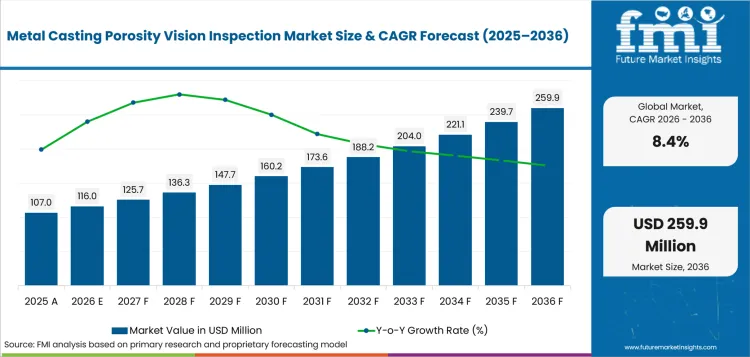
| Metric | Value |
|---|---|
| 2026 Market Size | USD 116.0 million |
| 2036 Market Size | USD 259.9 million |
| Forecast CAGR | 8.4% from 2026 to 2036 |
| Leading Component | Cameras |
| Cameras Share in 2026 | 28.0% |
| Leading Inspection Type | Defect Detection |
| Defect Detection Share in 2026 | 58.0% |
| Fastest-growing Country | China |
| China CAGR | 10.5% by 2036 |
| Market Signal | Commercial Impact |
|---|---|
| Demand and Growth Drivers | Foundries are increasing investment in porosity vision inspection systems to detect casting defects before machining and final assembly.
|
| Product and Segment View | Cameras, defect detection, inline deployment, metals, and East Asia lead their respective market segments.
|
| Geography and Growth Outlook | China and India are expected to remain the fastest-growing markets as casting automation accelerates.
|
| Competitive Landscape | Competition is centered on high-performance machine vision systems and factory integration capabilities.
|
| Analyst Perspective | Metal casting porosity vision inspection is evolving into a quality assurance investment rather than simply an automation upgrade.
- Nikhil Kaitwade, Principal Consultant at Future Market Insights |
Metal casting porosity vision inspection demand is being shaped by scrap risk in high-value cast parts rather than camera adoption alone. The USA Census Bureau reported April 2026 primary metals shipments of USD 28.954 billion and ferrous metal foundry shipments of USD 2.063 billion. This shows why foundries and casting users need faster defect evidence before machining or assembly adds more cost. Hexagon’s VGSTUDIO MAX 2025.3 update brought porosity and inclusion analysis methods into one workflow from analysis to reporting.
Which factors support expansion in the metal casting porosity vision inspection market?
Finished vision-system revenue and service attachment support market value across foundry quality programs.
- Market value is supported by imaging hardware sold with installation support for casting cells.
- Supplier pricing reflects camera resolution and lighting setup before software tuning changes the total project cost.
- Revenue improves when foundries convert manual surface checks into repeatable inline inspection programs.
- Buyer confidence rises when systems produce pore-size records that quality teams can compare across shifts.
Why is the metal casting porosity vision inspection market growing?
Foundries are using automated optical inspection to reduce late rejection where visible porosity can be screened before machining.
- EV aluminum castings are expected to raise inspection value when housings and structural parts carry higher scrap cost after finishing.
- Robotic handling is projected to support repeatable imaging by improving part orientation and lighting stability.
- Vision software is anticipated to improve porosity classification when plants separate cosmetic voids from load-risk defects.
- Service demand is likely to rise where foundries lack internal lighting and camera calibration skills.
Porosity inspection demand is expected to rise as customers ask for part-level evidence before a casting leaves the line. IFR reported that robot installations stayed above 500,000 units for a fourth straight year in 2024. This gives inspection suppliers more automated cells where camera position and part handling can stay repeatable.
European Foundry Federation reported in December 2025 that EFF members produced about 9.1 million tons of iron, steel and malleable castings in 2024. Non-ferrous output fell to 3.5 million tonnes in the same year. These volumes explain why inspection speed matters. Even a small miss rate can create rework cost across many parts. Adjacent demand for industrial robot market adoption supports the same cell-level automation reasoning used in porosity inspection projects.
How is the metal casting porosity vision inspection market segmented?
The metal casting porosity vision inspection industry is segmented by component, inspection type, deployment, end-use industry
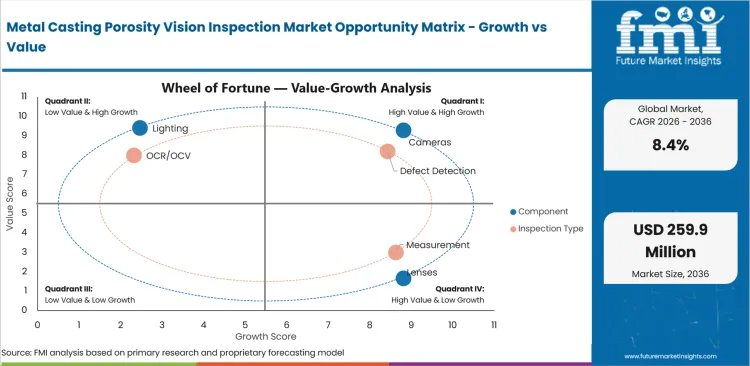
- Cameras are projected to secure 28.0% share in 2026, led by image capture needs on rough casting surfaces.
- Defect Detection is forecast to hold 58.0% share in 2026, supported by visible pore and blowhole rejection needs.
- Inline systems are expected to capture 46.0% share in 2026, reflecting the need for faster release decisions.
- Metals is anticipated to account for 35.0% share in 2026 with foundries controlling the earliest rejection point.
- East Asia is projected to represent 33.0% share in 2026, led by China and Japan manufacturing scale.
Which component leads the metal casting porosity vision inspection market?
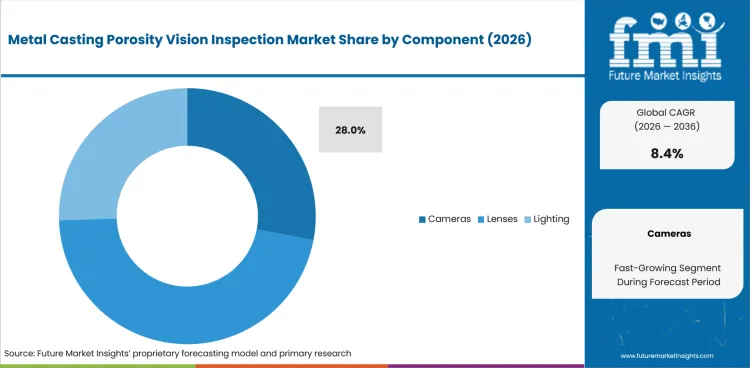
- Cameras are projected to account for 28.0% share in 2026, supported by exposure control and rough-surface contrast needs.
- Lighting gains value when buyers need stable pore contrast on cast aluminum and iron surfaces.
Which inspection type leads the metal casting porosity vision inspection market?
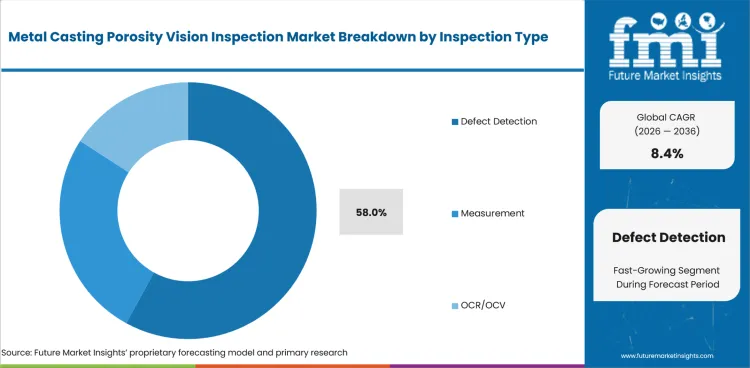
- Defect Detection is expected to hold 58.0% share in 2026, led by visible pores and blowholes that drive reject decisions.
- Measurement gains importance when buyers need pore-size thresholds for customer audits.
Which deployment leads the metal casting porosity vision inspection market?
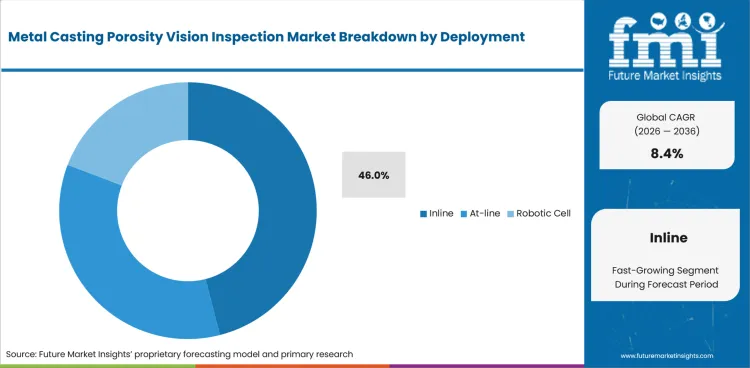
- Inline systems are forecast to secure 46.0% share in 2026, supported by faster release needs in high-volume cells.
- At-line systems remain useful where smaller foundries need proof before full cell investment.
Which end-use industry leads the metal casting porosity vision inspection market?
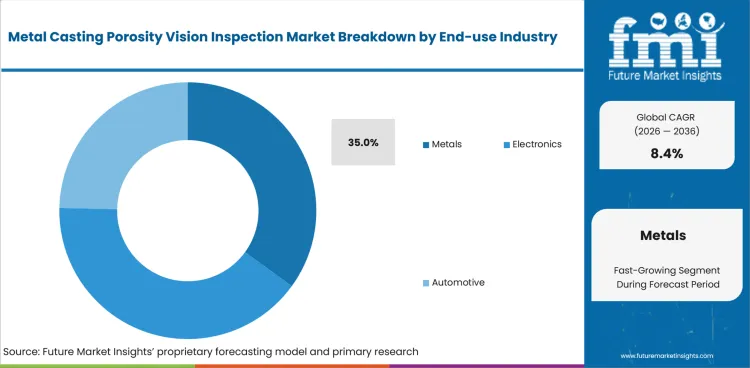
- Metals is projected to account for 35.0% share in 2026, reflecting direct foundry ownership of porosity control.
- Automotive demand is expected to rise where EV castings require better surface-defect evidence.
What supports the metal casting porosity vision inspection market and what holds it back?
Surface-visible porosity control supports growth while internal void limits keep X-ray and CT inspection relevant.
- Driver: EV casting complexity is expected to raise demand for repeatable checks before machining and assembly.
- Restraint: Camera systems cannot detect hidden internal voids across the full casting body.
- Opportunity: Hybrid inspection programs can use vision for surface screening and reserve X-ray for suspect parts.
Metal Casting Porosity Vision Inspection Market Demand Outlook
Demand outlook is moving toward inline systems that pair controlled lighting with defect records. This shift is clearest where foundries must prove surface-visible pores before machining.
- Buyers separate camera-based inspection from X-ray or CT. Vision systems are practical for visible and near-surface defects.
- Internal cavities need another test method when the component carries a safety or sealing risk.
- Internal void limits keep X-ray and CT inspection relevant for riskier parts. Camera screening is required when the target defect is visible or near the surface.
Foundry Buyer Segmentation and Purchase Behavior Analysis
Foundries and automotive tier suppliers form the primary buyer pool. These buyers usually test systems on real scrap parts before they approve a wider rollout. Basler and Orbbec launched an industrial 3D vision partnership in March 2026 for logistics and factory automation. The move supports projects where part presentations affect inspection reliability. The same buyer behavior is observed in the NDT inspection services market where traceability and repeatable proof shape service selection.
Lighting Recipes and Service Support Decision-driver Analysis
Quality managers want systems that reduce missed defects without creating too many false rejects. Production managers want the same system to hold cycle time. The primary decision driver is proof on the buyer’s own parts. Suppliers that tune lighting angles and software thresholds during trials are better placed than firms selling hardware alone. Lens choice is important when rough surfaces create glare. Automation planning in the robotics market gives similar attention to service support and integration depth when systems must work inside existing cells.
Who are the leading companies in the metal casting porosity vision inspection market?
Packaged vision-system suppliers compete with imaging hardware specialists and factory automation firms.
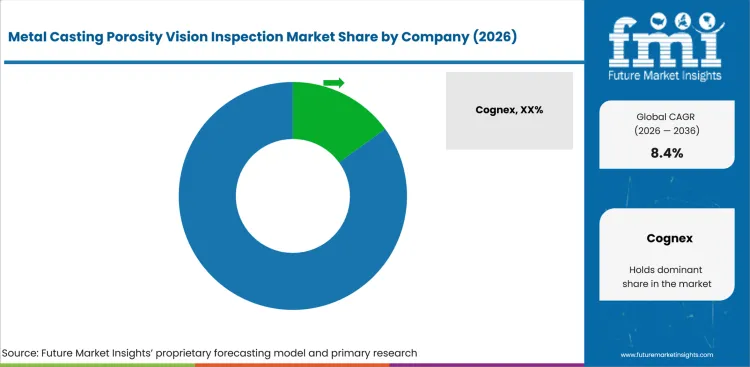
- Cognex and Keyence compete through packaged vision systems with software support for visible casting defects.
- Basler and Teledyne DALSA gain relevance where integrators need industrial cameras for custom foundry cells.
- SICK and Omron support projects where inspection results must feed factory automation systems.
- Regional integrators win smaller foundry projects when they tune lighting recipes and support service after installation.
Competition is shaped by proof on real production parts. Rough casting surfaces create glare and false edges. This makes porosity hard to inspect with a generic camera setup. Cognex strengthened its 3D inspection position in April 2024 with the In-Sight L38 system. SICK launched Inspector83x in June 2024 to simplify inspection setup for factory teams. These developments show why suppliers are competing on setup speed and defect clarity.
Hardware integration is a second separator. Teledyne DALSA expanded its AxCIS contact image sensor line to color in July 2024. The module combines imaging and lighting in one unit. This supports compact inspection layouts where space and alignment are difficult. Suppliers best placed to expand combine camera quality with lighting control and service support. The same purchase reasoning appears in robot-fed inspection projects where part presentation affects cell integration.
How do top metal casting porosity vision inspection companies compare?
Cognex and Keyence score highest on packaged vision systems. Basler and Teledyne DALSA remain stronger in hardware-led custom projects.
| Company | Relevance to Market Title | Casting Defect Imaging Depth | Inline Cell Integration | Vision Software Tooling | Geographic Footprint |
|---|---|---|---|---|---|
| Cognex | Very High | Very Strong | Strong | Very Strong | Global |
| Keyence | Very High | Very Strong | Very Strong | Strong | Global |
| Basler | High | Very Strong | Strong | Strong | Global |
| Teledyne DALSA | High | Very Strong | Moderate | Strong | Global |
| Omron | High | Strong | Very Strong | Moderate | Global |
| Zebra Technologies | Moderate to High | Moderate | Moderate | Strong | Global |
| SICK | High | Strong | Very Strong | Strong | Global |
| Balluff | Moderate to High | Moderate | Strong | Moderate | Europe and global |
| Siemens | Moderate | Low to Moderate | Very Strong | Moderate | Global |
| Datalogic | Moderate to High | Moderate | Moderate | Moderate | Europe and global |
Source: Future Market Insights competitive analysis, 2026.
Which companies are included in the metal casting porosity vision inspection market?
Cognex and Keyence are listed with Basler among the leading suppliers. Teledyne DALSA and SICK compete through machine vision portfolios.
Global companies active in the metal casting porosity vision inspection market include:
- Cognex
- Keyence
- Basler
- Teledyne DALSA
- Omron
- Zebra Technologies
- SICK
- Balluff
- Siemens
- Datalogic
Key Developments in Metal Casting Porosity Vision Inspection Market
- In April 2024, Cognex launched the In-Sight L38 3D Vision System. The system combines 2D and 3D inspection tools for manufacturing checks.
- In March 2026, Hexagon made VG Software 2025.3 available with a redesigned porosity and inclusion analysis workflow.
- In December 2025, Comet Technologies Canada highlighted Dragonfly 3D World 2025 with AI segmentation and GPU-accelerated CT analysis.
Key Companies in the Metal Casting Porosity Vision Inspection Market
Vision System Leaders
- Cognex
- Keyence
- Omron
- Zebra Technologies
Imaging Hardware Specialists
- Basler
- Teledyne DALSA
- SICK
- Balluff
Automation Ecosystem Suppliers
- Siemens
- Datalogic
Which countries are growing fastest in the metal casting porosity vision inspection market?
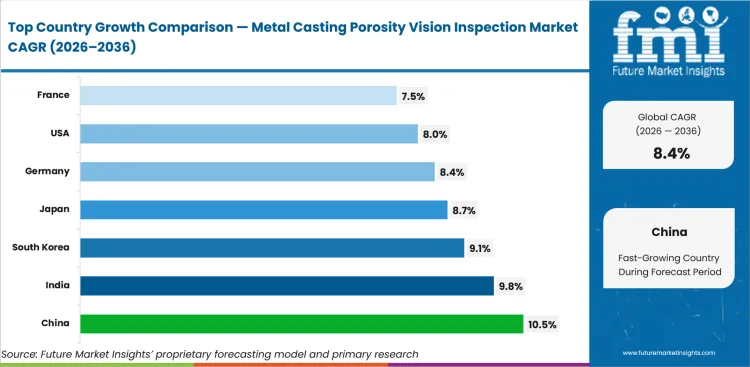
China 10.5% CAGR, India 9.8% CAGR, South Korea 9.1% CAGR, Japan 8.7% CAGR, Germany 8.4% CAGR, United States 8.0% CAGR, France 7.5% CAGR, and United Kingdom 7.0% CAGR through 2036.
.webp "Top Country Growth Comparison Metal Casting Porosity Vision Inspection Market Cagr (2026 2036)")
| Country | CAGR |
|---|---|
| China | 10.5% |
| India | 9.8% |
| South Korea | 9.1% |
| Japan | 8.7% |
| Germany | 8.4% |
| United States | 8.0% |
| France | 7.5% |
| United Kingdom | 7.0% |
| Source | Future Market Insights, 2026. |
How do country-level CAGRs compare in the metal casting porosity vision inspection market?
China leads country growth while the United Kingdom records the most cautious expansion outlook among profiled markets.
- China is forecast to record 10.5% CAGR by 2036 with casting volume and robot-fed cells supporting inline inspection.
- India is expected to expand at 9.8% CAGR through 2036 with automotive supplier automation and local integrator growth.
- South Korea is projected to rise at 9.1% CAGR by 2036 through high robot density and electronics-led quality discipline.
- Japan is anticipated to grow at 8.7% CAGR through 2036 with precision manufacturing and local automation suppliers supporting trials.
- Germany is forecast to post 8.4% CAGR by 2036 through automotive supplier audits and machine vision supplier depth.
- The United States is projected to grow at 8.0% CAGR through 2036 with automotive and aerospace casting users raising proof needs.
- France is expected to expand at 7.5% CAGR by 2036 with EV and hybrid component suppliers using at-line proof before inline rollout.
- The United Kingdom is forecast to advance at 7.0% CAGR by 2036 with targeted automation projects and tighter casting documentation.
How fast is the metal casting porosity vision inspection market growing in China?
A 10.5% CAGR through 2036 reflects casting scale and fast robot-fed inspection adoption across high-volume supplier plants.
Country Market Snapshot Table
| Parameter | Value |
|---|---|
| Market Size in 2025 (Value) | USD 28.5 million |
| Market Size in 2026 (Value) | USD 31.5 million |
| Market Forecast in 2036 (Value) | USD 85.5 million |
| CAGR (2026 to 2036) | 10.5% |
| Years Considered | 2021 to 2036 |
| Base Year | 2025 |
| Forecast Period | 2026 to 2036 |
| Units Considered | Value (USD million) |
| Leading Sub-Region | Yangtze River Delta and Pearl River Delta casting clusters |
China Metal Casting Porosity Vision Inspection Market Outlook
China demand is shaped by automotive scale and a large base of automated handling cells. Buyers use vision inspection to reduce manual sorting where EV parts need clearer defect records.
Top-tier suppliers are expected to buy inline systems with stronger lighting control and data export. Lower-tier foundries may start with simpler at-line setups before moving into full cell integration.
Key Growth Drivers
- Automotive casting programs are expected to lift inspection demand. The State Council reported China auto output at 31.282 million units in 2024.
- Robot-fed inspection readiness is supported by domestic automation output. NBS reported China produced 556369 industrial robots in 2024.
- Local integrator competition is expected to reduce installation friction for foundries that need faster camera setup.
- EV housing programs are likely to raise demand for pore records before machining and sealing operations.
Key Restraints
- Price pressure can reduce lighting and software quality in lower-tier foundries that compare systems mainly on upfront cost.
- Network access reviews can slow software deployment when plants restrict data export from production lines.
- Capital pressure can make buyers selective. NBS China reported industrial receivables at 28.40 trillion yuan in November 2025.
What makes China unique
China combines the largest casting-related volume opportunity with a deep robot integrator base.
Key Companies
- Cognex
- Keyence
- SICK
- Basler
- Omron
- Hikrobot
- Dahua Technology
Sales & Marketing Channels
- Direct sales to EV component suppliers
- Local vision integrators
- Robot OEM partnerships
- Distributor networks in manufacturing hubs
- Online technical lead generation
- OEM equipment specification routes
Country Segment Breakdown Table
| Segment | Sub-Segments |
|---|---|
| By Component | Cameras · Lenses · Lighting · Frame Grabbers · Vision Software · Services |
| By Inspection Type | Defect Detection · Measurement · OCR/OCV · Presence/Absence · Guidance |
| By Deployment | Inline · At-line · Robotic Cell · Portable |
| By End-use Industry | Electronics · Automotive · Packaging · Pharmaceuticals · Food & Beverage · Metals |
| By Region | North America · Latin America · Europe · East Asia · South Asia & Pacific · Middle East & Africa |
| Key Sub-Regions Covered | Yangtze River Delta and Pearl River Delta casting clusters |
Frequently Asked Questions
How fast is China metal casting porosity vision inspection market growing?
Demand in China is forecast to grow at 10.5% from 2026 to 2036 through automotive casting scale and factory automation.
Who leads China metal casting porosity vision inspection market?
Cognex and Keyence compete through vision hardware and software. SICK and Basler support local projects through imaging products and integration channels.
What is driving adoption in China metal casting porosity vision inspection market?
Adoption is supported by casting quality documentation and repeatable surface-defect proof.
What is the metal casting porosity vision inspection market outlook in India?
A 9.8% CAGR through 2036 reflects automotive supplier growth and a rising base of factory automation projects.
Country Market Snapshot Table
| Parameter | Value |
|---|---|
| Market Size in 2025 (Value) | USD 7.5 million |
| Market Size in 2026 (Value) | USD 8.2 million |
| Market Forecast in 2036 (Value) | USD 20.9 million |
| CAGR (2026 to 2036) | 9.8% |
| Years Considered | 2021 to 2036 |
| Base Year | 2025 |
| Forecast Period | 2026 to 2036 |
| Units Considered | Value (USD million) |
| Leading Sub-Region | Pune, Chennai and Gujarat automotive supplier corridors |
India Metal Casting Porosity Vision Inspection Market Outlook
India demand is moving from portable inspection toward cell-level projects. Mid-sized foundries still test payback carefully before they install fully inline systems.
Local distributors and integrators are central to adoption. Buyers often need training, defect libraries and service support before they expand camera-based inspection across more casting lines.
Key Growth Drivers
- Automotive supplier activity is expected to raise casting inspection needs. PIB reported India produced more than 28 million vehicles in 2023-24.
- EV casting programs are expected to increase quality-check needs. NITI Aayog reported Indian EV sales reached 2.08 million units in 2024.
- Local integrators are expected to make camera-based inspection easier for mid-sized foundries to trial.
- Basler’s October 2025 Alpha TechSys stake strengthens local support for Indian machine vision projects.
Key Restraints
- Upfront cost can keep smaller foundries at at-line inspection before they move into inline systems.
- Trained vision-engineer shortages can slow defect library development and lighting recipe work.
- Small-enterprise financing needs can slow full inline purchases. PIB reported 84034 new micro enterprises assisted during 2025-26 up to December 2025.
What makes India unique
India is a channel-build market where local application support can unlock mid-sized foundry demand.
Key Companies
- Basler
- Cognex
- Keyence
- Omron
- Balluff
- SICK India
- Alpha TechSys Automation
Sales & Marketing Channels
- Regional distributors
- Local system integrators
- Automotive tier supplier approvals
- Foundry association referrals
- Demonstration-based selling
- Retrofit packages for existing cells
Country Segment Breakdown Table
| Segment | Sub-Segments |
|---|---|
| By Component | Cameras · Lenses · Lighting · Frame Grabbers · Vision Software · Services |
| By Inspection Type | Defect Detection · Measurement · OCR/OCV · Presence/Absence · Guidance |
| By Deployment | Inline · At-line · Robotic Cell · Portable |
| By End-use Industry | Electronics · Automotive · Packaging · Pharmaceuticals · Food & Beverage · Metals |
| By Region | North America · Latin America · Europe · East Asia · South Asia & Pacific · Middle East & Africa |
| Key Sub-Regions Covered | Pune, Chennai and Gujarat automotive supplier corridors |
Frequently Asked Questions
How fast is India metal casting porosity vision inspection market growing?
Demand in India is forecast to grow at 9.8% from 2026 to 2036 through vehicle supplier growth and local integration support.
Who leads India metal casting porosity vision inspection market?
Basler and Cognex compete through machine vision hardware. Keyence and Omron support local inspection projects through software and integrator access.
What is driving adoption in India metal casting porosity vision inspection market?
Adoption is supported by casting quality documentation and repeatable surface-defect proof.
How is the metal casting porosity vision inspection market performing in South Korea?
A 9.1% CAGR through 2036 reflects high robot density and strict quality expectations in automotive and electronics manufacturing.
Country Market Snapshot Table
| Parameter | Value |
|---|---|
| Market Size in 2025 (Value) | USD 8.8 million |
| Market Size in 2026 (Value) | USD 9.6 million |
| Market Forecast in 2036 (Value) | USD 22.9 million |
| CAGR (2026 to 2036) | 9.1% |
| Years Considered | 2021 to 2036 |
| Base Year | 2025 |
| Forecast Period | 2026 to 2036 |
| Units Considered | Value (USD million) |
| Leading Sub-Region | Ulsan and Gyeonggi manufacturing corridors |
South Korea Metal Casting Porosity Vision Inspection Market Outlook
South Korea demand is shaped by production discipline and high automation readiness. Buyers expect inspection cells to work with existing robot setups and factory data systems.
Purchasing access can be concentrated through large groups and approved vendors. Suppliers need local references and service teams to win broader rollout opportunities.
Key Growth Drivers
- Automotive output keeps inspection needs visible. MOTIR reported domestic automobile production of 4.1 million units in 2025.
- High robot density raises expectations for automated inspection in plants that already rely on robot-fed process discipline.
- Manufacturing recovery supports automated quality checks. Invest Korea reported mining and manufacturing production rose 4.6% in December 2024.
- Electronics manufacturing culture is expected to raise expectations for data-backed defect control.
Key Restraints
- Approved-vendor systems can slow entry for smaller foreign suppliers that lack local references.
- Premium systems face price checks against established local integration alternatives.
- Production volatility can delay quality-system upgrades. Statistics Korea reported all-industry production fell 0.6% month on month in April 2026.
What makes South Korea unique
South Korea’s robot density makes it a strong market for robot-fed porosity vision inspection.
Key Companies
- Cognex
- Keyence
- SICK
- Omron
- Basler Korea
- Hyundai Robotics
- Doosan Robotics
Sales & Marketing Channels
- Large enterprise procurement
- Approved automation integrators
- Direct technical demonstrations
- Robot cell partnerships
- Distributor support for cameras
- Automotive tier supplier programs
Country Segment Breakdown Table
| Segment | Sub-Segments |
|---|---|
| By Component | Cameras · Lenses · Lighting · Frame Grabbers · Vision Software · Services |
| By Inspection Type | Defect Detection · Measurement · OCR/OCV · Presence/Absence · Guidance |
| By Deployment | Inline · At-line · Robotic Cell · Portable |
| By End-use Industry | Electronics · Automotive · Packaging · Pharmaceuticals · Food & Beverage · Metals |
| By Region | North America · Latin America · Europe · East Asia · South Asia & Pacific · Middle East & Africa |
| Key Sub-Regions Covered | Ulsan and Gyeonggi manufacturing corridors |
Frequently Asked Questions
How fast is South Korea metal casting porosity vision inspection market growing?
Demand in South Korea is forecast to grow at 9.1% from 2026 to 2036 through robot-fed production discipline and quality control.
Who leads South Korea metal casting porosity vision inspection market?
Cognex and Keyence compete through vision hardware and software. SICK and Omron support local projects through application support channels.
What is driving adoption in South Korea metal casting porosity vision inspection market?
Adoption is supported by casting quality documentation and repeatable surface-defect proof.
What is the metal casting porosity vision inspection market forecast for Japan?
An 8.7% CAGR through 2036 reflects precision manufacturing and strong local automation supplier support.
Country Market Snapshot Table
| Parameter | Value |
|---|---|
| Market Size in 2025 (Value) | USD 13.1 million |
| Market Size in 2026 (Value) | USD 14.2 million |
| Market Forecast in 2036 (Value) | USD 32.7 million |
| CAGR (2026 to 2036) | 8.7% |
| Years Considered | 2021 to 2036 |
| Base Year | 2025 |
| Forecast Period | 2026 to 2036 |
| Units Considered | Value (USD million) |
| Leading Sub-Region | Aichi and Kansai automotive supplier corridors |
Japan Metal Casting Porosity Vision Inspection Market Outlook
Japan demand is shaped by conservative qualification and repeatability expectations. Foundries serving automotive and electronics-related parts often value proven stability over lowest installed cost.
On-site trials remain important. Suppliers with application engineers can shorten approvals by tuning camera exposure, lighting direction and defect thresholds at the plant.
Key Growth Drivers
- Export quality needs remain high. JAMA reported Japanese motor vehicle exports reached 4.22 million units in 2024.
- Regional manufacturing depth supports inspection pilots. Chubu METI reported the region holds 20% of Japan’s manufactured shipment value.
- Local automation suppliers are expected to support plant trials close to production lines.
- Precision manufacturing culture is likely to raise demand for repeatable surface-defect proof.
Key Restraints
- Long qualification cycles can slow replacement of proven manual or at-line checks.
- Internal-void requirements can keep X-ray inspection in high-risk casting programs.
- Output softness can narrow upgrade budgets. METI reported whole-industry production declined 0.7% in February 2026.
What makes Japan unique
Japan rewards suppliers that prove repeatability across many production shifts before scale rollout.
Key Companies
- Keyence
- Omron
- Cognex
- Basler
- SICK
- Panasonic Connect
- Sony Semiconductor Solutions
Sales & Marketing Channels
- Direct factory automation sales
- On-site application demonstrations
- Automotive tier supplier approvals
- Integrator-led robot cells
- Distributor support for camera components
- Quality engineering referrals
Country Segment Breakdown Table
| Segment | Sub-Segments |
|---|---|
| By Component | Cameras · Lenses · Lighting · Frame Grabbers · Vision Software · Services |
| By Inspection Type | Defect Detection · Measurement · OCR/OCV · Presence/Absence · Guidance |
| By Deployment | Inline · At-line · Robotic Cell · Portable |
| By End-use Industry | Electronics · Automotive · Packaging · Pharmaceuticals · Food & Beverage · Metals |
| By Region | North America · Latin America · Europe · East Asia · South Asia & Pacific · Middle East & Africa |
| Key Sub-Regions Covered | Aichi and Kansai automotive supplier corridors |
Frequently Asked Questions
How fast is Japan metal casting porosity vision inspection market growing?
Demand in Japan is forecast to grow at 8.7% from 2026 to 2036 through repeatability expectations and local automation suppliers.
Who leads Japan metal casting porosity vision inspection market?
Keyence and Omron compete through local vision systems. Cognex and Basler support projects through camera hardware and software channels.
What is driving adoption in Japan metal casting porosity vision inspection market?
Adoption is supported by casting quality documentation and repeatable surface-defect proof.
How fast is Germany metal casting porosity vision inspection market growing?
An 8.4% CAGR through 2036 reflects automotive supplier audits and local machine vision depth.
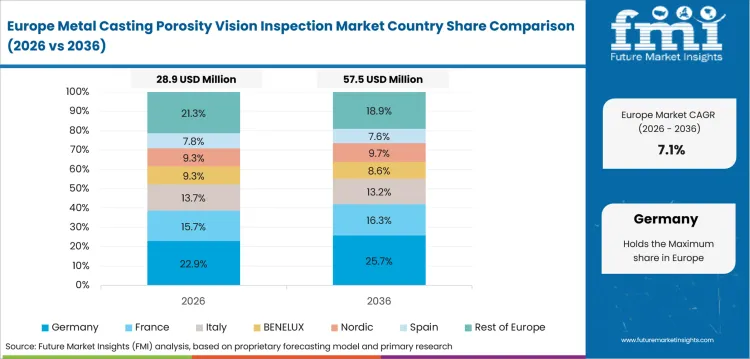
Country Market Snapshot Table
| Parameter | Value |
|---|---|
| Market Size in 2025 (Value) | USD 10.9 million |
| Market Size in 2026 (Value) | USD 11.8 million |
| Market Forecast in 2036 (Value) | USD 26.4 million |
| CAGR (2026 to 2036) | 8.4% |
| Years Considered | 2021 to 2036 |
| Base Year | 2025 |
| Forecast Period | 2026 to 2036 |
| Units Considered | Value (USD million) |
| Leading Sub-Region | Bavaria, Baden-Wurttemberg and North Rhine-Westphalia |
Germany Metal Casting Porosity Vision Inspection Market Outlook
Germany demand is built around process proof and automation integration. Foundries and automotive suppliers usually evaluate porosity inspection within documented production systems.
Buyers tend to expect stable calibration, serviceability and data links into factory systems. Supplier selection is therefore more integration-led than price-led in many projects.
Key Growth Drivers
- Automotive casting demand is supported by local vehicle output. GTAI reported Germany produced almost 4.1 million passenger cars in 2024.
- Factory ordering supports inspection projects. Destatis reported manufacturing orders rose 7.8% in December 2025.
- Local supplier depth is expected to help buyers access cameras and automation platforms.
- Automotive supplier audits are likely to increase demand for pore-size records and defect proof.
Key Restraints
- Validation cycles can slow supplier switching when inspection results affect customer audit acceptance.
- Engineering cost raises the entry barrier for smaller system integrators that must support plants on site.
- Factory weakness can delay inspection upgrades. Destatis reported industrial production fell 1.9% in December 2025.
What makes Germany unique
Germany combines local vision suppliers with demanding buyer validation and reference-market credibility.
Key Companies
- Basler
- Siemens
- SICK
- Balluff
- Cognex Germany
- Keyence Germany
- Datalogic Germany
Sales & Marketing Channels
- Direct sales to automotive tier suppliers
- Siemens automation ecosystem partners
- Specialist machine vision integrators
- Foundry equipment OEMs
- Technical distributor networks
- Plant digitalization programs
Country Segment Breakdown Table
| Segment | Sub-Segments |
|---|---|
| By Component | Cameras · Lenses · Lighting · Frame Grabbers · Vision Software · Services |
| By Inspection Type | Defect Detection · Measurement · OCR/OCV · Presence/Absence · Guidance |
| By Deployment | Inline · At-line · Robotic Cell · Portable |
| By End-use Industry | Electronics · Automotive · Packaging · Pharmaceuticals · Food & Beverage · Metals |
| By Region | North America · Latin America · Europe · East Asia · South Asia & Pacific · Middle East & Africa |
| Key Sub-Regions Covered | Bavaria, Baden-Wurttemberg and North Rhine-Westphalia |
Frequently Asked Questions
How fast is Germany metal casting porosity vision inspection market growing?
Demand in Germany is forecast to grow at 8.4% from 2026 to 2036 through supplier audits and machine vision depth.
Who leads Germany metal casting porosity vision inspection market?
Basler and Siemens compete through local automation channels. SICK and Balluff support foundry inspection through sensor and machine vision portfolios.
What is driving adoption in Germany metal casting porosity vision inspection market?
Adoption is supported by casting quality documentation and repeatable surface-defect proof.
What is the metal casting porosity vision inspection market outlook in the United States?
An 8.0% CAGR through 2036 reflects automotive and aerospace casting users raising repeatable proof needs.
Country Market Snapshot Table
| Parameter | Value |
|---|---|
| Market Size in 2025 (Value) | USD 19.0 million |
| Market Size in 2026 (Value) | USD 20.5 million |
| Market Forecast in 2036 (Value) | USD 44.3 million |
| CAGR (2026 to 2036) | 8.0% |
| Years Considered | 2021 to 2036 |
| Base Year | 2025 |
| Forecast Period | 2026 to 2036 |
| Units Considered | Value (USD million) |
| Leading Sub-Region | Midwest, Southeast and Texas manufacturing corridors |
United States Metal Casting Porosity Vision Inspection Market Outlook
United States demand is shaped by automation in automotive, aerospace and industrial metalworking plants. Buyers look for inspection systems that reduce manual judgment and document results for customer audits.
System integrators remain important in France. Many plants require custom fixturing and lighting before camera checks can support customer audits.
Key Growth Drivers
- Automotive scale supports casting inspection. USA International Trade Administration reported the United States produced 10.6 million vehicles in 2024.
- Transportation equipment spending supports casting quality projects. The USA Census Bureau reported durable goods orders at USD 346.0 billion in April 2026.
- Aerospace and defense casting users are expected to add demand where surface-defect proof affects release decisions.
- Domestic system integrators are likely to support custom robot and camera cells for foundries.
Key Restraints
- Factory spending can pause when durable goods orders shift by month and buyers delay capital approvals.
- Camera systems remain limited for hidden internal voids, which keeps X-ray and CT inspection in high-risk programs.
- Factory output can shift by month and delay capital approvals. The Federal Reserve reported manufacturing output was unchanged in May 2026.
What makes United States unique
The United States has a large integrator base and strong demand for documented inspection in automotive and aerospace casting.
Key Companies
- Cognex
- Zebra Technologies
- Teledyne DALSA
- Keyence America
- SICK USA
- Omron Automation Americas
- Datalogic USA
Sales & Marketing Channels
- Machine vision system integrators
- Automotive tier supplier programs
- Aerospace quality audits
- Industrial distributor networks
- Direct camera supplier sales
- Robot cell partnerships
Country Segment Breakdown Table
| Segment | Sub-Segments |
|---|---|
| By Component | Cameras · Lenses · Lighting · Frame Grabbers · Vision Software · Services |
| By Inspection Type | Defect Detection · Measurement · OCR/OCV · Presence/Absence · Guidance |
| By Deployment | Inline · At-line · Robotic Cell · Portable |
| By End-use Industry | Electronics · Automotive · Packaging · Pharmaceuticals · Food & Beverage · Metals |
| By Region | North America · Latin America · Europe · East Asia · South Asia & Pacific · Middle East & Africa |
| Key Sub-Regions Covered | Midwest, Southeast and Texas manufacturing corridors |
Frequently Asked Questions
How fast is United States metal casting porosity vision inspection market growing?
Demand in the United States is forecast to grow at 8.0% from 2026 to 2036 through aerospace and automotive inspection needs.
Who leads United States metal casting porosity vision inspection market?
Cognex and Zebra Technologies compete through USA automation channels. Teledyne DALSA and Keyence America support camera-based inspection projects.
What is driving adoption in United States metal casting porosity vision inspection market?
Adoption is supported by casting quality documentation and repeatable surface-defect proof.
How is the metal casting porosity vision inspection market performing in France?
A 7.5% CAGR through 2036 reflects targeted EV and hybrid component quality programs.
Country Market Snapshot Table
| Parameter | Value |
|---|---|
| Market Size in 2025 (Value) | USD 5.4 million |
| Market Size in 2026 (Value) | USD 5.8 million |
| Market Forecast in 2036 (Value) | USD 12.0 million |
| CAGR (2026 to 2036) | 7.5% |
| Years Considered | 2021 to 2036 |
| Base Year | 2025 |
| Forecast Period | 2026 to 2036 |
| Units Considered | Value (USD million) |
| Leading Sub-Region | Auvergne-Rhone-Alpes and northern automotive corridors |
France Metal Casting Porosity Vision Inspection Market Outlook
France is a measured growth market for porosity vision inspection. Demand comes from automotive casting programs that need clearer defect control across supplier networks.
At-line systems may be used first when plants want to document defect frequency. Inline projects are expected to follow when model allocation and production volumes justify automation.
Key Growth Drivers
- Vehicle programs support inspection demand. SDES reported 1.665 million new passenger cars were registered in France in 2025.
- Factory recovery can support inspection trials. INSEE reported manufacturing output increased 1.4% in February 2025.
- European integrator access is expected to help buyers use tested lighting and camera recipes.
- EV and hybrid component programs are likely to raise demand for traceable surface-defect evidence.
Key Restraints
- Concentrated automotive accounts can make sales cycles project-specific and slower.
- Some plants delay inspection upgrades until new model allocation is confirmed.
- Factory softness can slow broad inline rollout. INSEE reported manufacturing output fell 1.0% in May 2025.
What makes France unique
France is a channel-sensitive market where service coverage can decide adoption speed.
Key Companies
- Basler France
- Cognex France
- Keyence France
- SICK France
- Omron France
- Teledyne DALSA
- Datalogic France
Sales & Marketing Channels
- European automation distributors
- Automotive supplier quality programs
- Foundry retrofit integrators
- Direct OEM specification support
- Maintenance and service contracts
- Cross-border European sales teams
Country Segment Breakdown Table
| Segment | Sub-Segments |
|---|---|
| By Component | Cameras · Lenses · Lighting · Frame Grabbers · Vision Software · Services |
| By Inspection Type | Defect Detection · Measurement · OCR/OCV · Presence/Absence · Guidance |
| By Deployment | Inline · At-line · Robotic Cell · Portable |
| By End-use Industry | Electronics · Automotive · Packaging · Pharmaceuticals · Food & Beverage · Metals |
| By Region | North America · Latin America · Europe · East Asia · South Asia & Pacific · Middle East & Africa |
| Key Sub-Regions Covered | Auvergne-Rhone-Alpes and northern automotive corridors |
Frequently Asked Questions
How fast is France metal casting porosity vision inspection market growing?
Demand in France is forecast to grow at 7.5% from 2026 to 2036 through EV component programs and at-line trials.
Who leads France metal casting porosity vision inspection market?
Basler France and Cognex France compete through local imaging support. Keyence France and SICK France support projects through automation channels.
What is driving adoption in France metal casting porosity vision inspection market?
Adoption is supported by casting quality documentation and repeatable surface-defect proof.
What is driving metal casting porosity vision inspection growth in the United Kingdom?
A 7.0% CAGR through 2036 reflects targeted automation programs and tighter documentation in automotive supply chains.
Country Market Snapshot Table
| Parameter | Value |
|---|---|
| Market Size in 2025 (Value) | USD 4.6 million |
| Market Size in 2026 (Value) | USD 4.9 million |
| Market Forecast in 2036 (Value) | USD 9.6 million |
| CAGR (2026 to 2036) | 7.0% |
| Years Considered | 2021 to 2036 |
| Base Year | 2025 |
| Forecast Period | 2026 to 2036 |
| Units Considered | Value (USD million) |
| Leading Sub-Region | West Midlands and North East automotive corridors |
United Kingdom Metal Casting Porosity Vision Inspection Market Outlook
United Kingdom demand is smaller than Germany or France. Automotive and precision engineering corridors still support at-line inspection before buyers commit to full inline systems.
The best route to adoption is through integrators that understand casting defects and customer audit language. Service coverage is expected to matter after model changes and tooling updates.
Key Growth Drivers
- Automotive investment supports inspection demand. GOV.UK launched the GBP 2.5 billion DRIVE35 programme in July 2025.
- Manufacturing recovery supports at-line trials. ONS reported production output increased 1.2% in the three months to February 2026.
- Precision engineering users are expected to support at-line inspection for traceability and customer dispute evidence.
- Integrator-led projects are likely to help foundries add cameras without rebuilding the production cell.
Key Restraints
- Lower vehicle output limits the number of large casting inspection projects compared with larger European markets.
- Capital spending can be cautious where model programs and export demand remain uncertain.
- Production disruption can delay automation spending. ONS reported motor vehicle manufacturing fell 29.5% in September 2025.
What makes United Kingdom unique
The United Kingdom is strongest where precision engineering and automotive suppliers need documented inspection without large-volume scale.
Key Companies
- Cognex UK
- Keyence UK
- SICK UK
- Omron UK
- Zebra Technologies
- Teledyne DALSA
- Industrial Vision Systems
Sales & Marketing Channels
- Automation distributors
- Precision engineering integrators
- Automotive supplier audits
- Foundry retrofit programs
- Direct technical demonstrations
- Maintenance support contracts
Country Segment Breakdown Table
| Segment | Sub-Segments |
|---|---|
| By Component | Cameras · Lenses · Lighting · Frame Grabbers · Vision Software · Services |
| By Inspection Type | Defect Detection · Measurement · OCR/OCV · Presence/Absence · Guidance |
| By Deployment | Inline · At-line · Robotic Cell · Portable |
| By End-use Industry | Electronics · Automotive · Packaging · Pharmaceuticals · Food & Beverage · Metals |
| By Region | North America · Latin America · Europe · East Asia · South Asia & Pacific · Middle East & Africa |
| Key Sub-Regions Covered | West Midlands and North East automotive corridors |
Frequently Asked Questions
How fast is United Kingdom metal casting porosity vision inspection market growing?
Demand in the United Kingdom is forecast to grow at 7.0% from 2026 to 2036 through precision engineering and documentation needs.
Who leads United Kingdom metal casting porosity vision inspection market?
Cognex UK and Keyence UK compete through local vision systems. SICK UK and Omron UK support inspection projects through automation channels.
What is driving adoption in United Kingdom metal casting porosity vision inspection market?
Adoption is supported by casting quality documentation and repeatable surface-defect proof.
Metal Casting Porosity Vision Inspection Market - Report Scope
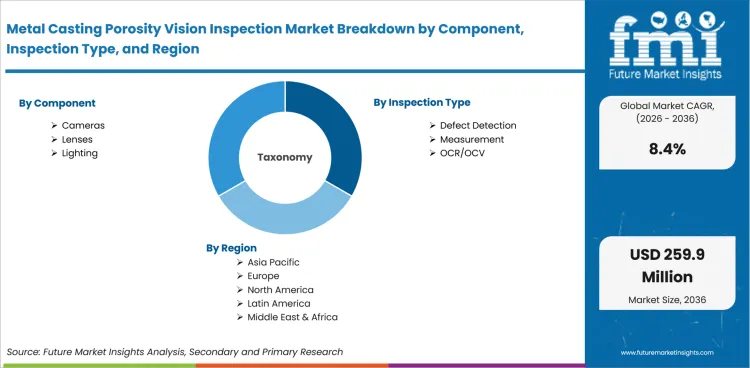
| Parameter | Details |
|---|---|
| Forecast period | 2026 to 2036 |
| Historical period | 2021 to 2025 |
| Quantitative unit | Revenue in USD million |
| By component | Cameras, lenses, lighting, frame grabbers, vision software, services |
| By inspection type | Defect detection, measurement, OCR/OCV, presence/absence, guidance |
| By deployment | Inline, at-line, robotic cell, portable |
| By end-use industry | Electronics, automotive, packaging, pharmaceuticals, food & beverage, metals |
| Regions covered | North America, Latin America, Europe, East Asia, South Asia & Pacific, Middle East & Africa |
| Countries covered | China, India, South Korea, Japan, Germany, United States, France, United Kingdom |
| Key companies profiled | Cognex, Keyence, Basler, Teledyne DALSA, Omron, Zebra Technologies, SICK, Balluff |
| Approach | Bottom-up product-boundary approach using system revenue, automation signals, country casting activity and inspection deployment mix |
Source: Future Market Insights, 2026.
Metal Casting Porosity Vision Inspection Market - Scope & Definition
| Attribute | Detail |
|---|---|
| Market Definition | Camera-based vision systems used to detect visible porosity and related surface void defects in metal castings. |
| Functions Covered | Visible pore detection, surface-void classification, pass-fail review, measurement, image capture, traceability export. |
| Applications Covered | Defect detection, measurement, OCR/OCV, presence/absence and guidance used in casting quality control. |
| End-Use Industries | Metals, automotive, electronics, packaging, pharmaceuticals and food & beverage manufacturing where cast or metal parts are inspected. |
| Components Covered | Cameras, lenses, lighting, frame grabbers, vision software and services. |
| Inclusions | Commercially sold porosity vision inspection systems across components, inspection types, deployments, end-use industries and regions. |
| Exclusions | Industrial X-ray, CT scanners, ultrasonic testing, laboratory metallography, destructive testing, surveillance cameras and manual-only inspection labor. |
Metal Casting Porosity Vision Inspection Market - Research Methodology
| Method | Description |
|---|---|
| Primary Research | FMI analyst interviews with foundry managers, automotive casting buyers, machine vision integrators, camera suppliers and quality-control teams. |
| Desk Research | Review of robotics statistics, automotive production data, foundry association evidence, company product information and automation references. |
| Market Sizing & Forecasting | Bottom-up model using system revenue, average project pricing, component mix, deployment type and country-level automation readiness. |
| Data Validation | Cross-verification against robot installations, casting activity, company portfolios, regional production evidence and inspection use-case checks. |
Metal Casting Porosity Vision Inspection Market Breakdown by Component and Other Segments
Metal Casting Porosity Vision Inspection Market Segmented by Component
- Cameras
- Lenses
- Lighting
- Frame Grabbers
- Vision Software
- Services
Metal Casting Porosity Vision Inspection Market Segmented by Inspection Type
- Defect Detection
- Measurement
- OCR/OCV
- Presence/Absence
- Guidance
Metal Casting Porosity Vision Inspection Market Segmented by Deployment
- Inline
- At-line
- Robotic Cell
- Portable
Metal Casting Porosity Vision Inspection Market Segmented by End-use Industry
- Electronics
- Automotive
- Packaging
- Pharmaceuticals
- Food & Beverage
- Metals
Metal Casting Porosity Vision Inspection Market Segmented by Region
- North America
- Latin America
- Europe
- East Asia
- South Asia & Pacific
- Middle East & Africa
Metal Casting Porosity Vision Inspection Market by Region
- North America
- United States
- Canada
- Europe
- Germany
- United Kingdom
- France
- Italy
- Spain
- Asia Pacific
- China
- Japan
- South Korea
- Taiwan
- Singapore
- Latin America
- Brazil
- Mexico
- Argentina
- Middle East & Africa
- GCC Countries
- South Africa
- Israel
Sources and Bibliography
- International Federation of Robotics. (2025, September 25). World Robotics 2025 report - industrial robots. International Federation of Robotics.
- European Foundry Federation. (2025, December). The European foundry industry 2024: EFF annual report. European Foundry Federation.
- The State Council of the People’s Republic of China. (2025, January 13). China’s auto output, sales both reach new heights in 2024.
- National Bureau of Statistics of China. (2025, January 24). Industrial production operation in December 2024.
- National Bureau of Statistics of China. (2025, December 28). The profit of industrial enterprises above the designated size from January to November in 2025.
- Press Information Bureau, Government of India. (2025, April 15). Powering India’s participation in global value chains.
- NITI Aayog. (2025, August 4). Unlocking a USD 200 billion opportunity: Electric vehicles in India.
- Press Information Bureau, Government of India. (2025, December 30). Year end review 2025: Ministry of Micro, Small and Medium Enterprises.
- Ministry of Trade, Industry and Energy, Republic of Korea. (2026, January 15). Automobile exports hit record high of USD 72 billion in 2025.
- Statistics Korea. (2026). Ministry of Data and Statistics current indicators.
- Invest Korea. (2025, January). Exploring opportunities for FDI: Prospects for Korea’s 13 major industries in 2025.
- Japan Automobile Manufacturers Association. (2025, September 26). The motor industry of Japan 2025.
- Ministry of Economy, Trade and Industry. (2025, August 7). Profile of Kyushu and Chubu regional manufacturing.
- Ministry of Economy, Trade and Industry. (2026, April 3). Indices of industrial production: February 2026.
- Germany Trade & Invest. (2025, May 20). The automotive industry in Germany.
- Federal Statistical Office of Germany. (2026, February 6). Production in December 2025: -1.9% on the previous month.
- Federal Statistical Office of Germany. (2026, February 6). New orders in manufacturing in December 2025: +7.8% on the previous month.
- USA International Trade Administration. (2025, November 20). SelectUSA automotive industry.
- USA Census Bureau. (2026, May 28). Monthly advance report on durable goods manufacturers’ shipments, inventories, and orders.
- Board of Governors of the Federal Reserve System. (2026, June 15). Industrial production and capacity utilization.
- Ministry for Ecological Transition, France. (2026, June 3). Road vehicle registrations.
- National Institute of Statistics and Economic Studies. (2025, April 4). In February 2025, manufacturing output bounced back.
- National Institute of Statistics and Economic Studies. (2025, July 4). In May 2025, manufacturing output went down by 1.0%.
- GOV.UK. (2025, July 13). Government launches GBP 2.5bn DRIVE35 programme to power UK auto investment and jobs.
- Office for National Statistics. (2026, April 16). Index of Production, UK: February 2026.
- Office for National Statistics. (2026, January 15). Index of Production, UK: November 2025.
- Cognex Corporation. (2024, April 2). Cognex launches the world’s first 3D vision system with AI.
- SICK AG. (2024, June 4). SICK Inspector83x delivers AI quality control out-of-the-box.
- Teledyne DALSA. (2024, July 9). Teledyne’s high-speed contact image sensors are now available in color.
- Hexagon Manufacturing Intelligence. March 2026. VG software release updates. Volume Graphics by Hexagon.
- Comet Technologies Canada Inc. December 9, 2025. Why Dragonfly 3D World leads the modern CT analysis software market. Dragonfly.
- Basler AG. (2025, October 14). Basler AG acquires 76% stake in Alpha TechSys Automation in India.
- Zebra Technologies. (2025, October 14). Zebra Aurora Vision 5.6 is available now.
- Basler AG. (2026, March 25). Basler AG and Orbbec launch technology partnership for industrial 3D vision in logistics and factory automation.
- Cognex Corporation. (2025, June 9). Cognex introduces OneVision: A breakthrough cloud platform for AI-powered machine vision.
This bibliography is provided for reader reference and is not exhaustive. The full report contains the complete reference list and detailed citations.
This Report Answers
- Market size estimates for 2026 and forecasts through 2036 for the metal casting porosity vision inspection market.
- Insights across more than 30 regional and country-level markets.
- Analysis of demand drivers, casting inspection use cases and buyer adoption behavior.
- Evaluation of leading components and deployment types with focus on cameras and inline systems.
- Assessment of surface-visible porosity control and the boundary with X-ray or CT inspection.
- Identification of opportunities across defect detection, software services and robot-fed inspection cells.
- Evaluation of supplier positioning across camera quality, vision software and automation integration.
- Country-level growth analysis covering China and India plus six more profiled markets.
- Assessment of the competitive landscape including vision system suppliers and imaging hardware companies.
- Delivery of market data, forecasts and supporting analysis in PDF and Excel formats.
Frequently Asked Questions
What is the growth prospect for metal casting porosity vision inspection?
Demand for metal casting porosity vision inspection is expected to rise steadily. Foundries are moving surface-defect checks closer to production.
Which companies are expected to shape the metal casting porosity vision inspection market?
Cognex and Keyence are expected to shape competition through vision systems and support depth. Basler, Teledyne DALSA and SICK hold relevant supplier positions.
Why are foundries investing in porosity vision inspection?
Foundries are investing in porosity vision inspection to reduce late rejection and document visible pore checks before machining adds cost.
Why are inline inspection channels important in this market?
Inline inspection supports faster release decisions and reduces manual review delays in high-volume casting cells.
Which components are gaining attention in porosity vision inspection?
Cameras and lighting are gaining attention. Image quality and surface contrast shape visible pore detection quality.
How do regulations and audits influence porosity inspection?
Customer audits influence porosity inspection through traceability requirements and repeatable pass-fail records.
Why is software important for porosity vision inspection?
Software matters when pore-size thresholds help quality teams separate cosmetic defects from rejection risks.
What role do robot cells play in porosity inspection?
Robot cells support repeatable part presentation and help camera systems hold inspection consistency across production shifts.
How do smaller foundries adopt porosity vision inspection?
Smaller foundries often start with portable or at-line systems before moving into inline projects after payback is proven.
How does vision inspection differ from X-ray inspection?
Vision inspection detects visible and near-surface defects. X-ray inspection is needed when buyers must find hidden internal voids.
Preview the report firsthand - request a free sample
Get SampleGet the brochure for pricing and purchase details.
Get PDFTable of Content
- Key Takeaways
- Market Size and CAGR
- Top Growth Driver
- Fastest Growing Segment
- Leading Region
- Key Companies
- Emerging Opportunities
- Executive Summary
- Global Market Outlook
- Demand-side Trends
- Supply-side Trends
- Technology Roadmap Analysis
- Analysis and Recommendations
- Analyst Perspective (What is happening? Why now? What should investors know?)
- Key Questions Answered
- How large is the market?
- What is the CAGR?
- What are key trends?
- Which region dominates?
- Who are the leaders?
- Market Overview
- Market Coverage / Taxonomy
- Market Definition / Scope / Limitations
- Research Methodology
- Chapter Orientation
- Analytical Lens and Working Hypotheses
- Market Structure, Signals, and Trend Drivers
- Benchmarking and Cross-market Comparability
- Market Sizing, Forecasting, and Opportunity Mapping
- Research Design and Evidence Framework
- Desk Research Programme (Secondary Evidence)
- Expert Input and Fieldwork (Primary Evidence)
- Tooling, Models, and Reference Databases
- Data Engineering and Model Build
- Quality Assurance and Audit Trail
- Market Background
- Market Dynamics (Drivers, Restraints, Opportunity, Trends)
- Scenario Forecast (Optimistic, Likely, Conservative)
- Impact Analysis
- AI Impact
- Sustainability Impact
- Regulatory Impact
- Technology Impact
- Consumer / Buyer Analysis
- Purchase Drivers
- Adoption Barriers
- Buyer Journey
- Opportunity Map Analysis
- Product Life Cycle Analysis
- Supply Chain Analysis
- Investment Feasibility Matrix
- Value Chain Analysis
- PESTLE and Porter's Analysis
- Regulatory Landscape
- Regional Parent Market Outlook
- Production and Consumption Statistics
- Import and Export Statistics
- Global Market Analysis and Forecast, 2021 to 2036
- Historical Market Size Value (USD Million) Analysis, 2021 to 2025
- Current and Future Market Size Value (USD Million) Projections, 2026 to 2036
- Y-o-Y Growth Trend Analysis
- Absolute $ Opportunity Analysis
- Global Market Pricing Analysis, 2021 to 2036
- Global Market Analysis and Forecast, By Component, 2021 to 2036
- Introduction / Key Findings
- Historical Market Size Value (USD Million) Analysis By Component, 2021 to 2025
- Current and Future Market Size Value (USD Million) Analysis and Forecast By Component, 2026 to 2036
- Cameras
- Lenses
- Lighting
- Cameras
- Y-o-Y Growth Trend Analysis By Component, 2021 to 2025
- Absolute $ Opportunity Analysis By Component, 2026 to 2036
- Global Market Analysis and Forecast, By Inspection Type, 2021 to 2036
- Introduction / Key Findings
- Historical Market Size Value (USD Million) Analysis By Inspection Type, 2021 to 2025
- Current and Future Market Size Value (USD Million) Analysis and Forecast By Inspection Type, 2026 to 2036
- Defect Detection
- Measurement
- OCR/OCV
- Defect Detection
- Y-o-Y Growth Trend Analysis By Inspection Type, 2021 to 2025
- Absolute $ Opportunity Analysis By Inspection Type, 2026 to 2036
- Global Market Analysis and Forecast, By Deployment, 2021 to 2036
- Introduction / Key Findings
- Historical Market Size Value (USD Million) Analysis By Deployment, 2021 to 2025
- Current and Future Market Size Value (USD Million) Analysis and Forecast By Deployment, 2026 to 2036
- Inline
- At-line
- Robotic Cell
- Inline
- Y-o-Y Growth Trend Analysis By Deployment, 2021 to 2025
- Absolute $ Opportunity Analysis By Deployment, 2026 to 2036
- Global Market Analysis and Forecast, By End-use Industry, 2021 to 2036
- Introduction / Key Findings
- Historical Market Size Value (USD Million) Analysis By End-use Industry, 2021 to 2025
- Current and Future Market Size Value (USD Million) Analysis and Forecast By End-use Industry, 2026 to 2036
- Metals
- Electronics
- Automotive
- Metals
- Y-o-Y Growth Trend Analysis By End-use Industry, 2021 to 2025
- Absolute $ Opportunity Analysis By End-use Industry, 2026 to 2036
- Global Market Analysis and Forecast, By Region, 2021 to 2036
- Introduction
- Historical Market Size Value (USD Million) Analysis By Region, 2021 to 2025
- Current Market Size Value (USD Million) Analysis and Forecast By Region, 2026 to 2036
- North America
- Latin America
- Western Europe
- Eastern Europe
- East Asia
- South Asia and Pacific
- Middle East & Africa
- Market Attractiveness Analysis By Region
- North America Market Analysis and Forecast, By Country, 2021 to 2036
- Historical Market Size Value (USD Million) Trend Analysis By Market Taxonomy, 2021 to 2025
- Market Size Value (USD Million) Forecast By Market Taxonomy, 2026 to 2036
- By Country
- USA
- Canada
- Mexico
- By Component
- By Inspection Type
- By Deployment
- By End-use Industry
- By Country
- Market Attractiveness Analysis
- By Country
- By Component
- By Inspection Type
- By Deployment
- By End-use Industry
- Key Takeaways
- Latin America Market Analysis and Forecast, By Country
- Historical Market Size Value (USD Million) Trend Analysis By Market Taxonomy, 2021 to 2025
- Market Size Value (USD Million) Forecast By Market Taxonomy, 2026 to 2036
- By Country
- Brazil
- Chile
- Rest of Latin America
- By Component
- By Inspection Type
- By Deployment
- By End-use Industry
- By Country
- Market Attractiveness Analysis
- By Country
- By Component
- By Inspection Type
- By Deployment
- By End-use Industry
- Key Takeaways
- Western Europe Market Analysis and Forecast, By Country
- Historical Market Size Value (USD Million) Trend Analysis By Market Taxonomy, 2021 to 2025
- Market Size Value (USD Million) Forecast By Market Taxonomy, 2026 to 2036
- By Country
- Germany
- UK
- Italy
- Spain
- France
- Nordic
- BENELUX
- Rest of Western Europe
- By Component
- By Inspection Type
- By Deployment
- By End-use Industry
- By Country
- Market Attractiveness Analysis
- By Country
- By Component
- By Inspection Type
- By Deployment
- By End-use Industry
- Key Takeaways
- Eastern Europe Market Analysis and Forecast, By Country
- Historical Market Size Value (USD Million) Trend Analysis By Market Taxonomy, 2021 to 2025
- Market Size Value (USD Million) Forecast By Market Taxonomy, 2026 to 2036
- By Country
- Russia
- Poland
- Hungary
- Balkan & Baltic
- Rest of Eastern Europe
- By Component
- By Inspection Type
- By Deployment
- By End-use Industry
- By Country
- Market Attractiveness Analysis
- By Country
- By Component
- By Inspection Type
- By Deployment
- By End-use Industry
- Key Takeaways
- East Asia Market Analysis and Forecast, By Country
- Historical Market Size Value (USD Million) Trend Analysis By Market Taxonomy, 2021 to 2025
- Market Size Value (USD Million) Forecast By Market Taxonomy, 2026 to 2036
- By Country
- China
- Japan
- South Korea
- By Component
- By Inspection Type
- By Deployment
- By End-use Industry
- By Country
- Market Attractiveness Analysis
- By Country
- By Component
- By Inspection Type
- By Deployment
- By End-use Industry
- Key Takeaways
- South Asia and Pacific Market Analysis and Forecast, By Country
- Historical Market Size Value (USD Million) Trend Analysis By Market Taxonomy, 2021 to 2025
- Market Size Value (USD Million) Forecast By Market Taxonomy, 2026 to 2036
- By Country
- India
- ASEAN
- Australia & New Zealand
- Rest of South Asia and Pacific
- By Component
- By Inspection Type
- By Deployment
- By End-use Industry
- By Country
- Market Attractiveness Analysis
- By Country
- By Component
- By Inspection Type
- By Deployment
- By End-use Industry
- Key Takeaways
- Middle East & Africa Market Analysis and Forecast, By Country
- Historical Market Size Value (USD Million) Trend Analysis By Market Taxonomy, 2021 to 2025
- Market Size Value (USD Million) Forecast By Market Taxonomy, 2026 to 2036
- By Country
- Kingdom of Saudi Arabia
- Other GCC Countries
- Türkiye
- South Africa
- Other African Union
- Rest of Middle East & Africa
- By Component
- By Inspection Type
- By Deployment
- By End-use Industry
- By Country
- Market Attractiveness Analysis
- By Country
- By Component
- By Inspection Type
- By Deployment
- By End-use Industry
- Key Takeaways
- Key Countries Market Analysis
- USA
- Pricing Analysis
- Market Share Analysis, 2025
- By Component
- By Inspection Type
- By Deployment
- By End-use Industry
- Canada
- Pricing Analysis
- Market Share Analysis, 2025
- By Component
- By Inspection Type
- By Deployment
- By End-use Industry
- Mexico
- Pricing Analysis
- Market Share Analysis, 2025
- By Component
- By Inspection Type
- By Deployment
- By End-use Industry
- Brazil
- Pricing Analysis
- Market Share Analysis, 2025
- By Component
- By Inspection Type
- By Deployment
- By End-use Industry
- Chile
- Pricing Analysis
- Market Share Analysis, 2025
- By Component
- By Inspection Type
- By Deployment
- By End-use Industry
- Germany
- Pricing Analysis
- Market Share Analysis, 2025
- By Component
- By Inspection Type
- By Deployment
- By End-use Industry
- UK
- Pricing Analysis
- Market Share Analysis, 2025
- By Component
- By Inspection Type
- By Deployment
- By End-use Industry
- Italy
- Pricing Analysis
- Market Share Analysis, 2025
- By Component
- By Inspection Type
- By Deployment
- By End-use Industry
- Spain
- Pricing Analysis
- Market Share Analysis, 2025
- By Component
- By Inspection Type
- By Deployment
- By End-use Industry
- France
- Pricing Analysis
- Market Share Analysis, 2025
- By Component
- By Inspection Type
- By Deployment
- By End-use Industry
- India
- Pricing Analysis
- Market Share Analysis, 2025
- By Component
- By Inspection Type
- By Deployment
- By End-use Industry
- ASEAN
- Pricing Analysis
- Market Share Analysis, 2025
- By Component
- By Inspection Type
- By Deployment
- By End-use Industry
- Australia & New Zealand
- Pricing Analysis
- Market Share Analysis, 2025
- By Component
- By Inspection Type
- By Deployment
- By End-use Industry
- China
- Pricing Analysis
- Market Share Analysis, 2025
- By Component
- By Inspection Type
- By Deployment
- By End-use Industry
- Japan
- Pricing Analysis
- Market Share Analysis, 2025
- By Component
- By Inspection Type
- By Deployment
- By End-use Industry
- South Korea
- Pricing Analysis
- Market Share Analysis, 2025
- By Component
- By Inspection Type
- By Deployment
- By End-use Industry
- Russia
- Pricing Analysis
- Market Share Analysis, 2025
- By Component
- By Inspection Type
- By Deployment
- By End-use Industry
- Poland
- Pricing Analysis
- Market Share Analysis, 2025
- By Component
- By Inspection Type
- By Deployment
- By End-use Industry
- Hungary
- Pricing Analysis
- Market Share Analysis, 2025
- By Component
- By Inspection Type
- By Deployment
- By End-use Industry
- Kingdom of Saudi Arabia
- Pricing Analysis
- Market Share Analysis, 2025
- By Component
- By Inspection Type
- By Deployment
- By End-use Industry
- Türkiye
- Pricing Analysis
- Market Share Analysis, 2025
- By Component
- By Inspection Type
- By Deployment
- By End-use Industry
- South Africa
- Pricing Analysis
- Market Share Analysis, 2025
- By Component
- By Inspection Type
- By Deployment
- By End-use Industry
- USA
- Market Structure Analysis
- Competition Dashboard
- Competition Benchmarking
- Market Share Analysis of Top Players
- By Regional
- By Component
- By Inspection Type
- By Deployment
- By End-use Industry
- Emerging Startups
- Innovation Benchmarking
- Competition Analysis
- Competition Deep Dive
- Cognex
- Overview
- Product Portfolio
- Profitability by Market Segments (Product/Region/Sales Channel)
- Sales Footprint
- Strategy Overview
- Marketing Strategy
- Product Strategy
- Channel Strategy
- Keyence
- Basler
- Teledyne DALSA
- Omron
- Zebra Technologies
- SICK
- Cognex
- Case Studies
- Success Stories
- Recent Developments
- Competition Deep Dive
- Assumptions & Acronyms Used


