
- Market Size (2026)
- USD 56.3 Bn
- Forecast (2036)
- USD 65.3 Bn
- CAGR (2026 to 2036)
- 1.5%
How Big Is the Metallurgical Coke Market in 2026?
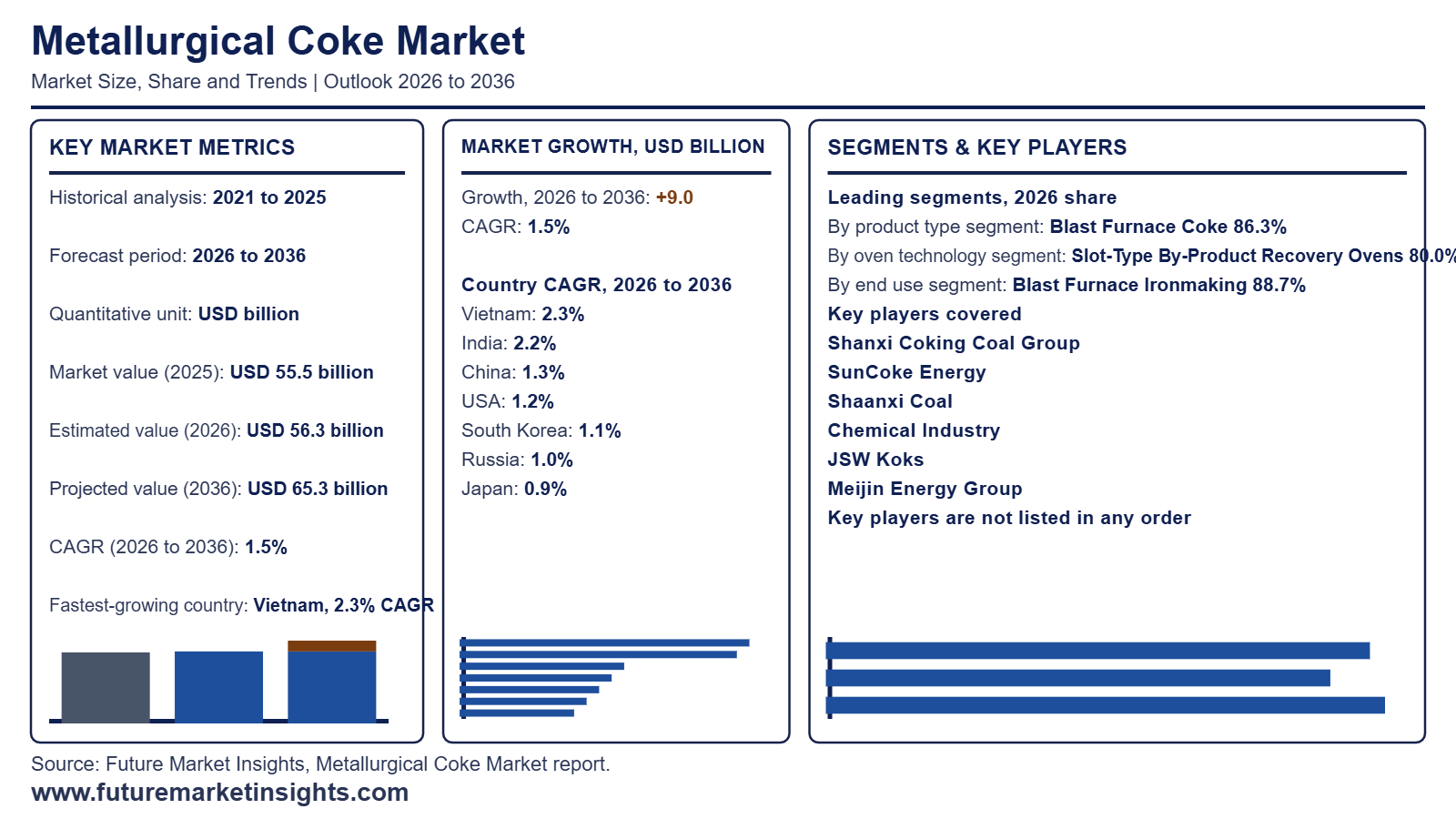
The metallurgical coke market demonstrated steady progress from USD 55.5 billion in 2025 to USD 56.3 billion in 2026, building toward a targeted valuation of USD 65.3 billion by 2036 at a 1.5% CAGR. Continued blast-furnace ironmaking campaigns and battery renewal projects generate an incremental opportunity of USD 9.0 billion over the ten-year period.
| Market Metric | Valuation / Share / Forecast Benchmark |
|---|---|
| 2025 Market Size (Historical) | USD 55.5 billion |
| 2026 Market Size (Estimated) | USD 56.3 billion |
| 2036 Market Size (Projected) | USD 65.3 billion |
| Compound Annual Growth Rate (2026 to 2036) | 1.5% CAGR |
| Incremental Dollar Opportunity (2026 to 2036) | USD 9.0 billion |
| Dominant Product Type Segment (2026 Share) | Blast Furnace Coke (86.3% share in 2026) | Other Segment Combined (13.7%) |
| Leading Oven Technology Segment (2026 Share) | Slot-Type By-Product Recovery Ovens (80.0% share in 2026) | Other Segment Combined (20.0%) |
| Leading End Use Segment (2026 Share) | Blast Furnace Ironmaking (88.7% share in 2026) | Other Segment Combined (11.3%) |
| Leading Supplier Type Segment (2026 Share) | Independent Domestic Coke Makers (74.0% share in 2026) | Other Segment Combined (26.0%) |
| Fastest-Growing Country Markets (2026 to 2036) | Vietnam (2.3% CAGR), India (2.2% CAGR), China (1.3% CAGR) |
| Leading Tier-1 Companies | Shanxi Coking Coal Group, SunCoke Energy, Shaanxi Coal and Chemical Industry, JSW Koks, Meijin Energy Group |
Source: Future Market Insights analysis of the metallurgical coke market, 2026.
Executive Market Overview
Industrial demand for metallurgical coke is supported by baseline primary crude steel production in blast furnaces, where high-strength carbon coke acts simultaneously as a chemical reducing agent, thermal energy source, and structural permeable bed for iron ore smelting. Production data released by the World Steel Association (2025) confirms that over 71% of global crude steel continues to depend on integrated blast furnace-basic oxygen furnace (BF-BOF) pathways, sustaining continuous bulk coking coal procurement schedules. Mainland China and India anchor the vast majority of global consumption, with Indian integrated steelmakers recording the fastest percentage growth due to national infrastructure steel expansion mandates across metals and coking coal.
Coke oven operators defend operating cash margins by selecting cost-effective coking coal blends (pairing premium hard coking coals with semi-soft coals) and recovering high-value chemical byproducts such as coal tar and coke oven gas rather than selling unprocessed coke. Environmental carbon taxation policies and the gradual industrial scale-up of hydrogen-based direct reduced iron (DRI) electric arc furnace plants present long-term structural restraints on consumption growth. FMI projects high-CSR (coke strength after reaction) blast furnace coke to hold the primary market share through 2036. Market sizing covers commercial merchant sales and merchant sales of blast furnace coke [or delete the Exclusions item] and foundry coke, while excluding petroleum needle coke and calcined petroleum coke (CPC).
Analyst Perspective
"Merchant coke producers will defend realizations by locking in multi-year furnace supply agreements and meeting strict post-reaction strength targets rather than chasing spot volume. High coking-coal import exposure and oven emissions retrofits remain the primary margin risks through 2036."
- Nikhil Kaitwade, Principal Consultant, Future Market Insights.
Major Market Trends and Insights
- Stamp-Charged Batteries and Gas Injection Optimize Coal Blends: Rising premium coking-coal costs are pushing integrated mills to adopt stamp-charged coke batteries and gas-injection systems that broaden coal-blend flexibility. When JFE Steel Corporation (September 2026) started Japan's first large stamp-charged coke oven at Fukuyama and Tata Steel Limited (September 2026) commissioned India's first coke-oven gas injection project at Meramandali, both moves proved that process upgrades cut external fossil fuel rates. Anthracite blending inside flat steel furnace campaigns is expected to influence buyer adoption and support steady industry efficiency through 2036.
- Selective Battery Renewal and Restructuring Anchor Mature Regions: Aging oven fleets and uneven blast-furnace operating rates in Europe and North America are driving selective battery rebuilds rather than broad capacity expansion. JSW Koks (May 2025) began heating its 610,000-tonne Battery No. 4 at Przyjaźń in May 2025, while JSW Group (September 2026) approved a 2026 to 2035 remedy program in September 2026 and SunCoke Energy (October 2026) adjusted its contract-to-spot mix after closing Haverhill Battery No. 1. So, while mature carbon steel producers keep batteries running, restructuring will govern regional supply reliability.
- Coastal Blast-Furnace Expansions Reshape Asian Seaborne Coke Flows: Greenfield blast-furnace complexes in coastal Asian hubs are shifting merchant coke procurement toward port-linked delivery schedules at present. Hoa Phat Group (September 2026) reported that its six Dung Quat blast furnaces reached 1.0 million tonnes of monthly hot-metal output in August 2026, confirming how rapidly coastal ironmaking demand is scaling. Reliable port handling preserves lump sizing for integrated mills and regional foundries casting exhaust manifolds, raising the likelihood of long-term seaborne supply contracts.
What Are the Main Drivers, Restraints, and Opportunities?
Sustained blast-furnace ironmaking across Asia drives recurring coke procurement, whereas stricter oven emission rules and coal cost swings restrain merchant margins, leaving battery modernization and specialty foundry grades as primary growth opportunities.
Driver: Integrated Blast-Furnace Ironmaking Expansion in Emerging Steel Hubs
Blast-furnace operators require continuous deliveries of low-ash, high-strength coke because burden permeability cannot be maintained by pulverized coal injection alone. Recent figures from the World Steel Association (2026) recorded 164.9 million tonnes of crude steel output in India during 2025, proving that expanding hot-metal production keeps furnace coke demand active. From these production runs, it can be projected that contracted deliveries will hold steady, while spot cargoes fluctuate; however, buyers still test sizing and rare earth nodularizer compatibility before approving new batteries.
Restraint: Tighter Oven Emissions Rules and Coking-Coal Cost Volatility
Environmental compliance mandates and raw-material import exposure are raising operating expenses across established coking plants at present. Stated simply, when the State Council of China (January 2025) announced stricter coking emissions standards in January 2025 and the United States Environmental Protection Agency (2025) enforced tighter benzene fenceline rules, producers had to absorb costly retrofits and quality-testing outlays. Because of this, smaller high-emission batteries face closure risk, restraining merchant supply expansion when steel mills resist coal-linked price surcharges.
Opportunity: Coke-Oven Gas Recovery and High-Efficiency Battery Upgrades
Modernization of by-product recovery units and tar-handling systems gives coking operators a direct route to stronger plant margins without waiting for higher steel demand. In August 2026, Shaanxi Coal and Chemical Industry Group (August 2026) improved tar-tank dewatering at its coking subsidiary, showing how process tuning stabilizes recovery economics. Suppliers pairing reliable furnace coke with clean-burning foundry grades for lightweight piston tooling makers are positioned to capture resilient specialty demand through 2036.
How Is the Metallurgical Coke Market Segmented?
Metallurgical Coke Market is segmented by Product Type, Oven Technology, End Use, Supplier Type, and Region. Forecast period from 2026 to 2036.
| Segmentation Axis | Sub-Segments Covered | 2026 Leading Segment & Share | Other Segment Combined & Total |
|---|---|---|---|
| Product Type | Blast Furnace Coke, Foundry Coke, Nut Coke | Blast Furnace Coke (86.3% share in 2026) | Other Segment Combined (13.7%) | Total (100.0%) |
| Oven Technology | Slot-Type By-Product Recovery Ovens, Stamp-Charged By-Product Ovens, Heat-Recovery Ovens, Beehive and Other Ovens | Slot-Type By-Product Recovery Ovens (80.0% share in 2026) | Other Segment Combined (20.0%) | Total (100.0%) |
| End Use | Blast Furnace Ironmaking, Foundries and Cast Iron, Ferroalloys and Silicon Metal | Blast Furnace Ironmaking (88.7% share in 2026) | Other Segment Combined (11.3%) | Total (100.0%) |
| Supplier Type | Independent Domestic Coke Makers, Steel-Linked Merchant Plants, Imported Coke, Coke Sold Under Long-Term Contracts | Independent Domestic Coke Makers (74.0% share in 2026) | Other Segment Combined (26.0%) | Total (100.0%) |
| Region | North America, Latin America, Western Europe, Eastern Europe, East Asia, South Asia and Pacific, Middle East and Africa | East Asia (led by China at 1.3% CAGR) | Global Coverage Across 7 Core Countries (100.0%) |
Source: Future Market Insights analysis of the metallurgical coke market, 2026.
Why Does Blast Furnace Coke Account for 86.3% of Product Type Revenue in 2026?
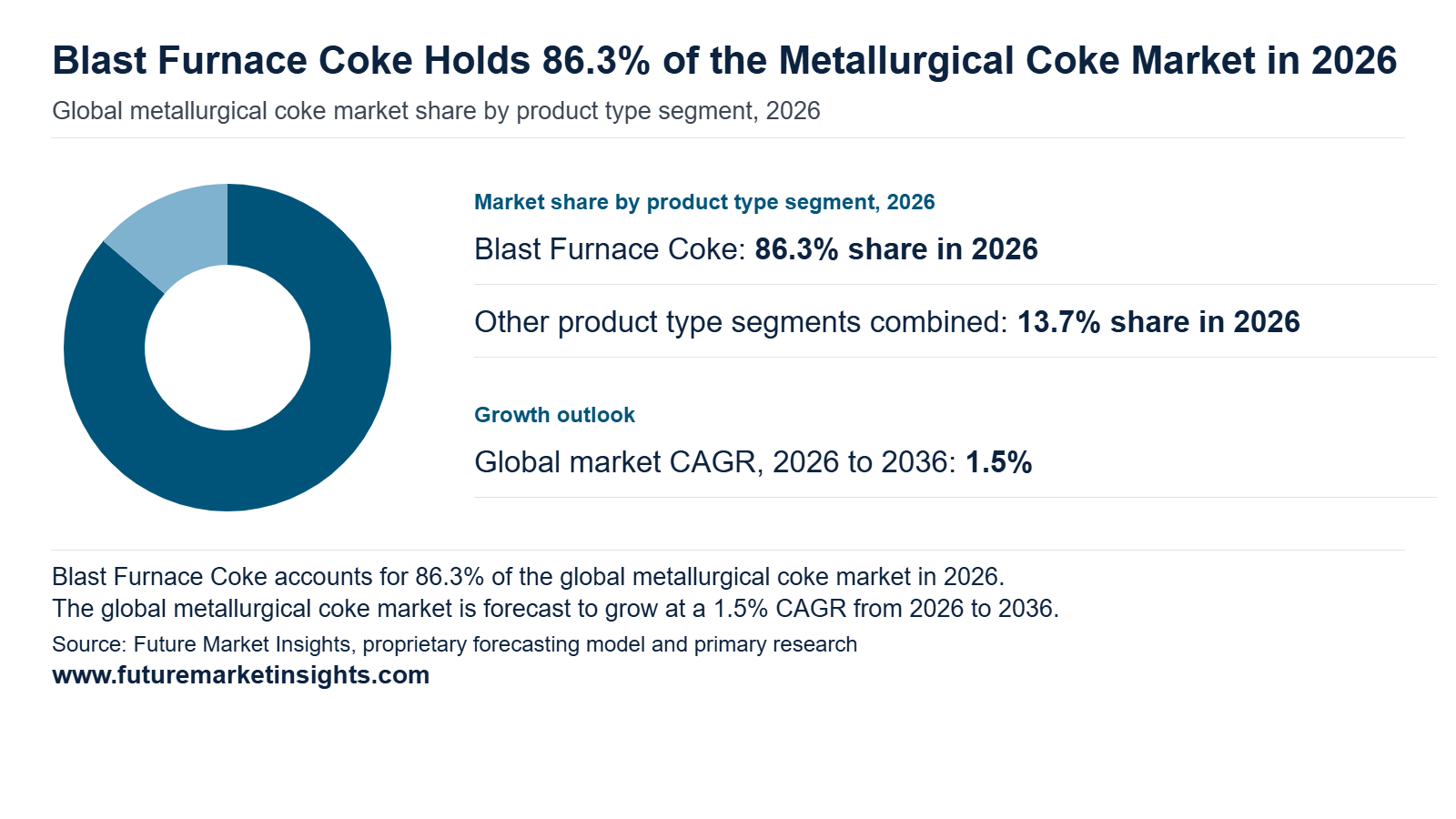
Blast Furnace Coke captures 86.3% of product type revenue in 2026 because integrated ironmaking requires narrow lump sizing and high mechanical strength after reaction to keep the furnace permeable. Neither foundry coke nor nut coke can replace primary burden coke in large furnaces without risking unstable gas flow. When SunCoke Energy (November 2025) extended its 500,000-ton annual Haverhill supply contract in November 2025, it proved how large-scale furnace procurement locks in demand. Buyer preferences for tested hot strength are expected to keep blast furnace coke ahead through 2036.
What Sustains Slot-Type By-Product Recovery Ovens at 80.0% of Oven Technology?
Due to long capital replacement cycles and established chemical co-product integration, Slot-Type By-Product Recovery Ovens hold 80.0% of oven technology revenue in 2026. Current batteries connect directly to gas-cleaning and quenching lines, while stamp-charged and heat-recovery ovens expand only in selective projects. JSW Koks (May 2025) started heating its 610,000-tonne Battery No. 4 at Przyjaźń in May 2025, showing that European producers still invest in modern recovery batteries. Consequently, installed infrastructure and co-product economics will sustain this technology's lead through 2036.
Why Is Blast Furnace Ironmaking the Leading End Use at 88.7%?
Blast Furnace Ironmaking accounts for 88.7% of end-use revenue in 2026 as integrated steelworks consume coke continuously across multi-year furnace campaigns. Foundries and ferroalloy smelters run on smaller batch schedules and distinct thermal rules, leaving hot-metal production as the decisive buyer. Hoa Phat Group (September 2025) produced first hot metal at its second Dung Quat 2 blast furnace in September 2025, confirming active Asian capacity additions. While electric-arc furnaces are growing in mature regions, sustained blast-furnace campaigns will anchor demand through 2036.
How Do Independent Domestic Coke Makers Hold 74.0% of Supplier Type?
Independent Domestic Coke Makers represent 74.0% of supplier type revenue in 2026 because merchant batteries supply multiple regional mills and foundries without captive ownership limits. Domestic plants also avoid ocean freight surcharges and customs delays that raise landed costs on imported coke. Meijin Energy Group (August 2026) recorded 3.7 million tonnes of coke output in the first half of 2026 across its Chinese merchant network, proving the scale of independent supply. Multi-customer domestic contracting is projected to sustain this channel's lead through 2036.
Metallurgical Coke Market by Region and Country (2026 to 2036)
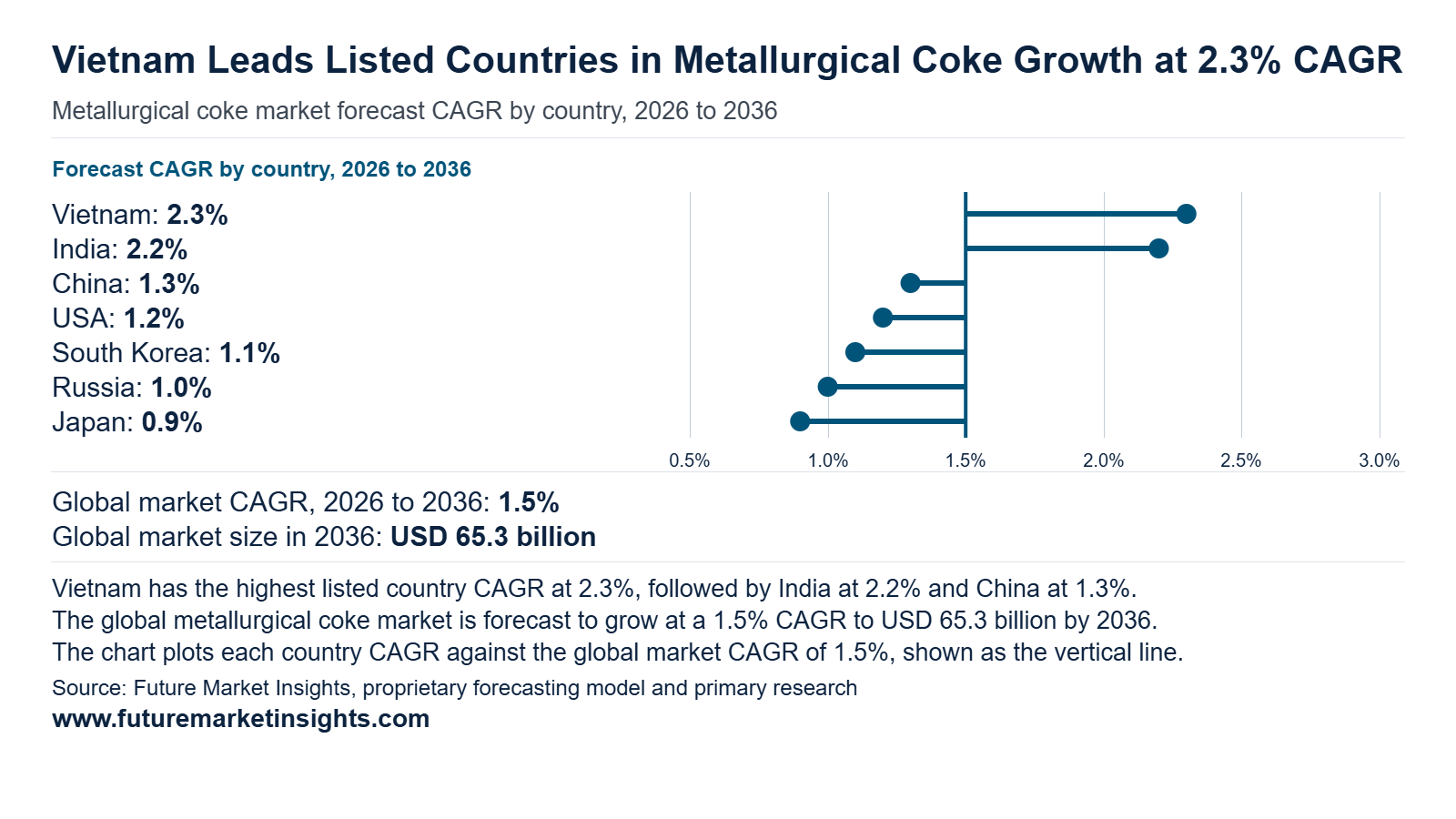
East Asia dominates global metallurgical coke revenue due to China's vast coking and blast-furnace base, while South and Southeast Asia post the fastest percentage growth through 2036. FMI expects Vietnam to lead profiled national growth at a 2.3% CAGR, followed closely by India at 2.2%. China expands at 1.3%, the USA at 1.2%, South Korea at 1.1%, Russia at 1.0%, and Japan at 0.9%, creating a 1.4 percentage point spread across the seven tracked countries as emerging blast-furnace additions contrast with mature steelmaking consolidation.
| Country | 2026 Revenue | 2036 Revenue | 10-Year Addition | 2026 to 2036 CAGR | Global Share (2026 -> 2036) |
|---|---|---|---|---|---|
| China | USD 28.2 billion | USD 32.1 billion | +USD 3.9 billion | 1.3% | 50.1% -> 49.2% |
| India | USD 6.8 billion | USD 8.5 billion | +USD 1.7 billion | 2.2% | 12.1% -> 13.0% |
| Japan | USD 4.5 billion | USD 4.9 billion | +USD 0.4 billion | 0.9% | 8.0% -> 7.5% |
| Russia | USD 3.9 billion | USD 4.3 billion | +USD 0.4 billion | 1.0% | 6.9% -> 6.6% |
| USA | USD 3.4 billion | USD 3.8 billion | +USD 0.4 billion | 1.2% | 6.0% -> 5.8% |
| South Korea | USD 2.8 billion | USD 3.1 billion | +USD 0.3 billion | 1.1% | 5.0% -> 4.7% |
| Vietnam | USD 1.8 billion | USD 2.3 billion | +USD 0.5 billion | 2.3% | 3.2% -> 3.5% |
Source: Future Market Insights analysis of the metallurgical coke market, 2026.
China
China metallurgical coke demand is projected to advance at a 1.3% CAGR through 2036, spurred by steady retail demand and growing consumer preference for certified products. FMI finds that slower construction steel demand and mandatory environmental retrofits shift buyer focus toward cleaner, higher-strength coke grades. The National Bureau of Statistics of China (February 2026) and World Steel Association (October 2026) placed 2025 Chinese crude steel output at 960.8 million tonnes while projecting softer 2026 consumption, meaning compliance-ready batteries will win steady domestic orders through 2036.
India
India metallurgical coke demand is projected to advance at a 2.2% CAGR through 2036, anchored by expanding end-user adoption and recurring replenishment demand. FMI observes that strong steel demand and coking-coal import exposure shape both domestic sales and trade-remedy scrutiny. World Steel Association (October 2026) projections expect 7.9% Indian steel consumption growth in 2026, while the Press Information Bureau, Government of India (January 2026) notified coking coal as a critical mineral with Directorate General of Foreign Trade, India (January 2026) and Directorate General of Trade Remedies, India (2026) import reviews guiding local expansion through 2036.
Japan
Japan metallurgical coke demand is projected to advance at a steady pace through 2036, supported by expanding procurement agreements across specialized commercial distribution channels. FMI notes that mature domestic steel output directs capital toward coal-blend flexibility and battery efficiency rather than greenfield volume growth. World Steel Association (2026) data showed Japanese crude steel output at 80.7 million tonnes in 2025, and JFE Steel Corporation (September 2026) started its large stamp-charged coke oven at Fukuyama in September 2026, signaling that efficiency upgrades will define Japanese procurement through 2036.
Russia
Russia metallurgical coke demand is projected to advance at a 1.0% CAGR through 2036, driven by continuous technical modernization and shifting institutional buyer preferences. FMI finds that domestic integrated steelworks absorb the bulk of local battery output amid constrained seaborne export routes. World Steel Association (2026) figures placed Russian crude steel production at 67.9 million tonnes in 2025, while Altai-Koks, NLMK Group (2026) operates five coke batteries converting coal concentrate into furnace coke and chemical by-products. Domestic rail logistics and regional foundry orders will govern Russian sales stability through 2036.
USA
USA metallurgical coke demand is projected to advance at a 1.2% CAGR through 2036, reflecting sustained industrial usage and growing awareness of operational advantages. In FMI's assessment, electric-arc furnace penetration limits rapid volume growth, leaving demand concentrated in remaining integrated blast furnaces and specialty foundries. World Steel Association (2026) data reported 81.9 million tonnes of USA crude steel in 2025, while SunCoke Energy (February 2026) confirmed extended supply contracts at Granite City and Haverhill II in February 2026. Multi-year contract renewals will anchor USA revenue through 2036.
South Korea
South Korea metallurgical coke demand is projected to advance at a 1.1% CAGR through 2036, sustained by long-term corporate supply contracts and resilient customer adoption. FMI's analysis indicates that mature coastal steelworks prioritize uninterrupted raw-material handling and strict impurity control over spot discounts. World Steel Association (2026) recorded 62.2 million tonnes of South Korean crude steel in 2025, and POSCO Group (October 2026) upgraded raw-material conveying reliability at Pohang Steelworks in October 2026. Consistent hot-strength performance will sustain South Korean coke contracts through 2036.
Vietnam
Vietnam metallurgical coke demand is projected to advance at a steady pace through 2036, strengthened by expanding regional network capabilities and favorable regulatory guidelines. FMI expects newly commissioned coastal blast furnaces to drive steady demand for qualified, low-ash burden coke and reliable port delivery schedules. Hoa Phat Group (September 2026) reported reaching 1.0 million tonnes of monthly hot-metal output across its six Dung Quat blast furnaces in August 2026. Increased flat and long steel capacity will make Vietnam a key Southeast Asian growth hub through 2036.
Competitive Environment and Notable Companies
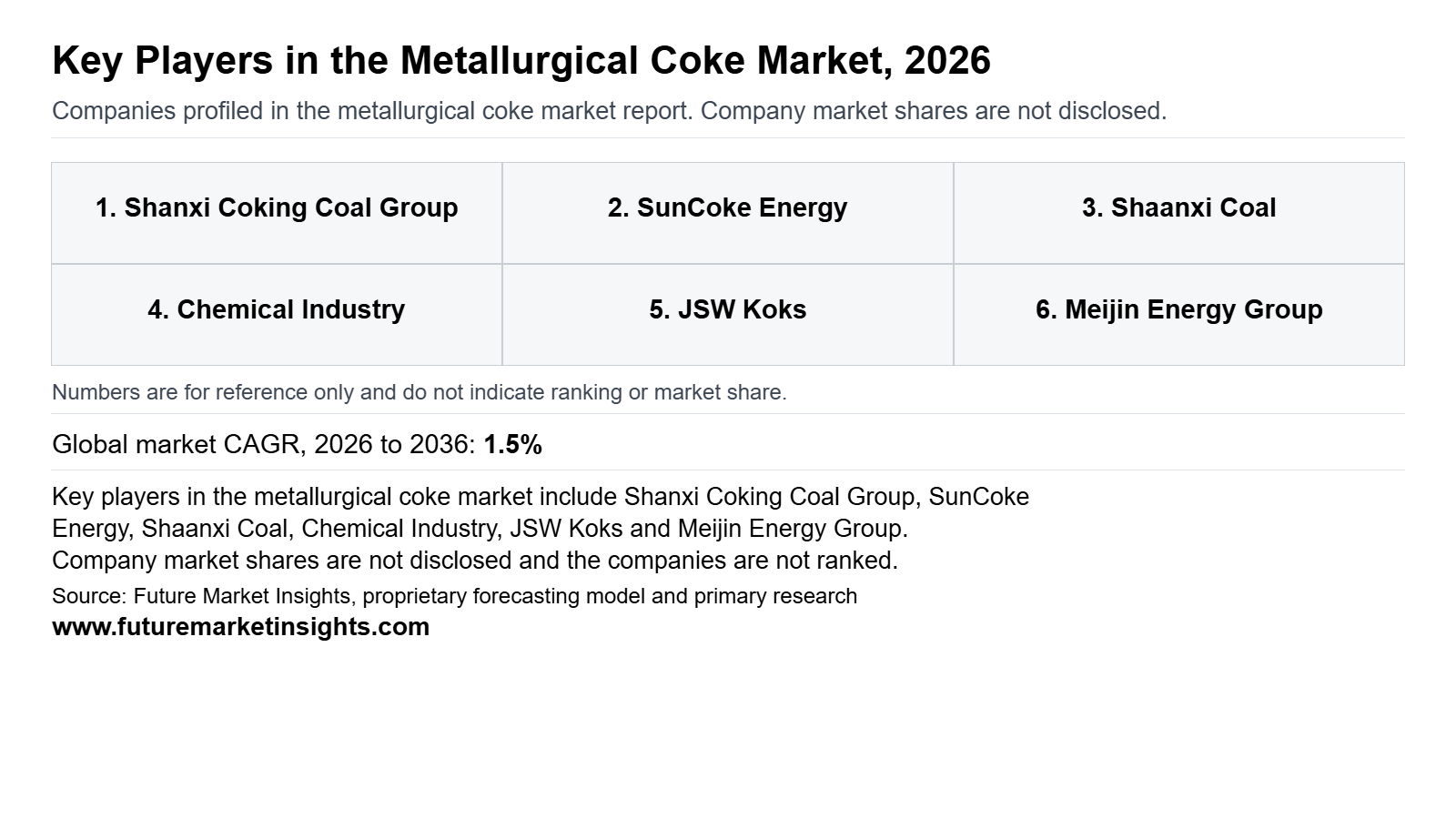
Competition in the metallurgical coke market spans coal-integrated Chinese producers, North American heat-recovery specialists, European coking battery operators, and Indian integrated steelmakers. Shanxi Coking Coal Group, Shaanxi Coal and Chemical Industry Group, and Meijin Energy Group supply domestic Chinese steelworks from large coal-chemical networks. SunCoke Energy differentiates through long-term heat-recovery furnace contracts in the United States, while JSW Koks operates Polish recovery batteries with seaborne and regional European sales. Tata Steel Limited strengthens Indian coking efficiency through new gas-injection and battery modernization investments.
How Do Profiled Suppliers Differ in Market Positioning?
SunCoke Energy relies on long-term take-or-pay heat-recovery contracts tied directly to North American blast furnaces, insulating cash flow from spot coal swings. By contrast, Meijin Energy Group and Shanxi Coking Coal Group operate large merchant recovery batteries integrated with coking coal mines and chemical by-product sales in China, while JSW Koks supplies European mills from Polish batteries.
What Qualification and Purchasing Terms Matter Most to Buyers?
Steelworks procurement teams test ash, sulfur, moisture and coke strength after reaction before approving a new battery source for blast-furnace campaigns. Buyers also require multi-month delivery schedules and coal-index pricing formulas to prevent costly furnace slowdowns.
Which Technical Capabilities Distinguish Leading Coke Producers?
Producers differentiate through stamp-charging coal-blend flexibility, dry-quenching energy recovery, and coke-oven gas injection integration. Tata Steel Limited's Meramandali gas-injection project and JFE Steel Corporation's Fukuyama stamp-charged unit demonstrate how process upgrades cut net coke consumption and lower plant emissions.
How Does Geographic Reach Affect Competition?
High ocean freight costs and lump degradation during transshipment favor domestic or port-adjacent coking plants near blast furnaces. SunCoke Energy anchors North American and Brazil-linked supply, JSW Koks serves Central and Western Europe, and Chinese and Indian producers focus on domestic and nearby Asian steel hubs.
| Company Name & Date (Month Year) | Verified Development | Commercial Impact on Market Growth & Buyer Adoption |
|---|---|---|
| JSW Koks (May 2025) | Started heating newly built Battery No. 4 at the Przyjaźń coke plant with an intended annual capacity of 610,000 tonnes. | Renews European by-product battery capacity and secures long-term qualified blast-furnace coke supply. |
| SunCoke Energy (November 2025) | Extended its Haverhill cokemaking agreement with Cleveland-Cliffs for 500,000 tons annually starting January 2026. | Locks in multi-year North American furnace offtake and reduces merchant volume volatility. |
| Meijin Energy Group (April 2026) | Reported full-year 2025 coke output of 8.0 million tonnes, up 20.0% year-on-year, in its annual report summary. | Confirms large-scale independent merchant coking throughput serving Chinese steelmakers. |
| JSW Group (October 2026) | Reported third-quarter 2026 coke output of 0.7 million tonnes alongside its 2026-2035 coking remedy program. | Demonstrates ongoing output stabilization across Polish recovery batteries. |
| Tata Steel Limited (September 2026) | Commissioned India's first coke-oven gas injection project at Blast Furnace 1 in Meramandali, Odisha. | Lowers external fossil fuel and coke rates per tonne of hot metal while cutting blast-furnace emissions. |
Source: Verified corporate disclosures and Future Market Insights analysis, 2026.
| Company Name | Headquarters & Tier | Core Metallurgical Coke Portfolio & End-Use Focus |
|---|---|---|
| Shanxi Coking Coal Group | China | Tier-1 Coal & Coke Group | Produces blast-furnace and foundry coke integrated with extensive domestic coking-coal mining assets. |
| SunCoke Energy | USA | Tier-1 Heat-Recovery Producer | Supplies blast-furnace and foundry coke under long-term contracts across the USA and Brazil-linked operations. |
| Shaanxi Coal and Chemical Industry Group | China | Tier-1 Coal-Chemical Group | Supplies specification-grade metallurgical coke and tar by-products to domestic Chinese steelworks. |
| JSW Koks | Poland | Tier-1 European Producer | Operates slot-type by-product recovery batteries supplying external European blast-furnace and foundry buyers. |
| Meijin Energy Group | China | Tier-1 Merchant Producer | Produces independent merchant metallurgical coke with integrated coal washing and chemical recovery. |
| Tata Steel Limited | India | Tier-1 Integrated Steelmaker | Operates captive and modernized coke-oven batteries with coke-oven gas injection across Indian steel plants. |
| JFE Steel Corporation | Japan | Tier-1 Integrated Steelmaker | Operates advanced stamp-charged coke-oven batteries supporting high-efficiency Japanese blast-furnace steelmaking. |
Source: Verified corporate disclosures and Future Market Insights analysis, 2026.
Metallurgical Coke Market Report Scope and Research Methodology
FMI analysts size the global metallurgical coke market through primary interviews with merchant coke producers, integrated steelworks procurement teams and port logistics operators, combined with desk research across steel association production statistics, environmental emissions standards, import-export notifications, and audited corporate filings. Core 2025 and 2026 valuations reconcile external merchant coke shipments, long-term tolling contracts, and blast-furnace consumption rates across all seven tracked countries. Segment shares across product type, oven technology, end use, and supplier type are validated against active battery capacities, while captive internal steelworks transfers, coking coal and coke-oven gas are excluded to prevent double counting.
| Coverage Field | Report Scope |
|---|---|
| Market Definition | Revenue from external sales of metallurgical coke across blast-furnace, foundry, and nut coke grades sold by merchant or steel-linked plants. |
| Product Type Segments | Blast Furnace Coke, Foundry Coke, and Nut Coke. |
| Oven Technology Segments | Slot-Type By-Product Recovery Ovens, Stamp-Charged By-Product Ovens, Heat-Recovery Ovens, and Beehive and Other Ovens. |
| End Use Segments | Blast Furnace Ironmaking, Foundries and Cast Iron, and Ferroalloys and Silicon Metal. |
| Supplier Type Segments | Independent Domestic Coke Makers, Steel-Linked Merchant Plants, Imported Coke, and Coke Sold Under Long-Term Contracts. |
| Exclusions | Captive internal transfers without a sale, raw coking coal, finished steel products, and separate revenues from coke-oven gas or electricity. |
| Quantitative Units | USD Billion for global and country-level market sizing. |
| Historical & Base Years | 2025 (Historical) and 2026 (Estimated Base Year). |
| Forecast Period | 2026 to 2036 (10-Year Projection Window). |
| Regions Covered | North America, Latin America, Western Europe, Eastern Europe, East Asia, South Asia and Pacific, and Middle East and Africa. |
| Countries Profiled | China, India, Japan, Russia, USA, South Korea, and Vietnam. |
| Companies Covered | Shanxi Coking Coal Group, SunCoke Energy, Shaanxi Coal and Chemical Industry Group, JSW Koks, Meijin Energy Group, Tata Steel Limited, and JFE Steel Corporation. |
| Research Approach | Primary steelworks and coke-maker interviews combined with official trade, production, and corporate disclosure triangulation. |
Source: Future Market Insights analysis of the metallurgical coke market, 2026.
Research Sources and Bibliography
- Altai-Koks, NLMK Group. (2026). About Altai-Koks: Key Facts.
- Directorate General of Foreign Trade, India. (2026, January 3). Notification No. 54/2025-26: Import Policy for Low Ash Metallurgical Coke.
- Directorate General of Trade Remedies, India. (2026). Anti-Dumping Investigation Concerning Imports of Low Ash Metallurgical Coke.
- Hoa Phat Group. (2025, September 4). Blast Furnace No. 2 of Dung Quat 2 Produces First Hot Metal.
- Hoa Phat Group. (2026, September 4). Hoa Phat Dung Quat Steel Reaches Monthly Hot Metal Output of One Million Tonnes. https://www.hoaphat.com.vn/news/hoa-phat-dung-quat-steel-reaches-monthly-hot-metal-output-milestone-of-1-million-tonnes.html
- International Energy Agency. (2025). Breakthrough Agenda Report 2025: Steel. https://www.iea.org/reports/breakthrough-agenda-report-2025/steel
- JFE Steel Corporation. (2026, September 1). Start of Japan's First Large Stamp-Charged Coke Oven. https://www.jfe-steel.co.jp/release/2026/09/260901.html
- JSW Group. (2026, September 28). Current Report No. 67/2026: Remedy Program for 2026-2035. https://www.jsw.pl/en/investors-relations/stock-market-reports/current-reports/current-report/current-report-no-67-2026
- JSW Group. (2026, October 16). JSW Increases Coal and Coke Production in Q3. https://www.jsw.pl/en/press-office/news/archive/archive-news-article/jsw-increases-coal-and-coke-production-in-q3
- JSW Koks. (2025, May 13). Przyjaźń Coke Plant Starts Heating New Coke-Oven Battery No. 4. https://www.jswkoks.pl/odpowiedzialny-biznes/wydarzenia/wydarzenie/koksownia-przyjazn-uruchamia-najnowoczesniejsza-baterie-koksownicza
- Meijin Energy Group. (2026, April 25). 2025 Annual Report Summary. https://paper.cnstock.com/html/2026-04/25/content_2206582.htm
- Meijin Energy Group. (2026, August 27). 2026 Half-Year Report Summary. https://paper.cnstock.com/html/2026-08/27/content_2260711.htm
- National Bureau of Statistics of China. (2026, February 28). Statistical Communiqué of the People's Republic of China on the 2025 National Economic and Social Development. https://www.stats.gov.cn/sj/zxfb/202602/t20260228_1962662.html
- POSCO Group. (2026, October 29). Pohang Steelworks Improves Ironmaking Material Conveying Equipment. https://newsroom.posco.com/kr/%ED%8F%AC%EC%8A%A4%EC%BD%94-%ED%8F%AC%ED%95%AD%EC%A0%9C%EC%B2%A0%EC%86%8C-qss%ED%98%81%EC%8B%A0%EA%B3%B5%EC%9E%A5-%EC%84%A0%EA%B0%95%EB%B6%80%EB%AC%B8-%EC%9D%B4%EC%86%A1%EC%84%A4%EB%B9%84/
- Press Information Bureau, Government of India. (2026, January 29). Coking Coal Notified as a Critical and Strategic Mineral. https://www.pib.gov.in/PressReleasePage.aspx?PRID=2219947&lang=1&noshow=1®=3
- Shaanxi Coal and Chemical Industry Group. (2026, August 25). Shaanxi Coking Company Improves Tar Storage Tank Operation. https://www.shccig.com/index/Article/index.html?cid=25&id=1429667
- Shanxi Coking Coal Group. (2026). Coke Industry and Products. https://www.sxcc.com.cn/jtcy.jhtml
- State Council of China. (2025, January 20). China Announces Stricter Emissions Standards for Coking Industry. https://english.www.gov.cn/news/202501/20/content_WS678e54fac6d0868f4e8ef00b.html
- SunCoke Energy. (2025, November 18). SunCoke Energy Announces Haverhill Cokemaking Agreement. https://www.suncoke.com/en/investors/press-releases/2025/11-18-2025-213017805
- SunCoke Energy. (2026, February 17). SunCoke Energy Announces 2025 Results and 2026 Guidance. https://www.suncoke.com/en/investors/press-releases/2026/02-17-2026-120105826
- SunCoke Energy. (2026, October 27). SunCoke Energy Reports Third Quarter 2026 Results. https://www.suncoke.com/en/investors/press-releases/2026/10-27-2026-110126216
- Tata Steel Limited. (2026, September 10). Tata Steel Advances Sustainable Steelmaking with India's First-of-its-kind Coke Oven Gas Injection Project at Meramandali. https://www.tatasteel.com/newsroom/press-releases/india/2026/tata-steel-advances-sustainable-steelmaking-with-india-s-first-of-its-kind-coke-oven-gas-injection-project-at-meramandali/
- United States Environmental Protection Agency. (2025). Coke Ovens Batteries: National Emissions Standards for Hazardous Air Pollutants. https://www.epa.gov/stationary-sources-air-pollution/coke-ovens-batteries-national-emissions-standards-hazardous-air
- World Steel Association. (2026). World Steel in Figures 2026. https://worldsteel.org/data/world-steel-in-figures/world-steel-in-figures-2026/
- World Steel Association. (2026, October 12). worldsteel Short Range Outlook October 2026. https://worldsteel.org/media/press-releases/2026/worldsteel-short-range-outlook-october-2026/
Table of Content
- Key Takeaways
- Market Size and CAGR
- Top Growth Driver
- Fastest Growing Segment
- Leading Region
- Key Companies
- Emerging Opportunities
- Executive Summary
- Global Market Outlook
- Demand-side Trends
- Supply-side Trends
- Technology Roadmap Analysis
- Analysis and Recommendations
- Analyst Perspective (What is happening? Why now? What should investors know?)
- Key Questions Answered
- How large is the market?
- What is the CAGR?
- What are key trends?
- Which region dominates?
- Who are the leaders?
Read More...
- Market Overview
- Market Coverage / Taxonomy
- Market Definition / Scope / Limitations
- Research Methodology
- Chapter Orientation
- Analytical Lens and Working Hypotheses
- Market Structure, Signals, and Trend Drivers
- Benchmarking and Cross-market Comparability
- Market Sizing, Forecasting, and Opportunity Mapping
- Research Design and Evidence Framework
- Desk Research Programme (Secondary Evidence)
- Expert Input and Fieldwork (Primary Evidence)
- Tooling, Models, and Reference Databases
- Data Engineering and Model Build
- Quality Assurance and Audit Trail
- Market Background
- Market Dynamics (Drivers, Restraints, Opportunity, Trends)
- Scenario Forecast (Optimistic, Likely, Conservative)
- Impact Analysis
- AI Impact
- Sustainability Impact
- Regulatory Impact
- Technology Impact
- Consumer / Buyer Analysis
- Purchase Drivers
- Adoption Barriers
- Buyer Journey
- Opportunity Map Analysis
- Product Life Cycle Analysis
- Supply Chain Analysis
- Investment Feasibility Matrix
- Value Chain Analysis
- PESTLE and Porter's Analysis
- Regulatory Landscape
- Regional Parent Market Outlook
- Production and Consumption Statistics
- Import and Export Statistics
- Global Market Analysis and Forecast, 2021 to 2036
- Historical Market Size Value (USD Billion) Analysis, 2021 to 2025
- Current and Future Market Size Value (USD Billion) Projections, 2026 to 2036
- Y-o-Y Growth Trend Analysis
- Absolute $ Opportunity Analysis
- Global Market Pricing Analysis, 2021 to 2036
- Global Market Analysis and Forecast, By Product Type, 2021 to 2036
- Introduction / Key Findings
- Historical Market Size Value (USD Billion) Analysis By Product Type, 2021 to 2025
- Current and Future Market Size Value (USD Billion) Analysis and Forecast By Product Type, 2026 to 2036
- Blast Furnace Coke
- Foundry Coke
- Nut Coke
- Y-o-Y Growth Trend Analysis By Product Type, 2021 to 2025
- Absolute $ Opportunity Analysis By Product Type, 2026 to 2036
- Global Market Analysis and Forecast, By Oven Technology, 2021 to 2036
- Introduction / Key Findings
- Historical Market Size Value (USD Billion) Analysis By Oven Technology, 2021 to 2025
- Current and Future Market Size Value (USD Billion) Analysis and Forecast By Oven Technology, 2026 to 2036
- Slot-Type By-Product Recovery Ovens
- Stamp-Charged By-Product Ovens
- Heat-Recovery Ovens
- Beehive and Other Ovens
- Y-o-Y Growth Trend Analysis By Oven Technology, 2021 to 2025
- Absolute $ Opportunity Analysis By Oven Technology, 2026 to 2036
- Global Market Analysis and Forecast, By End Use, 2021 to 2036
- Introduction / Key Findings
- Historical Market Size Value (USD Billion) Analysis By End Use, 2021 to 2025
- Current and Future Market Size Value (USD Billion) Analysis and Forecast By End Use, 2026 to 2036
- Blast Furnace Ironmaking
- Foundries and Cast Iron
- Ferroalloys and Silicon Metal
- Y-o-Y Growth Trend Analysis By End Use, 2021 to 2025
- Absolute $ Opportunity Analysis By End Use, 2026 to 2036
- Global Market Analysis and Forecast, By Supplier Type, 2021 to 2036
- Introduction / Key Findings
- Historical Market Size Value (USD Billion) Analysis By Supplier Type, 2021 to 2025
- Current and Future Market Size Value (USD Billion) Analysis and Forecast By Supplier Type, 2026 to 2036
- Independent Domestic Coke Makers
- Steel-Linked Merchant Plants
- Imported Coke
- Coke Sold Under Long-Term Contracts
- Y-o-Y Growth Trend Analysis By Supplier Type, 2021 to 2025
- Absolute $ Opportunity Analysis By Supplier Type, 2026 to 2036
- Global Market Analysis and Forecast, By Region, 2021 to 2036
- Introduction
- Historical Market Size Value (USD Billion) Analysis By Region, 2021 to 2025
- Current Market Size Value (USD Billion) Analysis and Forecast By Region, 2026 to 2036
- North America
- Western Europe
- East Asia
- South Asia and Pacific
- Market Attractiveness Analysis By Region
- North America Market Analysis and Forecast, By Country, 2021 to 2036
- Historical Market Size Value (USD Billion) Trend Analysis By Market Taxonomy, 2021 to 2025
- Market Size Value (USD Billion) Forecast By Market Taxonomy, 2026 to 2036
- By Country
- United States
- Canada
- By Product Type
- By Oven Technology
- By End Use
- By Supplier Type
- By Country
- Market Attractiveness Analysis
- By Country
- By Product Type
- By Oven Technology
- By End Use
- By Supplier Type
- Key Takeaways
- Western Europe Market Analysis and Forecast, By Country
- Historical Market Size Value (USD Billion) Trend Analysis By Market Taxonomy, 2021 to 2025
- Market Size Value (USD Billion) Forecast By Market Taxonomy, 2026 to 2036
- By Country
- United Kingdom
- Germany
- France
- By Product Type
- By Oven Technology
- By End Use
- By Supplier Type
- By Country
- Market Attractiveness Analysis
- By Country
- By Product Type
- By Oven Technology
- By End Use
- By Supplier Type
- Key Takeaways
- East Asia Market Analysis and Forecast, By Country
- Historical Market Size Value (USD Billion) Trend Analysis By Market Taxonomy, 2021 to 2025
- Market Size Value (USD Billion) Forecast By Market Taxonomy, 2026 to 2036
- By Country
- China
- Japan
- South Korea
- By Product Type
- By Oven Technology
- By End Use
- By Supplier Type
- By Country
- Market Attractiveness Analysis
- By Country
- By Product Type
- By Oven Technology
- By End Use
- By Supplier Type
- Key Takeaways
- South Asia and Pacific Market Analysis and Forecast, By Country
- Historical Market Size Value (USD Billion) Trend Analysis By Market Taxonomy, 2021 to 2025
- Market Size Value (USD Billion) Forecast By Market Taxonomy, 2026 to 2036
- By Country
- India
- Australia
- Rest of world aggregate
- By Product Type
- By Oven Technology
- By End Use
- By Supplier Type
- By Country
- Market Attractiveness Analysis
- By Country
- By Product Type
- By Oven Technology
- By End Use
- By Supplier Type
- Key Takeaways
- Key Countries Market Analysis
- United States
- Pricing Analysis
- Market Share Analysis, 2025
- By Product Type
- By Oven Technology
- By End Use
- By Supplier Type
- Canada
- Pricing Analysis
- Market Share Analysis, 2025
- By Product Type
- By Oven Technology
- By End Use
- By Supplier Type
- Germany
- Pricing Analysis
- Market Share Analysis, 2025
- By Product Type
- By Oven Technology
- By End Use
- By Supplier Type
- United Kingdom
- Pricing Analysis
- Market Share Analysis, 2025
- By Product Type
- By Oven Technology
- By End Use
- By Supplier Type
- France
- Pricing Analysis
- Market Share Analysis, 2025
- By Product Type
- By Oven Technology
- By End Use
- By Supplier Type
- India
- Pricing Analysis
- Market Share Analysis, 2025
- By Product Type
- By Oven Technology
- By End Use
- By Supplier Type
- China
- Pricing Analysis
- Market Share Analysis, 2025
- By Product Type
- By Oven Technology
- By End Use
- By Supplier Type
- Japan
- Pricing Analysis
- Market Share Analysis, 2025
- By Product Type
- By Oven Technology
- By End Use
- By Supplier Type
- South Korea
- Pricing Analysis
- Market Share Analysis, 2025
- By Product Type
- By Oven Technology
- By End Use
- By Supplier Type
- Australia
- Pricing Analysis
- Market Share Analysis, 2025
- By Product Type
- By Oven Technology
- By End Use
- By Supplier Type
- United States
- Market Structure Analysis
- Competition Dashboard
- Competition Benchmarking
- Market Share Analysis of Top Players
- By Regional
- By Product Type
- By Oven Technology
- By End Use
- By Supplier Type
- Emerging Startups
- Innovation Benchmarking
- Competition Analysis
- Competition Deep Dive
- Shanxi Coking Coal Group
- Overview
- Product Portfolio
- Profitability by Market Segments
- Sales Footprint
- Strategy Overview
- Marketing Strategy
- Product Strategy
- Channel Strategy
- SunCoke Energy
- Shaanxi Coal and Chemical Industry Group
- JSW Koks
- Meijin Energy Group
- Tata Steel Limited
- JFE Steel Corporation
- Shanxi Coking Coal Group
- Case Studies
- Success Stories
- Recent Developments
- Competition Deep Dive
- Assumptions & Acronyms Used
List of Tables
- Table 1: Global Market Value (USD Billion) Forecast by Region, 2021 to 2036
- Table 2: Global Market Value (USD Billion) Forecast by Product Type, 2021 to 2036
- Table 3: Global Market Value (USD Billion) Forecast by Oven Technology, 2021 to 2036
- Table 4: Global Market Value (USD Billion) Forecast by End Use, 2021 to 2036
- Table 5: Global Market Value (USD Billion) Forecast by Supplier Type, 2021 to 2036
- Table 6: North America Market Value (USD Billion) Forecast by Country, 2021 to 2036
- Table 7: North America Market Value (USD Billion) Forecast by Product Type, 2021 to 2036
- Table 8: North America Market Value (USD Billion) Forecast by Oven Technology, 2021 to 2036
- Table 9: North America Market Value (USD Billion) Forecast by End Use, 2021 to 2036
- Table 10: North America Market Value (USD Billion) Forecast by Supplier Type, 2021 to 2036
- Table 11: Western Europe Market Value (USD Billion) Forecast by Country, 2021 to 2036
- Table 12: Western Europe Market Value (USD Billion) Forecast by Product Type, 2021 to 2036
- Table 13: Western Europe Market Value (USD Billion) Forecast by Oven Technology, 2021 to 2036
- Table 14: Western Europe Market Value (USD Billion) Forecast by End Use, 2021 to 2036
- Table 15: Western Europe Market Value (USD Billion) Forecast by Supplier Type, 2021 to 2036
- Table 16: East Asia Market Value (USD Billion) Forecast by Country, 2021 to 2036
- Table 17: East Asia Market Value (USD Billion) Forecast by Product Type, 2021 to 2036
- Table 18: East Asia Market Value (USD Billion) Forecast by Oven Technology, 2021 to 2036
- Table 19: East Asia Market Value (USD Billion) Forecast by End Use, 2021 to 2036
- Table 20: East Asia Market Value (USD Billion) Forecast by Supplier Type, 2021 to 2036
- Table 21: South Asia and Pacific Market Value (USD Billion) Forecast by Country, 2021 to 2036
- Table 22: South Asia and Pacific Market Value (USD Billion) Forecast by Product Type, 2021 to 2036
- Table 23: South Asia and Pacific Market Value (USD Billion) Forecast by Oven Technology, 2021 to 2036
- Table 24: South Asia and Pacific Market Value (USD Billion) Forecast by End Use, 2021 to 2036
- Table 25: South Asia and Pacific Market Value (USD Billion) Forecast by Supplier Type, 2021 to 2036
List of Figures
- Figure 1: Global Market Pricing Analysis
- Figure 2: Global Market Value (USD Billion) Forecast 2021-2036
- Figure 3: Global Market Value Share and BPS Analysis by Product Type, 2026 and 2036
- Figure 4: Global Market Y-o-Y Growth Comparison by Product Type, 2026-2036
- Figure 5: Global Market Attractiveness Analysis by Product Type
- Figure 6: Global Market Value Share and BPS Analysis by Oven Technology, 2026 and 2036
- Figure 7: Global Market Y-o-Y Growth Comparison by Oven Technology, 2026-2036
- Figure 8: Global Market Attractiveness Analysis by Oven Technology
- Figure 9: Global Market Value Share and BPS Analysis by End Use, 2026 and 2036
- Figure 10: Global Market Y-o-Y Growth Comparison by End Use, 2026-2036
- Figure 11: Global Market Attractiveness Analysis by End Use
- Figure 12: Global Market Value Share and BPS Analysis by Supplier Type, 2026 and 2036
- Figure 13: Global Market Y-o-Y Growth Comparison by Supplier Type, 2026-2036
- Figure 14: Global Market Attractiveness Analysis by Supplier Type
- Figure 15: Global Market Value (USD Billion) Share and BPS Analysis by Region, 2026 and 2036
- Figure 16: Global Market Y-o-Y Growth Comparison by Region, 2026-2036
- Figure 17: Global Market Attractiveness Analysis by Region
- Figure 18: North America Market Incremental Dollar Opportunity, 2026-2036
- Figure 19: Western Europe Market Incremental Dollar Opportunity, 2026-2036
- Figure 20: East Asia Market Incremental Dollar Opportunity, 2026-2036
- Figure 21: South Asia and Pacific Market Incremental Dollar Opportunity, 2026-2036
- Figure 22: North America Market Value Share and BPS Analysis by Country, 2026 and 2036
- Figure 23: North America Market Value Share and BPS Analysis by Product Type, 2026 and 2036
- Figure 24: North America Market Y-o-Y Growth Comparison by Product Type, 2026-2036
- Figure 25: North America Market Attractiveness Analysis by Product Type
- Figure 26: North America Market Value Share and BPS Analysis by Oven Technology, 2026 and 2036
- Figure 27: North America Market Y-o-Y Growth Comparison by Oven Technology, 2026-2036
- Figure 28: North America Market Attractiveness Analysis by Oven Technology
- Figure 29: North America Market Value Share and BPS Analysis by End Use, 2026 and 2036
- Figure 30: North America Market Y-o-Y Growth Comparison by End Use, 2026-2036
- Figure 31: North America Market Attractiveness Analysis by End Use
- Figure 32: North America Market Value Share and BPS Analysis by Supplier Type, 2026 and 2036
- Figure 33: North America Market Y-o-Y Growth Comparison by Supplier Type, 2026-2036
- Figure 34: North America Market Attractiveness Analysis by Supplier Type
- Figure 35: Western Europe Market Value Share and BPS Analysis by Country, 2026 and 2036
- Figure 36: Western Europe Market Value Share and BPS Analysis by Product Type, 2026 and 2036
- Figure 37: Western Europe Market Y-o-Y Growth Comparison by Product Type, 2026-2036
- Figure 38: Western Europe Market Attractiveness Analysis by Product Type
- Figure 39: Western Europe Market Value Share and BPS Analysis by Oven Technology, 2026 and 2036
- Figure 40: Western Europe Market Y-o-Y Growth Comparison by Oven Technology, 2026-2036
- Figure 41: Western Europe Market Attractiveness Analysis by Oven Technology
- Figure 42: Western Europe Market Value Share and BPS Analysis by End Use, 2026 and 2036
- Figure 43: Western Europe Market Y-o-Y Growth Comparison by End Use, 2026-2036
- Figure 44: Western Europe Market Attractiveness Analysis by End Use
- Figure 45: Western Europe Market Value Share and BPS Analysis by Supplier Type, 2026 and 2036
- Figure 46: Western Europe Market Y-o-Y Growth Comparison by Supplier Type, 2026-2036
- Figure 47: Western Europe Market Attractiveness Analysis by Supplier Type
- Figure 48: East Asia Market Value Share and BPS Analysis by Country, 2026 and 2036
- Figure 49: East Asia Market Value Share and BPS Analysis by Product Type, 2026 and 2036
- Figure 50: East Asia Market Y-o-Y Growth Comparison by Product Type, 2026-2036
- Figure 51: East Asia Market Attractiveness Analysis by Product Type
- Figure 52: East Asia Market Value Share and BPS Analysis by Oven Technology, 2026 and 2036
- Figure 53: East Asia Market Y-o-Y Growth Comparison by Oven Technology, 2026-2036
- Figure 54: East Asia Market Attractiveness Analysis by Oven Technology
- Figure 55: East Asia Market Value Share and BPS Analysis by End Use, 2026 and 2036
- Figure 56: East Asia Market Y-o-Y Growth Comparison by End Use, 2026-2036
- Figure 57: East Asia Market Attractiveness Analysis by End Use
- Figure 58: East Asia Market Value Share and BPS Analysis by Supplier Type, 2026 and 2036
- Figure 59: East Asia Market Y-o-Y Growth Comparison by Supplier Type, 2026-2036
- Figure 60: East Asia Market Attractiveness Analysis by Supplier Type
- Figure 61: South Asia and Pacific Market Value Share and BPS Analysis by Country, 2026 and 2036
- Figure 62: South Asia and Pacific Market Value Share and BPS Analysis by Product Type, 2026 and 2036
- Figure 63: South Asia and Pacific Market Y-o-Y Growth Comparison by Product Type, 2026-2036
- Figure 64: South Asia and Pacific Market Attractiveness Analysis by Product Type
- Figure 65: South Asia and Pacific Market Value Share and BPS Analysis by Oven Technology, 2026 and 2036
- Figure 66: South Asia and Pacific Market Y-o-Y Growth Comparison by Oven Technology, 2026-2036
- Figure 67: South Asia and Pacific Market Attractiveness Analysis by Oven Technology
- Figure 68: South Asia and Pacific Market Value Share and BPS Analysis by End Use, 2026 and 2036
- Figure 69: South Asia and Pacific Market Y-o-Y Growth Comparison by End Use, 2026-2036
- Figure 70: South Asia and Pacific Market Attractiveness Analysis by End Use
- Figure 71: South Asia and Pacific Market Value Share and BPS Analysis by Supplier Type, 2026 and 2036
- Figure 72: South Asia and Pacific Market Y-o-Y Growth Comparison by Supplier Type, 2026-2036
- Figure 73: South Asia and Pacific Market Attractiveness Analysis by Supplier Type
- Figure 74: Global Market - Tier Structure Analysis
- Figure 75: Global Market - Company Share Analysis
Frequently Asked Questions
What is the projected size and CAGR of the metallurgical coke market through 2036?
Global metallurgical coke revenue is projected to reach USD 65.3 billion by 2036, expanding at a 1.5% CAGR and adding USD 9.0 billion.
Which Product Type segment leads the metallurgical coke market in 2026?
Blast Furnace Coke leads product type revenue with an 86.3% share in 2026 due to its structural and reduction role in ironmaking.
Which Oven Technology segment holds the largest share in 2026?
Slot-Type By-Product Recovery Ovens account for 80.0% of oven technology revenue in 2026, supported by established battery infrastructure and co-product recovery.
How much share does Blast Furnace Ironmaking hold in End Use?
Blast Furnace Ironmaking captures 88.7% of end-use revenue in 2026 as integrated steelworks consume coke continuously across furnace campaigns.
Which Supplier Type leads metallurgical coke distribution?
Independent Domestic Coke Makers represent 74.0% of supplier type revenue in 2026 by serving multiple regional mills without captive restrictions.
Which countries are projected to grow fastest in the metallurgical coke market?
Vietnam leads profiled national growth at a 2.3% CAGR from 2026 to 2036, followed by India at 2.2% and China at 1.3%.
Which companies are profiled as key players in the metallurgical coke market?
Key profiled companies include Shanxi Coking Coal Group, SunCoke Energy, Shaanxi Coal and Chemical Industry Group, JSW Koks, Meijin Energy Group, Tata Steel Limited, and JFE Steel Corporation.
Preview the report firsthand - request a free sample
Get SampleGet the brochure for pricing and purchase details.
Get PDF
