
- Market Size (2026)
- USD 234.1 Mn
- Forecast (2036)
- USD 464.8 Mn
- CAGR (2026 to 2036)
- 7.1%
How big is the Military Nitrocellulose Market in 2026?
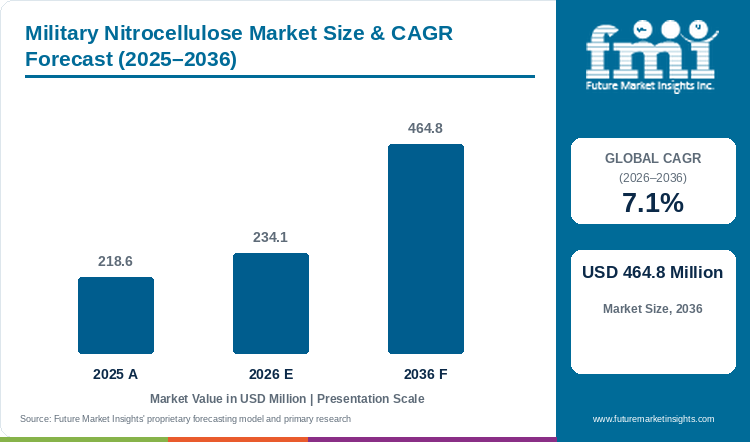
The Military Nitrocellulose Market stands at USD 234.1 million in 2026. It is projected to reach USD 464.8 million by 2036, a 7.1% CAGR from 2026 to 2036. The market was valued at USD 218.6 million in 2025. Rheinmetall laid the foundation stone for its expanded Aschau powder plant on 23 July 2026, with production due to start step by step from 2027 and maximum capacity expected in 2028 [3]. Colt CZ Group closed its 51% purchase of Synthesia Nitrocellulose on 7 January 2026 [7].
Supply, not price, sets the pace in this market. Nitrocellulose is made by nitrating purified cotton linters, and military grades start from bleached linters [1]. Eurenco's Bergerac line stopped on 3 August 2022 after an accident and was cleared to restart gradually in May 2023 [4]. Its output feeds artillery propellant [4]. The US Army awarded BAE Systems Ordnance Systems USD 20.3 million on 7 November 2025 for 6.4 million pounds of sheeted cotton linters for Radford, with delivery due to finish by 31 December 2026 [14]. Raw-material security is now written into contracts. Ammunition demand sets the volume of propellant that plants must feed.
Key Market Trends & Insights
- Nitrocellulose plants are moving into ammunition groups. MSM Group, the Slovak unit of Czechoslovak Group, completed its purchase of the Walsrode industrial park and nitrocellulose plant from IFF in May 2025 [9][10], with a plan to add energetic nitrocellulose production over time. Colt CZ Group closed its 51% purchase of Synthesia Nitrocellulose on 7 January 2026 [7]. The combined price was CZK 10.0 billion for the nitrocellulose and power companies, of which CZK 5.5 billion was paid in cash [7].
- Propellant plants are being enlarged around nitrocellulose supply, with Rheinmetall investing about EUR 650 million in propellant powder and energetic precursors [3]. EUR 350 million of that goes to Aschau, where the site grows from about 90 to 110 hectares [3]. Staff are due to rise from over 800 to about 1,400 [3].
- Supply is being locked in by contract. Eurenco and Poland's MESKO, part of PGZ Group, agreed a long-term deal for energetic nitrocellulose made at Bergerac, reported on 28 August 2025 [5]. A draft solicitation posted on 10 July 2026 describes a single contract to operate Radford Army Ammunition Plant and produce nitrocellulose in several grades [15].
Regional Highlights
- Europe: Rheinmetall's Aschau site produces about 1,700 tonnes of powder and about 300,000 propellant modules a year today [3]. Rheinmetall targets 20,000 tonnes a year of propellant powder group-wide by 2030, with 4,200 tonnes at Aschau [3].
- North America: Radford Army Ammunition Plant in Virginia is government-owned and contractor-operated [13]. Its new nitrocellulose facility runs nitration, purification and stabilisation in a closed system, in two buildings instead of nine [13].
- Asia Pacific: North Chemical Industries sold 45,708 tonnes of nitrocellulose-related products in 2025 [11]. That was up 28.1% from 35,669 tonnes in 2024 [11]. India's Cordite Factory Aruvankadu invited expressions of interest for a 65-tonne-a-month nitrocellulose plant [19].
Military Nitrocellulose Market Size and Forecast
Table 1: Military Nitrocellulose Market Size and Forecast
| Market size and forecast | Value |
|---|---|
| Market size in 2025 | USD 218.6 million |
| Market size in 2026 | USD 234.1 million |
| Projected market size by 2036 | USD 464.8 million |
| CAGR from 2026 to 2036 | 7.1% |
Source: Future Market Insights analysis of the military nitrocellulose market, 2026.
Analyst Perspective
“Military nitrocellulose is a captive-first business, since the plants that matter belong to propellant makers or sit inside government ammunition sites. Merchant sales are the smaller part of the picture. Cotton linter sources, grade qualification and plant permit status are more useful signals than list prices. Buyers who sign multi-year supply with a named plant and a named back-up will be better placed than those who buy lot by lot.”
- Nikhil Kaitwade, Principal Consultant, FMI
How is the Military Nitrocellulose Market segmented?
- By grade: High-Nitrogen (≥13.0% N), Medium-Nitrogen (12.0-12.9% N) and Low-Nitrogen (<12.0% N)
- By application: Small-Arms Ammunition, Artillery Ammunition, Tank/Large-Caliber Ammunition, Mortar Ammunition, Rocket & Missile Propulsion and Other Military Applications
- By region: North America, Europe, Asia Pacific and the Middle East
Why does High-Nitrogen (≥13.0% N) lead by Grade in the Military Nitrocellulose Market in 2026?
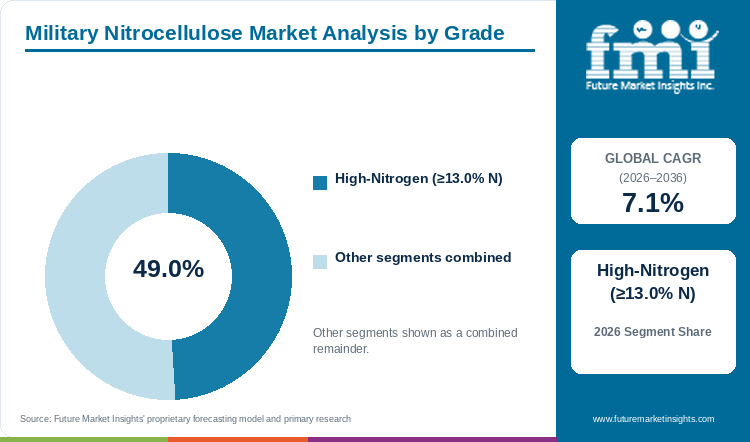
High-Nitrogen (≥13.0% N) accounts for 49.0% of the Military Nitrocellulose Market by grade in 2026. Nitrogen content measures how far the cellulose has been nitrated. It can run from 0% to a theoretical maximum of about 14.1% [25]. Nitrocellulose with a high degree of nitration is the form used in propellants, while lower degrees go to lacquers and similar uses [25]. Rheinmetall states that its nitrogen content varies between 11.5% and 13.6% depending on the intended purpose [1]. The lead follows from the top of that military range. Rheinmetall supplies military nitrocellulose as a uniformly nitrated grade from bleached linters, or as a mixture of two to three differently nitrated types [1]. That lets a propellant maker reach a target energy level from several inputs [1]. At Radford, nitrocellulose is the basic building block for all products made there [13]. Colt CZ Group calls the energetic nitrocellulose of Synthesia Nitrocellulose a basic raw material for single- and multi-component powders and propellants [7]. Where propellant is the end use, the highest-nitrated grades carry the largest share of demand.
Table 2: Grade, 2026 Share
| Leading Share | 2026 market share |
|---|---|
| High-Nitrogen (≥13.0% N) | 49.0% |
| All Other Segments Combined Share | 51.0% |
Source: Future Market Insights analysis of the military nitrocellulose market, 2026.
Why does Small-Arms Ammunition lead by Application in the Military Nitrocellulose Market in 2026?
Small-Arms Ammunition accounts for 34.0% of the Military Nitrocellulose Market by application in 2026. Single-base propellant powder is made from nitrocellulose, and Rheinmetall lists it first among the end uses of its nitrocellulose [1]. Nitrochemie, the Rheinmetall and RUAG MRO Holding joint venture, makes single- and multi-base propellants for small-calibre hunting and sport rifles, and it sells a reloading powder under its own brand [2]. Colt CZ Group says energetic nitrocellulose is the basic raw material for powders and propellants used in small-, medium- and large-calibre ammunition [7]. Small-arms demand draws on the same plants as artillery. Artillery is the second application because its propellant is built from larger charges, and Eurenco's Bergerac nitrocellulose feeds artillery propellant [4]. Hanwha Aerospace's Yeosu plant in South Korea makes artillery propelling charges, with output of about 200,000 rounds' worth a year for more than 20 years [16].
Table 3: Application, 2026 Share
| Leading Share | 2026 market share |
|---|---|
| Small-Arms Ammunition | 34.0% |
| All Other Segments Combined Share | 66.0% |
Source: Future Market Insights analysis of the military nitrocellulose market, 2026.
What are the key drivers, restraints and opportunities?
Driver
Propellant capacity build-out. New powder plants create nitrocellulose demand wherever they start up. Rheinmetall's Aschau groundbreaking on 23 July 2026 covers a site that makes about 1,700 tonnes of powder a year [3]. The site is meant to supply 4,200 of the 20,000 tonnes a year Rheinmetall targets by 2030 [3]. In April 2024 Eurenco announced a EUR 500 million plan over three years [6]. It includes a EUR 60 million project at Bergerac to restart propellant powder production for large-calibre shells [6]. The plan also included a third modular-charge line scheduled for 2026 [6]. Colt CZ Group says Synthesia Nitrocellulose is expanding production capacity to meet growing demand [7].
Contracted supply and domestic sourcing. Eurenco's Chief Executive Thierry Francou called the MESKO contract a decisive step toward shared strategic autonomy [5]. MESKO's board chair said the company had pursued such an agreement for years [5]. Jan Marinov, head of CSG's defence division, said energetic nitrocellulose production matters for the security of NATO and EU countries and their allies [9]. India's Cordite Factory Aruvankadu, a Munitions India unit, set a 27 January 2026 bid deadline for a 65-tonne-a-month nitrocellulose plant [19].
Restraint
Feedstock concentration and trade scrutiny. Nitrocellulose is made from cotton linters, and European industry says it relies heavily on China for them. Rheinmetall's chief executive told the Financial Times in April 2024 that Europe relied on China for more than 70% of its linters [24]. The South China Morning Post reported that figure on 14 June 2024, and quoted a RAND analyst who saw no evidence of a major global shortage [24]. Trade in the finished product is also under scrutiny. The US Treasury's 30 October 2024 release named a Russian company, AM Logistics, as having taken delivery of multiple shipments of nitrocellulose [17]. It named a Türkiye-based forwarder, SLD Lojistik, as having shipped it [17].
Hazard, permitting and plant age. An accident on 3 August 2022 stopped nitrocellulose output at Eurenco's Bergerac site, and gradual restart was authorised in May 2023 [4]. In early May 2024 an explosion at a plant in Laohekou, Hubei, killed three people [24]. The plant belonged to Hubei Xuefei Chemical, described as China's second-largest nitrocellulose producer [24]. CSG states that adding energetic nitrocellulose at Walsrode will need further investment and consultation with regulators [10]. At Radford, the legacy nitrocellulose area used nine separate buildings [13]. Purification in the old boiling tubs could take up to 80 hours [13].
Opportunity
Modern closed-system plants. Radford's new nitrocellulose facility runs the same processes as the legacy area in a closed system in two buildings [13]. It increases throughput while reducing energy waste and physical labour [13]. BAE Systems described the plant as highly automated, with a self-contained system to reprocess and reuse its waste stream [12]. The nitrating step uses nitric acid and sulfuric acid on the cotton linters [1]. Producers that can show lower hazard and lower waste per tonne are better placed in qualification rounds and permit talks.
New national suppliers. Several governments are building domestic sources. Nibe Group and Israel's Elbit Systems announced plans on 25 May 2026 for propellant and energetic-materials facilities in India, with nitrocellulose first on the proposed product list [20]. Hanwha Aerospace plans a privately funded US propellant plant, with full-scale production of modular artillery charges targeted for 2029 [16]. In Saudi Arabia the General Authority for Military Industries aims to localise over 50% of military spending by 2030 [23]. Nitrocellulose is a cellulose derivative, while microcrystalline cellulose serves different end uses.
Military Nitrocellulose Market by Country (2026 to 2036)
Table 4: Military Nitrocellulose Market Country Growth Forecast
| Country | CAGR, 2026 to 2036 |
|---|---|
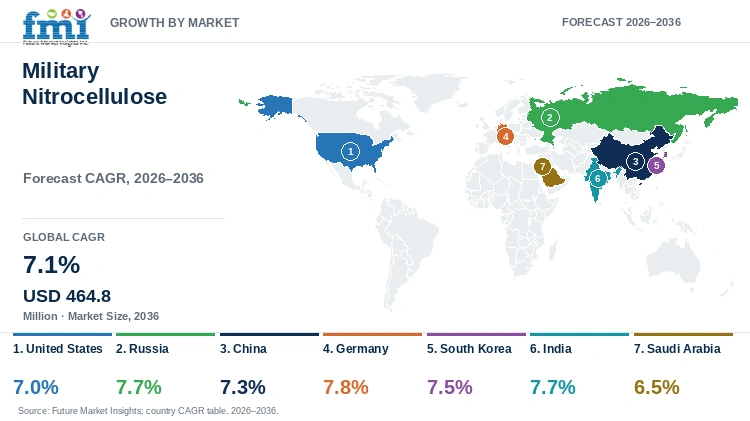
| United States | 7.0% |
| Russia | 7.7% |
| China | 7.3% |
| Germany | 7.8% |
| South Korea | 7.5% |
| India | 7.7% |
| Saudi Arabia | 6.5% |
Source: Future Market Insights analysis of the military nitrocellulose market, 2026.
United States
Radford Army Ammunition Plant in Virginia is the country's reference point for military nitrocellulose, and it is government-owned and contractor-operated [13]. In 2020 the Army described nitrocellulose as the basic building block for all products made there [13]. BAE Systems Ordnance Systems began commissioning a new nitrocellulose facility in 2021, with product qualification to follow [12].
A draft solicitation posted on 10 July 2026 by Army Contracting Command in Rock Island has reopened the operating arrangement. It describes a single indefinite-delivery contract to operate, modernise and produce propellants at Radford [15]. It prices nitrocellulose across multiple grades, with a performance period of up to 30 years, and the comment deadline was 20 July 2026 [15]. On 7 November 2025 BAE Systems Ordnance Systems received USD 20.3 million for 6.4 million pounds of sheeted cotton linters for the plant [14].
A private entrant is also planned: Hanwha Defense USA says it intends to build a privately funded plant for core energetic materials and triple-base propellant. It aims for full-scale modular artillery charge production in early 2029 and fully US-sourced charges by 2030 [16]. Buyers of US-origin propellant should expect the operator of Radford to be decided before any new plant is running.
Russia
Russian demand shows up in import data. Russian customs data cited by The Moscow Times show nitrocellulose imports rose more than fivefold in 2022, to over 2,000 metric tons [18]. Imports reached about 4,000 metric tons in 2023 [18]. Turkish companies accounted for nearly half of imports since the start of the war, and Chinese suppliers about one-third [18].
The United States has targeted the trade. In a release dated 30 October 2024, the US Treasury said Russia-based AM Logistics had taken delivery of multiple shipments of nitrocellulose [17]. It described nitrocellulose as a key ingredient in gunpowder, explosives and artillery shells [17]. The same release said Türkiye-based SLD Lojistik had made several large shipments of it to Russian companies, including AM Logistics [17].
For suppliers outside Russia the commercial point is compliance, not opportunity. Intermediaries in third countries have been named, so contracts for nitrocellulose and cotton cellulose need end-user declarations and route checks. Western suppliers profiled here should treat Russia as a closed channel.
China
North Chemical Industries, a Shenzhen exchange company whose actual controller is China North Industries Group, reported 2025 revenue from nitrocellulose-related products of CNY 1.0 billion [11]. That was 36.8% of its revenue, on sales of 45,708 tonnes, up 28.1% on 2024 [11]. Exports of its main products, mainly nitrocellulose, brought CNY 396.4 million, or 14.4% of revenue [11].
The company lists propellants among the uses of its nitrocellulose, alongside nitro lacquers, inks and celluloid [11]. It says it fully completed its supply-guarantee tasks in 2025 [11]. Its design capacity for nitrocellulose is 30,000 tonnes [11]. In 2025 it obtained an environmental approval for a new nitrocellulose line and safe storage project in Nanchong [11]. The investment itself was still at the evaluation stage [11]. The South China Morning Post reported in June 2024 that the company held a 15% international share of nitrocellulose in 2023 [24]. It also reported that the company had closed a 25,000-tonne plant in Xi'an [24].
For foreign buyers of military-grade material, export approval and linter traceability matter more than price. Chinese state-linked producers remain the first reference for volume.
Germany
Germany hosts Rheinmetall Nitrochemie Aschau GmbH in Aschau am Inn [2]. Nitrochemie Wimmis AG in Switzerland is the other part of the Nitrochemie Group, a joint venture of the Rheinmetall Group and RUAG MRO Holding AG [2]. The group produces nitrocellulose and NG-paste, which it describes as important precursors in the defence industry [2]. Rheinmetall's nitrocellulose is supplied water-wet or alcoholised, and viscosity, nitrogen content and fibre length can be varied for custom grades [1].
The foundation stone for the expanded Aschau powder plant was laid on 23 July 2026. The site currently makes about 1,700 tonnes of powder and about 300,000 propellant modules a year [3]. It is meant to supply 4,200 tonnes of the 20,000 tonnes a year targeted group-wide by 2030 [3]. The new premises start production step by step from 2027 [3]. Rheinmetall puts total investment in propellant powder and precursors at about EUR 650 million [3].
A second pole is forming in Lower Saxony. MSM Group, part of Czechoslovak Group, completed its purchase of the Walsroder industrial park and nitrocellulose plant from IFF in May 2025, taking over existing liabilities [9]. CSG plans to keep the plant's industrial operations while gradually enabling energetic nitrocellulose, which will need investment and regulatory consultation [9][10]. German buyers will see an industrial supplier turn into a defence supplier over the forecast period.
South Korea
According to its head, Lee Woo Jin, Hanwha Aerospace's Yeosu plant is the only South Korean site making propelling charges and modular charges for artillery [16]. It makes nitrocellulose and nitroglycerin in-house and dries nitroguanidine sourced from Europe [16]. Nitroglycerin, nitrocellulose and nitroguanidine production is fully automated [16].
Yeosu has produced about 200,000 rounds' worth of propelling charges a year for more than 20 years [16]. Output is expected to reach 250,000 rounds a year within three years [16]. A new Boeun factory with annual capacity of about 250,000 rounds is expected to begin operations in early to mid-2027 [16]. That would roughly double export-ready modular charge capacity to about 500,000 rounds a year [16].
Vertical integration is the competitive point, since Hanwha says it kept production running through COVID-19 because it makes its own energetic inputs [16]. In-house nitrocellulose means little South Korean demand reaches the merchant market. The planned US plant would carry the same model abroad.
India
India's government is moving to enlarge its own nitrocellulose output. Cordite Factory Aruvankadu, a unit of Munitions India Ltd under the Ministry of Defence, invited expressions of interest on a global tender dated 10 December 2025 [19]. The tender covers a nitrocellulose plant of 65 tonnes a month, with bids due by 27 January 2026 [19].
Private industry is entering as well. On 25 May 2026 Nibe Group and Israel's Elbit Systems announced plans for energetic-materials and propellant facilities in India [20]. Nitrocellulose comes first on a product list that also includes nitroglycerine and single-, double- and triple-base propellants [20]. Nibe Group would handle establishment, investment and operation, while Elbit would provide technical know-how, and no investment figure was given [20].
For suppliers, the opening lies in plant equipment, process know-how and qualification support, not in finished nitrocellulose exports. The tender is small beside the plants in Europe and the United States. Early Indian volumes are likely to cover domestic small-arms and artillery propellant needs before any export role.
Saudi Arabia
Saudi Arabia's military industry is being built around a localisation target. The General Authority for Military Industries aims to localise over 50% of the kingdom's total military spending by 2030 [23]. It reported a localisation rate of 24.9% at the end of 2024 [21].
Ammunition is one of the projects, and SAMI's chief executive said in February 2026 that its munitions industrial complex had passed 60% localisation [22]. The complex created more than 1,200 jobs within a group that employed more than 7,000 people by the end of 2025 [22]. Localisation is tracked on total military spending, not by input, so nitrocellulose sits inside a wider ammunition programme [21][23].
The commercial implication is that Saudi demand for military nitrocellulose will likely be met through imports and technology partnerships, while local filling and assembly grow alongside. Suppliers with qualified propellant and support for in-country work are best placed for tenders. The forecast rate in the table is the lowest of the seven profiled countries.
Who are the notable companies in the Military Nitrocellulose Market?
Notable companies in the Military Nitrocellulose Market include Rheinmetall AG, Eurenco, Nitrochemie, Czechoslovak Group (CSG), BAE Systems, Synthesia Nitrocellulose and North Chemical Industries Co., Ltd.
What a producer does with its nitrocellulose decides how it competes. Rheinmetall, through Nitrochemie, makes nitrocellulose and propellant paste and uses them in its powders and charge systems [1][2], and Hanwha Aerospace makes nitrocellulose and nitroglycerin in-house for its artillery charges [16]. At Radford, nitrocellulose is the building block of every product, and the plant is government-owned and run by a contractor [13]. For these operators the question is how much output is left to sell.
A smaller group sells nitrocellulose to other propellant makers. Eurenco's Bergerac output supplies artillery propellant and, since the contract reported on 28 August 2025, MESKO [4][5]. Synthesia Nitrocellulose, now 51% owned by Colt CZ Group, produces energetic nitrocellulose for single- and multi-component powders, and it also makes industrial nitrocellulose and oxycellulose for healthcare [7]. North Chemical Industries sells mainly into civil uses such as coatings and inks, and it also lists propellants, with exports worth CNY 396.4 million in 2025 [11]. Qualification with several customers is their advantage.
Newcomers are changing the market by buying or building. CSG bought Walsrode for its nitrocellulose plant and plans to add energetic production [9][10]. Colt CZ Group paid for a 51% stake and signed the purchase agreement on 28 August 2025 [7][8], and it also holds an agreed route to the remaining 49% [7][8]. In India, Aruvankadu's tender and the Nibe and Elbit venture aim to replace imports [19][20]. Rheinmetall's Aschau foundation stone and Hanwha's US plan show the same logic of securing the energetic chain from linters to charge before demand peaks [3][16]. Eurenco set out a EUR 500 million plan in April 2024 to raise production over three years [6].
Key Developments in the Military Nitrocellulose Market
- On 7 January 2026, Colt CZ Group SE announced the closing of its acquisition of 51% of Synthesia Nitrocellulose and 51% of Synthesia Power from Kaprain Chemical [7]. It holds the right to buy the remaining 49% of both in the medium term [7].
- On 25 May 2026, Nibe Group and Elbit Systems announced plans for energetic-materials and propellant facilities in India, with nitrocellulose first on the product list [20].
- On 10 July 2026, Army Contracting Command in Rock Island posted a draft solicitation for a single contract to operate and modernise Radford Army Ammunition Plant and produce nitrocellulose and propellants, with a comment deadline of 20 July 2026 [15].
- On 23 July 2026, Rheinmetall held the groundbreaking for the expanded Aschau powder plant [3]. Production in the new premises is due to start step by step from 2027 [3].
Key Players in the Military Nitrocellulose Market
- Rheinmetall AG
- Eurenco
- Nitrochemie
- Czechoslovak Group (CSG)
- BAE Systems
- Synthesia Nitrocellulose
- North Chemical Industries Co., Ltd.
Military Nitrocellulose Market Report Scope
Table 5: Military Nitrocellulose Market Report Scope
| Coverage field | Report scope |
|---|---|
| Market definition | Nitrocellulose supplied for military propellants and related energetic uses, classified by nitrogen content and measured by value of sales |
| Grade | High-Nitrogen (≥13.0% N), Medium-Nitrogen (12.0-12.9% N), Low-Nitrogen (<12.0% N) |
| Application | Small-Arms Ammunition, Artillery Ammunition, Tank/Large-Caliber Ammunition, Mortar Ammunition, Rocket & Missile Propulsion, Other Military Applications |
| Regions and profiled countries | North America, Europe, Asia Pacific and the Middle East. Profiled countries: United States, Russia, China, Germany, South Korea, India, Saudi Arabia |
| Companies covered | Rheinmetall AG, Eurenco, Nitrochemie, Czechoslovak Group (CSG), BAE Systems, Synthesia Nitrocellulose, North Chemical Industries Co., Ltd. |
| Forecast period | 2026 to 2036, with 2025 as the historical base year |
| Quantitative Units | USD million |
Source: Future Market Insights analysis of the military nitrocellulose market, 2026.
Military Nitrocellulose Market by Segments
Military Nitrocellulose Market segmented by Grade:
- High-Nitrogen (≥13.0% N)
- Medium-Nitrogen (12.0-12.9% N)
- Low-Nitrogen (<12.0% N)
Military Nitrocellulose Market segmented by Application:
- Small-Arms Ammunition
- Artillery Ammunition
- Tank/Large-Caliber Ammunition
- Mortar Ammunition
- Rocket & Missile Propulsion
- Other Military Applications
Military Nitrocellulose Market by Region
- North America
- Europe
- Asia Pacific
- Middle East
- United States
- Russia
- China
- Germany
- South Korea
- India
- Saudi Arabia
Research Sources and Bibliography
- [1] Rheinmetall. (n.d.). Nitrocellulose, propellant paste and premix. https://www.rheinmetall.com/en/products/weapons-and-ammunition/propulsion/nc-rm-pvk
- [2] Rheinmetall. (n.d.). Nitrochemie. https://www.rheinmetall.com/en/company/subsidiaries/nitrochemie
- [3] Rheinmetall. (2026, July 23). Grundsteinlegung Pulverwerk Aschau. https://www.rheinmetall.com/de/media/news-watch/news/2026/07/2026-07-23-rheinmetall-grundsteinlegung-pulverwerk-aschau
- [4] Defence Industry Europe. (2023, May 24). EURENCO: restart of the nitrocellulose production at the Bergerac site. https://defence-industry.eu/eurenco-restart-of-the-nitrocellulose-production-at-the-bergerac-site/
- [5] Defence Industry Europe. (2025, August 28). EURENCO and MESKO sign long-term contract for nitrocellulose supply in defence sector. https://defence-industry.eu/?p=59481
- [6] Army Recognition. (2024, April 11). French company Eurenco announces plans to increase gunpowder production. https://www.armyrecognition.com/archives/archives-land-defense/land-defense-2024/french-company-eurenco-announces-plans-to-increase-gunpowder-production
- [7] Colt CZ Group SE. (2026, January 7). Colt CZ Group SE announces closing of acquisition of Synthesia Nitrocellulose. https://shootingwire.com/releases/2026/01/colt-cz-group-se-announces-closing-of-acquisition-of-synthesia-nitrocellulose
- [8] Colt CZ Group SE. (2025, August 29). Colt CZ Group and Kaprain enter a strategic partnership in the production of nitrocellulose. https://www.coltczgroup.com/en/media-press-releases/colt-cz-group-and-kaprain-enter-a-strategic-partnership-in-the-production-of-nitrocellulose
- [9] Defence Industry Europe. (2025, May 10). MSM Group completes acquisition of nitrocellulose production facility in Germany. https://defence-industry.eu/msm-group-completes-acquisition-of-nitrocellulose-production-facility-in-germany/
- [10] Czechoslovak Group. (n.d.). CSG Acquires Nitrocellulose Production in Germany from IFF. https://csg.com/en/news/csg-acquires-nitrocellulose-production-in-germany-from-iff
- [11] North Chemical Industries Co., Ltd. (2026, April 8). 2025 Annual Report (full text, in Chinese). https://static.cninfo.com.cn/finalpage/2026-04-08/1225083158.PDF
- [12] BAE Systems. (2021, March 3). Radford moves to commissioning phase of a new nitrocellulose facility. https://www.baesystems.com/en/story/radford-moves-to-commissioning-phase-of-a-new-nitrocellulose-facility
- [13] U.S. Army. (2020, June 3). RFAAP modernization efforts improve munitions readiness. https://www.army.mil/article/236154/rfaap_modernization_efforts_improve_munitions_readiness
- [14] U.S. Army Contracting Command, Rock Island. (2025, November 7). BAE Systems Ordnance Systems contract for cotton linters for propellant production (award record). https://envzone.com/award-record/bae-systems-secures-20-3m-contract-for-cotton-linters-for-propellant-production/
- [15] U.S. Army Contracting Command, Rock Island. (2026, July 10). Radford Army Ammunition Plant - DRAFT Solicitation (Special Notice). https://console.sweetspotgov.com/federal-contracts/e7119dd6-5b05-5bfa-8c16-6642a4195b4f
- [16] The Defense Post. (2026, February). Hanwha's American Gambit: Korean Artillery Ammunition, Made in USA. https://thedefensepost.com/2026/02/01/hanwha-artillery-ammunition-us/
- [17] U.S. Department of the Treasury. (2024, October 30). Treasury Takes Aim at Third-Country Sanctions Evaders and Russian Producers Supporting Russia's Military-Industrial Base. https://fraser.stlouisfed.org/title/press-releases-united-states-department-treasury-6111/treasury-takes-aim-third-country-sanctions-evaders-russian-producers-supporting-russia-s-military-industrial-base-679404/fulltext
- [18] The Moscow Times. (2024, January 31). Chinese, Turkish Companies Supplying Russia With Key Gunpowder Component. https://www.themoscowtimes.com/2024/01/31/chinese-turkish-companies-supplying-russia-with-key-gunpowder-component-a83921
- [19] Cordite Factory Aruvankadu, Munitions India Ltd. (2025, December 16). Expression of Interest on Global Tender for Nitro Cellulose Plant. https://www.eoibudapest.gov.in/section/tenders/tender-cordite-factroy-aruvankadu-expression-of-interest-on-global-tender-for-nitro-cellulose-plant/
- [20] Asianet Newsable. (2026, May 25). Nibe Group, Israel's Elbit Systems to make propellants in India. https://newsable.asianetnews.com/india/nibe-group-israels-elbit-systems-to-make-propellants-in-india-articleshow-6s4vkev
- [21] Defence Industry Europe. (2025, November 10). Saudi Arabia raises military spending localisation as part of 2030 strategic target. https://defence-industry.eu/saudi-arabia-raises-military-spending-localisation-to-24-89-as-part-of-2030-strategic-target/
- [22] Asharq Al-Awsat. (2026, February 24). SAMI CEO: advancing toward an integrated, sovereign Saudi defense industry. https://english.aawsat.com/business/5244442-sami-ceo-asharq-al-awsat-advancing-toward-integrated-sovereign-saudi-defense
- [23] General Authority for Military Industries. (n.d.). About GAMI. https://gami.gov.sa/en/about-gami
- [24] South China Morning Post. (2024, June 14). Could China strangle Europe's weapons output with cotton? https://ca.finance.yahoo.com/news/could-china-strangle-europes-weapons-093000694.html
- [25] Morris, E., Pulham, C. R., and Morrison, C. A. (2023, November 2). Structure and properties of nitrocellulose: approaching 200 years of research. RSC Advances, 13(46), 32321-32333. https://pmc.ncbi.nlm.nih.gov/articles/PMC10620853/
Table of Content
Table of Content
- Key Takeaways
- Market Size and CAGR
- Top Growth Driver
- Fastest Growing Segment
- Leading Region
- Key Companies
- Emerging Opportunities
- Executive Summary
- Global Market Outlook
- Demand-side Trends
- Supply-side Trends
- Technology Roadmap Analysis
- Analysis and Recommendations
- Analyst Perspective (What is happening? Why now? What should investors know?)
- Key Questions Answered
- How large is the market?
- What is the CAGR?
- What are key trends?
- Which region dominates?
- Who are the leaders?
Read More...
- Market Overview
- Market Coverage / Taxonomy
- Market Definition / Scope / Limitations
- Research Methodology
- Chapter Orientation
- Analytical Lens and Working Hypotheses
- Market Structure, Signals, and Trend Drivers
- Benchmarking and Cross-market Comparability
- Market Sizing, Forecasting, and Opportunity Mapping
- Research Design and Evidence Framework
- Desk Research Programme (Secondary Evidence)
- Expert Input and Fieldwork (Primary Evidence)
- Tooling, Models, and Reference Databases
- Data Engineering and Model Build
- Quality Assurance and Audit Trail
- Market Background
- Market Dynamics (Drivers, Restraints, Opportunity, Trends)
- Scenario Forecast (Optimistic, Likely, Conservative)
- Impact Analysis
- AI Impact
- Sustainability Impact
- Regulatory Impact
- Technology Impact
- Consumer / Buyer Analysis
- Purchase Drivers
- Adoption Barriers
- Buyer Journey
- Opportunity Map Analysis
- Product Life Cycle Analysis
- Supply Chain Analysis
- Investment Feasibility Matrix
- Value Chain Analysis
- PESTLE and Porter's Analysis
- Regulatory Landscape
- Regional Parent Market Outlook
- Production and Consumption Statistics
- Import and Export Statistics
- Global Market Analysis and Forecast, 2021 to 2036
- Historical Market Size Value (USD Million) Analysis, 2021 to 2025
- Current and Future Market Size Value (USD Million) Projections, 2026 to 2036
- Y-o-Y Growth Trend Analysis
- Absolute $ Opportunity Analysis
- Global Market Pricing Analysis, 2021 to 2036
- Global Market Analysis and Forecast, By Grade, 2021 to 2036
- Introduction / Key Findings
- Historical Market Size Value (USD Million) Analysis By Grade, 2021 to 2025
- Current and Future Market Size Value (USD Million) Analysis and Forecast By Grade, 2026 to 2036
- High-Nitrogen (≥13.0% N)
- Medium-Nitrogen (12.0-12.9% N)
- Low-Nitrogen (<12.0% N)
- Y-o-Y Growth Trend Analysis By Grade, 2021 to 2025
- Absolute $ Opportunity Analysis By Grade, 2026 to 2036
- Global Market Analysis and Forecast, By Application, 2021 to 2036
- Introduction / Key Findings
- Historical Market Size Value (USD Million) Analysis By Application, 2021 to 2025
- Current and Future Market Size Value (USD Million) Analysis and Forecast By Application, 2026 to 2036
- Small-Arms Ammunition
- Artillery Ammunition
- Tank/Large-Caliber Ammunition
- Mortar Ammunition
- Rocket & Missile Propulsion
- Other Military Applications
- Y-o-Y Growth Trend Analysis By Application, 2021 to 2025
- Absolute $ Opportunity Analysis By Application, 2026 to 2036
- Global Market Analysis and Forecast, By Region, 2021 to 2036
- Introduction
- Historical Market Size Value (USD Million) Analysis By Region, 2021 to 2025
- Current Market Size Value (USD Million) Analysis and Forecast By Region, 2026 to 2036
- North America
- Europe
- Asia Pacific
- Middle East
- Market Attractiveness Analysis By Region
- North America Market Analysis and Forecast, By Country, 2021 to 2036
- Historical Market Size Value (USD Million) Trend Analysis By Market Taxonomy, 2021 to 2025
- Market Size Value (USD Million) Forecast By Market Taxonomy, 2026 to 2036
- By Country
- By Grade
- By Application
- Market Attractiveness Analysis
- By Country
- By Grade
- By Application
- Key Takeaways
- Europe Market Analysis and Forecast, By Country
- Historical Market Size Value (USD Million) Trend Analysis By Market Taxonomy, 2021 to 2025
- Market Size Value (USD Million) Forecast By Market Taxonomy, 2026 to 2036
- By Country
- By Grade
- By Application
- Market Attractiveness Analysis
- By Country
- By Grade
- By Application
- Key Takeaways
- Asia Pacific Market Analysis and Forecast, By Country
- Historical Market Size Value (USD Million) Trend Analysis By Market Taxonomy, 2021 to 2025
- Market Size Value (USD Million) Forecast By Market Taxonomy, 2026 to 2036
- By Country
- By Grade
- By Application
- Market Attractiveness Analysis
- By Country
- By Grade
- By Application
- Key Takeaways
- Middle East Market Analysis and Forecast, By Country
- Historical Market Size Value (USD Million) Trend Analysis By Market Taxonomy, 2021 to 2025
- Market Size Value (USD Million) Forecast By Market Taxonomy, 2026 to 2036
- By Country
- United States
- Russia
- China
- Germany
- South Korea
- India
- Saudi Arabia
- By Grade
- By Application
- By Country
- Market Attractiveness Analysis
- By Country
- By Grade
- By Application
- Key Takeaways
- Key Countries Market Analysis
- United States
- Pricing Analysis
- Market Share Analysis, 2025
- By Grade
- By Application
- Germany
- Pricing Analysis
- Market Share Analysis, 2025
- By Grade
- By Application
- India
- Pricing Analysis
- Market Share Analysis, 2025
- By Grade
- By Application
- China
- Pricing Analysis
- Market Share Analysis, 2025
- By Grade
- By Application
- South Korea
- Pricing Analysis
- Market Share Analysis, 2025
- By Grade
- By Application
- Russia
- Pricing Analysis
- Market Share Analysis, 2025
- By Grade
- By Application
- Saudi Arabia
- Pricing Analysis
- Market Share Analysis, 2025
- By Grade
- By Application
- United States
- Market Structure Analysis
- Competition Dashboard
- Competition Benchmarking
- Market Share Analysis of Top Players
- By Regional
- By Grade
- By Application
- Emerging Startups
- Innovation Benchmarking
- Competition Analysis
- Competition Deep Dive
- Rheinmetall AG
- Overview
- Product Portfolio
- Profitability by Market Segments
- Sales Footprint
- Strategy Overview
- Marketing Strategy
- Product Strategy
- Channel Strategy
- Eurenco
- Nitrochemie
- Czechoslovak Group (CSG)
- BAE Systems
- Synthesia Nitrocellulose
- North Chemical Industries Co., Ltd.
- Rheinmetall AG
- Case Studies
- Success Stories
- Recent Developments
- Competition Deep Dive
- Assumptions & Acronyms Used
List of Tables
- Table 1: Global Market Value (USD Million) Forecast by Region, 2021 to 2036
- Table 2: Global Market Value (USD Million) Forecast by Grade, 2021 to 2036
- Table 3: Global Market Value (USD Million) Forecast by Application, 2021 to 2036
- Table 4: North America Market Value (USD Million) Forecast by Country, 2021 to 2036
- Table 5: North America Market Value (USD Million) Forecast by Grade, 2021 to 2036
- Table 6: North America Market Value (USD Million) Forecast by Application, 2021 to 2036
- Table 7: Europe Market Value (USD Million) Forecast by Country, 2021 to 2036
- Table 8: Europe Market Value (USD Million) Forecast by Grade, 2021 to 2036
- Table 9: Europe Market Value (USD Million) Forecast by Application, 2021 to 2036
- Table 10: Asia Pacific Market Value (USD Million) Forecast by Country, 2021 to 2036
- Table 11: Asia Pacific Market Value (USD Million) Forecast by Grade, 2021 to 2036
- Table 12: Asia Pacific Market Value (USD Million) Forecast by Application, 2021 to 2036
- Table 13: Middle East Market Value (USD Million) Forecast by Country, 2021 to 2036
- Table 14: Middle East Market Value (USD Million) Forecast by Grade, 2021 to 2036
- Table 15: Middle East Market Value (USD Million) Forecast by Application, 2021 to 2036
List of Figures
- Figure 1: Global Market Pricing Analysis
- Figure 2: Global Market Value (USD Million) Forecast 2021-2036
- Figure 3: Global Market Value Share and BPS Analysis by Grade, 2026 and 2036
- Figure 4: Global Market Y-o-Y Growth Comparison by Grade, 2026-2036
- Figure 5: Global Market Attractiveness Analysis by Grade
- Figure 6: Global Market Value Share and BPS Analysis by Application, 2026 and 2036
- Figure 7: Global Market Y-o-Y Growth Comparison by Application, 2026-2036
- Figure 8: Global Market Attractiveness Analysis by Application
- Figure 9: Global Market Value (USD Million) Share and BPS Analysis by Region, 2026 and 2036
- Figure 10: Global Market Y-o-Y Growth Comparison by Region, 2026-2036
- Figure 11: Global Market Attractiveness Analysis by Region
- Figure 12: North America Market Incremental Dollar Opportunity, 2026-2036
- Figure 13: Europe Market Incremental Dollar Opportunity, 2026-2036
- Figure 14: Asia Pacific Market Incremental Dollar Opportunity, 2026-2036
- Figure 15: Middle East Market Incremental Dollar Opportunity, 2026-2036
- Figure 16: North America Market Value Share and BPS Analysis by Country, 2026 and 2036
- Figure 17: North America Market Value Share and BPS Analysis by Grade, 2026 and 2036
- Figure 18: North America Market Y-o-Y Growth Comparison by Grade, 2026-2036
- Figure 19: North America Market Attractiveness Analysis by Grade
- Figure 20: North America Market Value Share and BPS Analysis by Application, 2026 and 2036
- Figure 21: North America Market Y-o-Y Growth Comparison by Application, 2026-2036
- Figure 22: North America Market Attractiveness Analysis by Application
- Figure 23: Europe Market Value Share and BPS Analysis by Country, 2026 and 2036
- Figure 24: Europe Market Value Share and BPS Analysis by Grade, 2026 and 2036
- Figure 25: Europe Market Y-o-Y Growth Comparison by Grade, 2026-2036
- Figure 26: Europe Market Attractiveness Analysis by Grade
- Figure 27: Europe Market Value Share and BPS Analysis by Application, 2026 and 2036
- Figure 28: Europe Market Y-o-Y Growth Comparison by Application, 2026-2036
- Figure 29: Europe Market Attractiveness Analysis by Application
- Figure 30: Asia Pacific Market Value Share and BPS Analysis by Country, 2026 and 2036
- Figure 31: Asia Pacific Market Value Share and BPS Analysis by Grade, 2026 and 2036
- Figure 32: Asia Pacific Market Y-o-Y Growth Comparison by Grade, 2026-2036
- Figure 33: Asia Pacific Market Attractiveness Analysis by Grade
- Figure 34: Asia Pacific Market Value Share and BPS Analysis by Application, 2026 and 2036
- Figure 35: Asia Pacific Market Y-o-Y Growth Comparison by Application, 2026-2036
- Figure 36: Asia Pacific Market Attractiveness Analysis by Application
- Figure 37: Middle East Market Value Share and BPS Analysis by Country, 2026 and 2036
- Figure 38: Middle East Market Value Share and BPS Analysis by Grade, 2026 and 2036
- Figure 39: Middle East Market Y-o-Y Growth Comparison by Grade, 2026-2036
- Figure 40: Middle East Market Attractiveness Analysis by Grade
- Figure 41: Middle East Market Value Share and BPS Analysis by Application, 2026 and 2036
- Figure 42: Middle East Market Y-o-Y Growth Comparison by Application, 2026-2036
- Figure 43: Middle East Market Attractiveness Analysis by Application
- Figure 44: Global Market - Tier Structure Analysis
- Figure 45: Global Market - Company Share Analysis
Frequently Asked Questions
How big is the military nitrocellulose market in 2026?
The Military Nitrocellulose Market stands at USD 234.1 million in 2026, up from USD 218.6 million in 2025. It is projected to reach USD 464.8 million by 2036, a 7.1% CAGR from 2026 to 2036.
Which grade and application lead the military nitrocellulose market?
High-Nitrogen (≥13.0% N) leads by grade with 49.0% of the market in 2026. Small-Arms Ammunition leads by application with 34.0%. Rheinmetall gives a military nitrogen range of 11.5% to 13.6% [1]. Nitrocellulose with a high degree of nitration is the form used in propellants [25]. Colt CZ Group calls energetic nitrocellulose a basic raw material for powders used in small-, medium- and large-calibre ammunition [7].
Which other grades and applications matter?
By grade, Medium-Nitrogen (12.0-12.9% N) holds 29.0% and Low-Nitrogen (<12.0% N) 22.0%. By application, Artillery Ammunition holds 20.0%, Tank/Large-Caliber Ammunition 15.0%, Mortar Ammunition 12.0%, Rocket & Missile Propulsion 10.0% and Other Military Applications 9.0%. Rheinmetall lists single-base, double-base and multi-base powder among the uses of its nitrocellulose [1].
Which profiled country is forecast to grow fastest?
Germany has the highest forecast CAGR of the seven profiled countries at 7.8% from 2026 to 2036. Russia and India follow at 7.7% each. Rheinmetall laid the foundation stone for its expanded Aschau powder plant on 23 July 2026 [3]. MSM Group completed its purchase of the Walsrode nitrocellulose plant in May 2025 [9].
Which trade rules and sanctions affect nitrocellulose supply?
The US Treasury's 30 October 2024 release named Russia-based AM Logistics, which had taken delivery of multiple shipments of nitrocellulose [17]. It also named Türkiye-based SLD Lojistik, which had shipped it to Russian companies [17]. Russian customs data cited by The Moscow Times show imports of about 4,000 metric tons in 2023 [18]. Suppliers need end-user declarations and route checks for any shipment that could reach Russia.
What should a buyer check when choosing a nitrocellulose supplier?
Check the nitrogen range and nitration blend first. Rheinmetall supplies grades from 11.5% to 13.6% nitrogen, either uniformly nitrated or mixed from two to three types, water-wet or alcoholised [1]. Then confirm the plant, because ownership and capacity are changing at Walsrode, Synthesia and Radford [7][9][15]. Confirm the linter source as well, given the US Army's 6.4 million pound contract for Radford [14].
Preview the report firsthand - request a free sample
Get SampleGet the brochure for pricing and purchase details.
Get PDF
