

- Market Size (2026)
- USD 942.9 Mn
- Forecast (2036)
- USD 1478.4 Mn
- CAGR (2026 to 2036)
- 4.6%
How Big is the Mining Truck Body Pins Market in 2026?
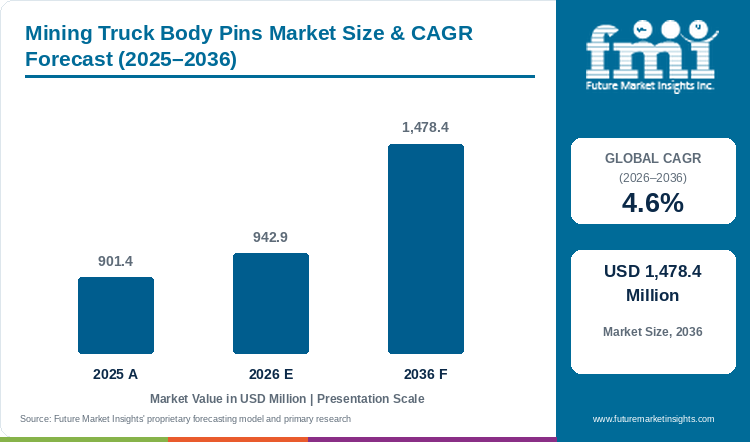
Sales of mining truck body pins will reach USD 942.9 Million in 2026, up from USD 901.4 Million in 2025, and will rise to USD 1,478.4 Million by 2036 at a 4.6% CAGR.
Demand for mining truck body pins is projected to expand at 4.6% CAGR between 2026 and 2036, as per FMI. Market valuation increases from USD 901.4 Million in 2025 to USD 942.9 Million in 2026 and is expected to reach USD 1,478.4 Million by 2036, adding USD 535.5 Million of new revenue over the forecast decade. Open-pit copper, gold and iron ore operators running large haul fleets across long shifts are buying the largest volume of pins, due to which open-pit mining is projected to hold 55% of demand by end use in 2026. Mining truck OEMs are expected to account for 38% of demand by sales channel, as new trucks arrive with pin specifications set by the truck maker.
Increasing use of autonomous haul trucks is supporting the demand for replacement pins, as driverless haulage keeps trucks working for more hours each year. Komatsu commissioned the company's 1,000th ultra-class autonomous haul truck in April 2026, with over 500 autonomous 930E units in service [1]. Owing to longer working hours, fleets running autonomous trucks will buy replacement pins more often. Long warranty periods on new fleets are slowing sales for independent suppliers, as mines keep the genuine part list until trucks age. Caterpillar states that linkage pins, bearings and seals are designed together as a system to fit within a fraction of a millimeter [2]. However, each new pin source will face long approval cycles at the mine before receiving repeat orders.
Adjacent haul-fleet categories are also widening the revenue base for the same supplier group. The autonomous mining haulage (surface) market is forecast to expand from USD 2.9 Billion in 2026 to USD 14.5 Billion by 2036 at 17.5% CAGR, creating an opportunity of USD 11.6 Billion. Sales of electric dump trucks are estimated to increase from USD 1,850.0 Million to USD 6,115.2 Million at 12.7% CAGR. The mining equipment rental market is expected to grow by USD 7.0 Billion, from USD 8.7 Billion to USD 15.7 Billion at 6%. Each new driverless or battery fleet will enter the pin aftermarket as a block of high-hour joints. FMI expects sales of pins to grow fastest in kitted replacement programs through 2036, as mines are buying pins, bushings and inspection support under one uptime contract. Plain forged pins sold on price alone are expected to record slower growth during the forecast period.
Key Takeaways
- Notable companies in the mining truck body pins market include Caterpillar, Komatsu, Liebherr, Hitachi Construction Machinery, Austin Engineering, Bradken, Columbia Steel, Epiroc and Sandvik.
- By pin type, body hinge pins are projected to account for 29% in 2026, owing to cyclic loading of the body-to-frame pivot at every dump.
- Based on material, alloy steel is estimated to hold 39% in 2026, as heat treatment gives a hard wear surface and a tough core at moderate cost.
- Mining truck OEMs are projected to hold 38% by sales channel in 2026, owing to factory drawings, warranty terms and dealer channels controlled by truck makers, and open-pit mining is expected to account for 55% by end use.
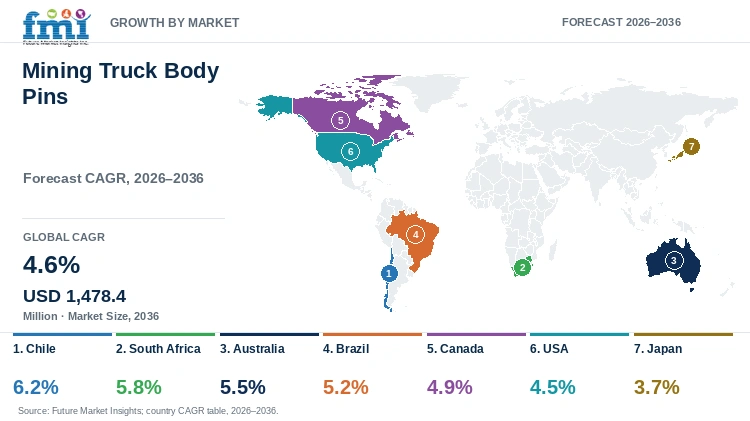
- Chile is projected at 6.2% CAGR through 2036, followed by South Africa at 5.8%, as copper brownfield work and high-hour fleets at remote sites keep pins in the replacement cycle.
Analyst Perspective
“Kitted pins, bushings and documented hardness profiles supplied as one qualified package will receive the larger share of haul-truck overhaul orders. Suppliers holding stock near the pit for autonomous and battery-electric fleets will turn each body rebuild into a planned replacement contract.”
- Nikhil Kaitwade, Principal Consultant, Future Market Insights
How is the Mining Truck Body Pins Market Segmented?
The mining truck body pins market is segmented into pin type, material, truck class, sales channel, end use and region.
The market is segmented by pin type into body hinge pins, tailgate pins, suspension pins, hoist cylinder pins and pivot pins. By material, the market is segmented into alloy steel, case-hardened steel, induction-hardened steel, stainless steel and coated pins. By truck class, the market is segmented into below 100 ton, 100-200 ton, 200-300 ton and above 300 ton trucks. By sales channel, the market is segmented into mining truck OEMs, aftermarket replacement, dealer service and MRO distributors. By end use, the market is segmented into open-pit mining, quarries, oil sands and heavy construction. The regional analysis covers seven regions and more than 30 countries.
Why Do Body Hinge Pins Lead the Mining Truck Body Pins Market by Pin Type?
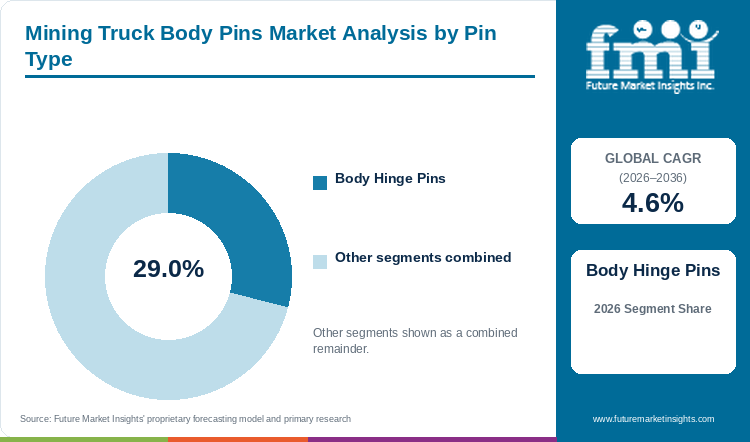
Based on pin type, body hinge pins will account for 29% of market share in 2026.
Rising haul-truck utilization at open-pit mines is supporting the demand for mining truck body pins in body hinge positions. The loaded tray pivots on this joint during each dump, and rock falling from a loading shovel sends repeated shock into the same pin, owing to which mine maintenance crews renew hinge pins at shorter intervals than other body joints, according to FMI. Smaller loads and fitment limited to tailgate-equipped trucks keep spending on tailgate pins low. Suspension pins follow chassis-frame maintenance schedules, with budgets planned apart from tray rebuilds. Mines replace hoist cylinder and pivot pins mostly as add-on items inside a hinge overhaul kit. However, OEM warranty cover on newer trucks will decide which supplier, the OEM or the aftermarket, books the order.
- Body hinge pins are projected to account for 29% of demand by pin type in 2026, owing to repeated loading of the body-to-frame pivot during every dump cycle.
- In April 2026, Komatsu reported the 1,000th ultra-class autonomous haul truck milestone, adding long-life bodies whose hinge pins will enter overhaul cycles [1].
Why Does Alloy Steel Lead the Mining Truck Body Pins Market by Material?
In 2026, alloy steel will account for 39% of market share by material.
Haul fleets prefer alloy steel for most body pin positions, as heat-treated alloy grades give a hard skin against abrasive fines and a tough core under shock at moderate cost. Planners need pins lasting a full change-out interval without bore damage, owing to which most replacement orders name an alloy grade. Caterpillar notes greater heat treat depth on Cat linkage pins for strength under high loads, along with ultra-fine surface finishes for lower wear rates [2]. Case-hardened and induction-hardened grades are growing at a slower pace, as the extra processing for a deeper or localized wear layer pays back on selected joints alone. Stainless pins see limited orders, since corrosion protection adds a premium most pits can avoid. Coated pins are bought mainly for specific high-wear positions at higher unit cost. However, hardness profile and surface finish checks at the mine will decide approval for a newly sourced alloy pin.
- Alloy steel is estimated to hold 39% of demand by material in 2026, supported by a practical balance of core toughness and wear resistance.
- Caterpillar documentation describes pins, bearings and seals designed together to fit within a fraction of a millimeter [2].
Why Does the 100-200 Ton Class Lead the Mining Truck Body Pins Market by Truck Class?
By truck class, the 100-200 ton class will account for 38% of market share in 2026.
Purchases of mid-size rigid trucks for mixed pit work are supporting the demand for mining truck body pins in the 100-200 ton class. Operators get strong payload from these trucks with lower capital outlay and fewer site limits compared with ultra-class units, owing to which this fleet works across nearly all mining operations and replaces pins on a steady cycle. Quarry fleets and minor pits run trucks below 100 ton, so pin orders from these sites are fewer and of modest size. Spending on above 300 ton and 200-300 ton trucks is growing at a slower pace, as only big operations run such units, and in small numbers. The surface mining equipment market shows mid-size fleets spread over many kinds of operation, and these fleets bring suppliers recurring orders for common part numbers. However, variety in part numbers among models will decide the inventory suppliers carry near every pit.
- The 100-200 ton class is expected to account for 38% of demand by truck class in 2026, owing to a broad surface-mining fleet running repeat change-outs on shared part numbers.
- Mid-size rigid trucks from the major OEMs are expected to keep supporting demand for replacement pins in this class through 2036.
What are the Drivers, Restraints, and Opportunities in the Mining Truck Body Pins Market?
According to FMI's report, fleet renewal and longer mine lives will keep demand for pins growing, qualification rules will slow supplier switching, and kitted condition-based replacement will open a higher-value aftermarket through 2036.
- Driver: Mine expansions, brownfield renewals and higher fleet utilization are keeping more body and chassis joints in service, due to which planned pin replacement volume is increasing.
- Restraint: Model-specific geometry, hardness, bushing compatibility and warranty terms are raising the cost and time needed to qualify a new pin source.
- Opportunity: Matched pins and bushings sold with inspection guidance, coatings and site stock can reduce maintenance downtime and open kitted supply contracts.
Mine life extension at large copper operations is supporting the demand for mining truck body pins. Chile's 2025-2034 mining investment portfolio reached US$104.549 billion, with 81% directed to brownfield work at existing operations [3]. Due to this, older trucks are being kept in service beside new ones, and hinges and hoist pivots on retained fleets will stay in the replacement cycle.
Key challenges in the market appear at the qualification stage, as a pin matching nominal diameter can still fail a buyer's test on hardness, surface condition, tolerance or bushing fit. Procurement teams accept a lower price only after the supplier reproduces drawing requirements and supplies full traceability.
Electrification and autonomy are also extending investment in large haul platforms. BHP, Rio Tinto and Caterpillar began a trial of two Cat 793 XE battery-electric haul trucks at the Jimblebar iron ore mine in June 2026, after more than 100 hours of operation and 200 test laps [4]. Fleets of this kind are expected to prefer suppliers offering pin-and-bushing kits with documented hardness, field measurement and local stock. Condition data from smart mining systems will help planners time change-outs before a worn joint damages the bore.
Which Country CAGRs are Profiled in the Mining Truck Body Pins Market?
| Country | CAGR, 2026 to 2036 |
|---|---|
| Chile | 6.2% |
| South Africa | 5.8% |
| Australia | 5.5% |
| Brazil | 5.2% |
| Canada | 4.9% |
| USA | 4.5% |
| Japan | 3.7% |
How do Country-level CAGRs Compare in the Mining Truck Body Pins Market?
According to FMI's analysis, Chile at 6.2% and South Africa at 5.8% are projected to lead the seven profiled countries. Brazil and Canada are expected to grow at 5.2% and 4.9%, and Japan is forecast at the lowest rate of 3.7%. Large installed haul fleets in slower-growing countries such as the USA will continue to generate substantial pin revenue through 2036.
- Chile will lead at 6.2%, as copper brownfield work keeps mixed-age fleets running.
- South Africa at 5.8% and Australia at 5.5% will reward suppliers supporting high-hour fleets at remote sites.
- Brazil at 5.2% and Canada at 4.9% will favor suppliers holding local stock near remote mines.
- The USA will grow at 4.5% on a large base of operating mines, and Japan will post 3.7%.
CAGRs for haul-truck pins in regions outside these seven countries are modeled in the complete study for North America, Latin America, Western Europe, Eastern Europe, East Asia, South Asia and Pacific, and the Middle East and Africa.
Country Outlook
- Chile is projected at 6.2% CAGR through 2036, the fastest in the profiled group, owing to copper brownfield work at existing mines. Cochilco's December 2025 report put national mining investment for 2025-2034 at US$104.549 billion, with 81% going to existing operations [3]. Suppliers stocking qualified pins near northern mining regions are expected to convert that activity into orders.
- Maintenance skills are the gating factor in South Africa, and Hitachi Construction Machinery will train local service personnel under a UNIDO-selected hybrid EH4000AC-3 demonstration in Limpopo Province [5]. The field demonstration is planned for July to December 2027. South Africa is projected at 5.8% CAGR, and vendors pairing regional training with abrasion-resistant metallurgy are expected to receive more orders.
- Demand for mining truck body pins in Australia will expand at a 5.5% CAGR through 2036, carried by long-duty open-pit fleets in the Pilbara. Two Cat 793 XE battery-electric trucks began a mine-site trial at BHP's Jimblebar operation in June 2026 [4]. Battery trucks keep the same heavy body and hoist joints, rewarding suppliers that hold regional stock.
- Brazilian iron ore and base-metal pits keep trucks through multi-year retrofit cycles, and pin sales in Brazil will grow at a 5.2% CAGR till 2036. Matching parts to fleet variants under long import lead times is the recurring problem, so local inventory will separate leading suppliers.
- Canada produced over 60 minerals and metals worth CAD 64.3 billion in 2024, according to Natural Resources Canada [6]. Remote mines turn any unscheduled truck stop into a long wait for parts, and Canadian sales of body pins will grow at a 4.9% CAGR as dealer and MRO stock near mining provinces shapes supplier share.
- Autonomous haulage is raising the cost of an unplanned stop in the USA. Komatsu placed the company's 1,000th ultra-class autonomous truck, a 930E-5AT, at Nevada Gold Mines in April 2026 [1]. Demand for body pins in the USA is projected at 4.5% CAGR, and dependable domestic lead times will help challengers displace incumbent sources.
- With a small domestic mining base, Japan is projected at the lowest profiled rate of 3.7%, and demand for pins comes mainly from quarrying, construction and OEM engineering. Japanese technology still reaches overseas fleets, as the Hitachi hybrid truck project forms part of a UNIDO programme funded by the Ministry of Economy, Trade and Industry [5]. Pin makers serving Japan will need precision machining and documented heat treatment.
Who are the Notable Companies in the Mining Truck Body Pins Market?
Caterpillar, Komatsu, Liebherr and Hitachi Construction Machinery hold pricing power during warranty, Austin Engineering, Bradken and Columbia Steel compete on refurbishment expertise, and Epiroc and Sandvik add global parts networks.
Caterpillar, Komatsu, Liebherr and Hitachi Construction Machinery control most supply of mining truck body pins through rigid-truck OEM ecosystems, and FMI finds these groups holding the strongest pricing power across three supplier tiers. These OEMs own factory drawings, warranty terms and dealer channels, due to which mines buying a new fleet keep the genuine part list through the warranty period. Body builders and foundries such as Austin Engineering, Bradken and Columbia Steel are competing on pivot-wear knowledge gained in refurbishment, and Epiroc and Sandvik bring parts networks with lighter evidence on truck bodies. Bradken operates as a wholly owned subsidiary of Hitachi Construction Machinery, linking the OEM and specialist tiers [7]. A new pin source needs to match geometry, hardness, bushing fit and traceability before a maintenance team approves a switch, owing to which qualification remains the main entry barrier. However, switching becomes easier once fleets leave warranty, and independent suppliers with local stock and kitted pin-and-bushing offers are expected to compete harder for aftermarket orders on high-hour autonomous and battery-electric trucks through 2036. OEM platform positions are covered in the mining trucks market and mining dump trucks market studies.
- Rigid Haul Truck OEM Ecosystems: Caterpillar, Komatsu, Liebherr and Hitachi Construction Machinery set factory pin specifications through truck platforms, genuine parts and lifecycle support.
- Truck Body, Wear and Attachment Specialists: Austin Engineering, Bradken and Columbia Steel compete through body fabrication, refurbishment, wear-part knowledge and mine-site application support.
- Mining Parts and Service Networks: Epiroc and Sandvik bring global parts and field-service networks, with public evidence weighted toward underground and rock-excavation equipment.
Competitive Benchmarking
| Company | Rigid Haul Truck Platform Integration | Body and Hinge Interface Capability | Lifecycle Parts and Service Support | Geographic Reach |
|---|---|---|---|---|
| Caterpillar | High | High | High | Global mining regions through the Cat dealer network |
| Komatsu | High | High | High | North America, South America, Australia, Europe, Asia, Africa |
| Liebherr | High | High | High | Major mining regions with global parts and service support |
| Hitachi Construction Machinery | High | High | High | Americas, Africa, Asia-Pacific and other mining regions |
| Austin Engineering | Medium | High | Medium | Australia, North America, South America, Asia, Africa |
| Bradken (Hitachi Construction Machinery) | Medium | Medium | Medium | Major mining regions with manufacturing and service presence |
| Columbia Steel | Low | Low | Medium | Primarily North America with mining wear-parts supply |
| Epiroc | Low | Low | High | Global mining and construction service network |
| Sandvik | Low | Low | High | Global mining regions through parts and service network |
Scoring basis: Platform Integration measures documented ownership of, or direct integration with, large mine-haul trucks. Interface Capability scores documented work on dump bodies, pivots, hoists and mounting points, and Parts and Service Support measures field-service depth. High marks broad and direct evidence, Medium narrower evidence, and Low limited or indirect public evidence.
Key Developments
- In July 2025, Komatsu commissioned the first diesel trolley Power Agnostic 930E for a 12-month field trial at Boliden's Aitik copper mine in Sweden [8].
- In August 2025, Austin Engineering reported in the 2025 annual report that the High Performance Tray range had reached 500 bodies [9].
- In November 2025, Hitachi Construction Machinery announced that UNIDO had selected a hybrid EH4000AC-3 demonstration at a Limpopo Province mine, with local maintenance training included [5].
- In April 2026, Komatsu commissioned the company's 1,000th ultra-class autonomous haul truck, a 930E-5AT placed at Nevada Gold Mines [1].
- In June 2026, BHP, Rio Tinto and Caterpillar launched a trial of two Cat 793 XE battery-electric haul trucks at the Jimblebar mine in Western Australia [4].
Key Players
Rigid Haul Truck OEM Ecosystems
- Caterpillar
- Komatsu
- Liebherr
- Hitachi Construction Machinery
Truck Body, Wear and Attachment Specialists
- Austin Engineering
- Bradken
- Columbia Steel
Mining Parts and Service Networks
- Epiroc
- Sandvik
Report Scope and Methodology
| Coverage field | Report scope |
|---|---|
| Market breakdown | 5 categories plus Region: Pin Type (Body hinge pins, Tailgate pins, Suspension pins, Hoist cylinder pins, Pivot pins), Material (Alloy steel, Case-hardened steel, Induction-hardened steel, Stainless steel, Coated pins), Truck Class (100-200 ton, Below 100 ton, 200-300 ton, Above 300 ton), Sales Channel (Mining truck OEMs, Aftermarket replacement, Dealer service, MRO distributors), End Use (Open-pit mining, Quarries, Oil sands, Heavy construction) |
| Quantitative units | USD Million |
| Market definition | Revenue from mining truck body pins sold as discrete components, covering body hinge pins, tailgate pins, suspension pins, hoist cylinder pins and pivot pins supplied through OEM, dealer, aftermarket or MRO channels. The definition excludes complete mining trucks, truck bodies, hoist cylinders, bushings sold separately, unrelated fasteners and adjacent wear parts. |
| Regions covered | North America, Latin America, Western Europe, Eastern Europe, East Asia, South Asia and Pacific, Middle East and Africa |
| Countries covered | More than 30 countries, including Chile, the USA, Japan, Australia, Canada, Brazil and South Africa |
| Key companies profiled | Caterpillar, Komatsu, Liebherr, Hitachi Construction Machinery, Austin Engineering, Bradken, Columbia Steel, Epiroc, and Sandvik, selected from a wider pool of haul-truck OEMs, body builders and parts suppliers tracked in the study |
| Forecast period | 2026 to 2036 |
| Approach | Haul-fleet exposure, replacement intensity, channel structure, product pricing and country-level mining activity are reconciled by FMI through a combined top-down and bottom-up model for sizing, with no double-counting of adjacent equipment revenue. |
Research Methodology
| Method | Approach |
|---|---|
| Primary research | The primary-research framework covers mining truck OEMs, body fabricators, component suppliers, dealer service teams, MRO distributors and mine maintenance personnel, testing replacement triggers, qualification requirements, service intervals, buying channels, lead times and price realization. |
| Desk research | The analysis reviews first-party company material, mine and government publications, product documentation, technical parts information and country mining developments. Public values supply operating context and company activity and do not replace the market figures or segment shares in this report. |
| Market sizing and forecasting | The sizing framework combines demand for pins on new equipment with recurring replacement demand from the installed truck and body base. Forecasts consider fleet renewal, open-pit mine activity, truck-class mix, body refurbishment, channel behavior, service intensity and qualification friction. |
| Data validation | Findings are cross-checked across product specifications, company disclosures, country mining evidence and channel logic. The review removes double-counting between OEM and aftermarket routes and excludes unsupported company-share claims, adjacent wear parts, bushings sold separately and finished truck-body revenue. |
Mining Truck Body Pins Market by Segments
Mining Truck Body Pins Market Segmented by Pin Type
- Body Hinge Pins
- Tailgate Pins
- Suspension Pins
- Hoist Cylinder Pins
- Pivot Pins
Mining Truck Body Pins Market Segmented by Material
- Alloy Steel
- Case-hardened Steel
- Induction-hardened Steel
- Stainless Steel
- Coated Pins
Mining Truck Body Pins Market Segmented by Truck Class
- 100-200 Ton
- Below 100 Ton
- 200-300 Ton
- Above 300 Ton
Mining Truck Body Pins Market Segmented by Sales Channel
- Mining Truck OEMs
- Aftermarket Replacement
- Dealer Service
- MRO Distributors
Mining Truck Body Pins Market Segmented by End Use
- Open-pit Mining
- Quarries
- Oil Sands
- Heavy Construction
Mining Truck Body Pins Market Segmented by Region
- North America
- Latin America
- Western Europe
- Eastern Europe
- East Asia
- South Asia and Pacific
- Middle East and Africa
Research Sources and Bibliography
- [1] Komatsu (2026, April 22). Komatsu becomes first OEM to commission 1,000 ultra-class autonomous haul trucks.
- [2] Caterpillar (2026, October). Cat Linkage Pins and Bearings.
- [3] Comisión Chilena del Cobre (Cochilco) (2025, December 11). Informe Cartera de Proyectos de Inversión Minera 2025-2034.
- [4] Caterpillar (2026, June 23). BHP, Rio Tinto and Caterpillar launch battery-electric haul truck trial in the Pilbara.
- [5] Hitachi Construction Machinery (2025, November 5). Hybrid Dump Truck Demonstration Test at South African Mining Site Selected by UNIDO's Industrial Cooperation Programme.
- [6] Natural Resources Canada (2026, July 8). Minerals and Metals Facts.
- [7] Bradken (2026, October). Management and Governance.
- [8] Komatsu (2025, July 24). Komatsu commissions first diesel trolley power agnostic truck.
- [9] Austin Engineering (2025, August 26). Austin Engineering Annual Report 2025.
This bibliography is provided for reader reference and is not exhaustive. The full report contains the complete reference list and detailed citations.
This Report Answers
- What revenue will mining truck body pins generate in 2026, and what value will haul-fleet pin spending reach by 2036?
- In what ways will haul-fleet utilization and mine life extension keep supporting demand for replacement pins?
- Why will body hinge pins stay ahead of tailgate, suspension and hoist cylinder pins on haul-truck rebuild schedules?
- What effect will alloy steel have on service life and replacement decisions in the material category?
- Why will the 100-200 ton class keep the largest share of truck class revenue?
- Which of Chile, South Africa, Australia, Brazil, Canada, the USA and Japan will post the fastest and slowest growth in demand for pins till 2036?
- Which truck OEMs, body specialists and parts networks will compete for pin revenue?
- Which qualification and compatibility rules will slow aftermarket adoption of new pin sources?
- What will maintenance and procurement teams need to check before approving a new pin source?
Frequently Asked Questions
How Big Is the Mining Truck Body Pins Market Expected to Be in 2026?
Because haul fleets keep body joints in a steady replacement cycle, sales of mining truck body pins will total USD 942.9 Million in 2026 versus USD 901.4 Million a year earlier in 2025, as FMI estimates. Spending is projected to hit USD 1,478.4 Million by 2036 as installed trucks pass through repeated rebuild intervals.
What Is the CAGR of the Mining Truck Body Pins Market from 2026 to 2036?
With fleet renewal, longer mine lives and autonomous haulage setting the pace of replacement, pin revenue will expand at a 4.6% CAGR from 2026 to 2036. Mine maintenance planners will see that rate in hinge, hoist and suspension pin orders placed at each haul-truck rebuild interval.
Which Pin Type Holds the Largest Share of the Mining Truck Body Pins Market?
Body hinge pins will lead with 29% of market share by pin type in 2026. The body-to-frame pivot will keep taking load on every dump cycle, making the hinge the first joint checked at overhaul.
Which Material Leads the Mining Truck Body Pins Market?
Alloy steel will account for 39% of market share by material in 2026. Buyers will keep choosing the grade for a tough core paired with a heat-treated, wear-resistant surface.
Which Country Is Expected to Grow Fastest in the Mining Truck Body Pins Market?
With copper brownfield work keeping mixed-age fleets running, Chile will post the quickest rise at a 6.2% CAGR till 2036, and South Africa will follow at 5.8%. Japan, carrying a small domestic mining base, will post the lowest rate among the seven countries profiled, at 3.7%.
What Notable Restraint Affects the Mining Truck Body Pins Market?
Qualification risk at a highly loaded joint will remain the main restraint. Buyers will need to confirm geometry, tolerance, hardness, surface treatment and bushing compatibility, since a poor fit can damage the bore and extend truck downtime.
Which Are the Key Companies in the Mining Truck Body Pins Market?
Because haul-truck downtime ties pin buying to qualified sources, Caterpillar, Komatsu, Liebherr, Hitachi Construction Machinery, Austin Engineering, Bradken, Columbia Steel, Epiroc and Sandvik appear in the FMI company coverage. Each supplier is grouped as a rigid-truck OEM, a body and wear specialist or a parts and service network.
Preview the report firsthand - request a free sample
Get SampleGet the brochure for pricing and purchase details.
Get PDFTable of Content
- Key Takeaways
- Market Size and CAGR
- Top Growth Driver
- Fastest Growing Segment
- Leading Region
- Key Companies
- Emerging Opportunities
- Executive Summary
- Global Market Outlook
- Demand-side Trends
- Supply-side Trends
- Technology Roadmap Analysis
- Analysis and Recommendations
- Analyst Perspective (What is happening? Why now? What should investors know?)
- Key Questions Answered
- How large is the market?
- What is the CAGR?
- What are key trends?
- Which region dominates?
- Who are the leaders?
- Market Overview
- Market Coverage / Taxonomy
- Market Definition / Scope / Limitations
- Research Methodology
- Chapter Orientation
- Analytical Lens and Working Hypotheses
- Market Structure, Signals, and Trend Drivers
- Benchmarking and Cross-market Comparability
- Market Sizing, Forecasting, and Opportunity Mapping
- Research Design and Evidence Framework
- Desk Research Programme (Secondary Evidence)
- Expert Input and Fieldwork (Primary Evidence)
- Tooling, Models, and Reference Databases
- Data Engineering and Model Build
- Quality Assurance and Audit Trail
- Market Background
- Market Dynamics (Drivers, Restraints, Opportunity, Trends)
- Scenario Forecast (Optimistic, Likely, Conservative)
- Impact Analysis
- AI Impact
- Sustainability Impact
- Regulatory Impact
- Technology Impact
- Consumer / Buyer Analysis
- Purchase Drivers
- Adoption Barriers
- Buyer Journey
- Opportunity Map Analysis
- Product Life Cycle Analysis
- Supply Chain Analysis
- Investment Feasibility Matrix
- Value Chain Analysis
- PESTLE and Porter's Analysis
- Regulatory Landscape
- Regional Parent Market Outlook
- Production and Consumption Statistics
- Import and Export Statistics
- Global Market Analysis and Forecast, 2021 to 2036
- Historical Market Size Value (USD Million) Analysis, 2021 to 2025
- Current and Future Market Size Value (USD Million) Projections, 2026 to 2036
- Y-o-Y Growth Trend Analysis
- Absolute $ Opportunity Analysis
- Global Market Pricing Analysis, 2021 to 2036
- Global Market Analysis and Forecast, By Pin Type, 2021 to 2036
- Introduction / Key Findings
- Historical Market Size Value (USD Million) Analysis By Pin Type, 2021 to 2025
- Current and Future Market Size Value (USD Million) Analysis and Forecast By Pin Type, 2026 to 2036
- Body Hinge Pins
- Tailgate Pins
- Suspension Pins
- Hoist Cylinder Pins
- Pivot Pins
- Y-o-Y Growth Trend Analysis By Pin Type, 2021 to 2025
- Absolute $ Opportunity Analysis By Pin Type, 2026 to 2036
- Global Market Analysis and Forecast, By Material, 2021 to 2036
- Introduction / Key Findings
- Historical Market Size Value (USD Million) Analysis By Material, 2021 to 2025
- Current and Future Market Size Value (USD Million) Analysis and Forecast By Material, 2026 to 2036
- Alloy Steel
- Case-hardened Steel
- Induction-hardened Steel
- Stainless Steel
- Coated Pins
- Y-o-Y Growth Trend Analysis By Material, 2021 to 2025
- Absolute $ Opportunity Analysis By Material, 2026 to 2036
- Global Market Analysis and Forecast, By Truck Class, 2021 to 2036
- Introduction / Key Findings
- Historical Market Size Value (USD Million) Analysis By Truck Class, 2021 to 2025
- Current and Future Market Size Value (USD Million) Analysis and Forecast By Truck Class, 2026 to 2036
- 100-200 Ton
- Below 100 Ton
- 200-300 Ton
- Above 300 Ton
- Y-o-Y Growth Trend Analysis By Truck Class, 2021 to 2025
- Absolute $ Opportunity Analysis By Truck Class, 2026 to 2036
- Global Market Analysis and Forecast, By Sales Channel, 2021 to 2036
- Introduction / Key Findings
- Historical Market Size Value (USD Million) Analysis By Sales Channel, 2021 to 2025
- Current and Future Market Size Value (USD Million) Analysis and Forecast By Sales Channel, 2026 to 2036
- Mining Truck OEMs
- Aftermarket Replacement
- Dealer Service
- MRO Distributors
- Y-o-Y Growth Trend Analysis By Sales Channel, 2021 to 2025
- Absolute $ Opportunity Analysis By Sales Channel, 2026 to 2036
- Global Market Analysis and Forecast, By End Use, 2021 to 2036
- Introduction / Key Findings
- Historical Market Size Value (USD Million) Analysis By End Use, 2021 to 2025
- Current and Future Market Size Value (USD Million) Analysis and Forecast By End Use, 2026 to 2036
- Open-pit Mining
- Quarries
- Oil Sands
- Heavy Construction
- Y-o-Y Growth Trend Analysis By End Use, 2021 to 2025
- Absolute $ Opportunity Analysis By End Use, 2026 to 2036
- Global Market Analysis and Forecast, By Region, 2021 to 2036
- Introduction
- Historical Market Size Value (USD Million) Analysis By Region, 2021 to 2025
- Current Market Size Value (USD Million) Analysis and Forecast By Region, 2026 to 2036
- North America
- Latin America
- Western Europe
- Eastern Europe
- East Asia
- South Asia and Pacific
- Middle East and Africa
- Market Attractiveness Analysis By Region
- North America Market Analysis and Forecast, By Country, 2021 to 2036
- Historical Market Size Value (USD Million) Trend Analysis By Market Taxonomy, 2021 to 2025
- Market Size Value (USD Million) Forecast By Market Taxonomy, 2026 to 2036
- By Country
- By Pin Type
- By Material
- By Truck Class
- By Sales Channel
- By End Use
- Market Attractiveness Analysis
- By Country
- By Pin Type
- By Material
- By Truck Class
- By Sales Channel
- By End Use
- Key Takeaways
- Latin America Market Analysis and Forecast, By Country
- Historical Market Size Value (USD Million) Trend Analysis By Market Taxonomy, 2021 to 2025
- Market Size Value (USD Million) Forecast By Market Taxonomy, 2026 to 2036
- By Country
- By Pin Type
- By Material
- By Truck Class
- By Sales Channel
- By End Use
- Market Attractiveness Analysis
- By Country
- By Pin Type
- By Material
- By Truck Class
- By Sales Channel
- By End Use
- Key Takeaways
- Western Europe Market Analysis and Forecast, By Country
- Historical Market Size Value (USD Million) Trend Analysis By Market Taxonomy, 2021 to 2025
- Market Size Value (USD Million) Forecast By Market Taxonomy, 2026 to 2036
- By Country
- By Pin Type
- By Material
- By Truck Class
- By Sales Channel
- By End Use
- Market Attractiveness Analysis
- By Country
- By Pin Type
- By Material
- By Truck Class
- By Sales Channel
- By End Use
- Key Takeaways
- Eastern Europe Market Analysis and Forecast, By Country
- Historical Market Size Value (USD Million) Trend Analysis By Market Taxonomy, 2021 to 2025
- Market Size Value (USD Million) Forecast By Market Taxonomy, 2026 to 2036
- By Country
- By Pin Type
- By Material
- By Truck Class
- By Sales Channel
- By End Use
- Market Attractiveness Analysis
- By Country
- By Pin Type
- By Material
- By Truck Class
- By Sales Channel
- By End Use
- Key Takeaways
- East Asia Market Analysis and Forecast, By Country
- Historical Market Size Value (USD Million) Trend Analysis By Market Taxonomy, 2021 to 2025
- Market Size Value (USD Million) Forecast By Market Taxonomy, 2026 to 2036
- By Country
- By Pin Type
- By Material
- By Truck Class
- By Sales Channel
- By End Use
- Market Attractiveness Analysis
- By Country
- By Pin Type
- By Material
- By Truck Class
- By Sales Channel
- By End Use
- Key Takeaways
- South Asia and Pacific Market Analysis and Forecast, By Country
- Historical Market Size Value (USD Million) Trend Analysis By Market Taxonomy, 2021 to 2025
- Market Size Value (USD Million) Forecast By Market Taxonomy, 2026 to 2036
- By Country
- By Pin Type
- By Material
- By Truck Class
- By Sales Channel
- By End Use
- Market Attractiveness Analysis
- By Country
- By Pin Type
- By Material
- By Truck Class
- By Sales Channel
- By End Use
- Key Takeaways
- Middle East and Africa Market Analysis and Forecast, By Country
- Historical Market Size Value (USD Million) Trend Analysis By Market Taxonomy, 2021 to 2025
- Market Size Value (USD Million) Forecast By Market Taxonomy, 2026 to 2036
- By Country
- By Pin Type
- By Material
- By Truck Class
- By Sales Channel
- By End Use
- Market Attractiveness Analysis
- By Country
- By Pin Type
- By Material
- By Truck Class
- By Sales Channel
- By End Use
- Key Takeaways
- Key Countries Market Analysis
- Chile
- Pricing Analysis
- Market Share Analysis, 2025
- By Pin Type
- By Material
- By Truck Class
- By Sales Channel
- By End Use
- South Africa
- Pricing Analysis
- Market Share Analysis, 2025
- By Pin Type
- By Material
- By Truck Class
- By Sales Channel
- By End Use
- Australia
- Pricing Analysis
- Market Share Analysis, 2025
- By Pin Type
- By Material
- By Truck Class
- By Sales Channel
- By End Use
- Brazil
- Pricing Analysis
- Market Share Analysis, 2025
- By Pin Type
- By Material
- By Truck Class
- By Sales Channel
- By End Use
- Canada
- Pricing Analysis
- Market Share Analysis, 2025
- By Pin Type
- By Material
- By Truck Class
- By Sales Channel
- By End Use
- USA
- Pricing Analysis
- Market Share Analysis, 2025
- By Pin Type
- By Material
- By Truck Class
- By Sales Channel
- By End Use
- Japan
- Pricing Analysis
- Market Share Analysis, 2025
- By Pin Type
- By Material
- By Truck Class
- By Sales Channel
- By End Use
- Chile
- Market Structure Analysis
- Competition Dashboard
- Competition Benchmarking
- Market Share Analysis of Top Players
- By Regional
- By Pin Type
- By Material
- By Truck Class
- By Sales Channel
- By End Use
- Emerging Startups
- Innovation Benchmarking
- Competition Analysis
- Competition Deep Dive
- Caterpillar
- Overview
- Product Portfolio
- Profitability by Market Segments
- Sales Footprint
- Strategy Overview
- Marketing Strategy
- Product Strategy
- Channel Strategy
- Komatsu
- Liebherr
- Hitachi Construction Machinery
- Austin Engineering
- Bradken (Hitachi Construction Machinery)
- Columbia Steel
- Epiroc
- Sandvik
- Bradken
- Caterpillar
- Case Studies
- Success Stories
- Recent Developments
- Competition Deep Dive
- Assumptions & Acronyms Used


