

- Market Size (2026)
- USD 409.5 Mn
- Forecast (2036)
- USD 740.3 Mn
- CAGR (2026 to 2036)
- 6.1%
How big is Moisture-Resistant Frozen Papers Market in 2026?
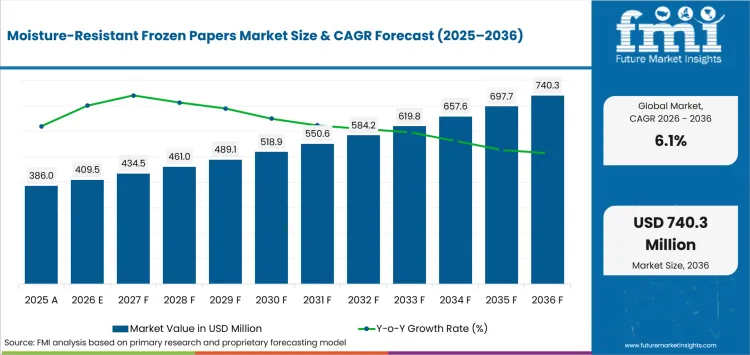
USD 409.5 million in 2026 and USD 740.3 million by 2036 at a 6.1% CAGR.
Demand for moisture-resistant frozen papers is projected to expand at 6.1% CAGR between 2026 and 2036, increasing valuation from USD 409.5 million to USD 740.3 million. Frozen food brands continue to evaluate paper-based alternatives as they seek packaging formats that balance barrier performance with recyclability objectives. Lecta introduced Metalvac Ice Cream in December 2025 with a water-vapor barrier designed for frozen cone packaging. The launch highlights growing efforts to replace selected laminate structures with paper-based solutions that can run on existing packaging lines while maintaining freezer performance
The commercial case for these materials varies across markets according to packaging-cost frameworks and material classifications. The United Kingdom has become an important example following the introduction of producer-responsibility fees linked to packaging materials. PackUK set 2025-2026 base fees with paper and card at less than half the rate applied to plastic and below the rate applied to fibre-based composite packaging. The difference increases the attractiveness of paper-led structures where manufacturers can retain paper classification without compromising moisture resistance, sealing performance or frozen-food protection requirements.
Key Takeaways of Moisture-Resistant Frozen Papers Market
- Frozen-food processors qualify more paper as moisture protection survives freezing and normal line speeds without increasing pack failures.
- Based on product type, wet-strength kraft papers are projected to account for 34.0% in 2026 due to wet integrity.
- By material, virgin kraft is estimated to hold 42.0% in 2026 owing to consistent fiber strength during converting.
- In 2026, standard WVTR grades are expected to lead barrier level with 40.0% share attributable to mainstream moisture needs.
- Qualification remains constrained by balancing moisture resistance with sealability, food-contact compliance and a defensible paper-recovery route.
- Billerud, Mondi, Sappi, Smurfit Westrock, UPM Specialty Papers, Koehler Paper, Ahlstrom and Cascades form the verified company set.
Analyst Perspective
"Frozen-paper economics depend on the complete pack specification, not the lowest paper price or barrier rating. Repeat business goes to grades matching WVTR and sealing behavior to the freezer cycle without weakening food-contact or recovery requirements."
- Nandini Roy Choudhury, Principal Consultant, Future Market Insights
How is the Moisture-Resistant Frozen Papers Market segmented?
By product type, material, barrier level, application, end use, sales channel and region.
Product type includes wet-strength kraft papers, dispersion-coated papers, PE-alternative barrier papers, wax-alternative papers and others. Material covers virgin kraft, recycled fiber, bleached paperboard and others. Barrier level includes standard WVTR, enhanced WVTR and high barrier. Applications cover frozen food cartons & sleeves, freezer wraps, bags & pouches, liners & interleaves and others. End use includes food processors, grocery retail, foodservice and others. Sales channels comprise direct - converter supply, packaging distributors, others and online - e-commerce.
What supports frozen food cartons & sleeves within the application category?
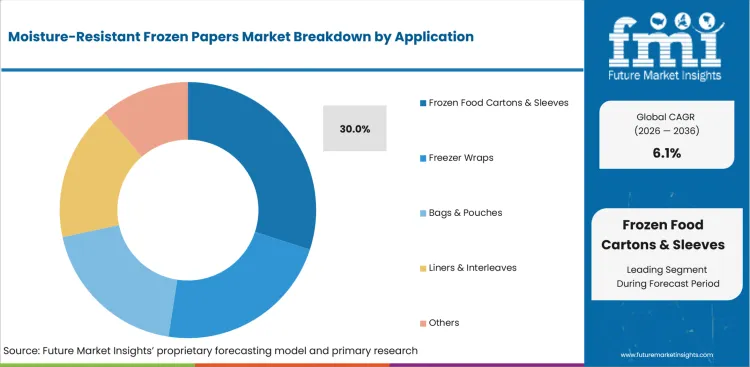
Frozen food cartons and sleeves combine structural protection with printable area across repeat-volume retail programs. Their established food packaging workflow makes stiffness after condensation a practical approval test and limits equipment changes during paper-led conversion.
- The application category is forecast to be led by frozen food cartons & sleeves at 30.0% share in 2026 due to compatibility with high-volume retail packing systems.
- Cascades reported in March 2026 that equipment at its Kingsey Falls boxboard plant increased capacity and improved food-packaging sheet quality. The upgrade strengthens surface and print attributes needed for carton conversion across recurring retail programs.
Why do wet-strength kraft papers lead demand within the product type category?
Wet-strength kraft papers retain tensile performance after condensation reaches the fiber network, reducing tearing across wraps and liners. Smurfit Westrock documented closed-loop frozen-food packaging work with Sivafrost in May 2025, giving specialty paper programs evidence that paper and cardboard can remain inside a commercial frozen-food recovery loop.
- Based on product type, wet-strength kraft papers are projected to account for 34.0% in 2026 due to wet integrity across several frozen-food formats.
- Frozen-food processors select wet-strength kraft for formats that need handling strength before extreme vapor protection becomes economically justified across routine filling and distribution cycles.
Why does virgin kraft lead demand within the material category?
Virgin kraft provides long consistent fibers that help thinner paper structures retain strength during coating and frozen distribution. Its predictable surface supports food grade packaging qualification by reducing variation in odor, food-contact documentation and coating response across customer trials.
- By material, virgin kraft is estimated to hold 42.0% in 2026 owing to consistent fiber strength during initial coating and converting qualification.
- Ahlstrom launched LamiBak Flex in March 2025 using 100% responsibly sourced wood pulp with lower primer demand. The launch gives coating operations a current virgin-fiber base for flexible food packaging across repeated production runs.
How does standard WVTR retain the leading barrier level position?
Standard WVTR grades let barrier coated papers manage condensation and moderate vapor transfer without the coat weight required for severe exposure. Delfort launched thinbarrier 303 in June 2025 for temperatures from -18°C to +38°C, documenting water-vapor performance across refrigerated transport and warmer retail conditions.
- In 2026, standard WVTR grades are expected to lead barrier level with 40.0% share because mainstream frozen packs balance protection against coating weight and conversion complexity.
- Food processors reserve enhanced or high-barrier structures for longer storage and exposed products, keeping standard moisture protection commercially relevant across routine high-volume retail cartons and wraps.
What are the drivers, restraints and opportunities in the Moisture-Resistant Frozen Papers Market?
Plastic substitution and packaging rules increase paper trials, qualification complexity limits conversion, and lower-coat-weight barriers expand the addressable application range.
- Driver: Brands are testing paper-led structures where moisture protection and recyclability can replace selected plastic-heavy barrier formats without raising product-loss risk.
- Restraint: Coatings can improve water-vapor resistance yet complicate sealing or recovery classification, which extends plant trials and delays recurring commercial orders.
- Opportunity: Paper mills and coating specialists can convert demand faster by pre-validating barrier levels on equipment that resembles the customer’s actual frozen-food line.
Packaging Regulation Raises the Value of Recyclable Barrier Design
European packaging rules now make recyclability part of barrier paper design, raising scrutiny of barrier packaging that substitutes for plastic. The Directorate-General for Environment reported in February 2025 that the Packaging and Packaging Waste Regulation entered into force with measures promoting recycling and material circularity. Frozen-food paper projects convert faster into orders if moisture protection meets the recovery criteria used during material selection.
Recyclability Testing Adds a Qualification Gate
Recyclability classification adds a direct cost test to paper coating materials used around frozen foods. PackUK stated in December 2025 that red-rated packaging would carry year-two fees at 1.2 times amber rates, while green material receives a discount based on reported volumes. Packaging teams therefore need reprocessing evidence alongside WVTR and seal data, raising trial costs for coated structures that risk an unfavorable rating.
Pre-Validated Barrier Platforms Expand the Commercial Window
Paper mills expand frozen applications by validating barrier coatings with packaging specialists before commercial conversion. Delfort and Rieusset reported in October 2025 that thinbarrier 201 ice-lolly packs resisted moisture and freezer burn, remained recyclable under CEPI testing and ran on existing machines. Joint application work reduces uncertainty around sealing, print and freezer performance before a paper structure replaces a known laminate.
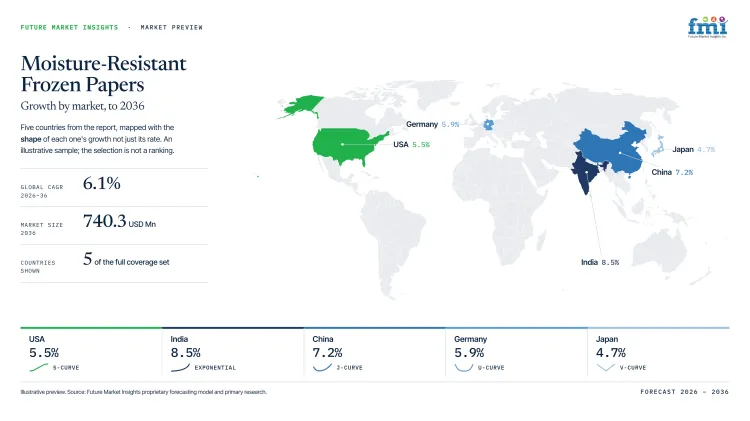
Which country CAGRs are profiled in the Moisture-Resistant Frozen Papers Market?
| Country | CAGR |
|---|---|
| Brazil | 6.5% |
| United Kingdom | 6.0% |
| Germany | 5.9% |
| United States | 5.5% |
| Japan | 4.7% |
How do country-level CAGRs compare in the Moisture-Resistant Frozen Papers Market?
The five profiled forecasts form a 1.8-point band, with Brazil and the United Kingdom in the upper group and Japan separated at the lower end. The spacing reflects qualification economics instead of current market size: packaging rules, recovery infrastructure and trial costs determine how quickly paper grades become recurring frozen-food orders.
- Brazil combines faster growth with price-sensitive conversion and changing food-packaging compliance requirements.
- United Kingdom fee modulation makes recovery classification a routine packaging-design cost consideration.
- Germany’s mature paper-recycling system rewards repulpable structures and scrutinizes heavily coated formats.
- United States PFAS reformulation makes barrier chemistry a direct food-contact qualification issue.
- Japan’s collection system places greater weight on print consistency and controlled material substitutions.
Similar CAGRs therefore produce different entry conditions for mills serving frozen-food applications.
The full report provides country-level CAGR analysis across North America, Latin America, Europe, East Asia, South Asia, Oceania and the Middle East and Africa.
Country-wise Analysis
- United States food processors face a direct reformulation route because the FDA determined in January 2025 that 35 PFAS food-contact notifications covering grease-proofing paper and paperboard were no longer effective for commercial food-contact use. In the United States, moisture-resistant frozen paper demand is predicted to advance at 5.5% CAGR through 2036 owing to processor trials of PFAS-free barriers on established high-speed packaging equipment during plant qualification cycles. Domestic converting capacity shortens trial cycles, but mills must prove replacement chemistries preserve moisture and grease resistance without reducing line speed or changing established sealing settings across high-volume retail programs that penalize downtime.
- German converters operate inside a mature paper-recovery system, and the German Environment Agency reported in January 2026 that paper and cardboard packaging met statutory recycling targets during 2024 across dual-system collections. Moisture-resistant frozen paper sales in Germany are forecast to expand at 5.9% CAGR by 2036, shaped by collection infrastructure that gives repulpable grades a practical recovery route across national food-packaging programs serving large frozen-food processor and retail accounts nationwide. Mills must document coating behavior and food-contact suitability, since a moisture barrier loses its commercial advantage if the finished pack falls outside accepted recycling conditions during routine frozen-food order approval.
- Japanese packaging programs operate within established fiber collection routes as the Ministry of the Environment reported in March 2026 that 1,299 municipalities collected beverage paper packaging during fiscal 2024 across national systems. Japan’s moisture-resistant frozen papers outlook is anticipated to advance at 4.7% CAGR over the assessment period, supported by local recovery experience and careful material substitution across established retail channels. Packaging teams require narrow print and barrier tolerances, so mills need local technical support that proves coating performance without weakening shelf presentation or creating a recovery route customers cannot explain during commercial frozen-food trials at customer plants nationwide.
- United Kingdom packaging teams operate under formal recyclability economics, and Defra reported in July 2025 that paper and cardboard achieved a 74.3% packaging recycling rate during 2024 across national recovery systems. Moisture-resistant frozen paper demand in the United Kingdom is forecast to rise at 6.0% CAGR over the forecast period, reinforced by high paper recovery and producer-responsibility costs across frozen-food packaging programs serving major national retail programs. Laminations and difficult coatings can weaken that advantage, since unfavorable recyclability ratings increase fee exposure and require additional evidence before converters approve a barrier structure for recurring frozen-food production on high-volume commercial lines.
- Brazilian food-packaging programs operate under a registration framework that changed in July 2025, when Anvisa adopted RDC 983/2025 and allowed already-produced food and beverage packaging to be used for up to 180 days after approval. By 2036, Brazil is projected to grow at 6.5% CAGR, supported by domestic conversion and localized frozen-food application trials across major production centers and retail channels. Price sensitivity remains a material friction, so paper mills need locally available grades and technical support that document food-contact compliance plus moisture performance without relying on expensive imported assistance during recurring qualification across dispersed key regional customer sites nationwide.
Who are the notable companies in the Moisture-Resistant Frozen Papers Market?
Billerud, Mondi, Sappi, Smurfit Westrock, UPM Specialty Papers, Koehler Paper, Ahlstrom and Cascades are the notable companies serving this market.
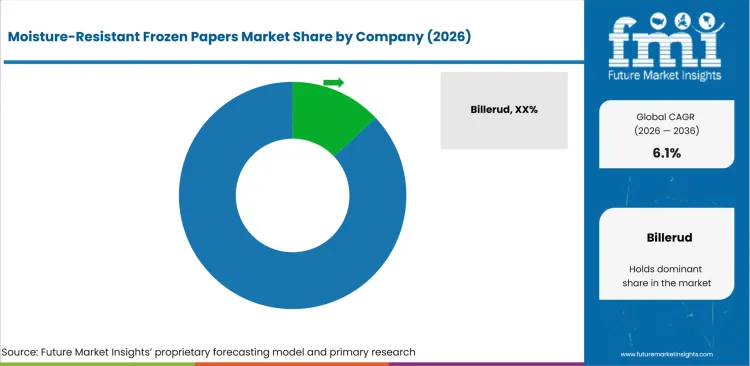
Competition spans integrated mills, specialty barrier developers and converted paperboard networks serving frozen-food packaging accounts. Frozen-food grades face higher entry barriers than simpler greaseproof paper sheets because moisture control must be proven alongside food-contact records and line performance. Repeat orders favor companies that shorten trials and document recovery behavior across the geographies they serve.
- Billerud, Mondi, UPM Specialty Papers and Koehler Paper pair papermaking platforms with current barrier-paper programs for flexible food packaging.
- Sappi and Ahlstrom provide functional papers that give converters several sealing or coating routes for moisture-sensitive food applications.
- Smurfit Westrock and Cascades bring fiber packaging networks closer to package conversion and print-performance decisions.
Competitive Benchmarking: Moisture-Resistant Frozen Papers Market
| Company | Moisture and Vapor Barrier Portfolio | Food-Packaging Converting Readiness | Fiber-Circularity Evidence | Geographic Reach |
|---|---|---|---|---|
| Billerud | Medium | High | High | Europe and North America |
| Mondi | High | High | High | Europe, Americas, Africa and Asia |
| Sappi | High | High | High | Europe, North America, South Africa and Asia |
| Smurfit Westrock | Medium | High | High | Global |
| UPM Specialty Papers | High | High | High | Europe and China with global supply |
| Koehler Paper | High | High | High | Europe and international distribution |
| Ahlstrom | High | High | High | Global |
| Cascades | Medium | Medium | High | Canada and United States |
Key Developments in the Moisture-Resistant Frozen Papers Market
- In December 2025, Koehler Paper reported commercial chewing-gum packaging using Koehler NexCoat Smart M with metallised barrier conversion and a recyclable paper base for moisture-sensitive food applications.
- In May 2025, Ahlstrom inaugurated the PMZ5 parchmentizer in France to increase capacity and flexibility for grease- and water-resistant vegetable parchment serving food-packaging applications.
- In March 2025, UPM Specialty Papers and Orkla Suomi began a six-month Finnish retail pilot using barrier paper and cold-seal lacquer on existing flow-pack equipment.
Key Players in the Moisture-Resistant Frozen Papers Market
Integrated Barrier-Paper Platforms
- Billerud
- Mondi
- UPM Specialty Papers
- Koehler Paper
Specialty Functional-Paper Suppliers
- Sappi
- Ahlstrom
Board and Packaging Network Suppliers
- Smurfit Westrock
- Cascades
Moisture-Resistant Frozen Papers Market - Report Scope
| Coverage field | Report scope |
|---|---|
| Market breakdown | By product type, material, barrier level, application, end use, sales channel and region. |
| Quantitative Units | Revenue USD million and CAGR in %. |
| Market Definition | Commercial moisture-resistant paper and paperboard grades sold for frozen-food and freezer-chain packaging within the stated segments. |
| Regions Covered | North America, Latin America, Europe, East Asia, South Asia and Pacific and Middle East and Africa. |
| Countries Covered | Brazil, United Kingdom, Germany, United States, Japan, and 20+ countries included in the full report. |
| Key Companies Profiled | Billerud, Mondi, Sappi, Smurfit Westrock, UPM Specialty Papers, Koehler Paper, Ahlstrom, Cascades. |
| Forecast Period | 2026 to 2036. |
| Approach | Primary and secondary research with market triangulation. |
Moisture-Resistant Frozen Papers Market - Research Methodology
| Method | Approach |
|---|---|
| Primary Research | FMI analysts gathered input from manufacturers, service providers, technology developers, distributors, end users, procurement teams, and subject-matter experts. Interviews examined purchasing decisions, product or service evaluation, adoption barriers, approval requirements, pricing considerations, and expectations for technical or commercial support. Respondents were also asked what evidence is required before a trial, pilot, or initial order develops into regular purchasing. |
| Desk Research | Desk research covered government statistics, regulatory publications, trade data, industry associations, technical literature, standards, company filings, product information, and official corporate announcements. Sources were reviewed for relevance, publication date, geographic coverage, and consistency with the defined market scope. Claims relating to performance, applications, approvals, capacity, investment, and commercial activity were retained only when supported by credible public evidence. |
| Market Sizing and Forecasting | The market model combined the baseline value with historical performance, segment structure, pricing and volume indicators, adoption levels, company participation, and country-level demand conditions. Forecast assumptions considered economic activity, investment trends, regulatory developments, technology adoption, purchasing cycles, supply availability, and barriers to wider market use. Segment and regional estimates were reconciled before the final market total was calculated. |
| Data Validation | Estimates were checked against multiple independent indicators, including public data, company activity, trade patterns, industry developments, and findings from primary interviews. Validation also tested whether products, services, applications, and company revenues fell within the defined market boundaries. Adjacent categories, unsupported claims, overlapping revenues, and activities without direct market relevance were excluded to reduce double counting and maintain consistency across segments and countries. |
Moisture-Resistant Frozen Papers Market by Segments
Moisture-Resistant Frozen Papers Market segmented by Product Type:
- Wet-Strength Kraft Papers
- Dispersion-Coated Papers
- PE-Alternative Barrier Papers
- Wax-Alternative Papers
- Others
Moisture-Resistant Frozen Papers Market segmented by Material:
- Virgin Kraft
- Recycled Fiber
- Bleached Paperboard
- Others
Moisture-Resistant Frozen Papers Market segmented by Barrier Level:
- Standard WVTR
- Enhanced WVTR
- High Barrier
Moisture-Resistant Frozen Papers Market segmented by Application:
- Frozen Food Cartons & Sleeves
- Freezer Wraps
- Bags & Pouches
- Liners & Interleaves
- Others
Moisture-Resistant Frozen Papers Market segmented by End Use:
- Food Processors
- Grocery Retail
- Foodservice
- Others
Moisture-Resistant Frozen Papers Market segmented by Sales Channel:
- Direct - Converter Supply
- Packaging Distributors
- Others
- Online - E-commerce
Moisture-Resistant Frozen Papers Market by Region:
- North America
- United States
- Canada
- Latin America
- Brazil
- Mexico
- Argentina
- Chile
- Western Europe
- Germany
- France
- United Kingdom
- Italy
- Spain
- Benelux
- Nordics
- Eastern Europe
- Poland
- Czech Republic
- Romania
- Hungary
- East Asia
- China
- Japan
- South Korea
- South Asia and Pacific
- India
- ASEAN
- Australia and New Zealand
- Middle East and Africa
- GCC Countries
- South Africa
- Türkiye
- Israel
Research Sources and Bibliography
- Lecta. (2025, December 18). Lecta presents Metalvac Ice Cream, its innovative solution for the ice cream sector.
- Department for Environment, Food & Rural Affairs. (2025, June 27). Extended Producer Responsibility for Packaging: 2025 base fees.
- Smurfit Westrock. (2025, May 26). Closing the loop: Smurfit Westrock and Sivafrost build a sustainable future.
- Ahlstrom. (2025, March 17). Ahlstrom expands LamiBak™ portfolio with a new base paper for flexible food packaging.
- delfortgroup AG. (2025, June 17). new barrier paper for varying temperatures: thinbarrier 303 protects food from frozen to tropical.
- Cascades. (2026, March 5). Cascades invests in its Kingsey Falls uncoated recycled boxboard plant to improve sheet quality control, surface finish and printing requirements for food packaging.
- Directorate-General for Environment. (2025, February 11). New rules enter into force for a more sustainable and competitive packaging economy.
- PackUK & Department for Environment, Food & Rural Affairs. (2025, December 16). Year 2 illustrative waste disposal fees: Extended producer responsibility for packaging.
- delfortgroup AG. (2025, October 13). paper packaging for ice lollies: delfort and Rieusset Gerosa Group join forces.
- USA Food and Drug Administration. (2025, January 3). FDA Determines Authorization for 35 Food Contact Notifications Related to PFAS Are No Longer Effective.
- German Environment Agency. (2026, January 27). Facts against myths: Packaging waste recycling in Germany is working.
- Ministry of the Environment, Government of Japan. (2026, March 31).
- Department for Environment, Food & Rural Affairs. (2025, July 23). UK statistics on waste.
- Agência Nacional de Vigilância Sanitária. (2025, July 31). Anvisa autoriza esgotamento de embalagens já produzidas após regularização de alimentos.
- Billerud. (2025, March 12). Billerud launches ConFlex® HeatSeal - a recyclable, heat-sealable paper packaging material.
- Mondi. (2025, August 14). Mondi ramps up FunctionalBarrier Paper Ultimate to meet growing demand for sustainable high-barrier paper-based packaging.
- UPM Specialty Papers. (2025, September 4). UPM and Royal Vaassen have developed a fibre-based alternative to plastic and aluminum packaging solutions.
- Koehler Paper. (2025, February 20). pack&satt Organic Ready-to-Eat Meals Packed in Koehler Paper Material.
- Sappi. (2025, September 2). Sappi expands recyclable, high-barrier paper portfolio for primary packaging.
- Koehler Paper. (2025, December 17). Boom Boom Chewing Gum Now Packed in Paper Made by Koehler Paper.
- Ahlstrom. (2025, May 21). Ahlstrom inaugurates new parchmentizer at the Saint-Séverin plant, strengthening customer partnerships and local commitment.
- Koehler Paper. (2026, April 21). RUF Lebensmittelwerk KG chooses Koehler Paper barrier paper for its porridge packaging.
- Mondi. (2026, February 18). How Prymat improved spice preservation with Mondi's recyclable ultra-high barrier paper solution.
- UPM Specialty Papers. (2025, March 18). UPM packaging papers achieve recyclability certifications in Europe and the USA
- UPM Specialty Papers. (2025, March 6). UPM and Orkla Suomi introduce paper packaging for Panda Milk chocolate.
This bibliography is provided for reader reference and is not exhaustive. The full report contains the complete reference list and detailed citations.
This Report Answers
- How does the 2026 to 2036 forecast change the commercial scale of moisture-resistant frozen papers?
- Which packaging regulations are changing barrier-chemistry choices for frozen-food paper structures?
- Why do wet-strength kraft papers remain central to several frozen-food packaging formats?
- How does virgin kraft affect coating consistency and food-contact qualification across converting lines?
- Why do standard WVTR grades cover more mainstream applications than maximum-barrier structures?
- How do Brazil, the United Kingdom, Germany, the United States and Japan differ in qualification conditions?
- Which company capabilities matter most during frozen-paper barrier and converting evaluations?
- What operating frictions can delay paper substitution despite favorable recycling economics?
- Which supplier actions are expanding current barrier-paper capacity or commercial conversion evidence?
Frequently Asked Questions
How big is the moisture-resistant frozen papers market in 2026?
The moisture-resistant frozen papers market is estimated at USD 409.5 million in 2026 and is projected to reach USD 740.3 million by 2036. Growth is driven by increasing demand for paper-based packaging solutions that maintain moisture control and package integrity throughout frozen-food distribution.
What is the CAGR of the moisture-resistant frozen papers market from 2026 to 2036?
The moisture-resistant frozen papers market is projected to grow at a CAGR of 6.1% between 2026 and 2036. Expansion is supported by the adoption of paper grades that meet moisture resistance, sealing performance, and food-contact requirements.
Which material segment is projected to account for 42.0% of the moisture-resistant frozen papers market?
Virgin kraft is projected to account for 42.0% of the market in 2026. Its leading share is supported by strong fiber properties, consistent performance, and suitability for coated frozen-food packaging applications.
How much will the moisture-resistant frozen papers market add between 2026 and 2036?
The moisture-resistant frozen papers market is expected to add USD 330.8 million in value between 2026 and 2036. Growth reflects increasing use of qualified paper structures as alternatives to plastic-intensive frozen-food packaging formats.
Which companies are active in the moisture-resistant frozen papers market?
Key companies operating in the market include Billerud, Mondi, Sappi, Smurfit Westrock, UPM Specialty Papers, Koehler Paper, Ahlstrom, and Cascades. These companies compete through specialty barrier papers, integrated paper production capabilities, and frozen-food packaging solutions.
Preview the report firsthand - request a free sample
Get SampleGet the brochure for pricing and purchase details.
Get PDFTable of Content
- Key Takeaways
- Market Size and CAGR
- Top Growth Driver
- Fastest Growing Segment
- Leading Region
- Key Companies
- Emerging Opportunities
- Executive Summary
- Global Market Outlook
- Demand-side Trends
- Supply-side Trends
- Technology Roadmap Analysis
- Analysis and Recommendations
- Analyst Perspective (What is happening? Why now? What should investors know?)
- Key Questions Answered
- How large is the market?
- What is the CAGR?
- What are key trends?
- Which region dominates?
- Who are the leaders?
- Market Overview
- Market Coverage / Taxonomy
- Market Definition / Scope / Limitations
- Research Methodology
- Chapter Orientation
- Analytical Lens and Working Hypotheses
- Market Structure, Signals, and Trend Drivers
- Benchmarking and Cross-market Comparability
- Market Sizing, Forecasting, and Opportunity Mapping
- Research Design and Evidence Framework
- Desk Research Programme (Secondary Evidence)
- Expert Input and Fieldwork (Primary Evidence)
- Tooling, Models, and Reference Databases
- Data Engineering and Model Build
- Quality Assurance and Audit Trail
- Market Background
- Market Dynamics (Drivers, Restraints, Opportunity, Trends)
- Scenario Forecast (Optimistic, Likely, Conservative)
- Impact Analysis
- AI Impact
- Sustainability Impact
- Regulatory Impact
- Technology Impact
- Consumer / Buyer Analysis
- Purchase Drivers
- Adoption Barriers
- Buyer Journey
- Opportunity Map Analysis
- Product Life Cycle Analysis
- Supply Chain Analysis
- Investment Feasibility Matrix
- Value Chain Analysis
- PESTLE and Porter's Analysis
- Regulatory Landscape
- Regional Parent Market Outlook
- Production and Consumption Statistics
- Import and Export Statistics
- Global Market Analysis and Forecast, 2021 to 2036
- Historical Market Size Value (USD Million) Analysis, 2021 to 2025
- Current and Future Market Size Value (USD Million) Projections, 2026 to 2036
- Y-o-Y Growth Trend Analysis
- Absolute $ Opportunity Analysis
- Global Market Pricing Analysis, 2021 to 2036
- Global Market Analysis and Forecast, By Product Type, 2021 to 2036
- Introduction / Key Findings
- Historical Market Size Value (USD Million) Analysis By Product Type, 2021 to 2025
- Current and Future Market Size Value (USD Million) Analysis and Forecast By Product Type, 2026 to 2036
- Wet-Strength Kraft Papers
- Dispersion-Coated Papers
- PE-Alternative Barrier Papers
- Wax-Alternative Papers
- Others
- Wet-Strength Kraft Papers
- Y-o-Y Growth Trend Analysis By Product Type, 2021 to 2025
- Absolute $ Opportunity Analysis By Product Type, 2026 to 2036
- Global Market Analysis and Forecast, By Material, 2021 to 2036
- Introduction / Key Findings
- Historical Market Size Value (USD Million) Analysis By Material, 2021 to 2025
- Current and Future Market Size Value (USD Million) Analysis and Forecast By Material, 2026 to 2036
- Virgin Kraft
- Recycled Fiber
- Bleached Paperboard
- Others
- Virgin Kraft
- Y-o-Y Growth Trend Analysis By Material, 2021 to 2025
- Absolute $ Opportunity Analysis By Material, 2026 to 2036
- Global Market Analysis and Forecast, By Barrier Level, 2021 to 2036
- Introduction / Key Findings
- Historical Market Size Value (USD Million) Analysis By Barrier Level, 2021 to 2025
- Current and Future Market Size Value (USD Million) Analysis and Forecast By Barrier Level, 2026 to 2036
- Standard WVTR
- Enhanced WVTR
- High Barrier
- Standard WVTR
- Y-o-Y Growth Trend Analysis By Barrier Level, 2021 to 2025
- Absolute $ Opportunity Analysis By Barrier Level, 2026 to 2036
- Global Market Analysis and Forecast, By Application, 2021 to 2036
- Introduction / Key Findings
- Historical Market Size Value (USD Million) Analysis By Application, 2021 to 2025
- Current and Future Market Size Value (USD Million) Analysis and Forecast By Application, 2026 to 2036
- Frozen Food Cartons & Sleeves
- Freezer Wraps
- Bags & Pouches
- Liners & Interleaves
- Others
- Frozen Food Cartons & Sleeves
- Y-o-Y Growth Trend Analysis By Application, 2021 to 2025
- Absolute $ Opportunity Analysis By Application, 2026 to 2036
- Global Market Analysis and Forecast, By End Use, 2021 to 2036
- Introduction / Key Findings
- Historical Market Size Value (USD Million) Analysis By End Use, 2021 to 2025
- Current and Future Market Size Value (USD Million) Analysis and Forecast By End Use, 2026 to 2036
- Food Processors
- Grocery Retail
- Foodservice
- Others
- Food Processors
- Y-o-Y Growth Trend Analysis By End Use, 2021 to 2025
- Absolute $ Opportunity Analysis By End Use, 2026 to 2036
- Global Market Analysis and Forecast, By Sales Channel
- Introduction / Key Findings
- Historical Market Size Value (USD Million) Analysis By Sales Channel, 2021 to 2025
- Current and Future Market Size Value (USD Million) Analysis and Forecast By Sales Channel, 2026 to 2036
- Direct - Converter Supply
- Packaging Distributors
- Others
- Online - E-commerce
- Direct - Converter Supply
- Y-o-Y Growth Trend Analysis By Sales Channel, 2021 to 2025
- Absolute $ Opportunity Analysis By Sales Channel, 2026 to 2036
- Global Market Analysis and Forecast, By Region, 2021 to 2036
- Introduction
- Historical Market Size Value (USD Million) Analysis By Region, 2021 to 2025
- Current Market Size Value (USD Million) Analysis and Forecast By Region, 2026 to 2036
- North America
- Latin America
- Western Europe
- Eastern Europe
- East Asia
- South Asia and Pacific
- Middle East & Africa
- Market Attractiveness Analysis By Region
- North America Market Analysis and Forecast, By Country, 2021 to 2036
- Historical Market Size Value (USD Million) Trend Analysis By Market Taxonomy, 2021 to 2025
- Market Size Value (USD Million) Forecast By Market Taxonomy, 2026 to 2036
- By Country
- USA
- Canada
- By Product Type
- By Material
- By Barrier Level
- By Application
- By End Use
- By Sales Channel
- By Country
- Market Attractiveness Analysis
- By Country
- By Product Type
- By Material
- By Barrier Level
- By Application
- By End Use
- By Sales Channel
- Key Takeaways
- Latin America Market Analysis and Forecast, By Country
- Historical Market Size Value (USD Million) Trend Analysis By Market Taxonomy, 2021 to 2025
- Market Size Value (USD Million) Forecast By Market Taxonomy, 2026 to 2036
- By Country
- Brazil
- Mexico
- Chile
- Rest of Latin America
- By Product Type
- By Material
- By Barrier Level
- By Application
- By End Use
- By Sales Channel
- By Country
- Market Attractiveness Analysis
- By Country
- By Product Type
- By Material
- By Barrier Level
- By Application
- By End Use
- By Sales Channel
- Key Takeaways
- Western Europe Market Analysis and Forecast, By Country
- Historical Market Size Value (USD Million) Trend Analysis By Market Taxonomy, 2021 to 2025
- Market Size Value (USD Million) Forecast By Market Taxonomy, 2026 to 2036
- By Country
- Germany
- UK
- Italy
- Spain
- France
- Nordic
- BENELUX
- Rest of Western Europe
- By Product Type
- By Material
- By Barrier Level
- By Application
- By End Use
- By Sales Channel
- By Country
- Market Attractiveness Analysis
- By Country
- By Product Type
- By Material
- By Barrier Level
- By Application
- By End Use
- By Sales Channel
- Key Takeaways
- Eastern Europe Market Analysis and Forecast, By Country
- Historical Market Size Value (USD Million) Trend Analysis By Market Taxonomy, 2021 to 2025
- Market Size Value (USD Million) Forecast By Market Taxonomy, 2026 to 2036
- By Country
- Russia
- Poland
- Hungary
- Balkan & Baltic
- Rest of Eastern Europe
- By Product Type
- By Material
- By Barrier Level
- By Application
- By End Use
- By Sales Channel
- By Country
- Market Attractiveness Analysis
- By Country
- By Product Type
- By Material
- By Barrier Level
- By Application
- By End Use
- By Sales Channel
- Key Takeaways
- East Asia Market Analysis and Forecast, By Country
- Historical Market Size Value (USD Million) Trend Analysis By Market Taxonomy, 2021 to 2025
- Market Size Value (USD Million) Forecast By Market Taxonomy, 2026 to 2036
- By Country
- China
- Japan
- South Korea
- By Product Type
- By Material
- By Barrier Level
- By Application
- By End Use
- By Sales Channel
- By Country
- Market Attractiveness Analysis
- By Country
- By Product Type
- By Material
- By Barrier Level
- By Application
- By End Use
- By Sales Channel
- Key Takeaways
- South Asia and Pacific Market Analysis and Forecast, By Country
- Historical Market Size Value (USD Million) Trend Analysis By Market Taxonomy, 2021 to 2025
- Market Size Value (USD Million) Forecast By Market Taxonomy, 2026 to 2036
- By Country
- India
- ASEAN
- Australia & New Zealand
- Rest of South Asia and Pacific
- By Product Type
- By Material
- By Barrier Level
- By Application
- By End Use
- By Sales Channel
- By Country
- Market Attractiveness Analysis
- By Country
- By Product Type
- By Material
- By Barrier Level
- By Application
- By End Use
- By Sales Channel
- Key Takeaways
- Middle East & Africa Market Analysis and Forecast, By Country
- Historical Market Size Value (USD Million) Trend Analysis By Market Taxonomy, 2021 to 2025
- Market Size Value (USD Million) Forecast By Market Taxonomy, 2026 to 2036
- By Country
- Kingdom of Saudi Arabia
- Other GCC Countries
- Türkiye
- South Africa
- Other African Union
- Rest of Middle East & Africa
- By Product Type
- By Material
- By Barrier Level
- By Application
- By End Use
- By Sales Channel
- By Country
- Market Attractiveness Analysis
- By Country
- By Product Type
- By Material
- By Barrier Level
- By Application
- By End Use
- By Sales Channel
- Key Takeaways
- Key Countries Market Analysis
- USA
- Pricing Analysis
- Market Share Analysis, 2025
- By Product Type
- By Material
- By Barrier Level
- By Application
- By End Use
- By Sales Channel
- Canada
- Pricing Analysis
- Market Share Analysis, 2025
- By Product Type
- By Material
- By Barrier Level
- By Application
- By End Use
- By Sales Channel
- Mexico
- Pricing Analysis
- Market Share Analysis, 2025
- By Product Type
- By Material
- By Barrier Level
- By Application
- By End Use
- By Sales Channel
- Brazil
- Pricing Analysis
- Market Share Analysis, 2025
- By Product Type
- By Material
- By Barrier Level
- By Application
- By End Use
- By Sales Channel
- Chile
- Pricing Analysis
- Market Share Analysis, 2025
- By Product Type
- By Material
- By Barrier Level
- By Application
- By End Use
- By Sales Channel
- Germany
- Pricing Analysis
- Market Share Analysis, 2025
- By Product Type
- By Material
- By Barrier Level
- By Application
- By End Use
- By Sales Channel
- UK
- Pricing Analysis
- Market Share Analysis, 2025
- By Product Type
- By Material
- By Barrier Level
- By Application
- By End Use
- By Sales Channel
- Italy
- Pricing Analysis
- Market Share Analysis, 2025
- By Product Type
- By Material
- By Barrier Level
- By Application
- By End Use
- By Sales Channel
- Spain
- Pricing Analysis
- Market Share Analysis, 2025
- By Product Type
- By Material
- By Barrier Level
- By Application
- By End Use
- By Sales Channel
- France
- Pricing Analysis
- Market Share Analysis, 2025
- By Product Type
- By Material
- By Barrier Level
- By Application
- By End Use
- By Sales Channel
- India
- Pricing Analysis
- Market Share Analysis, 2025
- By Product Type
- By Material
- By Barrier Level
- By Application
- By End Use
- By Sales Channel
- ASEAN
- Pricing Analysis
- Market Share Analysis, 2025
- By Product Type
- By Material
- By Barrier Level
- By Application
- By End Use
- By Sales Channel
- Australia & New Zealand
- Pricing Analysis
- Market Share Analysis, 2025
- By Product Type
- By Material
- By Barrier Level
- By Application
- By End Use
- By Sales Channel
- China
- Pricing Analysis
- Market Share Analysis, 2025
- By Product Type
- By Material
- By Barrier Level
- By Application
- By End Use
- By Sales Channel
- Japan
- Pricing Analysis
- Market Share Analysis, 2025
- By Product Type
- By Material
- By Barrier Level
- By Application
- By End Use
- By Sales Channel
- South Korea
- Pricing Analysis
- Market Share Analysis, 2025
- By Product Type
- By Material
- By Barrier Level
- By Application
- By End Use
- By Sales Channel
- Russia
- Pricing Analysis
- Market Share Analysis, 2025
- By Product Type
- By Material
- By Barrier Level
- By Application
- By End Use
- By Sales Channel
- Poland
- Pricing Analysis
- Market Share Analysis, 2025
- By Product Type
- By Material
- By Barrier Level
- By Application
- By End Use
- By Sales Channel
- Hungary
- Pricing Analysis
- Market Share Analysis, 2025
- By Product Type
- By Material
- By Barrier Level
- By Application
- By End Use
- By Sales Channel
- Kingdom of Saudi Arabia
- Pricing Analysis
- Market Share Analysis, 2025
- By Product Type
- By Material
- By Barrier Level
- By Application
- By End Use
- By Sales Channel
- Türkiye
- Pricing Analysis
- Market Share Analysis, 2025
- By Product Type
- By Material
- By Barrier Level
- By Application
- By End Use
- By Sales Channel
- South Africa
- Pricing Analysis
- Market Share Analysis, 2025
- By Product Type
- By Material
- By Barrier Level
- By Application
- By End Use
- By Sales Channel
- USA
- Market Structure Analysis
- Competition Dashboard
- Competition Benchmarking
- Market Share Analysis of Top Players
- By Regional
- By Product Type
- By Material
- By Barrier Level
- By Application
- By End Use
- By Sales Channel
- Emerging Startups
- Innovation Benchmarking
- Competition Analysis
- Competition Deep Dive
- Billerud
- Overview
- Product Portfolio
- Profitability by Market Segments
- Sales Footprint
- Strategy Overview
- Marketing Strategy
- Product Strategy
- Channel Strategy
- Mondi
- Sappi
- Smurfit Westrock
- Georgia-Pacific
- UPM Specialty Papers
- Koehler Paper
- Ahlstrom
- Twin Rivers Paper
- Cascades
- Billerud
- Case Studies
- Success Stories
- Recent Developments
- Competition Deep Dive
- Assumptions & Acronyms Used


