

- Market Size (2026)
- USD 558.1 Mn
- Forecast (2036)
- USD 1321.1 Mn
- CAGR (2026 to 2036)
- 9.0%
How big is Multicore Fiber Cabling for AI Campuses Market in 2026?
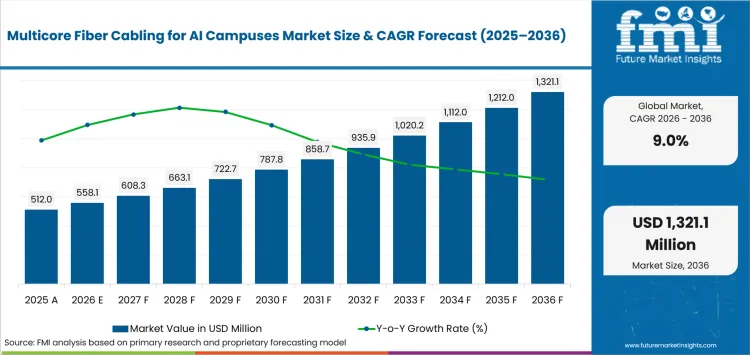
USD 558.1 million in 2026 and USD 1,321.1 million by 2036 at a 9.0% CAGR.
Demand for multicore fiber cabling for AI campuses is projected to expand at 9.0% CAGR between 2026 and 2036. Valuation rises from USD 558.1 million to USD 1,321.1 million as scale-out fabrics add parallel optical paths between switching stages. The Ethernet Alliance's December 2025 roadmap places 1.6 Tb/s interfaces, linear pluggable optics, and more efficient fiber options on the AI networking path. Denser data center cabling becomes relevant once cable volume slows installation or consumes pathway capacity reserved for later upgrades.
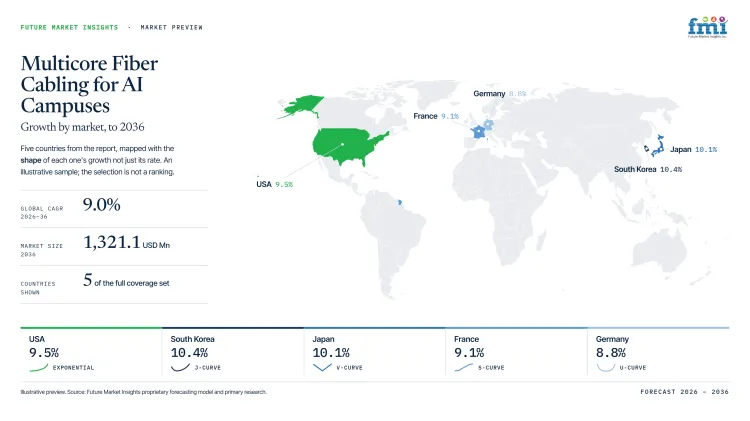
Country growth differs most clearly between South Korea at 10.4% CAGR and Germany at 8.8%. South Korea is adding clustered compute capacity, whereas German AI and HPC projects usually carry longer formal acceptance gates. In August 2026, South Korea's Ministry of Science and ICT began construction of a national AI computing center planned for 15,000 advanced AI semiconductors by 2028. Compact passive routes gain relevance as cabling absorbs higher compute density without extending commissioning schedules.
Key Takeaways
- Multicore fiber demand rises where AI scale-out makes tray capacity, connector density, and installation labor measurable constraints on network expansion.
- By link speed, 800G is estimated to hold 38.0% in 2026 owing to mature Ethernet interfaces that reduce near-term qualification work.
- In 2026, the pluggable optics segment is expected to lead optical architecture with 32.0% share because replaceable interfaces limit system-level changes during passive-media qualification.
- Inter-rack - scale-out is set to lead the deployment location category with 36.0% share in 2026 due to parallel rack-to-rack paths inside AI clusters.
- Interoperability, core alignment, splicing, and test procedures can delay approval unless MCF deployment economics outperform proven single-core cabling in field use.
- Some of the key players in this market include Corning, AFL, Sumitomo Electric, and TeraHop.
Analyst Perspective
"MCF should be judged by usable optical paths per occupied tray position after splice, connector, and restoration testing. The economics improve if lower cable and connector counts offset qualification work, repair training, and spare-part complexity."
- Sudip saha, Principal Consultant, Future Market Insights
How is the multicore fiber cabling for AI campuses market segmented?
The market is segmented by link speed, optical architecture, deployment location, data center type, route to market, and region.
The market is segmented by link speed, optical architecture, deployment location, data center type, route to market, and region. Link speeds cover 800G, 400G, 1.6T, and 3.2T and above. Optical architectures include pluggable, near-packaged, co-packaged, and passive fiber - cabling systems. Deployment locations cover inter-rack - scale-out, intra-rack - scale-up, spine-leaf fabric, and campus - DCI. Data center types include hyperscale AI, colocation AI, enterprise AI/HPC, and research - sovereign compute. Routes include OEM direct, network system integrators, fiber-cabling specialists, and test - managed-service providers.
Why does 800G lead the link speed category?
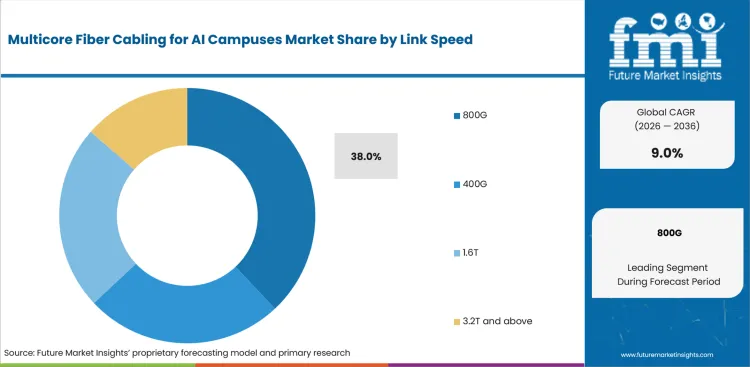
800G is the current qualification anchor for AI fabric cabling because multi-vendor operation is already routine enough for production network planning. The Ethernet Alliance reported in October 2025 that 800G interoperability had become repeatable and 1.6T interfaces continued advancing toward broader deployment.
- By link speed, 800G is estimated to hold 38.0% in 2026 owing to established high-speed interfaces that reduce qualification work during current AI network deployments and planned 1.6T migration.
- Network architects can introduce multicore pathways beside proven 800G high-speed interconnects, then preserve route density for the later 1.6T transition without rebuilding every cable corridor.
Why do pluggable optics lead the optical architecture category?
Pluggable optics keep transceiver replacement separate from passive cabling, which narrows the equipment set involved in MCF qualification and later refreshes. Field replacement preserves vendor choice during staged accelerator and network-switch refreshes over the same cabling plant.
- Based on optical architecture, the pluggable optics segment is projected to account for 32.0% in 2026 due to field-replaceable interfaces that preserve equipment choice during cabling transitions.
- OIF's March 2025 interoperability program covered 800G pluggable coherent optics and CMIS plug-and-play operation for AI and cloud networks. Network teams can qualify pluggable optical modules against a defined connector and fiber route without binding cabling to one engine generation.
How does inter-rack - scale-out lead the deployment location category?
Scale-out networks multiply short optical routes between accelerator racks and switching tiers. Cable management then becomes a repeated deployment constraint inside dense AI rows. Each hardware refresh can replicate the same routes inside newly added rack pods.
- Inter-rack - scale-out is set to lead deployment location with 36.0% share in 2026 due to rack-to-rack fabrics multiplying parallel paths faster than campus trunks. In March 2026, the Ethernet Alliance demonstrated multi-vendor Ethernet from 100G to 1.6T for AI and data-intensive networks.
- Dense network equipment rows favor MCF where fewer strands reduce tray occupation and connector handling without changing the short-reach O-band operating plan or proportional cable bulk.
Why do hyperscale AI data centers lead the data center type category?
Hyperscale AI facilities repeat high-radix network blocks at volumes large enough for modest cable-count reductions to affect labor, pathway occupation, and commissioning schedules. OIF announced in January 2026 that 40 member companies would demonstrate AI-data-center interoperability covering CMIS, co-packaging, and 400ZR to 800ZR optical technologies.
- By data center type, hyperscale AI data centers are forecast to represent 48.0% in 2026, driven by large cluster builds that expose pathway-density costs earlier than smaller sites.
- Large operators can fund direct qualification of new passive media, making MCF more practical where data center GPU expansion would otherwise add repeated cable bundles between network stages.
Why does OEM direct lead the route to market category?
Early MCF programs require fiber geometry, connectorization, and active-interface choices to be qualified as one deployment path before field conventions settle. Joint qualification reduces rework if connector or interface specifications change during early programs.
- The OEM direct segment is likely to capture 39.0% share in 2026 attributable to engineering access requirements during initial multicore qualification and volume planning.
- Corning stated in May 2025 that it became a qualified optical-infrastructure supplier for Broadcom's 51.2 TBps Bailly co-packaged optics system. Direct optical transceiver and cabling coordination gives engineering teams one qualification route for passive media and active interfaces.
What are the drivers, restraints and opportunities in the Multicore Fiber Cabling for AI Campuses Market?
AI scale-out increases pathway density requirements, interoperability slows approval, and standard-diameter MCF gives operators a route to add optical paths without proportional cable growth.
- Driver: 800G deployment and the 1.6T standards path increase the number of optical lanes that AI fabrics must route through finite rack and pathway space.
- Restraint: Four-core MCF still needs common design, core-alignment, connector, splicing, and field-test conventions before multi-vendor operations become routine.
- Opportunity: Standard-diameter multicore designs can cut strand count in dense routes if manufacturers prove connector savings, serviceability, and repeatable field economics.
AI Fabric Scaling Raises the Cost of Physical Pathway Density
AI scale-out multiplies links between compute and switching stages even though higher Ethernet speeds do not require multicore fiber. In February 2026, IEEE reported 99% approval in the fourth P802.3dj working-group recirculation ballot covering 200 Gb/s through 1.6 Tb/s Ethernet. The 1.6 Tb/s path raises interface capacity, so fixed tray space must carry more parallel fiber routes.
Interoperability and Field Procedures Delay Broad Qualification
Different core geometry and field procedures slow MCF approval as repair and acceptance work must remain predictable after installation. In March 2026, AFL announced the SDM4 MCF MSA with Corning, Sumitomo Electric, and TeraHop to define four-core design, performance, and interoperability requirements for passive data-center links. Common rules reduce interoperability risk, but approval still depends on repeatable splice, connector, and test records.
MCF-Native Interfaces Give Dense Campuses a Practical Adoption Route
Operators can justify MCF if denser passive routes work with current optical interfaces instead of requiring a proprietary network. In March 2025, TeraHop announced an MCF-native 800G-2xDR4 OSFP demonstration for AI and data-center networking. A defined 800G interface gives cabling teams a qualification target for comparing strand-count savings with fan-out, splice, test, spare, and repair requirements.
Which country CAGRs are profiled in the Multicore Fiber Cabling for AI Campuses Market?
| Country | CAGR |
|---|---|
| South Korea | 10.4% |
| Japan | 10.1% |
| UAE | 9.8% |
| USA | 9.5% |
| France | 9.1% |
| Germany | 8.8% |
How do country-level CAGRs compare in the Multicore Fiber Cabling for AI Campuses Market?
The six profiled countries span a 1.6 percentage-point CAGR range from 8.8% to 10.4%. South Korea and Japan form the upper band as dense compute additions meet mature domestic engineering bases. UAE and USA follow with large campus programs, while France and Germany carry more visible project-timing or acceptance friction.
- Domestic accelerator rollouts favor passive routes that conserve existing risers.
- Local multicore-fiber expertise shortens specialty-fiber qualification and repair escalation.
- Multinational contractors increase the value of common connector acceptance procedures.
- Hyperscalers spread qualification costs over repeated rack-pod expansions.
- Live-service constraints raise the value of denser metropolitan fiber pathways.
- Long equipment lives reward compatibility with later transceiver generations.
CAGR does not establish country priority because starting scale and project readiness differ. The full report covers North America, Latin America, Western Europe, Eastern Europe, East Asia, South Asia and Pacific, and the Middle East and Africa.
Country-wise Analysis
- South Korean operators are fitting accelerator clusters into existing data-center halls while national projects add purpose-built compute capacity. In May 2025, the Ministry of Science and ICT planned 10,000 advanced GPUs for 2025 and another 8,000 in the first half of 2026. South Korean demand is projected to grow at 10.4% CAGR through 2036, tied to continued accelerator deployment and limited pathway space in live facilities. MCF can reduce cable bulk during staged additions, yet unfamiliar splice and test routines leave little tolerance for commissioning delays. Local engineering teams can validate connectors near the installed base and shorten travel time during restoration.
- Japanese AI programs place service continuity and documented qualification ahead of rapid passive-media changes during scheduled maintenance windows at production sites and sovereign compute facilities. Multicore fiber cabling demand in Japan is forecast to rise at 10.1% CAGR over the assessment period, supported by domestic compute programs and strong local engineering coverage. METI and NEDO selected 16 GENIAC Cycle 4 computing-resource projects in June 2026 for domestic AI model development. Domestic optical manufacturers give operators a practical path for controlled trials and local repair escalation. Strong local service coverage does not remove conservative restoration policies that can slow approval of unfamiliar passive media.
- Many national sovereign-compute projects start as greenfield developments, allowing UAE campus planners to reserve dense optical routes early during phased construction. Abu Dhabi Media Office announced Stargate UAE in May 2025 with a 1-gigawatt compute cluster and a first 200-megawatt phase expected in 2026. Rapid delivery increases coordination risk among optics, cabling, installation, and test teams responsible for acceptance. UAE demand is anticipated to expand at 9.8% CAGR during the forecast period, attributable to greenfield scale and early topology decisions. Local integrators can influence passive-route choices before rack and cooling layouts become final, provided field procedures fit compressed project schedules.
- US hyperscale operators can qualify fiber and connectivity at large volume, with domestic manufacturing shortening replenishment during aggressive build programs. USA demand is expected to advance at 9.5% CAGR by 2036, given large AI builds and established optical supply. The Department of Energy identified 16 federal sites for potential data-center and AI infrastructure development in April 2025. Power availability and retrofit economics can defer MCF adoption even where pathway density is tight. Specifications therefore depend on measurable installation, repair, and cable-count savings over repeated large expansion cycles. Domestic supply gives US programs a shorter replacement route than import-dependent campuses face.
- French data-center projects often lock passive-network layouts after grid connection and site readiness become credible enough for detailed design. In January 2026, the Ministry of Economy identified 63 suitable data-center sites and reported 26 already secured, including five fast-track locations above 700 MW. Multicore fiber cabling sales in France are estimated to grow at 9.1% CAGR through 2036, driven by a secured-site pipeline that brings optical-route choices forward. French engineering firms can influence route density during commercial design, though uncertain construction timing weakens early commitments to specialized cabling. Grid connection timing determines how long MCF remains an open specification choice.
- German AI and HPC operators give formal acceptance evidence more weight than density claims during long-life infrastructure qualification. The EuroHPC Joint Undertaking stated in March 2026 that HammerHAI would exceed 15 Exaflops of peak AI inference performance using NVIDIA Quantum-X800 networking. Longer acceptance cycles require detailed repair records and interoperability evidence before passive infrastructure changes enter procurement. Germany is projected to record 8.8% CAGR over the forecast period, reflecting sovereign and industrial compute programs under tighter qualification controls. Local HPC engineering expertise can shorten technical review once repair procedures and lifecycle records are documented for unfamiliar passive-media systems in production.
Who are the notable companies in the Multicore Fiber Cabling for AI Campuses Market?
Corning, AFL, Sumitomo Electric, and TeraHop are the notable companies active in this market.
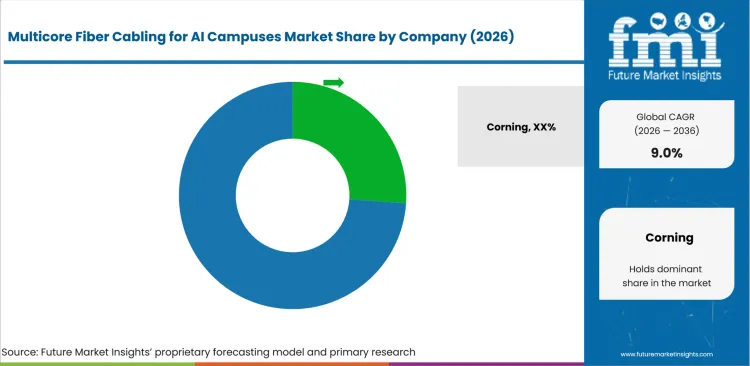
Competition spans four roles: integrated passive MCF platforms, field-enablement specialists, specialty-fiber manufacturers, and active-interface developers. Corning covers fiber, cable, and connectivity within one passive program. AFL and Sumitomo Electric focus on field access or specialty fiber, whereas TeraHop supplies MCF-native high-speed interfaces. Cross-vendor fit and repeatable field procedures determine entry more directly than corporate scale.
- Corning supplies an integrated four-core MCF fiber, cable, and connectivity platform for AI data-center networks.
- AFL and Sumitomo Electric support specialty fiber deployment through splicing, connector, cable, and core-access expertise.
- TeraHop provides MCF-native 800G and 1.6T optical interfaces that link passive multicore routes to AI network equipment.
Competitive Benchmarking: Multicore Fiber Cabling for AI Campuses Market
| Company | Passive MCF Program Depth | Field Deployment Enablement | AI-Speed Interface Alignment | Geographic Reach |
|---|---|---|---|---|
| Corning | High | High | High | Global |
| AFL | Medium | High | Medium | Global, with products in 130+ countries |
| Sumitomo Electric | High | Medium | Medium | Global, with operations in 40+ countries |
| TeraHop | Medium | Low | High | Singapore-led operations in the US and Asia |
Benchmark ratings use documented market scope without treating company size or reputation as a capability proxy. Passive-MCF depth is High for multiple native layers, Medium for one interface or field-access role, and Low for one enabling layer. Field enablement is High for direct splice, connector, test, or installation support and Medium for part of that workflow. A Low rating identifies an active-interface role outside field cabling without treating missing evidence as a score. AI-speed alignment is High with documented 800G and 1.6T support and Medium for one speed or a passive enabling layer. A Low rating indicates no direct interface alignment, while geographic reach remains descriptive.
Key Developments in the Multicore Fiber Cabling for AI Campuses Market
- In March 2026, TeraHop joined the XPO MSA and announced a 12.8 Tbps XPO optical-transceiver demonstration for OFC 2026 to extend its AI interface work beyond 1.6T.
- In March 2025, Corning launched GlassWorks AI Solutions with high-density cable, connectivity, and deployment support for AI data centers to offer one passive platform for dense optical buildouts.
- In March 2025, Sumitomo Electric entered an assembly agreement with 3M for expanded-beam optical interconnects used in hyperscale data centers to broaden its high-count connectivity and field-deployment offer.
Key Players in the Multicore Fiber Cabling for AI Campuses Market
Integrated MCF Fiber, Cable and Connectivity Platforms
- Corning
Specialty Fiber and Field Enablement
- AFL
- Sumitomo Electric
MCF-Native Optical Interface Providers
- TeraHop
Multicore Fiber Cabling for AI Campuses Market - Report Scope
| Coverage field | Report scope |
|---|---|
| Market breakdown | By link speed, optical architecture, deployment location, data center type, route to market, and region. |
| Quantitative Units | USD million. |
| Market Definition | Commercial multicore optical fiber, cabling, passive connectivity, and directly coupled interface infrastructure used to increase optical pathway density within AI data-center campuses. |
| Regions Covered | North America, Latin America, Western Europe, Eastern Europe, East Asia, South Asia and Pacific, and Middle East and Africa. |
| Countries Covered | USA, Japan, South Korea, France, Germany, UAE, and 20+ countries included in the full report. |
| Key Companies Profiled | Corning, AFL, Sumitomo Electric, TeraHop. |
| Forecast Period | 2026 to 2036. |
| Approach | Primary and secondary research with market triangulation. |
Multicore Fiber Cabling for AI Campuses Market - Research Methodology
| Method | Approach |
|---|---|
| Primary Research | FMI analysts gathered input from manufacturers, service providers, technology developers, distributors, end users, procurement teams, and subject-matter experts. Interviews examined purchasing decisions, product or service evaluation, adoption barriers, approval requirements, pricing considerations, and expectations for technical or commercial support. Respondents were also asked what evidence is required before a trial, pilot, or initial order develops into regular purchasing. |
| Desk Research | Desk research covered government statistics, regulatory publications, trade data, industry associations, technical literature, standards, company filings, product information, and official corporate announcements. Sources were reviewed for relevance, publication date, geographic coverage, and consistency with the defined market scope. Claims relating to performance, applications, approvals, capacity, investment, and commercial activity were retained only when supported by credible public evidence. |
| Market Sizing and Forecasting | The market model combined the baseline value with historical performance, segment structure, pricing and volume indicators, adoption levels, company participation, and country-level demand conditions. Forecast assumptions considered economic activity, investment trends, regulatory developments, technology adoption, purchasing cycles, supply availability, and barriers to wider market use. Segment and regional estimates were reconciled before the final market total was calculated. |
| Data Validation | Estimates were checked against multiple independent indicators, including public data, company activity, trade patterns, industry developments, and findings from primary interviews. Validation also tested whether products, services, applications, and company revenues fell within the defined market boundaries. Adjacent categories, unsupported claims, overlapping revenues, and activities without direct market relevance were excluded to reduce double counting and maintain consistency across segments and countries. |
Multicore Fiber Cabling for AI Campuses Market by Segments
Multicore Fiber Cabling for AI Campuses Market segmented by Link Speed:
- 800G
- 400G
- 1.6T
- 3.2T and above
Multicore Fiber Cabling for AI Campuses Market segmented by Optical Architecture:
- Pluggable optics
- Near-packaged optics
- Co-packaged optics
- Passive fiber - cabling systems
Multicore Fiber Cabling for AI Campuses Market segmented by Deployment Location:
- Inter-rack - scale-out
- Intra-rack - scale-up
- Spine-leaf fabric
- Campus - DCI
Multicore Fiber Cabling for AI Campuses Market segmented by Data Center Type:
- Hyperscale AI data centers
- Colocation AI facilities
- Enterprise AI/HPC
- Research - sovereign compute
Multicore Fiber Cabling for AI Campuses Market segmented by Route to Market:
- OEM direct
- Network system integrators
- Fiber-cabling specialists
- Test - managed-service providers
Multicore Fiber Cabling for AI Campuses Market by Region:
- North America
- United States
- Canada
- Latin America
- Brazil
- Mexico
- Chile
- Rest of Latin America
- Western Europe
- Germany
- United Kingdom
- Italy
- Spain
- France
- Nordics
- Benelux
- Rest of Western Europe
- Eastern Europe
- Russia
- Poland
- Hungary
- Balkan and Baltic States
- Rest of Eastern Europe
- East Asia
- China
- Japan
- South Korea
- South Asia and Pacific
- India
- ASEAN
- Australia and New Zealand
- Rest of South Asia and Pacific
- Middle East and Africa
- Kingdom of Saudi Arabia
- Other GCC Countries
- Türkiye
- South Africa
- Other African Union Countries
- Rest of Middle East and Africa
Research Sources and Bibliography
- Ethernet Alliance. (2025, December 9). Ethernet Alliance 2026 Ethernet Roadmap Sets a New Course for Connectivity.
- Ministry of Science and ICT, Republic of Korea. (2026, August 3).
- Ethernet Alliance. (2025, October 27). ECOC 2025: Interoperability at 800G is Given -Advancing Toward 1.6T.
- OIF. (2025, March 12). OIF Advances Interoperability at OFC 2025 with Live Demos, Expert Insights and Cross-Industry Collaboration.
- Ethernet Alliance. (2026, March 3). AI-Scale Ethernet at the Heart of Ethernet Alliance’s OFC 2026 Demo.
- OIF. (2026, January 28). OIF Demonstrates Industry-Wide Interoperability at Scale at OFC 2026, Advancing Energy Efficiency, Performance and Capacity for AI-Era Data Center Networks.
- Corning Incorporated. (2025, May 13). Corning Collaborates with Broadcom To Accelerate AI Data Center Processing Capacity.
- IEEE 802.3 Ethernet Working Group. (2026, February 13). IEEE P802.3dj 200 Gb/s, 400 Gb/s, 800 Gb/s, and 1.6 Tb/s Ethernet 4th IEEE 802.3 Working Group recirculation ballot results.
- AFL. (2026, March 11). Fiber Optics Industry Leaders Announce Collaboration to Define a New Multicore Fiber Design Optimized for AI Data Center Campuses.
- TeraHop. (2025, March 28). TeraHop to Showcase Advanced Optical Transceiver Solutions for AI/DC at OFC 2025.
- USA Department of Energy. (2025, April 3). DOE Identifies 16 Federal Sites Across the Country for Data Center and AI Infrastructure Development.
- Ministry of Economy, Trade and Industry. (2026, June 4). Selection of 16 New Projects to support the development of AI Models under the GENIAC Computing Resource Provision Support Project (Cycle 4).
- Ministry of Science and ICT, Republic of Korea. (2025, May 16).
- Ministère de l’Économie, des Finances et de la Souveraineté industrielle et énergétique. (2026, January 30). Rencontres des centres de données : la dynamique des projets d’infrastructures numériques se confirme.
- European High-Performance Computing Joint Undertaking. (2026, March 16). EuroHPC JU Signs Contract to Deploy AI Supercomputer HammerHAI.
- Abu Dhabi Media Office. (2025, May 22). Global tech alliance launches 'Stargate UAE'.
- Corning Incorporated. (2026, March 16). Corning To Launch AI Innovations in Fiber, Cable, and Connectivity at OFC 2026.
- TeraHop. (2026, March 14). TeraHop to Show Case Advanced Optical Connectivity Solutions for Scaling AI Data Centers at OFC 2026.
- AFL. (2026, March 13). AFL to Showcase Advanced Fiber Optic Solutions for Broadband and AI Data Centers at OFC 2026.
- Sumitomo Electric Industries, Ltd. (2025, May 29). World Record Achieved in Transmission Capacity and Distance: With 19-core Optical Fiber with Standard Cladding Diameter 1,808 km Transmission of 1.02 Petabits per Second.
- TeraHop. (2025, September 26). TeraHop to Show Case Advanced Optical Transceiver Solutions for AI/DC at ECOC 2025.
- Corning Incorporated. (2025, March 27). Corning Launches GlassWorks AI™ Solutions, a One-Stop Shop for AI Data Center Infrastructure Needs.
- Sumitomo Electric Industries, Ltd. (2025, March 21). Sumitomo Electric Industries, Ltd. and 3M Enter into an Assembly Agreement for Expanded Beam Optical Interconnect Technology for Data Centers.
- Corning Incorporated. (2026, January 27). Corning and Meta Announce Multiyear, up to $6 Billion Agreement to Accelerate US Data Center Buildout.
- AFL. (2025, July 16). AFL Launches DENALI™: Peak Performance for Optical Fiber Networks.
- Corning Incorporated. (2026, March 11). Corning Expands AI Data Center Connectivity Portfolio with PRIZM® TMT Technology.
- TeraHop. (2026, March 13). TeraHop Announces Membership in XPO MSA and Industry's First Demonstration of 12.8Tbps XPO Optical Transceivers at OFC 2026.
- TeraHop. (2026, March 13). Leading Optical Connectivity Solutions Providers form New Organization to Support Optical Interconnects for AI Data Center Applications.
- AFL. (2026, January 13). AFL Introduces Fujikura 100S Fusion Splicer with Dual-Fiber Technology and CT60 Cleaver.
- AFL. (2026, May 14). AFL Introduces the Fujikura 100R Mass Fusion Splicer.
- Sumitomo Electric Industries, Ltd. (2025, October 14). Sumitomo Electric Establishes a Sales Company in Australia to Expand its Infocommunications Business.
- Sumitomo Electric Industries, Ltd. (2025, July 30). Sumitomo Electric Achieves Successful Demonstration of Dynamic GPU Allocation to Multiple Servers Utilizing its Developed Optical Circuit Switch Control Software.
- Corning Incorporated. (2026, April 9). Corning Adds Manufacturing Capacity in Poland to Support AI Data Center Growth.
- AFL. (2025, April 1). AFL Achieves ISO/IEC 17025:2017 Accreditation for Duncan, S.C. Facility.
- Corning Incorporated. (2026, February 12). Annual Report on Form 10-K for the fiscal year ended December 31, 2025.
This bibliography is provided for reader reference and is not exhaustive. The full report contains the complete reference list and detailed citations.
This Report Answers
- How large is the multicore fiber cabling for AI campuses market in 2026 and 2036?
- Why does 800G account for 38.0% of link-speed revenue in 2026?
- Why do pluggable optics account for 32.0% of optical-architecture revenue in 2026?
- How does inter-rack - scale-out capture 36.0% of deployment-location revenue?
- Why do hyperscale AI data centers represent 48.0% of data-center-type revenue?
- How do country CAGRs differ among South Korea, Japan, UAE, USA, France, and Germany?
- Which companies serve passive MCF, field-enablement, and optical-interface roles?
- What interoperability and field-service requirements can delay multicore fiber purchasing?
Frequently Asked Questions
How big is the Multicore Fiber Cabling for AI Campuses Market in 2026?
The multicore fiber cabling for AI campuses market is valued at USD 558.1 million in 2026 and is projected to reach USD 1,321.1 million by 2036. AI scale-out increases optical path counts inside rack and cable space, raising the value of denser passive routing.
What is the CAGR of the Multicore Fiber Cabling for AI Campuses Market from 2026 to 2036?
The multicore fiber cabling for AI campuses market is projected to grow at a CAGR of 9.0% between 2026 and 2036. Denser AI fabrics require more optical routes and faster interface generations as tray space and connector counts stay physically constrained.
Which link speed leads the Multicore Fiber Cabling for AI Campuses Market?
The 800G segment is expected to hold 38.0% of the multicore fiber cabling for AI campuses market in 2026, driven by mature interoperability and scale-out deployment needs. Mature standards and multi-vendor operation reduce qualification uncertainty for dense AI campus deployments and staged 1.6T migration.
Which optical architecture leads the Multicore Fiber Cabling for AI Campuses Market?
The pluggable optics segment is expected to hold 32.0% of the multicore fiber cabling for AI campuses market in 2026, attributable to field-replaceable interfaces that separate transceiver changes from passive cabling. Separating active optics from passive cabling limits system-level changes during qualification and equipment refreshes.
Which companies are active in the Multicore Fiber Cabling for AI Campuses Market?
Key companies operating in the multicore fiber cabling for AI campuses market include Corning, AFL, Sumitomo Electric, and TeraHop. They cover passive MCF, field connectivity, specialty fiber, and MCF-native optical interfaces.
Preview the report firsthand - request a free sample
Get SampleGet the brochure for pricing and purchase details.
Get PDFTable of Content
- Key Takeaways
- Market Size and CAGR
- Top Growth Driver
- Fastest Growing Segment
- Leading Region
- Key Companies
- Emerging Opportunities
- Executive Summary
- Global Market Outlook
- Demand-side Trends
- Supply-side Trends
- Technology Roadmap Analysis
- Analysis and Recommendations
- Analyst Perspective (What is happening? Why now? What should investors know?)
- Key Questions Answered
- How large is the market?
- What is the CAGR?
- What are key trends?
- Which region dominates?
- Who are the leaders?
- Market Overview
- Market Coverage / Taxonomy
- Market Definition / Scope / Limitations
- Research Methodology
- Chapter Orientation
- Analytical Lens and Working Hypotheses
- Market Structure, Signals, and Trend Drivers
- Benchmarking and Cross-market Comparability
- Market Sizing, Forecasting, and Opportunity Mapping
- Research Design and Evidence Framework
- Desk Research Programme (Secondary Evidence)
- Expert Input and Fieldwork (Primary Evidence)
- Tooling, Models, and Reference Databases
- Data Engineering and Model Build
- Quality Assurance and Audit Trail
- Market Background
- Market Dynamics (Drivers, Restraints, Opportunity, Trends)
- Scenario Forecast (Optimistic, Likely, Conservative)
- Impact Analysis
- AI Impact
- Sustainability Impact
- Regulatory Impact
- Technology Impact
- Consumer / Buyer Analysis
- Purchase Drivers
- Adoption Barriers
- Buyer Journey
- Opportunity Map Analysis
- Product Life Cycle Analysis
- Supply Chain Analysis
- Investment Feasibility Matrix
- Value Chain Analysis
- PESTLE and Porter's Analysis
- Regulatory Landscape
- Regional Parent Market Outlook
- Production and Consumption Statistics
- Import and Export Statistics
- Global Market Analysis and Forecast, 2021 to 2036
- Historical Market Size Value (USD Million) Analysis, 2021 to 2025
- Current and Future Market Size Value (USD Million) Projections, 2026 to 2036
- Y-o-Y Growth Trend Analysis
- Absolute $ Opportunity Analysis
- Global Market Pricing Analysis, 2021 to 2036
- Global Market Analysis and Forecast, By Link Speed, 2021 to 2036
- Introduction / Key Findings
- Historical Market Size Value (USD Million) Analysis By Link Speed, 2021 to 2025
- Current and Future Market Size Value (USD Million) Analysis and Forecast By Link Speed, 2026 to 2036
- 800G
- 400G
- 1.6T
- 3.2T and above
- 800G
- Y-o-Y Growth Trend Analysis By Link Speed, 2021 to 2025
- Absolute $ Opportunity Analysis By Link Speed, 2026 to 2036
- Global Market Analysis and Forecast, By Optical Architecture, 2021 to 2036
- Introduction / Key Findings
- Historical Market Size Value (USD Million) Analysis By Optical Architecture, 2021 to 2025
- Current and Future Market Size Value (USD Million) Analysis and Forecast By Optical Architecture, 2026 to 2036
- Pluggable optics
- Near-packaged optics
- Co-packaged optics
- Passive fiber / cabling systems
- Pluggable optics
- Y-o-Y Growth Trend Analysis By Optical Architecture, 2021 to 2025
- Absolute $ Opportunity Analysis By Optical Architecture, 2026 to 2036
- Global Market Analysis and Forecast, By Deployment Location, 2021 to 2036
- Introduction / Key Findings
- Historical Market Size Value (USD Million) Analysis By Deployment Location, 2021 to 2025
- Current and Future Market Size Value (USD Million) Analysis and Forecast By Deployment Location, 2026 to 2036
- Inter-rack / scale-out
- Intra-rack / scale-up
- Spine-leaf fabric
- Campus / DCI
- Inter-rack / scale-out
- Y-o-Y Growth Trend Analysis By Deployment Location, 2021 to 2025
- Absolute $ Opportunity Analysis By Deployment Location, 2026 to 2036
- Global Market Analysis and Forecast, By Data Center Type, 2021 to 2036
- Introduction / Key Findings
- Historical Market Size Value (USD Million) Analysis By Data Center Type, 2021 to 2025
- Current and Future Market Size Value (USD Million) Analysis and Forecast By Data Center Type, 2026 to 2036
- Hyperscale AI data centers
- Colocation AI facilities
- Enterprise AI/HPC
- Research / sovereign compute
- Hyperscale AI data centers
- Y-o-Y Growth Trend Analysis By Data Center Type, 2021 to 2025
- Absolute $ Opportunity Analysis By Data Center Type, 2026 to 2036
- Global Market Analysis and Forecast, By Route to Market, 2021 to 2036
- Introduction / Key Findings
- Historical Market Size Value (USD Million) Analysis By Route to Market, 2021 to 2025
- Current and Future Market Size Value (USD Million) Analysis and Forecast By Route to Market, 2026 to 2036
- OEM direct
- Network system integrators
- Fiber/cabling specialists
- Test & managed-service providers
- OEM direct
- Y-o-Y Growth Trend Analysis By Route to Market, 2021 to 2025
- Absolute $ Opportunity Analysis By Route to Market, 2026 to 2036
- Global Market Analysis and Forecast, By Region, 2021 to 2036
- Introduction
- Historical Market Size Value (USD Million) Analysis By Region, 2021 to 2025
- Current Market Size Value (USD Million) Analysis and Forecast By Region, 2026 to 2036
- North America
- Latin America
- Western Europe
- Eastern Europe
- East Asia
- South Asia and Pacific
- Middle East & Africa
- Market Attractiveness Analysis By Region
- North America Market Analysis and Forecast, By Country, 2021 to 2036
- Historical Market Size Value (USD Million) Trend Analysis By Market Taxonomy, 2021 to 2025
- Market Size Value (USD Million) Forecast By Market Taxonomy, 2026 to 2036
- By Country
- USA
- Canada
- By Link Speed
- By Optical Architecture
- By Deployment Location
- By Data Center Type
- By Route to Market
- By Country
- Market Attractiveness Analysis
- By Country
- By Link Speed
- By Optical Architecture
- By Deployment Location
- By Data Center Type
- By Route to Market
- Key Takeaways
- Latin America Market Analysis and Forecast, By Country
- Historical Market Size Value (USD Million) Trend Analysis By Market Taxonomy, 2021 to 2025
- Market Size Value (USD Million) Forecast By Market Taxonomy, 2026 to 2036
- By Country
- Brazil
- Mexico
- Chile
- Rest of Latin America
- By Link Speed
- By Optical Architecture
- By Deployment Location
- By Data Center Type
- By Route to Market
- By Country
- Market Attractiveness Analysis
- By Country
- By Link Speed
- By Optical Architecture
- By Deployment Location
- By Data Center Type
- By Route to Market
- Key Takeaways
- Western Europe Market Analysis and Forecast, By Country
- Historical Market Size Value (USD Million) Trend Analysis By Market Taxonomy, 2021 to 2025
- Market Size Value (USD Million) Forecast By Market Taxonomy, 2026 to 2036
- By Country
- Germany
- UK
- Italy
- Spain
- France
- Nordic
- BENELUX
- Rest of Western Europe
- By Link Speed
- By Optical Architecture
- By Deployment Location
- By Data Center Type
- By Route to Market
- By Country
- Market Attractiveness Analysis
- By Country
- By Link Speed
- By Optical Architecture
- By Deployment Location
- By Data Center Type
- By Route to Market
- Key Takeaways
- Eastern Europe Market Analysis and Forecast, By Country
- Historical Market Size Value (USD Million) Trend Analysis By Market Taxonomy, 2021 to 2025
- Market Size Value (USD Million) Forecast By Market Taxonomy, 2026 to 2036
- By Country
- Russia
- Poland
- Hungary
- Balkan & Baltic
- Rest of Eastern Europe
- By Link Speed
- By Optical Architecture
- By Deployment Location
- By Data Center Type
- By Route to Market
- By Country
- Market Attractiveness Analysis
- By Country
- By Link Speed
- By Optical Architecture
- By Deployment Location
- By Data Center Type
- By Route to Market
- Key Takeaways
- East Asia Market Analysis and Forecast, By Country
- Historical Market Size Value (USD Million) Trend Analysis By Market Taxonomy, 2021 to 2025
- Market Size Value (USD Million) Forecast By Market Taxonomy, 2026 to 2036
- By Country
- China
- Japan
- South Korea
- By Link Speed
- By Optical Architecture
- By Deployment Location
- By Data Center Type
- By Route to Market
- By Country
- Market Attractiveness Analysis
- By Country
- By Link Speed
- By Optical Architecture
- By Deployment Location
- By Data Center Type
- By Route to Market
- Key Takeaways
- South Asia and Pacific Market Analysis and Forecast, By Country
- Historical Market Size Value (USD Million) Trend Analysis By Market Taxonomy, 2021 to 2025
- Market Size Value (USD Million) Forecast By Market Taxonomy, 2026 to 2036
- By Country
- India
- ASEAN
- Australia & New Zealand
- Rest of South Asia and Pacific
- By Link Speed
- By Optical Architecture
- By Deployment Location
- By Data Center Type
- By Route to Market
- By Country
- Market Attractiveness Analysis
- By Country
- By Link Speed
- By Optical Architecture
- By Deployment Location
- By Data Center Type
- By Route to Market
- Key Takeaways
- Middle East & Africa Market Analysis and Forecast, By Country
- Historical Market Size Value (USD Million) Trend Analysis By Market Taxonomy, 2021 to 2025
- Market Size Value (USD Million) Forecast By Market Taxonomy, 2026 to 2036
- By Country
- Kingdom of Saudi Arabia
- Other GCC Countries
- Türkiye
- South Africa
- Other African Union
- Rest of Middle East & Africa
- By Link Speed
- By Optical Architecture
- By Deployment Location
- By Data Center Type
- By Route to Market
- By Country
- Market Attractiveness Analysis
- By Country
- By Link Speed
- By Optical Architecture
- By Deployment Location
- By Data Center Type
- By Route to Market
- Key Takeaways
- Key Countries Market Analysis
- USA
- Pricing Analysis
- Market Share Analysis, 2025
- By Link Speed
- By Optical Architecture
- By Deployment Location
- By Data Center Type
- By Route to Market
- Canada
- Pricing Analysis
- Market Share Analysis, 2025
- By Link Speed
- By Optical Architecture
- By Deployment Location
- By Data Center Type
- By Route to Market
- Mexico
- Pricing Analysis
- Market Share Analysis, 2025
- By Link Speed
- By Optical Architecture
- By Deployment Location
- By Data Center Type
- By Route to Market
- Brazil
- Pricing Analysis
- Market Share Analysis, 2025
- By Link Speed
- By Optical Architecture
- By Deployment Location
- By Data Center Type
- By Route to Market
- Chile
- Pricing Analysis
- Market Share Analysis, 2025
- By Link Speed
- By Optical Architecture
- By Deployment Location
- By Data Center Type
- By Route to Market
- Germany
- Pricing Analysis
- Market Share Analysis, 2025
- By Link Speed
- By Optical Architecture
- By Deployment Location
- By Data Center Type
- By Route to Market
- UK
- Pricing Analysis
- Market Share Analysis, 2025
- By Link Speed
- By Optical Architecture
- By Deployment Location
- By Data Center Type
- By Route to Market
- Italy
- Pricing Analysis
- Market Share Analysis, 2025
- By Link Speed
- By Optical Architecture
- By Deployment Location
- By Data Center Type
- By Route to Market
- Spain
- Pricing Analysis
- Market Share Analysis, 2025
- By Link Speed
- By Optical Architecture
- By Deployment Location
- By Data Center Type
- By Route to Market
- France
- Pricing Analysis
- Market Share Analysis, 2025
- By Link Speed
- By Optical Architecture
- By Deployment Location
- By Data Center Type
- By Route to Market
- India
- Pricing Analysis
- Market Share Analysis, 2025
- By Link Speed
- By Optical Architecture
- By Deployment Location
- By Data Center Type
- By Route to Market
- ASEAN
- Pricing Analysis
- Market Share Analysis, 2025
- By Link Speed
- By Optical Architecture
- By Deployment Location
- By Data Center Type
- By Route to Market
- Australia & New Zealand
- Pricing Analysis
- Market Share Analysis, 2025
- By Link Speed
- By Optical Architecture
- By Deployment Location
- By Data Center Type
- By Route to Market
- China
- Pricing Analysis
- Market Share Analysis, 2025
- By Link Speed
- By Optical Architecture
- By Deployment Location
- By Data Center Type
- By Route to Market
- Japan
- Pricing Analysis
- Market Share Analysis, 2025
- By Link Speed
- By Optical Architecture
- By Deployment Location
- By Data Center Type
- By Route to Market
- South Korea
- Pricing Analysis
- Market Share Analysis, 2025
- By Link Speed
- By Optical Architecture
- By Deployment Location
- By Data Center Type
- By Route to Market
- Russia
- Pricing Analysis
- Market Share Analysis, 2025
- By Link Speed
- By Optical Architecture
- By Deployment Location
- By Data Center Type
- By Route to Market
- Poland
- Pricing Analysis
- Market Share Analysis, 2025
- By Link Speed
- By Optical Architecture
- By Deployment Location
- By Data Center Type
- By Route to Market
- Hungary
- Pricing Analysis
- Market Share Analysis, 2025
- By Link Speed
- By Optical Architecture
- By Deployment Location
- By Data Center Type
- By Route to Market
- Kingdom of Saudi Arabia
- Pricing Analysis
- Market Share Analysis, 2025
- By Link Speed
- By Optical Architecture
- By Deployment Location
- By Data Center Type
- By Route to Market
- Türkiye
- Pricing Analysis
- Market Share Analysis, 2025
- By Link Speed
- By Optical Architecture
- By Deployment Location
- By Data Center Type
- By Route to Market
- South Africa
- Pricing Analysis
- Market Share Analysis, 2025
- By Link Speed
- By Optical Architecture
- By Deployment Location
- By Data Center Type
- By Route to Market
- USA
- Market Structure Analysis
- Competition Dashboard
- Competition Benchmarking
- Market Share Analysis of Top Players
- By Regional
- By Link Speed
- By Optical Architecture
- By Deployment Location
- By Data Center Type
- By Route to Market
- Emerging Startups
- Innovation Benchmarking
- Competition Analysis
- Competition Deep Dive
- Corning
- Overview
- Product Portfolio
- Profitability by Market Segments
- Sales Footprint
- Strategy Overview
- Marketing Strategy
- Product Strategy
- Channel Strategy
- TeraHop
- AFL
- Sumitomo Electric
- Corning
- Case Studies
- Success Stories
- Recent Developments
- Competition Deep Dive
- Assumptions & Acronyms Used


