

- Industry Size (2025)
- USD 654.6 Mn
- Forecast (2035)
- USD 1194.6 Mn
- CAGR (2025 to 2035)
- 6.2%
Nail Guns Market Size and Share Forecast Outlook 2025 to 2035
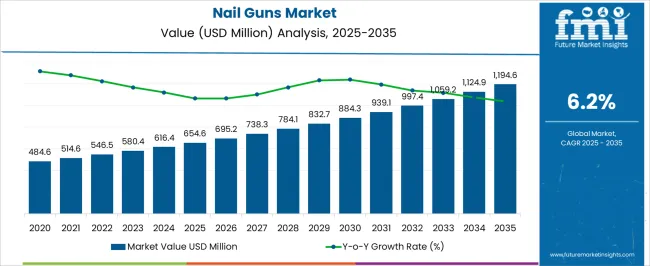
The nail guns market, valued at USD 654.6 million in 2025 and projected to reach USD 1,194.6 million by 2035 at a CAGR of 6.2%, demonstrates a clear movement along the market maturity curve. In the early phase, nail guns experienced adoption driven by professional contractors and industrial users who valued efficiency and reduced manual labor.
The adoption lifecycle shows that by the mid-2020s, penetration was established in commercial construction and woodworking, with steady replacement demand sustaining incremental gains. The trajectory from USD 654.6 million in 2025 to USD 884.3 million in 2030 indicates progression through the growth stage, where increasing awareness, ergonomic designs, and cordless technology innovations drive acceptance among small contractors and residential users.
The market moves toward early maturity after 2030 as usage becomes standardized, evident in the rise to USD 1,059.2 million by 2033. However, differentiation through battery innovations, safety mechanisms, and multi-material compatibility prevents stagnation. By 2035, reaching USD 1,194.6 million, the market is expected to be in late growth and approaching maturity, with penetration high in developed economies but still expanding in emerging regions. The lifecycle suggests sustained but competitive growth, where innovation and regional adoption patterns define long-term market positioning.
Quick Stats for Nail Guns Market
- Nail Guns Market Value (2025): USD 654.6 million
- Nail Guns Market Forecast Value (2035): USD 1194.6 million
- Nail Guns Market Forecast CAGR: 6.2%
- Leading Segment in Nail Guns Market in 2025: Framing nailer (42.6%)
- Key Growth Regions in Nail Guns Market: North America, Asia-Pacific, Europe
- Top Key Players in Nail Guns Market: Stanley Black & Decker, Freeman, Hilti Corporation, Hitachi, Makita, Max Corporation, Metabo, Milwaukee, Paslode, Ridgid, Robert Bosch, Ryobi, Senco
Nail Guns Market Key Takeaways
| Metric | Value |
|---|---|
| Nail Guns Market Estimated Value in (2025 E) | USD 654.6 million |
| Nail Guns Market Forecast Value in (2035 F) | USD 1194.6 million |
| Forecast CAGR (2025 to 2035) | 6.2% |
The nail guns market represents a significant segment within the global power tools and construction equipment industry, emphasizing speed, precision, and productivity in fastening applications. Within the broader power tools sector, it accounts for about 5.4%, driven by demand from residential, commercial, and infrastructure projects. In the woodworking and carpentry equipment segment, it holds nearly 4.7%, reflecting its vital role in framing, roofing, and furniture manufacturing.
Across the professional construction tools market, the share is 4.1%, supporting large-scale adoption for efficiency and labor cost reduction. Within the home improvement and DIY tools category, it represents 3.6%, highlighting use among hobbyists and small-scale users. In the pneumatic and battery-powered fastening tools market, it secures 3.3%, emphasizing the transition from manual hammering to automated and cordless solutions. Recent developments in this market have focused on cordless technology, ergonomics, and multi-surface compatibility. Innovations include lithium-ion powered nail guns, brushless motors for durability, and depth-adjustment features for precision fastening. Key players are collaborating with battery technology providers and construction firms to enhance product performance and safety.
Adoption of compact, lightweight designs, quick-reload systems, and vibration reduction mechanisms is gaining traction to improve user comfort and reduce fatigue. The integration of smart sensors for jam detection, safety locks, and IoT-enabled monitoring is being explored to enhance reliability.
Why is the Nail Guns Market Growing?
The market is experiencing robust growth fueled by the rising demand for efficient fastening solutions across construction, woodworking, and industrial manufacturing sectors. Increasing infrastructure development activities worldwide, coupled with the need for enhanced productivity and safety on job sites, are driving the adoption of advanced nail gun technologies.
The future outlook is shaped by innovations in ergonomics, battery efficiency, and automation that improve operator convenience and reduce fatigue. Additionally, growing preference for cordless and pneumatic tools that offer portability and consistent power is influencing market expansion.
The demand is further supported by urbanization trends, rising renovation projects, and a shift toward mechanized fastening methods to replace manual nailing. As construction standards become more stringent and contractors seek tools that enhance speed without compromising quality, the Nail Guns market is poised for sustained growth with opportunities for product differentiation and technological upgrades.
Segmental Analysis
The nail guns market is segmented by product type, power source, operation, end-use, distribution channel, and geographic regions. By product type, nail guns market is divided into Framing nailer, Brad nailer, Pin nailer, Roofing nailer, Flooring nailer, and Others (palm nailer, staple guns, etc.). In terms of power source, nail guns market is classified into Pneumatic, Electric, and Gas-powered.
Based on operation, nail guns market is segmented into Handheld guns and Automatic guns. By end-use, nail guns market is segmented into Construction & infrastructure, Furniture & home improvement, Automotive, Packaging, and Others (upholstery, etc.). By distribution channel, nail guns market is segmented into Offline and Online. Regionally, the nail guns industry is classified into North America, Latin America, Western Europe, Eastern Europe, Balkan & Baltic Countries, Russia & Belarus, Central Asia, East Asia, South Asia & Pacific, and the Middle East & Africa.
Insights into the Framing Nailer Segment
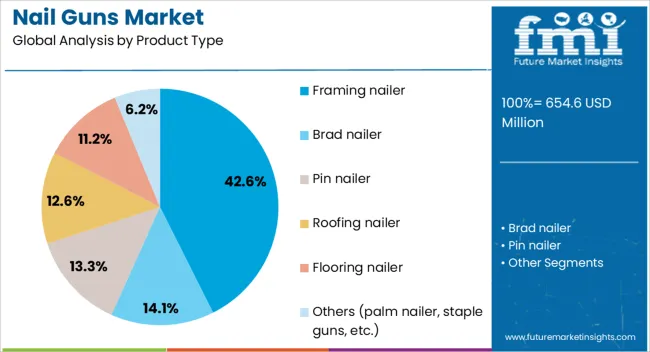
The framing nailer segment is estimated to hold 42.6% of the market revenue share in 2025, emerging as the leading product type. This prominence is being attributed to its widespread application in heavy-duty construction projects where large timber and framing components require robust fastening. Framing nailers offer superior power and precision that support structural integrity and speed on site.
Their adaptability to various nail sizes and fasteners enhances versatility, making them a preferred choice among professional contractors and builders. The segment growth has also been reinforced by the increasing construction of residential and commercial buildings that demand reliable framing tools.
Ergonomic advancements and compatibility with both pneumatic and battery-powered systems have expanded their use in diverse job environments. Furthermore, framing nailers’ ability to reduce manual labor and improve safety compliance has accelerated their adoption, positioning the segment as a cornerstone of the Nail Guns market.
Insights into the Pneumatic Power Source Segment
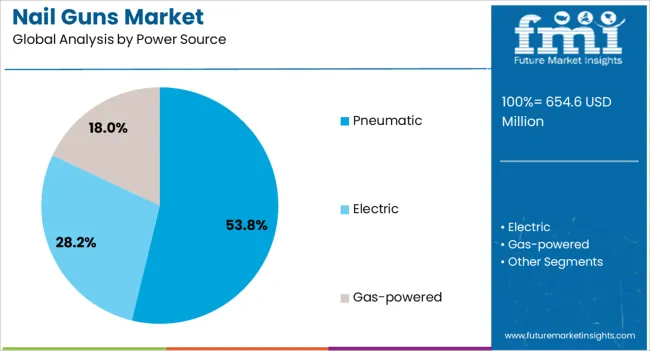
Pneumatic nail guns are anticipated to command 53.8% of the power source segment’s revenue share in 2025, making them the dominant choice in the market. Their leading position is attributed to the consistent and high power output delivered by compressed air, which allows for rapid firing and penetration in demanding construction tasks. Pneumatic systems are favored in professional environments for their reliability, durability, and capacity to handle heavy-duty applications.
The widespread availability of air compressors on construction sites supports the continued preference for pneumatic tools. Despite the rising popularity of cordless alternatives, pneumatic nail guns maintain their edge due to lower upfront costs and well-established maintenance protocols.
The segment’s growth is also supported by advancements in lightweight design and improved hose management systems that enhance operator mobility and reduce fatigue The proven performance of pneumatic nail guns in high-volume and intensive projects secures their leading status within the power source category.
Insights into the Handheld Guns Operation Segment
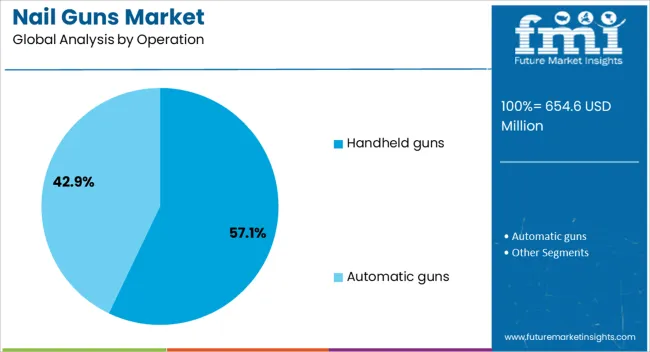
The handheld guns segment is projected to hold 57.1% of the market revenue share in 2025, reflecting its dominance in terms of operational design. This prevalence is attributed to the demand for portable, easy-to-use fastening solutions that facilitate flexibility and speed across a variety of job sites. Handheld nail guns enable precise targeting, quick maneuverability, and reduced operator strain, making them highly suitable for both professional and DIY applications.
Their ergonomic design and compatibility with various power sources, including pneumatic and battery-powered systems, have expanded their adoption. The growth of this segment has been driven by the increasing number of small to medium construction and remodeling projects where compact and lightweight tools offer practical advantages.
Furthermore, handheld nail guns support enhanced safety through trigger and depth control features, aligning with evolving workplace safety standards. The operational convenience and adaptability of handheld guns secure their leading role in the Nail Guns market.
What are the Drivers, Restraints, and Key Trends of the Nail Guns Market?
The market has been influenced by developments in construction, woodworking, and furniture production. Nail guns, also called nailers, have replaced manual hammering methods in many industries due to their efficiency, precision, and labor-saving capabilities. Their adoption has been supported by the rise of large-scale building projects, modular housing, and demand for lightweight furniture manufacturing. Technological advances, including cordless and pneumatic systems, have broadened applications while improving safety and performance. As industries focus on time efficiency and precision fastening, nail guns have secured their role as essential tools across both professional and residential applications.
Rising Demand from the Construction Industry
The construction industry has remained the dominant end-user of nail guns, driven by the need for faster and more accurate fastening methods in large projects. With increased building activities in residential and commercial sectors, demand for efficient tools has expanded. Nail guns enable faster completion of flooring, roofing, framing, and decking tasks compared to manual methods. Contractors increasingly prefer pneumatic and gas-powered nailers for heavy-duty use, while battery-powered options gain popularity in smaller projects. The emphasis on improving productivity, reducing labor costs, and enhancing project turnaround times continues to support the growing use of nail guns in global construction markets.
Expanding Adoption in Furniture and Woodworking
The furniture and woodworking sectors have adopted nail guns extensively due to their ability to improve assembly speed and ensure precise fastening. Manufacturers rely on brad nailers and finish nailers for delicate woodwork, cabinetry, and upholstery, where aesthetics and structural stability are critical. Rising consumer demand for ready-to-assemble and modular furniture has further strengthened the role of nail guns in production lines. Smaller workshops and DIY enthusiasts have also shown interest in electric and cordless models that combine convenience with professional-grade performance. This rising adoption in both large-scale manufacturing and personal woodworking projects has broadened market opportunities significantly.
Technological Advancements in Product Design
Innovation in nail gun technology has played a central role in shaping market growth. Cordless nailers equipped with lithium-ion batteries provide mobility and eliminate the need for compressors or gas cartridges. Pneumatic models are being improved with lightweight designs, enhanced safety features, and reduced recoil to ensure operator comfort. Smart tools with adjustable depth control, jam-clearing mechanisms, and noise reduction technologies are increasingly available. Such advancements make nail guns more versatile and accessible to different user segments. Continuous improvements in energy efficiency, ergonomics, and durability are expected to maintain steady demand across professional contractors and DIY users.
Challenges of Safety and Operational Risks
Despite strong adoption, safety concerns and operational risks remain significant challenges in the market. Improper handling or malfunctioning tools can cause injuries, which have necessitated stricter safety regulations and user training requirements. Manufacturers have been incorporating safety mechanisms such as sequential firing modes, trigger locks, and contact safety tips to reduce accidental discharge. Noise levels and vibration exposure also pose ergonomic challenges for long-term users. The cost barriers for advanced cordless models may limit accessibility in developing regions. Addressing these safety and affordability issues will be crucial for ensuring wider market penetration and consistent industry growth.
Analysis of Nail Guns Market By Key Countries
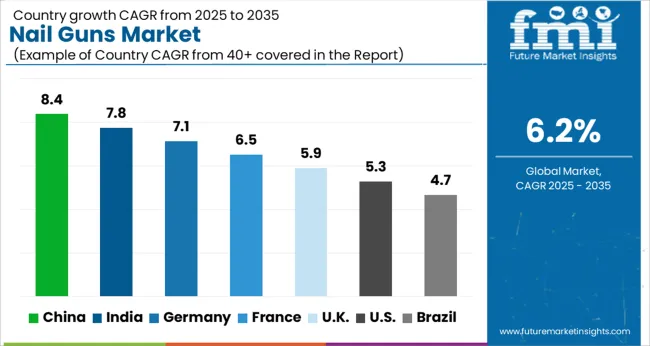
| Country | CAGR |
|---|---|
| China | 8.4% |
| India | 7.8% |
| Germany | 7.1% |
| France | 6.5% |
| UK | 5.9% |
| USA | 5.3% |
| Brazil | 4.7% |
The market is expected to grow at a CAGR of 6.2% from 2025 to 2035, influenced by expanding construction activities, woodworking applications, and the demand for efficient fastening tools. India registered 7.8, supported by rapid residential and commercial construction growth. Germany accounted for 7.1, where high adoption in precision carpentry and industrial projects was noted. China dominated at 8.4, reflecting large-scale infrastructure development and strong manufacturing capacity. The United Kingdom recorded 5.9, driven by steady demand in renovation projects, while the United States stood at 5.3, reflecting adoption in housing and do-it-yourself applications. Each of these markets illustrates a different approach to scaling nail gun usage, driven by local construction dynamics and technological adoption. This report includes insights on 40+ countries; the top markets are shown here for reference.
Expansion of Nail Guns Market in China
China is projected to advance at a CAGR of 8.4%, supported by rising construction activity, furniture manufacturing, and rapid adoption of mechanized tools in small and medium enterprises. Domestic companies focus on cost effective pneumatic and cordless variants to capture both professional and DIY segments. Government emphasis on infrastructure growth has played a crucial role in stimulating demand. The exports of Chinese produced nail guns remain significant, as competitive pricing and wide product ranges make local brands strong competitors in international markets.
- China accounted for more than 35% of global nail gun production in 2023.
- Pneumatic nail guns represented nearly 60% of total domestic demand in 2023.
- Exports of cordless nail guns increased by almost 18% year on year in 2023.
Growth Dynamics of Nail Guns Market in India
The market in India is expected to grow steadily with a CAGR of 7.8%, supported by strong demand from furniture workshops, construction contractors, and small-scale manufacturing units. Adoption has been reinforced by the shift from manual nailing methods to mechanized tools for efficiency and safety. Domestic manufacturers increasingly collaborate with international brands to bring affordable cordless models to market, while imports also supplement growing demand. Expansion of real estate and interior design sectors is expected to remain a strong driver of long-term consumption.
- India imported nearly 40% of its nail gun supply in 2023.
- Furniture manufacturing consumed almost 45% of nail guns sold in the country in 2023.
- Cordless nail gun sales recorded growth of more than 20% year on year in 2023.
Market Outlook for Nail Guns in Germany
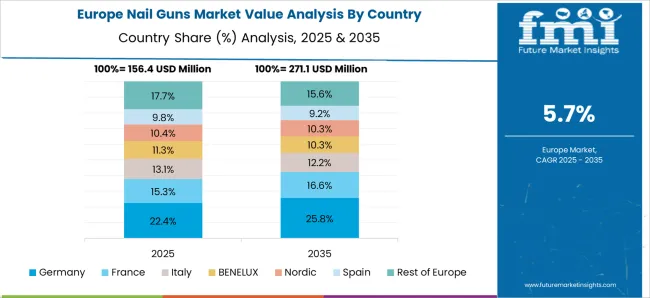
Germany is forecast to expand at a CAGR of 7.1%, supported by robust growth in prefabricated housing, carpentry, and renovation projects. Consumers show a preference for high quality cordless models with advanced safety features, creating opportunities for premium international brands. Domestic distributors emphasize after sales service and product durability, which plays a crucial role in buyer decisions. Imports from China and other Asian markets remain essential, though European manufacturers continue to focus on specialized nail gun models for professional carpenters and contractors.
- Germany imported nearly 65% of its nail gun supply in 2023.
- Cordless nail guns accounted for nearly 50% of market sales in 2023.
- Renovation sector demand grew by almost 12% year on year in 2023.
Demand Forecast for Nail Guns in the United Kingdom
The United Kingdom market is projected to record a CAGR of 5.9%, driven by demand from the construction sector, DIY users, and interior refurbishment projects. Domestic retailers continue to focus on supplying cordless and battery operated models to cater to a growing preference for mobility and convenience. Imports primarily from China and Germany supply a large portion of market requirements. Demand is also supported by an increase in smaller renovation projects, where lightweight and compact nail guns are preferred for efficient use.
- The U K imported nearly 70% of its nail gun demand in 2023.
- DIY segment accounted for more than 30% of sales in 2023.
- Battery operated nail guns recorded annual growth of nearly 14% in 2023.
Future Growth of Nail Guns Market in the United States
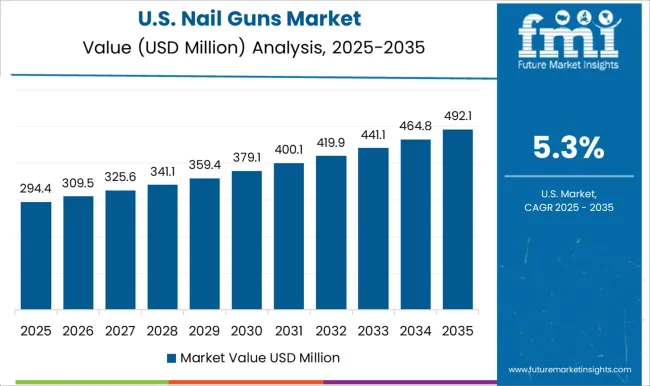
The United States is anticipated to grow at a CAGR of 5.3%, supported by steady demand from the residential housing sector, remodeling projects, and commercial carpentry. Domestic producers emphasize innovation in battery technology, ergonomic design, and safety enhancements, giving them a strong foothold in premium segments. Imports from Asia complement local production, particularly in pneumatic nail guns used in industrial settings. The presence of leading brands ensures continuous product development, while DIY adoption continues to support retail channel growth.
- The U S produced more than 55% of the nail guns sold domestically in 2023.
- Residential remodeling accounted for nearly 40% of nail gun demand in 2023.
- Sales of pneumatic nail guns grew by about 10% year on year in 2023.
Competitive Landscape of Nail Guns Market
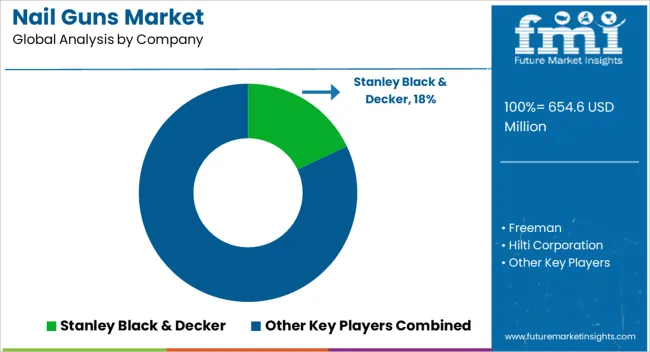
The market is characterized by strong competition among multinational tool manufacturers and specialized pneumatic and cordless equipment providers. Stanley Black & Decker, Hilti Corporation, Hitachi, Makita, Milwaukee, Robert Bosch, and Ryobi dominate the global landscape with expansive product portfolios, advanced cordless technologies, and extensive retail networks. These companies leverage brand recognition, global distribution, and continuous innovation to maintain their competitive edge. Paslode, Senco, Freeman, Metabo, Max Corporation, and Ridgid strengthen the market with a focus on pneumatic nailers, framing nailers, and finish nailers that serve both professional contractors and DIY users. Their strategies emphasize cost efficiency, durable construction, and user-friendly designs to target different customer segments.
Many players are investing in lithium-ion powered nail guns and ergonomic designs to reduce operator fatigue and improve productivity. The competitive environment is influenced by a shift toward cordless solutions, sustainability in battery technology, and increased demand from the construction and woodworking industries. Companies that combine innovation in fastening systems with affordability and after-sales support are positioned to strengthen their market presence.
Key Players in the Nail Guns Market
- Stanley Black & Decker
- Freeman
- Hilti Corporation
- Hitachi
- Makita
- Max Corporation
- Metabo
- Milwaukee
- Paslode
- Ridgid
- Robert Bosch
- Ryobi
- Senco
Scope of the Report
| Item | Value |
|---|---|
| Quantitative Units | USD 654.6 Million |
| Product Type | Framing nailer, Brad nailer, Pin nailer, Roofing nailer, Flooring nailer, and Others (palm nailer, staple guns, etc.) |
| Power Source | Pneumatic, Electric, and Gas-powered |
| Operation | Handheld guns and Automatic guns |
| End-use | Construction & infrastructure, Furniture & home improvement, Automotive, Packaging, and Others (upholstery, etc.) |
| Distribution Channel | Offline and Online |
| Regions Covered | North America, Europe, Asia-Pacific, Latin America, Middle East & Africa |
| Country Covered | United States, Canada, Germany, France, United Kingdom, China, Japan, India, Brazil, South Africa |
| Key Companies Profiled | Stanley Black & Decker, Freeman, Hilti Corporation, Hitachi, Makita, Max Corporation, Metabo, Milwaukee, Paslode, Ridgid, Robert Bosch, Ryobi, and Senco |
| Additional Attributes | Dollar sales by nail gun type and application, demand dynamics across construction, woodworking, and furniture manufacturing sectors, regional trends in professional tool adoption, innovation in power efficiency, ergonomics, and safety features, environmental impact of material use and energy consumption, and emerging use cases in modular construction, precision carpentry, and automated assembly processes. |
Nail Guns Market by Segments
Product Type:
- Framing nailer
- Brad nailer
- Pin nailer
- Roofing nailer
- Flooring nailer
- Others (palm nailer, staple guns, etc.)
Power Source:
- Pneumatic
- Electric
- Gas-powered
Operation:
- Handheld guns
- Automatic guns
End-use:
- Construction & infrastructure
- Furniture & home improvement
- Automotive
- Packaging
- Others (upholstery, etc.)
Distribution Channel:
- Offline
- Online
Region:
- North America
- USA
- Canada
- Mexico
- Latin America
- Brazil
- Chile
- Rest of Latin America
- Western Europe
- Germany
- UK
- Italy
- Spain
- France
- Nordic
- BENELUX
- Rest of Western Europe
- Eastern Europe
- Russia
- Poland
- Hungary
- Balkan & Baltic
- Rest of Eastern Europe
- East Asia
- China
- Japan
- South Korea
- South Asia and Pacific
- India
- ASEAN
- Australia & New Zealand
- Rest of South Asia and Pacific
- Middle East & Africa
- Kingdom of Saudi Arabia
- Other GCC Countries
- Turkiye
- South Africa
- Other African Union
- Rest of Middle East & Africa
Frequently Asked Questions
How big is the nail guns market in 2025?
The global nail guns market is estimated to be valued at USD 654.6 million in 2025.
What will be the size of nail guns market in 2035?
The market size for the nail guns market is projected to reach USD 1,194.6 million by 2035.
How much will be the nail guns market growth between 2025 and 2035?
The nail guns market is expected to grow at a 6.2% CAGR between 2025 and 2035.
What are the key product types in the nail guns market?
The key product types in nail guns market are framing nailer, brad nailer, pin nailer, roofing nailer, flooring nailer and others (palm nailer, staple guns, etc.).
Which power source segment to contribute significant share in the nail guns market in 2025?
In terms of power source, pneumatic segment to command 53.8% share in the nail guns market in 2025.
Preview the report firsthand - request a free sample
Get SampleGet the brochure for pricing and purchase details.
Get PDFTable of Content
- Executive Summary
- Global Market Outlook
- Demand-side Trends
- Supply-side Trends
- Technology Roadmap Analysis
- Analysis and Recommendations
- Market Overview
- Market Coverage / Taxonomy
- Market Definition / Scope / Limitations
- Market Background
- Market Dynamics
- Drivers
- Restraints
- Opportunity
- Trends
- Scenario Forecast
- Demand in Optimistic Scenario
- Demand in Likely Scenario
- Demand in Conservative Scenario
- Opportunity Map Analysis
- Product Life Cycle Analysis
- Supply Chain Analysis
- Investment Feasibility Matrix
- Value Chain Analysis
- PESTLE and Porter’s Analysis
- Regulatory Landscape
- Regional Parent Market Outlook
- Production and Consumption Statistics
- Import and Export Statistics
- Market Dynamics
- Global Nail Guns Market Analysis 2020-2024 and Forecast, 2025-2035
- Historical Market Size Value (USD Mn) Analysis, 2020-2024
- Current and Future Market Size Value (USD Mn) Projections, 2025-2035
- Y-o-Y Growth Trend Analysis
- Absolute $ Opportunity Analysis
- Global Nail Guns Market Pricing Analysis 2020-2024 and Forecast 2025-2035
- Global Nail Guns Market Analysis 2020-2024 and Forecast 2025-2035, By Product Type
- Introduction / Key Findings
- Historical Market Size Value (USD Mn) Analysis By Product Type , 2020-2024
- Current and Future Market Size Value (USD Mn) Analysis and Forecast By Product Type , 2025-2035
- Framing nailer
- Brad nailer
- Pin nailer
- Roofing nailer
- Flooring nailer
- Others (palm nailer, staple guns, etc.)
- Y-o-Y Growth Trend Analysis By Product Type , 2020-2024
- Absolute $ Opportunity Analysis By Product Type , 2025-2035
- Global Nail Guns Market Analysis 2020-2024 and Forecast 2025-2035, By Power Source
- Introduction / Key Findings
- Historical Market Size Value (USD Mn) Analysis By Power Source, 2020-2024
- Current and Future Market Size Value (USD Mn) Analysis and Forecast By Power Source, 2025-2035
- Pneumatic
- Electric
- Gas-powered
- Y-o-Y Growth Trend Analysis By Power Source, 2020-2024
- Absolute $ Opportunity Analysis By Power Source, 2025-2035
- Global Nail Guns Market Analysis 2020-2024 and Forecast 2025-2035, By Operation
- Introduction / Key Findings
- Historical Market Size Value (USD Mn) Analysis By Operation, 2020-2024
- Current and Future Market Size Value (USD Mn) Analysis and Forecast By Operation, 2025-2035
- Handheld guns
- Automatic guns
- Y-o-Y Growth Trend Analysis By Operation, 2020-2024
- Absolute $ Opportunity Analysis By Operation, 2025-2035
- Global Nail Guns Market Analysis 2020-2024 and Forecast 2025-2035, By End-use
- Introduction / Key Findings
- Historical Market Size Value (USD Mn) Analysis By End-use, 2020-2024
- Current and Future Market Size Value (USD Mn) Analysis and Forecast By End-use, 2025-2035
- Construction & infrastructure
- Furniture & home improvement
- Automotive
- Packaging
- Others (upholstery, etc.)
- Y-o-Y Growth Trend Analysis By End-use, 2020-2024
- Absolute $ Opportunity Analysis By End-use, 2025-2035
- Global Nail Guns Market Analysis 2020-2024 and Forecast 2025-2035, By Distribution Channel
- Introduction / Key Findings
- Historical Market Size Value (USD Mn) Analysis By Distribution Channel, 2020-2024
- Current and Future Market Size Value (USD Mn) Analysis and Forecast By Distribution Channel, 2025-2035
- Offline
- Online
- Y-o-Y Growth Trend Analysis By Distribution Channel, 2020-2024
- Absolute $ Opportunity Analysis By Distribution Channel, 2025-2035
- Global Nail Guns Market Analysis 2020-2024 and Forecast 2025-2035, By Region
- Introduction
- Historical Market Size Value (USD Mn) Analysis By Region, 2020-2024
- Current Market Size Value (USD Mn) Analysis and Forecast By Region, 2025-2035
- North America
- Latin America
- Western Europe
- Eastern Europe
- East Asia
- South Asia and Pacific
- Middle East & Africa
- Market Attractiveness Analysis By Region
- North America Nail Guns Market Analysis 2020-2024 and Forecast 2025-2035, By Country
- Historical Market Size Value (USD Mn) Trend Analysis By Market Taxonomy, 2020-2024
- Market Size Value (USD Mn) Forecast By Market Taxonomy, 2025-2035
- By Country
- USA
- Canada
- Mexico
- By Product Type
- By Power Source
- By Operation
- By End-use
- By Distribution Channel
- By Country
- Market Attractiveness Analysis
- By Country
- By Product Type
- By Power Source
- By Operation
- By End-use
- By Distribution Channel
- Key Takeaways
- Latin America Nail Guns Market Analysis 2020-2024 and Forecast 2025-2035, By Country
- Historical Market Size Value (USD Mn) Trend Analysis By Market Taxonomy, 2020-2024
- Market Size Value (USD Mn) Forecast By Market Taxonomy, 2025-2035
- By Country
- Brazil
- Chile
- Rest of Latin America
- By Product Type
- By Power Source
- By Operation
- By End-use
- By Distribution Channel
- By Country
- Market Attractiveness Analysis
- By Country
- By Product Type
- By Power Source
- By Operation
- By End-use
- By Distribution Channel
- Key Takeaways
- Western Europe Nail Guns Market Analysis 2020-2024 and Forecast 2025-2035, By Country
- Historical Market Size Value (USD Mn) Trend Analysis By Market Taxonomy, 2020-2024
- Market Size Value (USD Mn) Forecast By Market Taxonomy, 2025-2035
- By Country
- Germany
- UK
- Italy
- Spain
- France
- Nordic
- BENELUX
- Rest of Western Europe
- By Product Type
- By Power Source
- By Operation
- By End-use
- By Distribution Channel
- By Country
- Market Attractiveness Analysis
- By Country
- By Product Type
- By Power Source
- By Operation
- By End-use
- By Distribution Channel
- Key Takeaways
- Eastern Europe Nail Guns Market Analysis 2020-2024 and Forecast 2025-2035, By Country
- Historical Market Size Value (USD Mn) Trend Analysis By Market Taxonomy, 2020-2024
- Market Size Value (USD Mn) Forecast By Market Taxonomy, 2025-2035
- By Country
- Russia
- Poland
- Hungary
- Balkan & Baltic
- Rest of Eastern Europe
- By Product Type
- By Power Source
- By Operation
- By End-use
- By Distribution Channel
- By Country
- Market Attractiveness Analysis
- By Country
- By Product Type
- By Power Source
- By Operation
- By End-use
- By Distribution Channel
- Key Takeaways
- East Asia Nail Guns Market Analysis 2020-2024 and Forecast 2025-2035, By Country
- Historical Market Size Value (USD Mn) Trend Analysis By Market Taxonomy, 2020-2024
- Market Size Value (USD Mn) Forecast By Market Taxonomy, 2025-2035
- By Country
- China
- Japan
- South Korea
- By Product Type
- By Power Source
- By Operation
- By End-use
- By Distribution Channel
- By Country
- Market Attractiveness Analysis
- By Country
- By Product Type
- By Power Source
- By Operation
- By End-use
- By Distribution Channel
- Key Takeaways
- South Asia and Pacific Nail Guns Market Analysis 2020-2024 and Forecast 2025-2035, By Country
- Historical Market Size Value (USD Mn) Trend Analysis By Market Taxonomy, 2020-2024
- Market Size Value (USD Mn) Forecast By Market Taxonomy, 2025-2035
- By Country
- India
- ASEAN
- Australia & New Zealand
- Rest of South Asia and Pacific
- By Product Type
- By Power Source
- By Operation
- By End-use
- By Distribution Channel
- By Country
- Market Attractiveness Analysis
- By Country
- By Product Type
- By Power Source
- By Operation
- By End-use
- By Distribution Channel
- Key Takeaways
- Middle East & Africa Nail Guns Market Analysis 2020-2024 and Forecast 2025-2035, By Country
- Historical Market Size Value (USD Mn) Trend Analysis By Market Taxonomy, 2020-2024
- Market Size Value (USD Mn) Forecast By Market Taxonomy, 2025-2035
- By Country
- Kingdom of Saudi Arabia
- Other GCC Countries
- Turkiye
- South Africa
- Other African Union
- Rest of Middle East & Africa
- By Product Type
- By Power Source
- By Operation
- By End-use
- By Distribution Channel
- By Country
- Market Attractiveness Analysis
- By Country
- By Product Type
- By Power Source
- By Operation
- By End-use
- By Distribution Channel
- Key Takeaways
- Key Countries Nail Guns Market Analysis
- USA
- Pricing Analysis
- Market Share Analysis, 2024
- By Product Type
- By Power Source
- By Operation
- By End-use
- By Distribution Channel
- Canada
- Pricing Analysis
- Market Share Analysis, 2024
- By Product Type
- By Power Source
- By Operation
- By End-use
- By Distribution Channel
- Mexico
- Pricing Analysis
- Market Share Analysis, 2024
- By Product Type
- By Power Source
- By Operation
- By End-use
- By Distribution Channel
- Brazil
- Pricing Analysis
- Market Share Analysis, 2024
- By Product Type
- By Power Source
- By Operation
- By End-use
- By Distribution Channel
- Chile
- Pricing Analysis
- Market Share Analysis, 2024
- By Product Type
- By Power Source
- By Operation
- By End-use
- By Distribution Channel
- Germany
- Pricing Analysis
- Market Share Analysis, 2024
- By Product Type
- By Power Source
- By Operation
- By End-use
- By Distribution Channel
- UK
- Pricing Analysis
- Market Share Analysis, 2024
- By Product Type
- By Power Source
- By Operation
- By End-use
- By Distribution Channel
- Italy
- Pricing Analysis
- Market Share Analysis, 2024
- By Product Type
- By Power Source
- By Operation
- By End-use
- By Distribution Channel
- Spain
- Pricing Analysis
- Market Share Analysis, 2024
- By Product Type
- By Power Source
- By Operation
- By End-use
- By Distribution Channel
- France
- Pricing Analysis
- Market Share Analysis, 2024
- By Product Type
- By Power Source
- By Operation
- By End-use
- By Distribution Channel
- India
- Pricing Analysis
- Market Share Analysis, 2024
- By Product Type
- By Power Source
- By Operation
- By End-use
- By Distribution Channel
- ASEAN
- Pricing Analysis
- Market Share Analysis, 2024
- By Product Type
- By Power Source
- By Operation
- By End-use
- By Distribution Channel
- Australia & New Zealand
- Pricing Analysis
- Market Share Analysis, 2024
- By Product Type
- By Power Source
- By Operation
- By End-use
- By Distribution Channel
- China
- Pricing Analysis
- Market Share Analysis, 2024
- By Product Type
- By Power Source
- By Operation
- By End-use
- By Distribution Channel
- Japan
- Pricing Analysis
- Market Share Analysis, 2024
- By Product Type
- By Power Source
- By Operation
- By End-use
- By Distribution Channel
- South Korea
- Pricing Analysis
- Market Share Analysis, 2024
- By Product Type
- By Power Source
- By Operation
- By End-use
- By Distribution Channel
- Russia
- Pricing Analysis
- Market Share Analysis, 2024
- By Product Type
- By Power Source
- By Operation
- By End-use
- By Distribution Channel
- Poland
- Pricing Analysis
- Market Share Analysis, 2024
- By Product Type
- By Power Source
- By Operation
- By End-use
- By Distribution Channel
- Hungary
- Pricing Analysis
- Market Share Analysis, 2024
- By Product Type
- By Power Source
- By Operation
- By End-use
- By Distribution Channel
- Kingdom of Saudi Arabia
- Pricing Analysis
- Market Share Analysis, 2024
- By Product Type
- By Power Source
- By Operation
- By End-use
- By Distribution Channel
- Turkiye
- Pricing Analysis
- Market Share Analysis, 2024
- By Product Type
- By Power Source
- By Operation
- By End-use
- By Distribution Channel
- South Africa
- Pricing Analysis
- Market Share Analysis, 2024
- By Product Type
- By Power Source
- By Operation
- By End-use
- By Distribution Channel
- USA
- Market Structure Analysis
- Competition Dashboard
- Competition Benchmarking
- Market Share Analysis of Top Players
- By Regional
- By Product Type
- By Power Source
- By Operation
- By End-use
- By Distribution Channel
- Competition Analysis
- Competition Deep Dive
- Stanley Black & Decker
- Overview
- Product Portfolio
- Profitability by Market Segments (Product/Age /Sales Channel/Region)
- Sales Footprint
- Strategy Overview
- Marketing Strategy
- Product Strategy
- Channel Strategy
- Freeman
- Hilti Corporation
- Hitachi
- Makita
- Max Corporation
- Metabo
- Milwaukee
- Paslode
- Ridgid
- Robert Bosch
- Ryobi
- Senco
- Stanley Black & Decker
- Competition Deep Dive
- Assumptions & Acronyms Used
- Research Methodology


