

- Market Size (2026)
- USD 415.9 Mn
- Forecast (2036)
- USD 1002.8 Mn
- CAGR (2026 to 2036)
- 9.2%
How big is Neurocosmetic Ingredients Market in 2026?
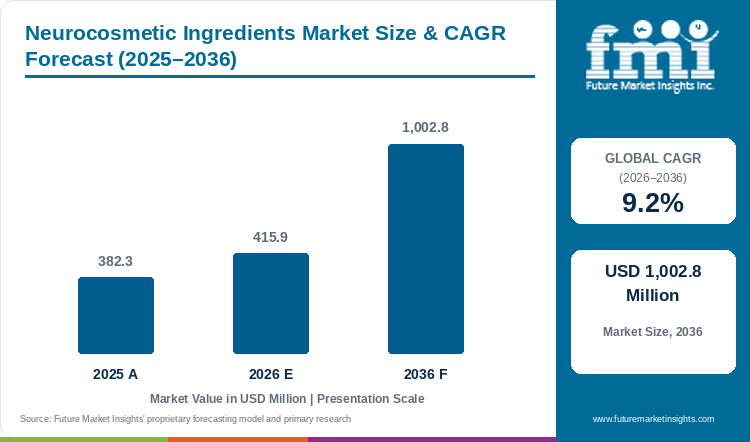
Sales of neurocosmetic ingredients will reach USD 1,002.8 million by 2036, up from USD 382.3 million in 2025 and an estimated USD 415.9 million in 2026. Demand for neurocosmetic ingredients is forecast to advance at a 9.2% CAGR during 2026 to 2036, more than doubling market value over the decade.
Brand owners are adding calming and mood claims to serums, night creams and anti-wrinkle products, and each claim needs a neuro-active ingredient with test data. In March 2026, Givaudan Active Beauty launched PrimalHyal NeuroYouth with clinical studies on more than 120 volunteers [1]. In the same month, dsm-firmenich released Alpaflor Neurosooth and reported a 34% fall in stress-induced redness versus placebo after two months [2]. The retail pool is large, as L'Oréal put the 2025 global beauty market at more than EUR 290 billion, with skincare at 39% [3]. FMI notes that neuropeptides lead with a 33.5% share in 2026, and clinically tested actives will gain most new briefs up to 2036.
Key Market Trends & Insights
- By ingredient type, neuropeptides hold a 33.5% share in 2026, as skincare brands rely on peptides with long test records for expression lines. Lubrizol has sold Argireline for more than two decades [4].
- By function, anti-aging and expression line relaxing leads with 37% of 2026 sales, as shoppers still judge a cream by visible effect on lines and firmness.
- By application, facial skincare makes up 57% of sales in 2026. Givaudan research reported in April 2026 found 93% of American body care users keen on mood-enhancing formulations, so body care is set to gain share [5].
- By source, synthetic actives hold 44% in 2026, as brands need identical purity and dose data in every batch.
Regional Highlights
- Fastest-growing profiled country: South Korea (10.1% CAGR, 2026 to 2036), with K-beauty brands taking new launches into foreign stores.
- By country: Brazil (9.7%) ranks second and the USA (9%) third, and the UK grows slowest among profiled countries at 8.4% for 2026 to 2036.
- Orders from Korean skincare exporters are growing, as South Korea's cosmetics exports rose 11.8% in 2025 to a record USD 11.4 billion. Skincare made up USD 8.5 billion of that total [6].
Market Size & Forecast
Table 1: Market Size and Forecast for the Neurocosmetic Ingredients Market (USD million and percentage), 2025 to 2036
| Metric | Value |
|---|---|
| 2025 Market Size | USD 382.3 million |
| Estimated Market Size in 2026 | USD 415.9 million |
| Projected Market Size by 2036 | USD 1,002.8 million |
| CAGR, 2026 to 2036 | 9.2% |
| Added Revenue, 2026 to 2036 | USD 586.9 million |
| Market Expansion Multiple | 2.4x |
Prestige and masstige facial skincare generates most sales of neurocosmetic ingredients, as brands earn a higher price for a stress or mood claim. Each new claim needs an active with study data, so suppliers holding full clinical files gain most formulation briefs. Croda reported a 13.5% rise in user happiness after one month and an 11.3% gain in sleep quality after two weeks for Zenakine [7]. Clariant paid an enterprise value of USD 810 million for Lucas Meyer Cosmetics in April 2024. The company expects Lucas Meyer revenue to grow from about USD 100 million to USD 180 million by 2028 [8]. However, EU and Great Britain rules require cosmetic claims to have adequate and verifiable evidence, raising testing costs for every neuro claim [9]. As per FMI, ingredient makers will give neuro-active lines a larger place within personal care ingredients ranges over the next decade.
Neuro Claim Proof and Supplier Activity
Demand for stress-relief skincare is rising as more shoppers report feeling stressed. An American Psychological Association poll of 3,199 U.S. adults, released in November 2025, found 75% more stressed about the country's future than before [10]. In the same poll, 69% reported needing more emotional support than was received [10]. Givaudan Active Beauty research from April 2026 adds a buying angle, with 76% of Gen Z shoppers weighing emotional and mental health support when choosing beauty products [5]. Under Regulation (EU) No 655/2013, claims in the EU and Great Britain need adequate and verifiable evidence, with any named ingredient present at an effective concentration [9]. Growth is fastest in countries with strong beauty exports or very large product ranges. Korean cosmetics exports hit a record USD 11.4 billion in 2025, up 11.8% [6]. In Latin America, L'Oréal reported 8.3% like-for-like growth for 2025 [11]. U.S. brands have a very large range to reformulate, with 1,298,361 active cosmetic product listings from 16,398 facilities at the FDA as of 30 June 2026 [12]. FMI expects mood claims in body lotions and scalp care to grow faster than the category average. France and the UK will grow more slowly, as shoppers there already follow long skincare routines.
FMI finds that several large ingredient makers now treat neurocosmetics as a lead product line, drawing orders from both prestige and mass brands. Croda reported a 13.5% rise in user happiness, an 11.3% gain in sleep quality and a 13.3% gain against visible skin fatigue for Zenakine, aimed at eye contour, face and scalp products [7]. The active came from University of Manchester research developed by SkinBioTherapeutics, and Croda said in September 2025 that Zenakine was available worldwide [13]. Apart from that, dsm-firmenich tested Alpaflor Neurosooth on redness, water loss and feelings of calm [2]. Givaudan reports a 28% rise in nerve fibre count for PrimalHyal NeuroYouth and skin looking more than five years younger [1]. Symrise, IFF and Eurofragance sell mood benefits through scent, and Symrise links the relaxation and joy effects of Flowerconcentrole to Actimood technology [14] [15] [16]. Clariant's Care Chemicals sales were flat in local currency at CHF 2,112 million in 2025, though the Lucas Meyer Cosmetics business kept growing through innovation [17]. With USD 586.9 million of new value to come between 2026 and 2036, several mid-sized ingredient makers have room to grow neuro lines.
Table 2: Neuro Claim Proof and Supplier Activity Indicators for the Neurocosmetic Ingredients Market (survey shares, clinical results, deal values, export values, product listings and claim rules), mixed reporting years from 2013 to 2026
| Indicator | Data Point | Relevance to Demand | Source |
|---|---|---|---|
| Global beauty market base | More than EUR 290 billion in 2025, skincare 39%, growth about 3.5% | Neuro claims draw on a very large retail base. | [3] |
| Shopper stress level | Of 3,199 U.S. adults surveyed in August 2025, 75% more stressed about the country's future | Stress-relief claims on pack reach a wide group of shoppers. | [10] |
| Gen Z and body care buying factors | Gen Z shoppers weighing emotional and mental health support at 76%; U.S. body care users open to mood formulations at 93% | Neuro claims are spreading from face care into body care. | [5] |
| PrimalHyal NeuroYouth skin nerve result | Nerve fibres up 28%; fibre length up 29%; more than 120 volunteers | Anti-aging brands gain a nerve-based claim with printable figures. | [1] |
| Alpaflor Neurosooth soothing result | Stress-induced redness down 34% versus placebo; TEWL under heat stress down 26%; both after two months | Sensitive-skin lines get a calming active with placebo-controlled data. | [2] |
| Zenakine wellbeing result | Happiness up 13.5% after one month; sleep quality up 11.3% after two weeks | Brands can pair mood and sleep claims with skin claims on one product. | [7] |
| Lucas Meyer Cosmetics purchase | USD 810 million enterprise value; revenue about USD 100 million, target USD 180 million by 2028 | Ingredient makers are paying high prices for active cosmetic portfolios. | [8] |
| EU and GB claim rule | Claims need adequate and verifiable evidence under Regulation (EU) No 655/2013 | Suppliers with full study files gain more briefs in Europe. | [9] |
| U.S. product base | Active cosmetic product listings of 1,298,361 from 16,398 facilities as of 30 June 2026 | U.S. brands have a very large range to reformulate with neuro actives. | [12] |
| Korean export reach | Record exports of USD 11.4 billion in 2025, up 11.8% | Korean neuro launches reach foreign stores quickly. | [6] |
Table 3: Neuro-Active Launches and Published Evidence for the Neurocosmetic Ingredients Market (launch dates and company-reported results), 2024 to 2026
| Supplier | Ingredient and launch | Neuro positioning | Published result | Source |
|---|---|---|---|---|
| Symrise AG | Flowerconcentrole, April 2024 | Mood-enhancing botanical with Actimood technology | Relaxation, joy and well-being claims through Actimood technology | [14] |
| Croda International Plc | Zenakine, April 2025 | Neuroactive lysate against stress effects on skin | Happiness up 13.5% in one month, sleep quality up 11.3% in two weeks | [7] |
| Givaudan SA | PrimalHyal NeuroYouth, March 2026 | Neuro Skin Ageing pathway and touch perception | Nerve fibre count up 28%, fibre length up 29%, more than 120 volunteers | [1] |
| dsm-firmenich | Alpaflor Neurosooth, March 2026 | Climate-adaptive neurocosmetic for the skin and mind stress loop | Stress-induced redness down 34%, TEWL under heat down 26% after two months | [2] |
| International Flavors & Fragrances Inc. | MetaMood and MetaSleep, April 2026 | Scent solutions for energy, relaxation, happiness and sleep | Built with consumer perception data and neuroscience | [15] |
| Eurofragance | EuroMotion, April 2026 | Fragrance technology linked to physiological effects | Six emotion platforms identified from social listening | [16] |
| Clariant (Lucas Meyer Cosmetics) | Revenue target | Active cosmetic ingredient portfolio | From about USD 100 million to USD 180 million by 2028 | Clariant [8] |
| Market forecast | Added market value | Neurocosmetic ingredients, 2026 to 2036 | USD 586.9 million | Forecast by Future Market Insights |
Analyst Perspective
“Brands will keep asking ingredient suppliers for one study that measures both skin results and mood or sleep results. Ingredient makers offering that proof at a price mass body care brands accept will secure the largest number of new formulas up to 2036.”
- Nikhil Kaitwade, Principal Consultant, Future Market Insights.
How is the neurocosmetic ingredients market segmented?
Four commercial axes shape the neurocosmetic ingredients market, namely ingredient type, function, application and source, alongside a regional view. Leading 2026 shares are neuropeptides at 33.5%, anti-aging and expression line relaxing at 37%, facial skincare at 57% and synthetic actives at 44%.
By ingredient type: neuropeptides, botanical neuro-soothing extracts, mood-active fragrance ingredients, probiotic and postbiotic lysates, neurosensory TRP modulators, and others.
By function: anti-aging and expression line relaxing, soothing and sensitive skin relief, stress and mood balance, sleep and circadian support, and others.
By application: facial skincare, body care, hair and scalp care, makeup, and fragrance and aromatherapy.
By source: synthetic, plant-derived, and biotechnology and fermentation-derived.
By region: North America, Latin America, Western Europe, Eastern Europe, East Asia, South Asia and Pacific, and Middle East and Africa.
Why do neuropeptides hold the top ingredient type share?
Neuropeptides are projected to hold 33.5% of ingredient type sales in 2026, backed by long clinical records on expression lines.
Table 4: Ingredient Type Share for the Neurocosmetic Ingredients Market (percentage share), 2026
| Ingredient Type | Share (2026) |
|---|---|
| Neuropeptides | 33.5% |
| Other Segments Combined | 66.5% |
| Total | 100% |
Table 5: Ingredient Type Leadership and Market Growth for the Neurocosmetic Ingredients Market (segment and CAGR percentage), 2026 to 2036
| Metric | Value |
|---|---|
| Global CAGR (2026 to 2036) | 9.2% |
| Leading Segment | Neuropeptides |
Neuropeptides lead ingredient type sales with a 33.5% share in 2026, as brands want an expression line claim backed by years of test data. Botanical neuro-soothing extracts are the next largest group, with 26% of ingredient type sales. Lubrizol has sold Argireline for more than two decades and calls the peptide the first found to reduce muscle contractions on skin [4]. In April 2026, Lubrizol presented Eyeseryl All-In at in-cosmetics Global, an eye peptide described as reaching seven soft tissues, including muscle and ligament [18]. Demand for neuropeptide skincare will keep peptide makers on top up to 2036, as brands reuse proven actives when refreshing eye creams and serums.
- Neuropeptides hold a 33.5% share in 2026, owing to formulator trust in peptides with long safety and efficacy records.
- Peptide buyers ask suppliers for the dose used in each clinical test, as the finished product needs an effective level to carry the claim [9].
What keeps anti-aging and expression line relaxing ahead by function?
Anti-aging and expression line relaxing uses are on course for 37% of function sales in 2026, as shoppers rank visible results on lines first.
Anti-aging and expression line relaxing uses hold 37% of function sales in 2026, as shoppers still judge a cream by visible effect on lines and firmness. Soothing and sensitive skin relief comes next at 27.5%, helped by calming actives for reactive skin. In March 2026, Givaudan Active Beauty reported a 28% rise in nerve fibre count and a 29% rise in fibre length for PrimalHyal NeuroYouth [1]. According to FMI, nerve-based anti-aging claims will help brands relaunch premium serums over the forecast period.
- Steady demand for line-softening serums keeps anti-aging and expression line relaxing uses at a 37% share in 2026.
- Brands moving into stress and sleep claims can start with anti-aging actives already backed by skin data, then add wellbeing tests to the same file.
Why does facial skincare take the largest application share?
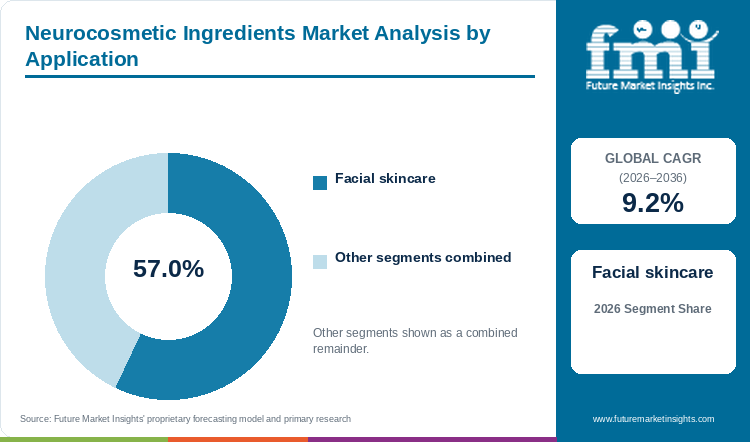
Facial skincare is set to take 57% of application sales in 2026, as serums and night creams carry most neuro claims.
Facial skincare accounts for 57% of the application split in 2026, since face serums, eye creams and night creams carry the highest price per gram. Body care stands at 14%, yet sales of mood boosting skincare for the body have room to grow. Givaudan research reported in April 2026 found 93% of American body care users keen on mood-enhancing formulations [5]. Neuro claims are also reaching colour cosmetics, as Gotha Cosmetics presented Neuroaura, a four-product make-up concept inspired by neurocosmetics, in March 2026 [19]. FMI projects that facial skincare will remain the largest application up to 2036, with body and scalp care gaining share.
- Facial skincare holds a 57% share in 2026, with premium serums and night creams carrying the strongest neuro claims at the highest price per gram.
- Body lotion and shower gel launches need mood actives at a lower cost per kilo than face serums, and body care is set to gain share as these launches multiply.
Why do synthetic actives retain the lead by source?
Synthetic actives are projected to hold 44% of source sales in 2026, owing to consistent purity and dose data.
Synthetic actives lead the source split at 44% in 2026, as brands need identical structure and purity in every batch to support a claim. Plant-derived actives follow at 38.5%, helped by natural positioning, and Symrise sold Flowerconcentrole as 100% natural under ISO 16128 in April 2024 [14]. In April 2026, dsm-firmenich received gold in the Best Green Ingredient Award at in-cosmetics Global for Alpaflor Neurosooth [20]. Sales of probiotic skincare ingredients and other fermentation-based actives will grow fastest from a 17.5% share in 2026.
- Synthetic actives hold 44% of source sales in 2026 and will keep the lead up to 2036, as lab-made peptides give brands repeatable quality.
- Brands seeking natural claims check ISO 16128 natural origin data for each plant-based neuro active before listing.
What are the drivers, restraints, and opportunities in the neurocosmetic ingredients market?
Rising shopper stress and clinically tested launches are adding to orders for neurocosmetic ingredients. Strict proof rules slow some products, and scent-based mood actives for body care open the next growth wave.
- Driver: Key drivers of the neurocosmetic ingredients market include brands adding stress, mood and sleep claims that need actives with study results.
- Restraint: EU and Great Britain proof rules are the top challenge for suppliers, as each stress or mood claim needs a separate study and raises testing costs.
- Opportunity: FMI sees scent-based mood actives for body, scalp and make-up products as the next growth area, as shoppers notice a scent effect at first use.
Stressed Shoppers Lift Mood Claims
Shoppers report more stress, and skincare brands are answering with calming and mood claims. In a survey of 3,199 U.S. adults released in November 2025, the American Psychological Association found 75% more stressed about the country's future than before [10]. Givaudan research reported in April 2026 found that 76% of Gen Z shoppers weigh emotional and mental health support when choosing beauty products [5]. Due to this, more product lines will carry stress-relief skincare claims up to 2036, keeping orders for neuro actives rising.
Claim Proof Rules Raise Testing Costs
Neuro claims cost more to support than moisture or texture claims, as mood and stress results need separate studies. Regulation (EU) No 655/2013 requires claims in the EU and Great Britain to have adequate and verifiable evidence [9]. Under FDA guidance, a fragrance sold with a claim of helping the user sleep meets the definition of a drug [21]. Smaller brands may delay launches or use softer wording until suppliers share full study files.
Scent-based Actives Open Body Care
Key trends in the neurocosmetic ingredients market point to body lotions, shower gels and hair care as a large new outlet for mood actives. In April 2026, IFF brought MetaMood and MetaSleep scent solutions for energy, relaxation, happiness and sleep to in-cosmetics Global [15]. Eurofragance presented EuroMotion the same month, a fragrance technology linked to physiological effects [16]. Apart from that, suppliers of perfume ingredients stand to gain more body care briefs over the forecast period.
Which country CAGRs are profiled in the neurocosmetic ingredients market?
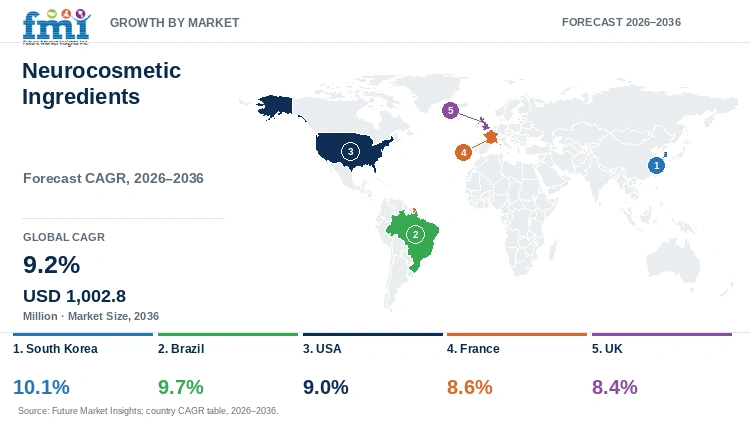
South Korea heads the five profiled neurocosmetic ingredient markets, with sales rising at a 10.1% CAGR over 2026 to 2036. The UK is slowest at 8.4% over the same period. In each country, neuro-active ingredients sell best when brands can back a stress, mood or sleep claim with test data accepted by local claim rules.
Table 6: Country CAGRs and Primary Growth Levers for the Neurocosmetic Ingredients Market (CAGR percentage), 2026 to 2036
| Country | CAGR (2026-2036) | Primary Growth Lever |
|---|---|---|
| South Korea | 10.1% | Skincare exports by K-beauty brands and contract makers |
| Brazil | 9.7% | Mood fragrances in mass body care |
| USA | 9% | Mood claims kept within cosmetic rules |
| France | 8.6% | Prestige neuroscience skincare lines |
| UK | 8.4% | Mood-led ranges at high-street pharmacies |
Source: Future Market Insights
South Korea Neurocosmetic Ingredients Market Outlook (2026-2036)
Sales of neuro-active ingredients to Korean brands will expand at a 10.1% CAGR up to 2036, faster than in any other profiled country. Skincare accounted for USD 8.5 billion of South Korea's cosmetics exports in 2025, or 74.7% of the total [6]. Korean shipments to the USA reached USD 2.2 billion in 2025, a 15% gain that moved the U.S. ahead of China as the first destination [6]. Sales to China dropped by nearly a fifth, so Korean brands are turning toward Western shoppers who expect clinical proof for soothing and stress claims [6]. Contract makers Cosmax and Kolmar Korea, the two largest by 2025 production, give suppliers a short route into many of these launches [6].
Key takeaway: Export-bound Korean skincare will bring in most new neuro-active orders from Korean brands.
Brazil Neurocosmetic Ingredients Market Outlook (2026-2036)
Brazil ranks second with a 9.7% CAGR forecast to 2036, as mass brands build mood fragrance into body care. O Boticário launched the Cuide-se Bem Nuvem de Alegria body care line in April 2025, with a fragrance developed with neuroscience to give a feeling of happiness [22]. Natura is also using neuroscience in product design, and the Tododia Energia fragrance, developed with the Neurux institute, uses BrainEmotions technology [23]. Nuvem de Alegria items sold at R$ 34.90 to R$ 84.90, so mood actives for Brazilian mass body care need a low cost per kilo [22]. Lubrizol has opened a testing centre in São Paulo, letting suppliers run claim tests close to Brazilian brand owners [18].
Key takeaway: Low-cost mood fragrances for body lotions and splashes drive Brazilian volume.
USA Neurocosmetic Ingredients Market Outlook (2026-2036)
Under FDA guidance, a fragrance sold with a sleep claim is classed as a drug [21]. Due to this, U.S. brands keep neurocosmetic claims to skin comfort, calm and mood wording, and suppliers helping with compliant claims gain more briefs. Sales of neurocosmetic ingredients in the USA are forecast at a 9% CAGR up to 2036, slightly behind the 9.2% global pace. Givaudan research found 93% of American body care users keen on mood-enhancing formulations, which supports body care launches [5].
Key takeaway: Neuro actives supporting cosmetic-only wording will gain the most U.S. formulas.
France Neurocosmetic Ingredients Market Outlook (2026-2036)
Adoption of neuro-active skincare in France is forecast at an 8.6% CAGR up to 2036. The Sisley Group launched Neuraé in April 2024 as a neuroscience skincare brand with seven products built around tiredness, sadness and stress [24] [25]. France was the largest cosmetics exporter in the world in 2025 at USD 24.3 billion, so a neuro claim adopted by a French prestige house can reach many markets [6]. Growth stays below the 9.2% global pace, as shoppers already follow long skincare routines and every mood claim needs adequate and verifiable evidence under EU rules [9].
Key takeaway: French prestige houses will set the price level for neuroscience skincare.
UK Neurocosmetic Ingredients Market Outlook (2026-2036)
Boots found that 78% of UK consumers believe fragrance can improve mental wellbeing [26]. ROCCO, a new neurocosmetic skincare brand, went on sale exclusively at Boots in June 2026, with products priced from £16 to £18 [27]. Neurocosmetics research at the University of Manchester led to Zenakine, which Croda now sells to brands worldwide [13]. The UK grows at an 8.4% CAGR up to 2036, the slowest pace here, as British claims need the same adequate and verifiable evidence as EU claims [9].
Key takeaway: Affordable mood-led skincare on pharmacy shelves offers British suppliers the clearest growth path.
Who are the notable companies in the neurocosmetic ingredients market?
Givaudan, Croda, dsm-firmenich, Symrise, IFF, Clariant, Lubrizol, Eurofragance and SkinBioTherapeutics form the profiled supplier set in this market.
Neurocosmetic ingredients come mainly from large fragrance, flavour and specialty chemical groups, each taking a different route into neuro claims. Givaudan, Croda and dsm-firmenich sell actives with published skin or wellbeing results [1] [7] [2], and Symrise, IFF and Eurofragance build mood benefits around scent. Lubrizol competes with peptides, and Clariant said in February 2026 that Lucas Meyer Cosmetics kept growing through innovation [17]. SkinBioTherapeutics licenses lysate science to Croda and receives tiered royalties on Zenakine-based products [28]. FMI expects suppliers to widen neuro ranges through trade fair launches and acquisitions over the forecast period.
- Neuro-active skincare specialists: Givaudan, Croda, and dsm-firmenich sell clinically tested actives for anti-aging, soothing and sleep claims.
- Fragrance and mood ingredient houses: Symrise, IFF, and Eurofragance build mood benefits around scent and botanical actives for skin, body and hair care.
- Peptide and lysate science suppliers: Lubrizol, Clariant, and SkinBioTherapeutics widen neuro ranges through peptide launches, acquisitions and licensing.
Competitive Benchmarking: Neurocosmetic Ingredients Market
Table 7: Competitive Benchmarking for the Neurocosmetic Ingredients Market (qualitative capability ratings), 2026
| Company | Clinical Data | Neuro Range | Wellbeing Tests | Reach |
|---|---|---|---|---|
| Givaudan | High | High | Medium | High |
| Croda | High | Medium | High | High |
| dsm-firmenich | High | Medium | High | High |
| Symrise | Low | Medium | Medium | High |
| IFF | Low | High | Medium | High |
| Eurofragance | Low | Medium | Medium | Medium |
| Lubrizol | High | Medium | Low | High |
| Clariant | Low | Medium | Low | High |
| SkinBioTherapeutics | Medium | Low | High | Low |
High marks strong published proof such as numeric clinical results or several neuro launches, Medium marks partial proof, and Low marks limited public documentation.
Key Developments in the Neurocosmetic Ingredients Market
- IFF presented MetaMood and MetaSleep scent solutions at in-cosmetics Global in Paris in April 2026, aimed at energy, relaxation, happiness and sleep [15].
- In April 2026, dsm-firmenich received gold in the Best Green Ingredient Award at in-cosmetics Global for Alpaflor Neurosooth, raising visibility with natural brands [20].
- Givaudan Active Beauty unveiled PrimalHyal NeuroYouth in March 2026 for a pathway named Neuro Skin Ageing, with clinical studies on more than 120 volunteers [1].
- In April 2025, Croda launched Zenakine against the effects of stress on skin at in-cosmetics Global in Amsterdam, targeting more night cream and scalp care launches [7].
Key Players in the Neurocosmetic Ingredients Market
Neuro-Active Skincare Specialists
- Givaudan SA
- Croda International Plc
- DSM-Firmenich AG
Fragrance and Mood Ingredient Houses
- Symrise AG
- International Flavors & Fragrances Inc.
- Eurofragance
Peptide and Lysate Science Suppliers
- The Lubrizol Corporation
- Clariant AG
- SkinBioTherapeutics plc
Neurocosmetic Ingredients Market - Report Scope
Table 8: Report Scope for the Neurocosmetic Ingredients Market (coverage fields and definitions), 2026 to 2036
| Coverage field | Report scope |
|---|---|
| Market breakdown | Ingredient type; function; application; source; region |
| Quantitative units | USD million |
| Market definition | First-sale revenue from cosmetic active and functional ingredients sold to brand owners and contract manufacturers with a claimed action on skin nerves, stress response, sensory perception or mood. Finished cosmetic products and general fragrance oils sold without a mood claim are excluded. |
| Regions covered | North America; Latin America; Western Europe; Eastern Europe; East Asia; South Asia and Pacific; Middle East and Africa |
| Countries covered | South Korea; Brazil; USA; France; UK |
| Key companies profiled | Givaudan, Croda, dsm-firmenich, Symrise, IFF, Clariant, Lubrizol, Eurofragance, SkinBioTherapeutics |
| Forecast period | 2026 to 2036 |
| Approach | Ingredient value is counted once at the first sale to a brand owner or contract manufacturer, split by function, application and country and checked against supplier revenues and launches. |
Neurocosmetic Ingredients Market - Research Methodology
Table 9: Research Methodology for the Neurocosmetic Ingredients Market (research methods and approach), 2026 edition
| Method | Approach |
|---|---|
| Primary Research | Discussions took place with ingredient supplier marketing and regulatory teams, cosmetic formulators, contract manufacturers and brand product developers. Topics covered neuro claim briefs, dose levels, test requirements and ingredient prices. |
| Desk Research | Desk work drew on supplier launch releases and clinical summaries, company annual results, trade fair coverage, EU and Great Britain claim rules, FDA cosmetic guidance and national export data. |
| Market Sizing and Forecasting | Value is built from supplier revenues for active cosmetic ingredients, together with launch counts, claim use in skincare and adjacent categories, ingredient prices and country beauty sales. |
| Data Validation | Segment shares and country growth rates are tested against supplier results, trade data and interview findings. Finished product revenue is removed from the ingredient total. |
Neurocosmetic Ingredients Market by Segments
Neurocosmetic Ingredients Market segmented by Ingredient Type:
- Neuropeptides
- Botanical neuro-soothing extracts
- Mood-active fragrance ingredients
- Probiotic and postbiotic lysates
- Neurosensory TRP modulators
- Others
Neurocosmetic Ingredients Market segmented by Function:
- Anti-aging and expression line relaxing
- Soothing and sensitive skin relief
- Stress and mood balance
- Sleep and circadian support
- Others
Neurocosmetic Ingredients Market segmented by Application:
- Facial skincare
- Body care
- Hair and scalp care
- Makeup
- Fragrance and aromatherapy
Neurocosmetic Ingredients Market segmented by Source:
- Synthetic
- Plant-derived
- Biotechnology and fermentation-derived
Neurocosmetic Ingredients Market by Region
- North America
- United States
- Canada
- Latin America
- Brazil
- Mexico
- Argentina
- Chile
- Western Europe
- Germany
- France
- United Kingdom
- Italy
- Spain
- Benelux
- Nordics
- Eastern Europe
- Poland
- Czech Republic
- Romania
- Hungary
- East Asia
- Japan
- South Korea
- South Asia and Pacific
- ASEAN
- Australia and New Zealand
- Middle East and Africa
- GCC Countries
- South Africa
- Türkiye
- Israel
Research Sources and Bibliography
- [1] Givaudan SA. (2026, March 25). Givaudan Active Beauty unveils PrimalHyal™ NeuroYouth.https://www.givaudan.com/print/2746411
- [2] dsm-firmenich. (2026, March 27). dsm-firmenich introduces ALPAFLOR® NEUROSOOTH, climate-adaptive neurocosmetic science for holistic skin well-being.https://www.dsm-firmenich.com/en/businesses/perfumery-beauty/beauty-care/press-releases/2026/dsm-firmenich-introduces-alpaflor-neurosooth-climate-adaptive-neurocosmetic-science-for-holistic-skin-wellbeing.html
- [3] L'Oréal. (2026 (Annual Report 2025)). Beauty market.https://www.loreal-finance.com/en/annual-report-2025/beauty-market/
- [4] The Lubrizol Corporation. (2025, January 7). Innovation and Revolution: The Journey to Argireline® Amplified Peptide.https://lubrizol.com/Personal-Care/Blog/2025/01/Innovation-and-Revolution-The-Journey-to-Argireline-Amplified-Peptide
- [5] Personal Care Insights. (2026, April 28). Formulating “feel-good beauty”: Unlocking the skin-brain axis for neurocosmetics.https://www.personalcareinsights.com/news/neurocosmetics-skin-brain-axis.html
- [6] Korea JoongAng Daily. (2026, May 23). Korea surpasses U.S. in cosmetics exports with record $11.4 billion.https://www.koreajoongangdaily.com/business/korea-surpasses-us-in-cosmetics-exports-with-record-114-billion/12713991
- [7] SkinBioTherapeutics plc (RNS, FCA National Storage Mechanism). (2025, April 8). Croda Launches Zenakine™ at in-cosmetics Global, Amsterdam.https://data.fca.org.uk/artefacts/NSM/RNS/5608837.html
- [8] Clariant AG. (2024, April 3). Clariant completed acquisition of Lucas Meyer Cosmetics.https://www.clariant.com/pt/Corporate/News/2024/04/Clariant-completed-acquisition-of-Lucas-Meyer-Cosmetics
- [9] legislation.gov.uk (The National Archives). (2013, July 10). Commission Regulation (EU) No 655/2013 laying down common criteria for the justification of claims used in relation to cosmetic products, Annex, Part 3 Evidential support.https://www.legislation.gov.uk/eur/2013/655/annex/division/3
- [10] American Psychological Association (PR Newswire). (2025, November 6). APA Poll Reveals a Nation Suffering from Stress of Societal Division, Loneliness.https://www.streetinsider.com/PRNewswire/APA+POLL+REVEALS+A+NATION+SUFFERING+FROM+STRESS+OF+SOCIETAL+DIVISION%2C+LONELINESS/25564291.html
- [11] CosmeticsDesign-Europe. (2026, February 16). L’Oréal outperformed global beauty market in 2025 with €44bn in sales.https://www.cosmeticsdesign-europe.com/Article/2026/02/16/loreal-outperforms-the-beauty-market-with-44bn-in-2025-sales
- [12] U.S. Food and Drug Administration. (2026, September 9 (content current as of)). Registration & Listing of Cosmetic Product Facilities and Products.https://www.fda.gov/cosmetics/registration-listing-cosmetic-product-facilities-and-products
- [13] Croda International Plc. (2025, September 8). Celebrating our innovative ingredients: Zenakine™ - redefining neurocosmetic skincare possibilities.https://www.croda.com/en-gb/media-hub/news/general/celebrating-our-innovative-ingredients
- [14] Symrise AG. (2024, April 10). Flowerconcentrole press release (Symrise Cosmetic Ingredients).https://www.symrise.com/fileadmin/symrise/News/2024/pdf/240410_Symrise_PR_Flowerconcentrole.pdf
- [15] International Flavors & Fragrances Inc. (2026, April 13). IFF explores the science behind well-being at in-cosmetics Global 2026.https://www.iff.com/media/news/iff-explores-the-science-behind-well-being-at-in-cosmetics-global-2026/
- [16] Personal Care Insights. (2026, April 22). In-cosmetics Global 2026: Well-being demands fuel neurocosmetics emergence.https://www.personalcareinsights.com/news/in-cosmetics-neurocosmetics-2026.html
- [17] Clariant AG (Nasdaq press release). (2026, February 26). Clariant delivers third year of strong EBITDA margin improvement.https://www.nasdaq.com/press-release/clariant-delivers-third-year-strong-ebitda-margin-improvement-ebitda-margin
- [18] Personal Care Insights. (2026, April 16). In-cosmetics Global 2026 live: Lubrizol eye-peptide targets 7 tissues, including ligaments and muscles.https://www.personalcareinsights.com/news/lubrizol-ai-peptide-incosmetics.html
- [19] CosmeticsDesign-Europe. (2026, March 10). Gotha launches neurocosmetics concept products.https://www.cosmeticsdesign-europe.com/Article/2026/03/10/gotha-launches-neurocosmetics-concept-products
- [20] dsm-firmenich. (2026, April 15). dsm-firmenich wins gold for Best Green Ingredient Award at in-cosmetics Global 2026 for ALPAFLOR® NEUROSOOTH.https://www.dsm-firmenich.com/en/businesses/perfumery-beauty/beauty-care/press-releases/2026/dsm-firmenich-wins-gold-for-best-green-ingredient-award-at-in-cosmetics-global-2026-for-alpaflor-neurosooth.html
- [21] U.S. Food and Drug Administration. (2024, September 11 (content current as of)). Is It a Cosmetic, a Drug, or Both? (Or Is It Soap?).https://www.fda.gov/cosmetics/cosmetics-laws-regulations/it-cosmetic-drug-or-both-or-it-soap
- [22] Bem Paraná (Simone Bello blog). (2025, April 29). O Boticário apresenta Cuide-se Bem Nuvem de Alegria, com fragrância que comprovadamente promove sensação de felicidade.https://www.bemparana.com.br/publicacao/blogs/simonebello/o-boticario-apresenta-cuide-se-bem-nuvem-de-alegria-com-fragrancia-que-comprovadamente-promove-sensacao-de-felicidade/
- [23] Forbes Brasil. (2025, February 21). Com P&Ds integrados, Natura aposta em neurociência para desenvolvimento de novos produtos.https://forbes.com.br/forbes-mkt/2025/02/com-pds-integrados-natura-aposta-em-neurociencia-para-desenvolvimento-de-novos-produtos/
- [24] Luxus Plus. (2024, April 4). Le groupe Sisley dévoile sa nouvelle marque Neuraé.https://luxus-plus.com/le-groupe-sisley-devoile-sa-nouvelle-marque-neurae/
- [25] Sisley Paris. (n.d. (accessed 2026, October)). The Sisley Group presents NEUR|AÉ.https://www.sisley-paris.com/en-GB/new-brand-neurae.html
- [26] Cosmetics Business. (2025, February 12). Sleep-focused skin care and moodscaping fragrances top Boots beauty trends.https://cosmeticsbusiness.com/sleep-focused-skin-care-and-moodscaping-fragrances-top-boots-beauty-trends
- [27] The Industry Beauty. (2026, June 1). New brand ROCCO debuts with neurocosmetic skincare range.https://theindustry.beauty/new-brand-rocco-debuts-with-neurocosmetic-skincare-range/
- [28] SkinBioTherapeutics plc (RNS, FCA National Storage Mechanism). (2025, June 30). Commercial Launch Progressing as Expected.https://data.fca.org.uk/artefacts/NSM/RNS/5716105.html
This bibliography is provided for reader reference. The full report contains the complete reference list and detailed citations.
This Report Answers
- What is the value of neurocosmetic ingredient sales in 2026?
- By 2036, to what level will neurocosmetic ingredient sales grow?
- Which ingredient type leads sales, and why do neuropeptides hold the top share?
- Which function and application lead sales of neurocosmetic ingredients?
- Among five profiled countries, which one grows fastest in neurocosmetic ingredient sales?
- Which neuro-active ingredient suppliers compete, and what sets each group apart?
Frequently Asked Questions
How large is the neurocosmetic ingredients market expected in 2026?
Sales of neurocosmetic ingredients will reach USD 415.9 million in 2026. More brands adding stress, mood and sleep claims will push the market past USD 1 billion, to USD 1,002.8 million by 2036.
What CAGR is projected for the neurocosmetic ingredients market through 2036?
FMI forecasts a 9.2% CAGR for neurocosmetic ingredients over 2026 to 2036. Actives with published skin and wellbeing results will bring the bulk of new value.
Which ingredient type holds a notable market share in 2026?
Neuropeptides will hold 33.5% of ingredient type sales in 2026. Brands favour peptides with long clinical records for expression line claims.
Which application leads neurocosmetic ingredient demand in 2026?
FMI places facial skincare at 57% of application sales in 2026. Serums, eye creams and night creams carry the highest prices and the strongest neuro claims.
Which country has a notable expansion outlook through 2036?
South Korea has the fastest outlook among the five profiled countries, with a 10.1% CAGR from 2026 to 2036. Record skincare exports by Korean brands will carry new neuro-active launches into foreign stores.
Who are the key companies in the neurocosmetic ingredients market?
Key suppliers include Givaudan, Croda, dsm-firmenich, Symrise, IFF, Clariant, Lubrizol, Eurofragance and SkinBioTherapeutics. These suppliers compete on clinical data, mood science and peptide portfolios.
Preview the report firsthand - request a free sample
Get SampleGet the brochure for pricing and purchase details.
Get PDFTable of Content
- Key Takeaways
- Market Size and CAGR
- Top Growth Driver
- Fastest Growing Segment
- Leading Region
- Key Companies
- Emerging Opportunities
- Executive Summary
- Global Market Outlook
- Demand-side Trends
- Supply-side Trends
- Technology Roadmap Analysis
- Analysis and Recommendations
- Analyst Perspective (What is happening? Why now? What should investors know?)
- Key Questions Answered
- How large is the market?
- What is the CAGR?
- What are key trends?
- Which region dominates?
- Who are the leaders?
- Market Overview
- Market Coverage / Taxonomy
- Market Definition / Scope / Limitations
- Research Methodology
- Chapter Orientation
- Analytical Lens and Working Hypotheses
- Market Structure, Signals, and Trend Drivers
- Benchmarking and Cross-market Comparability
- Market Sizing, Forecasting, and Opportunity Mapping
- Research Design and Evidence Framework
- Desk Research Programme (Secondary Evidence)
- Expert Input and Fieldwork (Primary Evidence)
- Tooling, Models, and Reference Databases
- Data Engineering and Model Build
- Quality Assurance and Audit Trail
- Market Background
- Market Dynamics (Drivers, Restraints, Opportunity, Trends)
- Scenario Forecast (Optimistic, Likely, Conservative)
- Impact Analysis
- AI Impact
- Sustainability Impact
- Regulatory Impact
- Technology Impact
- Consumer / Buyer Analysis
- Purchase Drivers
- Adoption Barriers
- Buyer Journey
- Opportunity Map Analysis
- Product Life Cycle Analysis
- Supply Chain Analysis
- Investment Feasibility Matrix
- Value Chain Analysis
- PESTLE and Porter's Analysis
- Regulatory Landscape
- Regional Parent Market Outlook
- Production and Consumption Statistics
- Import and Export Statistics
- Global Market Analysis and Forecast, 2021 to 2036
- Historical Market Size Value (USD Million) Analysis, 2021 to 2025
- Current and Future Market Size Value (USD Million) Projections, 2026 to 2036
- Y-o-Y Growth Trend Analysis
- Absolute $ Opportunity Analysis
- Global Market Pricing Analysis, 2021 to 2036
- Global Market Analysis and Forecast, By Ingredient Type, 2021 to 2036
- Introduction / Key Findings
- Historical Market Size Value (USD Million) Analysis By Ingredient Type, 2021 to 2025
- Current and Future Market Size Value (USD Million) Analysis and Forecast By Ingredient Type, 2026 to 2036
- Neuropeptides
- Botanical neuro-soothing extracts
- Mood-active fragrance ingredients
- Probiotic and postbiotic lysates
- Neurosensory TRP modulators
- Others
- Y-o-Y Growth Trend Analysis By Ingredient Type, 2021 to 2025
- Absolute $ Opportunity Analysis By Ingredient Type, 2026 to 2036
- Global Market Analysis and Forecast, By Function, 2021 to 2036
- Introduction / Key Findings
- Historical Market Size Value (USD Million) Analysis By Function, 2021 to 2025
- Current and Future Market Size Value (USD Million) Analysis and Forecast By Function, 2026 to 2036
- Anti-aging and expression line relaxing
- Soothing and sensitive skin relief
- Stress and mood balance
- Sleep and circadian support
- Others
- Y-o-Y Growth Trend Analysis By Function, 2021 to 2025
- Absolute $ Opportunity Analysis By Function, 2026 to 2036
- Global Market Analysis and Forecast, By Application, 2021 to 2036
- Introduction / Key Findings
- Historical Market Size Value (USD Million) Analysis By Application, 2021 to 2025
- Current and Future Market Size Value (USD Million) Analysis and Forecast By Application, 2026 to 2036
- Facial skincare
- Body care
- Hair and scalp care
- Makeup
- Fragrance and aromatherapy
- Y-o-Y Growth Trend Analysis By Application, 2021 to 2025
- Absolute $ Opportunity Analysis By Application, 2026 to 2036
- Global Market Analysis and Forecast, By Source, 2021 to 2036
- Introduction / Key Findings
- Historical Market Size Value (USD Million) Analysis By Source, 2021 to 2025
- Current and Future Market Size Value (USD Million) Analysis and Forecast By Source, 2026 to 2036
- Synthetic
- Plant-derived
- Biotechnology and fermentation-derived
- Y-o-Y Growth Trend Analysis By Source, 2021 to 2025
- Absolute $ Opportunity Analysis By Source, 2026 to 2036
- Global Market Analysis and Forecast, By Region, 2021 to 2036
- Introduction
- Historical Market Size Value (USD Million) Analysis By Region, 2021 to 2025
- Current Market Size Value (USD Million) Analysis and Forecast By Region, 2026 to 2036
- North America
- Latin America
- Western Europe
- Eastern Europe
- East Asia
- South Asia and Pacific
- Middle East and Africa
- Market Attractiveness Analysis By Region
- North America Market Analysis and Forecast, By Country, 2021 to 2036
- Historical Market Size Value (USD Million) Trend Analysis By Market Taxonomy, 2021 to 2025
- Market Size Value (USD Million) Forecast By Market Taxonomy, 2026 to 2036
- By Country
- United States
- Canada
- By Ingredient Type
- By Function
- By Application
- By Source
- By Country
- Market Attractiveness Analysis
- By Country
- By Ingredient Type
- By Function
- By Application
- By Source
- Key Takeaways
- Latin America Market Analysis and Forecast, By Country
- Historical Market Size Value (USD Million) Trend Analysis By Market Taxonomy, 2021 to 2025
- Market Size Value (USD Million) Forecast By Market Taxonomy, 2026 to 2036
- By Country
- Brazil
- Mexico
- Argentina
- Chile
- By Ingredient Type
- By Function
- By Application
- By Source
- By Country
- Market Attractiveness Analysis
- By Country
- By Ingredient Type
- By Function
- By Application
- By Source
- Key Takeaways
- Western Europe Market Analysis and Forecast, By Country
- Historical Market Size Value (USD Million) Trend Analysis By Market Taxonomy, 2021 to 2025
- Market Size Value (USD Million) Forecast By Market Taxonomy, 2026 to 2036
- By Country
- Germany
- France
- United Kingdom
- Italy
- Spain
- Benelux
- Nordics
- By Ingredient Type
- By Function
- By Application
- By Source
- By Country
- Market Attractiveness Analysis
- By Country
- By Ingredient Type
- By Function
- By Application
- By Source
- Key Takeaways
- Eastern Europe Market Analysis and Forecast, By Country
- Historical Market Size Value (USD Million) Trend Analysis By Market Taxonomy, 2021 to 2025
- Market Size Value (USD Million) Forecast By Market Taxonomy, 2026 to 2036
- By Country
- Poland
- Czech Republic
- Romania
- Hungary
- By Ingredient Type
- By Function
- By Application
- By Source
- By Country
- Market Attractiveness Analysis
- By Country
- By Ingredient Type
- By Function
- By Application
- By Source
- Key Takeaways
- East Asia Market Analysis and Forecast, By Country
- Historical Market Size Value (USD Million) Trend Analysis By Market Taxonomy, 2021 to 2025
- Market Size Value (USD Million) Forecast By Market Taxonomy, 2026 to 2036
- By Country
- Japan
- South Korea
- By Ingredient Type
- By Function
- By Application
- By Source
- By Country
- Market Attractiveness Analysis
- By Country
- By Ingredient Type
- By Function
- By Application
- By Source
- Key Takeaways
- South Asia and Pacific Market Analysis and Forecast, By Country
- Historical Market Size Value (USD Million) Trend Analysis By Market Taxonomy, 2021 to 2025
- Market Size Value (USD Million) Forecast By Market Taxonomy, 2026 to 2036
- By Country
- ASEAN
- Australia and New Zealand
- By Ingredient Type
- By Function
- By Application
- By Source
- By Country
- Market Attractiveness Analysis
- By Country
- By Ingredient Type
- By Function
- By Application
- By Source
- Key Takeaways
- Middle East and Africa Market Analysis and Forecast, By Country
- Historical Market Size Value (USD Million) Trend Analysis By Market Taxonomy, 2021 to 2025
- Market Size Value (USD Million) Forecast By Market Taxonomy, 2026 to 2036
- By Country
- GCC Countries
- South Africa
- Türkiye
- Israel
- By Ingredient Type
- By Function
- By Application
- By Source
- By Country
- Market Attractiveness Analysis
- By Country
- By Ingredient Type
- By Function
- By Application
- By Source
- Key Takeaways
- Key Countries Market Analysis
- United States
- Pricing Analysis
- Market Share Analysis, 2025
- By Ingredient Type
- By Function
- By Application
- By Source
- Canada
- Pricing Analysis
- Market Share Analysis, 2025
- By Ingredient Type
- By Function
- By Application
- By Source
- Mexico
- Pricing Analysis
- Market Share Analysis, 2025
- By Ingredient Type
- By Function
- By Application
- By Source
- Brazil
- Pricing Analysis
- Market Share Analysis, 2025
- By Ingredient Type
- By Function
- By Application
- By Source
- Chile
- Pricing Analysis
- Market Share Analysis, 2025
- By Ingredient Type
- By Function
- By Application
- By Source
- Germany
- Pricing Analysis
- Market Share Analysis, 2025
- By Ingredient Type
- By Function
- By Application
- By Source
- United Kingdom
- Pricing Analysis
- Market Share Analysis, 2025
- By Ingredient Type
- By Function
- By Application
- By Source
- Italy
- Pricing Analysis
- Market Share Analysis, 2025
- By Ingredient Type
- By Function
- By Application
- By Source
- Spain
- Pricing Analysis
- Market Share Analysis, 2025
- By Ingredient Type
- By Function
- By Application
- By Source
- France
- Pricing Analysis
- Market Share Analysis, 2025
- By Ingredient Type
- By Function
- By Application
- By Source
- ASEAN
- Pricing Analysis
- Market Share Analysis, 2025
- By Ingredient Type
- By Function
- By Application
- By Source
- Australia and New Zealand
- Pricing Analysis
- Market Share Analysis, 2025
- By Ingredient Type
- By Function
- By Application
- By Source
- Japan
- Pricing Analysis
- Market Share Analysis, 2025
- By Ingredient Type
- By Function
- By Application
- By Source
- South Korea
- Pricing Analysis
- Market Share Analysis, 2025
- By Ingredient Type
- By Function
- By Application
- By Source
- Poland
- Pricing Analysis
- Market Share Analysis, 2025
- By Ingredient Type
- By Function
- By Application
- By Source
- Hungary
- Pricing Analysis
- Market Share Analysis, 2025
- By Ingredient Type
- By Function
- By Application
- By Source
- Türkiye
- Pricing Analysis
- Market Share Analysis, 2025
- By Ingredient Type
- By Function
- By Application
- By Source
- South Africa
- Pricing Analysis
- Market Share Analysis, 2025
- By Ingredient Type
- By Function
- By Application
- By Source
- United States
- Market Structure Analysis
- Competition Dashboard
- Competition Benchmarking
- Market Share Analysis of Top Players
- By Regional
- By Ingredient Type
- By Function
- By Application
- By Source
- Emerging Startups
- Innovation Benchmarking
- Competition Analysis
- Competition Deep Dive
- Givaudan
- Overview
- Product Portfolio
- Profitability by Market Segments
- Sales Footprint
- Strategy Overview
- Marketing Strategy
- Product Strategy
- Channel Strategy
- Croda
- dsm-firmenich
- Symrise
- IFF
- Eurofragance
- Lubrizol
- Clariant
- SkinBioTherapeutics
- Givaudan SA
- Croda International Plc
- DSM-Firmenich AG
- Symrise AG
- International Flavors & Fragrances Inc.
- The Lubrizol Corporation
- Clariant AG
- SkinBioTherapeutics plc
- Givaudan
- Case Studies
- Success Stories
- Recent Developments
- Competition Deep Dive
- Assumptions & Acronyms Used


