

- Market Size (2026)
- USD 87.3 Mn
- Forecast (2036)
- USD 206.7 Mn
- CAGR (2026 to 2036)
- 9.0%
How big is Neutropenia Nutrition Product Market in 2026?
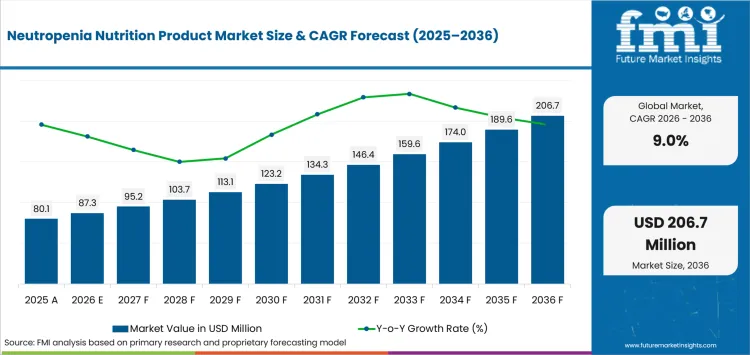
USD 87.3 million in 2026 and USD 206.7 million by 2036 at a 9.0% CAGR.
Demand for neutropenia nutrition product is projected to rise at a 9.0% CAGR by 2036, driving industry valuation from USD 87.3 million in 2026 to USD 206.7 million during the forecast period. Demand begins with patients who can still take nutrition orally but cannot reliably finish normal meals during intensive cancer treatment. The American Cancer Society estimated 2,041,910 new USA cancer diagnoses in 2025. The figure indicates more care episodes in which clinicians manage calorie and protein shortfalls without serving as a direct sales denominator. The oncology nutrition market clarifies why disease-related malnutrition is a commercial issue instead of a diet-label proposition.
Country growth separates systems that identify nutrition risk early from systems with fragmented access and continuation. In April 2025, the UK Department of Health and Social Care said 80,000 more patients received a cancer diagnosis or all-clear within 28 days than a year earlier. The comparison covered July 2024 through January 2025 and documented faster diagnostic processing over that period. Faster diagnostic throughput can bring nutrition review forward for patients entering chemotherapy or transplantation pathways, but local formularies determine which products are purchased. Adjacent clinical nutrition market structures and medical nutrition market access therefore influence how quickly sealed oral formats progress from specialist centers into routine care.
Key Takeaways
- Treatment-related appetite loss, mucositis, taste change and fatigue increase demand for sealed oral nutrition that can be served with minimal preparation.
- In 2026, sterile / UHT RTD nutrition is expected to lead product type with 47.0% share because sealed servings reduce preparation and portioning steps.
- By neutropenia severity, mild-moderate is estimated to hold 56.4% in 2026 owing to a larger patient group that can continue oral support.
- RTD is set to lead the product form with 56.2% share in 2026 due to fixed portions that remove mixing and provide a known serving volume.
- Conflicting evidence on strict neutropenic diets limits broad infection-prevention claims, keeping product positioning centered on nutritional adequacy, tolerability and safe handling.
- Some of the key players in this market include Nestlé Health Science, Abbott, Danone Nutricia, Fresenius Kabi, Medtrition, Mom's Meals (PurFoods), Meiji Co., Ltd., and Kate Farms.
Analyst Perspective
"Neutropenia nutrition earns repeat use by solving an intake problem during treatment without turning package format into an infection-prevention claim. Hospital initiation has greater commercial value once patients can obtain the same tolerated drink or portion after discharge."
- Nandini Roy Choudhury, Principal Consultant, Future Market Insights
How is the neutropenia nutrition product market segmented?
The market is segmented by product type, neutropenia severity, product form, end user and sales channel.
Product type covers sterile / UHT RTD nutrition, low-microbial / hygienic packaged snacks, fortified single-serve portions and others. Neutropenia severity covers mild-moderate, severe (<500 ANC) and prolonged cases that require different levels of nutrition oversight. Product form separates RTD, snack packs, sealed portions and other formats according to how nutrition is served. End user includes hospitals & transplant units, homecare, retail consumers and others that differ in initiation and replenishment routes. Sales channel covers hospital pharmacy, institutional tender, retail pharmacy, online and others.
What supports demand for Hospitals & Transplant Units within the End User category?
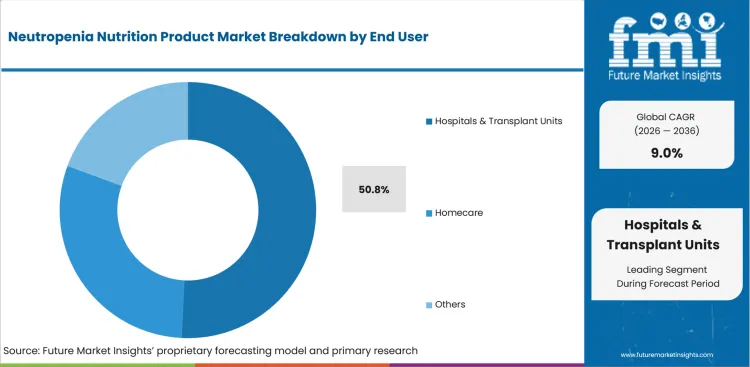
Hospitals and transplant units concentrate treatment episodes during which clinicians screen nutrition, select supplements and judge whether oral intake is sufficient. These institutions also control formulary access and discharge handoff into home or outpatient care. Enteral feeding becomes relevant once oral intake fails, and parenteral nutrition serves patients who cannot use the gastrointestinal tract.
- The end user category is forecast to be led by hospitals & transplant units at 50.8% share in 2026 due to concentrated clinical decisions in supervised care.
- HRSA reported in July 2026 that 22,579 hematopoietic cell transplants were performed in the United States in 2024, giving hospitals repeated nutrition decision points.
What makes Sterile / UHT RTD Nutrition central to the Product Type category?
Sterile or UHT drinks give oncology teams a fixed serving without bedside mixing. A fixed serving suits patients whose appetite changes during treatment and lets dietitians track intake. Related oral clinical supplements and medical food market routes show why manufacturers compete on nutrient density, flavor and portion size instead of a special-diet claim.
- Based on product type, sterile / UHT RTD nutrition is projected to account for 47.0% in 2026 due to sealed single servings that reduce preparation and portioning steps.
- Danone Nutricia addressed this requirement in February 2025 by launching Fortimel Plantbased Protein for disease-related malnutrition in oncology care.
How does Mild-Moderate shape demand within the Neutropenia Severity category?
Mild-Moderate neutropenia includes patients who can continue oral nutrition despite treatment-related appetite or taste problems. Demand centers on preserving intake without making food restrictions the purchase rationale. The neighboring cancer supportive care market places nutrition beside other supportive-care needs, whereas severe or prolonged cases may require closer oversight and earlier feeding escalation.
- Mild-moderate is projected to hold 56.4% share in 2026 owing to a larger population that can continue routine oral supplementation.
- A February 2025 NIH-indexed review of five randomized trials covering 510 adults found no significant neutropenic-diet advantage, limiting restrictive diets as a rationale for this segment.
What role does RTD play within the Product Form category?
RTD products remove measuring and mixing during care episodes in which fatigue, nausea or mouth soreness reduce intake. A known bottle volume lets staff track what was offered and consumed. Clinical nutrition puddings suit patients who need spoonable textures instead of a bottled serving. RTD fits more care settings and reaches the patient with fewer serving steps.
- By product form, RTD is forecast to represent 56.2% in 2026 driven by its fixed portion and lower preparation burden at bedside or home.
- In July 2025, Kate Farms introduced its High Protein Nutrition Shake with 25 grams of plant protein per serving, extending ready-to-drink adult nutrition options.
What are the drivers, restraints and opportunities in the Neutropenia Nutrition Product Market?
Treatment-related intake loss raises oral nutrition need, conflicting diet evidence narrows broad claims, and home coverage can extend use after discharge.
- Driver: Cancer treatment and transplantation repeatedly reduce oral intake before tube or intravenous feeding becomes necessary.
- Restraint: Conflicting clinical evidence on neutropenic diets limits broad infection-prevention claims for packaged nutrition products.
- Opportunity: Health-plan and homecare channels can extend tolerated oral nutrition beyond hospital discharge provided reimbursement and replenishment are available.
Treatment-related intake loss raises oral nutrition need
Repeated treatment episodes increase the chance that a patient will need nutrition support more than once during cancer care. The American Cancer Society estimated that 18.6 million people in the United States were living with a history of cancer on January 1, 2025. Survivorship covers a broader cancer population, so longer care trajectories increase periods of treatment-related appetite loss and mucositis. Treatment-related intake problems can push clinicians toward oral supplementation before escalation to more intensive feeding.
Conflicting diet evidence narrows broad claims
Diet evidence now requires more careful positioning than a simple pro- or anti-restriction claim. A phase III trial published online in December 2025 enrolled 214 evaluable transplant or acute-leukemia patients. Major infections affected 31.4% with a liberalized diet versus 20.2% with a neutropenic diet. The trial does not show that packaged nutrition prevents infection, so clinical nutrition brands must separate nutrition delivery from protocol-specific infection-control decisions in high-risk transplant care.
Home coverage extends the reorder route
Clinical suitability does not secure repeat orders unless patients can pay for and reliably obtain the product after discharge. In September 2025, CMS projected 34 million Medicare Advantage enrollees for 2026. The figure defines a large plan-administered population for qualifying supplemental benefits and post-discharge programs, without implying that nutrition is covered for every member. Commercial access depends on plan terms, eligibility rules and fulfillment capacity as much as product formulation.
Which country CAGRs are profiled in the Neutropenia Nutrition Product Market?
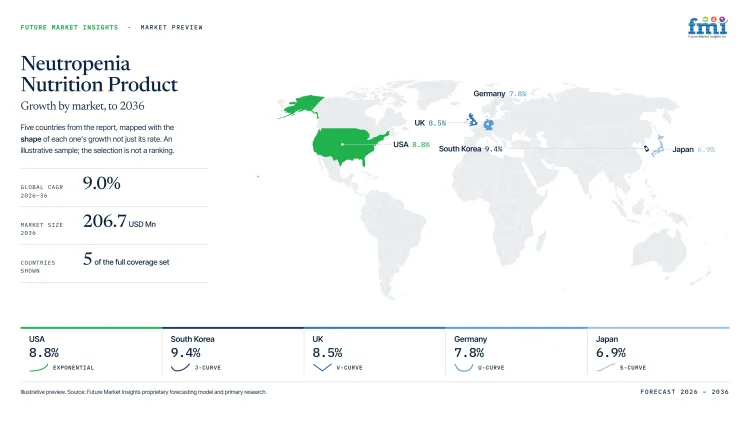
| Country | CAGR |
|---|---|
| South Korea | 9.4% |
| USA | 8.8% |
| UK | 8.5% |
| Germany | 7.8% |
| Japan | 6.9% |
How do country-level CAGRs compare in the Neutropenia Nutrition Product Market?
South Korea, USA and UK form the upper growth group, with Germany and Japan below that band. The five-country spread is 2.5 percentage points from 9.4% to 6.9%, but growth rate alone does not identify the largest revenue pool. Treatment volume, local access and repeat-purchase routes determine how quickly each forecast becomes commercial demand.
- South Korea's favors earlier distributor buildout before broad retail expansion becomes necessary.
- USA puts more weight on account selection and contract economics.
- UK's leaves execution quality more important than the narrow gap with USA.
- Germany requires tighter payback discipline during longer hospital qualification cycles.
- Japan's places more weight on retention than rapid customer acquisition.
These differences change how much execution risk a company can absorb while building distribution. The full report provides country-level CAGR analysis across North America, Latin America, Europe, East Asia, South Asia, Oceania and the Middle East and Africa.
Country-wise Analysis
- In South Korea's tertiary cancer centers, dietitians can introduce oral nutrition during treatment and revisit the same product during discharge planning. South Korea is estimated to post 9.4% CAGR over the forecast period, given its concentrated specialist oncology network and expanding treated population. The National Cancer Center documented 288,613 new cancer cases for 2023 in its January 2026 national statistics release. Concentrated specialist care shortens the route to clinical recommendation, but outpatient replenishment still depends on local coverage and brand availability. Companies entering this market need Korean-language clinical support and a clear route from hospital recommendation to repeat home purchase.
- USA health systems manage large oncology volumes under different formularies and benefit designs, so national distribution does not produce one purchasing route. The American Cancer Society projected 2,114,850 new cancer diagnoses for 2026 in its January 2026 statistics release. Neutropenia nutrition product demand in USA is forecast to rise at 8.8% CAGR over the forecast period, attributable to repeated nutrition screening in a large treatment base. Hospital distribution gives brands immediate institutional reach, but payer variation limits uniform continuation after discharge. National coverage has commercial value only after each health system accepts the product and patients can obtain it outside the hospital. Contract economics therefore vary materially even once a brand secures national distribution.
- In UK, oncology pathways give specialist teams defined diagnosis and treatment milestones that place nutrition screening inside an existing care sequence. In UK, neutropenia nutrition product demand is predicted to advance at 8.5% CAGR through 2036, aided by faster diagnostic throughput and established dietetic services. NHS England documented 236,263 cancer diagnoses or all-clears within 28 days during July 2025. National service standards provide referral opportunities, yet local formularies and prescribing practice still control the chosen nutrition product. Commercial success depends on fitting those local decisions and preserving access after discharge. National availability alone does not secure repeat use once patients return to community care.
- Formal hygiene practice shapes German hospital nutrition purchasing, and packaged nutrition cannot rely on a broad infection-prevention claim. Destatis recorded about 1.45 million patients treated in hospital for cancer during 2024 in its February 2026 release. Germany's neutropenia nutrition product outlook is anticipated to advance at 7.8% CAGR over the assessment period, tied to repeated nutrition decisions in a deep inpatient care base. Hospital dietetics provides a direct clinical route for oral supplements, yet infection-prevention claims face stricter evidence requirements. Institutional clinical nutrition access provides the main commercial enabler for this market. Companies that separate nutrition adequacy from infection claims have a clearer qualification path with German hospitals.
- Compact oral nutrition is familiar in Japan's mature hospital and pharmacy system, yet slower category expansion raises the cost of weak localization. The national registry still points to a large cancer treatment base that can sustain clinical nutrition use. In January 2026, Japan's Ministry of Health, Labour and Welfare stated that 990,930 people were newly diagnosed with cancer in 2022. Adoption of neutropenia nutrition products in Japan is estimated to expand at 6.9% CAGR through 2036, supported by existing medical-nutrition use and an aging oncology population. Established local brands limit easy share gains, so new entrants need differentiated taste or format and a credible clinical channel. New entrants need local taste acceptance and credible clinical access before account expansion.
Who are the notable companies in the neutropenia nutrition product market?
Nestlé Health Science, Abbott, Danone Nutricia, Fresenius Kabi, Medtrition, Mom's Meals (PurFoods), Meiji Co., Ltd., and Kate Farms.
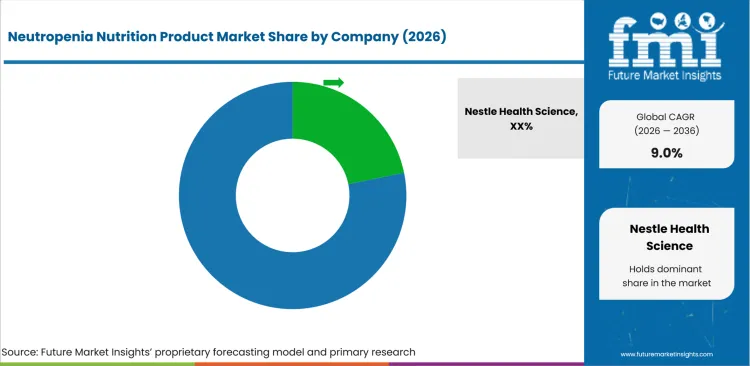
Competition is concentrated among medical-nutrition groups with hospital access, but specialty protein formats and home-delivered meals offer different routes to the same nutrition problem. Nestlé Health Science, Abbott, Danone Nutricia and Fresenius Kabi bring broad clinical nutrition portfolios with international hospital access. Medtrition specializes in compact protein formats for acute and long-term care nutrition programs. Mom's Meals (PurFoods) supplies medically tailored meals through home healthcare products programs and health-plan arrangements. Meiji Co., Ltd. focuses on Japanese high-nutrition foods, whereas Kate Farms operates as a Danone-controlled plant-based clinical nutrition brand with USA hospital and retail reach.
- Global medical nutrition platforms: Nestlé Health Science, Abbott, Danone Nutricia and Fresenius Kabi compete through hospital access, disease-related nutrition portfolios and international distribution.
- Clinical format specialists: Medtrition and Meiji Co., Ltd. focus on compact oral nutrition formats that address intake volume, portioning or concentrated nutrient delivery.
- Home and retail continuation routes: Mom's Meals (PurFoods) and Kate Farms extend nutrition beyond the inpatient setting through delivered meals or broader retail access.
Competitive Benchmarking: Neutropenia Nutrition Product Market
| Company | Ready-to-Use Format Depth | Oncology Nutrition Alignment | Hospital-to-Home Access | Geographic Reach |
|---|---|---|---|---|
| Nestlé Health Science | High | High | High | Global |
| Abbott | High | Medium | High | Global |
| Danone Nutricia | High | High | High | Global |
| Fresenius Kabi | High | High | Medium | Global hospital nutrition markets |
| Medtrition | High | Medium | Medium | United States and over 50 countries |
| Mom's Meals (PurFoods) | Medium | Medium | High | United States |
| Meiji Co., Ltd. | High | Low | Medium | Japan |
| Kate Farms | High | Medium | High | United States |
Scoring basis: Ready-to-use format depth is High for several documented liquid, cup or sealed formats. Medium marks a narrower prepared-food route and Low marks limited ready-to-use depth. Oncology nutrition alignment is High for companies with documented oncology activity inside the nutrition portfolio. Medium covers broader clinical nutrition with cancer relevance and Low indicates general nutrition without oncology-specific positioning. Hospital-to-home access is High for documented institutional plus home or retail routes. Medium marks one strong setting with narrower continuation and Low indicates a constrained route. The Low rating always reflects a documented limitation and never substitutes for missing evidence in any benchmark column. Geographic reach states the current operating scope documented in official company material used for the benchmark.
Key Developments in the Neutropenia Nutrition Product Market
- In October 2025, Nestlé Health Science formed a nutrition and health-science partnership with the University of California, Davis that includes disease-specific work in oncology.
- In July 2025, Fresenius Kabi introduced NutriKabina in Argentina and placed the first two telehealth nutrition-screening units in hospitals in Buenos Aires and Córdoba for oncology patients.
- In July 2025, Danone completed its majority-stake acquisition of Kate Farms, expanding its USA specialized-nutrition business into plant-based medical and everyday nutrition routes.
Key Players in the Neutropenia Nutrition Product Market
Global Medical Nutrition Platforms
- Nestlé Health Science
- Abbott
- Danone Nutricia
- Fresenius Kabi
Specialized Clinical Nutrition Formats
- Medtrition
Home and Regional Nutrition Routes
- Mom's Meals (PurFoods)
- Meiji Co., Ltd.
- Kate Farms
Neutropenia Nutrition Product Market - Report Scope
| Coverage field | Report scope |
|---|---|
| Market breakdown | Product Type; Neutropenia Severity; Product Form; End User; Sales Channel |
| Quantitative Units | USD million |
| Market Definition | Revenue from ready-to-use oral nutrition, sealed snack or portion formats and medically tailored meals used in neutropenia-support settings. Excludes pharmaceutical therapy, stand-alone enteral or parenteral feeding systems, general hospital foodservice and adjacent wellness products. |
| Regions Covered | North America; Latin America; Western Europe; Eastern Europe; East Asia; South Asia & Pacific; Middle East & Africa |
| Countries Covered | USA, UK, Germany, Japan, South Korea; 20+ countries included in the full report. |
| Key Companies Profiled | Nestlé Health Science; Abbott; Danone Nutricia; Fresenius Kabi; Medtrition; Mom's Meals (PurFoods); Meiji Co., Ltd.; Kate Farms |
| Forecast Period | 2026 to 2036 |
| Approach | Primary and secondary research with market triangulation. |
Neutropenia Nutrition Product Market - Research Methodology
| Method | Approach |
|---|---|
| Primary Research | FMI analysts gathered input from manufacturers, service providers, technology developers, distributors, end users, procurement teams, and subject-matter experts. Interviews examined purchasing decisions, product or service evaluation, adoption barriers, approval requirements, pricing considerations, and expectations for technical or commercial support. Respondents were also asked what evidence is required before a trial, pilot, or initial order develops into regular purchasing. |
| Desk Research | Desk research covered government statistics, regulatory publications, trade data, industry associations, technical literature, standards, company filings, product information, and official corporate announcements. Sources were reviewed for relevance, publication date, geographic coverage, and consistency with the defined market scope. Claims relating to performance, applications, approvals, capacity, investment, and commercial activity were retained only when supported by credible public evidence. |
| Market Sizing and Forecasting | The market model combined the baseline value with historical performance, segment structure, pricing and volume indicators, adoption levels, company participation, and country-level demand conditions. Forecast assumptions considered economic activity, investment trends, regulatory developments, technology adoption, purchasing cycles, supply availability, and barriers to wider market use. Segment and regional estimates were reconciled before the final market total was calculated. |
| Data Validation | Estimates were checked against multiple independent indicators, including public data, company activity, trade patterns, industry developments, and findings from primary interviews. Validation also tested whether products, services, applications, and company revenues fell within the defined market boundaries. Adjacent categories, unsupported claims, overlapping revenues, and activities without direct market relevance were excluded to reduce double counting and maintain consistency across segments and countries. |
Neutropenia Nutrition Product Market by Segments
Neutropenia Nutrition Product Market segmented by Product Type:
- Sterile / UHT RTD Nutrition
- Low-Microbial / Hygienic Packaged Snacks
- Fortified Single-Serve Portions
- Others
Neutropenia Nutrition Product Market segmented by Neutropenia Severity:
- Mild-Moderate
- Severe (<500 ANC)
- Prolonged
Neutropenia Nutrition Product Market segmented by Product Form:
- RTD
- Snack Packs
- Sealed Portions
- Others
Neutropenia Nutrition Product Market segmented by End User:
- Hospitals & Transplant Units
- Homecare
- Retail Consumers
- Others
Neutropenia Nutrition Product Market segmented by Sales Channel:
- Hospital Pharmacy
- Institutional Tender
- Retail Pharmacy
- Online
- Others
Neutropenia Nutrition Product Market by Region:
- North America
- USA
- Canada
- Latin America
- Brazil
- Mexico
- Argentina
- Rest of Latin America
- Western Europe
- Germany
- UK
- France
- Italy
- Spain
- Nordics
- Benelux
- Rest of Western Europe
- Eastern Europe
- Russia
- Poland
- Hungary
- Balkan & Baltic Countries
- Rest of Eastern Europe
- East Asia
- China
- Japan
- South Korea
- South Asia & Pacific
- India
- ASEAN
- Australia & New Zealand
- Rest of South Asia & Pacific
- Middle East & Africa
- GCC Countries
- Türkiye
- South Africa
- North Africa
- Rest of Middle East & Africa
Research Sources and Bibliography
- American Cancer Society. (2025, January 16). ACS Annual Report: Cancer Mortality Continues to Drop Despite Rising Incidence in Women; Rates of New Diagnoses Under 65 Higher in Women Than Men.
- Department of Health and Social Care. (2025, April 6). Wait times slashed for 80,000 thanks to boost in cancer detection.
- Danone. (2025, February 25). Nutricia lanza Fortimel Plantbased Protein, un nuevo suplemento nutricional oral hiperproteico completamente vegetal para el manejo de la DRE.
- Jahns, L., Hübner, J., Mensger, C., & Mathies, V. (2025, February 21). A Neutropenic Diet in Haemato-Oncological Patients Receiving High-Dose Therapy and Hematopoietic Stem Cell Transplantation: A Systematic Review.
- Kate Farms. (2025, July 8). Kate Farms unveils new High Protein Nutrition Shake: Protein with purpose, built for real change.
- Health Resources and Services Administration. (2026, July). Donation and Transplantation Statistics.
- American Cancer Society. (2025, May 30). New ACS Study: Number of Cancer Survivors in the USA Reaches 18.6 Million - Projected to Exceed 22 Million by 2035.
- Wingard, J. R., Lee, J.-H., Li, D., Al-Mansour, Z., Farhadfar, N., Hsu, J., Hiemenz, J., Dean, E. A., Brown, R., Trikha, G., Schulz, J. N., Cline, C. L., Leather, H., Sugrue, M. W., Dahl, W. J., McGee, K. H., Leggett, A., & Kelly, D. L. (2025, December 17). Randomized Noninferiority Trial of a Liberalized Diet Versus the Neutropenic Diet in Hematopoietic Stem-Cell Transplant Patients and Patients With Acute Leukemia.
- Centers for Medicare & Medicaid Services. (2025, September 26). Medicare Advantage and Medicare Prescription Drug Programs Expected to Remain Stable in 2026.
- American Cancer Society. (2026, January 13). ACS Annual Statistics Report: Milestone 70 Percent 5-Year Survival Rate for all Cancers Combined; Largest Gains for Advanced and Fatal Cancers.
- NHS England. (2025, September 11). Record number of cancer checks and treatments despite strikes.
- Federal Statistical Office of Germany. (2026, February 2). Sterblichkeit aufgrund von Krebs geht in nahezu allen Altersgruppen zurück.
- Ministry of Health, Labour and Welfare, Japan. (2026, January 14).
- National Cancer Center Korea. (2026, January 28).
- Nestlé Health Science. (2025, October 15). Nestlé Health Science and University of California, Davis Innovation Institute for Food & Health Announce Strategic Partnership to Accelerate Innovation in Nutrition and Health Science.
- Fresenius Kabi. (2025, July 16). NutriKabina: Bringing smart nutrition screening closer to patients.
- Danone. (2025, July 1). Danone completes the acquisition of Kate Farms, enhancing its USA specialized nutrition offerings.
- Nestlé Health Science. (2025, October 17). Nestlé Health Science and the Food & Nutrition Innovation Institute at the Friedman School at Tufts University Expand Opportunities to Advance Nutrition Science and Innovation.
- Danone. (2025, September 29). Danone Inaugurates its OneBiome Laboratory in Paris-Saclay, Strengthening its Investment in Science-Driven Gut Health innovation.
- Nestlé Health Science. (2025, September 26). Nestlé Health Science is now accepting applications for health economics & outcomes research and advocacy grants.
- Abbott. (2026, May 13). Abbott launches Ensure Strength Pro in India to support healthy ageing.
- Danone. (2025, September 22). Fortimel Plantbased Protein: innovación con el primer suplemento oral nutricional vegetal con sabor salado para pacientes con desnutrición que rompe con la monotonía.
- Fresenius Kabi. (2025, June 26). New R&D center in India strengthens Fresenius Kabi’s innovation network.
- Medtrition, Inc. (2025, March 25). Medtrition, Inc. Launches the ProSource Cup Portfolio.
- Mom's Meals. (2026, June 18). Mom's Meals and Agilix Health Collaborate to Advance Food as Medicine.
- Meiji Co., Ltd. (2025, March 11).
- Kate Farms. (2026, July 28). Kate Farms Expands High Protein Nutrition Shake Into Walmart and CVS as Retail Distribution Grows Sevenfold.
- Kate Farms. (2025, November 10). Kate Farms Expands Access with Launch of High Protein Nutrition Shakes at Select Walmart Stores.
- Fresenius Kabi. (2025, February 25). Advancing clinical nutrition research: The JUMPstart program enters its fourth wave.
- Fresenius Kabi. (2025, January 29). Fresenius Kabi and ESICM Renew Joint Collaboration for 2025.
This bibliography is provided for reader reference and is not exhaustive. The full report contains the complete reference list and detailed citations
This Report Answers
- How large is the neutropenia nutrition product market in 2026 and 2036?
- Which treatment-related intake problems support demand for ready-to-use oral nutrition?
- Why does sterile / UHT RTD nutrition lead the product type category in 2026?
- How does mild-moderate neutropenia shape routine oral nutrition use?
- Why does RTD hold the leading share within product form?
- How do country growth rates differ among South Korea, USA, UK, Germany and Japan?
- Which business models do the eight profiled companies use to reach hospitals and home settings?
- How does conflicting evidence on strict neutropenic diets affect infection-prevention positioning?
Frequently Asked Questions
How big is the neutropenia nutrition product market in 2026?
The neutropenia nutrition product market is valued at USD 87.3 million in 2026 and is projected to reach USD 206.7 million by 2036. Repeated oral nutrition needs during cancer treatment and transplantation underpin the forecast.
What is the CAGR of the neutropenia nutrition product market from 2026 to 2036?
The neutropenia nutrition product market is projected to grow at a CAGR of 9.0% between 2026 and 2036. Expansion is tied to oral nutrition use during treatment and continued access to tolerated products after discharge.
Which product type leads the neutropenia nutrition product market?
The sterile / UHT RTD nutrition segment is expected to hold 47.0% of the neutropenia nutrition product market in 2026, driven by sealed single servings that reduce preparation steps. Fixed portions also simplify intake tracking for patients in hospital and home settings.
Which product form leads the neutropenia nutrition product market?
The RTD segment is expected to hold 56.2% of product form in the neutropenia nutrition product market in 2026, supported by a fixed serving that removes mixing and portioning. Hospitals and caregivers can track offered and consumed volume with less preparation.
Which companies are active in the neutropenia nutrition product market?
Key companies operating in the neutropenia nutrition product market include Nestlé Health Science, Abbott, Danone Nutricia, Fresenius Kabi, Medtrition, Mom's Meals (PurFoods), Meiji Co., Ltd., and Kate Farms. They differ in clinical focus, ready-to-use formats, hospital access and home-continuation routes.
Preview the report firsthand - request a free sample
Get SampleGet the brochure for pricing and purchase details.
Get PDFTable of Content
- Key Takeaways
- Market Size and CAGR
- Top Growth Driver
- Fastest Growing Segment
- Leading Region
- Key Companies
- Emerging Opportunities
- Executive Summary
- Global Market Outlook
- Demand-side Trends
- Supply-side Trends
- Technology Roadmap Analysis
- Analysis and Recommendations
- Analyst Perspective (What is happening? Why now? What should investors know?)
- Key Questions Answered
- How large is the market?
- What is the CAGR?
- What are key trends?
- Which region dominates?
- Who are the leaders?
- Market Overview
- Market Coverage / Taxonomy
- Market Definition / Scope / Limitations
- Research Methodology
- Chapter Orientation
- Analytical Lens and Working Hypotheses
- Market Structure, Signals, and Trend Drivers
- Benchmarking and Cross-market Comparability
- Market Sizing, Forecasting, and Opportunity Mapping
- Research Design and Evidence Framework
- Desk Research Programme (Secondary Evidence)
- Expert Input and Fieldwork (Primary Evidence)
- Tooling, Models, and Reference Databases
- Data Engineering and Model Build
- Quality Assurance and Audit Trail
- Market Background
- Market Dynamics (Drivers, Restraints, Opportunity, Trends)
- Scenario Forecast (Optimistic, Likely, Conservative)
- Impact Analysis
- AI Impact
- Sustainability Impact
- Regulatory Impact
- Technology Impact
- Consumer / Buyer Analysis
- Purchase Drivers
- Adoption Barriers
- Buyer Journey
- Opportunity Map Analysis
- Product Life Cycle Analysis
- Supply Chain Analysis
- Investment Feasibility Matrix
- Value Chain Analysis
- PESTLE and Porter's Analysis
- Regulatory Landscape
- Regional Parent Market Outlook
- Production and Consumption Statistics
- Import and Export Statistics
- Global Market Analysis and Forecast, 2021 to 2036
- Historical Market Size Value (USD Million) Analysis, 2021 to 2025
- Current and Future Market Size Value (USD Million) Projections, 2026 to 2036
- Y-o-Y Growth Trend Analysis
- Absolute $ Opportunity Analysis
- Global Market Pricing Analysis, 2021 to 2036
- Global Market Analysis and Forecast, By Product Type, 2021 to 2036
- Introduction / Key Findings
- Historical Market Size Value (USD Million) Analysis By Product Type, 2021 to 2025
- Current and Future Market Size Value (USD Million) Analysis and Forecast By Product Type, 2026 to 2036
- Sterile / UHT RTD Nutrition
- Low-Microbial Snack Products
- Single-Serve Sealed Portions
- Others
- Sterile / UHT RTD Nutrition
- Y-o-Y Growth Trend Analysis By Product Type, 2021 to 2025
- Absolute $ Opportunity Analysis By Product Type, 2026 to 2036
- Global Market Analysis and Forecast, By Neutropenia Severity, 2021 to 2036
- Introduction / Key Findings
- Historical Market Size Value (USD Million) Analysis By Neutropenia Severity, 2021 to 2025
- Current and Future Market Size Value (USD Million) Analysis and Forecast By Neutropenia Severity, 2026 to 2036
- Mild-Moderate
- Severe (<500 ANC)
- Prolonged
- Mild-Moderate
- Y-o-Y Growth Trend Analysis By Neutropenia Severity, 2021 to 2025
- Absolute $ Opportunity Analysis By Neutropenia Severity, 2026 to 2036
- Global Market Analysis and Forecast, By Product Form, 2021 to 2036
- Introduction / Key Findings
- Historical Market Size Value (USD Million) Analysis By Product Form, 2021 to 2025
- Current and Future Market Size Value (USD Million) Analysis and Forecast By Product Form, 2026 to 2036
- RTD
- Sealed Snacks
- Others
- RTD
- Y-o-Y Growth Trend Analysis By Product Form, 2021 to 2025
- Absolute $ Opportunity Analysis By Product Form, 2026 to 2036
- Global Market Analysis and Forecast, By End User, 2021 to 2036
- Introduction / Key Findings
- Historical Market Size Value (USD Million) Analysis By End User, 2021 to 2025
- Current and Future Market Size Value (USD Million) Analysis and Forecast By End User, 2026 to 2036
- Hospitals & Transplant Units
- Homecare
- Others
- Hospitals & Transplant Units
- Y-o-Y Growth Trend Analysis By End User, 2021 to 2025
- Absolute $ Opportunity Analysis By End User, 2026 to 2036
- Global Market Analysis and Forecast, By Sales Channel, 2021 to 2036
- Introduction / Key Findings
- Historical Market Size Value (USD Million) Analysis By Sales Channel, 2021 to 2025
- Current and Future Market Size Value (USD Million) Analysis and Forecast By Sales Channel, 2026 to 2036
- Hospital Pharmacy
- Retail Pharmacy
- Online
- Institutional Tender
- Others
- Hospital Pharmacy
- Y-o-Y Growth Trend Analysis By Sales Channel, 2021 to 2025
- Absolute $ Opportunity Analysis By Sales Channel, 2026 to 2036
- Global Market Analysis and Forecast, By Region, 2021 to 2036
- Introduction
- Historical Market Size Value (USD Million) Analysis By Region, 2021 to 2025
- Current Market Size Value (USD Million) Analysis and Forecast By Region, 2026 to 2036
- North America
- Latin America
- Western Europe
- Eastern Europe
- East Asia
- South Asia and Pacific
- Middle East & Africa
- Market Attractiveness Analysis By Region
- North America Market Analysis and Forecast, By Country, 2021 to 2036
- Historical Market Size Value (USD Million) Trend Analysis By Market Taxonomy, 2021 to 2025
- Market Size Value (USD Million) Forecast By Market Taxonomy, 2026 to 2036
- By Country
- USA
- Canada
- By Product Type
- By Neutropenia Severity
- By Product Form
- By End User
- By Sales Channel
- By Country
- Market Attractiveness Analysis
- By Country
- By Product Type
- By Neutropenia Severity
- By Product Form
- By End User
- By Sales Channel
- Key Takeaways
- Latin America Market Analysis and Forecast, By Country
- Historical Market Size Value (USD Million) Trend Analysis By Market Taxonomy, 2021 to 2025
- Market Size Value (USD Million) Forecast By Market Taxonomy, 2026 to 2036
- By Country
- Brazil
- Mexico
- Chile
- Rest of Latin America
- By Product Type
- By Neutropenia Severity
- By Product Form
- By End User
- By Sales Channel
- By Country
- Market Attractiveness Analysis
- By Country
- By Product Type
- By Neutropenia Severity
- By Product Form
- By End User
- By Sales Channel
- Key Takeaways
- Western Europe Market Analysis and Forecast, By Country
- Historical Market Size Value (USD Million) Trend Analysis By Market Taxonomy, 2021 to 2025
- Market Size Value (USD Million) Forecast By Market Taxonomy, 2026 to 2036
- By Country
- Germany
- UK
- Italy
- Spain
- France
- Nordic
- BENELUX
- Rest of Western Europe
- By Product Type
- By Neutropenia Severity
- By Product Form
- By End User
- By Sales Channel
- By Country
- Market Attractiveness Analysis
- By Country
- By Product Type
- By Neutropenia Severity
- By Product Form
- By End User
- By Sales Channel
- Key Takeaways
- Eastern Europe Market Analysis and Forecast, By Country
- Historical Market Size Value (USD Million) Trend Analysis By Market Taxonomy, 2021 to 2025
- Market Size Value (USD Million) Forecast By Market Taxonomy, 2026 to 2036
- By Country
- Russia
- Poland
- Hungary
- Balkan & Baltic
- Rest of Eastern Europe
- By Product Type
- By Neutropenia Severity
- By Product Form
- By End User
- By Sales Channel
- By Country
- Market Attractiveness Analysis
- By Country
- By Product Type
- By Neutropenia Severity
- By Product Form
- By End User
- By Sales Channel
- Key Takeaways
- East Asia Market Analysis and Forecast, By Country
- Historical Market Size Value (USD Million) Trend Analysis By Market Taxonomy, 2021 to 2025
- Market Size Value (USD Million) Forecast By Market Taxonomy, 2026 to 2036
- By Country
- China
- Japan
- South Korea
- By Product Type
- By Neutropenia Severity
- By Product Form
- By End User
- By Sales Channel
- By Country
- Market Attractiveness Analysis
- By Country
- By Product Type
- By Neutropenia Severity
- By Product Form
- By End User
- By Sales Channel
- Key Takeaways
- South Asia and Pacific Market Analysis and Forecast, By Country
- Historical Market Size Value (USD Million) Trend Analysis By Market Taxonomy, 2021 to 2025
- Market Size Value (USD Million) Forecast By Market Taxonomy, 2026 to 2036
- By Country
- India
- ASEAN
- Australia & New Zealand
- Rest of South Asia and Pacific
- By Product Type
- By Neutropenia Severity
- By Product Form
- By End User
- By Sales Channel
- By Country
- Market Attractiveness Analysis
- By Country
- By Product Type
- By Neutropenia Severity
- By Product Form
- By End User
- By Sales Channel
- Key Takeaways
- Middle East & Africa Market Analysis and Forecast, By Country
- Historical Market Size Value (USD Million) Trend Analysis By Market Taxonomy, 2021 to 2025
- Market Size Value (USD Million) Forecast By Market Taxonomy, 2026 to 2036
- By Country
- Kingdom of Saudi Arabia
- Other GCC Countries
- Türkiye
- South Africa
- Other African Union
- Rest of Middle East & Africa
- By Product Type
- By Neutropenia Severity
- By Product Form
- By End User
- By Sales Channel
- By Country
- Market Attractiveness Analysis
- By Country
- By Product Type
- By Neutropenia Severity
- By Product Form
- By End User
- By Sales Channel
- Key Takeaways
- Key Countries Market Analysis
- USA
- Pricing Analysis
- Market Share Analysis, 2025
- By Product Type
- By Neutropenia Severity
- By Product Form
- By End User
- By Sales Channel
- Canada
- Pricing Analysis
- Market Share Analysis, 2025
- By Product Type
- By Neutropenia Severity
- By Product Form
- By End User
- By Sales Channel
- Mexico
- Pricing Analysis
- Market Share Analysis, 2025
- By Product Type
- By Neutropenia Severity
- By Product Form
- By End User
- By Sales Channel
- Brazil
- Pricing Analysis
- Market Share Analysis, 2025
- By Product Type
- By Neutropenia Severity
- By Product Form
- By End User
- By Sales Channel
- Chile
- Pricing Analysis
- Market Share Analysis, 2025
- By Product Type
- By Neutropenia Severity
- By Product Form
- By End User
- By Sales Channel
- Germany
- Pricing Analysis
- Market Share Analysis, 2025
- By Product Type
- By Neutropenia Severity
- By Product Form
- By End User
- By Sales Channel
- UK
- Pricing Analysis
- Market Share Analysis, 2025
- By Product Type
- By Neutropenia Severity
- By Product Form
- By End User
- By Sales Channel
- Italy
- Pricing Analysis
- Market Share Analysis, 2025
- By Product Type
- By Neutropenia Severity
- By Product Form
- By End User
- By Sales Channel
- Spain
- Pricing Analysis
- Market Share Analysis, 2025
- By Product Type
- By Neutropenia Severity
- By Product Form
- By End User
- By Sales Channel
- France
- Pricing Analysis
- Market Share Analysis, 2025
- By Product Type
- By Neutropenia Severity
- By Product Form
- By End User
- By Sales Channel
- India
- Pricing Analysis
- Market Share Analysis, 2025
- By Product Type
- By Neutropenia Severity
- By Product Form
- By End User
- By Sales Channel
- ASEAN
- Pricing Analysis
- Market Share Analysis, 2025
- By Product Type
- By Neutropenia Severity
- By Product Form
- By End User
- By Sales Channel
- Australia & New Zealand
- Pricing Analysis
- Market Share Analysis, 2025
- By Product Type
- By Neutropenia Severity
- By Product Form
- By End User
- By Sales Channel
- China
- Pricing Analysis
- Market Share Analysis, 2025
- By Product Type
- By Neutropenia Severity
- By Product Form
- By End User
- By Sales Channel
- Japan
- Pricing Analysis
- Market Share Analysis, 2025
- By Product Type
- By Neutropenia Severity
- By Product Form
- By End User
- By Sales Channel
- South Korea
- Pricing Analysis
- Market Share Analysis, 2025
- By Product Type
- By Neutropenia Severity
- By Product Form
- By End User
- By Sales Channel
- Russia
- Pricing Analysis
- Market Share Analysis, 2025
- By Product Type
- By Neutropenia Severity
- By Product Form
- By End User
- By Sales Channel
- Poland
- Pricing Analysis
- Market Share Analysis, 2025
- By Product Type
- By Neutropenia Severity
- By Product Form
- By End User
- By Sales Channel
- Hungary
- Pricing Analysis
- Market Share Analysis, 2025
- By Product Type
- By Neutropenia Severity
- By Product Form
- By End User
- By Sales Channel
- Kingdom of Saudi Arabia
- Pricing Analysis
- Market Share Analysis, 2025
- By Product Type
- By Neutropenia Severity
- By Product Form
- By End User
- By Sales Channel
- Türkiye
- Pricing Analysis
- Market Share Analysis, 2025
- By Product Type
- By Neutropenia Severity
- By Product Form
- By End User
- By Sales Channel
- South Africa
- Pricing Analysis
- Market Share Analysis, 2025
- By Product Type
- By Neutropenia Severity
- By Product Form
- By End User
- By Sales Channel
- USA
- Market Structure Analysis
- Competition Dashboard
- Competition Benchmarking
- Market Share Analysis of Top Players
- By Regional
- By Product Type
- By Neutropenia Severity
- By Product Form
- By End User
- By Sales Channel
- Emerging Startups
- Innovation Benchmarking
- Competition Analysis
- Competition Deep Dive
- Nestle Health Science
- Overview
- Product Portfolio
- Profitability by Market Segments
- Sales Footprint
- Strategy Overview
- Marketing Strategy
- Product Strategy
- Channel Strategy
- Abbott
- Danone Nutricia
- Mom's Meals (PurFoods)
- Hormel Health Labs
- Fresenius Kabi
- Medtrition
- Victus
- Nestle Health Science
- Case Studies
- Success Stories
- Recent Developments
- Competition Deep Dive
- Assumptions & Acronyms Used


