

- Market Size (2026)
- USD 163.6 Mn
- Forecast (2036)
- USD 398.1 Mn
- CAGR (2026 to 2036)
- 9.3%
How big is Fall-Prevention Nutrition Product Market in 2026?
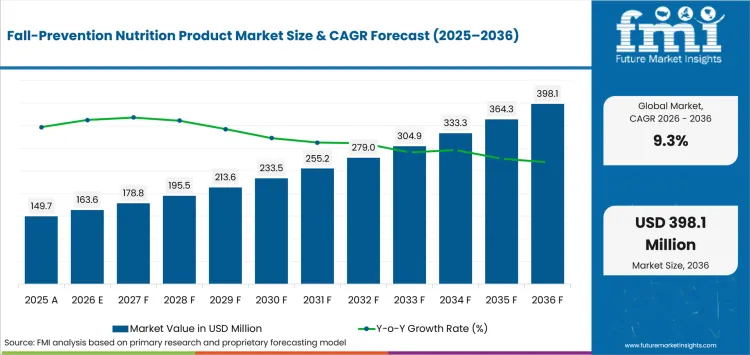
USD 163.6 million in 2026 and USD 398.1 million by 2036 at a 9.3% CAGR.
Demand for fall-prevention nutrition products is projected to expand at a 9.3% CAGR between 2026 and 2036, increasing market valuation from USD 163.6 million in 2026 to USD 398.1 million by 2036. Falls remain a major contributor to injury risk among older adults and often trigger broader assessments of mobility, nutritional status, and functional health. CDC data published in February 2026 show that more than 14 million USA adults aged 65 years and older experience a fall each year. The scale of fall-related encounters creates opportunities for clinicians to identify deficiencies in protein, vitamin, mineral and muscle-support nutrition as part of prevention and recovery programs.
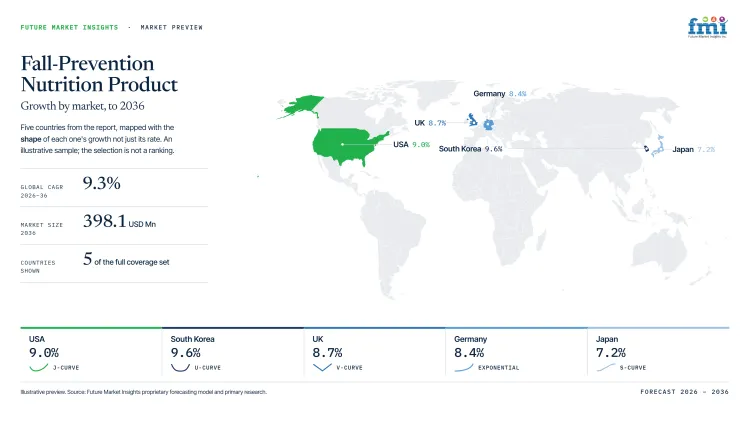
The structure of elder-care systems influences how frequently nutrition interventions are introduced into routine care. South Korea is forecast to expand at a 9.6% CAGR compared with 7.2% for Japan. South Korea's community-integrated care model creates additional points of contact where frailty, mobility decline, and nutrition risk can be identified before more intensive interventions become necessary. The Ministry of Health and Welfare outlined 30 linked community-care services in March 2026 and set an expansion target of 60 services by 2030. A broader referral network can increase exposure to preventive nutrition programs and related products. Japan's more mature senior-nutrition market supports steady demand, but widespread familiarity with preventive nutrition leaves comparatively less room for category expansion.
Key Takeaways
- Falls and frailty assessments are increasing demand for nutrition products that address identified bone, muscle or intake needs during recovery.
- By product type, vitamin D + calcium products are estimated to hold 41.7% in 2026 owing to familiar nutrient-support use and pharmacy access.
- In 2026, post-fall rehabilitation is expected to lead program context with 48.5% share due to the defined reassessment period after injury.
- Tablets - capsules are projected to hold 40.9% share in 2026 owing to dose control and straightforward repeat purchasing.
- Evidence limits direct fall-prevention claims, which shifts commercial positioning toward deficiency, bone health, frailty and recovery needs.
- Some of the key players in this market include Abbott, Pharmavite (Nature Made), Nestle Health Science, Danone Nutricia, Haleon (Caltrate), Thorne, Meiji Holdings, and Medtrition.
Analyst Perspective
"Commercial value rises when a fall or frailty assessment identifies a specific nutrition gap and the product addresses that need without overstating prevention. Strong portfolios separate bone-health supplementation from protein-led recovery nutrition and choose formats that patients can keep using after discharge."
- Nandini Roy Choudhury, Principal Consultant, Future Market Insights
How is the Fall-Prevention Nutrition Product Market segmented?
The fall-prevention nutrition product market is segmented by product type, program context, product form, end user and sales channel.
The fall-prevention nutrition product market is segmented by product type, program context, product form, end user and sales channel. Product type covers vitamin D + calcium products, protein-vitamin D combo ONS, balance & neuro-muscular blends and others. Program context covers post-fall rehabilitation, high-risk prevention programs and general 70+ prevention. Product form includes Tablets - capsules, RTD ONS, powders and others. End users include long-term care, home / self-care, community fall programs and others. Sales channels include online / DTC, retail pharmacy, supermarkets & hypermarkets, specialty & health stores and others.
What makes vitamin D + calcium products central to the Product type category?
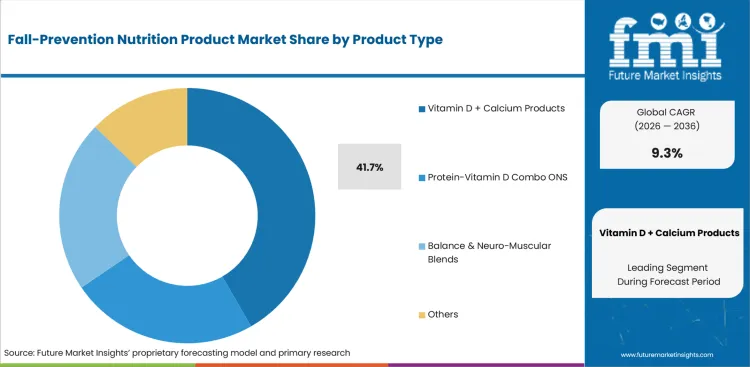
Clinicians use vitamin D + calcium products for assessed low intake or deficiency risk. The format fits calcium supplements and vitamin and mineral supplements routines without the calorie load of complete oral nutrition.
- Vitamin D + calcium products are set to lead the product type category with 41.7% share in 2026 due to familiar daily dosing and pharmacy access.
- Bone-health guidance gives the category a defined nutrient role before any prevention claim. NIH's June 2025 fact sheet states that vitamin D promotes calcium absorption and supports bone mineralization. That evidence keeps positioning focused on nutrient adequacy instead of promising fall prevention from supplementation alone.
Why does Post-fall rehabilitation lead the Program context category?
Post-fall rehabilitation provides a defined reassessment point for diet and muscle function. Care teams can fit oral clinical nutrition into therapy plans once poor intake or frailty is documented. Clinical nutrition can then continue after discharge during structured home recovery.
- The post-fall rehabilitation segment is likely to capture 48.5% share in 2026 attributable to immediate nutrition review after an injury event.
- Falls rehabilitation treats each event as a multifactorial problem with several modifiable risks. CDC's July 2025 Falls Compendium catalogs 34 single interventions and 16 multifaceted interventions. Nutrition products therefore compete for a defined place beside exercise and other measures used during structured recovery.
How do Tablets - capsules shape the product Form category?
Tablets and capsules suit concentrated daily dosing for narrow and stable nutritional needs. They reduce storage volume and fit specialized nutrition routines that target bone support without a complete oral nutrition serving.
- By product form, Tablets - capsules are forecast to represent 40.9% in 2026 driven by dose consistency and low storage burden.
- Pill burden and swallowing difficulty make alternative formats more important for older adults with poor adherence. Haleon's November 2025 healthy-ageing update described a liquid Caltrate format in China alongside newer bone-health formulations in Asia. Format breadth matters even with tablets and capsules holding the largest modeled share.
What supports Long-term care as the leading End user?
Long-term care concentrates residents with frailty, limited mobility and poor intake inside supervised nutrition routines. Staff can observe intake changes and direct enteral nutrition or supplements toward residents with a documented need.
- By end user, long-term care is estimated to hold 41.6% in 2026 owing to concentrated nutrition risk and staff-led observation.
- Institutional oversight makes product fit more visible than in unsupervised self-care. CMS announced a risk-based nursing-home survey approach in July 2026 with a 22-state pilot while retaining periodic surveys for every facility. Nutrition products that fit medication passes and scheduled nutrition rounds have a clearer route to repeat orders.
What are the drivers, restraints and opportunities in the Fall-Prevention Nutrition Product Market?
Older-adult falls increase nutrition assessment demand, evidence limits supplement-only prevention claims and adherence-focused medical nutrition offers the clearest commercial opening.
- Driver: Fall-related treatment puts more older adults into settings where clinicians can identify poor intake, frailty and bone-health needs.
- Restraint: Current guidance does not support routine vitamin D supplementation as a stand-alone intervention for preventing falls.
- Opportunity: Medical nutrition brands can improve repeat use by matching protein delivery and product form to recovery-related adherence barriers.
Fall-Related Treatment Expands Nutrition Assessment
Fall-related injury brings older adults into clinical review and makes poor intake or weakness easier to identify. CDC's STEADI page updated in August 2025 states that more than 3 million older adults receive emergency-department treatment for fall injuries each year. Those encounters give clinicians a practical point for nutrition screening and selection of bone or muscle support.
Evidence Limits Stand-Alone Prevention Claims
Broad preventive purchasing is constrained by evidence limits on vitamin D as a stand-alone falls intervention. NICE guidance issued in April 2025 states that evidence is insufficient to support vitamin D supplements specifically for reducing fall risk. Brands therefore need to anchor use in deficiency, bone-health products or malnutrition instead of making a stand-alone prevention claim.
Adherence-Focused Medical Nutrition Offers Expansion
Formulation choices that address adherence problems give medical foods a clearer recovery role during rehabilitation. Danone Nutricia launched Fortimel PlantBased Protein in October 2025 for disease-related malnutrition including frailty and stroke, with savory options intended to reduce flavor fatigue. Similar format work can extend repeat use among patients who struggle with standard sweet oral nutrition during longer rehabilitation.
Which country CAGRs are profiled in the Fall-Prevention Nutrition Product Market?
| Country | CAGR |
|---|---|
| South Korea | 9.6% |
| USA | 9.0% |
| UK | 8.7% |
| Germany | 8.4% |
| Japan | 7.2% |
How do country-level CAGRs compare in the Fall-Prevention Nutrition Product Market?
The five forecasts span 2.4 percentage points from South Korea at 9.6% to Japan at 7.2%. Earlier access to recovery care places South Korea and USA in the upper-growth pair. UK and Germany occupy a narrow middle band. Mature senior-nutrition routines leave Japan less room for category creation despite demographic demand.
- South Korea gains from integrated-care expansion that brings frailty screening into community settings.
- USA pairs high fall volumes with rehabilitation access and mature retail supplement channels.
- UK providers work inside multidisciplinary falls assessment and conservative nutrition-claim rules today.
- Germany balances demographic need against closer scrutiny of vitamin D dosing and safety.
- Mature senior-nutrition purchasing makes adherence and format refinement Japan's main growth levers.
Care pathways determine order conversion even where country CAGRs look broadly comparable. The full report provides country-level CAGR analysis across North America, Latin America, Europe, East Asia, South Asia, Oceania and the Middle East and Africa.
Country-wise Analysis
- South Korean community care brings frailty screening closer to older adults and shifts more follow-up into local programs in aging districts outside major hospitals, but providers still vary in how consistently a positive screen becomes a specific nutrition referral. Statistics Korea reported in September 2025 that adults aged 65 and older represented 20.3% of the population and are projected near 30% by 2036. Fall-prevention nutrition product demand is forecast to rise at 9.6% CAGR through 2036, reflecting integrated-care expansion that gives simple home-use formats more referral points while leaving repeat orders dependent on a specific nutrition recommendation during follow-up care.
- US purchasing moves between self-directed supplementation and nutrition recommended during rehabilitation, giving national brands wide retail access while making clinical relevance depend on the reason for use. The USA Census Bureau reported in June 2025 that the population aged 65 and older rose 3.1% to 61.2 million from 2023 to 2024 and represented 18.0% of the population, reinforcing the scale of older-adult supplement channels. Fall-prevention nutrition product demand is projected to expand at 9.0% CAGR through 2036 because mature pharmacy access and frequent recovery encounters support repeat use, although rehabilitation-focused brands still need discharge relationships and conservative claims to convert assessment into orders.
- UK falls services use multidisciplinary assessment that includes diet and recent weight loss, which gives nutrition a defined clinical entry point instead of a broad wellness message. The UK outlook is anticipated to advance at 8.7% CAGR through 2036, tied to an expanding older population and established care-home and pharmacy channels that keep nutrition visible during recovery. In April 2026, the Office for National Statistics projected the population aged 85 and older to rise from 1.75 million in 2024 to 3.6 million by 2049, but strict evidence language gives bone and joint health or malnutrition positioning more credibility than direct fall-prevention claims.
- German pharmacy and clinical channels scrutinize vitamin D dosing closely, making transparent daily regimens easier to defend while raising the commercial cost of high-dose positioning. The German Federal Institute for Risk Assessment warned in September 2025 that high intermittent vitamin D doses can carry health risks and recommended lower-dose daily preparations when supplementation is needed. Germany is estimated to post 8.4% CAGR through 2036 given substantial demographic need and pharmacy access, yet companies must keep dosing claims conservative and place products beside rehabilitation or broader nutrition advice while local safety scrutiny limits promotional flexibility more than underlying demand in practice.
- Japan already has mature senior-nutrition purchasing in hospitals and home care, so growth depends more on adherence and product fit than on basic category education. Fall-prevention nutrition product sales in Japan are forecast to expand at 7.2% CAGR by 2036, helped by established clinical channels but constrained by limited room for awareness-led category creation. The Statistics Bureau counted 36.19 million people aged 65 or older in September 2025 and placed their share at 29.4%, which gives easy-to-swallow and small-volume nutrition formats a large addressable base while forcing new entrants to improve use experience or clinical relevance instead of relying on demographic scale alone.
Who are the notable companies in the Fall-Prevention Nutrition Product Market?
Abbott, Pharmavite (Nature Made), Nestle Health Science, Danone Nutricia, Haleon (Caltrate), Thorne, Meiji Holdings, and Medtrition are the notable companies serving this market.
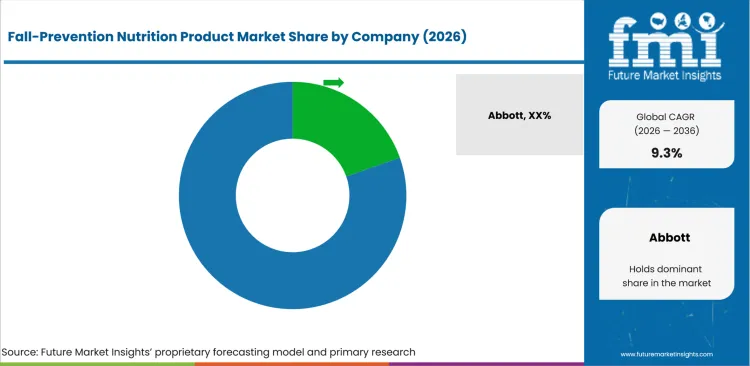
Competition divides between clinical oral nutrition, consumer bone-health supplements and senior-focused nutrition. Evidence quality and dosing credibility raise entry barriers because products must fit care settings and remain usable for older adults with poor appetite or swallowing difficulty.
- Abbott, Nestle Health Science, Danone Nutricia and Medtrition concentrate on clinical nutrition and recovery-oriented oral formats.
- Pharmavite (Nature Made), Haleon (Caltrate) and Thorne emphasize bone-health and micronutrient routes with strong consumer access.
- Meiji Holdings brings senior-focused balanced nutrition and institutional familiarity from Japan into selected Asian markets.
Competitive Benchmarking: Fall-Prevention Nutrition Product Market
| Company | Nutrition Route Breadth | Protein / Recovery Depth | Channel & Care Access | Geographic Reach |
|---|---|---|---|---|
| Abbott | High | High | High | North America and broad international markets |
| Pharmavite (Nature Made) | High | Low | High | United States consumer channels |
| Nestle Health Science | High | High | High | North America, Europe, Asia-Pacific and other international markets |
| Danone Nutricia | Medium | High | High | Europe and broad international medical-nutrition markets |
| Haleon (Caltrate) | Medium | Low | High | North America, Europe and Asia |
| Thorne | Medium | Medium | High | United States and selected international channels |
| Meiji Holdings | Medium | High | Medium | Japan and selected Asian markets |
| Medtrition | Low | High | Medium | United States healthcare and long-term care channels |
Scoring basis: For each rated criterion, High requires at least three documented routes or settings while Medium requires two and Low identifies one verified route. Nutrition-route breadth counts distinct product groups and protein / recovery depth counts relevant formats or care uses. Channel & care access counts distinct purchasing routes, while Geographic Reach records active regions descriptively and is not scored.
Key Developments in the Fall-Prevention Nutrition Product Market
- In October 2025, Medtrition launched NutriConnect as a portfolio brand for personalized modular nutrition used in healthcare settings.
- In May 2025, Pharmavite opened a 225,000-square-foot New Albany production and research facility following a USD 250 million investment.
- In March 2025, Meiji Holdings launched a new Meiji MeiBalance Mini Cup savory flavor nationally in Japan for compact balanced nutrition.
Key Players in the Fall-Prevention Nutrition Product Market
Clinical ONS and Recovery Nutrition
- Abbott
- Nestle Health Science
- Danone Nutricia
- Medtrition
Consumer Bone-Health Supplementation
- Pharmavite (Nature Made)
- Haleon (Caltrate)
- Thorne
Senior-Focused Regional Nutrition
- Meiji Holdings
Fall-Prevention Nutrition Product Market - Report Scope
| Coverage field | Report scope |
|---|---|
| Market breakdown | By product type, program context, product form, end user, sales channel and region. |
| Quantitative Units | USD Million. |
| Market Definition | Commercial nutrition products used for older-adult bone or muscle support, post-fall rehabilitation, frailty-related nutrition management and high-risk prevention programs. Prescription therapeutics, exercise services, mobility aids and fall-detection devices are excluded. |
| Regions Covered | North America, Latin America, Western Europe, Eastern Europe, East Asia, South Asia and Pacific, and Middle East and Africa. |
| Countries Covered | USA, UK, Germany, Japan, South Korea, and more than twenty-five additional countries in the full report. |
| Key Companies Profiled | Abbott, Pharmavite (Nature Made), Nestle Health Science, Danone Nutricia, Haleon (Caltrate), Thorne, Meiji Holdings, and Medtrition. |
| Forecast Period | 2026 to 2036. |
| Approach | Primary and secondary research with market triangulation. |
Fall-Prevention Nutrition Product Market - Research Methodology
| Method | Approach |
|---|---|
| Primary Research | FMI analysts gathered input from manufacturers, service providers, technology developers, distributors, end users, procurement teams, and subject-matter experts. Interviews examined purchasing decisions, product or service evaluation, adoption barriers, approval requirements, pricing considerations, and expectations for technical or commercial support. Respondents were also asked what evidence is required before a trial, pilot, or initial order develops into regular purchasing. |
| Desk Research | Desk research covered government statistics, regulatory publications, trade data, industry associations, technical literature, standards, company filings, product information, and official corporate announcements. Sources were reviewed for relevance, publication date, geographic coverage, and consistency with the defined market scope. Claims relating to performance, applications, approvals, capacity, investment, and commercial activity were retained only when supported by credible public evidence. |
| Market Sizing and Forecasting | The market model combined the baseline value with historical performance, segment structure, pricing and volume indicators, adoption levels, company participation, and country-level demand conditions. Forecast assumptions considered economic activity, investment trends, regulatory developments, technology adoption, purchasing cycles, supply availability, and barriers to wider market use. Segment and regional estimates were reconciled before the final market total was calculated. |
| Data Validation | Estimates were checked against multiple independent indicators, including public data, company activity, trade patterns, industry developments, and findings from primary interviews. Validation also tested whether products, services, applications, and company revenues fell within the defined market boundaries. Adjacent categories, unsupported claims, overlapping revenues, and activities without direct market relevance were excluded to reduce double counting and maintain consistency across segments and countries. |
Fall-Prevention Nutrition Product Market by Segments
Fall-Prevention Nutrition Product Market segmented by Product Type:
- Vitamin D + Calcium Products
- Protein-Vitamin D Combo ONS
- Balance & Neuro-Muscular Blends
- Others
Fall-Prevention Nutrition Product Market segmented by Program Context:
- Post-Fall Rehabilitation
- High-Risk Prevention Programs
- General 70+ Prevention
Fall-Prevention Nutrition Product Market segmented by Product Form:
- Tablets - capsules
- RTD ONS
- Powders
- Others
Fall-Prevention Nutrition Product Market segmented by End User:
- Long-Term Care
- Home / Self-Care
- Community Fall Programs
- Others
Fall-Prevention Nutrition Product Market segmented by Sales Channel:
- Online / DTC
- Retail Pharmacy
- Supermarkets & Hypermarkets
- Specialty & Health Stores
- Others
Fall-Prevention Nutrition Product Market by Region:
- North America
- United States
- Canada
- Latin America
- Brazil
- Mexico
- Argentina
- Chile
- Western Europe
- Germany
- France
- United Kingdom
- Italy
- Spain
- Benelux
- Nordics
- Eastern Europe
- Poland
- Czech Republic
- Romania
- Hungary
- East Asia
- China
- Japan
- South Korea
- South Asia and Pacific
- India
- ASEAN
- Australia and New Zealand
- Middle East and Africa
- GCC Countries
- South Africa
- Türkiye
- Israel
Research Sources and Bibliography
- Centers for Disease Control and Prevention. (2026, February 26). Older Adult Falls Data
- Ministry of Health and Welfare, Republic of Korea. (2026, March 13). MOHW to Link 30 Community Integrated Care Services, Expanding to 60 by 2030
- National Institutes of Health, Office of Dietary Supplements. (2025, June 27). Vitamin D - Health Professional Fact Sheet
- Centers for Disease Control and Prevention. (2025, July 28). Falls Compendium
- Haleon. (2025, November 27). Healthy Ageing in Asia: From Lifespan to Healthspan
- Centers for Medicare & Medicaid Services. (2026, July 16). CMS Modernizes Nursing Home Oversight with New Risk-Based Survey Approach Designed to Highlight High Performance, Encourage Improvement
- Centers for Disease Control and Prevention. (2025, August 4). About STEADI
- National Institute for Health and Care Excellence. (2025, April 29). Falls: assessment and prevention in older people and in people 50 and over at higher risk
- Danone Nutricia. (2025, October 1). Nutricia’s new savory plant-based medical nutrition proven to improve patient adherence
- Statistics Korea. (2025, September 29). 2025 고령자 통계
- USA Census Bureau. (2025, June 26). Older Adults Outnumber Children in 11 States and Nearly Half of USA Counties
- Office for National Statistics. (2026, April 28). National population projections: 2024-based
- German Federal Institute for Risk Assessment. (2025, September 3). High single doses of vitamin D via food supplements at intervals of days or weeks associated with health risks
- Statistics Bureau of Japan. (2025, September 14). 統計トピックスNo.146 統計からみた我が国の高齢者-「敬老の日」にちなんで-
- Medtrition. (2025, October 27). Medtrition Launches NutriConnect - A Portfolio Brand for Personalized Modular Nutrition
- Pharmavite. (2025, May 8). Pharmavite, Maker of Nature Made Vitamins, Opens $250 Million Production Facility in New Albany, Ohio
- Meiji Co., Ltd. (2025, March 11). カラダに大切な栄養素がまとめて摂れる!「食事の一品」としておすすめ!「明治メイバランスMiniカップ」に「スープテイストシリーズ」が新登場!「明治メイバランスMiniカップ コーンスープ味」3月中旬より順次リニューアル「明治メイバランスMiniカップ オニオンスープ味」3月17日新発売/全国
- Abbott. (2025, April 11). Favorable demographics propel growth in adult nutrition
- Nestlé Health Science. (2025, November 3). Nestlé Health Science to collaborate with universities in the USA and Australia to further the science of nutrition
- Fresenius Kabi. (2025, June 26). New R&D center in India strengthens Fresenius Kabi’s innovation network
- Medtrition. (2025, July 9). PRESS RELEASE: EXPEDITE GRAPE PRODUCT LAUNCH
- Arla Foods Ingredients. (2025, December 10). New CGMP ingredient has even lower phenylalanine content
- Glanbia. (2025, October 23). Why creatine works and how Glanbia is leading the way
- dsm-firmenich. (2025, September 16). dsm-firmenich brings first-of-its-kind immersive “Longevity Shift” experience to SupplySide Global 2025
- Otsuka Pharmaceutical Co., Ltd. (2025, December 2). Otsuka Launches Frailty Prevention Support VR as Newest Content in FACEDUO VR Program Portfolio
- Thorne Medical Affairs Team. (2025, July 28). Podcast Rewind: Exploring Bone and Muscle Loss
This bibliography is provided for reader reference and is not exhaustive. The full report contains the complete reference list and detailed citations
This Report Answers
- How large is the fall-prevention nutrition product market in 2026 and 2036?
- Which care pathways convert falls and frailty into nutrition purchasing?
- Why do vitamin D + calcium products hold the leading product-type share?
- Why does post-fall rehabilitation lead the program-context category?
- How do product forms affect adherence among older adults?
- Which country growth rates are highest among the five profiled markets?
- How do evidence limits change fall-prevention nutrition positioning?
- Which companies span clinical nutrition and bone-health supplementation?
- What should care providers evaluate before selecting products for repeat use?
Frequently Asked Questions
How big is the fall-prevention nutrition product market in 2026?
The fall-prevention nutrition product market is valued at USD 163.6 million in 2026 and is projected to reach USD 398.1 million by 2036. Aging, fall-related rehabilitation and nutrition assessment support growth during the forecast period.
What is the CAGR of the fall-prevention nutrition product market from 2026 to 2036?
The fall-prevention nutrition product market is projected to grow at a CAGR of 9.3% between 2026 and 2036. Post-fall recovery needs and identified bone or muscle nutrition gaps support expansion.
Which product type leads the fall-prevention nutrition product market?
The vitamin D + calcium products segment is expected to hold 41.7% of the fall-prevention nutrition product market in 2026, attributable to familiar nutrient-support use. Broad pharmacy availability makes routine repurchasing easier for older adults using daily calcium and vitamin D support.
Which program context leads the fall-prevention nutrition product market?
The post-fall rehabilitation segment is expected to hold 48.5% of the fall-prevention nutrition product market in 2026, driven by immediate reassessment after injury. Rehabilitation gives clinicians a defined period to identify poor intake and recommend targeted nutrition during recovery.
How much value will the fall-prevention nutrition product market add between 2026 and 2036?
The fall-prevention nutrition product market is expected to add USD 234.5 million in value between 2026 and 2036. Larger older populations and more nutrition assessment during recovery account for the additional spending opportunity.
Which countries are projected to record the highest growth in the fall-prevention nutrition product market?
South Korea is projected to grow at 9.6% CAGR, followed by USA at 9.0% and UK at 8.7% through 2036. Care integration and older-adult service pathways determine how quickly frailty or rehabilitation needs convert into nutrition use.
Which companies are active in the fall-prevention nutrition product market?
Key companies operating in the fall-prevention nutrition product market include Abbott, Pharmavite (Nature Made), Nestle Health Science, Danone Nutricia, Haleon (Caltrate), Thorne, Meiji Holdings, and Medtrition. These companies compete through clinical nutrition coverage, bone-health portfolios and access to consumer or care channels.
Preview the report firsthand - request a free sample
Get SampleGet the brochure for pricing and purchase details.
Get PDFTable of Content
- Key Takeaways
- Market Size and CAGR
- Top Growth Driver
- Fastest Growing Segment
- Leading Region
- Key Companies
- Emerging Opportunities
- Executive Summary
- Global Market Outlook
- Demand-side Trends
- Supply-side Trends
- Technology Roadmap Analysis
- Analysis and Recommendations
- Analyst Perspective (What is happening? Why now? What should investors know?)
- Key Questions Answered
- How large is the market?
- What is the CAGR?
- What are key trends?
- Which region dominates?
- Who are the leaders?
- Market Overview
- Market Coverage / Taxonomy
- Market Definition / Scope / Limitations
- Research Methodology
- Chapter Orientation
- Analytical Lens and Working Hypotheses
- Market Structure, Signals, and Trend Drivers
- Benchmarking and Cross-market Comparability
- Market Sizing, Forecasting, and Opportunity Mapping
- Research Design and Evidence Framework
- Desk Research Programme (Secondary Evidence)
- Expert Input and Fieldwork (Primary Evidence)
- Tooling, Models, and Reference Databases
- Data Engineering and Model Build
- Quality Assurance and Audit Trail
- Market Background
- Market Dynamics (Drivers, Restraints, Opportunity, Trends)
- Scenario Forecast (Optimistic, Likely, Conservative)
- Impact Analysis
- AI Impact
- Sustainability Impact
- Regulatory Impact
- Technology Impact
- Consumer / Buyer Analysis
- Purchase Drivers
- Adoption Barriers
- Buyer Journey
- Opportunity Map Analysis
- Product Life Cycle Analysis
- Supply Chain Analysis
- Investment Feasibility Matrix
- Value Chain Analysis
- PESTLE and Porter's Analysis
- Regulatory Landscape
- Regional Parent Market Outlook
- Production and Consumption Statistics
- Import and Export Statistics
- Global Market Analysis and Forecast, 2021 to 2036
- Historical Market Size Value (USD Million) Analysis, 2021 to 2025
- Current and Future Market Size Value (USD Million) Projections, 2026 to 2036
- Y-o-Y Growth Trend Analysis
- Absolute $ Opportunity Analysis
- Global Market Pricing Analysis, 2021 to 2036
- Global Market Analysis and Forecast, By Product Type, 2021 to 2036
- Introduction / Key Findings
- Historical Market Size Value (USD Million) Analysis By Product Type, 2021 to 2025
- Current and Future Market Size Value (USD Million) Analysis and Forecast By Product Type, 2026 to 2036
- Vitamin D + Calcium Products
- Protein-Vitamin D Combo ONS
- Balance & Neuro-Muscular Blends
- Others
- Vitamin D + Calcium Products
- Y-o-Y Growth Trend Analysis By Product Type, 2021 to 2025
- Absolute $ Opportunity Analysis By Product Type, 2026 to 2036
- Global Market Analysis and Forecast, By Program Context, 2021 to 2036
- Introduction / Key Findings
- Historical Market Size Value (USD Million) Analysis By Program Context, 2021 to 2025
- Current and Future Market Size Value (USD Million) Analysis and Forecast By Program Context, 2026 to 2036
- Post-Fall Rehabilitation
- High-Risk Prevention Programs
- General 70+ Prevention
- Post-Fall Rehabilitation
- Y-o-Y Growth Trend Analysis By Program Context, 2021 to 2025
- Absolute $ Opportunity Analysis By Program Context, 2026 to 2036
- Global Market Analysis and Forecast, By Product Form, 2021 to 2036
- Introduction / Key Findings
- Historical Market Size Value (USD Million) Analysis By Product Form, 2021 to 2025
- Current and Future Market Size Value (USD Million) Analysis and Forecast By Product Form, 2026 to 2036
- Tablets / Capsules
- RTD ONS
- Powders
- Others
- Tablets / Capsules
- Y-o-Y Growth Trend Analysis By Product Form, 2021 to 2025
- Absolute $ Opportunity Analysis By Product Form, 2026 to 2036
- Global Market Analysis and Forecast, By End User, 2021 to 2036
- Introduction / Key Findings
- Historical Market Size Value (USD Million) Analysis By End User, 2021 to 2025
- Current and Future Market Size Value (USD Million) Analysis and Forecast By End User, 2026 to 2036
- Long-Term Care
- Home / Self-Care
- Community Fall Programs
- Others
- Long-Term Care
- Y-o-Y Growth Trend Analysis By End User, 2021 to 2025
- Absolute $ Opportunity Analysis By End User, 2026 to 2036
- Global Market Analysis and Forecast, By Sales Channel, 2021 to 2036
- Introduction / Key Findings
- Historical Market Size Value (USD Million) Analysis By Sales Channel, 2021 to 2025
- Current and Future Market Size Value (USD Million) Analysis and Forecast By Sales Channel, 2026 to 2036
- Online / DTC
- Retail Pharmacy
- Supermarkets & Hypermarkets
- Specialty & Health Stores
- Others
- Online / DTC
- Y-o-Y Growth Trend Analysis By Sales Channel, 2021 to 2025
- Absolute $ Opportunity Analysis By Sales Channel, 2026 to 2036
- Global Market Analysis and Forecast, By Region, 2021 to 2036
- Introduction
- Historical Market Size Value (USD Million) Analysis By Region, 2021 to 2025
- Current Market Size Value (USD Million) Analysis and Forecast By Region, 2026 to 2036
- North America
- Latin America
- Western Europe
- Eastern Europe
- East Asia
- South Asia and Pacific
- Middle East & Africa
- Market Attractiveness Analysis By Region
- North America Market Analysis and Forecast, By Country, 2021 to 2036
- Historical Market Size Value (USD Million) Trend Analysis By Market Taxonomy, 2021 to 2025
- Market Size Value (USD Million) Forecast By Market Taxonomy, 2026 to 2036
- By Country
- USA
- Canada
- By Product Type
- By Program Context
- By Product Form
- By End User
- By Sales Channel
- By Country
- Market Attractiveness Analysis
- By Country
- By Product Type
- By Program Context
- By Product Form
- By End User
- By Sales Channel
- Key Takeaways
- Latin America Market Analysis and Forecast, By Country
- Historical Market Size Value (USD Million) Trend Analysis By Market Taxonomy, 2021 to 2025
- Market Size Value (USD Million) Forecast By Market Taxonomy, 2026 to 2036
- By Country
- Brazil
- Mexico
- Chile
- Rest of Latin America
- By Product Type
- By Program Context
- By Product Form
- By End User
- By Sales Channel
- By Country
- Market Attractiveness Analysis
- By Country
- By Product Type
- By Program Context
- By Product Form
- By End User
- By Sales Channel
- Key Takeaways
- Western Europe Market Analysis and Forecast, By Country
- Historical Market Size Value (USD Million) Trend Analysis By Market Taxonomy, 2021 to 2025
- Market Size Value (USD Million) Forecast By Market Taxonomy, 2026 to 2036
- By Country
- Germany
- UK
- Italy
- Spain
- France
- Nordic
- BENELUX
- Rest of Western Europe
- By Product Type
- By Program Context
- By Product Form
- By End User
- By Sales Channel
- By Country
- Market Attractiveness Analysis
- By Country
- By Product Type
- By Program Context
- By Product Form
- By End User
- By Sales Channel
- Key Takeaways
- Eastern Europe Market Analysis and Forecast, By Country
- Historical Market Size Value (USD Million) Trend Analysis By Market Taxonomy, 2021 to 2025
- Market Size Value (USD Million) Forecast By Market Taxonomy, 2026 to 2036
- By Country
- Russia
- Poland
- Hungary
- Balkan & Baltic
- Rest of Eastern Europe
- By Product Type
- By Program Context
- By Product Form
- By End User
- By Sales Channel
- By Country
- Market Attractiveness Analysis
- By Country
- By Product Type
- By Program Context
- By Product Form
- By End User
- By Sales Channel
- Key Takeaways
- East Asia Market Analysis and Forecast, By Country
- Historical Market Size Value (USD Million) Trend Analysis By Market Taxonomy, 2021 to 2025
- Market Size Value (USD Million) Forecast By Market Taxonomy, 2026 to 2036
- By Country
- China
- Japan
- South Korea
- By Product Type
- By Program Context
- By Product Form
- By End User
- By Sales Channel
- By Country
- Market Attractiveness Analysis
- By Country
- By Product Type
- By Program Context
- By Product Form
- By End User
- By Sales Channel
- Key Takeaways
- South Asia and Pacific Market Analysis and Forecast, By Country
- Historical Market Size Value (USD Million) Trend Analysis By Market Taxonomy, 2021 to 2025
- Market Size Value (USD Million) Forecast By Market Taxonomy, 2026 to 2036
- By Country
- India
- ASEAN
- Australia & New Zealand
- Rest of South Asia and Pacific
- By Product Type
- By Program Context
- By Product Form
- By End User
- By Sales Channel
- By Country
- Market Attractiveness Analysis
- By Country
- By Product Type
- By Program Context
- By Product Form
- By End User
- By Sales Channel
- Key Takeaways
- Middle East & Africa Market Analysis and Forecast, By Country
- Historical Market Size Value (USD Million) Trend Analysis By Market Taxonomy, 2021 to 2025
- Market Size Value (USD Million) Forecast By Market Taxonomy, 2026 to 2036
- By Country
- Kingdom of Saudi Arabia
- Other GCC Countries
- Türkiye
- South Africa
- Other African Union
- Rest of Middle East & Africa
- By Product Type
- By Program Context
- By Product Form
- By End User
- By Sales Channel
- By Country
- Market Attractiveness Analysis
- By Country
- By Product Type
- By Program Context
- By Product Form
- By End User
- By Sales Channel
- Key Takeaways
- Key Countries Market Analysis
- USA
- Pricing Analysis
- Market Share Analysis, 2025
- By Product Type
- By Program Context
- By Product Form
- By End User
- By Sales Channel
- Canada
- Pricing Analysis
- Market Share Analysis, 2025
- By Product Type
- By Program Context
- By Product Form
- By End User
- By Sales Channel
- Mexico
- Pricing Analysis
- Market Share Analysis, 2025
- By Product Type
- By Program Context
- By Product Form
- By End User
- By Sales Channel
- Brazil
- Pricing Analysis
- Market Share Analysis, 2025
- By Product Type
- By Program Context
- By Product Form
- By End User
- By Sales Channel
- Chile
- Pricing Analysis
- Market Share Analysis, 2025
- By Product Type
- By Program Context
- By Product Form
- By End User
- By Sales Channel
- Germany
- Pricing Analysis
- Market Share Analysis, 2025
- By Product Type
- By Program Context
- By Product Form
- By End User
- By Sales Channel
- UK
- Pricing Analysis
- Market Share Analysis, 2025
- By Product Type
- By Program Context
- By Product Form
- By End User
- By Sales Channel
- Italy
- Pricing Analysis
- Market Share Analysis, 2025
- By Product Type
- By Program Context
- By Product Form
- By End User
- By Sales Channel
- Spain
- Pricing Analysis
- Market Share Analysis, 2025
- By Product Type
- By Program Context
- By Product Form
- By End User
- By Sales Channel
- France
- Pricing Analysis
- Market Share Analysis, 2025
- By Product Type
- By Program Context
- By Product Form
- By End User
- By Sales Channel
- India
- Pricing Analysis
- Market Share Analysis, 2025
- By Product Type
- By Program Context
- By Product Form
- By End User
- By Sales Channel
- ASEAN
- Pricing Analysis
- Market Share Analysis, 2025
- By Product Type
- By Program Context
- By Product Form
- By End User
- By Sales Channel
- Australia & New Zealand
- Pricing Analysis
- Market Share Analysis, 2025
- By Product Type
- By Program Context
- By Product Form
- By End User
- By Sales Channel
- China
- Pricing Analysis
- Market Share Analysis, 2025
- By Product Type
- By Program Context
- By Product Form
- By End User
- By Sales Channel
- Japan
- Pricing Analysis
- Market Share Analysis, 2025
- By Product Type
- By Program Context
- By Product Form
- By End User
- By Sales Channel
- South Korea
- Pricing Analysis
- Market Share Analysis, 2025
- By Product Type
- By Program Context
- By Product Form
- By End User
- By Sales Channel
- Russia
- Pricing Analysis
- Market Share Analysis, 2025
- By Product Type
- By Program Context
- By Product Form
- By End User
- By Sales Channel
- Poland
- Pricing Analysis
- Market Share Analysis, 2025
- By Product Type
- By Program Context
- By Product Form
- By End User
- By Sales Channel
- Hungary
- Pricing Analysis
- Market Share Analysis, 2025
- By Product Type
- By Program Context
- By Product Form
- By End User
- By Sales Channel
- Kingdom of Saudi Arabia
- Pricing Analysis
- Market Share Analysis, 2025
- By Product Type
- By Program Context
- By Product Form
- By End User
- By Sales Channel
- Türkiye
- Pricing Analysis
- Market Share Analysis, 2025
- By Product Type
- By Program Context
- By Product Form
- By End User
- By Sales Channel
- South Africa
- Pricing Analysis
- Market Share Analysis, 2025
- By Product Type
- By Program Context
- By Product Form
- By End User
- By Sales Channel
- USA
- Market Structure Analysis
- Competition Dashboard
- Competition Benchmarking
- Market Share Analysis of Top Players
- By Regional
- By Product Type
- By Program Context
- By Product Form
- By End User
- By Sales Channel
- Emerging Startups
- Innovation Benchmarking
- Competition Analysis
- Competition Deep Dive
- Abbott
- Overview
- Product Portfolio
- Profitability by Market Segments
- Sales Footprint
- Strategy Overview
- Marketing Strategy
- Product Strategy
- Channel Strategy
- Pharmavite (Nature Made)
- Nestle Health Science
- Danone Nutricia
- Haleon (Caltrate)
- Thorne
- Meiji Holdings
- Medtrition
- Abbott
- Case Studies
- Success Stories
- Recent Developments
- Competition Deep Dive
- Assumptions & Acronyms Used


