

- Industry Size (2026)
- USD 108 Mn
- Forecast (2036)
- USD 230 Mn
- CAGR (2026 to 2036)
- 8.9%
NIR-Detectable Black Masterbatch Packaging Market Forecast and Outlook By FMI
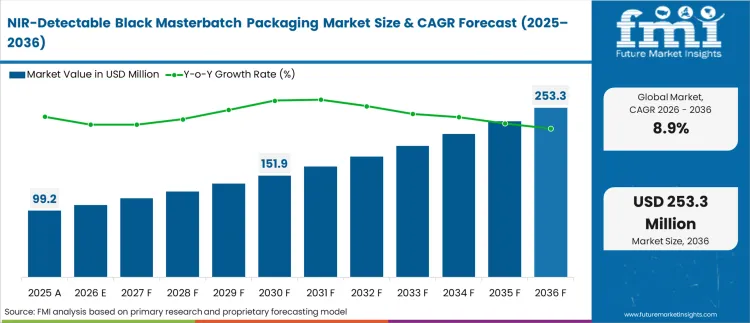
In 2025, the NIR-detectable black masterbatch packaging market was valued at USD 100 million. Based on Future Market Insights' analysis, demand for NIR-detectable black masterbatch packaging is estimated to grow to USD 108 million in 2026 and USD 230 million by 2036. FMI projects a CAGR of 8.9% during the forecast period.
Absolute dollar growth of USD 130 million over the decade reflects accelerating regulatory displacement of carbon black packaging formats rather than organic market expansion. Growth derives from mandated substitution in established packaging volumes as recyclability compliance deadlines force converters to reformulate existing black packaging specifications. Despite technical maturity of carbon-free pigment platforms, adoption remains concentrated in regulatory-advanced markets where Extended Producer Responsibility schemes penalize non-sortable formats through fee modulation structures.
Summary of NIR-Detectable Black Masterbatch Packaging Market
- NIR-Detectable Black Masterbatch Packaging Market Definition
- The industry covers carbon-free black masterbatch concentrates enabling near-infrared sortability for plastic packaging while maintaining black aesthetic appearance required by brand specifications.
- Demand Drivers in the Market
- EU Packaging and Packaging Waste Regulation mandates all packaging recyclable by 2030, with black PET trays unable to be detected by optical sorters explicitly cited as non-compliant formats.
- Extended Producer Responsibility fee modulation in Germany, France, and Netherlands penalizes non-sortable packaging through elevated waste management charges, creating direct cost incentive for NIR-detectable alternatives.
- Major retailers including UK Plastics Pact members commit to eliminating non-recyclable black plastic from own-brand packaging, requiring suppliers to reformulate using detectable colorant systems.
- Key Segments Analyzed in the FMI Report
- Polymer Compatibility: Polypropylene packaging dominates with 41% share due to prevalence in food containers and rigid packaging applications.
- Packaging Format: Rigid packaging accounts for 58% of consumption driven by bottles, jars, trays, and tubs requiring NIR sortability.
- End-use Industry: Food and beverage packaging leads with 55% share as perishable goods distribution drives highest black packaging volumes requiring recyclability compliance.
- Analyst Opinion at FMI
- As per senior consultant at FMI, Ismail Sutaria, the NIR-detectable black masterbatch packaging market report for 2026 to 2036 reveals that CXOs will encounter regulatory fragmentation where NIR-sortable formats satisfy European and North American recyclability definitions but face limited collection infrastructure in emerging markets, creating geographic specification complexity. Findings indicate cost premiums of 15 to 25% over carbon black constrain voluntary adoption outside regulated markets, while technical limitations such as reduced UV stability restrict outdoor applications and require reformulation investment.
- Strategic Implications/Executive Takeaways
- Prioritize NIR-detectable masterbatch adoption in markets with operational Extended Producer Responsibility schemes where fee modulation delivers measurable cost recovery within 18 to 24 months.
- Segment product portfolios by regulatory jurisdiction rather than application, as compliance timelines and sortation infrastructure availability determine commercial viability more than end-use requirements.
- Invest in customer education demonstrating Association of Plastic Recyclers Design Recognition as third-party validation to streamline brand owner procurement decision cycles.
- Methodology
- Validated through direct interviews with masterbatch producers and packaging converters supplying regulated markets.
- Cross-referenced against Association of Plastic Recyclers Recognition database and EU PPWR recyclability criteria.
- Based on verifiable regulatory text, industry consortium progress reports, and supplier technical disclosures.
| Metric | Value |
|---|---|
| Market Size (2026) | USD 108 Million |
| Forecast Value (2036) | USD 230 Million |
| CAGR (2026-2036) | 8.9% |
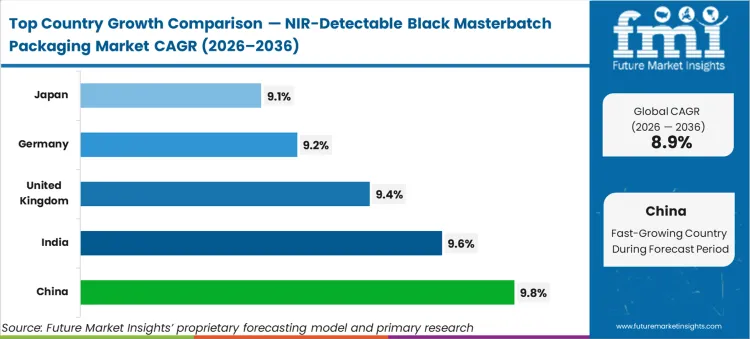
China (9.8% CAGR) and India (9.6% CAGR) drive expansion through organized retail infrastructure development requiring standardized recyclable packaging and export compliance specifications for Western markets. United Kingdom (9.4% CAGR) generates demand from voluntary industry commitments under the UK Plastics Pact targeting elimination of non-recyclable black plastic. Germany (9.2% CAGR) and Japan (9.1% CAGR) reflect mature regulatory environments where Extended Producer Responsibility fee structures and design-for-recycling criteria favor NIR-sortable black packaging over conventional carbon black formats.
NIR-Detectable Black Masterbatch Packaging Market Definition
The NIR-detectable black masterbatch packaging market comprises carbon-free black colorant concentrates designed to enable near-infrared optical sorting at material recovery facilities while maintaining aesthetic black appearance in plastic packaging applications. These masterbatches utilize alternative pigment systems that reflect sufficient infrared wavelengths for automated polymer identification, addressing the technical limitation.
Market Inclusions
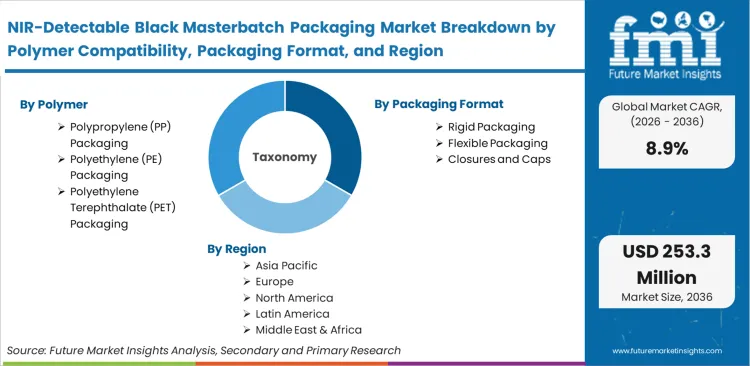
The report includes comprehensive analysis of market dynamics, featuring global and regional market sizes in value terms and a 10-year forecast from 2026 to 2036. It covers segmental breakdowns by polymer compatibility (PP, PE, PET, PS packaging systems), packaging format (rigid, flexible, closures, labels), end-use industry (food and beverage, personal care, pharmaceuticals, industrial), and regional deployment patterns across markets with established optical sorting infrastructure.
Market Exclusions
The scope excludes conventional carbon black masterbatches and non-packaging applications of NIR-detectable colorants such as automotive components or consumer durables. It omits finished packaged goods and focuses strictly on the masterbatch concentrate and its immediate adoption in packaging conversion processes. Report does not account for alternative black plastic solutions such as complete color elimination or mid-infrared detection technologies deployed outside standard NIR sorting infrastructure.
NIR-Detectable Black Masterbatch Packaging Market Research Methodology
- Primary Research: Interviews were conducted with masterbatch producers, packaging converters, brand owners implementing recyclability commitments, material recovery facility operators, and recyclability certification bodies across major packaging markets.
- Desk Research: Technical standards from APR Design Guide for Plastics Recyclability, EU Packaging and Packaging Waste Regulation text, national Extended Producer Responsibility frameworks, and UK Plastics Pact progress reports supported regulatory context and adoption benchmarking.
- Market-Sizing and Forecasting: A hybrid bottom-up and top-down model was developed. Demand was reconstructed from black packaging conversion volumes in food contact and non-food applications, regulatory compliance timelines requiring carbon black phase-out, and masterbatch loading rates, then validated against supplier production capacities and brand owner procurement commitments.
- Data Validation and Update Cycle: Outputs undergo cross-validation against packaging industry trade flows, masterbatch producer revenue disclosures, and structured peer review with material science experts prior to publication.
Segmental Analysis
NIR-Detectable Black Masterbatch Packaging Market Analysis by Polymer Compatibility
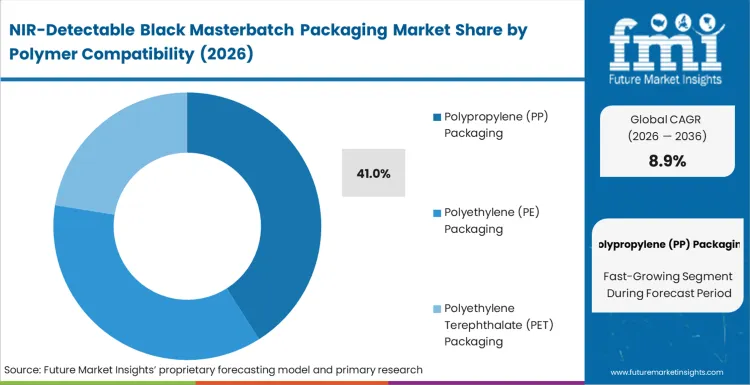
Based on FMI's NIR-detectable black masterbatch packaging market report, consumption for polypropylene packaging is estimated to hold 41% share in 2026. Growth in demand for PP-compatible NIR masterbatch comes from polypropylene's dominance in rigid food packaging applications where transparency to optical sorting is critical for compliance with food-grade recycled content mandates and Extended Producer Responsibility recyclability classifications.
- APR Recognition Validation: Ampacet Corporation received COTREP (French Technical Committee for Recycling of Plastic Packaging) certification for its REC-NIR-BLACK formulations for polypropylene rigid packaging applications, providing third-party validation that products meet European recycling system sortation requirements and enabling converter compliance documentation for retailer procurement specifications. [2]
- Polyethylene Flexible Extension: Ampacet extended its REC-NIR-BLACK masterbatch range with PE 512 formulation in May 2022 specifically designed for black flexible packaging applications, enabling NIR detectability while maintaining high opacity levels and orienting polyethylene materials to correct sorting streams when using models suitable for dark plastics. [3]
- Commercial Deployment: Henkel partnered with Ampacet and converter Greiner Packaging to launch recyclable black bottles for Bref toilet cleaner products in May 2019, demonstrating commercial-scale deployment where carbon-free REC-NIR-BLACK masterbatch enabled retail packaging to be scanned by recycling facility infrared optical sensors and integrated back into value chains. [4]
NIR-Detectable Black Masterbatch Packaging Market Analysis by Packaging Format
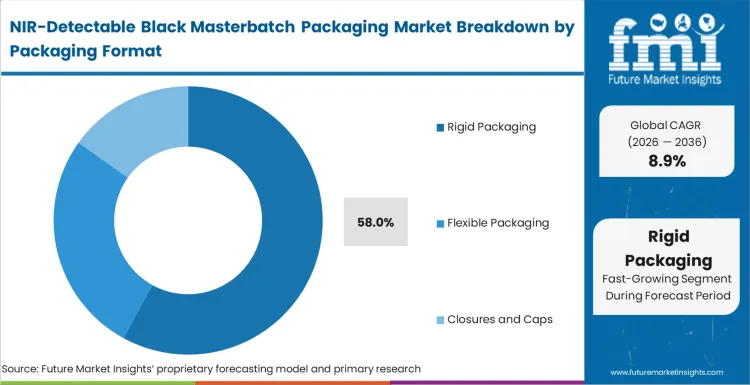
Rigid packaging's 58% market share in 2026 stems from bottles, jars, trays, and containers representing highest-volume black packaging formats where automated NIR sorting infrastructure operates at scale within material recovery facilities. The segment's concentration creates a clear compliance pathway as rigid format standardisation enables consistent sortation testing protocols and Association of Plastic Recyclers Design Recognition qualification.
- Brand Owner Commitments: UK Plastics Pact members including major supermarkets Aldi, ASDA, Lidl, Marks & Spencer, Sainsbury's, Tesco, and Waitrose made significant steps to remove non-recyclable black plastic from packaging portfolios, with Morrisons and Co-op completely eliminating black plastic from all own-brand food and drink packaging. [5]
- Material Recovery Infrastructure: Waste Management upgraded its Germantown, Wisconsin material recovery facility with a USD 39 million investment in January 2024, installing Tomra Autosort optical sorters with laser object detection capabilities as part of the company's USD 1.4 billion nationwide investment cycle from 2022 to 2026, incorporating advanced sortation for dark plastics identification. [6]
- Flexible Packaging Limitations: As per FMI analysis, flexible packaging adoption of NIR-detectable masterbatch remains constrained by limited curbside collection infrastructure, with only 5% of UK local authorities collecting plastic bags and wrapping as of 2023 despite design improvements, requiring store drop-off programs to access recycling channels and limiting commercial viability of premium NIR-sortable formulations.
NIR-Detectable Black Masterbatch Packaging Market Drivers, Restraints, and Opportunities
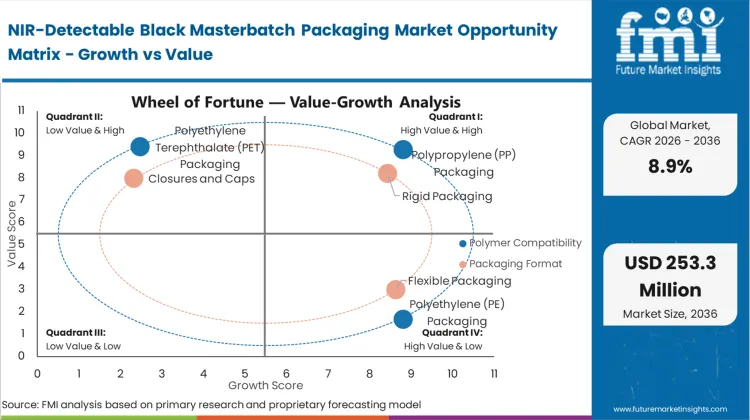
Future Market Insights analysis indicates that historical patterns point to a nascent specialty segment where NIR-detectable masterbatch remains premium-priced niche product until regulatory mandates force widespread carbon black displacement. The 2026 valuation represents early-stage regulatory compliance adoption concentrated in European Union and select North American jurisdictions with operational Extended Producer Responsibility schemes, while 2036 forecast assumes progressive global diffusion as recyclability mandates expand geographically and optical sorting infrastructure scales in emerging markets.
Growth trajectory reflects simultaneous regulatory push through compliance deadlines and market pull from brand owner sustainability commitments requiring recyclable packaging across product portfolios. Value expansion derives from converters reformulating existing black packaging specifications rather than net-new packaging creation, with masterbatch suppliers capturing premium pricing for specialty carbon-free formulations. Cost differential versus conventional carbon black narrows over forecast period as production volumes scale and alternative pigment supply chains mature, though NIR-detectable formats maintain 10 to 15% premium reflecting technical complexity and certification requirements.
- EU Packaging Regulation Recyclability Mandate: European Union Packaging and Packaging Waste Regulation (EU) 2025/40 entered force February 11, 2025, requiring all packaging placed on EU market to be recyclable by 2030 and recyclable at scale by 2035, with black PET trays that optical sorters cannot detect explicitly referenced as formats that will not qualify as recyclable. [7]
- Extended Producer Responsibility Fee Modulation: Germany, France, Netherlands, and other EU member states implement Extended Producer Responsibility schemes with eco-modulated fees that reduce charges for easily recyclable packaging while increasing fees for hard-to-recycle formats, creating direct financial incentive for converters to adopt NIR-sortable black masterbatch over conventional carbon black colorants.
- Association of Plastic Recyclers Recognition Program: APR Design for Recyclability Recognition program provides third-party validation for packaging components meeting North American recycling system compatibility standards, with NIR-sortable black colorants achieving mainstream adoption status alongside pressure-sensitive adhesives and crystallizable PET shrink sleeves since program inception. [8]
Regional Analysis
Based on regional analysis, the NIR-detectable black masterbatch packaging market is segmented into North America, Latin America, Europe, East Asia, South Asia, Oceania, and Middle East and Africa across 30+ countries. The full report offers market attractiveness analysis based on Extended Producer Responsibility implementation status, optical sorting infrastructure deployment, and regulatory recyclability compliance timelines.
.webp "Top Country Growth Comparison Nir Detectable Black Masterbatch Packaging Market Cagr (2026 2036)")
| Country | CAGR (2026 to 2036) |
|---|---|
| China | 9.8% |
| India | 9.6% |
| United Kingdom | 9.4% |
| Germany | 9.2% |
| Japan | 9.1% |
Source: Future Market Insights (FMI) analysis, based on proprietary forecasting model and primary research
Europe NIR-Detectable Black Masterbatch Packaging Market Analysis
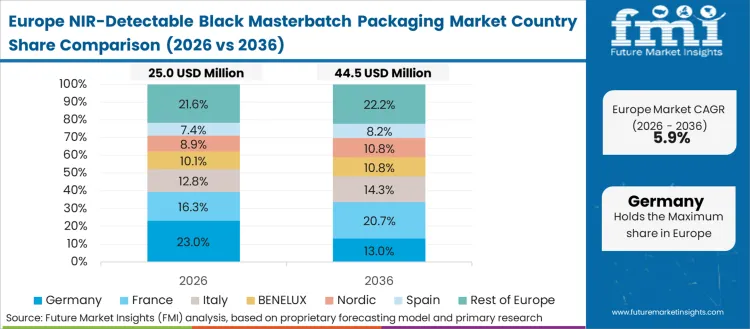
Europe functions as the global regulatory catalyst, where EU Packaging and Packaging Waste Regulation recyclability mandates create binding compliance timelines forcing systematic carbon black displacement across all packaging categories. Key players in the European market include Ampacet Corporation leading with REC-NIR-BLACK range certified by COTREP for French market compliance, Clariant AG developing carbon-free colorant platforms, and Tosaf Group supplying specialty masterbatch formulations to European converters serving regulated packaging applications.
- United Kingdom: Demand for NIR-detectable black masterbatch packaging in United Kingdom is rising at 9.4% CAGR through 2036, driven by UK Plastics Pact voluntary industry commitments where over 100 member businesses target elimination of problematic packaging formats including non-recyclable black plastic. As per FMI analysis, major UK supermarkets including Morrisons and Co-op removed black plastic from all own-brand food and drink packaging, while brands such as Unilever reformulated TRESemmé and Lynx bottles to contain detectable black pigment making them recyclable through standard collection systems. According to WRAP analysis, approximately 30,000 to 60,000 tonnes of black plastic packaging enters UK household waste stream annually, with carbon black-based masterbatches rendering base polymer undetectable by near-infrared spectroscopy technology used in recycling plants. [5]
- Germany: Demand for NIR-detectable black masterbatch packaging in Germany is projected to rise at 9.2% CAGR through 2036, supported by German Packaging Act requirements for 90% recyclable packaging and EU Packaging and Packaging Waste Regulation design-for-recycling criteria adopted by January 2028. As per FMI analysis, German converters face eco-modulated Extended Producer Responsibility fees that penalize non-sortable packaging through elevated waste management charges, creating direct cost recovery pathway for NIR-detectable masterbatch adoption despite 15 to 25% premium pricing versus conventional carbon black formulations. EU PPWR establishes that packaging must be recyclable in practice and at scale by 2035, meaning materials must be collected, sorted, and processed through existing industrial recycling infrastructure across EU member states, explicitly excluding formats such as black PET trays that optical sorters cannot detect from qualifying as recyclable. [7]
FMI's analysis of the NIR-detectable black masterbatch packaging market in Europe consists of country-wise assessments that include the United Kingdom, Germany, France, Italy, Spain, the Netherlands, Belgium, and the rest of Europe. Readers can find detailed information about Extended Producer Responsibility fee modulation structures, PPWR compliance timelines, and optical sorting infrastructure deployment impacting growth in the European region.
Asia Pacific NIR-Detectable Black Masterbatch Packaging Market Analysis
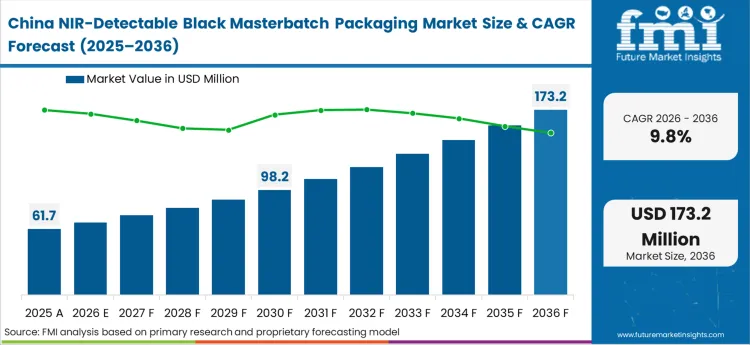
Asia Pacific represents the fastest-growing region globally, leveraging export compliance requirements for Western markets and domestic organised retail expansion to drive NIR-detectable masterbatch adoption despite limited domestic recycling infrastructure. Key regional players include Ampacet Corporation, operating technical centres in China and India, Tosaf Group, supplying Asian converter networks, and regional masterbatch producers, including Avient Corporation, developing carbon-free colourant platforms for local packaging markets.
- China: Demand for NIR-detectable black masterbatch packaging in China is projected to rise at 9.8% CAGR through 2036, driven by export-oriented packaging converters serving European and North American brand owners requiring recyclability compliance for import market access. As per FMI analysis, Chinese packaging manufacturers face dual specifications where domestic consumption accepts conventional carbon black formats while export production requires NIR-sortable alternatives to satisfy importer sustainability procurement policies and Extended Producer Responsibility recyclability classifications. Organised retail expansion across tier-1 and tier-2 cities establishes standardised packaging requirements aligned with multinational retailer global procurement specifications, creating domestic demand for recyclability-compliant formats independent of export drivers.
- India: Demand for NIR-detectable black masterbatch packaging in India is rising at 9.6% CAGR through 2036, supported by organized retail penetration requiring modern packaging standards and export-oriented pharmaceutical and personal care manufacturers adopting international recyclability specifications. As per FMI analysis, Indian converters prioritize NIR-detectable masterbatch for export packaging destined for European and North American markets where recyclability compliance determines market access, while domestic consumption remains dominated by conventional carbon black due to limited optical sorting infrastructure and absence of Extended Producer Responsibility mandates penalizing non-sortable formats. Make in India initiatives encourage backward integration in packaging materials supply chains, with domestic masterbatch producers investing in carbon-free colorant formulation capabilities to reduce import dependency for specialty additives.
- Japan: Demand for NIR-detectable black masterbatch packaging in Japan is projected to rise at 9.1% CAGR through 2036, driven by Container and Packaging Recycling Law requirements and domestic brand owner commitments to circular economy principles. As per FMI analysis, Japanese packaging industry demonstrates high baseline recyclability compliance rates through established collection systems and material-specific sorting protocols, with NIR-detectable masterbatch adoption focused on maintaining export competitiveness and aligning with international best practices rather than addressing acute domestic regulatory gaps. Ministry of Economy, Trade and Industry chemical industry production bulletins track thermosetting resin output and capacity utilisation rates, providing visibility into speciality masterbatch adoption trends across packaging and industrial applications.
The full report analyzes the NIR-detectable black masterbatch packaging market across East and South Asia from 2021 to 2036, covering regulatory developments, optical sorting infrastructure deployment, and export compliance dynamics in China, India, Japan, South Korea, Indonesia, Thailand, Vietnam, and Malaysia. The assessment highlights organised retail penetration and Western market access requirements dictating regional adoption patterns.
Competitive Aligners for Market Players
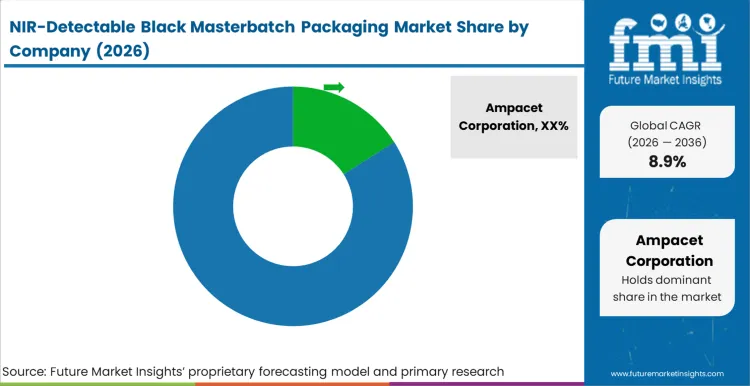
Market structure remains concentrated among global masterbatch producers with established technical capabilities in carbon-free pigment formulation and regulatory certification expertise. Approximately 65% of NIR-detectable masterbatch capacity sits with Ampacet Corporation, Avient Corporation, and Clariant AG operating with multi-regional production networks and Association of Plastic Recyclers Design Recognition qualification, while remaining capacity operates through specialized regional suppliers and custom compounders serving localized converter relationships.
Suppliers with existing carbon-free pigment platforms and NIR sortation testing infrastructure absorb regulatory compliance cycles more effectively than suppliers dependent on technology licensing or external certification services. Integrated masterbatch producers maintain long-term supply agreements with major packaging converters and brand owners, securing committed volumes that justify formulation development investment and certification costs. Non-integrated regional suppliers face margin pressure competing for specification-driven opportunities without established regulatory approval documentation.
Operational success requires achieving technical equivalence to conventional carbon black across opacity, dispersion, processing stability, and application-specific performance requirements while maintaining NIR reflectivity above 10% threshold for sortation compatibility. Suppliers unable to balance aesthetic requirements with optical detection specifications face limited commercial adoption as converters prioritize proven formulations over development-stage alternatives. Customer concentration reinforces supplier qualification cycles, with packaging converters multi-sourcing certified masterbatch to prevent supply chain dependency but limiting new entrant access through stringent validation requirements.
Recent Developments
- In 2025, Ampacet highlighted GASTOP-Flex™ as a packaging innovation designed to improve freshness while supporting recyclability in mono- and multi-layer PE film structures, linking barrier performance upgrades with recyclable design goals.
- In October 2024, Techmer PM completed the acquisition of OptiColor, Inc., a move positioned to strengthen its color concentrates and masterbatch capabilities and expand support for recyclability-driven packaging specifications, including specialty colorants used in detectable/sortable packaging formats.
Key Players in NIR-Detectable Black Masterbatch Packaging Market
- Ampacet Corporation
- Avient Corporation
- Clariant AG
- Techmer PM LLC
- Tosaf Group
- Cabot Corporation
- Sukano AG
- Finke Colors GmbH
- Broadway Colours Inc.
- Colortech Inc.
Scope of the Report
| Metric | Value |
|---|---|
| Quantitative Units | USD 108 million (2026) to USD 230 million (2036), at a CAGR of 8.9% |
| Market Definition | The NIR-detectable black masterbatch packaging market comprises carbon-free black colorant concentrates designed to enable near-infrared optical sorting at material recovery facilities while maintaining aesthetic black appearance in plastic packaging applications. |
| Polymer Compatibility Segmentation | Polypropylene Packaging, Polyethylene Packaging, Polyethylene Terephthalate Packaging, Polystyrene Packaging |
| Packaging Format Segmentation | Rigid Packaging, Flexible Packaging, Closures and Caps, Labels and Sleeves |
| End-use Industry Segmentation | Food and Beverage Packaging, Personal Care and Homecare Packaging, Pharmaceuticals and Healthcare Packaging, Industrial and Agrochemical Packaging |
| Regions Covered | North America, Latin America, Europe, East Asia, South Asia, Oceania, Middle East and Africa |
| Countries Covered | United States, Canada, Mexico, Brazil, Argentina, Germany, France, United Kingdom, Italy, Spain, Netherlands, Belgium, China, India, Japan, South Korea, Indonesia, Thailand, Vietnam, Malaysia, Australia and 30 plus countries |
| Key Companies Profiled | Ampacet Corporation, Avient Corporation, Clariant AG, Techmer PM LLC, Tosaf Group, Cabot Corporation, Sukano AG, Finke Colors GmbH, Broadway Colours Inc., Colortech Inc. |
| Forecast Period | 2026 to 2036 |
| Approach | Hybrid bottom-up and top-down market modeling validated through primary interviews with masterbatch producers, packaging converters, and regulatory certification bodies, supported by Extended Producer Responsibility framework analysis and optical sorting infrastructure deployment verification |
NIR-Detectable Black Masterbatch Packaging Market Analysis by Segments
Polymer Compatibility (Packaging Resin System)
- Polypropylene (PP) Packaging
- Polyethylene (PE) Packaging
- Polyethylene Terephthalate (PET) Packaging
- Polystyrene (PS) Packaging
Packaging Format
- Rigid Packaging (bottles, jars, trays, containers)
- Flexible Packaging (films, pouches, wraps)
- Closures and Caps
- Labels and Sleeves
End-use Industry
- Food and Beverage Packaging
- Personal Care and Homecare Packaging
- Pharmaceuticals and Healthcare Packaging
- Industrial and Agrochemical Packaging
Region
- Asia Pacific
- China
- India
- Japan
- South Korea
- Indonesia
- Thailand
- Vietnam
- Malaysia
- Australia & New Zealand
- Rest of Asia Pacific
- Europe
- Germany
- United Kingdom
- France
- Italy
- Spain
- Netherlands
- Belgium
- Rest of Europe
- North America
- United States
- Canada
- Mexico
- Latin America
- Brazil
- Argentina
- Chile
- Rest of Latin America
- Middle East & Africa
- Kingdom of Saudi Arabia
- United Arab Emirates
- South Africa
- Turkey
- Rest of Middle East & Africa
Bibliography
- [1] Ampacet Corporation. (2019). Ampacet's Carbon Black-Free Masterbatch Range REC-NIR-BLACK Named Plastics Recycling Awards Europe 2019 Finalist in Product Technology Innovation Category. Corporate Press Release, April 2019.
- [2] Ampacet Corporation. (2023). Ampacet Receives COTREP Certification For NIR-sortable REC-NIR-BLACK For PP Rigid Packaging Applications. Corporate Announcement, 2023.
- [3] Ampacet Corporation. (2022). Ampacet Extends Rec-NIR-Black Range with NIR-detectable Masterbatch for Black Flexible Applications. Corporate Press Release, May 31, 2022.
- [4] Packaging Insights. (2019). See me now? Ampacet's REC-NIR-BLACK plastic enables optical sensor recycling of Henkel bottles. Industry News Report, May 6, 2019.
- [5] WRAP. (2024). Black Plastic Packaging Hub: Major supermarkets remove non-recyclable black plastic. UK Plastics Pact Progress Report, 2024.
- [6] Waste Dive. (2025). Can recycling advancements get black rigid plastics off packaging's blacklist? Industry Analysis, September 10, 2025.
- [7] Circularise. (2025). Packaging and Packaging Waste Regulation (PPWR): A guide to compliance, timelines, and mass balance solutions. Regulatory Analysis, January 2025.
- [8] Association of Plastic Recyclers. (2024). APR Design for Recyclability Recognition Program. Program Overview, December 5, 2024.
- [9] Plastics Machinery Manufacturing. (2023). New Ampacet masterbatches improve NIR sorting of black plastics. Industry Report, Spring 2023.
- [10] Packaging Insights. (2022). Ampacet adds NIR-detectable masterbatch for flexible packaging to carbon-free black range. Industry News, June 2, 2022.
This bibliography is provided for the reader's reference and is not exhaustive. The full report contains the complete reference list and detailed citations.
This Report Addresses
- Market intelligence to enable structured strategic decision making across NIR-detectable masterbatch adoption and regulatory compliance planning
- Market size estimation and 10 year revenue forecasts from 2026 to 2036, supported by validated Extended Producer Responsibility implementation timelines and optical sorting infrastructure deployment data
- Growth opportunity mapping across polypropylene, polyethylene, and PET packaging systems with emphasis on rigid versus flexible format adoption dynamics
- Segment and regional revenue forecasts covering food and beverage, personal care, pharmaceuticals, and industrial packaging across Europe, Asia Pacific, and North America markets
- Competition strategy assessment including regulatory certification positioning, technical formulation capabilities, and converter partnership development
- Product development tracking including Association of Plastic Recyclers Design Recognition qualification and COTREP certification progress across polymer systems
- Regulatory impact analysis covering EU PPWR recyclability mandates, Extended Producer Responsibility fee modulation structures, and national packaging compliance timelines
- Market report delivery in PDF, Excel, PPT, and interactive dashboard formats for executive and operational use
Frequently Asked Questions
How large is the demand for NIR-Detectable Black Masterbatch Packaging in the global market in 2026?
Demand for NIR-detectable black masterbatch packaging in the global market is estimated to be valued at USD 108 million in 2026.
What will be the market size of NIR-Detectable Black Masterbatch Packaging in the global market by 2036?
Market size for NIR-detectable black masterbatch packaging is projected to reach USD 230 million by 2036.
What is the expected demand growth for NIR-Detectable Black Masterbatch Packaging in the global market between 2026 and 2036?
Demand for NIR-detectable black masterbatch packaging in the global market is expected to grow at a CAGR of 8.9% between 2026 and 2036.
Which Polymer Compatibility segment is poised to lead global sales by 2026?
Polypropylene packaging is expected to be the dominant polymer compatibility segment, capturing approximately 41% of global market share in 2026 due to prevalence in food containers and rigid packaging applications.
How significant is the role of Rigid Packaging Format in driving NIR-Detectable Masterbatch adoption in 2026?
Rigid packaging represents the leading format segment, projected to hold approximately 58% share of the total market in 2026 as bottles, jars, trays, and containers drive highest-volume black packaging requiring NIR sortability.
What is Driving NIR-Detectable Masterbatch Demand in Europe?
EU Packaging and Packaging Waste Regulation mandates all packaging recyclable by 2030, with Extended Producer Responsibility fee modulation penalizing non-sortable formats through elevated waste management charges.
What Compliance Standards are Referenced for European Markets?
EU PPWR Regulation 2025/40 recyclability criteria and COTREP certification for French market compliance are referenced as key regulatory benchmarks.
What is the United Kingdom Growth Outlook in this Report?
United Kingdom is projected to grow at a CAGR of 9.4% during 2026 to 2036, driven by UK Plastics Pact voluntary commitments to eliminate non-recyclable black plastic.
Why is Europe the Primary Market for NIR-Detectable Masterbatch in this Report?
Europe functions as regulatory catalyst with binding EU PPWR compliance timelines forcing systematic carbon black displacement across packaging categories by 2030 recyclability mandate.
What Type of Demand Dominates in Germany?
Regulatory compliance-driven demand dominates as German Packaging Act and eco-modulated Extended Producer Responsibility fees create financial incentive for NIR-sortable formats despite cost premiums.
What is Germany Growth Outlook in this Report?
Germany is projected to expand at a CAGR of 9.2% during 2026 to 2036, supported by 90% recyclable packaging targets and PPWR design-for-recycling criteria.
Does the Report Cover Japan in its Regional Analysis?
Japan is included within East Asia under the regional scope of analysis.
What are the Sources referred to for analyzing the Market in Japan?
Ministry of Economy, Trade and Industry chemical industry production bulletins covering thermosetting resin output and capacity utilization, along with Container and Packaging Recycling Law compliance data are cited as primary reference sources.
What is the Main Demand Theme Linked to Japan in Asia Coverage?
Export competitiveness maintenance and alignment with international best practices drive adoption as Japanese converters supply multinational brand owners establishing global recyclability standards.
Does the Report Cover China in its Regional Analysis?
China is included within East Asia under the regional coverage framework with detailed country-level analysis.
What is the Main China Related Demand Theme in Asia Coverage?
Export-oriented packaging converters serving European and North American markets requiring recyclability compliance for import market access drive adoption alongside domestic organized retail expansion.
Which Polymer Systems are Strategically Important for Food Packaging Applications?
Polypropylene and polyethylene packaging systems are prioritized due to prevalence in food contact applications requiring food safety compliance and NIR sortability for recycled content mandates.
What is NIR-Detectable Black Masterbatch Packaging and What is It Used For?
NIR-detectable black masterbatch packaging comprises carbon-free black colorant concentrates enabling near-infrared optical sorting at material recovery facilities while maintaining aesthetic black appearance for brand specifications.
What does NIR-Detectable Black Masterbatch Packaging Market Mean in this Report?
NIR-detectable black masterbatch packaging market refers to global production, trade, and converter adoption of carbon-free black colorant concentrates designed for recyclability compliance.
What is Included in the Scope of this NIR-Detectable Black Masterbatch Packaging Market Report?
Scope covers masterbatch concentrates by polymer compatibility, packaging format applications including rigid and flexible systems, and end-use industries including food and beverage, personal care, and pharmaceuticals.
What is Excluded from the Scope of this Report?
Conventional carbon black masterbatches, non-packaging colorant applications, finished packaged goods, and mid-infrared detection technologies are excluded from coverage.
Preview the report firsthand - request a free sample
Get SampleGet the brochure for pricing and purchase details.
Get PDFTable of Content
- Executive Summary
- Global Market Outlook
- Demand-side Trends
- Supply-side Trends
- Technology Roadmap Analysis
- Analysis and Recommendations
- Market Overview
- Market Coverage / Taxonomy
- Market Definition / Scope / Limitations
- Research Methodology
- Chapter Orientation
- Analytical Lens and Working Hypotheses
- Market Structure, Signals, and Trend Drivers
- Benchmarking and Cross-market Comparability
- Market Sizing, Forecasting, and Opportunity Mapping
- Research Design and Evidence Framework
- Desk Research Programme (Secondary Evidence)
- Company Annual and Sustainability Reports
- Peer-reviewed Journals and Academic Literature
- Corporate Websites, Product Literature, and Technical Notes
- Earnings Decks and Investor Briefings
- Statutory Filings and Regulatory Disclosures
- Technical White Papers and Standards Notes
- Trade Journals, Industry Magazines, and Analyst Briefs
- Conference Proceedings, Webinars, and Seminar Materials
- Government Statistics Portals and Public Data Releases
- Press Releases and Reputable Media Coverage
- Specialist Newsletters and Curated Briefings
- Sector Databases and Reference Repositories
- FMI Internal Proprietary Databases and Historical Market Datasets
- Subscription Datasets and Paid Sources
- Social Channels, Communities, and Digital Listening Inputs
- Additional Desk Sources
- Expert Input and Fieldwork (Primary Evidence)
- Primary Modes
- Qualitative Interviews and Expert Elicitation
- Quantitative Surveys and Structured Data Capture
- Blended Approach
- Why Primary Evidence is Used
- Field Techniques
- Interviews
- Surveys
- Focus Groups
- Observational and In-context Research
- Social and Community Interactions
- Stakeholder Universe Engaged
- C-suite Leaders
- Board Members
- Presidents and Vice Presidents
- R&D and Innovation Heads
- Technical Specialists
- Domain Subject-matter Experts
- Scientists
- Physicians and Other Healthcare Professionals
- Governance, Ethics, and Data Stewardship
- Research Ethics
- Data Integrity and Handling
- Primary Modes
- Tooling, Models, and Reference Databases
- Desk Research Programme (Secondary Evidence)
- Data Engineering and Model Build
- Data Acquisition and Ingestion
- Cleaning, Normalisation, and Verification
- Synthesis, Triangulation, and Analysis
- Quality Assurance and Audit Trail
- Market Background
- Market Dynamics
- Drivers
- Restraints
- Opportunity
- Trends
- Scenario Forecast
- Demand in Optimistic Scenario
- Demand in Likely Scenario
- Demand in Conservative Scenario
- Opportunity Map Analysis
- Product Life Cycle Analysis
- Supply Chain Analysis
- Investment Feasibility Matrix
- Value Chain Analysis
- PESTLE and Porter’s Analysis
- Regulatory Landscape
- Regional Parent Market Outlook
- Production and Consumption Statistics
- Import and Export Statistics
- Market Dynamics
- Global Market Analysis 2021 to 2025 and Forecast, 2026 to 2036
- Historical Market Size Value (USD Million) Analysis, 2021 to 2025
- Current and Future Market Size Value (USD Million) Projections, 2026 to 2036
- Y-o-Y Growth Trend Analysis
- Absolute $ Opportunity Analysis
- Global Market Pricing Analysis 2021 to 2025 and Forecast 2026 to 2036
- Global Market Analysis 2021 to 2025 and Forecast 2026 to 2036, By Polymer Compatibility
- Introduction / Key Findings
- Historical Market Size Value (USD Million) Analysis By Polymer Compatibility , 2021 to 2025
- Current and Future Market Size Value (USD Million) Analysis and Forecast By Polymer Compatibility , 2026 to 2036
- Polypropylene (PP) Packaging
- Polyethylene (PE) Packaging
- Polyethylene Terephthalate (PET) Packaging
- Polypropylene (PP) Packaging
- Y-o-Y Growth Trend Analysis By Polymer Compatibility , 2021 to 2025
- Absolute $ Opportunity Analysis By Polymer Compatibility , 2026 to 2036
- Global Market Analysis 2021 to 2025 and Forecast 2026 to 2036, By Packaging Format
- Introduction / Key Findings
- Historical Market Size Value (USD Million) Analysis By Packaging Format, 2021 to 2025
- Current and Future Market Size Value (USD Million) Analysis and Forecast By Packaging Format, 2026 to 2036
- Rigid Packaging
- Flexible Packaging
- Closures and Caps
- Rigid Packaging
- Y-o-Y Growth Trend Analysis By Packaging Format, 2021 to 2025
- Absolute $ Opportunity Analysis By Packaging Format, 2026 to 2036
- Global Market Analysis 2021 to 2025 and Forecast 2026 to 2036, By End-use Industry
- Introduction / Key Findings
- Historical Market Size Value (USD Million) Analysis By End-use Industry, 2021 to 2025
- Current and Future Market Size Value (USD Million) Analysis and Forecast By End-use Industry, 2026 to 2036
- Food and Beverage Packaging
- Personal Care and Homecare Packaging
- Pharmaceuticals and Healthcare Packaging
- Food and Beverage Packaging
- Y-o-Y Growth Trend Analysis By End-use Industry, 2021 to 2025
- Absolute $ Opportunity Analysis By End-use Industry, 2026 to 2036
- Global Market Analysis 2021 to 2025 and Forecast 2026 to 2036, By Region
- Introduction
- Historical Market Size Value (USD Million) Analysis By Region, 2021 to 2025
- Current Market Size Value (USD Million) Analysis and Forecast By Region, 2026 to 2036
- North America
- Latin America
- Western Europe
- Eastern Europe
- East Asia
- South Asia and Pacific
- Middle East & Africa
- Market Attractiveness Analysis By Region
- North America Market Analysis 2021 to 2025 and Forecast 2026 to 2036, By Country
- Historical Market Size Value (USD Million) Trend Analysis By Market Taxonomy, 2021 to 2025
- Market Size Value (USD Million) Forecast By Market Taxonomy, 2026 to 2036
- By Country
- USA
- Canada
- Mexico
- By Polymer Compatibility
- By Packaging Format
- By End-use Industry
- By Country
- Market Attractiveness Analysis
- By Country
- By Polymer Compatibility
- By Packaging Format
- By End-use Industry
- Key Takeaways
- Latin America Market Analysis 2021 to 2025 and Forecast 2026 to 2036, By Country
- Historical Market Size Value (USD Million) Trend Analysis By Market Taxonomy, 2021 to 2025
- Market Size Value (USD Million) Forecast By Market Taxonomy, 2026 to 2036
- By Country
- Brazil
- Chile
- Rest of Latin America
- By Polymer Compatibility
- By Packaging Format
- By End-use Industry
- By Country
- Market Attractiveness Analysis
- By Country
- By Polymer Compatibility
- By Packaging Format
- By End-use Industry
- Key Takeaways
- Western Europe Market Analysis 2021 to 2025 and Forecast 2026 to 2036, By Country
- Historical Market Size Value (USD Million) Trend Analysis By Market Taxonomy, 2021 to 2025
- Market Size Value (USD Million) Forecast By Market Taxonomy, 2026 to 2036
- By Country
- Germany
- UK
- Italy
- Spain
- France
- Nordic
- BENELUX
- Rest of Western Europe
- By Polymer Compatibility
- By Packaging Format
- By End-use Industry
- By Country
- Market Attractiveness Analysis
- By Country
- By Polymer Compatibility
- By Packaging Format
- By End-use Industry
- Key Takeaways
- Eastern Europe Market Analysis 2021 to 2025 and Forecast 2026 to 2036, By Country
- Historical Market Size Value (USD Million) Trend Analysis By Market Taxonomy, 2021 to 2025
- Market Size Value (USD Million) Forecast By Market Taxonomy, 2026 to 2036
- By Country
- Russia
- Poland
- Hungary
- Balkan & Baltic
- Rest of Eastern Europe
- By Polymer Compatibility
- By Packaging Format
- By End-use Industry
- By Country
- Market Attractiveness Analysis
- By Country
- By Polymer Compatibility
- By Packaging Format
- By End-use Industry
- Key Takeaways
- East Asia Market Analysis 2021 to 2025 and Forecast 2026 to 2036, By Country
- Historical Market Size Value (USD Million) Trend Analysis By Market Taxonomy, 2021 to 2025
- Market Size Value (USD Million) Forecast By Market Taxonomy, 2026 to 2036
- By Country
- China
- Japan
- South Korea
- By Polymer Compatibility
- By Packaging Format
- By End-use Industry
- By Country
- Market Attractiveness Analysis
- By Country
- By Polymer Compatibility
- By Packaging Format
- By End-use Industry
- Key Takeaways
- South Asia and Pacific Market Analysis 2021 to 2025 and Forecast 2026 to 2036, By Country
- Historical Market Size Value (USD Million) Trend Analysis By Market Taxonomy, 2021 to 2025
- Market Size Value (USD Million) Forecast By Market Taxonomy, 2026 to 2036
- By Country
- India
- ASEAN
- Australia & New Zealand
- Rest of South Asia and Pacific
- By Polymer Compatibility
- By Packaging Format
- By End-use Industry
- By Country
- Market Attractiveness Analysis
- By Country
- By Polymer Compatibility
- By Packaging Format
- By End-use Industry
- Key Takeaways
- Middle East & Africa Market Analysis 2021 to 2025 and Forecast 2026 to 2036, By Country
- Historical Market Size Value (USD Million) Trend Analysis By Market Taxonomy, 2021 to 2025
- Market Size Value (USD Million) Forecast By Market Taxonomy, 2026 to 2036
- By Country
- Kingdom of Saudi Arabia
- Other GCC Countries
- Turkiye
- South Africa
- Other African Union
- Rest of Middle East & Africa
- By Polymer Compatibility
- By Packaging Format
- By End-use Industry
- By Country
- Market Attractiveness Analysis
- By Country
- By Polymer Compatibility
- By Packaging Format
- By End-use Industry
- Key Takeaways
- Key Countries Market Analysis
- USA
- Pricing Analysis
- Market Share Analysis, 2025
- By Polymer Compatibility
- By Packaging Format
- By End-use Industry
- Canada
- Pricing Analysis
- Market Share Analysis, 2025
- By Polymer Compatibility
- By Packaging Format
- By End-use Industry
- Mexico
- Pricing Analysis
- Market Share Analysis, 2025
- By Polymer Compatibility
- By Packaging Format
- By End-use Industry
- Brazil
- Pricing Analysis
- Market Share Analysis, 2025
- By Polymer Compatibility
- By Packaging Format
- By End-use Industry
- Chile
- Pricing Analysis
- Market Share Analysis, 2025
- By Polymer Compatibility
- By Packaging Format
- By End-use Industry
- Germany
- Pricing Analysis
- Market Share Analysis, 2025
- By Polymer Compatibility
- By Packaging Format
- By End-use Industry
- UK
- Pricing Analysis
- Market Share Analysis, 2025
- By Polymer Compatibility
- By Packaging Format
- By End-use Industry
- Italy
- Pricing Analysis
- Market Share Analysis, 2025
- By Polymer Compatibility
- By Packaging Format
- By End-use Industry
- Spain
- Pricing Analysis
- Market Share Analysis, 2025
- By Polymer Compatibility
- By Packaging Format
- By End-use Industry
- France
- Pricing Analysis
- Market Share Analysis, 2025
- By Polymer Compatibility
- By Packaging Format
- By End-use Industry
- India
- Pricing Analysis
- Market Share Analysis, 2025
- By Polymer Compatibility
- By Packaging Format
- By End-use Industry
- ASEAN
- Pricing Analysis
- Market Share Analysis, 2025
- By Polymer Compatibility
- By Packaging Format
- By End-use Industry
- Australia & New Zealand
- Pricing Analysis
- Market Share Analysis, 2025
- By Polymer Compatibility
- By Packaging Format
- By End-use Industry
- China
- Pricing Analysis
- Market Share Analysis, 2025
- By Polymer Compatibility
- By Packaging Format
- By End-use Industry
- Japan
- Pricing Analysis
- Market Share Analysis, 2025
- By Polymer Compatibility
- By Packaging Format
- By End-use Industry
- South Korea
- Pricing Analysis
- Market Share Analysis, 2025
- By Polymer Compatibility
- By Packaging Format
- By End-use Industry
- Russia
- Pricing Analysis
- Market Share Analysis, 2025
- By Polymer Compatibility
- By Packaging Format
- By End-use Industry
- Poland
- Pricing Analysis
- Market Share Analysis, 2025
- By Polymer Compatibility
- By Packaging Format
- By End-use Industry
- Hungary
- Pricing Analysis
- Market Share Analysis, 2025
- By Polymer Compatibility
- By Packaging Format
- By End-use Industry
- Kingdom of Saudi Arabia
- Pricing Analysis
- Market Share Analysis, 2025
- By Polymer Compatibility
- By Packaging Format
- By End-use Industry
- Turkiye
- Pricing Analysis
- Market Share Analysis, 2025
- By Polymer Compatibility
- By Packaging Format
- By End-use Industry
- South Africa
- Pricing Analysis
- Market Share Analysis, 2025
- By Polymer Compatibility
- By Packaging Format
- By End-use Industry
- USA
- Market Structure Analysis
- Competition Dashboard
- Competition Benchmarking
- Market Share Analysis of Top Players
- By Regional
- By Polymer Compatibility
- By Packaging Format
- By End-use Industry
- Competition Analysis
- Competition Deep Dive
- Ampacet Corporation
- Overview
- Product Portfolio
- Profitability by Market Segments (Product/Age /Sales Channel/Region)
- Sales Footprint
- Strategy Overview
- Marketing Strategy
- Product Strategy
- Channel Strategy
- Avient Corporation
- Clariant AG
- Techmer PM LLC
- Tosaf Group
- Cabot Corporation
- Ampacet Corporation
- Competition Deep Dive
- Assumptions & Acronyms Used


