

- Market Size (2026)
- USD 455.0 Mn
- Forecast (2036)
- USD 6273.0 Mn
- CAGR (2026 to 2036)
- 30.0%
How big is the No-Code Robot Programming & High-Mix Automation Market in 2026?
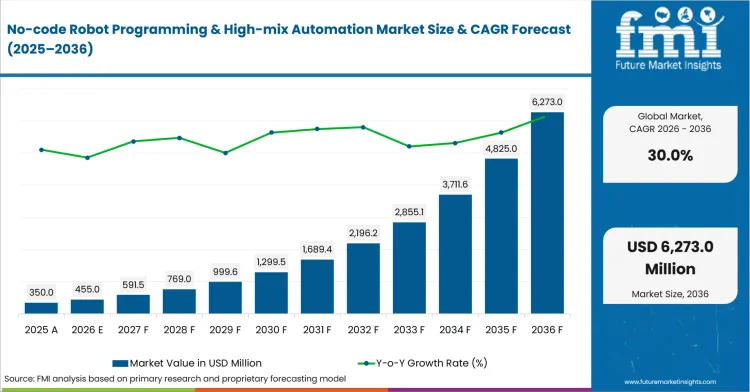
USD 455.0 million in 2026 and USD 6,273.0 million by 2036 at a 30.0% CAGR.
Demand for no-code robot programming and high-mix automation is projected to expand at a 30.0% CAGR between 2026 and 2036. The market is estimated to rise from USD 455.0 million in 2026 to USD 6,273.0 million by 2036. Frequent part changes in high-mix, low-volume production environments turn robot setup and reprogramming into recurring costs rather than one-time tasks, directly impacting throughput and labor efficiency. In February 2026, the Association for Advancing Automation reported North American robot orders totaling USD 2.25 billion in 2025, underscoring how setup speed has become a daily financial consideration as industrial robotics budgets increasingly prioritize no-code tools that reduce setup hours and improve asset utilization.
Factories in Europe and the United States judge these tools against different operating needs and approval practices. Many European sites combine established industrial robots with newer cobots, so one platform must handle several controllers. American metal fabricators focus more on the hours saved during welding and machine-tending changeovers across short production runs. In February 2026, the Association for Advancing Automation valued North American cobot orders at USD 241 million for 2025. The cobot total points to a wider range of smaller automation projects with tight payback targets, while smart factory adoption raises the same central test: a platform must turn process knowledge into stable output without creating a new safety or support burden.
Key Takeaways of No-Code Robot Programming & High-Mix Automation Market
- Demand for no-code robot programming solutions is driven by the rising cost of robot setup in plants running many part variants, giving trained production staff a practical way to handle routine changes without waiting for a specialist.
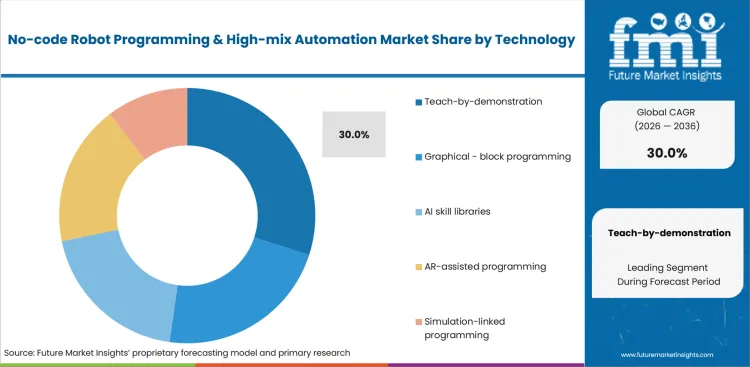
- By technology, teach-by-demonstration is expected to lead with 30.0% share in 2026, supported by its ability to turn process knowledge into repeatable motion without requiring technicians to learn traditional code.
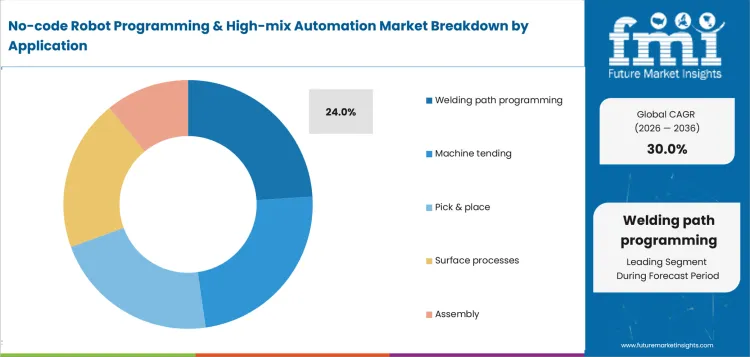
- Welding path programming is the dominant application segment, projected to hold 24.0% share in 2026, reflecting the repeated path-editing work created by fixture and geometry changes between batches.
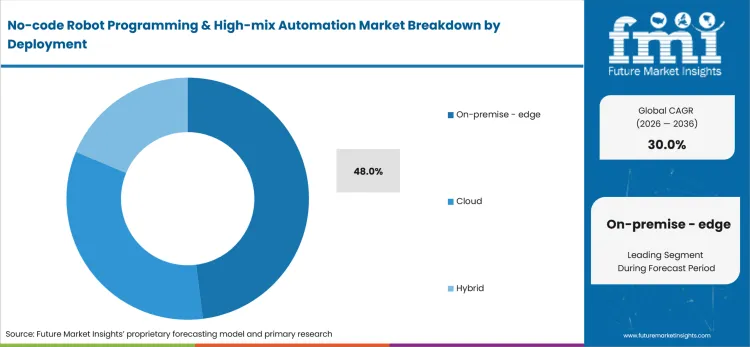
- On-premise or edge deployment is estimated to lead the deployment category with 48.0% share in 2026, driven by the need to protect time-sensitive motion and give maintenance staff clearer ownership of versions and access rights.
- Simulation capability and robot-neutral platforms remain key factors shaping adoption, as they let engineers test paths away from active cells and keep engineering knowledge usable across mixed robot fleets.
- The United States prioritizes payback speed across welding and machine-tending projects, while European plants focus more on controller support across older and newer robot systems during approval.
- Competition centers on Wandelbots, RoboDK, Augmentus, Vention, and Universal Robots, with vendors differentiating across robot-neutral programming platforms, geometry-based path programming, integrated design-to-cell automation, and robot OEM programming platforms.
Analyst Perspective
"Manufacturers are looking for programming solutions that reduce downtime without compromising safety or production quality. The real measure of value lies in software that enables technicians to adapt to new part variants quickly while maintaining reliable robot performance across changing workflows. Vendors that combine intuitive programming, cross-platform compatibility, and practical application support are likely to build stronger customer relationships in high-mix manufacturing environments."
- Nikhil Kaitwade, Principal Consultant at Future Market Insights
Source: FMI's proprietary forecasting model and primary research
How is the No-Code Robot Programming & High-Mix Automation Market segmented?
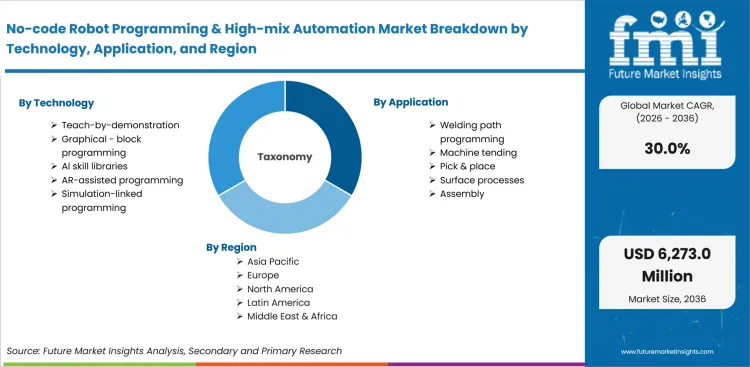
The no-code robot programming & high-mix automation industry is segmented by technology, application, deployment, end-use industry, user type, and region.
The report divides the market by technology, application, deployment, end-use industry, user type, and region. Technology covers teach-by-demonstration, block programming, AI skill libraries, AR-assisted tools, and simulation-linked programming. Applications include welding, machine tending, pick-and-place, surface processing, and assembly. Deployment compares local edge systems with cloud and hybrid models used for shared files or remote review. End-use coverage spans metal fabrication SMEs, automotive suppliers, electronics manufacturers, and machinery OEMs. User types include SMEs, system integrators, large enterprises, and education or research organizations.
How does teach-by-demonstration shape demand within the technology category?
Teach-by-demonstration records an operator's motion and converts it into a repeatable robot task for future batches. The method works well for visible paths and stable sequences with limited branching inside established cells. Tasks that depend on frequent sensor decisions need a different method and a deeper engineering review. Plant engineers judge repeatability and editing control instead of the appearance of the screen during approval. For a plant, the value comes from handling routine changes in-house without weakening process standards.
- By technology, teach-by-demonstration is estimated to hold 30.0% share in 2026 due to its direct learning method. Vention launched MachineBuilder 101 in May 2025 to teach users how to design and simulate complete automation systems in the cloud. The course lowers the learning barrier and lets a plant test a cell design with less outside help.
- Metal fabrication shops favor teach-by-demonstration for tasks based on knowledge already held by experienced welders, but each cell still needs an articulated robot that matches the intended weld path, reach, payload, and working angle. Reviewing the arm first prevents a simple interface from hiding limits in reach or working angle. That check prevents a fast programming method from masking a poor fit between the robot and the job.
What supports welding path programming within the application category?
Every fixture change or part variant in short-run welding resets the setup clock, since the torch path and angle have to be rebuilt from scratch rather than nudged from a prior job. The bar for success isn't how fast the new path gets built; it's whether the first parts off that path pass the same inspection standard as the last batch did. That's a harder test than most no-code claims get held to, because welding defects are rarely visible until a part fails a stress or fit check downstream.
- Welding path programming is expected to lead the application category with 24.0% share in 2026. Vention's March 2025 Click & Customize welding and tending cells package cell design and path setup together, a response to labor shortages that lets a shop buy a working process rather than assembling one piece by piece.
- Job shops and automotive suppliers, both running frequent fixture changes, tend to weigh a software upgrade against a full cell replacement by isolating what's actually causing downtime: a stale path library versus worn hardware. That distinction changes which purchase gets approved.
How do plant engineers evaluate on-premise or edge deployment?
Robot motion must remain predictable even during a slow or failed outside connection at an active production cell. Edge setups hold the active program near the cell and cloud services store design files or simulation libraries. The split gives maintenance staff clearer control over versions and user access during routine troubleshooting and recovery. Local control lowers the chance that a network issue stops time-sensitive motion during an active process. The final choice is about production continuity as much as control over programs and design files.
- On-premise or edge systems are forecast to hold 48.0% share in 2026 due to the need for local control. Vention introduced GRIIP in February 2026 with CAD-to-pick setup and local motion planning for high-variation cells. The release shows why these cells need fast setup without weakening control at the machine.
- Plant engineers favor edge systems that place safety and output decisions close to the robot cell, and machine vision adds local sensor processing to the same control choice in active production. Locating motion and sensor feedback near the cell makes fault finding easier during fixture changes or unexpected part positions. Maintenance staff gain one clear place to review the event and restore operation.
What are the drivers, restraints, and opportunities in the No-Code Robot Programming & High-Mix Automation Market?
Frequent part changes are projected to raise demand for tools that shorten robot setup across varied production runs. Accuracy and safety checks are anticipated to slow approval for products that lack clear process evidence. Robot-neutral platforms are estimated to widen use across factories that operate mixed robot fleets and older controllers.
- Driver: Short production runs are expected to raise demand for tools that reduce robot setup time between part families.
- Restraint: Accuracy and safety checks are anticipated to slow approval of products that offer a simple interface without clear process evidence.
- Opportunity: Robot-neutral platforms are projected to expand access across plants that operate several brands and older controllers.
A robot waiting for a specialist during a product change reduces output in high-mix plants. In October 2025, Vention used its annual Demo Day to present AI and developer platform updates for factory automation. The updates place path creation and robot control inside the same cell-design process. Code-free tools let trained staff handle routine path changes with less outside support. The clearest business case appears in plants that lose delivery time or expensive machine hours at each changeover.
An easy interface does not remove the engineering limits of welding or surface-finishing tasks. Machine tending brings checks for grip force and safe clearance around equipment in every cycle. In March 2026, Universal Robots introduced the UR AI Trainer with Scale AI to collect structured data from human-guided tasks in controlled cells. The project shows that learned behavior needs consistent examples and factory testing under real operating conditions. Code-free tools face the same standard: speed has no value if a revised path fails a safety or quality check.
Mixed robot fleets create demand for one programming method that works across established hardware brands. In June 2026, Vention and FANUC America announced plans to add FANUC industrial robots to Vention's automation platform. The work combines industrial robots with AI-based programming and digital twins to shorten cell design. The agreement supports faster design and commissioning without replacing proven equipment, while factory controls remain central to mixed-brand projects. Controller limits that remain hidden in a polished demo raise commissioning risk.
Which country CAGRs are profiled in the No-Code Robot Programming & High-Mix Automation Market?
| Country | CAGR |
|---|---|
| European Union | 29.0% |
| United States | 31.0% |
Source: FMI's proprietary forecasting model and primary research
How do country-level CAGRs compare in the No-Code Robot Programming & High-Mix Automation Market?
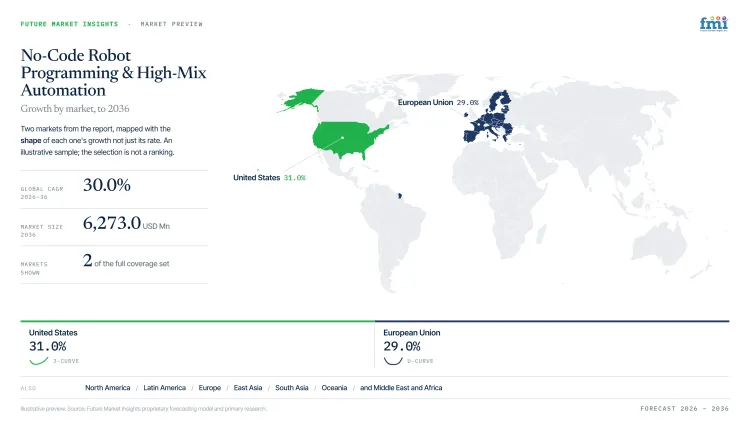
Metal fabricators place more emphasis on rapid payback from short-run automation, which lifts the United States outlook above the worldwide pace. Longer controller reviews and the need for local support place the European Union one percentage point below the global pace. Both markets value shorter setup cycles during regular product changes, but Europe gives more importance to cross-brand support. American reviews focus on labor coverage and the payback effect of idle equipment in short runs.
- European plants often modernize one cell at a time and operate several robot generations on the same floor. Demand in the European Union is projected to expand at 29.0% CAGR by 2036. Mixed fleets require careful controller checks and local engineering support in each production trial. In January 2026, Vention announced USD 110 million in financing to expand its platform and operations across North America and Europe. The investment gives Vention more resources for application support and regional service. Wandelbots provides a German example of robot-neutral control for mixed hardware systems. Machinery builders commonly request controller support records during a production trial. Regional growth depends on integration depth and service access instead of a polished interface alone.
- American metal fabricators often begin automation reviews with labor coverage and payback time for each project. United States industry is forecast to rise at 31.0% CAGR over the forecast period. Short production runs increase the cost of specialist programming across repeated part and fixture changes. In February 2026, the Association for Advancing Automation reported North American robot orders worth USD 579 million in the fourth quarter of 2025. The spending shows that manufacturers continue to fund automation under tighter project reviews and clearer payback tests. Universal Robots announced in December 2025 that its Metro Detroit operations hub would open during 2026. Local service gives smaller engineering groups a clearer support route once the first cell enters operation, and the broader robotics investment cycle reinforces this payback test across industrial automation projects.
Who are the notable companies in the No-Code Robot Programming & High-Mix Automation Market?
Wandelbots, Augmentus, Vention, RoboDK, and Universal Robots are the notable companies shaping this market.
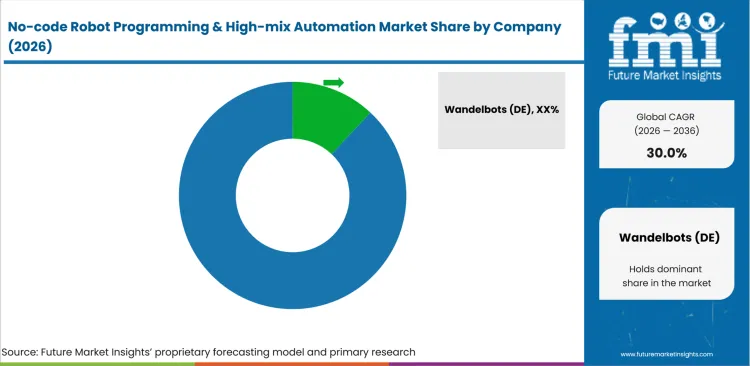
Competition comes from robot-neutral platforms and geometry specialists that build paths from part data for changing production tasks. Robot makers form a third group by simplifying setup inside their own product ranges and service networks. A formal review begins with supported robot brands and simulation quality. Training and local support then shape the final choice for manufacturers with small automation teams, especially as collaborative robots make guided programming familiar to smaller manufacturers and first-time automation users. No group covers every need in factories with mixed brands and long-lived equipment. A credible product must prove two things: the workflow is easy to edit and the result remains accurate during real part changes.
- Wandelbots and RoboDK support mixed fleets that use different controllers. RoboDK introduced RoboDK CAM in February 2026 to shorten setup for robotic machining, which shows how software depth is moving into application-specific workflows. Their value lies in reducing dependence on one hardware brand across long-lived equipment and future upgrades.
- Augmentus focuses on CAD-to-path and scan-to-path work for welding and surface treatment across changing part shapes. Its tools build paths from part data and correct measured variation directly at the robot cell. This focus makes scan accuracy and process control central to every technical review for commercial use.
- Vention links code-free programming with modular hardware and remote service for welding or machine-tending cells. The model suits manufacturers that prefer one contract from early cell design to full operation and service. Its value comes from reducing handoffs between design and commissioning staff during a new automation project.
- Universal Robots offers guided programming across its own cobot family and reduces setup work for trained technicians. The tradeoff is narrower support for mixed fleets that combine several robot brands on one floor. The narrower support is acceptable for plants that purchase hardware and training under one service agreement.
Competitive Benchmarking: No-Code Robot Programming & High-Mix Automation Market
| Company | No-Code Programming Depth | Multi-Brand Robot Support | High-Mix Application Fit | Service Reach |
|---|---|---|---|---|
| Wandelbots | High | High | High | Europe and North America / Regional |
| Augmentus | High | High | High | Asia and North America / Regional |
| Vention | High | Medium | High | North America and Europe / Regional |
| RoboDK | Medium | High | Medium | Global |
| Universal Robots | High | Low | Medium | Global |
Scoring basis: High means substantial direct capability supported by current official evidence. Medium means the company has relevant capability with limits in scope or application coverage. Low means official company material provides little direct evidence for that comparison.
Source: Future Market Insights competitive analysis, 2026. Ratings reflect relative portfolio relevance and workflow fit. Service capability and geographic reach shape the remaining comparison.
Key Developments in the No-Code Robot Programming & High-Mix Automation Market
- In April 2026, Augmentus, released Augmentus 3.0 with one-click toolpath generation and vision-guided correction for irregular metal parts in active factories. The new version adds native STEP-file import and true arc motion, which reduce manual point teaching across welding and finishing tasks.
- In October 2025, Universal Robots, introduced the UR18 collaborative robot with a compact design and familiar programming for higher-payload work in space-limited cells. The launch widened hardware choices for existing UR users and paired simpler setup with a higher-payload robot.
- In June 2025, Wandelbots, partnered with SoftServe to connect robot-neutral control with simulation and AI services across mixed-brand factories. The agreement reflects demand for programming methods that work across robot brands during line changes.
- In May 2025, Vention, made the MachineMotion AI controller commercially available with NVIDIA computing and built-in cellular access for secure remote service. The controller links code-free MachineLogic programming with local motion control in one platform, which reduces technical handoffs during commissioning and later process changes.
Key Players in the No-Code Robot Programming & High-Mix Automation Market
Robot-Neutral Programming Platforms
- Wandelbots
- RoboDK
Geometry-Based Path Programming Specialists
- Augmentus
Integrated Design-to-Cell Automation Providers
- Vention
Robot OEM Programming Platforms
- Universal Robots
No-Code Robot Programming & High-Mix Automation Market - Report Scope
| Coverage field | Report scope |
|---|---|
| Market breakdown | Technology, Application, Deployment, End-Use Industry, User Type, and Region |
| Quantitative Units | Revenue in USD Million, Volume in Units, CAGR in % |
| Market Definition | Software and connected tools that let operators program or reprogram industrial robots without writing traditional robot code for high-mix production. |
| Regions Covered | North America, Latin America, Europe, East Asia, South Asia, Oceania, and Middle East and Africa |
| Countries Covered | United States, Canada, Germany, United Kingdom, China, Japan, India, and 20+ countries within the regional model |
| Key Companies Profiled | Wandelbots, Augmentus, Vention, RoboDK, and Universal Robots |
| Forecast Period | 2026 to 2036 |
| Approach | Hybrid sizing that combines bottom-up company evidence with top-down application and country checks. |
Source: Future Market Insights - analysis driven by proprietary forecasting models and primary research
No-Code Robot Programming & High-Mix Automation Market - Research Methodology
| Method | Approach |
|---|---|
| Primary Research | FMI analysts gathered input from manufacturers, service providers, technology developers, distributors, end users, sourcing teams, and subject-matter experts. Interviews examined purchasing decisions, product or service evaluation, adoption barriers, approval requirements, pricing considerations, and expectations for technical or commercial support. Respondents were also asked what evidence is required before a trial, pilot, or initial order develops into regular purchasing. |
| Desk Research | Desk research covered government statistics, regulatory publications, trade data, industry associations, technical literature, standards, company filings, product information, and official corporate announcements. Sources were reviewed for relevance, publication date, geographic coverage, and consistency with the defined market scope. Claims relating to performance, applications, approvals, capacity, investment, and commercial activity were retained only when supported by credible public evidence. |
| Market Sizing and Forecasting | The market model combined the baseline value with historical performance, segment structure, pricing and volume indicators, adoption levels, company participation, and country-level demand conditions. Forecast assumptions considered economic activity, investment trends, regulatory developments, technology adoption, purchasing cycles, supply availability, and barriers to wider market use. Segment and regional estimates were reconciled before the final market total was calculated. |
| Data Validation | Estimates were checked against multiple independent indicators, including public data, company activity, trade patterns, industry developments, and findings from primary interviews. Validation also tested whether products, services, applications, and company revenues fell within the defined market boundaries. Adjacent categories, unsupported claims, overlapping revenues, and activities without direct market relevance were excluded to reduce double counting and maintain consistency across segments and countries. |
Source: Future Market Insights (FMI) analysis, based on proprietary forecasting model and primary research
No-Code Robot Programming & High-Mix Automation Market by Segments
No-Code Robot Programming & High-Mix Automation Market segmented by Technology:
- Teach-by-Demonstration
- Graphical or Block Programming
- AI Skill Libraries
- AR-Assisted Programming
- Simulation-Linked Programming
No-Code Robot Programming & High-Mix Automation Market segmented by Application:
- Welding Path Programming
- Machine Tending
- Pick and Place
- Surface Processes
- Assembly
No-Code Robot Programming & High-Mix Automation Market segmented by Deployment:
- On-Premise or Edge
- Cloud
- Hybrid
No-Code Robot Programming & High-Mix Automation Market segmented by End-Use Industry:
- Metal Fabrication SMEs
- Automotive Suppliers
- Electronics
- Machinery OEMs
- Others
No-Code Robot Programming & High-Mix Automation Market segmented by User Type:
- SMEs
- System Integrators
- Large Enterprises
- Education and Research
No-Code Robot Programming & High-Mix Automation Market by Region:
- North America
- United States
- Canada
- Latin America
- Brazil
- Mexico
- Argentina
- Europe
- Germany
- United Kingdom
- France
- Italy
- Spain
- East Asia
- China
- Japan
- South Korea
- South Asia
- India
- Thailand
- Indonesia
- Oceania
- Australia
- New Zealand
- Middle East and Africa
- GCC Countries
- South Africa
- Turkey
Research Sources and Bibliography
- Association for Advancing Automation. (2026, February 6). Robot Orders Grow 6.6% in 2025 as General Industries Drive Broader Automation Adoption. Association for Advancing Automation.
- Augmentus. (2026, April 30). One-Click Toolpath Generation, Vision-Guided Adaptive Robotics, and More - Augmentus 3.0. Augmentus.
- RoboDK. (2026, February 18). RoboDK CAM: The Solution Designed to Slash Robotic Machining Deployment Times. RoboDK.
- Universal Robots. (2025, October 6). Universal Robots Welcomes UR18 to Its Portfolio. Universal Robots.
- Universal Robots. (2025, December 9). New US Operations Hub to Open in 2026. Universal Robots.
- Universal Robots. (2026, March 16). Universal Robots and Scale AI launch imitation learning system to accelerate AI model training, bridging the 'lab-to-factory' gap. Universal Robots.
- Vention. (2025, March 13). Vention Unveils Click & Customize Robotic Work Cells -- Fast-Deploy Machine Tending & Welding Solutions to Address Manufacturing's Labor Crisis. Vention.
- Vention. (2025, May 5). Vention Announces Commercial Availability of MachineMotion AI - An AI-Ready Automation Controller with Built-In Cellular Connectivity. Vention.
- Vention. (2025, May 6). Vention Launches Online Design Certification to Close Talent Gap and Train the Next Generation of Automation Experts. Vention.
- Vention. (2025, October 29). Vention Advances Intelligent Manufacturing with Major AI and Developer Platform Expansions at 6th Annual Demo Day. Vention.
- Vention. (2026, January 27). Vention Raises $110M USD ($150M CAD) to Accelerate Physical AI Deployment Across Global Manufacturing. Vention.
- Vention. (2026, February 10). Vention Introduces GRIIP™: A Generalized Physical AI Pipeline for Manufacturing Automation. Vention.
- Vention. (2026, June 22). Vention and FANUC America Join Forces to Bring Industrial Robots to Vention's AI-Driven Hardware and Software Platform. Vention.
- Wandelbots. (2025, June 24). Wandelbots and SoftServe Partner to Accelerate Software-Defined Robotics with Physical AI. Wandelbots.
This bibliography is provided for reader reference and uses official industry-association and company sources.
This Report Answers
- What value is estimated for the no-code robot programming and high-mix automation market in 2026 and by 2036?
- What CAGR is projected for the market from 2026 to 2036?
- Which technology and application segments shape the disclosed demand outlook?
- Which production pressures support adoption across high-mix plants?
- How do European Union and United States CAGRs differ over the forecast period?
- Which companies compete on robot support and application fit?
- How does FMI validate software revenue and country forecasts?
- What should companies address before committing to a programming platform?
- How do process records and safety checks affect company selection?
Frequently Asked Questions
What is driving growth in the No-Code Robot Programming & High-Mix Automation Market?
Frequent changes to part designs alter paths and fixtures, so high-mix plants need faster robot changeovers. Code-free tools are expected to reduce specialist hours and maintain cell availability during regular changeovers.
Who are the key players in the No-Code Robot Programming & High-Mix Automation Market?
Wandelbots and RoboDK compete on support for mixed robot fleets and different controllers in established factories. Augmentus and Vention emphasize geometry-based paths or complete cells, while Universal Robots simplifies setup within one cobot family and support network.
What is a notable restraint in the No-Code Robot Programming & High-Mix Automation Market?
A simple interface does not remove process approval or safety testing for changed robot paths. Welding and finishing tasks need proof that revised motion preserves accuracy across changing parts during normal production.
Why should executives track the No-Code Robot Programming & High-Mix Automation Market?
Programming time affects whether automation remains economic across short runs with regular product changes over time. Executives should track tools that lower changeover cost without hiding integration work or process risk.
What business problem does the No-Code Robot Programming & High-Mix Automation Market address?
The market addresses delays caused by rewriting robot programs for each new part or fixture. It gives trained technicians a faster route from process knowledge to approved robot motion during each changeover.
What should procurement leaders evaluate before selecting suppliers?
A final platform review should cover supported robot brands and accuracy for the intended task. Companies should confirm simulation quality and local technical help during the commercial review for long-term use.
What limits return on investment for purchasers?
Returns fall if a platform needs repeated engineering help for every process change during operation. Weak links with existing controls add costs that reduce the expected savings from faster setup.
How do suppliers build long-term account confidence?
Companies earn long-term confidence by reproducing approved paths across repeated process changes without hidden rework. Clear version control and responsive technical help protect the relationship during later changes and future upgrades.
Preview the report firsthand - request a free sample
Get SampleGet the brochure for pricing and purchase details.
Get PDFTable of Content
- Key Takeaways
- Market Size and CAGR
- Top Growth Driver
- Fastest Growing Segment
- Leading Region
- Key Companies
- Emerging Opportunities
- Executive Summary
- Global Market Outlook
- Demand-side Trends
- Supply-side Trends
- Technology Roadmap Analysis
- Analysis and Recommendations
- Analyst Perspective (What is happening? Why now? What should investors know?)
- Key Questions Answered
- How large is the market?
- What is the CAGR?
- What are key trends?
- Which region dominates?
- Who are the leaders?
- Market Overview
- Market Coverage / Taxonomy
- Market Definition / Scope / Limitations
- Research Methodology
- Chapter Orientation
- Analytical Lens and Working Hypotheses
- Market Structure, Signals, and Trend Drivers
- Benchmarking and Cross-market Comparability
- Market Sizing, Forecasting, and Opportunity Mapping
- Research Design and Evidence Framework
- Desk Research Programme (Secondary Evidence)
- Expert Input and Fieldwork (Primary Evidence)
- Tooling, Models, and Reference Databases
- Data Engineering and Model Build
- Quality Assurance and Audit Trail
- Market Background
- Market Dynamics (Drivers, Restraints, Opportunity, Trends)
- Scenario Forecast (Optimistic, Likely, Conservative)
- Impact Analysis
- AI Impact
- Sustainability Impact
- Regulatory Impact
- Technology Impact
- Consumer / Buyer Analysis
- Purchase Drivers
- Adoption Barriers
- Buyer Journey
- Opportunity Map Analysis
- Product Life Cycle Analysis
- Supply Chain Analysis
- Investment Feasibility Matrix
- Value Chain Analysis
- PESTLE and Porter's Analysis
- Regulatory Landscape
- Regional Parent Market Outlook
- Production and Consumption Statistics
- Import and Export Statistics
- Global Market Analysis and Forecast, 2021 to 2036
- Historical Market Size Value (USD Mn) Analysis, 2021 to 2025
- Current and Future Market Size Value (USD Mn) Projections, 2026 to 2036
- Y-o-Y Growth Trend Analysis
- Absolute $ Opportunity Analysis
- Global Market Pricing Analysis, 2021 to 2036
- Global Market Analysis and Forecast, By Technology, 2021 to 2036
- Introduction / Key Findings
- Historical Market Size Value (USD Mn) Analysis By Technology, 2021 to 2025
- Current and Future Market Size Value (USD Mn) Analysis and Forecast By Technology, 2026 to 2036
- Teach-by-demonstration
- Graphical - block programming
- AI skill libraries
- AR-assisted programming
- Simulation-linked programming
- Teach-by-demonstration
- Y-o-Y Growth Trend Analysis By Technology, 2021 to 2025
- Absolute $ Opportunity Analysis By Technology, 2026 to 2036
- Global Market Analysis and Forecast, By Application, 2021 to 2036
- Introduction / Key Findings
- Historical Market Size Value (USD Mn) Analysis By Application, 2021 to 2025
- Current and Future Market Size Value (USD Mn) Analysis and Forecast By Application, 2026 to 2036
- Welding path programming
- Machine tending
- Pick & place
- Surface processes
- Assembly
- Welding path programming
- Y-o-Y Growth Trend Analysis By Application, 2021 to 2025
- Absolute $ Opportunity Analysis By Application, 2026 to 2036
- Global Market Analysis and Forecast, By Deployment, 2021 to 2036
- Introduction / Key Findings
- Historical Market Size Value (USD Mn) Analysis By Deployment, 2021 to 2025
- Current and Future Market Size Value (USD Mn) Analysis and Forecast By Deployment, 2026 to 2036
- On-premise - edge
- Cloud
- Hybrid
- On-premise - edge
- Y-o-Y Growth Trend Analysis By Deployment, 2021 to 2025
- Absolute $ Opportunity Analysis By Deployment, 2026 to 2036
- Global Market Analysis and Forecast, By End-use Industry, 2021 to 2036
- Introduction / Key Findings
- Historical Market Size Value (USD Mn) Analysis By End-use Industry, 2021 to 2025
- Current and Future Market Size Value (USD Mn) Analysis and Forecast By End-use Industry, 2026 to 2036
- Metal fabrication SMEs
- Automotive suppliers
- Electronics
- Machinery OEMs
- Others
- Metal fabrication SMEs
- Y-o-Y Growth Trend Analysis By End-use Industry, 2021 to 2025
- Absolute $ Opportunity Analysis By End-use Industry, 2026 to 2036
- Global Market Analysis and Forecast, By User Type, 2021 to 2036
- Introduction / Key Findings
- Historical Market Size Value (USD Mn) Analysis By User Type, 2021 to 2025
- Current and Future Market Size Value (USD Mn) Analysis and Forecast By User Type, 2026 to 2036
- SMEs
- System integrators
- Large enterprises
- Education & research
- SMEs
- Y-o-Y Growth Trend Analysis By User Type, 2021 to 2025
- Absolute $ Opportunity Analysis By User Type, 2026 to 2036
- Global Market Analysis and Forecast, By Region, 2021 to 2036
- Introduction
- Historical Market Size Value (USD Mn) Analysis By Region, 2021 to 2025
- Current Market Size Value (USD Mn) Analysis and Forecast By Region, 2026 to 2036
- North America
- Latin America
- Western Europe
- Eastern Europe
- East Asia
- South Asia and Pacific
- Middle East & Africa
- Market Attractiveness Analysis By Region
- North America Market Analysis and Forecast, By Country, 2021 to 2036
- Historical Market Size Value (USD Mn) Trend Analysis By Market Taxonomy, 2021 to 2025
- Market Size Value (USD Mn) Forecast By Market Taxonomy, 2026 to 2036
- By Country
- USA
- Canada
- By Technology
- By Application
- By Deployment
- By End-use Industry
- By User Type
- By Country
- Market Attractiveness Analysis
- By Country
- By Technology
- By Application
- By Deployment
- By End-use Industry
- By User Type
- Key Takeaways
- Latin America Market Analysis and Forecast, By Country
- Historical Market Size Value (USD Mn) Trend Analysis By Market Taxonomy, 2021 to 2025
- Market Size Value (USD Mn) Forecast By Market Taxonomy, 2026 to 2036
- By Country
- Brazil
- Mexico
- Chile
- Rest of Latin America
- By Technology
- By Application
- By Deployment
- By End-use Industry
- By User Type
- By Country
- Market Attractiveness Analysis
- By Country
- By Technology
- By Application
- By Deployment
- By End-use Industry
- By User Type
- Key Takeaways
- Western Europe Market Analysis and Forecast, By Country
- Historical Market Size Value (USD Mn) Trend Analysis By Market Taxonomy, 2021 to 2025
- Market Size Value (USD Mn) Forecast By Market Taxonomy, 2026 to 2036
- By Country
- Germany
- UK
- Italy
- Spain
- France
- Nordic
- BENELUX
- Rest of Western Europe
- By Technology
- By Application
- By Deployment
- By End-use Industry
- By User Type
- By Country
- Market Attractiveness Analysis
- By Country
- By Technology
- By Application
- By Deployment
- By End-use Industry
- By User Type
- Key Takeaways
- Eastern Europe Market Analysis and Forecast, By Country
- Historical Market Size Value (USD Mn) Trend Analysis By Market Taxonomy, 2021 to 2025
- Market Size Value (USD Mn) Forecast By Market Taxonomy, 2026 to 2036
- By Country
- Russia
- Poland
- Hungary
- Balkan & Baltic
- Rest of Eastern Europe
- By Technology
- By Application
- By Deployment
- By End-use Industry
- By User Type
- By Country
- Market Attractiveness Analysis
- By Country
- By Technology
- By Application
- By Deployment
- By End-use Industry
- By User Type
- Key Takeaways
- East Asia Market Analysis and Forecast, By Country
- Historical Market Size Value (USD Mn) Trend Analysis By Market Taxonomy, 2021 to 2025
- Market Size Value (USD Mn) Forecast By Market Taxonomy, 2026 to 2036
- By Country
- China
- Japan
- South Korea
- By Technology
- By Application
- By Deployment
- By End-use Industry
- By User Type
- By Country
- Market Attractiveness Analysis
- By Country
- By Technology
- By Application
- By Deployment
- By End-use Industry
- By User Type
- Key Takeaways
- South Asia and Pacific Market Analysis and Forecast, By Country
- Historical Market Size Value (USD Mn) Trend Analysis By Market Taxonomy, 2021 to 2025
- Market Size Value (USD Mn) Forecast By Market Taxonomy, 2026 to 2036
- By Country
- India
- ASEAN
- Australia & New Zealand
- Rest of South Asia and Pacific
- By Technology
- By Application
- By Deployment
- By End-use Industry
- By User Type
- By Country
- Market Attractiveness Analysis
- By Country
- By Technology
- By Application
- By Deployment
- By End-use Industry
- By User Type
- Key Takeaways
- Middle East & Africa Market Analysis and Forecast, By Country
- Historical Market Size Value (USD Mn) Trend Analysis By Market Taxonomy, 2021 to 2025
- Market Size Value (USD Mn) Forecast By Market Taxonomy, 2026 to 2036
- By Country
- Kingdom of Saudi Arabia
- Other GCC Countries
- Türkiye
- South Africa
- Other African Union
- Rest of Middle East & Africa
- By Technology
- By Application
- By Deployment
- By End-use Industry
- By User Type
- By Country
- Market Attractiveness Analysis
- By Country
- By Technology
- By Application
- By Deployment
- By End-use Industry
- By User Type
- Key Takeaways
- Key Countries Market Analysis
- USA
- Pricing Analysis
- Market Share Analysis, 2025
- By Technology
- By Application
- By Deployment
- By End-use Industry
- By User Type
- Canada
- Pricing Analysis
- Market Share Analysis, 2025
- By Technology
- By Application
- By Deployment
- By End-use Industry
- By User Type
- Mexico
- Pricing Analysis
- Market Share Analysis, 2025
- By Technology
- By Application
- By Deployment
- By End-use Industry
- By User Type
- Brazil
- Pricing Analysis
- Market Share Analysis, 2025
- By Technology
- By Application
- By Deployment
- By End-use Industry
- By User Type
- Chile
- Pricing Analysis
- Market Share Analysis, 2025
- By Technology
- By Application
- By Deployment
- By End-use Industry
- By User Type
- Germany
- Pricing Analysis
- Market Share Analysis, 2025
- By Technology
- By Application
- By Deployment
- By End-use Industry
- By User Type
- UK
- Pricing Analysis
- Market Share Analysis, 2025
- By Technology
- By Application
- By Deployment
- By End-use Industry
- By User Type
- Italy
- Pricing Analysis
- Market Share Analysis, 2025
- By Technology
- By Application
- By Deployment
- By End-use Industry
- By User Type
- Spain
- Pricing Analysis
- Market Share Analysis, 2025
- By Technology
- By Application
- By Deployment
- By End-use Industry
- By User Type
- France
- Pricing Analysis
- Market Share Analysis, 2025
- By Technology
- By Application
- By Deployment
- By End-use Industry
- By User Type
- India
- Pricing Analysis
- Market Share Analysis, 2025
- By Technology
- By Application
- By Deployment
- By End-use Industry
- By User Type
- ASEAN
- Pricing Analysis
- Market Share Analysis, 2025
- By Technology
- By Application
- By Deployment
- By End-use Industry
- By User Type
- Australia & New Zealand
- Pricing Analysis
- Market Share Analysis, 2025
- By Technology
- By Application
- By Deployment
- By End-use Industry
- By User Type
- China
- Pricing Analysis
- Market Share Analysis, 2025
- By Technology
- By Application
- By Deployment
- By End-use Industry
- By User Type
- Japan
- Pricing Analysis
- Market Share Analysis, 2025
- By Technology
- By Application
- By Deployment
- By End-use Industry
- By User Type
- South Korea
- Pricing Analysis
- Market Share Analysis, 2025
- By Technology
- By Application
- By Deployment
- By End-use Industry
- By User Type
- Russia
- Pricing Analysis
- Market Share Analysis, 2025
- By Technology
- By Application
- By Deployment
- By End-use Industry
- By User Type
- Poland
- Pricing Analysis
- Market Share Analysis, 2025
- By Technology
- By Application
- By Deployment
- By End-use Industry
- By User Type
- Hungary
- Pricing Analysis
- Market Share Analysis, 2025
- By Technology
- By Application
- By Deployment
- By End-use Industry
- By User Type
- Kingdom of Saudi Arabia
- Pricing Analysis
- Market Share Analysis, 2025
- By Technology
- By Application
- By Deployment
- By End-use Industry
- By User Type
- Türkiye
- Pricing Analysis
- Market Share Analysis, 2025
- By Technology
- By Application
- By Deployment
- By End-use Industry
- By User Type
- South Africa
- Pricing Analysis
- Market Share Analysis, 2025
- By Technology
- By Application
- By Deployment
- By End-use Industry
- By User Type
- USA
- Market Structure Analysis
- Competition Dashboard
- Competition Benchmarking
- Market Share Analysis of Top Players
- By Regional
- By Technology
- By Application
- By Deployment
- By End-use Industry
- By User Type
- Emerging Startups
- Innovation Benchmarking
- Competition Analysis
- Competition Deep Dive
- Wandelbots (DE)
- Overview
- Product Portfolio
- Profitability by Market Segments
- Sales Footprint
- Strategy Overview
- Marketing Strategy
- Product Strategy
- Channel Strategy
- RoboDK (CA)
- Augmentus (SG)
- Wandelbots (DE)
- Case Studies
- Success Stories
- Recent Developments
- Competition Deep Dive
- Assumptions & Acronyms Used


