

- Market Size (2026)
- USD 4.5 Bn
- Forecast (2036)
- USD 10.8 Bn
- CAGR (2026 to 2036)
- 9.1%
How big is Non-Invasive Diagnostics for Fibrotic Diseases Market in 2026?
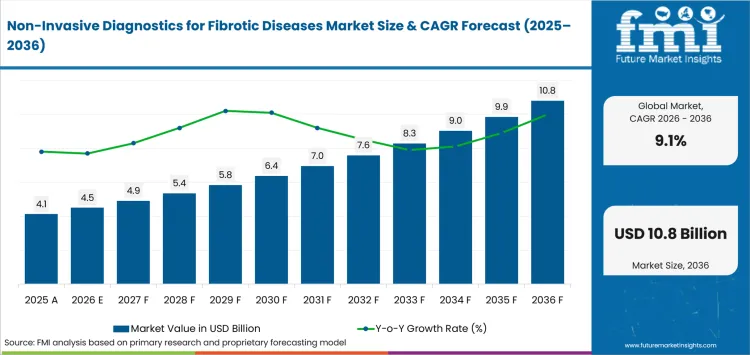
USD 4.5 billion in 2026 and USD 10.8 billion by 2036 at a 9.1% CAGR.
Demand for non-invasive diagnostics for fibrotic diseases is projected to expand from USD 4.5 billion in 2026 to USD 10.8 billion by 2036, growing at a CAGR of 9.1% through the forecast period. Growth depends less on test availability than on whether results can clear a practical bar, imaging and biomarker outputs must be reproducible across sites, interpretable within a defined clinical context, and tied to an actual care pathway rather than existing as a standalone data point. Clinical guidance is giving these tests that pathway role across diagnosis, staging, and monitoring. AASLD maintains separate guidance tracks for blood based and imaging based liver disease assessment, while EASL addresses non-invasive evaluation of disease severity and prognosis, giving clinicians defined points at which each modality applies. NHLBI extends this logic beyond liver disease by identifying imaging and lung function tests as core components of pulmonary fibrosis diagnosis and follow-up, broadening demand across organ systems rather than concentrating it in a single disease area.
Restraints include variability in how imaging results are interpreted across centers and the slow pace at which some biomarker tests achieve broad clinical validation. Opportunity lies in standardized scoring systems and multi marker panels that reduce interpretation variability while supporting longitudinal monitoring. Segment level activity spans imaging modalities, blood based biomarker tests, and combination diagnostic panels. Regionally, North America and Europe lead on guideline maturity, while Asia Pacific adoption tracks rising fibrotic disease burden and diagnostic infrastructure investment.
Key Takeaways of Non-Invasive Diagnostics for Fibrotic Diseases Market
- Imaging systems is estimated at 44.0% of product type demand in 2026.
- Liver fibrosis is projected at 42.0% of disease type demand in 2026.
- Ultrasound elastography is forecast at 39.0% of technology demand in 2026.
- Hospitals are estimated at 43.0% of End User demand, while disease diagnosis accounts for 46.0% of application demand in 2026.
- Inflammation, comorbidities, acquisition conditions and modality differences can limit comparability across non-invasive results.
- GE HealthCare, Siemens Healthineers, Canon Medical Systems, FUJIFILM Healthcare, Philips Healthcare, Echosens, Roche Diagnostics, Abbott Laboratories and Fibronostics serve imaging, elastography or diagnostic-platform routes.
Analyst Perspective
"Non-invasive fibrosis assessment is shifting from isolated measurements toward linked evidence pathways. Suppliers that connect imaging, biomarkers and repeat monitoring can support earlier decisions while preserving the clinical safeguards needed before biopsy is deferred."
- Anurag Sharma, Principal Consultant at Future Market Insights
How is the Non-Invasive Diagnostics for Fibrotic Diseases Market segmented?
The non-invasive diagnostics for fibrotic diseases market is segmented by product type, disease type, technology, end user, application and region.
Product type covers imaging systems, biomarker tests, molecular diagnostics and other software or point-of-care routes. Disease type separates liver, pulmonary, kidney and other fibrotic disorders. Technology includes ultrasound elastography, magnetic resonance imaging and biomarker-based diagnostics. End user and application categories distinguish where the tests are used and whether the primary task is diagnosis, monitoring or drug development.
Why does disease diagnosis lead the application category?
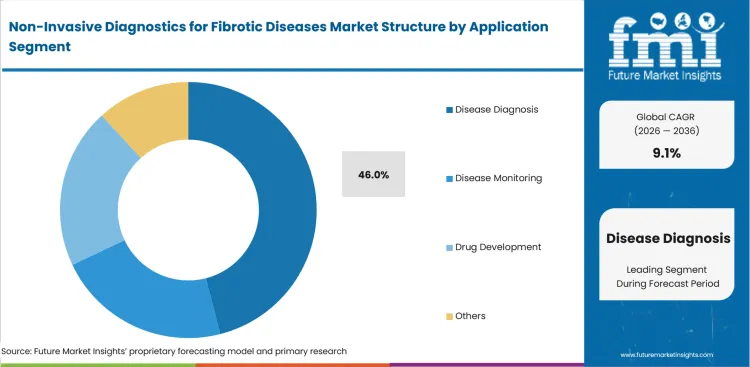
Diagnosis is the entry point for patients with suspected fibrosis and establishes whether additional staging, monitoring or specialist review is required. The same non-invasive measures can later support treatment-response assessment and disease-progression tracking.
- Disease Diagnosis is projected to account for 46.0% of application demand in 2026 because early detection and differential diagnosis precede most monitoring pathways.
- NHLBI identifies high-resolution CT and other tests in pulmonary fibrosis diagnosis, while liver guidance uses blood-based and imaging-based assessment to determine risk and the need for further investigation.
Why do imaging systems lead the product type category?
Imaging systems provide a direct route to tissue stiffness and structural assessment without requiring surgical sampling for every evaluation. Their value is strongest where clinicians need repeat measurements that can be reviewed alongside laboratory results and prior scans.
- Based on product type, Imaging Systems is projected to account for 44.0% in 2026 because elastography and diagnostic imaging are established entry points for fibrosis assessment.
- AASLD and EASL place imaging-based and tissue-property methods within non-invasive liver assessment pathways, supporting demand for systems that can stage disease and monitor change over time.
Why does liver fibrosis lead the disease type category?
Liver fibrosis has the most developed set of blood-based scores, elastography methods and clinical pathways within the market. Testing can support initial risk stratification, specialist referral and longitudinal monitoring across metabolic and hepatitis-related disease.
- Liver Fibrosis is expected to lead the disease type category with 42.0% share in 2026 due to dedicated guidance and established non-invasive testing routes.
- NICE, AASLD, EASL and several national societies describe blood-based or elastography-led assessment for chronic liver disease, giving the category a clearer purchasing pathway than less standardized fibrosis indications.
Why does ultrasound elastography lead the technology category?
Ultrasound elastography measures tissue stiffness during an ultrasound-led examination and can be deployed across hospital, diagnostic-center and specialist settings. Transient and shear-wave approaches offer a practical balance between measurement speed, repeat use and workflow integration.
- Ultrasound Elastography is forecast to account for 39.0% of technology demand in 2026 because stiffness measurement can be incorporated into familiar ultrasound workflows.
- Official materials from Siemens Healthineers, Philips, Canon Medical Systems, FUJIFILM Healthcare, Echosens and Hologic document liver stiffness or elastography capabilities, supporting the breadth of supplier participation in this segment.
Why do hospitals lead the end user category?
Hospitals can combine imaging, laboratory assessment, specialist review and repeat follow-up within one operating environment. This makes them the main setting for cases that require differential diagnosis, confirmatory testing or coordination across several clinical departments.
- Hospitals are estimated to hold 43.0% of end user demand in 2026 because they concentrate diagnostic equipment, laboratories and specialist interpretation.
- Hospital-based pathways can sequence blood tests, elastography, CT or MRI and biopsy when required, while diagnostic centers and research organizations serve narrower imaging, testing or study functions.
What are the drivers, restraints and opportunities in the Non-Invasive Diagnostics for Fibrotic Diseases Market?
Guideline-backed pathways support repeatable assessment, while biological and technical confounders limit stand-alone interpretation as integrated testing expands across care and drug development.
- Driver: Clinical guidance gives blood-based, elastography and imaging tests defined roles in fibrosis assessment and referral.
- Restraint: Inflammation, comorbidities, operator conditions and platform variability can affect the meaning of a result.
- Opportunity: Connected algorithms can sequence triage, imaging and monitoring across clinical care and drug-development workflows.
Guideline-backed pathways reduce uncertainty about when a non-invasive test should be used. AASLD separates blood-based and imaging-based assessment, NICE supports FibroScan outside specialist care and Canadian guidance recommends a two-step blood-based followed by imaging-based route for MASLD risk stratification.
A non-invasive measurement is not a complete clinical conclusion. FDA workshop materials note that elastography cannot separate the relative contribution of inflammation and fibrosis to liver stiffness, while national guidance stresses patient context and technical quality. These limitations sustain demand for confirmatory testing and specialist interpretation.
Integrated algorithms create a route from first-line triage to imaging and follow-up. Roche launched its Liver Disease Panel in May 2026 with certified algorithms for chronic liver disease management, while non-invasive biomarkers remain relevant to clinical trials when their relationship to disease biology and treatment response is established.
Which country CAGRs are profiled in the Non-Invasive Diagnostics for Fibrotic Diseases Market?
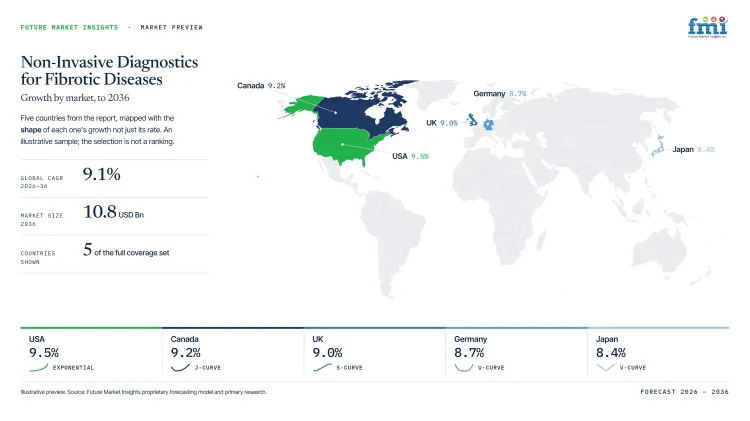
| Country | CAGR |
|---|---|
| USA | 9.5% |
| Canada | 9.2% |
| UK | 9.0% |
| Germany | 8.7% |
| Japan | 8.4% |
How do country-level CAGRs compare in the Non-Invasive Diagnostics for Fibrotic Diseases Market?
The country comparison spans 1.1 percentage points and reveals three distinct growth groups across the non-invasive diagnostics for fibrotic diseases market. The USA and Canada form the upper tier with a 0.3-point gap, while the UK and Germany create a closely aligned middle group separated by 0.3 percentage points. Japan remains at the lower end with a 0.3-point gap from Germany.
- The USA leads the comparison at a 9.5% CAGR through 2036, supported by established diagnostic infrastructure, specialist testing pathways and adoption of advanced fibrosis assessment.
- Canada follows at a 9.2% CAGR, remaining 0.3 percentage points below the USA. Expanding access to non-invasive testing and structured diagnostic pathways support adoption across healthcare settings.
- The UK records a 9.0% CAGR, 0.2 percentage points below Canada. Organized healthcare pathways and increasing use of non-invasive assessment support steady diagnostic demand.
- Germany grows at an 8.7% CAGR, remaining 0.3 percentage points below the UK. Established healthcare infrastructure and growing use of non-invasive diagnostic approaches support market expansion.
- Japan records an 8.4% CAGR, 0.3 percentage points below Germany and the lowest among the profiled countries. Specialist diagnostic capacity and continued adoption of less-invasive fibrosis assessment methods support gradual growth.
Comparable CAGRs can still produce different market-entry conditions. Differences in clinical guidance, reimbursement, diagnostic infrastructure, equipment access and specialist capacity influence adoption of non-invasive diagnostics for fibrotic diseases across countries. The full report provides country-level CAGR analysis across major regions and individual markets within the non-invasive diagnostics for fibrotic diseases market.
Country-wise Analysis
- The USA is projected to expand at 9.5% CAGR. AASLD maintains guidance for blood-based and imaging-based non-invasive liver disease assessment, while FDA activity continues to examine the role and limits of biomarkers in drug development. The opportunity spans imaging systems, biomarker tests and workflow integration across clinical and research settings.
- Canada is forecast to grow at 9.2% CAGR. Canadian Association of Radiologists guidance recommends a two-step blood-based followed by imaging-based investigation for MASLD risk stratification in primary care. This sequence supports demand for biomarker tests, elastography and referral workflows that preserve measurement quality between settings.
- The UK is expected to record 9.0% CAGR. NICE states that FibroScan outside secondary and specialist care has the potential to detect liver disease earlier. Wider access can expand first-line assessment, although services still need referral rules and quality control for patients with indeterminate or high-risk results.
- Germany is forecast to grow at 8.7% CAGR. DGVS guidance gives preference to transient elastography over other non-invasive methods for liver fibrosis assessment. The market therefore has a defined elastography-led use case, while test interpretation still depends on clinical context and technical quality.
- Japan is expected to record 8.4% CAGR. Japanese ultrasound guidance describes transient elastography, real-time tissue elastography and shear-wave methods for liver assessment. Buyers are likely to emphasize protocol consistency and reproducibility within the lowest-growth country profile in the assessed set.
Who are the notable companies in the Non-Invasive Diagnostics for Fibrotic Diseases Market?
GE HealthCare, Siemens Healthineers, Canon Medical Systems, FUJIFILM Healthcare, Philips Healthcare, Echosens, Roche Diagnostics, Abbott Laboratories and Fibronostics are the notable companies serving the market.
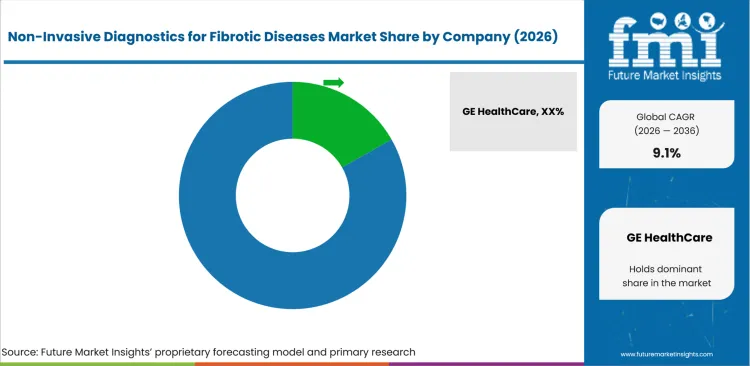
Competition spans broad imaging manufacturers, specialist elastography providers and diagnostic-platform companies. Imaging suppliers compete through measurement reproducibility, installed workflow and multiparametric assessment, while biomarker companies compete through assay access, algorithms and integration with laboratory systems.
- GE HealthCare, Siemens Healthineers, Canon Medical Systems, FUJIFILM Healthcare and Philips Healthcare serve ultrasound-led liver assessment and adjacent imaging workflows.
- Echosens provide specialist elastography routes for liver stiffness assessment and monitoring.
- Roche Diagnostics, Abbott Laboratories and Fibronostics represent biomarker or diagnostic-platform participation, although exact fibrosis-specific capability evidence differs by company.
Competitive Benchmarking: Non-Invasive Diagnostics for Fibrotic Diseases Market
| Company | Imaging / Elastography | Monitoring / Workflow | Evidence-backed company coverage |
|---|---|---|---|
| GE HealthCare | High | High | LOGIQ ultrasound and liver assessment workflows |
| Siemens Healthineers | High | High | Virtual Touch ARFI and shear-wave elastography |
| Canon Medical Systems | High | High | Multiparametric ultrasound liver analysis |
| FUJIFILM Healthcare | High | High | RTE, SWM and SWE liver assessment |
| Philips Healthcare | High | High | ElastQ and Auto ElastQ liver stiffness assessment |
| Echosens | High | High | FibroScan VCTE stiffness assessment and monitoring |
| Roche Diagnostics | Not rated | High | Liver Disease Panel, LiverPRO and Elecsys PRO-C3 |
| Abbott Laboratories | Not rated | Not rated | Named diagnostics company in the assessed company set |
| Fibronostics | Not rated | Not rated | Named diagnostics company in the assessed company set |
Key Developments in the Non-Invasive Diagnostics for Fibrotic Diseases Market
- In February 2025, Philips announced new AI-assisted workflow and quantitative measurement functions for its EPIQ Elite and Affiniti ultrasound systems.
- In October 2025, FUJIFILM Healthcare Europe announced an ARIETTA 850 FF ENDO software upgrade for EUS-guided liver attenuation measurement and 2D shear-wave elastography.
- In May 2026, Roche launched the Liver Disease Panel with certified algorithms to support chronic liver disease management and fibrosis risk assessment.
Key Players in the Non-Invasive Diagnostics for Fibrotic Diseases Market
Imaging and Elastography Systems
- GE HealthCare
- Siemens Healthineers
- Canon Medical Systems
- FUJIFILM Healthcare
- Philips Healthcare
Specialist Liver Assessment
- Echosens
Biomarker and Diagnostic Platforms
- Roche Diagnostics
- Abbott Laboratories
- Fibronostics
Non-Invasive Diagnostics for Fibrotic Diseases Market - Report Scope
| Coverage field | Report scope |
|---|---|
| Market breakdown | By product type, disease type, technology, end user, application and region. |
| Quantitative Units | Revenue in USD billion and CAGR in %. |
| Market Definition | Products, software and related services used to assess fibrotic disease through imaging, biomarker, molecular or point-of-care methods without surgical tissue sampling as the routine first step. |
| Regions Covered | North America, Latin America, Europe, East Asia, South Asia and Pacific, and Middle East and Africa. |
| Countries Covered | South Korea, USA, Canada, UK, Australia, Germany, Japan, and additional countries included in the full report. |
| Key Companies Profiled | GE HealthCare, Siemens Healthineers, Canon Medical Systems, FUJIFILM Healthcare, Philips Healthcare, Echosens, Roche Diagnostics, Abbott Laboratories and Fibronostics. |
| Forecast Period | 2026 to 2036. |
| Approach | Primary and secondary research with market triangulation. |
Non-Invasive Diagnostics for Fibrotic Diseases Market - Research Methodology
| Method | Approach |
|---|---|
| Primary Research | FMI analysts gathered input from manufacturers, distributors, hospitals, diagnostic centers, pharmaceutical companies, research organizations and subject-matter experts. Interviews examined test selection, workflow integration, evidence requirements, adoption barriers, pricing and the conditions required for pilot use to become regular purchasing. |
| Desk Research | Desk research covered clinical guidelines, regulator documents, technical literature, company filings, product information and official corporate announcements. Claims related to performance, applications, approvals and commercial activity were retained only when supported by credible public evidence. |
| Market Sizing and Forecasting | The market model combined the baseline value with segment structure, pricing and volume indicators, diagnostic capacity, technology adoption, company participation and country-level demand conditions. Segment and regional estimates were reconciled before the final total was calculated. |
| Data Validation | Estimates were checked against multiple indicators, including public evidence, company activity, clinical pathways and findings from primary interviews. Adjacent categories, unsupported claims and overlapping revenues were excluded to reduce double counting. |
Non-Invasive Diagnostics for Fibrotic Diseases Market by Segments
Non-Invasive Diagnostics for Fibrotic Diseases Market segmented by Product Type:
- Imaging Systems
- Elastography Systems
- Ultrasound-Based Imaging
- Biomarker Tests
- Serum Biomarkers
- Blood-Based Assays
- Molecular Diagnostics
- Genetic Biomarkers
- Transcriptomic Tests
- Others
- AI Diagnostic Software
- Point-of-Care Diagnostic Kits
Non-Invasive Diagnostics for Fibrotic Diseases Market segmented by Disease Type:
- Liver Fibrosis
- NAFLD-NASH
- Hepatitis-Related Fibrosis
- Pulmonary Fibrosis
- Idiopathic Pulmonary Fibrosis
- Interstitial Lung Disease
- Kidney Fibrosis
- Chronic Kidney Disease
- Diabetic Nephropathy
- Others
- Cardiac Fibrosis
- Systemic Fibrotic Disorders
Non-Invasive Diagnostics for Fibrotic Diseases Market segmented by Technology:
- Ultrasound Elastography
- Transient Elastography
- Shear Wave Elastography
- Magnetic Resonance Imaging
- MR Elastography
- Functional MRI
- Biomarker-Based Diagnostics
- Protein Biomarkers
- Multi-Analyte Panels
- Others
- AI-Assisted Image Analysis
- Hybrid Diagnostic Platforms
Non-Invasive Diagnostics for Fibrotic Diseases Market segmented by End User:
- Hospitals
- Tertiary Care Hospitals
- Specialty Hospitals
- Diagnostic Centers
- Imaging Centers
- Independent Laboratories
- Academic & Research Institutes
- Clinical Research Centers
- Universities
- Others
- Pharmaceutical Companies
- CROs
Non-Invasive Diagnostics for Fibrotic Diseases Market segmented by Application:
- Disease Diagnosis
- Early Disease Detection
- Differential Diagnosis
- Disease Monitoring
- Treatment Response Monitoring
- Disease Progression Assessment
- Drug Development
- Clinical Trials
- Biomarker Validation
- Others
- Population Screening
- Personalized Medicine
Non-Invasive Diagnostics for Fibrotic Diseases Market by Region:
- North America
- United States
- Canada
- Mexico
- Latin America
- Brazil
- Chile
- Rest of Latin America
- Western Europe
- Germany
- United Kingdom
- Italy
- Spain
- France
- Nordics
- Benelux
- Rest of Western Europe
- Eastern Europe
- Russia
- Poland
- Hungary
- Balkan and Baltic States
- Rest of Eastern Europe
- East Asia
- China
- Japan
- South Korea
- South Asia and Pacific
- India
- ASEAN
- Australia and New Zealand
- Rest of South Asia and Pacific
- Middle East and Africa
- Kingdom of Saudi Arabia
- Other GCC Countries
- Türkiye
- South Africa
- Other African Union Countries
- Rest of Middle East and Africa
Research Sources and Bibliography
- American Association for the Study of Liver Diseases. (accessed 2026). Noninvasive Liver Disease Assessment.
- European Association for the Study of the Liver. (2021). EASL Clinical Practice Guidelines on non-invasive tests for evaluation of liver disease severity and prognosis - 2021 update.
- USA Food and Drug Administration. (2023). Non-invasive tests as Diagnostic Biomarkers and Surrogate Endpoints for NASH Clinical Trials Workshop.
- National Heart, Lung, and Blood Institute. (2024). Tests for Lung Disease.
- National Heart, Lung, and Blood Institute. (accessed 2026). Pulmonary Fibrosis - Diagnosis.
- National Institute for Health and Care Excellence. (2023). FibroScan for assessing liver fibrosis and cirrhosis outside secondary and specialist care.
- Canadian Association of Radiologists. (2025). CAR MASLD Guidelines Part 2: Recommendations for Risk Stratifying Patients with MASLD.
- Korean Association for the Study of the Liver. (2024). KASL clinical practice guidelines for noninvasive tests to assess liver fibrosis in chronic liver disease.
- Deutsche Gesellschaft für Gastroenterologie, Verdauungs- und Stoffwechselkrankheiten. (accessed 2026). Bei welchen Patienten ist eine Leberbiopsie indiziert, bei welchen Patienten eine nicht-invasive Fibrose-Diagnostik?
- Japanese Society for Ultrasound in Medicine. (accessed 2026). Guidelines for the performance of liver elastography.
- Australian Liver Foundation. (accessed 2026). FIB-4 Calculator.
- Philips. (2025, February 14). Philips' new AI-assisted workflow and quantitative measurement functions in the EPIQ Elite and Affiniti ultrasound systems speed up exams and increase clinical confidence.
- FUJIFILM Healthcare Europe. (2025, October 15). FUJIFILM's New ARIETTA 850 FF ENDO Upgrade for Endoscopic Ultrasound including Attenuation Measurement and 2D Shear Wave Elastography.
- Roche. (2026, May 27). Roche launches the Liver Disease Panel, the first suite of certified algorithms to support Chronic Liver Disease management.
- GE HealthCare. (accessed 2026). Smart ultrasound tool to scan for liver steatosis.
- Siemens Healthineers. (accessed 2026). Ultrasound Elastography.
- Canon Medical Systems. (accessed 2026). Liver analysis for general imaging ultrasound.
- FUJIFILM Healthcare. (accessed 2026). ARIETTA elastography applications.
- Philips. (accessed 2026). Shear wave elastography and Auto ElastQ.
- Echosens. (accessed 2026). FibroScan and clinical evidence.
- Hologic. (accessed 2026). Image-guided noninvasive staging of liver fibrosis: Real-time ShearWave Elastography.
- Roche Diagnostics. (2025). Elecsys PRO-C3.
This bibliography is provided for reader reference and is not exhaustive. The full report contains the complete reference list and detailed citations.
This Report Answers
- How large is the Non-Invasive Diagnostics for Fibrotic Diseases Market in 2026 and 2036?
- Which product type, disease type, technology, end user and application lead in 2026?
- How do imaging, elastography, biomarker and molecular pathways fit within the market definition?
- What clinical and technical conditions support or restrain adoption?
- How do the profiled country growth rates compare?
- Which companies serve imaging, elastography and diagnostic-platform routes?
- How do documented supplier capabilities compare without implying market-share leadership?
- Which recent company developments affect non-invasive fibrosis assessment?
Frequently Asked Questions
How big is the non-invasive diagnostics for fibrotic diseases market in 2026?
USD 4.5 billion represents the market value in 2026 across imaging, biomarker, molecular and point-of-care routes used for fibrotic disease assessment. The market is projected to reach USD 10.8 billion by 2036 as repeatable testing expands across diagnosis, monitoring and drug development.
What is the CAGR of the market from 2026 to 2036?
A 9.1% CAGR is projected between 2026 and 2036. Growth depends on wider access to non-invasive pathways, reproducible measurements and clinical rules that determine when a result is sufficient or requires confirmation.
Which product type is projected to account for 44.0% of the market?
Imaging Systems is projected to account for 44.0% of product type demand in 2026. Elastography and diagnostic imaging provide repeatable tissue assessment that can be reviewed with laboratory results and prior examinations.
How much will the market add between 2026 and 2036?
USD 6.3 billion is expected to be added between 2026 and 2036. The increase reflects broader use of imaging systems, biomarker tests, algorithms and monitoring workflows across liver, pulmonary, kidney and other fibrotic diseases.
Which companies are active in the market?
Ten notable companies include GE HealthCare, Siemens Healthineers, Canon Medical Systems, FUJIFILM Healthcare, Philips Healthcare, Echosens, Hologic, Inc., Roche Diagnostics, Abbott Laboratories and BioMérieux SA. The group covers broad imaging, specialist elastography and diagnostic-platform participation.
Preview the report firsthand - request a free sample
Get SampleGet the brochure for pricing and purchase details.
Get PDFTable of Content
- Key Takeaways
- Market Size and CAGR
- Top Growth Driver
- Fastest Growing Segment
- Leading Region
- Key Companies
- Emerging Opportunities
- Executive Summary
- Global Market Outlook
- Demand-side Trends
- Supply-side Trends
- Technology Roadmap Analysis
- Analysis and Recommendations
- Analyst Perspective (What is happening? Why now? What should investors know?)
- Key Questions Answered
- How large is the market?
- What is the CAGR?
- What are key trends?
- Which region dominates?
- Who are the leaders?
- Market Overview
- Market Coverage / Taxonomy
- Market Definition / Scope / Limitations
- Research Methodology
- Chapter Orientation
- Analytical Lens and Working Hypotheses
- Market Structure, Signals, and Trend Drivers
- Benchmarking and Cross-market Comparability
- Market Sizing, Forecasting, and Opportunity Mapping
- Research Design and Evidence Framework
- Desk Research Programme (Secondary Evidence)
- Expert Input and Fieldwork (Primary Evidence)
- Tooling, Models, and Reference Databases
- Data Engineering and Model Build
- Quality Assurance and Audit Trail
- Market Background
- Market Dynamics (Drivers, Restraints, Opportunity, Trends)
- Scenario Forecast (Optimistic, Likely, Conservative)
- Impact Analysis
- AI Impact
- Sustainability Impact
- Regulatory Impact
- Technology Impact
- Consumer / Buyer Analysis
- Purchase Drivers
- Adoption Barriers
- Buyer Journey
- Opportunity Map Analysis
- Product Life Cycle Analysis
- Supply Chain Analysis
- Investment Feasibility Matrix
- Value Chain Analysis
- PESTLE and Porter's Analysis
- Regulatory Landscape
- Regional Parent Market Outlook
- Production and Consumption Statistics
- Import and Export Statistics
- Global Market Analysis and Forecast, 2021 to 2036
- Historical Market Size Value (USD Billion) Analysis, 2021 to 2025
- Current and Future Market Size Value (USD Billion) Projections, 2026 to 2036
- Y-o-Y Growth Trend Analysis
- Absolute $ Opportunity Analysis
- Global Market Pricing Analysis, 2021 to 2036
- Global Market Analysis and Forecast, By Product Type, 2021 to 2036
- Introduction / Key Findings
- Historical Market Size Value (USD Billion) Analysis By Product Type, 2021 to 2025
- Current and Future Market Size Value (USD Billion) Analysis and Forecast By Product Type, 2026 to 2036
- Imaging Systems
- Elastography Systems
- Ultrasound-Based Imaging
- Biomarker Tests
- Serum Biomarkers
- Blood-Based Assays
- Molecular Diagnostics
- Genetic Biomarkers
- Transcriptomic Tests
- Others
- AI Diagnostic Software
- Point-of-Care Diagnostic Kits
- Imaging Systems
- Y-o-Y Growth Trend Analysis By Product Type, 2021 to 2025
- Absolute $ Opportunity Analysis By Product Type, 2026 to 2036
- Global Market Analysis and Forecast, By Disease Type, 2021 to 2036
- Introduction / Key Findings
- Historical Market Size Value (USD Billion) Analysis By Disease Type, 2021 to 2025
- Current and Future Market Size Value (USD Billion) Analysis and Forecast By Disease Type, 2026 to 2036
- Liver Fibrosis
- NAFLD-NASH
- Hepatitis-Related Fibrosis
- Pulmonary Fibrosis
- Idiopathic Pulmonary Fibrosis
- Interstitial Lung Disease
- Kidney Fibrosis
- Chronic Kidney Disease
- Diabetic Nephropathy
- Others
- Cardiac Fibrosis
- Systemic Fibrotic Disorders
- Liver Fibrosis
- Y-o-Y Growth Trend Analysis By Disease Type, 2021 to 2025
- Absolute $ Opportunity Analysis By Disease Type, 2026 to 2036
- Global Market Analysis and Forecast, By Technology, 2021 to 2036
- Introduction / Key Findings
- Historical Market Size Value (USD Billion) Analysis By Technology, 2021 to 2025
- Current and Future Market Size Value (USD Billion) Analysis and Forecast By Technology, 2026 to 2036
- Ultrasound Elastography
- Transient Elastography
- Shear Wave Elastography
- Magnetic Resonance Imaging
- MR Elastography
- Functional MRI
- Biomarker-Based Diagnostics
- Protein Biomarkers
- Multi-Analyte Panels
- Others
- AI-Assisted Image Analysis
- Hybrid Diagnostic Platforms
- Ultrasound Elastography
- Y-o-Y Growth Trend Analysis By Technology, 2021 to 2025
- Absolute $ Opportunity Analysis By Technology, 2026 to 2036
- Global Market Analysis and Forecast, By End User, 2021 to 2036
- Introduction / Key Findings
- Historical Market Size Value (USD Billion) Analysis By End User, 2021 to 2025
- Current and Future Market Size Value (USD Billion) Analysis and Forecast By End User, 2026 to 2036
- Hospitals
- Tertiary Care Hospitals
- Specialty Hospitals
- Diagnostic Centers
- Imaging Centers
- Independent Laboratories
- Academic & Research Institutes
- Clinical Research Centers
- Universities
- Others
- Pharmaceutical Companies
- CROs
- Hospitals
- Y-o-Y Growth Trend Analysis By End User, 2021 to 2025
- Absolute $ Opportunity Analysis By End User, 2026 to 2036
- Global Market Analysis and Forecast, By Application, 2021 to 2036
- Introduction / Key Findings
- Historical Market Size Value (USD Billion) Analysis By Application, 2021 to 2025
- Current and Future Market Size Value (USD Billion) Analysis and Forecast By Application, 2026 to 2036
- Disease Diagnosis
- Early Disease Detection
- Differential Diagnosis
- Disease Monitoring
- Treatment Response Monitoring
- Disease Progression Assessment
- Drug Development
- Clinical Trials
- Biomarker Validation
- Others
- Population Screening
- Personalized Medicine
- Disease Diagnosis
- Y-o-Y Growth Trend Analysis By Application, 2021 to 2025
- Absolute $ Opportunity Analysis By Application, 2026 to 2036
- Global Market Analysis and Forecast, By Region, 2021 to 2036
- Introduction
- Historical Market Size Value (USD Billion) Analysis By Region, 2021 to 2025
- Current Market Size Value (USD Billion) Analysis and Forecast By Region, 2026 to 2036
- North America
- Latin America
- Western Europe
- Eastern Europe
- East Asia
- South Asia and Pacific
- Middle East & Africa
- Market Attractiveness Analysis By Region
- North America Market Analysis and Forecast, By Country, 2021 to 2036
- Historical Market Size Value (USD Billion) Trend Analysis By Market Taxonomy, 2021 to 2025
- Market Size Value (USD Billion) Forecast By Market Taxonomy, 2026 to 2036
- By Country
- USA
- Canada
- By Product Type
- By Disease Type
- By Technology
- By End User
- By Application
- By Country
- Market Attractiveness Analysis
- By Country
- By Product Type
- By Disease Type
- By Technology
- By End User
- By Application
- Key Takeaways
- Latin America Market Analysis and Forecast, By Country
- Historical Market Size Value (USD Billion) Trend Analysis By Market Taxonomy, 2021 to 2025
- Market Size Value (USD Billion) Forecast By Market Taxonomy, 2026 to 2036
- By Country
- Brazil
- Mexico
- Chile
- Rest of Latin America
- By Product Type
- By Disease Type
- By Technology
- By End User
- By Application
- By Country
- Market Attractiveness Analysis
- By Country
- By Product Type
- By Disease Type
- By Technology
- By End User
- By Application
- Key Takeaways
- Western Europe Market Analysis and Forecast, By Country
- Historical Market Size Value (USD Billion) Trend Analysis By Market Taxonomy, 2021 to 2025
- Market Size Value (USD Billion) Forecast By Market Taxonomy, 2026 to 2036
- By Country
- Germany
- UK
- Italy
- Spain
- France
- Nordic
- BENELUX
- Rest of Western Europe
- By Product Type
- By Disease Type
- By Technology
- By End User
- By Application
- By Country
- Market Attractiveness Analysis
- By Country
- By Product Type
- By Disease Type
- By Technology
- By End User
- By Application
- Key Takeaways
- Eastern Europe Market Analysis and Forecast, By Country
- Historical Market Size Value (USD Billion) Trend Analysis By Market Taxonomy, 2021 to 2025
- Market Size Value (USD Billion) Forecast By Market Taxonomy, 2026 to 2036
- By Country
- Russia
- Poland
- Hungary
- Balkan & Baltic
- Rest of Eastern Europe
- By Product Type
- By Disease Type
- By Technology
- By End User
- By Application
- By Country
- Market Attractiveness Analysis
- By Country
- By Product Type
- By Disease Type
- By Technology
- By End User
- By Application
- Key Takeaways
- East Asia Market Analysis and Forecast, By Country
- Historical Market Size Value (USD Billion) Trend Analysis By Market Taxonomy, 2021 to 2025
- Market Size Value (USD Billion) Forecast By Market Taxonomy, 2026 to 2036
- By Country
- China
- Japan
- South Korea
- By Product Type
- By Disease Type
- By Technology
- By End User
- By Application
- By Country
- Market Attractiveness Analysis
- By Country
- By Product Type
- By Disease Type
- By Technology
- By End User
- By Application
- Key Takeaways
- South Asia and Pacific Market Analysis and Forecast, By Country
- Historical Market Size Value (USD Billion) Trend Analysis By Market Taxonomy, 2021 to 2025
- Market Size Value (USD Billion) Forecast By Market Taxonomy, 2026 to 2036
- By Country
- India
- ASEAN
- Australia & New Zealand
- Rest of South Asia and Pacific
- By Product Type
- By Disease Type
- By Technology
- By End User
- By Application
- By Country
- Market Attractiveness Analysis
- By Country
- By Product Type
- By Disease Type
- By Technology
- By End User
- By Application
- Key Takeaways
- Middle East & Africa Market Analysis and Forecast, By Country
- Historical Market Size Value (USD Billion) Trend Analysis By Market Taxonomy, 2021 to 2025
- Market Size Value (USD Billion) Forecast By Market Taxonomy, 2026 to 2036
- By Country
- Kingdom of Saudi Arabia
- Other GCC Countries
- Türkiye
- South Africa
- Other African Union
- Rest of Middle East & Africa
- By Product Type
- By Disease Type
- By Technology
- By End User
- By Application
- By Country
- Market Attractiveness Analysis
- By Country
- By Product Type
- By Disease Type
- By Technology
- By End User
- By Application
- Key Takeaways
- Key Countries Market Analysis
- USA
- Pricing Analysis
- Market Share Analysis, 2025
- By Product Type
- By Disease Type
- By Technology
- By End User
- By Application
- Canada
- Pricing Analysis
- Market Share Analysis, 2025
- By Product Type
- By Disease Type
- By Technology
- By End User
- By Application
- Mexico
- Pricing Analysis
- Market Share Analysis, 2025
- By Product Type
- By Disease Type
- By Technology
- By End User
- By Application
- Brazil
- Pricing Analysis
- Market Share Analysis, 2025
- By Product Type
- By Disease Type
- By Technology
- By End User
- By Application
- Chile
- Pricing Analysis
- Market Share Analysis, 2025
- By Product Type
- By Disease Type
- By Technology
- By End User
- By Application
- Germany
- Pricing Analysis
- Market Share Analysis, 2025
- By Product Type
- By Disease Type
- By Technology
- By End User
- By Application
- UK
- Pricing Analysis
- Market Share Analysis, 2025
- By Product Type
- By Disease Type
- By Technology
- By End User
- By Application
- Italy
- Pricing Analysis
- Market Share Analysis, 2025
- By Product Type
- By Disease Type
- By Technology
- By End User
- By Application
- Spain
- Pricing Analysis
- Market Share Analysis, 2025
- By Product Type
- By Disease Type
- By Technology
- By End User
- By Application
- France
- Pricing Analysis
- Market Share Analysis, 2025
- By Product Type
- By Disease Type
- By Technology
- By End User
- By Application
- India
- Pricing Analysis
- Market Share Analysis, 2025
- By Product Type
- By Disease Type
- By Technology
- By End User
- By Application
- ASEAN
- Pricing Analysis
- Market Share Analysis, 2025
- By Product Type
- By Disease Type
- By Technology
- By End User
- By Application
- Australia & New Zealand
- Pricing Analysis
- Market Share Analysis, 2025
- By Product Type
- By Disease Type
- By Technology
- By End User
- By Application
- China
- Pricing Analysis
- Market Share Analysis, 2025
- By Product Type
- By Disease Type
- By Technology
- By End User
- By Application
- Japan
- Pricing Analysis
- Market Share Analysis, 2025
- By Product Type
- By Disease Type
- By Technology
- By End User
- By Application
- South Korea
- Pricing Analysis
- Market Share Analysis, 2025
- By Product Type
- By Disease Type
- By Technology
- By End User
- By Application
- Russia
- Pricing Analysis
- Market Share Analysis, 2025
- By Product Type
- By Disease Type
- By Technology
- By End User
- By Application
- Poland
- Pricing Analysis
- Market Share Analysis, 2025
- By Product Type
- By Disease Type
- By Technology
- By End User
- By Application
- Hungary
- Pricing Analysis
- Market Share Analysis, 2025
- By Product Type
- By Disease Type
- By Technology
- By End User
- By Application
- Kingdom of Saudi Arabia
- Pricing Analysis
- Market Share Analysis, 2025
- By Product Type
- By Disease Type
- By Technology
- By End User
- By Application
- Türkiye
- Pricing Analysis
- Market Share Analysis, 2025
- By Product Type
- By Disease Type
- By Technology
- By End User
- By Application
- South Africa
- Pricing Analysis
- Market Share Analysis, 2025
- By Product Type
- By Disease Type
- By Technology
- By End User
- By Application
- USA
- Market Structure Analysis
- Competition Dashboard
- Competition Benchmarking
- Market Share Analysis of Top Players
- By Regional
- By Product Type
- By Disease Type
- By Technology
- By End User
- By Application
- Emerging Startups
- Innovation Benchmarking
- Competition Analysis
- Competition Deep Dive
- GE HealthCare
- Overview
- Product Portfolio
- Profitability by Market Segments
- Sales Footprint
- Strategy Overview
- Marketing Strategy
- Product Strategy
- Channel Strategy
- Siemens Healthineers
- Canon Medical Systems
- FUJIFILM Healthcare
- Philips Healthcare
- Echosens
- Roche Diagnostics
- Abbott Laboratories
- Fibronostics
- Others
- GE HealthCare
- Case Studies
- Success Stories
- Recent Developments
- Competition Deep Dive
- Assumptions & Acronyms Used


