

- Market Size (2026)
- USD 86.9 Mn
- Forecast (2036)
- USD 142.9 Mn
- CAGR (2026 to 2036)
- 5.1%
How big is Olive-Derived Emulsifiers Market in 2026?
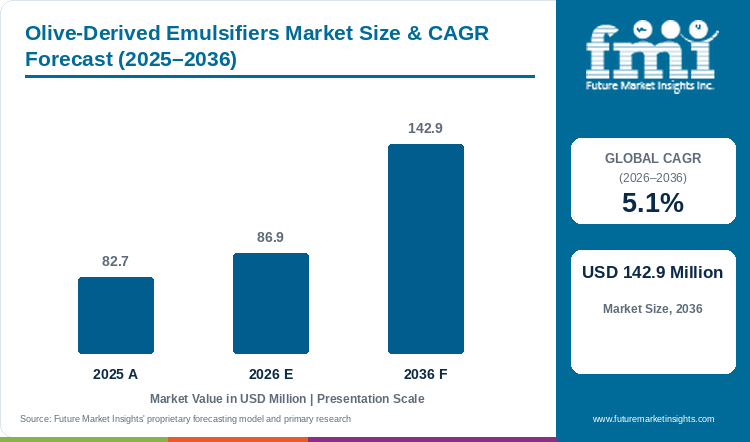
The market was valued at USD 82.7 Million in 2025 and is expected to reach USD 86.9 Million in 2026, with growth at a 5.1% CAGR from 2026 to 2036 taking its value to USD 142.9 Million by 2036.
A cosmetic chemist selects an emulsifier to hold a formulation together and produce the intended texture, with olive origin providing an additional fit with a brand’s ingredient brief. The system needs to remain compatible with the selected oils, preservatives and active ingredients, since changes in viscosity during storage can affect appearance as well as filling-line performance. Sensory assessment is equally relevant when a stable cream leaves an unwanted residue. Before placing repeat orders, manufacturers need accurate ingredient names, composition records and traceable supply that can be carried into safety documentation and manufacturing specifications. Application support becomes useful when a laboratory sample moves to a larger batch or another site, where the processing conditions tolerated by the selected grade need to remain clear. The category covers olive-origin emulsifying chemicals and systems used in the stated cosmetic applications; finished cosmetics and olive-derived oils, extracts or emollients without an emulsifying role are excluded. Claims about skin outcomes require evidence for the finished product in which the ingredient is used. [5]
Key Market Trends & Insights
- Standard grade holds 43.0% of product type in 2026, reducing sourcing complexity while chemists assess viscosity and stability at the intended oil loading.
- Anti-aging holds 26.0% of function in 2026, describing the finished cosmetic’s positioning while the emulsifier accommodates oils and selected active ingredients.
- Facial skincare holds 36.0% of application in 2026, placing the system in creams and serums whose texture and stability influence repeated product use.
- Standard cosmetic grade holds 43.0% of grade in 2026, requiring appropriate composition and safety documentation even where no separate organic or clinical positioning is sought.
Regional Highlights
- UAE has the highest profiled CAGR at 6.3% during 2026–2036.
- The next two profiled growth rates are Saudi Arabia at 5.9% and South Korea at 5.6% over the same period.
Market Size & Forecast
| Metric | Value |
|---|---|
| 2025 market value | USD 82.7 Million |
| 2026 market estimate | USD 86.9 Million |
| 2036 market forecast | USD 142.9 Million |
| Forecast CAGR, 2026–2036 | 5.1% |
The market covers olive-origin emulsifying chemicals and emulsifier systems used in the stated cosmetic applications. Finished cosmetics and olive-derived emollients or extracts without an emulsifying function are excluded.
Olive-derived systems are evaluated within personal-care emulsifiers, where ingredient origin must be supported by an acceptable process window and stable finished emulsion.
Formulation qualification
| Documented operating context | Source |
|---|---|
| Hallstar identifies Olivem 1000 as a self-emulsifying system based on cetearyl olivate and sorbitan olivate. | [1] |
| Kalichem’s Olivoil range combines olive-derived fatty-acid chemistry with amino-acid or polypeptide components. | [2] |
| MyMicrobiome records a February 2025 certification for Olivem 1000 tested at 5.0% concentration. | [3] |
| Coast Southwest describes the Medolla Olivatis ingredient range and its distribution role. | [4] |
Analyst Perspective
An olive-derived emulsifier needs to deliver the required texture and remain stable in the customer’s actual formulation and production process. Traceable composition records and useful scale-up advice help a brand carry an approved laboratory formula into repeat manufacturing with fewer avoidable changes.
- Nandini Roy Choudhury, Principal Analyst at Future Market Insights
How is the olive-derived emulsifiers market segmented?
Product Type covers Standard grade, High-purity / clinical grade, Natural & certified grade and Customized systems. Function covers Anti-aging, Hydration & barrier, Brightening, Soothing & sensitive and UV & protection. Application covers Facial skincare, Body care, Haircare, Color cosmetics and Suncare. Grade covers Standard cosmetic grade, COSMOS / natural certified, Pharma & clinical grade and Organic certified. Sales Channel covers Direct to brands, Specialty distributors, Contract manufacturers and Online B2B.
Formulators comparing squalane-based emulsifiers need to assess the emulsifying system’s composition and performance alongside olive-origin options within the intended recipe.
Why does Standard grade lead product type demand?
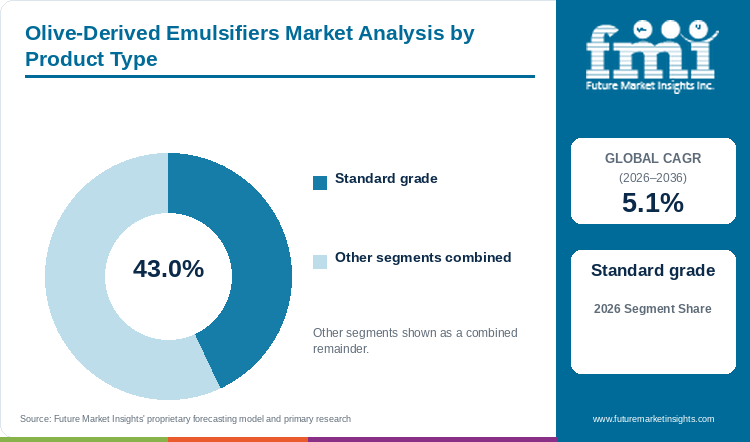
Standard grade: 43.0% of product type in 2026.
Standard grades suit formulas produced repeatedly on familiar equipment with controlled heating and cooling, offering a reproducible specification that the manufacturer can source and use consistently. Chemists still need to establish viscosity and phase stability at the intended oil loading, with application guidance helping transfer a laboratory batch into production. Origin records support the formulation brief, while the decision to retain a grade depends on its behavior at the actual processing temperature and composition. Once those requirements are met, a more elaborate grade may add cost without resolving a further formulation need.
- The Standard grade segment accounts for 43.0% of product type in 2026.
- A reproducible grade specification makes it easier to maintain an approved formula across successive production batches.
Why does Anti-aging lead function demand?
Anti-aging: 26.0% of function in 2026.
Anti-aging identifies the positioning of the finished cosmetic in this segmentation, while the emulsifier provides a physical structure that accommodates the selected oils and active ingredients. Such formulas may combine peptides or other actives and need a stable texture that remains pleasant to apply. Buyers assess compatibility and sensory performance as part of formulation work, with efficacy claims supported separately by evidence for the finished product. This gives brands a clear basis for choosing an olive-derived system for its emulsifying role while keeping the intended product claims within their supporting evidence.
- The Anti-aging segment accounts for 26.0% of function in 2026.
- Finished-product claims require their own support even when the emulsifier performs well as the formulation’s physical base.
What are the drivers, restraints, and opportunities in the olive-derived emulsifiers market?
Formulators seek a workable olive-derived ingredient story
A natural-origin formulation brief can prompt a chemist to test an olive-derived emulsifier in place of an existing system. The ingredient then has to pass the same stability and sensory requirements as other candidates. Hallstar’s OLIVEM 1000 technical sheet identifies Cetearyl Olivate and Sorbitan Olivate for oil-in-water emulsification and liquid-crystal organization. Evonik documents an olive-residue source for ECOHANCE Care PS3. These examples give formulators different materials to assess rather than a single interchangeable olive-based solution. Repeat purchases follow when the selected grade works at the intended batch scale and its supply records support the brand’s requirements.
Stability and sensory trade-offs govern qualification
Changing an emulsifier can alter droplet structure, preservative compatibility and viscosity, while a stable result may still leave an unwanted residue in sensory testing. Manufacturers need accurate composition records and advance notice of origin or processing changes, particularly for formulas sold across jurisdictions. Consistent supply and usable technical guidance can reduce repeated screening, with olive origin supporting ingredient positioning alongside safety documentation and finished-cosmetic testing.
Application support can convert trials into approved formulas
Application support can help a brand move from an appealing feedstock choice to a usable production formula. Evonik states that ECOHANCE Care PS3 uses post-industrial olive-refinery residue rather than edible oil and describes traceable Mediterranean sourcing. A customer still needs to know the actual material composition and its performance at the intended dosage. Suitable cold-process grades may offer processing advantages but those benefits depend on the formulation and site. Suppliers can reduce development iterations by explaining compatibility limits and workable processing conditions. A supported formula is more useful than a broad assertion that an olive-based ingredient suits every skin-care product.
Purchasing in cosmetic ingredients involves repeat batches and application support, making the approved specification more important than a successful first sample.
Which country and market CAGRs are profiled for olive-derived emulsifiers?
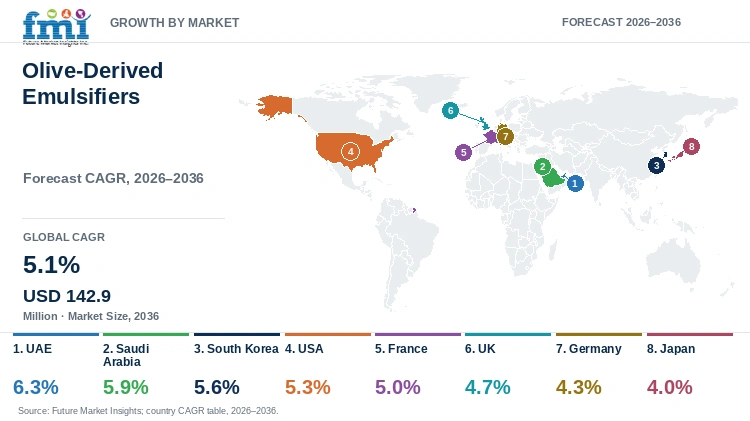
| Country | CAGR |
|---|---|
| UAE | 6.3% |
| Saudi Arabia | 5.9% |
| South Korea | 5.6% |
| USA | 5.3% |
| France | 5.0% |
| UK | 4.7% |
| Germany | 4.3% |
| Japan | 4.0% |
Country-wise Analysis
UAE
- UAE brands evaluating olive-derived emulsifiers need composition and origin records that remain consistent through the distributor. The UAE carries the highest profiled CAGR at 6.3% from 2026 to 2036. Application samples should be tested in the complete formula at the intended process temperature. An attractive feedstock description will not resolve separation or an unsuitable texture. A local distributor that can answer formulation questions helps smaller brands decide which grade merits a full stability program before they commit to regular purchases.
Saudi Arabia
- Composition documentation can determine how quickly an olive-derived emulsifier moves through a Saudi formulation review. Saudi Arabia is expected to grow at a 5.9% CAGR for 2026 to 2036. A successful sensory sample is only the beginning when the manufacturer still needs a precise specification and batch records. Distributors can make comparison easier by supplying representative samples with supporting information, allowing formulators to assess the ingredient within an existing product before committing to a wider recipe change.
South Korea
- South Korean skin-care exporters need formulas that can be reproduced for several destination markets. South Korea has a 5.6% CAGR from 2026 to 2036 in this profile. An olive-derived emulsifier must fit that manufacturing requirement and have a traceable source. Chemists also need to distinguish the emulsifier’s physical role from claims made for the finished skin-care product, particularly when the formula contains several actives. Stable texture and compatibility under actual production conditions give the ingredient a basis for repeat orders across an approved range.
USA
- American brands compare olive-derived emulsifiers with established ingredients under their own processing and storage conditions, including preservative compatibility and texture. The USA’s 5.3% CAGR forecast for 2026 to 2036 accompanies a need for records supporting listing and safety substantiation, while application advice can identify unsuitable combinations early. Ingredient origin may support the formula’s positioning, with claimed cosmetic benefits still requiring evidence for the finished product.
France
- French formulators can consider olive-derived systems as part of a texture brief for facial or body care. France’s CAGR is 5.0% for 2026 to 2036. The material has to work with the chosen actives and preservatives without creating an unacceptable finish. Cost is best assessed at the finished-batch level because dosage and processing requirements can differ between grades. Traceability records and scale-up guidance help preserve the properties that led to selection when a preferred laboratory sample moves into production.
UK
- UK cosmetic manufacturers need supplier information that can be incorporated into the product information file. Great Britain’s requirements include a Responsible Person and product notification alongside safety records. The UK is forecast to grow at a 4.7% CAGR from 2026 to 2036. Changing an emulsion base therefore involves documentation as well as a new texture sample. Distributors offering small trial quantities with complete technical records can make early assessment more manageable. The finished product’s claims still need substantiation independently of the emulsifier’s natural-origin description.
Germany
- German industrial buyers need an emulsifier that behaves predictably through batching and filling. Germany is forecast at a 4.3% CAGR between 2026 and 2036. Consistent viscosity and storage performance matter when even a modest change affects a high-volume line. Olive-derived grades may fit selected natural formulations but the price premium has to be justified within the manufacturing process. Technical teams can help by resolving raw-material variation and process changes without forcing the customer to restart development for an otherwise established formula.
Japan
- Japanese formulators may test spread and after-feel closely before selecting an olive-derived grade. Japan is forecast at a 4.0% CAGR during 2026–2036. Precise composition records also matter because ordinary cosmetics and products with certain active claims can follow different regulatory routes under the applicable Standards for Cosmetics and quasi-drug framework. A well-documented grade with consistent sensory behavior may be more useful than a large range of loosely specified alternatives. Traceability must remain intact through distribution and manufacturing so that the approved material can be used repeatedly.
Who are the notable companies in the olive-derived emulsifiers market?
Hallstar; Kalichem; Medolla Specialty Chemicals; Coast Southwest; Evonik
Olive-derived emulsifier suppliers need to show how their grade forms and maintains the intended emulsion. Distributors add value by making samples and technical records available and by keeping repeat deliveries consistent with the approved material.
Competitive Benchmarking: Olive-Derived Emulsifiers Market
| Participant | Commercial focus | Buyer qualification priority |
|---|---|---|
| Hallstar | Olive-derived emulsifier chemistry | Emulsion stability and process window |
| Kalichem | Olive-derived lipoamino-acid systems | Formula compatibility and sensory profile |
| Medolla Specialty Chemicals | Olive-based functional ingredients | Ingredient identity and batch consistency |
| Coast Southwest | Specialty ingredient distribution | Technical support and supply continuity |
| Evonik | Bio-based cosmetic emulsifier systems | Feedstock traceability and application testing |
Key Developments in the Olive-Derived Emulsifiers Market
- MyMicrobiome records a February 2025 certification for Olivem 1000 tested at 5.0% concentration. [3]
Key Players in the Olive-Derived Emulsifiers Market
- Hallstar
- Kalichem
- Medolla Specialty Chemicals
- Coast Southwest
- Evonik
Olive-Derived Emulsifiers Market - Report Scope
| Coverage field | Report scope |
|---|---|
| Market breakdown | Product Type; Function; Application; Grade; Sales Channel; Region |
| Quantitative unit | USD Million |
| Market definition | The market covers olive-origin emulsifying chemicals and emulsifier systems used in the stated cosmetic applications. Finished cosmetics and olive-derived emollients or extracts without an emulsifying function are excluded. |
| Regions covered | North America; Latin America; Western Europe; Eastern Europe; East Asia; South Asia and Pacific; Middle East and Africa |
| Countries / markets profiled | UAE; Saudi Arabia; South Korea; USA; France; UK; Germany; Japan |
| Key companies profiled | Hallstar; Kalichem; Medolla Specialty Chemicals; Coast Southwest; Evonik |
| Base year / forecast period | 2026 / 2026–2036 |
| Estimate coverage | 2025 and 2026 market estimates; 2036 forecast; segment shares and country / market CAGRs. |
Olive-Derived Emulsifiers Market - Research Methodology
| Method | Application |
|---|---|
| Market definition | The analysis follows the stated product or service boundary and distinguishes direct category revenue from adjacent activities. |
| Secondary research | Official technical, regulatory, research and company publications provide the documented operating context and recent developments cited in this report. |
| Forecast and segmentation | Market estimates, segment shares and geographic forecasts are presented as analytical estimates within the stated commercial scope. |
| Competitive assessment | Participants are compared by their relevant products or services, commercial role and buyer qualification requirements. |
| Interpretation | The assessment considers purchasing conditions and the scope of the documented product, service or performance claim. |
Olive-Derived Emulsifiers Market by Segments
Product Type
- Standard grade
- High-purity / clinical grade
- Natural & certified grade
- Customized systems
Function
- Anti-aging
- Hydration & barrier
- Brightening
- Soothing & sensitive
- UV & protection
Application
- Facial skincare
- Body care
- Haircare
- Color cosmetics
- Suncare
Grade
- Standard cosmetic grade
- COSMOS / natural certified
- Pharma & clinical grade
- Organic certified
Sales Channel
- Direct to brands
- Specialty distributors
- Contract manufacturers
- Online B2B
Olive-Derived Emulsifiers Market by Region
- North America
- United States
- Canada
- Latin America
- Brazil
- Mexico
- Argentina
- Chile
- Western Europe
- Germany
- France
- United Kingdom
- Italy
- Spain
- Benelux
- Nordics
- Eastern Europe
- Poland
- Czech Republic
- Romania
- Hungary
- East Asia
- China
- Japan
- South Korea
- South Asia and Pacific
- India
- ASEAN
- Australia and New Zealand
- Middle East and Africa
- GCC Countries
- South Africa
- Türkiye
- Israel
Research Sources and Bibliography
- [1] Hallstar. (n.d.). Olivem 1000.
- [2] Kalichem. (n.d.). Olivoil emulsifiers.
- [3] MyMicrobiome. (2025, February 21). Olivem 1000 at 5%: Certification record.
- [4] Coast Southwest. (2021). Exploring the naturally nourishing benefits of Olivatis.
- [5] Future Market Insights. (2026). Olive-Derived Emulsifiers Market: Global industry analysis and opportunity assessment, 2026–2036.
This Report Answers
- How large is the olive-derived emulsifiers market in 2026?
- What value and CAGR are forecast through 2036?
- Which product type segment leads in 2026?
- Which function segment has the largest share?
- Which profiled country or market has the fastest forecast growth?
- Which participants are covered in the competitive assessment?
Frequently Asked Questions
How large is the olive-derived emulsifiers market in 2026?
The market was valued at USD 82.7 Million in 2025 and is expected to reach USD 86.9 Million in 2026.
What value and CAGR are forecast through 2036?
The market is projected to reach USD 142.9 Million by 2036, with a 5.1% CAGR during 2026–2036.
Which product type segment leads in 2026?
The Standard grade segment accounts for 43.0% of product type in 2026.
Which function segment has the largest share?
The Anti-aging segment accounts for 26.0% of function in 2026.
Which profiled country or market has the fastest forecast growth?
UAE has the highest profiled CAGR at 6.3% during 2026–2036.
Which participants are covered in the competitive assessment?
The assessment covers Hallstar, Kalichem, Medolla Specialty Chemicals, Coast Southwest and Evonik.
Preview the report firsthand - request a free sample
Get SampleGet the brochure for pricing and purchase details.
Get PDFTable of Content
- Key Takeaways
- Market Size and CAGR
- Top Growth Driver
- Fastest Growing Segment
- Leading Region
- Key Companies
- Emerging Opportunities
- Executive Summary
- Global Market Outlook
- Demand-side Trends
- Supply-side Trends
- Technology Roadmap Analysis
- Analysis and Recommendations
- Analyst Perspective (What is happening? Why now? What should investors know?)
- Key Questions Answered
- How large is the market?
- What is the CAGR?
- What are key trends?
- Which region dominates?
- Who are the leaders?
- Market Overview
- Market Coverage / Taxonomy
- Market Definition / Scope / Limitations
- Research Methodology
- Chapter Orientation
- Analytical Lens and Working Hypotheses
- Market Structure, Signals, and Trend Drivers
- Benchmarking and Cross-market Comparability
- Market Sizing, Forecasting, and Opportunity Mapping
- Research Design and Evidence Framework
- Desk Research Programme (Secondary Evidence)
- Expert Input and Fieldwork (Primary Evidence)
- Tooling, Models, and Reference Databases
- Data Engineering and Model Build
- Quality Assurance and Audit Trail
- Market Background
- Market Dynamics (Drivers, Restraints, Opportunity, Trends)
- Scenario Forecast (Optimistic, Likely, Conservative)
- Impact Analysis
- AI Impact
- Sustainability Impact
- Regulatory Impact
- Technology Impact
- Consumer / Buyer Analysis
- Purchase Drivers
- Adoption Barriers
- Buyer Journey
- Opportunity Map Analysis
- Product Life Cycle Analysis
- Supply Chain Analysis
- Investment Feasibility Matrix
- Value Chain Analysis
- PESTLE and Porter's Analysis
- Regulatory Landscape
- Regional Parent Market Outlook
- Production and Consumption Statistics
- Import and Export Statistics
- Global Market Analysis and Forecast, 2021 to 2036
- Historical Market Size Value (USD Million) Analysis, 2021 to 2025
- Current and Future Market Size Value (USD Million) Projections, 2026 to 2036
- Y-o-Y Growth Trend Analysis
- Absolute $ Opportunity Analysis
- Global Market Pricing Analysis, 2021 to 2036
- Global Market Analysis and Forecast, By Product Type, 2021 to 2036
- Introduction / Key Findings
- Historical Market Size Value (USD Million) Analysis By Product Type, 2021 to 2025
- Current and Future Market Size Value (USD Million) Analysis and Forecast By Product Type, 2026 to 2036
- Standard grade
- High-purity / clinical grade
- Natural & certified grade
- Customized systems
- Y-o-Y Growth Trend Analysis By Product Type, 2021 to 2025
- Absolute $ Opportunity Analysis By Product Type, 2026 to 2036
- Global Market Analysis and Forecast, By Function, 2021 to 2036
- Introduction / Key Findings
- Historical Market Size Value (USD Million) Analysis By Function, 2021 to 2025
- Current and Future Market Size Value (USD Million) Analysis and Forecast By Function, 2026 to 2036
- Anti-aging
- Hydration & barrier
- Brightening
- Soothing & sensitive
- UV & protection
- Y-o-Y Growth Trend Analysis By Function, 2021 to 2025
- Absolute $ Opportunity Analysis By Function, 2026 to 2036
- Global Market Analysis and Forecast, By Application, 2021 to 2036
- Introduction / Key Findings
- Historical Market Size Value (USD Million) Analysis By Application, 2021 to 2025
- Current and Future Market Size Value (USD Million) Analysis and Forecast By Application, 2026 to 2036
- Facial skincare
- Body care
- Haircare
- Color cosmetics
- Suncare
- Y-o-Y Growth Trend Analysis By Application, 2021 to 2025
- Absolute $ Opportunity Analysis By Application, 2026 to 2036
- Global Market Analysis and Forecast, By Grade, 2021 to 2036
- Introduction / Key Findings
- Historical Market Size Value (USD Million) Analysis By Grade, 2021 to 2025
- Current and Future Market Size Value (USD Million) Analysis and Forecast By Grade, 2026 to 2036
- Standard cosmetic grade
- COSMOS / natural certified
- Pharma & clinical grade
- Organic certified
- Y-o-Y Growth Trend Analysis By Grade, 2021 to 2025
- Absolute $ Opportunity Analysis By Grade, 2026 to 2036
- Global Market Analysis and Forecast, By Sales Channel, 2021 to 2036
- Introduction / Key Findings
- Historical Market Size Value (USD Million) Analysis By Sales Channel, 2021 to 2025
- Current and Future Market Size Value (USD Million) Analysis and Forecast By Sales Channel, 2026 to 2036
- Direct to brands
- Specialty distributors
- Contract manufacturers
- Online B2B
- Y-o-Y Growth Trend Analysis By Sales Channel, 2021 to 2025
- Absolute $ Opportunity Analysis By Sales Channel, 2026 to 2036
- Global Market Analysis and Forecast, By Region, 2021 to 2036
- Introduction
- Historical Market Size Value (USD Million) Analysis By Region, 2021 to 2025
- Current Market Size Value (USD Million) Analysis and Forecast By Region, 2026 to 2036
- North America
- Latin America
- Western Europe
- Eastern Europe
- East Asia
- South Asia and Pacific
- Middle East and Africa
- Market Attractiveness Analysis By Region
- North America Market Analysis and Forecast, By Country, 2021 to 2036
- Historical Market Size Value (USD Million) Trend Analysis By Market Taxonomy, 2021 to 2025
- Market Size Value (USD Million) Forecast By Market Taxonomy, 2026 to 2036
- By Country
- United States
- Canada
- By Product Type
- By Function
- By Application
- By Grade
- By Sales Channel
- By Country
- Market Attractiveness Analysis
- By Country
- By Product Type
- By Function
- By Application
- By Grade
- By Sales Channel
- Key Takeaways
- Latin America Market Analysis and Forecast, By Country
- Historical Market Size Value (USD Million) Trend Analysis By Market Taxonomy, 2021 to 2025
- Market Size Value (USD Million) Forecast By Market Taxonomy, 2026 to 2036
- By Country
- Brazil
- Mexico
- Argentina
- Chile
- By Product Type
- By Function
- By Application
- By Grade
- By Sales Channel
- By Country
- Market Attractiveness Analysis
- By Country
- By Product Type
- By Function
- By Application
- By Grade
- By Sales Channel
- Key Takeaways
- Western Europe Market Analysis and Forecast, By Country
- Historical Market Size Value (USD Million) Trend Analysis By Market Taxonomy, 2021 to 2025
- Market Size Value (USD Million) Forecast By Market Taxonomy, 2026 to 2036
- By Country
- Germany
- France
- United Kingdom
- Italy
- Spain
- Benelux
- Nordics
- By Product Type
- By Function
- By Application
- By Grade
- By Sales Channel
- By Country
- Market Attractiveness Analysis
- By Country
- By Product Type
- By Function
- By Application
- By Grade
- By Sales Channel
- Key Takeaways
- Eastern Europe Market Analysis and Forecast, By Country
- Historical Market Size Value (USD Million) Trend Analysis By Market Taxonomy, 2021 to 2025
- Market Size Value (USD Million) Forecast By Market Taxonomy, 2026 to 2036
- By Country
- Poland
- Czech Republic
- Romania
- Hungary
- By Product Type
- By Function
- By Application
- By Grade
- By Sales Channel
- By Country
- Market Attractiveness Analysis
- By Country
- By Product Type
- By Function
- By Application
- By Grade
- By Sales Channel
- Key Takeaways
- East Asia Market Analysis and Forecast, By Country
- Historical Market Size Value (USD Million) Trend Analysis By Market Taxonomy, 2021 to 2025
- Market Size Value (USD Million) Forecast By Market Taxonomy, 2026 to 2036
- By Country
- China
- Japan
- South Korea
- By Product Type
- By Function
- By Application
- By Grade
- By Sales Channel
- By Country
- Market Attractiveness Analysis
- By Country
- By Product Type
- By Function
- By Application
- By Grade
- By Sales Channel
- Key Takeaways
- South Asia and Pacific Market Analysis and Forecast, By Country
- Historical Market Size Value (USD Million) Trend Analysis By Market Taxonomy, 2021 to 2025
- Market Size Value (USD Million) Forecast By Market Taxonomy, 2026 to 2036
- By Country
- India
- ASEAN
- Australia and New Zealand
- By Product Type
- By Function
- By Application
- By Grade
- By Sales Channel
- By Country
- Market Attractiveness Analysis
- By Country
- By Product Type
- By Function
- By Application
- By Grade
- By Sales Channel
- Key Takeaways
- Middle East and Africa Market Analysis and Forecast, By Country
- Historical Market Size Value (USD Million) Trend Analysis By Market Taxonomy, 2021 to 2025
- Market Size Value (USD Million) Forecast By Market Taxonomy, 2026 to 2036
- By Country
- GCC Countries
- South Africa
- Türkiye
- Israel
- By Product Type
- By Function
- By Application
- By Grade
- By Sales Channel
- By Country
- Market Attractiveness Analysis
- By Country
- By Product Type
- By Function
- By Application
- By Grade
- By Sales Channel
- Key Takeaways
- Key Countries Market Analysis
- United States
- Pricing Analysis
- Market Share Analysis, 2025
- By Product Type
- By Function
- By Application
- By Grade
- By Sales Channel
- Canada
- Pricing Analysis
- Market Share Analysis, 2025
- By Product Type
- By Function
- By Application
- By Grade
- By Sales Channel
- Mexico
- Pricing Analysis
- Market Share Analysis, 2025
- By Product Type
- By Function
- By Application
- By Grade
- By Sales Channel
- Brazil
- Pricing Analysis
- Market Share Analysis, 2025
- By Product Type
- By Function
- By Application
- By Grade
- By Sales Channel
- Chile
- Pricing Analysis
- Market Share Analysis, 2025
- By Product Type
- By Function
- By Application
- By Grade
- By Sales Channel
- Germany
- Pricing Analysis
- Market Share Analysis, 2025
- By Product Type
- By Function
- By Application
- By Grade
- By Sales Channel
- United Kingdom
- Pricing Analysis
- Market Share Analysis, 2025
- By Product Type
- By Function
- By Application
- By Grade
- By Sales Channel
- Italy
- Pricing Analysis
- Market Share Analysis, 2025
- By Product Type
- By Function
- By Application
- By Grade
- By Sales Channel
- Spain
- Pricing Analysis
- Market Share Analysis, 2025
- By Product Type
- By Function
- By Application
- By Grade
- By Sales Channel
- France
- Pricing Analysis
- Market Share Analysis, 2025
- By Product Type
- By Function
- By Application
- By Grade
- By Sales Channel
- India
- Pricing Analysis
- Market Share Analysis, 2025
- By Product Type
- By Function
- By Application
- By Grade
- By Sales Channel
- ASEAN
- Pricing Analysis
- Market Share Analysis, 2025
- By Product Type
- By Function
- By Application
- By Grade
- By Sales Channel
- Australia and New Zealand
- Pricing Analysis
- Market Share Analysis, 2025
- By Product Type
- By Function
- By Application
- By Grade
- By Sales Channel
- China
- Pricing Analysis
- Market Share Analysis, 2025
- By Product Type
- By Function
- By Application
- By Grade
- By Sales Channel
- Japan
- Pricing Analysis
- Market Share Analysis, 2025
- By Product Type
- By Function
- By Application
- By Grade
- By Sales Channel
- South Korea
- Pricing Analysis
- Market Share Analysis, 2025
- By Product Type
- By Function
- By Application
- By Grade
- By Sales Channel
- Poland
- Pricing Analysis
- Market Share Analysis, 2025
- By Product Type
- By Function
- By Application
- By Grade
- By Sales Channel
- Hungary
- Pricing Analysis
- Market Share Analysis, 2025
- By Product Type
- By Function
- By Application
- By Grade
- By Sales Channel
- Türkiye
- Pricing Analysis
- Market Share Analysis, 2025
- By Product Type
- By Function
- By Application
- By Grade
- By Sales Channel
- South Africa
- Pricing Analysis
- Market Share Analysis, 2025
- By Product Type
- By Function
- By Application
- By Grade
- By Sales Channel
- UAE
- Pricing Analysis
- Market Share Analysis, 2025
- By Product Type
- By Function
- By Application
- By Grade
- By Sales Channel
- Saudi Arabia
- Pricing Analysis
- Market Share Analysis, 2025
- By Product Type
- By Function
- By Application
- By Grade
- By Sales Channel
- United States
- Market Structure Analysis
- Competition Dashboard
- Competition Benchmarking
- Market Share Analysis of Top Players
- By Regional
- By Product Type
- By Function
- By Application
- By Grade
- By Sales Channel
- Emerging Startups
- Innovation Benchmarking
- Competition Analysis
- Competition Deep Dive
- Hallstar
- Overview
- Product Portfolio
- Profitability by Market Segments
- Sales Footprint
- Strategy Overview
- Marketing Strategy
- Product Strategy
- Channel Strategy
- Kalichem
- Medolla Specialty Chemicals
- Coast Southwest
- Evonik
- Hallstar
- Case Studies
- Success Stories
- Recent Developments
- Competition Deep Dive
- Assumptions & Acronyms Used


