

- Market Size (2026)
- USD 1.3 Bn
- Forecast (2036)
- USD 4.2 Bn
- CAGR (2026 to 2036)
- 12.7%
How big is Optogenetics Actuators Sensors Market in 2026?
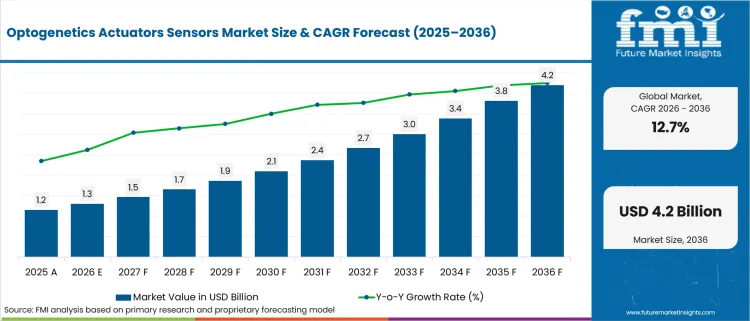
USD 1.3 billion in 2026 and USD 4.2 billion by 2036 at a 12.7% CAGR.
Demand in the optogenetics actuators sensors market is anticipated to push valuation from USD 1.3 billion in 2026 to USD 4.2 billion by 2036, expanding at a 12.7% CAGR over the forecast period. Federal research budgets influence platform purchases by linking genetic access with optical recording and modulation systems. NIH's June 2026 budget review records USD 321 million for the BRAIN Initiative in fiscal 2025, including continued priorities for platform tools and neurotechnologies.
Laboratories purchase constructs and light delivery alongside implants for 3D neuroscience programs that require synchronized measurement across complete experiments. Instrumentation manufacturers gain repeat business by reducing calibration and training burdens across preclinical imaging workflows without weakening biological compatibility.
Key Takeaways of Optogenetics Actuators Sensors Market
- Grant-supported circuit research increases spending on matched actuator and sensor workflows that produce reproducible causal evidence across repeated studies.
- Optogenetic actuators are projected to represent 43.0% share in 2026 due to their central intervention role.
- Neuroscience research is estimated to account for 48.0% share in 2026 owing to controlled circuit studies.
- Academic and research institutes are forecast to capture 51.0% share in 2026 driven by specialized discovery platforms.
- Spectral overlap with tissue heating and variable expression can lengthen qualification across animal models and recording sessions.
- The Jackson Laboratory and Addgene provide biological access alongside optical or recording roles from Thorlabs, Bruker, Coherent, NeuroNexus, Doric and Prizmatix.
Analyst Perspective
“Optogenetics revenue follows the experiment’s weakest interface as a well-chosen opsin cannot rescue poor tissue illumination or contaminated sensor output. Platform developers that document construct-to-readout compatibility can convert one-off component orders into repeat programs across shared neuroscience facilities.”
- Anurag Sharma, Principal Consultant, Future Market Insights
How is the Optogenetics Actuators Sensors Market segmented?
The Optogenetics Actuators Sensors Market is segmented by product, application, end user, distribution channel, technology and region.
The market is organized by product, application, end user, distribution channel, technology and region with product coverage spanning actuators, sensors, light-delivery systems, controls and supporting kits for complete experiments. Applications span neuroscience research, drug discovery, behavioral studies, cell biology and biomedical research across academic or life-science settings. End users include research institutes, life-science companies, contract laboratories and public organizations using direct sales, scientific distributors, online platforms or public tenders. Technology coverage includes microbial opsins, encoded sensors, fiber stimulation, wireless systems and LED-based laboratory tools.
What makes optogenetic actuators central to the product category?
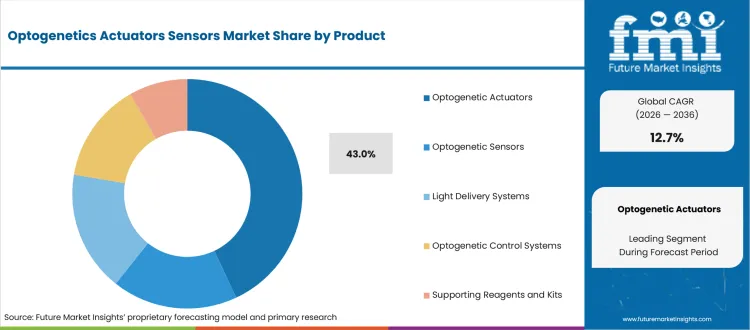
Optogenetic actuators provide the controlled intervention that separates causal circuit testing from observational brain imaging studies. Laboratories match each actuator with the promoter and target cell then qualify wavelength and pulse timing across repeat cohorts.
- Based on product, optogenetic actuators are projected to account for 43.0% in 2026 due to their central role in controlled neural excitation and inhibition.
- Shared neuroscience facilities are increasing actuator purchases, supported by repositories that reduce model setup across animal studies. The Jackson Laboratory lists strains covering excitation and inhibition alongside calcium and voltage indicators, helping core facilities standardize model access without rebuilding the biological workflow.
How does neuroscience research shape demand within the application category?
Neuroscience research pairs light-driven perturbation with optical imaging or electrophysiology to test how defined cells influence behavior. Federal programs support this workflow across cognitive neuroscience experiments with aligned stimulation and readout protocols. NIH's March 2025 funding opportunity focused on tools directly probing cell-specific and circuit-specific brain processes.
- The neuroscience research segment is likely to capture 48.0% share in 2026 attributable to broad use across circuit mapping and neural modulation.
- Longitudinal study teams are expected to increase system purchases, aided by protocols preserving timing and spectral separation across repeat cohorts. Shared procedures reduce retraining and support recurring accessory purchases across related models and behavioral tasks.
How do academic and research institutes evaluate the end-user category?
Academic and research institutes combine genetics with animal surgery and optical measurement inside shared discovery programs. Core facilities spread capital costs across investigators and maintain training for small animal imaging protocols.
- In 2026, academic and research institutes are expected to lead the end-user category with 51.0% share because shared facilities concentrate specialized discovery platforms.
- Core facilities are increasingly selecting configurable optogenetics systems, reinforced by scheduled access and standardized changeover across several biological models. Institutional tenders can delay installation if technical teams do not define service responsibilities and data interfaces during review, making local training and maintenance capacity part of the purchase decision.
What supports microbial opsin technology within the technology category?
Microbial opsin technology provides established excitation and inhibition routes through widely used channelrhodopsin and halorhodopsin families. Researchers select variants by response kinetics and spectral compatibility with sensors or adjacent neurotech devices.
- The technology category is forecast to be led by microbial opsin technology at 39.0% share in 2026 due to established construct access across routine excitation and inhibition protocols.
- Research groups are adopting microbial opsins in multicolor experiments, aided by red-shifted variants that lower spectral conflict during simultaneous stimulation and measurement. Laboratories must verify tissue-level power and stable expression across complete cohorts to protect interpretable readout during repeated sessions under comparable settings.
What are the drivers, restraints and opportunities in the Optogenetics Actuators Sensors Market?
Matched intervention and readout capabilities are driving optogenetics adoption, but spectral interference complicates qualification, creating opportunities for integrated systems that simplify setup and improve experimental efficiency.
- Driver: Causal circuit research requires matched actuator and sensor workflows that reproduce intervention and readout across validated biological models.
- Restraint: Spectral interference and tissue heating can obscure sensor output as variable expression extends qualification across animal cohorts.
- Opportunity: Integrated stimulation and readout systems reduce setup work across experiments sharing constructs and behavioral protocols.
Optogenetics laboratories pair cell-specific manipulation with measured responses to establish causal evidence across neural circuits. The same requirement aligns with NIH's March 2025 funding opportunity for nervous-system recording and modulation technologies used during behaving-animal studies.
Protocol transfer slows adoption as implant position and tissue-level power change responses across animals and research sites. Laboratories must qualify each vector against the complete optical path to prevent stimulation light from contaminating fluorescent output.
Integrated systems reduce rework by aligning viral vector development with implant geometry during synchronized closed-loop experiments. Documented compatibility supports repeat purchasing across translational retinal and CNS gene therapy programs with shared controls.
Which country CAGRs are profiled in the Optogenetics Actuators Sensors Market?
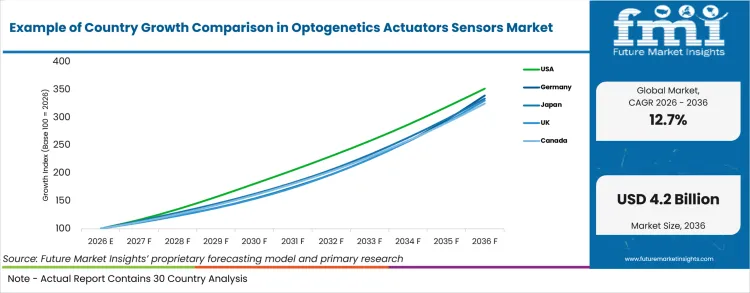
| Country | CAGR |
|---|---|
| United States | 13.4% |
| Germany | 13.0% |
| Japan | 12.8% |
| United Kingdom | 12.7% |
| Canada | 12.5% |
How do country-level CAGRs compare in the Optogenetics Actuators Sensors Market?
The country forecasts are exceptionally concentrated across the optogenetics actuators and sensors market, with only 0.9 percentage points separating the first and last countries in the comparison. The limited spread suggests that market development is occurring across multiple advanced research ecosystems simultaneously rather than being concentrated in a single geography. This pattern reflects growing investment in neural circuit mapping, brain disorder research and next-generation biological sensing technologies, supported by strong academic and biomedical research infrastructure.
- The United States benefits from extensive neuroscience research funding, established optogenetics programs and strong collaboration between academic institutions, biotechnology companies and research organizations.
- Germany supports market growth through advanced life sciences research and increasing use of optogenetic tools in neurobiology, cellular studies and preclinical experimentation.
- Japan continues to generate demand through investments in brain science initiatives and the development of precision tools for studying neural activity and disease mechanisms.
- The United Kingdom reflects steady adoption supported by strong university-led neuroscience research and continued advancement of optical control and sensing technologies.
- Canada maintains growth through expanding research activity in neurotechnology and increasing application of optogenetic platforms in biomedical and translational studies.
Comparable CAGRs do not necessarily translate into identical market opportunities. Differences in research funding structures, laboratory infrastructure, commercialization pathways and regulatory frameworks governing advanced life science technologies can influence adoption patterns and purchasing decisions across countries. The full report provides country-level CAGR analysis across North America, Latin America, Europe, East Asia, South Asia, Oceania and the Middle East and Africa.
Country-wise Analysis
- United States neuroscience laboratories combine federal grant networks with direct access to genetic repositories and optical service teams across major research centers and shared university facilities that support multiyear platform planning. The United States' optogenetics actuators and sensors outlook is anticipated to advance at 13.4% CAGR over the assessment period, supported by federal programs for recording and modulation tools. Federal tool funding remained active in February 2026 as NIH added a June application date to two BRAIN Initiative opportunities for nervous-system recording and modulation technologies, although shifting award schedules and institutional priorities complicate maintenance planning across multiyear platform programs.
- German universities combine photonics engineering with regional neuroscience facilities that support custom probes and advanced optical alignment alongside specialist training across several shared research programs. In May 2025, the Max Planck Institute of Microstructure Physics reported dual-color nanophotonic probes that combine optical stimulation with electrophysiological recording during complex in vivo studies. Adoption of optogenetic actuators and sensors in Germany is estimated to expand at 13.0% CAGR through 2036, reinforced by local device engineering and university research capacity despite tender cycles and animal-use approvals that require calibration records with dependable regional training and clearly assigned maintenance responsibility across university networks.
- Japanese neuroscience programs emphasize compact instruments with low drift and controlled protocol transfer through experienced domestic service channels across university research teams and national research institutes with shared technical facilities. Optogenetics actuators and sensors demand in Japan is forecast to rise at 12.8% CAGR over the forecast period, driven by national brain-science programs and established technical support. Clinical translation gained a domestic reference in May 2025 as Japan Science and Technology Agency reported the country's first optogenetics trial for retinal gene therapy, yet lengthy equipment qualification continues to slow adoption of unfamiliar optical components and software interfaces lacking proven local service across research groups.
- United Kingdom universities separate scientific equipment selection from institutional contract approval across major shared neuroscience facilities serving several principal investigators and specialist regional technical teams nationwide. UK Research and Innovation improved planning visibility in May 2025 by announcing a neuroscience and mental health program that supports projects lasting up to five years. The United Kingdom optogenetic actuator and sensor sector is projected to record 12.7% CAGR during the assessment period, supported by specialist platform access and sustained research programs despite central contract reviews that can delay service commitments following technical approval across multiyear funded programs within established national networks.
- Canadian neuroscience centers rely on shared facilities and specialized teams at geographically separated institutions that coordinate platform access through provincial research networks and local university service hubs across regional academic laboratories. Canada is estimated to post 12.5% CAGR over the forecast period, shaped by national platform support and concentrated optogenetics expertise. Université Laval reinforced this shared-platform route in May 2025 by reporting funding for the Canadian Optogenetics and Vectorology Foundry to expand optogenetic and viral tools, yet shared configuration decisions and long service routes continue to delay purchases that combine several wavelengths with sensors and implants across multiyear programs.
Who are the notable companies in the Optogenetics Actuators Sensors Market?
The Jackson Laboratory, Addgene, Thorlabs Inc., Bruker Corporation, Coherent Corp., NeuroNexus Technologies, Inc., Doric Lenses Inc. and Prizmatix Ltd.
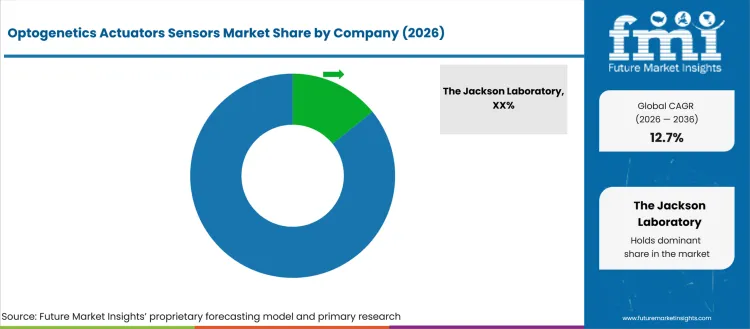
Competition remains fragmented across biological resources and optical hardware with no company controlling the complete experiment. Specialists enter through one validated interface, but repeat business depends on compatibility with established constructs and recording systems. Switching costs rise as laboratories standardize wavelengths and connectors across shared molecular imaging programs serving research teams.
- The Jackson Laboratory provides optogenetic strains and Addgene supplies plasmids or viral vectors for model selection.
- Thorlabs and Coherent provide configurable light sources with fibers and optical controls for laboratory stimulation.
- Bruker, NeuroNexus, Doric Lenses and Prizmatix cover integrated imaging, electrophysiology, photometry or controlled LED delivery.
Competitive Benchmarking: Optogenetics Actuators Sensors Market
| Company | Exact-Market Portfolio | Workflow Integration | Technical Support | Geographic Reach |
|---|---|---|---|---|
| The Jackson Laboratory | High | Medium | Medium | North America, Europe and Asia |
| Addgene | High | Medium | High | Global distribution |
| Thorlabs Inc. | High | High | High | Global offices and e-commerce |
| Bruker Corporation | Medium | High | High | Global |
| Coherent Corp. | Medium | Medium | High | Global |
| NeuroNexus Technologies, Inc. | High | High | Medium | North America and international distribution |
| Doric Lenses Inc. | High | High | High | North America and international distribution |
| Prizmatix Ltd. | Medium | High | Medium | Israel and international distribution |
Key Developments in the Optogenetics Actuators Sensors Market
- Doric Lenses launched the second-generation Rotary Bundle-imaging Fluorescence Mini Cube (RBFMC-G2) featuring a swappable isosbestic LED for flexible biosensor compatibility, as documented on Doric's own neuroscience product platform.
- In June 2025, Coherent introduced the Osprey femtosecond laser for optogenetics with integrated controls for complex optical paths.
- In April 2025, Bruker introduced the nVista 2P miniature microscope for deeper neural circuit imaging during freely behaving animal studies.
- In January 2025, Addgene launched Packaged on Request for more than three thousand eligible AAV plasmids across five serotypes.
Optogenetics Actuators Sensors Market - Report Scope
| Coverage field | Report scope |
|---|---|
| Market breakdown | By product, application, end user, distribution channel, technology and region. |
| Quantitative Units | Revenue in USD billion and CAGR in %. |
| Market Definition | The market covers optogenetic actuators and sensors alongside light-delivery systems, control systems and supporting kits used in research or translational workflows. |
| Regions Covered | North America, Latin America, Europe, East Asia, South Asia and Pacific and Middle East and Africa. |
| Countries Covered | United States, Germany, Japan, United Kingdom, Canada and 20+ countries included in the full report. |
| Key Companies Profiled | The Jackson Laboratory, Addgene, Thorlabs Inc., Bruker Corporation, Coherent Corp., NeuroNexus Technologies, Inc., Doric Lenses Inc. and Prizmatix Ltd. |
| Forecast Period | 2026 to 2036. |
| Approach | Primary and secondary research with market triangulation. |
Optogenetics Actuators Sensors Market - Research Methodology
| Method | Approach |
|---|---|
| Primary Research | FMI analysts gathered input from manufacturers, service providers, technology developers, distributors, end users, procurement teams, and subject-matter experts. Interviews examined purchasing decisions, product or service evaluation, adoption barriers, approval requirements, pricing considerations, and expectations for technical or commercial support. Respondents were also asked what evidence is required before a trial, pilot, or initial order develops into regular purchasing. |
| Desk Research | Desk research covered government statistics, regulatory publications, trade data, industry associations, technical literature, standards, company filings, product information, and official corporate announcements. Sources were reviewed for relevance, publication date, geographic coverage, and consistency with the defined market scope. Claims relating to performance, applications, approvals, capacity, investment, and commercial activity were retained only when supported by credible public evidence. |
| Market Sizing and Forecasting | The market model combined the baseline value with historical performance, segment structure, pricing and volume indicators, adoption levels, company participation, and country-level demand conditions. Forecast assumptions considered economic activity, investment trends, regulatory developments, technology adoption, purchasing cycles, supply availability, and barriers to wider market use. Segment and regional estimates were reconciled before the final market total was calculated. |
| Data Validation | Estimates were checked against multiple independent indicators, including public data, company activity, trade patterns, industry developments, and findings from primary interviews. Validation also tested whether products, services, applications, and company revenues fell within the defined market boundaries. Adjacent categories, unsupported claims, overlapping revenues, and activities without direct market relevance were excluded to reduce double counting and maintain consistency across segments and countries. |
Optogenetics Actuators Sensors Market by Segments
Optogenetics Actuators Sensors Market segmented by Product:
- Optogenetic Actuators
- Channelrhodopsins
- Halorhodopsins
- Optogenetic Sensors
- Calcium Sensors
- Voltage Sensors
- Light Delivery Systems
- Fiber Optic Cannulas
- Miniature LED Systems
- Optogenetic Control Systems
- Laser Stimulation Systems
- Wireless Stimulation Systems
- Supporting Reagents and Kits
- Viral Vector Kits
- Genetic Expression Kits
Optogenetics Actuators Sensors Market segmented by Application:
- Neuroscience Research
- Brain Circuit Mapping
- Neural Activity Modulation
- Drug Discovery
- Target Validation
- Preclinical Screening
- Behavioral Research
- Cognitive Studies
- Neurological Disorder Models
- Cell Biology Research
- Signal Transduction Studies
- Gene Expression Studies
- Biomedical Research
- Disease Mechanism Studies
- Functional Genomics
Optogenetics Actuators Sensors Market segmented by End User:
- Academic and Research Institutes
- Universities
- Neuroscience Research Centers
- Pharmaceutical and Biotechnology Companies
- Drug Discovery Companies
- Gene Therapy Developers
- Contract Research Organizations
- Preclinical CROs
- Discovery Research CROs
- Government Research Laboratories
- National Research Institutes
- Public Research Facilities
- Clinical Research Organizations
- Translational Research Centers
- Neurological Research Hospitals
Optogenetics Actuators Sensors Market segmented by Distribution Channel:
- Direct Sales
- Institutional Procurement
- Key Account Sales
- Scientific Equipment Distributors
- National Laboratory Distributors
- Global Scientific Suppliers
- Online Scientific Platforms
- Manufacturer Online Stores
- Laboratory E-Commerce Platforms
- Research Supply Dealers
- Authorized Scientific Dealers
- Laboratory Equipment Suppliers
- Government Procurement
- Public Research Tenders
- University Procurement Programs
Optogenetics Actuators Sensors Market segmented by Technology:
- Microbial Opsin Technology
- Channelrhodopsin Technology
- Halorhodopsin Technology
- Genetically Encoded Fluorescent Sensors
- Calcium Indicator Proteins
- Voltage Indicator Proteins
- Fiber Optic Stimulation
- Single Fiber Systems
- Multichannel Fiber Systems
- Wireless Optogenetics
- Miniature Wireless Devices
- Implantable Optical Systems
- LED Based Optogenetics
- Micro LED Arrays
- Wearable Optical Devices
Optogenetics Actuators Sensors Market by Region
- North America
- United States
- Canada
- Latin America
- Brazil
- Chile
- Mexico
- Rest of Latin America
- Western Europe
- Germany
- United Kingdom
- Italy
- Spain
- France
- Nordics
- Benelux
- Rest of Western Europe
- Eastern Europe
- Russia
- Poland
- Hungary
- Balkan and Baltic States
- Rest of Eastern Europe
- East Asia
- China
- Japan
- South Korea
- South Asia and Pacific
- India
- ASEAN
- Australia and New Zealand
- Rest of South Asia and Pacific
- Middle East and Africa
- Kingdom of Saudi Arabia
- Other GCC Countries
- Türkiye
- South Africa
- Other African Union Countries
- Rest of Middle East and Africa
Research Sources and Bibliography
- Addgene. (2025, January 10). Addgene Expands Viral Vector Service with Packaged on Request.
- Bruker Corporation. (2025, April 17). Bruker Introduces nVista 2P Miniature Microscope.
- Coherent Corp. (2025, June 23). Coherent Introduces OSPREY, a Compact Femtosecond Laser for Optogenetics, Microsurgery, and Medical Device Manufacturing.
- Coherent Corp. (n.d.). Optogenetics Lasers.
- Doric Lenses Inc. (n.d.). Rotary Bundle-imaging Fluorescence Mini Cubes Gen.2 – System.
- Doric Lenses Inc. (n.d.). Fiber Photometry Systems | Integrated Behavior & Optogenetics.
- Doric Lenses Inc. (n.d.). About Us.
- Japan Science and Technology Agency. (2025, May 9). Optogenetics Used to Aim for Vision Regeneration in Intractable Eye Disease: First Clinical Trial in Japan Begins at Keio University.
- Max Planck Institute of Microstructure Physics. (2025, May 15). Collaboration with the Allen Institute begins with the debut of new nanophotonic neural probes.
- National Institutes of Health. (2026, June 8). Budget.
- National Institutes of Health. (2026, February 13). Notice of Change to Key Dates for RFA-NS-25-017 and RFA-NS-25-018: BRAIN Initiative Technologies for Recording and Modulation in the Nervous System.
- National Institutes of Health. (2025, March 31). BRAIN Initiative: Development and Validation of Novel Tools to Probe Cell-Specific and Circuit-Specific Processes in the Brain (R01 Clinical Trial Not Allowed).
- National Institutes of Health. (2025, March 31). BRAIN Initiative: New Technologies and Novel Approaches for Recording and Modulation in the Nervous System (R01 Clinical Trial Not Allowed).
- Thorlabs, Inc. (n.d.). Optogenetics Patch Cables, Ø200 µm Core, 0.50 NA Fiber.
- UK Research and Innovation. (2025, May 6). Neurosciences and mental health: programme.
- Université Laval. (2025, May 13). 4,75 M$ pour des outils optogénétiques et viraux.
This bibliography is provided for reader reference and is not exhaustive. The full report contains the complete reference list and detailed citations.
This Report Answers
- How large is the optogenetics actuators sensors market in 2026 and 2036?
- Which operating conditions support demand for optogenetics actuators and sensors?
- Which product segment holds the largest approved 2026 share?
- How does neuroscience research shape application demand across experimental workflows?
- Which end users operate the most specialized optogenetics platforms?
- How do country growth rates differ across the profiled markets?
- Which companies serve biological, optical and integrated workflow roles?
- What technical constraints limit repeat optogenetics adoption across research institutions?
Frequently Asked Questions
What is driving growth in the optogenetics actuators sensors market?
Matched actuator-sensor systems support growth by linking controlled cell stimulation with reliable optical readout across repeated studies in shared labs.
Who are key players in the optogenetics actuators sensors market?
The Jackson Laboratory and Addgene supply biological tools while Thorlabs, Coherent, Bruker, NeuroNexus, Doric and Prizmatix provide optical or integrated systems.
What is a notable restraint in the optogenetics actuators sensors market?
Spectral crosstalk and tissue heating distort readout while variable expression extends qualification across repeated animal cohorts in several research labs.
Why should executives track the optogenetics actuators sensors market?
Funding continuity and service coverage warrant executive attention as both conditions shape platform use across shared neuroscience facilities and research centers.
What business problem do optogenetics actuators and sensors address?
Optogenetic actuators and sensors help researchers test how defined cells affect circuits through controlled intervention linked with measurable biological outcomes.
What should research decision-makers evaluate in the optogenetics actuators sensors market?
Research teams should compare action spectra with sensor bands and tissue power alongside timing, calibration and clearly assigned service responsibilities.
What limits return on investment for optogenetics platforms?
Repeated vector qualification and optical calibration delay routine use while incompatible interfaces or limited service access leave specialized platforms underused.
What supports long-term confidence in the optogenetics actuators sensors market?
Documented compatibility from constructs through light delivery and readout supports repeatable lab programs with less downtime and fewer qualification cycles.
Preview the report firsthand - request a free sample
Get SampleGet the brochure for pricing and purchase details.
Get PDFTable of Content
- Key Takeaways
- Market Size and CAGR
- Top Growth Driver
- Fastest Growing Segment
- Leading Region
- Key Companies
- Emerging Opportunities
- Executive Summary
- Global Market Outlook
- Demand-side Trends
- Supply-side Trends
- Technology Roadmap Analysis
- Analysis and Recommendations
- Analyst Perspective (What is happening? Why now? What should investors know?)
- Key Questions Answered
- How large is the market?
- What is the CAGR?
- What are key trends?
- Which region dominates?
- Who are the leaders?
- Market Overview
- Market Coverage / Taxonomy
- Market Definition / Scope / Limitations
- Research Methodology
- Chapter Orientation
- Analytical Lens and Working Hypotheses
- Market Structure, Signals, and Trend Drivers
- Benchmarking and Cross-market Comparability
- Market Sizing, Forecasting, and Opportunity Mapping
- Research Design and Evidence Framework
- Desk Research Programme (Secondary Evidence)
- Expert Input and Fieldwork (Primary Evidence)
- Tooling, Models, and Reference Databases
- Data Engineering and Model Build
- Quality Assurance and Audit Trail
- Market Background
- Market Dynamics (Drivers, Restraints, Opportunity, Trends)
- Scenario Forecast (Optimistic, Likely, Conservative)
- Impact Analysis
- AI Impact
- Sustainability Impact
- Regulatory Impact
- Technology Impact
- Consumer / Buyer Analysis
- Purchase Drivers
- Adoption Barriers
- Buyer Journey
- Opportunity Map Analysis
- Product Life Cycle Analysis
- Supply Chain Analysis
- Investment Feasibility Matrix
- Value Chain Analysis
- PESTLE and Porter's Analysis
- Regulatory Landscape
- Regional Parent Market Outlook
- Production and Consumption Statistics
- Import and Export Statistics
- Global Market Analysis and Forecast, 2021 to 2036
- Historical Market Size Value (USD Billion) Analysis, 2021 to 2025
- Current and Future Market Size Value (USD Billion) Projections, 2026 to 2036
- Y-o-Y Growth Trend Analysis
- Absolute $ Opportunity Analysis
- Global Market Pricing Analysis, 2021 to 2036
- Global Market Analysis and Forecast, By Product, 2021 to 2036
- Introduction / Key Findings
- Historical Market Size Value (USD Billion) Analysis By Product, 2021 to 2025
- Current and Future Market Size Value (USD Billion) Analysis and Forecast By Product, 2026 to 2036
- Optogenetic Actuators
- Channelrhodopsins
- Halorhodopsins
- Optogenetic Sensors
- Calcium Sensors
- Voltage Sensors
- Light Delivery Systems
- Fiber Optic Cannulas
- Miniature LED Systems
- Optogenetic Control Systems
- Laser Stimulation Systems
- Wireless Stimulation Systems
- Supporting Reagents and Kits
- Viral Vector Kits
- Genetic Expression Kits
- Optogenetic Actuators
- Y-o-Y Growth Trend Analysis By Product, 2021 to 2025
- Absolute $ Opportunity Analysis By Product, 2026 to 2036
- Global Market Analysis and Forecast, By Application, 2021 to 2036
- Introduction / Key Findings
- Historical Market Size Value (USD Billion) Analysis By Application, 2021 to 2025
- Current and Future Market Size Value (USD Billion) Analysis and Forecast By Application, 2026 to 2036
- Neuroscience Research
- Brain Circuit Mapping
- Neural Activity Modulation
- Drug Discovery
- Target Validation
- Preclinical Screening
- Behavioral Research
- Cognitive Studies
- Neurological Disorder Models
- Cell Biology Research
- Signal Transduction Studies
- Gene Expression Studies
- Biomedical Research
- Disease Mechanism Studies
- Functional Genomics
- Neuroscience Research
- Y-o-Y Growth Trend Analysis By Application, 2021 to 2025
- Absolute $ Opportunity Analysis By Application, 2026 to 2036
- Global Market Analysis and Forecast, By End User, 2021 to 2036
- Introduction / Key Findings
- Historical Market Size Value (USD Billion) Analysis By End User, 2021 to 2025
- Current and Future Market Size Value (USD Billion) Analysis and Forecast By End User, 2026 to 2036
- Academic and Research Institutes
- Universities
- Neuroscience Research Centers
- Pharmaceutical and Biotechnology Companies
- Drug Discovery Companies
- Gene Therapy Developers
- Contract Research Organizations
- Preclinical CROs
- Discovery Research CROs
- Government Research Laboratories
- National Research Institutes
- Public Research Facilities
- Clinical Research Organizations
- Translational Research Centers
- Neurological Research Hospitals
- Academic and Research Institutes
- Y-o-Y Growth Trend Analysis By End User, 2021 to 2025
- Absolute $ Opportunity Analysis By End User, 2026 to 2036
- Global Market Analysis and Forecast, By Distribution Channel, 2021 to 2036
- Introduction / Key Findings
- Historical Market Size Value (USD Billion) Analysis By Distribution Channel, 2021 to 2025
- Current and Future Market Size Value (USD Billion) Analysis and Forecast By Distribution Channel, 2026 to 2036
- Direct Sales
- Institutional Procurement
- Key Account Sales
- Scientific Equipment Distributors
- National Laboratory Distributors
- Global Scientific Suppliers
- Online Scientific Platforms
- Manufacturer Online Stores
- Laboratory E-Commerce Platforms
- Research Supply Dealers
- Authorized Scientific Dealers
- Laboratory Equipment Suppliers
- Government Procurement
- Public Research Tenders
- University Procurement Programs
- Direct Sales
- Y-o-Y Growth Trend Analysis By Distribution Channel, 2021 to 2025
- Absolute $ Opportunity Analysis By Distribution Channel, 2026 to 2036
- Global Market Analysis and Forecast, By Technology, 2021 to 2036
- Introduction / Key Findings
- Historical Market Size Value (USD Billion) Analysis By Technology, 2021 to 2025
- Current and Future Market Size Value (USD Billion) Analysis and Forecast By Technology, 2026 to 2036
- Microbial Opsin Technology
- Channelrhodopsin Technology
- Halorhodopsin Technology
- Genetically Encoded Fluorescent Sensors
- Calcium Indicator Proteins
- Voltage Indicator Proteins
- Fiber Optic Stimulation
- Single Fiber Systems
- Multichannel Fiber Systems
- Wireless Optogenetics
- Miniature Wireless Devices
- Implantable Optical Systems
- LED Based Optogenetics
- Micro LED Arrays
- Wearable Optical Devices
- Microbial Opsin Technology
- Y-o-Y Growth Trend Analysis By Technology, 2021 to 2025
- Absolute $ Opportunity Analysis By Technology, 2026 to 2036
- Global Market Analysis and Forecast, By Region, 2021 to 2036
- Introduction
- Historical Market Size Value (USD Billion) Analysis By Region, 2021 to 2025
- Current Market Size Value (USD Billion) Analysis and Forecast By Region, 2026 to 2036
- North America
- Latin America
- Western Europe
- Eastern Europe
- East Asia
- South Asia and Pacific
- Middle East & Africa
- Market Attractiveness Analysis By Region
- North America Market Analysis and Forecast, By Country, 2021 to 2036
- Historical Market Size Value (USD Billion) Trend Analysis By Market Taxonomy, 2021 to 2025
- Market Size Value (USD Billion) Forecast By Market Taxonomy, 2026 to 2036
- By Country
- USA
- Canada
- By Product
- By Application
- By End User
- By Distribution Channel
- By Technology
- By Country
- Market Attractiveness Analysis
- By Country
- By Product
- By Application
- By End User
- By Distribution Channel
- By Technology
- Key Takeaways
- Latin America Market Analysis and Forecast, By Country
- Historical Market Size Value (USD Billion) Trend Analysis By Market Taxonomy, 2021 to 2025
- Market Size Value (USD Billion) Forecast By Market Taxonomy, 2026 to 2036
- By Country
- Brazil
- Mexico
- Chile
- Rest of Latin America
- By Product
- By Application
- By End User
- By Distribution Channel
- By Technology
- By Country
- Market Attractiveness Analysis
- By Country
- By Product
- By Application
- By End User
- By Distribution Channel
- By Technology
- Key Takeaways
- Western Europe Market Analysis and Forecast, By Country
- Historical Market Size Value (USD Billion) Trend Analysis By Market Taxonomy, 2021 to 2025
- Market Size Value (USD Billion) Forecast By Market Taxonomy, 2026 to 2036
- By Country
- Germany
- UK
- Italy
- Spain
- France
- Nordic
- BENELUX
- Rest of Western Europe
- By Product
- By Application
- By End User
- By Distribution Channel
- By Technology
- By Country
- Market Attractiveness Analysis
- By Country
- By Product
- By Application
- By End User
- By Distribution Channel
- By Technology
- Key Takeaways
- Eastern Europe Market Analysis and Forecast, By Country
- Historical Market Size Value (USD Billion) Trend Analysis By Market Taxonomy, 2021 to 2025
- Market Size Value (USD Billion) Forecast By Market Taxonomy, 2026 to 2036
- By Country
- Russia
- Poland
- Hungary
- Balkan & Baltic
- Rest of Eastern Europe
- By Product
- By Application
- By End User
- By Distribution Channel
- By Technology
- By Country
- Market Attractiveness Analysis
- By Country
- By Product
- By Application
- By End User
- By Distribution Channel
- By Technology
- Key Takeaways
- East Asia Market Analysis and Forecast, By Country
- Historical Market Size Value (USD Billion) Trend Analysis By Market Taxonomy, 2021 to 2025
- Market Size Value (USD Billion) Forecast By Market Taxonomy, 2026 to 2036
- By Country
- China
- Japan
- South Korea
- By Product
- By Application
- By End User
- By Distribution Channel
- By Technology
- By Country
- Market Attractiveness Analysis
- By Country
- By Product
- By Application
- By End User
- By Distribution Channel
- By Technology
- Key Takeaways
- South Asia and Pacific Market Analysis and Forecast, By Country
- Historical Market Size Value (USD Billion) Trend Analysis By Market Taxonomy, 2021 to 2025
- Market Size Value (USD Billion) Forecast By Market Taxonomy, 2026 to 2036
- By Country
- India
- ASEAN
- Australia & New Zealand
- Rest of South Asia and Pacific
- By Product
- By Application
- By End User
- By Distribution Channel
- By Technology
- By Country
- Market Attractiveness Analysis
- By Country
- By Product
- By Application
- By End User
- By Distribution Channel
- By Technology
- Key Takeaways
- Middle East & Africa Market Analysis and Forecast, By Country
- Historical Market Size Value (USD Billion) Trend Analysis By Market Taxonomy, 2021 to 2025
- Market Size Value (USD Billion) Forecast By Market Taxonomy, 2026 to 2036
- By Country
- Kingdom of Saudi Arabia
- Other GCC Countries
- Türkiye
- South Africa
- Other African Union
- Rest of Middle East & Africa
- By Product
- By Application
- By End User
- By Distribution Channel
- By Technology
- By Country
- Market Attractiveness Analysis
- By Country
- By Product
- By Application
- By End User
- By Distribution Channel
- By Technology
- Key Takeaways
- Key Countries Market Analysis
- USA
- Pricing Analysis
- Market Share Analysis, 2025
- By Product
- By Application
- By End User
- By Distribution Channel
- By Technology
- Canada
- Pricing Analysis
- Market Share Analysis, 2025
- By Product
- By Application
- By End User
- By Distribution Channel
- By Technology
- Mexico
- Pricing Analysis
- Market Share Analysis, 2025
- By Product
- By Application
- By End User
- By Distribution Channel
- By Technology
- Brazil
- Pricing Analysis
- Market Share Analysis, 2025
- By Product
- By Application
- By End User
- By Distribution Channel
- By Technology
- Chile
- Pricing Analysis
- Market Share Analysis, 2025
- By Product
- By Application
- By End User
- By Distribution Channel
- By Technology
- Germany
- Pricing Analysis
- Market Share Analysis, 2025
- By Product
- By Application
- By End User
- By Distribution Channel
- By Technology
- UK
- Pricing Analysis
- Market Share Analysis, 2025
- By Product
- By Application
- By End User
- By Distribution Channel
- By Technology
- Italy
- Pricing Analysis
- Market Share Analysis, 2025
- By Product
- By Application
- By End User
- By Distribution Channel
- By Technology
- Spain
- Pricing Analysis
- Market Share Analysis, 2025
- By Product
- By Application
- By End User
- By Distribution Channel
- By Technology
- France
- Pricing Analysis
- Market Share Analysis, 2025
- By Product
- By Application
- By End User
- By Distribution Channel
- By Technology
- India
- Pricing Analysis
- Market Share Analysis, 2025
- By Product
- By Application
- By End User
- By Distribution Channel
- By Technology
- ASEAN
- Pricing Analysis
- Market Share Analysis, 2025
- By Product
- By Application
- By End User
- By Distribution Channel
- By Technology
- Australia & New Zealand
- Pricing Analysis
- Market Share Analysis, 2025
- By Product
- By Application
- By End User
- By Distribution Channel
- By Technology
- China
- Pricing Analysis
- Market Share Analysis, 2025
- By Product
- By Application
- By End User
- By Distribution Channel
- By Technology
- Japan
- Pricing Analysis
- Market Share Analysis, 2025
- By Product
- By Application
- By End User
- By Distribution Channel
- By Technology
- South Korea
- Pricing Analysis
- Market Share Analysis, 2025
- By Product
- By Application
- By End User
- By Distribution Channel
- By Technology
- Russia
- Pricing Analysis
- Market Share Analysis, 2025
- By Product
- By Application
- By End User
- By Distribution Channel
- By Technology
- Poland
- Pricing Analysis
- Market Share Analysis, 2025
- By Product
- By Application
- By End User
- By Distribution Channel
- By Technology
- Hungary
- Pricing Analysis
- Market Share Analysis, 2025
- By Product
- By Application
- By End User
- By Distribution Channel
- By Technology
- Kingdom of Saudi Arabia
- Pricing Analysis
- Market Share Analysis, 2025
- By Product
- By Application
- By End User
- By Distribution Channel
- By Technology
- Türkiye
- Pricing Analysis
- Market Share Analysis, 2025
- By Product
- By Application
- By End User
- By Distribution Channel
- By Technology
- South Africa
- Pricing Analysis
- Market Share Analysis, 2025
- By Product
- By Application
- By End User
- By Distribution Channel
- By Technology
- USA
- Market Structure Analysis
- Competition Dashboard
- Competition Benchmarking
- Market Share Analysis of Top Players
- By Regional
- By Product
- By Application
- By End User
- By Distribution Channel
- By Technology
- Emerging Startups
- Innovation Benchmarking
- Competition Analysis
- Competition Deep Dive
- The Jackson Laboratory
- Overview
- Product Portfolio
- Profitability by Market Segments
- Sales Footprint
- Strategy Overview
- Marketing Strategy
- Product Strategy
- Channel Strategy
- Addgene
- Thorlabs Inc.
- Bruker Corporation
- Coherent Corp.
- NeuroNexus Technologies
- GenSight Biologics
- Shanghai Laser & Optics Century
- Doric Lenses
- Prizmatix Ltd.
- The Jackson Laboratory
- Case Studies
- Success Stories
- Recent Developments
- Competition Deep Dive
- Assumptions & Acronyms Used


