

- Market Size (2026)
- USD 95.1 Mn
- Forecast (2036)
- USD 292.8 Mn
- CAGR (2026 to 2036)
- 11.9%
How big is Pectin Crop Additives Market in 2026?
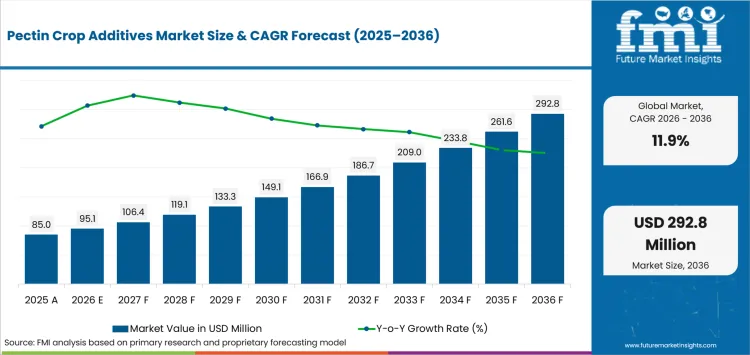
USD 95.1 million in 2026 and USD 292.8 million by 2036 at an 11.9% CAGR.
Demand for pectin crop additives is projected to expand at 11.9% CAGR between 2026 and 2036, increasing valuation from USD 95.1 million in 2026 to USD 292.8 million by 2036. Commercial growth depends on converting pectin or pectin-derived fragments into crop inputs with reproducible composition, practical application rates and evidence that fits existing farm programs.
Oligogalacturonides are fragments produced from pectin and are well characterized as signals that activate plant defence responses. A 2025 Frontiers in Plant Science review describes their role in plant immunity while also noting that excessive signalling can interfere with growth. The commercial requirement is therefore controlled chemistry rather than simply adding more pectin. Products such as FytoSave and PLANTICINE show how pectin-derived oligosaccharides can be translated into regulated crop-protection or biostimulant use.
Key Takeaways of Pectin Crop Additives Market
- Pectin-derived oligogalacturonides create a defined crop-input route by activating plant defence signalling while requiring controlled composition and dose.
- Raw / Crude Extract Grades is projected at 52.2% by Product Type in 2026, while Cereals & Grains is estimated at 40.9% by Crop Type.
- Soil Application is forecast at 46.1% by Application Method in 2026, with Large Commercial Farms projected at 41.0% by Farm Type.
- Agri-Input Distributors is estimated at 40.5% by Sales Channel in 2026 because crop inputs require local technical guidance, label compliance and field support.
- Variable degree of polymerization, dose response and crop conditions can weaken repeatability if pectin-derived fractions are not standardized for agricultural use.
- FytoFend S.A., INTERMAG sp. z o.o., Biobest Group NV, Tate & Lyle PLC, Cargill, Incorporated, International Flavors & Fragrances Inc., Herbstreith & Fox GmbH & Co. KG and JRS Silvateam Ingredients S.r.l. participate through direct pectin-derived crop formulations, agricultural distribution or pectin production.
Analyst Perspective
"Pectin crop additives become commercially useful when the active fraction is specified tightly enough to produce the same plant response across locations. Buyers should separate raw pectin supply from oligogalacturonide formulations, then compare crop label, application route and field validation before treating two products as equivalent."
- Nandini Roy Choudhury, Principal Consultant, Future Market Insights
How is the Pectin Crop Additives Market segmented?
The pectin crop additives market is segmented by Product Type, Crop Type, Application Method, Farm Type, Sales Channel and Region.
Product Type covers Raw / Crude Extract Grades, Refined & Standardized Fractions, Formulated End-Use Blends and Others. Crop Type covers Cereals & Grains, Fruits & Vegetables, Oilseeds & Pulses, Turf & Ornamentals and Others. Application Method includes Soil Application, Foliar Application, Fertigation / Drip, Seed Application and Others. Farm Type includes Large Commercial Farms, Mid-Size Farms, Smallholders, Greenhouses & Nurseries and Others. Sales Channel includes Agri-Input Distributors, Cooperatives, Agri-Retail Chains, Online / Direct-to-Farm and Others.
Why is Raw / Crude Extract Grades projected at 52.2% in the Product Type category?
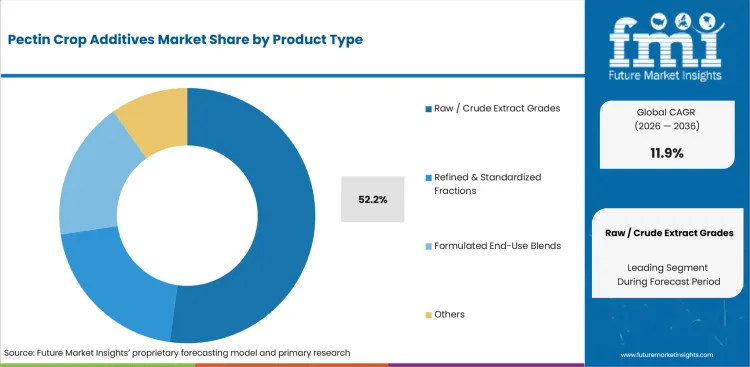
Raw / Crude Extract Grades provide the upstream material base from which standardized pectin fractions and oligogalacturonides can be produced. Their commercial role is different from finished biostimulants because buyers may use them as formulation inputs, processing feedstocks or components in soil-oriented products where further standardization occurs downstream.
- Based on Product Type, Raw / Crude Extract Grades is projected to account for 52.2% in 2026 as agricultural formulators retain flexibility over concentration, hydrolysis and blending.
- Industrial pectin production already uses citrus peel and apple pomace as feedstocks. Agricultural value depends on how consistently those raw fractions can be converted into materials with defined galacturonic-acid structure and repeatable plant response.
Why is Cereals & Grains projected at 40.9% in the Crop Type category?
Cereals & Grains offer broad field acreage and standardized spray or soil-treatment routines that can absorb additive products without redesigning farm operations. The segment also gives suppliers a clear test of whether an elicitor or soil-support product can perform across variable weather, soil and disease pressure.
- In 2026, Cereals & Grains is expected to account for 40.9% of Crop Type demand as field-scale programs create a large base for repeatable application and distributor-led agronomy support.
- Pectin-derived defence elicitors are still more visibly commercialized in horticulture than in cereals. Expansion in Cereals & Grains therefore depends on crop-specific validation that demonstrates a measurable role alongside established nutrition and plant-protection programs.
Why is Soil Application projected at 46.1% in the Application Method category?
Soil Application gives pectin-rich materials a direct route to the rhizosphere and can be combined with biological inputs used around roots. Research from Auburn University showed that a pectin-rich amendment enhanced Bacillus velezensis-mediated soybean growth promotion and nodulation, giving a mechanistic basis for soil-oriented product development.
- The Application Method category is forecast to be led by Soil Application at 46.1% share in 2026 because root-zone delivery can fit pre-plant, transplanting and in-season soil programs.
- The soil route also creates a different formulation problem from foliar elicitors. Persistence, microbial interaction and local soil conditions matter more, so suppliers need compatibility evidence before positioning pectin-rich inputs with inoculants or nutrient programs.
Why is Large Commercial Farms projected at 41.0% in the Farm Type category?
Large Commercial Farms can trial new inputs over defined blocks, compare treated and untreated areas and standardize application through existing equipment. That operating structure suits products whose value depends on timing, dose and local disease or stress conditions rather than on a single universal response.
- Large Commercial Farms is projected to represent 41.0% of Farm Type demand in 2026 as larger operations can absorb technical trials and repeat purchases through structured crop-input programs.
- The adoption threshold remains evidence. Commercial farms can stop a program quickly when response varies by field, which raises the value of specified active fractions, crop-specific instructions and distributor agronomy support.
Why is Agri-Input Distributors projected at 40.5% in the Sales Channel category?
Agri-Input Distributors connect formulation suppliers with growers while handling local product positioning, crop recommendations and compatibility questions. This matters for pectin-derived products because a raw pectin ingredient, a biostimulant and a registered plant-protection product can sit under different commercial and regulatory requirements.
- Agri-Input Distributors is expected to account for 40.5% of Sales Channel demand in 2026 as local technical support remains central to product selection and repeat use.
- FytoFend markets FytoSave with a distributor-and-grower route, while biological-control companies such as Biobest carry the product into crop-protection programs. The channel therefore does more than move inventory; it translates label conditions and application timing into farm practice.
What are the drivers, restraints and opportunities in the Pectin Crop Additives Market?
Pectin-derived elicitors create a route to crop defence and biostimulation while molecular variability can weaken repeatability as regulated products expand across field and protected-crop applications.
- Driver: Oligogalacturonides derived from pectin can activate plant defence responses, giving formulators a defined biological mechanism for crop inputs.
- Restraint: Biological response changes with oligomer structure, concentration, crop physiology and field conditions, so weak standardization can produce inconsistent results.
- Opportunity: Regulated foliar products and soil-oriented biological combinations create expansion routes for refined fractions and Formulated End-Use Blends.
The scientific base for pectin-derived crop inputs is concentrated around oligogalacturonides. Reviews published in 2025 describe these pectin fragments as damage-associated molecular signals that can activate plant immunity. Commercial products convert that mechanism into a usable formulation, with FytoFend using the pectin-derived OGA component inside COS-OGA and INTERMAG using oligogalacturonides in PLANTICINE.
The same signalling mechanism creates a restraint when the active fraction is poorly controlled. The 2025 Frontiers review notes that excessive oligogalacturonide levels can interfere with growth and development. Suppliers therefore need to control chain length, concentration and application timing while growers need crop-specific directions rather than generic pectin claims.
The opportunity is widening where regulation and distribution give biological products a defined route to farms. FytoSave has current authorizations in Great Britain and Germany, while INTERMAG states that PLANTICINE is registered as a PFC 6 biostimulant under Regulation (EU) 2019/1009. These routes support more structured commercial testing of Formulated End-Use Blends and create demand for standardized upstream pectin fractions.
Which country CAGRs are profiled in the Pectin Crop Additives Market?
| Country | CAGR |
|---|---|
| South Korea | 11.5% |
| Germany | 11.2% |
| USA | 10.9% |
| UK | 10.3% |
| Japan | 9.9% |
How do country-level CAGRs compare in the Pectin Crop Additives Market?
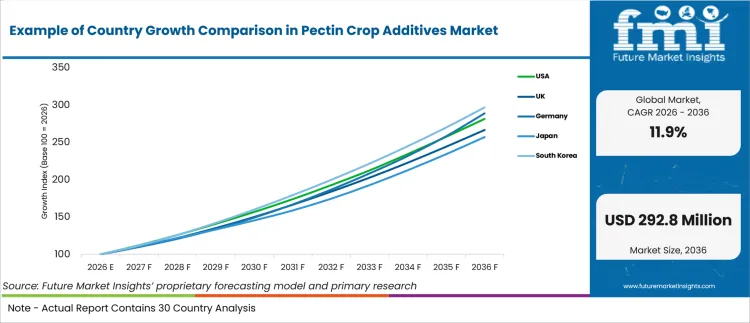
The five profiled CAGRs span 1.6 percentage points across agricultural systems with different regulatory routes, farm structures and biological-input adoption conditions. The spacing reflects expected market expansion rather than current pectin crop additive consumption in each country.
- South Korea is projected at 11.5%, supported by policy emphasis on smart farming and controlled production systems that can improve measurement of input response.
- Germany is forecast at 11.2%, with an established regulatory route for COS-OGA products demonstrated by the current FytoSave authorization listed by the Federal Office of Consumer Protection and Food Safety.
- The USA is estimated at 10.9%, supported by university research on pectin-rich soil amendments and a large field-crop base that can support structured biological-input trials.
- The UK is projected at 10.3%, where the Health and Safety Executive lists Fytosave as a professional fungicide containing 12.500 g/l COS-OGA for protected crops.
- Japan is forecast at 9.9%, with the Ministry of Agriculture, Forestry and Fisheries developing clearer information around biostimulant labeling and use.
Comparable CAGRs can produce different market entry conditions. The full report provides country-level CAGR analysis across North America, Latin America, Europe, East Asia, South Asia and Pacific, and the Middle East and Africa.
Country-wise Analysis
- South Korean pectin crop additive demand is expected to expand as farms add more controlled production and digital monitoring to greenhouse and field systems. The Ministry of Agriculture, Food and Rural Affairs plans to turn 35% of 55,000 hectares of greenhouses into smart farms by 2029 and apply smart-farming technology across part of major field-crop areas. Those systems can make application timing and response measurement more disciplined for new biological inputs. South Korea is projected to record 11.5% CAGR during the assessment period, although pectin-derived products still need local crop validation and commercial registration before technology adoption translates into routine use.
- Germany has a defined crop-protection route for pectin-derived oligogalacturonides through COS-OGA. The Federal Office of Consumer Protection and Food Safety listed FytoSave with COS-OGA among authorized plant-protection products in 2026, providing a current example of regulatory acceptance for a pectin-derived active complex. Germany is forecast to post 11.2% CAGR through 2036 as biological crop-protection options enter structured farm programs, while product claims remain tied to authorized crops and use conditions rather than broad pectin functionality.
- USA demand is estimated to advance at 10.9% CAGR through 2036. Research at Auburn University found that a pectin-rich amendment could enhance Bacillus velezensis-mediated soybean growth promotion and nodulation, showing how pectin-rich materials can interact with beneficial soil biology. The commercial route is still narrower than the underlying research base because field performance depends on soil microbiology, formulation quality and compatibility with established crop inputs across large production regions.
- UK demand is projected to expand at 10.3% CAGR during the forecast period. The Health and Safety Executive lists Fytosave, held by FytoFend S.A., as a professional fungicide containing 12.500 g/l COS-OGA for protected vegetables, with a product expiry date in 2032. That authorization gives the market a concrete pectin-derived crop-protection reference, although the permitted use remains crop and label specific. Distribution support is important because growers need to integrate the product with existing spray programs and protected-crop disease management.
- Japan is forecast to record 9.9% CAGR through 2036 as the policy environment around plant biostimulants becomes more explicit. The Ministry of Agriculture, Forestry and Fisheries issued guidelines on biostimulant labeling in May 2025 and held an information exchange meeting on those guidelines in March 2026. The guidance covers efficacy and use claims, supporting evidence and safety information. Market growth will depend on how suppliers translate pectin-derived claims into locally acceptable labels and crop-specific evidence.
Who are the notable companies in the Pectin Crop Additives Market?
FytoFend S.A., INTERMAG sp. z o.o., Biobest Group NV, Tate & Lyle PLC, Cargill, Incorporated, International Flavors & Fragrances Inc., Herbstreith & Fox GmbH & Co. KG and JRS Silvateam Ingredients S.r.l. are notable companies serving direct pectin-derived crop formulations, agricultural biological distribution or pectin supply relevant to crop-additive formulation.
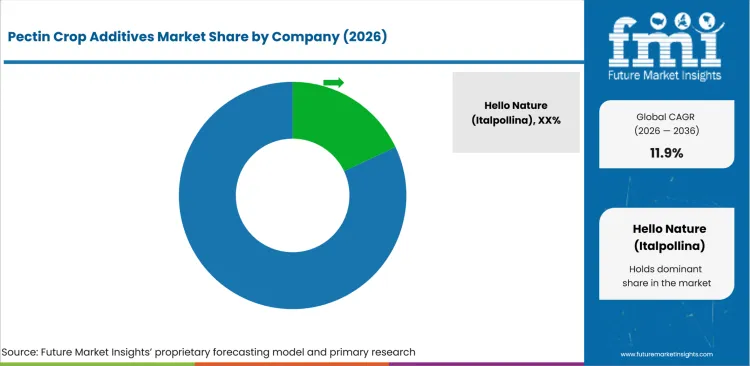
Competition spans two connected layers. FytoFend and INTERMAG sell crop products that explicitly use pectin-derived oligogalacturonides. Biobest participates through biological crop-protection distribution. The remaining companies manufacture pectin or standardized pectin systems that can serve as upstream material capability, although their current public portfolios are centered mainly on food, health or industrial applications rather than labeled crop additives.
- FytoFend S.A. and INTERMAG sp. z o.o. provide direct agricultural evidence through COS-OGA and oligogalacturonide-based crop products.
- Biobest Group NV provides a commercial distribution route for FytoSave within biological crop-protection programs.
- Tate & Lyle PLC, Cargill, Incorporated, International Flavors & Fragrances Inc., Herbstreith & Fox GmbH & Co. KG and JRS Silvateam Ingredients S.r.l. provide pectin production, standardization or formulation capability that is relevant upstream.
Competitive Benchmarking: Pectin Crop Additives Market
| Company | Crop-additive relevance | Pectin / OG capability | Formulation or distribution support | Geographic Reach |
|---|---|---|---|---|
| FytoFend S.A. | High | High | High | European and selected international crop-protection markets |
| INTERMAG sp. z o.o. | High | High | High | Europe and selected international agricultural markets |
| Biobest Group NV | High | Medium | High | Europe and international biological-control markets |
| Tate & Lyle PLC | Low | High | High | Ingredient markets across multiple regions |
| Cargill, Incorporated | Low | High | High | Americas, Europe and Asia Pacific |
| International Flavors & Fragrances Inc. | Low | High | High | Ingredient markets across multiple regions |
| Herbstreith & Fox GmbH & Co. KG | Low | High | High | Europe and international ingredient markets |
| JRS Silvateam Ingredients S.r.l. | Low | High | High | Europe and international ingredient markets |
Key Developments in the Pectin Crop Additives Market
- In May 2026, FytoFend reported a 120-day Italian emergency authorization for Ibisco, its FytoSave formulation, for tomato bacteriosis caused by Pseudomonas syringae.
- In June 2026, International Flavors & Fragrances Inc. introduced GRINDSTED DuoGel in EMEA, combining pectin and carrageenan in a standardized hydrocolloid system and demonstrating continued development of pre-engineered pectin blends.
- In September 2025, Tate & Lyle marked 75 years of pectin production and innovation at its Großenbrode site following the company's combination with CP Kelco.
Key Players in the Pectin Crop Additives Market
Pectin-Derived Crop Formulations
- FytoFend S.A.
- INTERMAG sp. z o.o.
Agricultural Biological Distribution
- Biobest Group NV
Pectin and Standardized Fraction Producers
- Tate & Lyle PLC
- Cargill, Incorporated
- International Flavors & Fragrances Inc.
- Herbstreith & Fox GmbH & Co. KG
- JRS Silvateam Ingredients S.r.l.
Pectin Crop Additives Market - Report Scope
| Coverage field | Report scope |
|---|---|
| Market breakdown | By Product Type, Crop Type, Application Method, Farm Type, Sales Channel and Region. |
| Quantitative Units | Revenue in USD million and CAGR in %. |
| Market Definition | Pectin extracts, pectin-derived oligogalacturonides, standardized fractions and formulated crop inputs used in plant nutrition, biostimulation, soil programs or crop-protection support. |
| Regions Covered | North America, Latin America, Europe, East Asia, South Asia and Pacific, and Middle East and Africa. |
| Countries Covered | South Korea, Germany, USA, UK, Japan, and 20+ countries included in the full report. |
| Key Companies Profiled | FytoFend S.A., INTERMAG sp. z o.o., Biobest Group NV, Tate & Lyle PLC, Cargill, Incorporated, International Flavors & Fragrances Inc., Herbstreith & Fox GmbH & Co. KG and JRS Silvateam Ingredients S.r.l. |
| Forecast Period | 2026 to 2036. |
| Approach | Primary and secondary research with market triangulation. |
Pectin Crop Additives Market - Research Methodology
| Method | Approach |
|---|---|
| Primary Research | FMI analysts gathered input from pectin manufacturers, crop-input formulators, biological crop-protection companies, agri-input distributors, growers, agronomists, procurement teams and subject-matter experts. Interviews examined product selection, application practice, crop response, approval requirements, pricing considerations and the evidence required before a trial becomes repeat purchasing. |
| Desk Research | Desk research covered government regulations, plant-protection registers, academic literature, industry associations, company filings, official product information and corporate announcements. Sources were reviewed for relevance, publication date, geographic coverage and consistency with the defined market scope. Claims relating to pectin chemistry, crop application, authorization, production capability and commercial activity were retained only when supported by credible public evidence. |
| Market Sizing and Forecasting | The market model combined the baseline value with historical performance, segment structure, pricing and volume indicators, adoption levels, company participation and country-level demand conditions. Forecast assumptions considered farm economics, biological-input adoption, regulatory developments, formulation progress, distribution coverage and barriers to repeatable field performance. Segment and regional estimates were reconciled before the final market total was calculated. |
| Data Validation | Estimates were checked against multiple independent indicators, including public regulations, academic evidence, company activity, industry participation and findings from primary interviews. Validation also tested whether pectin materials, oligogalacturonide products, application routes and company activities fell within the defined market boundaries. Adjacent hydrocolloids, unrelated biostimulants and activities without direct pectin relevance were excluded to reduce overlap and maintain consistency. |
Pectin Crop Additives Market by Segments
Pectin Crop Additives Market segmented by Product Type:
- Raw / Crude Extract Grades
- Refined & Standardized Fractions
- Formulated End-Use Blends
- Others
Pectin Crop Additives Market segmented by Crop Type:
- Cereals & Grains
- Fruits & Vegetables
- Oilseeds & Pulses
- Turf & Ornamentals
- Others
Pectin Crop Additives Market segmented by Application Method:
- Soil Application
- Foliar Application
- Fertigation / Drip
- Seed Application
- Others
Pectin Crop Additives Market segmented by Farm Type:
- Large Commercial Farms
- Mid-Size Farms
- Smallholders
- Greenhouses & Nurseries
- Others
Pectin Crop Additives Market segmented by Sales Channel:
- Agri-Input Distributors
- Cooperatives
- Agri-Retail Chains
- Online / Direct-to-Farm
- Others
Pectin Crop Additives Market by Region:
- North America
- United States
- Canada
- Latin America
- Brazil
- Chile
- Mexico
- Rest of Latin America
- Western Europe
- Germany
- United Kingdom
- Italy
- Spain
- France
- Nordics
- Benelux
- Rest of Western Europe
- Eastern Europe
- Russia
- Poland
- Hungary
- Balkan and Baltic States
- Rest of Eastern Europe
- East Asia
- China
- Japan
- South Korea
- South Asia and Pacific
- India
- ASEAN
- Australia and New Zealand
- Rest of South Asia and Pacific
- Middle East and Africa
- Kingdom of Saudi Arabia
- Other GCC Countries
- Türkiye
- South Africa
- Other African Union Countries
- Rest of Middle East and Africa
Research Sources and Bibliography
- Carton, C. et al. (2025). Potential of Bio-Sourced Oligogalacturonides in Crop Protection. Molecules.
- Degli Esposti, C. et al. (2025). Cell wall bricks of defence: the case study of oligogalacturonides. Frontiers in Plant Science.
- Hassan, M. K. et al. (2019). Pectin-Rich Amendment Enhances Soybean Growth Promotion and Nodulation Mediated by Bacillus velezensis Strains. Plants.
- Benedetti, M. et al. (2015). Plant immunity triggered by engineered in vivo release of oligogalacturonides, damage-associated molecular patterns. Proceedings of the National Academy of Sciences.
- European Commission. (2026). EU Pesticides Database.
- European Parliament and Council. (2019, June 5). Regulation (EU) 2019/1009 laying down rules on the making available on the market of EU fertilising products.
- Health and Safety Executive. (2026). Fytosave (18433) - Authorisation Details.
- Federal Office of Consumer Protection and Food Safety, Germany. (2026, May 31). List of authorised plant protection products in Germany.
- Ministry of Agriculture, Food and Rural Affairs, Republic of Korea. (2025, February 27). First Master Plan for Promotion of the Growth of the Smart-Farming Industry for 2025-2029.
- Ministry of Agriculture, Forestry and Fisheries, Japan. (2025, May 30; 2026, March 4). Guidelines concerning labeling of biostimulants and information exchange meeting.
- INTERMAG sp. z o.o. (2026). PLANTICINE product information and PFC 6 registration information.
- FytoFend S.A. (2026). FytoSave and COS-OGA technology information.
- Biobest Group NV. (2026). FytoSave product information.
- International Pectin Producers Association. (2026). Pectin Producers.
- Tate & Lyle PLC. (2025, September 4). 75 years of pectin innovation at our plant in Großenbrode.
- International Flavors & Fragrances Inc. (2026, June 23). IFF launches GRINDSTED DuoGel in Europe, the Middle East and Africa.
- Cargill, Incorporated. (2026). UniPECTINE pectin portfolio information.
- Herbstreith & Fox GmbH & Co. KG. (2026). Pectin applications and company information.
- dsm-firmenich. (2025, April 3). dsm-firmenich completes shareholding increase in Andre Pectin to 90.5%.
- JRS Silvateam Ingredients S.r.l. (2026). Aglupectin citrus pectin and plant-based ingredients information.
This bibliography is provided for reader reference and is not exhaustive. The full report contains the complete reference list and detailed citations.
This Report Answers
- How does the Pectin Crop Additives Market develop across the forecast period?
- Which operating conditions support adoption of pectin-derived crop inputs?
- Which Product Type accounts for the principal share?
- How does Crop Type shape commercial demand for pectin crop additives?
- Which Application Method supports repeat use across field programs?
- How do Farm Type and Sales Channel affect product trials and repeat purchasing?
- How do country growth patterns affect commercial entry conditions?
- Which companies participate in direct pectin-derived crop products, distribution and upstream pectin supply?
Frequently Asked Questions
How big is the Pectin Crop Additives Market in 2026?
USD 95.1 million represents the Pectin Crop Additives Market value in 2026. Pectin-derived oligogalacturonides create a defined agricultural route through defence elicitation, while the wider market also includes raw extracts, standardized fractions and formulated crop inputs. The market is projected to reach USD 292.8 million by 2036.
What is the CAGR of the Pectin Crop Additives Market from 2026 to 2036?
An 11.9% CAGR is projected for the Pectin Crop Additives Market between 2026 and 2036. Growth depends on tighter standardization of pectin-derived fractions, broader crop validation and distribution support that converts biological activity into repeatable farm use.
Which Product Type segment is projected to account for 52.2% of the Pectin Crop Additives Market?
Raw / Crude Extract Grades is projected to account for 52.2% of Product Type demand within the Pectin Crop Additives Market in 2026. The segment gives formulators flexibility to refine, hydrolyze or blend pectin materials for soil, foliar or other crop-input applications.
How much will the Pectin Crop Additives Market add between 2026 and 2036?
USD 197.7 million is expected to be added to the Pectin Crop Additives Market between 2026 and 2036. Expansion depends on conversion of upstream pectin supply into standardized crop formulations and on field evidence that supports repeat purchasing across different farm systems.
Which companies are active in the Pectin Crop Additives Market?
Eight companies active across direct pectin-derived crop formulations, agricultural distribution and upstream pectin capability include FytoFend S.A., INTERMAG sp. z o.o., Biobest Group NV, Tate & Lyle PLC, Cargill, Incorporated, International Flavors & Fragrances Inc., Herbstreith & Fox GmbH & Co. KG and JRS Silvateam Ingredients S.r.l. Their roles differ, so direct crop-product evidence should be separated from pectin manufacturing capacity when comparing competitors.
Preview the report firsthand - request a free sample
Get SampleGet the brochure for pricing and purchase details.
Get PDFTable of Content
- Key Takeaways
- Market Size and CAGR
- Top Growth Driver
- Fastest Growing Segment
- Leading Region
- Key Companies
- Emerging Opportunities
- Executive Summary
- Global Market Outlook
- Demand-side Trends
- Supply-side Trends
- Technology Roadmap Analysis
- Analysis and Recommendations
- Analyst Perspective (What is happening? Why now? What should investors know?)
- Key Questions Answered
- How large is the market?
- What is the CAGR?
- What are key trends?
- Which region dominates?
- Who are the leaders?
- Market Overview
- Market Coverage / Taxonomy
- Market Definition / Scope / Limitations
- Research Methodology
- Chapter Orientation
- Analytical Lens and Working Hypotheses
- Market Structure, Signals, and Trend Drivers
- Benchmarking and Cross-market Comparability
- Market Sizing, Forecasting, and Opportunity Mapping
- Research Design and Evidence Framework
- Desk Research Programme (Secondary Evidence)
- Expert Input and Fieldwork (Primary Evidence)
- Tooling, Models, and Reference Databases
- Data Engineering and Model Build
- Quality Assurance and Audit Trail
- Market Background
- Market Dynamics (Drivers, Restraints, Opportunity, Trends)
- Scenario Forecast (Optimistic, Likely, Conservative)
- Impact Analysis
- AI Impact
- Sustainability Impact
- Regulatory Impact
- Technology Impact
- Consumer / Buyer Analysis
- Purchase Drivers
- Adoption Barriers
- Buyer Journey
- Opportunity Map Analysis
- Product Life Cycle Analysis
- Supply Chain Analysis
- Investment Feasibility Matrix
- Value Chain Analysis
- PESTLE and Porter's Analysis
- Regulatory Landscape
- Regional Parent Market Outlook
- Production and Consumption Statistics
- Import and Export Statistics
- Global Market Analysis and Forecast, 2021 to 2036
- Historical Market Size Value (USD Million) Analysis, 2021 to 2025
- Current and Future Market Size Value (USD Million) Projections, 2026 to 2036
- Y-o-Y Growth Trend Analysis
- Absolute $ Opportunity Analysis
- Global Market Pricing Analysis, 2021 to 2036
- Global Market Analysis and Forecast, By Product Type, 2021 to 2036
- Introduction / Key Findings
- Historical Market Size Value (USD Million) Analysis By Product Type, 2021 to 2025
- Current and Future Market Size Value (USD Million) Analysis and Forecast By Product Type, 2026 to 2036
- Raw / Crude Extract Grades
- Refined & Standardized Fractions
- Formulated End-Use Blends
- Others
- Raw / Crude Extract Grades
- Y-o-Y Growth Trend Analysis By Product Type, 2021 to 2025
- Absolute $ Opportunity Analysis By Product Type, 2026 to 2036
- Global Market Analysis and Forecast, By Crop Type, 2021 to 2036
- Introduction / Key Findings
- Historical Market Size Value (USD Million) Analysis By Crop Type, 2021 to 2025
- Current and Future Market Size Value (USD Million) Analysis and Forecast By Crop Type, 2026 to 2036
- Cereals & Grains
- Fruits & Vegetables
- Oilseeds & Pulses
- Turf & Ornamentals
- Others
- Cereals & Grains
- Y-o-Y Growth Trend Analysis By Crop Type, 2021 to 2025
- Absolute $ Opportunity Analysis By Crop Type, 2026 to 2036
- Global Market Analysis and Forecast, By Application Method, 2021 to 2036
- Introduction / Key Findings
- Historical Market Size Value (USD Million) Analysis By Application Method, 2021 to 2025
- Current and Future Market Size Value (USD Million) Analysis and Forecast By Application Method, 2026 to 2036
- Soil Application
- Foliar Application
- Fertigation / Drip
- Seed Application
- Others
- Soil Application
- Y-o-Y Growth Trend Analysis By Application Method, 2021 to 2025
- Absolute $ Opportunity Analysis By Application Method, 2026 to 2036
- Global Market Analysis and Forecast, By Farm Type, 2021 to 2036
- Introduction / Key Findings
- Historical Market Size Value (USD Million) Analysis By Farm Type, 2021 to 2025
- Current and Future Market Size Value (USD Million) Analysis and Forecast By Farm Type, 2026 to 2036
- Large Commercial Farms
- Mid-Size Farms
- Smallholders
- Greenhouses & Nurseries
- Others
- Large Commercial Farms
- Y-o-Y Growth Trend Analysis By Farm Type, 2021 to 2025
- Absolute $ Opportunity Analysis By Farm Type, 2026 to 2036
- Global Market Analysis and Forecast, By Sales Channel, 2021 to 2036
- Introduction / Key Findings
- Historical Market Size Value (USD Million) Analysis By Sales Channel, 2021 to 2025
- Current and Future Market Size Value (USD Million) Analysis and Forecast By Sales Channel, 2026 to 2036
- Agri-Input Distributors
- Cooperatives
- Agri-Retail Chains
- Online / Direct-to-Farm
- Others
- Agri-Input Distributors
- Y-o-Y Growth Trend Analysis By Sales Channel, 2021 to 2025
- Absolute $ Opportunity Analysis By Sales Channel, 2026 to 2036
- Global Market Analysis and Forecast, By Region, 2021 to 2036
- Introduction
- Historical Market Size Value (USD Million) Analysis By Region, 2021 to 2025
- Current Market Size Value (USD Million) Analysis and Forecast By Region, 2026 to 2036
- North America
- Latin America
- Western Europe
- Eastern Europe
- East Asia
- South Asia and Pacific
- Middle East & Africa
- Market Attractiveness Analysis By Region
- North America Market Analysis and Forecast, By Country, 2021 to 2036
- Historical Market Size Value (USD Million) Trend Analysis By Market Taxonomy, 2021 to 2025
- Market Size Value (USD Million) Forecast By Market Taxonomy, 2026 to 2036
- By Country
- USA
- Canada
- By Product Type
- By Crop Type
- By Application Method
- By Farm Type
- By Sales Channel
- By Country
- Market Attractiveness Analysis
- By Country
- By Product Type
- By Crop Type
- By Application Method
- By Farm Type
- By Sales Channel
- Key Takeaways
- Latin America Market Analysis and Forecast, By Country
- Historical Market Size Value (USD Million) Trend Analysis By Market Taxonomy, 2021 to 2025
- Market Size Value (USD Million) Forecast By Market Taxonomy, 2026 to 2036
- By Country
- Brazil
- Mexico
- Chile
- Rest of Latin America
- By Product Type
- By Crop Type
- By Application Method
- By Farm Type
- By Sales Channel
- By Country
- Market Attractiveness Analysis
- By Country
- By Product Type
- By Crop Type
- By Application Method
- By Farm Type
- By Sales Channel
- Key Takeaways
- Western Europe Market Analysis and Forecast, By Country
- Historical Market Size Value (USD Million) Trend Analysis By Market Taxonomy, 2021 to 2025
- Market Size Value (USD Million) Forecast By Market Taxonomy, 2026 to 2036
- By Country
- Germany
- UK
- Italy
- Spain
- France
- Nordic
- BENELUX
- Rest of Western Europe
- By Product Type
- By Crop Type
- By Application Method
- By Farm Type
- By Sales Channel
- By Country
- Market Attractiveness Analysis
- By Country
- By Product Type
- By Crop Type
- By Application Method
- By Farm Type
- By Sales Channel
- Key Takeaways
- Eastern Europe Market Analysis and Forecast, By Country
- Historical Market Size Value (USD Million) Trend Analysis By Market Taxonomy, 2021 to 2025
- Market Size Value (USD Million) Forecast By Market Taxonomy, 2026 to 2036
- By Country
- Russia
- Poland
- Hungary
- Balkan & Baltic
- Rest of Eastern Europe
- By Product Type
- By Crop Type
- By Application Method
- By Farm Type
- By Sales Channel
- By Country
- Market Attractiveness Analysis
- By Country
- By Product Type
- By Crop Type
- By Application Method
- By Farm Type
- By Sales Channel
- Key Takeaways
- East Asia Market Analysis and Forecast, By Country
- Historical Market Size Value (USD Million) Trend Analysis By Market Taxonomy, 2021 to 2025
- Market Size Value (USD Million) Forecast By Market Taxonomy, 2026 to 2036
- By Country
- China
- Japan
- South Korea
- By Product Type
- By Crop Type
- By Application Method
- By Farm Type
- By Sales Channel
- By Country
- Market Attractiveness Analysis
- By Country
- By Product Type
- By Crop Type
- By Application Method
- By Farm Type
- By Sales Channel
- Key Takeaways
- South Asia and Pacific Market Analysis and Forecast, By Country
- Historical Market Size Value (USD Million) Trend Analysis By Market Taxonomy, 2021 to 2025
- Market Size Value (USD Million) Forecast By Market Taxonomy, 2026 to 2036
- By Country
- India
- ASEAN
- Australia & New Zealand
- Rest of South Asia and Pacific
- By Product Type
- By Crop Type
- By Application Method
- By Farm Type
- By Sales Channel
- By Country
- Market Attractiveness Analysis
- By Country
- By Product Type
- By Crop Type
- By Application Method
- By Farm Type
- By Sales Channel
- Key Takeaways
- Middle East & Africa Market Analysis and Forecast, By Country
- Historical Market Size Value (USD Million) Trend Analysis By Market Taxonomy, 2021 to 2025
- Market Size Value (USD Million) Forecast By Market Taxonomy, 2026 to 2036
- By Country
- Kingdom of Saudi Arabia
- Other GCC Countries
- Türkiye
- South Africa
- Other African Union
- Rest of Middle East & Africa
- By Product Type
- By Crop Type
- By Application Method
- By Farm Type
- By Sales Channel
- By Country
- Market Attractiveness Analysis
- By Country
- By Product Type
- By Crop Type
- By Application Method
- By Farm Type
- By Sales Channel
- Key Takeaways
- Key Countries Market Analysis
- USA
- Pricing Analysis
- Market Share Analysis, 2025
- By Product Type
- By Crop Type
- By Application Method
- By Farm Type
- By Sales Channel
- Canada
- Pricing Analysis
- Market Share Analysis, 2025
- By Product Type
- By Crop Type
- By Application Method
- By Farm Type
- By Sales Channel
- Mexico
- Pricing Analysis
- Market Share Analysis, 2025
- By Product Type
- By Crop Type
- By Application Method
- By Farm Type
- By Sales Channel
- Brazil
- Pricing Analysis
- Market Share Analysis, 2025
- By Product Type
- By Crop Type
- By Application Method
- By Farm Type
- By Sales Channel
- Chile
- Pricing Analysis
- Market Share Analysis, 2025
- By Product Type
- By Crop Type
- By Application Method
- By Farm Type
- By Sales Channel
- Germany
- Pricing Analysis
- Market Share Analysis, 2025
- By Product Type
- By Crop Type
- By Application Method
- By Farm Type
- By Sales Channel
- UK
- Pricing Analysis
- Market Share Analysis, 2025
- By Product Type
- By Crop Type
- By Application Method
- By Farm Type
- By Sales Channel
- Italy
- Pricing Analysis
- Market Share Analysis, 2025
- By Product Type
- By Crop Type
- By Application Method
- By Farm Type
- By Sales Channel
- Spain
- Pricing Analysis
- Market Share Analysis, 2025
- By Product Type
- By Crop Type
- By Application Method
- By Farm Type
- By Sales Channel
- France
- Pricing Analysis
- Market Share Analysis, 2025
- By Product Type
- By Crop Type
- By Application Method
- By Farm Type
- By Sales Channel
- India
- Pricing Analysis
- Market Share Analysis, 2025
- By Product Type
- By Crop Type
- By Application Method
- By Farm Type
- By Sales Channel
- ASEAN
- Pricing Analysis
- Market Share Analysis, 2025
- By Product Type
- By Crop Type
- By Application Method
- By Farm Type
- By Sales Channel
- Australia & New Zealand
- Pricing Analysis
- Market Share Analysis, 2025
- By Product Type
- By Crop Type
- By Application Method
- By Farm Type
- By Sales Channel
- China
- Pricing Analysis
- Market Share Analysis, 2025
- By Product Type
- By Crop Type
- By Application Method
- By Farm Type
- By Sales Channel
- Japan
- Pricing Analysis
- Market Share Analysis, 2025
- By Product Type
- By Crop Type
- By Application Method
- By Farm Type
- By Sales Channel
- South Korea
- Pricing Analysis
- Market Share Analysis, 2025
- By Product Type
- By Crop Type
- By Application Method
- By Farm Type
- By Sales Channel
- Russia
- Pricing Analysis
- Market Share Analysis, 2025
- By Product Type
- By Crop Type
- By Application Method
- By Farm Type
- By Sales Channel
- Poland
- Pricing Analysis
- Market Share Analysis, 2025
- By Product Type
- By Crop Type
- By Application Method
- By Farm Type
- By Sales Channel
- Hungary
- Pricing Analysis
- Market Share Analysis, 2025
- By Product Type
- By Crop Type
- By Application Method
- By Farm Type
- By Sales Channel
- Kingdom of Saudi Arabia
- Pricing Analysis
- Market Share Analysis, 2025
- By Product Type
- By Crop Type
- By Application Method
- By Farm Type
- By Sales Channel
- Türkiye
- Pricing Analysis
- Market Share Analysis, 2025
- By Product Type
- By Crop Type
- By Application Method
- By Farm Type
- By Sales Channel
- South Africa
- Pricing Analysis
- Market Share Analysis, 2025
- By Product Type
- By Crop Type
- By Application Method
- By Farm Type
- By Sales Channel
- USA
- Market Structure Analysis
- Competition Dashboard
- Competition Benchmarking
- Market Share Analysis of Top Players
- By Regional
- By Product Type
- By Crop Type
- By Application Method
- By Farm Type
- By Sales Channel
- Emerging Startups
- Innovation Benchmarking
- Competition Analysis
- Competition Deep Dive
- Hello Nature (Italpollina)
- Overview
- Product Portfolio
- Profitability by Market Segments
- Sales Footprint
- Strategy Overview
- Marketing Strategy
- Product Strategy
- Channel Strategy
- Sicit Group
- Tessenderlo Group
- Algaia
- Gelymar
- Kimitec
- Seipasa
- Borregaard
- Hello Nature (Italpollina)
- Case Studies
- Success Stories
- Recent Developments
- Competition Deep Dive
- Assumptions & Acronyms Used


