

- Market Size (2026)
- USD 1.9 Bn
- Forecast (2036)
- USD 3.0 Bn
- CAGR (2026 to 2036)
- 4.9%
How big is Perlite Insulation Materials Market in 2026?
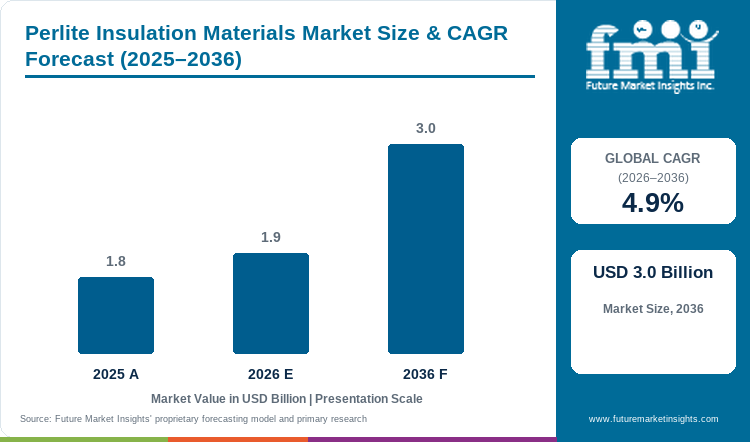
USD 1.9 billion in 2026 and USD 3.0 billion by 2036, expanding at 4.9% CAGR.
Sales of perlite insulation materials are estimated to rise at 4.9% CAGR through 2036, increasing valuation from USD 1.8 billion in 2025 to USD 1.9 billion in 2026, and reaching USD 3.0 billion by 2036. Cryogenic tanks use expanded perlite between two tank walls. The light fill slows heat flow without adding much weight. The Perlite Institute lists storage tanks and cold boxes as low-temperature uses. Orders also come from high-temperature insulation and building products. Tank builders check density and moisture before filling starts.
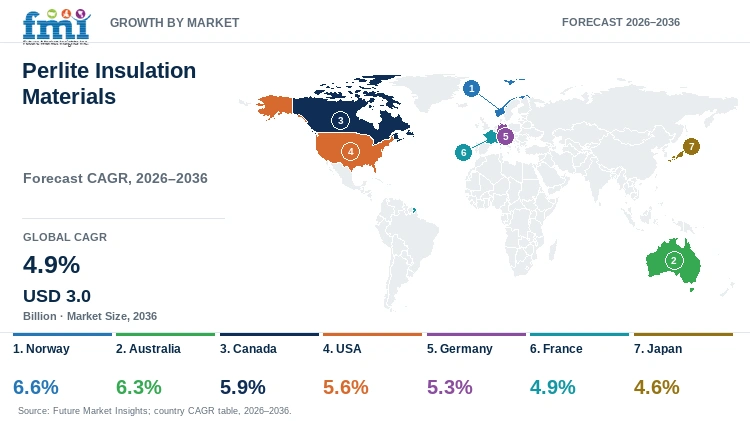
Norway is projected to grow at 6.6% CAGR through 2036, compared with 4.6% for Japan. The Norwegian Offshore Directorate says Snøhvit uses all available space at Hammerfest LNG. Active gas output keeps cold-storage equipment in regular use. New capacity choices can add large perlite jobs in Norway. Japan has a mature LNG system with longer approval steps. Its demand comes more from service work and steady supply by approved vendors.
Key Takeaways
- New LNG and gas tanks create large perlite orders. Later service needs dry fill and careful placement.
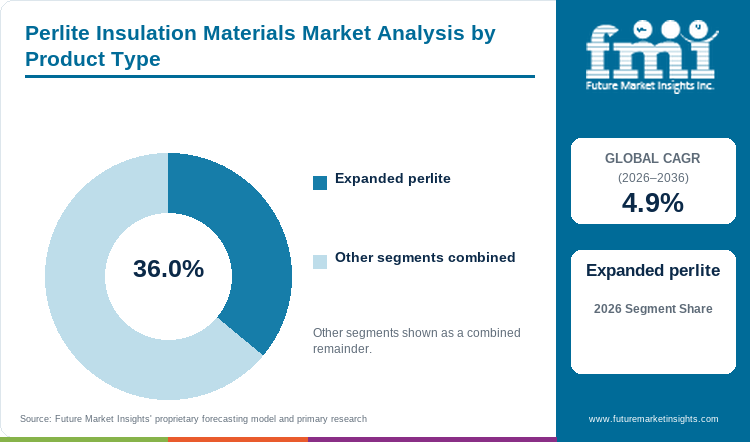
- By product type, expanded perlite is estimated to hold 36.0% in 2026, supported by loose-fill and formed uses.
- Cryogenic tanks are expected to hold 28.0% of application demand in 2026 because large tanks need deep perlite fills.
- LNG and industrial gases are projected to hold 31.0% of end-use demand in 2026 because large sites need perlite.
- Bulky perlite costs more to ship, and wet or uneven filling can reduce heat protection.
- Key players include Imerys, Dicalite Management Group, Perlite Hellas SA, Keltech Energies Limited and Gulf Perlite LLC. Other active firms are Supreme Perlite Company, Aegean Perlites SA, Termolita S.A.P.I. de C.V., Silbrico Corporation, TurkPerlite and CRYOPERL Ltd.
Analyst Perspective
“Perlite suppliers can cut costs when they control raw ore and site work. Local expansion units cut freight and help tank crews control density and moisture.”
- Nikhil Kaitwade, Principal Consultant, Future Market Insights
How is the perlite insulation materials market segmented?
Perlite Insulation Materials Market is segmented by Product Type, Application, End Use, Density, Sales Channel, and Region.
The market has six main groups: product type, application, end use, density, sales channel and region. Product type covers expanded and cryogenic perlite plus boards, pipe sections and loose fill. Application covers tanks, buildings, furnaces, pipes and horticulture or filtration. End use covers LNG and industrial gases, construction, petrochemicals, power and food or pharma. Density and sales channel show how perlite is supplied and installed.
How does expanded perlite shape demand within the product type category?
USGS estimated that building work used 45% of expanded perlite in 2025. Builders can use it as loose fill or as formed insulation. Tank grades need tighter control of density and moisture.
- Based on product type, expanded perlite is projected to account for 36.0% in 2026, supported by loose-fill and formed uses.
- Bagged, bulk and site-expanded supply change freight costs and the equipment needed for filling.
What supports cryogenic tanks within the application category?
Large LNG tanks need careful filling during setup. Tall walls can cause uneven density and later settling. CRYOPERL described fill methods by tank size in May 2026. Technical insulation choices set the fill method, checks and perlite grade.
- By application, cryogenic tanks are estimated to hold 28.0% in 2026, supported by large fill needs and startup checks.
- Project teams compare mobile expansion and backup equipment before they approve a large tank-filling plan.
Why do LNG and industrial gases lead the end-use category?
EIA said Golden Pass LNG shipped its first cargo in April 2026 as startup work continued. Industrial insulation at LNG and gas plants includes first fills and later service. Petrochemical and power plants buy more during planned shutdowns.
- In 2026, LNG and industrial gases are expected to lead end use with 31.0% share, supported by large storage and processing sites.
- Operators need density, moisture and fill records before a new storage tank starts work.
How does medium density influence selection within the density category?
Medium-density perlite balances heat control with smooth filling. CRYOPERL gave a 50 to 70 kg/m3 range in May 2026. High-performance insulation still needs batch and site checks because density changes heat flow and the amount of fill.
- By density, medium density is forecast to represent 38.0% in 2026, supported by heat control and easy filling.
- Batch records and site checks help keep bulk density within the approved range and design limits.
What makes insulation contractors central to the sales channel category?
Contractors affect loose-fill results because crews choose equipment and check the fill. CRYOPERL described air and mechanical handling in February 2026 for LNG and gas-storage jobs. Building thermal insulation relies more on local distributors. EPC jobs often combine perlite supply with site work.
- Insulation contractors are projected to hold 35.0% of sales-channel demand in 2026 because they control fill density and site work.
- Local stock and trained crews can cut rework during short shutdown and startup windows.
What are the drivers, restraints and opportunities in the Perlite Insulation Materials Market?
Cryogenic infrastructure raises concentrated material demand, freight and handling limit delivered economics, and local expansion capacity can shorten supply routes.
- Driver: LNG and industrial-gas storage needs large perlite fills, while building upgrades add a separate replacement base.
- Restraint: Bulky perlite costs more to ship, and wet or uneven filling can reduce insulation performance.
- Opportunity: Mobile expansion and clear site records let suppliers expand perlite near each job site.
New LNG plants raise orders for thermal insulation materials in large batches. EIA said US LNG exports averaged 17.4 Bcf/d in the first half of 2026. Exports were 23% above the same 2025 period as new terminals came online. Perlite demand does not rise at the same rate because storage tanks and liquefaction plants create the direct link. Each new double-wall tank needs perlite between its walls, while older tanks may need extra fill during later service. Tank work can bring service orders years later. Building jobs add another order base when LNG work slows. Producers can use smaller building jobs to balance large tank orders across the year.
Expanded perlite takes up a lot of space for its weight. Long routes raise freight cost before a job starts, especially for large jobs at remote sites. Industrial pipe insulation can use formed sections, but tank spaces need loose perlite and careful filling. CRYOPERL said in June 2026 that vibration can pack perlite more tightly over time. Moisture and poor storage can also raise waste before filling begins. Site crews must prevent empty spots during air filling, so local equipment and trained crews can affect supplier choice. Cheap ore cannot offset rework or a late startup. Nearby expansion units can cut freight while crews keep the approved mineral grade for the job.
Existing LNG and gas tanks need service after their first fill. CRYOPERL listed signs for a perlite top-up in April 2026. The signs included higher boil-off rates and cold spots. Suppliers can add fresh perlite with careful filling and simple work records, while other equipment may use thermal insulation coatings instead. Perlite service focuses on the space between tank walls and can return several times during a tank’s life. Planned top-ups let crews fix settling before a major shutdown. Mobile expansion can cut freight on large jobs and help match delivery with refill work. Repeat service creates steady sales without turning perlite supply into full tank maintenance on large LNG jobs.
Which country CAGRs are profiled in the Perlite Insulation Materials Market?
| Country | CAGR |
|---|---|
| Norway | 6.6% |
| Australia | 6.3% |
| Canada | 5.9% |
| USA | 5.6% |
| Germany | 5.3% |
| France | 4.9% |
| Japan | 4.6% |
How do country-level CAGRs compare in the Perlite Insulation Materials Market?
Growth rates differ by two percentage points from Norway to Japan. New LNG projects and remote sites lift the faster group. Mature markets depend more on service and building work. Similar CAGRs can still produce different order sizes because one large tank can change yearly demand.
- Norway’s Arctic LNG sites need backup perlite and field gear because long routes raise delay risk.
- Australia’s remote LNG sites make transport plans and local service important during large perlite jobs.
- Canada’s Pacific LNG route moves service demand west and makes nearby stock more useful.
- US LNG growth creates first-fill work while operating terminals keep tank checks and top-up demand active.
- Germany’s LNG terminals and building upgrades create two separate buying cycles for perlite suppliers.
- France’s LNG system and terminal service plans set the timing of many perlite orders.
- Japan’s mature LNG base makes technical approval and repeatable grades more important than new construction.
Similar CAGRs create different buying needs because project size and contractor coverage vary. Stock and field support must match each country’s order pattern. Full report analysis covers North America, Latin America, Western Europe, Eastern Europe, East Asia, South Asia and Pacific, and the Middle East and Africa.
Country-wise Analysis
- By 2036, Norway is projected to grow at 6.6% CAGR, linked to Barents Sea gas work. Norwegianpetroleum.no said in April 2026 that three Barents fields were operating. It also said Snøhvit gas moved to Melkøya for LNG production. Northern sites face long travel routes and hard weather, so a missing load can delay tank work or planned service. Tank jobs therefore need backup perlite and mobile gear. Large local stores cannot remove weather risk. Suppliers need dry packing and service plans that match terminal work and vessel schedules. Reliable field support can help crews finish fills within short work windows.
- Perlite demand in Australia is forecast to rise at 6.3% CAGR over the forecast period, influenced by steady LNG export work. Australia’s Department of Industry said in July 2026 that LNG export volumes remain strong. Large remote sites use a lot of expanded perlite during new work or repair. Long travel routes raise the cost of damaged bags and late spare parts. Mobile expansion can cut freight for low-density perlite. Suppliers also need backup gear and local service partners. Those resources help crews finish planned fills on time. Simple stock plans can lower the risk of delays at distant sites.
- Canada is estimated to post 5.9% CAGR over the forecast period, supported by Pacific LNG exports and higher gas flows. Statistics Canada recorded 58.3 million gigajoules of gas exports beyond the USA in June 2026. It was the highest level since Canadian LNG exports began in July 2025. Western projects now need more perlite and service near British Columbia. Winter weather can slow trucks and site crews. Regional ore stock can reduce that risk. Mobile expansion gear can also support first fills and later top-ups. Nearby crews give projects another way to handle short service windows and planned tank work.
- The USA perlite sector is projected to record 5.6% CAGR during the assessment period, driven by new LNG capacity and repeat tank service. EIA said Corpus Christi Liquefaction Stage 3 was completed on August 28 2026. The work raised nominal capacity to 3.1 Bcf/d. New trains need a first perlite fill before they start work. Older tanks need matching perlite for checks and top-ups. Gulf Coast clusters give specialist crews a steady flow of jobs. Busy periods can tighten equipment supply. Suppliers can reduce that risk by keeping ore and backup expansion units near major terminals during planned work.
- By 2036, Germany is projected to grow at 5.3% CAGR, reinforced by LNG terminal work and building upgrades. Bundesnetzagentur recorded 106 TWh of gas imports through four LNG terminals in 2025. Those flows made up 10.3% of national gas imports. Terminal service creates cold-storage orders that differ from building work. Site owners need clear work records in local formats. Suppliers need steady stock and trusted installers. Good records help an approved grade win repeat work and make later checks easier. Local crews keep site work on time, and building jobs add orders between terminal work and planned tank work.
- Adoption of perlite insulation in France is estimated to expand at 4.9% CAGR through 2036, shaped by LNG terminal service and building upgrades. CRE said LNG imports reached 249 TWh in 2025. That was 18% more than in 2024, and LNG made up 56% of French gas imports. Planned terminal work sets the timing for many cold-storage orders. Building upgrades spread smaller orders across contractors and distributors. Suppliers must plan stock for both routes. Each route needs a different delivery plan. Clear work records and reliable delivery can matter more than broad sales coverage during short shutdown windows and service periods.
- In Japan, perlite demand is predicted to advance at 4.6% CAGR through 2036, influenced by repeat tank service and industrial gas needs. JOGMEC reported about 110 million tonnes of LNG handled by Japanese companies in fiscal 2024. That large base supports storage and terminal work without pointing to fast new construction. Supplier changes still face close technical review. Density and shipment records can affect repeat orders. Local support can shorten the review process. Suppliers need reliable stock for planned tank work. Late perlite can disrupt service, so stable grades and local crews remain important for repeat business at large sites.
Who are the notable companies in the Perlite Insulation Materials Market?
Imerys, Dicalite Management Group, Perlite Hellas SA, Keltech Energies Limited, Gulf Perlite LLC, Supreme Perlite Company, Aegean Perlites SA, Termolita S.A.P.I. de C.V., Silbrico Corporation, TurkPerlite, and CRYOPERL Ltd.
Competition comes from firms that control raw perlite, expansion plants or field work. The Perlite Institute lists active perlite suppliers worldwide. Control of unexpanded perlite can make raw supply more stable. Tank jobs also need mobile gear and trained crews. Silbrico bought Supreme Perlite Company in February 2026. Supreme now operates as a Silbrico-owned perlite brand.
- Integrated firms include Imerys, Dicalite, Perlite Hellas, Aegean Perlites, Termolita and TurkPerlite.
- Keltech Energies, Gulf Perlite and CRYOPERL provide cryogenic filling and field services.
- Silbrico and Supreme Perlite provide North American processing under the same ownership.
Competitive Benchmarking: Perlite Insulation Materials Market
| Company | Mineral / Expansion Control | Cryogenic Execution | Regional Service | Geographic Reach |
|---|---|---|---|---|
| Imerys | High | Medium | Medium | Global |
| Dicalite Management Group | High | High | High | North America and Europe |
| Perlite Hellas SA | High | Medium | High | Europe and export markets |
| Keltech Energies Limited | Medium | High | High | India and international projects |
| Gulf Perlite LLC | Medium | High | High | Middle East and international projects |
| Supreme Perlite Company | Medium | Medium | High | Western North America |
| Aegean Perlites SA | High | Medium | Medium | Greece and seaborne exports |
| Termolita S.A.P.I. de C.V. | High | High | High | Mexico, USA and project exports |
| Silbrico Corporation | High | High | High | North America and international support |
| TurkPerlite | High | High | Medium | Türkiye and global exports |
| CRYOPERL Ltd | Medium | High | High | Europe, Asia-Pacific and project markets |
Scoring basis: High means strong public proof for the criterion. Medium means more limited public proof for the criterion. Low means little public proof for the same criterion. Geographic reach remains outside the benchmark score itself.
Key Developments in the Perlite Insulation Materials Market
- In June 2026, TurkPerlite said its cryogenic perlite capacity doubled from 30,000 to 60,000 tons per year.
- In February 2026, Silbrico bought Supreme Perlite Company and added its Portland site to the North American network.
- In January 2026, CRYOPERL published test results for sensor-guided vibration equipment used during perlite filling.
Key Players in the Perlite Insulation Materials Market
Integrated mineral and expansion platforms
- Imerys
- Dicalite Management Group
- Perlite Hellas SA
- Aegean Perlites SA
- Termolita S.A.P.I. de C.V.
- TurkPerlite
Cryogenic field execution specialists
- Keltech Energies Limited
- Gulf Perlite LLC
- CRYOPERL Ltd
North American processors and operating brands
- Silbrico Corporation
- Supreme Perlite Company
Perlite Insulation Materials Market - Report Scope
| Coverage field | Report scope |
|---|---|
| Market breakdown | By product type, application, end use, density, sales channel and region. |
| Quantitative Units | USD billion. |
| Market Definition | Commercial perlite sold for cryogenic, building, high-temperature, pipe, board and loose-fill insulation is included. Finished tanks, installed building systems, standalone contracting revenue and substitute insulation materials are excluded. |
| Regions Covered | North America, Latin America, Western Europe, Eastern Europe, East Asia, South Asia and Pacific, and Middle East and Africa. |
| Countries Covered | Norway, Australia, Canada, USA, Germany, France, Japan, and 20+ countries included in the full report. |
| Key Companies Profiled | Imerys, Dicalite Management Group, Perlite Hellas SA, Keltech Energies Limited, Gulf Perlite LLC, Supreme Perlite Company, Aegean Perlites SA, Termolita S.A.P.I. de C.V., Silbrico Corporation, TurkPerlite, and CRYOPERL Ltd. |
| Forecast Period | 2026 to 2036. |
| Approach | Primary and secondary research with market triangulation. |
Perlite Insulation Materials Market - Research Methodology
| Method | Approach |
|---|---|
| Primary Research | FMI analysts gathered input from manufacturers, service providers, technology developers, distributors, end users, procurement teams, and subject-matter experts. Interviews examined purchasing decisions, product or service evaluation, adoption barriers, approval requirements, pricing considerations, and expectations for technical or commercial support. Respondents were also asked what evidence is required before a trial, pilot, or initial order develops into regular purchasing. |
| Desk Research | Desk research covered government statistics, regulatory publications, trade data, industry associations, technical literature, standards, company filings, product information, and official corporate announcements. Sources were reviewed for relevance, publication date, geographic coverage, and consistency with the defined market scope. Claims relating to performance, applications, approvals, capacity, investment, and commercial activity were retained only when supported by credible public evidence. |
| Market Sizing and Forecasting | The market model combined the baseline value with historical performance, segment structure, pricing and volume indicators, adoption levels, company participation, and country-level demand conditions. Forecast assumptions considered economic activity, investment trends, regulatory developments, technology adoption, purchasing cycles, supply availability, and barriers to wider market use. Segment and regional estimates were reconciled before the final market total was calculated. |
| Data Validation | Estimates were checked against multiple independent indicators, including public data, company activity, trade patterns, industry developments, and findings from primary interviews. Validation also tested whether products, services, applications, and company revenues fell within the defined market boundaries. Adjacent categories, unsupported claims, overlapping revenues, and activities without direct market relevance were excluded to reduce double counting and maintain consistency across segments and countries. |
Perlite Insulation Materials Market by Segments
Perlite Insulation Materials Market segmented by Product Type:
- Expanded perlite
- Cryogenic perlite
- Perlite boards
- Perlite pipe sections
- Perlite loose fill
Perlite Insulation Materials Market segmented by Application:
- Cryogenic tanks
- Building insulation
- Industrial furnaces
- Pipe insulation
- Horticulture - filtration
Perlite Insulation Materials Market segmented by End Use:
- LNG - industrial gases
- Construction
- Petrochemical plants
- Power generation
- Food - pharma facilities
Perlite Insulation Materials Market segmented by Density:
- Medium density
- Low density
- High density
- Specialty treated
Perlite Insulation Materials Market segmented by Sales Channel:
- Insulation contractors
- Material distributors
- Direct mineral suppliers
- EPC projects
Perlite Insulation Materials Market by Region:
- North America
- United States
- Canada
- Latin America
- Brazil
- Mexico
- Chile
- Rest of Latin America
- Western Europe
- Germany
- United Kingdom
- Italy
- Spain
- France
- Nordics
- Benelux
- Rest of Western Europe
- Eastern Europe
- Russia
- Poland
- Hungary
- Balkan and Baltic States
- Rest of Eastern Europe
- East Asia
- China
- Japan
- South Korea
- South Asia and Pacific
- India
- ASEAN
- Australia and New Zealand
- Rest of South Asia and Pacific
- Middle East and Africa
- Kingdom of Saudi Arabia
- Other GCC Countries
- Türkiye
- South Africa
- Other African Union Countries
- Rest of Middle East and Africa
Research Sources and Bibliography
- The Perlite Institute. (n.d.). Perlite for Non-Evacuated Cryogenic and Low Temperature Service.
- Norwegian Offshore Directorate. (2026, September 8). The Resource Report 2026: Summary.
- U.S. Energy Information Administration. (2026, September 1). U.S. LNG exports rose 23% in the first half of 2026 because of higher capacity.
- Department of Industry, Science and Resources. (2026, June). Resources and energy quarterly: June 2026.
- Statistics Canada. (2026, August 31). Energy statistics, June 2026.
- Bundesnetzagentur. (2026, January). Rückblick: Gasversorgung im Jahr 2025.
- Commission de régulation de l’énergie. (2026). La CRE publie son rapport de surveillance des marchés de gros 2025.
- Japan Organization for Metals and Energy Security. (2026, February 18). Results of the FY2025 Surveys: LNG Handling Volume and Destination Restrictions in SPAs by Japanese Companies.
- The Perlite Institute. (n.d.). Find a Member.
- Dicalite Management Group. (n.d.). Cryogenic.
- Aegean Perlites SA. (n.d.). Cryogenics and low temperature insulation.
- Keltech Energies Limited. (n.d.). Cryogenic insulation.
- Gulf Perlite LLC. (n.d.). Cryogenic Insulation.
- Termolita S.A.P.I. de C.V.. (n.d.). About us.
- Silbrico Corporation. (2026, March). Silbrico Acquires Supreme Perlite, Expanding North American and International Reach.
- TurkPerlite. (2026, June 3). We Have Doubled Our Cryogenic Perlite Production Capacity.
- CRYOPERL Ltd. (2026, January 21). Safer perlite filling through remote-controlled vibration.
- U.S. Geological Survey. (2026, February 6). Mineral commodity summaries 2026.
- U.S. Energy Information Administration. (2026, April 23). The 9th U.S. liquefied natural gas export terminal, Golden Pass, ships first cargo.
- U.S. Energy Information Administration. (2026, September 15). Corpus Christi LNG expansion makes facility the second-largest in the United States.
- Norwegianpetroleum.no. (2026, April 24). Activity per sea area.
- CRYOPERL Ltd. (2026, February 4). Handling perlite at scale: hydraulic vs pneumatic systems.
- CRYOPERL Ltd. (2026, April 29). When Should You Consider a Perlite Top-Up? Key Operational Indicators for Cryogenic Assets.
- CRYOPERL Ltd. (2026, May 6). Perlite Bulk Density Control: From Filling Practice to Engineered Performance.
- CRYOPERL Ltd. (2026, May 27). Perlite Insulation Design: Large LNG Tanks vs Small-Scale Vessels.
- CRYOPERL Ltd. (2026, June 3). Perlite Behavior Under Vibration: Transport, Seismic, and Equipment Effects.
- TurkPerlite. (2026, June). Bulk Density of Expanded Perlite.
- CRYOPERL Ltd. (2026, June 24). Cryogenic Insulation Commissioning Tests: From Installation to Performance.
- CRYOPERL Ltd. (2026, August 26). What Happens to Cryogenic Insulation During the First Cooldown?.
This bibliography gives the main sources used for reader reference. The full report contains the complete source list and detailed citations.
This Report Answers
- How large is the market through 2036?
- What raises demand for cryogenic perlite?
- Which product type has the largest share?
- Why do cryogenic tanks lead applications?
- How do density and sales channels affect costs?
- What limits perlite use?
- Why do country growth rates vary?
- Which companies supply perlite or services?
- What scope, segments and research approach support the assessment?
Frequently Asked Questions
How big is the Perlite Insulation Materials Market in 2026?
The Perlite Insulation Materials Market is valued at USD 1.9 billion in 2026 and is projected to reach USD 3.0 billion by 2036. Demand is supported by cold-storage infrastructure and building insulation projects that require lightweight and thermally efficient materials.
What is the CAGR of the Perlite Insulation Materials Market from 2026 to 2036?
The Perlite Insulation Materials Market is expected to grow at 4.9% CAGR between 2026 and 2036. Growth is supported by increasing investment in insulation applications across industrial facilities, energy infrastructure, and commercial construction projects.
Which product type leads the Perlite Insulation Materials Market?
Expanded perlite is expected to hold 36.0% of product type revenue in the Perlite Insulation Materials Market in 2026. Its suitability for both loose-fill and molded insulation applications supports broad adoption across building and industrial end uses.
Which application leads the Perlite Insulation Materials Market?
Cryogenic tanks are expected to account for 28.0% of application demand in the Perlite Insulation Materials Market in 2026. The large annular space between tank walls requires carefully installed perlite insulation to maintain thermal efficiency and operational reliability.
Which end use leads the Perlite Insulation Materials Market?
LNG and industrial gases are expected to hold 31.0% of end-use demand in the Perlite Insulation Materials Market in 2026. Large storage and processing facilities require perlite insulation during both construction and maintenance activities.
Which country is expected to record the highest growth in the Perlite Insulation Materials Market?
Norway is expected to grow at 6.6% CAGR through 2036 among the profiled countries. Demand is supported by cold-climate infrastructure projects and the need for reliable insulation solutions in cryogenic and industrial applications.
What should buyers evaluate before selecting a perlite insulation supplier?
Buyers should assess ore quality, bulk density, dry-handling performance, and filling support before supplier approval. Cryogenic tank projects may also require mobile expansion equipment, backup systems, and detailed installation records to ensure successful project execution.
Which companies are active in the Perlite Insulation Materials Market?
Key companies include Imerys, Dicalite, Perlite Hellas, Keltech Energies, Gulf Perlite, Supreme Perlite, Aegean Perlites, Termolita, Silbrico, TurkPerlite, and CRYOPERL. These companies compete on raw-material quality, delivery capabilities, processing expertise, and field-service support.
Preview the report firsthand - request a free sample
Get SampleGet the brochure for pricing and purchase details.
Get PDFTable of Content
- Key Takeaways
- Market Size and CAGR
- Top Growth Driver
- Fastest Growing Segment
- Leading Region
- Key Companies
- Emerging Opportunities
- Executive Summary
- Global Market Outlook
- Demand-side Trends
- Supply-side Trends
- Technology Roadmap Analysis
- Analysis and Recommendations
- Analyst Perspective (What is happening? Why now? What should investors know?)
- Key Questions Answered
- How large is the market?
- What is the CAGR?
- What are key trends?
- Which region dominates?
- Who are the leaders?
- Market Overview
- Market Coverage / Taxonomy
- Market Definition / Scope / Limitations
- Research Methodology
- Chapter Orientation
- Analytical Lens and Working Hypotheses
- Market Structure, Signals, and Trend Drivers
- Benchmarking and Cross-market Comparability
- Market Sizing, Forecasting, and Opportunity Mapping
- Research Design and Evidence Framework
- Desk Research Programme (Secondary Evidence)
- Expert Input and Fieldwork (Primary Evidence)
- Tooling, Models, and Reference Databases
- Data Engineering and Model Build
- Quality Assurance and Audit Trail
- Market Background
- Market Dynamics (Drivers, Restraints, Opportunity, Trends)
- Scenario Forecast (Optimistic, Likely, Conservative)
- Impact Analysis
- AI Impact
- Sustainability Impact
- Regulatory Impact
- Technology Impact
- Consumer / Buyer Analysis
- Purchase Drivers
- Adoption Barriers
- Buyer Journey
- Opportunity Map Analysis
- Product Life Cycle Analysis
- Supply Chain Analysis
- Investment Feasibility Matrix
- Value Chain Analysis
- PESTLE and Porter's Analysis
- Regulatory Landscape
- Regional Parent Market Outlook
- Production and Consumption Statistics
- Import and Export Statistics
- Global Market Analysis and Forecast, 2021 to 2036
- Historical Market Size Value (USD Billion) Analysis, 2021 to 2025
- Current and Future Market Size Value (USD Billion) Projections, 2026 to 2036
- Y-o-Y Growth Trend Analysis
- Absolute $ Opportunity Analysis
- Global Market Pricing Analysis, 2021 to 2036
- Global Market Analysis and Forecast, By Product Type, 2021 to 2036
- Introduction / Key Findings
- Historical Market Size Value (USD Billion) Analysis By Product Type, 2021 to 2025
- Current and Future Market Size Value (USD Billion) Analysis and Forecast By Product Type, 2026 to 2036
- Expanded perlite
- Cryogenic perlite
- Perlite boards
- Perlite pipe sections
- Perlite loose fill
- Y-o-Y Growth Trend Analysis By Product Type, 2021 to 2025
- Absolute $ Opportunity Analysis By Product Type, 2026 to 2036
- Global Market Analysis and Forecast, By Application, 2021 to 2036
- Introduction / Key Findings
- Historical Market Size Value (USD Billion) Analysis By Application, 2021 to 2025
- Current and Future Market Size Value (USD Billion) Analysis and Forecast By Application, 2026 to 2036
- Cryogenic tanks
- Building insulation
- Industrial furnaces
- Pipe insulation
- Horticulture - filtration
- Y-o-Y Growth Trend Analysis By Application, 2021 to 2025
- Absolute $ Opportunity Analysis By Application, 2026 to 2036
- Global Market Analysis and Forecast, By End Use, 2021 to 2036
- Introduction / Key Findings
- Historical Market Size Value (USD Billion) Analysis By End Use, 2021 to 2025
- Current and Future Market Size Value (USD Billion) Analysis and Forecast By End Use, 2026 to 2036
- LNG - industrial gases
- Construction
- Petrochemical plants
- Power generation
- Food - pharma facilities
- Y-o-Y Growth Trend Analysis By End Use, 2021 to 2025
- Absolute $ Opportunity Analysis By End Use, 2026 to 2036
- Global Market Analysis and Forecast, By Density, 2021 to 2036
- Introduction / Key Findings
- Historical Market Size Value (USD Billion) Analysis By Density, 2021 to 2025
- Current and Future Market Size Value (USD Billion) Analysis and Forecast By Density, 2026 to 2036
- Medium density
- Low density
- High density
- Specialty treated
- Y-o-Y Growth Trend Analysis By Density, 2021 to 2025
- Absolute $ Opportunity Analysis By Density, 2026 to 2036
- Global Market Analysis and Forecast, By Sales Channel, 2021 to 2036
- Introduction / Key Findings
- Historical Market Size Value (USD Billion) Analysis By Sales Channel, 2021 to 2025
- Current and Future Market Size Value (USD Billion) Analysis and Forecast By Sales Channel, 2026 to 2036
- Insulation contractors
- Material distributors
- Direct mineral suppliers
- EPC projects
- Y-o-Y Growth Trend Analysis By Sales Channel, 2021 to 2025
- Absolute $ Opportunity Analysis By Sales Channel, 2026 to 2036
- Global Market Analysis and Forecast, By Region, 2021 to 2036
- Introduction
- Historical Market Size Value (USD Billion) Analysis By Region, 2021 to 2025
- Current Market Size Value (USD Billion) Analysis and Forecast By Region, 2026 to 2036
- North America
- Latin America
- Western Europe
- Eastern Europe
- East Asia
- South Asia and Pacific
- Middle East and Africa
- Market Attractiveness Analysis By Region
- North America Market Analysis and Forecast, By Country, 2021 to 2036
- Historical Market Size Value (USD Billion) Trend Analysis By Market Taxonomy, 2021 to 2025
- Market Size Value (USD Billion) Forecast By Market Taxonomy, 2026 to 2036
- By Country
- United States
- Canada
- By Product Type
- By Application
- By End Use
- By Density
- By Sales Channel
- By Country
- Market Attractiveness Analysis
- By Country
- By Product Type
- By Application
- By End Use
- By Density
- By Sales Channel
- Key Takeaways
- Latin America Market Analysis and Forecast, By Country
- Historical Market Size Value (USD Billion) Trend Analysis By Market Taxonomy, 2021 to 2025
- Market Size Value (USD Billion) Forecast By Market Taxonomy, 2026 to 2036
- By Country
- Brazil
- Mexico
- Chile
- Rest of Latin America
- By Product Type
- By Application
- By End Use
- By Density
- By Sales Channel
- By Country
- Market Attractiveness Analysis
- By Country
- By Product Type
- By Application
- By End Use
- By Density
- By Sales Channel
- Key Takeaways
- Western Europe Market Analysis and Forecast, By Country
- Historical Market Size Value (USD Billion) Trend Analysis By Market Taxonomy, 2021 to 2025
- Market Size Value (USD Billion) Forecast By Market Taxonomy, 2026 to 2036
- By Country
- Germany
- United Kingdom
- Italy
- Spain
- France
- Nordics
- Benelux
- Rest of Western Europe
- By Product Type
- By Application
- By End Use
- By Density
- By Sales Channel
- By Country
- Market Attractiveness Analysis
- By Country
- By Product Type
- By Application
- By End Use
- By Density
- By Sales Channel
- Key Takeaways
- Eastern Europe Market Analysis and Forecast, By Country
- Historical Market Size Value (USD Billion) Trend Analysis By Market Taxonomy, 2021 to 2025
- Market Size Value (USD Billion) Forecast By Market Taxonomy, 2026 to 2036
- By Country
- Russia
- Poland
- Hungary
- Balkan and Baltic States
- Rest of Eastern Europe
- By Product Type
- By Application
- By End Use
- By Density
- By Sales Channel
- By Country
- Market Attractiveness Analysis
- By Country
- By Product Type
- By Application
- By End Use
- By Density
- By Sales Channel
- Key Takeaways
- East Asia Market Analysis and Forecast, By Country
- Historical Market Size Value (USD Billion) Trend Analysis By Market Taxonomy, 2021 to 2025
- Market Size Value (USD Billion) Forecast By Market Taxonomy, 2026 to 2036
- By Country
- China
- Japan
- South Korea
- By Product Type
- By Application
- By End Use
- By Density
- By Sales Channel
- By Country
- Market Attractiveness Analysis
- By Country
- By Product Type
- By Application
- By End Use
- By Density
- By Sales Channel
- Key Takeaways
- South Asia and Pacific Market Analysis and Forecast, By Country
- Historical Market Size Value (USD Billion) Trend Analysis By Market Taxonomy, 2021 to 2025
- Market Size Value (USD Billion) Forecast By Market Taxonomy, 2026 to 2036
- By Country
- India
- ASEAN
- Australia and New Zealand
- Rest of South Asia and Pacific
- By Product Type
- By Application
- By End Use
- By Density
- By Sales Channel
- By Country
- Market Attractiveness Analysis
- By Country
- By Product Type
- By Application
- By End Use
- By Density
- By Sales Channel
- Key Takeaways
- Middle East and Africa Market Analysis and Forecast, By Country
- Historical Market Size Value (USD Billion) Trend Analysis By Market Taxonomy, 2021 to 2025
- Market Size Value (USD Billion) Forecast By Market Taxonomy, 2026 to 2036
- By Country
- Kingdom of Saudi Arabia
- Other GCC Countries
- Türkiye
- South Africa
- Other African Union Countries
- Rest of Middle East and Africa
- By Product Type
- By Application
- By End Use
- By Density
- By Sales Channel
- By Country
- Market Attractiveness Analysis
- By Country
- By Product Type
- By Application
- By End Use
- By Density
- By Sales Channel
- Key Takeaways
- Key Countries Market Analysis
- United States
- Pricing Analysis
- Market Share Analysis, 2025
- By Product Type
- By Application
- By End Use
- By Density
- By Sales Channel
- Canada
- Pricing Analysis
- Market Share Analysis, 2025
- By Product Type
- By Application
- By End Use
- By Density
- By Sales Channel
- Mexico
- Pricing Analysis
- Market Share Analysis, 2025
- By Product Type
- By Application
- By End Use
- By Density
- By Sales Channel
- Brazil
- Pricing Analysis
- Market Share Analysis, 2025
- By Product Type
- By Application
- By End Use
- By Density
- By Sales Channel
- Chile
- Pricing Analysis
- Market Share Analysis, 2025
- By Product Type
- By Application
- By End Use
- By Density
- By Sales Channel
- Germany
- Pricing Analysis
- Market Share Analysis, 2025
- By Product Type
- By Application
- By End Use
- By Density
- By Sales Channel
- United Kingdom
- Pricing Analysis
- Market Share Analysis, 2025
- By Product Type
- By Application
- By End Use
- By Density
- By Sales Channel
- Italy
- Pricing Analysis
- Market Share Analysis, 2025
- By Product Type
- By Application
- By End Use
- By Density
- By Sales Channel
- Spain
- Pricing Analysis
- Market Share Analysis, 2025
- By Product Type
- By Application
- By End Use
- By Density
- By Sales Channel
- France
- Pricing Analysis
- Market Share Analysis, 2025
- By Product Type
- By Application
- By End Use
- By Density
- By Sales Channel
- India
- Pricing Analysis
- Market Share Analysis, 2025
- By Product Type
- By Application
- By End Use
- By Density
- By Sales Channel
- ASEAN
- Pricing Analysis
- Market Share Analysis, 2025
- By Product Type
- By Application
- By End Use
- By Density
- By Sales Channel
- Australia and New Zealand
- Pricing Analysis
- Market Share Analysis, 2025
- By Product Type
- By Application
- By End Use
- By Density
- By Sales Channel
- China
- Pricing Analysis
- Market Share Analysis, 2025
- By Product Type
- By Application
- By End Use
- By Density
- By Sales Channel
- Japan
- Pricing Analysis
- Market Share Analysis, 2025
- By Product Type
- By Application
- By End Use
- By Density
- By Sales Channel
- South Korea
- Pricing Analysis
- Market Share Analysis, 2025
- By Product Type
- By Application
- By End Use
- By Density
- By Sales Channel
- Russia
- Pricing Analysis
- Market Share Analysis, 2025
- By Product Type
- By Application
- By End Use
- By Density
- By Sales Channel
- Poland
- Pricing Analysis
- Market Share Analysis, 2025
- By Product Type
- By Application
- By End Use
- By Density
- By Sales Channel
- Hungary
- Pricing Analysis
- Market Share Analysis, 2025
- By Product Type
- By Application
- By End Use
- By Density
- By Sales Channel
- Kingdom of Saudi Arabia
- Pricing Analysis
- Market Share Analysis, 2025
- By Product Type
- By Application
- By End Use
- By Density
- By Sales Channel
- Türkiye
- Pricing Analysis
- Market Share Analysis, 2025
- By Product Type
- By Application
- By End Use
- By Density
- By Sales Channel
- South Africa
- Pricing Analysis
- Market Share Analysis, 2025
- By Product Type
- By Application
- By End Use
- By Density
- By Sales Channel
- Norway
- Pricing Analysis
- Market Share Analysis, 2025
- By Product Type
- By Application
- By End Use
- By Density
- By Sales Channel
- Australia
- Pricing Analysis
- Market Share Analysis, 2025
- By Product Type
- By Application
- By End Use
- By Density
- By Sales Channel
- United States
- Market Structure Analysis
- Competition Dashboard
- Competition Benchmarking
- Market Share Analysis of Top Players
- By Regional
- By Product Type
- By Application
- By End Use
- By Density
- By Sales Channel
- Emerging Startups
- Innovation Benchmarking
- Competition Analysis
- Competition Deep Dive
- Imerys
- Overview
- Product Portfolio
- Profitability by Market Segments
- Sales Footprint
- Strategy Overview
- Marketing Strategy
- Product Strategy
- Channel Strategy
- Dicalite Management Group
- Perlite Hellas SA
- Keltech Energies Limited
- Gulf Perlite LLC
- Supreme Perlite Company
- Aegean Perlites SA
- Termolita S.A.P.I. de C.V.
- Silbrico Corporation
- TurkPerlite
- CRYOPERL Ltd
- Imerys
- Case Studies
- Success Stories
- Recent Developments
- Competition Deep Dive
- Assumptions & Acronyms Used


