
- Market Size (2026)
- USD 11.9 Bn
- Forecast (2036)
- USD 20.9 Bn
- CAGR (2026 to 2036)
- 5.8%
How big is the Pervious Pavement Market in 2026?
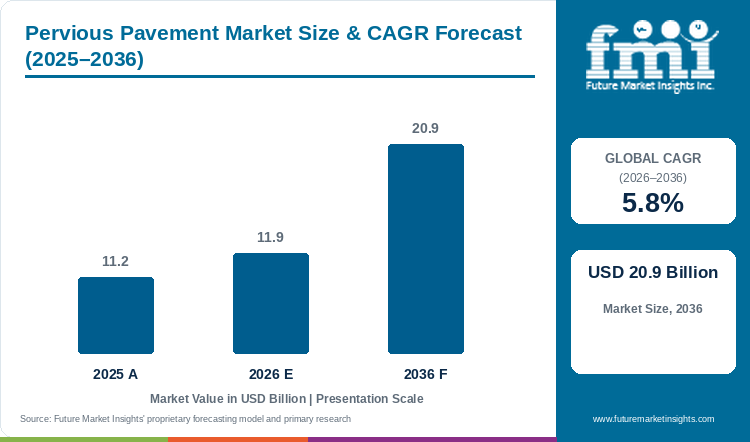
The Pervious Pavement Market is projected to reach USD 20.9 billion by 2036, growing at a 5.8% CAGR from 2026 to 2036. The market is estimated at USD 11.9 billion in 2026.
The market was valued at USD 11.2 billion in 2025. England's national standards for sustainable drainage systems were first published on 19 June 2025 and updated on 30 July 2025. Standard 2 states that all permeable surfaces, lined or not, are assumed to comply with the interception requirement provided no additional area drains to the permeable pavement. MPA Precast, which includes Interpave, published a 2026 edition of The Permeable Paving Manual. In the United States, EPA lists pervious asphalt, pervious concrete, interlocking pavers and plastic grid pavers as alternatives to conventional pavement that let rain and snowmelt seep through to soil and gravel below.
Stormwater rules shape demand for permeable surfaces. Under the US National Pollutant Discharge Elimination System, EPA states that certain operators must obtain permits and develop stormwater management programs. EPA says permeable pavements reduce runoff and help filter pollutants. In ready-mix supply, a pervious mix is a specialised product, and Cemex sells its Pervia range with installation in Mexico. Readers following ready-mix concrete can compare standard and specialised mixes. Those tracking construction chemicals can see how another site-applied input is sold.
Key Market Trends & Insights
- England's national standards for sustainable drainage systems were first published on 19 June 2025 and updated on 30 July 2025, and Standard 2 assumes that permeable surfaces comply with the interception requirement when no extra area drains onto them. Interpave describes concrete block permeable paving as the most versatile sustainable drainage technique on its site, and its permeable paving page lists a 2026 edition of The Permeable Paving Manual.
- Since 2 June 2026, applications under the Toronto Green Standard are to use interim Version 4 checklists following Bill 98, while Tier 1 stays mandatory through planning approval. Version 4 had applied to applications received on or after 1 May 2022.
- Suppliers are widening permeable ranges. Unilock's permeable page lists eleven products, and its home page features a 2026 catalogue. Belgard lists seven permeable and grid paver products. Invisible Structures has scheduled a live continuing-education session on low impact development strategies for stormwater management for 19 November 2026.
Regional Highlights
- North America: ASTM C1701 covers the field infiltration rate of in-place pervious concrete, and ASTM C1781 covers the surface infiltration rate of in-place permeable unit pavement systems built with interlocking concrete units, concrete grid units or clay brick. EPA names four permeable pavement types for US stormwater practice.
- Europe: England's standards place permeable surfaces under a presumed-compliance rule for interception. Germany's Godelmann lists permeable, percolating and evaporation-active paving families, and Rinn lists a Hydropor paving category and green-joint systems based on the sponge city principle.
- Mexico, France and Italy: Cemex sells Pervia permeable concrete in Mexico, Lafarge France sells Hydromedia drainage concrete, and Heidelberg Materials' Italian business sells i.idro DRAIN. Each is a ready-mix product for pedestrian and light vehicle areas.
Pervious Pavement Market Size and Forecast
Table 1: Pervious Pavement Market Size and Forecast
| Market size and forecast | Value |
|---|---|
| Market size in 2025 | USD 11.2 billion |
| Estimated market size in 2026 | USD 11.9 billion |
| Projected market size by 2036 | USD 20.9 billion |
| CAGR from 2026 to 2036 | 5.8% |
Source: Future Market Insights analysis of the pervious pavement market, 2026.
Analyst Perspective
“Pervious pavement is sold on what it does for a drainage plan, so the buying decision sits with the engineer who needs a surface that counts toward stormwater compliance. Concrete leads because ready-mix suppliers can put a defined product and an installer behind it. The more useful signals are changes in drainage standards, how suppliers document load limits and how maintenance is handled after a few years in service. Buyers who ask for infiltration test results on completed work will end up with fewer surprises than those who buy on the published specification alone.”
- Nikhil Kaitwade, Principal Consultant, FMI
How is the Pervious Pavement Market segmented?
- By material: Pervious Concrete, Porous Asphalt and Interlocking Pavement
- By end-use: Residential, Commercial and Infrastructure
- By region: North America and Europe
Why does Pervious Concrete lead by Material in the Pervious Pavement Market in 2026?
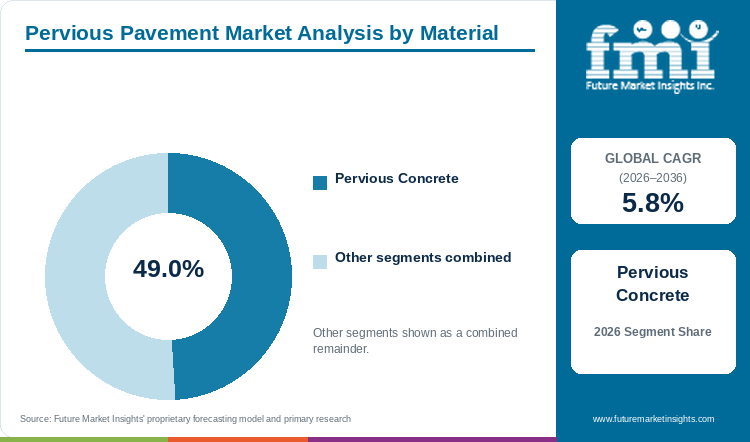
Pervious Concrete accounts for 49.0% of the Pervious Pavement Market by material in 2026. ACI Committee 522 describes it as a near-zero-slump, open-graded material with interconnected pores, a void content of roughly 15% to 35% and typical compressive strength between 400 and 4,000 psi. The same ACI report covers applications, mix proportioning, construction, testing and inspection, so a specifier can draw on it across design and construction [6]. ASTM C1701 gives the field test for infiltration rate on completed pervious concrete [4]. Cement and ready-mix companies publish product data that engineers can write into a specification. Lafarge France gives Hydromedia a porosity of 15% to 25% and a 28-day compressive strength of 7 to 20 MPa, in three formulations for foot traffic, light and occasional heavy vehicles, and as a sub-layer under pavers or decking [21]. Heidelberg Materials' i.idro DRAIN has voids above 15% and below 25%, an average compressive strength at 28 days of at least 15 MPa and flexural strength above 1 MPa [22]. Cemex gives Pervia a permeability coefficient of 1.7 to 12.0 mm/s and flexural strength at 28 days of 25 kg/cm2 for pedestrian use and 30 kg/cm2 for vehicular use [23]. Specialist contractors carry the installation risk. Pacific Pervious, the new name of Beeson Pervious Concrete, states 40 years of experience and full NRMCA certification, and serves Los Angeles, Santa Barbara, Santa Monica and Orange County [17]. Its news archive shows parking at a Los Angeles YMCA and pervious ramps in Santa Barbara [18]. Factory-made pervious concrete also reaches the market, as with the precast concrete tree well covers Pacific Pervious announced for Los Angeles [18].
Table 2: Material, 2026 Share
| Leading Share | 2026 market share |
|---|---|
| Pervious Concrete | 49.0% |
| All Other Segments Combined Share | 51.0% |
Source: Future Market Insights analysis of the pervious pavement market, 2026.
Why does Residential lead by End-use in the Pervious Pavement Market in 2026?
Residential accounts for 49.0% of the Pervious Pavement Market by end-use in 2026. Belgard lists driveways, patios, pool decks and walkways as uses for its permeable paver lines, with Aqua-Bric, Aqualine and Eco Dublin among the seven products [14]. Unilock offers permeable pavers with ECO-PRIORA, ECO-HEX and ECO-PROMENADE among eleven products, and its site carries an article on permeable pavers on pool decks [12][13]. TRUEGRID names PRO LITE as its residential paver [9]. Load limits keep heavier work with a smaller share. Cemex states that Pervia is not suitable for heavy traffic or abrasive conditions [23]. Lafarge France positions Hydromedia for pedestrian routes and roads with light vehicles or occasional heavy trucks [21], and Heidelberg Materials' Italian page names secondary or access roads below 30 km/h [22]. TRUEGRID offers PRO PLUS for commercial and industrial use and MACK for industrial use [9]. Commercial and infrastructure work therefore relies on a narrower set of products and on engineered bases.
Table 3: End-use, 2026 Share
| Leading Share | 2026 market share |
|---|---|
| Residential | 49.0% |
| All Other Segments Combined Share | 51.0% |
Source: Future Market Insights analysis of the pervious pavement market, 2026.
What are the key drivers, restraints and opportunities?
Driver
Drainage standards that name permeable surfaces. England's national standards state that all permeable surfaces, lined or not, are assumed to comply with Standard 2 on everyday rainfall, provided no additional area is drained to the pavement [1]. Where an unlined surface sits over soil with infiltration above 1 x 10⁻⁶ m/s, up to five times its own area can be added as contributing area [1]. A rule that treats the surface as compliant by default gives designers a reason to specify it, and Interpave's permeable paving page lists a 2026 edition of The Permeable Paving Manual [2].
Stormwater permitting and cost. EPA states that operators of certain municipal sources need NPDES permits and stormwater management programs [8]. It adds that permeable pavements reduce runoff and filter pollutants, and can lower development cost by reducing the need for some conventional drainage features [7]. For a developer, one surface that serves as parking and as drainage can replace a separate system. Suppliers of geosynthetics and grid products fit the same specification. Invisible Structures lists Gravelpave2 and Grasspave2 porous paving alongside underground water storage [19][20].
Restraint
Load and traffic limits. Cemex states that Pervia is not suitable for heavy traffic or abrasive conditions [23]. Lafarge France lists Hydromedia for light vehicles or occasional heavy trucks, and notes that it is delivered by truck mixer and cannot be pumped [21]. These limits narrow the surface to car parks, paths and light roads and keep heavy-duty pavements on conventional construction.
Maintenance and testing. UNI-GROUP promotes its UNI Rapid Clean System as a newer permeable design with an easier cleaning method [10]. Performance is checked in the field under ASTM C1701 for pervious concrete and ASTM C1781 for permeable unit pavement, so owners need an inspection routine [4][5]. The ACI Committee 522 report on pervious concrete is shown as a historical document with a newer version available, and specifiers should check which edition applies to a project [6].
Opportunity
Retrofits and municipal street furniture. Pacific Pervious announced precast pervious concrete tree well covers for the City of Los Angeles on 13 November 2023, and its archive lists pervious concrete ADA ramps in Santa Barbara dated 30 April 2020 [18]. Small retrofit jobs of this kind may give suppliers repeat orders from city programmes.
Grass and gravel grids. Belgard's Turfstone grid paver can be filled with grass or gravel [14]. Invisible Structures lists Gravelpave2 with 92% void space, made from 100% recycled HDPE and rated by the company at more than 60 years of life, and calls Grasspave2 the industry's leader since 1982 [19][20]. Belgard lists driveways among the uses of its grid paver [14], so grids extend permeable specification to driveways and parking areas.
Pervious Pavement Market by Country (2026 to 2036)
Table 4: Pervious Pavement Market Country Growth Forecast
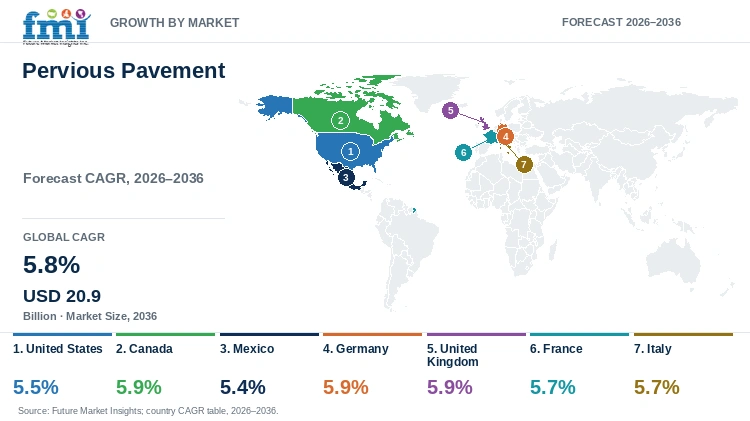
| Country | CAGR, 2026 to 2036 |
|---|---|
| United States | 5.5% |
| Canada | 5.9% |
| Mexico | 5.4% |
| Germany | 5.9% |
| United Kingdom | 5.9% |
| France | 5.7% |
| Italy | 5.7% |
Source: Future Market Insights analysis of the pervious pavement market, 2026.
United States
The United States has two published test standards for permeable surfaces. ASTM C1701 covers infiltration testing for in-place pervious concrete, and ASTM C1781 covers permeable unit pavement systems [4][5]. EPA names pervious asphalt, pervious concrete, interlocking pavers and plastic grid pavers as the main alternatives to traditional pavement [7].
Product supply is spread across paver makers, grid specialists and concrete contractors. Belgard, an Oldcastle APG outdoor brand, lists seven permeable and grid products [14][15]. Stepstone offers a Permeable Pavers Collection with national distribution [16]. TRUEGRID, which lists Omaha, Nebraska as its headquarters, markets six paver lines and claims an infiltration rate of more than 1,000 inches an hour [9]. Invisible Structures advertises Made in the USA grids [20].
Western buyers also have local installers. Pacific Pervious serves Los Angeles and Orange County and states full NRMCA certification [17]. UNI-GROUP lists Unilock for the Midwest, Northeast, Mid-Atlantic, Southeast, Mountain States, Nevada, California and the Southwest, and Mutual Materials for the West Coast [11]. Buyers should ask which product, which installer and which infiltration test will be used on the finished surface.
Canada
Toronto's Green Standard is the clearest dated policy signal in the country. Version 4 applies to planning applications received on or after 1 May 2022, Tier 1 is mandatory through the planning approval process, and since 2 June 2026, following Bill 98, applications are to use the Interim Version 4 checklists [26]. The page does not itemise paving measures, so contractors should confirm the checklist items for each project.
Unilock, whose site lists Hengestone Holdings, Inc. as the copyright holder, presents permeable pavers as a product category and offers a French version of its site [13]. Its permeable range includes ECO-HEX, ECO-PRIORA, ECO-PROMENADE and TOWN HALL [12]. The company says permeable pavers use wider spacer-bar joints and an open-graded base, often clear angular stone with no sand fines [12].
The base detail matters in a cold country. EPA notes that permeable pavements can reduce the need for road salt [7]. Canadian buyers should ask suppliers how the clear-stone base is specified and how winter maintenance is handled before tender.
Mexico
Cemex sells Pervia permeable concrete in Mexico as a system covering supply and installation. It states that the product lets rainwater and irrigation water pass through, so the water can seep into the ground or be collected and reused [23].
The company positions Pervia for parking spaces, sidewalks, bike paths, parks and plazas. It lists unit mass of 1,900 to 2,200 kg/m3 depending on local raw materials, flexural strength at 28 days of 25 kg/cm2 for pedestrian use and 30 kg/cm2 for vehicular use, and a permeability coefficient of 1.7 to 12.0 mm/s [23].
Cemex says the product is not suitable for heavy traffic or abrasive conditions, and that it can contribute points toward LEED certification, produces less surface heat than asphalt and can be made in an integral colour [23]. For buyers, the sale of supply and installation together means one contractor answers for the finished surface.
Germany
German supply is built around concrete paving stones with water-permeable joints and openings. Godelmann lists families of water-permeable and greenable, percolating, evaporation-active and water-treating paving, including GDM.DRAIN, GDM.KLIMASTEIN and GDM.GEO [24].
At Ostfildern, the Kemnat sports hall forecourt uses water-permeable GDM.KLIMASTEIN, which the company says supports infiltration and evaporation of rainwater, together with GDM.SCADA liner and stone and GDM.TIEFBORD in the parking areas [24]. Godelmann also links to a page on unsealing with permeable paving surfaces [24].
German suppliers sell permeability as part of climate adaptation. A municipal buyer should compare product approvals and infiltration data across suppliers before tender.
United Kingdom
England's national standards for sustainable drainage systems were first published on 19 June 2025 and updated on 30 July 2025. They are non-statutory standards for design, maintenance and operation of surface water drainage in England and apply to surface water that is essentially uncontaminated [1].
Standard 2 treats permeable surfaces as compliant provided no extra area drains to them, and lined permeable paving that also drains an adjacent impermeable area does not count as compliant [1]. Interpave, the paving division of MPA Precast, calls concrete block permeable paving the most versatile SuDS technique and points to The Permeable Paving Manual 2026 [2][3].
Interpave states that block permeable paving has been in use for over 25 years, and that SuDS should cost less than conventional piped drainage, citing a 2025 case study at Lamb Drove and Riverside Court in Cambourne [2]. Developers and highway authorities can use the manual when justifying a permeable design.
France
Lafarge France sells Hydromedia, which it describes as a fully permeable drainage concrete for pedestrian walkways and roads carrying light vehicles or occasional heavy trucks. Its page lists three formulations, one for foot traffic, one for light and occasional heavy vehicles and one as a sub-layer under surfaces such as pavers or decking [21].
The product has a porosity of 15% to 25% and a 28-day compressive strength of 7 to 20 MPa. Lafarge says it needs no sloped base, is delivered by truck mixer and cannot be pumped [21]. It lists typical uses as sidewalks, schoolyards and parking lots, and also garden paths and terraces [21].
A ready-mix concrete route suits French municipal buyers who already work with local concrete plants. The no-pumping rule means placement must be planned around truck access, and designers should provide this early in site layouts.
Italy
Heidelberg Materials' Italian business sells i.idro DRAIN, a pervious concrete with voids above 15% and below 25%, depending on compaction, and a surface free area of 25% [22]. The page gives an indicative average compressive strength at 28 days of at least 15 MPa and flexural strength above 1 MPa [22].
The product is positioned for pedestrian areas and light vehicles, including secondary or access roads with speeds below 30 km/h, parking areas, sidewalks, cycle paths and public gardens [22].
The use list points to municipal work in town centres, parks and minor roads, not major roadways. A specifier should confirm the drainage requirement and the compaction method with the supplier before writing them into a tender, since the stated void content depends on how well the material is compacted [22].
Who are the notable companies in the Pervious Pavement Market?
Notable companies in the Pervious Pavement Market include Airlite Plastics Company & TRUEGRID Pavers, UNI-GROUP U.S.A., INC, Hengestone Holdings, Inc., Stepstone, LLC and Beeson Pervious Concrete.
Competition in this market turns on how a supplier takes responsibility for the finished surface. Ready-mix companies such as Cemex, Lafarge France and Heidelberg Materials' Italian business publish data on porosity, strength and permeability and sell a mix that must be placed by a trained crew [21][22][23]. Cemex says its Pervia range is sold as a complete system with supply and installation [23]. Pacific Pervious, formerly Beeson Pervious Concrete, sells the contractor route, with NRMCA certification and a record of installations in southern California [17][18].
Paver and grid suppliers compete on catalogue breadth and on what sits under the surface. Unilock lists eleven permeable products, Belgard lists seven, and Stepstone offers a Permeable Pavers Collection [12][14][16]. Unilock states that permeable pavers rely on wider spacer-bar joints and an open-graded base [12]. UNI-GROUP lists UNI Eco-Stone, introduced to North America in 1989, and the UNI Rapid Clean System [10]. TRUEGRID and Invisible Structures sell grid products, with TRUEGRID claiming 100% pervious cover and Invisible Structures giving Gravelpave2 a void space of 92% [9][19].
Reach shapes who competes where. UNI-GROUP is an association whose member manufacturers produce the pavers, and its manufacturer page lists Unilock and Mutual Materials by region [10][11]. TRUEGRID's footer carries the name Airlite Plastics Company & TRUEGRID Pavers [9], and Unilock's footer names Hengestone Holdings, Inc. [13]. In Europe, supply comes through paving makers such as Godelmann and Rinn and through national ready-mix businesses [21][22][24][25].
Key Developments in the Pervious Pavement Market
- Interpave's permeable paving page lists The Permeable Paving Manual 2026 as the latest edition of its guide, which first appeared in 2003 and has run through seven editions [2].
- On 2 June 2026, Toronto moved applications under its Green Standard to interim Version 4 checklists following Bill 98, while Tier 1 of the standard remains mandatory through the planning approval process [26].
- Invisible Structures lists a live continuing-education session, Low Impact Development Strategies for Stormwater Management, for 19 November 2026 [20].
- Unilock's home page features its 2026 Catalog of Dreams, and its permeable paver page lists eleven products [12][13].
Key Players in the Pervious Pavement Market
- Airlite Plastics Company & TRUEGRID Pavers
- UNI-GROUP U.S.A., INC
- Hengestone Holdings, Inc. (Unilock)
- Stepstone, LLC
- Beeson Pervious Concrete (now Pacific Pervious)
- Belgard (Oldcastle APG)
- Invisible Structures, Inc.
- Cemex
- Lafarge France
- Heidelberg Materials
Pervious Pavement Market Report Scope
Table 5: Pervious Pavement Market Report Scope
| Coverage field | Report scope |
|---|---|
| Market definition | Stormwater-permeable surfacing, namely pervious concrete, porous asphalt and interlocking permeable pavement (pavers and grids), measured by value of sales to end-use sectors |
| Material | Pervious Concrete, Porous Asphalt, Interlocking Pavement |
| End-use | Residential, Commercial, Infrastructure |
| Regions and profiled countries | North America and Europe, covering the United States, Canada, Mexico, Germany, United Kingdom, France and Italy |
| Companies covered | Airlite Plastics Company & TRUEGRID Pavers, UNI-GROUP U.S.A., INC, Hengestone Holdings, Inc. (Unilock), Stepstone, LLC, Beeson Pervious Concrete (now Pacific Pervious), Belgard, Invisible Structures, Inc., Cemex, Lafarge France and Heidelberg Materials |
| Forecast period | 2026 to 2036, with 2025 as the historical base year |
| Quantitative Units | USD billion |
Source: Future Market Insights analysis of the pervious pavement market, 2026.
Pervious Pavement Market by Segments
Pervious Pavement Market segmented by Material:
- Pervious Concrete
- Porous Asphalt
- Interlocking Pavement
Pervious Pavement Market segmented by End-use:
- Residential
- Commercial
- Infrastructure
Pervious Pavement Market by Region
- North America
- Europe
- United States
- Canada
- Mexico
- Germany
- United Kingdom
- France
- Italy
Research Sources and Bibliography
- [1] UK Government. (2025, June 19). National standards for sustainable drainage systems (SuDS). https://www.gov.uk/government/publications/national-standards-for-sustainable-drainage-systems/national-standards-for-sustainable-drainage-systems-suds
- [2] MPA Precast (Interpave). (2026). Permeable paving. https://www.paving.org.uk/permeable-paving
- [3] Interpave, MPA Precast. (n.d.). Interpave: the precast concrete paving and kerb association. https://www.paving.org.uk/
- [4] ASTM International. (2023, October 6). C1701/C1701M-17a, Standard Test Method for Infiltration Rate of In Place Pervious Concrete. https://store.astm.org/c1701_c1701m-17a.html
- [5] ASTM International. (2021, December 14). C1781/C1781M-21, Standard Test Method for Surface Infiltration Rate of Permeable Unit Pavement Systems. https://store.astm.org/c1781_c1781m-21.html
- [6] American Concrete Institute. (2010). ACI PRC-522-10 Report on Pervious Concrete (Reapproved 2011). https://www.concrete.org/store/productdetail.aspx?ItemID=52210
- [7] U.S. Environmental Protection Agency. (n.d.). Soak Up the Rain: Permeable Pavement. https://www.epa.gov/soakuptherain/soak-rain-permeable-pavement
- [8] U.S. Environmental Protection Agency. (n.d.). Stormwater Discharges from Municipal Sources. https://www.epa.gov/npdes/stormwater-discharges-municipal-sources
- [9] Airlite Plastics Company & TRUEGRID Pavers. (2026). TRUEGRID permeable pavers. http://www.truegridpaver.com/
- [10] UNI-GROUP U.S.A. (n.d.). UNI-GROUP U.S.A. home page. https://www.uni-groupusa.org/
- [11] UNI-GROUP U.S.A. (n.d.). Find a manufacturer. https://www.uni-groupusa.org/manufacturers.html
- [12] Unilock. (n.d.). Permeable Pavers. https://www.unilock.com/permeable-pavers/
- [13] Unilock. (2026). Unilock home page. https://www.unilock.com/
- [14] Belgard. (n.d.). Permeable and Grid Pavers. https://www.belgard.com/products/permeable-pavers/
- [15] Belgard. (2026). Belgard home page. https://www.belgard.com/
- [16] Stepstone. (n.d.). Pervious Pavers. https://stepstoneprecast.com/
- [17] Pacific Pervious. (n.d.). Pacific Pervious, formerly Beeson Pervious Concrete. http://www.pacificpervious.com/pacificpervious
- [18] Pacific Pervious. (n.d.). News. http://www.pacificpervious.com/news
- [19] Invisible Structures, Inc. (n.d.). Gravelpave2. https://www.invisiblestructures.com/gravelpave2
- [20] Invisible Structures, Inc. (n.d.). Home page. https://www.invisiblestructures.com/
- [21] Lafarge France. (2026). Hydromedia. https://www.lafarge.fr/hydromedia
- [22] Heidelberg Materials Italia. (n.d.). i.idro DRAIN. https://www.heidelbergmaterials.it/it/i-idro-drain
- [23] Cemex Mexico. (n.d.). Concreto permeable (Pervia). https://www.cemexmexico.com/concreto-permeable
- [24] Godelmann. (n.d.). Home page. https://www.godelmann.de/
- [25] Rinn Beton- und Naturstein. (n.d.). Home page. https://www.rinn.net/
- [26] City of Toronto. (n.d.). Toronto Green Standard. https://www.toronto.ca/city-government/planning-development/official-plan-guidelines/toronto-green-standard/
Table of Content
- Key Takeaways
- Market Size and CAGR
- Top Growth Driver
- Fastest Growing Segment
- Leading Region
- Key Companies
- Emerging Opportunities
- Executive Summary
- Global Market Outlook
- Demand-side Trends
- Supply-side Trends
- Technology Roadmap Analysis
- Analysis and Recommendations
- Analyst Perspective (What is happening? Why now? What should investors know?)
- Key Questions Answered
- How large is the market?
- What is the CAGR?
- What are key trends?
- Which region dominates?
- Who are the leaders?
Read More...
- Market Overview
- Market Coverage / Taxonomy
- Market Definition / Scope / Limitations
- Research Methodology
- Chapter Orientation
- Analytical Lens and Working Hypotheses
- Market Structure, Signals, and Trend Drivers
- Benchmarking and Cross-market Comparability
- Market Sizing, Forecasting, and Opportunity Mapping
- Research Design and Evidence Framework
- Desk Research Programme (Secondary Evidence)
- Expert Input and Fieldwork (Primary Evidence)
- Tooling, Models, and Reference Databases
- Data Engineering and Model Build
- Quality Assurance and Audit Trail
- Market Background
- Market Dynamics (Drivers, Restraints, Opportunity, Trends)
- Scenario Forecast (Optimistic, Likely, Conservative)
- Impact Analysis
- AI Impact
- Sustainability Impact
- Regulatory Impact
- Technology Impact
- Consumer / Buyer Analysis
- Purchase Drivers
- Adoption Barriers
- Buyer Journey
- Opportunity Map Analysis
- Product Life Cycle Analysis
- Supply Chain Analysis
- Investment Feasibility Matrix
- Value Chain Analysis
- PESTLE and Porter's Analysis
- Regulatory Landscape
- Regional Parent Market Outlook
- Production and Consumption Statistics
- Import and Export Statistics
- Global Market Analysis and Forecast, 2021 to 2036
- Historical Market Size Value (USD Billion) Analysis, 2021 to 2025
- Current and Future Market Size Value (USD Billion) Projections, 2026 to 2036
- Y-o-Y Growth Trend Analysis
- Absolute $ Opportunity Analysis
- Global Market Pricing Analysis, 2021 to 2036
- Global Market Analysis and Forecast, By Material, 2021 to 2036
- Introduction / Key Findings
- Historical Market Size Value (USD Billion) Analysis By Material, 2021 to 2025
- Current and Future Market Size Value (USD Billion) Analysis and Forecast By Material, 2026 to 2036
- Pervious Concrete
- Porous Asphalt
- Interlocking Pavement
- Y-o-Y Growth Trend Analysis By Material, 2021 to 2025
- Absolute $ Opportunity Analysis By Material, 2026 to 2036
- Global Market Analysis and Forecast, By End-use, 2021 to 2036
- Introduction / Key Findings
- Historical Market Size Value (USD Billion) Analysis By End-use, 2021 to 2025
- Current and Future Market Size Value (USD Billion) Analysis and Forecast By End-use, 2026 to 2036
- Residential
- Commercial
- Infrastructure
- Y-o-Y Growth Trend Analysis By End-use, 2021 to 2025
- Absolute $ Opportunity Analysis By End-use, 2026 to 2036
- Global Market Analysis and Forecast, By Region, 2021 to 2036
- Introduction
- Historical Market Size Value (USD Billion) Analysis By Region, 2021 to 2025
- Current Market Size Value (USD Billion) Analysis and Forecast By Region, 2026 to 2036
- North America
- Europe
- Market Attractiveness Analysis By Region
- North America Market Analysis and Forecast, By Country, 2021 to 2036
- Historical Market Size Value (USD Billion) Trend Analysis By Market Taxonomy, 2021 to 2025
- Market Size Value (USD Billion) Forecast By Market Taxonomy, 2026 to 2036
- By Country
- By Material
- By End-use
- Market Attractiveness Analysis
- By Country
- By Material
- By End-use
- Key Takeaways
- Europe Market Analysis and Forecast, By Country
- Historical Market Size Value (USD Billion) Trend Analysis By Market Taxonomy, 2021 to 2025
- Market Size Value (USD Billion) Forecast By Market Taxonomy, 2026 to 2036
- By Country
- United States
- Canada
- Mexico
- Germany
- United Kingdom
- France
- Italy
- By Material
- By End-use
- By Country
- Market Attractiveness Analysis
- By Country
- By Material
- By End-use
- Key Takeaways
- Key Countries Market Analysis
- United States
- Pricing Analysis
- Market Share Analysis, 2025
- By Material
- By End-use
- Canada
- Pricing Analysis
- Market Share Analysis, 2025
- By Material
- By End-use
- Mexico
- Pricing Analysis
- Market Share Analysis, 2025
- By Material
- By End-use
- Germany
- Pricing Analysis
- Market Share Analysis, 2025
- By Material
- By End-use
- United Kingdom
- Pricing Analysis
- Market Share Analysis, 2025
- By Material
- By End-use
- Italy
- Pricing Analysis
- Market Share Analysis, 2025
- By Material
- By End-use
- France
- Pricing Analysis
- Market Share Analysis, 2025
- By Material
- By End-use
- United States
- Market Structure Analysis
- Competition Dashboard
- Competition Benchmarking
- Market Share Analysis of Top Players
- By Regional
- By Material
- By End-use
- Emerging Startups
- Innovation Benchmarking
- Competition Analysis
- Competition Deep Dive
- Airlite Plastics Company & TRUEGRID Pavers
- Overview
- Product Portfolio
- Profitability by Market Segments
- Sales Footprint
- Strategy Overview
- Marketing Strategy
- Product Strategy
- Channel Strategy
- UNI-GROUP U.S.A., INC
- Hengestone Holdings, Inc. (Unilock)
- Stepstone, LLC
- Beeson Pervious Concrete (now Pacific Pervious)
- Belgard (Oldcastle APG)
- Invisible Structures, Inc.
- Lafarge France
- Cemex
- Heidelberg Materials
- Airlite Plastics Company & TRUEGRID Pavers
- Case Studies
- Success Stories
- Recent Developments
- Competition Deep Dive
- Assumptions & Acronyms Used
List of Tables
- Table 1: Global Market Value (USD Billion) Forecast by Region, 2021 to 2036
- Table 2: Global Market Value (USD Billion) Forecast by Material, 2021 to 2036
- Table 3: Global Market Value (USD Billion) Forecast by End-use, 2021 to 2036
- Table 4: North America Market Value (USD Billion) Forecast by Country, 2021 to 2036
- Table 5: North America Market Value (USD Billion) Forecast by Material, 2021 to 2036
- Table 6: North America Market Value (USD Billion) Forecast by End-use, 2021 to 2036
- Table 7: Europe Market Value (USD Billion) Forecast by Country, 2021 to 2036
- Table 8: Europe Market Value (USD Billion) Forecast by Material, 2021 to 2036
- Table 9: Europe Market Value (USD Billion) Forecast by End-use, 2021 to 2036
List of Figures
- Figure 1: Global Market Pricing Analysis
- Figure 2: Global Market Value (USD Billion) Forecast 2021-2036
- Figure 3: Global Market Value Share and BPS Analysis by Material, 2026 and 2036
- Figure 4: Global Market Y-o-Y Growth Comparison by Material, 2026-2036
- Figure 5: Global Market Attractiveness Analysis by Material
- Figure 6: Global Market Value Share and BPS Analysis by End-use, 2026 and 2036
- Figure 7: Global Market Y-o-Y Growth Comparison by End-use, 2026-2036
- Figure 8: Global Market Attractiveness Analysis by End-use
- Figure 9: Global Market Value (USD Billion) Share and BPS Analysis by Region, 2026 and 2036
- Figure 10: Global Market Y-o-Y Growth Comparison by Region, 2026-2036
- Figure 11: Global Market Attractiveness Analysis by Region
- Figure 12: North America Market Incremental Dollar Opportunity, 2026-2036
- Figure 13: Europe Market Incremental Dollar Opportunity, 2026-2036
- Figure 14: North America Market Value Share and BPS Analysis by Country, 2026 and 2036
- Figure 15: North America Market Value Share and BPS Analysis by Material, 2026 and 2036
- Figure 16: North America Market Y-o-Y Growth Comparison by Material, 2026-2036
- Figure 17: North America Market Attractiveness Analysis by Material
- Figure 18: North America Market Value Share and BPS Analysis by End-use, 2026 and 2036
- Figure 19: North America Market Y-o-Y Growth Comparison by End-use, 2026-2036
- Figure 20: North America Market Attractiveness Analysis by End-use
- Figure 21: Europe Market Value Share and BPS Analysis by Country, 2026 and 2036
- Figure 22: Europe Market Value Share and BPS Analysis by Material, 2026 and 2036
- Figure 23: Europe Market Y-o-Y Growth Comparison by Material, 2026-2036
- Figure 24: Europe Market Attractiveness Analysis by Material
- Figure 25: Europe Market Value Share and BPS Analysis by End-use, 2026 and 2036
- Figure 26: Europe Market Y-o-Y Growth Comparison by End-use, 2026-2036
- Figure 27: Europe Market Attractiveness Analysis by End-use
- Figure 28: Global Market - Tier Structure Analysis
- Figure 29: Global Market - Company Share Analysis
Frequently Asked Questions
How big is the pervious pavement market in 2026?
The Pervious Pavement Market is estimated at USD 11.9 billion in 2026, up from USD 11.2 billion in 2025. It is projected to reach USD 20.9 billion by 2036, a 5.8% CAGR from 2026 to 2036.
Which material leads the pervious pavement market?
Pervious Concrete leads with 49.0% of the market in 2026. ACI Committee 522 gives a void content of roughly 15% to 35% for the material, and ASTM C1701 provides the field infiltration test [4][6]. Ready-mix suppliers such as Lafarge France, Heidelberg Materials' Italian business and Cemex publish product data for it [21][22][23].
Which other materials and end-uses matter?
Porous Asphalt holds 29.0% and Interlocking Pavement 22.0% of the market by material. By end-use, Residential leads with 49.0%, followed by Commercial at 29.0% and Infrastructure at 22.0%. Belgard and Unilock list driveways, patios, pool decks and walkways among their permeable paver uses [12][14].
Which profiled country is forecast to grow fastest?
Canada, Germany and the United Kingdom share the highest forecast CAGR of the seven profiled countries at 5.9% from 2026 to 2036, ahead of France and Italy at 5.7%, the United States at 5.5% and Mexico at 5.4%.
Which standards and rules affect specification?
ASTM C1701 covers the infiltration rate of in-place pervious concrete and ASTM C1781 covers permeable unit pavement systems [4][5]. In England, the national SuDS standards were first published on 19 June 2025 and treat permeable surfaces as compliant with Standard 2 when no extra area drains to them [1]. In Toronto, applications use interim Version 4 checklists of the Green Standard since 2 June 2026 [26].
What should a buyer check before choosing a product?
Check the traffic class first. Cemex states that Pervia is not suitable for heavy traffic, and Lafarge France positions Hydromedia for light vehicles or occasional heavy trucks [21][23]. Then ask who installs it and which infiltration test will be run on the completed surface [4][5].
Preview the report firsthand - request a free sample
Get SampleGet the brochure for pricing and purchase details.
Get PDF
