

- Market Size (2026)
- USD 1288.1 Mn
- Forecast (2036)
- USD 2201.7 Mn
- CAGR (2026 to 2036)
- 5.5%
How big is Cryogenic Pipe Insulants Market in 2026?
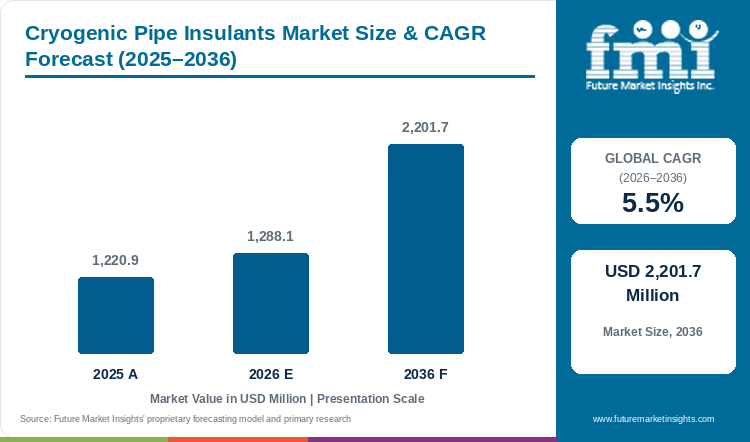
Demand for cryogenic pipe insulants is projected to grow at 5.5% CAGR from 2026 to 2036. The market was valued at USD 1,220.9 million in 2025 and the market is estimated at USD 1,288.1 million in 2026 before reaching USD 2,201.7 million by 2036.
FMI estimates cryogenic pipe insulants market to reach USD 1,288.1 million in 2026, increasing from USD 1,220.9 million in 2025. The market is projected to reach USD 2,201.7 million by 2036, witnessing 5.5% CAGR during the forecast period. Increasing LNG trade and construction of storage terminals is boosting the requirement for insulated cold-service pipes. In July 2026, the U.S. Energy Information Administration reported that global LNG trade increased by 5.4% and reached 56.3 billion cubic feet per day in 2025.[1] Increasing number of LNG facilities requires insulation around processing lines, storage connections and loading systems. Apart from new construction, damaged insulation at operating plants also creates replacement demand. The availability of cellular glass, rigid foam and flexible aerogel blankets provides different material options according to operating temperature and available installation space. These factors are expected to drive the cryogenic pipe insulants market growth over the forecast period.
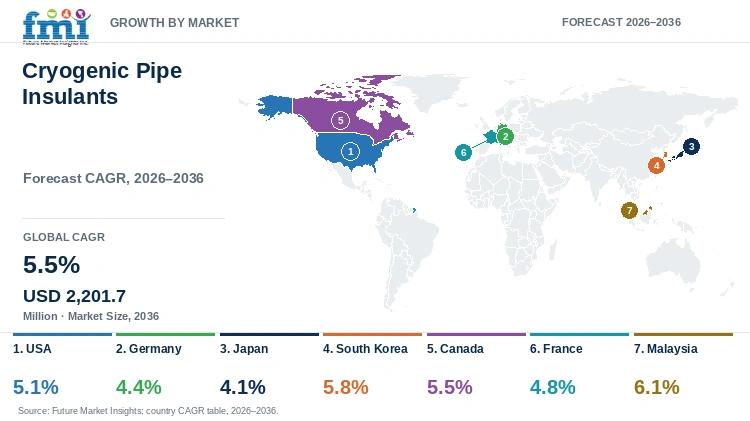
Regional demand varies with LNG terminals, industrial gas plants and liquid-hydrogen projects. Malaysia is projected to grow at 6.1% CAGR, whereas South Korea is expected to expand at 5.8% CAGR through 2036. Malaysia has a large LNG operating base and PETRONAS reported in August 2025 that the Green Hydrogen Hub in Terengganu was launched in July 2025.[2] South Korea is expanding liquid-hydrogen production, storage and refueling facilities, due to which insulation is required around deep-temperature transfer equipment. Hot and humid climate in Malaysia increases requirement for vapor-tight insulation and durable outer protection. South Korean projects gives more attention to low-temperature qualification and integration with storage equipment. Expansion of these different low-temperature applications is anticipated to support regional demand, while product approval will remain dependent on temperature range and installation performance.
Key Takeaways
- New low-temperature transfer systems need insulation that limits heat gain and controls moisture.
- Cellular glass is expected to account for 31.0% share of insulant type demand in 2026, owing to its closed-cell structure and moisture resistance.
- LNG pipelines is expected to account for 37.0% share in 2026 because liquefaction, storage and loading facilities use extensive cold-service transfer piping that must control heat gain and moisture.
- The -196°C to -100°C range is estimated to account for 37.0% share of temperature range demand in 2026, owing to wider use in LNG and industrial-gas systems.
- FMI finds that Malaysia is projected to expand at 6.1% CAGR from 2026 to 2036. The country has a large LNG operating base and increasing low-temperature project activity.
- Notable companies in the Cryogenic Pipe Insulants market include Owens Corning / FOAMGLAS, Armacell, Aspen Aerogels, Johns Manville, Kingspan.
Analyst Perspective
“FMI analysis ties growth to cold-service construction and repair rather than every announced energy project. Insulation suppliers gain orders when vapor control and installation performance match the actual pipe duty.”
- Nikhil Kaitwade, Principal Consultant, Future Market Insights.
How is the cryogenic pipe insulants market segmented?
The cryogenic pipe insulants market is segmented by insulant type, Application, temperature range, end use and sales channel, plus region. In 2026, the leading subsegments are cellular glass at 31.0% of insulant type demand, why do lng pipelines lead the application category at 37.0% of application demand, -196°c to -100°c at 37.0% of temperature range demand, lng terminals at 34.0% of end use demand and insulation contractors at 36.0% of sales channel demand.
insulant type distinguishes the physical insulation architecture used to control heat gain and vapor entry.
Application separates LNG pipelines from hydrogen lines, industrial gas transfer, cryogenic storage piping and marine bunkering lines.
temperature range captures the severity of the operating condition and the material qualification required.
end use identifies the asset owner or operating environment where the piping is installed.
sales channel shows how material reaches the project through insulation contractors, cryogenic system OEMs, EPC projects or material distributors.
These axes matter because the same nominal thermal requirement can produce a different material choice when geometry, vapor control, installation sequence or operating risk changes.
What makes Cellular glass central to the insulant type category?
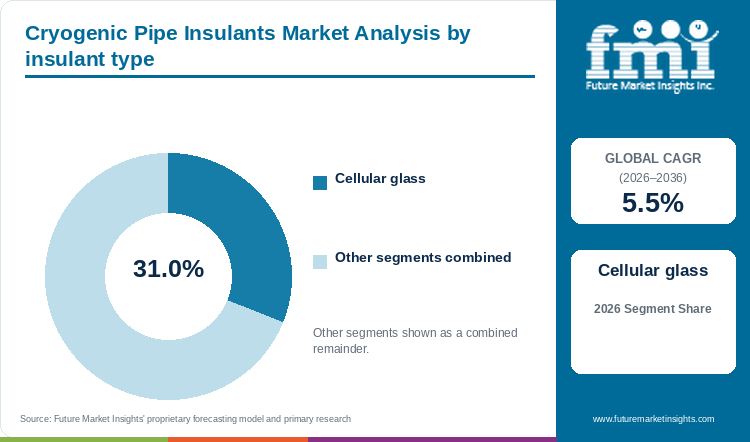
In 2026, cellular glass is expected to account for 31.0% of insulant type demand in the global market.
Cellular glass is a rigid insulation material made with closed-cell construction. This construction does not readily absorb water and provides resistance against water vapor, due to which cellular glass is used on LNG and industrial-gas pipes. Owens Corning identifies FOAMGLAS for cold and cryogenic applications where moisture protection and compressive strength are required. Cellular glass is also installed near pipe supports and load-bearing points because soft insulation can lose shape under pressure. Increasing requirement for stable insulation with low moisture entry is expected to support the cellular glass segment during the forecast period.
- Cellular glass accounts for 31.0% share in 2026 because vapor-tight closed-cell construction and compressive stability fit demanding cryogenic pipe systems.
- Owens Corning technical guidance for FOAMGLAS identifies cold and cryogenic applications that include LNG and ethylene service, with system design focused on vapor control and dimensional stability.
Why do LNG pipelines lead the Application category?
In 2026, why do LNG pipelines lead the Application category is forecast to represent 37.0% of application demand in the global market.
LNG pipelines are used between liquefaction units, storage tanks, loading areas and marine transfer points. Natural gas remains at very low temperature in these lines, due to which heat entry can increase boil-off and moisture inside insulation can form ice. In September 2026, the U.S. Energy Information Administration reported that completion of Corpus Christi Stage 3 expanded the terminal’s nominal capacity to 3.1 billion cubic feet per day.[3] Expansion of export capacity will add more processing and transfer piping that requires insulation before operation. Increasing construction of LNG facilities is expected to drive the LNG pipelines segment in cryogenic pipe insulants market.
- LNG pipelines account for 37.0% share in 2026 because liquefaction, storage and loading facilities use extensive cold-service transfer piping that must control heat gain and moisture.
- Expansion of LNG terminal piping is increasing demand for insulation around storage connections, loading lines and transfer equipment.
How does -196°C to -100°C anchor the temperature range category?
In 2026, -196°C to -100°C is projected to hold 37.0% of temperature range demand in the global market.
The -196°C to -100°C range covers LNG and several industrial-gas applications. Insulation used in this range should reduce heat entry and maintain performance when the pipe surface remains below freezing for long periods. NASA TechPort reported in January 2026 that Aspen Aerogels developed a hybrid aerogel/MLI system that outperformed conventional MLI at cryogenic temperatures and across a range of vacuum conditions.[4] In April 2025, Armacell introduced ArmaGel XGC for cryogenic conditions down to -196°C. Availability of both rigid and flexible insulation materials is providing wider selection to contractors and plant operators. This is anticipated to support growth of the -196°C to -100°C segment over the forecast period.
- -196°C to -100°C accounts for 37.0% share in 2026 because it spans core LNG and industrial-gas temperatures while matching the qualified range of several rigid and flexible insulation products.
- Availability of flexible insulation suitable down to -196°C is supporting material use around complex pipe shapes and restricted installation areas.
What supports LNG terminals in the end use category?
In 2026, lNG terminals is estimated to make up 34.0% of end use demand in the global market.
LNG terminals concentrate the full insulation problem in one asset class. Feed-gas processing and liquefaction create multiple cold pipe runs. Storage connections, boil-off handling and ship-loading systems add different diameters and support details. Terminal owners also manage insulation after commissioning because moisture ingress or mechanical damage can degrade performance. In September 2026, FERC reported that proposed Corpus Christi Stage 4 would add four liquefaction trains and two 220,000-cubic-meter LNG storage tanks. The larger installed base increases maintenance exposure for cold insulation around low-temperature process and storage systems.[5] That maintenance burden makes system durability and repairability commercially relevant. Industrial gases and chemical plants provide recurring demand but often have smaller individual pipe networks. Marine and hydrogen assets can be specification-intensive, although their installed base remains less uniform by country.
- LNG terminals account for 34.0% share in 2026 because they combine extensive cryogenic piping with recurring inspection, maintenance and replacement requirements.
- Online repair methods are creating replacement demand where damaged cold insulation cannot wait for a complete plant shutdown.
What drives Insulation contractors in the sales channel category?
In 2026, insulation contractors is anticipated to capture 36.0% of sales channel demand in the global market.
Insulation contractors lead the channel because cryogenic performance depends heavily on field execution. Materials arrive as pipe sections, slabs or blankets. Foams and layered components must also be cut and fitted around elbows, valves and pipe supports. Vapor-barrier continuity also depends on joint sealing and sequencing with jacketing. In January 2026, NASA reported that traditional multilayer insulation performance depends heavily on assembly quality and seam joining, adding uncertainty when installation is inconsistent.[6] Cryogenic system OEMs can control material choice on packaged equipment. EPC projects influence specifications and project purchasing. Material distributors remain important for availability, but they usually do not replace the installation responsibility carried by specialist contractors.
- Insulation contractors account for 36.0% share in 2026 because field fabrication, vapor sealing and interface quality directly affect installed-system performance.
- Johns Manville cryogenic and LNG technical guidance combines TRYMER PIR insulation with vapor-retarder and jacketing recommendations, reinforcing the need for system-level installation practice rather than material-only selection.
What are the drivers, restraints, and opportunities in the cryogenic pipe insulants market?
LNG and selected liquid-hydrogen projects expand the installed base, while specification and installation risk restrain conversion and flexible vapor-integrated systems create a route to lower installed complexity.
- Driver: New LNG liquefaction, export and terminal assets create direct insulation demand as cold piping reaches mechanical completion.
- Restraint: Cryogenic insulation requires system-level qualification and disciplined installation because small vapor or joint failures can create costly ice and rework.
- Opportunity: Flexible aerogel, multilayer and vapor-integrated solutions can gain where buyers value thinner builds, faster installation or online remediation.
Cryogenic Projects Increase Insulation Demand
Construction of LNG and industrial-gas facilities is one of the primary factor driving demand for cryogenic pipe insulants. In April 2026, the U.S. Energy Information Administration forecast U.S. LNG exports to average 17.0 billion cubic feet per day in 2026 and rise by another 9% in 2027.[7] Increasing LNG output requires more insulated liquefaction lines, storage connections and loading pipes. Every new train uses insulation before commissioning and later requires replacement where moisture or physical damage affects performance. Expansion of LNG processing and transfer systems is expected to drive the cryogenic pipe insulants market growth.
Installation Conditions Restrict Material Choice
Moisture entry and improper installation are some of the major factors restraining the cryogenic pipe insulants market. Water vapor can enter through damaged jacketing, open joints and unsealed areas around valves or pipe supports. At low temperature, this moisture can freeze inside the insulation and affect thermal performance. Rigid insulation requires proper joint treatment, whereas flexible insulation also requires continuous vapor-barrier closure. In January 2026, NASA TechPort reported that Ultramet was developing aerogel-filled structural foam to reduce cryogenic insulation fabrication and installation complexity.[8] High requirement for skilled installation and complete sealing may limiting the adoption of new insulation materials and hamper market growth.
Maintenance Opens Replacement Demand
Flexible insulation materials are creating new growth opportunities in crowded pipe racks and maintenance applications. In February 2026, NASA reported ongoing development of polymer aerogels for cryogenic fuels, with thermal conductivity testing across cryogenic temperature ranges and different vacuum levels.[9] Liquid-hydrogen storage and transfer equipment from these projects will require insulation at deep temperature. Flexible blankets can be installed around complex pipe shapes with fewer rigid sections and can reduce work around valves and supports. Increasing low-temperature hydrogen projects is expected to create new avenues for flexible cryogenic pipe insulants.
Which country CAGRs are profiled in the cryogenic pipe insulants market?
| Country | CAGR |
|---|---|
| USA | 5.1% |
| Germany | 4.4% |
| Japan | 4.1% |
| South Korea | 5.8% |
| Canada | 5.5% |
| France | 4.8% |
| Malaysia | 6.1% |
How do country-level CAGRs compare in the cryogenic pipe insulants market?
Country demand for cryogenic pipe insulants varies according to LNG operations, industrial-gas capacity and liquid-hydrogen projects. Malaysia and South Korea are expected to witness stronger growth because new low-temperature facilities are being added along with existing LNG and gas infrastructure. Mature markets such as USA, France and Japan will also generate replacement demand from operating terminals and industrial plants. Germany demand will remain selective because gaseous hydrogen pipelines do not use the same insulation as liquid-hydrogen equipment.
- Malaysia at 6.1% CAGR is supported by its LNG operating base and new hydrogen activity, whereas South Korea at 5.8% is gaining from liquid-hydrogen infrastructure.
- South Korea is expected to grow at 5.8% CAGR due to liquid-hydrogen projects, while Canada at 5.5% CAGR is supported by LNG export operations.
- USA is projected at 5.1% CAGR and France at 4.8% CAGR, owing to new low-temperature projects and maintenance of existing LNG assets.
- Germany at 4.4% CAGR and Japan at 4.1% CAGR will gain from selected LNG, liquid-hydrogen and industrial-gas storage applications.
The full report provides country-wise CAGR outlooks across North America, Latin America, Western Europe, Eastern Europe, East Asia, South Asia and Pacific, and the Middle East and Africa.
Country-wise Analysis
- Demand for cryogenic pipe insulants in USA is forecast to expand at 5.1% CAGR from 2026 to 2036. The country has several LNG export facilities and new capacity is increasing requirement for insulated processing, storage and loading lines. In September 2026, the U.S. Energy Information Administration reported that U.S. LNG exports averaged 17.4 billion cubic feet per day during the first half of 2026, increasing by 23% from the same period in 2025.[10] Higher LNG movement increases use of cold-service piping at export terminals. Apart from that, humid Gulf Coast conditions can cause moisture entry where joints and jacketing are not properly installed. New LNG capacity and replacement of damaged insulation is expected to support the USA cryogenic pipe insulants market.
- Cryogenic pipe insulants market in Germany is forecast to grow at 4.4% CAGR during 2026 to 2036. Germany is expanding hydrogen transport infrastructure, but gaseous hydrogen pipelines does not require the same insulation used for liquid hydrogen. In June 2026, Bundesnetzagentur opened consultation on a gas and hydrogen network plan proposing 9,241 km of hydrogen pipelines by 2037.[11] Direct demand for cryogenic insulation will remain around liquefaction, storage, ammonia transfer and other low-temperature equipment. Existing industrial plants will also require replacement insulation during maintenance. Growth of selected low-temperature storage and transfer applications is expected to support the Germany cryogenic pipe insulants market.
- Demand for cryogenic pipe insulants in Japan is projected to expand at 4.1% CAGR through 2036. Japan already uses LNG and industrial gases at large scale, due to which the country has an established requirement for cold-service pipe insulation. In September 2025, Japan METI reported that more than 690,000 fuel cell systems and over 1,300 hydrogen refueling stations were installed globally by the end of 2024.[12] Japan is also participating in hydrogen production and shipping projects. New demand for cryogenic insulation will arise where hydrogen is liquefied, stored or transferred at deep temperature. Expansion of LNG maintenance and selected liquid-hydrogen facilities is anticipated to support market growth.
- Cryogenic pipe insulants demand in South Korea is forecast to rise at 5.8% CAGR over the forecast period. South Korea is developing liquid-hydrogen production and refueling facilities, which require insulation around storage vessels and transfer pipes. In May 2026, the International Energy Agency reported that Korea’s liquid-hydrogen carrier demonstration includes a 2,000 cubic meter vessel scheduled for construction in 2026-2027.[13] Increasing number of deep-temperature transfer points requires insulation to control heat entry and moisture. Expansion of liquid-hydrogen equipment is expected to drive the South Korea cryogenic pipe insulants market.
- Sales of cryogenic pipe insulants in Canada are forecast to expand at 5.5% CAGR through 2036. Natural Resources Canada reported in 2025 that seven LNG export projects under development represented 50.3 million tonnes per annum of possible production capacity.[14] LNG Canada Phase 1 contributes 14 million tonnes per annum and uses a large network of low-temperature processing and transfer equipment. Cold coastal weather and remote project locations can increase the cost of damaged material and field replacement. New LNG operation and future maintenance of terminal piping is expected to support the Canada cryogenic pipe insulants market.
- The cryogenic pipe insulants market in France is anticipated to grow at 4.8% CAGR between 2026 and 2036. France has operating LNG terminals and industrial facilities which creates regular demand for maintenance and replacement of cold-service insulation. The French government published its updated National Hydrogen Strategy on April 17, 2025.[15] Hydrogen projects will support this market where the activity includes liquefaction, low-temperature storage or transfer systems. Mature LNG assets will continue to require insulation repair when moisture or physical damage affects the system. These factors are expected to support the France cryogenic pipe insulants market.
- Malaysia is projected to register 6.1% CAGR in cryogenic pipe insulants market through 2036. The country has a large LNG operating base around Bintulu and floating LNG facilities, which uses insulated pipe systems for processing, storage and marine transfer. In September 2025, PETRONAS signed a 15-year agreement for supply of 1 million tonnes per annum of LNG to Malaysia from 2028.[16] The agreement will support gas availability for power and industrial demand and may increase use of LNG storage and transfer equipment. Hot and humid conditions also increases the need for vapor-tight joints and durable outer protection. Expansion of LNG operation and maintenance is expected to drive the Malaysia cryogenic pipe insulants market.
Who are the notable companies in the cryogenic pipe insulants market?
Owens Corning / FOAMGLAS, Armacell, Aspen Aerogels, Johns Manville, Kingspan, Lydall, Thermaxx Jackets, Cabot Corporation, Nichias, and Kaimann are the notable companies profiled in this market.
Cryogenic pipe insulants market is moderately fragmented with companies offering cellular glass, rigid foam, aerogel blankets, removable jackets and elastomeric materials. Owens Corning / FOAMGLAS, Johns Manville, Kingspan and Nichias are focused on rigid insulation systems. Armacell and Aspen Aerogels offer flexible aerogel materials for thin and complex pipe applications. Lydall and Cabot Corporation provides advanced thermal materials, whereas Thermaxx Jackets and Kaimann serve removable and elastomeric insulation requirements. Some of the key players are increasing product range, production capacity and application support in order to cater the growing demand from LNG, industrial-gas and hydrogen projects. Competition is expected to remain based on temperature range, vapor protection, durability and availability of installation support.
- Rigid cryogenic systems: Owens Corning / FOAMGLAS, Johns Manville, Kingspan, and Nichias compete through cellular glass or rigid foam insulation with established pipe and process applications.
- Flexible and advanced thermal materials: Armacell, Aspen Aerogels, Lydall, and Cabot Corporation address thin-profile, aerogel or multilayer requirements where geometry and installation sequence influence material choice.
- Specialized field solutions: Thermaxx Jackets and Kaimann support removable or elastomeric insulation roles where access, condensation control and surface protection influence project execution.
Competitive Benchmarking: Cryogenic Pipe Insulants Market
| Company | Deep-Cryogenic Pipe Material Coverage | Vapor/Moisture-Control Integration | Application Engineering & Installation Support | Geographic Reach |
|---|---|---|---|---|
| Owens Corning / FOAMGLAS | High | High | High | High |
| Armacell | High | High | High | High |
| Aspen Aerogels | High | High | High | High |
| Johns Manville | High | High | High | Low |
| Kingspan | High | Medium | Medium | Medium |
| Lydall | Medium | Low | Low | Low |
| Thermaxx Jackets | Medium | Low | High | Low |
| Cabot Corporation | Medium | Medium | Medium | High |
| Nichias | High | High | High | Medium |
| Kaimann | Medium | High | Medium | Low |
Scoring basis: High indicates broad available capability for the stated measure. Medium reflects a narrower documented role, while Low means public material shows limited direct coverage. Ratings compare the named companies within this market only.
Key Developments in the Cryogenic Pipe Insulants Market
- In April 2026, the U.S. Energy Information Administration reported that Golden Pass LNG shipped its first cargo from Train 1 and that the full facility is designed for 2.0 billion cubic feet per day of nominal capacity.[17] The project adds another large low-temperature process and transfer system to the U.S. LNG base.
- In September 2026, FERC reported that proposed Corpus Christi Stage 4 would add four liquefaction trains and two 220,000-cubic-meter LNG storage tanks.[5] The expansion would add new insulated process, storage and marine-transfer interfaces.
- In January 2026, NASA TechPort reported that Aspen Aerogels developed a hybrid aerogel/MLI system that outperformed conventional MLI at cryogenic temperatures and across multiple vacuum conditions.[4] The development supports wider evaluation of advanced aerogel-based cryogenic insulation.
- In January 2026, NASA reported that Quest Thermal Group developed Integrated Multilayer Insulation versions that can wrap around pipes and support hydrogen infrastructure.[6] The design targets more consistent cryogenic insulation performance around complex geometries.
Key Players in the Cryogenic Pipe Insulants Market
Rigid Cellular and Foam Cryogenic Systems
- Owens Corning / FOAMGLAS
- Johns Manville
- Kingspan
- Nichias
Flexible Aerogel and Advanced Thermal Materials
- Armacell
- Aspen Aerogels
- Lydall
- Cabot Corporation
Specialized Jackets and Elastomeric Layers
- Thermaxx Jackets
- Kaimann
Cryogenic Pipe Insulants Market - Report Scope
| Coverage field | Report scope |
|---|---|
| Market breakdown | insulant type, Application, temperature range, end use, and sales channel |
| Quantitative Units | USD Million |
| Market Definition | Revenue from cryogenic pipe insulant materials sold within the defined segmentation universe. This includes insulation used directly on cryogenic piping and associated pipe-support interfaces. Downstream LNG, hydrogen and industrial-gas revenue plus finished piping or full EPC value are excluded. Adjacent or substitute insulation not sold for cryogenic pipe service is also excluded. |
| Regions Covered | North America; Latin America; Western Europe; Eastern Europe; East Asia; South Asia and Pacific; Middle East and Africa |
| Countries Covered | USA, Germany, Japan, South Korea, Canada, France, Malaysia, and more than twenty-five additional countries in the full report |
| Key Companies Profiled | Owens Corning / FOAMGLAS; Armacell; Aspen Aerogels; Johns Manville; Kingspan; Lydall; Thermaxx Jackets; Cabot Corporation; Nichias; Kaimann |
| Forecast Period | 2026 to 2036 |
| Approach | Hybrid bottom-up and top-down sizing reconciles insulant material revenue with project activity, installed cryogenic assets, end-use demand and channel evidence while excluding adjacent revenue. |
Cryogenic Pipe Insulants Market - Research Methodology
| Method | Approach |
|---|---|
| Market inputs | Market inputs are assessed against the defined product and service boundary. Public company information and official industry data are used to test commercial relevance where available. |
| Desk Research | Desk research uses official government data, standards, association material, company product pages and dated announcements. Sources are checked for product relevance, date, geography and scope. |
| Market Sizing and Forecasting | FMI forecasts use proprietary market estimates and the stated segment structure. Public evidence informs the direction of demand but does not independently establish FMI market values or shares. |
| Data Validation | The market boundary is checked for adjacent products and double counting. Values, units, forecast years, country rates and parent-segment share denominators are reconciled within the report. |
Cryogenic Pipe Insulants Market by Segments
Cryogenic Pipe Insulants Market segmented by insulant type:
- Cellular glass
- Polyurethane/PIR foam
- Aerogel blankets
- Perlite insulation
- Multilayer insulation
Cryogenic Pipe Insulants Market segmented by Application:
- LNG pipelines
- Hydrogen lines
- Industrial gas transfer
- Cryogenic storage piping
- Marine bunkering lines
Cryogenic Pipe Insulants Market segmented by temperature range:
- -196°C to -100°C
- Below -196°C
- -100°C to -40°C
- Specialty thermal breaks
Cryogenic Pipe Insulants Market segmented by end use:
- LNG terminals
- Industrial gases
- Chemical plants
- Marine/offshore
- Hydrogen infrastructure
Cryogenic Pipe Insulants Market segmented by sales channel:
- Insulation contractors
- Cryogenic system OEMs
- EPC projects
- Material distributors
Cryogenic Pipe Insulants Market by Region:
- North America
- United States
- Canada
- Latin America
- Brazil
- Mexico
- Argentina
- Chile
- Western Europe
- Germany
- France
- United Kingdom
- Italy
- Spain
- Benelux
- Nordics
- Eastern Europe
- Poland
- Czech Republic
- Romania
- Hungary
- East Asia
- China
- Japan
- South Korea
- South Asia and Pacific
- India
- ASEAN
- Australia and New Zealand
- Middle East and Africa
- GCC Countries
- South Africa
- Türkiye
- Israel
Research Sources and Bibliography
- [1] U.S. Energy Information Administration. (2026, July 14). Global liquefied natural gas trade volumes reached record high in 2025.
- [2] PETRONAS. (2025, August 19). TNB, PETRONAS and Terengganu Inc advance Malaysia’s National Energy Transition Roadmap.
- [3] U.S. Energy Information Administration. (2026, September 15). Corpus Christi LNG expansion makes facility the second-largest in the United States.
- [4] NASA TechPort. (2026, January 22). Hybrid Aerogel-MLI Insulation System for Cryogenic Storage in Space Applications.
- [5] Federal Energy Regulatory Commission. (2026, September 18). FERC staff issues the draft environmental impact statement for the Corpus Christi Liquefaction Stage 4 and CCPL Expansion Projects.
- [6] NASA Spinoff. (2026, January 26). New Insulation to Benefit Many Industries.
- [7] U.S. Energy Information Administration. (2026, April 16). U.S. natural gas exports to grow nearly 30% by 2027 as LNG facilities ramp up.
- [8] NASA TechPort. (2026, January 22). Aerogel-Filled Foam Core Insulation for Cryogenic Propellant Storage, Phase II.
- [9] NASA Technical Reports Server. (2026, February 25). Next-Generation Polymer Aerogel Insulation for Cryogenic Applications.
- [10] U.S. Energy Information Administration. (2026, September 1). U.S. LNG exports rose 23% in the first half of 2026 because of higher capacity.
- [11] Bundesnetzagentur. (2026, June 15). Bundesnetzagentur launches consultation for Gas and Hydrogen Network Development Plan 2025-2037/2045.
- [12] Ministry of Economy, Trade and Industry, Japan. (2025, September 15). Chair’s summary of the seventh Hydrogen Energy Ministerial Meeting.
- [13] International Energy Agency. (2026, May 26). Liquid Hydrogen Carrier Demonstration Project.
- [14] Natural Resources Canada. (2025, January 7). Canadian liquefied natural gas projects.
- [15] Government of France. (2025, April 17). Stratégie nationale hydrogène: Le Gouvernement publie sa mise à jour.
- [16] PETRONAS. (2025, September 10). Woodside and PETRONAS strengthen partnership with 15-year LNG supply agreement.
- [17] U.S. Energy Information Administration. (2026, April 23). The 9th U.S. liquefied natural gas export terminal, Golden Pass, ships first cargo.
This bibliography is provided for reader reference. The full report contains the complete reference list and detailed citations.
This Report Answers
- How big is the Cryogenic Pipe Insulants market in 2026?
- What value is the Cryogenic Pipe Insulants market projected to reach by 2036?
- Which segment leads the Cryogenic Pipe Insulants market in 2026?
- Which sales channel is prominent in the Cryogenic Pipe Insulants market?
- Which countries show notable Cryogenic Pipe Insulants market growth through 2036?
- Who are notable companies in the Cryogenic Pipe Insulants market?
Frequently Asked Questions
How big is the cryogenic pipe insulants market in 2026?
Future Market Insights estimates the cryogenic pipe insulants market at USD 1,288.1 million in 2026 and projects USD 2,201.7 million by 2036. Increasing LNG terminals and industrial-gas transfer systems is expected to support market growth.
What is the cryogenic pipe insulants market CAGR from 2026 to 2036?
As per FMI, cryogenic pipe insulants market is projected to grow at 5.5% CAGR from 2026 to 2036. Growth is attributed to increasing cold-service pipes and replacement of damaged insulation.
Why is cellular glass prominent in the cryogenic pipe insulants market?
Cellular glass is estimated to account for 31.0% share of insulant type demand in 2026. Closed-cell construction and resistance against moisture is supporting its use in cryogenic pipe systems.
Why does why do lng pipelines lead the application category matter in the cryogenic pipe insulants market?
LNG pipelines are projected to hold 37.0% share of application demand in 2026. Increasing liquefaction, storage and loading lines is driving demand for cryogenic pipe insulation.
Which country has notable cryogenic pipe insulants market growth?
Malaysia is projected to expand at 6.1% CAGR from 2026 to 2036 under the report's country outlook.
Who are notable companies in the cryogenic pipe insulants market?
Some of the key players are Owens Corning / FOAMGLAS, Armacell, Aspen Aerogels, Johns Manville, Kingspan, Lydall, Thermaxx Jackets, Cabot Corporation, Nichias and Kaimann. These companies are focusing on product expansion, production capacity and wider market presence.
Preview the report firsthand - request a free sample
Get SampleGet the brochure for pricing and purchase details.
Get PDFTable of Content
- Key Takeaways
- Market Size and CAGR
- Top Growth Driver
- Fastest Growing Segment
- Leading Region
- Key Companies
- Emerging Opportunities
- Executive Summary
- Global Market Outlook
- Demand-side Trends
- Supply-side Trends
- Technology Roadmap Analysis
- Analysis and Recommendations
- Analyst Perspective (What is happening? Why now? What should investors know?)
- Key Questions Answered
- How large is the market?
- What is the CAGR?
- What are key trends?
- Which region dominates?
- Who are the leaders?
- Market Overview
- Market Coverage / Taxonomy
- Market Definition / Scope / Limitations
- Research Methodology
- Chapter Orientation
- Analytical Lens and Working Hypotheses
- Market Structure, Signals, and Trend Drivers
- Benchmarking and Cross-market Comparability
- Market Sizing, Forecasting, and Opportunity Mapping
- Research Design and Evidence Framework
- Desk Research Programme (Secondary Evidence)
- Expert Input and Fieldwork (Primary Evidence)
- Tooling, Models, and Reference Databases
- Data Engineering and Model Build
- Quality Assurance and Audit Trail
- Market Background
- Market Dynamics (Drivers, Restraints, Opportunity, Trends)
- Scenario Forecast (Optimistic, Likely, Conservative)
- Impact Analysis
- AI Impact
- Sustainability Impact
- Regulatory Impact
- Technology Impact
- Consumer / Buyer Analysis
- Purchase Drivers
- Adoption Barriers
- Buyer Journey
- Opportunity Map Analysis
- Product Life Cycle Analysis
- Supply Chain Analysis
- Investment Feasibility Matrix
- Value Chain Analysis
- PESTLE and Porter's Analysis
- Regulatory Landscape
- Regional Parent Market Outlook
- Production and Consumption Statistics
- Import and Export Statistics
- Global Market Analysis and Forecast, 2021 to 2036
- Historical Market Size Value (USD Million) Analysis, 2021 to 2025
- Current and Future Market Size Value (USD Million) Projections, 2026 to 2036
- Y-o-Y Growth Trend Analysis
- Absolute $ Opportunity Analysis
- Global Market Pricing Analysis, 2021 to 2036
- Global Market Analysis and Forecast, By insulant type, 2021 to 2036
- Introduction / Key Findings
- Historical Market Size Value (USD Million) Analysis By insulant type, 2021 to 2025
- Current and Future Market Size Value (USD Million) Analysis and Forecast By insulant type, 2026 to 2036
- Cellular glass
- Polyurethane/PIR foam
- Aerogel blankets
- Perlite insulation
- Multilayer insulation
- Y-o-Y Growth Trend Analysis By insulant type, 2021 to 2025
- Absolute $ Opportunity Analysis By insulant type, 2026 to 2036
- Global Market Analysis and Forecast, By Application, 2021 to 2036
- Introduction / Key Findings
- Historical Market Size Value (USD Million) Analysis By Application, 2021 to 2025
- Current and Future Market Size Value (USD Million) Analysis and Forecast By Application, 2026 to 2036
- LNG pipelines
- Hydrogen lines
- Industrial gas transfer
- Cryogenic storage piping
- Marine bunkering lines
- Y-o-Y Growth Trend Analysis By Application, 2021 to 2025
- Absolute $ Opportunity Analysis By Application, 2026 to 2036
- Global Market Analysis and Forecast, By temperature range, 2021 to 2036
- Introduction / Key Findings
- Historical Market Size Value (USD Million) Analysis By temperature range, 2021 to 2025
- Current and Future Market Size Value (USD Million) Analysis and Forecast By temperature range, 2026 to 2036
- -196°C to -100°C
- Below -196°C
- -100°C to -40°C
- Specialty thermal breaks
- Y-o-Y Growth Trend Analysis By temperature range, 2021 to 2025
- Absolute $ Opportunity Analysis By temperature range, 2026 to 2036
- Global Market Analysis and Forecast, By end use, 2021 to 2036
- Introduction / Key Findings
- Historical Market Size Value (USD Million) Analysis By end use, 2021 to 2025
- Current and Future Market Size Value (USD Million) Analysis and Forecast By end use, 2026 to 2036
- LNG terminals
- Industrial gases
- Chemical plants
- Marine/offshore
- Hydrogen infrastructure
- Y-o-Y Growth Trend Analysis By end use, 2021 to 2025
- Absolute $ Opportunity Analysis By end use, 2026 to 2036
- Global Market Analysis and Forecast, By sales channel, 2021 to 2036
- Introduction / Key Findings
- Historical Market Size Value (USD Million) Analysis By sales channel, 2021 to 2025
- Current and Future Market Size Value (USD Million) Analysis and Forecast By sales channel, 2026 to 2036
- Insulation contractors
- Cryogenic system OEMs
- EPC projects
- Material distributors
- Y-o-Y Growth Trend Analysis By sales channel, 2021 to 2025
- Absolute $ Opportunity Analysis By sales channel, 2026 to 2036
- Global Market Analysis and Forecast, By Region, 2021 to 2036
- Introduction
- Historical Market Size Value (USD Million) Analysis By Region, 2021 to 2025
- Current Market Size Value (USD Million) Analysis and Forecast By Region, 2026 to 2036
- North America
- Latin America
- Western Europe
- Eastern Europe
- East Asia
- South Asia and Pacific
- Middle East and Africa
- Market Attractiveness Analysis By Region
- North America Market Analysis and Forecast, By Country, 2021 to 2036
- Historical Market Size Value (USD Million) Trend Analysis By Market Taxonomy, 2021 to 2025
- Market Size Value (USD Million) Forecast By Market Taxonomy, 2026 to 2036
- By Country
- United States
- Canada
- By insulant type
- By Application
- By temperature range
- By end use
- By sales channel
- By Country
- Market Attractiveness Analysis
- By Country
- By insulant type
- By Application
- By temperature range
- By end use
- By sales channel
- Key Takeaways
- Latin America Market Analysis and Forecast, By Country
- Historical Market Size Value (USD Million) Trend Analysis By Market Taxonomy, 2021 to 2025
- Market Size Value (USD Million) Forecast By Market Taxonomy, 2026 to 2036
- By Country
- Brazil
- Mexico
- Argentina
- Chile
- By insulant type
- By Application
- By temperature range
- By end use
- By sales channel
- By Country
- Market Attractiveness Analysis
- By Country
- By insulant type
- By Application
- By temperature range
- By end use
- By sales channel
- Key Takeaways
- Western Europe Market Analysis and Forecast, By Country
- Historical Market Size Value (USD Million) Trend Analysis By Market Taxonomy, 2021 to 2025
- Market Size Value (USD Million) Forecast By Market Taxonomy, 2026 to 2036
- By Country
- Germany
- France
- United Kingdom
- Italy
- Spain
- Benelux
- Nordics
- By insulant type
- By Application
- By temperature range
- By end use
- By sales channel
- By Country
- Market Attractiveness Analysis
- By Country
- By insulant type
- By Application
- By temperature range
- By end use
- By sales channel
- Key Takeaways
- Eastern Europe Market Analysis and Forecast, By Country
- Historical Market Size Value (USD Million) Trend Analysis By Market Taxonomy, 2021 to 2025
- Market Size Value (USD Million) Forecast By Market Taxonomy, 2026 to 2036
- By Country
- Poland
- Czech Republic
- Romania
- Hungary
- By insulant type
- By Application
- By temperature range
- By end use
- By sales channel
- By Country
- Market Attractiveness Analysis
- By Country
- By insulant type
- By Application
- By temperature range
- By end use
- By sales channel
- Key Takeaways
- East Asia Market Analysis and Forecast, By Country
- Historical Market Size Value (USD Million) Trend Analysis By Market Taxonomy, 2021 to 2025
- Market Size Value (USD Million) Forecast By Market Taxonomy, 2026 to 2036
- By Country
- China
- Japan
- South Korea
- By insulant type
- By Application
- By temperature range
- By end use
- By sales channel
- By Country
- Market Attractiveness Analysis
- By Country
- By insulant type
- By Application
- By temperature range
- By end use
- By sales channel
- Key Takeaways
- South Asia and Pacific Market Analysis and Forecast, By Country
- Historical Market Size Value (USD Million) Trend Analysis By Market Taxonomy, 2021 to 2025
- Market Size Value (USD Million) Forecast By Market Taxonomy, 2026 to 2036
- By Country
- India
- ASEAN
- Australia and New Zealand
- By insulant type
- By Application
- By temperature range
- By end use
- By sales channel
- By Country
- Market Attractiveness Analysis
- By Country
- By insulant type
- By Application
- By temperature range
- By end use
- By sales channel
- Key Takeaways
- Middle East and Africa Market Analysis and Forecast, By Country
- Historical Market Size Value (USD Million) Trend Analysis By Market Taxonomy, 2021 to 2025
- Market Size Value (USD Million) Forecast By Market Taxonomy, 2026 to 2036
- By Country
- GCC Countries
- South Africa
- Türkiye
- Israel
- By insulant type
- By Application
- By temperature range
- By end use
- By sales channel
- By Country
- Market Attractiveness Analysis
- By Country
- By insulant type
- By Application
- By temperature range
- By end use
- By sales channel
- Key Takeaways
- Key Countries Market Analysis
- United States
- Pricing Analysis
- Market Share Analysis, 2025
- By insulant type
- By Application
- By temperature range
- By end use
- By sales channel
- Canada
- Pricing Analysis
- Market Share Analysis, 2025
- By insulant type
- By Application
- By temperature range
- By end use
- By sales channel
- Mexico
- Pricing Analysis
- Market Share Analysis, 2025
- By insulant type
- By Application
- By temperature range
- By end use
- By sales channel
- Brazil
- Pricing Analysis
- Market Share Analysis, 2025
- By insulant type
- By Application
- By temperature range
- By end use
- By sales channel
- Chile
- Pricing Analysis
- Market Share Analysis, 2025
- By insulant type
- By Application
- By temperature range
- By end use
- By sales channel
- Germany
- Pricing Analysis
- Market Share Analysis, 2025
- By insulant type
- By Application
- By temperature range
- By end use
- By sales channel
- United Kingdom
- Pricing Analysis
- Market Share Analysis, 2025
- By insulant type
- By Application
- By temperature range
- By end use
- By sales channel
- Italy
- Pricing Analysis
- Market Share Analysis, 2025
- By insulant type
- By Application
- By temperature range
- By end use
- By sales channel
- Spain
- Pricing Analysis
- Market Share Analysis, 2025
- By insulant type
- By Application
- By temperature range
- By end use
- By sales channel
- France
- Pricing Analysis
- Market Share Analysis, 2025
- By insulant type
- By Application
- By temperature range
- By end use
- By sales channel
- India
- Pricing Analysis
- Market Share Analysis, 2025
- By insulant type
- By Application
- By temperature range
- By end use
- By sales channel
- ASEAN
- Pricing Analysis
- Market Share Analysis, 2025
- By insulant type
- By Application
- By temperature range
- By end use
- By sales channel
- Australia and New Zealand
- Pricing Analysis
- Market Share Analysis, 2025
- By insulant type
- By Application
- By temperature range
- By end use
- By sales channel
- China
- Pricing Analysis
- Market Share Analysis, 2025
- By insulant type
- By Application
- By temperature range
- By end use
- By sales channel
- Japan
- Pricing Analysis
- Market Share Analysis, 2025
- By insulant type
- By Application
- By temperature range
- By end use
- By sales channel
- South Korea
- Pricing Analysis
- Market Share Analysis, 2025
- By insulant type
- By Application
- By temperature range
- By end use
- By sales channel
- Poland
- Pricing Analysis
- Market Share Analysis, 2025
- By insulant type
- By Application
- By temperature range
- By end use
- By sales channel
- Hungary
- Pricing Analysis
- Market Share Analysis, 2025
- By insulant type
- By Application
- By temperature range
- By end use
- By sales channel
- Türkiye
- Pricing Analysis
- Market Share Analysis, 2025
- By insulant type
- By Application
- By temperature range
- By end use
- By sales channel
- South Africa
- Pricing Analysis
- Market Share Analysis, 2025
- By insulant type
- By Application
- By temperature range
- By end use
- By sales channel
- Malaysia
- Pricing Analysis
- Market Share Analysis, 2025
- By insulant type
- By Application
- By temperature range
- By end use
- By sales channel
- United States
- Market Structure Analysis
- Competition Dashboard
- Competition Benchmarking
- Market Share Analysis of Top Players
- By Regional
- By insulant type
- By Application
- By temperature range
- By end use
- By sales channel
- Emerging Startups
- Innovation Benchmarking
- Competition Analysis
- Competition Deep Dive
- Owens Corning / FOAMGLAS
- Overview
- Product Portfolio
- Profitability by Market Segments
- Sales Footprint
- Strategy Overview
- Marketing Strategy
- Product Strategy
- Channel Strategy
- Armacell
- Aspen Aerogels
- Johns Manville
- Kingspan
- Lydall
- Thermaxx Jackets
- Cabot Corporation
- Nichias
- Kaimann
- Owens Corning / FOAMGLAS
- Case Studies
- Success Stories
- Recent Developments
- Competition Deep Dive
- Assumptions & Acronyms Used


