

- Market Size (2026)
- USD 674.1 Mn
- Forecast (2036)
- USD 1277.3 Mn
- CAGR (2026 to 2036)
- 6.6%
How big is Pimple Patches Market in 2026?
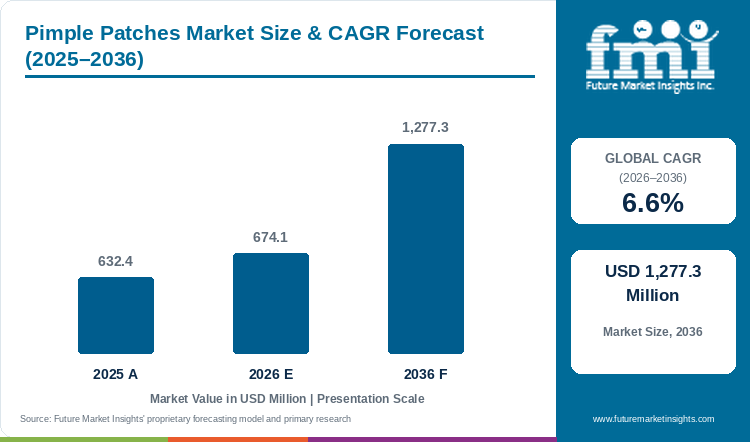
USD 674.1 Million in 2026 and USD 1,277.3 Million by 2036 at a 6.6% CAGR.
FMI values the pimple patches market at USD 674.1 Million in 2026 and forecasts it to reach USD 1,277.3 Million by 2036 at a 6.6% CAGR. FMI values the pimple patches market at approximately USD 632.4 Million in 2025. Demand is supported by the high incidence of acne among younger consumers and the convenience of a single-use product for visible surface blemishes. The NHS reports that about 95% of people aged 11 to 30 experience acne to some extent, while the American Academy of Dermatology notes that hydrocolloid patches can protect the skin and support healing. Hydrocolloid therefore has a clear role in mild and surface-level blemish care, where ease of use and repeat purchase matter more than complex treatment claims. [3] [2]
Brands are adding medicated actives and barrier-support ingredients to increase value per use and extend the category into new blemish stages. This also raises regulatory and formulation complexity. In the USA, acne-treatment actives such as salicylic acid and sulfur fall under the FDA OTC acne monograph, while other markets apply their own cosmetic and functional-claim rules. Suppliers that keep the core patch platform simple while adapting actives, claims and labeling by market will be better placed to scale across channels. [1]
Key Takeaways
- Hydrocolloid patches remain the core of the category and are projected to hold 45.0% of Product Type demand in 2026. Their strength comes from a simple use case around visible surface blemishes.
- Conventional products are expected to account for 52.0% of Nature demand. They keep formulation and claim requirements simpler than more specialized natural, sensitive-skin or clinical variants.
- Cream & balm is projected to hold 26.0% of Format demand in 2026. The segment benefits from patch-plus-aftercare routines that extend spending beyond the patch itself.
- Mass positioning is expected to represent 38.0% of demand. Pack pricing and repeat use matter because consumers may use several patches during one breakout cycle.
- E-commerce & DTC is projected to account for 27.0% of Sales Channel demand. Digital channels work well for a product that can be demonstrated quickly and replenished without professional advice.
- UAE is expected to record the fastest profiled country CAGR at 8.0% through 2036. Saudi Arabia follows at 7.6% and South Korea at 7.3%, while Japan has the slowest profiled rate at 5.7%.
Analyst Perspective
“Pimple patches are moving from simple hydrocolloid dots to a wider spot-care system. Brands can now compete through patch material, active ingredients, body formats and aftercare products. The main commercial challenge is to add more value without making claims that the product cannot support.”
- Rahul Pandita, Principal Consultant, Future Market Insights
How is the pimple patches market segmented?
The market is segmented by Product Type, Nature, Format, Price Positioning, Sales Channel, and Region.
By Product Type, the market includes Hydrocolloid patches, Microdart patches, Medicated patches, and Decorative patches. Nature covers Conventional, Vegan & cruelty-free, Natural & organic, Dermocosmetic / clinical, and Fragrance-free & sensitive products. Format includes Cream & balm, Liquid & serum, Stick & solid, Spray & mist, Sheet & patch, and Powder. Price Positioning is divided into Mass, Masstige, Premium, and Professional. Sales Channel covers E-commerce & DTC, Specialty beauty retail, Pharmacies & drugstores, Supermarkets & hypermarkets, and Salons & spas.
Why do Hydrocolloid Patches lead demand within the Product Type category?
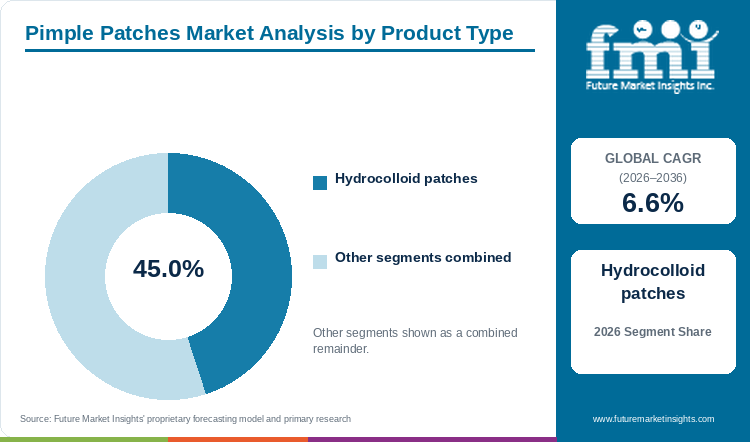
Hydrocolloid Patches are projected to account for 45.0% of Product Type demand in 2026.
Hydrocolloid patches have the largest customer base because they are already widely used for surface-level pimples. The format is sold across pharmacies, beauty stores and online channels, and consumers can buy it without moving into a medicated acne routine.
The segment is also expanding beyond basic clear dots. Larger body patches and patches with added skincare ingredients are increasing the number of products that can be built around hydrocolloid. CeraVe entered the category in 2025 with hydrocolloid patches containing ceramides and niacinamide. Microdart and medicated patches will gain demand for more specific needs, but hydrocolloid is expected to remain the largest Product Type throughout the forecast period. [14]
- Hydrocolloid Patches are projected to account for 45.0% of Product Type demand in 2026.
- In July 2025, CeraVe introduced Blemish Barrier Patches with hydrocolloid, ceramides and niacinamide. [14]
Why does Conventional lead demand within the Nature category?
Conventional is projected to account for 52.0% of Nature demand in 2026.
Conventional products are likely to retain the largest share because most pimple-patch buyers still purchase standard products rather than choosing on the basis of vegan, natural or clinical positioning. These products already have wide retail availability and a large existing customer base.
Demand for sensitive-skin, vegan and dermocosmetic products will increase as the category becomes more crowded. This can reduce the Conventional share over time. However, standard products are still expected to account for the largest part of demand because they remain the normal choice for many repeat buyers.
- Conventional products are projected to account for 52.0% of Nature demand in 2026.
- In November 2023, e.l.f. Beauty introduced Stick It to Zits as clear hydrocolloid pimple patches. [13]
Why does Cream & Balm lead demand within the Format category?
Cream & Balm is projected to account for 26.0% of Format demand in 2026.
Cream and balm products benefit from use after the patch is removed. A consumer may still have redness or a visible mark even after the patch has absorbed fluid. This creates demand for another product during the same blemish-care routine.
Hero Cosmetics already combines Mighty Patch with Rescue Balm. This shows how patch brands can sell aftercare alongside the patch rather than depend only on repeat sales of patch packs. Cream & Balm therefore gains demand from consumers who use more than one product during the same breakout.
- Cream & Balm is projected to account for 26.0% of Format demand in 2026.
- Hero Cosmetics pairs Rescue Balm with Mighty Patch in its patch-plus-aftercare offer.
Why does Mass lead demand within the Price Positioning category?
Mass is projected to account for 38.0% of Price Positioning demand in 2026.
Pimple patches are often used more than once during a breakout, so consumers pay attention to pack price and the number of patches included. This supports mass-priced products, particularly standard hydrocolloid packs sold through drugstores and large online retailers.
Higher-priced products will continue to grow where brands offer microdarts, specialized ingredients or clinical positioning. These products can earn more revenue per pack, but they serve a smaller part of demand. Standard hydrocolloid packs are expected to keep Mass as the largest price segment.
- Mass products are projected to account for 38.0% of Price Positioning demand in 2026.
- Value-focused brands such as e.l.f. Beauty already sell hydrocolloid patches as part of their regular skincare range. [13]
Why does E-commerce & DTC lead demand within the Sales Channel category?
E-commerce & DTC is projected to account for 27.0% of Sales Channel demand in 2026.
Pimple patches work well online because buyers can compare pack size, patch type, ingredients and price without visiting a store. Online shops can also carry a larger number of variants, including body patches, decorative patches and microdart products.
Repeat purchase is another advantage for this channel. Once consumers know which patch they use, they can order the same product again with little effort. Pharmacies and beauty stores will remain important for discovery, but online channels are likely to keep a strong position because much of the category depends on replenishment.
- E-commerce & DTC is projected to account for 27.0% of Sales Channel demand in 2026.
- Online stores can carry more patch formats and pack sizes than most physical retail shelves.
What are the drivers, restraints, and opportunities in the pimple patches market?
Frequent visible blemishes and demand for discreet self-care support patch use, while lesion-specific efficacy and regulatory claim boundaries restrain adoption, and differentiated patch systems create room for portfolio expansion.
- Driver: Pimple patches are easy to use and can cover visible surface blemishes without adding another full skincare step.
- Restraint: Hydrocolloid patches do not work equally well on every type of acne. Medicated patches also face stricter claim and regulatory requirements.
- Opportunity: Growth can come from body patches, microdart products, sensitive-skin variants and post-patch care.
Acne is common among younger consumers, which keeps the need for spot care high. The NHS reports that about 95% of people aged 11 to 30 experience acne to some extent. Pimple patches are mainly useful for visible surface blemishes where consumers want to cover the spot and avoid touching or picking it. This makes the category suitable for regular home use and supports repeat purchase when breakouts return. [3] [2]
The main restraint is that patches are not suitable for every blemish. Hydrocolloid works best when fluid is close to the skin surface, while deeper nodules and cysts may need medical treatment. The regulatory burden also increases when brands add acne-treatment actives. In the USA, ingredients such as salicylic acid and sulfur fall under the FDA OTC acne-drug framework. Japan and South Korea also apply stricter rules when cosmetic products move toward treatment or functional claims. Brands therefore need to be clear about what the patch is designed to do. [1] [10] [11]
The next phase of growth will come from using patches in more situations. Hero Cosmetics has expanded into larger body patches and micropoint products for early-stage blemishes. CeraVe has added ceramides and niacinamide to hydrocolloid patches, while Dermalogica offers a liquid product that forms a patch on the skin. These products take the category beyond standard facial dots and give consumers more options for different blemish types and body areas. [5] [14] [15]
Which country CAGRs are profiled in the pimple patches market?
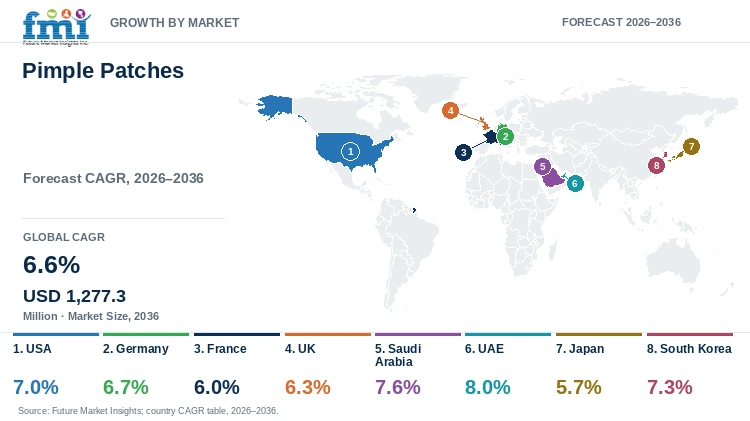
| Country | CAGR |
|---|---|
| USA | 7.0% |
| Germany | 6.7% |
| France | 6.0% |
| UK | 6.3% |
| Saudi Arabia | 7.6% |
| UAE | 8.0% |
| Japan | 5.7% |
| South Korea | 7.3% |
- USA: The USA is expected to grow at a 7.0% CAGR from 2026 to 2036. Basic hydrocolloid patches can be sold without an acne-drug claim. Medicated patches face a different route because ingredients such as salicylic acid and sulfur fall under the FDA OTC acne framework. This creates room for both simple patches and treatment-led products. [1]
- Germany: Germany is projected to expand at a 6.7% CAGR through 2036. Pimple patches mainly fit mild and visible blemishes. German health guidance also notes that stronger acne may need medical treatment. This keeps the category focused on spot care rather than wider acne therapy. [4]
- France: France is likely to grow at a 6.0% CAGR through 2036. Pharmacies are important for acne and skincare products while beauty stores and online channels add wider access. In 2026 the DGCCRF checked 147 cosmetics businesses and more than 200 product information files. This makes product documentation especially important for brands entering pharmacy and premium beauty channels. [6]
- UK: The UK market is expected to rise at a 6.3% CAGR through 2036. Pimple patches already fit pharmacy and beauty retail as well as online sales. Cosmetics sold in Great Britain need a Responsible Person and the required product information. Overseas brands therefore need local compliance in place before wider distribution. [7]
- Saudi Arabia: Saudi Arabia is expected to record a 7.6% CAGR through 2036. Beauty retail and online sales are expanding while cosmetic products still need local notification. The Saudi Food and Drug Authority maintains a list of notified cosmetic products. Registration readiness will remain important for brands planning wider distribution. [8]
- UAE: UAE is expected to post the fastest growth among the profiled countries at 8.0% CAGR through 2036. Pimple patches can move through malls and pharmacies as well as online marketplaces. The country also applies formal conformity requirements to imported products. Brands that prepare local packaging and product documents early can enter several channels at the same time. [9]
- Japan: Japan is forecast to grow at a 5.7% CAGR through 2036. Buyers already have a wide choice of skincare products. Pimple patches therefore need a clear use case rather than heavy ingredient promotion. Japan also tightened guidance in 2025 on how cosmetic ingredients can be highlighted. This makes claim wording more important for medicated or ingredient-led patches. [10]
- South Korea: South Korea is expected to expand at a 7.3% CAGR through 2036. Consumers are already familiar with patch-based skincare and new beauty formats move quickly through the market. The Ministry of Food and Drug Safety separates acne cosmetics from acne treatment. This gives brands room to launch new patch formats while keeping treatment claims within the correct regulatory route. [11]
Who are the notable companies in the pimple patches market?
Church & Dwight, e.l.f. Beauty, Coty, Unilever, L'Oreal, Estee Lauder Companies, Kao Corporation, Amorepacific, Shiseido, and Procter & Gamble are the notable companies profiled in this market.
Competitive Landscape
Church & Dwight has a strong position through Hero Cosmetics and Mighty Patch. e.l.f. Beauty also sells hydrocolloid patches at mass-market prices. L'Oreal has entered the category through CeraVe, while Unilever has a different format through Dermalogica's Deep Acne Liquid Patch. [5] [13] [14] [15]
Competition from Asian beauty companies is different. Kao Corporation, Amorepacific and Shiseido already have products for acne-prone skin but have a smaller direct presence in pimple patches. They can become stronger competitors if they bring more patch products into their existing skincare ranges.
Coty, Estee Lauder Companies and Procter & Gamble have large beauty businesses but a limited direct presence in pimple patches. The market therefore still gives specialist patch brands room to grow. Large beauty companies can become a bigger threat if they decide to enter the category with their existing skincare brands.
- Direct Pimple Patch Players: Church & Dwight and e.l.f. Beauty have established patch products. L'Oreal and Unilever also have direct products in the category.
- Asian Skincare Companies: Kao Corporation, Amorepacific and Shiseido have a stronger presence in acne-prone skincare than in pimple patches.
- Large Beauty Companies: Coty, Estee Lauder Companies and Procter & Gamble have wide beauty portfolios but a smaller direct presence in pimple patches.
Competitive Benchmarking: Pimple Patches Market
| Company | Direct Patch Portfolio | Acne / Spot-Care Adjacency | Omnichannel Consumer Reach | Geographic Reach |
|---|---|---|---|---|
| Church & Dwight | High | High | High | United States-led with international consumer distribution |
| e.l.f. Beauty | High | High | High | United States, Canada, United Kingdom, and international e-commerce |
| Coty | Unscored | Medium | High | North America, Europe, Asia-Pacific, and global prestige markets |
| Unilever | Medium | High | High | Global professional and consumer skincare markets |
| L'Oreal | Medium | High | High | Global mass, pharmacy, and dermocosmetic markets |
| Estee Lauder Companies | Unscored | High | High | Global prestige beauty markets |
| Kao Corporation | Unscored | Medium | High | Japan, East Asia, and selected international markets |
| Amorepacific | Unscored | Medium | High | South Korea, East Asia, and international beauty markets |
| Shiseido | Unscored | Medium | High | Japan, Asia, Europe, and North America |
| Procter & Gamble | Unscored | Unscored | High | Global mass consumer and beauty markets |
Key Developments in the Pimple Patches Market
- On May 1, 2026, Church & Dwight announced Hero Mighty Shield. The product is a liquid that forms an invisible patch over the blemish and can be worn under makeup. This adds another format beyond standard hydrocolloid stickers. [16]
- On August 6, 2025, PanOxyl launched Daytime Invisible Patches. The patches contain salicylic acid and are designed for daytime wear on bare skin or under makeup. This shows stronger competition in medicated and less-visible patch formats. [17]
- On July 16, 2025, CeraVe launched Blemish Barrier Patches. The product combines hydrocolloid with ceramides and niacinamide. CeraVe also launched the patches through Amazon and major US retailers at USD 9.99 [14]
- On May 1, 2025, Church & Dwight confirmed the launch of Mighty Patch Body. The larger hydrocolloid patch is designed for breakouts on areas such as the chest and back. This expands pimple-patch use beyond the face [5]
Key Players in the Pimple Patches Market
Direct Patch and Blemish-System Platforms
- Church & Dwight
- e.l.f. Beauty
- Unilever
- L'Oreal
Asia-Led Acne-Prone Skincare Platforms
- Kao Corporation
- Amorepacific
- Shiseido
Broad Beauty and Skincare Channel Platforms
- Coty
- Estee Lauder Companies
- Procter & Gamble
Pimple Patches Market - Report Scope
| Coverage field | Report scope |
|---|---|
| Market breakdown | Product Type; Nature; Format; Price Positioning; Sales Channel; Region |
| Quantitative Units | USD Million |
| Market Definition | Revenue includes pimple-patch and patch-led spot-care products sold within the stated segmentation universe. It excludes unrelated acne cleansers, oral treatments, procedures, and substitute topical products outside a direct pimple-patch system. |
| Regions Covered | North America; Latin America; Western Europe; Eastern Europe; East Asia; South Asia and Pacific; Middle East and Africa |
| Countries Covered | USA, Germany, France, UK, Saudi Arabia, UAE, Japan, South Korea, and more than twenty-five additional countries in the full report |
| Key Companies Profiled | Church & Dwight, e.l.f. Beauty, Coty, Unilever, L'Oreal, Estee Lauder Companies, Kao Corporation, Amorepacific, Shiseido, Procter & Gamble |
| Forecast Period | 2026 to 2036 |
| Approach | FMI applies a hybrid bottom-up and top-down sizing approach using product availability, channel structure, public company evidence, regulatory conditions, and demand indicators to reconcile market estimates. |
Pimple Patches Market - Research Methodology
| Method | Approach |
|---|---|
| Primary Research | Structured interviews and market conversations with manufacturers, brand operators, distributors, retailers, dermatology-facing stakeholders, and category specialists are used to test product scope, buying behavior, channel economics, and adoption frictions. No interview count or respondent weighting is assumed in this report. |
| Desk Research | Public regulatory guidance, government health information, company filings, official product documentation, corporate announcements, and relevant trade or retail evidence are reviewed. Sources are included only when they support the defined pimple-patch market or explain a necessary regulatory and buyer context. |
| Market Sizing and Forecasting | Market estimates reconcile the market values with segment structure, observable product availability, channel penetration, country conditions, and expected category development through 2036. Forecast interpretation distinguishes growth rate from absolute market size and does not replace the stated market values with public web estimates. |
| Data Validation | Evidence is cross-checked across public authorities and first-party company records. Adjacent acne treatments are excluded from revenue unless they are sold as a direct component of the defined patch-led system, and unsupported company share claims are excluded. |
Pimple Patches Market by Segments
Pimple Patches Market segmented by Product Type:
- Hydrocolloid patches
- Microdart patches
- Medicated patches
- Decorative patches
Pimple Patches Market segmented by Nature:
- Conventional
- Vegan & cruelty-free
- Natural & organic
- Dermocosmetic / clinical
- Fragrance-free & sensitive
Pimple Patches Market segmented by Format:
- Cream & balm
- Liquid & serum
- Stick & solid
- Spray & mist
- Sheet & patch
- Powder
Pimple Patches Market segmented by Price Positioning:
- Mass
- Masstige
- Premium
- Professional
Pimple Patches Market segmented by Sales Channel:
- E-commerce & DTC
- Specialty beauty retail
- Pharmacies & drugstores
- Supermarkets & hypermarkets
- Salons & spas
Pimple Patches Market by Region:
- North America
- United States
- Canada
- Latin America
- Brazil
- Mexico
- Argentina
- Chile
- Western Europe
- Germany
- France
- United Kingdom
- Italy
- Spain
- Benelux
- Nordics
- Eastern Europe
- Poland
- Czech Republic
- Romania
- Hungary
- East Asia
- China
- Japan
- South Korea
- South Asia and Pacific
- India
- ASEAN
- Australia and New Zealand
- Middle East and Africa
- GCC Countries
- South Africa
- Türkiye
- Israel
Research Sources and Bibliography
- [1] U.S. Food and Drug Administration (2021, November 23). OTC Monograph M006: Topical Acne Drug Products for OTC Human Use. https://www.accessdata.fda.gov/drugsatfda_docs/omuf/monographs/OTC%20Monograph_M006-Topical%20Acne%20drug%20products%20for%20OTC%20Human%20Use%2011.23.2021.pdf
- [2] American Academy of Dermatology (2023, October 17). Tips to Treat a Deep, Painful Pimple. https://www.aad.org/public/diseases/acne/diy/treat-deep-painful-pimple
- [3] National Health Service (2023, January 3). Acne. https://www.nhs.uk/conditions/acne/
- [4] Institute for Quality and Efficiency in Health Care (2025, November 12). Akne. https://www.gesundheitsinformation.de/akne.html
- [5] Church & Dwight Co., Inc. (2025, January 31). Church & Dwight Reports Fourth Quarter and Full Year 2024 Results. https://investors.churchdwight.com/Investors/news/news-details/2025/Church--Dwight-Reports-Fourth-Quarter-and-Full-Year-2024-Results/default.aspx
- [6] Direction générale de la concurrence, de la consommation et de la répression des fraudes (2026, February 2). Cosmétiques : des TPE nouvelles dans le secteur qui méconnaissent trop souvent la réglementation. https://www.economie.gouv.fr/dgccrf/laction-de-la-dgccrf/les-enquetes-et-les-controles/cosmetiques-des-tpe-nouvelles-dans-le-secteur-qui-meconnaissent-trop-souvent-la
- [7] Office for Product Safety and Standards (2025, July 10). Consumer Products: Cosmetics. https://www.gov.uk/guidance/consumer-products-cosmetics
- [8] Saudi Food and Drug Authority (2026, April 28). List of Notification of Marketing for Cosmetic Products. https://www.sfda.gov.sa/en/cosmetics-list
- [9] UAE Ministry of Industry and Advanced Technology (2025, April 9). MoIAT Transforms Conformity Labels, Elevating Made in the UAE Products Globally. https://www.moiat.gov.ae/en/media-center/news/2025/04/09/conformity-marks-2025
- [10] Ministry of Health, Labour and Welfare of Japan (2025, March 10). Notice on Highlighted Labeling of Specific Ingredients in Cosmetics. https://www.mhlw.go.jp/web/t_doc?dataId=00tc9762&dataType=1&pageNo=1
- [11] Ministry of Food and Drug Safety, Republic of Korea (2025, May 19). Acne Cosmetics Are Not Treatments. https://www.korea.kr/news/customizedNewsView.do?newsId=148943223
- [12] Church & Dwight Co., Inc. (2023). Annual Report for the Year Ended December 31, 2022. https://www.sec.gov/Archives/edgar/data/313927/000095017023003066/chd-20221231.htm
- [13] e.l.f. Cosmetics (2023, November 14). New! Stick It To Zits Hydrocolloid Patches. https://milled.com/e-l-f-cosmetics/new-stick-it-to-zits-hydrocolloid-patches-xPzn2kqsY0UNIcw6
- [14] CeraVe (2025, July 16). CeraVe Marks 20 Years of Therapeutic Skincare Developed with Dermatologists with Five New Innovations. https://www.prnewswire.com/news-releases/cerave-marks-20-years-of-therapeutic-skincare-developed-with-dermatologists-with-five-new-innovations-302506352.html
- [15] U.S. National Library of Medicine, DailyMed (2024, December). Deep Acne Liquid Patch. https://dailymed.nlm.nih.gov/dailymed/fda/fdaDrugXsl.cfm?setid=d4e9d230-2ee4-4cc7-a7c9-a7dde50b6f40
- [16] Church & Dwight Co., Inc. (2026, May 1). Church & Dwight Reports Q1 2026 Results. https://investor.churchdwight.com/Investors/news/news-details/2026/Church--Dwight-Reports-Q1-2026-Results/default.aspx
- [17] PanOxyl (2025). PanOxyl Daytime Invisible Patches. https://panoxyl.com/acne-products/panoxyl-daytime-patches/
This bibliography is provided for reader reference and is not exhaustive. The full report contains the complete reference list and detailed citations.
This Report Answers
- What is the Pimple Patches Market size in 2026 and what value is forecast for 2036?
- Which consumer and dermatology-related pressures support demand for pimple patches?
- Why do Hydrocolloid patches hold the leading position in Product Type?
- How does Conventional positioning influence purchase breadth and downstream channel demand?
- Why does Cream & balm hold the leading position within the defined Format taxonomy?
- How do pimple-patch growth rates differ across USA, Germany, France, UK, Saudi Arabia, UAE, Japan, and South Korea?
- Which companies provide direct patch products, blemish-care adjacency, or broad beauty channel access?
- How do lesion suitability and regulatory claim boundaries limit adoption?
- What should beauty category managers and brand teams evaluate before expanding a pimple-patch portfolio?
Frequently Asked Questions
What is driving growth in the Pimple Patches Market?
Growth is driven by frequent visible blemishes and demand for a discreet single-use product that protects the spot during a defined wear period. Hydrocolloid also reduces direct touching, which gives consumers an intuitive reason to repurchase when new surface blemishes appear.
Who are the key players in the Pimple Patches Market?
The profiled company set includes Church & Dwight, e.l.f. Beauty, Coty, Unilever, L'Oreal, Estee Lauder Companies, Kao Corporation, Amorepacific, Shiseido, and Procter & Gamble. Their roles differ between direct patch portfolios, acne-prone skincare adjacency, and broad beauty distribution.
What notable restraint affects the Pimple Patches Market?
Pimple patches are not suitable for every acne lesion, and deeper nodular or cystic acne can require medical treatment rather than a surface patch. Medicated claims also add regulatory complexity when a product contains recognized acne-drug actives or implies treatment.
Why should executives track the Pimple Patches Market?
The category turns a small disposable format into a repeat-purchase beauty product with room for material and shape differentiation. It also shows how ingredient design and regulatory claims become competitive variables as brands move from physical protection toward medicated positioning.
What business problem does the Pimple Patches Market address?
The market addresses the need to cover and manage a visible blemish without requiring a full skincare regimen or professional procedure. For suitable surface lesions, patches can absorb fluid while reducing touching and giving consumers a discreet spot-specific action.
What should beauty category managers evaluate in the Pimple Patches Market?
Category managers should test lesion fit and adhesion duration. They should also review skin tolerance; patch visibility; pack economics; active-claim status; and whether channel education separates hydrocolloid protection from medicated acne treatment.
What limits return on investment in the Pimple Patches Market?
Return can weaken when products fail to adhere or target the wrong lesion stage. Irritation, unsupported claims, and high assortment turnover can also erode return when specialized variants fail to build repeat demand.
What supports long-term commercial confidence in the Pimple Patches Market?
Long-term confidence comes from a recurring acne burden, a simple use cycle, and continued product expansion into body areas plus early-stage blemish formats. Durable revenue still depends on evidence-backed performance, regulatory discipline, and replenishment economics rather than novelty alone.
Preview the report firsthand - request a free sample
Get SampleGet the brochure for pricing and purchase details.
Get PDFTable of Content
- Key Takeaways
- Market Size and CAGR
- Top Growth Driver
- Fastest Growing Segment
- Leading Region
- Key Companies
- Emerging Opportunities
- Executive Summary
- Global Market Outlook
- Demand-side Trends
- Supply-side Trends
- Technology Roadmap Analysis
- Analysis and Recommendations
- Analyst Perspective (What is happening? Why now? What should investors know?)
- Key Questions Answered
- How large is the market?
- What is the CAGR?
- What are key trends?
- Which region dominates?
- Who are the leaders?
- Market Overview
- Market Coverage / Taxonomy
- Market Definition / Scope / Limitations
- Research Methodology
- Chapter Orientation
- Analytical Lens and Working Hypotheses
- Market Structure, Signals, and Trend Drivers
- Benchmarking and Cross-market Comparability
- Market Sizing, Forecasting, and Opportunity Mapping
- Research Design and Evidence Framework
- Desk Research Programme (Secondary Evidence)
- Expert Input and Fieldwork (Primary Evidence)
- Tooling, Models, and Reference Databases
- Data Engineering and Model Build
- Quality Assurance and Audit Trail
- Market Background
- Market Dynamics (Drivers, Restraints, Opportunity, Trends)
- Scenario Forecast (Optimistic, Likely, Conservative)
- Impact Analysis
- AI Impact
- Sustainability Impact
- Regulatory Impact
- Technology Impact
- Consumer / Buyer Analysis
- Purchase Drivers
- Adoption Barriers
- Buyer Journey
- Opportunity Map Analysis
- Product Life Cycle Analysis
- Supply Chain Analysis
- Investment Feasibility Matrix
- Value Chain Analysis
- PESTLE and Porter's Analysis
- Regulatory Landscape
- Regional Parent Market Outlook
- Production and Consumption Statistics
- Import and Export Statistics
- Global Market Analysis and Forecast, 2021 to 2036
- Historical Market Size Value (USD Million) Analysis, 2021 to 2025
- Current and Future Market Size Value (USD Million) Projections, 2026 to 2036
- Y-o-Y Growth Trend Analysis
- Absolute $ Opportunity Analysis
- Global Market Pricing Analysis, 2021 to 2036
- Global Market Analysis and Forecast, By Product Type, 2021 to 2036
- Introduction / Key Findings
- Historical Market Size Value (USD Million) Analysis By Product Type, 2021 to 2025
- Current and Future Market Size Value (USD Million) Analysis and Forecast By Product Type, 2026 to 2036
- Hydrocolloid patches
- Microdart patches
- Medicated patches
- Decorative patches
- Y-o-Y Growth Trend Analysis By Product Type, 2021 to 2025
- Absolute $ Opportunity Analysis By Product Type, 2026 to 2036
- Global Market Analysis and Forecast, By Nature, 2021 to 2036
- Introduction / Key Findings
- Historical Market Size Value (USD Million) Analysis By Nature, 2021 to 2025
- Current and Future Market Size Value (USD Million) Analysis and Forecast By Nature, 2026 to 2036
- Conventional
- Vegan & cruelty-free
- Natural & organic
- Dermocosmetic / clinical
- Fragrance-free & sensitive
- Y-o-Y Growth Trend Analysis By Nature, 2021 to 2025
- Absolute $ Opportunity Analysis By Nature, 2026 to 2036
- Global Market Analysis and Forecast, By Format, 2021 to 2036
- Introduction / Key Findings
- Historical Market Size Value (USD Million) Analysis By Format, 2021 to 2025
- Current and Future Market Size Value (USD Million) Analysis and Forecast By Format, 2026 to 2036
- Cream & balm
- Liquid & serum
- Stick & solid
- Spray & mist
- Sheet & patch
- Powder
- Y-o-Y Growth Trend Analysis By Format, 2021 to 2025
- Absolute $ Opportunity Analysis By Format, 2026 to 2036
- Global Market Analysis and Forecast, By Price Positioning, 2021 to 2036
- Introduction / Key Findings
- Historical Market Size Value (USD Million) Analysis By Price Positioning, 2021 to 2025
- Current and Future Market Size Value (USD Million) Analysis and Forecast By Price Positioning, 2026 to 2036
- Mass
- Masstige
- Premium
- Professional
- Y-o-Y Growth Trend Analysis By Price Positioning, 2021 to 2025
- Absolute $ Opportunity Analysis By Price Positioning, 2026 to 2036
- Global Market Analysis and Forecast, By Sales Channel, 2021 to 2036
- Introduction / Key Findings
- Historical Market Size Value (USD Million) Analysis By Sales Channel, 2021 to 2025
- Current and Future Market Size Value (USD Million) Analysis and Forecast By Sales Channel, 2026 to 2036
- E-commerce & DTC
- Specialty beauty retail
- Pharmacies & drugstores
- Supermarkets & hypermarkets
- Salons & spas
- Y-o-Y Growth Trend Analysis By Sales Channel, 2021 to 2025
- Absolute $ Opportunity Analysis By Sales Channel, 2026 to 2036
- Global Market Analysis and Forecast, By Region, 2021 to 2036
- Introduction
- Historical Market Size Value (USD Million) Analysis By Region, 2021 to 2025
- Current Market Size Value (USD Million) Analysis and Forecast By Region, 2026 to 2036
- North America
- Latin America
- Western Europe
- Eastern Europe
- East Asia
- South Asia and Pacific
- Middle East and Africa
- Market Attractiveness Analysis By Region
- North America Market Analysis and Forecast, By Country, 2021 to 2036
- Historical Market Size Value (USD Million) Trend Analysis By Market Taxonomy, 2021 to 2025
- Market Size Value (USD Million) Forecast By Market Taxonomy, 2026 to 2036
- By Country
- United States
- Canada
- By Product Type
- By Nature
- By Format
- By Price Positioning
- By Sales Channel
- By Country
- Market Attractiveness Analysis
- By Country
- By Product Type
- By Nature
- By Format
- By Price Positioning
- By Sales Channel
- Key Takeaways
- Latin America Market Analysis and Forecast, By Country
- Historical Market Size Value (USD Million) Trend Analysis By Market Taxonomy, 2021 to 2025
- Market Size Value (USD Million) Forecast By Market Taxonomy, 2026 to 2036
- By Country
- Brazil
- Mexico
- Argentina
- Chile
- By Product Type
- By Nature
- By Format
- By Price Positioning
- By Sales Channel
- By Country
- Market Attractiveness Analysis
- By Country
- By Product Type
- By Nature
- By Format
- By Price Positioning
- By Sales Channel
- Key Takeaways
- Western Europe Market Analysis and Forecast, By Country
- Historical Market Size Value (USD Million) Trend Analysis By Market Taxonomy, 2021 to 2025
- Market Size Value (USD Million) Forecast By Market Taxonomy, 2026 to 2036
- By Country
- Germany
- France
- United Kingdom
- Italy
- Spain
- Benelux
- Nordics
- By Product Type
- By Nature
- By Format
- By Price Positioning
- By Sales Channel
- By Country
- Market Attractiveness Analysis
- By Country
- By Product Type
- By Nature
- By Format
- By Price Positioning
- By Sales Channel
- Key Takeaways
- Eastern Europe Market Analysis and Forecast, By Country
- Historical Market Size Value (USD Million) Trend Analysis By Market Taxonomy, 2021 to 2025
- Market Size Value (USD Million) Forecast By Market Taxonomy, 2026 to 2036
- By Country
- Poland
- Czech Republic
- Romania
- Hungary
- By Product Type
- By Nature
- By Format
- By Price Positioning
- By Sales Channel
- By Country
- Market Attractiveness Analysis
- By Country
- By Product Type
- By Nature
- By Format
- By Price Positioning
- By Sales Channel
- Key Takeaways
- East Asia Market Analysis and Forecast, By Country
- Historical Market Size Value (USD Million) Trend Analysis By Market Taxonomy, 2021 to 2025
- Market Size Value (USD Million) Forecast By Market Taxonomy, 2026 to 2036
- By Country
- China
- Japan
- South Korea
- By Product Type
- By Nature
- By Format
- By Price Positioning
- By Sales Channel
- By Country
- Market Attractiveness Analysis
- By Country
- By Product Type
- By Nature
- By Format
- By Price Positioning
- By Sales Channel
- Key Takeaways
- South Asia and Pacific Market Analysis and Forecast, By Country
- Historical Market Size Value (USD Million) Trend Analysis By Market Taxonomy, 2021 to 2025
- Market Size Value (USD Million) Forecast By Market Taxonomy, 2026 to 2036
- By Country
- India
- ASEAN
- Australia and New Zealand
- By Product Type
- By Nature
- By Format
- By Price Positioning
- By Sales Channel
- By Country
- Market Attractiveness Analysis
- By Country
- By Product Type
- By Nature
- By Format
- By Price Positioning
- By Sales Channel
- Key Takeaways
- Middle East and Africa Market Analysis and Forecast, By Country
- Historical Market Size Value (USD Million) Trend Analysis By Market Taxonomy, 2021 to 2025
- Market Size Value (USD Million) Forecast By Market Taxonomy, 2026 to 2036
- By Country
- GCC Countries
- South Africa
- Türkiye
- Israel
- By Product Type
- By Nature
- By Format
- By Price Positioning
- By Sales Channel
- By Country
- Market Attractiveness Analysis
- By Country
- By Product Type
- By Nature
- By Format
- By Price Positioning
- By Sales Channel
- Key Takeaways
- Key Countries Market Analysis
- United States
- Pricing Analysis
- Market Share Analysis, 2025
- By Product Type
- By Nature
- By Format
- By Price Positioning
- By Sales Channel
- Canada
- Pricing Analysis
- Market Share Analysis, 2025
- By Product Type
- By Nature
- By Format
- By Price Positioning
- By Sales Channel
- Mexico
- Pricing Analysis
- Market Share Analysis, 2025
- By Product Type
- By Nature
- By Format
- By Price Positioning
- By Sales Channel
- Brazil
- Pricing Analysis
- Market Share Analysis, 2025
- By Product Type
- By Nature
- By Format
- By Price Positioning
- By Sales Channel
- Chile
- Pricing Analysis
- Market Share Analysis, 2025
- By Product Type
- By Nature
- By Format
- By Price Positioning
- By Sales Channel
- Germany
- Pricing Analysis
- Market Share Analysis, 2025
- By Product Type
- By Nature
- By Format
- By Price Positioning
- By Sales Channel
- United Kingdom
- Pricing Analysis
- Market Share Analysis, 2025
- By Product Type
- By Nature
- By Format
- By Price Positioning
- By Sales Channel
- Italy
- Pricing Analysis
- Market Share Analysis, 2025
- By Product Type
- By Nature
- By Format
- By Price Positioning
- By Sales Channel
- Spain
- Pricing Analysis
- Market Share Analysis, 2025
- By Product Type
- By Nature
- By Format
- By Price Positioning
- By Sales Channel
- France
- Pricing Analysis
- Market Share Analysis, 2025
- By Product Type
- By Nature
- By Format
- By Price Positioning
- By Sales Channel
- India
- Pricing Analysis
- Market Share Analysis, 2025
- By Product Type
- By Nature
- By Format
- By Price Positioning
- By Sales Channel
- ASEAN
- Pricing Analysis
- Market Share Analysis, 2025
- By Product Type
- By Nature
- By Format
- By Price Positioning
- By Sales Channel
- Australia and New Zealand
- Pricing Analysis
- Market Share Analysis, 2025
- By Product Type
- By Nature
- By Format
- By Price Positioning
- By Sales Channel
- China
- Pricing Analysis
- Market Share Analysis, 2025
- By Product Type
- By Nature
- By Format
- By Price Positioning
- By Sales Channel
- Japan
- Pricing Analysis
- Market Share Analysis, 2025
- By Product Type
- By Nature
- By Format
- By Price Positioning
- By Sales Channel
- South Korea
- Pricing Analysis
- Market Share Analysis, 2025
- By Product Type
- By Nature
- By Format
- By Price Positioning
- By Sales Channel
- Poland
- Pricing Analysis
- Market Share Analysis, 2025
- By Product Type
- By Nature
- By Format
- By Price Positioning
- By Sales Channel
- Hungary
- Pricing Analysis
- Market Share Analysis, 2025
- By Product Type
- By Nature
- By Format
- By Price Positioning
- By Sales Channel
- Türkiye
- Pricing Analysis
- Market Share Analysis, 2025
- By Product Type
- By Nature
- By Format
- By Price Positioning
- By Sales Channel
- South Africa
- Pricing Analysis
- Market Share Analysis, 2025
- By Product Type
- By Nature
- By Format
- By Price Positioning
- By Sales Channel
- Saudi Arabia
- Pricing Analysis
- Market Share Analysis, 2025
- By Product Type
- By Nature
- By Format
- By Price Positioning
- By Sales Channel
- UAE
- Pricing Analysis
- Market Share Analysis, 2025
- By Product Type
- By Nature
- By Format
- By Price Positioning
- By Sales Channel
- United States
- Market Structure Analysis
- Competition Dashboard
- Competition Benchmarking
- Market Share Analysis of Top Players
- By Regional
- By Product Type
- By Nature
- By Format
- By Price Positioning
- By Sales Channel
- Emerging Startups
- Innovation Benchmarking
- Competition Analysis
- Competition Deep Dive
- Church & Dwight
- Overview
- Product Portfolio
- Profitability by Market Segments
- Sales Footprint
- Strategy Overview
- Marketing Strategy
- Product Strategy
- Channel Strategy
- e.l.f. Beauty
- Coty
- Unilever
- L'Oreal
- Estee Lauder Companies
- Kao Corporation
- Amorepacific
- Shiseido
- Procter & Gamble
- Church & Dwight
- Case Studies
- Success Stories
- Recent Developments
- Competition Deep Dive
- Assumptions & Acronyms Used


