

- Market Size (2026)
- USD 1.2 Bn
- Forecast (2036)
- USD 2.4 Bn
- CAGR (2026 to 2036)
- 7.2%
Plant-Based Chicken Filets Market Size, Market Forecast and Outlook By FMI
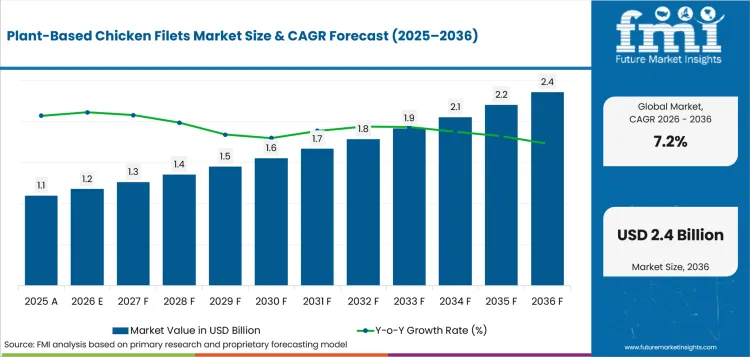
The plant-based chicken filets industry value is forecast to grow from USD 1.1 billion in 2025 to USD 2.4 billion by 2036 at 7.2% CAGR as freezer buyers and foodservice operators select chicken-style filets for sandwiches and air-fryer meals. Breaded filets are forecast to represent 58.4% share in 2026, led by familiar coating structure and chicken-sandwich usage. Retail frozen is expected to secure 47.6% share in 2026, reflected by supermarket freezer access and multipack selling.
Key Takeaways, Market Size, and Forecast
- 2026 Market Size: USD 1.2 billion
- 2036 Market Size: USD 2.4 billion
- Forecast CAGR: 7.2% from 2026 to 2036
- Leading Product Form: Breaded Filets
- Breaded Filets Share in 2026: 58.4%
- Leading Sales Channel: Retail Frozen
- Retail Frozen Share in 2026: 47.6%
- Fastest-growing Country: Saudi Arabia
- Saudi Arabia CAGR: 8.3% by 2036
Summary of Plant-Based Chicken Filets Market
- Demand and Growth Drivers
- Freezer buyers are selecting plant-based chicken filets for familiar dinner use and portion-controlled meal planning.
- Foodservice operators are testing breaded filet formats matching quick-service sandwich assembly and cafeteria menu rotation.
- Private-label processors are using frozen multipacks and retailer-owned recipes to reduce the price gap against conventional poultry.
- Product and Segment View
- Breaded filets are forecast to represent 58.4% share in 2026, driven by coating familiarity and chicken-sandwich use.
- Retail frozen is projected to hold 47.6% share in 2026, influenced by supermarket freezer access and club-store multipacks.
- Soy protein filets are expected to secure 39.7% share in 2026, reflected by texture formation and ingredient availability.
- Geography and Competitive Outlook
- Saudi Arabia is projected to record 8.3% CAGR by 2036, backed by poultry-heavy meal culture and premium foodservice trials.
- South Korea is expected to expand at 7.9% CAGR by 2036 due to imported processed food channels and convenience retail use.
- Gardein and Quorn compete based on exact plant-based chicken filet and fillet products.
- MorningStar Farms, TiNDLE and The Vegetarian Butcher focus on sandwich-style patties and foodservice channels.
- Analyst Opinion
- Nandini Roy Choudhury, Principal Consultant for Food and Beverage at FMI, observes, “Plant-based chicken filets are moving from trial-led freezer listings toward performance-led repeat purchase. Buyers now compare coating hold, juiciness and price per serving before approving wider placement. Suppliers combining familiar preparation and dependable frozen distribution are likely to gain stronger placement in mainstream accounts.”
- Plant-Based Chicken Filets Market Value Analysis
- Market value is supported by finished plant-based chicken filet revenue before retailer margins and foodservice distributor markups add incremental sales.
- Supplier pricing reflects protein isolate selection and frozen logistics costs.
- Revenue improves as retailers replace slow-moving meatless items with chicken-style formats supporting clear meal use and freezer repeat buying.
- Buyer confidence increases as product labels make protein grams and cooking method easier to compare.
Texture quality and repeat buying remain the main pressure points for plant-based chicken filets. Impossible Foods stated in April 2024, Impossible Chicken Patties were preferred by 61% of consumers over a leading animal chicken patty. This gives freezer buyers a stronger reason to test plant-based chicken patties in the meat alternatives market. Beyond Meat stated in October 2025, Beyond Chicken Pieces provide 21g protein per serving and 0.5g saturated fat. It helps suppliers compete through clear nutrition claims in the plant-based protein market. Tender Food’s June 2024 patent describes extrusion at 100°C to 175°C with residence times between 2 and 5 minutes. This supports better fiber control for filet and patty formats in the plant-based food market.
Why is the Plant-Based Chicken Filets Market Growing?
- Retailers are favoring chicken-style filets that work across frozen sandwiches and quick home meals.
- Foodservice buyers are looking for breaded formats that match existing chicken preparation routines.
- Suppliers are improving protein quality and label clarity to support repeat purchase.
Plant-based chicken filet demand is moving toward products able to prove cooking convenience and clear labeling at the same time. Quorn stated in May 2025, its Meatless Homestyle ChiQin Cutlets and Meatless Kickin’ ChiQin Cutlets deliver at least 14g protein and 5g fiber per serving, while cooking in 20 minutes in an oven or 12 minutes in an air fryer. Such specifications support freezer placement among the meat alternatives since they connect protein content with easy meal use. FDA also released draft guidance in January 2025 covering plant-based alternatives to poultry and meat, making clearer product naming more important for brands competing in the plant-based food market.
Market Segmentation Analysis
- Breaded filets are projected to secure 58.4% share in 2026, led by sandwich use and freezer buyers requiring a familiar poultry-style eating structure across branded and private-label programs.
- Retail frozen is anticipated to hold 47.6% share in 2026, since supermarkets and club stores support repeat home cooking through clear pack display and frozen storage.
- Soy protein is forecast to account for 39.7% share in 2026, shaped by fibrous texture formation and cost control across high-volume recipes.
- Sensory parity positioning is expected to capture 41.3% share in 2026, influenced by buyer scrutiny on juiciness, aftertaste and coating adhesion.
- Sandwich builds are projected to represent 44.8% share in 2026, reflected by quick-service formats, café menus and household burger-style meals.
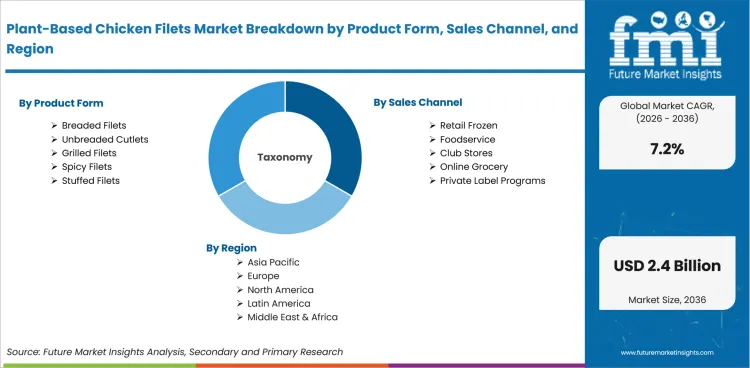
The plant-based chicken filets industry is segmented by product form, sales channel, protein source, product positioning, end-use application, and region. Product form covers breaded filets, unbreaded cutlets, grilled filets, spicy filets and stuffed filets. Sales channel covers retail frozen, foodservice, club stores, online grocery and private label programs. Protein source includes soy protein, pea protein, wheat protein, mycoprotein and blended proteins. Product positioning includes sensory parity, high protein, clean label, value packs and halal suitable. End-use application covers sandwich builds, ready meals, meal kits, cafeteria menus and household meals.
Insights into Plant-Based Chicken Filets Market by Product Form
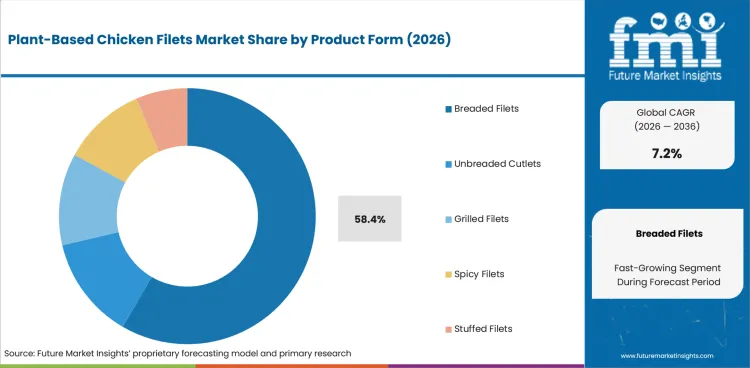
- Breaded filets are projected to account for 58.4% share in 2026, influenced by coating familiarity and easier sandwich conversion.
- Unbreaded cutlets gain selective use among buyers seeking lower coating weight and flexible seasoning for skillet meals.
Insights into Plant-Based Chicken Filets Market by Sales Channel
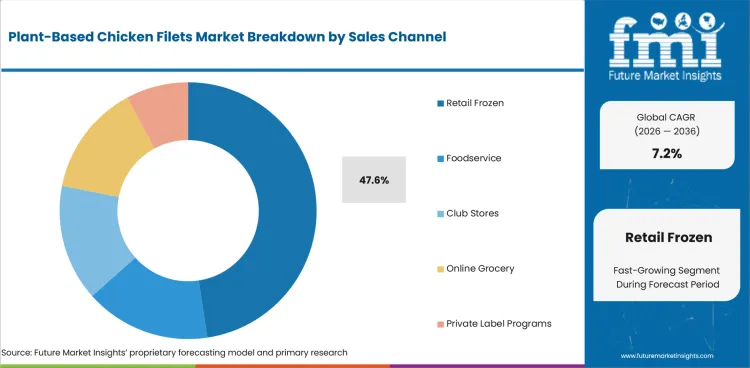
- Retail frozen is anticipated to hold 47.6% share in 2026 through supermarket freezer placement and multipack dinner use.
- Foodservice gains value among operators purchasing consistent filet weight for sandwiches and cafeteria plates.
Insights into Plant-Based Chicken Filets Market by Protein Source
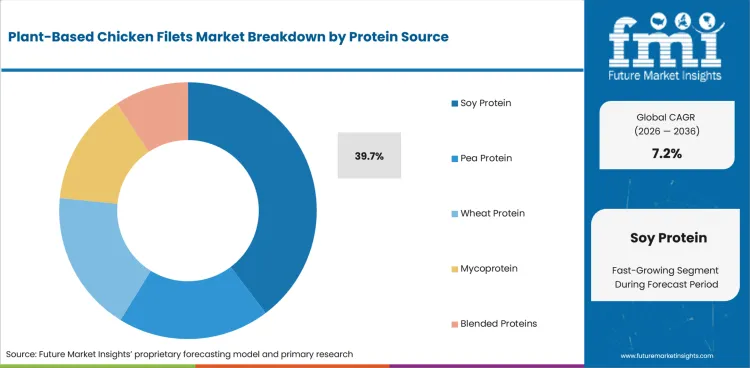
- Soy protein is forecast to secure 39.7% share in 2026, led by texture performance and established ingredient availability.
- Pea protein gains use among soy-free recipes and private-label programs requiring allergen separation.
Insights into Plant-Based Chicken Filets Market by Product Positioning
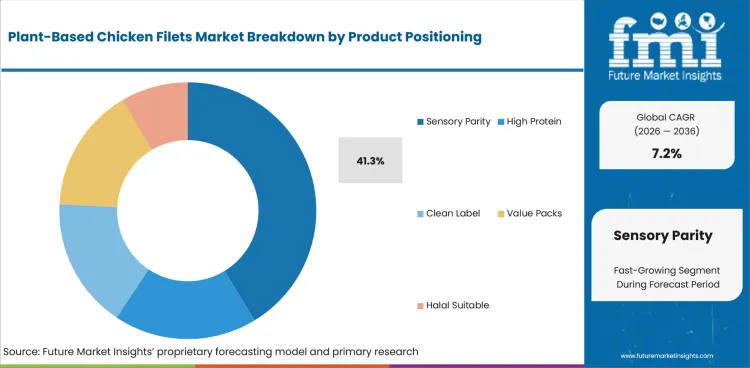
- Sensory parity is expected to capture 41.3% share in 2026, reflected by taste and texture screening before wider shelf approval.
- High-protein positioning gains value among active households comparing protein grams across frozen meal options.
Insights into Plant-Based Chicken Filets Market by End-use Application
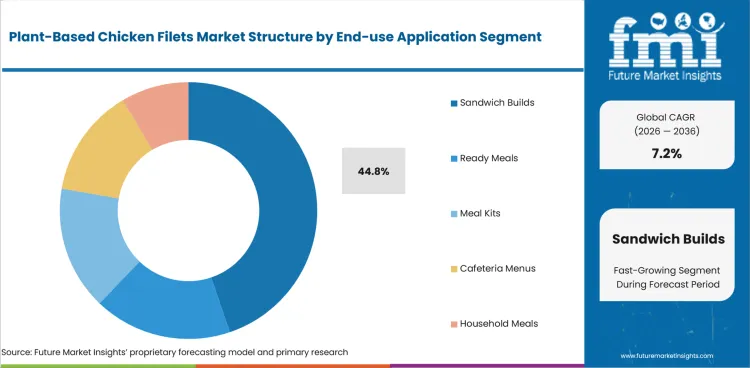
- Sandwich builds are projected to represent 44.8% share in 2026, guided by breaded filet use in burger-style meals and quick-service recipes.
- Ready meals add demand as frozen bowl producers include chicken-style protein in plant-based meal lines.
Market Drivers, Restraints and Opportunities
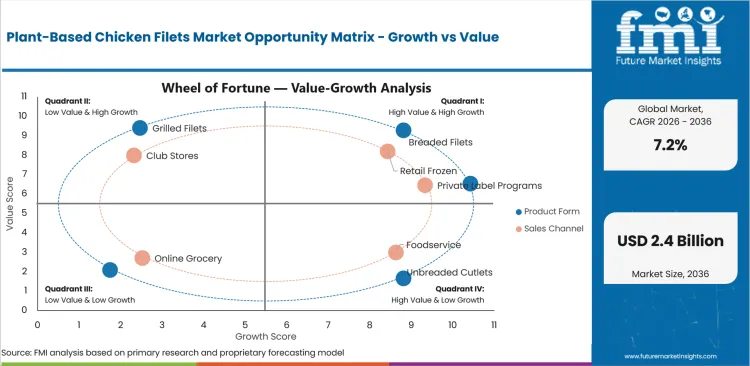
- Chicken-style sandwich formats are keeping plant-based filets active across freezer shelves and foodservice menus.
- Taste and price gaps can restrict repeat purchase after initial trial.
- Private-label reformulation is creating openings for value packs and retailer-owned frozen chicken-style ranges.
Sandwich Formats Keep Plant-Based Filets Commercially Active
Plant-based chicken filets gain stronger commercial use when the product holds shape and performs across hot meal applications. Schouten Europe stated in March 2026, its new plant-based fillet uses proprietary fibre technology in a 95g format. It also stated, 3D shaping creates a recognizable cutlet form and that the product performs strongly in hot applications. This supports suppliers in the plant-based chicken market because buyers can evaluate portion size and cooking use before approving wider freezer or foodservice placement.
Texture and Price Gaps Limit Low-price Expansion
Plant-based chicken filet suppliers need better texture and sharper price positioning to move beyond trial purchase. Jahn, Guhl and Erhard published a 2024 PNAS study on plant-based meat alternatives and price response. The study reported that price response is central to substitution behavior for plant-based meat alternatives. Such evidence means chicken-style filet brands cannot rely only on meat-like appearance. They need pricing and serving value to work together before retailers expand shelf commitment.
Private Label Creates Specification-led Openings
Retailer-owned programs are gaining practical value when suppliers can match clean formulation with store-scale availability. Swiss Food & Nutrition Valley stated in July 2025, ALDI Switzerland selected Libre mycoprotein for the MyVay Gourmet Filet, available in 242 stores from July 7 at recommended retail price parity with chicken filet. It also stated, the product contains 4 natural ingredients. This gives private-label buyers in the frozen food market a clearer route to test filet alternatives through simple specifications and controlled retail pricing.
Product Attribute and Claim Preference Analysis
Plant-based chicken filet development is shifting toward sensory proof instead of broad meatless claims. NECTAR’s 2025 Taste of the Industry analysis covered 122 plant-based meat products across 14 categories with 2,684 omnivores, including unbreaded and breaded chicken fillets. Its dashboard tracks flavor and preference testing, which makes it useful for identifying where filet products need recipe work before wider freezer and foodservice expansion. Filet suppliers can use these findings to link protein and cooking performance with clearer claims across the high protein food market.
Regional and Demographic Demand Analysis
Demand screening for plant-based chicken filets needs tighter income and convenience segmentation. IFIC’s 2025 Food & Health Survey used an online sample of 3,000 Americans ages 18 to 80 and weighted results by age and region. It found healthfulness surpasses price as a purchase driver for households earning USD 100,000 or more, while 32% of convenience-influenced shoppers said ease of cooking or preparation has a great impact on purchases. This supports city and cohort-level testing for freezer filets across the convenience food market, especially for higher-income shoppers and quick-meal households.
Analysis of Plant-Based Chicken Filets Market by Key Countries
.webp "Top Country Growth Comparison Plant Based Chicken Filets Market Cagr (2026 2036)")
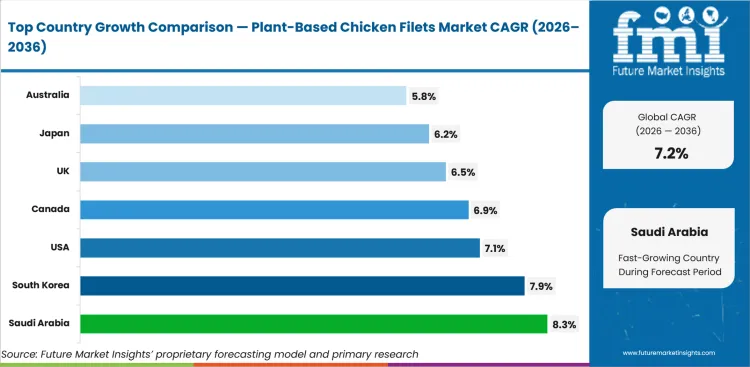
| Country | CAGR |
|---|---|
| Saudi Arabia | 8.3% |
| South Korea | 7.9% |
| United States | 7.1% |
| Canada | 6.9% |
| United Kingdom | 6.5% |
| Japan | 6.2% |
| Australia | 5.8% |
Source: Future Market Insights, 2026.
Plant-Based Chicken Filets Market CAGR Analysis by Country
- Saudi Arabia is forecast to record 8.3% CAGR by 2036, driven by poultry-heavy menus and premium hotel foodservice trials.
- South Korea is expected to expand at 7.9% CAGR from 2026 to 2036 due to imported processed food channels and convenience retail activity.
- United States is projected to grow at 7.1% CAGR by 2036, reflected by freezer retail access and sandwich-style usage.
- Canada is expected to advance at 6.9% CAGR by 2036, since ingredient trade and retail freezer programs guide product development.
- United Kingdom is projected to rise at 6.5% CAGR by 2036, influenced by price-led freezer resets and foodservice testing.
- Japan is forecast at 6.2% CAGR by 2036 as convenience meals and high-protein positioning support selective trial.
- Australia is expected to post 5.8% CAGR by 2036, led by consumer trial and reformulation pressure.
Industry Outlook for Plant-Based Chicken Filets Market in Saudi Arabia
Poultry-heavy meals and hotel foodservice center · 2026 to 2036
Country Market Snapshot Table
| Parameter | Value |
|---|---|
| Market Size in 2025 (Value) | USD 43.4 million |
| Market Size in 2026 (Value) | USD 47.0 million |
| Market Forecast in 2036 (Value) | USD 104.4 million |
| CAGR (2026 to 2036) | 8.3% |
| Years Considered | 2021 to 2036 |
| Base Year | 2025 |
| Forecast Period | 2026 to 2036 |
| Units Considered | Value (USD million) |
| Leading Sub-Region | Riyadh and Jeddah foodservice corridors |
Saudi Arabia Plant-Based Chicken Filets Market Outlook
Saudi Arabia plant-based chicken filet market is driven by poultry-centered meals and premium foodservice testing. Demand in Saudi Arabia is forecast to record 8.3% CAGR by 2036, influenced by modern grocery expansion and hotel menu trials.
Foodservice operators and retailers are expected to favor halal-suitable plant-based filets for sandwiches and buffet menus. Suppliers with frozen distribution and certification records should gain better order continuity from premium accounts.
Key Growth Drivers
- Modern grocery chains can support frozen plant-based chicken filets through mainstream food retail programs, supported by Saudi Arabia food retail sales of more than USD 50.0 billion in 2024.
- Hotel and serviced apartment foodservice channels can test halal-suitable chicken-style filets in buffet and sandwich menus, reflected by hotel average daily room rate of SAR 725.5 in Q2 2024.
- Riyadh and Jeddah premium supermarkets can trial breaded filets for flexitarian households seeking familiar poultry-style meals.
- Foodservice distributors can position spicy and breaded filet variants for café menus and quick-service sandwich builds.
Key Restraints
- Conventional poultry supply remains a large comparison base for plant-based filet pricing, shown by Saudi Arabia broiler chicken production reaching 1.3 million tons in 2024.
- Halal documentation and Arabic label checks can slow imported frozen product listing cycles.
- Imported frozen alternatives can face shelf-price pressure against locally supplied chicken products.
What makes Saudi Arabia unique
Saudi Arabia combines poultry-heavy eating habits and premium hotel foodservice in one demand base.
Key Companies
- Beyond Meat
- Impossible Foods
- TiNDLE
- Quorn
- Americana Foods
- Private-label processors
Sales & Marketing Channels
- Modern grocery chains
- Hotel foodservice distributors
- Quick-service restaurant suppliers
- Online grocery platforms
- Specialty vegan retailers
- Club-store import channels
Country Segment Breakdown Table
| Segment | Sub-Segments |
|---|---|
| By Product Form | Breaded Filets · Unbreaded Cutlets · Grilled Filets · Spicy Filets · Stuffed Filets |
| By Sales Channel | Retail Frozen · Foodservice · Club Stores · Online Grocery · Private Label Programs |
| By Protein Source | Soy Protein · Pea Protein · Wheat Protein · Mycoprotein · Blended Proteins |
| By Product Positioning | Sensory Parity · High Protein · Clean Label · Value Packs · Halal Suitable |
| By End-use Application | Sandwich Builds · Ready Meals · Meal Kits · Cafeteria Menus · Household Meals |
| Key Sub-Regions Covered, Foodservice and Retail Corridors | Riyadh · Jeddah · Dammam · Makkah · Madinah · Khobar |
Frequently Asked Questions
How fast is Saudi Arabia plant-based chicken filets market growing?
Saudi Arabia plant-based chicken filets industry is forecast to record 8.3% CAGR from 2026 to 2036, led by poultry-heavy menus and premium foodservice testing.
Who leads Saudi Arabia plant-based chicken filets market?
Beyond Meat, Impossible Foods, TiNDLE, Quorn, Americana Foods and private-label processors compete through imported frozen ranges and foodservice supply.
What is driving adoption in Saudi Arabia plant-based chicken filets market?
Premium grocery and hotel foodservice needs are pushing suppliers toward halal-suitable chicken-style filets with familiar sandwich use.
Demand Outlook for Plant-Based Chicken Filets Market in South Korea
Imported processed food and convenience retail center · 2026 to 2036
Country Market Snapshot Table
| Parameter | Value |
|---|---|
| Market Size in 2025 (Value) | USD 64.9 million |
| Market Size in 2026 (Value) | USD 70.0 million |
| Market Forecast in 2036 (Value) | USD 149.8 million |
| CAGR (2026 to 2036) | 7.9% |
| Years Considered | 2021 to 2036 |
| Base Year | 2025 |
| Forecast Period | 2026 to 2036 |
| Units Considered | Value (USD million) |
| Leading Sub-Region | Seoul metropolitan retail corridor |
South Korea Plant-Based Chicken Filets Market Outlook
South Korea plant-based chicken filet sector is shaped by imported food distribution and dense convenience retail. Buyers compare taste and flavor adaptation before selecting plant-based chicken formats.
The market in South Korea is expected to expand at 7.9% CAGR by 2036, guided by imported processed food channels and convenience meal formats. Local flavor adaptation gives suppliers a stronger path into spicy breaded filets and ready meals.
Key Growth Drivers
- Food retailers can test plant-based chicken filets through frozen and convenience meal formats, supported by Korean retail food sales of USD 132.0 billion in 2024.
- Imported processed food channels can support premium chicken-style launches, reflected by consumer-oriented agricultural imports of about USD 20.6 billion in 2024.
- Seoul and Busan convenience stores can use spicy breaded filets in sandwiches and microwaveable meals.
- Foodservice buyers can use portion-controlled plant-based filets for lunch menus and café wraps.
Key Restraints
- App-based meal and grocery purchases intensify competition for freezer-based trips, with South Korea foodservice sales by device and platform valued at USD 34.6 billion in 2024.
- Conventional poultry and seafood remain strong meal choices across household and restaurant menus.
- Imported frozen products can face higher cold-chain and listing costs in premium retail channels.
What makes South Korea unique
South Korea pairs imported food openness with dense convenience retail, creating a test base for flavored chicken-style filets.
Key Companies
- Beyond Meat
- Impossible Foods
- Pulmuone
- Shinsegae Food
- CJ CheilJedang
- Local private-label processors
Sales & Marketing Channels
- Convenience retail chains
- Online grocery platforms
- Foodservice distributors
- Premium supermarkets
- Meal-kit platforms
- Department-store food halls
Country Segment Breakdown Table
| Segment | Sub-Segments |
|---|---|
| By Product Form | Breaded Filets · Unbreaded Cutlets · Grilled Filets · Spicy Filets · Stuffed Filets |
| By Sales Channel | Retail Frozen · Foodservice · Club Stores · Online Grocery · Private Label Programs |
| By Protein Source | Soy Protein · Pea Protein · Wheat Protein · Mycoprotein · Blended Proteins |
| By Product Positioning | Sensory Parity · High Protein · Clean Label · Value Packs · Halal Suitable |
| By End-use Application | Sandwich Builds · Ready Meals · Meal Kits · Cafeteria Menus · Household Meals |
| Key Sub-Regions Covered, Retail and Convenience Meal Areas | Seoul · Busan · Incheon · Daegu · Daejeon · Gwangju |
Frequently Asked Questions
How fast is South Korea plant-based chicken filets market growing?
South Korea plant-based chicken filets industry is expected to expand at 7.9% CAGR from 2026 to 2036, influenced by imported processed food access.
Who leads South Korea plant-based chicken filets market?
Beyond Meat, Impossible Foods, Pulmuone, Shinsegae Food, CJ CheilJedang and local private-label processors compete based on retail and convenience channels.
What is driving adoption in South Korea plant-based chicken filets market?
Convenience meals and imported processed food channels are encouraging retailers to test chicken-style filets in frozen and prepared formats.
Sales Outlook for Plant-Based Chicken Filets Market in the United States
Frozen retail and sandwich-format center · 2026 to 2036
Country Market Snapshot Table
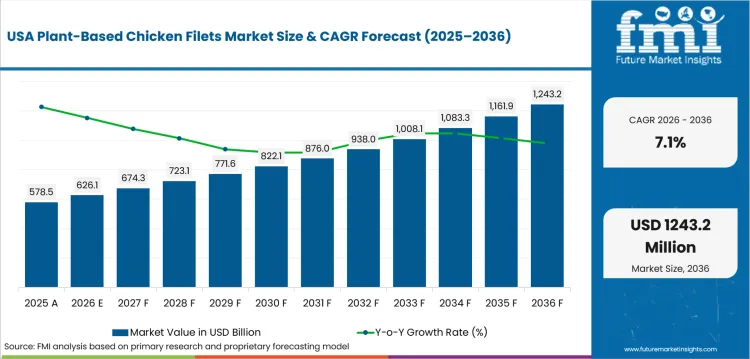
| Parameter | Value |
|---|---|
| Market Size in 2025 (Value) | USD 559.3 million |
| Market Size in 2026 (Value) | USD 599.0 million |
| Market Forecast in 2036 (Value) | USD 1,187.0 million |
| CAGR (2026 to 2036) | 7.1% |
| Years Considered | 2021 to 2036 |
| Base Year | 2025 |
| Forecast Period | 2026 to 2036 |
| Units Considered | Value (USD million) |
| Leading Sub-Region | California, Texas and Northeast freezer corridors |
United States Plant-Based Chicken Filets Market Outlook
United States plant-based chicken filet sales are influenced by freezer retail and national brand visibility. The industry in United States is projected to grow at 7.1% CAGR by 2036 due to sandwich-style usage and retail frozen execution promoting repeat demand.
Retail buyers use plant-based chicken filets for air-fryer meals and meatless sandwich occasions. Supplier advantage is concentrated among companies combining branded recognition and national frozen distribution.
Key Growth Drivers
- United States freezer channels support chicken-style filet trial, as retail e-commerce sales reached USD 302.3 billion in Q1 2026.
- Plant-based foods retained a defined retail base, with United States plant-based food sales reaching USD 7.9 billion in 2025.
- Foodservice operators can use breaded filets in sandwich and wrap builds without major kitchen changes.
- Retailers can test value packs beside plant-based nuggets and strips to improve repeat freezer use.
Key Restraints
- Food inflation can restrict premium frozen trial, with United States food prices in April 2026 standing 3.2% above April 2025.
- Conventional chicken products remain a lower-risk purchase for budget-focused households.
- Slow-moving meatless freezer SKUs can lose space during retail assortment reviews.
What makes the United States unique
United States demand is shaped by national freezer access and brand-led meatless assortments.
Key Companies
- Gardein
- MorningStar Farms
- Beyond Meat
- Impossible Foods
- Quorn
- TiNDLE
Sales & Marketing Channels
- Supermarket freezer aisles
- Club stores
- Online grocery platforms
- Foodservice distributors
- Natural food retailers
- Private-label frozen programs
Country Segment Breakdown Table
| Segment | Sub-Segments |
|---|---|
| By Product Form | Breaded Filets · Unbreaded Cutlets · Grilled Filets · Spicy Filets · Stuffed Filets |
| By Sales Channel | Retail Frozen · Foodservice · Club Stores · Online Grocery · Private Label Programs |
| By Protein Source | Soy Protein · Pea Protein · Wheat Protein · Mycoprotein · Blended Proteins |
| By Product Positioning | Sensory Parity · High Protein · Clean Label · Value Packs · Halal Suitable |
| By End-use Application | Sandwich Builds · Ready Meals · Meal Kits · Cafeteria Menus · Household Meals |
| Key Sub-Regions Covered, Freezer Retail and Foodservice Areas | California · Texas · Northeast · Midwest · Pacific Northwest · Southeast |
Frequently Asked Questions
How fast is United States plant-based chicken filets market growing?
United States plant-based chicken filets industry is projected to grow at 7.1% CAGR from 2026 to 2036, guided by frozen retail and sandwich-style use.
Who leads United States plant-based chicken filets market?
Gardein, MorningStar Farms, Beyond Meat, Impossible Foods, Quorn and TiNDLE compete led by retail freezer and foodservice channels.
What is driving adoption in United States plant-based chicken filets market?
Frozen grocery access and foodservice sandwich trials are moving buyers toward plant-based chicken filets for familiar meal occasions.
Growth Outlook for Plant-Based Chicken Filets Market in Canada
Ingredient trade and retail freezer center · 2026 to 2036
Country Market Snapshot Table
| Parameter | Value |
|---|---|
| Market Size in 2025 (Value) | USD 94.5 million |
| Market Size in 2026 (Value) | USD 101.0 million |
| Market Forecast in 2036 (Value) | USD 196.8 million |
| CAGR (2026 to 2036) | 6.9% |
| Years Considered | 2021 to 2036 |
| Base Year | 2025 |
| Forecast Period | 2026 to 2036 |
| Units Considered | Value (USD million) |
| Leading Sub-Region | Ontario and British Columbia retail corridors |
Canada Plant-Based Chicken Filets Market Outlook
Canada plant-based chicken filet market growth is aided by concentrated grocery access and frozen food retail programs. Retailer frozen programs raise attention on value packs and bilingual label execution.
Sector in Canada is predicted to scale at 6.9% CAGR by 2036, reflected by ingredient availability and supermarket freezer development. Suppliers offering soy-free variants and stable cold-chain service are expected to gain stronger acceptance among retail buyers.
Key Growth Drivers
- National grocery chains can support plant-based chicken filets through freezer assortments, supported by Canadian retail sales of CAD 803.1 billion in 2024.
- Food manufacturing capacity supports frozen meal and private-label development, with manufacturing sales rising to CAD 77.1 billion in April 2026.
- Ontario and British Columbia retailers can test soy-free or high-protein filets for premium shoppers.
- Bilingual packaging can help suppliers communicate cooking use and allergen status across provinces.
Key Restraints
- Conventional poultry prices create a direct comparison point, with chicken breasts priced at CAD 14.39 per kilogram in April 2026.
- Smaller brands can struggle to cover national cold-chain distribution across distant provinces.
- Private-label buyers can delay new chicken-style listings if pack prices do not narrow against poultry.
What makes Canada unique
Canada combines grocery concentration and freezer retail access, making retailer programs a practical route for filet expansion.
Key Companies
- Gardein
- Beyond Meat
- Impossible Foods
- Quorn
- Yves Veggie Cuisine
- Private-label processors
Sales & Marketing Channels
- National supermarkets
- Online grocery platforms
- Natural food chains
- Club stores
- Foodservice distributors
- Private-label frozen programs
Country Segment Breakdown Table
| Segment | Sub-Segments |
|---|---|
| By Product Form | Breaded Filets · Unbreaded Cutlets · Grilled Filets · Spicy Filets · Stuffed Filets |
| By Sales Channel | Retail Frozen · Foodservice · Club Stores · Online Grocery · Private Label Programs |
| By Protein Source | Soy Protein · Pea Protein · Wheat Protein · Mycoprotein · Blended Proteins |
| By Product Positioning | Sensory Parity · High Protein · Clean Label · Value Packs · Halal Suitable |
| By End-use Application | Sandwich Builds · Ready Meals · Meal Kits · Cafeteria Menus · Household Meals |
| Key Sub-Regions Covered, Retail and Ingredient Corridors | Ontario · Quebec · British Columbia · Alberta · Manitoba · Atlantic Canada |
Frequently Asked Questions
How fast is Canada plant-based chicken filets market growing?
Canada plant-based chicken filets industry is expected to advance at 6.9% CAGR from 2026 to 2036, backed by freezer retail programs.
Who leads Canada plant-based chicken filets market?
Gardein, Beyond Meat, Impossible Foods, Quorn, Yves Veggie Cuisine and private-label processors compete due to national grocery and frozen distribution.
What is driving adoption in Canada plant-based chicken filets market?
Retail freezer programs and food manufacturing capacity are supporting plant-based chicken filets for value packs and protein-positioned meals.
Industry Outlook for Plant-Based Chicken Filets Market in the United Kingdom
Price-sensitive freezer reset and foodservice center · 2026 to 2036
Country Market Snapshot Table
| Parameter | Value |
|---|---|
| Market Size in 2025 (Value) | USD 96.7 million |
| Market Size in 2026 (Value) | USD 103.0 million |
| Market Forecast in 2036 (Value) | USD 193.8 million |
| CAGR (2026 to 2036) | 6.5% |
| Years Considered | 2021 to 2036 |
| Base Year | 2025 |
| Forecast Period | 2026 to 2036 |
| Units Considered | Value (USD million) |
| Leading Sub-Region | London, Midlands and North West retail corridors |
United Kingdom Plant-Based Chicken Filets Market Outlook
United Kingdom plant-based chicken filet market is driven by high plant-based familiarity and stricter price screening. Buyers often compare plant-based chicken filets with vegetarian meals and conventional poultry for freezer productivity.
Demand in the United Kingdom is projected to rise at 6.5% CAGR by 2036, supported by foodservice trials and value-focused frozen programs. Price-controlled packs are expected to gain better distributor support as retailers review slow-moving meatless products.
Key Growth Drivers
- Retail and foodservice channels can test chicken-style filets through frozen meal deals, supported by 4.1 million people employed in the agri-food sector in 2025.
- Online grocery access supports product discovery, with internet sales accounting for 27.7% of total retail sales in September 2024.
- Pub and casual dining operators can use breaded filets in wraps, burgers and lunch menus.
- Discount retailers can use private-label filets to lower price barriers for repeat purchase.
Key Restraints
- Food inflation keeps premium freezer trials under pressure, with food and non-alcoholic beverage prices rising 4.5% in the twelve months to December 2025.
- Plant-based meat volume weakness raises the need for better taste and lower shelf price.
- Retailers can delist chicken-style products if freezer rotation trails vegetarian meals and poultry alternatives.
What makes the United Kingdom unique
United Kingdom demand is shaped by plant-based familiarity and sharper price scrutiny.
Key Companies
- Quorn
- The Vegetarian Butcher
- Gardein
- Beyond Meat
- Impossible Foods
- Retailer private-label processors
Sales & Marketing Channels
- Supermarket freezer aisles
- Pub and casual dining suppliers
- Online grocery platforms
- Foodservice wholesalers
- Meal-kit platforms
- Discount retail freezers
Country Segment Breakdown Table
| Segment | Sub-Segments |
|---|---|
| By Product Form | Breaded Filets · Unbreaded Cutlets · Grilled Filets · Spicy Filets · Stuffed Filets |
| By Sales Channel | Retail Frozen · Foodservice · Club Stores · Online Grocery · Private Label Programs |
| By Protein Source | Soy Protein · Pea Protein · Wheat Protein · Mycoprotein · Blended Proteins |
| By Product Positioning | Sensory Parity · High Protein · Clean Label · Value Packs · Halal Suitable |
| By End-use Application | Sandwich Builds · Ready Meals · Meal Kits · Cafeteria Menus · Household Meals |
| Key Sub-Regions Covered, Retail and Foodservice Areas | London · West Midlands · East Midlands · North West England · South East England · Yorkshire |
Frequently Asked Questions
How fast is United Kingdom plant-based chicken filets market growing?
United Kingdom plant-based chicken filets industry is projected to rise at 6.5% CAGR from 2026 to 2036, owing to foodservice testing and value-led freezer resets.
Who leads United Kingdom plant-based chicken filets market?
Quorn, The Vegetarian Butcher, Gardein, Beyond Meat, Impossible Foods and retailer private-label processors compete based on retail and foodservice access.
What is driving adoption in United Kingdom plant-based chicken filets market?
High plant-based familiarity and sandwich-format foodservice trials are supporting chicken-style filets for frozen and prepared meal use.
Demand Outlook for Plant-Based Chicken Filets Market in Japan
Convenience meals and high-protein positioning center · 2026 to 2036
Country Market Snapshot Table
| Parameter | Value |
|---|---|
| Market Size in 2025 (Value) | USD 75.3 million |
| Market Size in 2026 (Value) | USD 80.0 million |
| Market Forecast in 2036 (Value) | USD 145.9 million |
| CAGR (2026 to 2036) | 6.2% |
| Years Considered | 2021 to 2036 |
| Base Year | 2025 |
| Forecast Period | 2026 to 2036 |
| Units Considered | Value (USD million) |
| Leading Sub-Region | Tokyo and Kansai convenience meal corridors |
Japan Plant-Based Chicken Filets Market Outlook
Japan plant-based chicken filet sector is influenced by convenience meals, portion control and strict eating-quality expectations. Sales in Japan are forecast at 6.2% CAGR by 2036, aided by high-protein positioning and processed meal formats.
Retail buyers seek portion accuracy, clean pack design and reliable texture in small meal formats. Suppliers offering smaller filets and Japan-specific flavor systems are likely to gain better access to convenience retail and premium grocery accounts.
Key Growth Drivers
- Retailers can position plant-based chicken filets as easy-preparation frozen foods, supported by Japan retail food and beverage sales of USD 193.0 billion in 2024.
- Foodservice buyers can trial smaller chicken-style portions, with Japan’s HRI foodservice sales reaching USD 228.0 billion in 2024.
- Convenience stores can use portion-controlled filets for bento, sandwiches and ready meals.
- Premium supermarkets can test grilled and lightly breaded variants for smaller households.
Key Restraints
- E-commerce and ready-meal channels intensify competition for quick meal occasions, with Japan’s domestic B2C e-commerce market reaching JPY 26.1 trillion in 2024.
- Strict taste and texture expectations can lengthen approval cycles for new plant-based chicken products.
- Imported frozen brands can face higher shelf-price pressure in convenience-led retail channels.
What makes Japan unique
Japan places higher importance on portion discipline and pack quality than most priority markets.
Key Companies
- Quorn
- Beyond Meat
- Impossible Foods
- Marukome
- DAIZ
- Local private-label processors
Sales & Marketing Channels
- Convenience retail chains
- Supermarket frozen aisles
- Online grocery platforms
- Foodservice wholesalers
- Department-store food halls
- Bento suppliers
Country Segment Breakdown Table
| Segment | Sub-Segments |
|---|---|
| By Product Form | Breaded Filets · Unbreaded Cutlets · Grilled Filets · Spicy Filets · Stuffed Filets |
| By Sales Channel | Retail Frozen · Foodservice · Club Stores · Online Grocery · Private Label Programs |
| By Protein Source | Soy Protein · Pea Protein · Wheat Protein · Mycoprotein · Blended Proteins |
| By Product Positioning | Sensory Parity · High Protein · Clean Label · Value Packs · Halal Suitable |
| By End-use Application | Sandwich Builds · Ready Meals · Meal Kits · Cafeteria Menus · Household Meals |
| Key Sub-Regions Covered, Convenience Meal and Retail Areas | Kanto · Kansai · Chubu · Kyushu · Tohoku · Hokkaido |
Frequently Asked Questions
How fast is Japan plant-based chicken filets market growing?
Japan plant-based chicken filets industry is forecast at 6.2% CAGR from 2026 to 2036, supported by high-protein positioning and convenience meal formats.
Who leads Japan plant-based chicken filets market?
Quorn, Beyond Meat, Impossible Foods, Marukome, DAIZ and local private-label processors compete through grocery and convenience meal channels.
What is driving adoption in Japan plant-based chicken filets market?
High-protein processed food demand and convenience meal formats are supporting plant-based chicken filets for portion-controlled meals.
Sales Outlook for Plant-Based Chicken Filets Market in Australia
Consumer trial and reformulation center · 2026 to 2036
Country Market Snapshot Table
| Parameter | Value |
|---|---|
| Market Size in 2025 (Value) | USD 70.9 million |
| Market Size in 2026 (Value) | USD 75.0 million |
| Market Forecast in 2036 (Value) | USD 131.8 million |
| CAGR (2026 to 2036) | 5.8% |
| Years Considered | 2021 to 2036 |
| Base Year | 2025 |
| Forecast Period | 2026 to 2036 |
| Units Considered | Value (USD million) |
| Leading Sub-Region | New South Wales and Victoria retail corridors |
Australia Plant-Based Chicken Filets Market Outlook
Australia plant-based chicken filet industry is guided by established consumer trial and tougher repeat-purchase screening. Buyers value taste improvement and price discipline more than product novelty alone.
Sector in Australia is expected to post 5.8% CAGR by 2036, led by reformulated products and better freezer pricing. Growth remains lower than faster Asian and GCC markets as taste dissatisfaction and price gaps slow repeat purchase.
Key Growth Drivers
- Consumer trial supports future product testing, with 35.0% of surveyed Australians having tried plant-based meat in 2024.
- Supermarket channels can support frozen filet trial, with supermarket and grocery store turnover rising 1.2% in June 2025.
- New South Wales and Victoria retailers can use breaded filets in mainstream frozen assortments.
- Retailer-owned value packs can address households comparing plant-based chicken against poultry.
Key Restraints
- Repeat buying remains restricted by taste and price, with 46.0% of surveyed Australians citing poor taste and 37.0% citing high price in 2024.
- Smaller local brands can face scale limits in frozen manufacturing and national distribution.
- Premium chicken-style products can lose trial if shelf price stays above familiar poultry substitutes.
What makes Australia unique
Australia has broad trial but tougher repeat-purchase screening for taste and price.
Key Companies
- v2food
- Gardein
- Beyond Meat
- Quorn
- TiNDLE
- Retailer private-label processors
Sales & Marketing Channels
- Supermarket freezer aisles
- Online grocery platforms
- Foodservice distributors
- Natural food retailers
- Club stores
- Private-label frozen programs
Country Segment Breakdown Table
| Segment | Sub-Segments |
|---|---|
| By Product Form | Breaded Filets · Unbreaded Cutlets · Grilled Filets · Spicy Filets · Stuffed Filets |
| By Sales Channel | Retail Frozen · Foodservice · Club Stores · Online Grocery · Private Label Programs |
| By Protein Source | Soy Protein · Pea Protein · Wheat Protein · Mycoprotein · Blended Proteins |
| By Product Positioning | Sensory Parity · High Protein · Clean Label · Value Packs · Halal Suitable |
| By End-use Application | Sandwich Builds · Ready Meals · Meal Kits · Cafeteria Menus · Household Meals |
| Key Sub-Regions Covered, Retail and Foodservice Areas | New South Wales · Victoria · Queensland · Western Australia · South Australia · Tasmania |
Frequently Asked Questions
How fast is Australia plant-based chicken filets market growing?
Australia plant-based chicken filets industry is expected to post 5.8% CAGR from 2026 to 2036, aided by consumer trial and reformulation.
Who leads Australia plant-based chicken filets market?
v2food, Gardein, Beyond Meat, Quorn, TiNDLE and retailer private-label processors compete depending on supermarket freezer and foodservice channels.
What is driving adoption in Australia plant-based chicken filets market?
Consumer trial and supermarket freezer access are supporting plant-based chicken filets, while taste and price remain the main conversion limits.
Competitive Landscape and Strategic Positioning
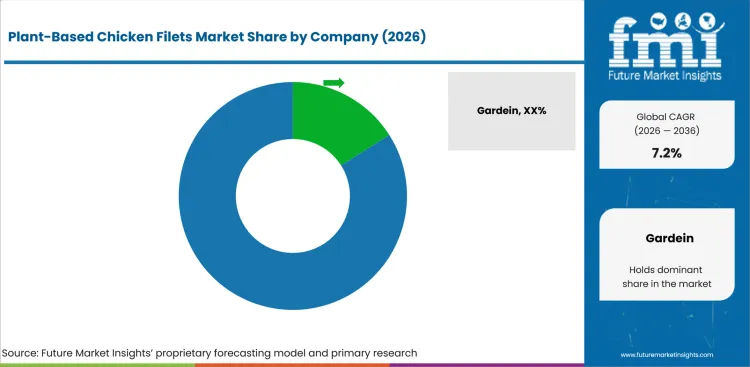
- Established plant-based chicken suppliers hold an advantage led by freezer access and repeat retail placement.
- Frozen meal producers gain orders by linking chicken-style filets with sandwiches and family meal formats.
- Foodservice-focused suppliers compete by offering consistent portion weight and low cooking loss for sandwich builds.
- Private-label processors can improve repeat orders through value packs and retailer-controlled recipes.
Competition in plant-based chicken filets centers on taste and frozen distribution. Buyers compare plant-based chicken against conventional poultry and ready meals before approving repeat listings. Supplier selection therefore requires proof of cooking performance under retail and foodservice preparation.
Manufacturing depth separates plant-based chicken suppliers from companies mainly selling imported finished products. Gardein and Quorn compete with established frozen chicken-style filet lines and clear retail product fit. MorningStar Farms and The Vegetarian Butcher add retail reach through chicken patties and chicken-style fillets. Beyond Meat and Impossible Foods retain brand value, although both should be treated as adjacent suppliers.
Regional and foodservice suppliers shape pricing and menu access depending on channel-specific chicken-style formats. TiNDLE and v2food compete through sandwich patties and regional foodservice placement. Companies better positioned to gain share are those combining exact filet-format products and pricing suitable for repeat household purchase.
Key Companies in the Plant-Based Chicken Filets Market
Competition differs across exact filet suppliers, chicken-style patty brands, adjacent plant-based chicken companies and regional suppliers. Private-label processors add price competition in supermarket freezer programs.
- Exact Filet and Fillet Suppliers: Gardein and Quorn compete depending on established plant-based chicken filet and fillet products. The Vegetarian Butcher adds chicken-style fillets and European retail reach.
- Chicken-style Patty and Sandwich Suppliers: MorningStar Farms and TiNDLE compete led by breaded chicken patties for sandwiches and frozen retail meals.
- Adjacent Branded Chicken Suppliers: Beyond Meat and Impossible Foods compete based on plant-based chicken pieces and patties.
- Regional and Private-label Suppliers: v2food and private-label processors compete through Australia retail access and retailer-owned value programs.
Competitive Benchmarking: Plant-Based Chicken Filets Market
| Company | Match to Market Title | Filet or Patty Portfolio Depth | Frozen Retail Capability | Foodservice Support | Channel Reach | Geographic Footprint |
|---|---|---|---|---|---|---|
| Gardein | Very High | Very Strong | Very Strong | Moderate | Strong | North America |
| Quorn | Very High | Very Strong | Strong | Strong | Strong | United Kingdom, Europe and United States |
| MorningStar Farms | High | Strong | Very Strong | Moderate | Strong | United States |
| The Vegetarian Butcher | High | Strong | Strong | Very Strong | Strong | United Kingdom and Europe |
| TiNDLE | High | Strong | Moderate | Very Strong | Moderate | United States, Asia and foodservice markets |
| Beyond Meat | Moderate to High | Moderate | Very Strong | Strong | Very Strong | United States and export markets |
| Impossible Foods | Moderate | Moderate | Strong | Very Strong | Very Strong | United States and select international markets |
| v2food | Moderate | Moderate | Strong | Strong | Moderate | Australia and selected export markets |
| Private-label processors | Moderate to High | Moderate | Strong | Moderate | Strong | Regional retail markets |
Source: Future Market Insights competitive analysis, 2026.
Key Developments in Plant-Based Chicken Filets Market
- In April 2025, Heura Foods and SWAP Food launched Suprême, a plant-based chicken fillet, across more than 2,000 retail outlets in France along with Spain and Portugal.
- In May 2025, Impossible Foods introduced Impossible Crispy Chicken Fillet at the National Restaurant Association Show for the U.S. foodservice channel.
- In June 2026, Revo Foods launched EL POLLO, a whole-cut mycoprotein chicken fillet range, across Austria with Germany and Italy.
Key Players in the Plant-Based Chicken Filets Market
- Gardein
- Quorn
- MorningStar Farms
- The Vegetarian Butcher
- TiNDLE
- Beyond Meat
- Impossible Foods
- v2food
- Private-label processors
Plant-Based Chicken Filets Market - Report Scope
| Parameter | Details |
|---|---|
| Market size by 2036 | USD 2.4 billion |
| Growth rate | 7.2% CAGR from 2026 to 2036 |
| Forecast period | 2026 to 2036 |
| Base year value (2025) | USD 1.1 billion |
| 2026 market value | USD 1.2 billion |
| By product form | Breaded filets, unbreaded cutlets, grilled filets, spicy filets, stuffed filets |
| By sales channel | Retail frozen, foodservice, club stores, online grocery, private label programs |
| By protein source | Soy protein, pea protein, wheat protein, mycoprotein, blended proteins |
| By product positioning | Sensory parity, high protein, clean label, value packs, halal suitable |
| By end-use application | Sandwich builds, ready meals, meal kits, cafeteria menus, household meals |
| Regions covered | North America, Latin America, Europe, East Asia, South Asia and Pacific, Middle East and Africa |
| Countries covered | Saudi Arabia, South Korea, United States, Canada, United Kingdom, Japan, Australia |
| Key companies profiled | Gardein, Quorn, MorningStar Farms, The Vegetarian Butcher, TiNDLE, Beyond Meat, Impossible Foods, v2food |
| Approach | Bottom-up product-boundary approach using eligible SKU revenue, channel presence, retail pricing, product positioning, and country-level adoption |
Source: Future Market Insights, 2026.
Plant-Based Chicken Filets Market Breakdown by Product Form, Sales Channel, Protein Source, Product Positioning, End-use Application, and Region
By Product Form:
- Breaded Filets
- Unbreaded Cutlets
- Grilled Filets
- Spicy Filets
- Stuffed Filets
By Sales Channel:
- Retail Frozen
- Foodservice
- Club Stores
- Online Grocery
- Private Label Programs
By Protein Source:
- Soy Protein
- Pea Protein
- Wheat Protein
- Mycoprotein
- Blended Proteins
By Product Positioning:
- Sensory Parity
- High Protein
- Clean Label
- Value Packs
- Halal Suitable
By End-use Application:
- Sandwich Builds
- Ready Meals
- Meal Kits
- Cafeteria Menus
- Household Meals
By Region:
- North America
- Latin America
- Europe
- East Asia
- South Asia and Pacific
- Middle East and Africa
This Report Answers
- What is the 2026 value and 2036 forecast for plant-based chicken filets market?
- Which product form is projected to hold the leading share during the forecast period?
- What sales channel is expected to account for the leading 2026 share?
- How do taste, price and freezer access affect plant-based chicken filet demand?
- What companies compete in plant-based chicken filets?
Research Sources and Bibliography
- Agriculture and Agri-Food Canada. (2026, February 4). Sector trend analysis: E-commerce trends in South Korea. Government of Canada.
- Australian Bureau of Statistics. (2025, July 31). Retail Trade, Australia, June 2025.
- Beyond Meat. (2025, October 21). Beyond Meat expands distribution at Walmart.
- Department for Environment, Food and Rural Affairs. (2026, February 25). Food statistics in your pocket. Government of the United Kingdom.
- Food Frontier. (2024, September 5). Food Frontier consumer survey 2024.
- Good Food Institute. (2026). State of the industry: Plant-based meat, seafood, eggs, dairy, and ingredients.
- Good Food Institute. (2026). U.S. retail market insights for the plant-based industry.
- Good Food Institute Europe. (2026). European plant-based sales data.
- Impossible Foods. (2024, April 30). For the first time, Impossible Foods offers best-selling Impossible Chicken From Plants at Whole Foods Market.
- International Food Information Council. (2026, January). 2025 IFIC Food & Health Survey: The full report.
- Jahn, S., Guhl, D., & Erhard, A. (2024). Substitution patterns and price response for plant-based meat alternatives. Proceedings of the National Academy of Sciences, 121(50), Article e2319016121.
- Ministry of Economy, Trade and Industry. (2025, August 26). Results of FY2024 E-Commerce Market Survey compiled. Government of Japan.
- NECTAR. (2025). Taste of the Industry 2025. Food System Innovations.
- Office for National Statistics. (2024, October 18). Retail sales, Great Britain: September 2024.
- Office for National Statistics. (2026, January 15). Consumer price inflation, UK: December 2025.
- Quorn. (2025, May 14). Meet Quorn’s new line of premium Meatless ChiQin.
- Schouten Europe. (2026, March 26). Schouten introduces plant-based fillet with innovative fibre technology.
- Statistics Canada. (2025, February 21). Retail trade, December 2024.
- Statistics Canada. (2026, April). Food Price Data Hub.
- Statistics Canada. (2026, June 15). Monthly Survey of Manufacturing, April 2026.
- Swiss Food & Nutrition Valley. (2025, July 7). Planetary scales B2B ingredient sales as ALDI Suisse selects Libre mycoprotein for product launch.
- Tender Food Inc. (2024, June 20). Plant-based poultry products, and methods of producing the same (WO2024129234A1). WIPO.
- U.S. Census Bureau. (2026, May 18). Quarterly retail e-commerce sales, first quarter 2026.
- U.S. Department of Agriculture, Economic Research Service. (2026, May 22). Food Price Outlook.
- U.S. Department of Agriculture, Foreign Agricultural Service. (2025, May 5). Food Processing Ingredients Annual: South Korea.
- U.S. Department of Agriculture, Foreign Agricultural Service. (2025, September 24). Retail Foods Annual: Saudi Arabia.
- U.S. Department of Agriculture, Foreign Agricultural Service. (2025, November 19). Retail Foods Annual: Japan.
- U.S. Department of Agriculture, Foreign Agricultural Service. (2025, November 19). Retail Foods Annual: South Korea.
- U.S. Department of Agriculture, Foreign Agricultural Service. (2025, December 31). Food Service - Hotel Restaurant Institutional Annual: Japan.
- U.S. Food and Drug Administration. (2025, January 6). Draft guidance for industry: Labeling of plant-based alternatives to animal-derived foods.
- Vegconomist. (2025, April 2). Heura and SWAP launch plant-based chicken fillet across 2,000 European supermarkets.
- Vegconomist. (2025, May 23). Impossible Foods introduces Crispy Chicken Fillet at National Restaurant Association Show.
- Vegconomist. (2026, June 4). Revo Foods launches mycoprotein chicken alternative in Austria, Germany, and Italy.
This bibliography is provided for reader reference and is not exhaustive. The full report contains the complete reference list and detailed citations.
Plant-Based Chicken Filets Market - Scope & Definition
| Attribute | Detail |
|---|---|
| Market Definition | Chicken-style plant-based filets made from soy, pea, wheat, mycoprotein or blended plant proteins and sold as breaded or unbreaded frozen or chilled cutlets |
| Functions Covered | Meatless sandwich filling, frozen entrée protein, foodservice menu item, cafeteria protein and retail dinner component |
| Applications Covered | Sandwich builds, ready meals, meal kits, cafeteria menus, household meals and foodservice wraps |
| End-use Industries | Retail grocery, foodservice, club stores, online grocery, meal kits and institutional foodservice |
| Grades Covered | Breaded filets, unbreaded cutlets, grilled filets, spicy filets and stuffed filets |
| Inclusions | Plant-based chicken-style filets sold through direct brands, retailers, distributors, online grocery, foodservice and private-label programs across global and country markets |
| Exclusions | Conventional poultry filets, nuggets, tenders, strips, deli slices, burger patties, seafood analogues, sausages and tofu blocks not marketed as chicken-style filets |
Plant-Based Chicken Filets Market - Research Methodology
| Method | Description |
|---|---|
| Primary Research | FMI analysts reviewed input from plant-based meat brands, frozen food suppliers, private-label processors, foodservice distributors and retail freezer buyers across major markets. Interviews focused on product form selection, cooking performance, sensory parity, protein-source preference and buyer switching patterns. |
| Desk Research | Desk research reviewed official food trade data, plant-based retail sales evidence, supplier product disclosures, company developments and country-level grocery indicators. Adjacent markets such as the plant-based meat market were reviewed only for substitution context. |
| Market Sizing & Forecasting | Market size was estimated using a bottom-up product-boundary approach. Eligible SKU revenue, channel presence, retail pricing, product positioning and country-level adoption were used to construct the 2026 market estimate. |
| Data Validation | Forecasts were cross-checked against plant-based meat sales, poultry consumption indicators, frozen retail activity, supplier product availability and country-level processed food demand. Segment shares were reviewed against product form availability, channel fit and end-use buying patterns before finalization. |
Frequently Asked Questions
What is the plant-based chicken filets market size in 2026?
The plant-based chicken filets market size is anticipated to cross USD 1.2 billion in 2026.
What is the plant-based chicken filets market forecast for 2036?
The plant-based chicken filets industry revenue is predicted to reach USD 2.4 billion by 2036 as chicken-style filets expand in frozen retail and foodservice uses.
What is the plant-based chicken filets market CAGR?
The plant-based chicken filets sector is projected to expand at 7.2% CAGR from 2026 to 2036.
What segment leads the plant-based chicken filets market?
Breaded filets are likely to capture 58.4% share in 2026, driven by sandwich builds and familiar coating structure.
What sales channel leads the plant-based chicken filets market?
Retail frozen is anticipated to garner 47.6% share in 2026, guided by supermarket freezer access and multipack selling.
What country grows fastest in the plant-based chicken filets market?
Saudi Arabia is projected to record 8.3% CAGR by 2036, influenced by poultry-heavy menus and premium foodservice trials.
Which companies operate in plant-based chicken filets market?
Gardein, Quorn, MorningStar Farms, The Vegetarian Butcher, TiNDLE, Beyond Meat, Impossible Foods and v2food operate across plant-based chicken-style products and adjacent meatless formats.
How are plant-based chicken filets different from plant-based nuggets?
Plant-based chicken filets are larger cutlet-style products used for sandwiches and entrées. Plant-based nuggets are smaller bite-sized products used mainly for snacks, children’s meals and shareable sides.
Preview the report firsthand - request a free sample
Get SampleGet the brochure for pricing and purchase details.
Get PDFTable of Content
- Executive Summary
- Global Market Outlook
- Demand to side Trends
- Supply to side Trends
- Technology Roadmap Analysis
- Analysis and Recommendations
- Market Overview
- Market Coverage / Taxonomy
- Market Definition / Scope / Limitations
- Research Methodology
- Chapter Orientation
- Analytical Lens and Working Hypotheses
- Market Structure, Signals, and Trend Drivers
- Benchmarking and Cross-market Comparability
- Market Sizing, Forecasting, and Opportunity Mapping
- Research Design and Evidence Framework
- Desk Research Programme (Secondary Evidence)
- Company Annual and Sustainability Reports
- Peer-reviewed Journals and Academic Literature
- Corporate Websites, Product Literature, and Technical Notes
- Earnings Decks and Investor Briefings
- Statutory Filings and Regulatory Disclosures
- Technical White Papers and Standards Notes
- Trade Journals, Industry Magazines, and Analyst Briefs
- Conference Proceedings, Webinars, and Seminar Materials
- Government Statistics Portals and Public Data Releases
- Press Releases and Reputable Media Coverage
- Specialist Newsletters and Curated Briefings
- Sector Databases and Reference Repositories
- FMI Internal Proprietary Databases and Historical Market Datasets
- Subscription Datasets and Paid Sources
- Social Channels, Communities, and Digital Listening Inputs
- Additional Desk Sources
- Expert Input and Fieldwork (Primary Evidence)
- Primary Modes
- Qualitative Interviews and Expert Elicitation
- Quantitative Surveys and Structured Data Capture
- Blended Approach
- Why Primary Evidence is Used
- Field Techniques
- Interviews
- Surveys
- Focus Groups
- Observational and In-context Research
- Social and Community Interactions
- Stakeholder Universe Engaged
- C-suite Leaders
- Board Members
- Presidents and Vice Presidents
- R&D and Innovation Heads
- Technical Specialists
- Domain Subject-matter Experts
- Scientists
- Physicians and Other Healthcare Professionals
- Governance, Ethics, and Data Stewardship
- Research Ethics
- Data Integrity and Handling
- Primary Modes
- Tooling, Models, and Reference Databases
- Desk Research Programme (Secondary Evidence)
- Data Engineering and Model Build
- Data Acquisition and Ingestion
- Cleaning, Normalisation, and Verification
- Synthesis, Triangulation, and Analysis
- Quality Assurance and Audit Trail
- Market Background
- Market Dynamics
- Drivers
- Restraints
- Opportunity
- Trends
- Scenario Forecast
- Demand in Optimistic Scenario
- Demand in Likely Scenario
- Demand in Conservative Scenario
- Opportunity Map Analysis
- Product Life Cycle Analysis
- Supply Chain Analysis
- Investment Feasibility Matrix
- Value Chain Analysis
- PESTLE and Porter’s Analysis
- Regulatory Landscape
- Regional Parent Market Outlook
- Production and Consumption Statistics
- Import and Export Statistics
- Market Dynamics
- Global Market Analysis 2021 to 2025 and Forecast, 2026 to 2036
- Historical Market Size Value (USD Million) Analysis, 2021 to 2025
- Current and Future Market Size Value (USD Million) Projections, 2026 to 2036
- Y to o to Y Growth Trend Analysis
- Absolute $ Opportunity Analysis
- Global Market Pricing Analysis 2021 to 2025 and Forecast 2026 to 2036
- Global Market Analysis 2021 to 2025 and Forecast 2026 to 2036, By Product Format
- Introduction / Key Findings
- Historical Market Size Value (USD Million) Analysis By Product Format , 2021 to 2025
- Current and Future Market Size Value (USD Million) Analysis and Forecast By Product Format , 2026 to 2036
- Frozen Bites
- Chilled Bites
- Egg Patties
- Breakfast Cups
- Foodservice Pucks
- Frozen Bites
- Y to o to Y Growth Trend Analysis By Product Format , 2021 to 2025
- Absolute $ Opportunity Analysis By Product Format , 2026 to 2036
- Global Market Analysis 2021 to 2025 and Forecast 2026 to 2036, By Protein Base
- Introduction / Key Findings
- Historical Market Size Value (USD Million) Analysis By Protein Base, 2021 to 2025
- Current and Future Market Size Value (USD Million) Analysis and Forecast By Protein Base, 2026 to 2036
- Mung Bean
- Lupin
- Pea
- Chickpea
- Soy Blend
- Mung Bean
- Y to o to Y Growth Trend Analysis By Protein Base, 2021 to 2025
- Absolute $ Opportunity Analysis By Protein Base, 2026 to 2036
- Global Market Analysis 2021 to 2025 and Forecast 2026 to 2036, By Sales Channel
- Introduction / Key Findings
- Historical Market Size Value (USD Million) Analysis By Sales Channel, 2021 to 2025
- Current and Future Market Size Value (USD Million) Analysis and Forecast By Sales Channel, 2026 to 2036
- Retail Freezer
- Club Stores
- Online Grocery
- Foodservice
- Meal Kits
- Retail Freezer
- Y to o to Y Growth Trend Analysis By Sales Channel, 2021 to 2025
- Absolute $ Opportunity Analysis By Sales Channel, 2026 to 2036
- Global Market Analysis 2021 to 2025 and Forecast 2026 to 2036, By Pack Size
- Introduction / Key Findings
- Historical Market Size Value (USD Million) Analysis By Pack Size, 2021 to 2025
- Current and Future Market Size Value (USD Million) Analysis and Forecast By Pack Size, 2026 to 2036
- Four Pack
- Family Pack
- Single Serve
- Bulk Case
- Mixed Kit
- Four Pack
- Y to o to Y Growth Trend Analysis By Pack Size, 2021 to 2025
- Absolute $ Opportunity Analysis By Pack Size, 2026 to 2036
- Global Market Analysis 2021 to 2025 and Forecast 2026 to 2036, By Buyer Type
- Introduction / Key Findings
- Historical Market Size Value (USD Million) Analysis By Buyer Type, 2021 to 2025
- Current and Future Market Size Value (USD Million) Analysis and Forecast By Buyer Type, 2026 to 2036
- Retail Brands
- Private Label
- Foodservice Operators
- Meal Kit Brands
- Co-Manufacturers
- Retail Brands
- Y to o to Y Growth Trend Analysis By Buyer Type, 2021 to 2025
- Absolute $ Opportunity Analysis By Buyer Type, 2026 to 2036
- Global Market Analysis 2021 to 2025 and Forecast 2026 to 2036, By Region
- Introduction
- Historical Market Size Value (USD Million) Analysis By Region, 2021 to 2025
- Current Market Size Value (USD Million) Analysis and Forecast By Region, 2026 to 2036
- North America
- Latin America
- Western Europe
- Eastern Europe
- East Asia
- South Asia and Pacific
- Middle East & Africa
- Market Attractiveness Analysis By Region
- North America Market Analysis 2021 to 2025 and Forecast 2026 to 2036, By Country
- Historical Market Size Value (USD Million) Trend Analysis By Market Taxonomy, 2021 to 2025
- Market Size Value (USD Million) Forecast By Market Taxonomy, 2026 to 2036
- By Country
- USA
- Canada
- Mexico
- By Product Format
- By Protein Base
- By Sales Channel
- By Pack Size
- By Buyer Type
- By Country
- Market Attractiveness Analysis
- By Country
- By Product Format
- By Protein Base
- By Sales Channel
- By Pack Size
- By Buyer Type
- Key Takeaways
- Latin America Market Analysis 2021 to 2025 and Forecast 2026 to 2036, By Country
- Historical Market Size Value (USD Million) Trend Analysis By Market Taxonomy, 2021 to 2025
- Market Size Value (USD Million) Forecast By Market Taxonomy, 2026 to 2036
- By Country
- Brazil
- Chile
- Rest of Latin America
- By Product Format
- By Protein Base
- By Sales Channel
- By Pack Size
- By Buyer Type
- By Country
- Market Attractiveness Analysis
- By Country
- By Product Format
- By Protein Base
- By Sales Channel
- By Pack Size
- By Buyer Type
- Key Takeaways
- Western Europe Market Analysis 2021 to 2025 and Forecast 2026 to 2036, By Country
- Historical Market Size Value (USD Million) Trend Analysis By Market Taxonomy, 2021 to 2025
- Market Size Value (USD Million) Forecast By Market Taxonomy, 2026 to 2036
- By Country
- Germany
- UK
- Italy
- Spain
- France
- Nordic
- BENELUX
- Rest of Western Europe
- By Product Format
- By Protein Base
- By Sales Channel
- By Pack Size
- By Buyer Type
- By Country
- Market Attractiveness Analysis
- By Country
- By Product Format
- By Protein Base
- By Sales Channel
- By Pack Size
- By Buyer Type
- Key Takeaways
- Eastern Europe Market Analysis 2021 to 2025 and Forecast 2026 to 2036, By Country
- Historical Market Size Value (USD Million) Trend Analysis By Market Taxonomy, 2021 to 2025
- Market Size Value (USD Million) Forecast By Market Taxonomy, 2026 to 2036
- By Country
- Russia
- Poland
- Hungary
- Balkan & Baltic
- Rest of Eastern Europe
- By Product Format
- By Protein Base
- By Sales Channel
- By Pack Size
- By Buyer Type
- By Country
- Market Attractiveness Analysis
- By Country
- By Product Format
- By Protein Base
- By Sales Channel
- By Pack Size
- By Buyer Type
- Key Takeaways
- East Asia Market Analysis 2021 to 2025 and Forecast 2026 to 2036, By Country
- Historical Market Size Value (USD Million) Trend Analysis By Market Taxonomy, 2021 to 2025
- Market Size Value (USD Million) Forecast By Market Taxonomy, 2026 to 2036
- By Country
- China
- Japan
- South Korea
- By Product Format
- By Protein Base
- By Sales Channel
- By Pack Size
- By Buyer Type
- By Country
- Market Attractiveness Analysis
- By Country
- By Product Format
- By Protein Base
- By Sales Channel
- By Pack Size
- By Buyer Type
- Key Takeaways
- South Asia and Pacific Market Analysis 2021 to 2025 and Forecast 2026 to 2036, By Country
- Historical Market Size Value (USD Million) Trend Analysis By Market Taxonomy, 2021 to 2025
- Market Size Value (USD Million) Forecast By Market Taxonomy, 2026 to 2036
- By Country
- India
- ASEAN
- Australia & New Zealand
- Rest of South Asia and Pacific
- By Product Format
- By Protein Base
- By Sales Channel
- By Pack Size
- By Buyer Type
- By Country
- Market Attractiveness Analysis
- By Country
- By Product Format
- By Protein Base
- By Sales Channel
- By Pack Size
- By Buyer Type
- Key Takeaways
- Middle East & Africa Market Analysis 2021 to 2025 and Forecast 2026 to 2036, By Country
- Historical Market Size Value (USD Million) Trend Analysis By Market Taxonomy, 2021 to 2025
- Market Size Value (USD Million) Forecast By Market Taxonomy, 2026 to 2036
- By Country
- Kingdom of Saudi Arabia
- Other GCC Countries
- Turkiye
- South Africa
- Other African Union
- Rest of Middle East & Africa
- By Product Format
- By Protein Base
- By Sales Channel
- By Pack Size
- By Buyer Type
- By Country
- Market Attractiveness Analysis
- By Country
- By Product Format
- By Protein Base
- By Sales Channel
- By Pack Size
- By Buyer Type
- Key Takeaways
- Key Countries Market Analysis
- USA
- Pricing Analysis
- Market Share Analysis, 2025
- By Product Format
- By Protein Base
- By Sales Channel
- By Pack Size
- By Buyer Type
- Canada
- Pricing Analysis
- Market Share Analysis, 2025
- By Product Format
- By Protein Base
- By Sales Channel
- By Pack Size
- By Buyer Type
- Mexico
- Pricing Analysis
- Market Share Analysis, 2025
- By Product Format
- By Protein Base
- By Sales Channel
- By Pack Size
- By Buyer Type
- Brazil
- Pricing Analysis
- Market Share Analysis, 2025
- By Product Format
- By Protein Base
- By Sales Channel
- By Pack Size
- By Buyer Type
- Chile
- Pricing Analysis
- Market Share Analysis, 2025
- By Product Format
- By Protein Base
- By Sales Channel
- By Pack Size
- By Buyer Type
- Germany
- Pricing Analysis
- Market Share Analysis, 2025
- By Product Format
- By Protein Base
- By Sales Channel
- By Pack Size
- By Buyer Type
- UK
- Pricing Analysis
- Market Share Analysis, 2025
- By Product Format
- By Protein Base
- By Sales Channel
- By Pack Size
- By Buyer Type
- Italy
- Pricing Analysis
- Market Share Analysis, 2025
- By Product Format
- By Protein Base
- By Sales Channel
- By Pack Size
- By Buyer Type
- Spain
- Pricing Analysis
- Market Share Analysis, 2025
- By Product Format
- By Protein Base
- By Sales Channel
- By Pack Size
- By Buyer Type
- France
- Pricing Analysis
- Market Share Analysis, 2025
- By Product Format
- By Protein Base
- By Sales Channel
- By Pack Size
- By Buyer Type
- India
- Pricing Analysis
- Market Share Analysis, 2025
- By Product Format
- By Protein Base
- By Sales Channel
- By Pack Size
- By Buyer Type
- ASEAN
- Pricing Analysis
- Market Share Analysis, 2025
- By Product Format
- By Protein Base
- By Sales Channel
- By Pack Size
- By Buyer Type
- Australia & New Zealand
- Pricing Analysis
- Market Share Analysis, 2025
- By Product Format
- By Protein Base
- By Sales Channel
- By Pack Size
- By Buyer Type
- China
- Pricing Analysis
- Market Share Analysis, 2025
- By Product Format
- By Protein Base
- By Sales Channel
- By Pack Size
- By Buyer Type
- Japan
- Pricing Analysis
- Market Share Analysis, 2025
- By Product Format
- By Protein Base
- By Sales Channel
- By Pack Size
- By Buyer Type
- South Korea
- Pricing Analysis
- Market Share Analysis, 2025
- By Product Format
- By Protein Base
- By Sales Channel
- By Pack Size
- By Buyer Type
- Russia
- Pricing Analysis
- Market Share Analysis, 2025
- By Product Format
- By Protein Base
- By Sales Channel
- By Pack Size
- By Buyer Type
- Poland
- Pricing Analysis
- Market Share Analysis, 2025
- By Product Format
- By Protein Base
- By Sales Channel
- By Pack Size
- By Buyer Type
- Hungary
- Pricing Analysis
- Market Share Analysis, 2025
- By Product Format
- By Protein Base
- By Sales Channel
- By Pack Size
- By Buyer Type
- Kingdom of Saudi Arabia
- Pricing Analysis
- Market Share Analysis, 2025
- By Product Format
- By Protein Base
- By Sales Channel
- By Pack Size
- By Buyer Type
- Turkiye
- Pricing Analysis
- Market Share Analysis, 2025
- By Product Format
- By Protein Base
- By Sales Channel
- By Pack Size
- By Buyer Type
- South Africa
- Pricing Analysis
- Market Share Analysis, 2025
- By Product Format
- By Protein Base
- By Sales Channel
- By Pack Size
- By Buyer Type
- USA
- Market Structure Analysis
- Competition Dashboard
- Competition Benchmarking
- Market Share Analysis of Top Players
- By Regional
- By Product Format
- By Protein Base
- By Sales Channel
- By Pack Size
- By Buyer Type
- Competition Analysis
- Competition Deep Dive
- Just Food Company
- Overview
- Product Portfolio
- Profitability by Market Segments (Product/Age /Sales Channel/Region)
- Sales Footprint
- Strategy Overview
- Marketing Strategy
- Product Strategy
- Channel Strategy
- Yo Egg Inc.
- Crafty Counter
- AcreMade
- Onego Bio
- Proeon
- Plant Heads Ltd.
- Just Food Company
- Competition Deep Dive
- Assumptions & Acronyms Used


