

- Industry Size (2026)
- USD 1.6 Bn
- Forecast (2036)
- USD 2.4 Bn
- CAGR (2026 to 2036)
- 4.4%
Polishing Filter Market Size, Market Forecast and Outlook By FMI
The polishing filter market is estimated at USD 1.53 billion in 2025, reaches USD 1.6 billion in 2026, and is projected to rise to USD 2.4 billion by 2036 at a CAGR of 4.4%. Cartridge and media-based polishing systems remain the largest categories in 2026 because they are widely used as final-stage cleanup steps after bulk treatment. Industrial wastewater and high-purity process streams are the largest application blocks, while industrial plants remain the leading end-use class. Market growth is supported by tighter discharge requirements, stronger demand for final-stage clarity and solids removal, and the broad role of polishing filtration in food, beverage, industrial water, and biopharma systems.
Summary of Polishing Filter Market
- Key Drivers
- Many applications now need a finishing stage after primary treatment to remove fine residual solids and stabilize output quality.
- Producers in food, beverage, and high-purity manufacturing cannot tolerate variability at the final filtration stage.
- Facilities pursuing water recycling or lower discharge loads often need polishing steps to make upstream treatment good enough for final use or release.
- Key Segments Analyzed in the Report
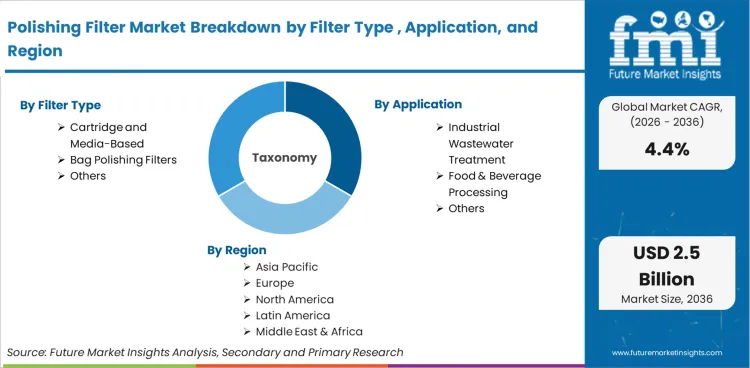
- Filter type: cartridge polishing filters, bag polishing filters, media bed polishing filters, membrane-based polishing filters, others
- Application: industrial wastewater treatment, food & beverage processing, pharmaceutical and biopharmaceutical water systems, chemical processing, others
- End use: municipal utilities, industrial plants, food & beverage producers, pharma and life sciences facilities, others
- Region: North America, Latin America, Western Europe, Eastern Europe, East Asia, South Asia & Pacific, and Middle East & Africa
- Analyst Opinion
- Polishing filtration captures value at the last meter of quality. Buyers invest in this category when upstream treatment alone is not enough, when discharge non-compliance is costly, or when product quality can still be compromised at the final stage. The market remains commercially important because the cost of residual particles, clarity failure, or final-stage contamination is often far higher than the cost of the polishing step itself, opines Nikhil Kaitwade, Principal Consultant at Future Market Insights.
- Polishing Filter Market Definition
- The polishing filter market includes final-stage filtration systems used to remove fine suspended solids, residual particles, and remaining impurities after primary or secondary treatment. It covers cartridge filters, bag filters, media-bed filters, and membrane-based polishing systems used to achieve final liquid clarity, improved discharge quality, or higher-purity process water.
- Polishing Filter Market Inclusions
- Revenue from final-stage polishing filtration equipment and replaceable filter elements
- Industrial and municipal polishing filters used after primary or secondary treatment steps
- Systems sold into water treatment, beverage processing, chemicals, and high-purity process applications
- Polishing Filter Market Exclusions
- Primary clarification or bulk solids-removal systems not positioned as polishing stages
- Air and gas filtration products outside liquid polishing scope
- Full water-treatment plants sold without separable polishing-filter revenue
- Polishing Filter Market Research Methodology
- This study evaluates the market across key segments and regions for the base year 2025 and the forecast period 2026 to 2036. All market values are presented in USD billion. The analysis is built on a review of company disclosures, product literature, technology developments, trade references, and industry documentation relevant to the value chain. Market estimates are derived through triangulation of demand-side trends, supply-side positioning, pricing dynamics, application intensity, replacement cycles, and regional adoption patterns to establish current market size and forecast potential.
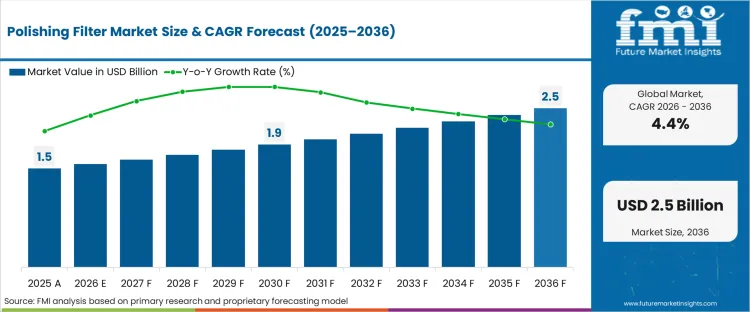
Key Drivers, Restraints, and Trends in Polishing Filter Market
Drivers
Demand is supported by discharge compliance, water reuse requirements, and product-quality expectations across industrial and process applications. Polishing filters remain relevant because many systems still need a final barrier against fine particles and residual solids before discharge, reuse, or further processing. This becomes more important in sectors where clarity, purity, or downstream equipment protection directly affects operating performance.
Restraints
The market is constrained by fouling, recurring consumables cost, and dependence on competent upstream treatment. Polishing filters can become uneconomical when earlier treatment stages perform inconsistently, because higher solids loading shortens replacement cycles and raises operating cost. In many applications, the value of the polishing stage depends on how well the broader treatment train is designed and maintained.
Trends
The main trend is the tighter integration of polishing stages into circular water systems and higher-spec process streams. End users increasingly treat polishing filtration as part of reuse, recovery, and quality-assurance strategy rather than as a stand-alone cleanup step. This is driving stronger interest in systems that improve final water quality while keeping replacement frequency, downtime, and lifecycle cost under better control.
Segmental Analysis
Polishing Filter Market Analysis by Primary Segment
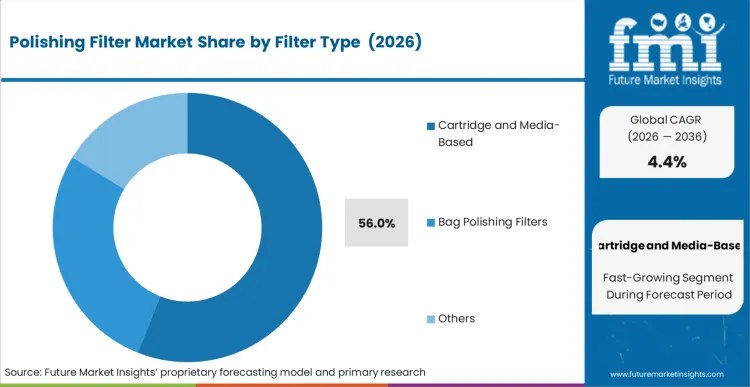
Cartridge and media-based polishing formats are expected to hold the largest share at 56% in 2026 because they are widely used, relatively easy to specify, and adaptable across a broad range of final-stage liquid-cleanup applications. Their commercial strength comes from their suitability for industrial water, food and beverage processing, and general process filtration where reliable solids reduction and manageable replacement cycles matter.
Polishing Filter Market Analysis by End Use or Application
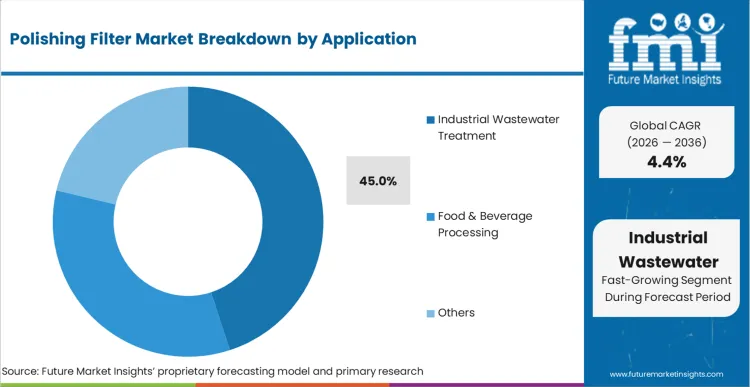
Industrial wastewater treatment is expected to remain the leading application in 2026 at 45% share because many facilities require a final solids-reduction or clarity-improvement step before discharge, reuse, or recycling. The segment remains commercially important because polishing filtration often acts as the last quality-control stage between treated water and regulatory, operational, or reuse targets.
Competitive Aligners for Market Players
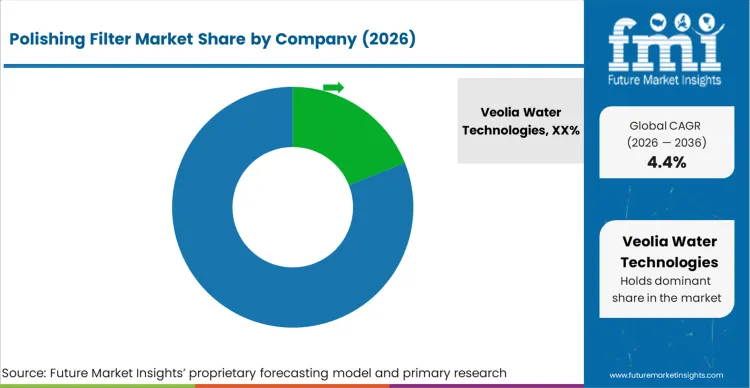
Competition is shaped by particle-removal performance, pressure-drop stability, hygienic design where relevant, and the economics of filter replacement over time. Buyers increasingly compare suppliers on total operating cost rather than hardware price alone, especially in applications where filter life, changeout frequency, and downtime affect system economics. Suppliers with stronger application support, broader element compatibility, and better lifecycle-cost positioning are therefore more likely to build durable customer relationships.
Key Players in Polishing Filter Market
- Veolia Water Technologies
- Roxia
- Evoqua Water Technologies
- Pall Corporation
- Parker Hannifin
- Donaldson Company
- Pentair
- 3M
- Eaton
- Critical Process Filtration
Strategic Outlook by FMI on Polishing Filter Market
The polishing filter market should expand steadily through 2036 as water quality standards tighten and more facilities pursue reuse, product consistency, and lower compliance risk. The best-positioned suppliers will be those that can prove both final quality and manageable operating cost.
Scope of the Report
| Metric | Value |
|---|---|
| Market Value | USD 1.53 billion in 2025 to USD 2.4 billion by 2036 |
| CAGR | 4.4% from 2026 to 2036 |
| Base Year | 2025 |
| Forecast Period | 2026 to 2036 |
| Filter Type Segmentation | Cartridge Polishing Filters, Bag Polishing Filters, Media Bed Polishing Filters, Membrane-based Polishing Filters, Others |
| Application Segmentation | Industrial Wastewater Treatment, Food & Beverage Processing, Pharmaceutical and Biopharmaceutical Water Systems, Chemical Processing, Others |
| End Use Segmentation | Municipal Utilities, Industrial Plants, Food & Beverage Producers, Pharma and Life Sciences Facilities, Others |
| Regions Covered | North America, Latin America, Western Europe, Eastern Europe, East Asia, South Asia & Pacific, and Middle East & Africa |
Bibliography
- Veolia Water Technologies. Current. Berkefeld PurBev Polisher.
- Roxia. Current. What is Polishing Filtration?
- EllisLudell. Current. Polishing Filter.
- Critical Process Filtration. Current. Filtration for Pharmaceutical & Biopharmaceutical Water Systems.
- Roxia. Current. Smart Filter Press
Frequently Asked Questions
What is driving growth in the polishing filter market?
Growth is being driven by tighter water-quality requirements, final-stage product clarity needs, and industrial water reuse projects.
Which filter segment leads the polishing filter market?
Cartridge and media-based polishing filters lead because they are widely used as practical finishing steps across multiple industries.
Why is industrial wastewater important in the polishing filter market?
Many plants need a final solids-reduction step after bulk treatment to meet discharge or reuse targets.
What restrains the polishing filter market?
Fouling, consumables cost, and reliance on stable upstream treatment all limit faster adoption.
Which regions are important in the polishing filter market?
All major industrial regions matter, especially those facing stronger water-stress and discharge-compliance pressure.
What is the outlook for the polishing filter market through 2036?
The outlook is steady, with growth supported by water reuse, compliance, and higher-quality process requirements.
Preview the report firsthand - request a free sample
Get SampleGet the brochure for pricing and purchase details.
Get PDFTable of Content
- Executive Summary
- Global Market Outlook
- Demand-side Trends
- Supply-side Trends
- Technology Roadmap Analysis
- Analysis and Recommendations
- Market Overview
- Market Coverage / Taxonomy
- Market Definition / Scope / Limitations
- Research Methodology
- Chapter Orientation
- Analytical Lens and Working Hypotheses
- Market Structure, Signals, and Trend Drivers
- Benchmarking and Cross-market Comparability
- Market Sizing, Forecasting, and Opportunity Mapping
- Research Design and Evidence Framework
- Desk Research Programme (Secondary Evidence)
- Company Annual and Sustainability Reports
- Peer-reviewed Journals and Academic Literature
- Corporate Websites, Product Literature, and Technical Notes
- Earnings Decks and Investor Briefings
- Statutory Filings and Regulatory Disclosures
- Technical White Papers and Standards Notes
- Trade Journals, Industry Magazines, and Analyst Briefs
- Conference Proceedings, Webinars, and Seminar Materials
- Government Statistics Portals and Public Data Releases
- Press Releases and Reputable Media Coverage
- Specialist Newsletters and Curated Briefings
- Sector Databases and Reference Repositories
- FMI Internal Proprietary Databases and Historical Market Datasets
- Subscription Datasets and Paid Sources
- Social Channels, Communities, and Digital Listening Inputs
- Additional Desk Sources
- Expert Input and Fieldwork (Primary Evidence)
- Primary Modes
- Qualitative Interviews and Expert Elicitation
- Quantitative Surveys and Structured Data Capture
- Blended Approach
- Why Primary Evidence is Used
- Field Techniques
- Interviews
- Surveys
- Focus Groups
- Observational and In-context Research
- Social and Community Interactions
- Stakeholder Universe Engaged
- C-suite Leaders
- Board Members
- Presidents and Vice Presidents
- R&D and Innovation Heads
- Technical Specialists
- Domain Subject-matter Experts
- Scientists
- Physicians and Other Healthcare Professionals
- Governance, Ethics, and Data Stewardship
- Research Ethics
- Data Integrity and Handling
- Primary Modes
- Tooling, Models, and Reference Databases
- Desk Research Programme (Secondary Evidence)
- Data Engineering and Model Build
- Data Acquisition and Ingestion
- Cleaning, Normalisation, and Verification
- Synthesis, Triangulation, and Analysis
- Quality Assurance and Audit Trail
- Market Background
- Market Dynamics
- Drivers
- Restraints
- Opportunity
- Trends
- Scenario Forecast
- Demand in Optimistic Scenario
- Demand in Likely Scenario
- Demand in Conservative Scenario
- Opportunity Map Analysis
- Product Life Cycle Analysis
- Supply Chain Analysis
- Investment Feasibility Matrix
- Value Chain Analysis
- PESTLE and Porter’s Analysis
- Regulatory Landscape
- Regional Parent Market Outlook
- Production and Consumption Statistics
- Import and Export Statistics
- Market Dynamics
- Global Market Analysis 2021 to 2025 and Forecast, 2026 to 2036
- Historical Market Size Value (USD Million) Analysis, 2021 to 2025
- Current and Future Market Size Value (USD Million) Projections, 2026 to 2036
- Y-o-Y Growth Trend Analysis
- Absolute $ Opportunity Analysis
- Global Market Pricing Analysis 2021 to 2025 and Forecast 2026 to 2036
- Global Market Analysis 2021 to 2025 and Forecast 2026 to 2036, By Filter Type
- Introduction / Key Findings
- Historical Market Size Value (USD Million) Analysis By Filter Type , 2021 to 2025
- Current and Future Market Size Value (USD Million) Analysis and Forecast By Filter Type , 2026 to 2036
- Cartridge and Media-Based
- Bag Polishing Filters
- Others
- Cartridge and Media-Based
- Y-o-Y Growth Trend Analysis By Filter Type , 2021 to 2025
- Absolute $ Opportunity Analysis By Filter Type , 2026 to 2036
- Global Market Analysis 2021 to 2025 and Forecast 2026 to 2036, By Application
- Introduction / Key Findings
- Historical Market Size Value (USD Million) Analysis By Application, 2021 to 2025
- Current and Future Market Size Value (USD Million) Analysis and Forecast By Application, 2026 to 2036
- Industrial Wastewater Treatment
- Food & Beverage Processing
- Others
- Industrial Wastewater Treatment
- Y-o-Y Growth Trend Analysis By Application, 2021 to 2025
- Absolute $ Opportunity Analysis By Application, 2026 to 2036
- Global Market Analysis 2021 to 2025 and Forecast 2026 to 2036, By Region
- Introduction
- Historical Market Size Value (USD Million) Analysis By Region, 2021 to 2025
- Current Market Size Value (USD Million) Analysis and Forecast By Region, 2026 to 2036
- North America
- Latin America
- Western Europe
- Eastern Europe
- East Asia
- South Asia and Pacific
- Middle East & Africa
- Market Attractiveness Analysis By Region
- North America Market Analysis 2021 to 2025 and Forecast 2026 to 2036, By Country
- Historical Market Size Value (USD Million) Trend Analysis By Market Taxonomy, 2021 to 2025
- Market Size Value (USD Million) Forecast By Market Taxonomy, 2026 to 2036
- By Country
- USA
- Canada
- Mexico
- By Filter Type
- By Application
- By Country
- Market Attractiveness Analysis
- By Country
- By Filter Type
- By Application
- Key Takeaways
- Latin America Market Analysis 2021 to 2025 and Forecast 2026 to 2036, By Country
- Historical Market Size Value (USD Million) Trend Analysis By Market Taxonomy, 2021 to 2025
- Market Size Value (USD Million) Forecast By Market Taxonomy, 2026 to 2036
- By Country
- Brazil
- Chile
- Rest of Latin America
- By Filter Type
- By Application
- By Country
- Market Attractiveness Analysis
- By Country
- By Filter Type
- By Application
- Key Takeaways
- Western Europe Market Analysis 2021 to 2025 and Forecast 2026 to 2036, By Country
- Historical Market Size Value (USD Million) Trend Analysis By Market Taxonomy, 2021 to 2025
- Market Size Value (USD Million) Forecast By Market Taxonomy, 2026 to 2036
- By Country
- Germany
- UK
- Italy
- Spain
- France
- Nordic
- BENELUX
- Rest of Western Europe
- By Filter Type
- By Application
- By Country
- Market Attractiveness Analysis
- By Country
- By Filter Type
- By Application
- Key Takeaways
- Eastern Europe Market Analysis 2021 to 2025 and Forecast 2026 to 2036, By Country
- Historical Market Size Value (USD Million) Trend Analysis By Market Taxonomy, 2021 to 2025
- Market Size Value (USD Million) Forecast By Market Taxonomy, 2026 to 2036
- By Country
- Russia
- Poland
- Hungary
- Balkan & Baltic
- Rest of Eastern Europe
- By Filter Type
- By Application
- By Country
- Market Attractiveness Analysis
- By Country
- By Filter Type
- By Application
- Key Takeaways
- East Asia Market Analysis 2021 to 2025 and Forecast 2026 to 2036, By Country
- Historical Market Size Value (USD Million) Trend Analysis By Market Taxonomy, 2021 to 2025
- Market Size Value (USD Million) Forecast By Market Taxonomy, 2026 to 2036
- By Country
- China
- Japan
- South Korea
- By Filter Type
- By Application
- By Country
- Market Attractiveness Analysis
- By Country
- By Filter Type
- By Application
- Key Takeaways
- South Asia and Pacific Market Analysis 2021 to 2025 and Forecast 2026 to 2036, By Country
- Historical Market Size Value (USD Million) Trend Analysis By Market Taxonomy, 2021 to 2025
- Market Size Value (USD Million) Forecast By Market Taxonomy, 2026 to 2036
- By Country
- India
- ASEAN
- Australia & New Zealand
- Rest of South Asia and Pacific
- By Filter Type
- By Application
- By Country
- Market Attractiveness Analysis
- By Country
- By Filter Type
- By Application
- Key Takeaways
- Middle East & Africa Market Analysis 2021 to 2025 and Forecast 2026 to 2036, By Country
- Historical Market Size Value (USD Million) Trend Analysis By Market Taxonomy, 2021 to 2025
- Market Size Value (USD Million) Forecast By Market Taxonomy, 2026 to 2036
- By Country
- Kingdom of Saudi Arabia
- Other GCC Countries
- Turkiye
- South Africa
- Other African Union
- Rest of Middle East & Africa
- By Filter Type
- By Application
- By Country
- Market Attractiveness Analysis
- By Country
- By Filter Type
- By Application
- Key Takeaways
- Key Countries Market Analysis
- USA
- Pricing Analysis
- Market Share Analysis, 2025
- By Filter Type
- By Application
- Canada
- Pricing Analysis
- Market Share Analysis, 2025
- By Filter Type
- By Application
- Mexico
- Pricing Analysis
- Market Share Analysis, 2025
- By Filter Type
- By Application
- Brazil
- Pricing Analysis
- Market Share Analysis, 2025
- By Filter Type
- By Application
- Chile
- Pricing Analysis
- Market Share Analysis, 2025
- By Filter Type
- By Application
- Germany
- Pricing Analysis
- Market Share Analysis, 2025
- By Filter Type
- By Application
- UK
- Pricing Analysis
- Market Share Analysis, 2025
- By Filter Type
- By Application
- Italy
- Pricing Analysis
- Market Share Analysis, 2025
- By Filter Type
- By Application
- Spain
- Pricing Analysis
- Market Share Analysis, 2025
- By Filter Type
- By Application
- France
- Pricing Analysis
- Market Share Analysis, 2025
- By Filter Type
- By Application
- India
- Pricing Analysis
- Market Share Analysis, 2025
- By Filter Type
- By Application
- ASEAN
- Pricing Analysis
- Market Share Analysis, 2025
- By Filter Type
- By Application
- Australia & New Zealand
- Pricing Analysis
- Market Share Analysis, 2025
- By Filter Type
- By Application
- China
- Pricing Analysis
- Market Share Analysis, 2025
- By Filter Type
- By Application
- Japan
- Pricing Analysis
- Market Share Analysis, 2025
- By Filter Type
- By Application
- South Korea
- Pricing Analysis
- Market Share Analysis, 2025
- By Filter Type
- By Application
- Russia
- Pricing Analysis
- Market Share Analysis, 2025
- By Filter Type
- By Application
- Poland
- Pricing Analysis
- Market Share Analysis, 2025
- By Filter Type
- By Application
- Hungary
- Pricing Analysis
- Market Share Analysis, 2025
- By Filter Type
- By Application
- Kingdom of Saudi Arabia
- Pricing Analysis
- Market Share Analysis, 2025
- By Filter Type
- By Application
- Turkiye
- Pricing Analysis
- Market Share Analysis, 2025
- By Filter Type
- By Application
- South Africa
- Pricing Analysis
- Market Share Analysis, 2025
- By Filter Type
- By Application
- USA
- Market Structure Analysis
- Competition Dashboard
- Competition Benchmarking
- Market Share Analysis of Top Players
- By Regional
- By Filter Type
- By Application
- Competition Analysis
- Competition Deep Dive
- Veolia Water Technologies
- Overview
- Product Portfolio
- Profitability by Market Segments (Product/Age /Sales Channel/Region)
- Sales Footprint
- Strategy Overview
- Marketing Strategy
- Product Strategy
- Channel Strategy
- Roxia
- Evoqua Water Technologies
- Pall Corporation
- Parker Hannifin
- Veolia Water Technologies
- Competition Deep Dive
- Assumptions & Acronyms Used


