

- Industry Size (2026)
- USD 2.5 Bn
- Forecast (2036)
- USD 3.7 Bn
- CAGR (2026 to 2036)
- 4.2%
Polishing Chemicals Market Size, Market Forecast and Outlook By FMI
In 2025, the polishing chemicals market crossed a valuation of USD 2.4 billion. Based on Future Market Insights’ analysis, expansion of the sector is estimated to push the valuation to USD 2.5 billion in 2026 and USD 3.7 billion by 2036. FMI projects a CAGR of 4.2% during the forecast period.
Despite a mature profile and inherent volatility in feedstock costs, major polishing chemical manufacturers are maintaining steady profitability through strategic pricing models. By shifting customer contracts from simple volume-based supply to performance-based service tiers, leaders like Ecolab are effectively passing through inflationary pressures. This structural resilience allows the industry to secure margins even as raw material indices fluctuate, decoupling revenue growth from pure volumetric output in stagnating Western markets.
Summary of Polishing Chemicals Market
- Polishing Chemicals Market Definition
- The industry covers specialized formulations designed to enhance the aesthetic and functional longevity of architectural and industrial surfaces.
- Demand Drivers in the Market
- Rapid urbanization in emerging markets driving construction and maintenance needs.
- Strict VOC regulations forcing a shift to waterborne and bio-based chemistries.
- Consolidation of facility management contracts requiring integrated chemical solutions.
- Key Segments Analyzed in the FMI Report
- Finish Type: High-Gloss Finishes dominate (38%), but matte options are gaining in European design trends.
- End Use: Commercial Facilities lead (40%) due to high traffic and aesthetic standards.
- Geography: High-growth Latin America and Asia versus value-driven North American replacement markets.
- Analyst Opinion at FMI
- Nikhil Kaitwade, Principal Consultant for Chemicals at Future Market Insights, opines, "In the updated Polishing Chemicals Market Report for 2026-2036, my analysis shows that the real winners won’t be the companies selling another glossy SKU, but those engineering genuinely high‑durability, self‑crosslinking finishes that meaningfully cut labor cycles. This is because in today’s operating environment, labor has become the dominant cost driver while product costs have become almost incidental. This shift is redefining value creation across the industry, forcing manufacturers to compete not on price, but on how many labor hours their chemistry can eliminate."
- Strategic Implications/Executive Takeaways
- Accelerate M&A to secure regional distribution hubs.
- Invest in "Direct Coating" technologies to reduce application steps.
- Focus on surface disinfectant chemicals integration for healthcare compliance.
- Methodology
- Validated through first-hand corporate production and capacity data.
- Zero reliance on speculative third-party market research reports.
- Based on verifiable industrial benchmarks and verified sources.
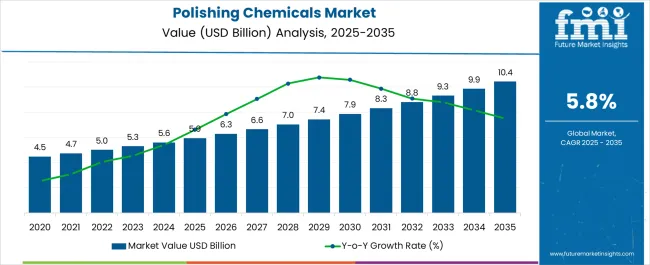
As Christophe Beck, Chairman & CEO of Ecolab, noted regarding the industry's structural resilience, "Thanks to the best sales and service team in the business, we delivered record sales, record adjusted earnings per share, record operating income margins and record free cash flow by taking care of our customers."[1] This highlights a pivot where integrated service models and floor finish and polish systems drive value over commodity sales.
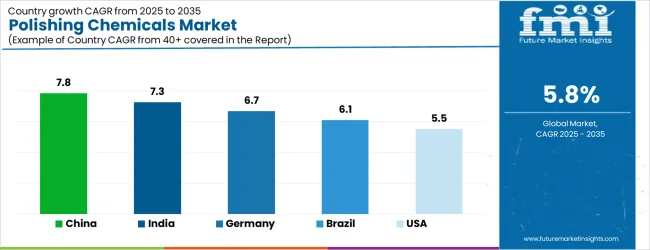
China (5.2% CAGR) and Brazil (5.0% CAGR) act as the primary volume engines, fueled by urbanization and industrial expansion. Conversely, mature markets like the United States (3.9% CAGR) and Germany (3.8% CAGR) are driven by replacement demand, where volume expansion is constrained by regulatory compliance costs and the encroachment of long-lifecycle concrete densification and polishing material in premium segments.
Polishing Chemicals Market Definition
The polishing chemicals market comprises the global formulation, production, and trade of chemical agents used to smooth, brighten, protect, and maintain surfaces including flooring, stone, metal, and semiconductor wafers.
Polishing Chemicals Market Inclusions
The report includes a comprehensive analysis of floor finishes, strippers, sealers, stone crystallizers, and slurries used in chemical mechanical planarization. It covers chemistries ranging from acrylic polymers and urethanes to advanced colloidal silica.
Polishing Chemicals Market Exclusions
The scope excludes general-purpose household detergents or raw abrasives (sandpaper, pads) unless sold as part of an integrated chemical polishing system. It also omits upstream raw material production (monomers) unless directly related to formulation innovation.
Polishing Chemicals Market Research Methodology
- Primary Research: Interviews were conducted with facility managers, chemical formulators, flooring contractors, and sustainability officers at major cleaning associations.
- Desk Research: Production data from chemical trade bodies (VCI, ABIPLA), corporate annual reports, and safety data sheets supported volume benchmarking.
- Market-Sizing and Forecasting: A hybrid top-down and bottom-up model was developed, reconstructing demand from commercial floor space growth and industrial production indices.
- Data Validation and Update Cycle: Outputs undergo anomaly screening against regional inflation data and structured peer review prior to release.
Segmental Analysis
Polishing Chemicals Market Analysis by Finish Type
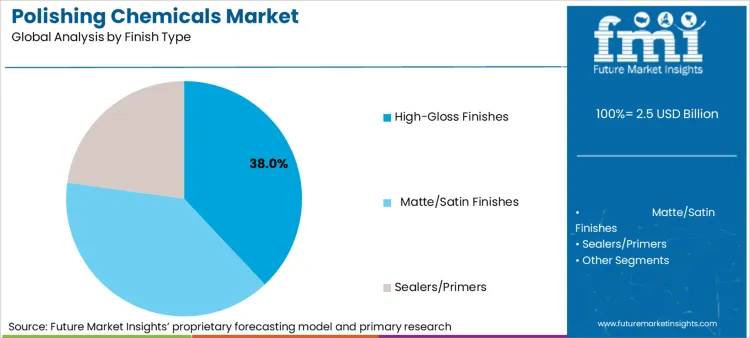
The finish type segment is witnessing a divergence based on regional aesthetic preferences and maintenance budgets. High-Gloss Finishes currently hold a 38% market share, primarily driven by the retail and grocery sectors where a "wet look" signals cleanliness. However, the market is shifting toward low-maintenance matte finishes and coating pretreatment solutions that do not require frequent burnishing. Bona exemplified this trend with the 2025 launch of Bona Mega EVO, a self-crosslinking finish with sub-3% VOCs, designed to offer high durability without toxic hardeners, directly addressing the health and labor concerns of modern facility managers.[2]
- High-Gloss Finishes: Standard for retail and supermarkets, driven by "cleanliness signaling."
- Matte/Satin Finishes: Growing in corporate and European markets, favored for hiding scratches and lower maintenance.
- Sealers/Primers: Critical for substrate protection, particularly in porous applications.
Polishing Chemicals Market Analysis by End Use Sector
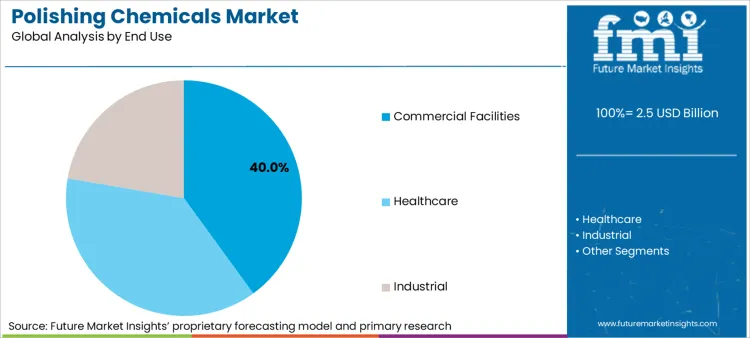
Commercial facilities represent the foundational volume of the industry, accounting for 40% of total revenue. This dominance is anchored by the sheer square footage of office buildings, malls, and airports that require daily maintenance. The sector is heavily influenced by corporate sustainability mandates; for instance, the American Cleaning Institute (ACI) reported that 36% of its members have committed to reaching net-zero emissions by 2050.[3] This forces commercial cleaning contractors to procure advanced surface treatment chemicals that contribute to LEED points and indoor air quality goals, effectively pushing out high-solvent legacy products.
- Commercial Facilities: High volume, price-sensitive but shifting to green contracts.
- Healthcare: High value, demanding disinfection compatibility and low odor.
- Industrial: Focused on bonded abrasives and heavy-duty concrete densifiers.
Polishing Chemicals Market Drivers, Restraints, and Opportunities
The primary driver is the robust expansion of industrial and commercial production in emerging economies, which necessitates consistent facility maintenance. In Brazil, the cleaning products industry registered a 9.1% increase in production in 2024, defying global slowdowns and signaling strong regional demand for maintenance chemicals.[4] This "emerging resilience" provides a critical volume offset for global manufacturers facing stagnation in Europe.
A major restraint is the volatility of raw material costs and the sensitivity of the market to price hikes. ABIPLA executives in Brazil noted that the sector is "extremely price sensitive," and while the domestic cleaning group saw deflation of 1.2% in 2024 relative to national inflation, margin pressure remains acute.[5] This dynamic is further complicated by operational risks; Zep Inc. faced over $161,000 in OSHA penalties in 2024 following a chemical release, highlighting the strict regulatory penalties that can erode profitability.[6]
- Emerging Market Volume: Strong production growth in Latin America drives demand for metal polish products. [4]
- Operational & Price Risk: Safety fines and price sensitivity limit margin expansion. [5, 6]
- Green Innovation: Opportunity to capture premiums with bio-based, low-VOC specialty silica formulations. [3]
Regional Analysis
Asia Pacific Polishing Chemicals Analysis
Asia Pacific is the global volume powerhouse, where the sheer velocity of urbanization and high-tech manufacturing necessitates a dual-track market for both architectural finishes and industrial slurries. The region's demand mechanism is evolving from simple cost-based procurement to a focus on technical specification, particularly in the electronics and automotive sectors.
- China: The market is anticipated to expand at a 5.2% CAGR through 2036. Covestro planned a new production facility for polyurethane dispersions (PUDs) in Shanghai, scheduled for completion in 2024, specifically to address the soaring Asian demand for waterborne coatings that replace traditional solvent-heavy polishes.[7]
- South Korea: Sales are estimated to increase at a 3.4% CAGR through 2036. The country's dominance in wafer fabrication drives a critical need for cmp slurry additives and ultra-high purity fumed silica in paints and coatings applications, where polishing precision is measured in nanometers rather than gloss units.
FMI’s report includes a detailed analysis of growth in the Asia Pacific region, along with a country-wise assessment that includes China and South Korea. Readers can also find regional trends, regulations, and market growth based on different segments and countries in Asia Pacific, including Japan, where Japan chemical mechanical planarization remains a key technology driver.
North America Polishing Chemicals Analysis
North America represents a mature, value-driven market where growth is achieved through consolidation and the rollout of digital efficiency tools. The focus here is on extending the lifecycle of existing assets through advanced chemical treatments rather than new construction volume.
- United States: The sector is forecast to advance at a 3.9% CAGR through 2036. Ecolab increased its capital expenditures by 28% to $994.5 million in 2024, focusing on digital technologies that optimize chemical usage for institutional clients, proving that the US market rewards efficiency over volume.[1]
FMI’s report includes a detailed analysis of growth in the North America region, along with a country-wise assessment that includes the United States. Readers can also find regional trends, regulations, and market growth based on different segments and countries in North America, including Canada and Mexico, where united states bonded abrasives trade flows influence cross-border pricing.
Europe Polishing Chemicals Analysis
Europe acts as the global regulatory benchmark, where market value is driven by strict environmental compliance, even as industrial volume faces headwinds. The region is seeing a rapid substitution of legacy chemistries with bio-based alternatives.
- Germany: Consumption is expected to grow at a 3.8% CAGR through 2036. The VCI reported that chemical production dropped by 4.2% in Q4 2024 against the previous quarter; this contraction forces local manufacturers to pivot toward high-margin, specialized functional plating chemicals rather than competing on commodity volume.[8]
FMI’s report includes a detailed analysis of growth in the Europe region, along with a country-wise assessment that includes Germany. Readers can also find regional trends, regulations, and market growth based on different segments and countries in Europe, such as France, Italy, and Spain, where nickel acetate demand is evolving in surface finishing applications.
Latin America Polishing Chemicals Analysis
Latin America is emerging as a resilient growth node, driven by strong domestic consumption and construction activity that is less correlated with European industrial stagnation.
- Brazil: The industry is set to witness growth of 5.0% CAGR through 2036. The domestic cleaning products industry is outperforming the broader economy, with production indices rising 9.1% in 2024, supported by a pricing dynamic where the sector saw 1.2% deflation, sustaining consumer demand.[4, 5]
FMI’s report includes a detailed analysis of growth in the Latin America region, along with a country-wise assessment that includes Brazil. Readers can also find regional trends, regulations, and market growth based on different segments and countries in Latin America, such as Peru and the Dominican Republic, where Sika AG recently completed acquisitions to strengthen its construction chemicals footprint.[9]
Competitive Aligners for Market Players
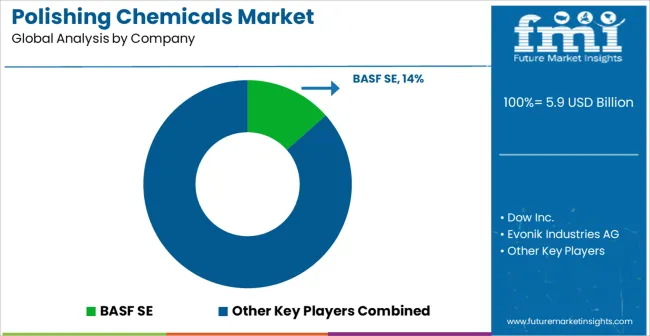
The competitive landscape is defined by "Scale and Sustainability." Major players are leveraging their balance sheets to acquire niche technologies and expand geographic reach. Sika AG demonstrated this strategy by acquiring Chema in Peru and Vinaldom in the Dominican Republic, allowing them to dictate terms in raw material procurement and offer integrated solutions that smaller regional players cannot match.[9]
Sustainability has become a defensive strategy for various key players. Companies like Bona reduced their greenhouse gas emissions by 41% in 2024, primarily through renewable energy certificates.[10] This verified environmental performance is increasingly becoming a prerequisite for winning contracts with global facility management firms, effectively locking out non-compliant competitors from the premium segment of the market.
Operational discipline is a key differentiator. While leaders invest in colloidal silica innovations, others face regulatory headwinds. The significant penalties faced by Zep Inc. underscore that ability to manage safety and environmental compliance is as critical to survival as product performance in this chemical sector.[6]
Recent Developments
The report includes full coverage of key trends from competitive benchmarking. Some of the recent developments covered in the reports:
- In December 2025, Covestro accelerated the rollout of "Direct Coating," a proprietary technology combining abrasives principles with injection molding to reduce energy use and process complexity.[7]
- In April 2025, Bona acquired Ezi Floor Products (EFP), its long-term exclusive distributor in Australia, to strengthen its direct presence in the APAC region.[2]
Key Players in Polishing Chemicals Market
- Ecolab
- Diversey (Solenis)
- SC Johnson Professional
- 3M
- Zep
- BASF
- Dow
- Sika AG
- RPM International Inc.
- Bona AB
Scope of the Report
| Metric | Value |
|---|---|
| Quantitative Units | USD 2.5 billion (2026) to USD 3.7 billion (2036), at a CAGR of 4.2% |
| Market Definition | The polishing chemicals market comprises the global formulation, production, and trade of chemical agents used to smooth, brighten, protect, and maintain surfaces including flooring, stone, metal, and semiconductor wafers. |
| Finish Type Segmentation | High-Gloss, Matte/Satin, Semi-Gloss, Sealers/Primers |
| System Component Segmentation | Finish/Polish Coatings, Maintenance Sprays, Strippers, Restorers |
| Application Coverage | Commercial, Education, Healthcare, Retail, Hospitality, Industrial |
| Regions Covered | North America, Latin America, Europe, East Asia, South Asia, Oceania, Middle East and Africa |
| Countries Covered | United States, Canada, Mexico, Brazil, Argentina, Germany, France, United Kingdom, Italy, Spain, China, India, Japan, South Korea, Indonesia, Australia and 40 plus countries |
| Key Companies Profiled | Ecolab, Diversey (Solenis), SC Johnson Professional, 3M, Zep, BASF, Dow, Sika AG, RPM International Inc., Bona AB |
| Forecast Period | 2026 to 2036 |
| Approach | Hybrid top down and bottom up market modeling validated through primary interviews with facility managers and chemical trade bodies |
Polishing Chemicals Market Analysis by Segments
Finish Type:
- High-Gloss Finishes
- Matte/Satin Finishes
- Semi-Gloss Finishes
- Sealers/Primers
System Component:
- Finish/Polish Coatings
- Maintenance Sprays
- Strippers
- Restorers
- Burnishing Aids
Floor Substrate:
- Concrete/Terrazzo
- VCT/Resilient Floors
- Stone/Tile
- Wood
- Laminate
End Use Sector:
- Commercial Facilities
- Education
- Healthcare
- Retail
- Hospitality
- Industrial
- Residential
Region:
- Asia Pacific
- India
- China
- Japan
- South Korea
- Indonesia
- Australia & New Zealand
- ASEAN
- Rest of Asia Pacific
- Europe
- Germany
- Italy
- France
- United Kingdom
- Spain
- Benelux
- Nordics
- Central & Eastern Europe
- Rest of Europe
- North America
- United States
- Canada
- Mexico
- Latin America
- Brazil
- Argentina
- Chile
- Rest of Latin America
- Middle East & Africa
- Kingdom of Saudi Arabia
- United Arab Emirates
- South Africa
- Turkey
- Rest of Middle East & Africa
Bibliography
- [1] Ecolab Inc. (2025). 2024 Annual Report.
- [2] Bona. (2025). Sustainability Report 2024 & Product Launch.
- [3] American Cleaning Institute (ACI). (2024). 2024 ACI Sustainability Report.
- [4] ABIPLA. (2024). Manufacturing of Cleaning Products Hits Record in 2024.
- [5] ABIPLA. (2024). Brazilian Cleaning Products Market Analysis 2024.
- [6] OSHA. (2025). OSHA Cites Chambersburg Manufacturer After Chemical Release.
- [7] Covestro. (2025). Covestro Plans New Plants for Polyurethane Dispersions in Shanghai.
- [8] Verband der Chemischen Industrie (VCI). (2025). Quarterly Report on the Business Situation of the German Chemical Industry.
- [9] Sika AG. (2024). Acquisitions: Vinaldom and Chema.
- [10] Bona. (2025). Sustainability Report 2024.
This Report Addresses
- Market intelligence to enable structured strategic decision making across mature and emerging surface treatment economies
- Market size estimation and 10 year revenue forecasts from 2026 to 2036, supported by validated capacity and trade benchmarks
- Growth opportunity mapping across high-gloss, matte, and sustainable finishes with emphasis on labor-saving systems
- Segment and regional revenue forecasts covering commercial, healthcare, education, and industrial applications
- Competition strategy assessment including M&A integration models, cost survivability positioning, and compliance capability benchmarking
- Product reformulation and environmental compliance tracking including low-VOC and bio-based grade adoption
- Regulatory impact analysis covering worker safety fines, indoor air quality mandates, and green building certifications
- Market report delivery in PDF, Excel, PPT, and interactive dashboard formats for executive and operational use
Frequently Asked Questions
How large is the demand for Polishing Chemicals in the global market in 2026?
Demand for Polishing Chemicals in the global market is estimated to be valued at USD 2.5 billion in 2026.
What will be the market size of Polishing Chemicals in the global market by 2036?
Market size for Polishing Chemicals is projected to reach USD 3.7 billion by 2036.
What is the expected demand growth for Polishing Chemicals in the global market between 2026 and 2036?
Demand for Polishing Chemicals in the global market is expected to grow at a CAGR of 4.2% between 2026 and 2036.
Which Finish Type is poised to lead global sales by 2026?
High-Gloss Finishes are expected to be the dominant type, capturing approximately 38% of global market share in 2026 due to their prevalence in retail environments.
How significant is the role of Commercial Facilities in driving Polishing Chemicals adoption in 2026?
Commercial Facilities represent a critical segment, projected to hold a substantial 40% share of the total market in 2026 as corporate sustainability mandates drive procurement.
What is driving demand in China?
Demand is driven by rapid industrialization and the expansion of local capacity for high-quality waterborne coatings.
What compliance standards or regulations are referenced for China?
Regulations concerning volatile organic compounds (VOCs) and sustainable manufacturing practices are key benchmarks referenced.
What is the China growth outlook in this report?
China is projected to grow at a CAGR of 5.2% during 2026 to 2036.
Why is Brazil described as a priority region in this report?
Brazil is a priority due to a 9.1% surge in cleaning product production in 2024, signaling strong resilience and volume growth.
What type of demand dominates in Brazil?
Volume-driven demand for affordable, effective maintenance chemicals dominates regional consumption.
What is Brazil growth outlook in this report?
Brazil is projected to expand at a CAGR of 5.0% during 2026 to 2036.
Does the report cover the United States in its regional analysis?
Yes, the United States is included within North America under the regional scope of analysis.
What are the sources referred to for analyzing the United States?
Data from Ecolab's capital expenditures and OSHA regulatory actions are used as primary reference sources.
What is the main demand theme linked to the United States in its region coverage?
Demand is linked to sustainable infrastructure investment and digital efficiency tools.
Does the report cover Germany in its regional analysis?
Yes, Germany is included within Europe under the regional coverage framework.
What is the main Germany related demand theme in its region coverage?
The theme is industrial contraction and the shift toward high-efficiency, specialized chemical formulations to survive high costs.
Which product formats or configurations are strategically important for North America supply chains?
Digital dispensing systems and self-crosslinking low-VOC finishes are strategically prioritized to reduce labor and meet environmental goals.
What are Polishing Chemicals and What are They Mainly Used For?
They are chemical agents used to smooth, protect, and maintain surfaces like floors and stone, improving durability and aesthetics.
What does Polishing Chemicals Market Mean in this Report?
It refers to the global production, trade, and commercial consumption of surface treatment formulations.
What is Included in the Scope of this Polishing Chemicals Report?
Scope covers floor finishes, sealers, strippers, and specialized industrial polishing slurries across various end-use sectors.
What is Excluded from the Scope of this Report?
Household detergents and raw abrasive materials are excluded from the analysis unless part of a chemical system.
What does Market Forecast Mean on this Page?
Market forecast represents a model-based projection built on defined assumptions for strategic planning purposes.
How does FMI Build and Validate the Polishing Chemicals Forecast?
Forecast is developed using hybrid top-down and bottom-up modeling validated through production indices and corporate financial reports.
What does zero reliance on speculative third party market research mean here?
Primary interviews and verifiable public datasets are used instead of unverified syndicated market estimates.
Preview the report firsthand - request a free sample
Get SampleGet the brochure for pricing and purchase details.
Get PDFTable of Content
- Executive Summary
- Global Market Outlook
- Demand-side Trends
- Supply-side Trends
- Technology Roadmap Analysis
- Analysis and Recommendations
- Market Overview
- Market Coverage / Taxonomy
- Market Definition / Scope / Limitations
- Research Methodology
- Chapter Orientation
- Analytical Lens and Working Hypotheses
- Market Structure, Signals, and Trend Drivers
- Desk Research Programme (Secondary Evidence)
- Company Annual and Sustainability Reports
- Peer-reviewed Journals and Academic Literature
- Corporate Websites, Product Literature, and Technical Notes
- Earnings Decks and Investor Briefings
- Statutory Filings and Regulatory Disclosures
- Technical White Papers and Standards Notes
- Trade Journals, Industry Magazines, and Analyst Briefs
- Conference Proceedings, Webinars, and Seminar Materials
- Government Statistics Portals and Public Data Releases
- Press Releases and Reputable Media Coverage
- Specialist Newsletters and Curated Briefings
- Sector Databases and Reference Repositories
- FMI Internal Proprietary Databases and Historical Market Datasets
- Subscription Datasets and Paid Sources
- Social Channels, Communities, and Digital Listening Inputs
- Additional Desk Sources
- Expert Input and Fieldwork (Primary Evidence)
- Primary Modes
- Qualitative Interviews and Expert Elicitation
- Quantitative Surveys and Structured Data Capture
- Blended Approach
- Why Primary Evidence is Used
- Field Techniques
- Interviews
- Surveys
- Focus Groups
- Observational and In-context Research
- Social and Community Interactions
- Stakeholder Universe Engaged
- C-suite Leaders
- Board Members
- Presidents and Vice Presidents
- R&D and Innovation Heads
- Technical Specialists
- Domain Subject-matter Experts
- Scientists
- Physicians and Other Healthcare Professionals
- Governance, Ethics, and Data Stewardship
- Research Ethics
- Data Integrity and Handling
- Primary Modes
- Tooling, Models, and Reference Databases
- Data Engineering and Model Build
- Data Acquisition and Ingestion
- Cleaning, Normalisation, and Verification
- Synthesis, Triangulation, and Analysis
- Quality Assurance and Audit Trail
- Market Background
- Market Dynamics
- Drivers
- Restraints
- Opportunity
- Trends
- Scenario Forecast
- Demand in Optimistic Scenario
- Demand in Likely Scenario
- Demand in Conservative Scenario
- Opportunity Map Analysis
- Product Life Cycle Analysis
- Supply Chain Analysis
- Investment Feasibility Matrix
- Value Chain Analysis
- PESTLE and Porter’s Analysis
- Regulatory Landscape
- Regional Parent Market Outlook
- Production and Consumption Statistics
- Import and Export Statistics
- Market Dynamics
- Global Market Analysis 2021 to 2025 and Forecast, 2026 to 2036
- Historical Market Size Value (USD Million) Analysis, 2021 to 2025
- Current and Future Market Size Value (USD Million) Projections, 2026 to 2036
- Y-o-Y Growth Trend Analysis
- Absolute $ Opportunity Analysis
- Global Market Pricing Analysis 2021 to 2025 and Forecast 2026 to 2036
- Global Market Analysis 2021 to 2025 and Forecast 2026 to 2036, By Finish Type
- Introduction / Key Findings
- Historical Market Size Value (USD Million) Analysis By Finish Type , 2021 to 2025
- Current and Future Market Size Value (USD Million) Analysis and Forecast By Finish Type , 2026 to 2036
- High-Gloss Finishes
- Matte/Satin Finishes
- Sealers/Primers
- High-Gloss Finishes
- Y-o-Y Growth Trend Analysis By Finish Type , 2021 to 2025
- Absolute $ Opportunity Analysis By Finish Type , 2026 to 2036
- Global Market Analysis 2021 to 2025 and Forecast 2026 to 2036, By End Use
- Introduction / Key Findings
- Historical Market Size Value (USD Million) Analysis By End Use, 2021 to 2025
- Current and Future Market Size Value (USD Million) Analysis and Forecast By End Use, 2026 to 2036
- Commercial Facilities
- Healthcare
- Industrial
- Commercial Facilities
- Y-o-Y Growth Trend Analysis By End Use, 2021 to 2025
- Absolute $ Opportunity Analysis By End Use, 2026 to 2036
- Global Market Analysis 2021 to 2025 and Forecast 2026 to 2036, By Region
- Introduction
- Historical Market Size Value (USD Million) Analysis By Region, 2021 to 2025
- Current Market Size Value (USD Million) Analysis and Forecast By Region, 2026 to 2036
- North America
- Latin America
- Western Europe
- Eastern Europe
- East Asia
- South Asia and Pacific
- Middle East & Africa
- Market Attractiveness Analysis By Region
- North America Market Analysis 2021 to 2025 and Forecast 2026 to 2036, By Country
- Historical Market Size Value (USD Million) Trend Analysis By Market Taxonomy, 2021 to 2025
- Market Size Value (USD Million) Forecast By Market Taxonomy, 2026 to 2036
- By Country
- USA
- Canada
- Mexico
- By Finish Type
- By End Use
- By Country
- Market Attractiveness Analysis
- By Country
- By Finish Type
- By End Use
- Key Takeaways
- Latin America Market Analysis 2021 to 2025 and Forecast 2026 to 2036, By Country
- Historical Market Size Value (USD Million) Trend Analysis By Market Taxonomy, 2021 to 2025
- Market Size Value (USD Million) Forecast By Market Taxonomy, 2026 to 2036
- By Country
- Brazil
- Chile
- Rest of Latin America
- By Finish Type
- By End Use
- By Country
- Market Attractiveness Analysis
- By Country
- By Finish Type
- By End Use
- Key Takeaways
- Western Europe Market Analysis 2021 to 2025 and Forecast 2026 to 2036, By Country
- Historical Market Size Value (USD Million) Trend Analysis By Market Taxonomy, 2021 to 2025
- Market Size Value (USD Million) Forecast By Market Taxonomy, 2026 to 2036
- By Country
- Germany
- UK
- Italy
- Spain
- France
- Nordic
- BENELUX
- Rest of Western Europe
- By Finish Type
- By End Use
- By Country
- Market Attractiveness Analysis
- By Country
- By Finish Type
- By End Use
- Key Takeaways
- Eastern Europe Market Analysis 2021 to 2025 and Forecast 2026 to 2036, By Country
- Historical Market Size Value (USD Million) Trend Analysis By Market Taxonomy, 2021 to 2025
- Market Size Value (USD Million) Forecast By Market Taxonomy, 2026 to 2036
- By Country
- Russia
- Poland
- Hungary
- Balkan & Baltic
- Rest of Eastern Europe
- By Finish Type
- By End Use
- By Country
- Market Attractiveness Analysis
- By Country
- By Finish Type
- By End Use
- Key Takeaways
- East Asia Market Analysis 2021 to 2025 and Forecast 2026 to 2036, By Country
- Historical Market Size Value (USD Million) Trend Analysis By Market Taxonomy, 2021 to 2025
- Market Size Value (USD Million) Forecast By Market Taxonomy, 2026 to 2036
- By Country
- China
- Japan
- South Korea
- By Finish Type
- By End Use
- By Country
- Market Attractiveness Analysis
- By Country
- By Finish Type
- By End Use
- Key Takeaways
- South Asia and Pacific Market Analysis 2021 to 2025 and Forecast 2026 to 2036, By Country
- Historical Market Size Value (USD Million) Trend Analysis By Market Taxonomy, 2021 to 2025
- Market Size Value (USD Million) Forecast By Market Taxonomy, 2026 to 2036
- By Country
- India
- ASEAN
- Australia & New Zealand
- Rest of South Asia and Pacific
- By Finish Type
- By End Use
- By Country
- Market Attractiveness Analysis
- By Country
- By Finish Type
- By End Use
- Key Takeaways
- Middle East & Africa Market Analysis 2021 to 2025 and Forecast 2026 to 2036, By Country
- Historical Market Size Value (USD Million) Trend Analysis By Market Taxonomy, 2021 to 2025
- Market Size Value (USD Million) Forecast By Market Taxonomy, 2026 to 2036
- By Country
- Kingdom of Saudi Arabia
- Other GCC Countries
- Turkiye
- South Africa
- Other African Union
- Rest of Middle East & Africa
- By Finish Type
- By End Use
- By Country
- Market Attractiveness Analysis
- By Country
- By Finish Type
- By End Use
- Key Takeaways
- Key Countries Market Analysis
- USA
- Pricing Analysis
- Market Share Analysis, 2025
- By Finish Type
- By End Use
- Canada
- Pricing Analysis
- Market Share Analysis, 2025
- By Finish Type
- By End Use
- Mexico
- Pricing Analysis
- Market Share Analysis, 2025
- By Finish Type
- By End Use
- Brazil
- Pricing Analysis
- Market Share Analysis, 2025
- By Finish Type
- By End Use
- Chile
- Pricing Analysis
- Market Share Analysis, 2025
- By Finish Type
- By End Use
- Germany
- Pricing Analysis
- Market Share Analysis, 2025
- By Finish Type
- By End Use
- UK
- Pricing Analysis
- Market Share Analysis, 2025
- By Finish Type
- By End Use
- Italy
- Pricing Analysis
- Market Share Analysis, 2025
- By Finish Type
- By End Use
- Spain
- Pricing Analysis
- Market Share Analysis, 2025
- By Finish Type
- By End Use
- France
- Pricing Analysis
- Market Share Analysis, 2025
- By Finish Type
- By End Use
- India
- Pricing Analysis
- Market Share Analysis, 2025
- By Finish Type
- By End Use
- ASEAN
- Pricing Analysis
- Market Share Analysis, 2025
- By Finish Type
- By End Use
- Australia & New Zealand
- Pricing Analysis
- Market Share Analysis, 2025
- By Finish Type
- By End Use
- China
- Pricing Analysis
- Market Share Analysis, 2025
- By Finish Type
- By End Use
- Japan
- Pricing Analysis
- Market Share Analysis, 2025
- By Finish Type
- By End Use
- South Korea
- Pricing Analysis
- Market Share Analysis, 2025
- By Finish Type
- By End Use
- Russia
- Pricing Analysis
- Market Share Analysis, 2025
- By Finish Type
- By End Use
- Poland
- Pricing Analysis
- Market Share Analysis, 2025
- By Finish Type
- By End Use
- Hungary
- Pricing Analysis
- Market Share Analysis, 2025
- By Finish Type
- By End Use
- Kingdom of Saudi Arabia
- Pricing Analysis
- Market Share Analysis, 2025
- By Finish Type
- By End Use
- Turkiye
- Pricing Analysis
- Market Share Analysis, 2025
- By Finish Type
- By End Use
- South Africa
- Pricing Analysis
- Market Share Analysis, 2025
- By Finish Type
- By End Use
- USA
- Market Structure Analysis
- Competition Dashboard
- Competition Benchmarking
- Market Share Analysis of Top Players
- By Regional
- By Finish Type
- By End Use
- Competition Analysis
- Competition Deep Dive
- Ecolab
- Overview
- Product Portfolio
- Profitability by Market Segments (Product/Age /Sales Channel/Region)
- Sales Footprint
- Strategy Overview
- Marketing Strategy
- Product Strategy
- Channel Strategy
- Diversey (Solenis)
- SC Johnson Professional
- 3M
- Zep
- BASF
- Ecolab
- Competition Deep Dive
- Assumptions & Acronyms Used


