

- Market Size (2026)
- USD 111.5 Mn
- Forecast (2036)
- USD 215.3 Mn
- CAGR (2026 to 2036)
- 6.8%
How big is Polygon Shaft Connections Market in 2026?
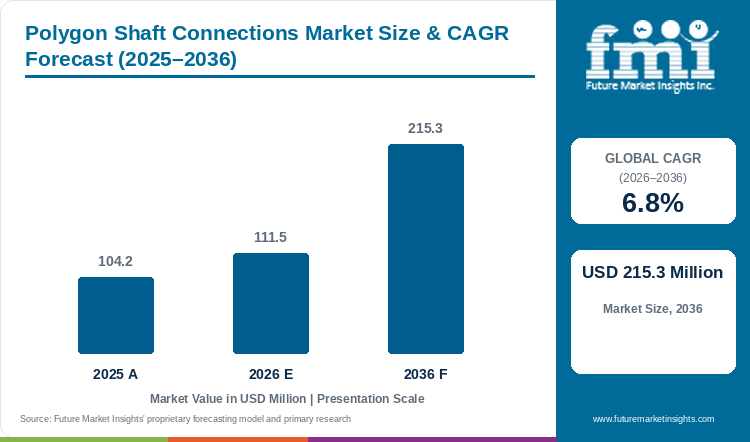
Starting with USD 104.2 million for 2025, the polygon shaft connections sector is estimated to total USD 111.5 million across 2026 and is forecast to attain USD 215.3 million in 2036 via a predicted 6.8% annual growth rate.
Mid-2026 Euro-indicator bulletins published by Eurostat in June 2026 showed seasonally adjusted April 2026 industrial output edging up 0.1% across both the eurozone and the EU27 (after March 2026 revisions of +0.4% and +0.8%, with annual capital-goods output up 3.4%) as factories retooled multi-tasking CNC spindles and heavy industrial drivetrains [1]. During these high-torque machinery upgrades, conventional keyed shafts and involute splines fail prematurely under reversing shock loads because sharp keyway root corners act as severe stress concentrators that initiate torsional fatigue cracks and fretting backlash. Replacing recessed key slots with a continuous harmonic curve ground onto the shaft and broached or ground inside the hub enables the P3G Trilobe Epitrochoidal Profile (DIN 32711) segment to claim a predicted 58.4% share of DIN 32711 / 32712 profile geometry demand in 2026. With 2025 turnover at USD 104.2 million and 2026 sales estimated at USD 111.5 million, the polygon shaft connections sector is projected to attain USD 215.3 million in 2036 at an anticipated 6.8% CAGR, representing a forecast USD 103.8 million gain in yearly industry turnover. This trajectory is further reinforced by factory standardization on 1:20 tapered polygon receivers across quick-change tool holders on turn-mill centers.
Key Market Trends & Insights
- By DIN 32711 / 32712 profile geometry: P3G Trilobe Epitrochoidal Profile (DIN 32711) (58.4% predicted share during 2026) is forecast to lead specifications because its continuous three-lobed curve lacks root stress concentrations and forms the geometric foundation of ISO 26623 polygonal spindle tooling.
- By fit & axial motion type: Tapered 1:20 Zero-Backlash Reversing-Torque Fit (53.0% forecast share during 2026) is expected to command the majority of demand since shallow 1:20 conical polygon shanks create radial interference and flange face contact simultaneously under drawbar tension.
- By end-use industrial application: Machine Tool Spindles, Gearboxes & Toolholders (PSC/Capto) (49.6% estimated share during 2026) are projected to represent the primary commercial outlet as mill-turn centers replace conventional steep-taper holders with rigid polygonal quick-change interfaces.
Regional Highlights
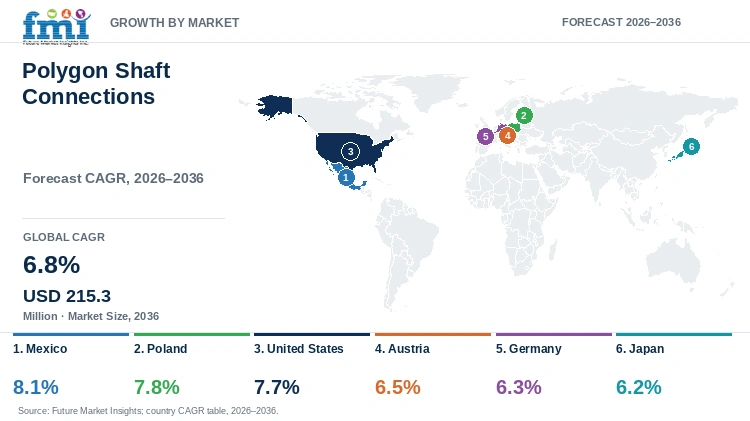
- Fastest national expansion: Mexico is forecast to top major industrial drivetrain markets by rising 8.1% yearly through 2036 as Queretaro and Nuevo Leon aerospace and automotive machining corridors adopt modular polygon tooling.
- Eastern European & North American reshoring hubs: Poland is projected to post a 7.8% yearly expansion rate and the United States is expected to scale by 7.7% each year until 2036 on heavy drive-shaft and automated CNC spindle investments.
- European & Japanese engineering bases: Austria is anticipated to compound by 6.5% per year whereas Germany is forecast to record 6.3% annual expansion and Japan is slated to achieve a 6.2% yearly clip across DIN-standard polygon grinding and motor-spindle plants.
Market Size & Forecast
Table 1: Market Size and Forecast for the Polygon Shaft Connections Market (USD million and CAGR percentage), 2025 to 2036
| Metric | Value |
|---|---|
| 2025 Market Size | USD 104.2 million |
| Estimated Market Size in 2026 | USD 111.5 million |
| Projected Market Size by 2036 | USD 215.3 million |
| CAGR, 2026 to 2036 | 6.8% |
| Added Revenue, 2026 to 2036 | USD 103.8 million |
Adoption of ISO 26623 polygonal shank tooling on turn-mill spindles and replacement of involute splines in high-torque extruders are reshaping precision shaft-hub manufacturing across Europe and North America. According to AMT's September 2026 USMTO release, July 2026 U.S. metalworking machinery orders totaled 605.8 million dollars (+55.2% year-on-year) and lifted seven-month bookings to 4.03 billion dollars (+37.1% year-on-year) as forging and contract machining plants added automated multi-tasking cells [2]. While German and Austrian spindle builders standardize on 1:20 tapered P3G interfaces for high-speed tool changers, heavy equipment plants across the United States and Poland specify cylindrical P4C and PC6 polygon shafts inside industrial gearboxes. Contract manufacturers equipped with synchronized CNC non-circular grinding and broaching cells capture recurring OEM shaft-hub awards.
Polygonal Shank and Heavy Drive-Shaft Production Sizing
Table 2: Polygonal Toolholder Shank and Drive-Shaft Volume Indicators for the Polygon Shaft Connections Market (USD million, thousand connections, and USD per unit), mixed historical and forecast years from 2025 to 2036
| Metric | 2025 | 2026 | 2036 |
|---|---|---|---|
| Market size (USD million) | 104.2 | 111.5 | 215.3 |
| Precision polygon shaft-hub connections produced (thousand units) | 410.0 to 440.0 | 435.0 to 468.0 | 780.0 to 840.0 |
| ISO 26623 / P3G tapered connections produced (thousand units) | 238.0 to 256.0 | 254.0 to 273.0 | 460.0 to 495.0 |
| Blended OEM realization per polygon connection (USD) | 236 to 254 | 238 to 256 | 256 to 276 |
Operational note: Connection volumes combine ISO 26623-1/2 (C3 to C10) tapered polygonal toolholder-spindle interfaces with custom-ground DIN 32711 P3G and DIN 32712 P4C heavy industrial shaft-hub couplings.
Grinding a true epitrochoidal P3G or four-lobed P4C profile requires synchronized C-axis workpiece rotation and X-axis wheelhead oscillation controlled by high-frequency CNC interpolators. In September 2026, Erwin Junker Maschinenfabrik GmbH (Junker Group) exhibited its Platform 3 modular high-speed CBN grinding machines at IMTS 2026 in Chicago for automated non-circular shaft and polygon profile production [3]. Replacing broached involute splines with finish-ground polygon shafts eliminates heat-treatment distortion and extends fatigue life inside twin-screw extruder and compounding machines.
Torsional Stress Capacity & Spindle Changeover Economics
Table 3: Engineering Performance and Spindle Economics for the Polygon Shaft Connections Market (USD, micron, and percentage metrics), mixed historical and forecast years from 2025 to 2036
| Metric | 2025 | 2026 | 2036 |
|---|---|---|---|
| Radial & axial toolholder repeatability tolerance (microns) | +/-2.0 | +/-2.0 | +/-1.0 |
| Shear strength gain vs. keyed shaft of equal diameter (%) | 35 to 40 | 35 to 42 | 38 to 45 |
| Typical ISO 26623 polygon taper ratio | 1:20 | 1:20 | 1:20 |
| Average polygon interface spend per mill-turn spindle build (USD) | 2,150 | 2,240 | 2,680 |
Table 4: Profile Geometry and Application Share Benchmarks for the Polygon Shaft Connections Market (USD million and percentages), 2026
| Benchmark Indicator | Reported / Modeled Value | Institutional Reference Basis |
|---|---|---|
| Market size, 2026 | USD 111.5 million | 2026 report valuation |
| P3G trilobe epitrochoidal profile revenue, 2026 | USD 65.1 million | 58.4% profile geometry share |
| Tapered 1:20 zero-backlash fit revenue, 2026 | USD 59.1 million | 53.0% fit & axial motion share |
| Machine tool spindles, gearboxes & toolholders revenue, 2026 | USD 55.3 million | 49.6% end-use application share |
Because a P3G polygon shaft lacks protruding spline teeth or recessed key slots, the full cross-sectional area of the alloy steel bar participates in shear torque transfer while reducing stress concentration factors below 1.3. Heavy steel mills and mining equipment builders increasingly retrofit polygon couplings onto work-roll drives in rolling mill machines to eliminate keyway cracking during reversing shock loads.
Analyst Perspective
"Self-centering 1:20 tapered P3G polygon connections have unified turning and rotating toolholders on modern multi-tasking machine spindles. Shaft grinders that pair synchronized CBN non-circular external grinding with single-setup internal bore grinding will capture heavy industrial powertrain conversions."
- Nikhil Kaitwade, Principal Consultant, Future Market Insights.
How is the polygon shaft connections market segmented?
The polygon shaft connections market is segmented by DIN 32711 / 32712 profile geometry, fit & axial motion type, end-use industrial application, and region. In 2026, P3G Trilobe Epitrochoidal Profile (DIN 32711) is predicted at 58.4%, Tapered 1:20 Zero-Backlash Reversing-Torque Fit is expected at 53.0%, and Machine Tool Spindles, Gearboxes & Toolholders (PSC/Capto) are projected at 49.6%.
By DIN 32711 / 32712 profile geometry: P3G Trilobe Epitrochoidal Profile (DIN 32711), P4C Four-Lobed Sliding-Fit Profile (DIN 32712), and PC6 Six-Lobed Heavy-Torque Profile.
By fit & axial motion type: Tapered 1:20 Zero-Backlash Reversing-Torque Fit, and Cylindrical Sliding-Gear Shift Fit.
By end-use industrial application: Machine Tool Spindles, Gearboxes & Toolholders (PSC/Capto), Rolling Mill, Extruder & Crusher Heavy Drive Shafts, and Railway Bogie Traction & Wind Gearbox Shafts.
Why Does the P3G Trilobe Epitrochoidal Profile (DIN 32711) Capture Nearly Three-Fifths of Profile Demand?
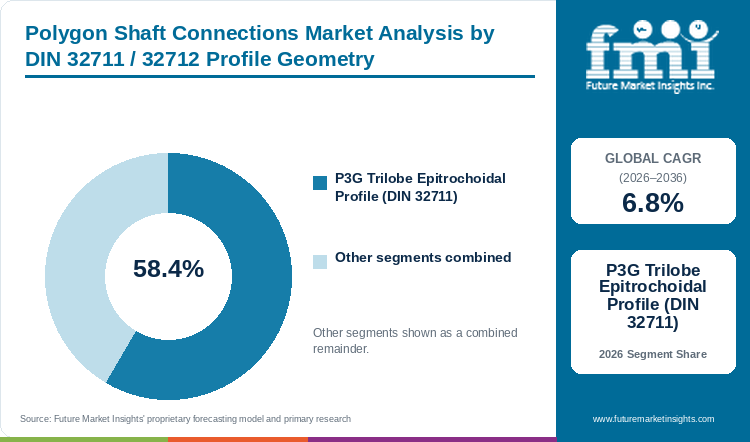
P3G Trilobe Epitrochoidal Profile (DIN 32711) is predicted to claim 58.4% of 2026 profile demand, stemming from ISO 26623 toolholders.
Table 5: DIN 32711 / 32712 Profile Geometry Share for the Polygon Shaft Connections Market (percentage share), 2026
| DIN 32711 / 32712 Profile Geometry Segment | Share (2026) |
|---|---|
| P3G Trilobe Epitrochoidal Profile (DIN 32711) | 58.4% |
| Other Segments Combined | 41.6%* |
| Total | 100.0% |
*Note: Combined share of remaining DIN 32711 / 32712 profile geometry categories totaling 100.0% of 2026 market demand.
Table 6: DIN 32711 / 32712 Profile Geometry Leadership and Market Growth for the Polygon Shaft Connections Market (segment and CAGR percentage), 2026 to 2036
| Metric | Value |
|---|---|
| Global CAGR (2026 to 2036) | 6.8% |
| Leading Segment | P3G Trilobe Epitrochoidal Profile (DIN 32711) |
Generated by a continuous harmonic curve without sharp transitions, the three-lobed DIN 32711 P3G profile automatically centers the hub on the shaft as torsional load increases and allows internal bores to be ground directly with a standard cylindrical wheel. In contrast, DIN 32712 P4C four-lobed profiles feature circular outer diameter arcs that require broaching or form-grinding for axial sliding fits, while six-lobed PC6 profiles serve ultra-heavy low-speed shafts. Standardization of the tapered P3G curve under ISO 26623-1/2 (Polygonal Shank Couplings) makes trilobe geometry the universal interface for sawing and cutting tools and motorized lathe spindles.
- P3G Trilobe Epitrochoidal Profile (DIN 32711) is forecast to command 58.4% of 2026 profile geometry revenue by combining low notch stress with economical internal and external CNC grinding.
- In June 2026, Sandvik AB published its Meet Sandvik 1/2026 group review highlighting Sandvik Coromant's expanding cutting-tool manufacturing and metrology footprint across South America and global machining corridors [4].
How Does Tapered 1:20 Zero-Backlash Reversing-Torque Fit Outperform Cylindrical Sliding Fits?
Tapered 1:20 Zero-Backlash Reversing-Torque Fit is expected to represent 53.0% of 2026 fit volume, benefiting from simultaneous face-and-taper spindle locking.
Grinding the polygon shaft and mating bore on a shallow 1:20 conical taper allows axial drawbar pull to expand the female socket elastically until the toolholder flange seats firmly against the spindle nose. This dual face-and-taper contact eliminates radial clearance and prevents micro-fretting when a mill-turn spindle reverses direction or switches from stationary turning to high-rpm milling. Whereas cylindrical sliding fits require 20 to 40 microns of radial clearance for gear shifting in automotive axle and propeller shafts, tapered 1:20 polygon joints maintain +/-2 micron repeatability without keys or drive dogs.
- Eliminating radial play under alternating cutting loads is expected to give Tapered 1:20 Zero-Backlash Reversing-Torque Fit 53.0% of 2026 fit & axial motion type sales.
- In February 2026, Kennametal Inc. launched its annual Machinist of the Year global program honoring metal-cutting innovators utilizing advanced Kennametal tooling and quick-change spindle interfaces [5].
What Places Machine Tool Spindles, Gearboxes & Toolholders (PSC/Capto) Ahead of Heavy Drive Shafts?
Machine Tool Spindles, Gearboxes & Toolholders (PSC/Capto) are projected to command 49.6% of 2026 application revenue, accompanied by quick-change lathe tooling.
Every multi-tasking turn-mill center and automated horizontal machining cell consumes dozens of C4 through C8 polygonal toolholders alongside a hardened polygon spindle receiver and gearbox shaft. Because polygonal shanks lack drive key slots, the toolholder remains dynamically balanced at 12,000 to 20,000 rpm while transmitting high bending moments during deep-hole boring of locomotive drive shafts. Recurring consumable replacement of polygonal toolholders and extensions across global job shops sustains a larger annual revenue pool than long-lived rolling-mill and railway shafts.
- High consumable attach rates per spindle are projected to give Machine Tool Spindles, Gearboxes & Toolholders (PSC/Capto) 49.6% of 2026 end-use application turnover.
- In its 2026 Americas tooling portfolio, BIG DAISHOWA Seiki Co. Ltd. offers its ISO 26623-1 licensed BIG CAPTO dual-contact modular system featuring a 1:20 polygon taper and guaranteed sub-3-micron accuracy at 4xD [6].
What are the drivers, restraints, and opportunities in the polygon shaft connections market?
Across the polygon shaft connections market, turn-mill spindle standardization on ISO 26623 polygonal interfaces and spline replacement in heavy extruders are anticipated to propel growth through 2036, while specialized non-circular bore grinding capital costs restrain small job-shop entry.
- Driver:Widespread OEM adoption of ISO 26623 (PSC / Coromant Capto) quick-change spindles and fatigue failures in keyed industrial drive shafts accelerate polygon connection orders.
- Restraint:High capital cost of synchronized C/X-axis CNC polygon internal and external grinding machines limits in-house production by general machine shops.
- Opportunity:Replacing fretting-prone involute splines in wind turbine gearboxes, electric railway bogie traction drives, and twin-screw plastic extruders creates high-margin custom shaft demand.
Growth Analysis and Future Potential: Qualitative Demand Catalysts
Contract machining plants and heavy powertrain OEMs are replacing traditional HSK and steep-taper toolholders as well as keyed drive shafts with DIN 32711 and ISO 26623 polygon connections to cut setup times and prevent torsional fatigue failures. In a keyed or splined shaft, sharp root corners concentrate shear stress and initiate cracks under reversing shock loads; a smooth P3G or P4C polygon profile distributes contact pressure across broad curved lobes. In October 2026, E. Zoller GmbH & Co. KG opened its Toolroom of the Year 2026 competition following IMTS 2026, spotlighting digital toolroom automation and presetting for precision toolholder systems [7]. Heavy traction builders also specify ground polygon joints inside railway engines and bogie axles to simplify bearing and gear dismounting during depot overhauls.
Risk Assessment of the Polygon Shaft Connections Market: Operational and Grinding Friction
Unlike cylindrical journals or straight keyways that can be machined on any standard lathe and vertical mill, producing a matched tapered polygon shaft and internal hub bore requires dedicated non-circular CNC grinding software and high-frequency linear motor axes. Internal grinding of a hardened 1:20 tapered P3G spindle receiver is particularly demanding because the small-diameter CBN wheel spindle must oscillate radially three times per workpiece revolution without deflection or thermal taper drift. In March 2026, Sandvik AB announced the second phase of its SEK 3 billion Machining business area restructuring program (targeting SEK 105 million in annual savings) to strengthen operational efficiency amid fluctuating industrial capital budgets [8]. Maintaining sub-micron profile accuracy requires temperature-controlled high-pressure emulsifiable metalworking fluids and tactile coordinate measuring machines.
Commercial Opportunity Analysis: Heavy Extruder, Wind Gearbox and Railway Retrofits
Beyond machine tool spindles, custom polygon shaft-hub specialists are capturing lucrative retrofit contracts across twin-screw polymer extruders and steel rolling mills alongside wind turbine planetary gearboxes. Four-lobed DIN 32712 P4C and six-lobed PC6 profiles allow axial sliding under torque while eliminating the tooth-flank fretting and spline seizing that plague heavily loaded involute splines. In February 2026, Erwin Junker Maschinenfabrik GmbH previewed its GrindingHub 2026 Stuttgart display featuring Platform 3 high-speed CBN and corundum grinding with optional internal grinding spindles for electrified powertrain and wind-power shafts [9]. Pairing custom-ground PC6 shafts with heavy-duty industrial couplings enables mining and petrochemical operators to extend mean time between gearbox overhauls.
Polygon Shaft Connections Market by Country (2026 to 2036)
Mexico is forecast to top global polygon shaft connections markets by rising 8.1% yearly through 2036, while Poland is projected to post a 7.8% yearly expansion rate and the United States is expected to scale by 7.7% each year as nearshore machining and heavy drivetrain plants expand. Precision European and East Asian grinding centers in Austria (anticipated at 6.5%) and Germany (predicted at 6.3%) alongside Japan (slated at 6.2%) sustain steady demand anchored by motor-spindle exports and ISO 26623 tooling upgrades.
Table 7: Country CAGR and Primary Growth Levers for the Polygon Shaft Connections Market (CAGR percentage and operational drivers), 2026 to 2036
| Country | CAGR (2026 to 2036) | Primary Growth Lever |
|---|---|---|
| Mexico | 8.1% | Queretaro and Nuevo Leon aerospace/automotive CNC turn-mill tooling and drive-shaft reshoring |
| Poland | 7.8% | Silesian and Aviation Valley CNC machining, railway bogie traction, and wind gearbox shaft manufacturing |
| United States | 7.7% | Custom aerospace/industrial polygon shaft retrofits and automated mill-turn Capto/KM spindle adoption |
| Austria | 6.5% | High-precision turn-mill machine builder exports and Alpine steel rolling-mill shaft engineering |
| Germany | 6.3% | DIN 32711/32712 standard origination, motor-spindle production, and CBN polygon grinding machine leadership |
| Japan | 6.2% | Multi-tasking lathe spindle production and ultra-precision BIG CAPTO modular tooling exports |
Source: Future Market Insights analysis
Mexico Polygon Shaft Connections Market Outlook (2026 to 2036)
In September 2026, INEGI's Monthly Indicator of Industrial Activity (IMAI) documented that Mexico's industrial sector grew 0.5% monthly and 2.4% annually during July 2026 (before accelerating to 3.6% annual growth in August 2026) [10]. Mexico is uniquely dynamic compared with legacy industrial markets because greenfield automotive e-axle and heavy truck transmission plants alongside aerospace subcontractors in Queretaro and Nuevo Leon are bypassing traditional steep-taper and keyed-shaft machinery altogether in favor of automated turn-mill cells equipped with ISO 26623 polygon spindles. Fueled by this greenfield equipment wave, Mexican polygon shaft connections sales are projected to rise 8.1% yearly through 2036. Heavy reliance on imported European spindle receivers and local shortages of non-circular CNC grinding programmers remain key operational hurdles.
Key takeaway: In Mexico, nearshored aerospace and automotive turn-mill machining plants are projected to fuel an 8.1% yearly rise for ISO 26623 polygonal tooling and shafts.
Poland Polygon Shaft Connections Market Outlook (2026 to 2036)
Poland's growth profile differs structurally from Western European OEM markets because Upper Silesia and Rzeszow's Aviation Valley have become the European Union's primary nearshored contract manufacturing base for electric railway bogie traction shafts and wind-turbine planetary gearboxes alongside precision ground polygon sleeves. In September 2026, Statistics Poland (GUS) reported that August 2026 sold production of industry rose 4.3% year-on-year and expanded 3.5% across January-August 2026 [11]. Supported by Western European drivetrain plant relocations, Polish polygon shaft connections demand is expected to post a 7.8% yearly expansion rate through 2036 while local gear shops replace keyed shafts with P3G and P4C profiles. Rising Polish industrial electricity tariffs and tight CNC grinder operator availability nonetheless pressure subcontractor margins.
Key takeaway: In Poland, nearshored aerospace machining and heavy rail and wind gearbox manufacturing are expected to generate a 7.8% yearly expansion rate through 2036.
United States Polygon Shaft Connections Market Outlook (2026 to 2036)
American polygon shaft connections spending is forecast to scale by 7.7% each year until 2036 as contract machine shops and petrochemical compounding plants upgrade to high-torque keyless interfaces. Unlike European industries where DIN 32711 and DIN 32712 polygon standards have been embedded for decades, the American market is characterized by an active retrofit conversion wave as defense depots and titanium aerostructure shops alongside twin-screw extruder operators replace fretting-prone ANSI involute splines with custom Stoffel Polygon shafts and KM/PSC quick-change tooling. October 2026 Census Bureau MTIS tables for August 2026 showed combined business sales climbing 10.2% year-on-year to USD 2,123.5 billion and factory shipments rising 8.5% year-on-year [12]. Extended domestic lead times for custom carbide internal polygon broaches still challenge small-batch buyers.
Key takeaway: In the United States, automated multi-tasking lathe adoption and heavy industrial spline-to-polygon retrofits are forecast to drive a 7.7% yearly expansion.
Austria Polygon Shaft Connections Market Outlook (2026 to 2036)
What sets Austria apart from volume-driven metalworking economies is its extraordinary concentration of world-leading heavy mill-turn machine builders in Linz and Hallein alongside high-speed railway bogie traction plants in Graz and steel rolling-mill engineering primes that specify 1:20 tapered P3G and sliding P4C polygon connections as baseline architecture. Anchored by these export-intensive OEMs, Austrian polygon shaft connections turnover is predicted to compound at a 6.5% CAGR until 2036. Eurostat short-term business indices published in May 2026 showed Austrian industrial output advancing 0.7% month-on-month and 2.2% year-on-year in March 2026 after posting consecutive annual gains in January and February [13]. Elevated Alpine industrial energy tariffs and specialist machinist wage inflation nevertheless compel Austrian suppliers to run lights-out CBN grinding cells.
Key takeaway: In Austria, heavy turn-mill machine builder exports and rail and rolling-mill drivetrain engineering are predicted to maintain a 6.5% annual compounding rate.
Germany Polygon Shaft Connections Market Outlook (2026 to 2036)
As the country that codified the DIN 32711 (P3G) and DIN 32712 (P4C) mathematical standards, Germany is uniquely positioned in the global market as the home of both non-circular CBN polygon grinding machine pioneers (JUNKER Group) and Europe's largest motorized turn-mill spindle and twin-screw extruder builders across Baden-Wuerttemberg and Bavaria. German polygon shaft connections revenue is estimated to register 6.3% yearly growth from 2026 through 2036 while domestic drivetrain and spindle OEMs pivot toward wind-gearbox pinions and automated PSC motor spindles. Late-August 2026 survey releases from the ifo Institute recorded the German Business Climate Index reaching 88.8 points as manufacturing sentiment improved from -9.6 to -4.2 [14]. Structural contraction in domestic combustion-engine automotive shafts and high grid electricity costs remain primary headwinds.
Key takeaway: In Germany, DIN polygon standard leadership alongside CBN grinding machine exports and motor-spindle production is estimated to deliver 6.3% yearly growth through 2036.
Japan Polygon Shaft Connections Market Outlook (2026 to 2036)
August 2026 revised production figures from METI confirmed that Japan's June 2026 industrial index climbed 1.9% over May (+4.9% compared with June 2025) to 104.6 while the factory operating ratio jumped 4.1% to 107.2 [15]. Japanese polygon shaft connections turnover is slated to record a 6.2% annual clip between 2026 and 2036 as five-axis turn-mill centers proliferate across domestic subcontractors. Unlike Western markets where heavy rolling-mill and mining shafts dominate tonnage, Japan's domestic market is uniquely centered on sub-micron ISO 26623 BIG CAPTO toolholders and damped boring bars alongside high-speed motor spindles built across Aichi and Osaka. Strict OEM price benchmarks and an aging cohort of grinding craftsmen compel local plants to adopt automated non-circular grinding cells.
Key takeaway: In Japan, global leadership in multi-tasking CNC lathes and sub-micron ISO 26623 polygonal toolholders is slated to secure a 6.2% annual clip.
Full report country CAGRs cover: North America; Latin America; Western Europe; Eastern Europe; East Asia; South Asia and Pacific; Middle East and Africa.
Who are the notable companies in the polygon shaft connections market?
Sandvik AB, Kennametal Inc., BIG DAISHOWA Seiki Co., Ltd., E. Zoller GmbH & Co. KG, Franz Kessler GmbH, Stoffel Polygon Systems Inc., Erwin Junker Maschinenfabrik GmbH, and Seco Tools AB are the notable companies in the polygon shaft connections market.
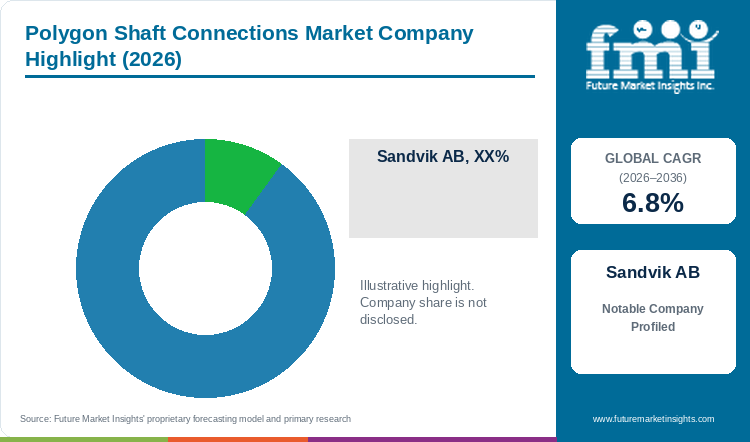
Competitive positioning across the polygon shaft connections market divides into global ISO 26623 polygonal tooling pioneers alongside high-speed motor-spindle specialists and custom industrial polygon shaft builders. Sandvik AB and Kennametal Inc. together with BIG DAISHOWA Seiki Co. Ltd. and Seco Tools AB supply the global installed base of 1:20 tapered P3G polygonal toolholders and modular boring extensions. Franz Kessler GmbH and Zoller GmbH & Co. KG provide the motorized PSC/Capto turn-mill spindles and automated tool-presetting metrology hardware required to run polygonal tooling cells. Meanwhile, Stoffel Polygon Systems Inc. and Erwin Junker Maschinenfabrik GmbH manufacture custom DIN 32711/32712/PC6 heavy drive shafts and the specialized CNC non-circular CBN grinding machines that generate them.
- ISO 26623 Polygonal Tooling & Quick-Change Interface Leaders: Sandvik AB and Kennametal Inc. alongside BIG DAISHOWA Seiki Co. Ltd. and Seco Tools AB manufacture 1:20 tapered P3G polygonal toolholders and modular boring bars.
- Motor-Spindle & Polygonal Tool-Management Subsystem Specialists: Franz Kessler GmbH and Zoller GmbH & Co. KG build high-torque turn-mill spindles with integrated PSC clamping and automated polygonal tool-presetting systems.
- Custom Industrial Polygon Shaft & Non-Circular Grinding Builders: Stoffel Polygon Systems Inc. and Erwin Junker Maschinenfabrik GmbH supply custom P3G and P4C heavy drive shafts alongside CNC non-circular CBN grinding platforms.
Competitive Benchmarking: Polygon Shaft Connections Market
Table 8: Competitive Benchmarking for the Polygon Shaft Connections Market (qualitative capability ratings), 2026
| Company | Polygon Profile Breadth | 1:20 Taper Repeatability | Spindle / Drivetrain Reach | Geographic Reach |
|---|---|---|---|---|
| Sandvik AB | High | High | High | High |
| Kennametal Inc. | High | High | High | High |
| BIG DAISHOWA Seiki Co., Ltd. | Medium | High | High | High |
| E. Zoller GmbH & Co. KG | Medium | High | High | High |
| Franz Kessler GmbH | Medium | High | High | High |
| Stoffel Polygon Systems Inc. | High | High | Medium | Medium |
| Erwin Junker Maschinenfabrik GmbH | High | High | High | High |
| Seco Tools AB | Medium | High | High | High |
Scoring basis: Polygon Profile Breadth rates High when a company supplies or grinds multiple polygon geometries spanning DIN 32711 P3G and DIN 32712 P4C or full ISO 26623 C3-C10 ranges, and Medium when focused primarily on tapered toolholder shanks. 1:20 Taper Repeatability reflects documented sub-2-micron radial and axial positioning precision. Spindle / Drivetrain Reach evaluates deployment across both CNC machine tool spindles and heavy industrial drive shafts.
Key Developments in the Polygon Shaft Connections Market
- In March 2025, Erwin Junker Maschinenfabrik GmbH highlighted its KARGO cylindrical and profile grinding platform capable of external and internal grinding of heavy wind-turbine and industrial gear shafts up to 5,000 mm and 5,000 kg with swiveling in-process metrology [16].
- In February 2025, Seco Tools AB launched the new generation of its Seco Octomill 06 self-centering face milling cutter series engineered for flexible multi-insert indexing across modular spindle tooling systems [17].
- In its 2026 spindle technology portfolio, Franz Kessler GmbH (Europe's largest spindle manufacturer with 600+ employees) features its HC line for heavy aerospace titanium cutting and compact MT line for turning and milling tilting heads [18].
Key Players in the Polygon Shaft Connections Market
ISO 26623 Polygonal Tooling & Quick-Change Interface Leaders
- Sandvik AB
- Kennametal Inc.
- BIG DAISHOWA Seiki Co., Ltd.
- Seco Tools AB
Motor-Spindle & Polygonal Tool-Management Subsystem Specialists
- Franz Kessler GmbH
- E. Zoller GmbH & Co. KG
Custom Industrial Polygon Shaft & Non-Circular Grinding Builders
- Stoffel Polygon Systems Inc.
- Erwin Junker Maschinenfabrik GmbH
Polygon Shaft Connections Market - Report Scope
Table 9: Report Scope for the Polygon Shaft Connections Market (coverage fields and definitions), 2026 to 2036
| Coverage field | Report scope |
|---|---|
| Market breakdown | DIN 32711 / 32712 Profile Geometry; Fit & Axial Motion Type; End-Use Industrial Application; Region |
| Quantitative Units | USD Million |
| Market Definition | Includes manufacturer revenue from precision-ground non-circular polygon shaft-hub connections (DIN 32711 P3G trilobe, DIN 32712 P4C four-lobed, and PC6 six-lobed profiles) and ISO 26623 (PSC / Coromant Capto / KM) polygonal spindle clamping interfaces, shanks, and heavy industrial drive shafts. Category Scope Note: Excludes conventional parallel-keyed shafts, standard involute gear splines, face-toothed Hirth/Curvic rings, and solid carbide cutting inserts. |
| Regions Covered | North America; Latin America; Western Europe; Eastern Europe; East Asia; South Asia and Pacific; Middle East and Africa |
| Countries Covered | Mexico, Poland, United States, Austria, Germany, Japan, and additional countries in the full report |
| Key Companies Covered | Sandvik AB, Kennametal Inc., BIG DAISHOWA Seiki Co., Ltd., E. Zoller GmbH & Co. KG, Franz Kessler GmbH, Stoffel Polygon Systems Inc., Erwin Junker Maschinenfabrik GmbH, Seco Tools AB |
| Forecast Period | 2026 to 2036 |
| Approach | Primary and secondary research with rigorous market triangulation. |
Polygon Shaft Connections Market - Research Methodology
Table 10: Research Methodology for the Polygon Shaft Connections Market (research methods and approach), 2026 edition
| Method | Approach |
|---|---|
| Primary Research | Primary interviews were conducted with non-circular CBN grinding specialists, turn-mill motor-spindle engineers, ISO 26623 polygonal toolholder product managers, and heavy rolling-mill drivetrain designers to validate profile share splits, taper tolerances, and spline-replacement economics. |
| Secondary Research | Secondary research encompassed DIN 32711, DIN 32712, and ISO 26623 engineering standards, Eurostat and U.S. Census Bureau manufacturing bulletins, INEGI and GUS industrial production reports, and technical literature from Sandvik, Kennametal, BIG DAISHOWA, Junker, and Stoffel Polygon. |
| Market Sizing and Forecasting | Market sizing and forecasting for 2026 to 2036 combined bottom-up tracking of annual multi-tasking CNC spindle builds, polygonal toolholder attach rates, and custom industrial polygon shaft shipments with top-down machinery CapEx modeling. |
| Data Triangulation and Validation | Estimates were cross-checked against global turn-mill lathe production, CNC non-circular grinder installations, and industrial gearbox rebuild volumes to avoid double counting complete machine tool spindles or cutting inserts. |
| Country Forecasting Model | Country CAGRs are calibrated around the 6.8% global baseline using national CNC machinery order trends, nearshoring manufacturing indices from INEGI, GUS, and the U.S. Census Bureau, and European/Japanese spindle production data from Statistik Austria, Destatis, and METI. |
| Operational Benchmark Traceability | Operational benchmarks in Tables 2, 3, and 4 (connection unit volumes, realization per unit, +/-2 micron repeatability, 1:20 taper ratio, and 35-40% shear strength gain) trace to ISO 26623-1/2 specifications, DIN 32711/32712 tables, and Stoffel Polygon engineering benchmarks. |
Polygon Shaft Connections Market by Segments
Polygon Shaft Connections Market segmented by DIN 32711 / 32712 Profile Geometry:
- P3G Trilobe Epitrochoidal Profile (DIN 32711)
- P4C Four-Lobed Sliding-Fit Profile (DIN 32712)
- PC6 Six-Lobed Heavy-Torque Profile
Polygon Shaft Connections Market segmented by Fit & Axial Motion Type:
- Tapered 1:20 Zero-Backlash Reversing-Torque Fit
- Cylindrical Sliding-Gear Shift Fit
Polygon Shaft Connections Market segmented by End-Use Industrial Application:
- Machine Tool Spindles, Gearboxes & Toolholders (PSC/Capto)
- Rolling Mill, Extruder & Crusher Heavy Drive Shafts
- Railway Bogie Traction & Wind Gearbox Shafts
Polygon Shaft Connections Market by Region
- North America
- United States
- Canada
- Latin America
- Brazil
- Mexico
- Argentina
- Chile
- Western Europe
- Germany
- France
- United Kingdom
- Italy
- Austria
- Spain
- Benelux
- Nordics
- Eastern Europe
- Poland
- Czech Republic
- Romania
- Hungary
- East Asia
- China
- Japan
- South Korea
- Taiwan
- South Asia and Pacific
- India
- ASEAN
- Australia and New Zealand
- Middle East and Africa
- GCC Countries
- South Africa
- Türkiye
- Israel
Research Sources and Bibliography
- [1] Eurostat. (2026, June 15). Industrial production up by 0.1% in both the euro area and the EU. Publications Office of the European Union.
- [2] Association For Manufacturing Technology (AMT). (2026, September 13). Manufacturing Technology Orders Exceed $500M for 5th Consecutive Month. AMT - The Association For Manufacturing Technology.
- [3] Erwin Junker Maschinenfabrik GmbH. (2026, June 12). The JUNKER Group at IMTS 2026: Cutting-Edge Grinding Innovations. JUNKER Group.
- [4] Sandvik AB. (2026, June 24). Meet Sandvik 1/2026 published. Sandvik AB.
- [5] Kennametal Inc. (2026, February 24). Kennametal Launches "Machinist of the Year" Global Program to Honor Long-Time Customers. Kennametal Inc.
- [6] BIG DAISHOWA—Americas. (2026). BIG CAPTO Tooling System From BIG DAISHOWA - Americas. BIG DAISHOWA Seiki Co., Ltd.
- [7] E. Zoller GmbH & Co. KG. (2026, October 09). TOOLROOM OF THE YEAR 2026 - ZOLLER. E. Zoller GmbH & Co. KG.
- [8] Sandvik AB. (2026, March 30). Sandvik implements the second phase of restructuring initiatives in Machining. Sandvik AB.
- [9] Erwin Junker Maschinenfabrik GmbH. (2026, February 25). We are grinding the future. Precisely. Intelligently. Sustainably. JUNKER Group.
- [10] National Institute of Statistics and Geography (INEGI). (2026, September 11). Aumentó 0.5% la actividad industrial en julio de 2026, a tasa mensual. Instituto Nacional de Estadística y Geografía (INEGI).
- [11] Statistics Poland (GUS). (2026, September 18). Sold production of industry in August 2026. Główny Urząd Statystyczny (Statistics Poland).
- [12] U.S. Census Bureau. (2026, October 15). Manufacturing and Trade Inventories and Sales - August 2026. U.S. Department of Commerce.
- [13] Eurostat. (2026, May 13). Industrial production up by 0.2% in the euro area and by 0.8% in the EU. Publications Office of the European Union.
- [14] ifo Institute. (2026, August 25). ifo Business Climate Rises (August 2026). ifo Institute – Leibniz Institute for Economic Research at the University of Munich.
- [15] Ministry of Economy, Trade and Industry (METI). (2026, August 17). Indices of Industrial Production (Revised Report for June 2026). Ministry of Economy, Trade and Industry, Japan.
- [16] Erwin Junker Maschinenfabrik GmbH. (2025, March 18). The reliable and cost-effective solution for grinding of gear shafts in the wind power industry. JUNKER Group.
- [17] Seco Tools AB. (2025, February 18). New Seco Face Milling Cutter offers high flexibility and ease of use. Seco Tools AB.
- [18] Franz Kessler GmbH. (2026). About Us - Franz Kessler. KESSLER Group.
- [19] Stoffel Polygon Systems Inc. (2025). Polygon Mechanical Systems - Polygon Profile Manufacturer. Stoffel Polygon Systems Inc.
- [20] Sandvik Coromant. (2026). Silent Tools™: Damped machining tools - Sandvik Coromant. AB Sandvik Coromant.
This bibliography is provided for reader reference and is not exhaustive. The full report contains the complete reference list and detailed citations.
This Report Answers
- How large is the polygon shaft connections market in 2026 and what is forecast for 2036?
- Which multi-tasking CNC spindle and heavy drivetrain pressures support polygon connection demand?
- Why does the P3G Trilobe Epitrochoidal Profile (DIN 32711) lead the profile geometry category?
- Why does Tapered 1:20 Zero-Backlash Reversing-Torque Fit lead the fit & axial motion category?
- How do growth rates differ across Mexico, Poland, the United States, Austria, Germany, and Japan?
- Which leading companies manufacture polygonal toolholders, spindles, and custom drive shafts today?
- What limits adoption or supplier switching in the polygon shaft connections market?
- What should powertrain and tooling engineers evaluate before specifying a polygon shaft connection?
Frequently Asked Questions
How big is the polygon shaft connections market in 2026, and what is forecast for 2036?
Global polygon shaft connections revenue is estimated to total USD 111.5 million in 2026 (up from USD 104.2 million in 2025) and is projected to reach USD 215.3 million by 2036 as turn-mill spindles and heavy industrial drivetrains replace keyed and splined joints.
What compound annual growth rate is forecast for the polygon shaft connections market?
Future Market Insights projects that global turnover will expand at an anticipated 6.8% CAGR between 2026 and 2036, yielding a projected USD 103.8 million rise in yearly revenue across precision tooling and industrial shaft applications.
Which DIN 32711 / 32712 profile geometry leads the market in 2026?
P3G Trilobe Epitrochoidal Profile (DIN 32711) is predicted to claim a 58.4% share in 2026 because its smooth three-lobed curve self-centers under torque without root stress risers and underpins ISO 26623 polygonal toolholders.
Which fit & axial motion type holds the largest share in 2026?
Tapered 1:20 Zero-Backlash Reversing-Torque Fit is expected to represent 53.0% of 2026 volume by generating simultaneous conical radial interference and flange face contact that eliminates play during spindle reversal.
Which country posts the fastest growth in the polygon shaft connections market?
As per FMI, Mexico is projected to pace major industrial drivetrain and machining markets at an anticipated 8.1% CAGR from 2026 to 2036, fueled by aerospace and automotive CNC turn-mill investments across Queretaro and Nuevo Leon.
Who are the notable companies in the polygon shaft connections market?
Major participants include Sandvik AB (Sandvik Coromant), Kennametal Inc., BIG DAISHOWA Seiki Co., Ltd., E. Zoller GmbH & Co. KG, Franz Kessler GmbH, Stoffel Polygon Systems Inc., Erwin Junker Maschinenfabrik GmbH, and Seco Tools AB.
Preview the report firsthand - request a free sample
Get SampleGet the brochure for pricing and purchase details.
Get PDFTable of Content
- Key Takeaways
- Market Size and CAGR
- Top Growth Driver
- Fastest Growing Segment
- Leading Region
- Key Companies
- Emerging Opportunities
- Executive Summary
- Global Market Outlook
- Demand-side Trends
- Supply-side Trends
- Technology Roadmap Analysis
- Analysis and Recommendations
- Analyst Perspective (What is happening? Why now? What should investors know?)
- Key Questions Answered
- How large is the market?
- What is the CAGR?
- What are key trends?
- Which region dominates?
- Who are the leaders?
- Market Overview
- Market Coverage / Taxonomy
- Market Definition / Scope / Limitations
- Research Methodology
- Chapter Orientation
- Analytical Lens and Working Hypotheses
- Market Structure, Signals, and Trend Drivers
- Benchmarking and Cross-market Comparability
- Market Sizing, Forecasting, and Opportunity Mapping
- Research Design and Evidence Framework
- Desk Research Programme (Secondary Evidence)
- Expert Input and Fieldwork (Primary Evidence)
- Tooling, Models, and Reference Databases
- Data Engineering and Model Build
- Quality Assurance and Audit Trail
- Market Background
- Market Dynamics (Drivers, Restraints, Opportunity, Trends)
- Scenario Forecast (Optimistic, Likely, Conservative)
- Impact Analysis
- AI Impact
- Sustainability Impact
- Regulatory Impact
- Technology Impact
- Consumer / Buyer Analysis
- Purchase Drivers
- Adoption Barriers
- Buyer Journey
- Opportunity Map Analysis
- Product Life Cycle Analysis
- Supply Chain Analysis
- Investment Feasibility Matrix
- Value Chain Analysis
- PESTLE and Porter's Analysis
- Regulatory Landscape
- Regional Parent Market Outlook
- Production and Consumption Statistics
- Import and Export Statistics
- Global Market Analysis and Forecast, 2021 to 2036
- Historical Market Size Value (USD Million) Analysis, 2021 to 2025
- Current and Future Market Size Value (USD Million) Projections, 2026 to 2036
- Y-o-Y Growth Trend Analysis
- Absolute $ Opportunity Analysis
- Global Market Pricing Analysis, 2021 to 2036
- Global Market Analysis and Forecast, By DIN 32711 / 32712 Profile Geometry, 2021 to 2036
- Introduction / Key Findings
- Historical Market Size Value (USD Million) Analysis By DIN 32711 / 32712 Profile Geometry, 2021 to 2025
- Current and Future Market Size Value (USD Million) Analysis and Forecast By DIN 32711 / 32712 Profile Geometry, 2026 to 2036
- P3G Trilobe Epitrochoidal Profile (DIN 32711)
- P4C Four-Lobed Sliding-Fit Profile (DIN 32712)
- PC6 Six-Lobed Heavy-Torque Profile
- Y-o-Y Growth Trend Analysis By DIN 32711 / 32712 Profile Geometry, 2021 to 2025
- Absolute $ Opportunity Analysis By DIN 32711 / 32712 Profile Geometry, 2026 to 2036
- Global Market Analysis and Forecast, By Fit & Axial Motion Type, 2021 to 2036
- Introduction / Key Findings
- Historical Market Size Value (USD Million) Analysis By Fit & Axial Motion Type, 2021 to 2025
- Current and Future Market Size Value (USD Million) Analysis and Forecast By Fit & Axial Motion Type, 2026 to 2036
- Tapered 1:20 Zero-Backlash Reversing-Torque Fit
- Cylindrical Sliding-Gear Shift Fit
- Y-o-Y Growth Trend Analysis By Fit & Axial Motion Type, 2021 to 2025
- Absolute $ Opportunity Analysis By Fit & Axial Motion Type, 2026 to 2036
- Global Market Analysis and Forecast, By End-Use Industrial Application, 2021 to 2036
- Introduction / Key Findings
- Historical Market Size Value (USD Million) Analysis By End-Use Industrial Application, 2021 to 2025
- Current and Future Market Size Value (USD Million) Analysis and Forecast By End-Use Industrial Application, 2026 to 2036
- Machine Tool Spindles, Gearboxes & Toolholders (PSC/Capto)
- Rolling Mill, Extruder & Crusher Heavy Drive Shafts
- Railway Bogie Traction & Wind Gearbox Shafts
- Y-o-Y Growth Trend Analysis By End-Use Industrial Application, 2021 to 2025
- Absolute $ Opportunity Analysis By End-Use Industrial Application, 2026 to 2036
- Global Market Analysis and Forecast, By Region, 2021 to 2036
- Introduction
- Historical Market Size Value (USD Million) Analysis By Region, 2021 to 2025
- Current Market Size Value (USD Million) Analysis and Forecast By Region, 2026 to 2036
- North America
- Latin America
- Western Europe
- Eastern Europe
- East Asia
- South Asia and Pacific
- Middle East and Africa
- Market Attractiveness Analysis By Region
- North America Market Analysis and Forecast, By Country, 2021 to 2036
- Historical Market Size Value (USD Million) Trend Analysis By Market Taxonomy, 2021 to 2025
- Market Size Value (USD Million) Forecast By Market Taxonomy, 2026 to 2036
- By Country
- United States
- Canada
- By DIN 32711 / 32712 Profile Geometry
- By Fit & Axial Motion Type
- By End-Use Industrial Application
- By Country
- Market Attractiveness Analysis
- By Country
- By DIN 32711 / 32712 Profile Geometry
- By Fit & Axial Motion Type
- By End-Use Industrial Application
- Key Takeaways
- Latin America Market Analysis and Forecast, By Country
- Historical Market Size Value (USD Million) Trend Analysis By Market Taxonomy, 2021 to 2025
- Market Size Value (USD Million) Forecast By Market Taxonomy, 2026 to 2036
- By Country
- Brazil
- Mexico
- Argentina
- Chile
- By DIN 32711 / 32712 Profile Geometry
- By Fit & Axial Motion Type
- By End-Use Industrial Application
- By Country
- Market Attractiveness Analysis
- By Country
- By DIN 32711 / 32712 Profile Geometry
- By Fit & Axial Motion Type
- By End-Use Industrial Application
- Key Takeaways
- Western Europe Market Analysis and Forecast, By Country
- Historical Market Size Value (USD Million) Trend Analysis By Market Taxonomy, 2021 to 2025
- Market Size Value (USD Million) Forecast By Market Taxonomy, 2026 to 2036
- By Country
- Germany
- France
- United Kingdom
- Italy
- Austria
- Spain
- Benelux
- Nordics
- By DIN 32711 / 32712 Profile Geometry
- By Fit & Axial Motion Type
- By End-Use Industrial Application
- By Country
- Market Attractiveness Analysis
- By Country
- By DIN 32711 / 32712 Profile Geometry
- By Fit & Axial Motion Type
- By End-Use Industrial Application
- Key Takeaways
- Eastern Europe Market Analysis and Forecast, By Country
- Historical Market Size Value (USD Million) Trend Analysis By Market Taxonomy, 2021 to 2025
- Market Size Value (USD Million) Forecast By Market Taxonomy, 2026 to 2036
- By Country
- Poland
- Czech Republic
- Romania
- Hungary
- By DIN 32711 / 32712 Profile Geometry
- By Fit & Axial Motion Type
- By End-Use Industrial Application
- By Country
- Market Attractiveness Analysis
- By Country
- By DIN 32711 / 32712 Profile Geometry
- By Fit & Axial Motion Type
- By End-Use Industrial Application
- Key Takeaways
- East Asia Market Analysis and Forecast, By Country
- Historical Market Size Value (USD Million) Trend Analysis By Market Taxonomy, 2021 to 2025
- Market Size Value (USD Million) Forecast By Market Taxonomy, 2026 to 2036
- By Country
- China
- Japan
- South Korea
- Taiwan
- By DIN 32711 / 32712 Profile Geometry
- By Fit & Axial Motion Type
- By End-Use Industrial Application
- By Country
- Market Attractiveness Analysis
- By Country
- By DIN 32711 / 32712 Profile Geometry
- By Fit & Axial Motion Type
- By End-Use Industrial Application
- Key Takeaways
- South Asia and Pacific Market Analysis and Forecast, By Country
- Historical Market Size Value (USD Million) Trend Analysis By Market Taxonomy, 2021 to 2025
- Market Size Value (USD Million) Forecast By Market Taxonomy, 2026 to 2036
- By Country
- India
- ASEAN
- Australia and New Zealand
- By DIN 32711 / 32712 Profile Geometry
- By Fit & Axial Motion Type
- By End-Use Industrial Application
- By Country
- Market Attractiveness Analysis
- By Country
- By DIN 32711 / 32712 Profile Geometry
- By Fit & Axial Motion Type
- By End-Use Industrial Application
- Key Takeaways
- Middle East and Africa Market Analysis and Forecast, By Country
- Historical Market Size Value (USD Million) Trend Analysis By Market Taxonomy, 2021 to 2025
- Market Size Value (USD Million) Forecast By Market Taxonomy, 2026 to 2036
- By Country
- GCC Countries
- South Africa
- Türkiye
- Israel
- By DIN 32711 / 32712 Profile Geometry
- By Fit & Axial Motion Type
- By End-Use Industrial Application
- By Country
- Market Attractiveness Analysis
- By Country
- By DIN 32711 / 32712 Profile Geometry
- By Fit & Axial Motion Type
- By End-Use Industrial Application
- Key Takeaways
- Key Countries Market Analysis
- United States
- Pricing Analysis
- Market Share Analysis, 2025
- By DIN 32711 / 32712 Profile Geometry
- By Fit & Axial Motion Type
- By End-Use Industrial Application
- Canada
- Pricing Analysis
- Market Share Analysis, 2025
- By DIN 32711 / 32712 Profile Geometry
- By Fit & Axial Motion Type
- By End-Use Industrial Application
- Mexico
- Pricing Analysis
- Market Share Analysis, 2025
- By DIN 32711 / 32712 Profile Geometry
- By Fit & Axial Motion Type
- By End-Use Industrial Application
- Brazil
- Pricing Analysis
- Market Share Analysis, 2025
- By DIN 32711 / 32712 Profile Geometry
- By Fit & Axial Motion Type
- By End-Use Industrial Application
- Chile
- Pricing Analysis
- Market Share Analysis, 2025
- By DIN 32711 / 32712 Profile Geometry
- By Fit & Axial Motion Type
- By End-Use Industrial Application
- Germany
- Pricing Analysis
- Market Share Analysis, 2025
- By DIN 32711 / 32712 Profile Geometry
- By Fit & Axial Motion Type
- By End-Use Industrial Application
- United Kingdom
- Pricing Analysis
- Market Share Analysis, 2025
- By DIN 32711 / 32712 Profile Geometry
- By Fit & Axial Motion Type
- By End-Use Industrial Application
- Italy
- Pricing Analysis
- Market Share Analysis, 2025
- By DIN 32711 / 32712 Profile Geometry
- By Fit & Axial Motion Type
- By End-Use Industrial Application
- Spain
- Pricing Analysis
- Market Share Analysis, 2025
- By DIN 32711 / 32712 Profile Geometry
- By Fit & Axial Motion Type
- By End-Use Industrial Application
- France
- Pricing Analysis
- Market Share Analysis, 2025
- By DIN 32711 / 32712 Profile Geometry
- By Fit & Axial Motion Type
- By End-Use Industrial Application
- India
- Pricing Analysis
- Market Share Analysis, 2025
- By DIN 32711 / 32712 Profile Geometry
- By Fit & Axial Motion Type
- By End-Use Industrial Application
- ASEAN
- Pricing Analysis
- Market Share Analysis, 2025
- By DIN 32711 / 32712 Profile Geometry
- By Fit & Axial Motion Type
- By End-Use Industrial Application
- Australia and New Zealand
- Pricing Analysis
- Market Share Analysis, 2025
- By DIN 32711 / 32712 Profile Geometry
- By Fit & Axial Motion Type
- By End-Use Industrial Application
- China
- Pricing Analysis
- Market Share Analysis, 2025
- By DIN 32711 / 32712 Profile Geometry
- By Fit & Axial Motion Type
- By End-Use Industrial Application
- Japan
- Pricing Analysis
- Market Share Analysis, 2025
- By DIN 32711 / 32712 Profile Geometry
- By Fit & Axial Motion Type
- By End-Use Industrial Application
- South Korea
- Pricing Analysis
- Market Share Analysis, 2025
- By DIN 32711 / 32712 Profile Geometry
- By Fit & Axial Motion Type
- By End-Use Industrial Application
- Poland
- Pricing Analysis
- Market Share Analysis, 2025
- By DIN 32711 / 32712 Profile Geometry
- By Fit & Axial Motion Type
- By End-Use Industrial Application
- Hungary
- Pricing Analysis
- Market Share Analysis, 2025
- By DIN 32711 / 32712 Profile Geometry
- By Fit & Axial Motion Type
- By End-Use Industrial Application
- Türkiye
- Pricing Analysis
- Market Share Analysis, 2025
- By DIN 32711 / 32712 Profile Geometry
- By Fit & Axial Motion Type
- By End-Use Industrial Application
- South Africa
- Pricing Analysis
- Market Share Analysis, 2025
- By DIN 32711 / 32712 Profile Geometry
- By Fit & Axial Motion Type
- By End-Use Industrial Application
- Austria
- Pricing Analysis
- Market Share Analysis, 2025
- By DIN 32711 / 32712 Profile Geometry
- By Fit & Axial Motion Type
- By End-Use Industrial Application
- United States
- Market Structure Analysis
- Competition Dashboard
- Competition Benchmarking
- Market Share Analysis of Top Players
- By Regional
- By DIN 32711 / 32712 Profile Geometry
- By Fit & Axial Motion Type
- By End-Use Industrial Application
- Emerging Startups
- Innovation Benchmarking
- Competition Analysis
- Competition Deep Dive
- Sandvik AB
- Overview
- Product Portfolio
- Profitability by Market Segments
- Sales Footprint
- Strategy Overview
- Marketing Strategy
- Product Strategy
- Channel Strategy
- Kennametal Inc.
- BIG DAISHOWA Seiki Co., Ltd.
- E. Zoller GmbH & Co. KG
- Franz Kessler GmbH
- Stoffel Polygon Systems Inc.
- Erwin Junker Maschinenfabrik GmbH
- Seco Tools AB
- Sandvik AB
- Case Studies
- Success Stories
- Recent Developments
- Competition Deep Dive
- Assumptions & Acronyms Used


