

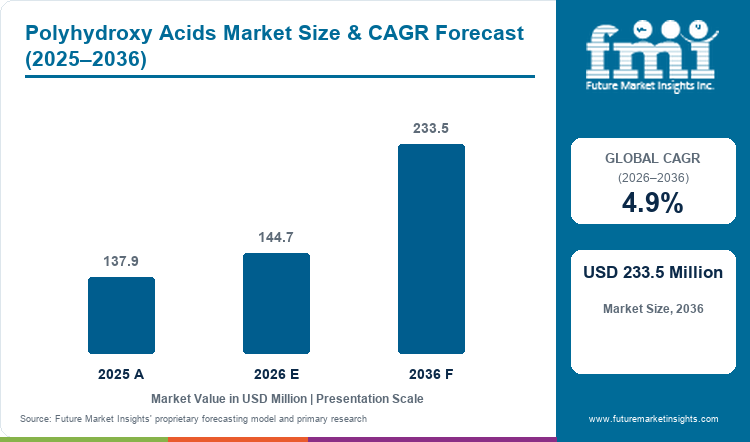
- Market Size (2026)
- USD 144.7 Mn
- Forecast (2036)
- USD 233.5 Mn
- CAGR (2026 to 2036)
- 4.9%
How big is Polyhydroxy Acids Market in 2026?
USD 144.7 million in 2026 and USD 233.5 million by 2036 at a 4.9% CAGR.
Demand for polyhydroxy acids is projected to expand at 4.9% CAGR between 2026 and 2036, increasing value from USD 144.7 million to USD 233.5 million. Formulators use PHA chemistry for surface renewal that preserves hydration and repeat-use comfort. During its May 2025 earnings call, Waldencast said Obagi Medical had launched the Retinol + PHA Refining Night Cream for lower retinol tolerance. The launch documents frequent-use PHA renewal in facial care.
Notification scale and importer execution give each country different launch costs. OPSS counted 861,686 cosmetic notifications and 24,112 registered Responsible Persons in Great Britain by May 28, 2026. Great Britain gives brands a standard filing route. Gulf launches rely more on importer-led registration, so faster percentage growth can coexist with smaller revenue pools and heavier launch work.
Key Takeaways
- Demand for polyhydroxy acids comes from skin-care formulas that need controlled renewal without sacrificing hydration, barrier support, or repeat-use tolerance.
- By product type, standard grade is estimated to hold 38.0% in 2026 owing to mainstream cosmetic specifications that rarely require clinical-grade qualification.
- In 2026, hydration & barrier is expected to lead function with 25.0% share, attributable to mild renewal in daily facial-care routines.
- Facial skincare is set to lead application with 38.0% share in 2026 due to leave-on formats that allow tighter pH and exposure control.
- Qualification slows as brands reconcile low-pH stability, safety substantiation, claims support and regional documentation for a finished-formula release.
- Some of the key players in this market include Clariant, Givaudan, IFF, Ashland, Croda, Evonik, Lubrizol, Symrise, DSM-Firmenich and BASF.
Analyst Perspective
"PHA economics depend on how quickly a grade survives finished-formula work at the intended pH and use frequency. Stronger offers reduce reformulation cycles by pairing stable acid specifications with tolerance evidence, claims support and regional documentation."
- Rahul Pandita, Principal Consultant, Future Market Insights
How is the polyhydroxy acids market segmented?
The polyhydroxy acids market is segmented by product type, function, application, grade and sales channel.
Product type covers standard grade, high-purity - clinical grade, natural & certified grade and customized systems. Function includes hydration & barrier, anti-aging, brightening, soothing & sensitive and UV & protection. Application covers facial skincare, body care, haircare, color cosmetics and suncare. Grade distinguishes standard cosmetic grade, COSMOS - natural certified, pharma & clinical grade and organic certified. Sales channel includes direct to brands, specialty distributors, contract manufacturers and online B2B.
Why does standard grade lead demand within the product type category?
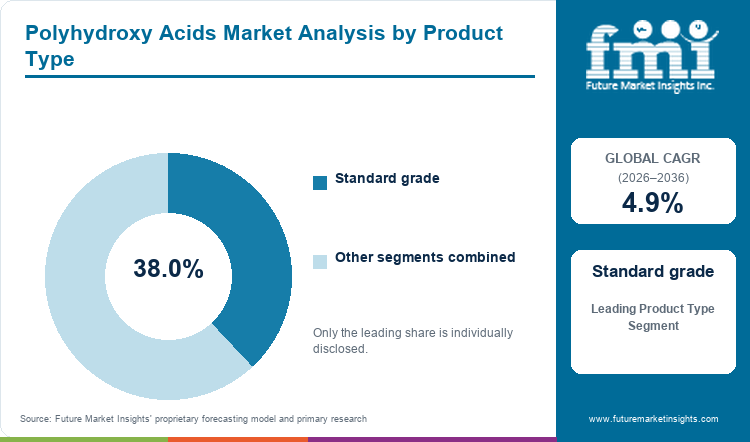
Standard grade suits programs that need consistent identity and impurity control without a clinical or natural-certification route. Formulators can qualify toners, serums and creams broadly through normal cosmetic safety work.
- Based on product type, standard grade is projected to account for 38.0% in 2026 due to mainstream specifications that avoid added certification work.
- Finished-formula support can shorten qualification once the acid has a stable specification. IFF launched its Xelestia collection in March 2025 with skin-care prototypes built from commercial ingredient systems, giving brands a current model for testing an active inside a complete formula.
Why does hydration & barrier lead demand within the function category?
Hydration and barrier care gives PHA chemistry a clear role in leave-on products that need surface renewal without losing comfort. BASF launched Ameriflor Calm in October 2025, with testing recording an 11% improvement in transepidermal water loss versus placebo after seven days. Formulators can therefore test PHA beside barrier-support actives within the same finished formula.
- In 2026, hydration & barrier is expected to lead function with 25.0% share due to daily facial care demand for mild renewal that preserves comfort.
- Daily-use programs favor combinations that preserve comfort after repeated application. Barrier evidence influences which companion actives advance with a PHA grade into stability testing.
Why does facial skincare lead demand within the application category?
Facial skincare gives formulators tighter control over acid concentration, contact time and supporting emollients than many rinse-off formats. A specialty acid must survive stability, tolerance and efficacy work in repeated pilot batches during scale-up decisions at commercial scale.
- By application, facial skincare is forecast to represent 38.0% in 2026 driven by leave-on formats that support controlled renewal at lower use levels.
- Age-care programs compete on specific biological claims. Givaudan introduced PrimalHyal UltraReverse in April 2025 with clinical work on visible facial-ageing measures, raising the evidence standard for premium facial-care actives used beside PHA chemistry.
Why does standard cosmetic grade lead demand within the grade category?
Standard cosmetic grade fits the safety and quality systems used for routine personal-care formulation. Clariant launched Clariant Beauty in April 2025 with skin-care actives, emulsifiers, rheology modifiers and preservation systems. The broader formulation platform lets brands test a conventional PHA grade beside supporting ingredients without adding a separate certification route.
- Standard cosmetic grade is projected to hold 42.0% share in 2026 owing to conventional documentation used by most skin-care programs.
- Conventional documentation keeps this grade easier to qualify for mainstream programs. Formulators can tighten impurity limits for a specific brief while using familiar safety and stability workflows.
Why does direct to brands lead demand within the sales channel category?
Direct brand relationships are useful during pH adjustment, stability work and claims review. The purchase includes technical answers during formulation, not just delivery of an ingredient drum.
- Direct to brands is set to lead the sales channel with 50.0% share in 2026 due to qualification work starting inside brand formulation teams.
- Local technical access sustains qualification beyond the first sample. Ashland appointed IMCD as its exclusive United States personal-care distributor in March 2026. The agreement formalized application support and ingredient supply, showing why channel value depends on response quality as much as order handling.
What are the drivers, restraints and opportunities in the Polyhydroxy Acids Market?
Mild multifunctional exfoliation supports demand, formulation and compliance work restrain conversion and certified or customized PHA systems provide the clearest expansion route.
- Driver: Daily-use skin care needs renewal systems that preserve hydration and reduce irritation risk from stronger acid routines.
- Restraint: Low-pH stability, safety files and regional product documentation can extend qualification beyond a simple active substitution.
- Opportunity: Certification-ready grades and formulation support can place PHA chemistry in premium natural and sensitive-skin care briefs.
Mild renewal widens repeat-use formats
Daily-use renewal expands if formulators control irritation without losing visible exfoliation performance. Symrise's March 2025 launch of SymRelief green placed a clinically tested, 100% natural-origin soothing system into sensitive-skin formulation work. PHA grades fit this direction since milder acid systems can pair with soothing actives, but repeat orders depend on consistent finished-formula tolerability during regular use at the intended level.
Qualification work slows formula conversion
A technically sound acid can miss a launch date if the finished formula lacks a complete product-information file. DGCCRF reported in February 2026 that just 26 of more than 200 reviewed cosmetic files were complete or nearly complete at 147 establishments. Documentation becomes a real qualification cost as reformulation, claims revision, or missing safety evidence can directly delay commercial release.
Certified grades open premium briefs
Natural-positioned PHA programs gain value if raw-material status matches the certification route selected for the finished product. COSMOS Standard Version 4.2 applies to new submissions from September 1, 2025 and sets the reference requirements for certified organic and natural cosmetics. Ingredient companies with compliant origin and processing records can shorten initial commercial review for premium natural or sensitive-skin formulas.
Which country CAGRs are profiled in the Polyhydroxy Acids Market?
| Country | CAGR |
|---|---|
| UAE | 6.2% |
| Saudi Arabia | 5.9% |
| South Korea | 5.5% |
| USA | 5.2% |
| UK | 4.9% |
| France | 4.6% |
| Japan | 4.3% |
| Germany | 3.9% |
How do country-level CAGRs compare in the Polyhydroxy Acids Market?
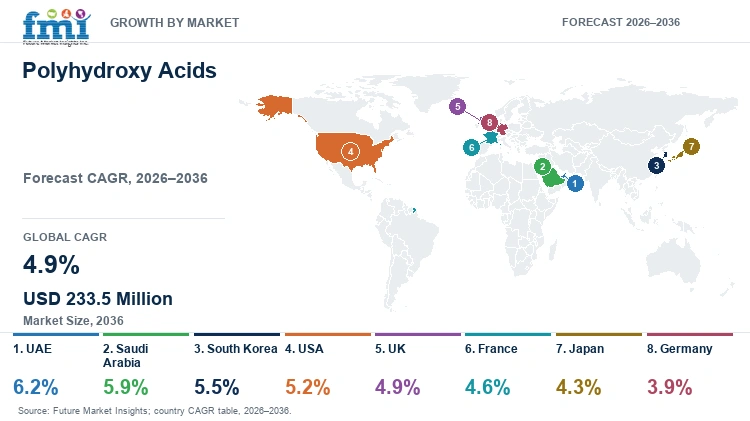
The profiled markets span 2.3 percentage points from UAE at 6.2% to Germany at 3.9%. UAE and Saudi Arabia form a distinct upper tier, South Korea and USA follow and UK through Germany make a tighter lower group. The spacing reflects different launch routes and channel maturity, not a ranking of current revenue.
- UAE turns prestige facial launches quickly through luxury retail.
- Saudi importers use local stock to avoid replenishment gaps.
- South Korea shortens active-development cycles for rapid launches.
- USA broadens formulation trial capacity through contract manufacturers.
- UK premium retail sustains repeat launches.
- France favors pharmacy-led dermocosmetic positioning.
- Japan prioritizes specification-led formulation discipline.
- Germany relies on specialist technical distribution.
Similar rates produce different launch economics. The full report provides country-level CAGR analysis across North America, Latin America, Western Europe, Eastern Europe, East Asia, South Asia and Pacific and Middle East and Africa.
Country-wise Analysis
- Dubai beauty launches depend on distributors that can register imported cosmetics, maintain local stock and move premium formulas into department-store and e-commerce retail without repeated document queries in Dubai. Dubai Municipality reported in October 2025 that nearly 13,000 establishments traded cosmetics and monitored more than 500,000 imported products. The figures show why licensing and formula files can delay individual launches, so PHA companies need stable specifications and current distributor-ready safety records for retailer onboarding. UAE is estimated to post 6.2% CAGR over the forecast period owing to fast prestige assortment turnover and demand for gentler facial-care actives.
- Saudi beauty portfolios depend on importers that translate ingredient files into local safety and claims documentation before premium skin-care products reach retail. Polyhydroxy acid demand in Saudi Arabia is forecast to rise at 5.9% CAGR over the forecast period given growing facial-care assortment and distributor-led replenishment. In June 2025, SFDA adopted updated Gulf technical regulations for cosmetic safety and cosmetic claims, moving ingredient lists and claim controls into the current compliance route. Local stock supports repeat ordering, but incomplete product or factory records can interrupt listings and leave smaller distributors carrying avoidable rework during disciplined local retail launch execution.
- South Korean brands shorten active-development cycles, but functional claims can place a finished cosmetic on formal review or reporting routes that change launch timing. MFDS reported in May 2026 that 2025 cosmetics exports rose 11.8%, giving ingredient companies an export-facing customer base that expects rapid formulation support. In South Korea, polyhydroxy acid demand is predicted to advance at 5.5% CAGR through 2036 owing to frequent launches of gentler renewal systems for repeat-use skin care. PHA companies must separate cosmetic renewal evidence from functional claims needing added substantiation during final packaging approval for export brands working on compressed calendars.
- United States brands can run specialty-acid trials at scale using contract manufacturers and in-house laboratories. Polyhydroxy acid sales in the USA are forecast to expand at 5.2% CAGR by 2036, tied to broad facial-care formulation capacity and frequent testing of differentiated actives. FDA data dated June 30, 2026 counted 16,398 active facility registrations and 1,298,361 active cosmetic product listings under MoCRA. Large trial capacity supports adoption, but incomplete low-pH stability or identity files can push national launches toward familiar acids with established internal records. The penalty is rework during retailer onboarding and contract-manufacturer handoffs for nationwide programs.
- Great Britain uses its own cosmetic notification route, so companies selling the same formula in both GB and the EU carry parallel launch records. OPSS recorded 325,496 cosmetic notifications in 2025-26, up 11% from the prior year, keeping responsible-person files and ingredient records central to launch execution. Duplicate GB and EU workflows can make smaller launches commercially uneconomic despite strong specialty retail unless one technical pack serves both routes with limited local rework. The UK polyhydroxy acids sector is projected to record 4.9% CAGR during the assessment period, aided by mature facial-care channels and repeat premium launches locally.
- French dermocosmetic brands sell through pharmacies, premium retail and export channels that place efficacy claims under close formulation and commercial review. France's polyhydroxy acids outlook is anticipated to advance at 4.6% CAGR over the assessment period, attributable to facial-care programs that value mild renewal with hydration. French Customs reported in February 2026 that perfume and cosmetics exports to the United States fell 25% year over year in the fourth quarter of 2025. Domestic technical depth supports qualification, but export volatility increases the value of evidence packages that transfer cleanly between EU and key overseas launches without fresh formula testing.
- Japanese cosmetic companies favor tightly controlled specifications and digital beauty retail gives new facial formulas a route to discovery without removing careful pre-production review. METI's August 2025 survey put the 2024 e-commerce ratio for cosmetics and pharmaceuticals at 8.82%, with online sales rising 4.54% year over year. Conservative claim review slows rapid ingredient switching, so distributors and brand laboratories favor stable specifications and restrained efficacy language for repeat production decisions. Adoption of polyhydroxy acids in Japan is estimated to expand at 4.3% CAGR through 2036, helped by premium skin-care routines and steady online replenishment for facial-care brands.
- German cosmetic programs put safety documentation and modest claims under close regulatory scrutiny. By 2036, Germany is projected to grow at 3.9% CAGR, supported by steady dermocosmetic demand and established laboratory capabilities. BfR's September 2025 consumer monitor found 43% of respondents considered body-care products safe or very safe, leaving brands little room for weak safety communication. Specialist distributors provide technical depth, but PHA companies need reproducible impurity control and product-level evidence until conservative formulation teams replace familiar acids in repeat programs. The safety threshold favors ingredient partners that answer safety and specification questions without repeating basic local formulation work.
Who are the notable companies in the Polyhydroxy Acids Market?
Evonik, Clariant, Givaudan, IFF, Ashland, Croda, Lubrizol, Symrise, DSM-Firmenich and BASF are active in the polyhydroxy acids market and adjacent formulation systems.
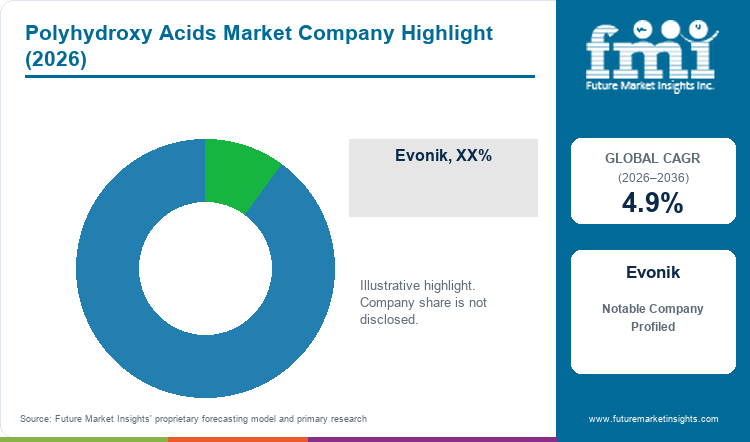
Evonik has the clearest direct PHA-family chemistry among the profiled companies. Other profiled companies compete through skin actives, rheology, delivery systems and application support. Entry barriers arise from low-pH stability evidence, impurity control and claims support that must survive scale-up into finished facial-care formulas.
- Hydroxy-acid and renewal specialists: Evonik, Givaudan, Croda, Symrise and DSM-Firmenich bring active-science routes for renewal, hydration, or ageing briefs.
- Formulation and delivery platforms: Ashland, IFF, Lubrizol and BASF provide rheology, delivery, emulsification and application-testing support for specialty actives.
- Integrated beauty ingredients: Clariant pairs active ingredients with emulsifiers, rheology modifiers and preservation systems used during complete skin-care formulation.
Competitive Benchmarking: Polyhydroxy Acids Market
| Company | Skin-Renewal Active Depth | Barrier & Sensitive-Skin Support | Formulation & Delivery Support | Geographic Reach |
|---|---|---|---|---|
| Clariant | Medium | High | High | Global |
| Givaudan | High | High | High | Global |
| IFF | Medium | High | High | Global |
| Ashland | Medium | High | High | Global |
| Croda | High | High | High | Global |
| Evonik | High | High | High | Global |
| Lubrizol | Medium | High | High | Global |
| Symrise | High | High | High | Global |
| DSM-Firmenich | High | High | High | Global |
| BASF | Medium | High | High | Global |
Scoring basis: High indicates current official evidence for a dedicated program plus multiple documented capabilities within the criterion. Medium indicates one current dedicated capability or a narrower supporting route. Low requires official material documenting a related role with an explicit application limitation. Geographic reach describes served regions and is not a score.
Key Developments in the Polyhydroxy Acids Market
- In June 2026, Croda launched Malvallin for premium facial-care formulations with hydration and skin-resilience positioning relevant to high-value active systems.
- In June 2026, Evonik opened its Asia Beauty Science & Innovation Center in Shanghai to expand regional formulation, testing and customer application support.
- In April 2026, Clariant introduced AlgaSurge through Lucas Meyer Cosmetics by Clariant for hydration and cellular-renewal positioning at in-cosmetics Global.
Key Players in the Polyhydroxy Acids Market
Renewal and Beauty-Active Platforms
- Evonik
- Givaudan
- Croda
- Symrise
- DSM-Firmenich
Formulation and Delivery Platforms
- Ashland
- IFF
- Lubrizol
- BASF
Integrated Personal-Care Ingredients
- Clariant
Polyhydroxy Acids Market - Report Scope
| Coverage field | Report scope |
|---|---|
| Market breakdown | By product type, function, application, grade, sales channel and region. |
| Quantitative Units | USD million. |
| Market Definition | Commercial revenue from polyhydroxy acid ingredients and PHA-based cosmetic ingredient systems within the stated personal-care segmentation universe. |
| Regions Covered | North America, Latin America, Western Europe, Eastern Europe, East Asia, South Asia and Pacific and Middle East and Africa. |
| Countries Covered | UAE, Saudi Arabia, South Korea, USA, UK, France, Japan, Germany and 20+ countries included in the full report. |
| Key Companies Profiled | Clariant, Givaudan, IFF, Ashland, Croda, Evonik, Lubrizol, Symrise, DSM-Firmenich, BASF. |
| Forecast Period | 2026 to 2036. |
| Approach | Primary and secondary research with market triangulation. |
Polyhydroxy Acids Market - Research Methodology
| Method | Approach |
|---|---|
| Primary Research | FMI analysts gathered input from manufacturers, service providers, technology developers, distributors, end users, procurement teams and subject-matter experts. Interviews examined purchasing decisions, product or service evaluation, adoption barriers, approval requirements, pricing considerations and expectations for technical or commercial support. Respondents were also asked what evidence is required before a trial, pilot, or initial order develops into regular purchasing. |
| Desk Research | Desk research covered government statistics, regulatory publications, trade data, industry associations, technical literature, standards, company filings, product information and official corporate announcements. Sources were reviewed for relevance, publication date, geographic coverage and consistency with the defined market scope. Claims relating to performance, applications, approvals, capacity, investment and commercial activity were retained only when supported by credible public evidence. |
| Market Sizing and Forecasting | The market model combined the baseline value with historical performance, segment structure, pricing and volume indicators, adoption levels, company participation and country-level demand conditions. Forecast assumptions considered economic activity, investment trends, regulatory developments, technology adoption, purchasing cycles, supply availability and barriers to wider market use. Segment and regional estimates were reconciled before the final market total was calculated. |
| Data Validation | Estimates were checked against multiple independent indicators, including public data, company activity, trade patterns, industry developments and findings from primary interviews. Validation also tested whether products, services, applications and company revenues fell within the defined market boundaries. Adjacent categories, unsupported claims, overlapping revenues and activities without direct market relevance were excluded to reduce double counting and maintain consistency across segments and countries. |
Polyhydroxy Acids Market by Segments
Polyhydroxy Acids Market segmented by Product Type:
- Standard grade
- High-purity - clinical grade
- Natural & certified grade
- Customized systems
Polyhydroxy Acids Market segmented by Function:
- Hydration & barrier
- Anti-aging
- Brightening
- Soothing & sensitive
- UV & protection
Polyhydroxy Acids Market segmented by Application:
- Facial skincare
- Body care
- Haircare
- Color cosmetics
- Suncare
Polyhydroxy Acids Market segmented by Grade:
- Standard cosmetic grade
- COSMOS - natural certified
- Pharma & clinical grade
- Organic certified
Polyhydroxy Acids Market segmented by Sales Channel:
- Direct to brands
- Specialty distributors
- Contract manufacturers
- Online B2B
Polyhydroxy Acids Market by Region:
- North America
- United States
- Canada
- Latin America
- Brazil
- Mexico
- Argentina
- Chile
- Western Europe
- Germany
- France
- United Kingdom
- Italy
- Spain
- Benelux
- Nordics
- Eastern Europe
- Poland
- Czech Republic
- Romania
- Hungary
- East Asia
- China
- Japan
- South Korea
- South Asia and Pacific
- India
- ASEAN
- Australia and New Zealand
- Middle East and Africa
- GCC Countries
- South Africa
- Türkiye
- Israel
Research Sources and Bibliography
- Waldencast plc (2025, May 14). Waldencast First Quarter 2025 Earnings Call
- Office for Product Safety and Standards (2026, July 17). New data on UK cosmetic product safety notifications
- IFF (2025, March 18). Xelestia Fantasy Beauty Formulations Brought to Life via Gaming
- BASF (2025, October 15). BASF’s Personal Care business launches Ameriflor Calm
- Givaudan (2025, April 2). Givaudan Active Beauty launches PrimalHyal™ UltraReverse
- Clariant (2025, April 7). “Clariant Beauty” launches new solutions for personal care
- Ashland Inc. (2026, March 12). Ashland announces strategic partnership with IMCD for the exclusive distribution of personal and home care ingredients in the United States
- Symrise (2025, March 26). Symrise introduces SymRelief® green for next-generation, natural-origin intensive skin soothing
- DGCCRF (2026, February 2). Cosmétiques : des TPE nouvelles dans le secteur qui méconnaissent trop souvent la réglementation
- COSMOS-standard AISBL (2025, September 1). COSMOS-standard Version 4.2
- Dubai Municipality (2025, October 27). Product safety at Beautyworld Middle East 2025
- Saudi Food and Drug Authority (2025, June 24).
- Ministry of Food and Drug Safety, Republic of Korea (2026, May 28).
- USA Food and Drug Administration (2026, June 30). Registration & Listing of Cosmetic Product Facilities and Products
- Office for Product Safety and Standards (2026, August 5). OPSS delivery report 2025 to 2026: statistical annex
- Direction générale des douanes et droits indirects (2026, February 9). Résultats du commerce extérieur de la France pour le mois de décembre et pour l'année 2025
- Ministry of Economy, Trade and Industry, Japan (2025, August 26). Results of FY2024 E-Commerce Market Survey Compiled
- German Federal Institute for Risk Assessment (2025, September 1). BfR Consumer Monitor 05/2025
- Clariant (2026, April 14). Clariant launches Hostapon CT solid: The Gentle Giant expanding the mild surfactant portfolio
- Givaudan (2026, March 17). Givaudan Active Beauty unveils VectorHyal
- IFF (2025, October 9). IFF teams up with influencers Chemist Confessions
- Ashland Inc. (2026, May 19). Ashland shaping the future of personal care at NYSCC Suppliers’ Day 2026
- Croda International Plc (2026, July 27). Croda demonstrates how delivery science creates value across its portfolio
- Evonik (2026, March 12). PCHi 2026: Evonik goes beyond for the soul and science of beauty
- Lubrizol (2025, November 20). Lubrizol unveils new data on Telophi biotech ingredient and skin regeneration
- Symrise (2026, April 14). Symrise accelerates innovation and champions longevity and inner beauty at in-cosmetics global 2026
- DSM-Firmenich (2026, April 7). DSM-Firmenich unveils its dream-led science at in-cosmetics Global 2026
- BASF (2025, May 28). BASF presents personal care innovations at NYSCC Suppliers’ Day 2025
- Croda International Plc (2026, June 17). Croda strengthens premium beauty pipeline with next-generation skincare active Malvallin
- Evonik (2026, June 2). Evonik opens new Asia Beauty Science & Innovation Center in Shanghai
- Clariant (2026, April 15). Lucas Meyer Cosmetics by Clariant to unveil beauty innovations at in-cosmetics 2026
- Givaudan (2025, October 16). Givaudan inaugurates a new White Biotechnology Innovation Centre in Toulouse, France
- Symrise (2025, September 2). Symrise starts production unit in Granada enabling a more secure and sustainable supply of Hydrolite® 5 green
- Evonik (2026, March 18). Evonik launches new ceramide SPHINOX® Vively at PCHi 2026
- Croda International Plc (2026, April 21). Croda unveils Matrixyl® Neolide™, an iconic peptide with smarter delivery
- dsm-firmenich (2026, April 10). dsm-firmenich introduces EXOVIVE™ LIFT: The next generation science-backed exosomes and the first in a breakthrough range of products
- Clariant (2025, May 13). Clariant Beauty to spark, solve and enliven at CITE show in Japan
- Givaudan (2025, October 1). Givaudan Active Beauty takes Unispheres® Technology to the next level
- IFF (2025, August 27). IFF and Reservas Votorantim sign bioprospecting partnership in Brazil
- Ashland Inc. (2025, April 3). Ashland unveils collapeptyl™, a revolutionary biofunctional delivering superior performance for the collaverse™ ecosystem
- Croda International Plc (2026, June 26). Croda commissions Guangzhou Hub to strengthen strategic growth and innovation in China
- Evonik (2025, February 12). PCHi 2025: Evonik introduces next-generation system solutions
- Lubrizol (2026, March 17). Lubrizol inaugurates its Beauty Research Institute in Brazil, Reinforcing the Country’s Position as a Global Beauty Innovation Hub
- Symrise (2026, March 17). Symrise establishes a new Care & Wellness Division
- dsm-firmenich (2026, May 1). dsm-firmenich introduces GLYCARE® SK range: HMO biotechnology for skin regeneration and resilience
- BASF (2026, July 16). BASF inaugurates new production plant in Düsseldorf, Germany
This bibliography is provided for reader reference and is not exhaustive. The full report contains the complete reference list and detailed citations
This Report Answers
- How large is the polyhydroxy acids market in 2026 and 2036?
- Which conditions support daily-use PHA facial care?
- Why does standard grade lead product type demand?
- How does hydration & barrier affect PHA selection?
- Why does facial skincare lead application demand?
- How do CAGRs differ among the eight profiled countries?
- Which qualification steps can delay a PHA formula?
- Which companies provide active and formulation support?
Frequently Asked Questions
How big is the polyhydroxy acids market in 2026?
The polyhydroxy acids market is valued at USD 144.7 million in 2026 and is projected to reach USD 233.5 million by 2036. Mild renewal with hydration and repeat-use comfort underpins demand.
What is the CAGR of the polyhydroxy acids market from 2026 to 2036?
The polyhydroxy acids market is projected to grow at a CAGR of 4.9% between 2026 and 2036. Facial-care use and sensitive-skin positioning support expansion.
Which product type leads the polyhydroxy acids market?
The standard grade segment is expected to hold 38.0% of the polyhydroxy acids market in 2026, driven by specifications suited to mainstream cosmetic development. Clinical and certified grades require extra qualification for many routine skin-care formulas.
Which application leads the polyhydroxy acids market?
The facial skincare segment is expected to hold 38.0% of the polyhydroxy acids market in 2026, driven by controlled leave-on exposure. Serums, toners and creams let formulators manage pH with hydration and barrier support.
Which countries are projected to record the highest growth in the polyhydroxy acids market?
UAE is projected to grow at 6.2% CAGR, followed by Saudi Arabia at 5.9% and South Korea at 5.5% through 2036. Premium assortment turnover and regional beauty channels keep these countries above the other profiled growth rates.
Which companies are active in the polyhydroxy acids market?
Key companies operating in the market include Clariant, Givaudan, IFF, Ashland, Croda, Evonik, Lubrizol, Symrise, DSM-Firmenich and BASF. Competition centers on active science, formulation support, delivery technology and regional application service.
Preview the report firsthand - request a free sample
Get SampleGet the brochure for pricing and purchase details.
Get PDFTable of Content
- Key Takeaways
- Market Size and CAGR
- Top Growth Driver
- Fastest Growing Segment
- Leading Region
- Key Companies
- Emerging Opportunities
- Executive Summary
- Global Market Outlook
- Demand-side Trends
- Supply-side Trends
- Technology Roadmap Analysis
- Analysis and Recommendations
- Analyst Perspective (What is happening? Why now? What should investors know?)
- Key Questions Answered
- How large is the market?
- What is the CAGR?
- What are key trends?
- Which region dominates?
- Who are the leaders?
- Market Overview
- Market Coverage / Taxonomy
- Market Definition / Scope / Limitations
- Research Methodology
- Chapter Orientation
- Analytical Lens and Working Hypotheses
- Market Structure, Signals, and Trend Drivers
- Benchmarking and Cross-market Comparability
- Market Sizing, Forecasting, and Opportunity Mapping
- Research Design and Evidence Framework
- Desk Research Programme (Secondary Evidence)
- Expert Input and Fieldwork (Primary Evidence)
- Tooling, Models, and Reference Databases
- Data Engineering and Model Build
- Quality Assurance and Audit Trail
- Market Background
- Market Dynamics (Drivers, Restraints, Opportunity, Trends)
- Scenario Forecast (Optimistic, Likely, Conservative)
- Impact Analysis
- AI Impact
- Sustainability Impact
- Regulatory Impact
- Technology Impact
- Consumer / Buyer Analysis
- Purchase Drivers
- Adoption Barriers
- Buyer Journey
- Opportunity Map Analysis
- Product Life Cycle Analysis
- Supply Chain Analysis
- Investment Feasibility Matrix
- Value Chain Analysis
- PESTLE and Porter's Analysis
- Regulatory Landscape
- Regional Parent Market Outlook
- Production and Consumption Statistics
- Import and Export Statistics
- Global Market Analysis and Forecast, 2021 to 2036
- Historical Market Size Value (USD Million) Analysis, 2021 to 2025
- Current and Future Market Size Value (USD Million) Projections, 2026 to 2036
- Y-o-Y Growth Trend Analysis
- Absolute $ Opportunity Analysis
- Global Market Pricing Analysis, 2021 to 2036
- Global Market Analysis and Forecast, By Product Type, 2021 to 2036
- Introduction / Key Findings
- Historical Market Size Value (USD Million) Analysis By Product Type, 2021 to 2025
- Current and Future Market Size Value (USD Million) Analysis and Forecast By Product Type, 2026 to 2036
- Standard grade
- High-purity - clinical grade
- Natural & certified grade
- Customized systems
- Y-o-Y Growth Trend Analysis By Product Type, 2021 to 2025
- Absolute $ Opportunity Analysis By Product Type, 2026 to 2036
- Global Market Analysis and Forecast, By Function, 2021 to 2036
- Introduction / Key Findings
- Historical Market Size Value (USD Million) Analysis By Function, 2021 to 2025
- Current and Future Market Size Value (USD Million) Analysis and Forecast By Function, 2026 to 2036
- Hydration & barrier
- Anti-aging
- Brightening
- Soothing & sensitive
- UV & protection
- Y-o-Y Growth Trend Analysis By Function, 2021 to 2025
- Absolute $ Opportunity Analysis By Function, 2026 to 2036
- Global Market Analysis and Forecast, By Application, 2021 to 2036
- Introduction / Key Findings
- Historical Market Size Value (USD Million) Analysis By Application, 2021 to 2025
- Current and Future Market Size Value (USD Million) Analysis and Forecast By Application, 2026 to 2036
- Facial skincare
- Body care
- Haircare
- Color cosmetics
- Suncare
- Y-o-Y Growth Trend Analysis By Application, 2021 to 2025
- Absolute $ Opportunity Analysis By Application, 2026 to 2036
- Global Market Analysis and Forecast, By Grade, 2021 to 2036
- Introduction / Key Findings
- Historical Market Size Value (USD Million) Analysis By Grade, 2021 to 2025
- Current and Future Market Size Value (USD Million) Analysis and Forecast By Grade, 2026 to 2036
- Standard cosmetic grade
- COSMOS - natural certified
- Pharma & clinical grade
- Organic certified
- Y-o-Y Growth Trend Analysis By Grade, 2021 to 2025
- Absolute $ Opportunity Analysis By Grade, 2026 to 2036
- Global Market Analysis and Forecast, By Sales Channel, 2021 to 2036
- Introduction / Key Findings
- Historical Market Size Value (USD Million) Analysis By Sales Channel, 2021 to 2025
- Current and Future Market Size Value (USD Million) Analysis and Forecast By Sales Channel, 2026 to 2036
- Direct to brands
- Specialty distributors
- Contract manufacturers
- Online B2B
- Y-o-Y Growth Trend Analysis By Sales Channel, 2021 to 2025
- Absolute $ Opportunity Analysis By Sales Channel, 2026 to 2036
- Global Market Analysis and Forecast, By Region, 2021 to 2036
- Introduction
- Historical Market Size Value (USD Million) Analysis By Region, 2021 to 2025
- Current Market Size Value (USD Million) Analysis and Forecast By Region, 2026 to 2036
- North America
- Latin America
- Western Europe
- Eastern Europe
- East Asia
- South Asia and Pacific
- Middle East and Africa
- Market Attractiveness Analysis By Region
- North America Market Analysis and Forecast, By Country, 2021 to 2036
- Historical Market Size Value (USD Million) Trend Analysis By Market Taxonomy, 2021 to 2025
- Market Size Value (USD Million) Forecast By Market Taxonomy, 2026 to 2036
- By Country
- United States
- Canada
- By Product Type
- By Function
- By Application
- By Grade
- By Sales Channel
- By Country
- Market Attractiveness Analysis
- By Country
- By Product Type
- By Function
- By Application
- By Grade
- By Sales Channel
- Key Takeaways
- Latin America Market Analysis and Forecast, By Country
- Historical Market Size Value (USD Million) Trend Analysis By Market Taxonomy, 2021 to 2025
- Market Size Value (USD Million) Forecast By Market Taxonomy, 2026 to 2036
- By Country
- Brazil
- Mexico
- Argentina
- Chile
- By Product Type
- By Function
- By Application
- By Grade
- By Sales Channel
- By Country
- Market Attractiveness Analysis
- By Country
- By Product Type
- By Function
- By Application
- By Grade
- By Sales Channel
- Key Takeaways
- Western Europe Market Analysis and Forecast, By Country
- Historical Market Size Value (USD Million) Trend Analysis By Market Taxonomy, 2021 to 2025
- Market Size Value (USD Million) Forecast By Market Taxonomy, 2026 to 2036
- By Country
- Germany
- France
- United Kingdom
- Italy
- Spain
- Benelux
- Nordics
- By Product Type
- By Function
- By Application
- By Grade
- By Sales Channel
- By Country
- Market Attractiveness Analysis
- By Country
- By Product Type
- By Function
- By Application
- By Grade
- By Sales Channel
- Key Takeaways
- Eastern Europe Market Analysis and Forecast, By Country
- Historical Market Size Value (USD Million) Trend Analysis By Market Taxonomy, 2021 to 2025
- Market Size Value (USD Million) Forecast By Market Taxonomy, 2026 to 2036
- By Country
- Poland
- Czech Republic
- Romania
- Hungary
- By Product Type
- By Function
- By Application
- By Grade
- By Sales Channel
- By Country
- Market Attractiveness Analysis
- By Country
- By Product Type
- By Function
- By Application
- By Grade
- By Sales Channel
- Key Takeaways
- East Asia Market Analysis and Forecast, By Country
- Historical Market Size Value (USD Million) Trend Analysis By Market Taxonomy, 2021 to 2025
- Market Size Value (USD Million) Forecast By Market Taxonomy, 2026 to 2036
- By Country
- China
- Japan
- South Korea
- By Product Type
- By Function
- By Application
- By Grade
- By Sales Channel
- By Country
- Market Attractiveness Analysis
- By Country
- By Product Type
- By Function
- By Application
- By Grade
- By Sales Channel
- Key Takeaways
- South Asia and Pacific Market Analysis and Forecast, By Country
- Historical Market Size Value (USD Million) Trend Analysis By Market Taxonomy, 2021 to 2025
- Market Size Value (USD Million) Forecast By Market Taxonomy, 2026 to 2036
- By Country
- India
- ASEAN
- Australia and New Zealand
- By Product Type
- By Function
- By Application
- By Grade
- By Sales Channel
- By Country
- Market Attractiveness Analysis
- By Country
- By Product Type
- By Function
- By Application
- By Grade
- By Sales Channel
- Key Takeaways
- Middle East and Africa Market Analysis and Forecast, By Country
- Historical Market Size Value (USD Million) Trend Analysis By Market Taxonomy, 2021 to 2025
- Market Size Value (USD Million) Forecast By Market Taxonomy, 2026 to 2036
- By Country
- GCC Countries
- South Africa
- Türkiye
- Israel
- By Product Type
- By Function
- By Application
- By Grade
- By Sales Channel
- By Country
- Market Attractiveness Analysis
- By Country
- By Product Type
- By Function
- By Application
- By Grade
- By Sales Channel
- Key Takeaways
- Key Countries Market Analysis
- United States
- Pricing Analysis
- Market Share Analysis, 2025
- By Product Type
- By Function
- By Application
- By Grade
- By Sales Channel
- Canada
- Pricing Analysis
- Market Share Analysis, 2025
- By Product Type
- By Function
- By Application
- By Grade
- By Sales Channel
- Mexico
- Pricing Analysis
- Market Share Analysis, 2025
- By Product Type
- By Function
- By Application
- By Grade
- By Sales Channel
- Brazil
- Pricing Analysis
- Market Share Analysis, 2025
- By Product Type
- By Function
- By Application
- By Grade
- By Sales Channel
- Chile
- Pricing Analysis
- Market Share Analysis, 2025
- By Product Type
- By Function
- By Application
- By Grade
- By Sales Channel
- Germany
- Pricing Analysis
- Market Share Analysis, 2025
- By Product Type
- By Function
- By Application
- By Grade
- By Sales Channel
- United Kingdom
- Pricing Analysis
- Market Share Analysis, 2025
- By Product Type
- By Function
- By Application
- By Grade
- By Sales Channel
- Italy
- Pricing Analysis
- Market Share Analysis, 2025
- By Product Type
- By Function
- By Application
- By Grade
- By Sales Channel
- Spain
- Pricing Analysis
- Market Share Analysis, 2025
- By Product Type
- By Function
- By Application
- By Grade
- By Sales Channel
- France
- Pricing Analysis
- Market Share Analysis, 2025
- By Product Type
- By Function
- By Application
- By Grade
- By Sales Channel
- India
- Pricing Analysis
- Market Share Analysis, 2025
- By Product Type
- By Function
- By Application
- By Grade
- By Sales Channel
- ASEAN
- Pricing Analysis
- Market Share Analysis, 2025
- By Product Type
- By Function
- By Application
- By Grade
- By Sales Channel
- Australia and New Zealand
- Pricing Analysis
- Market Share Analysis, 2025
- By Product Type
- By Function
- By Application
- By Grade
- By Sales Channel
- China
- Pricing Analysis
- Market Share Analysis, 2025
- By Product Type
- By Function
- By Application
- By Grade
- By Sales Channel
- Japan
- Pricing Analysis
- Market Share Analysis, 2025
- By Product Type
- By Function
- By Application
- By Grade
- By Sales Channel
- South Korea
- Pricing Analysis
- Market Share Analysis, 2025
- By Product Type
- By Function
- By Application
- By Grade
- By Sales Channel
- Poland
- Pricing Analysis
- Market Share Analysis, 2025
- By Product Type
- By Function
- By Application
- By Grade
- By Sales Channel
- Hungary
- Pricing Analysis
- Market Share Analysis, 2025
- By Product Type
- By Function
- By Application
- By Grade
- By Sales Channel
- Türkiye
- Pricing Analysis
- Market Share Analysis, 2025
- By Product Type
- By Function
- By Application
- By Grade
- By Sales Channel
- South Africa
- Pricing Analysis
- Market Share Analysis, 2025
- By Product Type
- By Function
- By Application
- By Grade
- By Sales Channel
- UAE
- Pricing Analysis
- Market Share Analysis, 2025
- By Product Type
- By Function
- By Application
- By Grade
- By Sales Channel
- Saudi Arabia
- Pricing Analysis
- Market Share Analysis, 2025
- By Product Type
- By Function
- By Application
- By Grade
- By Sales Channel
- United States
- Market Structure Analysis
- Competition Dashboard
- Competition Benchmarking
- Market Share Analysis of Top Players
- By Regional
- By Product Type
- By Function
- By Application
- By Grade
- By Sales Channel
- Emerging Startups
- Innovation Benchmarking
- Competition Analysis
- Competition Deep Dive
- Evonik
- Overview
- Product Portfolio
- Profitability by Market Segments
- Sales Footprint
- Strategy Overview
- Marketing Strategy
- Product Strategy
- Channel Strategy
- Givaudan
- Croda
- Symrise
- DSM-Firmenich
- Ashland
- IFF
- Lubrizol
- BASF
- Clariant
- Evonik
- Case Studies
- Success Stories
- Recent Developments
- Competition Deep Dive
- Assumptions & Acronyms Used


