

- Market Size (2026)
- USD 91.2 Mn
- Forecast (2036)
- USD 198.7 Mn
- CAGR (2026 to 2036)
- 8.1%
How big is Polyphosphazene Elastomers Market in 2026?
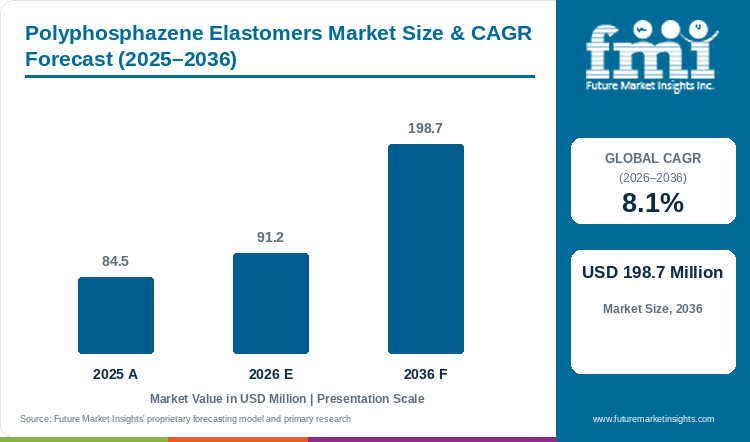
Starting from USD 84.5 million in 2025, the Polyphosphazene Elastomers Market valuation advanced to USD 91.2 million in 2026, with projections pointing toward USD 198.7 million by 2036 at a CAGR of 8.1%.
The global polyphosphazene elastomers market was valued at USD 84.5 million in 2025 and is estimated to reach USD 91.2 million in 2026. The market is projected to reach USD 198.7 million by 2036, expanding at a compound annual growth rate (CAGR) of 8.1% between 2026 and 2036. Fluoroalkoxy polyphosphazene is projected to capture 54.2% of 2026 chemistry demand, as fluoroalkoxy side chains keep the inorganic backbone flexible through cold soak where organic elastomers glass and crack. Demand is attributed to failure cost rather than durometer, since one hydraulic seal change on an in-service airframe costs more than the whole elastomer lot that would have prevented it. Regulatory pull now compounds that arithmetic, as EU Regulation 2024/3190 pushed Freudenberg to commercialize bisphenol AF-free peroxide-crosslinked specialty elastomers in November 2025 [20], and the same firm moved to absorb the DMH Group's CNC seal capacity in September 2025 [21]. The class grows ahead of the established silicone elastomers market at 6.4% CAGR, because silicone sells into mature sealing volumes while phosphazene chemistry sells against fuel-resistance and cold-soak specifications silicone concedes [20]. Parker Hannifin's record USD 7.4 billion aerospace backlog reported in August 2025 [19] and Arkema's EUR 600 million 2026 capital plan behind fluorospecialty growth [25] fund that qualification queue from the demand side. Program offices qualify seal chemistry years before volume moves, and elastomers already inside those qualification queues convert specification wins into revenue by 2036.
Key Market Trends & Insights
- By substitution chemistry: Fluoroalkoxy Polyphosphazene is projected to capture 54.2% in 2026 because mixed trifluoroethoxy and octafluoropentoxy side chains preserve glass transition temperatures down to -65°C in aviation fuel service [1].
- By product format: Molded O-Rings & Seals are estimated to command 47.6% in 2026 as military aviation MRO depots standardize peroxide-cured hydraulic actuator glands that eliminate bisphenol AF crosslinkers [20].
- By service regime: Extreme Cold Hydrocarbon is expected to concentrate 61.5% in 2026 because stratospheric flight controls and Arctic wellheads require simultaneous sub-zero elasticity and hydrocarbon swell resistance [1].
- By end-use vertical: Defense & Aerospace Hydraulics is forecast to generate 49.0% in 2026 owing to multi-decade military airframe and nuclear submarine qualification lock-in [19].
Regional Highlights
- Top national expansion: South Korea is projected to lead national growth at a 9.3% CAGR through 2036 as solid-state EV battery cell makers adopt non-flammable polyphosphazene electrolytes and KF-21 fighter production scales [14] [18].
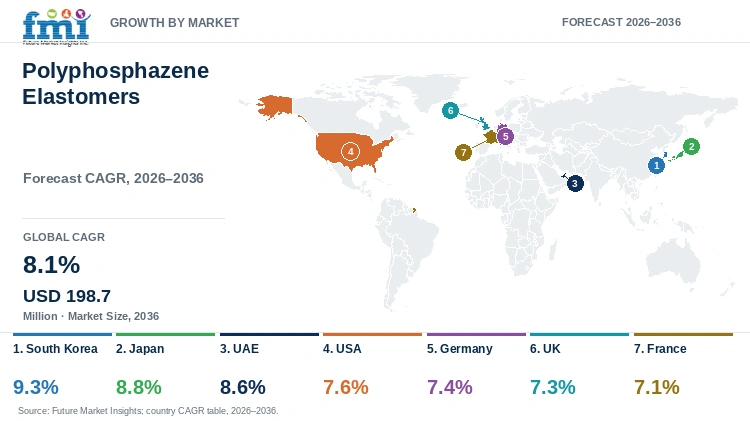
- Broader country progression: Japan is expected to expand at an 8.8% CAGR ahead of the UAE at 8.6% and the USA at 7.6%, while Germany is forecast to progress at 7.4%, the UK at 7.3% and France at 7.1%.
Market Size & Forecast
Table 1: Market Size and Forecast for the Polyphosphazene Elastomers Market (USD million and CAGR percentage), 2025 to 2036
| Metric | Value |
|---|---|
| 2025 Market Size | USD 84.5 million |
| Estimated Market Size in 2026 | USD 91.2 million |
| Projected Market Size by 2036 | USD 198.7 million |
| CAGR, 2026 to 2036 | 8.1% |
| Added Value, 2026 to 2036 | USD 107.5 million |
Defense airframe primes and offshore subsea equipment manufacturers confront severe reliability penalties when elastomeric seals fail during cold-soak start-ups. Standard fluorocarbon elastomers lose elastic recovery below -25°C, whereas fluorosilicone rubbers suffer from poor dynamic tear resistance (<15 kN/m) under high-pressure actuator cycling. In June 2025, membrane pervaporation benchmarks published in Polymers demonstrated that fluorinated polyphosphazene networks exhibit glass transition temperatures between -47.0°C (PTFEP) and -114.1°C (PTFBP) while maintaining thermal decomposition thresholds above 303°C [1]. so specialty compounders within the performance elastomer market are reallocating cleanroom compression-molding capacity toward polyphosphazene grades that capture an 8.1% CAGR through 2036.
Monomer Batch and Compounded Gum Sizing
Table 2: Monomer Batch and Compounded Gum Sizing for the Polyphosphazene Elastomers Market (USD million and physical ranges), 2025 to 2036
| Metric | 2025 | 2026 | 2036 |
|---|---|---|---|
| Market size (USD million) | 84.5 | 91.2 | 198.7 |
| Sublimed HCCP trimer demand (metric tons) | 82.0 to 90.0 | 88.5 to 97.0 | 185.0 to 205.0 |
| Compounded elastomer shipment volume (metric tons) | 59.5 to 63.0 | 64.2 to 68.0 | 139.0 to 148.0 |
| Weighted average selling price (USD per kg) | 1,380 to 1,450 | 1,400 to 1,460 | 1,410 to 1,490 |
Operational note: Physical monomer-to-elastomer conversion ranges apply the 65% to 70% thermal ring-opening polymerization conversion ceiling required to prevent insoluble gelation in polydichlorophosphazene and 87% nucleophilic substitution yields in anhydrous tetrahydrofuran [1] [18].
Macromolecular synthesis requires tight vertical coordination between sublimed hexachlorocyclotriphosphazene (HCCP) trimer producers in Japan and precision seal molders in North America and Europe. Compounders widely pair peroxide-curable fluoroalkoxy gums with non-fluorinated aryloxy foams to protect customer accounts in the polymer seals market against evolving European fluorochemical restrictions [20] [22].
Airframe Shipset & Subsea Facility Sizing
Table 3: Airframe Shipset and Industrial Facility Indicators for the Polyphosphazene Elastomers Market (USD), 2025 to 2036
| Metric | 2025 | 2026 | 2036 |
|---|---|---|---|
| Active military & civil airframes in service (thousand) | 84.5 | 86.8 | 108.4 |
| Elastomer spend per 1,000 airframes (USD thousand) | 1,000.0 | 1,050.7 | 1,833.0 |
| Annual seal spend per defense hydraulic program (USD thousand) | 145.0 to 180.0 | 155.0 to 195.0 | 260.0 to 320.0 |
| Long-term defense & naval contract share (%) | 68.0% to 72.0% | 70.0% to 74.0% | 75.0% to 79.0% |
Table 4: Program & Vertical Allocation Indicators for the Polyphosphazene Elastomers Market (USD and percentages), 2026
| Metric | Value | Institutional / Industrial Reference Basis |
|---|---|---|
| Market size, 2026 | USD 91.2 million | 2026 global market value baseline |
| Qualified defense, subsea & battery programs | 620 programs | Global MIL-spec, Arctic EPC & EV cell registry |
| Average elastomer spend per program | USD 147,097 | Annualized qualified compound expenditure |
| Defense & aerospace hydraulics value, 2026 | USD 44.7 million | 49.0% end-use vertical allocation |
Qualifying an inorganic-backbone elastomer inside military flight controls or nuclear submarine hulls requires balancing upfront compounding cost against 25-year program lifecycle reliability. Aerospace procurement groups combine sub-zero polyphosphazene dynamic seals with High Performance Fluoropolymer Market backup rings to eliminate cold-soak hydraulic fluid blow-by.
Analyst Perspective
"Aerospace hydraulic engineers and solid-state battery architects require elastomers that remain compliant below minus 60 degrees Celsius without swelling in hydrocarbon fuels or igniting under thermal runaway. Suppliers that control hexachlorocyclotriphosphazene trimer sublimation purity and bisphenol AF-free peroxide curing will secure sole-source defense and EV electrolyte contracts through 2036."
- Nikhil Kaitwade, Principal Consultant, Future Market Insights.
How is the polyphosphazene elastomers market segmented?
The polyphosphazene elastomers market is segmented by substitution chemistry, product format, service regime, and end-use vertical. In 2026, Fluoroalkoxy Polyphosphazene is projected at 54.2%, Molded O-Rings & Seals at 47.6%, Extreme Cold Hydrocarbon at 61.5%, and Defense & Aerospace Hydraulics at 49.0%.
By substitution chemistry: Fluoroalkoxy Polyphosphazene, Aryloxy Polyphosphazene, MEEP Ion-Conducting Elastomers, Biodegradable Amino-Ester Elastomers.
By product format: Molded O-Rings & Seals, Fire-Retardant Acoustic Foams, Halogen-Free Cable Jackets, Bioresorbable Medical Scaffolds.
By service regime: Extreme Cold Hydrocarbon, Zero-Halogen Fire Barrier, Physiological Hydrolytic Regime.
By end-use vertical: Defense & Aerospace Hydraulics, Arctic Subsea Completions, EV Solid-State Electrolytes, Cardiovascular & Bone Implants.
Why does Fluoroalkoxy Polyphosphazene lead the substitution chemistry category?
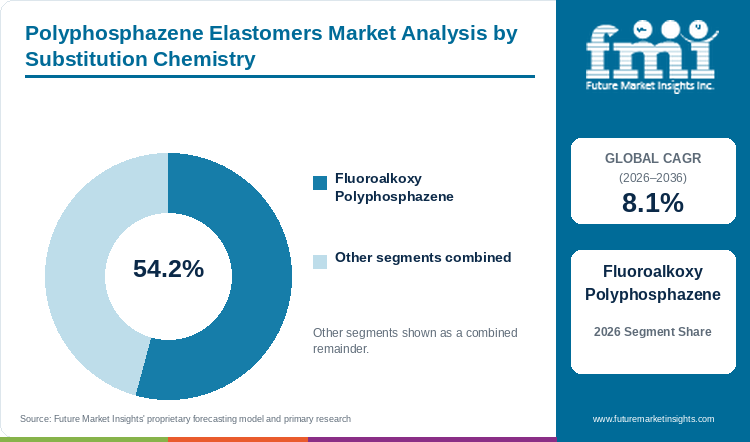
Fluoroalkoxy Polyphosphazene is projected to capture 54.2% of substitution chemistry demand in 2026, supported by mixed C2 to C5 fluoroalkoxy side-chain flexibility down to minus 65 degrees Celsius.
Table 5: Substitution Chemistry Share for the Polyphosphazene Elastomers Market (percentage share), 2026
| Substitution Chemistry | Share (2026) |
|---|---|
| Fluoroalkoxy Polyphosphazene | 54.2% |
| Other Segments Combined | 45.8% |
| Total | 100.0% |
Note: Remaining substitution chemistry categories sum to 100.0% of 2026 commercial volume.
Table 6: Substitution Chemistry Leadership and Market Growth for the Polyphosphazene Elastomers Market (segment and CAGR percentage), 2026 to 2036
| Metric | Value |
|---|---|
| Global CAGR (2026 to 2036) | 8.1% |
| Leading Segment | Fluoroalkoxy Polyphosphazene |
Aerospace hydraulic and polar oilfield buyers favor Fluoroalkoxy Polyphosphazene (PNF class) because substituting the alternating phosphorus-nitrogen chain with mixed trifluoroethoxy (-OCH2CF3) and octafluoropentoxy (-OCH2(CF2)3CF2H) groups disrupts crystalline packing while creating an oleophobic barrier against jet fuels [1] [16]. Compounders incorporate 1 to 2 mol% allylphenoxy cure sites to enable clean peroxide vulcanization, outperforming conventional compounds in the APAC Fluoroelastomer across sub-zero dynamic sealing.
- Fluoroalkoxy Polyphosphazene is projected to secure 54.2% of substitution chemistry market value in 2026 by combining -65°C to 175°C service capability with low hydrocarbon volume swell.
- A July 2025 Acta Biomaterialia in vivo study validated crosslinkable poly[bis(octafluoropentoxy)phosphazene] (X-OFP) coatings on blood-contacting polyurethane central venous catheters, demonstrating reduced thrombus accumulation [16], while 2026 University of Cambridge trials confirmed >500-cycle silicon-anode battery stabilization [14].
Why do Molded O-Rings & Seals define the largest product format segment?
Molded O-Rings & Seals are estimated to secure 47.6% of the product format category in 2026, driven by mandatory flight-hour replacement schedules in military and commercial hydraulic actuators.
High-pressure flight-control actuators and subsea valve stems require compression-molded O-rings, hydraulic rod T-seals, and fuel-pump diaphragms that resist extrusion and abrasive tearing where fluorosilicone rubbers fail. Compounding polyphosphazene gums with silanized fumed silica yields Shore A hardness between 50 and 85 and low-temperature TR-10 retraction values below -55°C [1] [20], complementing acoustic insulation in the halogen-free flame retardant systems.
- Molded O-Rings & Seals are estimated to command 47.6% of the product format segment in 2026 because recurring aviation MRO seal overhauls generate predictable aftermarket replacement demand.
- Freudenberg Sealing Technologies commercialized bisphenol AF-free peroxide-crosslinked specialty elastomers in November 2025 following the September 2025 European ban on bisphenol AF under EU Regulation 2024/3190 [20], and acquired the 200-employee DMH Group in September 2025 to expand custom CNC seal machining [21].
What keeps Extreme Cold Hydrocarbon ahead by service regime?
Extreme Cold Hydrocarbon is expected to command 61.5% of service regime volume in 2026, reflecting sole-source specification in minus 65 degrees Celsius aviation fuel and hydraulic systems.
Equipment operating across -65°C to 175°C in continuous contact with JP-8 jet fuel, synthetic ester hydraulic fluids, and sour crude condensates cannot rely on nitrile or fluorocarbon rubbers that fracture under cold shock. Extreme Cold Hydrocarbon polyphosphazene grades maintain hydrocarbon volume swell below 12% while resisting rapid gas decompression, outperforming standard silicones in the Silicone Elastomer Market.
- Extreme Cold Hydrocarbon is expected to hold 61.5% of service regime market value in 2026 because neither fluorocarbon (FKM) nor fluorosilicone (FVMQ) rubbers match its combined sub-zero elasticity and dynamic tear strength.
- June 2025 pervaporation trials on thiophene/n-heptane hydrocarbon streams at 85°C confirmed that poly(bis(trifluorobutoxy)phosphazene) (PTFBP) membranes achieved a flux of 0.284 kg·m⁻²·h⁻¹ and a sulfur enrichment factor of 26.48 without structural swelling degradation [1].
Why does Defense & Aerospace Hydraulics lead the end-use vertical category?
Defense & Aerospace Hydraulics is forecast to generate 49.0% of end-use vertical demand in 2026, owing to multi-year military fighter actuator and nuclear submarine hull insulation backlogs.
Tactical fighter flight-control actuators, landing-gear shock struts, and MIL-DTL-24689 submarine hull acoustic baffles operate under 3,000 to 5,000 psi hydraulic pressures across extreme thermal cycles. Once a polyphosphazene compound is qualified on an airframe hydraulic drawing or naval hull specification and flame-retardant synergist systems with low smoke toxicity barriers, defense primes rarely re-qualify competing elastomers over a 25-year program lifecycle.
- Defense & Aerospace Hydraulics is forecast to account for 49.0% of end-use vertical demand in 2026 as NATO fleet modernization locks in recurring OEM and depot MRO seal orders.
- Parker-Hannifin reported FY2025 Aerospace Systems sales of USD 6,185 million (+13.0% YoY with a 28.5% adjusted operating margin) and a record USD 7.4 billion aerospace backlog in August 2025 [19].
What are the drivers, restraints, and opportunities in the polyphosphazene elastomers market?
In the polyphosphazene elastomers market, record defense hydraulic backlogs and zero-halogen naval fire safety mandates expand high-margin volume whereas high hexachlorocyclotriphosphazene synthesis costs restrain commodity adoption and solid-state EV battery electrolytes create rapid growth opportunities.
- Driver: Expanding military aviation hydraulic backlogs and MIL-DTL-24689 zero-halogen submarine hull insulation mandates convert fluoroalkoxy and aryloxy polyphosphazenes into sole-source defense specifications.
- Restraint: Multi-step vacuum sublimation of hexachlorocyclotriphosphazene trimer and moisture-sensitive nucleophilic chlorine substitution keep base gum prices above USD 1,150/kg while ECHA PFAS reviews lengthen European qualification cycles.
- Opportunity: Crosslinked MEEP Ion-Conducting Elastomers, silicon-anode passivation coatings, and bioresorbable amino-ester medical scaffolds unlock high-margin revenue across solid-state EV cells and Class III implants.
Growth Analysis and Future Potential: Qualitative Demand Catalysts
Defense aerospace primes and naval shipbuilders are replacing legacy fluorocarbon and chloroprene rubbers because sub-zero hydraulic leakage and toxic halogen smoke trigger mission failures. Delivering simultaneous -65°C cold-soak recovery and UL-94 V-0 char formation requires an inorganic phosphorus-nitrogen backbone that resists both hydrocarbon swelling and flaming combustion. Future Market Insights notes that rising EV battery safety rules are also pulling polyphosphazene networks into the flame-retardant polyamide compounds for ev powertrains and batteries market. In July 2025, an international research team demonstrated in International Journal of Biological Macromolecules that constructing polyphosphazene nanonetworks on ammonium polyphosphate raised polylactic acid Limiting Oxygen Index (LOI) values to 31.0% with a UL-94 V-0 rating while reducing peak heat release rate from 489.6 to 378.2 kW/m² [5]. Similarly, December 2025 battery trials in International Journal of Molecular Sciences proved that adding 15 wt% hexa(fluoroethoxy)cyclotriphosphazene (HFEPN) completely suppressed electrolyte ignition in Si-graphite lithium-ion cells while maintaining 6.11 mS/cm ionic conductivity [18].
Risk Assessment of the Polyphosphazene Elastomers Market: Operational and Formulation Friction
Macromolecular synthesis bottlenecks during thermal ring-opening polymerization and European regulatory scrutiny on fluorinated side chains represent the primary barriers restricting commercial volume expansion. When hexachlorocyclotriphosphazene (HCCP) is polymerized in vacuum-sealed reactors at 250°C, conversion beyond 68% triggers premature branching into an insoluble crosslinked gel unless trace water and linear oligomers are removed via multi-stage sublimation [1]. also every labile P-Cl bond in polydichlorophosphazene must be substituted with sodium fluoroalkoxides or aryloxides in anhydrous tetrahydrofuran so residual chloride remains below 15 ppm. In September 2025, the European Chemicals Agency (ECHA) announced that its Committee for Socio-Economic Analysis (SEAC) will consult on the draft universal PFAS restriction opinion in spring 2026 and conclude final deliberations by late 2026 [22] [23]. Although the -P=N- backbone itself is carbon-free, non-exempted industrial buyers in Europe are delaying new Fluoroalkoxy Polyphosphazene qualifications in favor of non-fluorinated Aryloxy Polyphosphazene grades.
Commercial Opportunity Analysis: Formulation Differentiation and Value-Add Formats
Specialty chemical procurement economics reward elastomer formulators that monetize the -P=N- backbone inside solid-state EV battery interfaces and bioresorbable clinical implants. Silicon-rich lithium-ion anodes expand by up to 300% during charging, pulverizing conventional polyvinylidene fluoride (PVDF) binders and fracturing the solid electrolyte interphase (SEI). Manufacturers capturing 45% to 52% gross margins formulate elastic polyphosphazene coatings and Battery Pack Sealants Market interlayers that flex with the electrode while suppressing lithium dendrites. In 2026, University of Cambridge researchers demonstrated in ACS Applied Materials & Interfaces that partially fluorinated polyphosphazene coatings stabilize silicon thin-film anodes across more than 500 cycles by forming a mechanically compliant, LiF-rich SEI [14]; while July 2025 trials showed polyphosphonitrile interfacial layers enabling 2,800 hours of dendrite-free zinc anode cycling at 99.66% Coulombic efficiency [17]. In clinical biomedicine, October 2025 Vaccines trials confirmed that PCPP-R polyphosphazene nano-adjuvant assemblies carrying TLR4 and TLR7/8 agonists induced 10-fold higher IgG antibody titers for hepatitis C antigens [2].
Polyphosphazene Elastomers Market by Country (2026 to 2036)
As per FMI, South Korea is projected to lead polyphosphazene elastomers expansion across analyzed national markets at a 9.3% CAGR through 2036, whereas France is forecast to progress at a 7.1% annual pace. Commercial performance across East Asia, the Middle East, North America and Europe depends on solid-state EV battery pilot line adoption; sovereign fighter and submarine procurement backlogs and compliance with ECHA and US EPA fluorochemical and chloroprene regulations [19] [22] [24].
Table 7: Country CAGR and Primary Growth Levers for the Polyphosphazene Elastomers Market (CAGR percentage and operational drivers), 2026 to 2036
| Country | CAGR (2026 to 2036) | Primary Growth Lever |
|---|---|---|
| South Korea | 9.3% | Solid-state EV battery electrolytes, silicon-anode coatings and KF-21 fighter hydraulic seals |
| Japan | 8.8% | Otsuka Chemical phosphazene monomer hub, EV battery binders and Shinkansen fire barriers |
| UAE | 8.6% | ADNOC sour-gas downhole completions, LNG cryogenic transfer seals and defense aviation MRO |
| USA | 7.6% | US Navy MIL-DTL-24689 submarine foams, Parker/Greene Tweed aerospace hydraulics and implants |
| Germany | 7.4% | Freudenberg bisphenol AF-free sealing R&D, PFAS-free rail cable jackets and 800V EV barriers |
| UK | 7.3% | Cambridge silicon-anode battery coatings, Trelleborg defense seals and Dreadnought naval foams |
| France | 7.1% | Tours non-flammable supercapacitor electrolytes, Safran aviation seals and Naval Group submarine foams |
Source: Future Market Insights analysis
South Korea Polyphosphazene Elastomers Market Outlook (2026 to 2036)
South Korea leads global expansion at a 9.3% CAGR from 2026 to 2036, driven by a commercial structure where solid-state EV battery gigafactories rather than legacy oilfield equipment dictate elastomer specifications. Cell manufacturers in Daejeon, Ochang, and Ulsan integrate MEEP Ion-Conducting Elastomers and fluorinated phosphazene interfacial coatings to prevent thermal runaway in high-nickel and silicon-anode pouch cells. In parallel, Korea Aerospace Industries (KAI) and Hanwha Aerospace specify Fluoroalkoxy Polyphosphazene hydraulic O-rings on KF-21 Boramae fighter production lots to maintain sealing integrity at -65°C. Oncology institutes in Seoul also advance lung-targeted Polytaxel docetaxel-polyphosphazene conjugates [3], although reliance on imported hexachlorocyclotriphosphazene monomer from Japan moderates domestic compounding margins.
Key takeaway: In South Korea, co-qualifying MEEP solid polymer electrolytes with domestic Tier-1 battery cell makers captures the fastest-growing national demand pool at a 9.3% CAGR.
Japan Polyphosphazene Elastomers Market Outlook (2026 to 2036)
Unlike import-dependent elastomer markets in Europe and North America, Japan possesses captive upstream monomer sovereignty through Otsuka Chemical's commercial synthesis of cyclic and linear phosphazene intermediates in Osaka. Market value in Japan expands at an 8.8% CAGR through 2036, propelled by solid-state automotive battery programs in Toyota City and high-speed Shinkansen rolling-stock fire-safety retrofits. Railway engineers specify Aryloxy Polyphosphazene closed-cell foams and Halogen-Free Cable Jackets to satisfy strict Ministry of Land, Infrastructure, Transport and Tourism (MLIT) smoke-toxicity caps inside undersea and mountain tunnels [5] [8]. However, lengthy multi-year validation protocols at keiretsu automotive and defense aerospace primes slow initial market entry for foreign elastomer processors.
Key takeaway: In Japan, partnering directly with domestic phosphazene precursor producers secures captive monomer supply for solid-state EV battery and Shinkansen fire-barrier contracts.
UAE Polyphosphazene Elastomers Market Outlook (2026 to 2036)
High-pressure sour-gas fields in Abu Dhabi and cryogenic LNG export trains on Das Island expose downhole elastomers to aggressive hydrogen sulfide (H2S) concentrations and rapid thermal cycling between desert ambient heat and cryogenic valve temperatures. Widebody commercial and military aviation MRO facilities in Dubai and Abu Dhabi also stock MIL-spec polyphosphazene hydraulic seals to prevent O-ring embrittlement after stratospheric cold soak. Demand in the UAE advances at an 8.6% CAGR over the 2026-2036 forecast period, outperforming the global average by 50 basis points. Even so, the absence of domestic base-gum polymerization capacity requires oilfield EPC contractors to import finished Fluoroalkoxy Polyphosphazene seals from qualified US and European molders [1] [21].
Key takeaway: In the UAE, oilfield seal suppliers that hold sour-gas and cryogenic LNG qualification approvals with ADNOC EPC contractors capture high-margin replacement orders.
USA Polyphosphazene Elastomers Market Outlook (2026 to 2036)
Department of Defense tactical aircraft programs, Virginia- and Columbia-class nuclear submarine hull insulation, and clinical biomaterial translation establish the USA as the largest national market throughout 2026–2036. Parker-Hannifin in Cleveland and Greene Tweed in Lansdale supply Molded O-Rings & Seals for military hydraulic actuators, supported by Parker's record USD 7.4 billion aerospace backlog reported in August 2025 [19]. Following the US EPA's June 2026 RCRA enforcement settlement with Denka Performance Elastomer in LaPlace in Louisiana [24], industrial specifiers are accelerating transitions toward high-durability specialty elastomers and MIL-DTL-24689 Aryloxy Polyphosphazene submarine acoustic foams. Consumption in the USA grows at a 7.6% CAGR through 2036, reinforced by PCPP-R vaccine adjuvant and X-OFP catheter coating commercialization [2] [16].
Key takeaway: In the USA, holding MIL-DTL-24689 naval foam and AMS aerospace hydraulic seal qualifications locks in multi-year defense procurement across submarine and fighter programs.
Germany Polyphosphazene Elastomers Market Outlook (2026 to 2036)
Germany records a 7.4% CAGR between 2026 and 2036, shaped by strict European chemical compliance deadlines that force industrial equipment makers to redesign legacy fluorinated and bisphenol-cured rubber components. On November 24, 2025, Freudenberg Sealing Technologies in Weinheim commercialized bisphenol AF-free peroxide-crosslinked specialty elastomers after the EU ban on bisphenol AF took effect in September 2025 [20] and acquired the DMH Group in September 2025 to expand custom CNC machined seal capacity [21]. Ahead of ECHA's late-2026 final SEAC opinion on universal PFAS restrictions [22] [23], automotive and rail OEMs in Stuttgart and Munich are qualifying halogen-free Aryloxy Polyphosphazene battery barriers, although high industrial energy costs in Germany constrain domestic compounding margins.
Key takeaway: In Germany, offering non-fluorinated aryloxy polyphosphazene fire barriers and bisphenol AF-free seal compounds captures immediate substitution demand from automotive and rail OEMs.
UK Polyphosphazene Elastomers Market Outlook (2026 to 2036)
Submarine hull acoustic lagging at Barrow-in-Furness and aerospace hydraulic actuator manufacturing across the Midlands differentiate demand in the UK from continental automotive markets. Industry valuation in the UK expands at a 7.3% CAGR from 2026 to 2036, anchored by Royal Navy Dreadnought and SSN-AUKUS submarine construction that mandates zero-halogen closed-cell polyphosphazene foams inside sealed compartments. In 2026, University of Cambridge researchers proved that partially fluorinated polyphosphazene coatings stabilize silicon thin-film lithium-ion anodes across more than 500 cycles [14], creating new licensing avenues with UK battery cell developers. However, mature North Sea oil and gas field decommissioning moderates near-term demand for conventional offshore wellhead replacement seals across Aberdeen supply bases.
Key takeaway: In the UK, defense naval insulation contracts and silicon-anode battery coating partnerships provide stable, high-margin demand through 2036.
France Polyphosphazene Elastomers Market Outlook (2026 to 2036)
Military and civil landing-gear and hydraulic actuation systems manufactured by Safran and Dassault Aviation and nuclear submarine builds by Naval Group in Cherbourg form the commercial backbone of demand in France. Electrochemical energy storage researchers at Université de Tours demonstrated in 2025 that formulating acetonitrile electrolytes with 5% to 20% phosphazene flame retardants suppresses flammability while delivering 23.0 Wh/kg supercapacitor energy density [6]. Market value in France advances at a 7.1% CAGR over the 2026–2036 forecast window, supported by Arkema's EUR 600 million annual capital expenditure discipline and +16% YoY growth in battery and fluorospecialty materials [25]. Stringent ECHA fluorochemical reporting rules nevertheless lengthen aerospace qualification timelines for fluorinated side-chain grades [22] [23].
Key takeaway: In France, aerospace hydraulic seal qualifications with Safran and non-flammable electrolyte co-development with domestic battery gigafactories anchor long-term demand.
Full report country CAGRs cover: North America; Latin America; Western Europe; Eastern Europe; East Asia; South Asia and Pacific; Middle East and Africa.
Who are the notable companies in the polyphosphazene elastomers market?
Parker Hannifin Corporation, Greene Tweed, Freudenberg Sealing Technologies GmbH, Otsuka Chemical Co. Ltd., Camber Spine Technologies, Trelleborg Sealing Solutions, 3M Company, Arkema S.A., DuPont de Nemours Inc., and Syensqo SA are the notable companies in the polyphosphazene elastomers market.
FMI analysis indicates that the competitive arena divides between integrated aerospace and subsea sealing manufacturers, upstream phosphazene precursor synthesizers, and clinical biomaterial specialists. Tier-1 seal compounders mold MIL-spec fluoroalkoxy O-rings and hydraulic T-seals for defense aviation and polar wellheads. Japan and multinational chemical producers control sublimed hexachlorocyclotriphosphazene trimer and halogen-free aryloxy flame-retardant resins, whereas biomedical innovators commercialize thromboresistant catheter coatings and bioresorbable orthopedic scaffolds.
- Integrated Aerospace & Subsea Seal Leaders: Parker Hannifin Corporation and Greene Tweed with Freudenberg Sealing Technologies GmbH and Trelleborg Sealing Solutions compound and mold sub-zero hydraulic seals and naval acoustic foams (56.0% combined share) [19] [20] [21].
- Precursor & Specialty Polymer Synthesizers: Otsuka Chemical Co. Ltd., 3M Company, Arkema S.A.; DuPont de Nemours Inc. and Syensqo SA supply high-purity phosphazene monomers; aryloxy fire-barrier resins and battery electrolyte polymers (31.5% share) [18] [25].
- Biomedical & Niche Polyphosphazene Specialists: Camber Spine Technologies (Polyzene-F / X-OFP heritage) and GMP macromolecular contract manufacturers deliver blood-contacting coatings and resorbable scaffolds (12.5% share) [2] [16].
Competitive Benchmarking: Polyphosphazene Elastomers Market
Table 8: Competitive Benchmarking for the Polyphosphazene Elastomers Market (qualitative capability ratings), 2026
| Company | Sub-Zero & Fuel Seal Breadth | HCCP / Macromolecular Synthesis Depth | Defense & EV OEM Access | Geographic Reach |
|---|---|---|---|---|
| Parker Hannifin Corporation | High | Medium | High | High |
| Greene Tweed | High | Medium | High | High |
| Freudenberg Sealing Technologies GmbH | High | Medium | High | High |
| Otsuka Chemical Co. Ltd. | Medium | High | Medium | High |
| Camber Spine Technologies | Low | High | Medium | Medium |
| Trelleborg Sealing Solutions | High | Medium | High | High |
| 3M Company | Medium | High | High | High |
| Arkema S.A. | Medium | High | High | High |
| DuPont de Nemours Inc. | High | Medium | High | High |
| Syensqo SA | High | Medium | High | High |
Scoring basis: Capability tiers evaluate documented product breadth across -65°C fluoroalkoxy dynamic seals and UL-94 V-0 aryloxy foams, captive hexachlorocyclotriphosphazene (HCCP) ring-opening and nucleophilic substitution expertise, direct qualification on military airframe and EV battery platforms and regional cleanroom molding footprint.
Key Developments in the Polyphosphazene Elastomers Market
- Freudenberg Sealing Technologies GmbH commercialized bisphenol AF-free peroxide-crosslinked specialty elastomers in November 2025 to comply with EU Regulation 2024/3190 [20], after agreeing to acquire the 200-employee DMH Group in September 2025 to expand custom CNC seal production [21].
- Penn State & Academic partner published landmark in vivo biocompatibility validation in July 2025 (Acta Biomaterialia) for crosslinkable poly[bis(octafluoropentoxy)phosphazene] (X-OFP) coatings on central venous catheters [16].
- University of Cambridge researchers demonstrated in 2026 (ACS Applied Materials & Interfaces) that partially fluorinated polyphosphazene coatings stabilize silicon thin-film lithium-ion battery anodes across more than 500 cycles [14].
Key Players in the Polyphosphazene Elastomers Market
Integrated Aerospace and Subsea Seal Leaders
- Parker Hannifin Corporation
- Greene Tweed
- Freudenberg Sealing Technologies GmbH
- Trelleborg Sealing Solutions
Precursor and Specialty Polymer Synthesizers
- Otsuka Chemical Co. Ltd.
- 3M Company
- Arkema S.A.
- DuPont de Nemours Inc.
- Syensqo SA
Biomedical and Resorbable Polyphosphazene Specialists
- Camber Spine Technologies
Polyphosphazene Elastomers Market - Report Scope
Table 9: Report Scope for the Polyphosphazene Elastomers Market (coverage fields and definitions), 2026 to 2036
| Coverage field | Report scope |
|---|---|
| Market breakdown | Substitution Chemistry; Product Format; Service Regime; End-Use Vertical |
| Quantitative Units | USD Million |
| Market Definition | Includes commercial supplier market value from high-molecular-weight linear and crosslinked polyorganophosphazene gums, molded dynamic seals, closed-cell acoustic foams, halogen-free cable jackets, solid-state battery electrolytes, and bioresorbable medical scaffolds. Category Scope Note: Excludes monomeric cyclic phosphazene liquid lubricant additives and uncrosslinked textile spray finishes. |
| Regions Covered | North America; Latin America; Western Europe; Eastern Europe; East Asia; South Asia and Pacific; Middle East and Africa |
| Countries Covered | South Korea, Japan, UAE, USA, Germany, UK, France, and additional countries in the full report |
| Key Companies Covered | Parker Hannifin Corporation, Greene Tweed, Freudenberg Sealing Technologies GmbH, Otsuka Chemical Co. Ltd., Camber Spine Technologies, Trelleborg Sealing Solutions, 3M Company, Arkema S.A., DuPont de Nemours Inc., Syensqo SA |
| Forecast Period | 2026 to 2036 |
| Approach | Primary and secondary research with top-down parent-market cap checks and bottom-up monomer-to-elastomer triangulation. |
Polyphosphazene Elastomers Market - Research Methodology
Table 10: Research Methodology for the Polyphosphazene Elastomers Market (research methods and approach), 2026 edition
| Method | Approach |
|---|---|
| Primary Research | Structured interviews with military aerospace hydraulic engineers, naval hull insulation specifiers, sublimed HCCP monomer producers, and solid-state EV battery electrolyte formulators to validate qualification timelines and per-kilogram pricing. |
| Secondary Research | Analysis of corporate annual filings (Parker-Hannifin, Arkema, Freudenberg), PubMed and PMC macromolecular synthesis studies, ECHA PFAS restriction dockets, and US EPA RCRA enforcement filings. |
| Market Sizing and Forecasting | Top-down parent Performance Elastomer Market (USD 22,830.0 million in 2026) and Fluoroelastomer Market (USD 1,694.1 million in 2025) models reconciled against bottom-up HCCP reactor batch capacities and nucleophilic substitution yields (~64.2 MT at USD 1,420/kg weighted ASP = USD 91.2 million in 2026) from 2026 to 2036. |
| Country Forecasting Model | Econometric country projections weight defense aviation backlogs, naval submarine build schedules, solid-state EV battery pilot line investments, and European fluorochemical compliance deadlines across seven national markets. |
| Operational Benchmark Traceability | Monomer batch and airframe shipset indicators in Tables 2, 3, and 4 trace to Polymers membrane pervaporation benchmarks, Parker-Hannifin aerospace backlog filings, and ACS Applied Materials & Interfaces battery cycling evaluations. |
| Data Triangulation and Validation | Demand estimates are cross-checked against military hydraulic seal replacement schedules and cleanroom elastomer molding capacity without double counting monomeric cyclic phosphazene lubricant additives. |
Polyphosphazene Elastomers Market by Segments
Polyphosphazene Elastomers Market segmented by Substitution Chemistry:
- Fluoroalkoxy Polyphosphazene
- Aryloxy Polyphosphazene
- MEEP Ion-Conducting Elastomers
- Biodegradable Amino-Ester Elastomers
Polyphosphazene Elastomers Market segmented by Product Format:
- Molded O-Rings & Seals
- Fire-Retardant Acoustic Foams
- Halogen-Free Cable Jackets
- Bioresorbable Medical Scaffolds
Polyphosphazene Elastomers Market segmented by Service Regime:
- Extreme Cold Hydrocarbon
- Zero-Halogen Fire Barrier
- Physiological Hydrolytic Regime
Polyphosphazene Elastomers Market segmented by End-Use Vertical:
- Defense & Aerospace Hydraulics
- Arctic Subsea Completions
- EV Solid-State Electrolytes
- Cardiovascular & Bone Implants
Polyphosphazene Elastomers Market by Region
- North America
- United States
- Canada
- Latin America
- Brazil
- Mexico
- Argentina
- Chile
- Western Europe
- Germany
- France
- United Kingdom
- Italy
- Spain
- Benelux
- Nordics
- Eastern Europe
- Poland
- Czech Republic
- Romania
- Hungary
- East Asia
- China
- Japan
- South Korea
- Taiwan
- South Asia and Pacific
- India
- ASEAN
- Australia and New Zealand
- Middle East and Africa
- GCC Countries (UAE, Saudi Arabia)
- South Africa
- Türkiye
- Israel
Research Sources and Bibliography
- [1] Xu, B., Zhang, X., He, W., & Han, X. (2025, June 3). Comparative Study on Pervaporation Performance of Polyphosphazene Membranes with Different Fluorine Side Groups for Thiophene/n-Heptane Separation. Polymers (Basel), 17(11), 1573.
- [2] Andrianov, A. K., Marin, A., Jeong, S., Kulakova, L., Chowdhury, A., Hlushko, R., Das, S., Moy, F., Toth, E. A., Ernst, R. K., & Fuerst, T. R. (2025, October 15). Polyphosphazene-Mediated Assembly of TLR4 and TLR7/8 Agonists Enables a Potent Nano-Adjuvant Delivery System for Hepatitis C Virus Vaccine Antigens. Vaccines (Basel), 13(10), 1012.
- [3] Rejinold, N. S., Jin, G. W., Oh, J. E., Yoo, H. H., & Choy, J. H. (2025, August 20). Transforming docetaxel delivery: lung-targeted polyphosphazene nanoparticles with enhanced safety profile. Nanoscale, 17(37), 21458–21462.
- [4] Gutierrez-Gutierrez, S., Mellid-Carballal, R., Csaba, N., & Garcia-Fuentes, M. (2025, August 12). Polyphosphazene-Based Nanotherapeutics. Journal of Functional Biomaterials, 16(8), 285.
- [5] Chen, W. H., Hu, D., Sun, D. X., Guo, L., Yang, J. H., & Wang, Y. (2025, July 14). Constructing polyphosphazene nanonetworks on ammonium polyphosphate to synchronously enhance the flame retardancy, mechanical and UV-shielding performances of polylactic acid. International Journal of Biological Macromolecules, 320(Pt 2), 145820.
- [6] Sayah, S., Douihri, I., Karbak, M., Baazizi, M., Martinez, H., Jacquemin, J., & Ghamouss, F. (2025, March 5). Exploring the Formulation and Efficacy of Phosphazene-Based Flame Retardants for Conventional Supercapacitor Electrolytes. ChemPhysChem, 26(5), e202400871.
- [7] Li, S., Chen, H., Zhao, C., He, J., & Zhang, L. (2025, April 18). Flame-Retardant Ionic Conductive Elastomers with Multiple Hydrogen Bonds: Synthesis, Characterization, and Strain Sensing Applications. Molecules, 30(8), 1810.
- [8] Shi, X., Du, X., Zhao, X., Wang, M., Liu, Q., Hong, B., Han, Y., Sun, H., & Yuan, W. (2026, February 28). Improvement of Flame Retardancy on Polyamide 6 Composites via Melamine Polyphosphate-Modified Carbon Nanotubes. Polymers (Basel), 18(5), 643.
- [9] Gao, Z., & Liu, P. (2026, March 10). Cyclomatrix polyphosphazene-based crosslinked polyprodrug nanoparticles as carrier-free HCPT and DOX co-delivery system for tumor combination chemotherapy. Colloids and Surfaces B: Biointerfaces, 263, 115599.
- [10] Liao, D., Yang, Y., Xiong, S., Feng, J., Zou, C., Peng, H., Yang, X., Zhang, S. L., Wang, Z. P., He, Y., & Huang, C. (2025, June 28). Self-assembled GSH-responsive polycyclophosphazene loaded honokiol nano-drug for enhanced cancer therapy. Colloids and Surfaces B: Biointerfaces, 255, 114876.
- [11] Garcia-Mazas, C., Bozzato, E., Araujo Fernandez, J. A., Quattrini, F., Preat, V., Sanchez, L., Csaba, N., & Garcia-Fuentes, M. (2025, July 22). Designing polyphosphazene derivatives for gene delivery in glioblastoma treatment. Materials Today Bio, 33, 102010.
- [12] Mohammadpour, M., Hamzehpour, F., Lotfabadi, A., Abbasi-Maleki, S., & Derakhshankhah, H. (2026, April 12). Engineered sodium alginate/poly (propylene glycol) phosphazene composite hydrogels: Toward functional remodeling of infected full-thickness skin defects. International Journal of Biological Macromolecules, 154501.
- [13] Suo, H., Chen, Z., Liu, C., Yan, X., Xu, S., Sun, Z., Liu, H. K., Dou, S. X., & Song, B. (2026, February 10). Multi-Scale Architecture Regulation of Hard Carbons for High-Efficiency Sodium Storage Across Ambient and Subzero Conditions. Angewandte Chemie International Edition, e25761.
- [14] Kneusels, N. J. H., Smith, B. E., Mylrea, K., Jin, Y., Ruff, Z., Weatherup, R. S., Wright, D. S., & Grey, C. P. (2026, May 19). Poly(phosphazene)-Coatings for Stabilizing Silicon Thin-Film Anodes in Lithium-Ion-Batteries. ACS Applied Materials & Interfaces, 18(22), 31301–31314.
- [15] Jiang, J., An, S., Dulaiti, B., Song, H., Li, S., Zhang, X., & Han, T. (2025, October 8). Synthesis of Molybdenum Disulfide Nanosheet/Polyphosphazene Carbon/Ferroferric Oxide Nanoparticles Ternary Nanostructure for Supercapacitors. Nanotechnology.
- [16] Gregorits, B. M., Wu, Y., Chen, C., Yeager, E., Parker, M. C., Martinez, I., Lancaster, M. L., Schmiedt, C., Handa, H., Allcock, H. R., Siedlecki, C. A., & Xu, L. C. (2025, July 29). In Vitro and In Vivo biocompatibility study of fluorinated polyphosphazene coatings for blood-contacting medical devices. Acta Biomaterialia, 203, 346–357.
- [17] Yao, T., Wan, S., Liu, M., Liu, X., Niu, X., Wang, K., & Li, H. (2025, July 25). Artificial Protective Interfacial Layer Functionalized by In Situ Constructed Hydrophobic Polyphosphonitrile-Containing Polymer for Dendrite-Free Zinc Metal Anodes. ACS Applied Materials & Interfaces, 17(31), 44368–44379.
- [18] Vlasova, Y., Potapov, S., Kokontsev, M., Isokjanov, S., Karakulina, O., Komayko, A., Inozemtseva, A., Savin, V., Minaeva, L., Ageshina, A., Rzhevskaia, A., & Krivetskiy, V. (2025, December 26). A Flame-Retardant Cyclophosphazene as an Electrolyte Component for Si-Graphite Anodes for Lithium-Ion Batteries. International Journal of Molecular Sciences, 27(1), 28.
- [19] Parker-Hannifin Corporation. (2025, August 7). Parker Reports Fiscal 2025 Fourth Quarter and Full Year Results. Parker-Hannifin Investor Relations.
- [20] Freudenberg Sealing Technologies GmbH. (2025, November 24). With innovative sealing solutions without bisphenol AF, Freudenberg is setting new standards. Freudenberg Sealing Technologies Press Releases.
- [21] Freudenberg Sealing Technologies GmbH. (2025, September 22). Freudenberg Sealing Technologies focuses on growth in the service sector: Acquisition of the DMH Group. Freudenberg Sealing Technologies Press Releases.
- [22] European Chemicals Agency. (2025, September 15). ECHA to consult on PFAS draft opinion in spring 2026. European Chemicals Agency (ECHA).
- [23] European Chemicals Agency. (2026, October 7). Per- and polyfluoroalkyl substances (PFAS) Regulatory Hot Topics. European Chemicals Agency (ECHA).
- [24] United States Environmental Protection Agency. (2026, July 2). Denka Performance Elastomer RCRA Settlement Summary. U.S. Environmental Protection Agency Enforcement.
- [25] Arkema S.A. (2026, February 26). ARKEMA: Full-Year 2025 Results — High cash generation supported by strict management of operations. Arkema Group Financial Communications.
This bibliography is provided for reader reference and is not exhaustive. The full report contains the complete reference list and detailed citations.
This Report Answers
- How large is the polyphosphazene elastomers market in 2026 and what is forecast for 2036?
- Which sub-zero hydraulic and zero-halogen fire safety pressures support demand for polyphosphazene elastomers?
- Why does Fluoroalkoxy Polyphosphazene lead the substitution chemistry category?
- Why do Molded O-Rings & Seals lead the product format category globally?
- How do growth rates differ across South Korea, Japan, the UAE, and the USA?
- Which leading companies supply polyphosphazene monomers, molded seals, and medical scaffolds today?
- What limits adoption or supplier switching in the polyphosphazene elastomers market?
- What should buyers evaluate before qualifying a polyphosphazene elastomer compound?
Frequently Asked Questions
How big is the polyphosphazene elastomers market in 2026, and what is forecast for 2036?
Starting from USD 84.5 million in 2025, the global Polyphosphazene Elastomers Market valuation advanced to USD 91.2 million in 2026, with projections pointing toward USD 198.7 million by 2036 at a CAGR of 8.1%.
What is the CAGR for the polyphosphazene elastomers market from 2026 to 2036?
Future Market Insights projects an 8.1% compound annual growth rate between 2026 and 2036, generating USD 107.5 million in incremental market value over the 10-year forecast period.
Which substitution chemistry segment leads the polyphosphazene elastomers market?
Fluoroalkoxy Polyphosphazene is projected to capture 54.2% of substitution chemistry demand (USD 49.4 million) in 2026 and grow at an 8.4% CAGR through 2036 because mixed fluoroalkoxy side chains preserve elasticity down to -65°C while resisting aviation fuel swell [1].
Which product format segment leads the polyphosphazene elastomers market?
Molded O-Rings & Seals are estimated to secure 47.6% of the product format category (USD 43.4 million) in 2026 as military aviation and subsea operators standardize peroxide-cured dynamic actuator seals [19] [20].
Which substitution chemistry segment is projected to grow the fastest between 2026 and 2036?
MEEP Ion-Conducting Elastomers leads all chemistry segments with an 8.9% CAGR from 2026 to 2036, driven by adoption as a non-flammable solid polymer electrolyte and silicon-anode passivation binder in lithium and sodium batteries [13] [14] [18].
Which country has the fastest growth outlook during the assessment period?
South Korea is projected to lead national growth at a 9.3% CAGR through 2036, supported by solid-state EV battery cell pilot lines and KF-21 fighter hydraulic seal production, ahead of Japan at 8.8% and the UAE at 8.6%.
Who are the key players in the market?
Parker Hannifin Corporation, Greene Tweed, Freudenberg Sealing Technologies GmbH; Otsuka Chemical Co. Ltd., Camber Spine Technologies, Trelleborg Sealing Solutions; 3M Company; Arkema S.A.; DuPont de Nemours Inc. and Syensqo SA are the key players evaluated in the market.
Preview the report firsthand - request a free sample
Get SampleGet the brochure for pricing and purchase details.
Get PDFTable of Content
- Key Takeaways
- Market Size and CAGR
- Top Growth Driver
- Fastest Growing Segment
- Leading Region
- Key Companies
- Emerging Opportunities
- Executive Summary
- Global Market Outlook
- Demand-side Trends
- Supply-side Trends
- Technology Roadmap Analysis
- Analysis and Recommendations
- Analyst Perspective (What is happening? Why now? What should investors know?)
- Key Questions Answered
- How large is the market?
- What is the CAGR?
- What are key trends?
- Which region dominates?
- Who are the leaders?
- Market Overview
- Market Coverage / Taxonomy
- Market Definition / Scope / Limitations
- Research Methodology
- Chapter Orientation
- Analytical Lens and Working Hypotheses
- Market Structure, Signals, and Trend Drivers
- Benchmarking and Cross-market Comparability
- Market Sizing, Forecasting, and Opportunity Mapping
- Research Design and Evidence Framework
- Desk Research Programme (Secondary Evidence)
- Expert Input and Fieldwork (Primary Evidence)
- Tooling, Models, and Reference Databases
- Data Engineering and Model Build
- Quality Assurance and Audit Trail
- Market Background
- Market Dynamics (Drivers, Restraints, Opportunity, Trends)
- Scenario Forecast (Optimistic, Likely, Conservative)
- Impact Analysis
- AI Impact
- Sustainability Impact
- Regulatory Impact
- Technology Impact
- Consumer / Buyer Analysis
- Purchase Drivers
- Adoption Barriers
- Buyer Journey
- Opportunity Map Analysis
- Product Life Cycle Analysis
- Supply Chain Analysis
- Investment Feasibility Matrix
- Value Chain Analysis
- PESTLE and Porter's Analysis
- Regulatory Landscape
- Regional Parent Market Outlook
- Production and Consumption Statistics
- Import and Export Statistics
- Global Market Analysis and Forecast, 2021 to 2036
- Historical Market Size Value (USD Million) Analysis, 2021 to 2025
- Current and Future Market Size Value (USD Million) Projections, 2026 to 2036
- Y-o-Y Growth Trend Analysis
- Absolute $ Opportunity Analysis
- Global Market Pricing Analysis, 2021 to 2036
- Global Market Analysis and Forecast, By Substitution Chemistry, 2021 to 2036
- Introduction / Key Findings
- Historical Market Size Value (USD Million) Analysis By Substitution Chemistry, 2021 to 2025
- Current and Future Market Size Value (USD Million) Analysis and Forecast By Substitution Chemistry, 2026 to 2036
- Fluoroalkoxy Polyphosphazene
- Aryloxy Polyphosphazene
- MEEP Ion-Conducting Elastomers
- Biodegradable Amino-Ester Elastomers
- Y-o-Y Growth Trend Analysis By Substitution Chemistry, 2021 to 2025
- Absolute $ Opportunity Analysis By Substitution Chemistry, 2026 to 2036
- Global Market Analysis and Forecast, By Product Format, 2021 to 2036
- Introduction / Key Findings
- Historical Market Size Value (USD Million) Analysis By Product Format, 2021 to 2025
- Current and Future Market Size Value (USD Million) Analysis and Forecast By Product Format, 2026 to 2036
- Molded O-Rings & Seals
- Fire-Retardant Acoustic Foams
- Halogen-Free Cable Jackets
- Bioresorbable Medical Scaffolds
- Y-o-Y Growth Trend Analysis By Product Format, 2021 to 2025
- Absolute $ Opportunity Analysis By Product Format, 2026 to 2036
- Global Market Analysis and Forecast, By Service Regime, 2021 to 2036
- Introduction / Key Findings
- Historical Market Size Value (USD Million) Analysis By Service Regime, 2021 to 2025
- Current and Future Market Size Value (USD Million) Analysis and Forecast By Service Regime, 2026 to 2036
- Extreme Cold Hydrocarbon
- Zero-Halogen Fire Barrier
- Physiological Hydrolytic Regime
- Y-o-Y Growth Trend Analysis By Service Regime, 2021 to 2025
- Absolute $ Opportunity Analysis By Service Regime, 2026 to 2036
- Global Market Analysis and Forecast, By End-Use Vertical, 2021 to 2036
- Introduction / Key Findings
- Historical Market Size Value (USD Million) Analysis By End-Use Vertical, 2021 to 2025
- Current and Future Market Size Value (USD Million) Analysis and Forecast By End-Use Vertical, 2026 to 2036
- Defense & Aerospace Hydraulics
- Arctic Subsea Completions
- EV Solid-State Electrolytes
- Cardiovascular & Bone Implants
- Y-o-Y Growth Trend Analysis By End-Use Vertical, 2021 to 2025
- Absolute $ Opportunity Analysis By End-Use Vertical, 2026 to 2036
- Global Market Analysis and Forecast, By Region, 2021 to 2036
- Introduction
- Historical Market Size Value (USD Million) Analysis By Region, 2021 to 2025
- Current Market Size Value (USD Million) Analysis and Forecast By Region, 2026 to 2036
- North America
- Latin America
- Western Europe
- Eastern Europe
- East Asia
- South Asia and Pacific
- Middle East and Africa
- Market Attractiveness Analysis By Region
- North America Market Analysis and Forecast, By Country, 2021 to 2036
- Historical Market Size Value (USD Million) Trend Analysis By Market Taxonomy, 2021 to 2025
- Market Size Value (USD Million) Forecast By Market Taxonomy, 2026 to 2036
- By Country
- United States
- Canada
- By Substitution Chemistry
- By Product Format
- By Service Regime
- By End-Use Vertical
- By Country
- Market Attractiveness Analysis
- By Country
- By Substitution Chemistry
- By Product Format
- By Service Regime
- By End-Use Vertical
- Key Takeaways
- Latin America Market Analysis and Forecast, By Country
- Historical Market Size Value (USD Million) Trend Analysis By Market Taxonomy, 2021 to 2025
- Market Size Value (USD Million) Forecast By Market Taxonomy, 2026 to 2036
- By Country
- Brazil
- Mexico
- Argentina
- Chile
- By Substitution Chemistry
- By Product Format
- By Service Regime
- By End-Use Vertical
- By Country
- Market Attractiveness Analysis
- By Country
- By Substitution Chemistry
- By Product Format
- By Service Regime
- By End-Use Vertical
- Key Takeaways
- Western Europe Market Analysis and Forecast, By Country
- Historical Market Size Value (USD Million) Trend Analysis By Market Taxonomy, 2021 to 2025
- Market Size Value (USD Million) Forecast By Market Taxonomy, 2026 to 2036
- By Country
- Germany
- France
- United Kingdom
- Italy
- Spain
- Benelux
- Nordics
- By Substitution Chemistry
- By Product Format
- By Service Regime
- By End-Use Vertical
- By Country
- Market Attractiveness Analysis
- By Country
- By Substitution Chemistry
- By Product Format
- By Service Regime
- By End-Use Vertical
- Key Takeaways
- Eastern Europe Market Analysis and Forecast, By Country
- Historical Market Size Value (USD Million) Trend Analysis By Market Taxonomy, 2021 to 2025
- Market Size Value (USD Million) Forecast By Market Taxonomy, 2026 to 2036
- By Country
- Poland
- Czech Republic
- Romania
- Hungary
- By Substitution Chemistry
- By Product Format
- By Service Regime
- By End-Use Vertical
- By Country
- Market Attractiveness Analysis
- By Country
- By Substitution Chemistry
- By Product Format
- By Service Regime
- By End-Use Vertical
- Key Takeaways
- East Asia Market Analysis and Forecast, By Country
- Historical Market Size Value (USD Million) Trend Analysis By Market Taxonomy, 2021 to 2025
- Market Size Value (USD Million) Forecast By Market Taxonomy, 2026 to 2036
- By Country
- China
- Japan
- South Korea
- Taiwan
- By Substitution Chemistry
- By Product Format
- By Service Regime
- By End-Use Vertical
- By Country
- Market Attractiveness Analysis
- By Country
- By Substitution Chemistry
- By Product Format
- By Service Regime
- By End-Use Vertical
- Key Takeaways
- South Asia and Pacific Market Analysis and Forecast, By Country
- Historical Market Size Value (USD Million) Trend Analysis By Market Taxonomy, 2021 to 2025
- Market Size Value (USD Million) Forecast By Market Taxonomy, 2026 to 2036
- By Country
- India
- ASEAN
- Australia and New Zealand
- By Substitution Chemistry
- By Product Format
- By Service Regime
- By End-Use Vertical
- By Country
- Market Attractiveness Analysis
- By Country
- By Substitution Chemistry
- By Product Format
- By Service Regime
- By End-Use Vertical
- Key Takeaways
- Middle East and Africa Market Analysis and Forecast, By Country
- Historical Market Size Value (USD Million) Trend Analysis By Market Taxonomy, 2021 to 2025
- Market Size Value (USD Million) Forecast By Market Taxonomy, 2026 to 2036
- By Country
- GCC Countries (UAE, Saudi Arabia)
- South Africa
- Türkiye
- Israel
- By Substitution Chemistry
- By Product Format
- By Service Regime
- By End-Use Vertical
- By Country
- Market Attractiveness Analysis
- By Country
- By Substitution Chemistry
- By Product Format
- By Service Regime
- By End-Use Vertical
- Key Takeaways
- Key Countries Market Analysis
- United States
- Pricing Analysis
- Market Share Analysis, 2025
- By Substitution Chemistry
- By Product Format
- By Service Regime
- By End-Use Vertical
- Canada
- Pricing Analysis
- Market Share Analysis, 2025
- By Substitution Chemistry
- By Product Format
- By Service Regime
- By End-Use Vertical
- Mexico
- Pricing Analysis
- Market Share Analysis, 2025
- By Substitution Chemistry
- By Product Format
- By Service Regime
- By End-Use Vertical
- Brazil
- Pricing Analysis
- Market Share Analysis, 2025
- By Substitution Chemistry
- By Product Format
- By Service Regime
- By End-Use Vertical
- Chile
- Pricing Analysis
- Market Share Analysis, 2025
- By Substitution Chemistry
- By Product Format
- By Service Regime
- By End-Use Vertical
- Germany
- Pricing Analysis
- Market Share Analysis, 2025
- By Substitution Chemistry
- By Product Format
- By Service Regime
- By End-Use Vertical
- United Kingdom
- Pricing Analysis
- Market Share Analysis, 2025
- By Substitution Chemistry
- By Product Format
- By Service Regime
- By End-Use Vertical
- Italy
- Pricing Analysis
- Market Share Analysis, 2025
- By Substitution Chemistry
- By Product Format
- By Service Regime
- By End-Use Vertical
- Spain
- Pricing Analysis
- Market Share Analysis, 2025
- By Substitution Chemistry
- By Product Format
- By Service Regime
- By End-Use Vertical
- France
- Pricing Analysis
- Market Share Analysis, 2025
- By Substitution Chemistry
- By Product Format
- By Service Regime
- By End-Use Vertical
- India
- Pricing Analysis
- Market Share Analysis, 2025
- By Substitution Chemistry
- By Product Format
- By Service Regime
- By End-Use Vertical
- ASEAN
- Pricing Analysis
- Market Share Analysis, 2025
- By Substitution Chemistry
- By Product Format
- By Service Regime
- By End-Use Vertical
- Australia and New Zealand
- Pricing Analysis
- Market Share Analysis, 2025
- By Substitution Chemistry
- By Product Format
- By Service Regime
- By End-Use Vertical
- China
- Pricing Analysis
- Market Share Analysis, 2025
- By Substitution Chemistry
- By Product Format
- By Service Regime
- By End-Use Vertical
- Japan
- Pricing Analysis
- Market Share Analysis, 2025
- By Substitution Chemistry
- By Product Format
- By Service Regime
- By End-Use Vertical
- South Korea
- Pricing Analysis
- Market Share Analysis, 2025
- By Substitution Chemistry
- By Product Format
- By Service Regime
- By End-Use Vertical
- Poland
- Pricing Analysis
- Market Share Analysis, 2025
- By Substitution Chemistry
- By Product Format
- By Service Regime
- By End-Use Vertical
- Hungary
- Pricing Analysis
- Market Share Analysis, 2025
- By Substitution Chemistry
- By Product Format
- By Service Regime
- By End-Use Vertical
- Türkiye
- Pricing Analysis
- Market Share Analysis, 2025
- By Substitution Chemistry
- By Product Format
- By Service Regime
- By End-Use Vertical
- South Africa
- Pricing Analysis
- Market Share Analysis, 2025
- By Substitution Chemistry
- By Product Format
- By Service Regime
- By End-Use Vertical
- UAE
- Pricing Analysis
- Market Share Analysis, 2025
- By Substitution Chemistry
- By Product Format
- By Service Regime
- By End-Use Vertical
- United States
- Market Structure Analysis
- Competition Dashboard
- Competition Benchmarking
- Market Share Analysis of Top Players
- By Regional
- By Substitution Chemistry
- By Product Format
- By Service Regime
- By End-Use Vertical
- Emerging Startups
- Innovation Benchmarking
- Competition Analysis
- Competition Deep Dive
- Parker Hannifin Corporation
- Overview
- Product Portfolio
- Profitability by Market Segments
- Sales Footprint
- Strategy Overview
- Marketing Strategy
- Product Strategy
- Channel Strategy
- Greene Tweed
- Freudenberg Sealing Technologies GmbH
- Otsuka Chemical Co. Ltd.
- Camber Spine Technologies
- Trelleborg Sealing Solutions
- 3M Company
- Arkema S.A.
- DuPont de Nemours Inc.
- Syensqo SA
- Parker Hannifin Corporation
- Case Studies
- Success Stories
- Recent Developments
- Competition Deep Dive
- Assumptions & Acronyms Used


