

- Market Size (2026)
- USD 6.1 Bn
- Forecast (2036)
- USD 12.8 Bn
- CAGR (2026 to 2036)
- 7.7%
How big is Polyvinyl Fluoride Market in 2026?
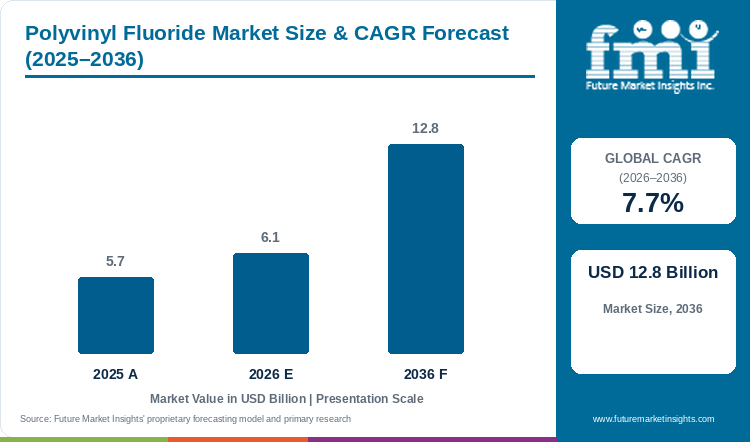
Across the 2026 to 2036 forecast window, an expected 7.7% compound annual clip lifts polyvinyl fluoride industry sales from USD 5.7 billion (2025) and an estimated USD 6.1 billion (2026) to a projected USD 12.8 billion.
Field failure analysis published by the International Energy Agency Photovoltaic Power Systems Programme in February 2025 documented that backsheet chalking and delamination remain critical degradation modes in crystalline silicon modules lacking weatherable fluoropolymer outer layers [1]. Polyvinyl fluoride (PVF) functions as a weatherable fluoropolymer barrier film and latent-solvent dispersion that airframe cabin integrators and photovoltaic laminators specify over conventional coatings whenever surfaces face decades of ultraviolet radiation or strict FAR 25.853 cabin heat-release audits. Reflecting these durability mandates, Future Market Insights places polyvinyl fluoride industry demand at USD 5.7 billion in 2025 alongside an estimated 2026 valuation of USD 6.1 billion, with an expected 7.7% CAGR through 2036 projected to push total fluoropolymer expenditure to USD 12.8 billion and create USD 6.7 billion in added commercial value. Extruded PVF film is anticipated to represent 39.4% of 2026 form-category shipments across fluoropolymer film converting lines due to pinhole-free dielectric uniformity, though energy-intensive latent-solvent casting and PFAS regulatory reviews temper usage in low-margin building claddings.
Key Market Trends & Insights
- By product form: PVF film is projected to reach 39.4% of 2026 product form demand owing to uniform dielectric breakdown strength and pinhole-free moisture barrier stability.
- By application: Protective surface films are estimated to attain 37.8% of 2026 application volume through anti-graffiti and solvent-wipe resistance on cabin bulkheads and stowage bins.
- By substrate: Metals are expected to constitute 43.1% of 2026 substrate consumption as coil-coated aluminum and galvanized steel sheets withstand zero-T roll-forming bends without micro-cracking.
- By end use: Aerospace is forecast to lead 2026 end-use purchasing at 45.1% share on the back of narrowbody and widebody commercial fuselage production backlogs.
Regional Highlights
- Fastest national expansion: South Korean semiconductor cleanroom and N-type solar module laminators are anticipated to top key fluoropolymer economies with an 8.6% CAGR from 2026 to 2036.
- Other national growth rates: American airframe and solar demand is expected to climb 8.0% annually while British composite molders (7.7%) and Japanese monomer plants (7.5%) are forecast to outpace French cabin suppliers (7.4%) and German coil coaters (7.2%).
Market Size & Forecast
Table 1: Market Size and Forecast for the Polyvinyl Fluoride Market (USD billion and CAGR percentage), 2025 to 2036
| Metric | Value |
|---|---|
| 2025 Market Size | USD 5.7 billion |
| Estimated Market Size in 2026 | USD 6.1 billion |
| Projected Market Size by 2036 | USD 12.8 billion |
| CAGR, 2026 to 2036 | 7.7% |
| Added Revenue, 2026 to 2036 | USD 6.7 billion |
Meeting low smoke-density and vertical burn limits while eliminating multi-coat cabin repainting downtime drives interior specification across commercial aviation. In June 2026, the Federal Aviation Administration published its 14 CFR Part 25 Transport Airplane and Propulsion Certification Modernization rulemaking harmonizing cabin flammability standards under 14 CFR 25.853 with EASA CS 25.853 [2]. Aerospace tier-one integrators are therefore replacing painted phenolic panels and commodity polyvinyl chloride sheets with pre-laminated PVF decorative barriers.
Aerospace Cabin and Photovoltaic Backsheet Volume Sizing
Table 2: Aerospace Cabin and Photovoltaic Backsheet Volume Sizing for the Polyvinyl Fluoride Market (USD billion, million square meters, and USD per square meter), mixed historical and forecast years from 2025 to 2036
| Metric | 2025 | 2026 | 2036 |
|---|---|---|---|
| Market size (USD billion) | 5.7 | 6.1 | 12.8 |
| Installed PVF surface area (million sq. m) | 410 to 445 | 440 to 480 | 910 to 985 |
| Aerospace cabin laminate demand (million sq. m) | 185 to 200 | 198 to 216 | 410 to 445 |
| Average realization per sq. m (USD) | 12.80 to 13.90 | 12.70 to 13.85 | 13.00 to 14.05 |
Operational note: Surface area estimates apply commercial aircraft interior panel square footage and utility solar backsheet laminations across standard 25-micron to 50-micron biaxially oriented film gauges.
Long-term supply contracts across commercial airframe assembly and desert solar module lamination anchor square-meter film realizations. FMI's fluorochemical survey confirms that pre-primed adhesive PVF films for aircraft acoustic insulation bags and honeycomb cabin sidewalls are projected to generate higher per-square-meter margins than unprimed release liners through 2036.
Per Capita & Industrial Facility Sizing
Table 3: Per Capita and Industrial Facility Spending Indicators for the Polyvinyl Fluoride Market (USD and USD thousands), mixed historical and forecast years from 2025 to 2036
| Metric | 2025 | 2026 | 2036 |
|---|---|---|---|
| World population (billion) | 8.23 | 8.30 | 8.95 |
| Spend per capita (USD) | 0.69 | 0.73 | 1.43 |
| Spend per 1,000 people (USD) | 692.6 | 734.9 | 1,430.2 |
| Spend per qualified laminating line (USD thousand) | 1,620 to 1,780 | 1,710 to 1,890 | 3,150 to 3,480 |
Table 4: Industrial & Aerospace Laminating Spending Indicators for the Polyvinyl Fluoride Market (USD billion, USD million, and percentages), 2026
| Metric | Value | Basis |
|---|---|---|
| Market size, 2026 | USD 6.1 billion | 2026 global estimate |
| Qualified aerospace and coil laminators worldwide | 3,400 facilities | 2025 industry registry |
| Market spend per laminating facility | USD 1.8 million | Facility average |
| Aerospace end-use revenue, 2026 | USD 2.8 billion | 45.1% end-use share |
Biaxially oriented fluoropolymer films and latent-solvent dispersions have scaled across heavy industrial manufacturing to prevent ultraviolet chalking and chemical permeation. Rising output across airframe monument plants and coastal metal coil lines converts multi-decade weatherability rules into recurring orders where PVF outperforms polyvinylidene fluoride in flex-fatigue resistance.
Analyst Perspective
"Aerospace cabin engineers and photovoltaic module laminators require protective fluoropolymer barriers that resist ultraviolet cleavage and pass OSU heat-release testing without plasticizer migration. Suppliers delivering pinhole-free biaxially oriented films and low-VOC dispersion primers will secure multi-year qualification contracts across airframe and solar programs."
- Nikhil Kaitwade, Principal Consultant, Future Market Insights.
How is the polyvinyl fluoride market segmented?
The polyvinyl fluoride market is segmented by product form, application, substrate, end use, and region. In 2026, PVF film is projected at 39.4%, protective surface films at 37.8%, metals at 43.1%, and aerospace at 45.1%.
By product form: PVF Film, PVF Coating, PVF Laminate, and PVF Resin.
By application: Protective Surface Films, Backsheets, Architectural Laminates, and Release Liners.
By substrate: Metals, Polymer Composites, Paper & Board, and Glass.
By end use: Aerospace, Solar Energy, Construction, and Transportation.
Why Does Biaxially Oriented PVF Film Lead Product Form Sales?
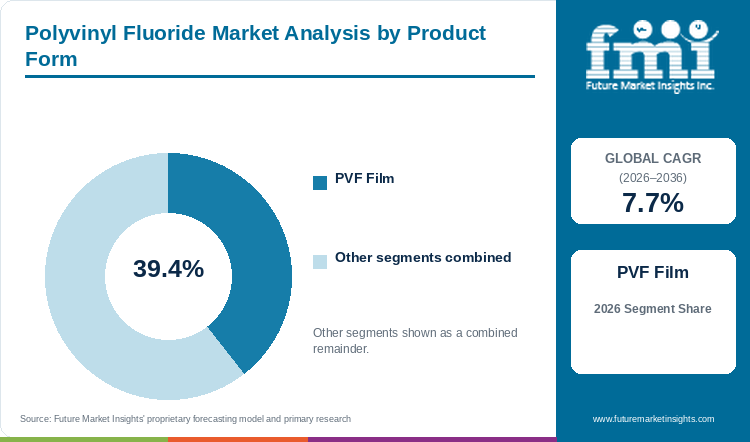
Biaxially oriented PVF film is projected to reach 39.4% of 2026 product form demand, reflecting pinhole-free dielectric strength.
Table 5: Product Form Share for the Polyvinyl Fluoride Market (percentage share), 2026
| Product Form | Share (2026) |
|---|---|
| PVF Film | 39.4% |
| Other Segments Combined | 60.6%* |
| Total | 100.0% |
*Note: Combined share of remaining product form categories totaling 100.0% of 2026 market demand.
Table 6: Product Form Leadership and Market Growth for the Polyvinyl Fluoride Market (segment and CAGR percentage), 2026 to 2036
| Metric | Value |
|---|---|
| Global CAGR (2026 to 2036) | 7.7% |
| Leading Segment | PVF Film |
Industrial laminators specify pre-extruded PVF film over liquid dispersions because slot-die cast webs deliver uniform micron gauge control and zero solvent-curing emissions on press lines. Biaxial orientation imparts high tear strength and electrical insulation across thin-gauge aircraft acoustic insulation bags and photovoltaic backsheets. Pre-primed film rolls also bond directly onto phenolic honeycomb cores and PET core layers without bake-oven blistering.
- High dielectric breakdown retention and moisture barrier uniformity are expected to give PVF film 39.4% of 2026 product form revenue.
- Updated IEC TS 62804-1:2025 technical specifications issued in June 2025 define high-voltage and UV stress test procedures for potential-induced degradation in crystalline silicon PV modules [3].
How Do Protective Surface Films Capture the Top Application Share?
Cleanable protective surface films are estimated to attain 37.8% of 2026 application volume, aided by harsh ketone wipe resistance.
Airline fleet operators and passenger rail authorities require cleanable interior surfaces that withstand methyl ethyl ketone solvent wiping and quaternary ammonium disinfectant scrubbing. Whereas polyvinyl butyral interlayers remain enclosed inside laminated safety glass, surface-applied PVF films shield exposed composite cabin sidewalls and overhead stowage bins from staining and ultraviolet yellowing. Embossed low-gloss PVF textures also preserve decorative cabin aesthetics across ten-year fuselage overhaul intervals.
- Cabin sidewall abrasion and anti-graffiti specifications are anticipated to place protective surface films at 37.8% of 2026 application turnover.
- DuPont de Nemours, Inc. featured its Tedlar protective overlaminate films at the ISA Sign Expo in April 2025 for graphics and architectural panels requiring graffiti and UV fading resistance [4].
What Keeps Metals Ahead as the Primary Lamination Substrate?
Galvanized steel and aluminum metals are expected to constitute 43.1% of 2026 substrate consumption, benefiting from zero-T bend lamination.
Architectural and industrial coil coaters laminate PVF films and apply specialized fluoropolymer coating primers onto continuous aluminum and hot-dip galvanized steel coils. Metal-bonded polyvinyl fluoride sheets endure severe zero-T roll-forming bends into corrugated roofing and cleanroom wall panels without micro-cracking or salt-fog delamination. This mechanical elongation advantage prevents sacrificial zinc and aluminum corrosion along coastal chemical plants.
- Flexible post-forming bend performance without film crazing is forecast to allow metals to claim 43.1% of 2026 substrate demand.
- DuPont and United States Steel broadened the COASTALUME product line (GALVALUME steel laminated with Tedlar PVF film) in June 2025 and unveiled 50-year-warranty coastal roofing solutions at IRE 2026 in January 2026 [5].
Why Does Commercial Aerospace Dominate End-Use Expenditure?
Commercial fuselage aerospace interiors are forecast to lead 2026 end use purchasing at 45.1%, accompanied by FAR 25.853 flame rules.
Commercial airframers mandate self-extinguishing decorative cabin laminates and moisture-impermeable thermal acoustic insulation bagging films across every narrowbody and widebody fuselage. Specifying PVF laminates across aircraft cabin interior monuments and sidewalls ensures compliance with vertical burn and Ohio State University calorimetry heat-release tests. Water-vapor barrier PVF films simultaneously prevent condensation buildup inside glass-wool fuselage insulation blankets.
- Multi-year narrowbody and widebody aircraft build backlogs are projected to secure 45.1% of 2026 end-user volume for aerospace.
- ISOVOLTA AG supplies FAR 25.853 and FAR 25.855 certified Airvolt Laminate 1C and Airvolt RHM Patch panels surfaced with white Tedlar PVF film for commercial aircraft cabin and cargo compartment interiors [6].
What are the drivers, restraints, and opportunities in the polyvinyl fluoride market?
Mandatory aircraft cabin flammability standards and desert solar backsheet durability rules are anticipated to lift polyvinyl fluoride shipments through 2036, while latent-solvent extrusion energy and PFAS regulatory audits raise compliance costs.
- Driver: Mandatory aircraft cabin heat-release certifications and utility photovoltaic module reliability standards establish polyvinyl fluoride lamination as a baseline engineering requirement.
- Restraint: High thermal extrusion energy consumption using latent solvents such as propylene carbonate alongside European fluoropolymer regulatory scrutiny elevates manufacturing costs.
- Opportunity: Co-extruded N-type TOPCon solar backsheets and hydrogen-peroxide-washable semiconductor cleanroom wall panels generate high-margin specifications across East Asia and North America.
Growth Analysis and Future Potential: Qualitative Demand Catalysts
Commercial aviation backlog execution and utility-scale solar farm installations serve as the primary structural catalysts expanding global polyvinyl fluoride consumption. In February 2025, DuPont published updated technical specifications for biaxially oriented Tedlar PVF release films serving aerospace prepreg autoclave curing and printed circuit board lamination [7]. Photovoltaic module manufacturers deploying high-efficiency cells simultaneously require backsheets that resist hydrolysis across 30-year desert power purchase agreements, sustaining long-term demand for industrial fluoropolymers in renewable energy.
Risk Assessment of the Polyvinyl Fluoride Market: Operational and Formulation Friction
Latent-solvent extrusion complexity and tightening environmental audits on fluorinated substances represent the main commercial barriers restraining broader market expansion. Because polyvinyl fluoride degrades near its crystalline melting temperature, processors must disperse polymer powders in high-boiling latent solvents such as dimethylacetamide or propylene carbonate prior to slot-die film casting. In August 2025, the European Chemicals Agency (ECHA) announced its revised evaluation timeline for the universal EU REACH PFAS restriction proposal ahead of its spring 2026 SEAC draft opinion consultation [8]. High solvent-recovery capital costs encourage price-sensitive construction buyers in mild climates to substitute polyester coil coatings.
Commercial Opportunity Analysis: Formulation Differentiation and Value-Add Formats
Polymer manufacturers and specialty laminators capture premium margins by engineering thin-gauge composite autoclave release liners and outgassing-free cleanroom wall laminates for semiconductor megafabs. During carbon-fiber wing spar curing, high performance fluoropolymer release films peel cleanly from epoxy prepregs at 180 degrees Celsius without transferring silicone residues onto structural aircraft bonds. In 2026, Krempel GmbH detailed its biaxially stretched Tedlar PVF protective and release films alongside custom Tedlar PVF fabric laminates rated from -70 to +110 degrees Celsius (with 200-degree short-term peaks) for epoxy resin separation and solar backsheets [9]. Pairing biaxially oriented PVF outer layers with adjacent polytetrafluoroethylene breathers and competing ethylene tetrafluoroethylene dielectrics also supports multi-layer vacuum-bagging kits across aerospace tooling plants.
Polyvinyl Fluoride Market by Country (2026 to 2036)
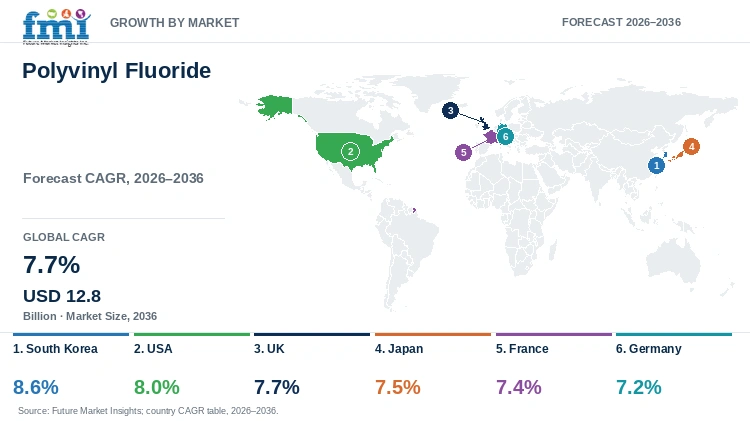
Across major aerospace and solar manufacturing economies, South Korean cleanroom and photovoltaic laminators are projected to rank first at 8.6% yearly growth through 2036, followed by expected gains across American plants at 8.0% and British composite tooling at 7.7%. Japanese monomer hubs are anticipated to grow 7.5% per annum alongside forecast expansion in France at 7.4% and Germany at 7.2%.
Table 7: Country CAGR and Primary Growth Levers for the Polyvinyl Fluoride Market (CAGR percentage and operational drivers), 2026 to 2036
| Country | CAGR (2026 to 2036) | Primary Growth Lever |
|---|---|---|
| South Korea | 8.6% | Semiconductor cleanroom interior wall laminates and N-type bifacial solar backsheet exports |
| USA | 8.0% | Commercial narrowbody cabin production and Inflation Reduction Act utility solar installations |
| UK | 7.7% | Aerospace composite wing autoclave release films and railcar anti-graffiti interior claddings |
| Japan | 7.5% | High-purity vinyl fluoride monomer synthesis and Shinkansen rolling stock fire-safe panels |
| France | 7.4% | Airbus cabin monument lamination and nuclear facility decontaminable wall coatings |
| Germany | 7.2% | Architectural metal coil-coated facade panels and chemical processing tank protective linings |
Source: Future Market Insights analysis
South Korea Polyvinyl Fluoride Market Outlook (2026 to 2036)
Unlike Western markets anchored in commercial aircraft cabins, South Korea's polyvinyl fluoride demand is uniquely driven by semiconductor megafab cleanroom wall claddings and next-generation battery material zones requiring outgassing-free fluoropolymer barriers. In December 2025, South Korea's 8th National High-Tech Strategic Industry Committee under MOTIR announced plans to designate new specialized strategic zones for rechargeable batteries and advanced aviation engines while strengthening domestic material supply chains [10]. South Korean polyvinyl fluoride revenue is anticipated to advance at an 8.6% annual clip through 2036 on cleanroom wall and solar backsheet exports. Domestic laminators still confront imported monomer costs, which local converters offset by co-extruding 25-micron PVF outer layers onto PET core films.
Key takeaway: In South Korea, semiconductor cleanroom outgassing standards and high-efficiency solar module exports sustain strong demand for ultra-pure polyvinyl fluoride laminates.
USA Polyvinyl Fluoride Market Outlook (2026 to 2036)
The United States stands apart from every other national market as the sole vertically integrated vinyl fluoride monomer and biaxial Tedlar film manufacturing base, directly supplying domestic narrowbody airframe assembly and utility solar plants. Researchers at the National Laboratory of the Rockies (formerly NREL) updated their Photovoltaic Lifetime Project in October 2026 tracking field degradation rates across 12 PV module types and backsheet architectures in Golden and Albuquerque [11]. American polyvinyl fluoride sales are forecast to climb 8.0% per year through 2036 across aircraft cabin lamination and desert solar installations. Producers also navigate U.S. EPA TSCA Section 8(a)(7) PFAS reporting rules updated in April 2026 by operating closed-loop polymerization reactors [12].
Key takeaway: In the USA, commercial narrowbody aircraft backlog execution and domestically incentivized solar module assembly anchor multi-year polyvinyl fluoride supply contracts.
UK Polyvinyl Fluoride Market Outlook (2026 to 2036)
Rather than finished photovoltaic module encapsulation, British polyvinyl fluoride consumption is uniquely concentrated in high-temperature autoclave composite release liners used to cure carbon-fiber commercial aircraft wings in the South West and North West alongside railcar interiors. In June 2025, the UK Department for Business and Trade issued its ten-year Advanced Manufacturing Sector Plan committing GBP 4.3 billion in capital support including GBP 2.3 billion for aerospace composite and propulsion R&D through the Aerospace Technology Institute [13]. British polyvinyl fluoride consumption is projected to expand at a 7.7% yearly pace through 2036 on steady aerospace autoclave release film demand. High industrial electricity tariffs still strain converters, prompting tier-one fabricators to procure pre-perforated PVF release liners.
Key takeaway: In the UK, autoclave composite wing molding and strict rail interior anti-graffiti standards drive specialized film procurement.
Japan Polyvinyl Fluoride Market Outlook (2026 to 2036)
Japan differs from volume architectural markets by operating as a precision laminating and electronics converting hub that engineers moisture barriers and release liners for next-generation building-integrated perovskite solar cells and Shinkansen rolling stock panels. In October 2025, Japan's Minister Muto confirmed at a Tokyo METI briefing that the Japanese government is tightening ground-mounted solar governance while strongly advancing the domestic social implementation of Japan-originated perovskite solar cells [14]. Japanese polyvinyl fluoride demand is expected to progress 7.5% annually through 2036 backed by high-barrier solar encapsulation and rail interior lamination. Although residential construction faces demographic headwinds, Japanese photovoltaic and rolling-stock converters offset domestic building softness by exporting weatherable PVF barrier laminates.
Key takeaway: In Japan, advanced fluorochemical monomer synthesis and precision electronics release liner engineering insulate domestic producers from slower residential building activity.
France Polyvinyl Fluoride Market Outlook (2026 to 2036)
French polyvinyl fluoride demand is uniquely dual-anchored in Toulouse commercial airframe cabin monument integration and record domestic utility solar photovoltaic installations across southern regions. In March 2026, the International Energy Agency's Global Energy Review 2026 reported that global solar PV additions surpassed 600 GW in 2025 (reaching 2,800 GW total installed capacity), while European Union renewable additions hit a record 85 GW with France setting a new national solar installation record [15]. French polyvinyl fluoride volume is predicted to grow at a 7.4% compound annual clip through 2036 on Airbus cabin lamination and solar backsheet orders. Strict industrial solvent emission limits challenge liquid coaters, prompting French contractors to adopt solvent-free thermal film lamination presses.
Key takeaway: In France, commercial airframe cabin assembly backlogs and decontaminable nuclear facility wall specifications sustain steady consumption of certified fluoropolymer laminates.
Germany Polyvinyl Fluoride Market Outlook (2026 to 2036)
Unlike Asian cleanroom or American solar backsheet markets, German polyvinyl fluoride consumption is uniquely centered on continuous architectural metal coil coating and corrosion-resistant chemical storage tank linings across Rhine industrial parks. In February 2026, the German Chemical Industry Association (VCI) reported in its Q4 2025 industry assessment that persistently high German energy costs and weak industrial orders kept domestic chemical plant capacity utilization depressed [16]. German polyvinyl fluoride expenditure is estimated to increase 7.2% each year through 2036 across metal facade claddings and chemical tank linings. Domestic manufacturers still face European REACH PFAS restriction proposals alongside elevated curing-oven gas costs, which German coil coaters counter by marketing multi-decade-warranty PVF facade panels.
Key takeaway: In Germany, long-life architectural coil-coated metal facades and corrosion-resistant chemical tank linings sustain demand despite European fluoropolymer regulatory headwinds.
Full report country CAGRs cover: North America; Latin America; Western Europe; Eastern Europe; East Asia; South Asia and Pacific; Middle East and Africa.
Who are the notable companies in the polyvinyl fluoride market?
DuPont de Nemours, Inc. (Tedlar), Krempel GmbH, DUNMORE Corporation, Coveme S.p.A., ISOVOLTA AG, United States Steel Corporation (COASTALUME), American Durafilm Co., Inc., and Jolywood (Suzhou) Sunwatt Co., Ltd. are the notable companies in the polyvinyl fluoride market.
FMI analysts note that global supply is anchored by vertically integrated vinyl fluoride monomer and biaxial film casting at DuPont de Nemours (Tedlar) alongside specialized solar and aerospace PVF film laminators. DuPont de Nemours produces biaxially oriented Tedlar polyvinyl fluoride films and dispersions across its American manufacturing footprint. Downstream multilayer laminators including Krempel GmbH and DUNMORE Corporation together with Coveme S.p.A. and Jolywood Sunwatt bond PVF outer layers onto PET cores for 1,500-volt photovoltaic backsheets. Aerospace and construction converters such as ISOVOLTA AG and United States Steel (COASTALUME) alongside American Durafilm fabricate FAR 25.853 cabin panels and coastal steel roofing separately from adjacent PTFE or PVDF resin producers.
- Primary Integrated PVF Resin & Biaxial Film Producer: DuPont de Nemours, Inc. (Tedlar) operates vertically integrated vinyl fluoride polymerization and latent-solvent dispersion synthesis alongside biaxial PVF film casting facilities.
- Photovoltaic & Industrial Multilayer PVF Laminators: Krempel GmbH and DUNMORE Corporation alongside Coveme S.p.A. and Jolywood (Suzhou) Sunwatt Co., Ltd. engineer Tedlar PVF solar module backsheets and composite release laminates.
- Aerospace Cabin, Architectural Metal & Cleanroom PVF Converters: ISOVOLTA AG and United States Steel Corporation (COASTALUME) together with American Durafilm Co., Inc. manufacture PVF-surfaced aircraft interior laminates and coastal steel roofing as well as gas sampling bags.
Competitive Benchmarking: Polyvinyl Fluoride Market
Table 8: Competitive Benchmarking for the Polyvinyl Fluoride Market (qualitative capability ratings), 2026
| Company | PVF Film & Laminate Breadth | Aerospace & Solar Certification Depth | Value-Chain Role & Converting Scale | Geographic Reach |
|---|---|---|---|---|
| DuPont de Nemours, Inc. (Tedlar) | High | High | High | High |
| Krempel GmbH | High | High | High | High |
| DUNMORE Corporation | High | High | High | High |
| Coveme S.p.A. | High | High | High | High |
| ISOVOLTA AG | Medium | High | High | High |
| United States Steel Corporation (COASTALUME) | Medium | Medium | High | Medium |
| American Durafilm Co., Inc. | High | High | Medium | Medium |
| Jolywood (Suzhou) Sunwatt Co., Ltd. | Medium | High | High | High |
Scoring basis: PVF Film & Laminate Breadth receives a High mark where verified product catalogs span multiple oriented Tedlar PVF film gauges or multilayer PVF laminates, while Medium indicates specialization in specific cabin or roofing substrates. Aerospace & Solar Certification Depth is rated High where PVF products hold documented FAR 25.853 flammability or UL/IEC 61730 photovoltaic backsheet qualifications. Value-Chain Role & Converting Scale is High when a participant operates primary vinyl fluoride polymerization or high-volume roll-to-roll PVF lamination lines.
Key Developments in the Polyvinyl Fluoride Market
- In February 2026, DuPont de Nemours, Inc. announced that its Tedlar polyvinyl fluoride (PVF) films manufacturing plants in Buffalo and Louisville alongside Fayetteville achieved 100% renewable electricity sourcing (approximately 42,000 MWh annually via Renewable Energy Certificates) [17].
- In January 2026, DuPont and United States Steel Corporation exhibited 50-year brackish-water-warrantied COASTALUME roofing panels (GALVALUME steel laminated with Tedlar PVF film) at the 2026 International Roofing Expo in Las Vegas following their five-shade coastal palette expansion [18].
- During 2025, DUNMORE Corporation expanded supply of its UL QIHE2-recognized DUN-SOLAR TPE and 425-micron aluminum-foil TAPE photovoltaic backsheets engineered with a DuPont Tedlar PVF outer layer (<0.0005 g/m2/day water vapor transmission rate) across its Bristol and Freiburg plants [19].
Key Players in the Polyvinyl Fluoride Market
Primary Integrated PVF Resin & Biaxial Film Producer
- DuPont de Nemours, Inc. (Tedlar)
Photovoltaic & Industrial Multilayer PVF Laminators
- Krempel GmbH
- DUNMORE Corporation
- Coveme S.p.A.
- Jolywood (Suzhou) Sunwatt Co., Ltd.
Aerospace Cabin, Architectural Metal & Cleanroom PVF Converters
- ISOVOLTA AG
- United States Steel Corporation (COASTALUME)
- American Durafilm Co., Inc.
Polyvinyl Fluoride Market - Report Scope
Table 9: Report Scope for the Polyvinyl Fluoride Market (coverage fields and definitions), 2026 to 2036
| Coverage field | Report scope |
|---|---|
| Market breakdown | Product Form; Application; Substrate; End Use; Region |
| Quantitative Units | USD Billion |
| Market Definition | Includes manufacturer and converter revenue from polyvinyl fluoride resins, biaxially oriented PVF films, latent-solvent PVF coatings, and pre-laminated PVF sheets across the four segmentation axes. Supply Scope Note: The valuation captures B2B polyvinyl fluoride resin, oriented PVF film rollstock, PVF dispersion coating, and PVF-laminated barrier sheet sales at the primary polymer producer and authorized PVF laminator/converter tier, excluding adjacent fluoropolymers (PTFE, FEP, PFA, ETFE, FFKM, and PVDF), non-fluorinated polyester films, and finished solar modules or aircraft monuments. |
| Regions Covered | North America; Latin America; Western Europe; Eastern Europe; East Asia; South Asia and Pacific; Middle East and Africa |
| Countries Covered | South Korea, USA, UK, Japan, France, Germany, and additional countries in the full report |
| Key Companies Covered | DuPont de Nemours, Inc. (Tedlar), Krempel GmbH, DUNMORE Corporation, Coveme S.p.A., ISOVOLTA AG, United States Steel Corporation (COASTALUME), American Durafilm Co., Inc., Jolywood (Suzhou) Sunwatt Co., Ltd. |
| Forecast Period | 2026 to 2036 |
| Approach | Primary and secondary research with market triangulation. |
Polyvinyl Fluoride Market - Research Methodology
Table 10: Research Methodology for the Polyvinyl Fluoride Market (research methods and approach), 2026 edition
| Method | Approach |
|---|---|
| Primary Research | Primary interviews were conducted with fluoropolymer resin chemists, biaxial film extruders, aerospace cabin tier-one integrators, photovoltaic backsheet laminators, and architectural coil coaters to validate demand and pricing. |
| Secondary Research | Secondary research included company annual filings, investor presentations, FAA and DGAC airworthiness directives, IEA-PVPS and NREL photovoltaic reliability reports, NCCA and VCI trade statistics, and product data sheets. |
| Market Sizing and Forecasting | Market sizing and forecasting for the 2026 to 2036 period were developed using top-down and bottom-up approaches reconciling vinyl fluoride monomer capacity against aerospace, solar, and coil-coating square-meter film consumption. |
| Data Triangulation and Validation | Data is validated against commercial aircraft delivery backlogs, gigawatt solar module installations, architectural coil-coating output, and historical pricing without double counting adjacent fluoropolymers. |
| Country Forecasting Model | Country-level CAGRs are projected via FMI's specialty fluoropolymers econometric model, calibrating national expansion rates against the 7.7% global baseline through semiconductor cleanroom buildouts, airframe cabin production, and utility solar installations. |
| Operational Benchmark Traceability | Operational benchmarks (installed PVF surface area in million square meters, aerospace cabin laminate volume, square-meter price realizations, and laminating facility spend) are synthesized from IEA-PVPS, FAA, NREL, NCCA, and producer disclosures. |
Polyvinyl Fluoride Market by Segments
Polyvinyl Fluoride Market segmented by Product Form:
- PVF Film
- PVF Coating
- PVF Laminate
- PVF Resin
Polyvinyl Fluoride Market segmented by Application:
- Protective Surface Films
- Backsheets
- Architectural Laminates
- Release Liners
Polyvinyl Fluoride Market segmented by Substrate:
- Metals
- Polymer Composites
- Paper & Board
- Glass
Polyvinyl Fluoride Market segmented by End Use:
- Aerospace
- Solar Energy
- Construction
- Transportation
Polyvinyl Fluoride Market by Region
- North America
- United States
- Canada
- Latin America
- Brazil
- Mexico
- Argentina
- Chile
- Western Europe
- Germany
- France
- United Kingdom
- Italy
- Spain
- Benelux
- Nordics
- Eastern Europe
- Poland
- Czech Republic
- Romania
- Hungary
- East Asia
- China
- Japan
- South Korea
- South Asia and Pacific
- India
- ASEAN
- Australia and New Zealand
- Middle East and Africa
- GCC Countries
- South Africa
- Türkiye
- Israel
Research Sources and Bibliography
- [1] International Energy Agency Photovoltaic Power Systems Programme (IEA-PVPS). (2025, February 14). Photovoltaic Failure Fact Sheets (PVFS) 2025. IEA-PVPS Task 13 Technical Report IEA-PVPS T13-30:2025.
- [2] Federal Aviation Administration (FAA), U.S. Department of Transportation. (2026, June 26). Transport Airplane and Propulsion Certification Modernization. Federal Register, 91 FR 38878 (14 CFR Part 25, Docket No. FAA-2026-0430).
- [3] International Electrotechnical Commission (IEC). (2025, June 13). IEC TS 62804-1:2025. IEC Webstore (Photovoltaic (PV) modules - Test methods for the detection of potential-induced degradation - Part 1: Crystalline silicon, Edition 2.0).
- [4] DuPont de Nemours, Inc. (2025, April 21). DuPont Joins International Signage Association and Features Overlaminate Innovations at ISA Expo in Las Vegas. DuPont Tedlar News & Events.
- [5] DuPont de Nemours, Inc. (2025, June 9). DuPont and United States Steel Broaden COASTALUME™ Product Line with an Exciting New Color Palette. DuPont Tedlar News & Events (with January 16, 2026 IRE Roofing Solutions Release).
- [6] ISOVOLTA AG. (2025, May 15). Airvolt Laminate series - Isovolta AG. ISOVOLTA Aviation & Transportation Composites (Airvolt Laminate 1C & RHM Patch with White Tedlar PVF).
- [7] DuPont de Nemours, Inc. (2025, February 27). DuPont™ Tedlar® for Release Films. DuPont Tedlar PVF Films Technical Literature.
- [8] European Chemicals Agency (ECHA). (2025, August 27). ECHA announces timeline for PFAS restriction evaluation. ECHA Official Press Releases.
- [9] Krempel GmbH. (2026, January 20). Tedlar Films | KREMPEL. Krempel Composite Materials & Solar Backsheet Laminates (Tedlar PVF Films and Special Laminates).
- [10] Ministry of Trade, Industry and Resources (MOTIR). (2025, December 1). K-Battery to Power Korea's Future Industries. Republic of Korea Ministry of Trade, Industry and Resources Press Releases.
- [11] National Laboratory of the Rockies (NLR / NREL), U.S. Department of Energy. (2026, October 2). Photovoltaic Lifetime Project. NLR Photovoltaic Research (PV Lifetime Project – 2025 NLR Annual Report).
- [12] U.S. Environmental Protection Agency (EPA). (2026, April 9). Update on Reporting Deadline for TSCA PFAS Reporting Rule. U.S. EPA Chemicals under the Toxic Substances Control Act (TSCA).
- [13] Department for Business and Trade (UK). (2025, June 23). Advanced Manufacturing Sector Plan. GOV.UK Policy Paper (The UK's Modern Industrial Strategy 2025).
- [14] Ministry of Economy, Trade and Industry (METI). (2025, October 7). Press Conference by Minister Muto (Excerpt). METI Official Press Conferences and Statements (Perovskite Solar Cell Implementation).
- [15] International Energy Agency (IEA). (2026, March 24). Technology: Solar PV and wind - Global Energy Review 2026. International Energy Agency Flagship Reports.
- [16] Verband der Chemischen Industrie e.V. (VCI). (2026, February 11). Chemical industry still in trouble. VCI Quarterly Report 4/2025 Press Releases.
- [17] DuPont de Nemours, Inc. (2026, February 23). DuPont™ Tedlar® Manufacturing Operations Now Powered by 100 Percent Renewable Electricity. DuPont Tedlar News & Events (Buffalo, Louisville & Fayetteville PVF Operations).
- [18] DuPont de Nemours, Inc. & United States Steel Corporation. (2026, January 16). Latest News and Releases | DuPont™ Tedlar® DuPont US. DuPont Tedlar Newsroom (DuPont to Unveil Innovative Roofing Solutions at IRE 2026 & COASTALUME Expansion).
- [19] DUNMORE Corporation. (2025, March 18). TPE Backsheet, DUN-SOLAR™ TPE Backsheets | Dunmore. DUNMORE Solar & Aerospace Division (DuPont Tedlar PVF-Based DUN-SOLAR TPE and TAPE Backsheets).
- [20] Coveme S.p.A. (2025, April 10). Backsheet in Tedlar for Solar Panels - dyMat TSL | Coveme. Coveme Photovoltaic Division (1500 VDC dyMat TsF 285 & Clr TsF 285 25µm Tedlar PVF Backsheets).
This bibliography is provided for reader reference and is not exhaustive. The full report contains the complete reference list and detailed citations.
This Report Answers
- How large is the polyvinyl fluoride market in 2026 and what is forecast for 2036?
- Which aerospace flammability and solar weatherability pressures support demand for polyvinyl fluoride?
- Why does PVF film lead the product form category?
- Why do protective surface films lead the application category globally?
- How do growth rates differ across South Korea, the USA, the UK, and Japan?
- Which leading companies supply polyvinyl fluoride resins, films, and coatings today?
- What limits adoption or supplier switching in the polyvinyl fluoride market?
- What should buyers evaluate before purchasing polyvinyl fluoride films or dispersions?
Frequently Asked Questions
How big is the polyvinyl fluoride market in 2026, and what is forecast for 2036?
Global polyvinyl fluoride demand is estimated at USD 6.1 billion in 2026 (rising from USD 5.7 billion in 2025) and is projected to reach USD 12.8 billion by 2036 on sustained aircraft cabin lamination and utility solar backsheet orders.
What is the CAGR for the polyvinyl fluoride market from 2026 to 2036?
Future Market Insights projects a 7.7% compound annual growth rate between 2026 and 2036, which is expected to generate USD 6.7 billion in incremental revenue across commercial airframe interiors and desert photovoltaic modules.
Which product form segment leads the polyvinyl fluoride market?
PVF film is anticipated to account for 39.4% of 2026 product form sales because pinhole-free biaxially oriented webs provide uniform dielectric strength and bond directly onto composite cabin panels.
Which application segment leads the polyvinyl fluoride market?
Protective surface films are estimated to claim 37.8% of 2026 application volume owing to harsh ketone wipe cleanability and ultraviolet stability across aircraft and railcar interiors.
Which country has a notable growth outlook from 2026 to 2036?
As per FMI, South Korea is forecast to lead major fluoropolymer markets with an 8.6% CAGR through 2036, backed by semiconductor megafab cleanroom wall claddings and N-type bifacial solar backsheet exports.
Who are the key players in the market?
Notable market participants include DuPont de Nemours, Inc. (Tedlar), Krempel GmbH, DUNMORE Corporation, Coveme S.p.A., ISOVOLTA AG, United States Steel Corporation (COASTALUME), American Durafilm Co., Inc., and Jolywood (Suzhou) Sunwatt Co., Ltd., supplying biaxially oriented PVF films, solar backsheets, and aircraft cabin laminates.
Preview the report firsthand - request a free sample
Get SampleGet the brochure for pricing and purchase details.
Get PDFTable of Content
- Key Takeaways
- Market Size and CAGR
- Top Growth Driver
- Fastest Growing Segment
- Leading Region
- Key Companies
- Emerging Opportunities
- Executive Summary
- Global Market Outlook
- Demand-side Trends
- Supply-side Trends
- Technology Roadmap Analysis
- Analysis and Recommendations
- Analyst Perspective (What is happening? Why now? What should investors know?)
- Key Questions Answered
- How large is the market?
- What is the CAGR?
- What are key trends?
- Which region dominates?
- Who are the leaders?
- Market Overview
- Market Coverage / Taxonomy
- Market Definition / Scope / Limitations
- Research Methodology
- Chapter Orientation
- Analytical Lens and Working Hypotheses
- Market Structure, Signals, and Trend Drivers
- Benchmarking and Cross-market Comparability
- Market Sizing, Forecasting, and Opportunity Mapping
- Research Design and Evidence Framework
- Desk Research Programme (Secondary Evidence)
- Expert Input and Fieldwork (Primary Evidence)
- Tooling, Models, and Reference Databases
- Data Engineering and Model Build
- Quality Assurance and Audit Trail
- Market Background
- Market Dynamics (Drivers, Restraints, Opportunity, Trends)
- Scenario Forecast (Optimistic, Likely, Conservative)
- Impact Analysis
- AI Impact
- Sustainability Impact
- Regulatory Impact
- Technology Impact
- Consumer / Buyer Analysis
- Purchase Drivers
- Adoption Barriers
- Buyer Journey
- Opportunity Map Analysis
- Product Life Cycle Analysis
- Supply Chain Analysis
- Investment Feasibility Matrix
- Value Chain Analysis
- PESTLE and Porter's Analysis
- Regulatory Landscape
- Regional Parent Market Outlook
- Production and Consumption Statistics
- Import and Export Statistics
- Global Market Analysis and Forecast, 2021 to 2036
- Historical Market Size Value (USD Billion) Analysis, 2021 to 2025
- Current and Future Market Size Value (USD Billion) Projections, 2026 to 2036
- Y-o-Y Growth Trend Analysis
- Absolute $ Opportunity Analysis
- Global Market Pricing Analysis, 2021 to 2036
- Global Market Analysis and Forecast, By Product Form, 2021 to 2036
- Introduction / Key Findings
- Historical Market Size Value (USD Billion) Analysis By Product Form, 2021 to 2025
- Current and Future Market Size Value (USD Billion) Analysis and Forecast By Product Form, 2026 to 2036
- PVF Film
- PVF Coating
- PVF Laminate
- PVF Resin
- Y-o-Y Growth Trend Analysis By Product Form, 2021 to 2025
- Absolute $ Opportunity Analysis By Product Form, 2026 to 2036
- Global Market Analysis and Forecast, By Application, 2021 to 2036
- Introduction / Key Findings
- Historical Market Size Value (USD Billion) Analysis By Application, 2021 to 2025
- Current and Future Market Size Value (USD Billion) Analysis and Forecast By Application, 2026 to 2036
- Protective Surface Films
- Backsheets
- Architectural Laminates
- Release Liners
- Y-o-Y Growth Trend Analysis By Application, 2021 to 2025
- Absolute $ Opportunity Analysis By Application, 2026 to 2036
- Global Market Analysis and Forecast, By Substrate, 2021 to 2036
- Introduction / Key Findings
- Historical Market Size Value (USD Billion) Analysis By Substrate, 2021 to 2025
- Current and Future Market Size Value (USD Billion) Analysis and Forecast By Substrate, 2026 to 2036
- Metals
- Polymer Composites
- Paper & Board
- Glass
- Y-o-Y Growth Trend Analysis By Substrate, 2021 to 2025
- Absolute $ Opportunity Analysis By Substrate, 2026 to 2036
- Global Market Analysis and Forecast, By End Use, 2021 to 2036
- Introduction / Key Findings
- Historical Market Size Value (USD Billion) Analysis By End Use, 2021 to 2025
- Current and Future Market Size Value (USD Billion) Analysis and Forecast By End Use, 2026 to 2036
- Aerospace
- Solar Energy
- Construction
- Transportation
- Y-o-Y Growth Trend Analysis By End Use, 2021 to 2025
- Absolute $ Opportunity Analysis By End Use, 2026 to 2036
- Global Market Analysis and Forecast, By Region, 2021 to 2036
- Introduction
- Historical Market Size Value (USD Billion) Analysis By Region, 2021 to 2025
- Current Market Size Value (USD Billion) Analysis and Forecast By Region, 2026 to 2036
- North America
- Latin America
- Western Europe
- Eastern Europe
- East Asia
- South Asia and Pacific
- Middle East and Africa
- Market Attractiveness Analysis By Region
- North America Market Analysis and Forecast, By Country, 2021 to 2036
- Historical Market Size Value (USD Billion) Trend Analysis By Market Taxonomy, 2021 to 2025
- Market Size Value (USD Billion) Forecast By Market Taxonomy, 2026 to 2036
- By Country
- United States
- Canada
- By Product Form
- By Application
- By Substrate
- By End Use
- By Country
- Market Attractiveness Analysis
- By Country
- By Product Form
- By Application
- By Substrate
- By End Use
- Key Takeaways
- Latin America Market Analysis and Forecast, By Country
- Historical Market Size Value (USD Billion) Trend Analysis By Market Taxonomy, 2021 to 2025
- Market Size Value (USD Billion) Forecast By Market Taxonomy, 2026 to 2036
- By Country
- Brazil
- Mexico
- Argentina
- Chile
- By Product Form
- By Application
- By Substrate
- By End Use
- By Country
- Market Attractiveness Analysis
- By Country
- By Product Form
- By Application
- By Substrate
- By End Use
- Key Takeaways
- Western Europe Market Analysis and Forecast, By Country
- Historical Market Size Value (USD Billion) Trend Analysis By Market Taxonomy, 2021 to 2025
- Market Size Value (USD Billion) Forecast By Market Taxonomy, 2026 to 2036
- By Country
- Germany
- France
- United Kingdom
- Italy
- Spain
- Benelux
- Nordics
- By Product Form
- By Application
- By Substrate
- By End Use
- By Country
- Market Attractiveness Analysis
- By Country
- By Product Form
- By Application
- By Substrate
- By End Use
- Key Takeaways
- Eastern Europe Market Analysis and Forecast, By Country
- Historical Market Size Value (USD Billion) Trend Analysis By Market Taxonomy, 2021 to 2025
- Market Size Value (USD Billion) Forecast By Market Taxonomy, 2026 to 2036
- By Country
- Poland
- Czech Republic
- Romania
- Hungary
- By Product Form
- By Application
- By Substrate
- By End Use
- By Country
- Market Attractiveness Analysis
- By Country
- By Product Form
- By Application
- By Substrate
- By End Use
- Key Takeaways
- East Asia Market Analysis and Forecast, By Country
- Historical Market Size Value (USD Billion) Trend Analysis By Market Taxonomy, 2021 to 2025
- Market Size Value (USD Billion) Forecast By Market Taxonomy, 2026 to 2036
- By Country
- China
- Japan
- South Korea
- By Product Form
- By Application
- By Substrate
- By End Use
- By Country
- Market Attractiveness Analysis
- By Country
- By Product Form
- By Application
- By Substrate
- By End Use
- Key Takeaways
- South Asia and Pacific Market Analysis and Forecast, By Country
- Historical Market Size Value (USD Billion) Trend Analysis By Market Taxonomy, 2021 to 2025
- Market Size Value (USD Billion) Forecast By Market Taxonomy, 2026 to 2036
- By Country
- India
- ASEAN
- Australia and New Zealand
- By Product Form
- By Application
- By Substrate
- By End Use
- By Country
- Market Attractiveness Analysis
- By Country
- By Product Form
- By Application
- By Substrate
- By End Use
- Key Takeaways
- Middle East and Africa Market Analysis and Forecast, By Country
- Historical Market Size Value (USD Billion) Trend Analysis By Market Taxonomy, 2021 to 2025
- Market Size Value (USD Billion) Forecast By Market Taxonomy, 2026 to 2036
- By Country
- GCC Countries
- South Africa
- Türkiye
- Israel
- By Product Form
- By Application
- By Substrate
- By End Use
- By Country
- Market Attractiveness Analysis
- By Country
- By Product Form
- By Application
- By Substrate
- By End Use
- Key Takeaways
- Key Countries Market Analysis
- United States
- Pricing Analysis
- Market Share Analysis, 2025
- By Product Form
- By Application
- By Substrate
- By End Use
- Canada
- Pricing Analysis
- Market Share Analysis, 2025
- By Product Form
- By Application
- By Substrate
- By End Use
- Mexico
- Pricing Analysis
- Market Share Analysis, 2025
- By Product Form
- By Application
- By Substrate
- By End Use
- Brazil
- Pricing Analysis
- Market Share Analysis, 2025
- By Product Form
- By Application
- By Substrate
- By End Use
- Chile
- Pricing Analysis
- Market Share Analysis, 2025
- By Product Form
- By Application
- By Substrate
- By End Use
- Germany
- Pricing Analysis
- Market Share Analysis, 2025
- By Product Form
- By Application
- By Substrate
- By End Use
- United Kingdom
- Pricing Analysis
- Market Share Analysis, 2025
- By Product Form
- By Application
- By Substrate
- By End Use
- Italy
- Pricing Analysis
- Market Share Analysis, 2025
- By Product Form
- By Application
- By Substrate
- By End Use
- Spain
- Pricing Analysis
- Market Share Analysis, 2025
- By Product Form
- By Application
- By Substrate
- By End Use
- France
- Pricing Analysis
- Market Share Analysis, 2025
- By Product Form
- By Application
- By Substrate
- By End Use
- India
- Pricing Analysis
- Market Share Analysis, 2025
- By Product Form
- By Application
- By Substrate
- By End Use
- ASEAN
- Pricing Analysis
- Market Share Analysis, 2025
- By Product Form
- By Application
- By Substrate
- By End Use
- Australia and New Zealand
- Pricing Analysis
- Market Share Analysis, 2025
- By Product Form
- By Application
- By Substrate
- By End Use
- China
- Pricing Analysis
- Market Share Analysis, 2025
- By Product Form
- By Application
- By Substrate
- By End Use
- Japan
- Pricing Analysis
- Market Share Analysis, 2025
- By Product Form
- By Application
- By Substrate
- By End Use
- South Korea
- Pricing Analysis
- Market Share Analysis, 2025
- By Product Form
- By Application
- By Substrate
- By End Use
- Poland
- Pricing Analysis
- Market Share Analysis, 2025
- By Product Form
- By Application
- By Substrate
- By End Use
- Hungary
- Pricing Analysis
- Market Share Analysis, 2025
- By Product Form
- By Application
- By Substrate
- By End Use
- Türkiye
- Pricing Analysis
- Market Share Analysis, 2025
- By Product Form
- By Application
- By Substrate
- By End Use
- South Africa
- Pricing Analysis
- Market Share Analysis, 2025
- By Product Form
- By Application
- By Substrate
- By End Use
- United States
- Market Structure Analysis
- Competition Dashboard
- Competition Benchmarking
- Market Share Analysis of Top Players
- By Regional
- By Product Form
- By Application
- By Substrate
- By End Use
- Emerging Startups
- Innovation Benchmarking
- Competition Analysis
- Competition Deep Dive
- DuPont de Nemours, Inc. (Tedlar)
- Overview
- Product Portfolio
- Profitability by Market Segments
- Sales Footprint
- Strategy Overview
- Marketing Strategy
- Product Strategy
- Channel Strategy
- Krempel GmbH
- DUNMORE Corporation
- Coveme S.p.A.
- ISOVOLTA AG
- United States Steel Corporation (COASTALUME)
- American Durafilm Co., Inc.
- Jolywood (Suzhou) Sunwatt Co., Ltd.
- DuPont de Nemours, Inc. (Tedlar)
- Case Studies
- Success Stories
- Recent Developments
- Competition Deep Dive
- Assumptions & Acronyms Used


