

- Industry Size (2025)
- USD 1.3 Bn
- Forecast (2035)
- USD 2.6 Bn
- CAGR (2025 to 2035)
- 7.3%
Portable Boring Machines Market Size and Share Forecast Outlook 2025 to 2035
The Portable Boring Machines Market is estimated to be valued at USD 1.3 billion in 2025 and is projected to reach USD 2.6 billion by 2035, registering a compound annual growth rate (CAGR) of 7.3% over the forecast period.
Quick Stats for Portable Boring Machines Market
- Portable Boring Machines Market Value (2025): USD 1.3 billion
- Portable Boring Machines Market Forecast Value (2035): USD 2.6 billion
- Portable Boring Machines Market Forecast CAGR: 7.3%
- Leading Segment in Portable Boring Machines Market in 2025: Horizontal (57.6%)
- Key Growth Regions in Portable Boring Machines Market: North America, Asia-Pacific, Europe
- Top Key Players in Portable Boring Machines Market: Sir Meccanica, ELSA, Mactech Europe, Ventil Test Equipment, PROTEM
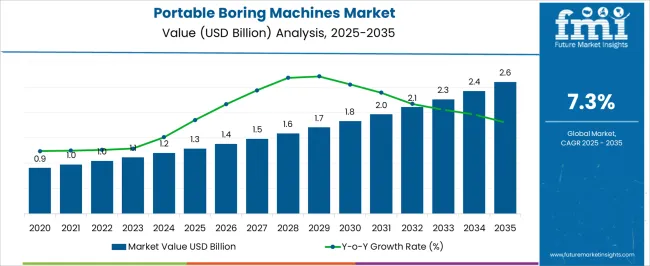
Portable Boring Machines Market Key Takeaways
| Metric | Value |
|---|---|
| Portable Boring Machines Market Estimated Value in (2025 E) | USD 1.3 billion |
| Portable Boring Machines Market Forecast Value in (2035 F) | USD 2.6 billion |
| Forecast CAGR (2025 to 2035) | 7.3% |
Why is the Portable Boring Machines Market Growing?
The Portable Boring Machines market is experiencing robust growth due to increasing demand for versatile machining solutions in various industrial sectors. The current market scenario is shaped by the adoption of portable machines that provide flexibility, precision, and ease of operation on-site, reducing downtime and increasing productivity. In 2025, the market is witnessing a strong preference for machines that combine compact design with high-performance capabilities, enabling operations in constrained spaces where conventional stationary machines are impractical.
Growth is being influenced by the rise of the automotive and heavy machinery industries, where efficient maintenance and component fabrication are critical. Technological advancements such as improved motor efficiency, digital controls, and ergonomic designs are further supporting the adoption of portable boring machines.
The future outlook is favorable as industries continue to prioritize on-site machining solutions, cost optimization, and process efficiency Demand is expected to expand in both established manufacturing hubs and emerging industrial regions, driven by increasing production volumes, industrial modernization initiatives, and the need for precision-driven operations.
Segmental Analysis
The portable boring machines market is segmented by type, power, application, and geographic regions. By type, portable boring machines market is divided into Horizontal and Vertical. In terms of power, portable boring machines market is classified into Electrical powered and Hydraulically powered. Based on application, portable boring machines market is segmented into Automotive, Aerospace, Oem, and Other Industrial. Regionally, the portable boring machines industry is classified into North America, Latin America, Western Europe, Eastern Europe, Balkan & Baltic Countries, Russia & Belarus, Central Asia, East Asia, South Asia & Pacific, and the Middle East & Africa.
Insights into the Horizontal Type Segment
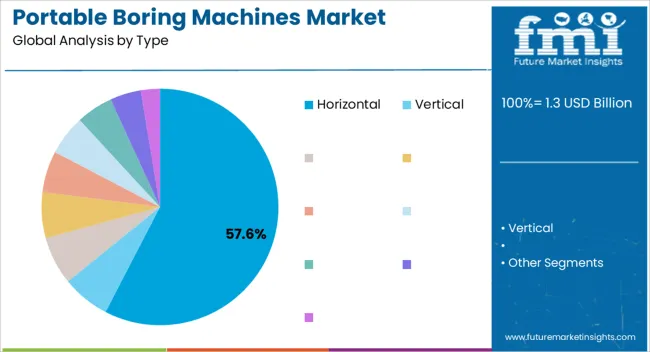
The horizontal type is projected to hold 57.60% of the Portable Boring Machines market revenue share in 2025, making it the leading machine type. This dominance is being attributed to its ability to provide enhanced stability and precision during machining of larger workpieces. Horizontal machines are favored in industrial environments where alignment, rigidity, and consistent boring accuracy are critical.
Growth in this segment has been supported by applications in sectors requiring high throughput and repeatable performance, such as automotive and heavy equipment manufacturing. The capability to integrate these machines with advanced control systems for automated operations has further reinforced their adoption.
Additionally, horizontal machines offer easier access to components during maintenance or on-site machining, reducing operational downtime and improving overall efficiency The combination of mechanical robustness and adaptability to various workpiece configurations has positioned horizontal portable boring machines as the preferred choice for industrial operators seeking reliability and long-term operational efficiency.
Insights into the Electrical Powered Application Segment
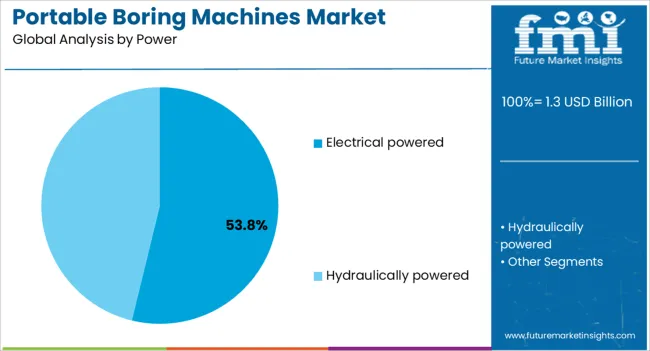
Electrical powered portable boring machines are expected to account for 53.80% of total revenue in 2025, emerging as the leading power type. This predominance is being driven by the efficiency, safety, and ease of use offered by electrical systems compared to conventional hydraulic or pneumatic alternatives. Electrical machines allow precise speed control, lower energy consumption, and integration with modern digital monitoring systems, enabling real-time adjustments and predictive maintenance.
The adoption of electrical machines has been accelerated in industries prioritizing environmentally friendly operations and reduced operational costs. Their flexibility for on-site operations without reliance on heavy infrastructure has further contributed to growth.
Electrical powered machines also support consistent torque and power delivery, improving machining quality and repeatability As industrial automation and process standardization expand across sectors, electrical powered portable boring machines are expected to remain the dominant segment, with continued investment in energy-efficient, high-performance solutions.
Insights into the Automotive Application Segment
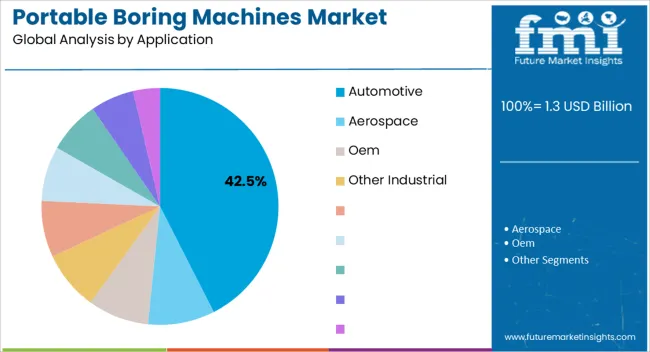
The automotive industry is anticipated to represent 42.50% of the Portable Boring Machines market revenue in 2025, making it the leading end-use application. This leadership is being driven by the high demand for precision machining in engine blocks, chassis components, and other critical assemblies. The automotive sector has benefited from portable boring machines that enable on-site maintenance, retrofitting, and quick component fabrication, reducing production downtime and improving assembly line efficiency.
Growth has been reinforced by the increasing production of complex, high-performance vehicles and the need for exact tolerances in component manufacturing. The flexibility of portable machines to adapt to various workpiece sizes and shapes without extensive setup makes them highly suitable for automotive operations.
Additionally, the integration of electrical power systems and digital control features has enhanced accuracy, safety, and productivity, further solidifying adoption As the automotive industry continues to expand and focus on high-quality, reliable production, portable boring machines are expected to maintain a leading role in enabling precision and efficiency.
Market Overview
Global Portable Boring Machines Market Introduction
Increasing focus on reducing downtime in the industrial maintenance industry is pushing the demand for easy to operate and portable maintenance equipment. Boring machine is a tool used for producing a smooth hole in a machine part or any other surface while production of machine or its maintenance. Portable boring machine is used in the majorly used in electrical industry, aerospace industry, power industry and many other industries. Portable boring machines are easy to set up and are compact to fit in the less space.
This allows these machines to work in the tight industrial work places. Portable boring machines are comes with various power options and flexibility in terms of sizes. The Portable Boring Machines is supplied in various sizes and power, as per its use in different applications. Portable boring machines can be divided into two major types including horizontal type and vertical type.
Analysis of Portable Boring Machines Market By Key Countries
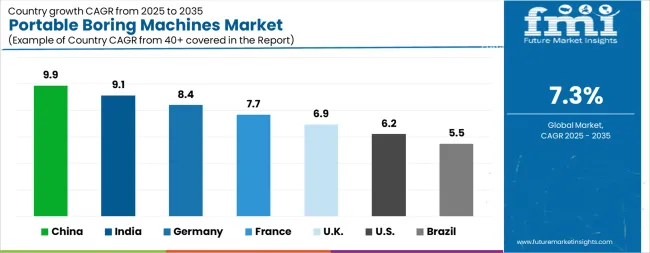
| Country | CAGR |
|---|---|
| China | 9.9% |
| India | 9.1% |
| Germany | 8.4% |
| France | 7.7% |
| UK | 6.9% |
| USA | 6.2% |
| Brazil | 5.5% |
Country-wise Analysis
The Portable Boring Machines Market is expected to register a CAGR of 7.3% during the forecast period, exhibiting varied country level momentum. China leads with the highest CAGR of 9.9%, followed by India at 9.1%. Developed markets such as Germany, France, and the UK continue to expand steadily, while the USA is likely to grow at consistent rates. Brazil posts the lowest CAGR at 5.5%, yet still underscores a broadly positive trajectory for the global Portable Boring Machines Market. In 2024, Germany held a dominant revenue in the Western Europe market and is expected to grow with a CAGR of 8.4%. The USA Portable Boring Machines Market is estimated to be valued at USD 475.8 million in 2025 and is anticipated to reach a valuation of USD 868.7 million by 2035. Sales are projected to rise at a CAGR of 6.2% over the forecast period between 2025 and 2035. While Japan and South Korea markets are estimated to be valued at USD 68.2 million and USD 34.5 million respectively in 2025.
Key Players in the Portable Boring Machines Market
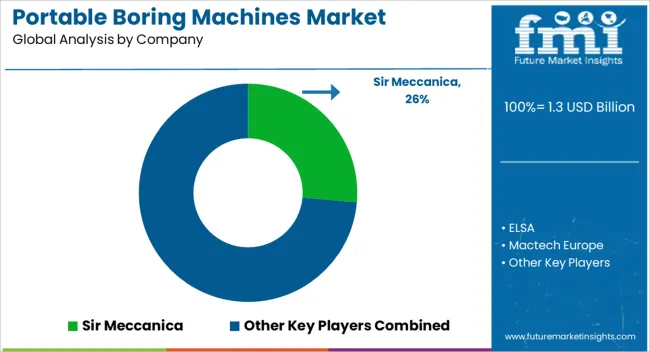
- Sir Meccanica
- ELSA
- Mactech Europe
- Ventil Test Equipment
- PROTEM
Scope of the Report
| Item | Value |
|---|---|
| Quantitative Units | USD 1.3 Billion |
| Type | Horizontal and Vertical |
| Power | Electrical powered and Hydraulically powered |
| Application | Automotive, Aerospace, Oem, and Other Industrial |
| Regions Covered | North America, Europe, Asia-Pacific, Latin America, Middle East & Africa |
| Country Covered | United States, Canada, Germany, France, United Kingdom, China, Japan, India, Brazil, South Africa |
| Key Companies Profiled | Sir Meccanica, ELSA, Mactech Europe, Ventil Test Equipment, and PROTEM |
Portable Boring Machines Market by Segments
Type:
- Horizontal
- Vertical
Power:
- Electrical powered
- Hydraulically powered
Application:
- Automotive
- Aerospace
- Oem
- Other Industrial
Region:
- North America
- USA
- Canada
- Mexico
- Latin America
- Brazil
- Chile
- Rest of Latin America
- Western Europe
- Germany
- UK
- Italy
- Spain
- France
- Nordic
- BENELUX
- Rest of Western Europe
- Eastern Europe
- Russia
- Poland
- Hungary
- Balkan & Baltic
- Rest of Eastern Europe
- East Asia
- China
- Japan
- South Korea
- South Asia and Pacific
- India
- ASEAN
- Australia & New Zealand
- Rest of South Asia and Pacific
- Middle East & Africa
- Kingdom of Saudi Arabia
- Other GCC Countries
- Turkiye
- South Africa
- Other African Union
- Rest of Middle East & Africa
Frequently Asked Questions
How big is the portable boring machines market in 2025?
The global portable boring machines market is estimated to be valued at USD 1.3 billion in 2025.
What will be the size of portable boring machines market in 2035?
The market size for the portable boring machines market is projected to reach USD 2.6 billion by 2035.
How much will be the portable boring machines market growth between 2025 and 2035?
The portable boring machines market is expected to grow at a 7.3% CAGR between 2025 and 2035.
What are the key product types in the portable boring machines market?
The key product types in portable boring machines market are horizontal and vertical.
Which power segment to contribute significant share in the portable boring machines market in 2025?
In terms of power, electrical powered segment to command 53.8% share in the portable boring machines market in 2025.
Preview the report firsthand - request a free sample
Get SampleGet the brochure for pricing and purchase details.
Get PDFTable of Content
- Executive Summary
- Global Market Outlook
- Demand-side Trends
- Supply-side Trends
- Technology Roadmap Analysis
- Analysis and Recommendations
- Market Overview
- Market Coverage / Taxonomy
- Market Definition / Scope / Limitations
- Market Background
- Market Dynamics
- Drivers
- Restraints
- Opportunity
- Trends
- Scenario Forecast
- Demand in Optimistic Scenario
- Demand in Likely Scenario
- Demand in Conservative Scenario
- Opportunity Map Analysis
- Product Life Cycle Analysis
- Supply Chain Analysis
- Investment Feasibility Matrix
- Value Chain Analysis
- PESTLE and Porter’s Analysis
- Regulatory Landscape
- Regional Parent Market Outlook
- Production and Consumption Statistics
- Import and Export Statistics
- Market Dynamics
- Global Market Analysis 2020 to 2024 and Forecast, 2025 to 2035
- Historical Market Size Value (USD Million) Analysis, 2020 to 2024
- Current and Future Market Size Value (USD Million) Projections, 2025 to 2035
- Y-o-Y Growth Trend Analysis
- Absolute $ Opportunity Analysis
- Global Market Pricing Analysis 2020 to 2024 and Forecast 2025 to 2035
- Global Market Analysis 2020 to 2024 and Forecast 2025 to 2035, By Type
- Introduction / Key Findings
- Historical Market Size Value (USD Million) Analysis By Type , 2020 to 2024
- Current and Future Market Size Value (USD Million) Analysis and Forecast By Type , 2025 to 2035
- Horizontal
- Vertical
- Y-o-Y Growth Trend Analysis By Type , 2020 to 2024
- Absolute $ Opportunity Analysis By Type , 2025 to 2035
- Global Market Analysis 2020 to 2024 and Forecast 2025 to 2035, By Power
- Introduction / Key Findings
- Historical Market Size Value (USD Million) Analysis By Power, 2020 to 2024
- Current and Future Market Size Value (USD Million) Analysis and Forecast By Power, 2025 to 2035
- Electrical powered
- Hydraulically powered
- Y-o-Y Growth Trend Analysis By Power, 2020 to 2024
- Absolute $ Opportunity Analysis By Power, 2025 to 2035
- Global Market Analysis 2020 to 2024 and Forecast 2025 to 2035, By Application
- Introduction / Key Findings
- Historical Market Size Value (USD Million) Analysis By Application, 2020 to 2024
- Current and Future Market Size Value (USD Million) Analysis and Forecast By Application, 2025 to 2035
- Automotive
- Aerospace
- Oem
- Other Industrial
- Y-o-Y Growth Trend Analysis By Application, 2020 to 2024
- Absolute $ Opportunity Analysis By Application, 2025 to 2035
- Global Market Analysis 2020 to 2024 and Forecast 2025 to 2035, By Region
- Introduction
- Historical Market Size Value (USD Million) Analysis By Region, 2020 to 2024
- Current Market Size Value (USD Million) Analysis and Forecast By Region, 2025 to 2035
- North America
- Latin America
- Western Europe
- Eastern Europe
- East Asia
- South Asia and Pacific
- Middle East & Africa
- Market Attractiveness Analysis By Region
- North America Market Analysis 2020 to 2024 and Forecast 2025 to 2035, By Country
- Historical Market Size Value (USD Million) Trend Analysis By Market Taxonomy, 2020 to 2024
- Market Size Value (USD Million) Forecast By Market Taxonomy, 2025 to 2035
- By Country
- USA
- Canada
- Mexico
- By Type
- By Power
- By Application
- By Country
- Market Attractiveness Analysis
- By Country
- By Type
- By Power
- By Application
- Key Takeaways
- Latin America Market Analysis 2020 to 2024 and Forecast 2025 to 2035, By Country
- Historical Market Size Value (USD Million) Trend Analysis By Market Taxonomy, 2020 to 2024
- Market Size Value (USD Million) Forecast By Market Taxonomy, 2025 to 2035
- By Country
- Brazil
- Chile
- Rest of Latin America
- By Type
- By Power
- By Application
- By Country
- Market Attractiveness Analysis
- By Country
- By Type
- By Power
- By Application
- Key Takeaways
- Western Europe Market Analysis 2020 to 2024 and Forecast 2025 to 2035, By Country
- Historical Market Size Value (USD Million) Trend Analysis By Market Taxonomy, 2020 to 2024
- Market Size Value (USD Million) Forecast By Market Taxonomy, 2025 to 2035
- By Country
- Germany
- UK
- Italy
- Spain
- France
- Nordic
- BENELUX
- Rest of Western Europe
- By Type
- By Power
- By Application
- By Country
- Market Attractiveness Analysis
- By Country
- By Type
- By Power
- By Application
- Key Takeaways
- Eastern Europe Market Analysis 2020 to 2024 and Forecast 2025 to 2035, By Country
- Historical Market Size Value (USD Million) Trend Analysis By Market Taxonomy, 2020 to 2024
- Market Size Value (USD Million) Forecast By Market Taxonomy, 2025 to 2035
- By Country
- Russia
- Poland
- Hungary
- Balkan & Baltic
- Rest of Eastern Europe
- By Type
- By Power
- By Application
- By Country
- Market Attractiveness Analysis
- By Country
- By Type
- By Power
- By Application
- Key Takeaways
- East Asia Market Analysis 2020 to 2024 and Forecast 2025 to 2035, By Country
- Historical Market Size Value (USD Million) Trend Analysis By Market Taxonomy, 2020 to 2024
- Market Size Value (USD Million) Forecast By Market Taxonomy, 2025 to 2035
- By Country
- China
- Japan
- South Korea
- By Type
- By Power
- By Application
- By Country
- Market Attractiveness Analysis
- By Country
- By Type
- By Power
- By Application
- Key Takeaways
- South Asia and Pacific Market Analysis 2020 to 2024 and Forecast 2025 to 2035, By Country
- Historical Market Size Value (USD Million) Trend Analysis By Market Taxonomy, 2020 to 2024
- Market Size Value (USD Million) Forecast By Market Taxonomy, 2025 to 2035
- By Country
- India
- ASEAN
- Australia & New Zealand
- Rest of South Asia and Pacific
- By Type
- By Power
- By Application
- By Country
- Market Attractiveness Analysis
- By Country
- By Type
- By Power
- By Application
- Key Takeaways
- Middle East & Africa Market Analysis 2020 to 2024 and Forecast 2025 to 2035, By Country
- Historical Market Size Value (USD Million) Trend Analysis By Market Taxonomy, 2020 to 2024
- Market Size Value (USD Million) Forecast By Market Taxonomy, 2025 to 2035
- By Country
- Kingdom of Saudi Arabia
- Other GCC Countries
- Turkiye
- South Africa
- Other African Union
- Rest of Middle East & Africa
- By Type
- By Power
- By Application
- By Country
- Market Attractiveness Analysis
- By Country
- By Type
- By Power
- By Application
- Key Takeaways
- Key Countries Market Analysis
- USA
- Pricing Analysis
- Market Share Analysis, 2024
- By Type
- By Power
- By Application
- Canada
- Pricing Analysis
- Market Share Analysis, 2024
- By Type
- By Power
- By Application
- Mexico
- Pricing Analysis
- Market Share Analysis, 2024
- By Type
- By Power
- By Application
- Brazil
- Pricing Analysis
- Market Share Analysis, 2024
- By Type
- By Power
- By Application
- Chile
- Pricing Analysis
- Market Share Analysis, 2024
- By Type
- By Power
- By Application
- Germany
- Pricing Analysis
- Market Share Analysis, 2024
- By Type
- By Power
- By Application
- UK
- Pricing Analysis
- Market Share Analysis, 2024
- By Type
- By Power
- By Application
- Italy
- Pricing Analysis
- Market Share Analysis, 2024
- By Type
- By Power
- By Application
- Spain
- Pricing Analysis
- Market Share Analysis, 2024
- By Type
- By Power
- By Application
- France
- Pricing Analysis
- Market Share Analysis, 2024
- By Type
- By Power
- By Application
- India
- Pricing Analysis
- Market Share Analysis, 2024
- By Type
- By Power
- By Application
- ASEAN
- Pricing Analysis
- Market Share Analysis, 2024
- By Type
- By Power
- By Application
- Australia & New Zealand
- Pricing Analysis
- Market Share Analysis, 2024
- By Type
- By Power
- By Application
- China
- Pricing Analysis
- Market Share Analysis, 2024
- By Type
- By Power
- By Application
- Japan
- Pricing Analysis
- Market Share Analysis, 2024
- By Type
- By Power
- By Application
- South Korea
- Pricing Analysis
- Market Share Analysis, 2024
- By Type
- By Power
- By Application
- Russia
- Pricing Analysis
- Market Share Analysis, 2024
- By Type
- By Power
- By Application
- Poland
- Pricing Analysis
- Market Share Analysis, 2024
- By Type
- By Power
- By Application
- Hungary
- Pricing Analysis
- Market Share Analysis, 2024
- By Type
- By Power
- By Application
- Kingdom of Saudi Arabia
- Pricing Analysis
- Market Share Analysis, 2024
- By Type
- By Power
- By Application
- Turkiye
- Pricing Analysis
- Market Share Analysis, 2024
- By Type
- By Power
- By Application
- South Africa
- Pricing Analysis
- Market Share Analysis, 2024
- By Type
- By Power
- By Application
- USA
- Market Structure Analysis
- Competition Dashboard
- Competition Benchmarking
- Market Share Analysis of Top Players
- By Regional
- By Type
- By Power
- By Application
- Competition Analysis
- Competition Deep Dive
- Sir Meccanica
- Overview
- Product Portfolio
- Profitability by Market Segments (Product/Age /Sales Channel/Region)
- Sales Footprint
- Strategy Overview
- Marketing Strategy
- Product Strategy
- Channel Strategy
- ELSA
- Mactech Europe
- Ventil Test Equipment
- PROTEM
- Sir Meccanica
- Competition Deep Dive
- Assumptions & Acronyms Used
- Research Methodology


