

- Market Size (2026)
- USD 374.7 Mn
- Forecast (2036)
- USD 980.7 Mn
- CAGR (2026 to 2036)
- 10.1%
How big is Post-Hospital Frailty Nutrition Market in 2026?
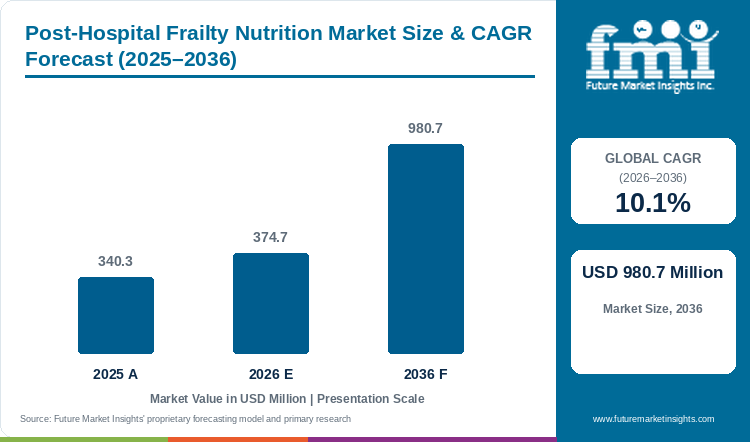
The post-hospital frailty nutrition market is estimated at USD 340.3 million in 2025 and is expected to reach USD 374.7 million in 2026. Sales of post-hospital frailty nutrition are projected to grow at a 10.1% CAGR and reach USD 980.7 million by 2036.
Post-hospital frailty nutrition market share is concentrated in prescribed drinks and powders that leave the ward with a frail older patient. Sales of post-hospital frailty nutrition are estimated at USD 340.3 million for 2025, and the post-hospital frailty nutrition market is expected to reach USD 374.7 million in 2026. By 2036, demand for post-hospital frailty nutrition is projected to reach USD 980.7 million, a 10.1% CAGR. Even so, flavour fatigue and small appetites cut intake once patients are home, and suppliers are rebuilding ranges around choice. For instance, Aymes renamed AYMES powders in the United Kingdom ActaSolve and AYMES ready-to-use packs ActaGain in steps between February 2025 and September 2026, keeping PIP codes unchanged for the renamed products.[1] As a result, community dietitians can now swap a flavour without re-coding a prescription, which protects repeat orders after the first discharge pack.
Of Porter's five forces, buyer power weighs heaviest on frailty supplement makers. For example, prescribing in the United Kingdom runs on listed codes and prices, so suppliers compete on flavour, volume and format, and Aymes kept PIP codes, and for most lines prices, unchanged through the rename.[1] Code stability of that kind stops a prescriber from switching brands at a rename, which shows how much control the buyer holds. The threat of substitutes ranks second, as food-first plans with fortified milk and puddings stay the starting point in community care. Against this backdrop, FMI analysis shows brands with lower serving volumes and wider flavour lists keeping prescriptions at each review, and single-format suppliers facing switches.
Key Market Trends & Insights
- Standard-volume high-protein ONS is expected to hold 45.4% of 2026 product type sales, with compact ONS near 21.6% as dietitians move low-appetite patients to 125 ml packs.
- Sales of 30-day post-discharge programs are likely to make up 50.6% of program length demand in 2026. The first month after discharge is the most closely managed stage of recovery. For reference, CMS counts the transitional care window as the day of discharge plus the next 29 days.[2] A billing window of that length concentrates prescribing and review inside one month.
- Within product form, ready-to-drink packs are projected at 51.7% in 2026, powder at about 27.4% and puddings and semi-solids at 14.6%.
- Recovery weeks pass mostly in the patient's own kitchen, and home care is expected to lead care setting sales with 48.7%.
- Hospital discharge supply will hold 39% of prescription route sales in 2026, and community prescription about 33.4%. Reimbursed listings carry patients from the first pack into community supply. On pricing, Fresenius Kabi lists Fresubin PRO Compact under Ireland's GMS scheme at EUR 1.60 per unit.[3] A listed unit price lets GPs continue the same product after discharge without a cost review.
Regional Highlights
- India is forecast to grow fastest, at 11.2% in FMI's estimate, ahead of the 10.1% global CAGR, as adult nutrition brands target ageing buyers. South Korea comes second at 10.5%.
- Demand in the United States is projected at 9.7%, with Medicare review rules shaping the first month, and in the United Kingdom at 9.4% on PIP-coded prescribing. By comparison, the German rate of 8.8% and the Japanese rate of 8.1% reflect older, fuller care systems.
- The older Korean population is growing quickly. South Korea counted 10.72 million residents aged 65 or older in the 2025 census, 20.7% of the population, the Kyunghyang Shinmun reported on 28 July 2026.[4] Each extra cohort of older residents adds acute admissions and, after discharge, supplement plans.
Market Size & Forecast
Table 1: Market Size and Forecast for the Post-Hospital Frailty Nutrition Market (USD million and percentage), 2025 to 2036
| Metric | Value |
|---|---|
| 2025 Market Size | USD 340.3 million |
| Estimated Market Size in 2026 | USD 374.7 million |
| Projected Market Size by 2036 | USD 980.7 million |
| CAGR, 2026 to 2036 | 10.1% |
| Added Revenue, 2026 to 2036 | USD 606 million |
| Market Expansion Multiple | 2.6x |
Tighter discharge follow-up is turning more first packs of post-hospital frailty nutrition into repeat orders. For example, under Medicare transitional care management, contact with the patient is due within 2 business days and a face-to-face visit within 7 or 14 days of discharge.[2] Those touchpoints decide whether a first supplement pack becomes a second. More broadly, prescribed sip feeds for every condition move at a slower pace, with a projected 6.1% CAGR for the oral clinical nutrition supplements market. In FMI's estimate, discharge-led demand adds USD 606 million to the post-hospital frailty nutrition market across the ten years, a 2.6-fold gain on the 2026 base. Even so, prescriptions abandoned after the first month remain the main risk to that outlook.
Discharge Windows, Compact Packs and Reimbursed Codes
Compact and savoury formats are changing what a frail patient is asked to drink. On this front, Nutricia added Pea Mint and Pumpkin Carrot flavours to Fortimel PlantBased Protein, a high-protein, high-energy drink for disease-related malnutrition linked to frailty or stroke, and said about 1 in 5 patients stop a medical nutrition prescription due to flavour fatigue.[5] Flavour choice is therefore a direct lever on repeat sales. Nutricia also pointed to a clinical study in which 95% of patients adhered to the prescription, with measurable gains in nutritional status after 4 weeks.[5] In practice, a drink that can be served warm as soup gives dietitians a second option for patients who refuse sweet shakes.
Reimbursed codes decide repeat supply after the first pack. For instance, Ireland's GMS scheme lists Fresubin PRO Compact, a 125 ml high-protein drink, under code 82771 at EUR 1.60 per unit.[3] A listed price under a public scheme removes cost as a barrier at the first community review. Likewise, Aymes kept PIP codes unchanged as ActaSolve and ActaGain replaced older AYMES names across 2025 and 2026.[1] Such stable codes spare GP practices and pharmacies from updating prescription files when a range is renamed.
Table 2: Discharge, Format and Reimbursement Indicators for the Post-Hospital Frailty Nutrition Market (timing, adherence and price), 2025 to 2026
| Indicator | Data Point | Relevance | Source |
|---|---|---|---|
| CMS transitional care window, August 2025 | Discharge day plus 29 days; contact within 2 business days | Timing of first supply and review | [2] |
| Nutricia Fortimel PlantBased Protein, October 2025 | 95% adherence in a clinical study, per Nutricia | Flavour fatigue and adherence | [5] |
| Fresubin PRO Compact in Ireland, August 2026 | GMS code 82771; EUR 1.60 per unit | Reimbursed compact ONS | [3] |
| Aymes rename, 2025 to 2026 | ActaSolve powders and ActaGain drinks; PIP codes kept | Prescription continuity in the United Kingdom | [1] |
| Abbott adult nutrition, Q2 2026 | USD 1,119 million; down 4% on a comparable basis | Price pressure on adult nutrition brands | [6] |
| Destatis ageing projection, December 2025 | About one in four residents aged 67 or older by 2035 | Frail older population in Germany | [7] |
Analyst Perspective
“The first month at home decides most of the value in post-hospital frailty nutrition. Patients still drinking the supplement at the 30-day review usually move into a 90-day plan, and those who stop seldom restart. Compact packs, savoury flavours and stable prescription codes keep more patients on the plan past that review, opening a longer runway for 90-day plans at suppliers offering all three.”
- Anurag Sharma, Principal Consultant, Future Market Insights.
How is the post-hospital frailty nutrition market segmented?
The market is segmented into product type, program length, product form, care setting, prescription route, and region. Standard-volume high-protein ONS is expected to lead product type with 45.4% share in 2026, and ready-to-drink packs lead product form with 51.7%.
By product type: standard-volume high-protein ONS, compact ONS, HMB-enriched recovery formulas, protein modules, and others.
By program length: 30-day post-discharge, 90-day support, and 6-month extended support.
By product form: ready-to-drink, powder, puddings and semi-solids, and others.
By care setting: home care, long-term care facilities, transitional care units, and others.
By prescription route: hospital discharge supply, community prescription, institutional contract, and self-pay retail.
By region: patients discharged from acute hospitals in North America, Latin America, Western Europe, Eastern Europe, East Asia, South Asia and Pacific, and Middle East and Africa.
Why does standard-volume high-protein ONS lead post-hospital frailty nutrition sales by product type?
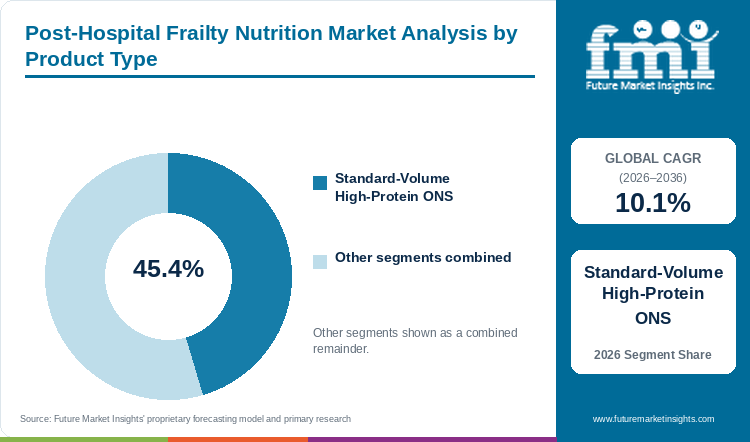
Standard-volume high-protein ONS is expected to lead product type sales with 45.4% share in 2026, ahead of compact ONS at about 21.6% and HMB-enriched recovery formulas at an estimated 14.2%.
Table 3: Product Type Share for the Post-Hospital Frailty Nutrition Market (percentage share), 2026
| Product Type | Estimated Share (2026) |
|---|---|
| Standard-Volume High-Protein ONS | 45.4% |
| Compact ONS | 21.6% |
| HMB-Enriched Recovery Formulas | 14.2% |
| Protein Modules | 10.3% |
| Others | 8.5% |
| Total | 100.0% |
Table 4: Product Type Leadership and Market Growth for the Post-Hospital Frailty Nutrition Market (segment and CAGR percentage), 2026 to 2036
| Metric | Value |
|---|---|
| Global CAGR (2026 to 2036) | 10.1% |
| Leading Segment | Standard-Volume High-Protein ONS |
By product type, standard-volume high-protein ONS is expected to lead with 45.4% of 2026 sales, as a full-size bottle of protein and energy is the default line on most discharge formularies. Next, compact ONS, near 21.6%, packs similar nutrition into about 125 ml for patients who cannot finish a full bottle, and dietitians switch low-appetite patients to that format at review. HMB-enriched recovery formulas, an estimated 14.2%, target muscle loss and are bought more often by families than by discharge teams. Protein modules at 10.3% add protein to food without much energy, so dietitians use them as top-ups. Others, about 8.5%, cover discharge kits and fortified desserts. For context, prescribed specialty foods in general grow slower, at a 6.2% CAGR projected for the medical food market. Over the forecast period, hospitals will keep the standard bottle as first choice and move patients to compact packs at the first review.
- Milk-style drinks, juice-style drinks and fibre variants make up most standard ONS volume.
- Plant-based formats are spreading fast across Europe. Nutricia said the new plant-based medical nutrition products reached over 10 markets in six months, including Spain, France and Germany.[5] Quick roll-out widens the choice for patients who refuse dairy-based drinks.
What keeps 30-day post-discharge programs ahead in post-hospital frailty nutrition by program length?
30-day post-discharge programs are projected to lead program length sales with 50.6% share in 2026, with 90-day support at about 31.8% and 6-month extended support near 17.6%.
Table 5: Program Length Share for the Post-Hospital Frailty Nutrition Market (percentage share), 2026
| Program Length | Estimated Share (2026) |
|---|---|
| 30-Day Post-Discharge | 50.6% |
| 90-Day Support | 31.8% |
| 6-Month Extended Support | 17.6% |
| Total | 100.0% |
In program length, 30-day post-discharge programs are projected to hold the lead in 2026 at 50.6%, as the first supply after discharge usually covers one month. In the US context, Medicare's transitional care period runs from discharge day through the next 29 days, and review visits fall inside that window.[2] Payment rules thus anchor the first month as the main buying window. After that, 90-day support, near 31.8%, follows only for patients whose weight or intake has not recovered by the first review. 6-month extended support, about 17.6%, is limited to patients with persistent malnutrition and a named community dietitian, so fewer plans reach that stage. In short, each step needs a fresh clinical decision, which keeps the first month the largest block of sales.
- Discharge packs, first community prescriptions and nursing-home starter supplies make up most 30-day programs.
- Early follow-up is built into US payment rules. Under CMS rules, a high-complexity transitional care visit is due within 7 calendar days of discharge.[2] A visit inside the first week gives clinicians an early chance to renew or switch the supplement.
Why do ready-to-drink packs lead post-hospital frailty nutrition sales by product form?
Ready-to-drink packs are likely to lead product form sales with 51.7% share in 2026, ahead of powder at about 27.4% and puddings and semi-solids at roughly 14.6%.
Table 6: Product Form Share for the Post-Hospital Frailty Nutrition Market (percentage share), 2026
| Product Form | Estimated Share (2026) |
|---|---|
| Ready-to-Drink | 51.7% |
| Powder | 27.4% |
| Puddings and Semi-Solids | 14.6% |
| Others | 6.3% |
| Total | 100.0% |
Ready-to-drink packs will lead product form in 2026 with 51.7% of sales, as a frail patient living alone can open a bottle without measuring or mixing. By contrast, powder, about 27.4%, costs less per serving and lets carers mix doses into milk, though each dose needs preparation that tired patients often skip. Puddings and semi-solids, near 14.6%, serve patients with chewing or swallowing difficulty, and the oral clinical nutrition desserts market reflects demand for that spoonable format. Others, an estimated 6.3%, include bars and soups. Savoury formats are widening the form mix. Among these, Nutricia's Fortimel PlantBased Protein can be served warm as a soup, which blurs the line between drink and meal.[5] Looking ahead, bottles will keep the lead, and powders will gain in self-pay homes.
- Bottles, cartons and compact 125 ml packs form the ready-to-drink group.
- Flavour updates are now part of range management. Aymes renamed AYMES Shake Compact Ginger as ActaSolve Shake Compact Warm Ginger in April 2026 and AYMES Shake Ginger as ActaSolve Shake Warm Ginger in August 2026, with no change to PIP codes or price.[1] Unchanged codes and prices let prescribers move patients to the new flavour without a fresh approval.
Why does home care lead post-hospital frailty nutrition sales by care setting?
Home care is estimated to lead care setting sales with 48.7% share in 2026, with long-term care facilities at about 27.5% and transitional care units near 16.9%.
Table 7: Care Setting Share for the Post-Hospital Frailty Nutrition Market (percentage share), 2026
| Care Setting | Estimated Share (2026) |
|---|---|
| Home Care | 48.7% |
| Long-Term Care Facilities | 27.5% |
| Transitional Care Units | 16.9% |
| Others | 6.9% |
| Total | 100.0% |
Home care is estimated to lead the setting split, at 48.7% for 2026, since most frail patients go home after an acute stay and drink the supplement there for weeks. Behind home care, long-term care facilities, about 27.5%, buy in bulk through catering and pharmacy contracts, and staff hand out doses on a schedule. Transitional care units, near 16.9%, hold patients for short stays before home, so each patient uses fewer packs there. Others, about 6.9%, cover day hospitals and outpatient clinics. Many facilities also contract out prepared meals, and a 6.8% CAGR is forecast for the therapeutic food delivery for clinical nutrition market. Payer rules also cover the patient after the move home. Under Medicare rules, a return to a home, domiciliary, nursing facility or assisted living facility qualifies for transitional care.[2] As a result, home care will stay ahead as hospitals shorten stays.
- Patients living alone, couples with a carer and families managing recovery account for most home-care use.
- Brands are marketing recovery nutrition directly to families. Nestlé Health Science began the A Real BOOST campaign on 30 July 2025, featuring users recovering from spinal surgery and hip replacement.[8] Consumer campaigns of this kind pull self-pay buyers into home care once prescriptions end.
Why does hospital discharge supply lead post-hospital frailty nutrition sales by prescription route?
Hospital discharge supply is forecast to lead prescription route sales with 39% share in 2026, ahead of community prescription at about 33.4% and institutional contracts at an estimated 15.2%.
Table 8: Prescription Route Share for the Post-Hospital Frailty Nutrition Market (percentage share), 2026
| Prescription Route | Estimated Share (2026) |
|---|---|
| Hospital Discharge Supply | 39% |
| Community Prescription | 33.4% |
| Institutional Contract | 15.2% |
| Self-Pay Retail | 12.4% |
| Total | 100.0% |
In 2026, hospital discharge supply is forecast to lead prescription routes at 39%, as the ward pharmacy hands over the first pack with the discharge letter. Community prescription, about 33.4%, picks up once a GP or community dietitian renews the plan, and Ireland's GMS scheme lists Fresubin PRO Compact at EUR 1.60 per unit for that stage.[3] Reimbursed pricing at that level keeps community prescribers on branded compact drinks. Meanwhile, institutional contracts, near 15.2%, cover care homes and transitional units buying under annual tenders, and price decides those awards. Self-pay retail, an estimated 12.4%, serves families buying brands such as Ensure and BOOST in pharmacies and online after prescriptions end. Self-pay demand is the most price-sensitive part of the route mix, however. To illustrate, Abbott reported US adult nutrition sales down 6.4% in the June 2026 quarter, a sign that self-pay buyers react fast to price.[6] Weak retail volume of that kind shifts brand focus toward reimbursed channels, which hold up better. Over the forecast period, discharge supply will keep the lead, and community prescription will close the gap as more plans run past 30 days.
- Ward pharmacies, discharge lounges and hospital outpatient dispensaries hand out the first supply.
- Community supply rests on code continuity. Aymes kept PIP codes and price unchanged for ActaSolve High Energy flavours renamed in September 2026.[1] Stable codes keep repeat prescriptions flowing through GP systems without re-approval.
What are the drivers, restraints, and opportunities in the post-hospital frailty nutrition market?
Frailty after an acute stay and small appetites keep demand for post-hospital frailty nutrition rising. Flavour fatigue and lapsed prescriptions cut repeat orders, and longer monitored plans open new sales.
- Driver: Older patients often leave hospital weaker and lighter than on admission, and discharge teams turn that risk into a written supplement plan.
- Restraint: Patients tire of sweet flavours and large volumes within weeks, and prescriptions lapse when no one reviews intake at home.
- Opportunity: Monitored 90-day and 6-month plans keep patients with lasting malnutrition on supplements and give suppliers a longer run of orders.
Ageing Populations Fill Discharge Lists
Rising numbers of very old patients in acute wards are adding to demand for post-hospital frailty nutrition. As one measure, Destatis projects that about one person in four in Germany will be 67 or older by 2035, against 20% in 2024.[7] A larger 67-plus group means more admissions of patients at risk of frailty. At the same time, Japan counted 36.24 million residents aged 65 or older in September 2026, 29.6% of the population.[9] In turn, each additional discharge of a frail patient adds a screening decision and, for many, a supplement plan.
Flavour Fatigue Cuts Repeat Orders
Producers of oral supplements lose sales after the first pack when patients stop drinking. On this point, Nutricia said about 1 in 5 patients stop a medical nutrition prescription due to flavour fatigue.[5] Losing one patient in five removes a large slice of repeat orders, so suppliers are reworking flavours. In August 2026 Aymes gave the renamed ActaSolve Shake Warm Ginger a warmer flavour profile and described improved flavour profiles across the ActaSolve Smoothie range.[1] For that reason, range breadth will carry as much weight as nutrient density at each review.
Longer Monitored Plans Open New Sales
Growth of the post-hospital frailty nutrition market will come from patients kept on supplements past the first month. To size this, FMI estimates that 90-day and 6-month plans together will make up 49.4% of program length sales in 2026. In particular, compact 125 ml drinks such as Fresubin PRO Compact, listed under Ireland's GMS scheme, suit long plans for patients with small appetites.[3] Consequently, suppliers pairing compact packs with review support will gain those longer prescriptions.
Which country CAGRs are profiled in the post-hospital frailty nutrition market?
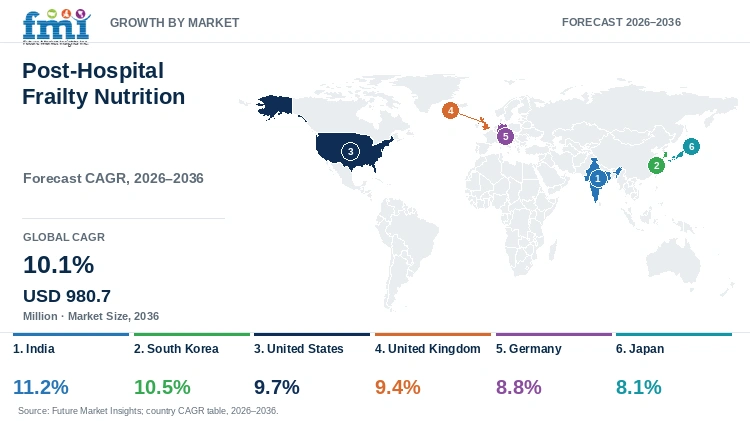
Table 9: Country CAGR Comparison for the Post-Hospital Frailty Nutrition Market (CAGR percentage), 2026 to 2036
| Country | CAGR (2026 to 2036) |
|---|---|
| India | 11.2% |
| South Korea | 10.5% |
| United States | 9.7% |
| United Kingdom | 9.4% |
| Germany | 8.8% |
| Japan | 8.1% |
How do country-level CAGRs compare in the post-hospital frailty nutrition market?
Global brands are bringing protein-dense adult nutrition to Indian pharmacies. Abbott launched Ensure Strength Pro, with 30 g of protein per 100 g, for ageing adults in India on 13 May 2026.[10] FMI expects the quickest gains in India, at 11.2%, ahead of the 10.1% global CAGR, since brands and private hospitals build adult nutrition habits from a small base. South Korea follows at 10.5%, with the census share of older residents above 20%. Below them, the United States, at 9.7%, grows a fraction under the global figure, and Medicare transitional care sets the review points there. Growth is forecast at 9.4% in the United Kingdom and 8.8% in Germany, as established prescribing leaves less new ground. Japan, at 8.1%, grows slowest from the oldest patient base among the seven countries.
- Abbott and other adult nutrition brands are adding high-protein ranges for ageing Indians, moving frailty nutrition from hospital pharmacies into retail. Brands with pharmacy reach beyond the large cities gain most.
- With the 65-plus share above 20% in the 2025 census, Korean acute wards discharge more frail patients each year, and suppliers working with university hospital nutrition teams capture first prescriptions.
- Medicare transitional care billing fixes review points within the first two weeks. Clinicians renew or switch the supplement at those reviews, so US brands compete hardest on early tolerance and flavour.
- In the United Kingdom, a PIP code carries a product from ward to GP prescription unchanged, which makes a listed code the entry ticket for any new supplier.
- A 67-plus share heading for about a quarter by 2035 adds older patients to German discharge lists. Hospital and nursing-home tenders reward suppliers offering plant-based and compact options.
- Hospital and care-home nutrition programs in Japan are mature, so new volume comes from the 80-plus group living at home, for whom compact and easy-open formats work best.
Full report country CAGRs cover: India and South Korea above the 10.1% world rate, four slower countries led by the United States, and a regional view of every other standard country.
Country-wise Analysis
India Post-Hospital Frailty Nutrition Market Outlook (2026 to 2036)
Indian demand for discharge nutrition starts small, and sales of post-hospital frailty nutrition in India are forecast to rise on an 11.2% CAGR, the fastest country pace. On the supply side, Abbott said on 13 May 2026 that Ensure Strength Pro carries 30 g of protein per 100 g and 31 nutrients for ageing adults, and pointed to estimates of up to 33% muscle loss between 40 and 80.[10] A product pitched at muscle loss from mid-life widens the buyer pool beyond discharged patients. At present, private hospitals in large cities are the first users of discharge nutrition plans, and a small base keeps the rate high.
Key takeaway: Retail protein brands are building the habit in India ahead of formal discharge programs, so early pharmacy presence matters more than hospital tenders.
South Korea Post-Hospital Frailty Nutrition Market Outlook (2026 to 2036)
South Korea is expected to grow at a 10.5% CAGR, the second-fastest country pace, as the country reaches super-aged status. On the numbers, the 2025 census counted 10.72 million residents aged 65 or older, 20.7% of the population and 1.2 points up, the Kyunghyang Shinmun reported on 28 July 2026.[4] Consequently, more older patients pass through acute wards each year, and university hospitals with nutrition support teams start the discharge plans.
Key takeaway: Korean volume grows with each new group of older patients, and hospital nutrition teams decide which brand starts the plan.
United States Post-Hospital Frailty Nutrition Market Outlook (2026 to 2036)
FMI projects a 9.7% CAGR for the United States. Behind that rate, CMS guidance from August 2025 requires contact within 2 business days of discharge and a face-to-face visit within 7 or 14 days for transitional care billing.[2] Early contact points give clinicians a structured chance to keep a patient on supplements. On the brand side, Nestlé Health Science promoted BOOST on 30 July 2025 with users recovering from spinal and hip surgery.[8] Recovery-themed advertising of this kind pushes families toward pharmacy and online refills once the prescribed month ends.
Key takeaway: US sales split between a prescribed first month and a long tail of retail refills, so brands need both clinical and consumer reach.
United Kingdom Post-Hospital Frailty Nutrition Market Outlook (2026 to 2036)
Prescription continuity is the main lever in the United Kingdom, and a 9.4% CAGR is likely there. For example, Aymes renamed AYMES powders ActaSolve and the ready-to-use range ActaGain between February 2025 and September 2026, keeping PIP codes so prescriptions carried over.[1] Carrying codes over protected existing patients from a forced switch. Beyond the rename, GP practices and community dietitians control most repeat supply, and medicines management teams review product choice on cost.
Key takeaway: British growth comes through GP repeat prescriptions, and medicines management reviews reward the lowest-cost listed code.
Germany Post-Hospital Frailty Nutrition Market Outlook (2026 to 2036)
Germany is forecast at an 8.8% CAGR. On demographics, Destatis said on 11 December 2025 that 20% of residents were 67 or older in 2024 and that the share will reach about 25% by 2035.[7] A five-point rise in the 67-plus share adds frail patients to each hospital discharge list. Meanwhile, Nutricia lists Germany among the markets for the new plant-based medical nutrition products.[5] Plant-based options give German tenders a second product line, and hospital and nursing-home buyers lead purchases.
Key takeaway: German demand rises steadily with the older population, and tender buyers favour suppliers with the widest range per contract.
Japan Post-Hospital Frailty Nutrition Market Outlook (2026 to 2036)
Japan is expected to grow at 8.1% in FMI's estimate, 2 points slower than the global CAGR of 10.1%, as long-established hospital and care-home nutrition programs leave less new ground. For scale, the Statistics Bureau counted 36.24 million people aged 65 or older on 15 September 2026, 29.6% of the population, and 12.88 million aged 80 or older.[9] Accordingly, growth there comes from compact formats and home use as the 80-plus group expands.
Key takeaway: Japan is a replacement market for hospital supply, with new growth coming from the 80-plus group at home.
Who are the notable companies in the post-hospital frailty nutrition market?
Abbott, Nestlé Health Science, Danone Nutricia, Fresenius Kabi, Aymes, Nualtra, Medtrition and Meiji Holdings are the profiled companies.
Leading companies identified by FMI include global medical nutrition groups, UK prescription specialists and protein module makers. Retail adult nutrition is soft outside reimbursed channels, however. Among the global groups, Abbott reported international adult nutrition sales of USD 773 million for the June 2026 quarter, down 2.8% on a comparable basis.[6] Price-led weakness of that kind pushes global groups toward prescription ranges, which hold volume better. Alongside Abbott, Danone Nutricia is extending Fortimel PlantBased Protein across European markets.[5] Plant-based lines give Nutricia a route to patients who refuse dairy. On the specialist side, Aymes runs a UK prescription range under the ActaSolve and ActaGain names.[1] A UK-only focus lets Aymes compete on code-level price. Joining them, Nestlé Health Science, Fresenius Kabi, Nualtra, Medtrition and Meiji Holdings complete the group.
- Full-range adult and medical nutrition groups: Abbott, Nestlé Health Science, Danone Nutricia and Fresenius Kabi.
- UK prescription specialists: Aymes and Nualtra.
- Protein module and regional suppliers: Medtrition and Meiji Holdings.
Competitive Benchmarking: Post-Hospital Frailty Nutrition Market
Table 10: Competitive Benchmarking for the Post-Hospital Frailty Nutrition Market (qualitative ratings), 2026
| Company | Compact Formats | Flavour Range | Reimbursed Codes | Recent Activity |
|---|---|---|---|---|
| Danone Nutricia | Medium | High | Low | High |
| Aymes | High | High | High | High |
| Fresenius Kabi | High | Medium | High | High |
| Abbott | Medium | Medium | Low | High |
| Nestlé Health Science | Low | Medium | Low | Medium |
The columns compare the companies on compact formats, flavour range, reimbursed codes and recent activity.
Key Developments in the Post-Hospital Frailty Nutrition Market
- In September 2026, Aymes renamed ActaSolve High Energy Strawberry and Chocolate flavours, keeping PIP codes and price, so existing prescriptions carry on unchanged.[1]
- Fresenius Kabi Ireland set out GMS reimbursement for Fresubin PRO Compact under code 82771 in August 2026, opening community prescribing for the compact drink.[3]
- Abbott adult nutrition sales for April to June 2026 came to USD 1,119 million, Abbott said on 16 July 2026, 4% lower on a comparable basis; for suppliers this signals soft retail demand.[6]
- On 13 May 2026, Abbott launched Ensure Strength Pro for ageing adults in India, a step toward pharmacy-led frailty nutrition there.[10]
- Nutricia announced Pea Mint and Pumpkin Carrot for Fortimel PlantBased Protein on 1 October 2025, the first savoury flavours in the Fortimel PlantBased range, which gives dietitians a non-sweet option.[5]
- Nestlé Health Science started the A Real BOOST campaign across television and retail media on 30 July 2025, aiming at families who buy after discharge.[8]
Key Players in the Post-Hospital Frailty Nutrition Market
Full-Range Adult and Medical Nutrition Groups
- Abbott
- Nestlé Health Science
- Danone Nutricia
- Fresenius Kabi
UK Prescription Specialists
- Aymes
- Nualtra
Protein Module and Regional Suppliers
- Medtrition
- Meiji Holdings
Post-Hospital Frailty Nutrition Market - Report Scope
Table 11: Report Scope for the Post-Hospital Frailty Nutrition Market (coverage fields and definitions), 2026 to 2036
| Coverage field | Report scope |
|---|---|
| Market breakdown | Product type; program length; product form; care setting; prescription route; region |
| Quantitative units | USD million |
| Market definition | Oral nutrition products supplied to frail or malnourished older adults after an acute hospital stay, covering standard and compact oral nutritional supplements, HMB-enriched recovery formulas, protein modules and spoonable formats issued at discharge, on community prescription, under institutional contract or bought by the patient. Tube feeds, parenteral nutrition, everyday foods and care services are excluded. |
| Regions covered | North America; Latin America; Western Europe; Eastern Europe; East Asia; South Asia and Pacific; Middle East and Africa |
| Countries covered | United States; Canada; Brazil; Mexico; Argentina; Chile; Germany; France; United Kingdom; Italy; Spain; Benelux; Nordics; Poland; Czech Republic; Romania; Hungary; China; Japan; South Korea; India; ASEAN; Australia and New Zealand; GCC Countries; South Africa; Türkiye; Israel |
| Key companies profiled | Abbott, Nestlé Health Science, Danone Nutricia, Fresenius Kabi, Aymes, Nualtra, Medtrition, Meiji Holdings |
| Forecast period | 2026 to 2036 |
Post-Hospital Frailty Nutrition Market - Research Methodology
Table 12: Research Methodology for the Post-Hospital Frailty Nutrition Market (research methods and approach), 2026 edition
| Method | Approach |
|---|---|
| Data Sources | Medical nutrition company releases, payer and reimbursement guidance and national population statistics. |
| Desk Research | Desk research covers discharge pathways, transitional care rules, compact and savoury product launches, prescription codes and ageing data. |
| Market Sizing and Forecasting | Sizing starts from the 2026 base of USD 374.7 million and the 10.1% CAGR for 2026 to 2036. |
| Data Validation | Figures are cross-checked across company, industry and government sources. |
Post-Hospital Frailty Nutrition Market by Segments
Post-Hospital Frailty Nutrition Market segmented by Product Type:
- Standard-Volume High-Protein ONS
- Compact ONS
- HMB-Enriched Recovery Formulas
- Protein Modules
- Others
Post-Hospital Frailty Nutrition Market segmented by Program Length:
- 30-Day Post-Discharge
- 90-Day Support
- 6-Month Extended Support
Post-Hospital Frailty Nutrition Market segmented by Product Form:
- Ready-to-Drink
- Powder
- Puddings and Semi-Solids
- Others
Post-Hospital Frailty Nutrition Market segmented by Care Setting:
- Home Care
- Long-Term Care Facilities
- Transitional Care Units
- Others
Post-Hospital Frailty Nutrition Market segmented by Prescription Route:
- Hospital Discharge Supply
- Community Prescription
- Institutional Contract
- Self-Pay Retail
Post-Hospital Frailty Nutrition Market by Region
- North America
- United States
- Canada
- Latin America
- Brazil
- Mexico
- Argentina
- Chile
- Western Europe
- Germany
- France
- United Kingdom
- Italy
- Spain
- Benelux
- Nordics
- Eastern Europe
- Poland
- Czech Republic
- Romania
- Hungary
- East Asia
- China
- Japan
- South Korea
- South Asia and Pacific
- India
- ASEAN
- Australia and New Zealand
- Middle East and Africa
- GCC Countries
- South Africa
- Türkiye
- Israel
Research Sources and Bibliography
- [1] AYMES International Ltd. (2026, July 30). Introducing AYMES Rebrand Journey. https://aymes.com/blogs/aymes-news/introducing-aymes-rebrand-journey
- [2] Centers for Medicare & Medicaid Services. (2025, August). Transitional Care Management Services (MLN908628). https://www.cms.gov/files/document/mln908628-transitional-care-management-services.pdf
- [3] Fresenius Kabi Ireland. (2026, August). Fresubin PRO COMPACT Drink: GMS reimbursement and clinical use. https://www.fresenius-kabi.com/ie/news-room/fresubin--pro-compact---gms-reimbursement---clinical-use
- [4] The Kyunghyang Shinmun. (2026, July 28). An era with 10 million people aged 65 and over has begun. https://www.khan.co.kr/en/article/202607281403017
- [5] Nutricia. (2025, October 1). Nutricia's new savory plant-based medical nutrition proven to improve patient adherence. https://www.nutricia.com/latest-news/Fortimel-PlantBased-Protein
- [6] Abbott. (2026, July 16). Abbott Reports Second-Quarter 2026 Results and Raises Full-Year EPS Guidance. https://abbott.mediaroom.com/2026-07-16-Abbott-Reports-Second-Quarter-2026-Results-and-Raises-Full-Year-EPS-Guidance
- [7] Federal Statistical Office of Germany (Destatis). (2025, December 11). By 2035, one quarter of Germany's population will be aged 67 or over. https://www.destatis.de/EN/Press/2025/12/PE25_446_12.html
- [8] Nestlé Health Science. (2025, July 30). The BOOST Brand Celebrates Real Stories of Resilience in its New A Real BOOST Campaign. https://www.nestlehealthscience.us/stories/boostr-brand-celebrates-real-stories-resilience-its-new-real-boostr-campaign
- [9] Statistics Bureau of Japan. (2026, September 20). Statistical Topics No. 149: Elderly People in Japan from Statistics. https://www.stat.go.jp/data/topics/pdf/topics149.pdf
- [10] Abbott India. (2026, May 13). Abbott launches Ensure Strength Pro in India to support healthy ageing. https://www.abbott.com/en-in/news/press-releases/abbott-launches-ensure--strength-pro-in-india-to-support-healthy
This bibliography is provided for reader reference. The full report contains the complete reference list and detailed citations.
This Report Answers
- How big is the post-hospital frailty nutrition market during 2026?
- What market size is projected by 2036?
- Which product type holds notable share?
- Which program length holds notable share?
- Which countries have notable growth?
- Which companies are notable in the market?
Frequently Asked Questions
How large is the post-hospital frailty nutrition market expected in 2026?
FMI estimates the post-hospital frailty nutrition market at USD 374.7 million in 2026, up from USD 340.3 million in 2025. Sales of post-hospital frailty nutrition are projected to reach USD 980.7 million by 2036.
What CAGR is projected for the post-hospital frailty nutrition market through 2036?
Sales of post-hospital frailty nutrition are expected to grow at a 10.1% CAGR through 2036. Ageing populations, discharge screening and longer monitored supplement plans carry that growth.
Which product type holds a notable market share in 2026?
Standard-volume high-protein ONS will lead with 45.4% share in 2026. Compact ONS follows at about 21.6%.
Which program length holds a notable market share in 2026?
30-day post-discharge programs are expected to lead with 50.6% share in 2026. 90-day support holds an estimated 31.8%.
Which country has a notable expansion outlook through 2036?
FMI projects India to grow fastest, at 11.2%. South Korea follows at 10.5%.
Who are the key companies in the post-hospital frailty nutrition market?
Abbott, Nestlé Health Science, Danone Nutricia and Fresenius Kabi lead the global medical nutrition group. Aymes, Nualtra, Medtrition and Meiji Holdings complete the profiled companies.
Preview the report firsthand - request a free sample
Get SampleGet the brochure for pricing and purchase details.
Get PDFTable of Content
- Key Takeaways
- Market Size and CAGR
- Top Growth Driver
- Fastest Growing Segment
- Leading Region
- Key Companies
- Emerging Opportunities
- Executive Summary
- Global Market Outlook
- Demand-side Trends
- Supply-side Trends
- Technology Roadmap Analysis
- Analysis and Recommendations
- Analyst Perspective (What is happening? Why now? What should investors know?)
- Key Questions Answered
- How large is the market?
- What is the CAGR?
- What are key trends?
- Which region dominates?
- Who are the leaders?
- Market Overview
- Market Coverage / Taxonomy
- Market Definition / Scope / Limitations
- Research Methodology
- Chapter Orientation
- Analytical Lens and Working Hypotheses
- Market Structure, Signals, and Trend Drivers
- Benchmarking and Cross-market Comparability
- Market Sizing, Forecasting, and Opportunity Mapping
- Research Design and Evidence Framework
- Desk Research Programme (Secondary Evidence)
- Expert Input and Fieldwork (Primary Evidence)
- Tooling, Models, and Reference Databases
- Data Engineering and Model Build
- Quality Assurance and Audit Trail
- Market Background
- Market Dynamics (Drivers, Restraints, Opportunity, Trends)
- Scenario Forecast (Optimistic, Likely, Conservative)
- Impact Analysis
- AI Impact
- Sustainability Impact
- Regulatory Impact
- Technology Impact
- Consumer / Buyer Analysis
- Purchase Drivers
- Adoption Barriers
- Buyer Journey
- Opportunity Map Analysis
- Product Life Cycle Analysis
- Supply Chain Analysis
- Investment Feasibility Matrix
- Value Chain Analysis
- PESTLE and Porter's Analysis
- Regulatory Landscape
- Regional Parent Market Outlook
- Production and Consumption Statistics
- Import and Export Statistics
- Global Market Analysis and Forecast, 2021 to 2036
- Historical Market Size Value (USD Million) Analysis, 2021 to 2025
- Current and Future Market Size Value (USD Million) Projections, 2026 to 2036
- Y-o-Y Growth Trend Analysis
- Absolute $ Opportunity Analysis
- Global Market Pricing Analysis, 2021 to 2036
- Global Market Analysis and Forecast, By Product Type, 2021 to 2036
- Introduction / Key Findings
- Historical Market Size Value (USD Million) Analysis By Product Type, 2021 to 2025
- Current and Future Market Size Value (USD Million) Analysis and Forecast By Product Type, 2026 to 2036
- Standard-Volume High-Protein ONS
- Compact ONS
- HMB-Enriched Recovery Formulas
- Protein Modules
- Others
- Y-o-Y Growth Trend Analysis By Product Type, 2021 to 2025
- Absolute $ Opportunity Analysis By Product Type, 2026 to 2036
- Global Market Analysis and Forecast, By Program Length, 2021 to 2036
- Introduction / Key Findings
- Historical Market Size Value (USD Million) Analysis By Program Length, 2021 to 2025
- Current and Future Market Size Value (USD Million) Analysis and Forecast By Program Length, 2026 to 2036
- 30-Day Post-Discharge
- 90-Day Support
- 6-Month Extended Support
- Y-o-Y Growth Trend Analysis By Program Length, 2021 to 2025
- Absolute $ Opportunity Analysis By Program Length, 2026 to 2036
- Global Market Analysis and Forecast, By Product Form, 2021 to 2036
- Introduction / Key Findings
- Historical Market Size Value (USD Million) Analysis By Product Form, 2021 to 2025
- Current and Future Market Size Value (USD Million) Analysis and Forecast By Product Form, 2026 to 2036
- Ready-to-Drink
- Powder
- Puddings and Semi-Solids
- Others
- Y-o-Y Growth Trend Analysis By Product Form, 2021 to 2025
- Absolute $ Opportunity Analysis By Product Form, 2026 to 2036
- Global Market Analysis and Forecast, By Care Setting, 2021 to 2036
- Introduction / Key Findings
- Historical Market Size Value (USD Million) Analysis By Care Setting, 2021 to 2025
- Current and Future Market Size Value (USD Million) Analysis and Forecast By Care Setting, 2026 to 2036
- Home Care
- Long-Term Care Facilities
- Transitional Care Units
- Others
- Y-o-Y Growth Trend Analysis By Care Setting, 2021 to 2025
- Absolute $ Opportunity Analysis By Care Setting, 2026 to 2036
- Global Market Analysis and Forecast, By Prescription Route, 2021 to 2036
- Introduction / Key Findings
- Historical Market Size Value (USD Million) Analysis By Prescription Route, 2021 to 2025
- Current and Future Market Size Value (USD Million) Analysis and Forecast By Prescription Route, 2026 to 2036
- Hospital Discharge Supply
- Community Prescription
- Institutional Contract
- Self-Pay Retail
- Y-o-Y Growth Trend Analysis By Prescription Route, 2021 to 2025
- Absolute $ Opportunity Analysis By Prescription Route, 2026 to 2036
- Global Market Analysis and Forecast, By Region, 2021 to 2036
- Introduction
- Historical Market Size Value (USD Million) Analysis By Region, 2021 to 2025
- Current Market Size Value (USD Million) Analysis and Forecast By Region, 2026 to 2036
- North America
- Latin America
- Western Europe
- Eastern Europe
- East Asia
- South Asia and Pacific
- Middle East and Africa
- Market Attractiveness Analysis By Region
- North America Market Analysis and Forecast, By Country, 2021 to 2036
- Historical Market Size Value (USD Million) Trend Analysis By Market Taxonomy, 2021 to 2025
- Market Size Value (USD Million) Forecast By Market Taxonomy, 2026 to 2036
- By Country
- United States
- Canada
- By Product Type
- By Program Length
- By Product Form
- By Care Setting
- By Prescription Route
- By Country
- Market Attractiveness Analysis
- By Country
- By Product Type
- By Program Length
- By Product Form
- By Care Setting
- By Prescription Route
- Key Takeaways
- Latin America Market Analysis and Forecast, By Country
- Historical Market Size Value (USD Million) Trend Analysis By Market Taxonomy, 2021 to 2025
- Market Size Value (USD Million) Forecast By Market Taxonomy, 2026 to 2036
- By Country
- Brazil
- Mexico
- Argentina
- Chile
- By Product Type
- By Program Length
- By Product Form
- By Care Setting
- By Prescription Route
- By Country
- Market Attractiveness Analysis
- By Country
- By Product Type
- By Program Length
- By Product Form
- By Care Setting
- By Prescription Route
- Key Takeaways
- Western Europe Market Analysis and Forecast, By Country
- Historical Market Size Value (USD Million) Trend Analysis By Market Taxonomy, 2021 to 2025
- Market Size Value (USD Million) Forecast By Market Taxonomy, 2026 to 2036
- By Country
- Germany
- France
- United Kingdom
- Italy
- Spain
- Benelux
- Nordics
- By Product Type
- By Program Length
- By Product Form
- By Care Setting
- By Prescription Route
- By Country
- Market Attractiveness Analysis
- By Country
- By Product Type
- By Program Length
- By Product Form
- By Care Setting
- By Prescription Route
- Key Takeaways
- Eastern Europe Market Analysis and Forecast, By Country
- Historical Market Size Value (USD Million) Trend Analysis By Market Taxonomy, 2021 to 2025
- Market Size Value (USD Million) Forecast By Market Taxonomy, 2026 to 2036
- By Country
- Poland
- Czech Republic
- Romania
- Hungary
- By Product Type
- By Program Length
- By Product Form
- By Care Setting
- By Prescription Route
- By Country
- Market Attractiveness Analysis
- By Country
- By Product Type
- By Program Length
- By Product Form
- By Care Setting
- By Prescription Route
- Key Takeaways
- East Asia Market Analysis and Forecast, By Country
- Historical Market Size Value (USD Million) Trend Analysis By Market Taxonomy, 2021 to 2025
- Market Size Value (USD Million) Forecast By Market Taxonomy, 2026 to 2036
- By Country
- China
- Japan
- South Korea
- By Product Type
- By Program Length
- By Product Form
- By Care Setting
- By Prescription Route
- By Country
- Market Attractiveness Analysis
- By Country
- By Product Type
- By Program Length
- By Product Form
- By Care Setting
- By Prescription Route
- Key Takeaways
- South Asia and Pacific Market Analysis and Forecast, By Country
- Historical Market Size Value (USD Million) Trend Analysis By Market Taxonomy, 2021 to 2025
- Market Size Value (USD Million) Forecast By Market Taxonomy, 2026 to 2036
- By Country
- India
- ASEAN
- Australia and New Zealand
- By Product Type
- By Program Length
- By Product Form
- By Care Setting
- By Prescription Route
- By Country
- Market Attractiveness Analysis
- By Country
- By Product Type
- By Program Length
- By Product Form
- By Care Setting
- By Prescription Route
- Key Takeaways
- Middle East and Africa Market Analysis and Forecast, By Country
- Historical Market Size Value (USD Million) Trend Analysis By Market Taxonomy, 2021 to 2025
- Market Size Value (USD Million) Forecast By Market Taxonomy, 2026 to 2036
- By Country
- GCC Countries
- South Africa
- Türkiye
- Israel
- By Product Type
- By Program Length
- By Product Form
- By Care Setting
- By Prescription Route
- By Country
- Market Attractiveness Analysis
- By Country
- By Product Type
- By Program Length
- By Product Form
- By Care Setting
- By Prescription Route
- Key Takeaways
- Key Countries Market Analysis
- United States
- Pricing Analysis
- Market Share Analysis, 2025
- By Product Type
- By Program Length
- By Product Form
- By Care Setting
- By Prescription Route
- Canada
- Pricing Analysis
- Market Share Analysis, 2025
- By Product Type
- By Program Length
- By Product Form
- By Care Setting
- By Prescription Route
- Mexico
- Pricing Analysis
- Market Share Analysis, 2025
- By Product Type
- By Program Length
- By Product Form
- By Care Setting
- By Prescription Route
- Brazil
- Pricing Analysis
- Market Share Analysis, 2025
- By Product Type
- By Program Length
- By Product Form
- By Care Setting
- By Prescription Route
- Chile
- Pricing Analysis
- Market Share Analysis, 2025
- By Product Type
- By Program Length
- By Product Form
- By Care Setting
- By Prescription Route
- Germany
- Pricing Analysis
- Market Share Analysis, 2025
- By Product Type
- By Program Length
- By Product Form
- By Care Setting
- By Prescription Route
- United Kingdom
- Pricing Analysis
- Market Share Analysis, 2025
- By Product Type
- By Program Length
- By Product Form
- By Care Setting
- By Prescription Route
- Italy
- Pricing Analysis
- Market Share Analysis, 2025
- By Product Type
- By Program Length
- By Product Form
- By Care Setting
- By Prescription Route
- Spain
- Pricing Analysis
- Market Share Analysis, 2025
- By Product Type
- By Program Length
- By Product Form
- By Care Setting
- By Prescription Route
- France
- Pricing Analysis
- Market Share Analysis, 2025
- By Product Type
- By Program Length
- By Product Form
- By Care Setting
- By Prescription Route
- India
- Pricing Analysis
- Market Share Analysis, 2025
- By Product Type
- By Program Length
- By Product Form
- By Care Setting
- By Prescription Route
- ASEAN
- Pricing Analysis
- Market Share Analysis, 2025
- By Product Type
- By Program Length
- By Product Form
- By Care Setting
- By Prescription Route
- Australia and New Zealand
- Pricing Analysis
- Market Share Analysis, 2025
- By Product Type
- By Program Length
- By Product Form
- By Care Setting
- By Prescription Route
- China
- Pricing Analysis
- Market Share Analysis, 2025
- By Product Type
- By Program Length
- By Product Form
- By Care Setting
- By Prescription Route
- Japan
- Pricing Analysis
- Market Share Analysis, 2025
- By Product Type
- By Program Length
- By Product Form
- By Care Setting
- By Prescription Route
- South Korea
- Pricing Analysis
- Market Share Analysis, 2025
- By Product Type
- By Program Length
- By Product Form
- By Care Setting
- By Prescription Route
- Poland
- Pricing Analysis
- Market Share Analysis, 2025
- By Product Type
- By Program Length
- By Product Form
- By Care Setting
- By Prescription Route
- Hungary
- Pricing Analysis
- Market Share Analysis, 2025
- By Product Type
- By Program Length
- By Product Form
- By Care Setting
- By Prescription Route
- Türkiye
- Pricing Analysis
- Market Share Analysis, 2025
- By Product Type
- By Program Length
- By Product Form
- By Care Setting
- By Prescription Route
- South Africa
- Pricing Analysis
- Market Share Analysis, 2025
- By Product Type
- By Program Length
- By Product Form
- By Care Setting
- By Prescription Route
- United States
- Market Structure Analysis
- Competition Dashboard
- Competition Benchmarking
- Market Share Analysis of Top Players
- By Regional
- By Product Type
- By Program Length
- By Product Form
- By Care Setting
- By Prescription Route
- Emerging Startups
- Innovation Benchmarking
- Competition Analysis
- Competition Deep Dive
- Danone Nutricia
- Overview
- Product Portfolio
- Profitability by Market Segments
- Sales Footprint
- Strategy Overview
- Marketing Strategy
- Product Strategy
- Channel Strategy
- Aymes
- Fresenius Kabi
- Abbott
- Nestlé Health Science
- Nualtra
- Medtrition
- Meiji Holdings
- Danone Nutricia
- Case Studies
- Success Stories
- Recent Developments
- Competition Deep Dive
- Assumptions & Acronyms Used


