

- Market Size (2026)
- USD 420.0 million
- Forecast (2036)
- USD 759.3 million
- CAGR (2026 to 2036)
- 6.1%
How big is the Pre-Calving Minerals Market in 2026?
USD 420.0 million in 2026 and USD 759.3 million by 2036 at a 6.1% CAGR.
The pre-calving minerals market was valued at USD 395.9 million in 2025, shaped by close-up ration control and milk-fever prevention programs. It is projected to grow from USD 420.0 million in 2026 to USD 759.3 million by 2036 at 6.1% CAGR. Transition-cow losses give pre-calving mineral programs a defined role beyond routine feed supplementation and seasonal product buying. OECD-FAO reported in July 2025 that world milk production is projected to reach 1,146 Mt by 2034. The scale is expected to lift pressure on herd nutrition before calving and strengthen mineral review inside close-up rations. Dairy farms using animal feed additives need mineral programs that help protect calcium balance and early-lactation output.
Dairy farmers and herd nutritionists are the main adopters once dry-cow rations move from advice into routine feeding. The buying pressure is driven by forage mineral variation and the need to control intake before calving. Kemin scheduled a September 2025 transition-management session focused on mineral and vitamin requirements before lactation. The training signal supports advice-led mineral packs that give farm teams clearer feeding instructions. Similar cattle feed outlook indicators point to wider service access for pre-calving mineral programs in cooperative and dealer channels.
Formulation-to-calving decisions make pre-calving minerals more valuable once feed mills and farms share ration accountability. USDA NASS reported in February 2026 that United States milk production reached 232 billion pounds in 2025. The production base is expected to keep transition-cow consistency central to herd planning and farm review. Established dairy regions are likely to emphasize ration records and veterinary review before supplier approval.
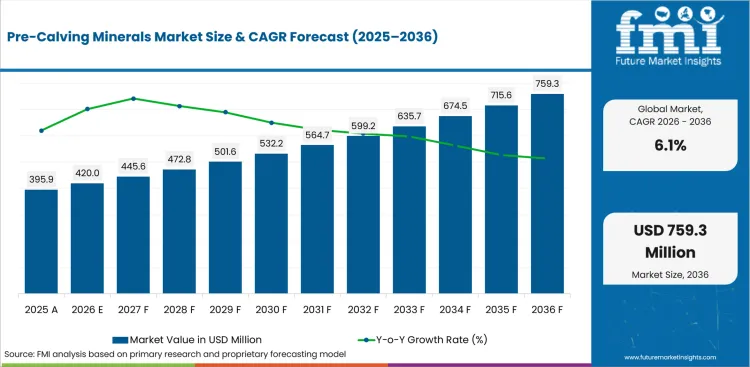
Key Takeaways
-
Demand for pre-calving minerals is driven by dry-cow ration control and milk-fever risk management, with documentation urgency reinforced by dairy farms needing feeding instructions before the close-up period.
-
By form, dry powder is expected to lead with 39.0% share in 2026, supported by easier ration blending across close-up programs.
-
Anionic mineral blends are the dominant mineral type, projected to hold 36.5% share in 2026, reflecting their role in DCAD ration use.
-
Dairy cattle are estimated to lead the livestock category with 34.5% share in 2026, driven by transition-herd mineral needs.
-
Milk-fever prevention is anticipated to capture 32.0% share of function demand in 2026, owing to calcium balance planning ahead of calving.
-
India and China are expected to form the higher-growth country tier, advancing at 5.5% and 4.6% CAGR respectively through 2036, supported by dairy herd scale and feed service expansion.
-
Competition centers on Cargill, ADM, Trouw Nutrition, Kemin Industries, DSM-Firmenich, Alltech, Animax, and Harbro, with vendors differentiating through premix and mill relationships, trace mineral and transition support, and local veterinary access.
Analyst Perspective
"Success in the pre-calving minerals market increasingly depends on demonstrating how mineral programs perform within complete transition feeding strategies rather than on product specifications alone. Dairy producers are seeking suppliers that provide practical guidance on DCAD management, feeding rates, and herd implementation to support consistent pre-calving nutrition. Companies that combine scientifically validated formulations with on-farm technical support are more likely to earn long-term trust and strengthen their position in dairy nutrition programs."
- Nandini Roy Choudhury, Principal Analyst at Future Market Insights
Source: FMI's proprietary forecasting model and primary research
How is the Pre-Calving Minerals Market segmented?
The pre-calving minerals industry is segmented by form, mineral type, livestock, function, and region.
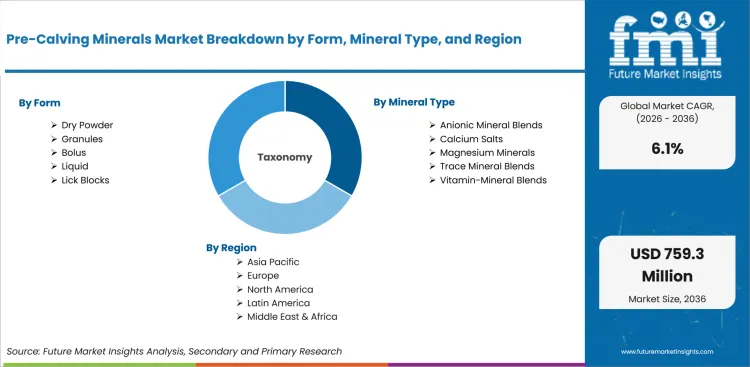
The pre-calving minerals market is segmented by form, mineral type, livestock, function, and region. By form, the market covers dry powder, granules, bolus, liquid, and lick blocks. By mineral type, it covers anionic mineral blends, calcium salts, magnesium minerals, trace mineral blends, and vitamin-mineral blends. By livestock, it covers dairy cattle, beef cattle, buffalo, sheep and goats, and other ruminants. By function, it covers milk-fever prevention, calcium metabolism, colostrum quality, immune support, and calf vitality. Regional coverage includes North America, Europe, East Asia, South Asia, Latin America, and the Middle East and Africa, supported by adjacent evidence from dairy ingredients outlook.
How does dry powder shape demand within the form category?
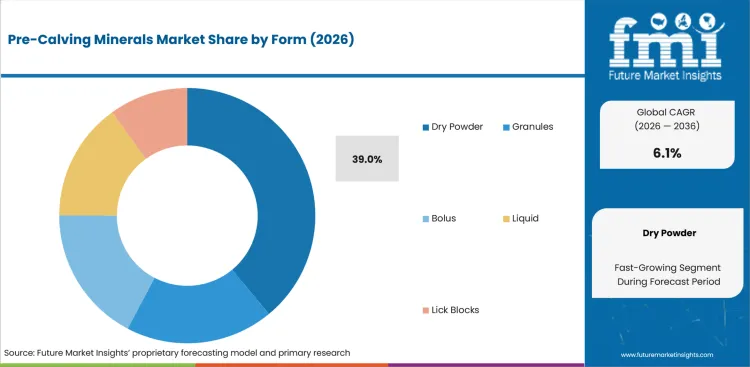
Close-up cow rations depend on controlled daily mineral intake before calving begins in managed dairy herds. Dry powder fits farm mixing routines and feed-mill premix lines better than formats requiring separate dosing. Teagasc advised in January 2025 that pre-calving minerals are generally fed at 100-120g/day before calving. The feeding rate makes pack size and mixing accuracy central to purchase review by farms.
- By form, dry powder is projected to account for 39.0% of demand in 2026 attributable to total mixed ration compatibility and farm-bin handling. Harbro stated in June 2026 that a powdered mineral should be fed from 6 weeks pre-calving. The timing links format selection to farm routines and close-up group planning before calving groups change.
- Dry powder is witnessing demand from dairy farmers owing to easier delivery inside close-up rations and lower handling disruption. Farms comparing compound feed systems value mineral products that fit existing bins and reduce separate cow-side dosing before calving. The format helps advisers compare consumption against expected calving dates during close-up herd checks and ration reviews.
What supports demand for anionic mineral blends within the mineral type category?
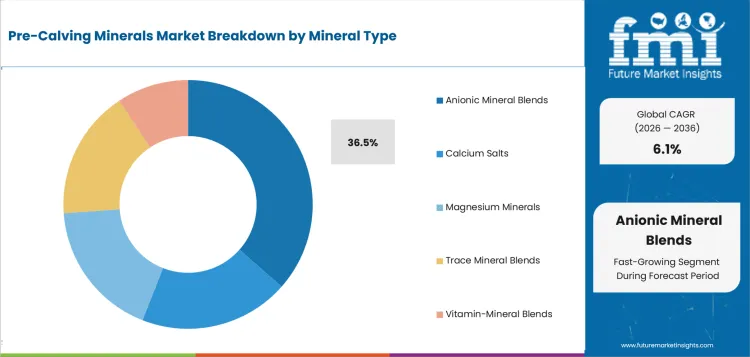
Pre-calving mineral selection is shaped by dietary cation-anion difference ration design and forage potassium variation. Herd advisers use anionic blends to acidify the ration before calving and support calcium response. Kemin described its transition management program in June 2026 as a toolset for balancing pre-calving diet cation and anion status. The program links mineral design to transition-cow ration support before farm advisers approve a change.
- By mineral type, anionic mineral blends are estimated to hold 36.5% of demand in 2026 owing to their role in ration acidification. ADM Animal Nutrition referenced its Destiny Dry and Transition Cow Program in June 2026 for dry cows. The portfolio supports nutritionists that manage calving risk and mineral specification questions before account approval.
- Demand for anionic mineral blends is expected to grow among dairy nutritionists attributable to ration acidification needs before calving. Premix teams linked to europe animal feed additives are expected to favor blends supported by mineral specification files. Farms need clear feeding instructions before intake checks begin during the dry-cow period at close-up pens.
How do dairy producers evaluate dairy cattle within the livestock category?
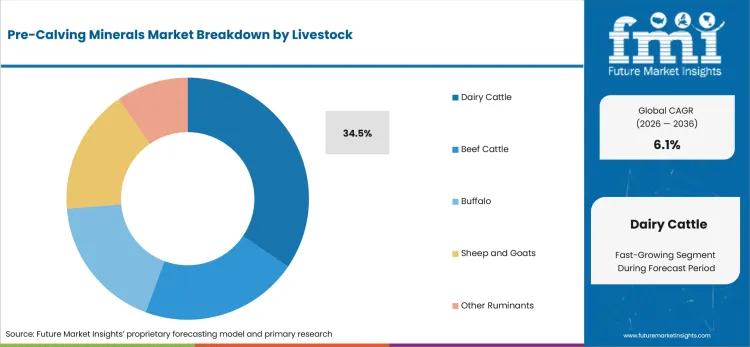
Dairy cattle need a narrower mineral program than general ruminant herds due to late-gestation calcium stress and early-lactation output. USDA NASS reported in February 2026 that the average number of milk cows in the United States reached 9.50 million head during 2025. High herd throughput makes pre-calving feeding discipline a purchasing issue for large dairy farms. Nutritionists need consistent mineral records before changing dry-cow programs during seasonal herd planning cycles.
- In 2026, dairy cattle are expected to lead livestock demand at 34.5% share due to direct exposure to transition-cow metabolic risk. USDA NASS reported in February 2026 that production per cow averaged 24,390 pounds in 2025. The output base keeps calcium response central to herd economics before approval by farm advisers.
- Dairy producers are increasingly purchasing pre-calving minerals led by the need to protect fresh-cow output and calf condition. Farm advisers use mineral specifications to align late-gestation feeding with milk yield planning and veterinary review. The purchase helps farms align dry-cow rations to calf-start expectations before fresh-cow monitoring begins.
How is milk-fever prevention positioned within the function category?
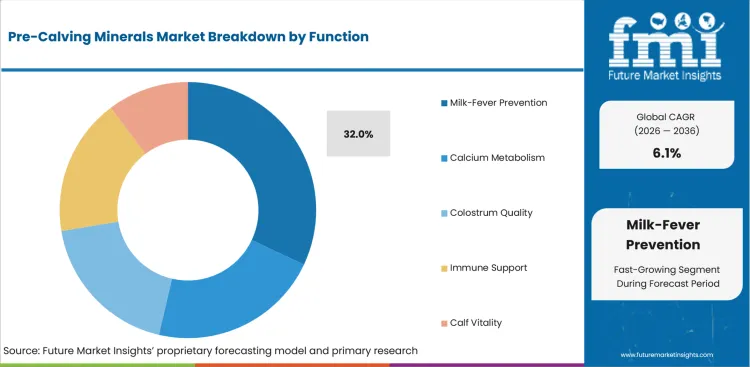
Function selection starts with the disorder that the farm needs to reduce during the calving window. Milk-fever prevention has a direct link to calcium metabolism and fresh-cow performance in dairy herds. Teagasc reported in January 2025 that forage potassium above 2.5% raises milk-fever risk. The threshold makes mineral choice part of forage review and not only product selection.
- By function, milk-fever prevention is forecast to represent 32.0% of demand in 2026 driven by calcium balance planning before calving. Teagasc reported in January 2025 that a 20% magnesium mineral at a 100g feed rate supplies 20g magnesium. The specification supports product review beyond routine mineral insurance during close-up feeding decisions before approval.
- Purchase activity for milk-fever prevention is anticipated to rise driven by veterinary review and dry-cow ration checks. Farms that monitor animal feed probiotic demand also compare mineral programs for fresh-cow health and calf-start outcomes. Nutrition teams need practical evidence before recommending a pre-calving function at farm level to veterinarians.
What are the drivers, restraints, and opportunities in the Pre-Calving Minerals Market?
Near-term purchases are being shaped by transition-cow mineral control and on-farm feeding discipline before calving begins. Cooperative advisory access is outlined below for farm and feed-mill teams before calving programs restart.
- Driver: Dairy herds are expected to increase use of documented mineral programs to reduce pre-calving calcium imbalance risk.
- Restraint: Adoption is likely to slow in farms that lack ration records and daily intake checks before calving.
- Opportunity: Cooperative advisory channels are projected to open access for mineral packs linked to dry-cow protocols.
Dairy farms are expected to use mineral programs more carefully in herds in which fresh-cow health affects milk output and replacement value. Kemin published a June 2026 dairy transition nutrition article that tied transition management to health costs and lactation performance. The driver is better documented close-up ration support before metabolic disorders affect herd economics and replacement value. Farm managers are likely to prefer mineral packs that explain feeding purpose in plain operating terms.
Farm-level execution is likely to restrain uptake in farms that treat mineral feeding as a generic purchase. Feeding rates need routine checks before the calving window closes and cow groups change. Teagasc reported in January 2025 that cows consuming 10kg dry feed mass need 40g magnesium from daily supply. The guidance shows why weak intake control is expected to reduce product value despite suitable formulation. Farms without records face weaker proof during supplier review and seasonal veterinary follow-up cycles.
Cooperative and feed-mill channels are projected to convert the restraint into a service opening. Dairy advisers need mineral packs that pair ration instructions and pack sizing before calving groups change. Related use of natural feed additives is expected to make farm managers more receptive to documented nutrition bundles. Suppliers that combine feed files and follow-up checks are likely to gain repeat accounts before seasonal calving programs restart. Service-led packs help advisers compare farms under one protocol before repeat purchase decisions begin.
Which country CAGRs are profiled in the Pre-Calving Minerals Market?
.webp "Top Country Growth Comparison Pre Calving Minerals Market Cagr (2026 2036)")
| Country | CAGR |
|---|---|
| United States | 3.7% |
| China | 4.6% |
| India | 5.5% |
| Germany | 3.1% |
| United Kingdom | 3.4% |
| Japan | 2.6% |
| South Korea | 3.5% |
Source: FMI's proprietary forecasting model and primary research
How do country-level CAGRs compare in the Pre-Calving Minerals Market?
The country comparison spans 2.9 percentage points and highlights three distinct growth groups across the Pre-Calving Minerals Market. India and China form the upper growth tier with 0.9 percentage points separating the two markets. The United States, South Korea and the United Kingdom create a closely aligned middle group with only 0.3 percentage points separating the three markets. Germany and Japan form the lower-growth segment with a 0.5-point difference. Countries with expanding dairy production, increasing focus on transition cow nutrition and greater adoption of preventive mineral supplementation generally demonstrate stronger market growth.
-
India holds the leading position within the comparison as expanding dairy herds and growing awareness of transition cow health continue to support the use of pre-calving mineral supplements.
-
China remains 0.9 percentage points below India and reflects a market where modernization of dairy farms and increasing emphasis on herd productivity sustain demand for balanced mineral nutrition before calving.
-
The United States remains 0.9 percentage points below China as dairy producers continue to incorporate pre-calving mineral programs to reduce metabolic disorders and improve post-calving performance.
-
South Korea sits 0.2 percentage points below the United States, highlighting the importance of nutritional management practices that support calving performance and overall herd health.
-
The United Kingdom remains only 0.1 percentage points below South Korea, reflecting continued attention to animal welfare, dairy efficiency and nutritional support during the transition period.
-
Germany records a CAGR 0.3 percentage points below the United Kingdom as established dairy farming practices and emphasis on herd health continue to support consistent demand for pre-calving mineral formulations.
-
Japan remains 0.5 percentage points below Germany, reflecting a mature dairy market where precision nutrition and careful herd management sustain the use of specialized mineral supplements.
Comparable CAGRs can still produce different market entry conditions. Differences in dairy production systems, herd management practices, livestock nutrition standards and adoption of transition feeding programs influence growth patterns and long-term market development. The full report provides country-level CAGR analysis across North America, Latin America, Europe, East Asia, South Asia, Oceania and the Middle East and Africa.
Country-wise Analysis
- China's pre-calving minerals outlook is anticipated to advance at 4.6% CAGR over the assessment period, supported by larger dairy farms and ration standardization programs. USDA FAS reported in November 2025 that farms above 1,000 head accounted for more than 68% of production. Larger herd units increase the cost of inconsistent pre-calving mineral delivery across organized dairy systems. Channel opportunity is concentrated in feed groups serving vertically integrated dairy farms and processor-linked herds. Suppliers offering DCAD guidance and farm-trial files are expected to receive stronger consideration in scaled accounts. Local formulation support is expected to guide repeat use in processor-led accounts that oversee herd performance and dry-cow ration records more closely.
- Pre-calving mineral demand in India is forecast to rise at 5.5% CAGR over the forecast period, propelled by milk output growth and cooperative dairy access. India's Press Information Bureau reported in November 2025 that total milk production reached 247.87 million tonnes during 2024-25. The production scale expands the need for transition nutrition that works in mixed cattle and buffalo systems. Adoption is limited in small farms that lack ration measurement and mineral intake tracking before calving. Cooperative mineral programs are expected to draw attention from dairy farmers in high-output milk states. Suppliers that train field advisers are likely to gain trust before seasonal dry-cow purchase cycles and cooperative ration meetings.
- Adoption of pre-calving minerals in Germany is estimated to expand at 3.1% CAGR through 2036, owing to documented dairy quality systems. Eurostat reported in November 2025 that Germany produced 22.0% of EU raw cow milk in 2024. The share gives German dairies a high documentation burden for nutrition inputs linked to milk quality. Growth is constrained by strict farm records and careful supplier qualification before ration changes. Trouw Nutrition and Kemin Industries are positioned to gain traction in dairy accounts that need technical service for compliant mineral use. Vendors are expected to win repeat accounts by translating trace mineral data into farm-ready feeding instructions and audit support.
- The United Kingdom pre-calving minerals sector is projected to record 3.4% CAGR during the assessment period, shaped by processor-focused milk utilization. Defra reported in June 2026 that UK dairies processed 1,150 million litres of milk in February 2026. Processing visibility increases pressure on farms to manage fresh-cow health and maintain milk delivery consistency. Adoption depends on advisory routes that translate mineral recommendations into practical feeding rates before spring calving. Suppliers offering pack sizing and farm service support are expected to receive stronger consideration before spring calving. Regional dealers are likely to influence repeat orders in regions requiring quick stock and advice before calving groups move into close-up pens.
- In Japan, pre-calving mineral demand is predicted to advance at 2.6% CAGR through 2036. The outlook is influenced by smaller farm numbers and careful herd management before ration changes. USDA FAS reported in December 2025 that Japan had approximately 1.3 million dairy cattle on February 1, 2025. The herd base requires mineral programs that fit high-cost feed systems and precise farm routines. Uptake is restrained in smaller farms that prefer proven service packages before changing close-up rations. Dairy producers are expected to concentrate purchases among suppliers offering clear instructions and technical follow-up. Farm advisers are likely to reward products that reduce uncertainty during ration changes and transition-cow monitoring.
- Pre-calving mineral sales in South Korea are forecast to expand at 3.5% CAGR by 2036, reinforced by concentrated farms and milk-quota pressure. USDA FAS forecast in November 2025 that Korea's 2026 milk production would reach 1.93 million tons. The constrained output environment makes fresh-cow performance and ration precision more visible in farm economics. Adoption opportunity is concentrated in mineral programs that help farms maintain productivity inside quota-linked planning. Format-ready mineral packs are expected to draw attention from dairy farms linked to organized feed channels. Suppliers that connect feeding guidance to farm profitability are likely to gain stronger dealer support during quota-linked planning and dry-cow review.
Who are the notable companies in the Pre-Calving Minerals Market?
Cargill, ADM, DSM-Firmenich, Kemin Industries, Alltech, Trouw Nutrition, Animax, and Harbro are the notable companies shaping this market.
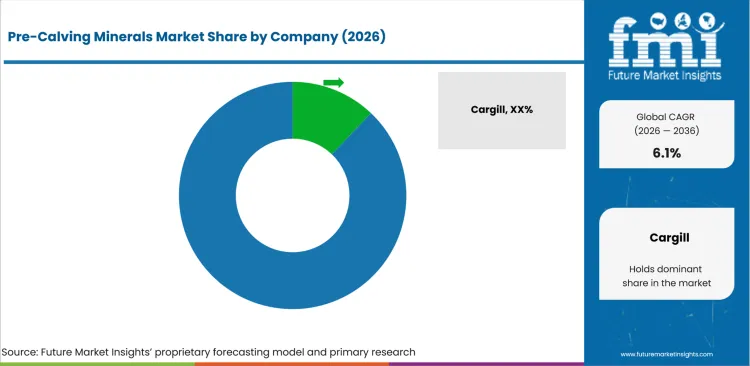
The competitive base is moderately concentrated around multinational animal nutrition groups and regional dairy specialists serving dairy farms. Concentration is controlled by premix scale and ration documentation across farm accounts seeking transition-cow support. Veterinary access and farm service depth create entry paths for smaller suppliers in local dairy channels. Large suppliers hold advantage in mineral sourcing and technical coverage across feed channels serving dry-cow programs. Smaller specialists compete in farm-specific pack design and seasonal advisory support for close-up cow groups. Competition centers on documented mineral content and close-up cow service rather than generic feed breadth. The related animal healthcare outlook reinforces why transition-cow claims need support from credible service records.
Ration integration forms the first competitive role in this category across feed-mill and large-farm accounts. Cargill and ADM serve feed mills and large farms that want dry-cow mineral programs inside broader dairy nutrition agreements. Their advantage is practical account coverage across feed supply and formulation review before approval.
Transition-cow technical service forms a second route to account retention across advised dairy programs. Kemin Industries and Trouw Nutrition compete around trace mineral behavior and nutrition advice for ruminant herds. Dairy nutritionists value suppliers that help interpret mineral form and intake consistency before calving.
Farm productivity tools create another competitive angle across farms connecting nutrition records to herd review. DSM-Firmenich and Alltech support accounts that connect mineral programs to herd performance and advisory routines. Their role is visible in dairy accounts that want nutrition records linked to fresh-cow outcomes.
Regional farm access shapes the final sourcing screen for smaller and mid-size dairy accounts. Animax and Harbro are expected to suit farms that need bolus options and local stock availability. Practical pre-calving advice supports repeat buying across seasonal ordering cycles in local farm accounts. Companies combining local service and documented mineral specifications are likely to receive stronger repeat consideration.
Competitive Benchmarking: Pre-Calving Minerals Market
| Company | Dairy mineral fit | Transition-cow service | Farm channel access | Reach |
|---|---|---|---|---|
| Cargill | Strong | High | Strong | Global |
| ADM | Strong | High | Medium | Global |
| DSM-Firmenich | High | Strong | Medium | Global |
| Kemin Industries | High | Strong | Medium | Global |
| Alltech | High | Medium | Strong | Global |
| Trouw Nutrition | Strong | Strong | High | Global |
| Animax | Medium | Medium | Strong | Regional |
| Harbro | Medium | Medium | Strong | Regional |
Source: Future Market Insights competitive analysis, 2026. Ratings reflect relative portfolio relevance and workflow fit. Service capability and geographic reach shape the remaining comparison.
Key Developments in the Pre-Calving Minerals Market
- February 2026 - Cargill opened a new dairy feed plant in Wazirabad, Punjab for regional dairy nutrition. The plant was built with an investment of ₹300 crore to provide science-based dairy nutrition at scale. The expansion is expected to improve access to documented feed and mineral programs for Indian dairy farms. Purchasers are expected to value local production during calving programs that depend on timely feed delivery.
- August 2025 - DSM-Firmenich launched the Lore artificial intelligence module for dairy cattle at Agroleite 2025. The launch was presented alongside the Bovigold line for different phases of the dairy herd. The development points to closer pairing of nutrition products and farm management tools for dairy accounts. Dairy accounts are expected to compare mineral programs against wider herd data support before purchase approval.
- September 2025 - ADM and Alltech announced a North American animal feed joint venture for feed channel scale. Alltech said it would contribute Hubbard Feeds and Masterfeeds operations across the United States and Canada. The move is expected to widen combined access to feed mills and farm relationships. Dairy producers are likely to watch service continuity before shifting dry-cow mineral supply into larger contracts.
- January 2025 - Trouw Nutrition published verified life-cycle documentation for Selko IntelliBond trace minerals in animal nutrition programs. The document stated that the IntelliBond family received independent verification for product carbon-equivalent values. The development points to stronger documentation expectations around trace minerals and ration claims across farm accounts.
Key Players in the Pre-Calving Minerals Market
Integrated feed and premix suppliers
- Cargill
- ADM
- Trouw Nutrition
Specialty mineral and transition-cow specialists
- Kemin Industries
- Alltech
- Animax
Dairy nutrition and regional advisory providers
- DSM-Firmenich
- Harbro
Pre-Calving Minerals Market - Report Scope
| Coverage field | Report scope |
|---|---|
| Market breakdown | Pre-Calving Minerals Market Breakdown By Form, Mineral Type, Livestock, Function, and Region |
| Market Definition | Pre-calving minerals are mineral supplements fed to dairy and ruminant animals before calving. They support calcium balance and calf vitality during transition. |
| Regions Covered | North America, Latin America, Western Europe, Eastern Europe, East Asia, South Asia and Pacific, and Middle East and Africa |
| Countries Covered | United States, China, India, Germany, United Kingdom, Japan, South Korea, and 25+ countries |
| Key Companies Profiled | Cargill, ADM, DSM-Firmenich, Kemin Industries, Alltech, Trouw Nutrition, Animax, and Harbro |
| Forecast Period | 2026 to 2036 |
| Approach | Hybrid bottom-up and top-down methodology using herd size and dry-cow mineral use. Dairy feed channel access and supplier portfolio depth supported model checks. |
Source: Future Market Insights - analysis driven by proprietary forecasting models and primary research
Pre-Calving Minerals Market - Research Methodology
| Method | Approach |
|---|---|
| Primary Research | FMI analysts gathered input from manufacturers, service providers, technology developers, distributors, end users, sourcing teams, and subject-matter experts. Interviews examined purchasing decisions, product or service evaluation, adoption barriers, approval requirements, pricing considerations, and expectations for technical or commercial support. Respondents were also asked what evidence is required before a trial, pilot, or initial order develops into regular purchasing. |
| Desk Research | Desk research covered government statistics, regulatory publications, trade data, industry associations, technical literature, standards, company filings, product information, and official corporate announcements. Sources were reviewed for relevance, publication date, geographic coverage, and consistency with the defined market scope. Claims relating to performance, applications, approvals, capacity, investment, and commercial activity were retained only when supported by credible public evidence. |
| Market Sizing and Forecasting | The market model combined the baseline value with historical performance, segment structure, pricing and volume indicators, adoption levels, company participation, and country-level demand conditions. Forecast assumptions considered economic activity, investment trends, regulatory developments, technology adoption, purchasing cycles, supply availability, and barriers to wider market use. Segment and regional estimates were reconciled before the final market total was calculated. |
| Data Validation | Estimates were checked against multiple independent indicators, including public data, company activity, trade patterns, industry developments, and findings from primary interviews. Validation also tested whether products, services, applications, and company revenues fell within the defined market boundaries. Adjacent categories, unsupported claims, overlapping revenues, and activities without direct market relevance were excluded to reduce double counting and maintain consistency across segments and countries. |
Source: Future Market Insights (FMI) analysis, based on proprietary forecasting model and primary research
Pre-Calving Minerals Market by Segments
Pre-Calving Minerals Market segmented by Form:
- Dry Powder
- Granules
- Bolus
- Liquid
- Lick Blocks
Pre-Calving Minerals Market segmented by Mineral Type:
- Anionic Mineral Blends
- Calcium Salts
- Magnesium Minerals
- Trace Mineral Blends
- Vitamin-Mineral Blends
Pre-Calving Minerals Market segmented by Livestock:
- Dairy Cattle
- Beef Cattle
- Buffalo
- Sheep and Goats
- Other Ruminants
Pre-Calving Minerals Market segmented by Function:
- Milk-Fever Prevention
- Calcium Metabolism
- Colostrum Quality
- Immune Support
- Calf Vitality
Pre-Calving Minerals Market by Region:
- North America
- United States
- Canada
- Latin America
- Brazil
- Mexico
- Chile
- Rest of Latin America
- Western Europe
- Germany
- United Kingdom
- Italy
- Spain
- France
- Nordic
- BENELUX
- Rest of Western Europe
- Eastern Europe
- Poland
- Hungary
- Balkan and Baltic
- Rest of Eastern Europe
- East Asia
- China
- Japan
- South Korea
- South Asia and Pacific
- India
- ASEAN
- Australia and New Zealand
- Rest of South Asia and Pacific
- Middle East and Africa
- Kingdom of Saudi Arabia
- Other GCC Countries
- Turkiye
- South Africa
- Other African Union
- Rest of Middle East and Africa
Research Sources and Bibliography
- OECD and Food and Agriculture Organization of the United Nations. (2025, July). Dairy and dairy products: OECD-FAO Agricultural Outlook 2025-2034. OECD.
- USA Department of Agriculture, National Agricultural Statistics Service. (2026, February). Milk Production. USDA.
- USA Department of Agriculture, Economic Research Service. (2026, June). Dairy - Market Outlook. USDA.
- Press Information Bureau. (2025, November). Release of Basic Animal Husbandry Statistics 2025. Government of India.
- Eurostat. (2025, November). Milk and milk product statistics. European Commission.
- Department for Environment, Food & Rural Affairs. (2026, June). Milk utilisation by dairies in England and Wales. GOV.UK.
- USA Department of Agriculture, Foreign Agricultural Service. (2025, November). Dairy and Products Annual: China. USDA.
- USA Department of Agriculture, Foreign Agricultural Service. (2025, December). Dairy and Products Annual: Japan. USDA.
- USA Department of Agriculture, Foreign Agricultural Service. (2025, November). Dairy and Products Annual: Korea. USDA.
- Teagasc. (2025, January). More than cost to consider when selecting a pre-calving mineral. Teagasc.
- Teagasc. (2025, January). Minimising the risk of milk fever and associated risks this spring. Teagasc.
- Harbro. (2026, June). A Bucket Load of Benefits. Harbro.
- Harbro. (2026, June). Pre Calver 1000. Harbro.
- Kemin Industries. (2026, June). Optimizing Dairy Cow Transition: The Power of Choline Nutrition. Kemin Industries.
- Kemin Industries. (2025, September). Secure here your place for the third session on transition phase management. Kemin Industries.
- Kemin Industries. (2026, June). Transition Management. Kemin Industries.
- ADM Animal Nutrition. (2026, June). Destiny Dry and Transition Cow Program. ADM.
- Cargill. (2026, February). Cargill deepens India commitment and opens new dairy feed plant. Cargill.
- DSM-Firmenich. (2025, August). dsm-firmenich launches new Lore artificial intelligence module for dairy cattle at Agroleite 2025. DSM-Firmenich.
- Alltech. (2025, September). ADM, Alltech to bring together expertise in new North American animal feed joint venture. Alltech.
- Trouw Nutrition. (2025, January). Knowing the exact environmental impact of the trace minerals in animal nutrition. Trouw Nutrition.
This bibliography is provided for reader reference and uses primary government and standards-body sources. Official trade body and company sources support company evidence.
This Report Answers
- What are the estimated market values for the pre-calving minerals market in 2026 and 2036?
- What CAGR is forecast for the pre-calving minerals market from 2026 to 2036?
- Which form and mineral type segments shape demand across livestock and function categories?
- Which dry-cow ration pressures support adoption and purchase activity?
- How do country CAGRs differ across the profiled dairy and ruminant markets?
- Which companies compete across mineral formulation and service reach in farm channel access?
- What should dairy producers and nutritionists address before wider account expansion?
- How do claims review and feeding documentation affect vendor selection by farm advisers?
Frequently Asked Questions
Why should executives track the Pre Calving Minerals Market?
Executives should track this market because pre calving mineral programs directly influence fresh cow health outcomes and milk yield stability. Dry cow ration discipline increasingly guides purchasing decisions before seasonal product commitments scale across farm accounts.
What business problem does the Pre Calving Minerals Market address?
The market addresses mineral imbalance risks during the close up period prior to calving. It helps farms connect feeding discipline to measurable transition cow health and productivity outcomes.
What should procurement leaders evaluate before selecting suppliers?
Procurement leaders should assess mineral form, DCAD guidance, and inclusion clarity before approving broader farm use. Feeding rate transparency and regional product availability should be validated against technical service support during supplier review.
What limits return on investment for dairy producers?
Return on investment is constrained in farms lacking daily intake monitoring and consistent ration records. Limited veterinary alignment before calving can also weaken outcomes and reduce repeat purchase confidence.
How do suppliers build long term account confidence?
Suppliers build confidence by documenting mineral composition and supporting on farm checks during the close up period. Ongoing technical engagement strengthens adoption across successive calving cycles.
Preview the report firsthand - request a free sample
Get SampleGet the brochure for pricing and purchase details.
Get PDFTable of Content
- Key Takeaways
- Market Size and CAGR
- Top Growth Driver
- Fastest Growing Segment
- Leading Region
- Key Companies
- Emerging Opportunities
- Executive Summary
- Global Market Outlook
- Demand-side Trends
- Supply-side Trends
- Technology Roadmap Analysis
- Analysis and Recommendations
- Analyst Perspective (What is happening? Why now? What should investors know?)
- Key Questions Answered
- How large is the market?
- What is the CAGR?
- What are key trends?
- Which region dominates?
- Who are the leaders?
- Market Overview
- Market Coverage / Taxonomy
- Market Definition / Scope / Limitations
- Research Methodology
- Chapter Orientation
- Analytical Lens and Working Hypotheses
- Market Structure, Signals, and Trend Drivers
- Benchmarking and Cross-market Comparability
- Market Sizing, Forecasting, and Opportunity Mapping
- Research Design and Evidence Framework
- Desk Research Programme (Secondary Evidence)
- Expert Input and Fieldwork (Primary Evidence)
- Tooling, Models, and Reference Databases
- Data Engineering and Model Build
- Quality Assurance and Audit Trail
- Market Background
- Market Dynamics (Drivers, Restraints, Opportunity, Trends)
- Scenario Forecast (Optimistic, Likely, Conservative)
- Impact Analysis
- AI Impact
- Sustainability Impact
- Regulatory Impact
- Technology Impact
- Consumer / Buyer Analysis
- Purchase Drivers
- Adoption Barriers
- Buyer Journey
- Opportunity Map Analysis
- Product Life Cycle Analysis
- Supply Chain Analysis
- Investment Feasibility Matrix
- Value Chain Analysis
- PESTLE and Porter's Analysis
- Regulatory Landscape
- Regional Parent Market Outlook
- Production and Consumption Statistics
- Import and Export Statistics
- Global Market Analysis and Forecast, 2021 to 2036
- Historical Market Size Value (USD Million) & Volume (Unit) Analysis, 2021 to 2025
- Current and Future Market Size Value (USD Million) & Volume (Unit) Projections, 2026 to 2036
- Y-o-Y Growth Trend Analysis
- Absolute $ Opportunity Analysis
- Global Market Pricing Analysis, 2021 to 2036
- Global Market Analysis and Forecast, By Form, 2021 to 2036
- Introduction / Key Findings
- Historical Market Size Value (USD Million) & Volume (Unit) Analysis By Form, 2021 to 2025
- Current and Future Market Size Value (USD Million) & Volume (Unit) Analysis and Forecast By Form, 2026 to 2036
- Dry Powder
- Granules
- Bolus
- Liquid
- Lick Blocks
- Dry Powder
- Y-o-Y Growth Trend Analysis By Form, 2021 to 2025
- Absolute $ Opportunity Analysis By Form, 2026 to 2036
- Global Market Analysis and Forecast, By Mineral Type, 2021 to 2036
- Introduction / Key Findings
- Historical Market Size Value (USD Million) & Volume (Unit) Analysis By Mineral Type, 2021 to 2025
- Current and Future Market Size Value (USD Million) & Volume (Unit) Analysis and Forecast By Mineral Type, 2026 to 2036
- Anionic Mineral Blends
- Calcium Salts
- Magnesium Minerals
- Trace Mineral Blends
- Vitamin-Mineral Blends
- Anionic Mineral Blends
- Y-o-Y Growth Trend Analysis By Mineral Type, 2021 to 2025
- Absolute $ Opportunity Analysis By Mineral Type, 2026 to 2036
- Global Market Analysis and Forecast, By Livestock, 2021 to 2036
- Introduction / Key Findings
- Historical Market Size Value (USD Million) & Volume (Unit) Analysis By Livestock, 2021 to 2025
- Current and Future Market Size Value (USD Million) & Volume (Unit) Analysis and Forecast By Livestock, 2026 to 2036
- Dairy Cattle
- Beef Cattle
- Buffalo
- Sheep and Goats
- Other Ruminants
- Dairy Cattle
- Y-o-Y Growth Trend Analysis By Livestock, 2021 to 2025
- Absolute $ Opportunity Analysis By Livestock, 2026 to 2036
- Global Market Analysis and Forecast, By Function, 2021 to 2036
- Introduction / Key Findings
- Historical Market Size Value (USD Million) & Volume (Unit) Analysis By Function, 2021 to 2025
- Current and Future Market Size Value (USD Million) & Volume (Unit) Analysis and Forecast By Function, 2026 to 2036
- Milk-Fever Prevention
- Calcium Metabolism
- Colostrum Quality
- Immune Support
- Calf Vitality
- Milk-Fever Prevention
- Y-o-Y Growth Trend Analysis By Function, 2021 to 2025
- Absolute $ Opportunity Analysis By Function, 2026 to 2036
- Global Market Analysis and Forecast, By Region, 2021 to 2036
- Introduction
- Historical Market Size Value (USD Million) & Volume (Unit) Analysis By Region, 2021 to 2025
- Current Market Size Value (USD Million) & Volume (Unit) Analysis and Forecast By Region, 2026 to 2036
- North America
- Latin America
- Western Europe
- Eastern Europe
- East Asia
- South Asia and Pacific
- Middle East & Africa
- Market Attractiveness Analysis By Region
- North America Market Analysis and Forecast, By Country, 2021 to 2036
- Historical Market Size Value (USD Million) & Volume (Unit) Trend Analysis By Market Taxonomy, 2021 to 2025
- Market Size Value (USD Million) & Volume (Unit) Forecast By Market Taxonomy, 2026 to 2036
- By Country
- USA
- Canada
- Mexico
- By Form
- By Mineral Type
- By Livestock
- By Function
- By Country
- Market Attractiveness Analysis
- By Country
- By Form
- By Mineral Type
- By Livestock
- By Function
- Key Takeaways
- Latin America Market Analysis and Forecast, By Country
- Historical Market Size Value (USD Million) & Volume (Unit) Trend Analysis By Market Taxonomy, 2021 to 2025
- Market Size Value (USD Million) & Volume (Unit) Forecast By Market Taxonomy, 2026 to 2036
- By Country
- Brazil
- Chile
- Rest of Latin America
- By Form
- By Mineral Type
- By Livestock
- By Function
- By Country
- Market Attractiveness Analysis
- By Country
- By Form
- By Mineral Type
- By Livestock
- By Function
- Key Takeaways
- Western Europe Market Analysis and Forecast, By Country
- Historical Market Size Value (USD Million) & Volume (Unit) Trend Analysis By Market Taxonomy, 2021 to 2025
- Market Size Value (USD Million) & Volume (Unit) Forecast By Market Taxonomy, 2026 to 2036
- By Country
- Germany
- UK
- Italy
- Spain
- France
- Nordic
- BENELUX
- Rest of Western Europe
- By Form
- By Mineral Type
- By Livestock
- By Function
- By Country
- Market Attractiveness Analysis
- By Country
- By Form
- By Mineral Type
- By Livestock
- By Function
- Key Takeaways
- Eastern Europe Market Analysis and Forecast, By Country
- Historical Market Size Value (USD Million) & Volume (Unit) Trend Analysis By Market Taxonomy, 2021 to 2025
- Market Size Value (USD Million) & Volume (Unit) Forecast By Market Taxonomy, 2026 to 2036
- By Country
- Russia
- Poland
- Hungary
- Balkan & Baltic
- Rest of Eastern Europe
- By Form
- By Mineral Type
- By Livestock
- By Function
- By Country
- Market Attractiveness Analysis
- By Country
- By Form
- By Mineral Type
- By Livestock
- By Function
- Key Takeaways
- East Asia Market Analysis and Forecast, By Country
- Historical Market Size Value (USD Million) & Volume (Unit) Trend Analysis By Market Taxonomy, 2021 to 2025
- Market Size Value (USD Million) & Volume (Unit) Forecast By Market Taxonomy, 2026 to 2036
- By Country
- China
- Japan
- South Korea
- By Form
- By Mineral Type
- By Livestock
- By Function
- By Country
- Market Attractiveness Analysis
- By Country
- By Form
- By Mineral Type
- By Livestock
- By Function
- Key Takeaways
- South Asia and Pacific Market Analysis and Forecast, By Country
- Historical Market Size Value (USD Million) & Volume (Unit) Trend Analysis By Market Taxonomy, 2021 to 2025
- Market Size Value (USD Million) & Volume (Unit) Forecast By Market Taxonomy, 2026 to 2036
- By Country
- India
- ASEAN
- Australia & New Zealand
- Rest of South Asia and Pacific
- By Form
- By Mineral Type
- By Livestock
- By Function
- By Country
- Market Attractiveness Analysis
- By Country
- By Form
- By Mineral Type
- By Livestock
- By Function
- Key Takeaways
- Middle East & Africa Market Analysis and Forecast, By Country
- Historical Market Size Value (USD Million) & Volume (Unit) Trend Analysis By Market Taxonomy, 2021 to 2025
- Market Size Value (USD Million) & Volume (Unit) Forecast By Market Taxonomy, 2026 to 2036
- By Country
- Kingdom of Saudi Arabia
- Other GCC Countries
- Türkiye
- South Africa
- Other African Union
- Rest of Middle East & Africa
- By Form
- By Mineral Type
- By Livestock
- By Function
- By Country
- Market Attractiveness Analysis
- By Country
- By Form
- By Mineral Type
- By Livestock
- By Function
- Key Takeaways
- Key Countries Market Analysis
- USA
- Pricing Analysis
- Market Share Analysis, 2025
- By Form
- By Mineral Type
- By Livestock
- By Function
- Canada
- Pricing Analysis
- Market Share Analysis, 2025
- By Form
- By Mineral Type
- By Livestock
- By Function
- Mexico
- Pricing Analysis
- Market Share Analysis, 2025
- By Form
- By Mineral Type
- By Livestock
- By Function
- Brazil
- Pricing Analysis
- Market Share Analysis, 2025
- By Form
- By Mineral Type
- By Livestock
- By Function
- Chile
- Pricing Analysis
- Market Share Analysis, 2025
- By Form
- By Mineral Type
- By Livestock
- By Function
- Germany
- Pricing Analysis
- Market Share Analysis, 2025
- By Form
- By Mineral Type
- By Livestock
- By Function
- UK
- Pricing Analysis
- Market Share Analysis, 2025
- By Form
- By Mineral Type
- By Livestock
- By Function
- Italy
- Pricing Analysis
- Market Share Analysis, 2025
- By Form
- By Mineral Type
- By Livestock
- By Function
- Spain
- Pricing Analysis
- Market Share Analysis, 2025
- By Form
- By Mineral Type
- By Livestock
- By Function
- France
- Pricing Analysis
- Market Share Analysis, 2025
- By Form
- By Mineral Type
- By Livestock
- By Function
- India
- Pricing Analysis
- Market Share Analysis, 2025
- By Form
- By Mineral Type
- By Livestock
- By Function
- ASEAN
- Pricing Analysis
- Market Share Analysis, 2025
- By Form
- By Mineral Type
- By Livestock
- By Function
- Australia & New Zealand
- Pricing Analysis
- Market Share Analysis, 2025
- By Form
- By Mineral Type
- By Livestock
- By Function
- China
- Pricing Analysis
- Market Share Analysis, 2025
- By Form
- By Mineral Type
- By Livestock
- By Function
- Japan
- Pricing Analysis
- Market Share Analysis, 2025
- By Form
- By Mineral Type
- By Livestock
- By Function
- South Korea
- Pricing Analysis
- Market Share Analysis, 2025
- By Form
- By Mineral Type
- By Livestock
- By Function
- Russia
- Pricing Analysis
- Market Share Analysis, 2025
- By Form
- By Mineral Type
- By Livestock
- By Function
- Poland
- Pricing Analysis
- Market Share Analysis, 2025
- By Form
- By Mineral Type
- By Livestock
- By Function
- Hungary
- Pricing Analysis
- Market Share Analysis, 2025
- By Form
- By Mineral Type
- By Livestock
- By Function
- Kingdom of Saudi Arabia
- Pricing Analysis
- Market Share Analysis, 2025
- By Form
- By Mineral Type
- By Livestock
- By Function
- Türkiye
- Pricing Analysis
- Market Share Analysis, 2025
- By Form
- By Mineral Type
- By Livestock
- By Function
- South Africa
- Pricing Analysis
- Market Share Analysis, 2025
- By Form
- By Mineral Type
- By Livestock
- By Function
- USA
- Market Structure Analysis
- Competition Dashboard
- Competition Benchmarking
- Market Share Analysis of Top Players
- By Regional
- By Form
- By Mineral Type
- By Livestock
- By Function
- Emerging Startups
- Innovation Benchmarking
- Competition Analysis
- Competition Deep Dive
- Cargill
- Overview
- Product Portfolio
- Profitability by Market Segments (Product/Region/Sales Channel)
- Sales Footprint
- Strategy Overview
- Marketing Strategy
- Product Strategy
- Channel Strategy
- ADM
- DSM-Firmenich
- Kemin Industries
- Alltech
- Trouw Nutrition
- Animax
- Harbro
- Cargill
- Case Studies
- Success Stories
- Recent Developments
- Competition Deep Dive
- Assumptions & Acronyms Used


