

- Market Size (2026)
- USD 1015.6 Mn
- Forecast (2036)
- USD 2018.0 Mn
- CAGR (2026 to 2036)
- 7.1%
How big is Precision Transplant Medicine Market in 2026?
USD 1,015.6 million in 2026 and USD 2,018.0 million by 2036 at a 7.1% CAGR.
Demand for precision transplant medicine is forecast to expand at 7.1% CAGR between 2026 and 2036 across established transplant pathways. The market is estimated at USD 1,015.6 million during 2026 as transplant programs establish repeatable testing demand. Valuation is projected to reach USD 2,018.0 million by 2036 as molecular services enter funded clinical pathways. Transplant programs purchase integrated testing and interpretation services once results change donor selection or post-transplant treatment within defined clinical pathways. The Health Resources and Services Administration reported in January 2025 that United States centers performed 48,149 organ transplants during 2024. The documented procedure volume creates recurring demand for transplant diagnostics across compatibility assessment and molecular rejection surveillance. Commercial value and recurring revenue depend on timely specialist interpretation plus coverage rules that connect each result with a documented medical action.
National adoption routes differ because transplant governance and reimbursement rules shape access to advanced laboratory services. The United Kingdom combines national registers with centralized allocation, whereas the United States relies on a broader network of transplant programs and laboratories. During March 2026 NHS Blood and Transplant reported 3,882 deceased-donor organs transplanted during 2024/25 across the United Kingdom. The same release recorded 8,237 people on the transplant waiting list as of January 29. Comparable clinical needs can therefore produce different purchasing routes for precision medicine tools across public and mixed-payment health systems. Manufacturers need local evidence packages that fit procurement rules and laboratory accreditation without fragmenting clinical responsibility. Country expansion becomes more sustainable once testing enters funded pathways with reliable turnaround times and accessible specialist support.
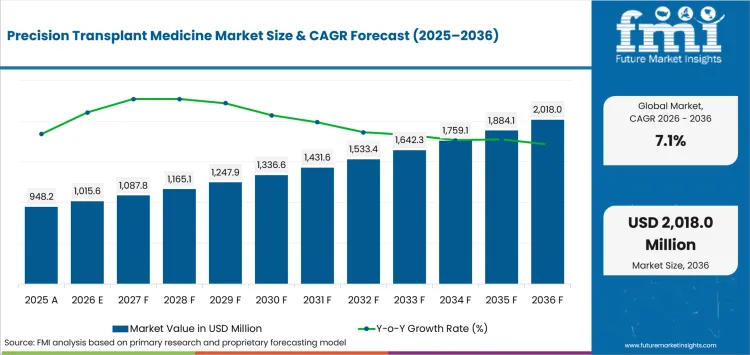
Key Takeaways of Precision Transplant Medicine Market
- Demand for precision transplant medicine is driven by laboratory findings guiding defined transplant decisions across accountable clinical pathways, with growing transplant activity sustaining recurring test volume across donor assessment and surveillance.
- By organ type, kidney transplantation is expected to lead with 35.2% share in 2026, driven by its larger procedure base and recurring surveillance requirements.
- Donor-recipient matching is the dominant application segment, projected to hold 37.6% share in 2026, through its direct effect on organ allocation and rejection risk.
- Genomic profiling is estimated to lead the technology category with 36.4% share in 2026, owing to high-resolution compatibility and biomarker assessment workflows.
- Transplant centers are anticipated to account for 35.6% share in 2026, supported by their control over multidisciplinary clinical decisions.
- South Korea, the United Kingdom, and Germany are expected to lead growth at 8.3%, 7.8%, and 7.4% CAGR respectively through 2036, while United States and Japanese adoption remain shaped by distinct reimbursement rules and specialist service networks.
- Competition centers on CareDx, Natera, Thermo Fisher Scientific, GenDx, Werfen, HistoGenetics, QIAGEN, and Eurofins Viracor, with vendors differentiating through blood-based rejection assessment, HLA typing platforms, histocompatibility products, and organ-specific molecular monitoring.
Analyst Perspective
"Commercial adoption will depend on whether precision diagnostics improve transplant decisions without disrupting time-sensitive clinical workflows. Healthcare providers are assessing analytical performance alongside turnaround time because both determine routine clinical utility. Long-term success will favor companies that generate robust clinical evidence, provide specialist interpretation, and support reimbursement strategies while integrating seamlessly into established transplant care pathways."
- Anurag Sharma, Principal Consultant at Future Market Insights
Source: FMI's proprietary forecasting model and primary research
How is the Precision Transplant Medicine Market segmented?
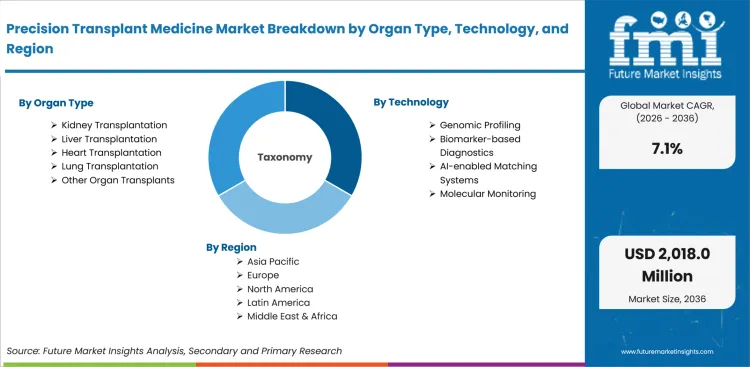
The precision transplant medicine industry is segmented by organ type, technology, end user, application, and region.
The segmentation framework separates transplant use cases from the technologies and institutions that control purchasing decisions. Organ type analysis follows kidney and liver transplantation alongside heart and lung procedures plus other organ transplants. Technology analysis compares genomic profiling with biomarker diagnostics and AI-enabled matching systems alongside molecular monitoring. The HLA typing workflow remains central to genomic assessment because donor and recipient compatibility influences allocation and immunologic risk. End-user categories distinguish transplant centers from hospitals and diagnostic laboratories plus research institutes with different operating responsibilities. Application analysis separates donor-recipient matching from rejection monitoring and therapy optimization across continuing post-transplant surveillance. Regional analysis explains how transplant capacity and payment systems shape adoption across national health-service and mixed-payer environments.
Why does kidney transplantation shape demand within the organ type category?
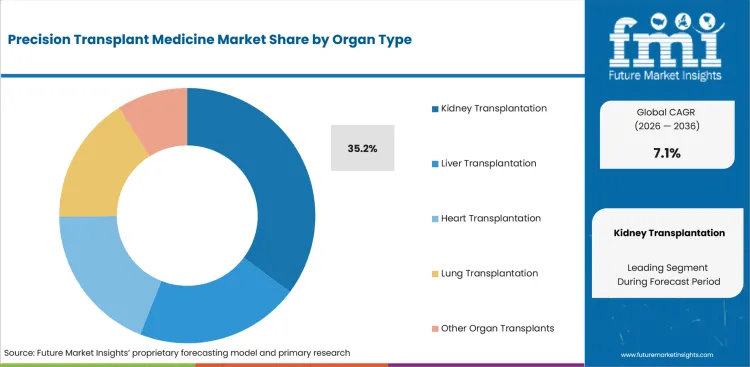
Kidney transplantation creates the largest recurring testing pathway because recipients require compatibility assessment and continued graft surveillance. Clinical teams combine donor information with antibody testing and molecular evidence before changing immunosuppression or requesting a biopsy. The Health Resources and Services Administration recorded 27,759 kidney transplants in the United States during 2024. The documented kidney workload supports clinical diagnostics across pre-transplant matching and post-transplant monitoring without proving universal purchasing at every center.
- Kidney transplantation holds 35.2% share in 2026, supported by its larger procedure base and repeated surveillance needs. Laboratories can distribute fixed workflow costs across more patients and more testing points during long-term care.
- Transplant nephrologists adopt precision tests once results clarify graft injury or immunologic risk within an established response pathway. Adoption slows whenever uncertain findings create additional biopsies without producing a meaningful change in treatment decisions.
What supports genomic profiling within the technology category?
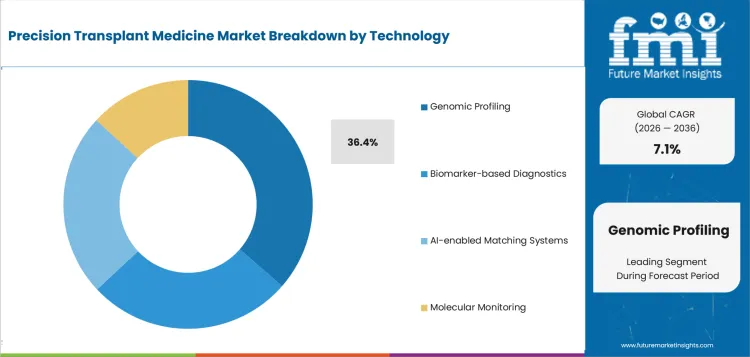
Genomic profiling supports precise compatibility assessment by resolving complex HLA variation and other transplant-relevant molecular features. Laboratories value methods that combine sample preparation and sequencing with software that produces traceable interpretation for specialist review. Current GenDx products pair high-resolution NGS typing assays with analysis software and training resources for transplant laboratories. Comparable genomics platforms gain commercial acceptance once laboratories can validate complete workflows rather than isolated sequencing performance.
- Genomic profiling represents 36.4% share in 2026, owing to high-resolution results that improve compatibility assessment across complex donor-recipient combinations. The segment also supports standardized data exchange across laboratory and multidisciplinary clinical teams during urgent transplant decisions.
- Histocompatibility laboratories favor profiling workflows that fit existing instruments and accreditation procedures without extending urgent allocation timelines. Commercial preference strengthens once software reduces manual review and preserves an auditable interpretation record for specialist decisions.
Why do transplant centers lead the end user category?
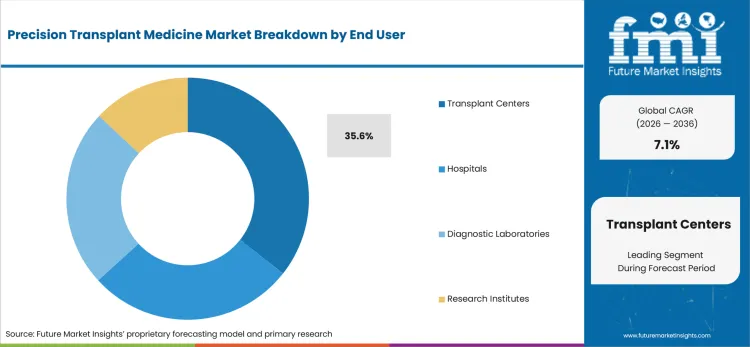
Transplant centers coordinate surgical selection and laboratory evidence across multidisciplinary teams that remain accountable for patient outcomes. HRSA reports that every United States transplant program and histocompatibility laboratory uses the OPTN network for time-sensitive matching and transplant data. Concentrated operating ownership gives centers direct influence over in vitro diagnostics selection and result-routing requirements across the complete patient pathway. Independent laboratories can provide specialized testing, although routine adoption still depends on center protocols and specialist acceptance.
- Transplant centers account for 35.6% share in 2026, underpinned by their authority over protocol design and clinical escalation. Centralized ownership also supports coordinated evaluation across surgical and pathology teams plus specialist immunology services.
- Center-based teams adopt new tests after defining order criteria and turnaround targets alongside responsibility for uncertain findings. A service gains routine use once reporting integrates with multidisciplinary review rather than creating a separate information channel.
How does donor-recipient matching shape the application category?
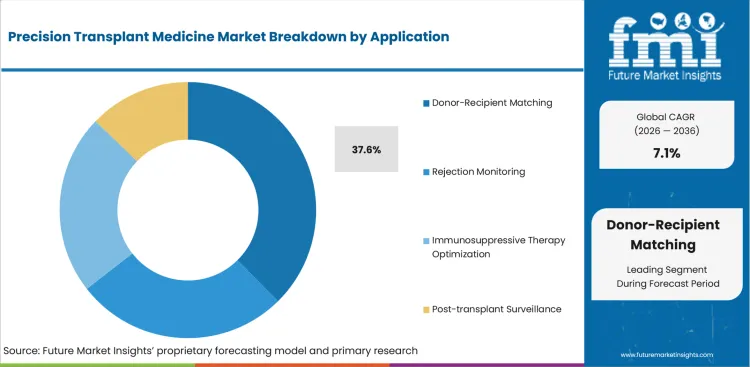
Donor-recipient matching creates the first precision decision because incompatible allocation can increase rejection risk and waste a scarce organ. Matching combines blood group and HLA information with sensitization history and organ-specific allocation rules under severe time pressure. NHS Blood and Transplant manages the national donor and transplant registers that support fair matching across the United Kingdom. Modern molecular diagnostics add value once results enter the allocation pathway quickly and remain interpretable across participating laboratories.
- Donor-recipient matching captures 37.6% share in 2026, linked to its direct effect on organ allocation and immediate transplant feasibility. High-resolution evidence can reduce avoidable incompatibility within carefully governed allocation rules across urgent transplant decisions.
- Allocation teams adopt advanced matching tools once laboratories deliver reliable results within urgent decision windows and established governance rules. Adoption remains limited whenever added detail cannot change ranking or creates delays that threaten organ usability.
What are the drivers, restraints, and opportunities in the Precision Transplant Medicine Market?
Recurring transplant decisions sustain demand across compatibility assessment and longitudinal graft surveillance throughout complex care pathways. Strict evidence and reimbursement requirements slow routine adoption across transplant centers and payer-governed clinical pathways. Integrated decision support creates commercial opportunity by connecting laboratory results with accountable specialist actions across continuing care.
- Driver: Transplant programs require repeated molecular evidence that can distinguish emerging graft injury from stable recovery across routine surveillance pathways.
- Restraint: Coverage policies and validation requirements limit routine testing whenever evidence does not support a defined clinical decision or patient group.
- Opportunity: Integrated compatibility and monitoring services can connect laboratory findings with specialist interpretation across one accountable transplant pathway.
Recurring clinical uncertainty supports market demand across compatibility assessment and graft surveillance throughout long patient-care pathways. Transplant teams need early evidence of incompatibility or graft injury to prevent irreversible clinical damage during routine care. South Korea’s Ministry of Health and Welfare reported in February 2025 that approximately 50,000 patients awaited transplants and around eight died daily without receiving an organ. Scarce organs increase the value of liquid biopsy methods that preserve longitudinal evidence without repeated invasive sampling across every surveillance event. Commercial demand strengthens once blood-based results identify a defined escalation step and remain available within ordinary clinic schedules.
Evidence requirements restrain adoption because molecular tests must prove clinical usefulness within specific organs and patient populations. The revised CMS MolDX policy provides limited coverage and ties payment to defined rejection-status uses plus established medical-necessity criteria. Transplant centers therefore need validation that matches their surveillance protocols rather than broad claims based on analytical sensitivity alone. Companies face slower conversion once coverage excludes routine use or requires documentation that laboratories cannot produce consistently.
Integrated decision support creates an opportunity by connecting compatibility data and molecular monitoring with treatment choices across longitudinal care. The Global Observatory on Donation and Transplantation reported more than 173,700 solid-organ transplants across 92 countries for 2024. Companion diagnostics can create practical value by linking a measured biomarker with a defined therapy or biopsy decision within validated populations. The strongest commercial models combine testing and interpretation with payer evidence plus service continuity across the transplant center network.
Which country CAGRs are profiled in the Precision Transplant Medicine Market?
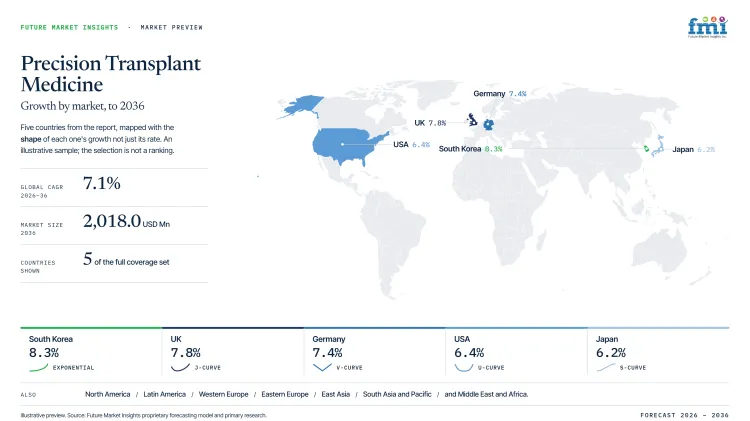
| Country | CAGR |
|---|---|
| USA | 6.4% |
| UK | 7.8% |
| Germany | 7.4% |
| Japan | 6.2% |
| South Korea | 8.3% |
How do country-level CAGRs compare in the Precision Transplant Medicine Market?
The country comparison forms three measured growth bands rather than a sharp split between mature and emerging transplant systems. South Korea and the United Kingdom occupy the upper band through centralized national infrastructure and concentrated specialist decision pathways. Germany follows closely through coordinated transplant and laboratory networks that connect regional centers with established allocation structures. The United States and Japan form a lower growth band despite substantial specialist capability and mature clinical institutions. The 2.1 percentage-point spread reflects different reimbursement routes and transplant capacity rather than a simple ranking of clinical quality.
- South Korea and the United Kingdom show stronger forecast momentum through centralized national infrastructure and concentrated specialist decision pathways.
- Germany remains close to the upper group because transplant coordination and laboratory services operate through established cross-border clinical structures.
- United States growth reflects a large clinical base that faces variable payer coverage and different adoption speeds across transplant programs.
- Japan records measured expansion within a regulated system that concentrates expertise and requires careful coordination across specialist facilities.
- Comparable growth rates can conceal different service distances and procurement routes plus training requirements across individual national markets.
Markets with broadly similar CAGRs can still present different entry conditions due to local transplant infrastructure and testing reimbursement. Commercial entry therefore depends on service coverage and reimbursement fit rather than relying on forecast rates alone. The full report provides country-level CAGR analysis across North America, Latin America, Europe, East Asia, South Asia, Oceania and the Middle East and Africa.
Country-wise Analysis
- United States transplant care operates through a membership network linking transplant hospitals with organ procurement organizations and histocompatibility laboratories. The precision transplant medicine market in the United States is forecast to expand at 6.4% CAGR through 2036, supported by a specialist care base. In June 2026, HRSA confirmed that every transplant hospital program and transplant histocompatibility laboratory was an OPTN member with policy responsibilities. The national structure enables shared standards and coordinated sample routing across major transplant centers and laboratory networks. Variable payer documentation and coverage criteria remain material frictions for routine molecular surveillance across patient groups. Commercial entry requires payer-specific evidence and dependable laboratory support that can satisfy rules without weakening local clinical control.
- United Kingdom transplant services operate through a nationally coordinated public pathway that concentrates specialist protocols and purchasing decisions within NHS institutions. The precision transplant medicine market in the United Kingdom is projected to record 7.8% CAGR during the 2026-2036 forecast period, supported by national transplant services. In June 2026, NHS Blood and Transplant activated the liver pathway within its Assessment and Recovery Centres program across three specialist trusts. The national network enables technical protocols and centralized training across participating hospitals that assess complex organs and testing pathways. Public budget review remains a material friction for molecular services that add laboratory work without demonstrating measurable service improvement. Manufacturers need evidence packages that match NHS procurement standards and provide specialist support across national rollout.
- Germany combines regional transplant centers with Eurotransplant allocation and national coordination across a distributed hospital network. The precision transplant medicine market in Germany is estimated to advance at 7.4% CAGR through 2036, supported by established transplant coordination. During January 2026 Deutsche Stiftung Organtransplantation reported 3,256 organs transplanted across 43 German transplant centers during 2025. Concentrated specialist institutions enable technical support and validated laboratory workflows across histocompatibility and molecular surveillance services. Regional differences and persistent organ scarcity remain material frictions for standardizing advanced testing across every hospital pathway. Market entry requires service coverage that reaches regional centers and supports consistent validation without disrupting Eurotransplant-linked clinical procedures.
- Japan concentrates transplant expertise within approved hospitals and uses hub relationships to support facilities with less donation experience. The precision transplant medicine market in Japan is forecast to expand at 6.2% CAGR across the ten-year forecast window, supported by structured specialist collaboration. During January 2026 the Ministry of Health, Labour and Welfare opened applications for a hub-facility program that provides manuals and multidisciplinary personnel support. The program enables training and maintenance routes across connected hospitals through experienced medical and laboratory personnel. Long service distances and limited procedure volume remain material frictions for commercial support outside major metropolitan centers. Providers need regional service models that preserve specialist access and workflow continuity across facilities with uneven operating experience.
- South Korean transplant care combines tertiary hospitals with national coordination and centralized digital reporting across donation and recipient pathways. The precision transplant medicine market in South Korea is projected to grow at 8.3% CAGR through 2036, supported by strong digital infrastructure. In October 2025, the Ministry of Health and Welfare announced a five-year national plan that introduces EMR notification and coordinated support for transplant hospitals. The planned digital route enables earlier coordinator involvement and more consistent data capture across participating clinical institutions. Government reporting also identified staffing shortages and excessive workloads within hospital transplant centers as material local frictions. Commercial deployment requires efficient integration and training that reduce workload without adding another disconnected information channel.
Who are the notable companies in the Precision Transplant Medicine Market?
CareDx, Thermo Fisher Scientific, Natera, GenDx, Werfen, HistoGenetics, QIAGEN, and Eurofins Viracor form the verified competitive set for precision transplant medicine.
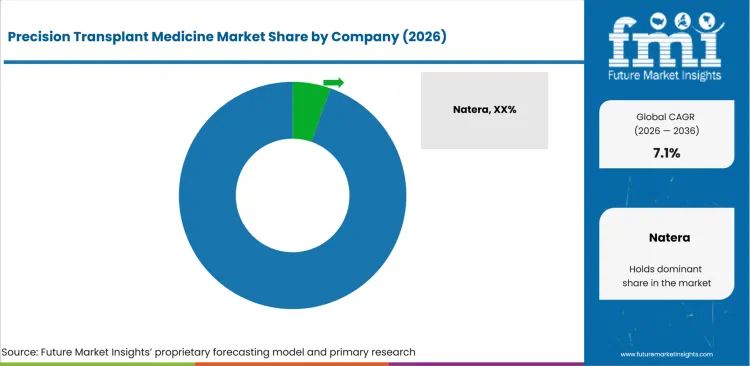
Competition separates commercial rejection-monitoring services from HLA laboratory platforms and specialized reference testing providers within distinct transplant workflows. CareDx provides transplant-specific molecular testing and reporting across kidney and heart plus lung care pathways. GenDx supplies NGS HLA typing assays and analysis software alongside transplant-monitoring products for specialized laboratories. Thermo Fisher Scientific combines typing and antibody products with software plus post-transplant molecular assays through One Lambda. Natera focuses on commercial blood-based monitoring while Eurofins Viracor supplies broad transplant laboratory services across United States programs. Broader point-of-care diagnostics remain adjacent rather than direct substitutes for these specialized transplant offerings across clinical pathways. Dedicated transplant interpretation requires laboratory oversight and clinical governance across every reported result plus subsequent specialist response decisions.
- Molecular monitoring specialists include CareDx and Natera through transplant-specific blood tests and clinical reporting pathways across selected organs.
- Integrated HLA platform providers include Thermo Fisher Scientific and GenDx plus Werfen through typing assays and analysis support across transplant laboratories.
- Sequencing and reference-service participants include QIAGEN and HistoGenetics through enabling panels or specialist histocompatibility testing across selected workflows.
Competitive Benchmarking: Precision Transplant Medicine Market
| Company | HLA Typing and Matching | Molecular Rejection Monitoring | Interpretation and Workflow Support | Geographic Reach |
|---|---|---|---|---|
| CareDx | Low | High | High | North America |
| Thermo Fisher Scientific | High | High | High | Global |
| Natera | Low | High | High | North America |
| GenDx | High | Medium | High | Global |
| Werfen | High | Low | Medium | Global |
| HistoGenetics | High | Low | Medium | Global service |
| QIAGEN | Medium | Low | Medium | Global |
| Eurofins Viracor | Low | Low | Medium | North America |
High HLA typing indicates dedicated high-resolution assays with matching software across a complete transplant workflow. Medium HLA typing indicates enabling panels that require additional transplant-specific workflow components and interpretation support. Low HLA typing indicates a documented current portfolio outside direct pre-transplant typing and matching services. High molecular monitoring indicates commercial rejection testing across several transplanted organs and established clinical reporting pathways. Medium molecular monitoring indicates one directly documented organ-specific assay or a narrower commercial monitoring service. Low molecular monitoring indicates a documented current portfolio without a direct rejection-monitoring service for solid-organ recipients. High interpretation support includes transplant-specific software and clinical reporting across the relevant diagnostic workflow and specialist decision pathway. Medium interpretation support includes assay analysis or technical assistance without complete transplant-specific decision support across clinical workflows. Low interpretation support indicates documented support limited to general laboratory output without dedicated transplant interpretation.
Key Developments in the Precision Transplant Medicine Market
- In June 2026, Natera and Eledon selected Prospera as the exclusive donor-derived cell-free DNA assay for a planned phase 3 kidney transplant trial. The study plans to enroll approximately 600 recipients across more than 100 centers, giving transplant programs a defined multicenter setting for evaluating molecular surveillance alongside investigational immunomodulatory therapy and established clinical endpoints.
- In March 2025, CareDx expanded commercial AlloSure testing to pediatric heart recipients of every age and to patients receiving simultaneous pancreas-kidney transplants. The broader indications extend donor-derived cell-free DNA monitoring into two specialized pathways, while transplant centers retain responsibility for integrating results with organ-specific clinical assessment and established escalation protocols during routine care.
- In July 2025, QIAGEN launched QIAseq xHYB Long Read Panels for high-resolution analysis of HLA genes and other complex genomic regions. The panels combine hybrid-capture chemistry with compatible long-read sequencing platforms and integrated bioinformatics, giving histocompatibility laboratories an enabling workflow that still requires transplant-specific validation and interpretation across accredited laboratory procedures and routine quality review.
- In July 2026, GenDx integrated the acquired CareDx laboratory-products portfolio with its HLA typing and transplant-monitoring solutions under Eurobio Scientific ownership. The completed integration broadens a transplant-focused product catalog and technical-support route, while laboratories must verify regulatory status and workflow continuity across each operating geography and defined local customer support obligations during implementation.
Key Players in the Precision Transplant Medicine Market
Molecular Monitoring and Digital Transplant Providers
- CareDx
- Natera
- Eurofins Viracor
HLA Typing and Transplant Laboratory Platforms
- Thermo Fisher Scientific
- GenDx
- Werfen
- QIAGEN
Specialized Histocompatibility Service Providers
- HistoGenetics
Precision Transplant Medicine Market - Report Scope
| Coverage field | Report scope |
|---|---|
| Market breakdown | Organ type, technology, end user, application, and region. |
| Quantitative Units | Revenue in USD Million, CAGR in %. |
| Market Definition | Precision transplant medicine comprises advanced diagnostic, genomic, molecular monitoring, donor-recipient matching, and personalized therapeutic technologies used to optimize transplant outcomes, reduce rejection risk, and improve long-term graft survival across solid organ and tissue transplantation procedures. |
| Regions Covered | North America, Latin America, Western Europe, Eastern Europe, East Asia, South Asia and Pacific, and Middle East and Africa. |
| Countries Covered | USA, Germany, France, UK, Japan, and South Korea, with analysis across more than 30 countries |
| Key Companies Profiled | CareDx, Thermo Fisher Scientific, Natera, GenDx, Werfen, HistoGenetics, QIAGEN, and Eurofins Viracor. |
| Forecast Period | 2026 to 2036. |
| Approach | Hybrid bottom-up and top-down market sizing supported by primary research, desk research, data validation, and segment reconciliation. |
Precision Transplant Medicine Market - Research Methodology
| Method | Approach |
|---|---|
| Primary Research | FMI analysts gathered input from manufacturers, service providers, technology developers, distributors, end users, sourcing teams, and subject-matter experts. Interviews examined purchasing decisions, product or service evaluation, adoption barriers, approval requirements, pricing considerations, and expectations for technical or commercial support. Respondents were also asked what evidence is required before a trial, pilot, or initial order develops into regular purchasing. |
| Desk Research | Desk research covered government statistics, regulatory publications, trade data, industry associations, technical literature, standards, company filings, product information, and official corporate announcements. Sources were reviewed for relevance, publication date, geographic coverage, and consistency with the defined market scope. Claims relating to performance, applications, approvals, capacity, investment, and commercial activity were retained only when supported by credible public evidence. |
| Market Sizing and Forecasting | The market model combined the baseline value with historical performance, segment structure, pricing and volume indicators, adoption levels, company participation, and country-level demand conditions. Forecast assumptions considered economic activity, investment trends, regulatory developments, technology adoption, purchasing cycles, supply availability, and barriers to wider market use. Segment and regional estimates were reconciled before the final market total was calculated. |
| Data Validation | Estimates were checked against multiple independent indicators, including public data, company activity, trade patterns, industry developments, and findings from primary interviews. Validation also tested whether products, services, applications, and company revenues fell within the defined market boundaries. Adjacent categories, unsupported claims, overlapping revenues, and activities without direct market relevance were excluded to reduce double counting and maintain consistency across segments and countries. |
Precision Transplant Medicine Market by Segments
Precision Transplant Medicine Market segmented by Organ Type:
- Kidney Transplantation
- Liver Transplantation
- Heart Transplantation
- Lung Transplantation
- Other Organ Transplants
Precision Transplant Medicine Market segmented by Technology:
- Genomic Profiling
- Biomarker-based Diagnostics
- AI-enabled Matching Systems
- Molecular Monitoring
Precision Transplant Medicine Market segmented by End User:
- Transplant Centers
- Hospitals
- Diagnostic Laboratories
- Research Institutes
Precision Transplant Medicine Market segmented by Application:
- Donor-Recipient Matching
- Rejection Monitoring
- Immunosuppressive Therapy Optimization
- Post-transplant Surveillance
Precision Transplant Medicine Market by Region:
- North America
- United States
- Canada
- Latin America
- Brazil
- Mexico
- Argentina
- Chile
- Western Europe
- Germany
- France
- United Kingdom
- Italy
- Spain
- Benelux
- Nordics
- Eastern Europe
- Poland
- Czech Republic
- Romania
- Hungary
- East Asia
- China
- Japan
- South Korea
- South Asia and Pacific
- India
- ASEAN
- Australia and New Zealand
- Middle East and Africa
- GCC Countries
- South Africa
- Türkiye
- Israel
Research Sources and Bibliography
- Health Resources and Services Administration. (2025, January 15). Organ Transplants Exceeded 48,000 in 2024; a 3.3 Percent Increase From the Transplants Performed in 2023.
- Health Resources and Services Administration. (2025, December). About OPTN Data.
- Health Resources and Services Administration. (2026, June). Professionals.
- NHS Blood and Transplant. (n.d.). Organ donation and transplantation.
- NHS Blood and Transplant. (2026, March 17). NHS starts machine preservation programme to enable more transplants.
- NHS Blood and Transplant. (2026, June 15). New pathway goes live for UK's world leading Assessment and Recovery Centres programme.
- Deutsche Stiftung Organtransplantation. (2026, January 13). Organspendezahlen 2025 auf höchstem Stand seit 2012, dennoch weiterhin großer Bedarf.
- Ministry of Health, Labour and Welfare. (2026, January 28).[Organ donation facility collaboration system development project].
- Ministry of Health and Welfare. (2025, February 5). [Organ donation].
- Ministry of Health and Welfare. (2025, October 16).[First national comprehensive plan expands organ donation beyond brain death].
- Centers for Medicare & Medicaid Services. (2025, July 10). MolDx: Molecular Testing for Solid Organ Allograft Rejection (L38680).
- Global Observatory on Donation and Transplantation. (2025). Home - GODT.
- Eurofins Viracor. (n.d.). Clinical Diagnostics.
- Thermo Fisher Scientific. (n.d.). One Lambda.
- Natera. (n.d.). Organ Health.
- GenDx. (n.d.). GenDx Products.
- Werfen. (n.d.). Werfen | Leading Provider Of Transfusion & Transplantation Diagnostic Products Worldwide.
- HistoGenetics. (n.d.). HistoGenetics - HLA|Genomics|CMV|ABO-RH|CCR5|KIR|FCGR.
- QIAGEN. (n.d.). QIAseq xHYB Long Read Panels for complex genomic analysis.
- CareDx. (n.d.). Our Tests.
- CareDx. (2026, June 30). CareDx Announces Completion of Sale of Lab Products Business to Eurobio Scientific.
- GenDx. (2026, July 1). A New Chapter for Transplant Diagnostics: CareDx Lab Products Join GenDx.
- Natera. (2026, June 25). Natera and Eledon Announce Strategic Partnership for Prospera™ Monitoring in Planned Phase 3 Kidney Transplant Trial.
- CareDx. (2025, March 11). CareDx Launches Two Expanded Indications for AlloSure Testing Services.
- QIAGEN. (2025, July 22). QIAGEN Expands NGS Portfolio with Launch of QIAseq xHYB Long Read Panels.
This bibliography is provided for reader reference and is not exhaustive. The full report contains the complete reference list and detailed citations
This Report Answers
- How large is the precision transplant medicine market in 2026 and 2036?
- Which clinical and reimbursement factors support demand for precision transplant medicine?
- Why does kidney transplantation hold the largest Organ Type share in 2026?
- How does genomic profiling support donor-recipient matching and transplant surveillance?
- Why do transplant centers control a substantial share of end-user demand?
- How do country growth rates differ across the five profiled transplant markets?
- Which companies provide verified transplant-specific molecular or HLA capabilities?
- What evidence should healthcare executives evaluate before routine adoption?
- Which limitations reduce commercial adoption across payer and laboratory systems?
- How do molecular monitoring services fit within established transplant pathways?
Frequently Asked Questions
How big is the Precision Transplant Medicine Market in 2026?
The precision transplant medicine market is valued at USD 1,015.6 million in 2026 and is forecast to reach USD 2,018.0 million by 2036. Growth is supported by rising transplant procedure volumes that sustain recurring demand for compatibility testing and post-transplant molecular surveillance across established clinical pathways.
What is the CAGR of the Precision Transplant Medicine Market from 2026 to 2036?
The precision transplant medicine market grows at a CAGR of 7.1% between 2026 and 2036, supported by transplant programs adopting integrated testing and interpretation services once results influence donor selection or post-transplant treatment decisions within defined clinical pathways across transplant centers and diagnostic laboratories.
Which organ type leads the Precision Transplant Medicine Market?
Kidney transplantation accounts for 35.2% of the precision transplant medicine market by organ type in 2026, driven by its larger procedure base and recurring surveillance requirements that let laboratories distribute fixed workflow costs across more patients and more testing points during long-term care.
How much will the Precision Transplant Medicine Market add between 2026 and 2036?
The precision transplant medicine market is set to add USD 1,002.4 million between 2026 and 2036, growing from USD 1,015.6 million to USD 2,018.0 million as molecular testing and interpretation services enter funded clinical pathways across a widening base of transplant programs.
Which segment leads the Organ Type category in the precision transplant medicine market during 2026?
Kidney transplantation is estimated to hold 35.2% share of the Organ Type category during 2026. The segment benefits from a larger procedure base and repeated surveillance needs across long-term graft management.
Who are the leading companies in the Precision Transplant Medicine Market?
Five companies lead the precision transplant medicine market, including CareDx, Natera, Thermo Fisher Scientific, GenDx, and Werfen, competing through blood-based rejection assessment, HLA typing platforms, histocompatibility products, and organ-specific molecular monitoring across transplant laboratory workflows and clinical decision pathways worldwide.
Preview the report firsthand - request a free sample
Get SampleGet the brochure for pricing and purchase details.
Get PDFTable of Content
- Key Takeaways
- Market Size and CAGR
- Top Growth Driver
- Fastest Growing Segment
- Leading Region
- Key Companies
- Emerging Opportunities
- Executive Summary
- Global Market Outlook
- Demand-side Trends
- Supply-side Trends
- Technology Roadmap Analysis
- Analysis and Recommendations
- Analyst Perspective (What is happening? Why now? What should investors know?)
- Key Questions Answered
- How large is the market?
- What is the CAGR?
- What are key trends?
- Which region dominates?
- Who are the leaders?
- Market Overview
- Market Coverage / Taxonomy
- Market Definition / Scope / Limitations
- Research Methodology
- Chapter Orientation
- Analytical Lens and Working Hypotheses
- Market Structure, Signals, and Trend Drivers
- Benchmarking and Cross-market Comparability
- Market Sizing, Forecasting, and Opportunity Mapping
- Research Design and Evidence Framework
- Desk Research Programme (Secondary Evidence)
- Expert Input and Fieldwork (Primary Evidence)
- Tooling, Models, and Reference Databases
- Data Engineering and Model Build
- Quality Assurance and Audit Trail
- Market Background
- Market Dynamics (Drivers, Restraints, Opportunity, Trends)
- Scenario Forecast (Optimistic, Likely, Conservative)
- Impact Analysis
- AI Impact
- Sustainability Impact
- Regulatory Impact
- Technology Impact
- Consumer / Buyer Analysis
- Purchase Drivers
- Adoption Barriers
- Buyer Journey
- Opportunity Map Analysis
- Product Life Cycle Analysis
- Supply Chain Analysis
- Investment Feasibility Matrix
- Value Chain Analysis
- PESTLE and Porter's Analysis
- Regulatory Landscape
- Regional Parent Market Outlook
- Production and Consumption Statistics
- Import and Export Statistics
- Global Market Analysis and Forecast, 2021 to 2036
- Historical Market Size Value (USD Million) Analysis, 2021 to 2025
- Current and Future Market Size Value (USD Million) Projections, 2026 to 2036
- Y-o-Y Growth Trend Analysis
- Absolute $ Opportunity Analysis
- Global Market Pricing Analysis, 2021 to 2036
- Global Market Analysis and Forecast, By Organ Type, 2021 to 2036
- Introduction / Key Findings
- Historical Market Size Value (USD Million) Analysis By Organ Type, 2021 to 2025
- Current and Future Market Size Value (USD Million) Analysis and Forecast By Organ Type, 2026 to 2036
- Kidney Transplantation
- Liver Transplantation
- Heart Transplantation
- Lung Transplantation
- Other Organ Transplants
- Kidney Transplantation
- Y-o-Y Growth Trend Analysis By Organ Type, 2021 to 2025
- Absolute $ Opportunity Analysis By Organ Type, 2026 to 2036
- Global Market Analysis and Forecast, By Technology, 2021 to 2036
- Introduction / Key Findings
- Historical Market Size Value (USD Million) Analysis By Technology, 2021 to 2025
- Current and Future Market Size Value (USD Million) Analysis and Forecast By Technology, 2026 to 2036
- Genomic Profiling
- Biomarker-based Diagnostics
- AI-enabled Matching Systems
- Molecular Monitoring
- Genomic Profiling
- Y-o-Y Growth Trend Analysis By Technology, 2021 to 2025
- Absolute $ Opportunity Analysis By Technology, 2026 to 2036
- Global Market Analysis and Forecast, By End User, 2021 to 2036
- Introduction / Key Findings
- Historical Market Size Value (USD Million) Analysis By End User, 2021 to 2025
- Current and Future Market Size Value (USD Million) Analysis and Forecast By End User, 2026 to 2036
- Transplant Centers
- Hospitals
- Diagnostic Laboratories
- Research Institutes
- Transplant Centers
- Y-o-Y Growth Trend Analysis By End User, 2021 to 2025
- Absolute $ Opportunity Analysis By End User, 2026 to 2036
- Global Market Analysis and Forecast, By Application, 2021 to 2036
- Introduction / Key Findings
- Historical Market Size Value (USD Million) Analysis By Application, 2021 to 2025
- Current and Future Market Size Value (USD Million) Analysis and Forecast By Application, 2026 to 2036
- Donor-Recipient Matching
- Rejection Monitoring
- Immunosuppressive Therapy Optimization
- Post-transplant Surveillance
- Donor-Recipient Matching
- Y-o-Y Growth Trend Analysis By Application, 2021 to 2025
- Absolute $ Opportunity Analysis By Application, 2026 to 2036
- Global Market Analysis and Forecast, By Region, 2021 to 2036
- Introduction
- Historical Market Size Value (USD Million) Analysis By Region, 2021 to 2025
- Current Market Size Value (USD Million) Analysis and Forecast By Region, 2026 to 2036
- North America
- Latin America
- Western Europe
- Eastern Europe
- East Asia
- South Asia and Pacific
- Middle East & Africa
- Market Attractiveness Analysis By Region
- North America Market Analysis and Forecast, By Country, 2021 to 2036
- Historical Market Size Value (USD Million) Trend Analysis By Market Taxonomy, 2021 to 2025
- Market Size Value (USD Million) Forecast By Market Taxonomy, 2026 to 2036
- By Country
- USA
- Canada
- By Organ Type
- By Technology
- By End User
- By Application
- By Country
- Market Attractiveness Analysis
- By Country
- By Organ Type
- By Technology
- By End User
- By Application
- Key Takeaways
- Latin America Market Analysis and Forecast, By Country
- Historical Market Size Value (USD Million) Trend Analysis By Market Taxonomy, 2021 to 2025
- Market Size Value (USD Million) Forecast By Market Taxonomy, 2026 to 2036
- By Country
- Brazil
- Mexico
- Chile
- Rest of Latin America
- By Organ Type
- By Technology
- By End User
- By Application
- By Country
- Market Attractiveness Analysis
- By Country
- By Organ Type
- By Technology
- By End User
- By Application
- Key Takeaways
- Western Europe Market Analysis and Forecast, By Country
- Historical Market Size Value (USD Million) Trend Analysis By Market Taxonomy, 2021 to 2025
- Market Size Value (USD Million) Forecast By Market Taxonomy, 2026 to 2036
- By Country
- Germany
- UK
- Italy
- Spain
- France
- Nordic
- BENELUX
- Rest of Western Europe
- By Organ Type
- By Technology
- By End User
- By Application
- By Country
- Market Attractiveness Analysis
- By Country
- By Organ Type
- By Technology
- By End User
- By Application
- Key Takeaways
- Eastern Europe Market Analysis and Forecast, By Country
- Historical Market Size Value (USD Million) Trend Analysis By Market Taxonomy, 2021 to 2025
- Market Size Value (USD Million) Forecast By Market Taxonomy, 2026 to 2036
- By Country
- Russia
- Poland
- Hungary
- Balkan & Baltic
- Rest of Eastern Europe
- By Organ Type
- By Technology
- By End User
- By Application
- By Country
- Market Attractiveness Analysis
- By Country
- By Organ Type
- By Technology
- By End User
- By Application
- Key Takeaways
- East Asia Market Analysis and Forecast, By Country
- Historical Market Size Value (USD Million) Trend Analysis By Market Taxonomy, 2021 to 2025
- Market Size Value (USD Million) Forecast By Market Taxonomy, 2026 to 2036
- By Country
- China
- Japan
- South Korea
- By Organ Type
- By Technology
- By End User
- By Application
- By Country
- Market Attractiveness Analysis
- By Country
- By Organ Type
- By Technology
- By End User
- By Application
- Key Takeaways
- South Asia and Pacific Market Analysis and Forecast, By Country
- Historical Market Size Value (USD Million) Trend Analysis By Market Taxonomy, 2021 to 2025
- Market Size Value (USD Million) Forecast By Market Taxonomy, 2026 to 2036
- By Country
- India
- ASEAN
- Australia & New Zealand
- Rest of South Asia and Pacific
- By Organ Type
- By Technology
- By End User
- By Application
- By Country
- Market Attractiveness Analysis
- By Country
- By Organ Type
- By Technology
- By End User
- By Application
- Key Takeaways
- Middle East & Africa Market Analysis and Forecast, By Country
- Historical Market Size Value (USD Million) Trend Analysis By Market Taxonomy, 2021 to 2025
- Market Size Value (USD Million) Forecast By Market Taxonomy, 2026 to 2036
- By Country
- Kingdom of Saudi Arabia
- Other GCC Countries
- Türkiye
- South Africa
- Other African Union
- Rest of Middle East & Africa
- By Organ Type
- By Technology
- By End User
- By Application
- By Country
- Market Attractiveness Analysis
- By Country
- By Organ Type
- By Technology
- By End User
- By Application
- Key Takeaways
- Key Countries Market Analysis
- USA
- Pricing Analysis
- Market Share Analysis, 2025
- By Organ Type
- By Technology
- By End User
- By Application
- Canada
- Pricing Analysis
- Market Share Analysis, 2025
- By Organ Type
- By Technology
- By End User
- By Application
- Mexico
- Pricing Analysis
- Market Share Analysis, 2025
- By Organ Type
- By Technology
- By End User
- By Application
- Brazil
- Pricing Analysis
- Market Share Analysis, 2025
- By Organ Type
- By Technology
- By End User
- By Application
- Chile
- Pricing Analysis
- Market Share Analysis, 2025
- By Organ Type
- By Technology
- By End User
- By Application
- Germany
- Pricing Analysis
- Market Share Analysis, 2025
- By Organ Type
- By Technology
- By End User
- By Application
- UK
- Pricing Analysis
- Market Share Analysis, 2025
- By Organ Type
- By Technology
- By End User
- By Application
- Italy
- Pricing Analysis
- Market Share Analysis, 2025
- By Organ Type
- By Technology
- By End User
- By Application
- Spain
- Pricing Analysis
- Market Share Analysis, 2025
- By Organ Type
- By Technology
- By End User
- By Application
- France
- Pricing Analysis
- Market Share Analysis, 2025
- By Organ Type
- By Technology
- By End User
- By Application
- India
- Pricing Analysis
- Market Share Analysis, 2025
- By Organ Type
- By Technology
- By End User
- By Application
- ASEAN
- Pricing Analysis
- Market Share Analysis, 2025
- By Organ Type
- By Technology
- By End User
- By Application
- Australia & New Zealand
- Pricing Analysis
- Market Share Analysis, 2025
- By Organ Type
- By Technology
- By End User
- By Application
- China
- Pricing Analysis
- Market Share Analysis, 2025
- By Organ Type
- By Technology
- By End User
- By Application
- Japan
- Pricing Analysis
- Market Share Analysis, 2025
- By Organ Type
- By Technology
- By End User
- By Application
- South Korea
- Pricing Analysis
- Market Share Analysis, 2025
- By Organ Type
- By Technology
- By End User
- By Application
- Russia
- Pricing Analysis
- Market Share Analysis, 2025
- By Organ Type
- By Technology
- By End User
- By Application
- Poland
- Pricing Analysis
- Market Share Analysis, 2025
- By Organ Type
- By Technology
- By End User
- By Application
- Hungary
- Pricing Analysis
- Market Share Analysis, 2025
- By Organ Type
- By Technology
- By End User
- By Application
- Kingdom of Saudi Arabia
- Pricing Analysis
- Market Share Analysis, 2025
- By Organ Type
- By Technology
- By End User
- By Application
- Türkiye
- Pricing Analysis
- Market Share Analysis, 2025
- By Organ Type
- By Technology
- By End User
- By Application
- South Africa
- Pricing Analysis
- Market Share Analysis, 2025
- By Organ Type
- By Technology
- By End User
- By Application
- USA
- Market Structure Analysis
- Competition Dashboard
- Competition Benchmarking
- Market Share Analysis of Top Players
- By Regional
- By Organ Type
- By Technology
- By End User
- By Application
- Emerging Startups
- Innovation Benchmarking
- Competition Analysis
- Competition Deep Dive
- Natera
- Overview
- Product Portfolio
- Profitability by Market Segments
- Sales Footprint
- Strategy Overview
- Marketing Strategy
- Product Strategy
- Channel Strategy
- CareDx
- Thermo Fisher Scientific
- Illumina
- QIAGEN
- Eurofins Scientific
- Roche
- Bio-Rad Laboratories
- Omixon
- HistoGenetics
- Natera
- Case Studies
- Success Stories
- Recent Developments
- Competition Deep Dive
- Assumptions & Acronyms Used


