

- Market Size (2026)
- USD 7.3 Bn
- Forecast (2036)
- USD 13.9 Bn
- CAGR (2026 to 2036)
- 6.8%
Private Label Superfood Powder Market Size, Market Forecast and Outlook By FMI
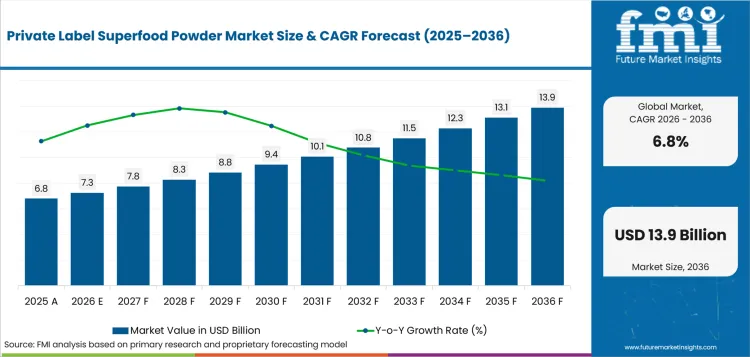
The private label superfood powder market value is predicted to scale from USD 6.8 billion in 2025 to USD 13.9 billion by 2036 at 6.8% CAGR, driven by retailer-led brand differentiation and rising demand for affordable wellness nutrition. Plant-based blends are anticipated to secure 49.6% share in 2026 as consumers prioritize clean-label, functional ingredient mixes for daily health routines. Online retail channels are projected to represent 51.2% share in 2026 as subscription models and direct-to-consumer positioning support repeat purchase behavior.
Key Takeaways, Market Size, and Forecast
- 2026 Market Size: USD 7.3 billion
- 2036 Market Size: USD 13.9 billion
- Forecast CAGR: 6.8% from 2026 to 2036
- Leading Program Type: Retailer-owned blends
- Retailer-owned Blends Share in 2026: 42.8%
- Leading Ingredient Base: Green blends
- Green Blends Share in 2026: 34.6%
- Fastest-growing Country: Saudi Arabia
- Saudi Arabia CAGR: 8.7% through 2036
Summary of Private Label Superfood Powder Market
- Demand and Growth Drivers
- Retailers are widening wellness aisles with own-brand greens, berry blends, mushroom powders, and protein-adjacent powders.
- Contract manufacturers are becoming more important as brands compare formulation support, allergen control, taste masking, and pack readiness.
- Quality systems now shape buyer shortlists because powder blends need batch records and country label review.
- Product and Segment View
- Green blends are forecast to hold 34.6% share in 2026 because daily greens programs fit repeat-use subscription and grocery formats.
- Certified organic products are expected to secure 46.2% share in 2026 as premium private-label buyers use certification to reduce claim risk.
- Resealable pouches are anticipated to represent 48.4% share in 2026 due to lower pack weight and easier e-commerce shipping.
- Geography and Competitive Outlook
- The United States is projected to record 8.2% CAGR through 2036, supported by store brand scale and supplement usage.
- Saudi Arabia is projected to rise at 8.7% CAGR through 2036 as imported wellness powders need clearer registration and label checks.
- Bactolac Pharmaceutical, Vitaquest International, Makers Nutrition, and SMP Nutra compete by formulation support and powder manufacturing depth.
- Analyst Opinion
- Nandini Roy Choudhury, Principal Consultant for Food and Beverage at FMI, observes, “Private label superfood powders are no longer simple me-too wellness SKUs. Buyers now ask who can control taste, label risk, allergen separation, and launch timing at the same time. The most useful supplier is often the one that makes retailer testing easier before a national rollout begins.”
- Private Label Superfood Powder Market Value Analysis
- Market value is supported by finished private-label SKU revenue before retailer margin and logistics markups are added.
- Supplier pricing reflects ingredient mix, testing frequency, pack format, order size, and flavor-masking work.
- Revenue improves when retailers move from one-off wellness powders into repeat programs with seasonal blends and subscription packs.
- Private-label buyers compare landed cost per serving because powder density and pouch weight can change shelf economics.
The private label superfood powder market is gaining value as retailers and wellness brands use owned-label powders to offer greens blends, berry powders and mushroom-based formulas at lower price points than premium branded supplements. FDA’s January 2025 draft guidance reported that USA retail plant-based food sales increased from USD 5.5 billion in 2019 to USD 8.1 billion in 2023. USDA ARS also reported in 2025 that less than 10% of Americans consume the recommended daily amount of dietary fiber. These indicators support demand for superfood powders that combine plant-source positioning with fiber and micronutrient messaging. In October 2025, SMP Nutra promoted its private-label and custom-formulation platform at SupplySide Global 2025 with more than 800 private-label supplements and custom formulations. Its powder catalogue also lists private-label green superfood formats with spirulina, chlorella, mushrooms, digestive enzymes and probiotics. This gives private-label buyers a faster route to shelf-ready powders while still comparing flavor masking and claim support before supplier selection.
Private Label Superfood Powder Market Definition
The private label superfood powder market covers contract-manufactured and retailer-owned powder programs made with plant, fruit, vegetable, mushroom, algae, root, seed, fiber, or micronutrient ingredients. Scope includes finished powders sold under retailer, distributor, DTC, foodservice, or brand-owner labels. Revenue includes B2B and retailer programs where a third-party supplier develops, blends, tests, packs, or labels the powder for sale under a buyer-controlled brand.
Private Label Superfood Powder Market Inclusions
Market scope covers green powders, berry powders, mushroom blends, algae powders, adaptogen powders, fiber blends, and superfood-protein combinations when sold under a private-label or B2B program. Packaging coverage includes pouches, canisters, stick packs, sachets, tubs, and cartons. Buyer coverage includes retailers, direct-to-consumer brands, wellness chains, food processors, foodservice buyers, and distributors. Revenue scope covers market activity from 2026 to 2036 across finished powder programs and supplier-managed formulation services.
Private Label Superfood Powder Market Exclusions
Scope excludes branded superfood powders sold only under the manufacturer’s own label. It also excludes single-ingredient commodity powders sold in bulk with no private-label program, liquid smoothies, ready-to-drink beverages, capsules, tablets, gummies, and fresh produce. Standard protein powders are excluded unless the product is positioned as a superfood blend using greens, berries, mushrooms, algae, roots, seeds, or similar functional powder ingredients.
Private Label Superfood Powder Market Research Methodology
- Primary Research: FMI analysts reviewed private-label supplier portfolios, retailer powder programs, ingredient claims, packaging formats, and buyer screening criteria across major wellness markets.
- Desk Research: Public data from the United States Food and Drug Administration, Health Canada, the United Kingdom Food Standards Agency, the Saudi Food and Drug Authority, the Australian Therapeutic Goods Administration, and official supplier pages were checked against category evidence.
- Market Sizing and Forecasting: The market size has been estimated using a bottom-up product-boundary approach. Each category has been defined by eligible SKUs, retailer revenue pools, B2B program availability, channel access, product positioning, and country-level adoption patterns.
- Scope Control: Standard protein powders, single-ingredient bulk powders, and branded-only superfood products were excluded unless they clearly matched the category definition. Eligible products needed private-label ownership, retailer-controlled branding, B2B formulation support, or contract-manufactured powder program status.
Why is the Private Label Superfood Powder Market Growing?
- Retailers are using private labels to control wellness assortment and margin while avoiding full brand development from the ground up.
- Powder programs fit repeat purchase behavior because buyers can compare serving count and pack size before committing to larger orders.
- Contract manufacturers reduce launch friction by handling formulation and packing under one supplier agreement.
Private-label buyers track superfood powders more closely as greens and berry blends move from specialty shelves into mass retail and club retail. This creates a larger test base for retailer-owned powder programs. Private Label Manufacturers Association reported in January 2026 that United States store brand sales reached USD 282.8 billion in 2025. Store brands also reached a record 68.7 billion units in 2025. This matters for private-label powders because wellness products can use the same retailer trust that supports food, beverage, and household store brands.
Supplier selection is also tied to custom supplement formulation because buyers need taste work, stability checks, and ingredient sourcing before the first purchase order is placed. Smaller brands often choose ready concepts first, while larger retailers ask for exclusive formulas and pack designs. The Council for Responsible Nutrition reported in October 2024 that 75% of Americans used dietary supplements. That base supports trial for powders that is present between food, nutrition and supplement aisles
Market Segmentation Analysis
- Retailer-owned blends are projected to secure 42.8% share in 2026 because grocery, mass, and club retailers can price private-label powders below national brands while keeping shelf control.
- Green blends are anticipated to hold 34.6% share in 2026 as daily greens programs support repeat use and simple serving messages.
- Certified organic products are expected to account for 46.2% share in 2026 since certification reduces buyer concern around natural-positioned claims.
- Resealable pouches are forecast to represent 48.4% share in 2026 due to lighter pack weight and easier online fulfillment.
- Mass retail is projected to hold 39.5% share in 2026 as private-label wellness moves beyond specialty stores.
- Smoothie mixes are expected to account for 31.7% share in 2026 because the use case is easy for new consumers to understand.
- Retail chains are anticipated to represent 44.1% share in 2026 as buyers consolidate supplier lists around tested powders and retail-ready packs.
Ingredient decisions are widening as fruit powders and berry blends give retailers a way to launch color-coded wellness lines without relying only on greens. Freeze-dried and spray-dried inputs also let suppliers adjust price points by channel. The same logic supports vegetable powders in blends where color and natural taste masking matter more than single-ingredient positioning. Retailers prefer formats that explain the use case without a long education cycle. The private label superfood powder market is segmented by program type, ingredient base, certification, packaging format, sales channel, end use, buyer type, and region. Program type covers retailer-owned blends, turnkey blends, white label kits, foodservice blends, and DTC private lines. Ingredient base covers green blends, berry blends, mushroom blends, algae blends, root adaptogens, and seed blends. Certification covers certified organic, non-GMO, vegan, gluten-free, halal, and allergen-controlled products.
Insights into Private Label Superfood Powder Market by Program Type
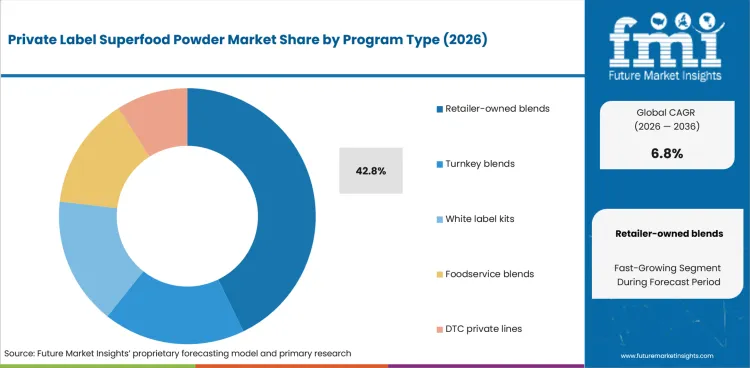
- Retailer-owned blends are expected to account for 42.8% share in 2026 through grocery, club, pharmacy, and wellness-chain private-label programs.
- Turnkey blends help smaller brands test greens and berry concepts before investing in exclusive formulas.
Insights into Private Label Superfood Powder Market by Ingredient Base
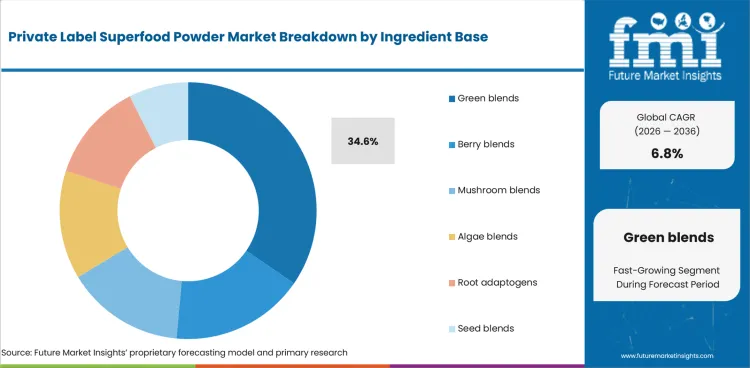
- Green blends are forecast to secure 34.6% share in 2026 because spinach, kale, grasses, algae, and fiber systems support daily-use messaging.
- Mushroom blends gain buyer attention when brands need cognitive, energy, or adaptogen positioning without adding capsule formats. Retailers also use organic fruit powder when color and certification must work together in a premium private-label formula. These inputs help private labels move beyond a plain greens taste profile.
Insights into Private Label Superfood Powder Market by Certification
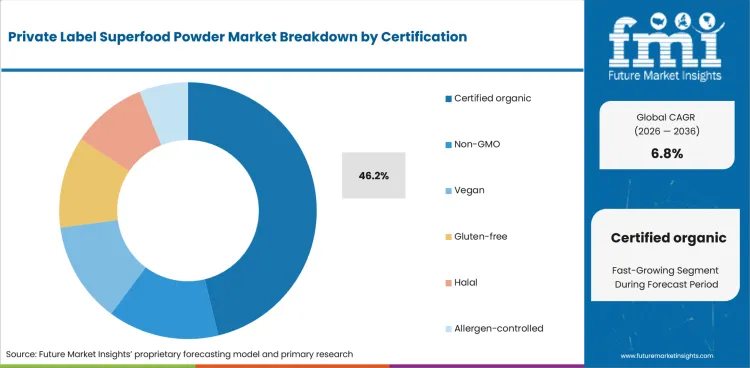
- Certified organic products are anticipated to hold 46.2% share in 2026 as retailers use third-party marks to support higher shelf prices.
- Halal and allergen-controlled products gain relevance in GCC, UK, and Australian channels where buyer review includes label suitability.
Insights into Private Label Superfood Powder Market by Packaging Format
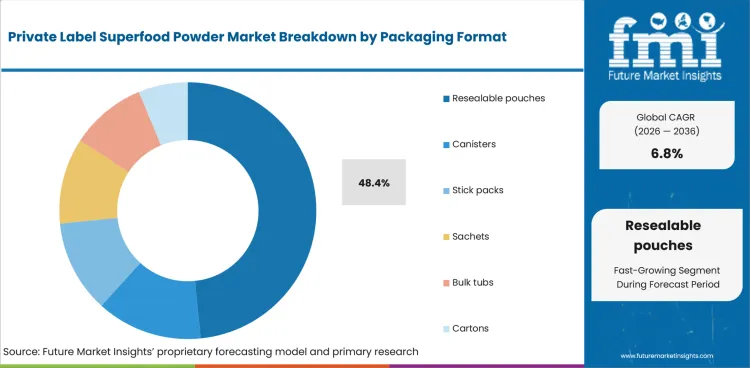
- Resealable pouches are projected to represent 48.4% share in 2026 because they are lighter than rigid canisters and easier to ship.
- Stick packs gain use in trial kits, travel packs, and foodservice sampling where one serving must be measured for the user. Pack choice is linked to dietary supplement packaging because private-label powders need moisture control, scoop space and label space for serving instructions.
Insights into Private Label Superfood Powder Market by Sales Channel
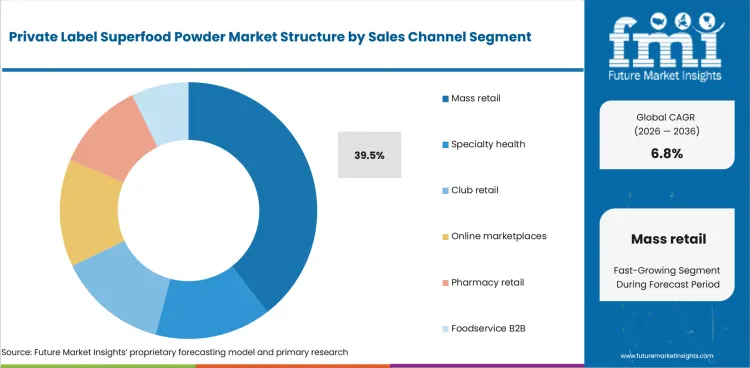
- Mass retail is expected to hold 39.5% share in 2026 as store brands move from food basics into wellness powders.
- Specialty health stores remain important for higher-priced mushroom, algae, and organic blends that need staff explanation.
Insights into Private Label Superfood Powder Market by End Use
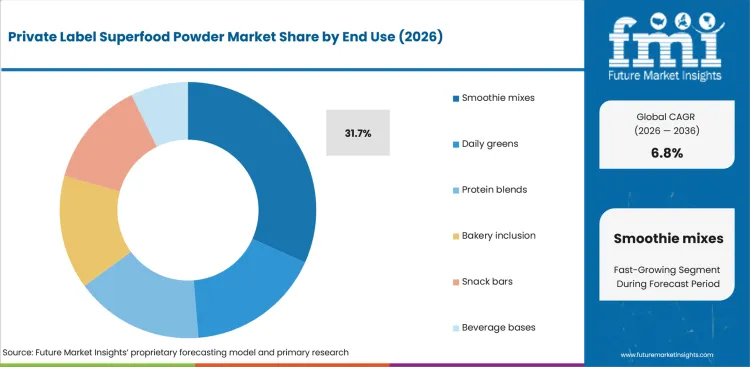
- Smoothie mixes are forecast to account for 31.7% share in 2026 because the use case is clear and the taste system can be adjusted.
- Bakery inclusion creates B2B value when food processors use powders in bars, muffins, mixes, and snack bases.
Insights into Private Label Superfood Powder Market by Buyer Type
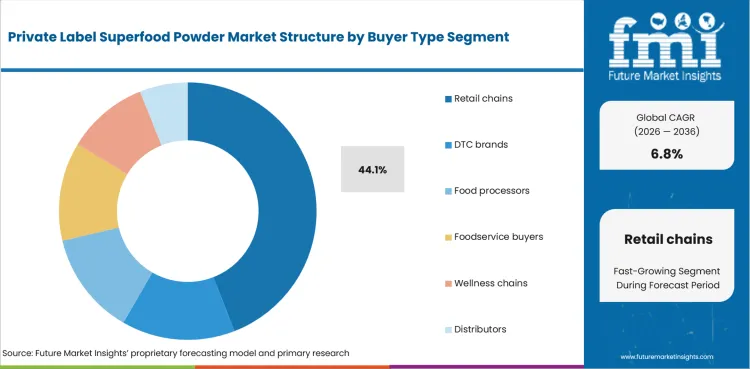
- Retail chains are projected to secure 44.1% share in 2026 as buyers use private-label powders to fill wellness price gaps.
- DTC brands use contract manufacturing to launch narrower concepts with smaller first orders and faster label testing.
Private Label Superfood Powder Market Drivers, Restraints, and Opportunities
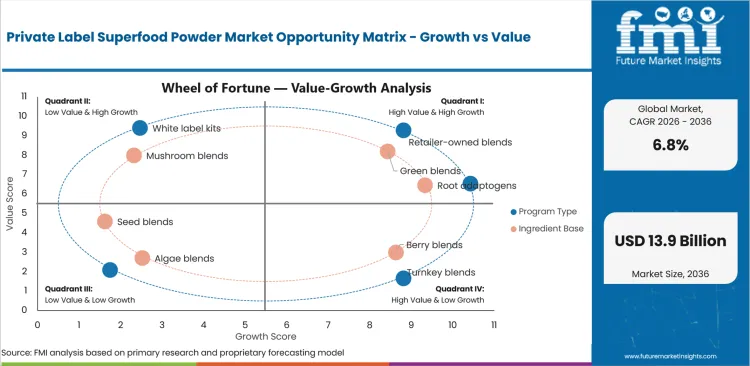
- Retailer private labels are moving into functional wellness as buyers look for owned assortments with better margin control.
- Ingredient testing raises cost because greens, algae, roots, and mushrooms can require contaminant checks before pack release.
- Retailers can use seasonal greens, berry blends, and wellness kits to create repeat programs instead of single launch events.
The United States Food and Drug Administration updated its current good manufacturing practice page in April 2024 and directed food companies toward clearer manufacturing controls. The guidance points food facilities to 21 Code of Federal Regulations Part 117 and dietary supplement manufacturers to 21 Code of Federal Regulations Part 111. This review pattern makes supplier documentation a buying requirement for private-label superfood powder programs that rely on imported botanicals and blended powder systems.
The United Kingdom Food Standards Agency stated in September 2024 that businesses producing, importing or selling food supplements must register as food business operators and comply with food safety laws. This affects private-label powders because caffeine blends, mushroom powders and botanical greens need label checks before retail placement. Ingredient breadth also makes micronutrient powder planning relevant when retailers add vitamins, minerals or fiber to greens blends. The opportunity improves when claim language stays simple and serving instructions remain clear because buyers need fast compliance review before shelf approval.
Consumer Segmentation and Purchase Behavior Analysis
Private-label superfood powder buyers split into retail chains and direct-to-consumer brands, with foodservice operators forming a smaller B2B group. Retail chains usually ask for launch-ready formulas and cost-per-serving control before a wider national or regional rollout. Smaller wellness brands use turnkey blends to reduce first-order risk while they test flavors and label claims. Repeat orders depend on flavor clarity and pouch stability when serving instructions are easy to read.
Voice of Customer and Decision-driver Analysis
Buyer conversations tend to begin with allergen records and minimum order quantity before they move into label review. Retailers compare suppliers on testing documents and pack options before they approve wider shelf placement across channels. Suppliers with stable powder flow and taste-masking work keep more value when local label support is available.
Competitive Landscape and Strategic Positioning
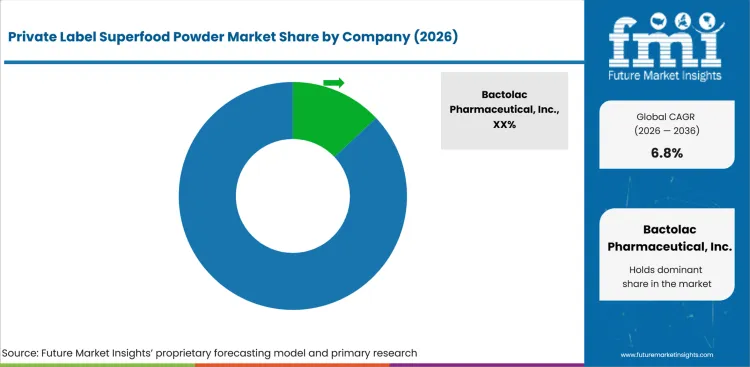
- Large contract manufacturers hold an advantage when they can combine powder blending, flavor systems, testing, and retail packaging.
- Retail buyers compare suppliers by minimum order quantity, allergen control, batch release timing, and formulation support.
- Regional suppliers can win smaller programs when they offer faster communication and country-specific label support.
- Brand owners lose time when formulation, testing, and packaging are handled by separate vendors with weak handoff records.
Competition is also shaped by spirulina powder and algae-based inputs because private labels use these ingredients to build color and nutrition cues. Suppliers with cleaner taste masking can move these blends into broader retail programs. Bactolac Pharmaceutical, Inc. competes through private-label supplement manufacturing and powder capabilities. Vitaquest International LLC competes through high-volume powder production and formulation support. Makers Nutrition LLC, SMP Nutra, NutraScience Labs, Supplement Factory Ltd., and BfEsse SIA compete by combining private-label support with smaller buyer entry routes.
The supplier base is estimated to have the ten largest private-label powder providers below 35% combined share in 2026. That concentration level leaves room for regional suppliers, but larger retailers still prefer providers that can pass quality audits and support multiple pack formats. Companies best placed through 2036 are expected to combine testing discipline, flavor work, certification support, and enough capacity for retailer-owned blends.
Competitive Benchmarking: Private Label Superfood Powder Market
| Company | Powder Capability | Private-label Fit | Market Positioning |
|---|---|---|---|
| Bactolac Pharmaceutical, Inc. | Custom powders and supplement manufacturing | Retailer and brand-owner programs | Strong fit for United States private-label buyers |
| Vitaquest International LLC | Large powder output and formulation services | High-volume programs | Strong fit for national wellness brands |
| Makers Nutrition LLC | Superfood powder and supplement program support | Turnkey private-label entry | Strong fit for smaller brand launches |
| SMP Nutra | Powder filling and private-label supplement support | DTC and retail programs | Strong fit for fast concept testing |
| Supplement Factory Ltd. | United Kingdom powder manufacturing | Regional private-label supply | Strong fit for UK and EU-adjacent launches |
| BfEsse SIA | European food supplement private-label supply | EU program support | Strong fit for label-controlled launches |
Source: Future Market Insights competitive analysis, 2026.
Key Developments in Private Label Superfood Powder Market
- In February 2026, Vitaquest International LLC announced expansion of probiotics manufacturing with a new suite. The move is relevant because gut health and greens powder programs often overlap in private-label wellness planning.
- In June 2025, Vitaquest International LLC published guidance on powdered supplement manufacturing. The guidance covered formulation and production steps, which supports private-label buyers reviewing powder workflow before supplier selection.
Key Companies in the Private Label Superfood Powder Market
- Bactolac Pharmaceutical, Inc.
- Vitaquest International LLC
- Makers Nutrition LLC
- SMP Nutra
- NutraScience Labs
- Supplement Factory Ltd.
- BfEsse SIA
- Bee Health Limited
- Healthspan Limited
- Holland & Barrett Retail Limited
- DM-drogerie markt GmbH + Co. KG
- Amazonia Pty Ltd.
- Organika Health Products Inc.
Analysis of Private Label Superfood Powder Market by Key Countries
.webp "Top Country Growth Comparison Private Label Superfood Powder Market Cagr (2026 2036)")
| Country | CAGR |
|---|---|
| United States | 8.2% |
| Canada | 7.5% |
| Germany | 7.2% |
| United Kingdom | 7.6% |
| Saudi Arabia | 8.7% |
| Japan | 7.0% |
| Australia | 7.3% |
Source: Future Market Insights, 2026.
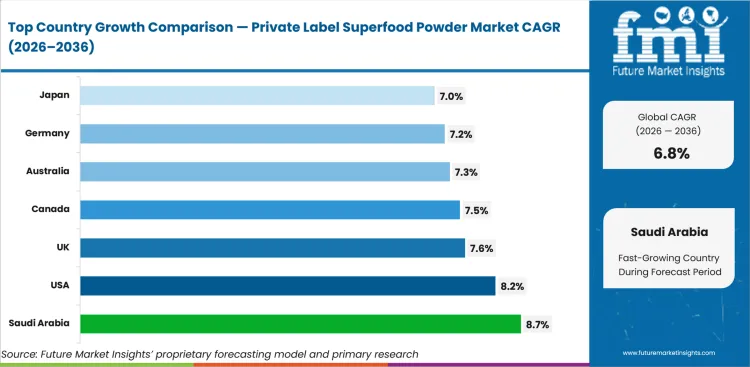
- United States is projected to record an 8.2% CAGR through 2036 as store brand scale and supplement use create a larger buyer base.
- Canada is expected to expand at 7.5% CAGR through 2036 as health supplement retail and natural health product channels support private-label testing.
- Germany is forecast to grow at 7.2% CAGR through 2036 as drugstores and organic retailers use private labels to widen wellness assortments.
- United Kingdom is expected to advance at 7.6% CAGR through 2036 as food supplement registration rules place more value on compliant suppliers.
- Saudi Arabia is projected to rise at 8.7% CAGR through 2036 as modern retail and food supplement registration support controlled SKU entry.
- Japan is forecast at 7.0% CAGR through 2036 as label discipline and pharmacy retail favor clearly positioned powder programs.
- Australia is expected to post 7.3% CAGR through 2036 as complementary medicine rules and health retail channels shape product screening.
Demand Outlook for Private Label Superfood Powder Market in United States
Retailer blend programs and powder compliance center - 2026 to 2036
Country Market Snapshot Table
| Parameter | Value |
|---|---|
| Market Size in 2025 (Value) | USD 332.7 million |
| Market Size in 2026 (Value) | USD 360.0 million |
| Market Forecast in 2036 (Value) | USD 791.7 million |
| CAGR (2026 to 2036) | 8.2% |
| Years Considered | 2021 to 2036 |
| Base Year | 2025 |
| Forecast Period | 2026 to 2036 |
| Units Considered | Value (USD million) |
| Leading Sub-Region | Pacific and South Atlantic retail corridors |
United States Private Label Superfood Powder Market Outlook
United States buyers start with shelf productivity and repeat purchase before they approve a new private-label powder. The country is projected to record an 8.2% CAGR through 2036, supported by store brand scale and a broad supplement user base. Retailers are expected to favor suppliers that can prove batch testing and deliver enough pack variety for club, grocery, and online programs.
Key Growth Drivers
- Store brand scale gives private-label powder suppliers a larger test channel. Private Label Manufacturers Association reported USD 282.8 billion in United States store brand sales in 2025.
- Supplement use keeps the addressable buyer base large. The Council for Responsible Nutrition reported that 75% of Americans used dietary supplements in 2024.
- Club retail favors larger pouches and tubs because buyers compare cost per serving before adding daily greens programs.
- Online private labels can test flavor systems faster because smaller campaigns can start before national shelf placement.
Key Restraints
- Heavy-metal and microbiological testing can raise release cost for blends that use leafy greens, algae, and root powders.
- Retailers may delay new SKUs when allergen separation records or country-of-origin details are incomplete.
- Flavor fatigue can reduce repeat purchase when greens blends depend on the same mint or berry profile across product lines.
What makes United States unique
The United States is unique due to store brand scale and national retail networks that can move a private-label powder from trial to large volume quickly.
Key Companies
- Bactolac Pharmaceutical, Inc.
- Vitaquest International LLC
- Makers Nutrition LLC
- SMP Nutra
- NutraScience Labs
- The Green Labs LLC
- Arizona Nutritional Supplements LLC
Sales & Marketing Channels
- Mass retail
- Club retail
- Online marketplaces
- Specialty health stores
- Pharmacy retail
- Foodservice distributors
Country Segment Breakdown Table
| Segment | Sub-Segments |
|---|---|
| By Program Type | Retailer-owned blends, Turnkey blends, White label kits, Foodservice blends, DTC private lines |
| By Ingredient Base | Green blends, Berry blends, Mushroom blends, Algae blends, Root adaptogens, Seed blends |
| By Certification | Certified organic, Non-GMO, Vegan, Gluten-free, Halal, Allergen-controlled |
| By Packaging Format | Resealable pouches, Canisters, Stick packs, Sachets, Bulk tubs, Cartons |
| By Sales Channel | Mass retail, Specialty health, Club retail, Online marketplaces, Pharmacy retail, Foodservice B2B |
| By End Use | Smoothie mixes, Daily greens, Protein blends, Bakery inclusion, Snack bars, Beverage bases |
| By Buyer Type | Retail chains, DTC brands, Food processors, Foodservice buyers, Wellness chains, Distributors |
| Key Sub-Regions Covered, Retail and Wellness Clusters | California, Texas, Florida, New York, Illinois, Pacific Northwest |
Frequently Asked Questions
How fast is the United States private label superfood powder market growing?
The United States market is projected to record 8.2% CAGR from 2026 to 2036, supported by store brand scale and supplement use.
Who leads United States private label superfood powder supply?
Bactolac, Vitaquest, Makers Nutrition, SMP Nutra, and NutraScience Labs compete through powder formulation and private-label manufacturing support.
What is driving United States private label superfood powder sales?
Retailer-owned wellness assortments, club packs, online test runs, and supplement user familiarity support higher private-label powder activity.
Opportunity Analysis for Private Label Superfood Powder Market in Canada
Natural health product retail and pharmacy-adjacent center - 2026 to 2036
Country Market Snapshot Table
| Parameter | Value |
|---|---|
| Market Size in 2025 (Value) | USD 79.1 million |
| Market Size in 2026 (Value) | USD 85.0 million |
| Market Forecast in 2036 (Value) | USD 175.2 million |
| CAGR (2026 to 2036) | 7.5% |
| Years Considered | 2021 to 2036 |
| Base Year | 2025 |
| Forecast Period | 2026 to 2036 |
| Units Considered | Value (USD million) |
| Leading Sub-Region | Ontario and British Columbia wellness retail corridors |
Canada Private Label Superfood Powder Market Outlook
Canadian buyers evaluate natural health positioning and pharmacy-adjacent trust before expanding powder assortments. Canada is expected to expand at 7.5% CAGR through 2036, supported by health supplement retail structure and private-label testing in wellness channels. Suppliers gain traction when label language, dosage form, and ingredient origin are easy to review.
Key Growth Drivers
- Health product retail gives private labels a trusted route for powder programs. Statistics Canada updated the 456191 food health supplement retailers class in October 2024.
- Consumer purchase patterns support pharmacy-adjacent placement. Health Canada’s 2024 survey found that 49% of consumers bought natural health products in pharmacies.
- Retailers can test bilingual labels and smaller packs before wider national distribution.
- Organic and vegan powder lines fit Canadian wellness shelves where shoppers compare certification before price.
Key Restraints
- Natural health product positioning can slow launch timing when the same powder sits between food and supplement expectations.
- Bilingual label work increases review time because claims, warnings, and serving directions need two-language consistency.
- Cold-weather shipping and long-distance logistics can raise cost for small regional powder programs.
What makes Canada unique
Canada is unique due to pharmacy trust, bilingual pack requirements, and a clear retail class for food health supplement sellers.
Key Companies
- Jamieson Wellness Inc.
- SISU Inc.
- Natural Factors Nutritional Products Ltd.
- Herbaland Naturals Inc.
- Genuine Health Inc.
- Organika Health Products Inc.
- CanPrev Natural Health Products Ltd.
Sales & Marketing Channels
- Pharmacy retail
- Natural health stores
- Online marketplaces
- Grocery chains
- Club stores
- Distributor networks
Country Segment Breakdown Table
| Segment | Sub-Segments |
|---|---|
| By Program Type | Retailer-owned blends, Turnkey blends, White label kits, Foodservice blends, DTC private lines |
| By Ingredient Base | Green blends, Berry blends, Mushroom blends, Algae blends, Root adaptogens, Seed blends |
| By Certification | Certified organic, Non-GMO, Vegan, Gluten-free, Halal, Allergen-controlled |
| By Packaging Format | Resealable pouches, Canisters, Stick packs, Sachets, Bulk tubs, Cartons |
| By Sales Channel | Mass retail, Specialty health, Club retail, Online marketplaces, Pharmacy retail, Foodservice B2B |
| By End Use | Smoothie mixes, Daily greens, Protein blends, Bakery inclusion, Snack bars, Beverage bases |
| By Buyer Type | Retail chains, DTC brands, Food processors, Foodservice buyers, Wellness chains, Distributors |
| Key Sub-Regions Covered, Retail and Wellness Clusters | Ontario, British Columbia, Quebec, Alberta, Manitoba, Nova Scotia |
Frequently Asked Questions
How fast is Canada private label superfood powder market growing?
Canada is expected to expand at 7.5% CAGR from 2026 to 2036, supported by natural health retail and pharmacy-adjacent channels.
Who leads Canada private label superfood powder activity?
Jamieson, Natural Factors, Organika, Genuine Health, and Canadian private-label manufacturers support the local wellness powder supply base.
What is driving adoption in Canada private label superfood powders?
Retailers use private labels to offer certified greens and protein-adjacent powder lines with bilingual labels and trusted placement.
Sales Outlook for Private Label Superfood Powder Market in Germany
Drugstore private labels and certification center - 2026 to 2036
| Parameter | Value |
|---|---|
| Market Size in 2025 (Value) | USD 97.9 million |
| Market Size in 2026 (Value) | USD 105.0 million |
| Market Forecast in 2036 (Value) | USD 210.4 million |
| CAGR (2026 to 2036) | 7.2% |
| Years Considered | 2021 to 2036 |
| Base Year | 2025 |
| Forecast Period | 2026 to 2036 |
| Units Considered | Value (USD million) |
| Leading Sub-Region | North Rhine-Westphalia and Bavaria health retail areas |
Germany Private Label Superfood Powder Market Outlook
Germany’s route to scale is shaped by drugstores, organic retail, and price-disciplined shoppers. The country is forecast to grow at 7.2% CAGR through 2036, led by retailer-owned wellness lines that can balance organic positioning with accessible pricing. Suppliers that meet German-language label and certification expectations are better placed for repeat listings.
Key Growth Drivers
- Drugstore private labels create repeat shelf space for greens, berry, and fiber powders that fit daily wellness use.
- Organic certification supports price separation because German buyers often compare certification before flavor variety.
- Retailers use pouch formats to reduce shelf weight and improve online fulfillment for powder products.
- Food supplement rules make documentation valuable when powders include botanical or caffeine-containing ingredients.
Key Restraints
- Price comparison is strict because drugstore shoppers can compare private labels with national wellness brands in the same aisle.
- German-language label review can slow imports when formula claims are written for United States or United Kingdom shelves first.
- Ingredient origin questions can create buyer friction when mushroom, algae, or root powders lack transparent sourcing records.
What makes Germany unique
Germany is unique due to drugstore private-label discipline and buyer focus on certification before broader wellness claims.
Key Companies
- nu3 GmbH
- KoRo Handels GmbH
- DM-drogerie markt GmbH + Co. KG
- Rossmann GmbH
- MyProtein Germany
- Raab Vitalfood GmbH
- Govinda Natur GmbH
Sales & Marketing Channels
- Drugstores
- Organic retail
- Online wellness stores
- Grocery chains
- Pharmacy-adjacent stores
- Fitness retail
Country Segment Breakdown Table
| Segment | Sub-Segments |
|---|---|
| By Program Type | Retailer-owned blends, Turnkey blends, White label kits, Foodservice blends, DTC private lines |
| By Ingredient Base | Green blends, Berry blends, Mushroom blends, Algae blends, Root adaptogens, Seed blends |
| By Certification | Certified organic, Non-GMO, Vegan, Gluten-free, Halal, Allergen-controlled |
| By Packaging Format | Resealable pouches, Canisters, Stick packs, Sachets, Bulk tubs, Cartons |
| By Sales Channel | Mass retail, Specialty health, Club retail, Online marketplaces, Pharmacy retail, Foodservice B2B |
| By End Use | Smoothie mixes, Daily greens, Protein blends, Bakery inclusion, Snack bars, Beverage bases |
| By Buyer Type | Retail chains, DTC brands, Food processors, Foodservice buyers, Wellness chains, Distributors |
| Key Sub-Regions Covered, Retail and Wellness Clusters | North Rhine-Westphalia, Bavaria, Baden-Württemberg, Berlin, Hamburg, Hesse |
Frequently Asked Questions
How fast is Germany private label superfood powder market growing?
Germany is forecast to grow at 7.2% CAGR from 2026 to 2036, led by drugstore private labels and organic wellness shelves.
Who leads Germany private label superfood powder retail?
DM, Rossmann, KoRo, nu3, and Raab Vitalfood influence German private-label and wellness powder placement.
What is driving Germany private label superfood powder sales?
Drugstore access, certified organic positioning, and price-disciplined wellness shoppers support private-label greens and berry powder programs.
Growth Outlook for Private Label Superfood Powder Market in United Kingdom
Food supplement duty and online wellness center - 2026 to 2036
| Parameter | Value |
|---|---|
| Market Size in 2025 (Value) | USD 69.7 million |
| Market Size in 2026 (Value) | USD 75.0 million |
| Market Forecast in 2036 (Value) | USD 156.0 million |
| CAGR (2026 to 2036) | 7.6% |
| Years Considered | 2021 to 2036 |
| Base Year | 2025 |
| Forecast Period | 2026 to 2036 |
| Units Considered | Value (USD million) |
| Leading Sub-Region | London, Southeast England and national grocery networks |
United Kingdom Private Label Superfood Powder Market Outlook
United Kingdom buyers compare safety responsibility before they compare flavor variety. The country is expected to advance at 7.6% CAGR through 2036, supported by clearer food supplement business duties and online wellness retail. Suppliers need practical pack claims and full ingredient documentation to avoid slowing launches.
Key Growth Drivers
- Food supplement registration duties push buyers toward suppliers with more complete label files. The United Kingdom Food Standards Agency clarified food business operator duties for supplement sellers in September 2024.
- Online wellness retail supports lower-risk testing of greens, mushroom, and berry blends before grocery expansion.
- Private-label sports nutrition experience gives retailers a base for superfood-protein powder programs.
- Retail buyers can use smaller pouches to test flavor and price before expanding into canisters.
Key Restraints
- Botanical and caffeine claims need careful review because food supplement guidance can affect pack language.
- Retailers may remove formulas that rely on unclear function claims or weak warning placement.
- Imported blends can face launch delays when supplier documents do not match United Kingdom label expectations.
What makes United Kingdom unique
The United Kingdom is unique due to food supplement registration duties and retailer experience with private-label sports nutrition.
Key Companies
- Supplement Factory Ltd.
- Myprotein
- Holland & Barrett Retail Limited
- Vitabiotics Ltd.
- Bulk Powders
- Nutravita Ltd.
- Vita Manufacture Ltd.
Sales & Marketing Channels
- Online wellness stores
- Pharmacy retail
- Grocery chains
- Specialty health stores
- Fitness retail
- Amazon UK
Country Segment Breakdown Table
| Segment | Sub-Segments |
|---|---|
| By Program Type | Retailer-owned blends, Turnkey blends, White label kits, Foodservice blends, DTC private lines |
| By Ingredient Base | Green blends, Berry blends, Mushroom blends, Algae blends, Root adaptogens, Seed blends |
| By Certification | Certified organic, Non-GMO, Vegan, Gluten-free, Halal, Allergen-controlled |
| By Packaging Format | Resealable pouches, Canisters, Stick packs, Sachets, Bulk tubs, Cartons |
| By Sales Channel | Mass retail, Specialty health, Club retail, Online marketplaces, Pharmacy retail, Foodservice B2B |
| By End Use | Smoothie mixes, Daily greens, Protein blends, Bakery inclusion, Snack bars, Beverage bases |
| By Buyer Type | Retail chains, DTC brands, Food processors, Foodservice buyers, Wellness chains, Distributors |
| Key Sub-Regions Covered, Retail and Wellness Clusters | London, Southeast England, Manchester, Birmingham, Scotland Central Belt, Wales |
Frequently Asked Questions
How fast is United Kingdom private label superfood powder market growing?
The United Kingdom is expected to advance at 7.6% CAGR from 2026 to 2036, supported by online wellness retail and supplier documentation.
Who supplies private label superfood powders in the United Kingdom?
Supplement Factory, Vita Manufacture, and contract powder manufacturers support private-label powder programs for wellness brands and retailers.
What is driving United Kingdom private label powder programs?
Food supplement duties, online testing, and private-label sports nutrition experience support wider greens and mushroom powder programs.
Retail Outlook for Private Label Superfood Powder Market in Saudi Arabia
Food supplement registration and halal private-label center - 2026 to 2036
| Parameter | Value |
|---|---|
| Market Size in 2025 (Value) | USD 36.8 million |
| Market Size in 2026 (Value) | USD 40.0 million |
| Market Forecast in 2036 (Value) | USD 92.1 million |
| CAGR (2026 to 2036) | 8.7% |
| Years Considered | 2021 to 2036 |
| Base Year | 2025 |
| Forecast Period | 2026 to 2036 |
| Units Considered | Value (USD million) |
| Leading Sub-Region | Riyadh, Jeddah and Dammam modern retail corridors |
Saudi Arabia Private Label Superfood Powder Market Outlook
Saudi Arabia is moving through modern retail, pharmacy chains, and imported wellness assortments. The country is projected to rise at 8.7% CAGR through 2036, attributable to food supplement pre-registration checks and higher interest in certified private-label formats. Halal status and solubility evidence shape supplier selection more than broad wellness language.
Key Growth Drivers
- Food supplement pre-registration gives importers a clearer route for compliant powder launches. Saudi Food and Drug Authority guidance from July 2024 requires product documentation, labeling review, and safety analysis for food supplement evaluation.
- Halal positioning supports private-label programs when retailers need assurance for algae, mushroom, and botanical blends.
- Modern pharmacy chains can scale imported wellness powders when Arabic labels and serving instructions are complete.
- Online retail can support test runs for daily greens and beauty-from-within powder blends before wider store placement.
Key Restraints
- Registration work can slow entry for small brands that lack solubility studies and full safety files.
- Imported ingredient dependence can raise landed cost when berry, mushroom, and algae powders move through long supply routes.
- Claims must stay controlled because broad immunity or energy language can create label review risk.
What makes Saudi Arabia unique
Saudi Arabia is unique due to food supplement pre-registration and modern pharmacy chains that can scale compliant imported powders.
Key Companies
- Nahdi Medical Company
- Al-Dawaa Medical Services Company
- Jamjoom Pharma
- Tamer Group
- iHerb Saudi Arabia
- Panda Retail Company
- BinDawood Holding
Sales & Marketing Channels
- Pharmacy chains
- E-commerce stores
- Modern grocery
- Specialty health retail
- Fitness centers
- Distributor-led import channels
Country Segment Breakdown Table
| Segment | Sub-Segments |
|---|---|
| By Program Type | Retailer-owned blends, Turnkey blends, White label kits, Foodservice blends, DTC private lines |
| By Ingredient Base | Green blends, Berry blends, Mushroom blends, Algae blends, Root adaptogens, Seed blends |
| By Certification | Certified organic, Non-GMO, Vegan, Gluten-free, Halal, Allergen-controlled |
| By Packaging Format | Resealable pouches, Canisters, Stick packs, Sachets, Bulk tubs, Cartons |
| By Sales Channel | Mass retail, Specialty health, Club retail, Online marketplaces, Pharmacy retail, Foodservice B2B |
| By End Use | Smoothie mixes, Daily greens, Protein blends, Bakery inclusion, Snack bars, Beverage bases |
| By Buyer Type | Retail chains, DTC brands, Food processors, Foodservice buyers, Wellness chains, Distributors |
| Key Sub-Regions Covered, Retail and Wellness Clusters | Riyadh, Jeddah, Dammam, Makkah, Madinah, Al Khobar |
Frequently Asked Questions
How fast is Saudi Arabia private label superfood powder market growing?
Saudi Arabia is projected to rise at 8.7% CAGR from 2026 to 2036, led by modern retail and supplement registration checks.
Who leads Saudi Arabia private label superfood powder channels?
Nahdi, Al-Dawaa, Tamer Group, and modern grocery retailers shape private-label powder access through pharmacy and distributor networks.
What is driving Saudi Arabia private-label powder activity?
Halal review, Arabic labeling and pharmacy retail scale support controlled powder program entry.
Demand Outlook for Private Label Superfood Powder Market in Japan
Label clarity and pharmacy channel center - 2026 to 2036
| Parameter | Value |
|---|---|
| Market Size in 2025 (Value) | USD 84.1 million |
| Market Size in 2026 (Value) | USD 90.0 million |
| Market Forecast in 2036 (Value) | USD 177.0 million |
| CAGR (2026 to 2036) | 7.0% |
| Years Considered | 2021 to 2036 |
| Base Year | 2025 |
| Forecast Period | 2026 to 2036 |
| Units Considered | Value (USD million) |
| Leading Sub-Region | Tokyo, Kansai and pharmacy retail corridors |
Japan Private Label Superfood Powder Market Outlook
Japan’s powder programs work best when the use case is precise and the label is easy to understand. The country is forecast at 7.0% CAGR through 2036, supported by pharmacy retail and convenience-led pack planning. Suppliers need to keep claims conservative while using taste, serving size, and Japanese-language label discipline to gain retailer trust.
Key Growth Drivers
- Japanese food labeling needs precise local-language communication. The Consumer Affairs Agency food labeling page confirms that food labeling for sale in Japan must be in Japanese.
- Pharmacy and convenience retail favor single-serve and small pouch concepts because buyers look for clear daily-use instructions.
- Mushroom and algae blends can fit local ingredient familiarity when claims remain conservative.
- Retailers value taste discipline because grassy notes can reduce repeat use in daily greens formulas.
Key Restraints
- Label translation can slow imports when ingredient names, cautions, and serving directions are not prepared for Japan first.
- Buyers can be cautious with high-caffeine or strong botanical blends that need more careful position review.
- Small home storage space can limit large tub formats and push suppliers toward higher-cost pouches or stick packs.
What makes Japan unique
Japan is unique due to strict label discipline and buyer preference for clear daily-use powder instructions.
Key Companies
- Asahi Group Foods, Ltd.
- Otsuka Pharmaceutical Co., Ltd.
- Fancl Corporation
- DHC Corporation
- Yakult Honsha Co., Ltd.
- Suntory Wellness Limited
- AFC-HD AMS Life Science Co., Ltd.
Sales & Marketing Channels
- Pharmacy retail
- Convenience stores
- Online wellness stores
- Department stores
- Grocery chains
- Fitness retail
Country Segment Breakdown Table
| Segment | Sub-Segments |
|---|---|
| By Program Type | Retailer-owned blends, Turnkey blends, White label kits, Foodservice blends, DTC private lines |
| By Ingredient Base | Green blends, Berry blends, Mushroom blends, Algae blends, Root adaptogens, Seed blends |
| By Certification | Certified organic, Non-GMO, Vegan, Gluten-free, Halal, Allergen-controlled |
| By Packaging Format | Resealable pouches, Canisters, Stick packs, Sachets, Bulk tubs, Cartons |
| By Sales Channel | Mass retail, Specialty health, Club retail, Online marketplaces, Pharmacy retail, Foodservice B2B |
| By End Use | Smoothie mixes, Daily greens, Protein blends, Bakery inclusion, Snack bars, Beverage bases |
| By Buyer Type | Retail chains, DTC brands, Food processors, Foodservice buyers, Wellness chains, Distributors |
| Key Sub-Regions Covered, Retail and Wellness Clusters | Tokyo, Osaka, Kanagawa, Aichi, Fukuoka, Hokkaido |
Frequently Asked Questions
How fast is Japan private label superfood powder market growing?
Japan is forecast at 7.0% CAGR from 2026 to 2036, supported by pharmacy retail and label-controlled wellness programs.
Who leads Japan superfood powder retail activity?
Asahi Group Foods, Fancl, DHC, Suntory Wellness, and Otsuka shape wellness powder expectations through local channel reach.
What is driving Japan private label superfood powder use?
Small packs, clear daily-use directions, and conservative label language support private-label powder testing in Japan.
Opportunity Analysis for Private Label Superfood Powder Market in Australia
Complementary product screening and health retail center - 2026 to 2036
| Parameter | Value |
|---|---|
| Market Size in 2025 (Value) | USD 55.9 million |
| Market Size in 2026 (Value) | USD 60.0 million |
| Market Forecast in 2036 (Value) | USD 121.4 million |
| CAGR (2026 to 2036) | 7.3% |
| Years Considered | 2021 to 2036 |
| Base Year | 2025 |
| Forecast Period | 2026 to 2036 |
| Units Considered | Value (USD million) |
| Leading Sub-Region | New South Wales, Victoria and Queensland retail areas |
Australia Private Label Superfood Powder Market Outlook
Australia treats many wellness products through a more formal product-screening culture than standard grocery powders. The country is expected to post 7.3% CAGR through 2036, supported by health retail access and complementary medicine awareness. Suppliers gain an advantage when they separate food-style greens from products that need therapeutic review.
Key Growth Drivers
- Regulated wellness culture shapes buyer expectations. The Therapeutic Goods Administration stated in May 2025 that listed complementary medicines must show an AUST L number when legally sold as medicines in Australia.
- Health stores and supermarkets support private-label powders that stay in food format and avoid therapeutic claims.
- Sports nutrition familiarity supports superfood-protein blends in pouches and tubs.
- Online health retailers can test berry, greens, and collagen-adjacent powder concepts before wider grocery shelf placement.
Key Restraints
- Therapeutic claim risk can slow launches when a powder crosses from food-style positioning into medicine-style benefit language.
- Import reliance for berries and algae can raise cost when suppliers need small-batch testing.
- Retail buyers may reject products that lack clear allergen, origin, and serving information for Australian shoppers.
What makes Australia unique
Australia is unique due to formal complementary medicine awareness and clear separation between food powders and therapeutic claims.
Key Companies
- Blackmores Limited
- Swisse Wellness Pty Ltd.
- Vitaco Health Australia Pty Ltd.
- Morlife Pty Ltd.
- Amazonia Pty Ltd.
- The Healthy Chef
- Bulk Nutrients Pty Ltd.
Sales & Marketing Channels
- Health food stores
- Pharmacy retail
- Supermarkets
- Online wellness stores
- Fitness retail
- Specialty grocers
Country Segment Breakdown Table
| Segment | Sub-Segments |
|---|---|
| By Program Type | Retailer-owned blends, Turnkey blends, White label kits, Foodservice blends, DTC private lines |
| By Ingredient Base | Green blends, Berry blends, Mushroom blends, Algae blends, Root adaptogens, Seed blends |
| By Certification | Certified organic, Non-GMO, Vegan, Gluten-free, Halal, Allergen-controlled |
| By Packaging Format | Resealable pouches, Canisters, Stick packs, Sachets, Bulk tubs, Cartons |
| By Sales Channel | Mass retail, Specialty health, Club retail, Online marketplaces, Pharmacy retail, Foodservice B2B |
| By End Use | Smoothie mixes, Daily greens, Protein blends, Bakery inclusion, Snack bars, Beverage bases |
| By Buyer Type | Retail chains, DTC brands, Food processors, Foodservice buyers, Wellness chains, Distributors |
| Key Sub-Regions Covered, Retail and Wellness Clusters | New South Wales, Victoria, Queensland, Western Australia, South Australia, Australian Capital Territory |
Frequently Asked Questions
How fast is Australia private label superfood powder market growing?
Australia is expected to post 7.3% CAGR from 2026 to 2036, supported by health retail and complementary product awareness.
Who leads Australia superfood powder activity?
Swisse, Blackmores, Vitaco, Morlife, Amazonia, and Bulk Nutrients influence buyer expectations for wellness powder formats.
What drives Australia private label superfood powder programs?
Health retail access, sports nutrition familiarity, and careful separation between food claims and medicine claims support private-label testing.
Private Label Superfood Powder Market - Report Scope
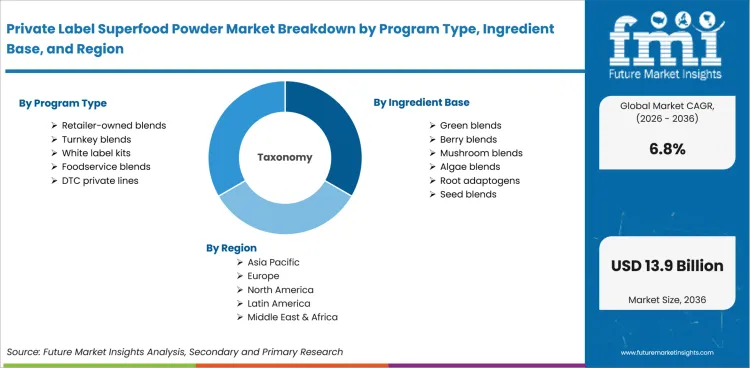
| Parameter | Details |
|---|---|
| Market size by 2036 | USD 13.9 billion |
| Growth rate | 6.8% CAGR from 2026 to 2036 |
| Forecast period | 2026 to 2036 |
| Base year value (2025) | USD 6.8 billion |
| 2026 market size | USD 7.3 billion |
| Historical years reviewed | 2021 to 2025 |
| Units | Value in USD billion and USD million |
| Product scope | B2B and retailer superfood powder programs |
| Geography | United States, Canada, Germany, United Kingdom, Saudi Arabia, Japan, Australia and Rest of World |
| By program type | Retailer-owned blends, turnkey blends, white label kits, foodservice blends, DTC private lines |
| By ingredient base | Green blends, berry blends, mushroom blends, algae blends, root adaptogens, seed blends |
| By certification | Certified organic, non-GMO, vegan, gluten-free, halal, allergen-controlled |
| By packaging format | Resealable pouches, canisters, stick packs, sachets, bulk tubs, cartons |
| By sales channel | Mass retail, specialty health, club retail, online marketplaces, pharmacy retail, foodservice B2B |
| By end use | Smoothie mixes, daily greens, protein blends, bakery inclusion, snack bars, beverage bases |
| By buyer type | Retail chains, DTC brands, food processors, foodservice buyers, wellness chains, distributors |
| Regions covered | North America, Latin America, Europe, East Asia, South Asia and Pacific, Middle East and Africa |
| Countries covered | United States, Canada, United Kingdom, Germany, Japan, Saudi Arabia, Australia |
| Key companies profiled | Bactolac Pharmaceutical, Vitaquest International, Makers Nutrition, SMP Nutra, NutraScience Labs, Supplement Factory, BfEsse SIA, Bee Health, Holland & Barrett |
| Approach | Bottom-up product-boundary approach using eligible SKU revenue, formulation support, channel presence, private-label positioning, ingredient mix, certification requirements, packaging formats, supplier capabilities, and country-level adoption patterns |
Source: Future Market Insights, 2026.
Private Label Superfood Powder Market Breakdown by Program Type, Ingredient Base, Certification, Packaging Format, Sales Channel, End Use, Buyer Type, and Region
Private Label Superfood Powder Market Segmented by Program Type
- Retailer-owned blends
- Turnkey blends
- White label kits
- Foodservice blends
- DTC private lines
Private Label Superfood Powder Market Segmented by Ingredient Base
- Green blends
- Berry blends
- Mushroom blends
- Algae blends
- Root adaptogens
- Seed blends
Private Label Superfood Powder Market Segmented by Certification
- Certified organic
- Non-GMO
- Vegan
- Gluten-free
- Halal
- Allergen-controlled
Private Label Superfood Powder Market Segmented by Packaging Format
- Resealable pouches
- Canisters
- Stick packs
- Sachets
- Bulk tubs
- Cartons
Private Label Superfood Powder Market Segmented by Sales Channel
- Mass retail
- Specialty health
- Club retail
- Online marketplaces
- Pharmacy retail
- Foodservice B2B
Private Label Superfood Powder Market Segmented by End Use
- Smoothie mixes
- Daily greens
- Protein blends
- Bakery inclusion
- Snack bars
- Beverage bases
Private Label Superfood Powder Market Segmented by Buyer Type
- Retail chains
- DTC brands
- Food processors
- Foodservice buyers
- Wellness chains
- Distributors
Private Label Superfood Powder Market by Region
- North America
- Latin America
- Europe
- East Asia
- South Asia and Pacific
- Middle East and Africa
This Report Answers
- What is the size of the private label superfood powder market in 2026 and 2036?
- Which private-label program types account for the highest share?
- Which ingredient bases are most important for retailer-owned powder programs?
- How do certification and packaging choices affect supplier selection?
- Which countries give suppliers the best route for private-label powder expansion?
- Which companies are active in private-label superfood powder manufacturing?
- What restraints can delay launch timing for greens, berry, mushroom, and algae blends?
Research Sources and Bibliography
- Australian Bureau of Statistics. (2025, March 28). Apparent consumption of selected foodstuffs, Australia, 2023-24.
- Bactolac Pharmaceutical, Inc. (2025, November 3). How to choose the right green powder manufacturer for your supplement brand.
- Bactolac Pharmaceutical, Inc. (2025, November 10). Contract manufacturing or private labeling? What’s best for your brand.
- Consumer Affairs Agency of Japan. (2026). Toward a safe, secure, and prosperous society.
- Council for Responsible Nutrition. (2024, October 29). CRN survey shows consistent supplement usage with increase of specialty product use over time.
- Food Standards Agency. (2024, September 25). Guidance for food business operators on food supplements containing caffeine.
- Food Standards Agency. (2026, January 20). New year, new guidance: FSA helps consumers navigate food supplements safely.
- Vitaquest International LLC. (2025, June 23). How powder supplement manufacturing works.
- Health Canada. (2024). Canadians’ views and use of natural health products, non-prescription drugs and health products containing cannabis.
- Makers Nutrition LLC. (2024, September 9). Manufacturing superfood supplements: A guide to health and quality with Makers Nutrition.
- Private Label Manufacturers Association. (2026, January 20). USA private label industry reached $282.8 billion in sales in 2025.
- Saudi Food and Drug Authority. (2024, July). Pre-registration evaluation of food products.
- Statistics Canada. (2024, October 23). 456191 - Food health supplement retailers.
- United States Department of Agriculture, Foreign Agricultural Service. (2026, April 6). Health functional food and supplements - Market brief for the Republic of Korea.
- United States Food and Drug Administration. (2024, April 24). Current good manufacturing practices for food and dietary supplements.
- Vitaquest International LLC. (2026, February 2). Vitaquest expands probiotics supplement manufacturing with new probiotics suite.
This bibliography is provided for reader reference and is not exhaustive. The full report contains the complete reference list and detailed citations.
Frequently Asked Questions
How big is the private label superfood powder market in 2026?
The market is estimated at USD 7.3 billion in 2026. It is projected to reach USD 13.9 billion by 2036 at 6.8% CAGR.
Which private label superfood powder segment leads in 2026?
Retailer-owned blends lead by program type with 42.8% share in 2026. Green blends lead by ingredient base with 34.6% share in 2026.
Which countries use private label superfood powders most?
The United States, Germany, Canada, the United Kingdom, Japan, Australia, and Saudi Arabia are important country markets because they combine wellness retail access with private-label program activity.
Which format is best for private label greens powder?
Resealable pouches work best for most private-label greens powders because they reduce pack weight, protect powder after opening, and support online shipping.
What is the difference between turnkey blends and retailer-owned blends?
Turnkey blends use ready concepts that a buyer can brand quickly. Retailer-owned blends are more customized and give the retailer more control over formula, label, and pack design.
Preview the report firsthand - request a free sample
Get SampleGet the brochure for pricing and purchase details.
Get PDFTable of Content
- Executive Summary
- Global Market Outlook
- Demand to side Trends
- Supply to side Trends
- Technology Roadmap Analysis
- Analysis and Recommendations
- Market Overview
- Market Coverage / Taxonomy
- Market Definition / Scope / Limitations
- Research Methodology
- Chapter Orientation
- Analytical Lens and Working Hypotheses
- Market Structure, Signals, and Trend Drivers
- Benchmarking and Cross-market Comparability
- Market Sizing, Forecasting, and Opportunity Mapping
- Research Design and Evidence Framework
- Desk Research Programme (Secondary Evidence)
- Company Annual and Sustainability Reports
- Peer-reviewed Journals and Academic Literature
- Corporate Websites, Product Literature, and Technical Notes
- Earnings Decks and Investor Briefings
- Statutory Filings and Regulatory Disclosures
- Technical White Papers and Standards Notes
- Trade Journals, Industry Magazines, and Analyst Briefs
- Conference Proceedings, Webinars, and Seminar Materials
- Government Statistics Portals and Public Data Releases
- Press Releases and Reputable Media Coverage
- Specialist Newsletters and Curated Briefings
- Sector Databases and Reference Repositories
- FMI Internal Proprietary Databases and Historical Market Datasets
- Subscription Datasets and Paid Sources
- Social Channels, Communities, and Digital Listening Inputs
- Additional Desk Sources
- Expert Input and Fieldwork (Primary Evidence)
- Primary Modes
- Qualitative Interviews and Expert Elicitation
- Quantitative Surveys and Structured Data Capture
- Blended Approach
- Why Primary Evidence is Used
- Field Techniques
- Interviews
- Surveys
- Focus Groups
- Observational and In-context Research
- Social and Community Interactions
- Stakeholder Universe Engaged
- C-suite Leaders
- Board Members
- Presidents and Vice Presidents
- R&D and Innovation Heads
- Technical Specialists
- Domain Subject-matter Experts
- Scientists
- Physicians and Other Healthcare Professionals
- Governance, Ethics, and Data Stewardship
- Research Ethics
- Data Integrity and Handling
- Primary Modes
- Tooling, Models, and Reference Databases
- Desk Research Programme (Secondary Evidence)
- Data Engineering and Model Build
- Data Acquisition and Ingestion
- Cleaning, Normalisation, and Verification
- Synthesis, Triangulation, and Analysis
- Quality Assurance and Audit Trail
- Market Background
- Market Dynamics
- Drivers
- Restraints
- Opportunity
- Trends
- Scenario Forecast
- Demand in Optimistic Scenario
- Demand in Likely Scenario
- Demand in Conservative Scenario
- Opportunity Map Analysis
- Product Life Cycle Analysis
- Supply Chain Analysis
- Investment Feasibility Matrix
- Value Chain Analysis
- PESTLE and Porter’s Analysis
- Regulatory Landscape
- Regional Parent Market Outlook
- Production and Consumption Statistics
- Import and Export Statistics
- Market Dynamics
- Global Market Analysis 2021 to 2025 and Forecast, 2026 to 2036
- Historical Market Size Value (USD Million) Analysis, 2021 to 2025
- Current and Future Market Size Value (USD Million) Projections, 2026 to 2036
- Y to o to Y Growth Trend Analysis
- Absolute $ Opportunity Analysis
- Global Market Pricing Analysis 2021 to 2025 and Forecast 2026 to 2036
- Global Market Analysis 2021 to 2025 and Forecast 2026 to 2036, By Program Type
- Introduction / Key Findings
- Historical Market Size Value (USD Million) Analysis By Program Type , 2021 to 2025
- Current and Future Market Size Value (USD Million) Analysis and Forecast By Program Type , 2026 to 2036
- Retailer-owned blends
- Turnkey blends
- White label kits
- Foodservice blends
- DTC private lines
- Retailer-owned blends
- Y to o to Y Growth Trend Analysis By Program Type , 2021 to 2025
- Absolute $ Opportunity Analysis By Program Type , 2026 to 2036
- Global Market Analysis 2021 to 2025 and Forecast 2026 to 2036, By Ingredient Base
- Introduction / Key Findings
- Historical Market Size Value (USD Million) Analysis By Ingredient Base, 2021 to 2025
- Current and Future Market Size Value (USD Million) Analysis and Forecast By Ingredient Base, 2026 to 2036
- Green blends
- Berry blends
- Mushroom blends
- Algae blends
- Root adaptogens
- Seed blends
- Green blends
- Y to o to Y Growth Trend Analysis By Ingredient Base, 2021 to 2025
- Absolute $ Opportunity Analysis By Ingredient Base, 2026 to 2036
- Global Market Analysis 2021 to 2025 and Forecast 2026 to 2036, By Certification
- Introduction / Key Findings
- Historical Market Size Value (USD Million) Analysis By Certification, 2021 to 2025
- Current and Future Market Size Value (USD Million) Analysis and Forecast By Certification, 2026 to 2036
- Certified organic
- Non-GMO
- Vegan
- Gluten-free
- Halal
- Allergen-controlled
- Certified organic
- Y to o to Y Growth Trend Analysis By Certification, 2021 to 2025
- Absolute $ Opportunity Analysis By Certification, 2026 to 2036
- Global Market Analysis 2021 to 2025 and Forecast 2026 to 2036, By Packaging Format
- Introduction / Key Findings
- Historical Market Size Value (USD Million) Analysis By Packaging Format, 2021 to 2025
- Current and Future Market Size Value (USD Million) Analysis and Forecast By Packaging Format, 2026 to 2036
- Resealable pouches
- Canisters
- Stick packs
- Sachets
- Bulk tubs
- Cartons
- Resealable pouches
- Y to o to Y Growth Trend Analysis By Packaging Format, 2021 to 2025
- Absolute $ Opportunity Analysis By Packaging Format, 2026 to 2036
- Global Market Analysis 2021 to 2025 and Forecast 2026 to 2036, By Sales Channel
- Introduction / Key Findings
- Historical Market Size Value (USD Million) Analysis By Sales Channel, 2021 to 2025
- Current and Future Market Size Value (USD Million) Analysis and Forecast By Sales Channel, 2026 to 2036
- Mass retail
- Specialty health
- Club retail
- Online marketplaces
- Pharmacy retail
- Foodservice B2B
- Mass retail
- Y to o to Y Growth Trend Analysis By Sales Channel, 2021 to 2025
- Absolute $ Opportunity Analysis By Sales Channel, 2026 to 2036
- Global Market Analysis 2021 to 2025 and Forecast 2026 to 2036, By End Use
- Introduction / Key Findings
- Historical Market Size Value (USD Million) Analysis By End Use, 2021 to 2025
- Current and Future Market Size Value (USD Million) Analysis and Forecast By End Use, 2026 to 2036
- Smoothie mixes
- Daily greens
- Protein blends
- Bakery inclusion
- Snack bars
- Beverage bases
- Smoothie mixes
- Y to o to Y Growth Trend Analysis By End Use, 2021 to 2025
- Absolute $ Opportunity Analysis By End Use, 2026 to 2036
- Global Market Analysis 2021 to 2025 and Forecast 2026 to 2036, By Buyer Type
- Introduction / Key Findings
- Historical Market Size Value (USD Million) Analysis By Buyer Type, 2021 to 2025
- Current and Future Market Size Value (USD Million) Analysis and Forecast By Buyer Type, 2026 to 2036
- Retail chains
- DTC brands
- Food processors
- Foodservice buyers
- Wellness chains
- Distributors
- Retail chains
- Y to o to Y Growth Trend Analysis By Buyer Type, 2021 to 2025
- Absolute $ Opportunity Analysis By Buyer Type, 2026 to 2036
- Global Market Analysis 2021 to 2025 and Forecast 2026 to 2036, By Region
- Introduction
- Historical Market Size Value (USD Million) Analysis By Region, 2021 to 2025
- Current Market Size Value (USD Million) Analysis and Forecast By Region, 2026 to 2036
- North America
- Latin America
- Western Europe
- Eastern Europe
- East Asia
- South Asia and Pacific
- Middle East & Africa
- Market Attractiveness Analysis By Region
- North America Market Analysis 2021 to 2025 and Forecast 2026 to 2036, By Country
- Historical Market Size Value (USD Million) Trend Analysis By Market Taxonomy, 2021 to 2025
- Market Size Value (USD Million) Forecast By Market Taxonomy, 2026 to 2036
- By Country
- USA
- Canada
- Mexico
- By Program Type
- By Ingredient Base
- By Certification
- By Packaging Format
- By Sales Channel
- By End Use
- By Buyer Type
- By Country
- Market Attractiveness Analysis
- By Country
- By Program Type
- By Ingredient Base
- By Certification
- By Packaging Format
- By Sales Channel
- By End Use
- By Buyer Type
- Key Takeaways
- Latin America Market Analysis 2021 to 2025 and Forecast 2026 to 2036, By Country
- Historical Market Size Value (USD Million) Trend Analysis By Market Taxonomy, 2021 to 2025
- Market Size Value (USD Million) Forecast By Market Taxonomy, 2026 to 2036
- By Country
- Brazil
- Chile
- Rest of Latin America
- By Program Type
- By Ingredient Base
- By Certification
- By Packaging Format
- By Sales Channel
- By End Use
- By Buyer Type
- By Country
- Market Attractiveness Analysis
- By Country
- By Program Type
- By Ingredient Base
- By Certification
- By Packaging Format
- By Sales Channel
- By End Use
- By Buyer Type
- Key Takeaways
- Western Europe Market Analysis 2021 to 2025 and Forecast 2026 to 2036, By Country
- Historical Market Size Value (USD Million) Trend Analysis By Market Taxonomy, 2021 to 2025
- Market Size Value (USD Million) Forecast By Market Taxonomy, 2026 to 2036
- By Country
- Germany
- UK
- Italy
- Spain
- France
- Nordic
- BENELUX
- Rest of Western Europe
- By Program Type
- By Ingredient Base
- By Certification
- By Packaging Format
- By Sales Channel
- By End Use
- By Buyer Type
- By Country
- Market Attractiveness Analysis
- By Country
- By Program Type
- By Ingredient Base
- By Certification
- By Packaging Format
- By Sales Channel
- By End Use
- By Buyer Type
- Key Takeaways
- Eastern Europe Market Analysis 2021 to 2025 and Forecast 2026 to 2036, By Country
- Historical Market Size Value (USD Million) Trend Analysis By Market Taxonomy, 2021 to 2025
- Market Size Value (USD Million) Forecast By Market Taxonomy, 2026 to 2036
- By Country
- Russia
- Poland
- Hungary
- Balkan & Baltic
- Rest of Eastern Europe
- By Program Type
- By Ingredient Base
- By Certification
- By Packaging Format
- By Sales Channel
- By End Use
- By Buyer Type
- By Country
- Market Attractiveness Analysis
- By Country
- By Program Type
- By Ingredient Base
- By Certification
- By Packaging Format
- By Sales Channel
- By End Use
- By Buyer Type
- Key Takeaways
- East Asia Market Analysis 2021 to 2025 and Forecast 2026 to 2036, By Country
- Historical Market Size Value (USD Million) Trend Analysis By Market Taxonomy, 2021 to 2025
- Market Size Value (USD Million) Forecast By Market Taxonomy, 2026 to 2036
- By Country
- China
- Japan
- South Korea
- By Program Type
- By Ingredient Base
- By Certification
- By Packaging Format
- By Sales Channel
- By End Use
- By Buyer Type
- By Country
- Market Attractiveness Analysis
- By Country
- By Program Type
- By Ingredient Base
- By Certification
- By Packaging Format
- By Sales Channel
- By End Use
- By Buyer Type
- Key Takeaways
- South Asia and Pacific Market Analysis 2021 to 2025 and Forecast 2026 to 2036, By Country
- Historical Market Size Value (USD Million) Trend Analysis By Market Taxonomy, 2021 to 2025
- Market Size Value (USD Million) Forecast By Market Taxonomy, 2026 to 2036
- By Country
- India
- ASEAN
- Australia & New Zealand
- Rest of South Asia and Pacific
- By Program Type
- By Ingredient Base
- By Certification
- By Packaging Format
- By Sales Channel
- By End Use
- By Buyer Type
- By Country
- Market Attractiveness Analysis
- By Country
- By Program Type
- By Ingredient Base
- By Certification
- By Packaging Format
- By Sales Channel
- By End Use
- By Buyer Type
- Key Takeaways
- Middle East & Africa Market Analysis 2021 to 2025 and Forecast 2026 to 2036, By Country
- Historical Market Size Value (USD Million) Trend Analysis By Market Taxonomy, 2021 to 2025
- Market Size Value (USD Million) Forecast By Market Taxonomy, 2026 to 2036
- By Country
- Kingdom of Saudi Arabia
- Other GCC Countries
- Turkiye
- South Africa
- Other African Union
- Rest of Middle East & Africa
- By Program Type
- By Ingredient Base
- By Certification
- By Packaging Format
- By Sales Channel
- By End Use
- By Buyer Type
- By Country
- Market Attractiveness Analysis
- By Country
- By Program Type
- By Ingredient Base
- By Certification
- By Packaging Format
- By Sales Channel
- By End Use
- By Buyer Type
- Key Takeaways
- Key Countries Market Analysis
- USA
- Pricing Analysis
- Market Share Analysis, 2025
- By Program Type
- By Ingredient Base
- By Certification
- By Packaging Format
- By Sales Channel
- By End Use
- By Buyer Type
- Canada
- Pricing Analysis
- Market Share Analysis, 2025
- By Program Type
- By Ingredient Base
- By Certification
- By Packaging Format
- By Sales Channel
- By End Use
- By Buyer Type
- Mexico
- Pricing Analysis
- Market Share Analysis, 2025
- By Program Type
- By Ingredient Base
- By Certification
- By Packaging Format
- By Sales Channel
- By End Use
- By Buyer Type
- Brazil
- Pricing Analysis
- Market Share Analysis, 2025
- By Program Type
- By Ingredient Base
- By Certification
- By Packaging Format
- By Sales Channel
- By End Use
- By Buyer Type
- Chile
- Pricing Analysis
- Market Share Analysis, 2025
- By Program Type
- By Ingredient Base
- By Certification
- By Packaging Format
- By Sales Channel
- By End Use
- By Buyer Type
- Germany
- Pricing Analysis
- Market Share Analysis, 2025
- By Program Type
- By Ingredient Base
- By Certification
- By Packaging Format
- By Sales Channel
- By End Use
- By Buyer Type
- UK
- Pricing Analysis
- Market Share Analysis, 2025
- By Program Type
- By Ingredient Base
- By Certification
- By Packaging Format
- By Sales Channel
- By End Use
- By Buyer Type
- Italy
- Pricing Analysis
- Market Share Analysis, 2025
- By Program Type
- By Ingredient Base
- By Certification
- By Packaging Format
- By Sales Channel
- By End Use
- By Buyer Type
- Spain
- Pricing Analysis
- Market Share Analysis, 2025
- By Program Type
- By Ingredient Base
- By Certification
- By Packaging Format
- By Sales Channel
- By End Use
- By Buyer Type
- France
- Pricing Analysis
- Market Share Analysis, 2025
- By Program Type
- By Ingredient Base
- By Certification
- By Packaging Format
- By Sales Channel
- By End Use
- By Buyer Type
- India
- Pricing Analysis
- Market Share Analysis, 2025
- By Program Type
- By Ingredient Base
- By Certification
- By Packaging Format
- By Sales Channel
- By End Use
- By Buyer Type
- ASEAN
- Pricing Analysis
- Market Share Analysis, 2025
- By Program Type
- By Ingredient Base
- By Certification
- By Packaging Format
- By Sales Channel
- By End Use
- By Buyer Type
- Australia & New Zealand
- Pricing Analysis
- Market Share Analysis, 2025
- By Program Type
- By Ingredient Base
- By Certification
- By Packaging Format
- By Sales Channel
- By End Use
- By Buyer Type
- China
- Pricing Analysis
- Market Share Analysis, 2025
- By Program Type
- By Ingredient Base
- By Certification
- By Packaging Format
- By Sales Channel
- By End Use
- By Buyer Type
- Japan
- Pricing Analysis
- Market Share Analysis, 2025
- By Program Type
- By Ingredient Base
- By Certification
- By Packaging Format
- By Sales Channel
- By End Use
- By Buyer Type
- South Korea
- Pricing Analysis
- Market Share Analysis, 2025
- By Program Type
- By Ingredient Base
- By Certification
- By Packaging Format
- By Sales Channel
- By End Use
- By Buyer Type
- Russia
- Pricing Analysis
- Market Share Analysis, 2025
- By Program Type
- By Ingredient Base
- By Certification
- By Packaging Format
- By Sales Channel
- By End Use
- By Buyer Type
- Poland
- Pricing Analysis
- Market Share Analysis, 2025
- By Program Type
- By Ingredient Base
- By Certification
- By Packaging Format
- By Sales Channel
- By End Use
- By Buyer Type
- Hungary
- Pricing Analysis
- Market Share Analysis, 2025
- By Program Type
- By Ingredient Base
- By Certification
- By Packaging Format
- By Sales Channel
- By End Use
- By Buyer Type
- Kingdom of Saudi Arabia
- Pricing Analysis
- Market Share Analysis, 2025
- By Program Type
- By Ingredient Base
- By Certification
- By Packaging Format
- By Sales Channel
- By End Use
- By Buyer Type
- Turkiye
- Pricing Analysis
- Market Share Analysis, 2025
- By Program Type
- By Ingredient Base
- By Certification
- By Packaging Format
- By Sales Channel
- By End Use
- By Buyer Type
- South Africa
- Pricing Analysis
- Market Share Analysis, 2025
- By Program Type
- By Ingredient Base
- By Certification
- By Packaging Format
- By Sales Channel
- By End Use
- By Buyer Type
- USA
- Market Structure Analysis
- Competition Dashboard
- Competition Benchmarking
- Market Share Analysis of Top Players
- By Regional
- By Program Type
- By Ingredient Base
- By Certification
- By Packaging Format
- By Sales Channel
- By End Use
- By Buyer Type
- Competition Analysis
- Competition Deep Dive
- Bactolac Pharmaceutical, Inc.
- Overview
- Product Portfolio
- Profitability by Market Segments (Product/Age /Sales Channel/Region)
- Sales Footprint
- Strategy Overview
- Marketing Strategy
- Product Strategy
- Channel Strategy
- Vitaquest International LLC
- Makers Nutrition LLC
- SMP Nutra
- NutraScience Labs
- Supplement Factory Ltd.
- BfEsse SIA
- Bee Health Limited
- Healthspan Limited
- Holland & Barrett Retail Limited
- DM-drogerie markt GmbH + Co. KG
- Amazonia Pty Ltd.
- Organika Health Products Inc.
- Bactolac Pharmaceutical, Inc.
- Competition Deep Dive
- Assumptions & Acronyms Used


