

- Industry Size (2026)
- USD 1.05 Bn
- Forecast (2036)
- USD 1.67 Bn
- CAGR (2026 to 2036)
- 4.8%
Custom Supplement Formulation Service Market Size, Market Forecast and Outlook By FMI
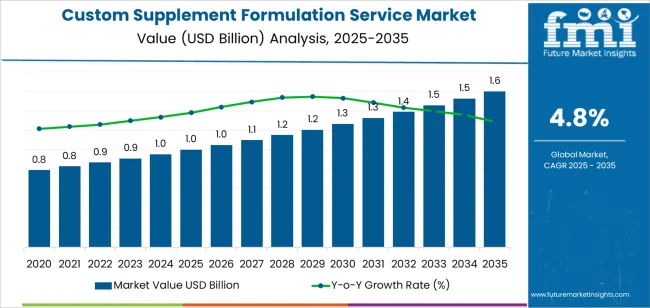
The Custom Supplement Formulation Service Market was valued at USD 1.00 billion in 2025, projected to reach USD 1.05 billion in 2026, and is forecast to expand to USD 1.67 billion by 2036 at a 4.8% CAGR. Rising demand for private-label and custom-formulated dietary supplements across global retail and direct-to-consumer channels is driving growth in the custom supplement formulation service market. Brand owners, e-commerce supplement startups, and healthcare practitioners are outsourcing product development and manufacturing to contract formulation specialists who provide turnkey services from ingredient sourcing through finished product packaging.
Summary of Custom Supplement Formulation Service Market
- Market Snapshot
- The market is valued at USD 1.00 billion in 2025 and is projected to reach USD 1.67 billion by 2036.
- The industry is expected to grow at a 4.8% CAGR from 2026 to 2036, creating an incremental opportunity of USD 0.63 billion.
- The market is a B2B contract manufacturing category where formulation flexibility, regulatory compliance capability, and turnkey brand-to-shelf service delivery define competitive positioning.
- Demand and Growth Drivers
- Low-barrier e-commerce supplement brand launches create sustained demand for contract formulation and manufacturing services.
- Consumer demand for personalized, condition-specific supplement products drives custom formulation complexity and service value.
- Healthcare practitioner demand for branded supplement lines generates prescription-grade formulation service requirements.
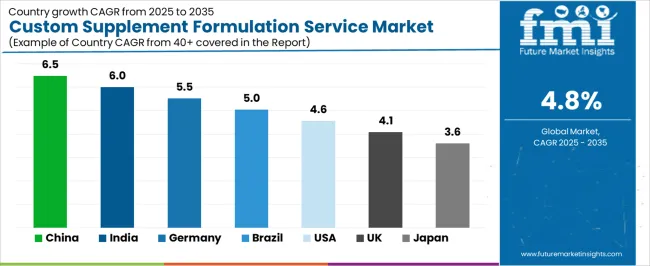
- Among key countries, China is at 6.5% CAGR, India is at 6% CAGR, Germany is at 5.5% CAGR, Brazil is at 5% CAGR, USA is at 4.6% CAGR, UK is at 4.1% CAGR, Japan is at 3.6% CAGR.
- Product and Segment View
- The market covers custom supplement formulation, contract manufacturing, private-label production, and turnkey brand development services for human and animal supplement products.
- Service formats span capsule supplements (38% share), tablet, powder, softgel, gummy, and liquid supplement production.
- Human Supplement Formulation Service leads the Product Type segment with 76% share in 2026.
- Capsule Supplements leads the Application segment with 38% share in 2026.
- Geography and Competitive Outlook
- China leads growth at 6.5% CAGR, while Japan tracks at 3.6%.
- China and India lead growth from contract manufacturing capacity expansion, while the USA and Germany anchor high-specification formulation demand.
- Competition is shaped by Natural Alternatives International, Supplement Factory, Uckele, Activ'Inside, Superior Supplement Manufacturing, Canyonside Lab, SDC Nutrition.
The custom supplement formulation service market is governed by FDA 21 CFR Part 111 (cGMP for dietary supplements) in the United States, EU Food Supplements Directive 2002/46/EC, and equivalent national regulations across major markets. Human supplement formulation services at 76% share dominate because the addressable brand owner population seeking contract manufacturing far exceeds the veterinary supplement segment. FMI is of the opinion that the structural growth catalyst is the convergence of low barriers to supplement brand entry via e-commerce, rising consumer demand for personalized and condition-specific supplement products, and the capital efficiency of outsourced formulation versus in-house manufacturing investment. Capsule supplements at 38% of formats reflect their versatility for custom dosage configurations.
All major countries reflect differentiated growth trajectories through 2036. China is projected at a 6.5% CAGR, India is projected at a 6% CAGR, Germany is projected at a 5.5% CAGR, Brazil is projected at a 5% CAGR, USA is projected at a 4.6% CAGR, UK is projected at a 4.1% CAGR, Japan is projected at a 3.6% CAGR. China leads at 6.5% CAGR, driven by its expanding domestic supplement market and established contract manufacturing infrastructure. Japan tracks at 3.6%, reflecting a mature contract formulation market where growth derives from premium and specialized formulation services.
Custom Supplement Formulation Service Market Key Takeaways
| Metric | Details |
|---|---|
| Industry Size (2026) | USD 1.05 billion |
| Industry Value (2036) | USD 1.67 billion |
| CAGR (2026 to 2036) | 4.8% |
Source: Future Market Insights, 2026
Custom Supplement Formulation Service Market Definition
The custom supplement formulation service market encompasses contract formulation, manufacturing, and packaging services provided to supplement brand owners, healthcare practitioners, and retailers seeking outsourced production of dietary supplement products. Services span ingredient sourcing, formula development, stability testing, regulatory compliance, and finished product manufacturing across capsule, tablet, powder, softgel, and liquid formats.
Custom Supplement Formulation Service Market Inclusions
Market scope includes human and animal supplement formulation services across all dosage formats. Coverage extends across contract manufacturing, private-label, and turnkey brand development services with global and country-level sizing for 2026 to 2036.
Custom Supplement Formulation Service Market Exclusions
The scope excludes pharmaceutical contract manufacturing (prescription drugs), food and beverage contract production, and raw ingredient distribution without formulation services.
Custom Supplement Formulation Service Market Research Methodology
- Primary Research: Analysts engaged with procurement directors, production managers, and supply chain leads across relevant companies to map purchasing specifications and volume trends.
- Desk Research: Data collection aggregated regulatory filings, trade association publications, statistical agency databases, and company annual reports to establish baseline parameters.
- Market-Sizing and Forecasting: Baseline values derive from a bottom-up aggregation of production volumes and trade flow data, applying region-specific consumption curves to project adoption velocity through 2036.
- Data Validation and Update Cycle: Projections are tested against publicly reported industry data and verified through cross-referencing with official statistical databases.
Why is the Custom Supplement Formulation Service Market Growing?
The custom supplement formulation service market is growing as wellness brands and nutrition-segment entrepreneurs demand tailor-made product formulas to meet specific health-goals, lifestyle needs and consumer preferences. This service allows companies to develop bespoke capsules, tablets, liquids or chewables using unique combinations of vitamins, botanicals and functional ingredients crafted for fitness, immunity, beauty or niche demographic segments. Growing awareness about preventive healthcare, personalised nutrition and direct-to-consumer (DTC) brand models drives interest in customised formulations.
Contract manufacturers and formulation specialists invest in research, ingredient sourcing and regulatory compliance services to support rapid product launch and market differentiation. Global expansion of health-supplement sales and macro-trends such as clean-label, vegan-friendly and plant-based ingredients widen the addressable market. Constraints include higher development cost and minimum volumes for customised formulations, complexity of regulatory compliance across multiple jurisdictions and the necessity for rigorous ingredient safety and stability testing before commercial release.
Which Product Type and Application Segments Lead the Custom Supplement Formulation Service Market?
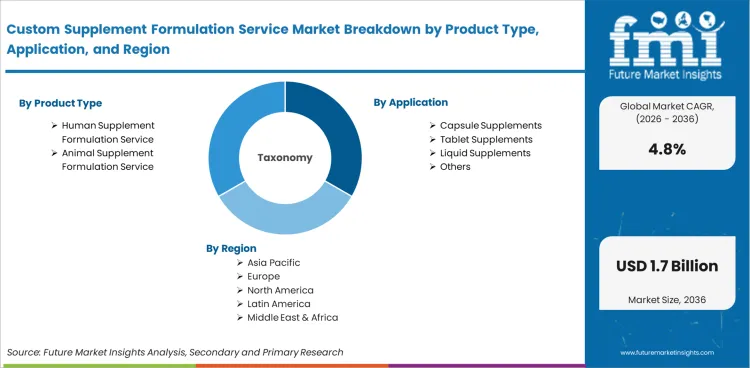
The custom supplement formulation service market is segmented by product type and application. By product type, the market includes human supplement formulation services and animal supplement formulation services. Based on application, it is categorized into capsule supplements, tablet supplements, liquid supplements, and others. Regionally, the market is divided into Asia Pacific, Europe, North America, and other key regions.
By Product Type, the Human Supplement Formulation Service Segment Accounts for the Largest Market Share
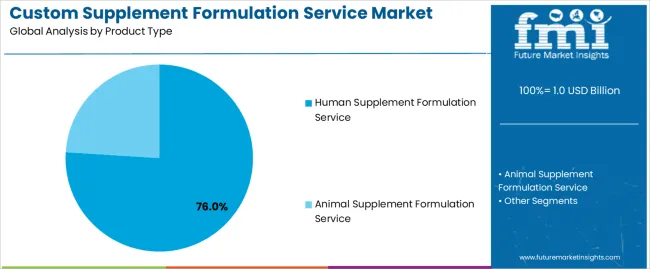
The human supplement formulation service segment represents the leading category, accounting for an estimated 76.0% of the total market share in 2026. Human-focused formulation services dominate due to strong demand for personalized nutrition, functional health products, and specialized formulations designed for immunity, sports performance, cognitive support, and metabolic health. These services involve ingredient selection, dosage optimization, regulatory compliance, and stability evaluation tailored to consumer health needs.
The animal supplement formulation service segment, estimated at 24.0%, supports veterinary, livestock, and companion animal nutrition markets. Growth in this segment is linked to increasing awareness of pet wellness and specialized formulations used in performance animals and herd health programs.
Key factors supporting the human supplement formulation service segment include:
- High demand for customized vitamin, mineral, botanical, and functional ingredient blends.
- Expansion of private-label nutraceutical brands requiring formulation support.
- Increased adoption of targeted health supplements across diverse consumer groups.
- Regulatory requirements driving professional formulation and quality validation.
By Application, the Capsule Supplements Segment Represents the Dominant Market Category
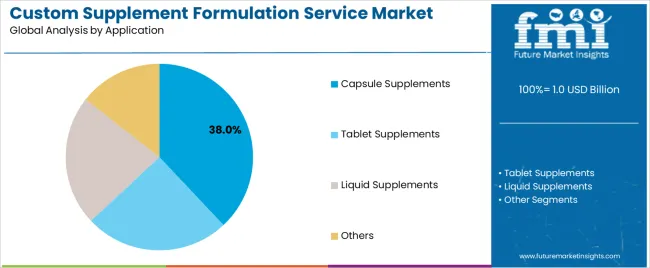
The capsule supplements segment accounts for approximately 38.0% of the market in 2026. Capsules support controlled dosing, ingredient stability, and broad compatibility with botanical extracts, probiotics, and specialty formulations. They remain widely selected by brands due to cost efficiency and consumer familiarity.
The tablet supplements segment follows with an estimated 31.0%, supported by demand for high-volume nutraceutical products requiring longer shelf life and robust structural integrity. The liquid supplements category accounts for about 22.0%, used primarily for fast absorption formulas and products intended for children or elderly populations. The others segment, representing roughly 9.0%, includes powders, gummies, and softgels.
Primary dynamics driving demand from the capsule supplements segment include:
- Strong consumer preference for easy-to-swallow formulation formats.
- Flexibility for complex ingredient combinations and sensitive actives.
- Demand from emerging nutraceutical brands requiring scalable, custom capsule solutions.
- Broader adoption of vegan and allergen-free capsules in health-focused product lines.
What are the Drivers, Restraints, and Key Trends of the Custom Supplement Formulation Service Market?
Growing demand for personalised nutrition, expansion of direct-to-consumer wellness brands, and increased interest in differentiated product portfolios are driving market growth.
The custom supplement formulation service market is expanding as brands seek unique formulations that address targeted health needs across immunity, cognitive support, fitness recovery, metabolic wellness, and healthy aging. Rising consumer preference for personalised supplements encourages companies to develop proprietary blends based on demographic profiles, lifestyle habits, and functional ingredient trends. Small and mid-sized wellness brands use contract formulators to access R&D support, ingredient sourcing, stability testing, and regulatory documentation without maintaining in-house laboratories. Growth in clean-label, plant-based, and allergen-conscious supplements further strengthens demand for formulation services that can validate ingredient purity and design compliant product claims. E-commerce expansion increases the number of private-label brands entering the market, creating sustained demand for custom formulation expertise.
High formulation cost, regulatory complexity, and ingredient supply constraints are restraining adoption.
Custom formulation involves development fees, pilot runs, stability studies, and minimum order quantities that may be challenging for start-ups or brands operating with limited capital. Regulatory frameworks differ across regions, requiring specialised knowledge of permissible claims, ingredient limits, and documentation standards for dietary supplements, which increases compliance cost. Supply constraints in high-demand ingredients such as botanical extracts, probiotics, amino acids, and specialty minerals can delay production or affect formulation stability. Variability in ingredient quality across suppliers requires extensive testing, raising operational complexity for service providers.
Expansion of science-backed formulations, increased use of digital R&D platforms, and growing adoption in emerging wellness markets are shaping industry trends.
Brands are requesting formulations supported by clinical research, leading to increased use of studied ingredients, standardized extracts, and validated dosage levels. Digital formulation tools that model ingredient interactions, shelf-life behavior, and bioavailability are improving development efficiency. Emerging markets in Asia Pacific, Latin America, and the Middle East are adopting custom supplement services as wellness retailers introduce region-specific products. Growth in personalised packs, ready-to-mix powders, functional gummies, and sustained-release capsules is also expanding the range of custom formulation projects managed by contract developers.
Analysis of the Custom Supplement Formulation Service Market by Key Country
The global custom supplement formulation service market is expanding through 2036, supported by increased consumer demand for personalized nutrition, broader adoption of contract formulation services, and rising interest in targeted wellness products. China leads with a 6.5% CAGR, followed by India at 6.0%, reflecting strong nutraceutical manufacturing capacity and growing use of specialized formulation services. Germany grows at 5.5%, supported by regulated product standards and increased demand for evidence-based supplement development. Brazil records 5.0%, driven by expanding wellness-product consumption. The United States grows at 4.6%, while the United Kingdom (4.1%) and Japan (3.6%) maintain stable demand supported by mature supplement industries and established formulation networks.
.webp "Top Country Growth Comparison Custom Supplement Formulation Service Market Cagr (2026 2036)")
| Country | CAGR (%) |
|---|---|
| China | 6.5 |
| India | 6.0 |
| Germany | 5.5 |
| Brazil | 5.0 |
| USA | 4.6 |
| UK | 4.1 |
| Japan | 3.6 |
How is China leading the Custom Supplement Formulation Service Market?
China’s market grows at 6.5% CAGR, supported by extensive nutraceutical production capacity, expanding demand for personalized wellness products, and increased use of contract formulation services among domestic and international brands. Manufacturers offer custom formulations featuring plant extracts, functional nutrients, probiotics, and condition-specific blends tailored for energy, immunity, and general wellness. Contract formulators provide testing, ingredient standardization, dosage optimization, and regulatory documentation. Growth in e-commerce and direct-to-consumer supplement brands strengthens demand for unique formulations. Increased health awareness across major cities reinforces adoption of customized supplement development.
Key Market Factors:
- Strong manufacturing capacity for plant-based and functional ingredients.
- Broad adoption of personalized wellness and condition-specific blends.
- Growth in contract formulation, testing, and regulatory-support services.
- High demand from e-commerce and direct-to-consumer supplement brands.
How is India advancing the Custom Supplement Formulation Service Market?
India’s market grows at 6.0% CAGR, driven by expanding nutraceutical production, increased demand for personalized-health products, and strong participation of contract manufacturers offering custom formulation solutions. Companies develop tailored blends using herbal extracts, micronutrients, probiotics, and functional additives aligned with regional wellness preferences. Domestic formulators offer stability testing, functional-ingredient sourcing, and compliance support for domestic and export markets. Growth in lifestyle-oriented supplement consumption among urban populations increases demand for unique formulations. Broader presence of online supplement brands strengthens long-term adoption.
Market Development Factors:
- Rising demand for customized herbal and micronutrient formulations.
- Expansion of contract manufacturing and formulation capabilities.
- Growth in urban wellness-product consumption.
- Increased use of compliance, sourcing, and stability-testing services.
How is Germany advancing the Custom Supplement Formulation Service Market?
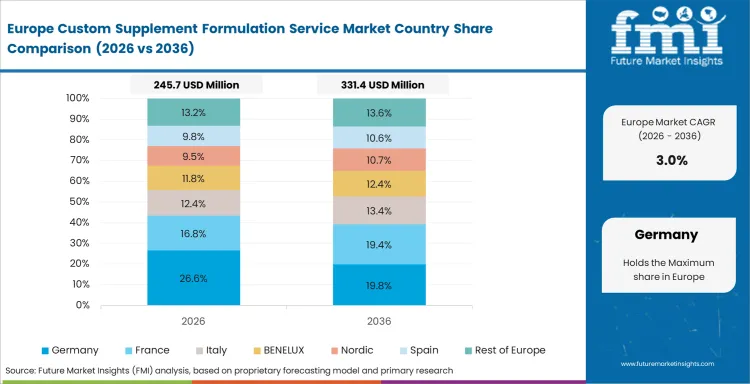
Germany’s market grows at 5.5% CAGR, supported by strict regulatory standards, strong consumer preference for clinically substantiated products, and widespread demand for scientifically aligned supplement formulations. Formulation service providers develop targeted blends for cognition, immunity, metabolic health, and sports nutrition. Companies focus on ingredient purity, documented sourcing, and compliance with European nutritional regulations. Demand rises for custom formulations used in pharmacy channels, health stores, and direct-to-consumer brands emphasizing evidence-based ingredients. Growth in functional-food and wellness-product development strengthens use of specialized formulation services.
Key Market Characteristics:
- Strong emphasis on regulated, evidence-based supplement formulations.
- High demand for clinically supported ingredients and precise dosages.
- Use across pharmacy, health-store, and direct-to-consumer channels.
- Increased development of functional-food and targeted-health blends.
How is Brazil developing the Custom Supplement Formulation Service Market?
Brazil’s market grows at 5.0% CAGR, driven by rising health-awareness, growth in local supplement brands, and increased use of custom formulation for sports nutrition, wellness blends, and condition-specific products. Contract formulators offer services including ingredient blending, flavor development, dosage refinement, and regulatory support aligned with national guidelines. Adoption increases among small and mid-sized supplement brands expanding their product portfolios. E-commerce growth and fitness-community demand strengthen market activity.
Market Development Factors:
- Rising interest in personalized and sports-nutrition formulations.
- Increased availability of contract formulation and blending services.
- Growth in local supplement brands expanding product lines.
- Strong e-commerce participation supporting new product launches.
How is the United States progressing in the Custom Supplement Formulation Service Market?
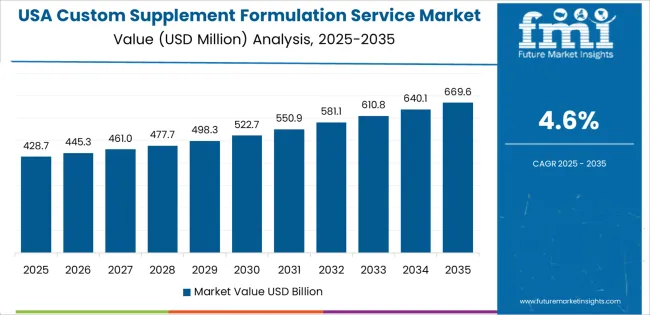
The United States grows at 4.6% CAGR, supported by an established supplement industry, increased consumer interest in personalized-health solutions, and strong participation of contract formulating firms. Companies develop custom blends for cognitive health, metabolic wellness, immunity, and performance nutrition. Providers offer ingredient sourcing, dosage optimization, stability testing, and compliance documentation tailored to regulated markets. Growth in direct-to-consumer brands and subscription-based wellness programs increases demand for unique, targeted formulations. Broader focus on premium ingredients strengthens customized formulation services.
Key Market Factors:
- High adoption of personalized supplement formulations across wellness categories.
- Strong contract manufacturing and formulation ecosystem.
- Demand supported by direct-to-consumer and subscription models.
- Focus on premium and clinically focused ingredients.
How is the United Kingdom developing the Custom Supplement Formulation Service Market?
The United Kingdom’s market grows at 4.1% CAGR, supported by steady consumer interest in clean-label and plant-based supplements, expansion of boutique formulation services, and increased demand for targeted blends. Providers offer custom formulations for digestive health, immunity, energy support, and lifestyle-oriented wellness. Companies emphasize compliance with regional labeling and ingredient standards. Growth in online supplement brands and small nutraceutical firms drives consistent use of formulation services.
Market Development Factors:
- Increased demand for clean-label and plant-based formulations.
- Expansion of boutique and specialized formulation service providers.
- Adoption across online supplement brands and wellness companies.
- Strong focus on compliance with regional ingredient guidelines.
How is Japan maintaining the Custom Supplement Formulation Service Market?
Japan’s market grows at 3.6% CAGR, supported by established nutraceutical consumption, strong interest in functional ingredients, and demand for compact, precise formulations suited to adult wellness routines. Providers develop targeted blends for energy, immunity, digestion, and healthy aging using plant-based compounds and micronutrients. Domestic formulators emphasize ingredient integrity, dosage accuracy, and packaging suited for daily-use formats. Growth in online health retail and personalized-nutrition tools supports stable demand.
Key Market Characteristics:
- High emphasis on precision-focused, compact supplement formulations.
- Strong demand for functional ingredients supporting daily wellness.
- Broad adoption of plant-derived and micronutrient-based blends.
- Increased procurement through online and specialty health retailers.
What is the competitive landscape of the Custom Supplement Formulation Service Market?
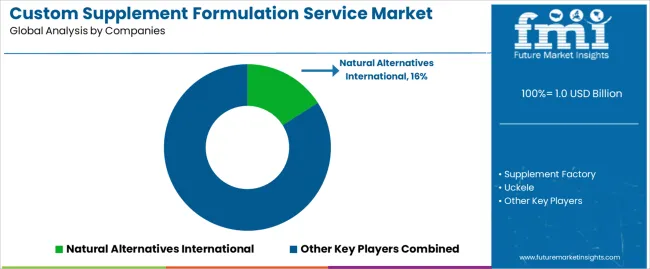
The custom supplement formulation service market is moderately fragmented, with about fifteen manufacturers providing contract formulation, blending, encapsulation, and packaging for nutrition brands and private-label manufacturers. Natural Alternatives International leads the market with an estimated 16.0% global share, supported by its long-standing expertise in nutritional formulation, controlled manufacturing environments, and validated processes for sports nutrition and wellness products. Its position is reinforced by documented quality systems and stable raw material sourcing.
Supplement Factory, Vitaquest, Superior Supplement Manufacturing, and Uckele follow as major competitors, each offering end-to-end formulation support combined with GMP-compliant production. Their competitive strengths include broad ingredient libraries, in-house R&D teams, and scalability across tablets, capsules, powders, and functional blends. Activ’Inside, Nutra Coast, LifeLab, and Canyonside Lab maintain mid-tier roles, focusing on specialized botanical extracts, cognitive health formulations, and rapid prototype development suited to emerging brands.
Manufacturers such as SDC Nutrition, Quality Supplement Manufacturing, Millmax, NutraBest, Arnet, and Martínez Nieto expand regional access through cost-efficient production, diverse dosage formats, and private-label services aligned with market-specific regulatory requirements.
Competition in this market centers on formulation precision, ingredient quality, regulatory compliance, lead times, and batch consistency. Growth is driven by increasing demand for personalized nutrition, expansion of private-label supplement brands, and greater reliance on contract developers capable of delivering science-based formulations, clean-label compliance, and scalable production for global nutrition markets.
Key Players in the Custom Supplement Formulation Service Market
- Natural Alternatives International
- Supplement Factory
- Uckele
- Activ'Inside
- Superior Supplement Manufacturing
- Canyonside Lab
- SDC Nutrition
- Vitaquest
- Nutra Coast
- LifeLab
- Quality Supplement Manufacturing
- Millmax
- NutraBest
- Arnet
- MARTÍNEZ NIETO
Scope of the Report
| Metric | Value |
|---|---|
| Quantitative Units | USD 1.05 billion to USD 1.67 billion, at a CAGR of 4.8% |
| Market Definition | The custom supplement formulation service market encompasses contract formulation, manufacturing, and packaging services provided to supplement brand owners, healthcare practitioners, and retailers se... |
| Segmentation | Product Type: Human Supplement Formulation Service, Animal Supplement Formulation Service; Application: Capsule Supplements, Tablet Supplements, Liquid Supplements, Others |
| Regions Covered | Global (North America, Europe, Asia Pacific, Latin America) |
| Areas Covered | China, India, Germany, Brazil, USA, UK, Japan |
| Key Companies Profiled | Natural Alternatives International, Supplement Factory, Uckele, Activ'Inside, Superior Supplement Manufacturing, Canyonside Lab, SDC Nutrition, Vitaquest |
| Forecast Period | 2026 to 2036 |
| Approach | Hybrid bottom-up modeling using production volume data, trade flow analysis, and primary research validation |
Custom Supplement Formulation Service Market by Segment
Product Type:
- Human Supplement Formulation Service
- Animal Supplement Formulation Service
Application:
- Capsule Supplements
- Tablet Supplements
- Liquid Supplements
- Others
Region:
- Asia Pacific
- China
- Japan
- South Korea
- India
- Australia & New Zealand
- ASEAN
- Rest of Asia Pacific
- Europe
- Germany
- United Kingdom
- France
- Italy
- Spain
- Nordic
- BENELUX
- Rest of Europe
- North America
- United States
- Canada
- Mexico
- Latin America
- Brazil
- Chile
- Rest of Latin America
- Middle East & Africa
- Kingdom of Saudi Arabia
- Other GCC Countries
- Turkey
- South Africa
- Other African Union
- Rest of Middle East & Africa
Bibliography
- 1. USA Food and Drug Administration. (2025). 21 CFR Part 111: Current Good Manufacturing Practice for dietary supplements. FDA.
- 2. European Commission. (2024). Directive 2002/46/EC on food supplements, consolidated text. EUR-Lex.
- 3. Council for Responsible Nutrition. (2024). Supplement industry economic impact report. CRN.
- 4. Eurostat. (2025). Health supplement manufacturing and service sector statistics. European Commission Statistical Office.
- 5. World Health Organization. (2024). Guidelines on good manufacturing practices for dietary supplements. WHO.
This bibliography is provided for reader reference. The full Future Market Insights report contains the complete reference list with primary research documentation.
Frequently Asked Questions
How large is the demand for Custom Supplement Formulation Service Market in the market in 2026?
Demand for custom supplement formulation service market is estimated to be valued at USD 1.05 billion in 2026.
What will be the market size of Custom Supplement Formulation Service Market by 2036?
Market size for custom supplement formulation service market is projected to reach USD 1.67 billion by 2036.
What is the expected demand growth for Custom Supplement Formulation Service Market between 2026 and 2036?
Demand for custom supplement formulation service market is expected to grow at a CAGR of 4.8% between 2026 and 2036.
Which Product Type is poised to lead sales by 2026?
Human Supplement Formulation Service accounts for 76% share in 2026.
How is Capsule Supplements positioned in custom supplement formulation service market adoption in 2026?
Capsule Supplements holds 38% of the Application segment share in 2026.
Which country is the fastest-growing market?
China is projected to grow at a CAGR of 6.5% during 2026 to 2036.
What is Custom Supplement Formulation Service Market and what is it mainly used for?
The custom supplement formulation service market encompasses contract formulation, manufacturing, and packaging services provided to supplement brand owners, healthcare practitioners, and retailers seeking outsourced production of dietary supplement products. Services span ingredient sourcing, formula development, stability testing, regulatory compliance, and finished product manufacturing across capsule, tablet, powder, softgel, and liquid formats.
How does FMI build and validate the custom supplement formulation service market forecast?
Forecasting models apply a bottom-up methodology starting with production volume data and cross-validate projections against publicly reported industry statistics and primary research inputs.
Preview the report firsthand - request a free sample
Get SampleGet the brochure for pricing and purchase details.
Get PDFTable of Content
- Executive Summary
- Global Market Outlook
- Demand-side Trends
- Supply-side Trends
- Technology Roadmap Analysis
- Analysis and Recommendations
- Market Overview
- Market Coverage / Taxonomy
- Market Definition / Scope / Limitations
- Research Methodology
- Chapter Orientation
- Analytical Lens and Working Hypotheses
- Market Structure, Signals, and Trend Drivers
- Benchmarking and Cross-market Comparability
- Market Sizing, Forecasting, and Opportunity Mapping
- Research Design and Evidence Framework
- Desk Research Programme (Secondary Evidence)
- Company Annual and Sustainability Reports
- Peer-reviewed Journals and Academic Literature
- Corporate Websites, Product Literature, and Technical Notes
- Earnings Decks and Investor Briefings
- Statutory Filings and Regulatory Disclosures
- Technical White Papers and Standards Notes
- Trade Journals, Industry Magazines, and Analyst Briefs
- Conference Proceedings, Webinars, and Seminar Materials
- Government Statistics Portals and Public Data Releases
- Press Releases and Reputable Media Coverage
- Specialist Newsletters and Curated Briefings
- Sector Databases and Reference Repositories
- FMI Internal Proprietary Databases and Historical Market Datasets
- Subscription Datasets and Paid Sources
- Social Channels, Communities, and Digital Listening Inputs
- Additional Desk Sources
- Expert Input and Fieldwork (Primary Evidence)
- Primary Modes
- Qualitative Interviews and Expert Elicitation
- Quantitative Surveys and Structured Data Capture
- Blended Approach
- Why Primary Evidence is Used
- Field Techniques
- Interviews
- Surveys
- Focus Groups
- Observational and In-context Research
- Social and Community Interactions
- Stakeholder Universe Engaged
- C-suite Leaders
- Board Members
- Presidents and Vice Presidents
- R&D and Innovation Heads
- Technical Specialists
- Domain Subject-matter Experts
- Scientists
- Physicians and Other Healthcare Professionals
- Governance, Ethics, and Data Stewardship
- Research Ethics
- Data Integrity and Handling
- Primary Modes
- Tooling, Models, and Reference Databases
- Desk Research Programme (Secondary Evidence)
- Data Engineering and Model Build
- Data Acquisition and Ingestion
- Cleaning, Normalisation, and Verification
- Synthesis, Triangulation, and Analysis
- Quality Assurance and Audit Trail
- Market Background
- Market Dynamics
- Drivers
- Restraints
- Opportunity
- Trends
- Scenario Forecast
- Demand in Optimistic Scenario
- Demand in Likely Scenario
- Demand in Conservative Scenario
- Opportunity Map Analysis
- Product Life Cycle Analysis
- Supply Chain Analysis
- Investment Feasibility Matrix
- Value Chain Analysis
- PESTLE and Porter’s Analysis
- Regulatory Landscape
- Regional Parent Market Outlook
- Production and Consumption Statistics
- Import and Export Statistics
- Market Dynamics
- Global Market Analysis 2021 to 2025 and Forecast, 2026 to 2036
- Historical Market Size Value (USD Million) Analysis, 2021 to 2025
- Current and Future Market Size Value (USD Million) Projections, 2026 to 2036
- Y-o-Y Growth Trend Analysis
- Absolute $ Opportunity Analysis
- Global Market Pricing Analysis 2021 to 2025 and Forecast 2026 to 2036
- Global Market Analysis 2021 to 2025 and Forecast 2026 to 2036, By Product Type
- Introduction / Key Findings
- Historical Market Size Value (USD Million) Analysis By Product Type , 2021 to 2025
- Current and Future Market Size Value (USD Million) Analysis and Forecast By Product Type , 2026 to 2036
- Human Supplement Formulation Service
- Animal Supplement Formulation Service
- Human Supplement Formulation Service
- Y-o-Y Growth Trend Analysis By Product Type , 2021 to 2025
- Absolute $ Opportunity Analysis By Product Type , 2026 to 2036
- Global Market Analysis 2021 to 2025 and Forecast 2026 to 2036, By Application
- Introduction / Key Findings
- Historical Market Size Value (USD Million) Analysis By Application, 2021 to 2025
- Current and Future Market Size Value (USD Million) Analysis and Forecast By Application, 2026 to 2036
- Capsule Supplements
- Tablet Supplements
- Liquid Supplements
- Others
- Capsule Supplements
- Y-o-Y Growth Trend Analysis By Application, 2021 to 2025
- Absolute $ Opportunity Analysis By Application, 2026 to 2036
- Global Market Analysis 2021 to 2025 and Forecast 2026 to 2036, By Region
- Introduction
- Historical Market Size Value (USD Million) Analysis By Region, 2021 to 2025
- Current Market Size Value (USD Million) Analysis and Forecast By Region, 2026 to 2036
- North America
- Latin America
- Western Europe
- Eastern Europe
- East Asia
- South Asia and Pacific
- Middle East & Africa
- Market Attractiveness Analysis By Region
- North America Market Analysis 2021 to 2025 and Forecast 2026 to 2036, By Country
- Historical Market Size Value (USD Million) Trend Analysis By Market Taxonomy, 2021 to 2025
- Market Size Value (USD Million) Forecast By Market Taxonomy, 2026 to 2036
- By Country
- USA
- Canada
- Mexico
- By Product Type
- By Application
- By Country
- Market Attractiveness Analysis
- By Country
- By Product Type
- By Application
- Key Takeaways
- Latin America Market Analysis 2021 to 2025 and Forecast 2026 to 2036, By Country
- Historical Market Size Value (USD Million) Trend Analysis By Market Taxonomy, 2021 to 2025
- Market Size Value (USD Million) Forecast By Market Taxonomy, 2026 to 2036
- By Country
- Brazil
- Chile
- Rest of Latin America
- By Product Type
- By Application
- By Country
- Market Attractiveness Analysis
- By Country
- By Product Type
- By Application
- Key Takeaways
- Western Europe Market Analysis 2021 to 2025 and Forecast 2026 to 2036, By Country
- Historical Market Size Value (USD Million) Trend Analysis By Market Taxonomy, 2021 to 2025
- Market Size Value (USD Million) Forecast By Market Taxonomy, 2026 to 2036
- By Country
- Germany
- UK
- Italy
- Spain
- France
- Nordic
- BENELUX
- Rest of Western Europe
- By Product Type
- By Application
- By Country
- Market Attractiveness Analysis
- By Country
- By Product Type
- By Application
- Key Takeaways
- Eastern Europe Market Analysis 2021 to 2025 and Forecast 2026 to 2036, By Country
- Historical Market Size Value (USD Million) Trend Analysis By Market Taxonomy, 2021 to 2025
- Market Size Value (USD Million) Forecast By Market Taxonomy, 2026 to 2036
- By Country
- Russia
- Poland
- Hungary
- Balkan & Baltic
- Rest of Eastern Europe
- By Product Type
- By Application
- By Country
- Market Attractiveness Analysis
- By Country
- By Product Type
- By Application
- Key Takeaways
- East Asia Market Analysis 2021 to 2025 and Forecast 2026 to 2036, By Country
- Historical Market Size Value (USD Million) Trend Analysis By Market Taxonomy, 2021 to 2025
- Market Size Value (USD Million) Forecast By Market Taxonomy, 2026 to 2036
- By Country
- China
- Japan
- South Korea
- By Product Type
- By Application
- By Country
- Market Attractiveness Analysis
- By Country
- By Product Type
- By Application
- Key Takeaways
- South Asia and Pacific Market Analysis 2021 to 2025 and Forecast 2026 to 2036, By Country
- Historical Market Size Value (USD Million) Trend Analysis By Market Taxonomy, 2021 to 2025
- Market Size Value (USD Million) Forecast By Market Taxonomy, 2026 to 2036
- By Country
- India
- ASEAN
- Australia & New Zealand
- Rest of South Asia and Pacific
- By Product Type
- By Application
- By Country
- Market Attractiveness Analysis
- By Country
- By Product Type
- By Application
- Key Takeaways
- Middle East & Africa Market Analysis 2021 to 2025 and Forecast 2026 to 2036, By Country
- Historical Market Size Value (USD Million) Trend Analysis By Market Taxonomy, 2021 to 2025
- Market Size Value (USD Million) Forecast By Market Taxonomy, 2026 to 2036
- By Country
- Kingdom of Saudi Arabia
- Other GCC Countries
- Turkiye
- South Africa
- Other African Union
- Rest of Middle East & Africa
- By Product Type
- By Application
- By Country
- Market Attractiveness Analysis
- By Country
- By Product Type
- By Application
- Key Takeaways
- Key Countries Market Analysis
- USA
- Pricing Analysis
- Market Share Analysis, 2025
- By Product Type
- By Application
- Canada
- Pricing Analysis
- Market Share Analysis, 2025
- By Product Type
- By Application
- Mexico
- Pricing Analysis
- Market Share Analysis, 2025
- By Product Type
- By Application
- Brazil
- Pricing Analysis
- Market Share Analysis, 2025
- By Product Type
- By Application
- Chile
- Pricing Analysis
- Market Share Analysis, 2025
- By Product Type
- By Application
- Germany
- Pricing Analysis
- Market Share Analysis, 2025
- By Product Type
- By Application
- UK
- Pricing Analysis
- Market Share Analysis, 2025
- By Product Type
- By Application
- Italy
- Pricing Analysis
- Market Share Analysis, 2025
- By Product Type
- By Application
- Spain
- Pricing Analysis
- Market Share Analysis, 2025
- By Product Type
- By Application
- France
- Pricing Analysis
- Market Share Analysis, 2025
- By Product Type
- By Application
- India
- Pricing Analysis
- Market Share Analysis, 2025
- By Product Type
- By Application
- ASEAN
- Pricing Analysis
- Market Share Analysis, 2025
- By Product Type
- By Application
- Australia & New Zealand
- Pricing Analysis
- Market Share Analysis, 2025
- By Product Type
- By Application
- China
- Pricing Analysis
- Market Share Analysis, 2025
- By Product Type
- By Application
- Japan
- Pricing Analysis
- Market Share Analysis, 2025
- By Product Type
- By Application
- South Korea
- Pricing Analysis
- Market Share Analysis, 2025
- By Product Type
- By Application
- Russia
- Pricing Analysis
- Market Share Analysis, 2025
- By Product Type
- By Application
- Poland
- Pricing Analysis
- Market Share Analysis, 2025
- By Product Type
- By Application
- Hungary
- Pricing Analysis
- Market Share Analysis, 2025
- By Product Type
- By Application
- Kingdom of Saudi Arabia
- Pricing Analysis
- Market Share Analysis, 2025
- By Product Type
- By Application
- Turkiye
- Pricing Analysis
- Market Share Analysis, 2025
- By Product Type
- By Application
- South Africa
- Pricing Analysis
- Market Share Analysis, 2025
- By Product Type
- By Application
- USA
- Market Structure Analysis
- Competition Dashboard
- Competition Benchmarking
- Market Share Analysis of Top Players
- By Regional
- By Product Type
- By Application
- Competition Analysis
- Competition Deep Dive
- Natural Alternatives International
- Overview
- Product Portfolio
- Profitability by Market Segments (Product/Age /Sales Channel/Region)
- Sales Footprint
- Strategy Overview
- Marketing Strategy
- Product Strategy
- Channel Strategy
- Supplement Factory
- Uckele
- Activ'Inside
- Superior Supplement Manufacturing
- Canyonside Lab
- SDC Nutrition
- Vitaquest
- Nutra Coast
- LifeLab
- Quality Supplement Manufacturing
- Millmax
- NutraBest
- Arnet
- MARTÍNEZ NIETO
- Natural Alternatives International
- Competition Deep Dive
- Assumptions & Acronyms Used


