

- Market Size (2026)
- USD 352.0 Mn
- Forecast (2036)
- USD 573.4 Mn
- CAGR (2026 to 2036)
- 5.0%
How Big is the Purple Whitening Toothpaste Market in 2026?
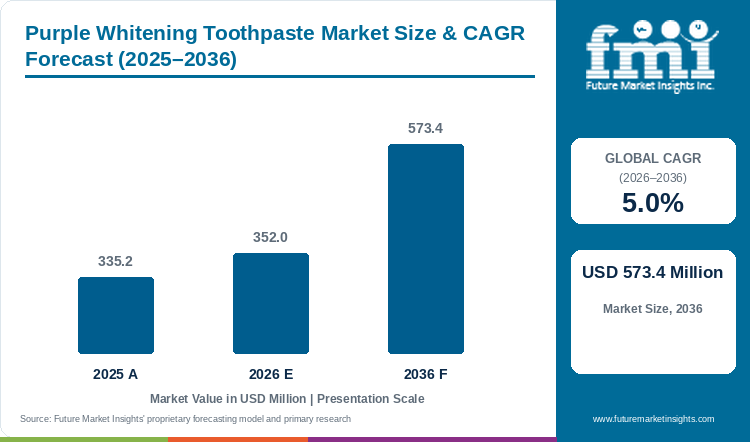
Purple whitening toothpaste revenue is estimated at USD 352.0 Million in 2026. A 5.0% CAGR will take the market to USD 573.4 Million by 2036, adding USD 221.4 Million in sales over the decade.
Spending on purple whitening toothpaste is estimated at USD 335.2 Million in 2025 and USD 352.0 Million in 2026, as per FMI. Revenue is projected to reach USD 573.4 Million by 2036 at a 5.0% CAGR, opening USD 221.4 Million of new sales for oral-care producers. Colgate-Palmolive’s second-quarter 2025 presentation describes the purple range’s colour-correction effect as temporary, setting a clear expectation for what the buyer receives [1].
That temporary effect shapes the purchase occasion. A shopper seeking a quick change in appearance may accept a product that does not promise lasting bleaching, provided the pack explains it plainly. Continued growth will depend on repeat satisfaction with that visible effect and on maintaining the everyday toothpaste benefits claimed for the formula. A dramatic demonstration can win trial, but an expectation the product cannot meet makes repurchase less likely.
Analysts at FMI see distribution and expectation-setting as the nearest revenue drivers. Colgate-Palmolive’s July 2026 management remarks pointed to continued Optic White Purple momentum in Asia Pacific [2]. The company’s India and Saudi Arabia ranges already give the format distinct local identities [3] [4]. Suppliers expanding into new markets will need to support the colour claim for the actual formula and make the difference from stain-removal or bleaching products clear at the shelf.
Key Takeaways
- Core and classic lines will hold 35.0% of product type revenue in 2026, the largest of five product types.
- Mass products will account for 40.0% of price positioning revenue in 2026.
- Conventional products will take 52.0% of revenue by nature, cream and balm formats 29.0% by format, and e-commerce and DTC 32.0% by sales channel.
- Colgate-Palmolive is the direct purple toothpaste supplier covered, and the full report reviews nine other oral-care and consumer companies as adjacent competitors.
- The UAE will grow fastest at a 6.3% CAGR, and Japan will grow slowest at 4.0%.
Analyst Perspective
“In my view, purple toothpaste will keep growing as long as brands are honest about what it does. It gives a visible change on day one and it fades. Brands that say so on the pack, and pair the colour effect with a proven stain-removal or everyday oral-care benefit where the formula supports it, will keep buyers coming back after the first tube.”
- Rahul Pandita, Principal Consultant, FMI
How is the Purple Whitening Toothpaste Market Segmented?
Five lenses, product type, nature, format, price positioning and sales channel, sit alongside a seven-region view of purple whitening toothpaste demand.
Based on product type, the market is segmented into core and classic lines, targeted treatment lines, sensitive and gentle lines, premium and clinical lines, and kits and sets. By nature, the report covers conventional, vegan and cruelty-free, natural and organic, dermocosmetic and clinical, and fragrance-free and sensitive products. Formats include cream and balm, liquid and serum, stick and solid, spray and mist, sheet and patch, and powder. Price positioning covers mass, masstige, premium and professional, and sales channels cover e-commerce and DTC, specialty beauty retail, pharmacies and drugstores, supermarkets and hypermarkets, and salons and spas. Only toothpaste and toothpaste-delivery formats count toward revenue, and for kits only the toothpaste revenue that can be separated is included. Whitening strips, mouthwash, devices and dental procedures sit outside the market. The regional study covers seven regions and 27 countries and country groups.
Why Do Core and Classic Lines Lead the Purple Whitening Toothpaste Market by Product Type?
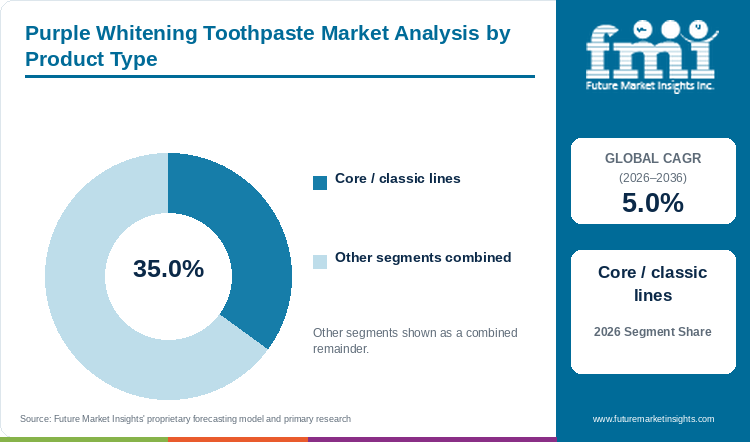
Core and classic lines will account for 35.0% of product type market share in 2026, the largest slice among five product types.
A purple toothpaste asks buyers to change nothing about their routine. They brush twice a day as before and see the colour effect straight away, which makes the first purchase easy to justify. Core lines are the standard tube versions of that proposition, such as Colgate Visible White Purple in India [3] and Optic White Purple Reveal in Saudi Arabia [4], and they carry the brand’s main shelf presence.
- Easy trial within an existing brushing habit will boost demand for core and classic lines, with this segment holding 35.0% of product type revenue in 2026.
- In July 2026, Colgate-Palmolive reported continued momentum for Colgate Optic White Purple in Asia Pacific in its second-quarter management remarks [2].
Why Do Conventional Products Lead the Purple Whitening Toothpaste Market by Nature?
At 52.0%, conventional products will account for the highest market share by nature in 2026.
Conventional formulas use standard toothpaste bases with a colour pigment added, and they can launch without the extra claim work that vegan, natural, clinical or sensitive positioning brings. Those claims can also overlap on one product. Regulation adds to the cost of moving outside a conventional formula, because rules in the EU, the UK and Saudi Arabia keep ordinary oral products to 0.1% hydrogen peroxide present or released, and send stronger whitening products down a separate route with dental-practitioner controls [5][6][7]. A product that crosses that line without the right documents can be stopped at the border.
- Lower formulation and compliance costs are a key factor for the 52.0% of revenue by nature of conventional products in 2026.
- In February 2025, the UK Office for Product Safety and Standards rejected an import of Diamond White toothpaste that advertised 3% hydrogen peroxide and lacked required documentation [6].
Why Does Cream and Balm Lead the Purple Whitening Toothpaste Market by Format?
Cream and balm formats will account for 29.0% of format revenue in 2026.
Standard tube paste falls in the cream and balm format, and it is the format buyers already know how to use. Liquid and serum products count only where they are sold as a toothpaste-delivery format and not as a separate whitening treatment. Stick, spray, sheet and powder formats are part of the segmentation, but qualifying purple toothpaste products in those formats are still thin on the ground. Alternative formats do exist in oral care more broadly, as Lush sells toothpaste tablets and jellies [8], although a purple colour-correcting version was not established.
- Cream and balm hold 29.0% of format revenue in 2026.
- In August 2025, Colgate-Palmolive added Purple Serum to its purple range, according to its second-quarter 2025 earnings presentation [1].
Why Does Mass Lead the Purple Whitening Toothpaste Market by Price Positioning?
Mass products will account for 40.0% of price positioning revenue in 2026.
Toothpaste is a weekly grocery item for most households, and purple variants sit on the same shelf as the brand’s regular tubes. The largest sellers are mass oral-care brands, so most purple volume moves at everyday prices. Competition at this level also comes from blue-pigment products, such as Unilever’s Closeup White Now, which uses a blue pigment for an optical whitening effect and is described as temporary on the brand’s own product pages [9]. In a strict purple-only scope, those blue products sit next to the market and outside its revenue.
- Mass products are set to hold 40.0% of price positioning revenue in 2026.
- In March 2026, Unilever’s 2025 annual report described the rollout of Closeup White Now across Asia during 2025 [10].
Why Does E-commerce and DTC Lead the Purple Whitening Toothpaste Market by Sales Channel?
At 32.0%, e-commerce and DTC will account for the highest market share by sales channel in 2026.
A colour-correcting toothpaste is easier to sell with a short video than with a tube on a shelf. Online listings let brands show the before-and-after effect and explain, in the same place, that it fades. Large oral-care companies already use online launches to build trial before moving into stores, as Church & Dwight did when it launched TheraBreath toothpaste online in August 2025 with three variants, one of them whitening, and then expanded to retail [11]. That launch is broader whitening context and not a purple product.
- E-commerce and DTC is likely to account for 32.0% of sales channel revenue in 2026.
- In July 2026, Church & Dwight described trial-led marketing that links TheraBreath mouthwash and toothpaste as one regimen [12].
What are the Drivers, Restraints, and Opportunities in the Purple Whitening Toothpaste Market?
As per FMI’s analysis, a visible effect from the first brushing will drive trial, disappointment from buyers expecting lasting bleaching will slow repeat purchase, and formulas that pair the colour effect with proven stain removal will open higher-value sales till 2036.
- Driver: Buyers can try the product inside a routine they already have, and the colour effect is visible straight after brushing.
- Restraint: The effect is temporary, and buyers who expect bleaching may not buy a second tube.
- Opportunity: Formulas that combine a clearly described colour effect with independently supported stain removal or everyday oral-care benefits can justify a higher price.
The 2025 research concerns blue pigment. In a 66-person crossover trial, three blue-covarine toothpastes improved immediate measured whiteness and yellowness relative to a silica-and-fluoride control; Unilever Oral Care authors were involved [13]. The study did not test purple formulas or establish a lasting effect. Colgate’s temporary-effect qualification [1] and Closeup’s similar wording [9] therefore remain important commercial distinctions. A purple product needs support for its own formula and any additional oral-care claims.
Which Country CAGRs are Profiled in the Purple Whitening Toothpaste Market?
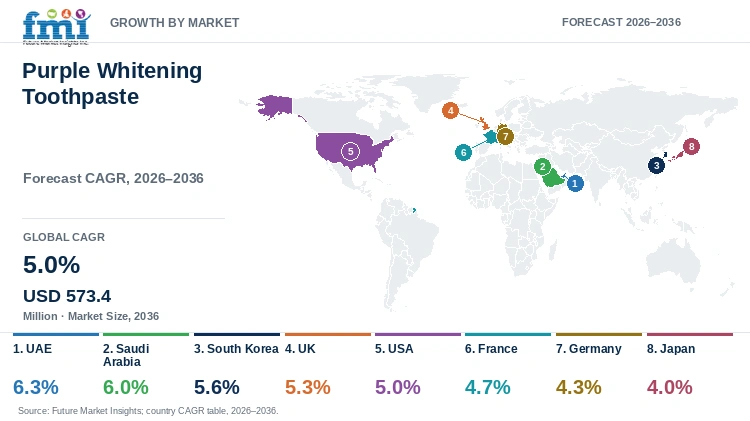
| Country | CAGR, 2026 to 2036 |
|---|---|
| UAE | 6.3% |
| Saudi Arabia | 6.0% |
| South Korea | 5.6% |
| UK | 5.3% |
| USA | 5.0% |
| France | 4.7% |
| Germany | 4.3% |
| Japan | 4.0% |
How do Country-level CAGRs Compare in the Purple Whitening Toothpaste Market?
As per FMI’s analysis, the Gulf leads the profiled group, with the UAE at a 6.3% CAGR and Saudi Arabia at 6.0%, and Japan records the slowest rate at 4.0%, a spread of 2.3 points. South Korea at 5.6% and the UK at 5.3% also grow faster than the 5.0% global rate, the USA matches it, and France at 4.7% and Germany at 4.3% fall below it. These rates measure speed only, and a slower-growing country can still hold a larger revenue base than a faster one.
- Saudi Arabia, at 6.0%, already has a direct purple toothpaste on sale in Colgate Optic White Purple Reveal [4].
- The UK, growing at 5.3%, has shown that whitening toothpaste above the ordinary peroxide limit can be stopped at the border [6].
- USA: At a 5.0% CAGR, purple products compete beside established stain-removal propositions, including Crest’s 2026 product recognition [14].
- Japan will grow slowest at 4.0%, as products with active ingredients generally need quasi-drug approval [15].
Regional growth rates are also modelled for North America, Latin America, Western Europe, Eastern Europe, East Asia, South Asia and Pacific, and the Middle East and Africa, with coverage extending to 27 countries and country groups.
Country Outlook
- The UAE offers the fastest profiled growth, at a 6.3% CAGR through 2036, with digital retail helping new oral-care formats reach shoppers. Aani reached 12.5 million registered users in April 2026 [16]. Purple-toothpaste suppliers can use short demonstrations to explain the visible effect, but repeat sales will depend on setting expectations accurately. Local distribution and clear formula claims should accompany a message that the colour correction is temporary.
- Saudi Arabia already has a direct purple product in Colgate Optic White Purple Reveal [4], while market revenue is forecast at a 6.0% CAGR through 2036. SFDA announced updated Gulf technical regulations for cosmetics in June 2025 [17]. Suppliers entering the category need to align labeling and formulation with local requirements. Clear distinction between temporary colour correction and other whitening methods can help the buyer choose knowingly.
- South Korea’s formal oral-care classification shapes the launch route, with a 5.6% CAGR forecast through 2036. MFDS’s current quasi-drug framework includes toothpaste [18]. Colgate’s July 2026 management remarks also point to Optic White Purple momentum across Asia Pacific [2], without separating Korean sales. Brands need country-specific product qualification and a clear consumer explanation before regional interest can become local repeat demand.
- The UK’s whitening-product enforcement makes formulation discipline commercially important, with a 5.3% CAGR forecast through 2036. In February 2025, OPSS rejected a Diamond White toothpaste shipment containing 1.25% hydrogen peroxide [6]. That case concerns a different formula, but illustrates the importance of matching the product to the permitted category. Purple brands can compete through a supported temporary colour effect and unambiguous pack claims.
- US whitening buyers have strong stain-removal alternatives, and purple-toothpaste sales are forecast at a 5.0% CAGR through 2036. P&G named Crest 3DWhite Deep Stain Remover among Circana’s 2026 Rising Stars in June 2026 [14]. Purple suppliers therefore need to explain a distinct appearance benefit. Colgate’s 2025 description of temporary colour correction provides the relevant expectation for that purchase [1].
- France’s cosmetics framework shapes oral-care claims and composition, with a 4.7% CAGR forecast through 2036. The May 2026 consolidated EU Cosmetics Regulation sets separate peroxide conditions for ordinary oral products and specified tooth-whitening products [5]. A purple formula must be assessed on its actual ingredients and claims. Clear local labeling and supported colour-effect communication can help suppliers reach buyers without implying that every whitening method is interchangeable.
- Germany shares the EU formulation requirements but has its own 4.3% CAGR forecast through 2036. The May 2026 consolidated Cosmetics Regulation defines peroxide conditions for oral and tooth-whitening products [5]. Suppliers should make the purple formula’s composition and intended effect easy for retailers to assess. Precise consumer communication can then support a repeat purchase based on the actual temporary appearance benefit.
- Japan’s product classification places a premium on disciplined claims, and the market is forecast at a 4.0% CAGR through 2036, the slowest pace in the group. PMDA’s current guidance distinguishes ordinary cosmetics from quasi-drugs [15]. Colgate’s July 2026 remarks describe wider Asia-Pacific momentum for Optic White Purple [2], rather than a Japanese sales figure. Entry plans need local classification work and a clear explanation of what the specific formula does.
Who are the Notable Companies in the Purple Whitening Toothpaste Market?
Companies covered in the market include Colgate-Palmolive as the direct purple toothpaste supplier, with Unilever, Procter & Gamble, Church & Dwight, Lush, Waterpik, Philips, Kenvue, Henkel and Edgewell Personal Care reviewed as adjacent oral-care and consumer companies.
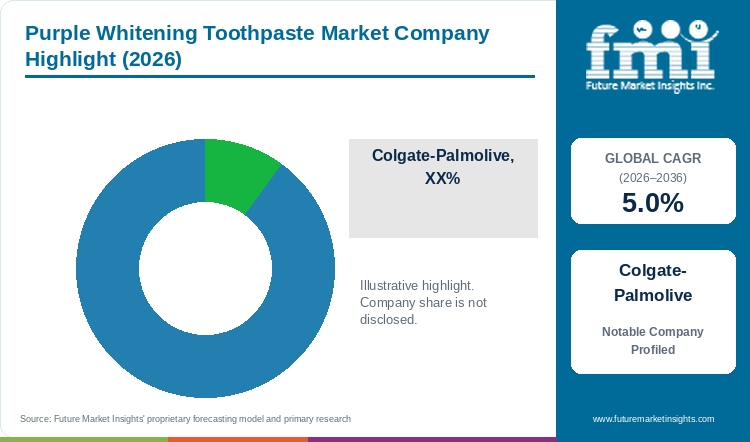
Colgate-Palmolive is the only company in this study with documented purple toothpaste on sale, through Visible White Purple in India and Optic White Purple Reveal in Saudi Arabia [3][4], and it has extended the range with Purple Serum [1]. Unilever competes with a blue-pigment optical toothpaste, Closeup White Now [10][9], and Procter & Gamble and Church & Dwight compete through whitening and stain-removal toothpaste, including Crest 3DWhite, ARM & HAMMER Advance White and TheraBreath [11][19][14]. None of these three has a verified purple product.
As per FMI’s analysis, competition through 2036 will turn on clear labelling of the colour effect, evidence for each added benefit and the regulatory route chosen for each formula. Blue-pigment and stain-removal products will keep competing for the same buyer, so purple brands will need to show what their product adds.
- Direct Purple Colour-Correcting Toothpaste Brands: Colgate-Palmolive sells purple toothpaste in India, Saudi Arabia and other Asian markets, and labels the colour-correction effect as temporary in investor materials [1][2].
- Optical and Whitening Toothpaste Competitors: Unilever, Procter & Gamble, Church & Dwight and Lush sell blue-pigment, stain-removal or alternative-format toothpaste [12][8]. Their sales sit next to the market, and no current purple product was verified for any of them.
- Adjacent Oral-Care, Device and Portfolio Companies: Waterpik sells WT-30 whitening refill tablets linked to devices whose listed compatible models are marked discontinued [20], Philips’ BreathRx whitening toothpaste is no longer available [21], Kenvue’s oral-care presence centres on Listerine mouthwash [22][23], and current portfolio material does not establish an oral-care role for Edgewell Personal Care [24]. A direct purple toothpaste role was not established for Henkel.
Competitive Benchmarking
| Company | Purple / Optical Colour Correction | Whitening Toothpaste Breadth | Regimen / Format Extension | Reviewed Geographic Reach |
|---|---|---|---|---|
| Colgate-Palmolive | High | High | High | Purple products in India, Saudi Arabia and other Asian markets |
| Unilever | High | High | Unscored | Closeup White Now across Asia; global corporate presence |
| Procter & Gamble | Unscored | High | Unscored | US Crest whitening evidence |
| Church & Dwight | Unscored | High | Medium | US oral-care evidence; broader international consumer business |
| Lush | Unscored | Medium | High | US product channel per source benchmark; reviewed category page is UAE |
| Waterpik | Unscored | Low | High | US platform; listed compatible whitening systems discontinued |
| Philips | Unscored | Low | Low | US BreathRx pages, product discontinued |
| Kenvue | Unscored | Unscored | Unscored | Company-wide presence in more than 165 countries; oral-care evidence centres on Listerine |
| Henkel | Unscored | Unscored | Unscored | Market-relevant reach not established |
| Edgewell Personal Care | Low | Low | Low | Company-wide presence in more than 50 countries; oral-care category not established |
Scoring basis: Purple / Optical Colour Correction scores documented colour-correcting toothpaste and combines purple and blue pigment products. Whitening Toothpaste Breadth scores the range of documented whitening toothpaste. Regimen / Format Extension scores documented products beyond a standard tube, such as serums, tablets or device-linked refills. A High score marks broad and clearly documented capability, Medium marks narrower but credible capability, Low marks a documented limitation, and Unscored marks insufficient public information. Company-wide country counts describe corporate presence and do not show where any purple product is sold. Scores are analyst judgments, not market shares or clinical performance rankings.
Key Developments
- In February 2025, the UK Office for Product Safety and Standards rejected an import of Diamond White toothpaste that advertised 3% hydrogen peroxide and lacked required documentation [6].
- In June 2025, the Saudi Food and Drug Authority announced adoption of updated Gulf technical regulations covering cosmetic safety and claims [17].
- In August 2025, Colgate-Palmolive presented its purple toothpaste range and the addition of Purple Serum, describing the colour-correction effect as temporary [1].
- In July 2026, Colgate-Palmolive reported continued momentum for Colgate Optic White Purple in Asia Pacific [2].
Key Players
Direct Purple Colour-Correcting Toothpaste Brands
- Colgate-Palmolive
Optical and Whitening Toothpaste Competitors
- Unilever
- Procter & Gamble
- Church & Dwight
- Lush
Adjacent Oral-Care, Device and Portfolio Companies
- Waterpik
- Philips
- Kenvue
- Henkel
- Edgewell Personal Care
Report Scope and Methodology
| Coverage field | Report scope |
|---|---|
| Market breakdown | 6 categories: Product Type (Core / classic lines, Targeted treatment lines, Sensitive & gentle lines, Premium & clinical lines, Kits & sets), Nature (Conventional, Vegan & cruelty-free, Natural & organic, Dermocosmetic / clinical, Fragrance-free & sensitive), Format (Cream & balm, Liquid & serum, Stick & solid, Spray & mist, Sheet & patch, Powder), Price Positioning (Mass, Masstige, Premium, Professional), Sales Channel (E-commerce & DTC, Specialty beauty retail, Pharmacies & drugstores, Supermarkets & hypermarkets, Salons & spas), and Region |
| Quantitative units | USD Million |
| Market definition | Revenue from purple whitening toothpaste and qualifying toothpaste-delivery formats where optical colour correction or purple-led whitening is a primary proposition. For kits, only separable toothpaste revenue is counted. The definition excludes dental procedures, whitening devices and strips, mouthwash, blue-only optical toothpaste and other oral-care or cosmetic whitening substitutes. |
| Regions covered | North America, Latin America, Western Europe, Eastern Europe, East Asia, South Asia and Pacific, Middle East and Africa |
| Countries covered | 27 countries and country groups, including the UAE, Saudi Arabia, South Korea, the UK, the USA, France, Germany and Japan |
| Key companies profiled | Colgate-Palmolive as the direct supplier, with Unilever, Procter & Gamble, Church & Dwight, Lush, Waterpik, Philips, Kenvue, Henkel and Edgewell Personal Care reviewed as adjacent companies |
| Forecast period | 2026 to 2036 |
| Approach | A hybrid bottom-up and top-down sizing framework applied by FMI reconciles purple toothpaste product, price and channel signals with oral-care, whitening and regulatory indicators in each country. |
Research Methodology
| Method | Approach |
|---|---|
| Primary research | The primary-research framework is structured around oral-care manufacturers, private-label producers, pharmacy and grocery category buyers, e-commerce sellers and dental professionals, to test purchase drivers, claim expectations, repeat-purchase conditions and regulatory requirements. |
| Desk research | The analysis reviews dental association guidance, published clinical trials, cosmetic and quasi-drug regulations, enforcement notices, company reports and product pages. Only sources that define demand, product mechanism, country conditions or company activity inside the market boundary are retained. |
| Market sizing and forecasting | The sizing framework combines the baseline value with segment structure, price positioning, channel mix and country-level oral-care and regulatory indicators. Forecasts consider product launches, format extensions, regulation and channel shifts. |
| Data validation | The validation step compares estimates with public data and company activity. Blue-only optical products, mouthwash, devices, strips, overlapping revenues and unsupported efficacy claims are excluded before final reconciliation. |
Purple Whitening Toothpaste Market by Segments
Purple Whitening Toothpaste Market Segmented by Product Type
- Core / classic lines
- Targeted treatment lines
- Sensitive & gentle lines
- Premium & clinical lines
- Kits & sets
Purple Whitening Toothpaste Market Segmented by Nature
- Conventional
- Vegan & cruelty-free
- Natural & organic
- Dermocosmetic / clinical
- Fragrance-free & sensitive
Purple Whitening Toothpaste Market Segmented by Format
- Cream & balm
- Liquid & serum
- Stick & solid
- Spray & mist
- Sheet & patch
- Powder
Purple Whitening Toothpaste Market Segmented by Price Positioning
- Mass
- Masstige
- Premium
- Professional
Purple Whitening Toothpaste Market Segmented by Sales Channel
- E-commerce & DTC
- Specialty beauty retail
- Pharmacies & drugstores
- Supermarkets & hypermarkets
- Salons & spas
Purple Whitening Toothpaste Market Segmented by Region
- North America
- United States
- Canada
- Latin America
- Brazil
- Mexico
- Argentina
- Chile
- Western Europe
- Germany
- France
- United Kingdom
- Italy
- Spain
- Benelux
- Nordics
- Eastern Europe
- Poland
- Czech Republic
- Romania
- Hungary
- East Asia
- China
- Japan
- South Korea
- South Asia and Pacific
- India
- ASEAN
- Australia and New Zealand
- Middle East and Africa
- GCC Countries
- South Africa
- Türkiye
- Israel
Research Sources and Bibliography
- [1] Colgate-Palmolive Company (2025, August 1). Second Quarter 2025 Earnings Presentation.
- [2] Colgate-Palmolive Company (2026, July 31). Second Quarter 2026 Prepared Management Remarks.
- [3] Colgate India (n.d.). Colgate Visible White Purple Toothpaste. Current page, accessed 6 October 2026.
- [4] Colgate Saudi Arabia (n.d.). Colgate Optic White Purple Reveal Toothpaste. Current page, accessed 6 October 2026.
- [5] European Union (2026, May 18). Regulation (EC) No 1223/2009 on cosmetic products, consolidated version.
- [6] Office for Product Safety and Standards, UK (2025, February 27). Product Safety Report: Home Teeth Whitening Diamond White Toothpaste (2502-0123).
- [7] Saudi Food and Drug Authority (n.d.). Restricted substances list: hydrogen peroxide, entry 12. Current page, accessed 6 October 2026.
- [8] Lush Middle East (n.d.). Toothpaste Tablets & Jellies. Current page, accessed 6 October 2026.
- [9] Closeup Arabia (n.d.). Closeup Products: White Now. Current page, accessed 6 October 2026.
- [10] Unilever (2026, March 4). Annual Report and Accounts 2025.
- [11] Church & Dwight (2026, January 30). Church & Dwight Reports Q4 2025 and 2025 Results and Provides 2026 Outlook.
- [12] Church & Dwight (2026, July 31). Church & Dwight Delivers Strong Second Quarter Results.
- [13] Zhang, L. et al., International Dental Journal (2025, August 19). Effect of Blue Covarine Toothpastes on Tooth Colour: A Randomised Crossover Study.
- [14] Procter & Gamble (2026, June 1). P&G Brands Top Circana’s 2025 New Product Pacesetters List.
- [15] Pharmaceuticals and Medical Devices Agency, Japan (n.d.). Frequently Asked Questions, Q12-2. Current page, accessed 6 October 2026.
- [16] Al Etihad Payments (2026, April 10). Aani reaches 12.5 million registered users.
- [17] Saudi Food and Drug Authority (2025, June 24). Updates to Gulf technical regulations for cosmetic products.
- [18] Ministry of Food and Drug Safety, Republic of Korea (n.d.). Quasi-Drugs: Approval Process. Current page, accessed 6 October 2026.
- [19] ARM & HAMMER Canada (n.d.). Advance White Whitening Toothpaste. Current page, accessed 6 October 2026.
- [20] Waterpik (n.d.). Fresh Mint Whitening Refill Tablets WT-30. Current page, accessed 6 October 2026.
- [21] Philips Sonicare (n.d.). BreathRx Whitening toothpaste DIS363/03. Current page, accessed 6 October 2026.
- [22] Kenvue (n.d.). Our brands. Current page, accessed 6 October 2026.
- [23] Kenvue (n.d.). Investor Relations Overview. Current page, accessed 6 October 2026.
- [24] Edgewell Personal Care (n.d.). About Us. Current page, accessed 6 October 2026.
This bibliography is provided for reader reference and is not exhaustive. The full report contains the complete reference list and detailed citations.
This Report Answers
- What will the Purple Whitening Toothpaste Market size be in 2026, and what value will the market reach by 2036?
- How does purple colour correction differ from stain removal and peroxide bleaching, and how does that affect repeat purchase?
- Why will core and classic lines hold the leading position within the Product Type category in 2026?
- Why will mass products lead the Price Positioning category?
- How will growth rates differ across the UAE, Saudi Arabia, South Korea, the UK, the USA, France, Germany and Japan till 2036?
- How will peroxide limits and product classification rules shape launch routes in each country?
- How should buyers separate direct purple toothpaste suppliers from blue-pigment and stain-removal competitors?
- How will buyer disappointment with a temporary effect slow repeat purchase?
- What will retailers need to check before listing a purple whitening toothpaste?
Frequently Asked Questions
How Big Is the Purple Whitening Toothpaste Market Expected to Be in 2026?
Sales of purple whitening toothpaste will total USD 352.0 Million in 2026, according to FMI. Revenue will reach USD 573.4 Million by 2036 as more buyers try colour-correcting toothpaste within their normal brushing routine.
What Is the CAGR of the Purple Whitening Toothpaste Market from 2026 to 2036?
Sales of purple whitening toothpaste will grow at a 5.0% CAGR from 2026 to 2036. Easy trial will set the pace, and clear labelling of the temporary effect will decide repeat purchase.
Which Product Type Holds the Largest Share of the Purple Whitening Toothpaste Market?
Core and classic lines will lead with 35.0% of product type revenue in 2026. Standard tube versions fit an existing brushing habit and carry the main shelf presence of the brands selling them.
Which Price Positioning Leads the Purple Whitening Toothpaste Market?
FMI expects mass products to account for 40.0% of price positioning revenue in 2026. Purple variants from large oral-care brands sit beside regular tubes at everyday prices.
Which Country Is Expected to Grow Fastest in the Purple Whitening Toothpaste Market?
Growth of purple whitening toothpaste sales will be fastest in the UAE, at a 6.3% CAGR till 2036. Saudi Arabia will follow at 6.0%, and Japan will sit last among the eight profiled countries at 4.0%.
What Notable Restraint Affects the Purple Whitening Toothpaste Market?
The colour effect is temporary, and buyers who expect bleaching may not repurchase. Published trials tested blue-pigment formulas, not purple ones, and results varied by product, comparator and timeframe, so purple brands cannot borrow those findings.
Which Are the Key Companies in the Purple Whitening Toothpaste Market?
Colgate-Palmolive is the direct purple toothpaste supplier covered in the study. The report also reviews Unilever, Procter & Gamble, Church & Dwight, Lush, Waterpik, Philips, Kenvue, Henkel and Edgewell Personal Care as adjacent companies and assigns each to one of three groups.
Preview the report firsthand - request a free sample
Get SampleGet the brochure for pricing and purchase details.
Get PDFTable of Content
- Key Takeaways
- Market Size and CAGR
- Top Growth Driver
- Fastest Growing Segment
- Leading Region
- Key Companies
- Emerging Opportunities
- Executive Summary
- Global Market Outlook
- Demand-side Trends
- Supply-side Trends
- Technology Roadmap Analysis
- Analysis and Recommendations
- Analyst Perspective (What is happening? Why now? What should investors know?)
- Key Questions Answered
- How large is the market?
- What is the CAGR?
- What are key trends?
- Which region dominates?
- Who are the leaders?
- Market Overview
- Market Coverage / Taxonomy
- Market Definition / Scope / Limitations
- Research Methodology
- Chapter Orientation
- Analytical Lens and Working Hypotheses
- Market Structure, Signals, and Trend Drivers
- Benchmarking and Cross-market Comparability
- Market Sizing, Forecasting, and Opportunity Mapping
- Research Design and Evidence Framework
- Desk Research Programme (Secondary Evidence)
- Expert Input and Fieldwork (Primary Evidence)
- Tooling, Models, and Reference Databases
- Data Engineering and Model Build
- Quality Assurance and Audit Trail
- Market Background
- Market Dynamics (Drivers, Restraints, Opportunity, Trends)
- Scenario Forecast (Optimistic, Likely, Conservative)
- Impact Analysis
- AI Impact
- Sustainability Impact
- Regulatory Impact
- Technology Impact
- Consumer / Buyer Analysis
- Purchase Drivers
- Adoption Barriers
- Buyer Journey
- Opportunity Map Analysis
- Product Life Cycle Analysis
- Supply Chain Analysis
- Investment Feasibility Matrix
- Value Chain Analysis
- PESTLE and Porter's Analysis
- Regulatory Landscape
- Regional Parent Market Outlook
- Production and Consumption Statistics
- Import and Export Statistics
- Global Market Analysis and Forecast, 2021 to 2036
- Historical Market Size Value (USD Million) Analysis, 2021 to 2025
- Current and Future Market Size Value (USD Million) Projections, 2026 to 2036
- Y-o-Y Growth Trend Analysis
- Absolute $ Opportunity Analysis
- Global Market Pricing Analysis, 2021 to 2036
- Global Market Analysis and Forecast, By Product Type, 2021 to 2036
- Introduction / Key Findings
- Historical Market Size Value (USD Million) Analysis By Product Type, 2021 to 2025
- Current and Future Market Size Value (USD Million) Analysis and Forecast By Product Type, 2026 to 2036
- Core / classic lines
- Targeted treatment lines
- Sensitive & gentle lines
- Premium & clinical lines
- Kits & sets
- Y-o-Y Growth Trend Analysis By Product Type, 2021 to 2025
- Absolute $ Opportunity Analysis By Product Type, 2026 to 2036
- Global Market Analysis and Forecast, By Nature, 2021 to 2036
- Introduction / Key Findings
- Historical Market Size Value (USD Million) Analysis By Nature, 2021 to 2025
- Current and Future Market Size Value (USD Million) Analysis and Forecast By Nature, 2026 to 2036
- Conventional
- Vegan & cruelty-free
- Natural & organic
- Dermocosmetic / clinical
- Fragrance-free & sensitive
- Y-o-Y Growth Trend Analysis By Nature, 2021 to 2025
- Absolute $ Opportunity Analysis By Nature, 2026 to 2036
- Global Market Analysis and Forecast, By Format, 2021 to 2036
- Introduction / Key Findings
- Historical Market Size Value (USD Million) Analysis By Format, 2021 to 2025
- Current and Future Market Size Value (USD Million) Analysis and Forecast By Format, 2026 to 2036
- Cream & balm
- Liquid & serum
- Stick & solid
- Spray & mist
- Sheet & patch
- Powder
- Y-o-Y Growth Trend Analysis By Format, 2021 to 2025
- Absolute $ Opportunity Analysis By Format, 2026 to 2036
- Global Market Analysis and Forecast, By Price Positioning, 2021 to 2036
- Introduction / Key Findings
- Historical Market Size Value (USD Million) Analysis By Price Positioning, 2021 to 2025
- Current and Future Market Size Value (USD Million) Analysis and Forecast By Price Positioning, 2026 to 2036
- Mass
- Masstige
- Premium
- Professional
- Y-o-Y Growth Trend Analysis By Price Positioning, 2021 to 2025
- Absolute $ Opportunity Analysis By Price Positioning, 2026 to 2036
- Global Market Analysis and Forecast, By Sales Channel, 2021 to 2036
- Introduction / Key Findings
- Historical Market Size Value (USD Million) Analysis By Sales Channel, 2021 to 2025
- Current and Future Market Size Value (USD Million) Analysis and Forecast By Sales Channel, 2026 to 2036
- E-commerce & DTC
- Specialty beauty retail
- Pharmacies & drugstores
- Supermarkets & hypermarkets
- Salons & spas
- Y-o-Y Growth Trend Analysis By Sales Channel, 2021 to 2025
- Absolute $ Opportunity Analysis By Sales Channel, 2026 to 2036
- Global Market Analysis and Forecast, By Region, 2021 to 2036
- Introduction
- Historical Market Size Value (USD Million) Analysis By Region, 2021 to 2025
- Current Market Size Value (USD Million) Analysis and Forecast By Region, 2026 to 2036
- North America
- Latin America
- Western Europe
- Eastern Europe
- East Asia
- South Asia and Pacific
- Middle East and Africa
- Market Attractiveness Analysis By Region
- North America Market Analysis and Forecast, By Country, 2021 to 2036
- Historical Market Size Value (USD Million) Trend Analysis By Market Taxonomy, 2021 to 2025
- Market Size Value (USD Million) Forecast By Market Taxonomy, 2026 to 2036
- By Country
- United States
- Canada
- By Product Type
- By Nature
- By Format
- By Price Positioning
- By Sales Channel
- By Country
- Market Attractiveness Analysis
- By Country
- By Product Type
- By Nature
- By Format
- By Price Positioning
- By Sales Channel
- Key Takeaways
- Latin America Market Analysis and Forecast, By Country
- Historical Market Size Value (USD Million) Trend Analysis By Market Taxonomy, 2021 to 2025
- Market Size Value (USD Million) Forecast By Market Taxonomy, 2026 to 2036
- By Country
- Brazil
- Mexico
- Argentina
- Chile
- By Product Type
- By Nature
- By Format
- By Price Positioning
- By Sales Channel
- By Country
- Market Attractiveness Analysis
- By Country
- By Product Type
- By Nature
- By Format
- By Price Positioning
- By Sales Channel
- Key Takeaways
- Western Europe Market Analysis and Forecast, By Country
- Historical Market Size Value (USD Million) Trend Analysis By Market Taxonomy, 2021 to 2025
- Market Size Value (USD Million) Forecast By Market Taxonomy, 2026 to 2036
- By Country
- Germany
- France
- United Kingdom
- Italy
- Spain
- Benelux
- Nordics
- By Product Type
- By Nature
- By Format
- By Price Positioning
- By Sales Channel
- By Country
- Market Attractiveness Analysis
- By Country
- By Product Type
- By Nature
- By Format
- By Price Positioning
- By Sales Channel
- Key Takeaways
- Eastern Europe Market Analysis and Forecast, By Country
- Historical Market Size Value (USD Million) Trend Analysis By Market Taxonomy, 2021 to 2025
- Market Size Value (USD Million) Forecast By Market Taxonomy, 2026 to 2036
- By Country
- Poland
- Czech Republic
- Romania
- Hungary
- By Product Type
- By Nature
- By Format
- By Price Positioning
- By Sales Channel
- By Country
- Market Attractiveness Analysis
- By Country
- By Product Type
- By Nature
- By Format
- By Price Positioning
- By Sales Channel
- Key Takeaways
- East Asia Market Analysis and Forecast, By Country
- Historical Market Size Value (USD Million) Trend Analysis By Market Taxonomy, 2021 to 2025
- Market Size Value (USD Million) Forecast By Market Taxonomy, 2026 to 2036
- By Country
- China
- Japan
- South Korea
- By Product Type
- By Nature
- By Format
- By Price Positioning
- By Sales Channel
- By Country
- Market Attractiveness Analysis
- By Country
- By Product Type
- By Nature
- By Format
- By Price Positioning
- By Sales Channel
- Key Takeaways
- South Asia and Pacific Market Analysis and Forecast, By Country
- Historical Market Size Value (USD Million) Trend Analysis By Market Taxonomy, 2021 to 2025
- Market Size Value (USD Million) Forecast By Market Taxonomy, 2026 to 2036
- By Country
- India
- ASEAN
- Australia and New Zealand
- By Product Type
- By Nature
- By Format
- By Price Positioning
- By Sales Channel
- By Country
- Market Attractiveness Analysis
- By Country
- By Product Type
- By Nature
- By Format
- By Price Positioning
- By Sales Channel
- Key Takeaways
- Middle East and Africa Market Analysis and Forecast, By Country
- Historical Market Size Value (USD Million) Trend Analysis By Market Taxonomy, 2021 to 2025
- Market Size Value (USD Million) Forecast By Market Taxonomy, 2026 to 2036
- By Country
- GCC Countries
- South Africa
- Türkiye
- Israel
- By Product Type
- By Nature
- By Format
- By Price Positioning
- By Sales Channel
- By Country
- Market Attractiveness Analysis
- By Country
- By Product Type
- By Nature
- By Format
- By Price Positioning
- By Sales Channel
- Key Takeaways
- Key Countries Market Analysis
- United States
- Pricing Analysis
- Market Share Analysis, 2025
- By Product Type
- By Nature
- By Format
- By Price Positioning
- By Sales Channel
- Canada
- Pricing Analysis
- Market Share Analysis, 2025
- By Product Type
- By Nature
- By Format
- By Price Positioning
- By Sales Channel
- Mexico
- Pricing Analysis
- Market Share Analysis, 2025
- By Product Type
- By Nature
- By Format
- By Price Positioning
- By Sales Channel
- Brazil
- Pricing Analysis
- Market Share Analysis, 2025
- By Product Type
- By Nature
- By Format
- By Price Positioning
- By Sales Channel
- Chile
- Pricing Analysis
- Market Share Analysis, 2025
- By Product Type
- By Nature
- By Format
- By Price Positioning
- By Sales Channel
- Germany
- Pricing Analysis
- Market Share Analysis, 2025
- By Product Type
- By Nature
- By Format
- By Price Positioning
- By Sales Channel
- United Kingdom
- Pricing Analysis
- Market Share Analysis, 2025
- By Product Type
- By Nature
- By Format
- By Price Positioning
- By Sales Channel
- Italy
- Pricing Analysis
- Market Share Analysis, 2025
- By Product Type
- By Nature
- By Format
- By Price Positioning
- By Sales Channel
- Spain
- Pricing Analysis
- Market Share Analysis, 2025
- By Product Type
- By Nature
- By Format
- By Price Positioning
- By Sales Channel
- France
- Pricing Analysis
- Market Share Analysis, 2025
- By Product Type
- By Nature
- By Format
- By Price Positioning
- By Sales Channel
- India
- Pricing Analysis
- Market Share Analysis, 2025
- By Product Type
- By Nature
- By Format
- By Price Positioning
- By Sales Channel
- ASEAN
- Pricing Analysis
- Market Share Analysis, 2025
- By Product Type
- By Nature
- By Format
- By Price Positioning
- By Sales Channel
- Australia and New Zealand
- Pricing Analysis
- Market Share Analysis, 2025
- By Product Type
- By Nature
- By Format
- By Price Positioning
- By Sales Channel
- China
- Pricing Analysis
- Market Share Analysis, 2025
- By Product Type
- By Nature
- By Format
- By Price Positioning
- By Sales Channel
- Japan
- Pricing Analysis
- Market Share Analysis, 2025
- By Product Type
- By Nature
- By Format
- By Price Positioning
- By Sales Channel
- South Korea
- Pricing Analysis
- Market Share Analysis, 2025
- By Product Type
- By Nature
- By Format
- By Price Positioning
- By Sales Channel
- Poland
- Pricing Analysis
- Market Share Analysis, 2025
- By Product Type
- By Nature
- By Format
- By Price Positioning
- By Sales Channel
- Hungary
- Pricing Analysis
- Market Share Analysis, 2025
- By Product Type
- By Nature
- By Format
- By Price Positioning
- By Sales Channel
- Türkiye
- Pricing Analysis
- Market Share Analysis, 2025
- By Product Type
- By Nature
- By Format
- By Price Positioning
- By Sales Channel
- South Africa
- Pricing Analysis
- Market Share Analysis, 2025
- By Product Type
- By Nature
- By Format
- By Price Positioning
- By Sales Channel
- UAE
- Pricing Analysis
- Market Share Analysis, 2025
- By Product Type
- By Nature
- By Format
- By Price Positioning
- By Sales Channel
- Saudi Arabia
- Pricing Analysis
- Market Share Analysis, 2025
- By Product Type
- By Nature
- By Format
- By Price Positioning
- By Sales Channel
- United States
- Market Structure Analysis
- Competition Dashboard
- Competition Benchmarking
- Market Share Analysis of Top Players
- By Regional
- By Product Type
- By Nature
- By Format
- By Price Positioning
- By Sales Channel
- Emerging Startups
- Innovation Benchmarking
- Competition Analysis
- Competition Deep Dive
- Colgate-Palmolive
- Overview
- Product Portfolio
- Profitability by Market Segments
- Sales Footprint
- Strategy Overview
- Marketing Strategy
- Product Strategy
- Channel Strategy
- Unilever
- Procter & Gamble
- Church & Dwight
- Lush
- Waterpik
- Philips
- Kenvue
- Henkel
- Edgewell Personal Care
- Colgate-Palmolive
- Case Studies
- Success Stories
- Recent Developments
- Competition Deep Dive
- Assumptions & Acronyms Used


