

- Industry Size (2026)
- USD 520 Mn
- Forecast (2036)
- USD 1910.9 Mn
- CAGR (2026 to 2036)
- 13.9%
Rainfastness-Boosting Spray Film-Former Market Forecast and Outlook 2026 to 2036
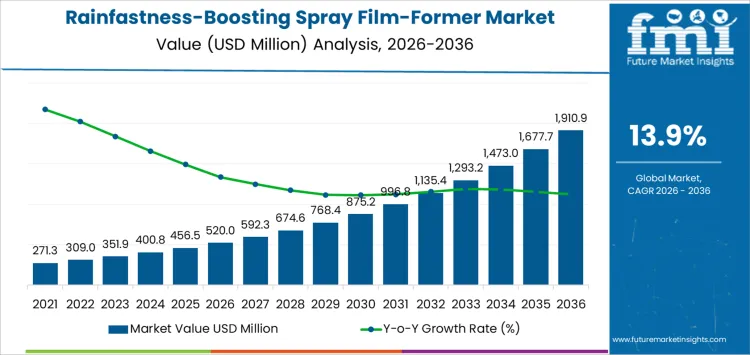
The rainfastness-boosting spray film-former market is valued at USD 520 million in 2026 and is projected to reach USD 1,910.9 million by 2036, reflecting a CAGR of 13.9%. Early growth from 2026 to 2031, increasing from approximately USD 282 million to USD 960 million, is driven by adoption in agricultural applications, particularly crop protection and foliar pesticide formulations. Enhanced film-forming chemistries improve adhesion and weather resistance, reducing wash-off and enabling more effective agrochemical delivery, prompting widespread uptake among growers and formulators globally.
Between 2031 and 2036, the market expands from roughly USD 1,084 million to USD 1,910.9 million. Growth contribution is reinforced by rising demand for higher-efficacy crop protection products, stricter regulatory requirements for reduced chemical runoff, and adoption of precision agriculture techniques. Innovation in polymeric carriers, UV-stable formulations, and eco-friendly film-formers further supports structural growth. The trajectory indicates strong value accumulation, with technological advancement and regulatory compliance driving sustained adoption across commercial and industrial agricultural sectors throughout the forecast period.
Quick Stats of the Rainfastness-Boosting Spray Film-Former Market:
- Rainfastness-Boosting Spray Film-Former Market Value (2026): USD 520 million
- Rainfastness-Boosting Spray Film-Former Market Forecast Value (2036): USD 1,910.9 million
- Rainfastness-Boosting Spray Film-Former Market Forecast CAGR (2026 to 2036): 13.9%
- Leading Compatibility Type in Rainfastness-Boosting Spray Film-Former Market: Systemic Pesticides (41%)
- Key Growth Regions in Rainfastness-Boosting Spray Film-Former Market: India, USA, Brazil, UK, China
- Top Players in Rainfastness-Boosting Spray Film-Former Market: AkzoNobel Surface Chemistry, Evonik Industries (Agro Additives), Arkema (Agro Polymers Division), Wacker Chemie AG, Elementis PLC
What is the Growth Forecast for the Rainfastness-Boosting Spray Film-Former Market through 2036?
From 2026 to 2031, the rainfastness-boosting spray film-former market grows from USD 520 million to approximately USD 960 million, representing the early adoption curve. Growth during this phase is driven by selective integration in agricultural spraying, horticulture, and turf management applications, where improved adhesion and weather resistance are critical for efficacy. Uptake is concentrated among high-value crops and pilot programs evaluating product performance under diverse environmental conditions. Annual value additions expand steadily as formulation stability, spray compatibility, and operational ease are validated, enabling gradual scaling without full market saturation.
Between 2031 and 2036, the market expands from roughly USD 960 million to USD 1,910.9 million, illustrating the late adoption curve characterized by structural scaling and broader commercial deployment. Growth accelerates as adoption spreads across large-scale agriculture, lawn care, and professional horticulture applications, supported by repeat procurement, higher per-hectare usage, and multi-region implementation. Annual value additions widen significantly, reflecting portfolio-wide adoption, improved supply chain integration, and embedded use in crop protection and turf maintenance programs. Early growth relied on selective pilot adoption, while later expansion is driven by full-scale operational integration and widespread market penetration.
Rainfastness Boosting Spray Film Former Market Key Takeaways
| Metric | Value |
|---|---|
| Market Value (2026) | USD 520 million |
| Forecast Value (2036) | USD 1,910.9 million |
| Forecast CAGR (2026 to 2036) | 13.9% |
What Is Driving the Demand for the Rainfastness-Boosting Spray Film Former Market?
Initial demand for rainfastness-boosting spray film formers grew from limitations in conventional agricultural spray applications where active ingredients washed off plant surfaces prematurely under rainfall. Traditional spray adjuvants provided limited adhesion under wet conditions, leading to reduced efficacy of pesticides, herbicides, and foliar nutrients. Farmers and crop protection formulators began adopting film-forming adjuvants that improved retention on leaves and stems, enhancing performance reliability. Historical growth reflected incremental improvements in crop protection outcomes rather than rapid technology shifts. Adoption was strongest in regions with unpredictable weather patterns where early rain events frequently undermined spray interventions.
Future demand for rainfastness-boosting spray film formers is expected to diverge from past drivers by aligning with regulatory scrutiny of spray adjuvants and integration with precision agriculture systems rather than solely spray retention performance. Environmental regulations are tightening on surfactants and adjuvant chemistries, prompting formulators to develop film formers that meet toxicity and biodegradability criteria. Advances in polymer science, biodegradable carriers, and humectant technologies will support film formers that balance rainfastness with environmental safety. Demand will be influenced by adoption of data-driven application methods that optimise spray volume, droplet size, and timing to match crop needs and weather forecasts.
What Factors Are Affecting the Demand for Rainfastness Boosting Spray Film Former Market in Terms of Film Former Chemistry and Compatibility Type?
Demand for rainfastness boosting spray film formers is segmented by film former chemistry and compatibility type across agricultural spray applications. Latex and acrylic polymer films account for about 35% of total demand, making this the leading chemistry segment. Silicone modified film formers, bio based resin and terpene films, and wax and paraffin emulsion systems represent additional chemistries without disclosed share splits. These chemistries differ in adhesion behavior, flexibility, and degradation profiles. Compatibility type defines how film formers interact with active spray formulations. Systemic pesticides, contact fungicides, insecticides, and foliar nutrients present different retention and uptake requirements. Together, these segments explain demand formation shaped by spray performance expectations, formulation stability, and field application conditions rather than crop type alone.
What Drives Demand by Film Former Chemistry in the Rainfastness Boosting Spray Film Former Market?
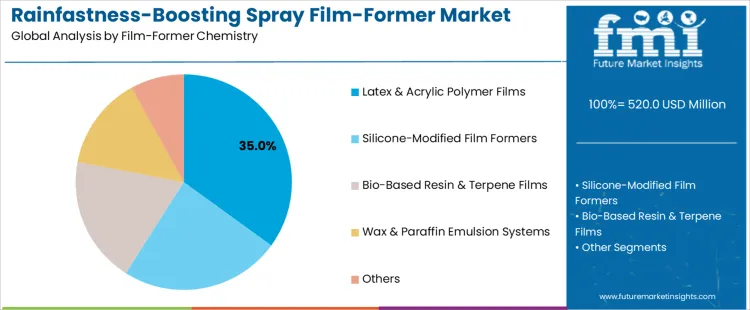
Latex and acrylic polymer films lead demand with a 35% share due to balanced adhesion, flexibility, and formulation stability. These chemistries form continuous films that improve spray retention under rainfall exposure. Silicone modified film formers are adopted where surface spreading and water repellency are required. Bio based resin and terpene films are used selectively in formulations targeting reduced residue persistence. Wax and paraffin emulsion systems support physical barrier formation on leaf surfaces. Adoption intensity aligns with crop sensitivity, spray frequency, and environmental exposure. Film former chemistry demand therefore reflects performance reliability and formulation compatibility rather than novelty or origin of raw materials.
Chemistry driven demand remains stable because spray formulations are qualified over multiple seasons. Agrochemical producers rely on proven film forming behavior to avoid efficacy variability. Silicone systems are applied cautiously due to interaction risks. Bio based films scale gradually as formulation consistency improves. Wax based systems persist in niche applications requiring physical coverage. These patterns limit rapid substitution. Film former chemistry segmentation highlights reliance on predictable field performance. Demand therefore aligns with formulation validation cycles and agronomic risk management rather than short term shifts in crop treatment strategies.
How Does Compatibility Type Shape Demand for Rainfastness Boosting Spray Film Former Market?
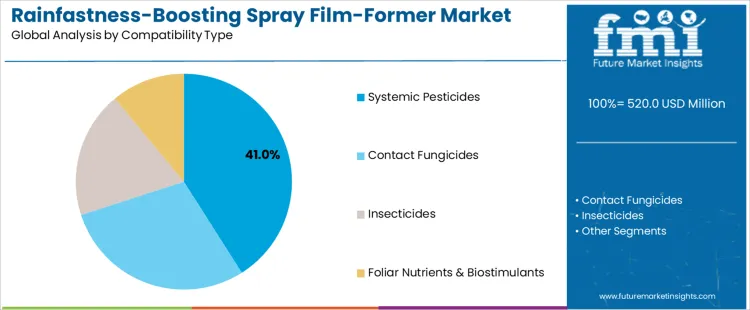
Systemic pesticide compatibility accounts for about 41% of total demand, making it the leading compatibility type. These applications require film formers that retain actives while allowing absorption into plant tissue. Contact fungicides use film formers to improve surface persistence and wash off resistance. Insecticide formulations adopt film formers to maintain leaf coverage during exposure periods. Foliar nutrients and biostimulants apply film formers to limit nutrient loss after application. Other compatibility uses address specialized crop treatments. Compatibility selection depends on interaction with active ingredients and spray behavior. Demand follows formulation performance requirements rather than crop segmentation.
Systemic compatibility maintains leadership due to widespread use of systemic products across crops. Contact fungicides rely on physical retention for efficacy. Insecticides require balanced adhesion without blocking activity. Nutrient sprays adopt film formers where rainfall timing affects uptake. Formulators prioritize compatibility to avoid reduced efficacy or phytotoxicity. Major compatibility changes are avoided due to regulatory and field trial constraints. This stabilizes demand distribution. Compatibility type therefore reinforces reliance on proven film former interactions within established agrochemical formulations.
How Are Rainfastness Boosting Spray Film Formers Being Applied Across Crop Protection and Horticultural Operations?
Use appears in agriculture and horticulture where foliar sprays require improved adhesion to plant surfaces under rainfall or irrigation conditions. Crop protection producers incorporate film formers in pesticide and fungicide formulations to extend residue longevity. Greenhouse operators use sprays on ornamental plants to maintain efficacy of nutrients and protective coatings. Fruit and vegetable growers apply them to reduce wash-off during rainfall events, ensuring uniform coverage. These applications reflect operational and efficacy priorities rather than cosmetic effects, with adoption driven by improved retention, consistent performance, and reduced chemical loss.
What Operational and Formulation Conditions Support Adoption of Rainfastness Boosting Spray Film Formers?
Selection aligns with formulations that maintain droplet adherence, spread evenly, and resist wash-off. Agrochemical engineers optimize polymer composition to be compatible with active ingredients without altering solubility or bioactivity. Sprayer calibration and application techniques are adapted to ensure uniform coverage and minimize runoff. Crop managers rely on film formers to reduce frequency of re-application, lowering labor and chemical costs. These conditions emerge from operational efficiency, product performance, and environmental impact considerations in structured crop protection workflows.
Which Practical Considerations Limit Wider Use of Rainfastness Boosting Spray Film Formers?
Compatibility with different active ingredients or tank mix components must be verified to prevent degradation or precipitation. Cost per application may be higher due to additional formulation complexity. Excessive film formation can lead to residue buildup or phytotoxicity on sensitive crops. Regulatory approval for adjuvant use varies by region. Equipment calibration and operator training are required to achieve optimal coverage. These factors lead to selective deployment where efficacy, environmental benefit, and operational efficiency justify incremental cost and application management.
What is the Demand for Rainfastness Boosting Spray Film Former by Country?
| Country | CAGR (%) |
|---|---|
| USA | 14.7% |
| Brazil | 14.2% |
| UK | 13.6% |
| China | 13.1% |
| India | 14.9% |
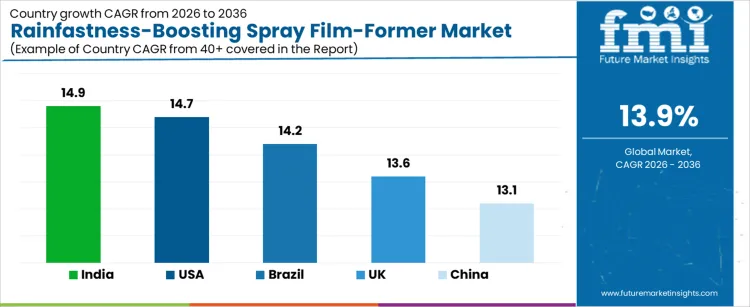
The demand for rainfastness boosting spray film-formers varies across countries, driven by agricultural intensification, crop protection practices, and adoption of advanced agrochemical formulations. India leads with a 14.9% CAGR, supported by extensive cultivation of high value crops, increasing use of foliar sprays, and a focus on minimizing pesticide wash-off. The USA follows at 14.7%, driven by large scale farming, horticulture, and adoption of protective spray technologies. Brazil records 14.2%, shaped by soybean, maize, and sugarcane production requiring enhanced adhesion of agrochemicals. The UK grows at 13.6%, supported by horticulture and specialty crop applications. China posts 13.1%, reflecting rising crop protection activities and integration of advanced spray technologies in commercial agriculture.
How Is Rainfastness-Enhancing Coating Technology Driving Growth in the United States?
In the United States, revenue from the Rainfastness-Boosting Spray Film-Former Market is expanding at a CAGR of 14.7% through 2035, driven by adoption of advanced spray film-formers to improve adhesion and rain resistance in agricultural, horticultural, and turf applications. Manufacturers are integrating formulations compatible with herbicides, pesticides, and foliar fertilizers to enhance efficacy and reduce wash-off. Demand is concentrated across commercial agriculture, landscaping, and professional turf management. Domestic suppliers provide high-performance spray additives designed for stability, uniform coverage, and compatibility with common agrochemical products. Increasing focus on crop yield, product performance, and recurring seasonal applications are sustaining predictable procurement nationwide.
- Agricultural, horticultural, and turf management applications drive rainfastness-boosting spray film adoption
- Formulations enhance adhesion and resistance to wash-off
- Domestic suppliers provide additives compatible with herbicides, pesticides, and foliar fertilizers
- Seasonal application cycles sustain predictable procurement
How Are Sustainability and Crop Protection Standards Supporting Growth in Brazil?
Brazil is seeing strong growth in the Rainfastness-Boosting Spray Film-Former Market at a CAGR of 14.2% through 2035, supported by large-scale agricultural operations and environmental regulations promoting efficient chemical use. Manufacturers are integrating spray film-formers to improve rainfastness of pesticides, herbicides, and foliar nutrients across soy, sugarcane, and horticultural crops. Demand is concentrated in commercial farms and agribusiness supply chains. Domestic suppliers provide robust, high-adhesion additives compatible with various application equipment. Focus on crop protection efficacy, reduced chemical loss, and recurring seasonal spraying cycles are sustaining consistent procurement nationwide.
- Large-scale crop production drives adoption of rainfastness-boosting spray film-formers
- Pesticides, herbicides, and foliar nutrients anchor demand
- Domestic suppliers provide high-adhesion, application-compatible additives
- Recurring seasonal spraying cycles sustain predictable procurement
How Is Professional Turf and Crop Management Driving Adoption in the United Kingdom?
In the United Kingdom, revenue from the Rainfastness-Boosting Spray Film-Former Market is growing at a CAGR of 13.6% through 2035, driven by demand for improved performance of foliar agrochemicals under variable weather conditions. Turf management, horticulture, and specialty crops are integrating spray film-formers to maintain adhesion and reduce chemical wash-off. Demand is concentrated in commercial agriculture, ornamental horticulture, and golf course management. Domestic suppliers provide stable, high-performance additives compatible with standard spraying equipment. Focus on product efficacy, compliance with environmental guidelines, and seasonal applications are sustaining predictable procurement across operators nationwide.
- Turf management, horticulture, and specialty crops drive adoption of spray film-formers
- Additives enhance adhesion and reduce wash-off under variable weather
- Domestic suppliers provide stable, high-performance, application-compatible products
- Seasonal agrochemical applications sustain predictable procurement
How Is Agricultural Intensification Accelerating Adoption in China?
In China, revenue from the Rainfastness-Boosting Spray Film-Former Market is expanding at a CAGR of 13.1% through 2035, driven by intensification of crop production and demand for foliar chemical performance improvement. Manufacturers are integrating spray film-formers with herbicides, pesticides, and foliar nutrients to maintain adhesion during rainfall. Demand is strong across rice, vegetable, and horticultural crops distributed through commercial farming networks. Domestic suppliers are scaling production of high-efficiency, weather-resistant additives compatible with modern spraying equipment. High crop volumes and recurring seasonal applications are sustaining rapid adoption nationwide.
- Commercial rice, vegetable, and horticultural crops drive spray film-former adoption
- Additives enhance chemical adhesion and rainfastness
- Domestic suppliers scale production of high-efficiency, weather-resistant products
- Recurring seasonal applications sustain consistent adoption
How Is Organized Agriculture Supporting Growth in India?
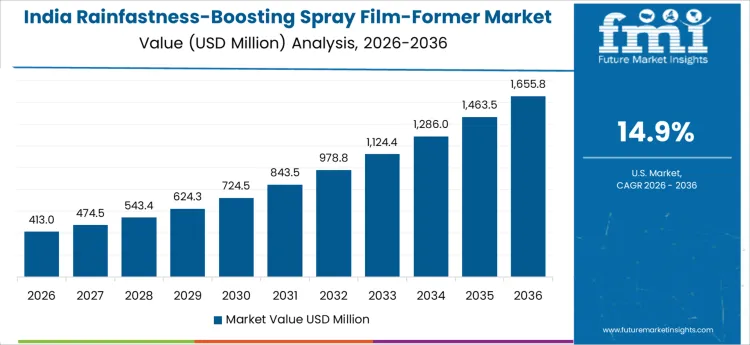
India is witnessing strong expansion in the Rainfastness-Boosting Spray Film-Former Market at a CAGR of 14.9% through 2035, supported by organized farming, horticultural intensification, and demand for effective foliar chemical application. Manufacturers are integrating spray film-formers with herbicides, pesticides, and foliar fertilizers to maintain adhesion and performance during monsoon and irregular rainfall periods. Demand is rising across commercial farms, orchards, and institutional horticulture. Domestic suppliers provide high-adhesion, durable spray additives compatible with modern spraying systems. Seasonal crop cycles, regulatory guidance, and recurring foliar chemical applications are sustaining robust procurement nationwide.
- Organized farms, orchards, and institutional horticulture drive adoption of spray film-formers
- Additives maintain adhesion and efficacy during monsoon and rainfall
- Domestic suppliers provide durable, high-adhesion spray additives
- Seasonal crop cycles and recurring foliar applications sustain procurement
Which Companies Are Shaping Competition in The Rainfastness Boosting Spray Film Former Market for Agricultural Applications?
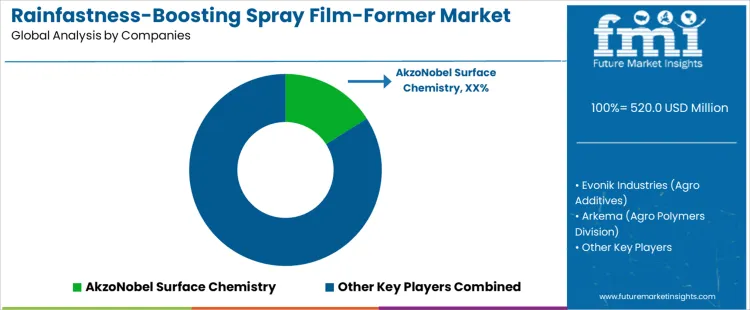
Competition in the Rainfastness Boosting Spray Film Former Market is driven by specialty chemical suppliers developing polymer and surface active systems for crop protection formulations. AkzoNobel Surface Chemistry plays a central role through functional additives designed to improve spray retention and adhesion under variable weather conditions. Evonik Industries contributes through agro additive portfolios focused on film formation and droplet behavior control. Arkema participates via its agro polymers division, supplying binders and dispersions used to enhance rainfastness in foliar applications. Wacker Chemie AG supports the market through silicone based and hybrid polymer systems tailored for agricultural sprays. These companies compete on formulation compatibility, stability under field conditions, and consistency across different active ingredients.
Mid-sized additive suppliers and niche specialists add depth to competitive dynamics. Elementis PLC contributes through rheology modifiers and surface chemistry solutions adapted for agricultural use, supporting improved coverage and resistance to wash off. Other regional and formulation focused players participate by supplying custom film formers and blends designed for specific crops, climates, and application methods. These firms often work closely with agrochemical formulators to align performance with regulatory and crop specific requirements. Competitive positioning reflects laboratory validation, field performance consistency, and ease of incorporation into existing formulations. Entry barriers are shaped by formulation expertise, regulatory acceptance, and customer qualification cycles rather than manufacturing scale alone.
Key Players in the Rainfastness Boosting Spray Film Former Market
- AkzoNobel Surface Chemistry
- Evonik Industries (Agro Additives)
- Arkema (Agro Polymers Division)
- Wacker Chemie AG
- Elementis PLC
- Others
Scope of the Report
| Items | Values |
|---|---|
| Quantitative Units (2026) | USD million |
| Film-Former Chemistry | Latex & Acrylic Polymer Films; Silicone-Modified Film Formers; Bio-Based Resin & Terpene Films; Wax & Paraffin Emulsion Systems; Others |
| Compatibility Type | Systemic Pesticides; Contact Fungicides; Insecticides; Foliar Nutrients & Biostimulants |
| Crop Type | Fruits & Vegetables; Cereals & Grains; Plantation & Export Crops; Vineyards; Others |
| Region | Asia Pacific; Europe; North America; Latin America; Middle East & Africa |
| Countries Covered | China; Japan; South Korea; India; Australia & New Zealand; ASEAN; Germany; United Kingdom; France; Italy; Spain; Nordic; BENELUX; United States; Canada; Mexico; Brazil; Chile; Kingdom of Saudi Arabia; Other GCC Countries; Turkey; South Africa; Other African Union; Rest of Asia Pacific; Rest of Europe; Rest of Latin America; Rest of Middle East & Africa |
| Key Companies Profiled | AkzoNobel Surface Chemistry; Evonik Industries (Agro Additives); Arkema (Agro Polymers Division); Wacker Chemie AG; Elementis PLC; Others |
| Additional Attributes | Dollar by sales across film-former chemistries, compatibility types, and crop applications; Latex & acrylic polymers lead due to adhesion, flexibility, and formulation stability; Systemic pesticide compatibility drives largest segment due to wide use in foliar applications; Bio-based and silicone-modified films support niche or environmentally conscious formulations; Adoption reinforced by regulatory compliance, crop protection efficacy, and reduced wash-off; Domestic and regional suppliers provide high-performance additives compatible with standard spraying equipment; Recurring procurement occurs with seasonal crop cycles for fruits, cereals, and plantation crops; High-value crops, professional horticulture, and precision agriculture applications sustain repeated adoption; Market growth supported by innovation in polymer carriers, UV-stable formulations, and environmentally friendly film-formers. |
Rainfastness Boosting Spray Film Former Market Segmentation
Film-Former Chemistry:
- Latex & Acrylic Polymer Films
- Silicone-Modified Film Formers
- Bio-Based Resin & Terpene Films
- Wax & Paraffin Emulsion Systems
- Others
Compatibility Type:
- Systemic Pesticides
- Contact Fungicides
- Insecticides
- Foliar Nutrients & Biostimulants
Crop Type:
- Fruits & Vegetables
- Cereals & Grains
- Plantation & Export Crops
- Vineyards
- Others
Region
- Asia Pacific
- China
- Japan
- South Korea
- India
- Australia & New Zealand
- ASEAN
- Rest of Asia Pacific
- Europe
- Germany
- United Kingdom
- France
- Italy
- Spain
- Nordic
- BENELUX
- Rest of Europe
- North America
- United States
- Canada
- Mexico
- Latin America
- Brazil
- Chile
- Rest of Latin America
- Middle East & Africa
- Kingdom of Saudi Arabia
- Other GCC Countries
- Turkey
- South Africa
- Other African Union
- Rest of Middle East & Africa
Bibliography
- United States Environmental Protection Agency. (2023). EPA guidelines for pesticide adjuvants and spray adjuvant classification including rainfastness and surfactant roles. EPA Regulatory and Guidance Publications.
- CropLife America. (2023). Best practice guidance for pesticide adjuvants, spray modifiers, and rainfastness enhancement in crop protection. CropLife Technical Guidance Documents.
- Society of Chemical Industry. (2023). Agricultural adjuvants, spray film-formers, and their role in application performance. SCI Technical Reports.
- North Central Weed Science Society of America. (2023). Research and field recommendations for adjuvant use and rainfast spray technology in agronomic applications.
Frequently Asked Questions
How big is the rainfastness-boosting spray film-former market in 2026?
The global rainfastness-boosting spray film-former market is estimated to be valued at USD 520.0 million in 2026.
What will be the size of rainfastness-boosting spray film-former market in 2036?
The market size for the rainfastness-boosting spray film-former market is projected to reach USD 1,910.9 million by 2036.
How much will be the rainfastness-boosting spray film-former market growth between 2026 and 2036?
The rainfastness-boosting spray film-former market is expected to grow at a 13.9% CAGR between 2026 and 2036.
What are the key product types in the rainfastness-boosting spray film-former market?
The key product types in rainfastness-boosting spray film-former market are latex & acrylic polymer films, silicone-modified film formers, bio-based resin & terpene films, wax & paraffin emulsion systems and others.
Which compatibility type segment to contribute significant share in the rainfastness-boosting spray film-former market in 2026?
In terms of compatibility type, systemic pesticides segment to command 41.0% share in the rainfastness-boosting spray film-former market in 2026.
Preview the report firsthand - request a free sample
Get SampleGet the brochure for pricing and purchase details.
Get PDFTable of Content
- Executive Summary
- Global Market Outlook
- Demand-side Trends
- Supply-side Trends
- Technology Roadmap Analysis
- Analysis and Recommendations
- Market Overview
- Market Coverage / Taxonomy
- Market Definition / Scope / Limitations
- Market Background
- Market Dynamics
- Drivers
- Restraints
- Opportunity
- Trends
- Scenario Forecast
- Demand in Optimistic Scenario
- Demand in Likely Scenario
- Demand in Conservative Scenario
- Opportunity Map Analysis
- Product Life Cycle Analysis
- Supply Chain Analysis
- Investment Feasibility Matrix
- Value Chain Analysis
- PESTLE and Porter’s Analysis
- Regulatory Landscape
- Regional Parent Market Outlook
- Production and Consumption Statistics
- Import and Export Statistics
- Market Dynamics
- Global Market Analysis 2021 to 2025 and Forecast, 2026 to 2036
- Historical Market Size Value (USD Million) Analysis, 2021 to 2025
- Current and Future Market Size Value (USD Million) Projections, 2026 to 2036
- Y-o-Y Growth Trend Analysis
- Absolute $ Opportunity Analysis
- Global Market Pricing Analysis 2021 to 2025 and Forecast 2026 to 2036
- Global Market Analysis 2021 to 2025 and Forecast 2026 to 2036, By Film-Former Chemistry
- Introduction / Key Findings
- Historical Market Size Value (USD Million) Analysis By Film-Former Chemistry , 2021 to 2025
- Current and Future Market Size Value (USD Million) Analysis and Forecast By Film-Former Chemistry , 2026 to 2036
- Latex & Acrylic Polymer Films
- Silicone-Modified Film Formers
- Bio-Based Resin & Terpene Films
- Wax & Paraffin Emulsion Systems
- Others
- Y-o-Y Growth Trend Analysis By Film-Former Chemistry , 2021 to 2025
- Absolute $ Opportunity Analysis By Film-Former Chemistry , 2026 to 2036
- Global Market Analysis 2021 to 2025 and Forecast 2026 to 2036, By Compatibility Type
- Introduction / Key Findings
- Historical Market Size Value (USD Million) Analysis By Compatibility Type, 2021 to 2025
- Current and Future Market Size Value (USD Million) Analysis and Forecast By Compatibility Type, 2026 to 2036
- Systemic Pesticides
- Contact Fungicides
- Insecticides
- Foliar Nutrients & Biostimulants
- Y-o-Y Growth Trend Analysis By Compatibility Type, 2021 to 2025
- Absolute $ Opportunity Analysis By Compatibility Type, 2026 to 2036
- Global Market Analysis 2021 to 2025 and Forecast 2026 to 2036, By Crop Type
- Introduction / Key Findings
- Historical Market Size Value (USD Million) Analysis By Crop Type, 2021 to 2025
- Current and Future Market Size Value (USD Million) Analysis and Forecast By Crop Type, 2026 to 2036
- Fruits & Vegetables
- Cereals & Grains
- Plantation & Export Crops
- Vineyards
- Others
- Y-o-Y Growth Trend Analysis By Crop Type, 2021 to 2025
- Absolute $ Opportunity Analysis By Crop Type, 2026 to 2036
- Global Market Analysis 2021 to 2025 and Forecast 2026 to 2036, By Region
- Introduction
- Historical Market Size Value (USD Million) Analysis By Region, 2021 to 2025
- Current Market Size Value (USD Million) Analysis and Forecast By Region, 2026 to 2036
- North America
- Latin America
- Western Europe
- Eastern Europe
- East Asia
- South Asia and Pacific
- Middle East & Africa
- Market Attractiveness Analysis By Region
- North America Market Analysis 2021 to 2025 and Forecast 2026 to 2036, By Country
- Historical Market Size Value (USD Million) Trend Analysis By Market Taxonomy, 2021 to 2025
- Market Size Value (USD Million) Forecast By Market Taxonomy, 2026 to 2036
- By Country
- USA
- Canada
- Mexico
- By Film-Former Chemistry
- By Compatibility Type
- By Crop Type
- By Country
- Market Attractiveness Analysis
- By Country
- By Film-Former Chemistry
- By Compatibility Type
- By Crop Type
- Key Takeaways
- Latin America Market Analysis 2021 to 2025 and Forecast 2026 to 2036, By Country
- Historical Market Size Value (USD Million) Trend Analysis By Market Taxonomy, 2021 to 2025
- Market Size Value (USD Million) Forecast By Market Taxonomy, 2026 to 2036
- By Country
- Brazil
- Chile
- Rest of Latin America
- By Film-Former Chemistry
- By Compatibility Type
- By Crop Type
- By Country
- Market Attractiveness Analysis
- By Country
- By Film-Former Chemistry
- By Compatibility Type
- By Crop Type
- Key Takeaways
- Western Europe Market Analysis 2021 to 2025 and Forecast 2026 to 2036, By Country
- Historical Market Size Value (USD Million) Trend Analysis By Market Taxonomy, 2021 to 2025
- Market Size Value (USD Million) Forecast By Market Taxonomy, 2026 to 2036
- By Country
- Germany
- UK
- Italy
- Spain
- France
- Nordic
- BENELUX
- Rest of Western Europe
- By Film-Former Chemistry
- By Compatibility Type
- By Crop Type
- By Country
- Market Attractiveness Analysis
- By Country
- By Film-Former Chemistry
- By Compatibility Type
- By Crop Type
- Key Takeaways
- Eastern Europe Market Analysis 2021 to 2025 and Forecast 2026 to 2036, By Country
- Historical Market Size Value (USD Million) Trend Analysis By Market Taxonomy, 2021 to 2025
- Market Size Value (USD Million) Forecast By Market Taxonomy, 2026 to 2036
- By Country
- Russia
- Poland
- Hungary
- Balkan & Baltic
- Rest of Eastern Europe
- By Film-Former Chemistry
- By Compatibility Type
- By Crop Type
- By Country
- Market Attractiveness Analysis
- By Country
- By Film-Former Chemistry
- By Compatibility Type
- By Crop Type
- Key Takeaways
- East Asia Market Analysis 2021 to 2025 and Forecast 2026 to 2036, By Country
- Historical Market Size Value (USD Million) Trend Analysis By Market Taxonomy, 2021 to 2025
- Market Size Value (USD Million) Forecast By Market Taxonomy, 2026 to 2036
- By Country
- China
- Japan
- South Korea
- By Film-Former Chemistry
- By Compatibility Type
- By Crop Type
- By Country
- Market Attractiveness Analysis
- By Country
- By Film-Former Chemistry
- By Compatibility Type
- By Crop Type
- Key Takeaways
- South Asia and Pacific Market Analysis 2021 to 2025 and Forecast 2026 to 2036, By Country
- Historical Market Size Value (USD Million) Trend Analysis By Market Taxonomy, 2021 to 2025
- Market Size Value (USD Million) Forecast By Market Taxonomy, 2026 to 2036
- By Country
- India
- ASEAN
- Australia & New Zealand
- Rest of South Asia and Pacific
- By Film-Former Chemistry
- By Compatibility Type
- By Crop Type
- By Country
- Market Attractiveness Analysis
- By Country
- By Film-Former Chemistry
- By Compatibility Type
- By Crop Type
- Key Takeaways
- Middle East & Africa Market Analysis 2021 to 2025 and Forecast 2026 to 2036, By Country
- Historical Market Size Value (USD Million) Trend Analysis By Market Taxonomy, 2021 to 2025
- Market Size Value (USD Million) Forecast By Market Taxonomy, 2026 to 2036
- By Country
- Kingdom of Saudi Arabia
- Other GCC Countries
- Turkiye
- South Africa
- Other African Union
- Rest of Middle East & Africa
- By Film-Former Chemistry
- By Compatibility Type
- By Crop Type
- By Country
- Market Attractiveness Analysis
- By Country
- By Film-Former Chemistry
- By Compatibility Type
- By Crop Type
- Key Takeaways
- Key Countries Market Analysis
- USA
- Pricing Analysis
- Market Share Analysis, 2025
- By Film-Former Chemistry
- By Compatibility Type
- By Crop Type
- Canada
- Pricing Analysis
- Market Share Analysis, 2025
- By Film-Former Chemistry
- By Compatibility Type
- By Crop Type
- Mexico
- Pricing Analysis
- Market Share Analysis, 2025
- By Film-Former Chemistry
- By Compatibility Type
- By Crop Type
- Brazil
- Pricing Analysis
- Market Share Analysis, 2025
- By Film-Former Chemistry
- By Compatibility Type
- By Crop Type
- Chile
- Pricing Analysis
- Market Share Analysis, 2025
- By Film-Former Chemistry
- By Compatibility Type
- By Crop Type
- Germany
- Pricing Analysis
- Market Share Analysis, 2025
- By Film-Former Chemistry
- By Compatibility Type
- By Crop Type
- UK
- Pricing Analysis
- Market Share Analysis, 2025
- By Film-Former Chemistry
- By Compatibility Type
- By Crop Type
- Italy
- Pricing Analysis
- Market Share Analysis, 2025
- By Film-Former Chemistry
- By Compatibility Type
- By Crop Type
- Spain
- Pricing Analysis
- Market Share Analysis, 2025
- By Film-Former Chemistry
- By Compatibility Type
- By Crop Type
- France
- Pricing Analysis
- Market Share Analysis, 2025
- By Film-Former Chemistry
- By Compatibility Type
- By Crop Type
- India
- Pricing Analysis
- Market Share Analysis, 2025
- By Film-Former Chemistry
- By Compatibility Type
- By Crop Type
- ASEAN
- Pricing Analysis
- Market Share Analysis, 2025
- By Film-Former Chemistry
- By Compatibility Type
- By Crop Type
- Australia & New Zealand
- Pricing Analysis
- Market Share Analysis, 2025
- By Film-Former Chemistry
- By Compatibility Type
- By Crop Type
- China
- Pricing Analysis
- Market Share Analysis, 2025
- By Film-Former Chemistry
- By Compatibility Type
- By Crop Type
- Japan
- Pricing Analysis
- Market Share Analysis, 2025
- By Film-Former Chemistry
- By Compatibility Type
- By Crop Type
- South Korea
- Pricing Analysis
- Market Share Analysis, 2025
- By Film-Former Chemistry
- By Compatibility Type
- By Crop Type
- Russia
- Pricing Analysis
- Market Share Analysis, 2025
- By Film-Former Chemistry
- By Compatibility Type
- By Crop Type
- Poland
- Pricing Analysis
- Market Share Analysis, 2025
- By Film-Former Chemistry
- By Compatibility Type
- By Crop Type
- Hungary
- Pricing Analysis
- Market Share Analysis, 2025
- By Film-Former Chemistry
- By Compatibility Type
- By Crop Type
- Kingdom of Saudi Arabia
- Pricing Analysis
- Market Share Analysis, 2025
- By Film-Former Chemistry
- By Compatibility Type
- By Crop Type
- Turkiye
- Pricing Analysis
- Market Share Analysis, 2025
- By Film-Former Chemistry
- By Compatibility Type
- By Crop Type
- South Africa
- Pricing Analysis
- Market Share Analysis, 2025
- By Film-Former Chemistry
- By Compatibility Type
- By Crop Type
- USA
- Market Structure Analysis
- Competition Dashboard
- Competition Benchmarking
- Market Share Analysis of Top Players
- By Regional
- By Film-Former Chemistry
- By Compatibility Type
- By Crop Type
- Competition Analysis
- Competition Deep Dive
- AkzoNobel Surface Chemistry
- Overview
- Product Portfolio
- Profitability by Market Segments (Product/Age /Sales Channel/Region)
- Sales Footprint
- Strategy Overview
- Marketing Strategy
- Product Strategy
- Channel Strategy
- Evonik Industries (Agro Additives)
- Arkema (Agro Polymers Division)
- Wacker Chemie AG
- Elementis PLC
- Others
- AkzoNobel Surface Chemistry
- Competition Deep Dive
- Assumptions & Acronyms Used
- Research Methodology


