

- Market Size (2026)
- USD 1.1 Bn
- Forecast (2036)
- USD 3.6 Bn
- CAGR (2026 to 2036)
- 12.3%
How big is Ready-to-Fill Tart Shells Market in 2026?
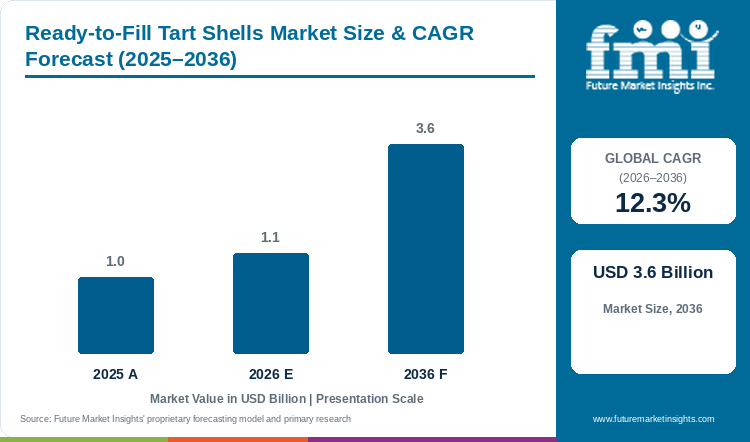
Starting from USD 1.0 billion in 2025, the ready-to-fill tart shells market valuation advanced to USD 1.1 billion in 2026, with projections pointing toward USD 3.6 billion by 2036 at a CAGR of 12.3%.
Hotel banquet kitchens and supermarket bakeries are shifting away from rolling and blind-baking pastry dough in-house to cut skilled preparation hours and keep dessert portion costs predictable. That operational transition is reflected in July 2026 figures published by USDA Economic Research Service analysts showing that full-service and limited-service restaurants captured 71.0% of away-from-home dining activity in 2025, creating steady institutional demand for time-saving pastry bases [1]. Commercial catering teams buy pre-baked shells to assemble fruit tarts and savory canapés without adding oven staff. Within the product type category, sweet shortcrust shells are expected to hold a 32.0% share in 2026 because one neutral butter-flour recipe holds custards and glazed berries while outpacing the 5.4% CAGR of frozen pastries. According to FMI, the global ready-to-fill tart shells market size reached USD 1.0 billion in 2025 and is estimated at USD 1.1 billion in 2026, reaching USD 3.6 billion by 2036 on a 12.3% CAGR. Even so, fragile rim breakage during multi-stop delivery and crust softening after wet filling continue to limit faster buyer conversion.
Key Market Trends & Insights
- By product type: Sweet shortcrust shells are expected to hold a 32.0% share in 2026 because neutral butter-flour bases accept fruit curds and chocolate fillings without line changeovers.
- By claim / nature: Conventional formulations are estimated to hold a 53.0% share in 2026 owing to predictable shortening plasticity and lower supplier qualification friction.
- By format: Frozen shells are projected to account for a 30.0% share in 2026 attributable to banquet kitchens holding buffer inventory for weekend event assembly.
- By packaging format: Multipack cases are predicted to record a 36.0% share in 2026 supported by thermoformed cavity trays that isolate fragile tartlet edges during shipping.
- By sales channel: Supermarkets and hypermarkets are anticipated to hold a 30.0% share in 2026 enabled by in-store patisserie counters and home-baking dessert aisles.
Regional Highlights
- Top national expansion: The UAE is forecast to lead profiled countries at a 13.5% CAGR through 2036 due to high-occupancy hotel banquet catering and luxury pastry buffets.
- Broader country progression: Saudi Arabia is projected to expand at a 13.2% CAGR ahead of South Korea at 12.8% and the USA at 12.5%, while Japan is estimated to register an 11.2% CAGR.
Market Size & Forecast
Table 1: Market Size and Forecast for the Ready-to-Fill Tart Shells Market (USD billion and CAGR percentage), 2025 to 2036
| Metric | Value |
|---|---|
| 2025 Market Size | USD 1.0 billion |
| Estimated Market Size in 2026 | USD 1.1 billion |
| Projected Market Size by 2036 | USD 3.6 billion |
| CAGR, 2026 to 2036 | 12.3% |
| Added Revenue, 2026 to 2036 | USD 2.5 billion |
Commercial patisseries and hotel banquet kitchens face persistent shortages of trained dough-sheeting bakers and rising kitchen payroll costs. Manual pressing and docking of tart tins often produces uneven wall thickness and inconsistent browning across morning baking shifts. In August 2026, a bakery storage study published in Foods showed that adding natural soybean oligosaccharides to frozen wheat dough reduces post-bake hardness by 15.27% and keeps pastry walls uniform during minus 18 degrees Celsius holding [2]. As a result, executive pastry chefs are replacing scratch dough preparation with pre-baked shells and frozen dough inputs to protect banquet margins.
Kitchen-Pool and Case-Requirement Sizing
Table 2: Kitchen-Pool and Case-Requirement Sizing for the Ready-to-Fill Tart Shells Market (USD billion and operational ranges), 2025 to 2036
| Metric | 2025 | 2026 | 2036 |
|---|---|---|---|
| Market size (USD billion) | 1.0 | 1.1 | 3.6 |
| Commercial pastry & banquet kitchens (million) | 0.8 to 0.9 | 0.9 to 1.0 | 1.4 to 1.6 |
| Preformed tart shells consumed per day (million) | 14.5 to 16.2 | 16.0 to 18.0 | 42.0 to 48.0 |
| Usable shell recovery rate after transit (%) | 94.0% to 96.0% | 94.5% to 96.5% | 97.0% to 98.5% |
Operational note: Kitchen-pool ranges reflect commercial hotel and supermarket bake-off outlets procuring preformed sweet and savory pastry cases across daily dessert and canapé assembly schedules.
Banquet procurement teams evaluate tart shell vendors on intact usable shells per 240-unit carton instead of headline factory case price. Distributors pair molded cases with bake-stable pastry fillings so kitchen staff finish fruit and custard tarts minutes before service.
Per Capita & Foodservice Establishment Sizing
Table 3: Per Capita and Establishment Spending Indicators for the Ready-to-Fill Tart Shells Market (USD), 2025 to 2036
| Metric | 2025 | 2026 | 2036 |
|---|---|---|---|
| World population (billion) | 8.2 | 8.3 | 9.0 |
| Spend per 1,000 people (USD) | 122.0 | 132.5 | 400.0 |
| Annual spend per commercial bakery outlet (USD) | 1,110.0 to 1,250.0 | 1,220.0 to 1,380.0 | 2,250.0 to 2,570.0 |
| Professional foodservice contract share (%) | 62.0% to 66.0% | 63.0% to 67.0% | 68.0% to 72.0% |
Table 4: Establishment & Channel Spending Indicators for the Ready-to-Fill Tart Shells Market (USD and percentages), 2026
| Metric | Value | Institutional Reference Basis |
|---|---|---|
| Market size, 2026 | USD 1.1 billion | 2026 global valuation baseline |
| Commercial bakery & hotel outlets | 0.9 million | Global patisserie and hospitality kitchen registry |
| Market spend per outlet | USD 1,222.2 | Annualized preformed shell procurement |
| Supermarket & hypermarket allocation, 2026 | USD 0.3 billion | 30.0% primary sales channel share |
Moisture barriers between wet custard or fruit fillings and baked shortcrust walls govern shelf-life retention in retail display cases. Industrial bakers coat interior shell walls with cocoa-butter layers sourced from bakery ingredients suppliers to keep crusts crisp through 48-hour chilled merchandising.
Analyst Perspective
"Foodservice pastry buyers judge preformed tart shells on net intact units recovered per case and crispness retention four hours after filling. Manufacturers that combine internal cocoa-butter moisture barriers with shock-absorbing blister trays will secure multi-year hotel and supermarket supply contracts."
- Nandini Roy Choudhury, Principal Consultant, Future Market Insights.
How is the ready-to-fill tart shells market segmented?
The ready-to-fill tart shells market is segmented by product type, claim / nature, format, packaging format, and sales channel. In 2026, sweet shortcrust shells are projected at 32.0%, conventional at 53.0%, frozen at 30.0%, multipack at 36.0%, and supermarkets & hypermarkets at 30.0%.
By product type: Sweet shortcrust shells, savory shells, chocolate-lined, and mini & petit four.
By claim / nature: Conventional, clean label, organic, and gluten-free.
By format: Frozen, fresh, and ambient packaged.
By packaging format: Multipack, single-serve, and bulk foodservice.
By sales channel: Supermarkets & hypermarkets, artisan & specialty bakeries, convenience & forecourt, online & DTC, and foodservice distributors.
Why do Sweet shortcrust shells lead the product type category?
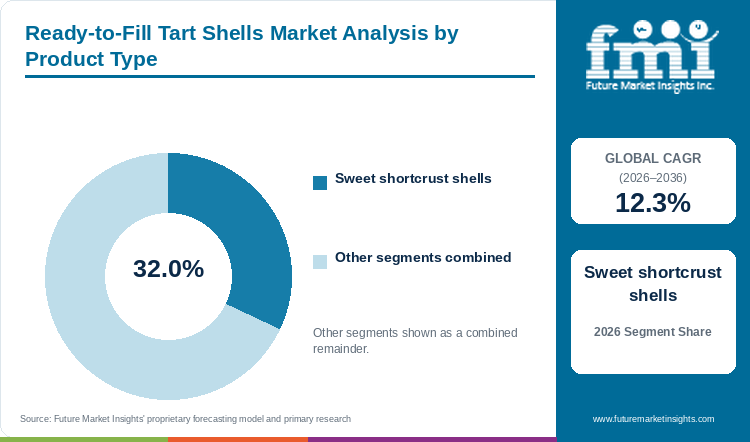
Sweet shortcrust shells are expected to hold a 32.0% share of the product type segment in 2026, driven by cross-menu dessert standardization.
Table 5: Product Type Share for the Ready-to-Fill Tart Shells Market (percentage share), 2026
| Product Type | Share (2026) |
|---|---|
| Sweet shortcrust shells | 32.0% |
| Other Segments Combined* | 68.0% |
| Total | 100.0% |
*Calculated as the balance remaining after deducting the leading segment's reported share from 100.0%.
Table 6: Product Type Leadership and Market Growth for the Ready-to-Fill Tart Shells Market (segment and CAGR percentage), 2026 to 2036
| Metric | Value |
|---|---|
| Global CAGR (2026 to 2036) | 12.3% |
| Leading Segment | Sweet shortcrust shells |
Executive pastry chefs standardize sweet shortcrust shells because one neutral butter-sugar pastry base accepts lemon curd and fresh berry glazes without altering oven deck schedules. Pre-docked round and square sweet tartlets eliminate dough rolling labor while complementing broader bakery products across hotel dessert buffets.
- Sweet shortcrust shells are expected to hold a 32.0% share in 2026 because standardized rim geometry simplifies portion costing across multi-item patisserie counters.
- A February 2025 shortening study in Food Chemistry confirmed that balancing solid fat profiles in baking shortenings improves pastry crispness and moisture resistance [3].
Why does Conventional define the largest claim / nature segment?
Conventional formulations are estimated to hold a 53.0% share of the claim / nature segment in 2026, owing to butterfat lamination stability.
High-volume commissaries favor conventional wheat-flour and butter shortcrust recipes because standard wheat doughs resist rim cracking during mechanical stamping and de-panning. Allergen-free tartlet lines require segregated milling rooms and specialized gluten-free bakery premix binders that raise unit case cost.
- Conventional products are estimated to hold a 53.0% share in 2026 resulting from predictable baking shrinkage and lower raw-material qualification overhead.
- In March 2026, the U.S. Food and Drug Administration updated its Gluten-Free Labeling of Foods regulatory portal requiring below 20 parts per million gluten thresholds across certified bakery SKUs [4].
What keeps Frozen ahead by format?
Frozen shells are projected to account for a 30.0% share of the format segment in 2026, attributable to banquet buffer stockholding.
Event caterers and central hotel kitchens procure frozen tart shells to separate pastry shell production from same-day banquet plating surges. Sub-zero storage at minus 18 degrees Celsius prevents fat rancidity and fits into wider frozen bakery cold-chain replenishment across regional foodservice depots.
- Frozen shells are projected to account for a 30.0% share in 2026 linked to zero ambient staling losses and flexible pull-thaw batching for weekend events.
- A June 2026 study in Food Chemistry X demonstrated that thermally buffered frozen storage over 60 days cuts temperature swings by 2.7-fold and prevents cracking in frozen wheat dough [5].
Why does Multipack lead the packaging format category?
Multipack configurations are predicted to record a 36.0% share of the packaging format segment in 2026, supported by compartmentalized tray protection.
Fragile shortcrust rims fracture easily when loose shells collide inside bulk corrugated cartons during last-mile courier and pallet movement. Multipack thermoformed blister sleeves isolate individual tartlets in dedicated cavities while matching the batch pull sizes used in refrigerated dough products across supermarket and café kitchens.
- Multipack formats are predicted to record a 36.0% share in 2026 associated with reduced transit breakage and convenient sleeve-by-sleeve kitchen opening.
- In August 2026, an International Journal of Biological Macromolecules study showed that combining xanthan gum and maltitol in frozen dough reduced mass loss to 1.96% and preserved 95.2% dough strength across five freeze-thaw cycles [6].
What gives Supermarkets & hypermarkets the leading position in sales channel?
Supermarkets and hypermarkets are anticipated to hold a 30.0% share of the sales channel segment in 2026, enabled by in-store bakery counters.
Grocery chains generate dual demand for ready-to-fill tart shells through in-store patisserie finishing counters and retail home-baking shelves. Supermarket category managers authorize multi-pack shortcrust cases next to dessert fillings and cake boards and drums to capture holiday entertaining baskets.
- Supermarkets and hypermarkets are anticipated to hold a 30.0% share in 2026 stemming from high weekly shopper footfall and centralized commissary tart programs.
- In August 2026, the USDA Economic Research Service Retail Trends update confirmed that supermarkets and grocery stores captured 56.2% of USA food-at-home spending in 2025 [7].
What are the drivers, restraints, and opportunities in the ready-to-fill tart shells market?
In the ready-to-fill tart shells market, culinary labor displacement in hotel and grocery patisseries drives recurring case orders whereas transit rim breakage restrains margins and cocoa-butter-lined mini shells create banquet catering opportunities.
- Driver: Persistent shortages of skilled pastry laminators push hotels and supermarket bakeries toward factory-molded tartlet cases that eliminate sheeting and blind-baking labor.
- Restraint: Rim chipping during multi-stop distribution and mandatory allergen cross-contact controls increase unusable shell waste and supplier onboarding costs.
- Opportunity: Pre-sprayed cocoa-butter interior coatings and single-bite canapé diameters open high-margin hotel banquet and airline catering contracts.
Growth Analysis and Future Potential: Qualitative Demand Catalysts
Hospitality operators and grocery in-store bakeries are removing manual dough mixing and tart-tin lining from daily kitchen schedules because skilled pastry labor commands high hourly wages. Uniform 3-millimeter shortcrust walls formed by hand often suffer from uneven bake times and high scrap rates across morning preparation shifts. Future Market Insights notes that centralizing crust production allows commissaries to redeploy staff toward high-margin fruit glazing plus phyllo pastry dessert assembly. In March 2025, a dough sheeting study in Food Chemistry X confirmed that controlled mechanical sheeting and resting cycles strengthen gluten bonding and prevent dough shrinkage during baking [8]. Banquet procurement directors therefore lock in annual supply agreements for calibrated ready-to-fill tart shells to guarantee uniform dessert plating.
Risk Assessment of the Ready-to-Fill Tart Shells Market: Operational and Formulation Friction
Mechanical fragility along thin fluted pastry rims and allergen testing rules during baking represent the primary operational barriers restricting supplier margins. When outer cartons experience drop shocks during cold-chain cross-docking, small cracks form along tartlet walls that cause liquid custard fillings to leak onto display trays. In May 2026, a baking allergen study published in Frontiers in Allergy demonstrated that baking dough at 185 to 210 degrees Celsius alters measurable egg and milk allergen levels by 86% to 98% between crust edges and centers [9]. Downstream foodservice buyers therefore demand validated raw-dough allergen swabbing and reinforced honeycomb dividers before onboarding new shell vendors. If broken or soggy units exceed 4% of carton count, kitchen controllers reject the shipment and revert to sheeted dough.
Commercial Opportunity Analysis: Formulation Differentiation and Value-Add Formats
Pastry manufacturers capture strong price premiums by producing moisture-barrier-lined miniature tartlet shells for standing cocktail receptions and luxury hotel afternoon-tea service. Unlined baked crusts absorb water from citrus curds and savory mousses within two hours, turning crisp shortcrust bases soft before guests are served. A thin cocoa-butter or dark-chocolate interior film extends filled holding stability past six hours on chilled buffet risers. In September 2026, a shortbread reformulation trial in Nutrients showed that erythritol-sweetened pastry recipes maintained consumer crispness scores while reducing glycemic load to 4.16 [10]. Suppliers that combine moisture-sealed cavities with clean-label butter recipes secure preferred vendor status across international hotel chains.
Ready-to-Fill Tart Shells Market by Country (2026 to 2036)
As per FMI, the UAE is projected to lead ready-to-fill tart shells expansion across profiled markets at a 13.5% CAGR through 2036, whereas Japan is forecast to progress at an 11.2% CAGR. Commercial uptake across Gulf hospitality hubs and European patisserie chains depends on banquet event density and low-breakage last-mile case packaging.
Table 7: Country CAGR and Primary Growth Levers for the Ready-to-Fill Tart Shells Market (CAGR percentage and operational drivers), 2026 to 2036
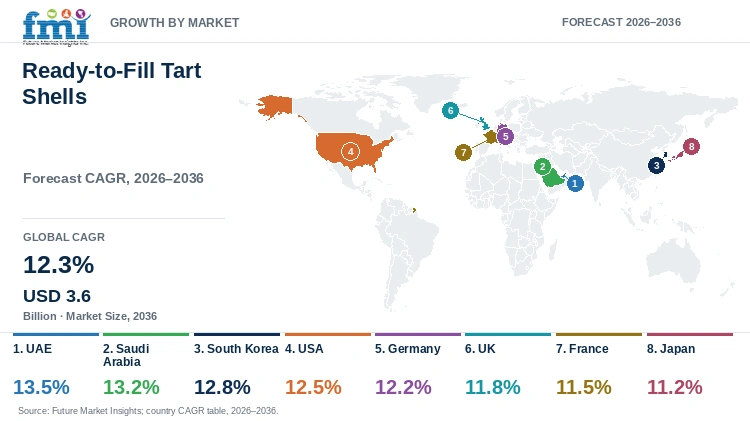
| Country | CAGR (2026 to 2036) | Primary Growth Lever |
|---|---|---|
| UAE | 13.5% | Record international hotel guest arrivals and luxury banquet pastry buffets |
| Saudi Arabia | 13.2% | Rapid expansion of licensed hospitality venues and GSO halal import compliance |
| South Korea | 12.8% | Cold-chain e-commerce bakery fulfillment and café dessert menu rotation |
| USA | 12.5% | High away-from-home dining share and supermarket in-store bakery labor savings |
| Germany | 12.2% | Hospitality margin pressure accelerating kitchen conversion to pre-baked cases |
| UK | 11.8% | CMA pastry supply remedies and strict prepacked allergen labeling compliance |
| France | 11.5% | Dense artisan boulangerie-patisserie network and frozen distribution consolidation |
| Japan | 11.2% | Precision miniature patisserie gifting standards and hotel buffet recovery |
Source: Future Market Insights analysis
UAE Ready-to-Fill Tart Shells Market Outlook (2026 to 2036)
Demand in the UAE is projected to expand at a 13.5% CAGR from 2026 to 2036, placing the country first among profiled markets. Unlike household-led European grocery markets, demand in the UAE is anchored by five-star hotel banquet kitchens and luxury mall patisseries serving year-round international business conferences. According to the USDA Foreign Agricultural Service in October 2026, consumer-oriented food imports into the UAE reached USD 17.7 billion in 2025 after rising 9.3% year on year [11]. High ambient summer temperatures and multi-stage port drayage require insulated reefer containers and rigid cavity blisters so imported butter tartlets arrive at resort kitchens without fat bloom or rim fractures.
Key takeaway: In the UAE, booming hotel banquet catering and USD 17.7 billion in consumer food imports are projected to drive premium demand for blister-packed miniature tart shells.
Saudi Arabia Ready-to-Fill Tart Shells Market Outlook (2026 to 2036)
New giga-project resort openings and religious tourism buffets set Saudi Arabia apart from mature Western bakery markets by generating rapid greenfield kitchen procurement across hospitality corridors. Market value in Saudi Arabia is estimated to advance at a 13.2% CAGR between 2026 and 2036 due to hospitality operators standardizing dessert buffet portioning. In August 2026, the USDA Foreign Agricultural Service reported that food retail sales in Saudi Arabia reached USD 57.0 billion in 2025 while U.S. retail food exports rose 22% in early 2026 [12]. Strict Gulf Standardization Organization halal certification rules banning porcine gelatin or alcohol carriers require European shell exporters to maintain audited halal-certified shortening lines before clearing customs.
Key takeaway: In Saudi Arabia, rapid resort construction and a USD 57.0 billion food retail sector are estimated to accelerate bulk foodservice imports of halal-certified tart shells.
South Korea Ready-to-Fill Tart Shells Market Outlook (2026 to 2036)
Whereas Gulf buyers purchase bulk banquet cartons, South Korea is distinguished by rapid café dessert menu turnover and dawn-delivery online grocery platforms supplying urban home bakers. In July 2026, the USDA Foreign Agricultural Service documented that South Korea imported USD 46.0 billion in agricultural and related products in 2025 to supply its convenience-driven retail sector [13]. Sales in South Korea are forecast to register a 12.8% CAGR from 2026 to 2036 owing to independent specialty coffee shops adopting pre-baked tart bases for seasonal fruit tarts. High parcel-handling velocity across last-mile courier networks forces suppliers to engineer crush-proof PET clamshells that prevent rim crumbling during doorstep delivery.
Key takeaway: In South Korea, specialty café dessert rotation and rapid online grocery fulfillment are forecast to sustain strong demand for cushion-packed tartlet shells.
USA Ready-to-Fill Tart Shells Market Outlook (2026 to 2036)
Commercial procurement in the USA splits between nationwide supermarket in-store bakery chains and large hotel-casino catering groups seeking to offset persistent culinary wage inflation across regional commissaries. In June 2026, the USDA Economic Research Service reported that total food expenditure in the USA reached USD 2.51 trillion in 2025, with food away from home capturing 56.3% [14]. However, the FDA's mandatory sesame allergen declaration rules and multi-state cold-chain freight rates penalize suppliers lacking dedicated allergen-segregated baking lines. Industry valuation in the USA is anticipated to record a 12.5% CAGR over 2026 to 2036 attributable to regional commissaries replacing scratch pie and tart dough pressing with pre-formed frozen shells.
Key takeaway: In the USA, a 56.3% away-from-home food expenditure share and high bakery labor costs are anticipated to shift commissaries toward pre-molded frozen tart shells.
Germany Ready-to-Fill Tart Shells Market Outlook (2026 to 2036)
Valuation in Germany is predicted to grow at a 12.2% CAGR from 2026 to 2036 resulting from commercial bakeries and hotel kitchens simplifying back-of-house pastry preparation workflows. Germany differs from high-growth Middle Eastern hospitality markets because elevated energy tariffs and a 19% restaurant turnover tax squeeze independent restaurant operating margins. According to the USDA Foreign Agricultural Service in September 2026, retail food sales in Germany reached USD 323.8 billion while agricultural imports climbed to USD 172.4 billion [15]. Because discount-heavy grocery chains in Germany enforce strict unit-price ceilings, commercial shell manufacturers must prove that pre-baked shortcrust cases lower net kitchen labor cost per plated dessert.
Key takeaway: In Germany, restaurant margin compression and a USD 323.8 billion retail food sector are predicted to favor labor-saving pre-baked shortcrust shells.
UK Ready-to-Fill Tart Shells Market Outlook (2026 to 2036)
What sets the UK apart from continental Europe is the high concentration of chilled food-to-go retail chains and strict prepacked-for-direct-sale allergen governance across commercial bakery estates. Market size in the UK is expected to rise at an 11.8% CAGR through 2036 supported by café chains and event caterers expanding afternoon-tea pastry assortments. In October 2026, the UK Competition and Markets Authority accepted final undertakings in the Vandemoortele and Délifrance merger inquiry to preserve competitive frozen bakery supply across UK foodservice customers [16]. Simultaneously, UK Food Standards Agency allergen recording rules require coffee shops filling tart shells on-site to maintain verifiable ingredient specifications for every batch.
Key takeaway: In the UK, regulatory protection of frozen bakery competition and strict allergen traceability rules are expected to support specification-led tart shell contracts.
France Ready-to-Fill Tart Shells Market Outlook (2026 to 2036)
Unlike markets reliant on centralized industrial commissaries, France features over 50,000 artisan boulangerie-patisserie shops where pure-butter flavor and hand-finished visual appearance govern buyer acceptance. In December 2025, the USDA Foreign Agricultural Service reported that commercial catering in France held 58% of foodservice activity and grew nearly 9% while institutional catering expanded 16% [17]. Yet fewer than one-third of restaurateurs in France expressed confidence over multi-year profitability due to energy and payroll inflation, prompting chefs to outsource base shell molding. Demand in France is slated to advance at an 11.5% CAGR between 2026 and 2036 linked to regional frozen bakery distributors delivering pure-butter tartlets to independent patisseries.
Key takeaway: In France, commercial catering expansion and patisserie labor pressures are slated to drive adoption of pure-butter ready-to-fill tartlet shells.
Japan Ready-to-Fill Tart Shells Market Outlook (2026 to 2036)
Patisserie buyers in Japan enforce the world's strictest visual tolerance for rim symmetry and zero surface scorching across gift-boxed fruit tarts sold in department-store food halls. In December 2025, the USDA Foreign Agricultural Service documented that hotel and institutional foodservice sales in Japan rose 5.2% to reach USD 228.0 billion on surging inbound tourism [18]. Despite hotel dessert buffet recovery, shrinking domestic household sizes and compact retail freezer space restrict bulk carton orders and require small-count inner sleeves. In turn, the market in Japan is likely to progress at an 11.2% CAGR from 2026 to 2036 associated with convenience stores and hotel pastry kitchens procuring precision-molded mini shells.
Key takeaway: In Japan, a USD 228.0 billion foodservice sector and exacting patisserie visual standards are likely to reward suppliers of zero-defect miniature tart shells.
Full report country CAGRs cover: North America; Latin America; Western Europe; Eastern Europe; East Asia; South Asia and Pacific; Middle East and Africa.
Who are the notable companies in the ready-to-fill tart shells market?
Vandemoortele, Aryzta, Pukka Pies, The Compleat Food Group, Samworth Brothers, Greggs, Wewalka, Goya Foods, Patties Foods, and Ruiz Foods are the notable companies profiled in the ready-to-fill tart shells market.
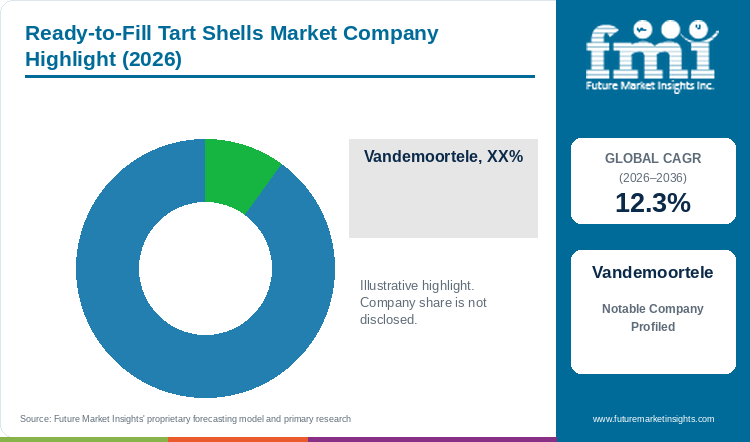
FMI analysis indicates that the competitive arena separates into dedicated preformed tart-shell manufacturers and unfilled pastry dough suppliers. Vandemoortele leads direct preformed shell supply through its Délifrance ready-to-fill sweet and savory tartlet catalog for hotels and patisseries. Unfilled dough specialists such as Wewalka and Goya Foods supply rolled shortcrust or puff pastry sheets, whereas finished savory-pastry groups provide downstream filling and packaging benchmarks.
- Direct Preformed Tart-Shell Specialists: Vandemoortele (including Délifrance) manufactures calibrated round and square empty sweet and savory tartlet shells for professional kitchens.
- Unfilled Dough & Bake-Off Bakery Platforms: Aryzta and Wewalka plus Pukka Pies and Goya Foods supply shortcrust dough sheets and bake-off bakery solutions across retail and foodservice channels.
- Downstream Finished-Pastry Comparators: The Compleat Food Group and Samworth Brothers plus Greggs and Patties Foods operate high-speed filled pie and savory pastry lines.
Competitive Benchmarking: Ready-to-Fill Tart Shells Market
Table 8: Competitive Benchmarking for the Ready-to-Fill Tart Shells Market (qualitative capability ratings), 2026
| Company | Preformed Shell Portfolio | Unfilled Pastry Depth | Foodservice Route Access | Geographic Reach |
|---|---|---|---|---|
| Vandemoortele | High | High | High | Pan-European and North American bakery networks |
| Aryzta | Medium | High | High | Europe, Asia-Pacific, Australia, and New Zealand |
| Wewalka | Medium | High | Medium | European and United States chilled dough retail |
| Pukka Pies | Low | High | High | United Kingdom grocery and foodservice channels |
| Goya Foods | Low | Medium | High | United States and international grocery retail |
| The Compleat Food Group | Low | Medium | High | United Kingdom retail and foodservice pastry |
| Samworth Brothers | Low | Medium | High | United Kingdom prepared food and bakery channels |
| Greggs | Low | Medium | High | United Kingdom vertically integrated bakery estate |
Scoring basis: Capability tiers evaluate documented SKU breadth across preformed empty sweet and savory tart shells and cold-chain foodservice distribution reach.
Key Developments in the Ready-to-Fill Tart Shells Market
- In September 2026, Vandemoortele reported EUR 685.7 million in first-half 2026 Bakery Products revenue and advanced the integration of Délifrance and Lizzi across its European patisserie network [19].
- In March 2026, Vandemoortele reported EUR 2.2 billion in 2025 group revenue and EUR 1.5 billion in Bakery Products sales (+10% year on year) following its bakery acquisitions across Italy and the United States [20].
- In January 2025, The Compleat Food Group eliminated over 110 tonnes of annual plastic packaging by rolling out automated trayless pastry packaging at its Tottle bakery facility [21].
Key Players in the Ready-to-Fill Tart Shells Market
Direct Preformed Tart-Shell & Frozen Bakery Leaders
- Vandemoortele (Délifrance)
- Aryzta
- Wewalka
Unfilled Pastry Dough & Sheet Specialists
- Pukka Pies
- Goya Foods
- Patties Foods
Downstream Filled-Pastry & Bakery Platforms
- The Compleat Food Group
- Samworth Brothers
Ready-to-Fill Tart Shells Market - Report Scope
Table 9: Report Scope for the Ready-to-Fill Tart Shells Market (coverage fields and definitions), 2026 to 2036
| Coverage field | Report scope |
|---|---|
| Market breakdown | Product Type; Claim / Nature; Format; Packaging Format; Sales Channel |
| Quantitative Units | USD Billion |
| Market Definition | Commercial first-sale revenue from preformed empty sweet and savory pastry tart shells sold for subsequent filling across retail and foodservice channels. Category Scope Note: Excludes pre-filled finished tarts and pies, unmolded bulk dough blocks, and ice-cream cones. |
| Regions Covered | North America; Latin America; Western Europe; Eastern Europe; East Asia; South Asia and Pacific; Middle East and Africa |
| Countries Covered | UAE, Saudi Arabia, South Korea, USA, Germany, UK, France, Japan, and additional countries in the full report |
| Key Companies Covered | Vandemoortele, Aryzta, Wewalka, Pukka Pies, Goya Foods, The Compleat Food Group, Samworth Brothers, Greggs |
| Forecast Period | 2026 to 2036 |
| Approach | Primary and secondary research with top-down and bottom-up market triangulation. |
Ready-to-Fill Tart Shells Market - Research Methodology
Table 10: Research Methodology for the Ready-to-Fill Tart Shells Market (research methods and approach), 2026 edition
| Method | Approach |
|---|---|
| Primary Research | Structured interviews with hotel executive pastry chefs, supermarket in-store bakery buyers, frozen bakery distributors, and industrial tart-shell production engineers to validate usable shell recovery rates and case pricing. |
| Secondary Research | Analysis of corporate annual reports (Vandemoortele, Aryzta, Greggs), UK CMA merger inquiry filings, USDA ERS and FAS GAIN retail/HRI reports, and peer-reviewed dough storage studies in Foods and Food Chemistry. |
| Market Sizing and Forecasting | Top-down commercial bakery and foodservice pastry procurement models reconciled against bottom-up daily preformed shell case consumption from 2026 to 2036. |
| Country Forecasting Model | Econometric country projections weight hotel banquet capacity, commercial catering growth, artisan patisserie outlet density, and cold-chain parcel infrastructure across eight national markets. |
| Operational Benchmark Traceability | Kitchen-pool and establishment spending indicators in Tables 2, 3, and 4 trace to USDA ERS Food Expenditure Series data, USDA FAS HRI annual reports, and frozen dough storage benchmarks. |
| Data Triangulation and Validation | Demand estimates are cross-checked against industrial bake-off pastry revenues and foodservice distributor case shipments while excluding downstream filled-pie and finished-tart retail turnover. |
Ready-to-Fill Tart Shells Market by Segments
Ready-to-Fill Tart Shells Market segmented by Product Type:
- Sweet shortcrust shells
- Savory shells
- Chocolate-lined
- Mini & petit four
Ready-to-Fill Tart Shells Market segmented by Claim / Nature:
- Conventional
- Clean label
- Gluten-free
Ready-to-Fill Tart Shells Market segmented by Format:
- Frozen
- Fresh
- Ambient packaged
Ready-to-Fill Tart Shells Market segmented by Packaging Format:
- Multipack
- Single-serve
- Bulk foodservice
- Others
Ready-to-Fill Tart Shells Market segmented by Sales Channel:
- Supermarkets & hypermarkets
- Artisan & specialty bakeries
- Convenience & forecourt
- Online & DTC
- Foodservice distributors
Ready-to-Fill Tart Shells Market by Region
- North America
- United States
- Canada
- Latin America
- Brazil
- Mexico
- Argentina
- Chile
- Western Europe
- Germany
- France
- United Kingdom
- Italy
- Spain
- Benelux
- Nordics
- Eastern Europe
- Poland
- Czech Republic
- Romania
- Hungary
- East Asia
- China
- Japan
- South Korea
- South Asia and Pacific
- India
- ASEAN
- Australia and New Zealand
- Middle East and Africa
- GCC Countries
- South Africa
- Türkiye
- Israel
Research Sources and Bibliography
- [1] United States Department of Agriculture, Economic Research Service. (2026, July 8). Food Service Industry - Market Segments. USDA Economic Research Service.
- [2] Gao, Y., Tan, Y. N., Ong, M. K., Wang, M., Sun, H., Shao, X., & Chay, S. Y. (2026, August 18). Cryoprotective Role of Soybean Oligosaccharides in Frozen Dough: Enhanced Gluten Stability and Bread Quality. Foods, 15(16), 2878 (PubMed PMID 42650572).
- [3] Xie, P., Wang, F., Zhou, J., Lee, Y. Y., Zhang, Y., Zou, S., Wang, Y., & Zhang, Z. (2025, February 28). Redefining shortening: Systematically characterizing traditional and new enriched diacylglycerol shortening and exploring their impact on processing applications. Food Chemistry, 466, 142196 (PubMed PMID 39612838).
- [4] United States Food and Drug Administration. (2026, March 17). Gluten-Free Labeling of Foods. U.S. Department of Health and Human Services.
- [5] Li, S., Wu, Z., Li, X., Huang, Y., Liu, Y., & Wang, F. (2026, June 8). Mitigating long-term deterioration of frozen dough: Isothermal-buffered frozen storage for stabilizing water mobility and the gluten-starch network. Food Chemistry X, 37, 104085 (PubMed PMID 42317271).
- [6] Chen, Z., Zhao, L., Yang, Y., Wang, R., & Xie, D. (2026, August 31). Combined protective effects of xanthan gum and maltitol on multi-scale properties of frozen dough under repeated freeze-thaw cycles. International Journal of Biological Macromolecules, 154277 (PubMed PMID 42674322).
- [7] United States Department of Agriculture, Economic Research Service. (2026, August 17). Retailing & Wholesaling: Retail Trends. USDA Economic Research Service.
- [8] Yang, Y. L., Yang, L., Guan, E. Q., & Bian, K. (2025, March 14). Investigation of the behavior of wheat flour dough under different sheeting-resting cycles and temperatures: Large deformation rheology and gluten molecular interactions. Food Chemistry X, 27, 102366 (PubMed PMID 40191844).
- [9] Bermingham, M. D., Meredith, R. T., Mills, H., Maddocks, S., Chapman, M. D., Blaxland, J. A., & Oliver, M. A. (2026, May 21). Baking results in impaired detection of clinically relevant food allergens. Frontiers in Allergy, 7, 1796342 (PubMed PMID 42253474).
- [10] Raczkowska, E., Slawinska, P., Wozniak, K., Rak, K., Gajda, R., & Lachowicz-Wisniewska, S. (2026, September 11). Functional Reformulation of Shortbread Cookies with Urtica dioica L. Powder and Erythritol: Effects on Sensory Quality, Glycaemic Index and Glycaemic Load. Nutrients, 18(18), 2973 (PubMed PMID 42796956).
- [11] United States Department of Agriculture, Foreign Agricultural Service. (2026, October 19). United Arab Emirates: Retail Foods Annual (Attaché Report TC2026-0013). USDA Foreign Agricultural Service GAIN.
- [12] United States Department of Agriculture, Foreign Agricultural Service. (2026, August 31). Saudi Arabia: Retail Foods Annual (Attaché Report SA2026-0013). USDA Foreign Agricultural Service GAIN.
- [13] United States Department of Agriculture, Foreign Agricultural Service. (2026, July 13). South Korea: Exporter Guide Annual (Attaché Report KS2026-0020). USDA Foreign Agricultural Service GAIN.
- [14] United States Department of Agriculture, Economic Research Service. (2026, June 11). Total U.S. food spending reached $2.51 trillion in 2025. USDA Economic Research Service Charts of Note.
- [15] United States Department of Agriculture, Foreign Agricultural Service. (2026, September 25). Germany: Retail Foods Annual (Attaché Report GM2026-0016). USDA Foreign Agricultural Service GAIN.
- [16] United Kingdom Competition and Markets Authority. (2026, October 7). Vandemoortele / Délifrance merger inquiry: Final Undertakings and Administrative Timetable. GOV.UK Competition and Markets Authority.
- [17] United States Department of Agriculture, Foreign Agricultural Service. (2025, December 31). France: Food Service - Hotel Restaurant Institutional Annual. USDA Foreign Agricultural Service GAIN.
- [18] United States Department of Agriculture, Foreign Agricultural Service. (2025, December 31). Japan: Food Service - Hotel Restaurant Institutional Annual. USDA Foreign Agricultural Service GAIN.
- [19] Vandemoortele NV. (2026, September 14). Vandemoortele Delivers Resilient Results and Further Advances Its Acquisition Strategy in H1 2026. Vandemoortele Investor Relations.
- [20] Vandemoortele NV. (2026, March 30). Vandemoortele Annual Results 2025: Strong Performance in Bakery Products and Strategic Acquisitions. Vandemoortele Investor Relations.
- [21] The Compleat Food Group. (2025, January 22). We have removed over 100 tonnes of plastic with our trayless pork pie packaging. The Compleat Food Group Corporate Updates.
- [22] Greggs plc. (2025, March 4). Greggs Annual Report and Accounts 2024: Supply Chain and Manufacturing Investment. Greggs Corporate Filings.
- [23] United States Department of Agriculture, Foreign Agricultural Service. (2026, March 30). Germany: Food Processing Ingredients Annual (Attaché Report GM2026-0007). USDA Foreign Agricultural Service GAIN.
This bibliography is provided for reader reference and is not exhaustive. The full report contains the complete reference list and detailed citations.
This Report Answers
- How large is the ready-to-fill tart shells market in 2026 and what is forecast for 2036?
- Which pastry-room labor and portion-cost pressures support demand for preformed tart shells?
- Why do Sweet shortcrust shells lead the product type category globally?
- Why does Conventional hold the largest share within claim / nature?
- How do growth rates differ across the UAE and Saudi Arabia versus Western Europe?
- Which companies supply direct preformed tart shells versus unfilled dough sheets?
- How do transit rim breakage and moisture migration constrain buyer switching?
- What operational benchmarks should hotels and grocers verify before awarding shell tenders?
Frequently Asked Questions
How big is the ready-to-fill tart shells market in 2026, and what is forecast for 2036?
According to FMI, global ready-to-fill tart shells market valuation is estimated to reach USD 1.1 billion in 2026 from USD 1.0 billion in 2025. The market is projected to reach USD 3.6 billion by 2036 as hotel and supermarket kitchens outsource manual crust molding.
What is the CAGR for the ready-to-fill tart shells market from 2026 to 2036?
Future Market Insights projects a 12.3% compound annual growth rate between 2026 and 2036, generating USD 2.5 billion in incremental market value across professional foodservice and retail channels.
Which product type segment leads the ready-to-fill tart shells market?
Sweet shortcrust shells are expected to hold a 32.0% share of the product type segment in 2026 because neutral butter-sugar pastry bases accommodate diverse fruit and chocolate fillings.
Which claim / nature segment leads the ready-to-fill tart shells market?
Conventional formulations are estimated to hold a 53.0% share in 2026 owing to predictable gluten-shortening plasticity and lower allergen-segregation overhead.
Which country has a notable growth outlook during the assessment period?
The UAE is projected to lead national expansion at a 13.5% CAGR through 2036, supported by high-occupancy hotel banquet catering and USD 17.7 billion in consumer-oriented food imports.
Who are the key players in the market?
Vandemoortele (Délifrance) and Aryzta lead commercial supply with Wewalka and Pukka Pies plus Goya Foods and The Compleat Food Group across preformed shell and pastry channels.
Preview the report firsthand - request a free sample
Get SampleGet the brochure for pricing and purchase details.
Get PDFTable of Content
- Key Takeaways
- Market Size and CAGR
- Top Growth Driver
- Fastest Growing Segment
- Leading Region
- Key Companies
- Emerging Opportunities
- Executive Summary
- Global Market Outlook
- Demand-side Trends
- Supply-side Trends
- Technology Roadmap Analysis
- Analysis and Recommendations
- Analyst Perspective (What is happening? Why now? What should investors know?)
- Key Questions Answered
- How large is the market?
- What is the CAGR?
- What are key trends?
- Which region dominates?
- Who are the leaders?
- Market Overview
- Market Coverage / Taxonomy
- Market Definition / Scope / Limitations
- Research Methodology
- Chapter Orientation
- Analytical Lens and Working Hypotheses
- Market Structure, Signals, and Trend Drivers
- Benchmarking and Cross-market Comparability
- Market Sizing, Forecasting, and Opportunity Mapping
- Research Design and Evidence Framework
- Desk Research Programme (Secondary Evidence)
- Expert Input and Fieldwork (Primary Evidence)
- Tooling, Models, and Reference Databases
- Data Engineering and Model Build
- Quality Assurance and Audit Trail
- Market Background
- Market Dynamics (Drivers, Restraints, Opportunity, Trends)
- Scenario Forecast (Optimistic, Likely, Conservative)
- Impact Analysis
- AI Impact
- Sustainability Impact
- Regulatory Impact
- Technology Impact
- Consumer / Buyer Analysis
- Purchase Drivers
- Adoption Barriers
- Buyer Journey
- Opportunity Map Analysis
- Product Life Cycle Analysis
- Supply Chain Analysis
- Investment Feasibility Matrix
- Value Chain Analysis
- PESTLE and Porter's Analysis
- Regulatory Landscape
- Regional Parent Market Outlook
- Production and Consumption Statistics
- Import and Export Statistics
- Global Market Analysis and Forecast, 2021 to 2036
- Historical Market Size Value (USD Billion) Analysis, 2021 to 2025
- Current and Future Market Size Value (USD Billion) Projections, 2026 to 2036
- Y-o-Y Growth Trend Analysis
- Absolute $ Opportunity Analysis
- Global Market Pricing Analysis, 2021 to 2036
- Global Market Analysis and Forecast, By Product Type, 2021 to 2036
- Introduction / Key Findings
- Historical Market Size Value (USD Billion) Analysis By Product Type, 2021 to 2025
- Current and Future Market Size Value (USD Billion) Analysis and Forecast By Product Type, 2026 to 2036
- Sweet shortcrust shells
- Savory shells
- Chocolate-lined
- Mini & petit four
- Y-o-Y Growth Trend Analysis By Product Type, 2021 to 2025
- Absolute $ Opportunity Analysis By Product Type, 2026 to 2036
- Global Market Analysis and Forecast, By Claim / Nature, 2021 to 2036
- Introduction / Key Findings
- Historical Market Size Value (USD Billion) Analysis By Claim / Nature, 2021 to 2025
- Current and Future Market Size Value (USD Billion) Analysis and Forecast By Claim / Nature, 2026 to 2036
- Conventional
- Clean label
- Gluten-free
- Y-o-Y Growth Trend Analysis By Claim / Nature, 2021 to 2025
- Absolute $ Opportunity Analysis By Claim / Nature, 2026 to 2036
- Global Market Analysis and Forecast, By Format, 2021 to 2036
- Introduction / Key Findings
- Historical Market Size Value (USD Billion) Analysis By Format, 2021 to 2025
- Current and Future Market Size Value (USD Billion) Analysis and Forecast By Format, 2026 to 2036
- Frozen
- Fresh
- Ambient packaged
- Y-o-Y Growth Trend Analysis By Format, 2021 to 2025
- Absolute $ Opportunity Analysis By Format, 2026 to 2036
- Global Market Analysis and Forecast, By Packaging Format, 2021 to 2036
- Introduction / Key Findings
- Historical Market Size Value (USD Billion) Analysis By Packaging Format, 2021 to 2025
- Current and Future Market Size Value (USD Billion) Analysis and Forecast By Packaging Format, 2026 to 2036
- Multipack
- Single-serve
- Bulk foodservice
- Others
- Y-o-Y Growth Trend Analysis By Packaging Format, 2021 to 2025
- Absolute $ Opportunity Analysis By Packaging Format, 2026 to 2036
- Global Market Analysis and Forecast, By Sales Channel, 2021 to 2036
- Introduction / Key Findings
- Historical Market Size Value (USD Billion) Analysis By Sales Channel, 2021 to 2025
- Current and Future Market Size Value (USD Billion) Analysis and Forecast By Sales Channel, 2026 to 2036
- Supermarkets & hypermarkets
- Artisan & specialty bakeries
- Convenience & forecourt
- Online & DTC
- Foodservice distributors
- Y-o-Y Growth Trend Analysis By Sales Channel, 2021 to 2025
- Absolute $ Opportunity Analysis By Sales Channel, 2026 to 2036
- Global Market Analysis and Forecast, By Region, 2021 to 2036
- Introduction
- Historical Market Size Value (USD Billion) Analysis By Region, 2021 to 2025
- Current Market Size Value (USD Billion) Analysis and Forecast By Region, 2026 to 2036
- North America
- Latin America
- Western Europe
- Eastern Europe
- East Asia
- South Asia and Pacific
- Middle East and Africa
- Market Attractiveness Analysis By Region
- North America Market Analysis and Forecast, By Country, 2021 to 2036
- Historical Market Size Value (USD Billion) Trend Analysis By Market Taxonomy, 2021 to 2025
- Market Size Value (USD Billion) Forecast By Market Taxonomy, 2026 to 2036
- By Country
- United States
- Canada
- By Product Type
- By Claim / Nature
- By Format
- By Packaging Format
- By Sales Channel
- By Country
- Market Attractiveness Analysis
- By Country
- By Product Type
- By Claim / Nature
- By Format
- By Packaging Format
- By Sales Channel
- Key Takeaways
- Latin America Market Analysis and Forecast, By Country
- Historical Market Size Value (USD Billion) Trend Analysis By Market Taxonomy, 2021 to 2025
- Market Size Value (USD Billion) Forecast By Market Taxonomy, 2026 to 2036
- By Country
- Brazil
- Mexico
- Argentina
- Chile
- By Product Type
- By Claim / Nature
- By Format
- By Packaging Format
- By Sales Channel
- By Country
- Market Attractiveness Analysis
- By Country
- By Product Type
- By Claim / Nature
- By Format
- By Packaging Format
- By Sales Channel
- Key Takeaways
- Western Europe Market Analysis and Forecast, By Country
- Historical Market Size Value (USD Billion) Trend Analysis By Market Taxonomy, 2021 to 2025
- Market Size Value (USD Billion) Forecast By Market Taxonomy, 2026 to 2036
- By Country
- Germany
- France
- United Kingdom
- Italy
- Spain
- Benelux
- Nordics
- By Product Type
- By Claim / Nature
- By Format
- By Packaging Format
- By Sales Channel
- By Country
- Market Attractiveness Analysis
- By Country
- By Product Type
- By Claim / Nature
- By Format
- By Packaging Format
- By Sales Channel
- Key Takeaways
- Eastern Europe Market Analysis and Forecast, By Country
- Historical Market Size Value (USD Billion) Trend Analysis By Market Taxonomy, 2021 to 2025
- Market Size Value (USD Billion) Forecast By Market Taxonomy, 2026 to 2036
- By Country
- Poland
- Czech Republic
- Romania
- Hungary
- By Product Type
- By Claim / Nature
- By Format
- By Packaging Format
- By Sales Channel
- By Country
- Market Attractiveness Analysis
- By Country
- By Product Type
- By Claim / Nature
- By Format
- By Packaging Format
- By Sales Channel
- Key Takeaways
- East Asia Market Analysis and Forecast, By Country
- Historical Market Size Value (USD Billion) Trend Analysis By Market Taxonomy, 2021 to 2025
- Market Size Value (USD Billion) Forecast By Market Taxonomy, 2026 to 2036
- By Country
- China
- Japan
- South Korea
- By Product Type
- By Claim / Nature
- By Format
- By Packaging Format
- By Sales Channel
- By Country
- Market Attractiveness Analysis
- By Country
- By Product Type
- By Claim / Nature
- By Format
- By Packaging Format
- By Sales Channel
- Key Takeaways
- South Asia and Pacific Market Analysis and Forecast, By Country
- Historical Market Size Value (USD Billion) Trend Analysis By Market Taxonomy, 2021 to 2025
- Market Size Value (USD Billion) Forecast By Market Taxonomy, 2026 to 2036
- By Country
- India
- ASEAN
- Australia and New Zealand
- By Product Type
- By Claim / Nature
- By Format
- By Packaging Format
- By Sales Channel
- By Country
- Market Attractiveness Analysis
- By Country
- By Product Type
- By Claim / Nature
- By Format
- By Packaging Format
- By Sales Channel
- Key Takeaways
- Middle East and Africa Market Analysis and Forecast, By Country
- Historical Market Size Value (USD Billion) Trend Analysis By Market Taxonomy, 2021 to 2025
- Market Size Value (USD Billion) Forecast By Market Taxonomy, 2026 to 2036
- By Country
- GCC Countries
- South Africa
- Türkiye
- Israel
- By Product Type
- By Claim / Nature
- By Format
- By Packaging Format
- By Sales Channel
- By Country
- Market Attractiveness Analysis
- By Country
- By Product Type
- By Claim / Nature
- By Format
- By Packaging Format
- By Sales Channel
- Key Takeaways
- Key Countries Market Analysis
- United States
- Pricing Analysis
- Market Share Analysis, 2025
- By Product Type
- By Claim / Nature
- By Format
- By Packaging Format
- By Sales Channel
- Canada
- Pricing Analysis
- Market Share Analysis, 2025
- By Product Type
- By Claim / Nature
- By Format
- By Packaging Format
- By Sales Channel
- Mexico
- Pricing Analysis
- Market Share Analysis, 2025
- By Product Type
- By Claim / Nature
- By Format
- By Packaging Format
- By Sales Channel
- Brazil
- Pricing Analysis
- Market Share Analysis, 2025
- By Product Type
- By Claim / Nature
- By Format
- By Packaging Format
- By Sales Channel
- Chile
- Pricing Analysis
- Market Share Analysis, 2025
- By Product Type
- By Claim / Nature
- By Format
- By Packaging Format
- By Sales Channel
- Germany
- Pricing Analysis
- Market Share Analysis, 2025
- By Product Type
- By Claim / Nature
- By Format
- By Packaging Format
- By Sales Channel
- United Kingdom
- Pricing Analysis
- Market Share Analysis, 2025
- By Product Type
- By Claim / Nature
- By Format
- By Packaging Format
- By Sales Channel
- Italy
- Pricing Analysis
- Market Share Analysis, 2025
- By Product Type
- By Claim / Nature
- By Format
- By Packaging Format
- By Sales Channel
- Spain
- Pricing Analysis
- Market Share Analysis, 2025
- By Product Type
- By Claim / Nature
- By Format
- By Packaging Format
- By Sales Channel
- France
- Pricing Analysis
- Market Share Analysis, 2025
- By Product Type
- By Claim / Nature
- By Format
- By Packaging Format
- By Sales Channel
- India
- Pricing Analysis
- Market Share Analysis, 2025
- By Product Type
- By Claim / Nature
- By Format
- By Packaging Format
- By Sales Channel
- ASEAN
- Pricing Analysis
- Market Share Analysis, 2025
- By Product Type
- By Claim / Nature
- By Format
- By Packaging Format
- By Sales Channel
- Australia and New Zealand
- Pricing Analysis
- Market Share Analysis, 2025
- By Product Type
- By Claim / Nature
- By Format
- By Packaging Format
- By Sales Channel
- China
- Pricing Analysis
- Market Share Analysis, 2025
- By Product Type
- By Claim / Nature
- By Format
- By Packaging Format
- By Sales Channel
- Japan
- Pricing Analysis
- Market Share Analysis, 2025
- By Product Type
- By Claim / Nature
- By Format
- By Packaging Format
- By Sales Channel
- South Korea
- Pricing Analysis
- Market Share Analysis, 2025
- By Product Type
- By Claim / Nature
- By Format
- By Packaging Format
- By Sales Channel
- Poland
- Pricing Analysis
- Market Share Analysis, 2025
- By Product Type
- By Claim / Nature
- By Format
- By Packaging Format
- By Sales Channel
- Hungary
- Pricing Analysis
- Market Share Analysis, 2025
- By Product Type
- By Claim / Nature
- By Format
- By Packaging Format
- By Sales Channel
- Türkiye
- Pricing Analysis
- Market Share Analysis, 2025
- By Product Type
- By Claim / Nature
- By Format
- By Packaging Format
- By Sales Channel
- South Africa
- Pricing Analysis
- Market Share Analysis, 2025
- By Product Type
- By Claim / Nature
- By Format
- By Packaging Format
- By Sales Channel
- UAE
- Pricing Analysis
- Market Share Analysis, 2025
- By Product Type
- By Claim / Nature
- By Format
- By Packaging Format
- By Sales Channel
- Saudi Arabia
- Pricing Analysis
- Market Share Analysis, 2025
- By Product Type
- By Claim / Nature
- By Format
- By Packaging Format
- By Sales Channel
- United States
- Market Structure Analysis
- Competition Dashboard
- Competition Benchmarking
- Market Share Analysis of Top Players
- By Regional
- By Product Type
- By Claim / Nature
- By Format
- By Packaging Format
- By Sales Channel
- Emerging Startups
- Innovation Benchmarking
- Competition Analysis
- Competition Deep Dive
- Vandemoortele
- Overview
- Product Portfolio
- Profitability by Market Segments
- Sales Footprint
- Strategy Overview
- Marketing Strategy
- Product Strategy
- Channel Strategy
- Aryzta
- Wewalka
- Pukka Pies
- Goya Foods
- The Compleat Food Group
- Samworth Brothers
- Greggs
- Vandemoortele (Délifrance)
- Patties Foods
- Vandemoortele
- Case Studies
- Success Stories
- Recent Developments
- Competition Deep Dive
- Assumptions & Acronyms Used


