

- Market Size (2026)
- USD 1060.0 Mn
- Forecast (2036)
- USD 2930.0 Mn
- CAGR (2026 to 2036)
- 10.7%
How big is the Regenerative Brake-by-Wire Systems Market in 2026?
USD 1,060.0 million in 2026 and USD 2,930.0 million by 2036 at a 10.7% CAGR.
Demand for regenerative brake-by-wire systems is projected to expand at 10.7% CAGR between 2026 and 2036, increasing valuation from USD 1060.0 million in 2026 to USD 2930.0 million by 2036. Electrified vehicles need control software that divides deceleration between motor recuperation and friction braking across changing battery acceptance and road conditions. The International Energy Agency reported in May 2026 that electric-car sales exceeded 20 million during 2025 and represented one quarter of global car sales. The expanding vehicle base gives regenerative braking systems a broader set of platforms requiring dependable blending and fault response. Commercial value is created by one validated control architecture that preserves pedal response and emergency stopping across several electrified models.
United States programs apply federal stopping tests to automated layouts; Chinese programs emphasize rapid local software integration; Japanese programs retain careful model-level qualification. NHTSA reported in December 2025 that completed research reviewed braking and electronic-stability methods across several federal standards for automated vehicle designs. The federal work connects driver assistance systems with measurable actuator response and preserved stopping performance across unconventional cabin layouts. Chinese automakers require local calibration support that can match shorter platform cycles without weakening fault documentation. Japanese automakers place greater weight on service continuity and repeated validation across long-running hybrid models. Approval evidence and software ownership rarely transfer cleanly across these operating models, so brake-system developers need regional engineering routes.
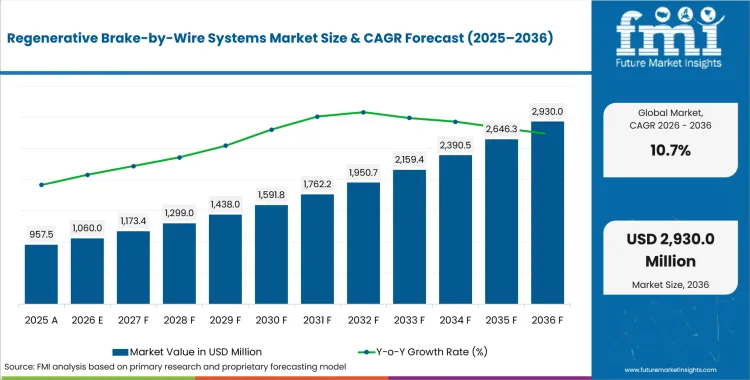
Key Takeaways of Regenerative Brake-by-Wire Systems Market
- Electrified platforms require coordinated recuperation and friction braking across changing battery acceptance, and software-controlled actuators must preserve dependable emergency stopping performance.
- Module is expected to account for 41.0% by component in 2026 owing to concentrated value in integrated actuation and control hardware.
- Passenger car is estimated to represent 66.0% share in 2026 due to repeated qualification across high-volume platform families.
- Battery electric propulsion is forecast to capture 48.0% of demand in 2026 through direct reliance on coordinated recuperation and friction braking.
- Redundant actuation and functional-safety validation increase engineering expense throughout lengthy programs ahead of automaker approval for series production.
- Bosch, ZF, AUMOVIO, Brembo, Astemo, ADVICS, BWI Group, and Hyundai Mobis compete through distinct brake architectures and integration capabilities.
Analyst Perspective
“Regenerative brake-by-wire programs succeed through one control strategy that blends motor recuperation with friction braking across full batteries and low-speed operation under electrical faults. Automakers should judge each architecture through pedal consistency and independent fallback paths alongside clear software ownership throughout the vehicle program. Production awards will favor braking groups that prove these functions locally and support calibration throughout every regional launch.”
- Nikhil Kaitwade, Principal Analyst, Future Market Insights
How is the Regenerative Brake-by-Wire Systems Market segmented?
The regenerative brake-by-wire systems industry is segmented by component type, vehicle type, propulsion, sales channel, and region.
Based on component type, market is divided by sensors, modules, connectors, software, and thermal systems within the purchased braking architecture. Vehicle type distinguishes passenger cars, light commercial vehicles, heavy trucks, buses, and two-wheelers that require different actuation forces and validation routes.Propulsion explains how battery electric, plug-in hybrid, fuel-cell, hybrid, and ICE retrofit vehicles divide deceleration between motor recovery and friction braking. Sales channel identifies OEM, aftermarket, fleet operators, distributors, and direct-sales routes that determine validation ownership and commercial accountability. Region completes the taxonomy through local safety standards, platform concentration, engineering access, and service coverage.
Why does module account for the largest component type share?
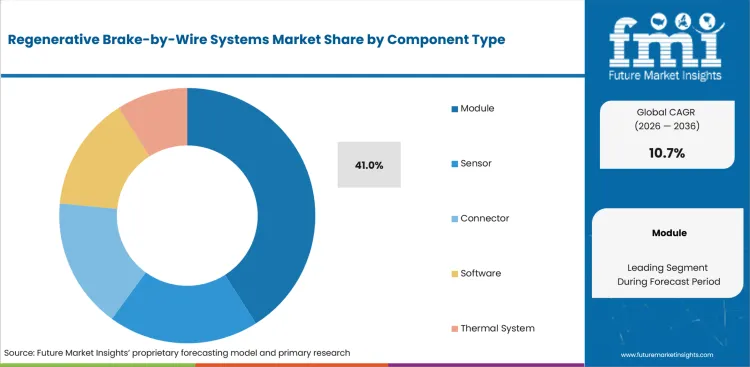
Modules combine pressure generation with electronic control and diagnostic logic inside one validated assembly with defined fallback functions. Bosch reported in September 2025 that more than two dozen manufacturers across Europe, China, and Japan had adopted its Vehicle Motion Management software. The installed base connects braking actuators with automotive software across several production platform architectures and regional vehicle programs. Automakers gain a clearer qualification boundary than separate pressure-generation and control packages provide across each regional program.
- Based on component type, module is projected to account for 41.0% in 2026 due to integrated actuation and control value within one validated assembly. Each assembly carries system-level responsibility for diagnostics and coordinated fallback responses throughout an approved vehicle program. Automakers can approve one integrated package instead of qualifying several separate components and software interfaces across each platform.
- Vehicle engineering teams favor modules that provide stable diagnostic interfaces and redundant braking responses across several model variants. One accountable assembly reduces integration disputes during software calibration and repeated fault testing across several vehicle configurations. Thermal limits and platform-specific tuning remain necessary; module selection therefore depends on engineering support throughout validation and series launch.
What keeps passenger car central to vehicle type demand?
Passenger-car platforms combine high production volumes with frequent software releases and increasingly complex assistance functions. Shared architectures let braking teams reuse validated interfaces across sedans, crossovers, and premium models within one vehicle family. Accurate automotive sensors must preserve pressure and pedal inputs across trim levels and regional vehicle configurations. The passenger-car category therefore concentrates recurring qualification work across the industry’s broadest model and production base.
- In 2026, passenger car is expected to lead vehicle type with 66.0% share, supported by repeated qualification across high-volume platform families. AUMOVIO announced in November 2025 that cumulative electronic brake-system deliveries had reached 500 million units worldwide. The milestone demonstrates the production scale required for repeatable calibration and service support across several vehicle architectures.
- Automakers prioritize passenger-car systems that combine smooth regenerative blending with predictable emergency deceleration across varied battery states. Shared platforms spread calibration investment across several body styles and regional configurations during repeated model launches. Commercial-vehicle programs require higher forces and longer validation cycles; those requirements limit their near-term contribution despite meaningful technical demand.
How does battery electric propulsion shape system demand?
Battery electric vehicles use the traction motor for routine deceleration, with friction brakes reserved for low-speed and emergency events. Control quality affects range efficiency and stopping consistency throughout each routine or emergency braking event. ZF stated in July 2025 that its electromechanical brake enables optimized recuperation and reduces residual drag. The design links energy recovery systems with wheel-level actuation and centralized stability control across several operating states.
- Battery electric is projected to hold 48.0% share in 2026 owing to its direct dependence on coordinated motor recuperation and friction braking. Each platform requires transitions that remain imperceptible during changing battery acceptance and emergency stopping events. The segment concentrates software value around energy recovery without reducing braking consistency across full-charge and low-temperature operation.
- Electric-vehicle manufacturers use EV brake controls to allocate deceleration continuously between the propulsion motor and physical brakes. Control software must preserve predictable pedal response during temperature changes and reduced battery acceptance across repeated stops. Engineering effort rises near full charge; friction braking must replace unavailable recuperation without changing the driver's expected response.
Why do OEM channels control most sales channel demand?
Safety-critical brake controls enter vehicles through platform engineering and homologation decisions made several years ahead of series production. Validated brake system components remain under program ownership; replacement channels cannot authorize calibration or functional-safety release decisions. Vehicle manufacturers also control warranty responsibility and software access throughout the complete production and service lifecycle. Initial commercial demand therefore follows platform awards instead of independent replacement purchasing across unrelated service channels.
- The sales channel category is forecast to be led by OEM at 74.0% share in 2026 due to automaker control over validation and production release. Tier-one awards combine software integration with plant support and warranty accountability throughout lengthy vehicle development programs. Aftermarket channels can replace approved hardware but cannot authorize calibration or functional-safety release for a new vehicle architecture.
- OEM agreements provide calibration access and warranty accountability throughout platform development and coordinated series-production planning activities. ZF announced in January 2025 that a global automaker had placed a major order for a hybrid brake-by-wire system. The award demonstrates why production revenue depends on early engineering access and multi-year platform commitment across several vehicle models.
What are the drivers, restraints, and opportunities in the Regenerative Brake-by-Wire Systems Market?
Electrified platforms expand integrated braking demand, but safety validation and automated cabin design create distinct cost and architecture pressures.
- Driver: Electrified platforms require coordinated recuperation and friction braking across changing battery conditions and automated safety interventions.
- Restraint: Redundant actuation and software validation increase engineering expense throughout lengthy development programs ahead of series-production approval.
- Opportunity: Pedal-free automated vehicles create new architecture choices for distributed braking and software-controlled cabin design across purpose-built platforms.
Routine deceleration in electric vehicles creates the main demand driver through one controller that divides braking force between the motor and friction hardware. Battery charge and operating temperature can change available recuperation several times during the same trip. Hyundai Mobis reported in September 2025 that it was combining brake-by-wire and steer-by-wire through one vehicle-motion controller. The integration raises the value of software that preserves stable pedal response and emergency stopping across changing energy-recovery conditions.
Redundant power and independent fallback actuation create the main adoption restraint across safety-critical vehicle programs. Engineering teams must prove dependable stopping through climate exposure and electrical faults across repeated road use on the intended platform. Bosch reported in January 2025 that its hydraulic brake-by-wire system completed a 3,300-kilometre public-road test through several climate zones. Comparable validation spending becomes harder to recover across smaller vehicle programs with limited production volumes and shorter commercial award cycles.
Purpose-built automated vehicles create a credible architecture opportunity by removing the need for a conventional pedal connection and fixed actuator location. NHTSA began rulemaking in June 2026 to reconsider manual brake-pedal requirements for vehicles designed exclusively around automated driving systems. Distributed electronic actuation can release cabin space and simplify left-hand or right-hand drive layouts across regional vehicle programs. Commercial adoption requires independent fallback paths that preserve federal stopping-distance performance across every approved configuration.
Which country CAGRs are profiled in the Regenerative Brake-by-Wire Systems Market?
| Country | CAGR |
|---|---|
| India | 14.4% |
| China | 13.4% |
| South Korea | 12.3% |
| United States | 11.2% |
| Germany | 10.2% |
| Japan | 9.1% |
How do country-level CAGRs compare in the Regenerative Brake-by-Wire Systems Market?
The country forecasts show a clear stepwise progression across the regenerative brake-by-wire systems market, with each country separated by a broadly consistent margin rather than forming sharply distinct clusters. India and China define the upper end of the comparison, reflecting accelerating electrification efforts and growing integration of electronically controlled braking architectures in next-generation vehicles. South Korea acts as a transition market between the higher-growth Asian economies and the more established automotive markets of North America, Europe and Japan. The United States, Germany and Japan follow in a gradual sequence, indicating steady adoption supported by ongoing vehicle technology upgrades rather than abrupt shifts in market structure. This pattern reflects differences in electric vehicle production growth, advanced braking system integration and the pace of software-defined vehicle development across major automotive hubs.
- India benefits from expanding electric vehicle manufacturing and increasing incorporation of advanced safety and energy-efficiency technologies that support demand for regenerative brake-by-wire systems.
- China's outlook is supported by its large electric vehicle ecosystem, where manufacturers continue to integrate regenerative braking and electronic control technologies to improve vehicle performance and energy recovery.
- South Korea reflects strong momentum through its concentration of automotive technology developers and continued investment in next-generation vehicle platforms.
- The United States continues to advance the market as automakers incorporate brake-by-wire architectures into electric and hybrid vehicle programs designed to enhance efficiency and driving control.
- Germany's market development is influenced by premium vehicle engineering, increasing software integration and the transition toward electrified mobility platforms across major automotive manufacturers.
- Japan maintains steady growth as vehicle producers gradually expand the use of electronically controlled braking systems while emphasizing reliability, safety and long-term platform optimization.
Similar CAGRs do not necessarily translate into identical commercialization conditions. Differences in electric vehicle penetration, regulatory requirements, automotive supply chains and vehicle platform strategies can significantly influence deployment timelines for regenerative brake-by-wire technologies. The full report provides country-level CAGR analysis across North America, Latin America, Europe, East Asia, South Asia, Oceania and the Middle East and Africa.
Country-wise Analysis
- Industry in India combines growing battery-electric passenger-car programs with cost-sensitive sourcing and limited brake-control calibration support outside major vehicle manufacturing hubs. ADVICS announced in April 2025 that its cooperative regenerative braking system had been selected for Suzuki’s e VITARA scheduled for sale in India. The Indian regenerative brake-by-wire systems sector is projected to record 14.4% CAGR during the assessment period, supported by local electric-vehicle programs and component investment. The production award gives domestic engineering teams direct experience with blending motor recuperation and friction braking across an accessible passenger-car platform. Price-sensitive launches require modular system costs and service arrangements that remain viable across smaller regional vehicle volumes. Developers without domestic calibration staff face slower fault resolution and longer qualification schedules across geographically dispersed assembly and service locations.
- China includes large vehicle programs with compressed software cycles and local engineering authority across rapidly updated passenger-car platforms. Adoption of regenerative brake-by-wire systems in China is estimated to expand at 13.4% CAGR through 2036, reinforced by local series awards and concentrated vehicle development. Bosch announced in April 2025 that a Chinese automaker had placed the company’s first local hydraulic brake-by-wire order. The production route gives domestic teams accountable access to actuator calibration and fallback testing across selected passenger-car models. Strong price pressure limits room for duplicated engineering work across frequent model updates and short award cycles. Entrants need local data routes and series-support authority to resolve software faults without delaying production release.
- South Korea combines export-oriented automakers with domestic electronics groups that develop integrated chassis controls for high-volume global vehicle programs. The Republic of Korea Policy Briefing reported annual electric-vehicle deployment of 220,000 in January 2026; the same briefing placed the registered fleet near 970,000. The expanding fleet gives local engineers more operating data for calibration across regenerative braking and conventional friction interventions. South Korea’s regenerative brake-by-wire systems outlook is anticipated to advance at 12.3% CAGR over the assessment period, enabled by domestic software and component engineering. Export programs must satisfy different safety standards across distant assembly plants and customer engineering centers. Commercial awards favor documentation and calibration support that remain consistent across destination markets and production sites.
- United States vehicle programs combine high-volume pickups with passenger cars using automated braking and increasingly electrified powertrains. Regenerative brake-by-wire system sales in the United States are forecast to expand at 11.2% CAGR by 2036, underpinned by large platform awards and federal safety standards. ZF reported in September 2025 that North American automakers had placed series orders for its brake-by-wire systems. The series awards create regional demand for calibration and fallback validation across varied payloads and road conditions. Product-liability exposure and lengthy qualification cycles create material barriers for developers without regional engineering resources.
- Germany provides dense automotive engineering clusters and established proving facilities that support brake-control development across European passenger-car programs. The German Association of the Automotive Industry reported in July 2026 that electric passenger-car registrations reached 531,807 during the first half of 2026 and increased 37% year over year. Regenerative brake-by-wire system demand in Germany is forecast to rise at 10.2% CAGR over the forecast period, sustained by electrified vehicle programs and experienced tier-one networks. Domestic proving capacity gives braking companies access to specialized test engineers and export-oriented automakers during early system qualification. High engineering costs can constrain smaller programs that lack shared architectures across several vehicle models.
- Japan has a mature hybrid engineering with careful model-level qualification and strong expectations for dependable service support across long vehicle programs. In Japan, regenerative brake-by-wire system demand is predicted to advance at 9.1% CAGR through 2036 across established hybrid vehicle programs. Local automakers can build on long experience coordinating motor recuperation with friction braking across hybrid passenger vehicles. Astemo announced in October 2025 that it would present a next-generation electric brake with integrated vehicle-control technologies in Japan. Conservative release procedures slow entry for developers without domestic calibration resources and established automaker relationships. Long production cycles also require dependable service coverage across every approved model family and regional support route.
Who are the notable companies in the Regenerative Brake-by-Wire Systems Market?
Bosch, ZF, AUMOVIO, Brembo, Astemo, ADVICS, BWI Group, and Hyundai Mobis are notable companies shaping this market.
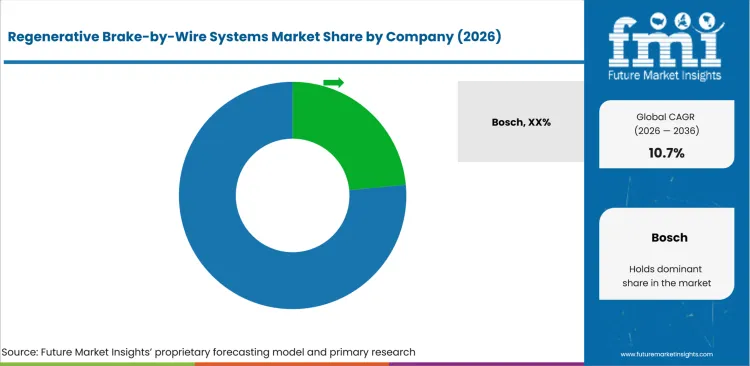
The competitive field combines global brake groups with chassis specialists developing electromechanical actuation and integrated vehicle-motion software. AUMOVIO became independent from Continental in September 2025, so current automotive braking activity belongs under the AUMOVIO name. Astemo adopted its present legal name in April 2025 following earlier operation as Hitachi Astemo. Bosch and ZF compete through broad automotive brake systems and documented automaker awards across several regions. Brembo and ADVICS contribute production evidence across intelligent braking architectures used by established passenger-vehicle programs. BWI Group and Hyundai Mobis add electromechanical or integrated chassis development through customer-specific engineering and validation routes. Automakers increasingly compare series proof and local integration capacity instead of relying on corporate scale.
- Bosch and ZF focus on dedicated brake-by-wire portfolios with integrated vehicle-motion software and documented OEM awards across several regions. Their commercial advantage depends on calibration and fallback testing near customer engineering centers throughout lengthy platform programs. Automakers should compare series evidence across the exact vehicle architecture instead of treating portfolio breadth as sufficient proof.
- AUMOVIO and Brembo pair electronic braking experience with scalable integrated systems that have reached meaningful production milestones. AUMOVIO covers modular one-box and dry-brake routes across several platform classes and vehicle architectures worldwide. Brembo differentiates through wheel-level control and software orchestration within the SENSIFY architecture across customer programs.
- Astemo and ADVICS develop market-specific chassis controls through established engineering and manufacturing networks across Japan and other vehicle-producing regions. ADVICS provides production evidence for cooperative regenerative braking across passenger vehicles with regional launch and service requirements. BWI Group and Hyundai Mobis focus on electromechanical braking or integrated chassis control that requires customer-specific validation across intended vehicle platforms.
Competitive Benchmarking: Regenerative Brake-by-Wire Systems Market
| Company | Technical Depth and Evidence | Delivery and Integration Support | Account and Channel Reach | Geographic Reach |
|---|---|---|---|---|
| Bosch | High | High | High | Global |
| ZF | High | High | High | Global |
| AUMOVIO | High | High | High | Global |
| Brembo | High | High | Medium | Global |
| Astemo | Medium | Medium | Medium | Global |
| ADVICS | High | Medium | Medium | Global |
| BWI Group | Medium | High | Medium | Global |
| Hyundai Mobis | Medium | Medium | Medium | Global |
Key Developments in the Regenerative Brake-by-Wire Systems Market
- In July 2025, AUMOVIO announced that its IAA Mobility display would include the Green Electric Caliper and a scalable corner module. The caliper removes hydraulic fluid and targets modular electric-vehicle platforms across several vehicle classes and powertrain configurations. The corner module integrates drive, braking, steering, and suspension inside one compact wheel-level unit with coordinated electronic control. Automakers gain a practical integration route for software-defined vehicles but must validate wheel actuation and fallback control for every platform.
- In December 2025, ADVICS announced that Toyota had adopted its new cooperative regenerative braking system for the RAV4. The production application combines recuperation with hydraulic control inside a passenger-vehicle program sold across several regional markets. The award gives ADVICS model-level production evidence across varied calibration requirements and customer service conditions. Broader expansion depends on repeating that integration across additional vehicle architectures and regional service networks.
- In May 2026, Brembo announced full production of SENSIFY for a global vehicle manufacturer and additional customer contracts. The company expects the platform to equip hundreds of thousands of vehicles annually through scalable wheel-level control. The production start demonstrates that distributed intelligent braking can progress beyond demonstration programs into regular vehicle manufacturing. Each additional platform requires dedicated software tuning and fallback validation across its complete operating envelope and regional requirements.
- In December 2025, Hyundai Mobis announced plans to present its X-by-Wire integrated chassis solution at CES 2026. The system combines electronic steering and braking through one controller with dual safety functions for fallback operation. The architecture gives automakers a defined route for coordinated vehicle motion without conventional mechanical connections. Commercial awards depend on production evidence and platform-specific validation across regional safety requirements and customer engineering standards.
Key Players in the Regenerative Brake-by-Wire Systems Market
Integrated Global Brake-by-Wire Providers
- Bosch
- ZF
- AUMOVIO
Established Intelligent Braking Suppliers
- Brembo
- Astemo
- ADVICS
Chassis Integration Specialists
- BWI Group
- Hyundai Mobis
Regenerative Brake-by-Wire Systems Market - Report Scope
| Coverage field | Report scope |
|---|---|
| Market breakdown | Component type, vehicle type, propulsion, sales channel, and region. |
| Quantitative Units | Revenue in USD Million, CAGR in %. |
| Market Definition | Electronic braking architectures that coordinate regenerative deceleration with friction-brake actuation through signal-based control across vehicle platforms. |
| Regions Covered | North America, Latin America, Europe, East Asia, South Asia, Oceania, and Middle East and Africa. |
| Countries Covered | India, China, South Korea, United States, Germany, Japan, and more than 30 countries. |
| Key Companies Profiled | Bosch, ZF, AUMOVIO, Brembo, Astemo, ADVICS, BWI Group, and Hyundai Mobis. |
| Forecast Period | 2026 to 2036. |
| Approach | Hybrid bottom-up and top-down market sizing supported by primary interviews and official desk research. |
Regenerative Brake-by-Wire Systems Market - Research Methodology
| Method | Approach |
|---|---|
| Primary Research | FMI analysts gathered input from manufacturers, service providers, technology developers, distributors, end users, procurement teams, and subject-matter experts. Interviews examined purchasing decisions, product or service evaluation, adoption barriers, approval requirements, pricing considerations, and expectations for technical or commercial support. Respondents were also asked what evidence is required before a trial, pilot, or initial order develops into regular purchasing. |
| Desk Research | Desk research covered government statistics, regulatory publications, trade data, industry associations, technical literature, standards, company filings, product information, and official corporate announcements. Sources were reviewed for relevance, publication date, geographic coverage, and consistency with the defined market scope. Claims relating to performance, applications, approvals, capacity, investment, and commercial activity were retained only when supported by credible public evidence. |
| Market Sizing and Forecasting | The market model combined the baseline value with historical performance, segment structure, pricing and volume indicators, adoption levels, company participation, and country-level demand conditions. Forecast assumptions considered economic activity, investment trends, regulatory developments, technology adoption, purchasing cycles, supply availability, and barriers to wider market use. Segment and regional estimates were reconciled before the final market total was calculated. |
| Data Validation | Estimates were checked against multiple independent indicators, including public data, company activity, trade patterns, industry developments, and findings from primary interviews. Validation also tested whether products, services, applications, and company revenues fell within the defined market boundaries. Adjacent categories, unsupported claims, overlapping revenues, and activities without direct market relevance were excluded to reduce double counting and maintain consistency across segments and countries. |
Regenerative Brake-by-Wire Systems Market by Segments
Regenerative Brake-by-Wire Systems Market segmented by Component Type:
- Sensor
- Module
- Connector
- Software
- Thermal System
Regenerative Brake-by-Wire Systems Market segmented by Vehicle Type:
- Passenger Car
- Light Commercial Vehicle
- Heavy Truck
- Two Wheeler
- Bus
Regenerative Brake-by-Wire Systems Market segmented by Propulsion:
- Battery Electric
- Plug-in Hybrid
- Fuel Cell
- Hybrid
- ICE Retrofit
Regenerative Brake-by-Wire Systems Market segmented by Sales Channel:
- OEM
- Aftermarket
- Fleet Operators
- Distributors
- Direct Sales
Regenerative Brake-by-Wire Systems Market segmented by Region:
- North America
- Europe
- East Asia
- South Asia and Pacific
- Latin America
- Middle East and Africa
Regenerative Brake-by-Wire Systems Market by Region:
- North America
- United States
- Canada
- Latin America
- Brazil
- Mexico
- Argentina
- Chile
- Western Europe
- Germany
- France
- United Kingdom
- Italy
- Spain
- Benelux
- Nordics
- Eastern Europe
- Poland
- Czech Republic
- Romania
- Hungary
- East Asia
- China
- Japan
- South Korea
- South Asia and Pacific
- India
- ASEAN
- Australia and New Zealand
- Middle East and Africa
- GCC Countries
- South Africa
- Türkiye
- Israel
Research Sources and Bibliography
- International Energy Agency. (2026, May 20). Trends in electric cars.
- National Highway Traffic Safety Administration. (2025, December 18). NHTSA Releases Multi-Year Research Project on Modernizing Safety Standards for Automated Vehicles.
- Robert Bosch GmbH. (2025, September 7). IAA Mobility 2025: Bosch is shaping the new vehicle world with intelligent hardware and software solutions.
- AUMOVIO SE. (2025, November 11). Celebrating 500 million electronic brake systems: A milestone in brake system innovation.
- ZF Friedrichshafen AG. (2025, July 10). Braking Evolution: ZF brings to market a comprehensive Brake-by-Wire portfolio.
- ZF Friedrichshafen AG. (2025, January 6). ZF secures substantial Brake-by-Wire technology business for Light Vehicles.
- Astemo Americas, Inc. (2025, June 9). Changes Are Underway at Astemo Americas - A Leading Auto Supplier.
- Hyundai Mobis. (2025, September 10). Hyundai Mobis Targets Global Top 3 with Electrification, Integration, and UX Innovation.
- Robert Bosch GmbH. (2025, January 30). With brake-by-wire from Bosch to the Arctic Circle.
- National Highway Traffic Safety Administration. (2026, June 25). Trump’s Transportation Department Launches Commonsense Updates to Brake Pedal Requirements for AVs.
- Robert Bosch GmbH. (2025, April 23). Auto Shanghai: Bosch Mobility grows in China with solutions for software-defined cars.
- ADVICS CO., LTD. (2025, April 22). ADVICS brake products adopted for Suzuki's first battery EV "e VITARA".
- Republic of Korea Policy Briefing. (2026, January 3). 2026 Electric Vehicle Purchase Subsidies Revised to Accelerate the Transition from Internal Combustion Vehicles and Strengthen the Industrial Base.
- ZF Friedrichshafen AG. (2025, September 8). Steering, braking, electrification: ZF presents technologies for software-defined chassis and e-mobility at the IAA Mobility 2025.
- German Association of the Automotive Industry. (2026, July 2). Produktion und Markt im Juni 2026.
- Astemo, Ltd. (2025, October 15). Astemo introduces advanced technologies for the SDV age at JAPAN MOBILITY SHOW 2025.
- AUMOVIO SE. (2025, September 18). AUMOVIO makes successful stock market debut.
- Astemo, Ltd. (2025, February 20). Hitachi Astemo to change company name.
- AUMOVIO SE. (2025, July 31). Group Sector Automotive introduces itself as AUMOVIO with Technologies for Future Mobility.
- ADVICS CO., LTD. (2025, December 24). ADVICS' new Cooperative regenerative braking system adopted for Toyota RAV4.
- Brembo N.V. (2026, May 4). The New Standard Begins: SENSIFY™ by Brembo Enters Production.
- Hyundai Mobis. (2025, December 9). Hyundai Mobis to Unveil 30+ New Technologies at CES 2026, Aiming to Strengthen Global OEM Partnerships.
This bibliography is provided for reader reference and is not exhaustive. The full report contains the complete reference list and detailed citations.
This Report Answers
- How large is the regenerative brake-by-wire systems market in 2026 and 2036?
- Which component type carries the largest 2026 share and what system functions support its position?
- How do vehicle type and propulsion alter control requirements across different vehicle platforms?
- Why do OEM agreements account for most initial commercial demand across this safety-critical category?
- Which country forecasts show the widest growth differences and what local operating conditions explain them?
- Which current companies provide verified brake-by-wire or regenerative cooperative braking capabilities?
- How do redundancy and software validation affect development cost and commercial release timing?
- Which recent launches and production awards demonstrate measurable progress toward broader series deployment?
- How should automakers compare technical depth with integration support and geographic service coverage?
Frequently Asked Questions
How big is the Regenerative Brake-by-Wire Systems Market in 2026?
The regenerative brake-by-wire systems market is valued at USD 1060.0 million in 2026 and is forecast to reach USD 2930.0 million by 2036, supported by expanding electrified vehicle platforms requiring coordinated motor recuperation and friction braking across changing battery conditions and automated safety interventions.
What is the CAGR of the Regenerative Brake-by-Wire Systems Market from 2026 to 2036?
The regenerative brake-by-wire systems market is projected to grow at a CAGR of 10.7% between 2026 and 2036, supported by rising electric vehicle adoption and growing demand for software-controlled braking architectures that preserve dependable pedal response and emergency stopping performance across electrified platform families.
Which component type leads the Regenerative Brake-by-Wire Systems Market?
Module accounts for 41.0% of the regenerative brake-by-wire systems market by component type in 2026, driven by its integrated actuation and control value within one validated assembly that carries system-level responsibility for diagnostics and coordinated fallback responses throughout an approved vehicle program.
How much will the Regenerative Brake-by-Wire Systems Market add between 2026 and 2036?
The regenerative brake-by-wire systems market is set to add USD 1,870.0 million between 2026 and 2036, growing from USD 1,060.0 million to USD 2,930.0 million as software-controlled braking architectures enter series production across battery electric, plug-in hybrid, and automated vehicle platforms worldwide.
Who are the leading companies in the Regenerative Brake-by-Wire Systems Market?
Leading companies in the regenerative brake-by-wire systems market include Bosch, ZF, AUMOVIO, Brembo, Astemo, ADVICS, BWI Group, and Hyundai Mobis, competing across integrated global brake-by-wire portfolios, established intelligent braking architectures, and chassis integration solutions with documented OEM production awards.
Preview the report firsthand - request a free sample
Get SampleGet the brochure for pricing and purchase details.
Get PDFTable of Content
- Key Takeaways
- Market Size and CAGR
- Top Growth Driver
- Fastest Growing Segment
- Leading Region
- Key Companies
- Emerging Opportunities
- Executive Summary
- Global Market Outlook
- Demand-side Trends
- Supply-side Trends
- Technology Roadmap Analysis
- Analysis and Recommendations
- Analyst Perspective (What is happening? Why now? What should investors know?)
- Key Questions Answered
- How large is the market?
- What is the CAGR?
- What are key trends?
- Which region dominates?
- Who are the leaders?
- Market Overview
- Market Coverage / Taxonomy
- Market Definition / Scope / Limitations
- Research Methodology
- Chapter Orientation
- Analytical Lens and Working Hypotheses
- Market Structure, Signals, and Trend Drivers
- Benchmarking and Cross-market Comparability
- Market Sizing, Forecasting, and Opportunity Mapping
- Research Design and Evidence Framework
- Desk Research Programme (Secondary Evidence)
- Expert Input and Fieldwork (Primary Evidence)
- Tooling, Models, and Reference Databases
- Data Engineering and Model Build
- Quality Assurance and Audit Trail
- Market Background
- Market Dynamics (Drivers, Restraints, Opportunity, Trends)
- Scenario Forecast (Optimistic, Likely, Conservative)
- Impact Analysis
- AI Impact
- Sustainability Impact
- Regulatory Impact
- Technology Impact
- Consumer / Buyer Analysis
- Purchase Drivers
- Adoption Barriers
- Buyer Journey
- Opportunity Map Analysis
- Product Life Cycle Analysis
- Supply Chain Analysis
- Investment Feasibility Matrix
- Value Chain Analysis
- PESTLE and Porter's Analysis
- Regulatory Landscape
- Regional Parent Market Outlook
- Production and Consumption Statistics
- Import and Export Statistics
- Global Market Analysis and Forecast, 2021 to 2036
- Historical Market Size Value (USD Million) Analysis, 2021 to 2025
- Current and Future Market Size Value (USD Million) Projections, 2026 to 2036
- Y-o-Y Growth Trend Analysis
- Absolute $ Opportunity Analysis
- Global Market Pricing Analysis, 2021 to 2036
- Global Market Analysis and Forecast, By Component Type, 2021 to 2036
- Introduction / Key Findings
- Historical Market Size Value (USD Million) Analysis By Component Type, 2021 to 2025
- Current and Future Market Size Value (USD Million) Analysis and Forecast By Component Type, 2026 to 2036
- Module
- Sensor
- Connector
- Software
- Thermal System
- Module
- Y-o-Y Growth Trend Analysis By Component Type, 2021 to 2025
- Absolute $ Opportunity Analysis By Component Type, 2026 to 2036
- Global Market Analysis and Forecast, By Vehicle Type, 2021 to 2036
- Introduction / Key Findings
- Historical Market Size Value (USD Million) Analysis By Vehicle Type, 2021 to 2025
- Current and Future Market Size Value (USD Million) Analysis and Forecast By Vehicle Type, 2026 to 2036
- Passenger Car
- Light Commercial Vehicle
- Heavy Truck
- Two Wheeler
- Bus
- Passenger Car
- Y-o-Y Growth Trend Analysis By Vehicle Type, 2021 to 2025
- Absolute $ Opportunity Analysis By Vehicle Type, 2026 to 2036
- Global Market Analysis and Forecast, By Propulsion, 2021 to 2036
- Introduction / Key Findings
- Historical Market Size Value (USD Million) Analysis By Propulsion, 2021 to 2025
- Current and Future Market Size Value (USD Million) Analysis and Forecast By Propulsion, 2026 to 2036
- Battery Electric
- Plug-In Hybrid
- Fuel Cell
- Hybrid
- Ice Retrofit
- Battery Electric
- Y-o-Y Growth Trend Analysis By Propulsion, 2021 to 2025
- Absolute $ Opportunity Analysis By Propulsion, 2026 to 2036
- Global Market Analysis and Forecast, By Sales Channel, 2021 to 2036
- Introduction / Key Findings
- Historical Market Size Value (USD Million) Analysis By Sales Channel, 2021 to 2025
- Current and Future Market Size Value (USD Million) Analysis and Forecast By Sales Channel, 2026 to 2036
- Oem
- Tier 1
- Aftermarket
- Fleet Retrofit
- Charging Network
- Oem
- Y-o-Y Growth Trend Analysis By Sales Channel, 2021 to 2025
- Absolute $ Opportunity Analysis By Sales Channel, 2026 to 2036
- Global Market Analysis and Forecast, By Region, 2021 to 2036
- Introduction
- Historical Market Size Value (USD Million) Analysis By Region, 2021 to 2025
- Current Market Size Value (USD Million) Analysis and Forecast By Region, 2026 to 2036
- North America
- Latin America
- Western Europe
- Eastern Europe
- East Asia
- South Asia and Pacific
- Middle East & Africa
- Market Attractiveness Analysis By Region
- North America Market Analysis and Forecast, By Country, 2021 to 2036
- Historical Market Size Value (USD Million) Trend Analysis By Market Taxonomy, 2021 to 2025
- Market Size Value (USD Million) Forecast By Market Taxonomy, 2026 to 2036
- By Country
- USA
- Canada
- By Component Type
- By Vehicle Type
- By Propulsion
- By Sales Channel
- By Country
- Market Attractiveness Analysis
- By Country
- By Component Type
- By Vehicle Type
- By Propulsion
- By Sales Channel
- Key Takeaways
- Latin America Market Analysis and Forecast, By Country
- Historical Market Size Value (USD Million) Trend Analysis By Market Taxonomy, 2021 to 2025
- Market Size Value (USD Million) Forecast By Market Taxonomy, 2026 to 2036
- By Country
- Brazil
- Mexico
- Chile
- Rest of Latin America
- By Component Type
- By Vehicle Type
- By Propulsion
- By Sales Channel
- By Country
- Market Attractiveness Analysis
- By Country
- By Component Type
- By Vehicle Type
- By Propulsion
- By Sales Channel
- Key Takeaways
- Western Europe Market Analysis and Forecast, By Country
- Historical Market Size Value (USD Million) Trend Analysis By Market Taxonomy, 2021 to 2025
- Market Size Value (USD Million) Forecast By Market Taxonomy, 2026 to 2036
- By Country
- Germany
- UK
- Italy
- Spain
- France
- Nordic
- BENELUX
- Rest of Western Europe
- By Component Type
- By Vehicle Type
- By Propulsion
- By Sales Channel
- By Country
- Market Attractiveness Analysis
- By Country
- By Component Type
- By Vehicle Type
- By Propulsion
- By Sales Channel
- Key Takeaways
- Eastern Europe Market Analysis and Forecast, By Country
- Historical Market Size Value (USD Million) Trend Analysis By Market Taxonomy, 2021 to 2025
- Market Size Value (USD Million) Forecast By Market Taxonomy, 2026 to 2036
- By Country
- Russia
- Poland
- Hungary
- Balkan & Baltic
- Rest of Eastern Europe
- By Component Type
- By Vehicle Type
- By Propulsion
- By Sales Channel
- By Country
- Market Attractiveness Analysis
- By Country
- By Component Type
- By Vehicle Type
- By Propulsion
- By Sales Channel
- Key Takeaways
- East Asia Market Analysis and Forecast, By Country
- Historical Market Size Value (USD Million) Trend Analysis By Market Taxonomy, 2021 to 2025
- Market Size Value (USD Million) Forecast By Market Taxonomy, 2026 to 2036
- By Country
- China
- Japan
- South Korea
- By Component Type
- By Vehicle Type
- By Propulsion
- By Sales Channel
- By Country
- Market Attractiveness Analysis
- By Country
- By Component Type
- By Vehicle Type
- By Propulsion
- By Sales Channel
- Key Takeaways
- South Asia and Pacific Market Analysis and Forecast, By Country
- Historical Market Size Value (USD Million) Trend Analysis By Market Taxonomy, 2021 to 2025
- Market Size Value (USD Million) Forecast By Market Taxonomy, 2026 to 2036
- By Country
- India
- ASEAN
- Australia & New Zealand
- Rest of South Asia and Pacific
- By Component Type
- By Vehicle Type
- By Propulsion
- By Sales Channel
- By Country
- Market Attractiveness Analysis
- By Country
- By Component Type
- By Vehicle Type
- By Propulsion
- By Sales Channel
- Key Takeaways
- Middle East & Africa Market Analysis and Forecast, By Country
- Historical Market Size Value (USD Million) Trend Analysis By Market Taxonomy, 2021 to 2025
- Market Size Value (USD Million) Forecast By Market Taxonomy, 2026 to 2036
- By Country
- Kingdom of Saudi Arabia
- Other GCC Countries
- Türkiye
- South Africa
- Other African Union
- Rest of Middle East & Africa
- By Component Type
- By Vehicle Type
- By Propulsion
- By Sales Channel
- By Country
- Market Attractiveness Analysis
- By Country
- By Component Type
- By Vehicle Type
- By Propulsion
- By Sales Channel
- Key Takeaways
- Key Countries Market Analysis
- USA
- Pricing Analysis
- Market Share Analysis, 2025
- By Component Type
- By Vehicle Type
- By Propulsion
- By Sales Channel
- Canada
- Pricing Analysis
- Market Share Analysis, 2025
- By Component Type
- By Vehicle Type
- By Propulsion
- By Sales Channel
- Mexico
- Pricing Analysis
- Market Share Analysis, 2025
- By Component Type
- By Vehicle Type
- By Propulsion
- By Sales Channel
- Brazil
- Pricing Analysis
- Market Share Analysis, 2025
- By Component Type
- By Vehicle Type
- By Propulsion
- By Sales Channel
- Chile
- Pricing Analysis
- Market Share Analysis, 2025
- By Component Type
- By Vehicle Type
- By Propulsion
- By Sales Channel
- Germany
- Pricing Analysis
- Market Share Analysis, 2025
- By Component Type
- By Vehicle Type
- By Propulsion
- By Sales Channel
- UK
- Pricing Analysis
- Market Share Analysis, 2025
- By Component Type
- By Vehicle Type
- By Propulsion
- By Sales Channel
- Italy
- Pricing Analysis
- Market Share Analysis, 2025
- By Component Type
- By Vehicle Type
- By Propulsion
- By Sales Channel
- Spain
- Pricing Analysis
- Market Share Analysis, 2025
- By Component Type
- By Vehicle Type
- By Propulsion
- By Sales Channel
- France
- Pricing Analysis
- Market Share Analysis, 2025
- By Component Type
- By Vehicle Type
- By Propulsion
- By Sales Channel
- India
- Pricing Analysis
- Market Share Analysis, 2025
- By Component Type
- By Vehicle Type
- By Propulsion
- By Sales Channel
- ASEAN
- Pricing Analysis
- Market Share Analysis, 2025
- By Component Type
- By Vehicle Type
- By Propulsion
- By Sales Channel
- Australia & New Zealand
- Pricing Analysis
- Market Share Analysis, 2025
- By Component Type
- By Vehicle Type
- By Propulsion
- By Sales Channel
- China
- Pricing Analysis
- Market Share Analysis, 2025
- By Component Type
- By Vehicle Type
- By Propulsion
- By Sales Channel
- Japan
- Pricing Analysis
- Market Share Analysis, 2025
- By Component Type
- By Vehicle Type
- By Propulsion
- By Sales Channel
- South Korea
- Pricing Analysis
- Market Share Analysis, 2025
- By Component Type
- By Vehicle Type
- By Propulsion
- By Sales Channel
- Russia
- Pricing Analysis
- Market Share Analysis, 2025
- By Component Type
- By Vehicle Type
- By Propulsion
- By Sales Channel
- Poland
- Pricing Analysis
- Market Share Analysis, 2025
- By Component Type
- By Vehicle Type
- By Propulsion
- By Sales Channel
- Hungary
- Pricing Analysis
- Market Share Analysis, 2025
- By Component Type
- By Vehicle Type
- By Propulsion
- By Sales Channel
- Kingdom of Saudi Arabia
- Pricing Analysis
- Market Share Analysis, 2025
- By Component Type
- By Vehicle Type
- By Propulsion
- By Sales Channel
- Türkiye
- Pricing Analysis
- Market Share Analysis, 2025
- By Component Type
- By Vehicle Type
- By Propulsion
- By Sales Channel
- South Africa
- Pricing Analysis
- Market Share Analysis, 2025
- By Component Type
- By Vehicle Type
- By Propulsion
- By Sales Channel
- USA
- Market Structure Analysis
- Competition Dashboard
- Competition Benchmarking
- Market Share Analysis of Top Players
- By Regional
- By Component Type
- By Vehicle Type
- By Propulsion
- By Sales Channel
- Emerging Startups
- Innovation Benchmarking
- Competition Analysis
- Competition Deep Dive
- Bosch
- Overview
- Product Portfolio
- Profitability by Market Segments
- Sales Footprint
- Strategy Overview
- Marketing Strategy
- Product Strategy
- Channel Strategy
- ZF
- Continental
- Brembo
- Hitachi Astemo
- ADVICS
- Mando
- Aisin
- Bosch
- Case Studies
- Success Stories
- Recent Developments
- Competition Deep Dive
- Assumptions & Acronyms Used


