

- Market Size (2026)
- USD 1154.6 Mn
- Forecast (2036)
- USD 5549.8 Mn
- CAGR (2026 to 2036)
- 17.0%
How big is Regenerative Medicine Scalable Manufacturing Market in 2026?
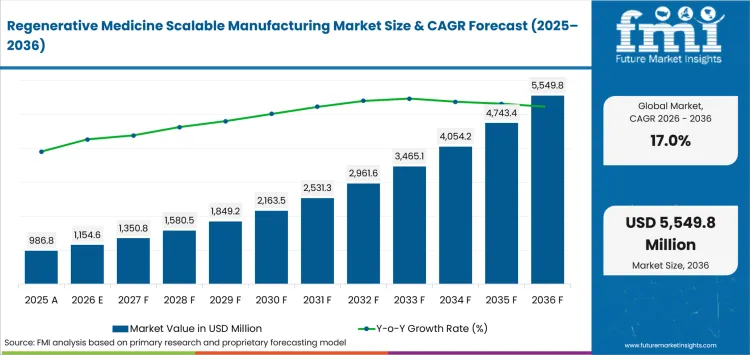
USD 1,154.6 million in 2026 and USD 5,549.8 million by 2036 at a 17.0% CAGR.
The regenerative medicine scalable manufacturing market is projected to grow at 17.0% CAGR through 2036, pushing valuation from USD 1,154.6 million in 2026 to USD 5,549.8 million by 2036. Cell therapy manufacturing creates recurring demand for expansion equipment and single-use materials that preserve identity across small patient-specific batches. Regenerative medicine programs also require process transfer from development laboratories into controlled production without changing critical quality attributes. In April 2025 Thermo Fisher Scientific opened an Advanced Therapies Collaboration Center in Carlsbad to support process development and cGMP scale transition. The center combines instrumentation and technical support around connected workflows rather than isolated equipment purchases during manufacturing scale-up. Manufacturers gain commercial value from platforms that shorten transfer work and produce comparable records across development and routine manufacturing.
United States programs operate through a centralized biologics pathway while European and Asian developers face distinct approval routes and manufacturing responsibilities. Germany supports specialized production through regulated facilities while Japan maintains a separate framework for regenerative medical products. South Korean investment increasingly combines consumable production with regional application training and technical service access for manufacturing operators. In January 2026 the USA Food and Drug Administration described a flexible approach to chemistry and manufacturing controls for cell and gene therapy applications. Cell and gene therapy manufacturing therefore depends on systems that preserve comparability without imposing one rigid process design across every therapy. Country investment decisions remain sensitive to qualified staff availability and service response alongside local regulatory expectations and purchasing routes.
Key Takeaways
- Market expansion is tied to the shift from manual, operator-dependent production toward closed manufacturing systems that improve batch consistency, contamination control, and process documentation across clinical and commercial programs.
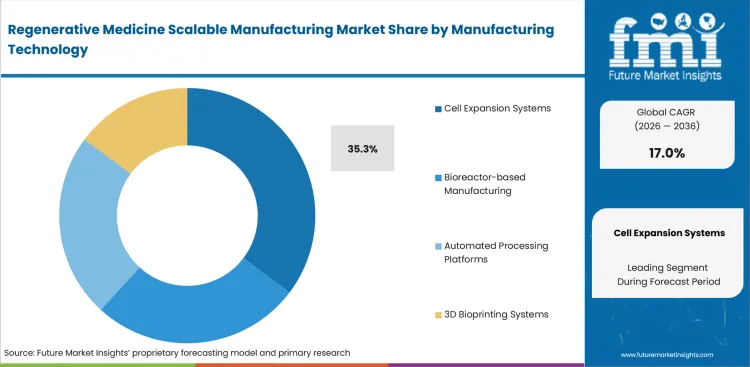
- Cell expansion systems are estimated to command 35.3% share in 2026, reflecting their central role in producing clinically usable cell volumes while maintaining identity, function, and controlled growth conditions.
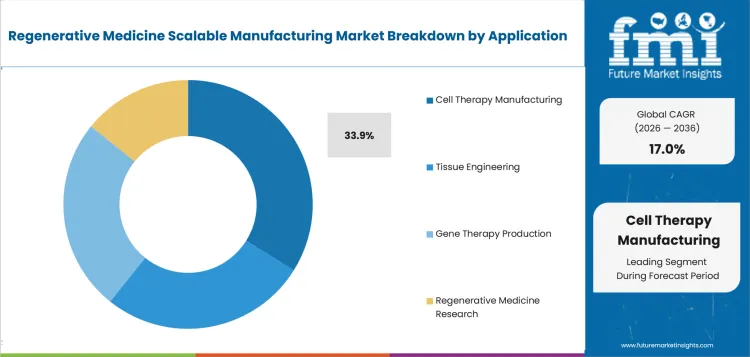
- Cell therapy manufacturing is forecast to secure 33.9% share in 2026, owing to the need for integrated workflows that protect chain of identity, support technology transfer, and manage patient-specific production schedules.
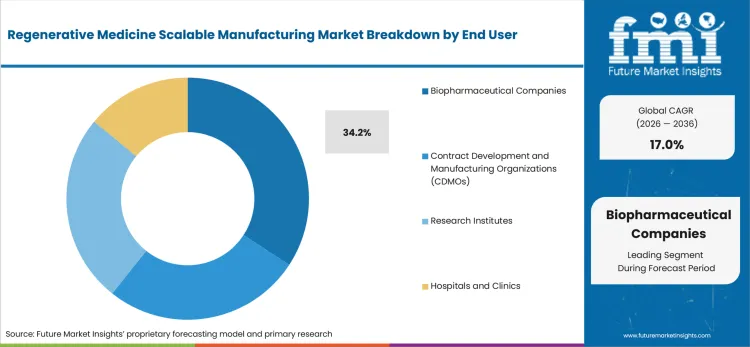
- Biopharmaceutical companies are projected to represent 34.2% share in 2026, since they retain direct responsibility for process development, regulatory commitments, manufacturing capacity, and dependable commercial supply.
- Consumables are estimated to lead the product type category with 38.9% share in 2026, driven by repeated use of culture media, tubing sets, sterile connectors, reagents, and closed fluid-path components during every production batch.
- The United States is forecast to post the fastest country growth at 19.1% CAGR, followed by Germany at 18.4% CAGR and South Korea at 17.6% CAGR, supported by advanced therapy programs, regulated production networks, and expanding bioprocess capacity.
- Product variability, demanding validation requirements, limited specialist capacity, equipment downtime, and uncertain access to qualified consumables continue to slow wider manufacturing scale-up.
- Competition features Thermo Fisher Scientific, Cytiva, Sartorius, Lonza, Miltenyi Biotec, FUJIFILM Biotechnologies, Charles River Laboratories, and Terumo Blood and Cell Technologies, with companies competing through closed processing, cell expansion integration, technical service, and clinical-to-commercial manufacturing support.
Analyst Perspective
“The key commercial question is whether a manufacturing platform maintains product quality while lowering manual intervention as production volumes rise. Developers are assessing process closure and cell expansion control as separate capabilities since each addresses a different source of manufacturing risk. Equipment decisions also depend on maintenance support and steady consumable availability, as strong technical performance offers little protection during prolonged downtime. Scale-up plans are expected to rely on representative process data instead of theoretical throughput that overlooks difficult cell types and release testing demands.”
— Anurag Sharma, Principal Analyst, Future Market Insights
How is the regenerative Medicine Scalable Manufacturing Market segmented?
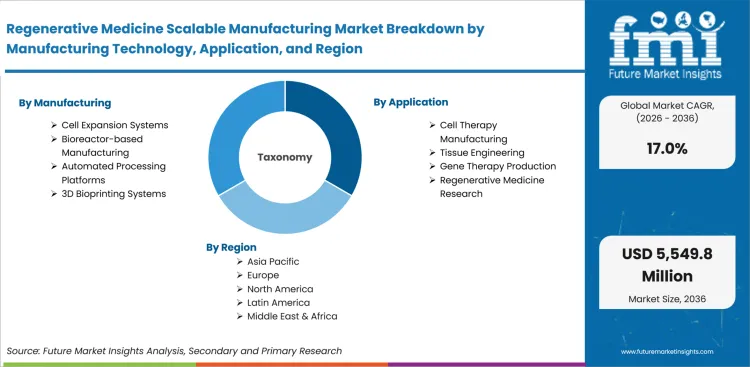
The regenerative medicine scalable manufacturing industry is segmented by manufacturing technology, application, end user, product type, and region.
The segmentation framework separates production methods from therapy applications and institutional ownership across one defined commercial boundary. Manufacturing technology covers expansion systems and automated processors alongside bioreactors and equipment used for three-dimensional tissue construction. Application analysis separates cell therapy production from tissue engineering workflows and manufacturing activities supporting gene therapy programs. End-user categories distinguish biopharmaceutical companies and CDMOs from research institutes alongside hospitals operating specialized clinical facilities. Product type separates recurring consumables from instruments and software products alongside specialized manufacturing and technical services. Regional analysis compares regulatory pathways and support infrastructure across countries with different advanced therapy manufacturing networks.
How do Cell Expansion Systems support the Manufacturing Technology category?
Cell expansion converts limited starting material into a clinically usable quantity without weakening identity or functional quality during production. Automated cell culture systems reduce manual interventions and create more consistent environmental control across repeated production runs. Sartorius Stedim Biotech reported in August 2025 that its Nanotein partnership covers global distribution of activation products supporting T-cell and natural-killer-cell expansion. Expansion platforms gain commercial relevance through compatible materials and controls that preserve reproducibility during scale transfer.
- In 2026, cell expansion systems are estimated to hold 35.3% share, attributable to their position during the longest controlled growth stage. Compatible cell culture media must work with sensors and fluid paths so larger batches preserve consistent environmental controls and release expectations.
- Biopharmaceutical developers adopt expansion systems that support several cell types without requiring complete process redevelopment during clinical progression. Flexible vessel sizes and validated control software preserve the same production logic across early batches and later commercial campaigns with greater volume and facility use.
Why does Cell Therapy Manufacturing shape the Application category?
Cell therapy production connects collection and processing with expansion and formulation across a chain that remains specific to each patient or donor. Single-use bioreactors support closed scale-out and reduce cleaning demands across facilities that manage several development programs. Commercial manufacturing depends on repeatable technology transfer and qualified production capacity rather than isolated equipment throughput under controlled laboratory conditions. Integrated digital records must preserve chain of identity across every transfer and final product release decision.
- Cell therapy manufacturing is forecast to represent 33.9% share in 2026, driven by its control over chain of identity and final product release. In March 2026 Lonza extended commercial manufacturing for ZYNTEGLO and planned additional capacity at its Houston facility for continuing supply.
- Contract manufacturers and therapy sponsors adopt scalable platforms that shorten technology transfer across changing campaign volumes and facility schedules. The most useful systems preserve process parameters across sites while allowing qualified adjustments for workforce capacity and cleanroom configuration without weakening comparability.
How are Biopharmaceutical Companies positioned within the End User category?
Biopharmaceutical companies control process development and regulatory commitments that determine whether manufacturing changes remain acceptable during clinical progression. Cell separation systems support standardized starting-material preparation before expansion and genetic modification begin within controlled production workflows. Direct product ownership also makes these companies responsible for qualified capacity and reliable commercial supply throughout the complete product lifecycle. Internal manufacturing teams therefore evaluate platforms against both technical performance and future regulatory comparability requirements.
- By end user, biopharmaceutical companies are projected to hold 34.2% share in 2026, reflecting direct responsibility for development strategy and commercial product supply. Their purchasing decisions emphasize validated performance and regulatory documentation alongside capacity that can expand without changing critical process controls or release specifications.
- Therapy developers favor platforms that connect instruments and materials under one quality framework across development and commercialization. In April 2026 the USA Food and Drug Administration approved Otarmeni for OTOF-associated genetic hearing loss under its national priority voucher program. Each approval increases the need for validated production and dependable commercial supply across tightly controlled treatment schedules.
What supports Consumables within the Product Type category?
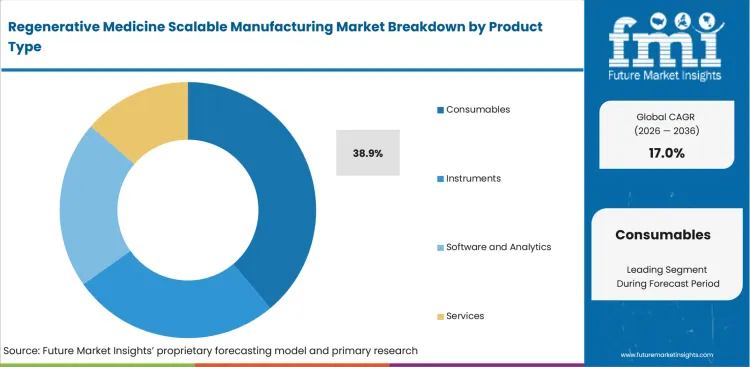
Consumables create recurring production demand through media and tubing sets alongside sterile connectors and quality-control reagents used during every batch. 3D bioprinting workflows also require qualified materials that preserve cell behavior during structured tissue production and repeatable analytical review. Sartorius reported in May 2026 that its new Freiburg competence center more than doubled manufacturing capacity for cytokines and growth factors. Expanded component production supports continuity but requires strong change control and supplier qualification across therapy programs.
- Consumables are estimated to account for 38.9% share in 2026, owing to repeated use across expansion and harvest operations. Media and closed fluid paths directly influence contamination control and remain embedded within validated manufacturing instructions for every qualified production batch.
- Manufacturers adopt consumable families that offer traceable lots and consistent performance across multiple equipment configurations and manufacturing locations. Standardized interfaces reduce qualification work and protect production schedules from delays caused by incompatible bags or unavailable critical reagents during active campaigns.
What are the drivers, restraints, and opportunities in the regenerative medicine scalable manufacturing market?
Demand rises as approved therapies require controlled production while validation burden and specialist capacity limit rapid manufacturing expansion.
- Driver: New therapy approvals create recurring demand for validated manufacturing platforms that support clinical supply and sustained commercial production.
- Restraint: Product variability and evolving safety expectations increase validation requirements across manufacturing equipment and analytical methods.
- Opportunity: Closed automation can connect expansion controls with quality records through scalable workflows under clearer operating responsibility.
New therapy approvals support market growth by converting development programs into recurring manufacturing and supply obligations. In March 2026 the USA Food and Drug Administration approved Kresladi for severe leukocyte adhesion deficiency type I. Each additional commercial therapy requires qualified facilities and controlled materials alongside validated release testing and patient-specific logistics. Equipment providers gain demand through platforms that preserve process performance across rising batch counts without proportional growth in manual intervention.
Manufacturing variability limits adoption whenever equipment performance cannot be connected with product-specific quality attributes and safety requirements. Developers must validate cell handling and analytical methods across changing materials during representative scale-transfer studies. In April 2026 the USA Food and Drug Administration issued draft guidance addressing standardized assessment of genome-editing off-target risks. Additional testing requirements can lengthen development timelines and increase demand for specialized analytical capability during product development. Smaller therapy companies face material friction as validation work exceeds their internal manufacturing and regulatory capacity.
Closed manufacturing creates an opportunity to combine automation and data capture around one accountable production path for therapy developers. Developers can reduce open handling while producing comparable records across expansion and formulation stages during repeated production campaigns. Japan Agency for Medical Research and Development supports programs that develop automated culture and closed manufacturing technologies for regenerative therapies. Portable bioprocessing bioreactors can extend controlled processing into modular facilities with limited permanent infrastructure and restricted cleanroom space. Commercial opportunity depends on qualified service and consumable supply rather than automation claims that exclude maintenance responsibility and operator training.
Which country CAGRs are profiled in the regenerative medicine scalable manufacturing market?
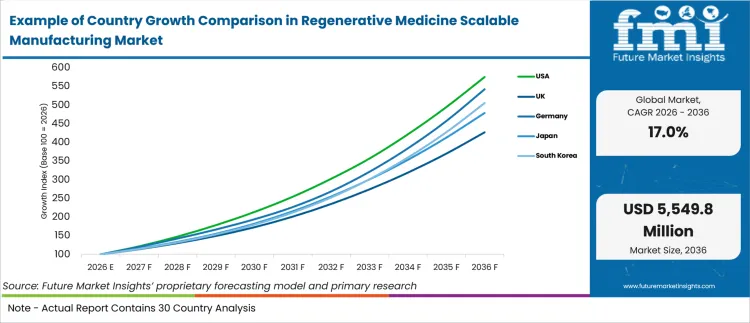
| Country | CAGR |
|---|---|
| USA | 19.1% |
| UK | 15.6% |
| Germany | 18.4% |
| Japan | 17.0% |
| South Korea | 17.6% |
How do country-level CAGRs compare in the regenerative Medicine Scalable Manufacturing Market?
The country comparison spans 3.5 percentage points and reveals three defined growth groups across the regenerative medicine scalable manufacturing market. The USA and Germany form a closely aligned upper tier, with only 0.7 percentage points separating their forecasts. South Korea and Japan create the middle group within a 0.6-point range. A wider 1.4-point difference between Japan and the UK creates a visible break in the comparison. Countries with established therapy pipelines, manufacturing networks and technical support generally demonstrate stronger investment momentum.
- The USA leads the comparison as therapy developers and contract manufacturers expand validated production capacity for clinical and commercial programs.
- Germany remains only 0.7 percentage points below the USA, supported by established biopharmaceutical infrastructure and regulated advanced therapy pathways.
- South Korea remains 0.8 percentage points below Germany as the Songdo bioprocess cluster and regional manufacturing investment support capacity expansion.
- Japan remains only 0.6 percentage points below South Korea, reflecting a dedicated regenerative medicine framework and established domestic production networks.
- The UK remains 1.4 percentage points below Japan despite its concentrated advanced therapy pipeline, clinical research centers and specialist manufacturing activity.
Comparable CAGRs can still produce different market-entry conditions. Differences in regulatory pathways, facility ownership, service coverage, workforce skills and contract manufacturing access influence equipment choices and investment timing. The full report provides country-level CAGR analysis across North America, Latin America, Europe, East Asia, South Asia, Oceania and the Middle East and Africa.
Country-wise Analysis
- United States manufacturing networks combine therapy developers, contract manufacturers and specialist equipment companies across major biopharmaceutical clusters. The USA is forecast to expand at 19.1% CAGR over the assessment period, supported by a broad development pipeline and flexible production strategies. FDA guidance issued in May 2026 described flexibility in chemistry and manufacturing controls while retaining applicable biologics requirements. Developers may purchase integrated systems or use qualified contract manufacturing capacity. Broad technical support and application training assist scale transfer across commercial programs. High facility costs and competition for experienced quality staff remain key barriers for smaller therapy companies.
- Germany combines established biopharmaceutical production with regulated hospital-based routes for preparing advanced therapies. Germany is projected to grow at 18.4% CAGR through 2036, supported by European manufacturing networks and specialist clinical infrastructure. Paul-Ehrlich-Institut explains that hospital-exemption products must be prepared non-routinely under physician supervision for individual patients. Local service groups support validated equipment installation across clinical and commercial programs. Strict facility requirements and differences between federal operating environments may slow consistent implementation. Manufacturing companies require complete documentation and qualified technical support when expanding standardized systems across several German production sites.
- South Korea combines a growing biopharmaceutical sector with major investment around the Songdo manufacturing hub. The market is projected to expand at 17.6% CAGR by 2036, supported by regional bioprocess infrastructure and local material access. Sartorius reports that its Songdo project includes consumables, media production and an application and training center. The investment improves service access and process support for expanding manufacturing programs. Regional technical groups also reduce dependence on distant support during commissioning. Workforce readiness and equipment qualification remain practical barriers until newly added facilities reach stable routine production.
- Japan follows a dedicated approval framework for regenerative medical products and requires manufacturing evidence aligned with that product category. The market is estimated to advance at 17.0% CAGR during the assessment period, supported by clinical development and specialist production networks. PMDA records list AMCHEPRY Raguneprocel among products approved in March 2026. Current approvals support investment in validated manufacturing platforms across domestic facilities. International systems reach operators through local subsidiaries and technical partners. Japanese-language documentation, domestic quality expectations and detailed technology-transfer requirements may extend commercial validation schedules.
- United Kingdom advanced therapy activity is concentrated within a connected research, clinical and manufacturing network. The UK is projected to record 15.6% CAGR during the forecast period, supported by a sizeable development pipeline and specialist centers. Cell and Gene Therapy Catapult reported 193 ongoing advanced therapy trials during 2025. Concentrated activity provides shared expertise and flexible process-development capacity during commercial preparation. Developers use direct equipment purchases or contracted clinical manufacturing with validation support. Funding continuity and limited specialist production slots remain key constraints as more programs approach later development and commercial scale.
Who are the notable companies in the regenerative Medicine Scalable Manufacturing Market?
Thermo Fisher Scientific, Cytiva, Sartorius, Lonza, Miltenyi Biotec, FUJIFILM Biotechnologies, Charles River Laboratories, and Terumo Blood and Cell Technologies are notable participants.
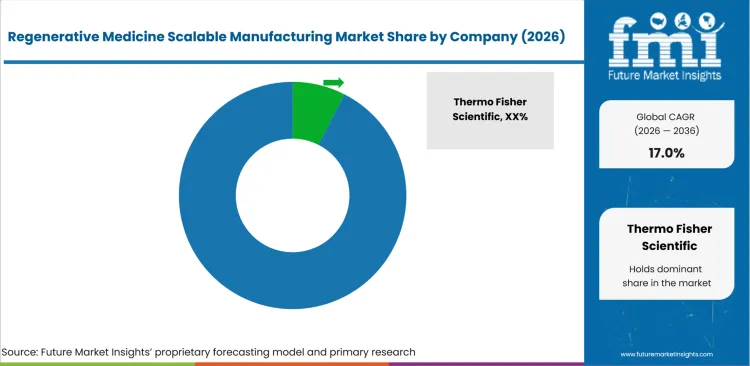
Competition spans integrated equipment suppliers and specialist manufacturers alongside companies that provide recurring materials and technical support. Platform relevance depends on direct control over expansion and closed processing rather than general biopharmaceutical scale. FUJIFILM Biotechnologies describes end-to-end cell therapy services from preclinical development through commercial cGMP production and distribution. Comparable cell culture media platforms strengthen system value through qualified materials and consistent process performance across different facilities. Customers should compare ownership of technology transfer and maintenance responsibility across each offering before committing production capacity. The competitive boundary excludes companies whose activity remains limited to unrelated research instruments or broader parent-industry services.
- Integrated equipment providers include Thermo Fisher Scientific and Cytiva alongside Sartorius and Terumo Blood and Cell Technologies. Their official portfolios combine closed processing or expansion equipment with software and technical support that connect several manufacturing stages.
- Manufacturing service providers include Lonza and FUJIFILM Biotechnologies alongside Charles River Laboratories within this defined market. Manufacturing service providers support process transfer and cGMP production across clinical or commercial phases using technologies from several equipment developers.
- Miltenyi Biotec combines cell separation and expansion within the integrated CliniMACS Prodigy manufacturing platform for therapy production. The company supplies a system that therapy developers or service organizations can operate within qualified manufacturing facilities.
Competitive Benchmarking: Regenerative Medicine Scalable Manufacturing Market
| Company | Closed Processing Depth | Cell Expansion Integration | GMP Scale Support | Geographic Reach |
|---|---|---|---|---|
| High | High | High | Global | |
| Cytiva | High | High | Medium | Global |
| Sartorius | High | High | High | Global |
| Lonza | Medium | High | High | North America, Europe, and Asia |
| Miltenyi Biotec | High | High | High | North America, Europe, and East Asia |
| FUJIFILM Biotechnologies | Medium | High | High | North America and Europe |
| Charles River Laboratories | Medium | High | High | North America and Europe |
| Terumo Blood and Cell Technologies | High | High | High | Global |
A High closed-processing rating requires an official integrated workflow that limits open handling across several manufacturing steps. A Medium closed-processing rating requires verified closed or automated support without one complete end-to-end workflow. A Low closed-processing rating requires documented enabling components that remain outside direct therapeutic-cell processing workflows and operations. A High cell-expansion rating requires controlled expansion inside an integrated platform or directly managed manufacturing workflow. A Medium cell-expansion rating requires verified expansion support through services or supporting equipment without complete platform integration. A Low cell-expansion rating requires a documented adjacent role without direct therapeutic-cell expansion capability or production responsibility. A High GMP-scale rating requires verified clinical-to-commercial manufacturing responsibility or validated commercial-scale platform support across active programs. A Medium GMP-scale rating requires GMP-capable equipment or services without complete commercial manufacturing responsibility across supported therapy programs. A Low GMP-scale rating requires documented development-stage capability that excludes direct GMP production or commercial-scale platform support.
Key Developments
- In April 2026, Thermo Fisher Scientific announced Japanese commercial availability of the Gibco CTS Compleo Fill and Finish System for automated formulation and filling. The functionally closed modular design uses sterile single-use kits with programmable software during cell therapy production. Installation support and global service coverage help manufacturers integrate the system with established clinical or commercial workflows.
- In March 2026, Sartorius launched the Eveo Cell Therapy Platform for automated multi-parallel production and quality control of autologous therapies. The platform combines cell selection and genetic modification with expansion and final formulation across a closed production system. Its multi-parallel architecture addresses capacity limitations without requiring proportional growth in existing cleanroom space or additional operator stations.
- In December 2025, Lonza received an FDA Advanced Manufacturing Technology designation for the Cocoon Platform used in cell therapy production. The designation covers an automated closed platform that supports centralized or decentralized manufacturing configurations across qualified production environments. Therapy developers gain a defined regulatory discussion route for advanced production technology during development and eventual commercial scale-up.
- In December 2025, Repligen Corporation introduced three chromatography resins for viral-vector and other new-modality purification workflows. The portfolio includes AAV affinity and anion-exchange products designed to broaden downstream processing choices across emerging therapeutic modalities. Gene therapy manufacturers can evaluate scalable purification options against product recovery and process consistency across increasingly complex biological materials during clinical and commercial production.
Key Players
Integrated Manufacturing Platforms
- Thermo Fisher Scientific
- Cytiva
- Sartorius
- Miltenyi Biotec
- Terumo Blood and Cell Technologies
Cell Therapy Development and Manufacturing Services
- Lonza
- FUJIFILM Biotechnologies
- Charles River Laboratories
Materials and Bioprocessing Specialists
- Repligen Corporation
- Sartorius CellGenix
Regenerative Medicine Scalable Manufacturing Market - Report Scope
| Coverage field | Report scope |
|---|---|
| Market breakdown | Manufacturing technology, application, end user, product type, country, and region |
| Quantitative Units | USD million for market value and percentage for shares and compound annual growth rates |
| Market Definition | Commercial systems, consumables, software, and services used to scale regenerative medicine manufacturing from development through clinical and commercial production |
| Regions Covered | North America, Latin America, Western Europe, Eastern Europe, East Asia, South Asia and Pacific, Middle East and Africa |
| Countries Covered | 30+ countries including USA, Canada, Brazil, Mexico, Germany, France, United Kingdom, China, Japan, South Korea, India, Australia, Türkiye, and South Africa |
| Key Companies Profiled | Thermo Fisher Scientific, Cytiva, Sartorius, Lonza, Miltenyi Biotec, FUJIFILM Biotechnologies, Charles River Laboratories, Terumo Blood and Cell Technologies, and other verified participants |
| Forecast Period | 2026 to 2036 |
| Approach | Data triangulation methodology combining bottom-up analysis, top-down validation, company benchmarking, and evidence-supported forecasting. |
Regenerative Medicine Scalable Manufacturing Market - Research Methodology
| Method | Approach |
|---|---|
| Primary Research | FMI analysts gathered input from manufacturers, service providers, technology developers, distributors, end users, procurement teams, and subject-matter experts. Interviews examined purchasing decisions, product or service evaluation, adoption barriers, approval requirements, pricing considerations, and expectations for technical or commercial support. Respondents were also asked what evidence is required before a trial, pilot, or initial order develops into regular purchasing. |
| Desk Research | Desk research covered government statistics, regulatory publications, trade data, industry associations, technical literature, standards, company filings, product information, and official corporate announcements. Sources were reviewed for relevance, publication date, geographic coverage, and consistency with the defined market scope. Claims relating to performance, applications, approvals, capacity, investment, and commercial activity were retained only when supported by credible public evidence. |
| Market Sizing and Forecasting | The market model combined the baseline value with historical performance, segment structure, pricing and volume indicators, adoption levels, company participation, and country-level demand conditions. Forecast assumptions considered economic activity, investment trends, regulatory developments, technology adoption, purchasing cycles, supply availability, and barriers to wider market use. Segment and regional estimates were reconciled before the final market total was calculated. |
| Data Validation | Estimates were checked against multiple independent indicators, including public data, company activity, trade patterns, industry developments, and findings from primary interviews. Validation also tested whether products, services, applications, and company revenues fell within the defined market boundaries. Adjacent categories, unsupported claims, overlapping revenues, and activities without direct market relevance were excluded to reduce double counting and maintain consistency across segments and countries. |
Regenerative Medicine Scalable Manufacturing Market by Segments
Regenerative Medicine Scalable Manufacturing Market segmented by Manufacturing Technology:
- Cell Expansion Systems
- Bioreactor-based Manufacturing
- Automated Processing Platforms
- 3D Bioprinting Systems
Regenerative Medicine Scalable Manufacturing Market segmented by Application:
- Cell Therapy Manufacturing
- Tissue Engineering
- Gene Therapy Production
- Regenerative Medicine Research
Regenerative Medicine Scalable Manufacturing Market segmented by End User:
- Biopharmaceutical Companies
- Contract Development and Manufacturing Organizations (CDMOs)
- Research Institutes
- Hospitals and Clinics
Regenerative Medicine Scalable Manufacturing Market segmented by Product Type:
- Consumables
- Instruments
- Software and Analytics
- Services
Regenerative Medicine Scalable Manufacturing Market by Region:
- North America
- United States
- Canada
- Latin America
- Brazil
- Mexico
- Argentina
- Chile
- Western Europe
- Germany
- France
- United Kingdom
- Italy
- Spain
- Benelux
- Nordics
- Eastern Europe
- Poland
- Czech Republic
- Romania
- Hungary
- East Asia
- China
- Japan
- South Korea
- South Asia and Pacific
- India
- ASEAN
- Australia and New Zealand
- Middle East and Africa
- GCC Countries
- South Africa
- Türkiye
- Israel
Research Sources and Bibliography
- Somers, T. (2025, April 16). Thermo Fisher Scientific launches state-of-the-art Advanced Therapies Collaboration Center.
- USA Food and Drug Administration. (2026, January 11). FDA Increases Flexibility on Requirements for Cell and Gene Therapies to Advance Innovation.
- Sartorius Stedim Biotech. (2025, August 11). Sartorius Stedim Biotech and Nanotein Technologies partner to advance cell therapy manufacturing.
- Lonza. (2026, March 9). Lonza and Genetix Biotherapeutics Extend Commercial Manufacturing Agreement for ZYNTEGLO™.
- USA Food and Drug Administration. (2026, April 23). FDA Approves First-Ever Gene Therapy for Treatment of Genetic Hearing Loss Under National Priority Voucher Program.
- Sartorius. (2026, May 21). Sartorius opens new competence center for cell and gene therapy components in Freiburg, Germany.
- USA Food and Drug Administration. (2026, March 26). FDA Approves First Gene Therapy for Severe Leukocyte Adhesion Deficiency Type I.
- USA Food and Drug Administration. (2026, April 14). FDA Issues Draft Guidance on Genome Editing Safety Standards to Advance Gene Therapy Development.
- Japan Agency for Medical Research and Development. (2026, May 15).[Project for development of foundational technologies for industrialization of regenerative medicine and gene therapy (next-generation manufacturing technologies for regenerative medicine and cell therapy)].
- USA Food and Drug Administration. (2026, May). Chemistry, Manufacturing, and Controls Flexibilities for Developing Human Cellular and Gene Therapy Products for a Biologics License Application.
- Cell and Gene Therapy Catapult. (2026, January 26). New data shows continued growth in advanced therapy clinical trials in the UK for 2025, with the number of early-stage trials remaining high.
- Paul-Ehrlich-Institut. (2025, April 3). ATMP - FAQ Frequently Asked Questions: ATMP.
- Thermo Fisher Scientific Japan Group. (2026, April 22).Gibco CTS Compleo Fill and Finish System」[Thermo Fisher Scientific announces the Gibco CTS Compleo Fill and Finish System to support efficient cell therapy product manufacturing].
- Sartorius. (2026, March 16). Sartorius launches next-generation platform to boost efficiency in cell therapy production.
- Lonza. (2025, December 11). Lonza Receives FDA Advanced Manufacturing Technology Designation for the Cocoon® Platform.
- Repligen Corporation. (2025, December 16). Repligen Introduces Next-Generation Chromatography Resins to Advance New Modality Workflows.
This bibliography is provided for reader reference and is not exhaustive. The full report contains the complete reference list and detailed citations
This Report Answers
- How large is the regenerative medicine scalable manufacturing market in 2026 and 2036?
- Which operating conditions support investment in scalable regenerative medicine manufacturing systems?
- Why do cell expansion systems hold the largest manufacturing technology share during 2026?
- How does cell therapy manufacturing influence demand for integrated production platforms?
- Why do biopharmaceutical companies represent the largest end-user segment during 2026?
- How do country growth rates differ across the USA, UK, Germany, Japan, and South Korea?
- Which companies provide closed platforms or clinical and commercial manufacturing services?
- What limits reproducible scale-up across varied cell types and therapy manufacturing processes?
- How can recurring consumables and technical service affect long-term manufacturing continuity?
Frequently Asked Questions
What is driving growth in the regenerative medicine scalable manufacturing market?
New therapy approvals increase demand for controlled manufacturing systems that support clinical supply and recurring commercial production across expanding treatment pipelines. Developers also need scalable workflows that reduce manual handling while preserving product quality and complete process traceability.
Who are the key players in the regenerative medicine scalable manufacturing market?
Thermo Fisher Scientific and Cytiva compete with Sartorius and Miltenyi Biotec across integrated manufacturing platforms for therapeutic cells. Lonza and FUJIFILM Biotechnologies provide development and cGMP manufacturing services across clinical and commercial production stages.
What is a notable restraint in the regenerative medicine scalable manufacturing market?
Product-specific variability makes equipment validation difficult across different cell types and manufacturing processes during representative production studies. Limited specialist staff and prolonged service interruptions can delay manufacturing even when platform performance remains technically suitable.
Why should executives track the regenerative medicine scalable manufacturing market?
Manufacturing capacity can determine whether an advanced therapy reaches patients reliably following regulatory approval and commercial launch. Executives need visibility into process cost and support coverage alongside expansion capacity and qualified consumable supply.
What business problem does the regenerative medicine scalable manufacturing market address?
The market addresses inconsistent scale transfer from development laboratories into controlled clinical and commercial manufacturing environments. Integrated systems create repeatable production records while reducing open handling and coordination across fragmented equipment steps.
What should manufacturers evaluate in the regenerative medicine scalable manufacturing market?
Manufacturers should compare process closure and cell expansion control across representative product conditions and expected batch sizes. Evaluation should also cover software records and maintenance response alongside consumable availability across every intended production region.
What limits return on investment in the regenerative medicine scalable manufacturing market?
Low equipment use and prolonged validation can reduce returns on manufacturing capital across small or uncertain therapy pipelines. Unclear service responsibility also increases downtime risk during patient-specific campaigns with limited scheduling flexibility and urgent treatment schedules.
What supports long-term commercial confidence in the regenerative medicine scalable manufacturing market?
Consistent process performance across clinical and commercial batches supports confidence in additional manufacturing investment across active therapy programs. Reliable service networks and qualified recurring materials provide therapy developers with a practical foundation for expanding capacity.
Preview the report firsthand - request a free sample
Get SampleGet the brochure for pricing and purchase details.
Get PDFTable of Content
- Key Takeaways
- Market Size and CAGR
- Top Growth Driver
- Fastest Growing Segment
- Leading Region
- Key Companies
- Emerging Opportunities
- Executive Summary
- Global Market Outlook
- Demand-side Trends
- Supply-side Trends
- Technology Roadmap Analysis
- Analysis and Recommendations
- Analyst Perspective (What is happening? Why now? What should investors know?)
- Key Questions Answered
- How large is the market?
- What is the CAGR?
- What are key trends?
- Which region dominates?
- Who are the leaders?
- Market Overview
- Market Coverage / Taxonomy
- Market Definition / Scope / Limitations
- Research Methodology
- Chapter Orientation
- Analytical Lens and Working Hypotheses
- Market Structure, Signals, and Trend Drivers
- Benchmarking and Cross-market Comparability
- Market Sizing, Forecasting, and Opportunity Mapping
- Research Design and Evidence Framework
- Desk Research Programme (Secondary Evidence)
- Expert Input and Fieldwork (Primary Evidence)
- Tooling, Models, and Reference Databases
- Data Engineering and Model Build
- Quality Assurance and Audit Trail
- Market Background
- Market Dynamics (Drivers, Restraints, Opportunity, Trends)
- Scenario Forecast (Optimistic, Likely, Conservative)
- Impact Analysis
- AI Impact
- Sustainability Impact
- Regulatory Impact
- Technology Impact
- Consumer / Buyer Analysis
- Purchase Drivers
- Adoption Barriers
- Buyer Journey
- Opportunity Map Analysis
- Product Life Cycle Analysis
- Supply Chain Analysis
- Investment Feasibility Matrix
- Value Chain Analysis
- PESTLE and Porter's Analysis
- Regulatory Landscape
- Regional Parent Market Outlook
- Production and Consumption Statistics
- Import and Export Statistics
- Global Market Analysis and Forecast, 2021 to 2036
- Historical Market Size Value (USD Million) Analysis, 2021 to 2025
- Current and Future Market Size Value (USD Million) Projections, 2026 to 2036
- Y-o-Y Growth Trend Analysis
- Absolute $ Opportunity Analysis
- Global Market Pricing Analysis, 2021 to 2036
- Global Market Analysis and Forecast, By Manufacturing Technology, 2021 to 2036
- Introduction / Key Findings
- Historical Market Size Value (USD Million) Analysis By Manufacturing Technology, 2021 to 2025
- Current and Future Market Size Value (USD Million) Analysis and Forecast By Manufacturing Technology, 2026 to 2036
- Cell Expansion Systems
- Bioreactor-based Manufacturing
- Automated Processing Platforms
- 3D Bioprinting Systems
- Cell Expansion Systems
- Y-o-Y Growth Trend Analysis By Manufacturing Technology, 2021 to 2025
- Absolute $ Opportunity Analysis By Manufacturing Technology, 2026 to 2036
- Global Market Analysis and Forecast, By Application, 2021 to 2036
- Introduction / Key Findings
- Historical Market Size Value (USD Million) Analysis By Application, 2021 to 2025
- Current and Future Market Size Value (USD Million) Analysis and Forecast By Application, 2026 to 2036
- Cell Therapy Manufacturing
- Tissue Engineering
- Gene Therapy Production
- Regenerative Medicine Research
- Cell Therapy Manufacturing
- Y-o-Y Growth Trend Analysis By Application, 2021 to 2025
- Absolute $ Opportunity Analysis By Application, 2026 to 2036
- Global Market Analysis and Forecast, By End User, 2021 to 2036
- Introduction / Key Findings
- Historical Market Size Value (USD Million) Analysis By End User, 2021 to 2025
- Current and Future Market Size Value (USD Million) Analysis and Forecast By End User, 2026 to 2036
- Biopharmaceutical Companies
- Contract Development and Manufacturing Organizations (CDMOs)
- Research Institutes
- Hospitals and Clinics
- Biopharmaceutical Companies
- Y-o-Y Growth Trend Analysis By End User, 2021 to 2025
- Absolute $ Opportunity Analysis By End User, 2026 to 2036
- Global Market Analysis and Forecast, By Product Type, 2021 to 2036
- Introduction / Key Findings
- Historical Market Size Value (USD Million) Analysis By Product Type, 2021 to 2025
- Current and Future Market Size Value (USD Million) Analysis and Forecast By Product Type, 2026 to 2036
- Consumables
- Instruments
- Software and Analytics
- Services
- Consumables
- Y-o-Y Growth Trend Analysis By Product Type, 2021 to 2025
- Absolute $ Opportunity Analysis By Product Type, 2026 to 2036
- Global Market Analysis and Forecast, By Region, 2021 to 2036
- Introduction
- Historical Market Size Value (USD Million) Analysis By Region, 2021 to 2025
- Current Market Size Value (USD Million) Analysis and Forecast By Region, 2026 to 2036
- North America
- Latin America
- Western Europe
- Eastern Europe
- East Asia
- South Asia and Pacific
- Middle East & Africa
- Market Attractiveness Analysis By Region
- North America Market Analysis and Forecast, By Country, 2021 to 2036
- Historical Market Size Value (USD Million) Trend Analysis By Market Taxonomy, 2021 to 2025
- Market Size Value (USD Million) Forecast By Market Taxonomy, 2026 to 2036
- By Country
- USA
- Canada
- By Manufacturing Technology
- By Application
- By End User
- By Product Type
- By Country
- Market Attractiveness Analysis
- By Country
- By Manufacturing Technology
- By Application
- By End User
- By Product Type
- Key Takeaways
- Latin America Market Analysis and Forecast, By Country
- Historical Market Size Value (USD Million) Trend Analysis By Market Taxonomy, 2021 to 2025
- Market Size Value (USD Million) Forecast By Market Taxonomy, 2026 to 2036
- By Country
- Brazil
- Mexico
- Chile
- Rest of Latin America
- By Manufacturing Technology
- By Application
- By End User
- By Product Type
- By Country
- Market Attractiveness Analysis
- By Country
- By Manufacturing Technology
- By Application
- By End User
- By Product Type
- Key Takeaways
- Western Europe Market Analysis and Forecast, By Country
- Historical Market Size Value (USD Million) Trend Analysis By Market Taxonomy, 2021 to 2025
- Market Size Value (USD Million) Forecast By Market Taxonomy, 2026 to 2036
- By Country
- Germany
- UK
- Italy
- Spain
- France
- Nordic
- BENELUX
- Rest of Western Europe
- By Manufacturing Technology
- By Application
- By End User
- By Product Type
- By Country
- Market Attractiveness Analysis
- By Country
- By Manufacturing Technology
- By Application
- By End User
- By Product Type
- Key Takeaways
- Eastern Europe Market Analysis and Forecast, By Country
- Historical Market Size Value (USD Million) Trend Analysis By Market Taxonomy, 2021 to 2025
- Market Size Value (USD Million) Forecast By Market Taxonomy, 2026 to 2036
- By Country
- Russia
- Poland
- Hungary
- Balkan & Baltic
- Rest of Eastern Europe
- By Manufacturing Technology
- By Application
- By End User
- By Product Type
- By Country
- Market Attractiveness Analysis
- By Country
- By Manufacturing Technology
- By Application
- By End User
- By Product Type
- Key Takeaways
- East Asia Market Analysis and Forecast, By Country
- Historical Market Size Value (USD Million) Trend Analysis By Market Taxonomy, 2021 to 2025
- Market Size Value (USD Million) Forecast By Market Taxonomy, 2026 to 2036
- By Country
- China
- Japan
- South Korea
- By Manufacturing Technology
- By Application
- By End User
- By Product Type
- By Country
- Market Attractiveness Analysis
- By Country
- By Manufacturing Technology
- By Application
- By End User
- By Product Type
- Key Takeaways
- South Asia and Pacific Market Analysis and Forecast, By Country
- Historical Market Size Value (USD Million) Trend Analysis By Market Taxonomy, 2021 to 2025
- Market Size Value (USD Million) Forecast By Market Taxonomy, 2026 to 2036
- By Country
- India
- ASEAN
- Australia & New Zealand
- Rest of South Asia and Pacific
- By Manufacturing Technology
- By Application
- By End User
- By Product Type
- By Country
- Market Attractiveness Analysis
- By Country
- By Manufacturing Technology
- By Application
- By End User
- By Product Type
- Key Takeaways
- Middle East & Africa Market Analysis and Forecast, By Country
- Historical Market Size Value (USD Million) Trend Analysis By Market Taxonomy, 2021 to 2025
- Market Size Value (USD Million) Forecast By Market Taxonomy, 2026 to 2036
- By Country
- Kingdom of Saudi Arabia
- Other GCC Countries
- Türkiye
- South Africa
- Other African Union
- Rest of Middle East & Africa
- By Manufacturing Technology
- By Application
- By End User
- By Product Type
- By Country
- Market Attractiveness Analysis
- By Country
- By Manufacturing Technology
- By Application
- By End User
- By Product Type
- Key Takeaways
- Key Countries Market Analysis
- USA
- Pricing Analysis
- Market Share Analysis, 2025
- By Manufacturing Technology
- By Application
- By End User
- By Product Type
- Canada
- Pricing Analysis
- Market Share Analysis, 2025
- By Manufacturing Technology
- By Application
- By End User
- By Product Type
- Mexico
- Pricing Analysis
- Market Share Analysis, 2025
- By Manufacturing Technology
- By Application
- By End User
- By Product Type
- Brazil
- Pricing Analysis
- Market Share Analysis, 2025
- By Manufacturing Technology
- By Application
- By End User
- By Product Type
- Chile
- Pricing Analysis
- Market Share Analysis, 2025
- By Manufacturing Technology
- By Application
- By End User
- By Product Type
- Germany
- Pricing Analysis
- Market Share Analysis, 2025
- By Manufacturing Technology
- By Application
- By End User
- By Product Type
- UK
- Pricing Analysis
- Market Share Analysis, 2025
- By Manufacturing Technology
- By Application
- By End User
- By Product Type
- Italy
- Pricing Analysis
- Market Share Analysis, 2025
- By Manufacturing Technology
- By Application
- By End User
- By Product Type
- Spain
- Pricing Analysis
- Market Share Analysis, 2025
- By Manufacturing Technology
- By Application
- By End User
- By Product Type
- France
- Pricing Analysis
- Market Share Analysis, 2025
- By Manufacturing Technology
- By Application
- By End User
- By Product Type
- India
- Pricing Analysis
- Market Share Analysis, 2025
- By Manufacturing Technology
- By Application
- By End User
- By Product Type
- ASEAN
- Pricing Analysis
- Market Share Analysis, 2025
- By Manufacturing Technology
- By Application
- By End User
- By Product Type
- Australia & New Zealand
- Pricing Analysis
- Market Share Analysis, 2025
- By Manufacturing Technology
- By Application
- By End User
- By Product Type
- China
- Pricing Analysis
- Market Share Analysis, 2025
- By Manufacturing Technology
- By Application
- By End User
- By Product Type
- Japan
- Pricing Analysis
- Market Share Analysis, 2025
- By Manufacturing Technology
- By Application
- By End User
- By Product Type
- South Korea
- Pricing Analysis
- Market Share Analysis, 2025
- By Manufacturing Technology
- By Application
- By End User
- By Product Type
- Russia
- Pricing Analysis
- Market Share Analysis, 2025
- By Manufacturing Technology
- By Application
- By End User
- By Product Type
- Poland
- Pricing Analysis
- Market Share Analysis, 2025
- By Manufacturing Technology
- By Application
- By End User
- By Product Type
- Hungary
- Pricing Analysis
- Market Share Analysis, 2025
- By Manufacturing Technology
- By Application
- By End User
- By Product Type
- Kingdom of Saudi Arabia
- Pricing Analysis
- Market Share Analysis, 2025
- By Manufacturing Technology
- By Application
- By End User
- By Product Type
- Türkiye
- Pricing Analysis
- Market Share Analysis, 2025
- By Manufacturing Technology
- By Application
- By End User
- By Product Type
- South Africa
- Pricing Analysis
- Market Share Analysis, 2025
- By Manufacturing Technology
- By Application
- By End User
- By Product Type
- USA
- Market Structure Analysis
- Competition Dashboard
- Competition Benchmarking
- Market Share Analysis of Top Players
- By Regional
- By Manufacturing Technology
- By Application
- By End User
- By Product Type
- Emerging Startups
- Innovation Benchmarking
- Competition Analysis
- Competition Deep Dive
- Thermo Fisher Scientific
- Overview
- Product Portfolio
- Profitability by Market Segments
- Sales Footprint
- Strategy Overview
- Marketing Strategy
- Product Strategy
- Channel Strategy
- Cytiva
- Sartorius
- Lonza
- FUJIFILM Diosynth Biotechnologies
- Miltenyi Biotec
- Catalent
- Repligen
- Danaher
- Charles River Laboratories
- Thermo Fisher Scientific
- Case Studies
- Success Stories
- Recent Developments
- Competition Deep Dive
- Assumptions & Acronyms Used


