

- Market Size (2026)
- USD 680.6 Mn
- Forecast (2036)
- USD 1567.4 Mn
- CAGR (2026 to 2036)
- 8.7%
How big is Remote Vessel Control Market in 2026?
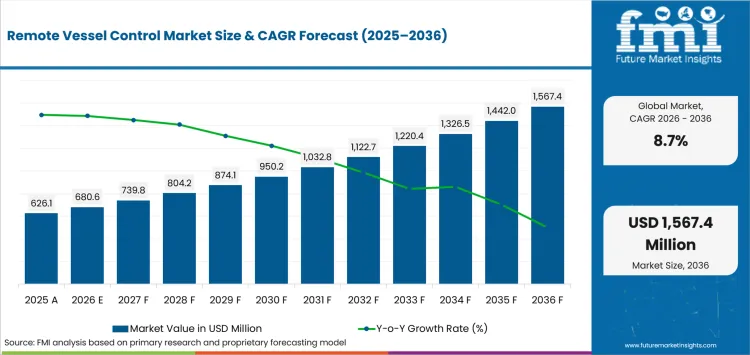
USD 680.6 Million in 2026 and USD 1,567.4 Million by 2036 at an 8.7% CAGR.
Demand for remote vessel control is projected to expand at 8.7% CAGR between 2026 and 2036, lifting valuation from USD 680.6 million in 2026 to USD 1,567.4 million by 2036. Remote vessel control spending is moving beyond isolated pilot projects because regulators and operators now have a clearer framework for dividing responsibility between onboard systems and shore teams. In May 2026, the International Maritime Organization adopted the non-mandatory MASS Code. It took effect on July 1, 2026. The Code sets expectations for navigation and connectivity while also covering remote operations, cybersecurity and human oversight. That framework does not remove the need for class or flag approval. It does give fleet owners a more consistent basis for specifying control systems. Buyers therefore place greater weight on functional safety, loss-of-link behavior and operator handover. They also assess whether a control package can connect with existing steering and propulsion interfaces. This shifts purchasing toward integrated packages that can be validated on a vessel rather than stand-alone remote-control devices.
Adoption conditions differ sharply by country even when the same technical platform is available. South Korea has built a statutory route for demonstrations and regulatory exceptions around autonomous ships. Norway is moving from trials into offshore work through class-reviewed remote vessels and shore control. Finland is concentrating on reliable communications for automation. Its national spectrum authority highlights hybrid use of terrestrial and satellite systems. Japan is progressing through formal technology qualification and staged vessel demonstrations. These approaches create different sales cycles for suppliers. A fleet operator may value the same remote helm or mission-control capability in each market. Conversion still depends on proof that the system works inside the local approval path and operating envelope.
Key Takeaways
- Remote vessel control is moving hazardous and repetitive tasks toward shore supervision while keeping command authority traceable through helm, propulsion and mission interfaces.
- Remote helm control accounts for 26.0% of the Control Type category in 2026 because it extends operator position while preserving direct human authority.
- Cellular accounts for 27.0% of the Connectivity category in 2026 because nearshore and port operations can use commercial network capacity with practical latency and cost.
- Workboats account for 25.0% of the Vessel Type category in 2026 because recurring utility missions create clear safety and retrofit economics.
- Line-of-sight accounts for 24.0% of the Operation Mode category in 2026 because it limits communications uncertainty while preserving immediate operator oversight.
- Autonomy integrators account for 34.0% of the Sales Channel category in 2026 because vessel-specific command chains require coordinated integration and validation.
- Certification, communications resilience and control-handover requirements slow deployment, but supervised autonomy creates a practical bridge between line-of-sight operation and broader remote missions.
- Direct and service-led participants include Sea Machines Robotics, Avikus / HD Hyundai, Kongsberg Maritime, Marine AI, Buffalo Automation, Robosys Automation, Ocean Infinity, and Fugro.
Analyst Perspective
“Remote operation is commercially credible when the system explains what happens during network loss, sensor disagreement and operator handover. Buyers need controlled degradation and a retrofit path into existing steering and propulsion systems before they expand the operating envelope.”
- Nikhil Kaitwade, Principal Consultant, Future Market Insights
How is the Remote Vessel Control Market segmented?
The market is segmented by Control Type, Connectivity, Vessel Type, Operation Mode, and Sales Channel.
Control Type separates the command function being moved away from the conventional bridge position. Connectivity distinguishes how control traffic and situational data move between vessel and operator. Vessel Type captures the different mission economics of workboats, unmanned surface vessels and other craft. Operation Mode tracks how much direct human presence is retained during a mission. Sales Channel reflects who packages the control system into a vessel-ready offer and who ultimately procures it. These axes interact. A workboat may start with line-of-sight remote helm control over radio or cellular connectivity. The same platform can later add remote monitoring or supervised autonomy when the communications and approval case supports a broader operating envelope.
Why does Remote helm control lead the Control Type category?
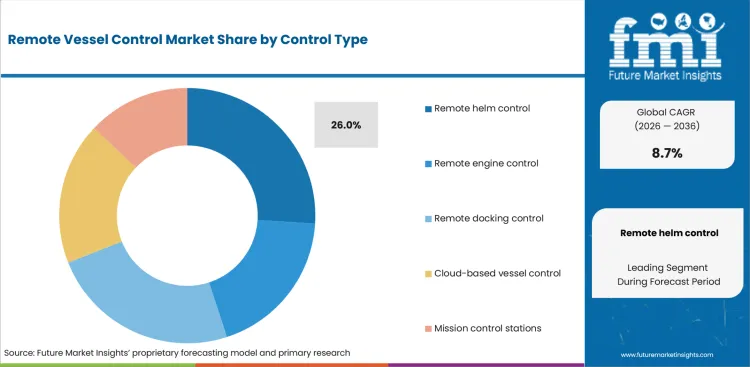
Remote helm control solves an immediate operating problem without requiring an owner to surrender command authority to a fully autonomous stack. It lets an operator move to a safer or more useful vantage point while retaining steering and propulsion control. This is especially relevant during docking, spill response and close-quarters work. The architecture also fits retrofit buying because it can sit between human controls and vessel actuators. Sea Machines states that its SM200 wireless helm system provides full bridge control away from the wheelhouse. The product has also received USA Coast Guard and ABS approval for a class of USA-flag tugboats. That combination of direct control and vessel integration supports adoption before buyers are ready for broader autonomy. Remote helm systems overlap with control logic used in boat controllers as actuation authority moves into software.
- Remote helm control accounts for 26.0% of the Control Type category in 2026 because it extends operator position while preserving direct human authority.
- In January 2020, Sea Machines Robotics reported USA Coast Guard and ABS approval for its SM200 wireless helm on a class of USA-flag articulated tug-barge support tugs.
Why does Cellular lead the Connectivity category?
Cellular connectivity fits the geographic profile of many early remote-control use cases. Workboats often operate near ports, coastlines or offshore assets that can be reached by terrestrial networks. In these areas cellular service can offer low latency and lower operating cost than continuous satellite bandwidth. It also supports video, telemetry and operator interfaces without dedicated radio infrastructure. The limitation is coverage. Finland’s Traficom notes that future marine automation will combine mobile communications with satellite and traditional radio systems. It also points to existing 4G and 5G use at ports. Cellular therefore leads where operations remain close to shore. Suppliers still need a planned fallback path when coverage weakens or the mission moves offshore. Connectivity choices sit inside wider marine electronics integration requirements aboard digitally equipped vessels.
- Cellular accounts for 27.0% of the Connectivity category in 2026 because nearshore and port operations can use commercial network capacity with practical latency and cost.
- In February 2026, Traficom described 4G and 5G use at Finnish ports and said future marine automation will combine mobile, terrestrial radio and satellite communications.
Why do Workboats lead the Vessel Type category?
Workboats provide a direct operational case for remote vessel control because their missions are repetitive and often expose crews to task-specific hazards. Survey craft, spill-response boats and offshore support vessels may follow defined routes or hold station near equipment. Owners can therefore compare a control retrofit with the cost of traditional crewing and task interruption. The vessel is also small enough for helm and propulsion interfaces to be integrated without redesigning an entire merchant bridge. Sea Machines has positioned remote command and autonomy around workboats for years. Its wireless helm approval on tug applications shows how a remote-control function can enter a conventional commercial vessel through a narrow and clearly defined operating task. Shore control reliability depends on resilient marine communication paths across the operating area.
- Workboats account for 25.0% of the Vessel Type category in 2026 because recurring utility missions create clear safety and retrofit economics.
- Sea Machines Robotics stated in January 2020 that its remote-control products are suited to fireboats, survey workboats, spill-response craft, patrol vessels and offshore wind support vessels.
Why does Line-of-sight lead the Operation Mode category?
Line-of-sight operation reduces two risks at the same time. The operator remains physically close enough to understand local conditions while the communication path can use short-range links with predictable latency. That makes the mode useful during acceptance testing and during missions where a nearby support craft is already present. Kongsberg Maritime used this staged approach during sea trials of REACH REMOTE 1. A temporary remote operations center on a support vessel monitored and controlled the USV before control moved to a land-based center in Norway. This progression shows why line-of-sight is not only a legacy mode. It is a practical validation step before operators widen range and depend more heavily on shore infrastructure. Line-of-sight operations often develop alongside docking assist functions that reduce close-quarter workload.
- Line-of-sight accounts for 24.0% of the Operation Mode category in 2026 because it limits communications uncertainty while preserving immediate operator oversight.
- In January 2025, Kongsberg Maritime reported that REACH REMOTE 1 sea trials used a temporary mobile remote operations center aboard a nearby support vessel before planned shore control.
Why do Autonomy integrators lead the Sales Channel category?
Remote control is rarely a plug-in purchase on a commercial vessel. Steering and propulsion must work as one command chain with sensors, communications and safety functions. The system also needs a documented response when data or connectivity is lost. That favors autonomy integrators that can coordinate hardware interfaces, software configuration and class evidence around a vessel-specific operating envelope. Kongsberg served as prime contractor and systems integrator for REACH REMOTE 1. Avikus has also taken HiNAS Control through DNV design qualification. These examples show why buyers often purchase through an integration route rather than from a component catalog. The integrator carries much of the technical burden that sits between a control product and an approved operating vessel. Autonomy integrators increasingly position remote control as a supervised step toward broader marine autonomy programs.
- Autonomy integrators account for 34.0% of the Sales Channel category in 2026 because vessel-specific command chains require coordinated integration and validation.
- In June 2025, Avikus / HD Hyundai announced DNV Type Approval Design Certification for HiNAS Control after a structured qualification process for autonomous and remotely operated vessel functions.
What are the drivers, restraints and opportunities in the Remote Vessel Control Market?
Demand rises as operators move hazardous and repetitive vessel tasks toward shore-based control, while approval and connectivity requirements slow deployment and supervised autonomy creates the clearest expansion path.
- Driver: Pressure to reduce onboard exposure and crew dependence in repetitive or hazardous workboat missions.
- Restraint: Reliable communications and certification requirements combine with cyber resilience and vessel-specific integration to lengthen approval cycles.
- Opportunity: Supervised autonomy can scale through standardized remote operations centers and hybrid connectivity as regulatory pathways mature.
The core demand mechanism is operational rather than purely technological. Remote control lets a fleet move the operator away from a hazardous task location while keeping command responsibility explicit. Sea Machines describes wireless helm use cases in spill response, firefighting and other workboat missions where visibility or crew exposure matters. Kongsberg Maritime reports that REACH REMOTE 1 can operate without onboard crew and be controlled from a remote operations center. These systems change the buying case from experimentation to mission design. Owners can compare the cost of a control retrofit with crew transfer, offshore exposure and task interruption. Demand is most pronounced when remote control removes a recurring operating burden rather than adding technology to an unchanged workflow.
The binding restraint appears at the point where a working prototype must become an approved operating system. The 2026 IMO MASS Code places explicit attention on connectivity, remote operations, cybersecurity and human oversight. A supplier therefore has to prove more than command accuracy. It must define an operating envelope and show what happens when communications degrade or responsibility moves between shore and vessel. Vessel-specific integration adds another layer because steering and propulsion interfaces differ by platform. This friction delays purchasing and narrows the first set of eligible missions. It does not eliminate demand. It shifts orders toward suppliers that can document safety behavior and support class or flag review.
The most pronounced opportunity is to turn remote control into a scalable supervision layer. A customer may begin with line-of-sight control or remote monitoring. The same command architecture can then support teleoperation and supervised autonomy as communications and approvals improve. Traficom expects marine automation to use hybrid terrestrial, mobile and satellite communications. The IMO framework also gives remote operations centers a clearer place in future vessel operations. Suppliers that make handover and fallback behavior consistent across connectivity modes are best placed to capture this opening. The commercial prize is not fully crewless operation in every mission. It is the ability to widen operating range without replacing the vessel-control stack after each stage of adoption.
Which country CAGRs are profiled in the Remote Vessel Control Market?
| Country | CAGR (2026-2036) |
|---|---|
| South Korea | 9.5% |
| USA | 8.0% |
| Japan | 6.7% |
| Norway | 9.0% |
| Finland | 8.6% |
| Netherlands | 8.4% |
| UAE | 8.2% |
How do country-level CAGRs compare in the Remote Vessel Control Market?
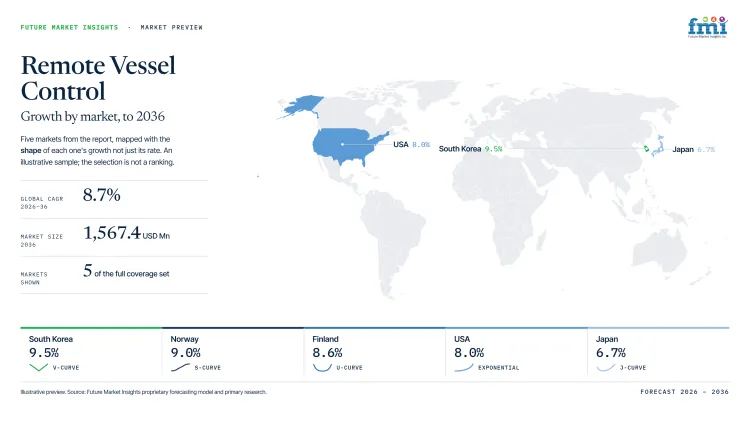
The profiled country CAGRs span 2.8 percentage points from South Korea at 9.5% to Japan at 6.7% between 2026 and 2036. South Korea and Norway form the upper band because both combine an active maritime technology base with visible routes to real-world autonomous operations. Finland, the Netherlands and UAE cluster between 8.2% and 8.6%. Each is building a different enabling condition around communications, offshore operations or controlled trials. USA sits at 8.0% with strong commercial and government use cases. Japan grows more slowly because its pathway places heavy emphasis on safety qualification before broader deployment. These rates describe growth pace rather than current market size.
- South Korea carries a 9.5% CAGR through 2036, with conversion tied to this market reality: Fleet owners and technology developers operate within an increasingly formal demonstration framework for autonomous ships.
- At 8.0% CAGR, USA remains commercially distinct. Buyers favor retrofit paths that keep proven workboats in service while adding remote command for specific tasks.
- Japan is forecast at 6.7% CAGR. Operators and class stakeholders place strong weight on formal safety verification before autonomous functions move onto working vessels.
- Offshore survey and subsea operators are using remote control as part of a broader uncrewed vessel operating model. In Norway, that operating setting accompanies a 9.0% CAGR through 2036.
- An 8.6% CAGR places Finland within the profiled set, but purchasing hinges on a specific condition: Maritime automation planning is closely tied to reliable communications across ports and coastal operating areas.
- Netherlands's 8.4% outlook is shaped by execution conditions. Buyers can connect remote vessel control to offshore wind and survey workflows that already use uncrewed platforms.
- For UAE, the forecast reaches 8.2% CAGR. Authorities are moving autonomous marine craft through controlled trials in defined waterways.
CAGR alone does not determine the best commercial target. A supplier also needs to consider vessel fleet composition and approval time. Connectivity cost, local integration partners and access to recurring missions also shape the target. A lower-growth country can still support a large addressable base or a better service model. The full market view therefore combines growth rates with country operating conditions and the broader regional coverage used in the report.
Country-wise Analysis
- South Korea: Fleet owners and technology developers operate within an increasingly formal demonstration framework for autonomous ships. The ten-year forecast for Remote Vessel Control in South Korea reaches 9.5% CAGR. In January 2025, the Ministry of Oceans and Fisheries published the enforcement decree for the Act on the Promotion of Development and Commercialization of Autonomous Ships. It sets procedures for performance verification, training support and designated operating areas. The harder operating issue is proving safety inside those approved areas before wider use. Suppliers should align control functions with the verification process and support staged demonstrations that can be converted into commercial operating evidence.
- USA: Buyers favor retrofit paths that keep proven workboats in service while adding remote command for specific tasks. Between 2026 and 2036, sales of Remote Vessel Control in USA are expected to rise at 8.0% CAGR. In August 2025, Buffalo Automation promoted retrofit availability for AutoMate and emphasized compatibility with existing steering and throttle systems. The USA market still requires mission-specific proof and integration with established vessel controls. Approval burden can be material for safety-critical use. Suppliers should target clearly bounded workboat or government missions first. They also need service partners that can commission hardware without extended vessel downtime.
- Japan: Operators and class stakeholders place strong weight on formal safety verification before autonomous functions move onto working vessels. The Remote Vessel Control outlook for Japan points to a 6.7% CAGR from 2026 to 2036. In April 2025, ClassNK issued its first Technology Qualification statement for Advanced Routing Simulation and Planning software. The technology is scheduled for demonstration on a container vessel and a remote island passenger ferry. The main commercial hurdle is the amount of simulation and risk evidence needed to qualify novel functions. Suppliers should package remote-control offers with test records and clear operating limits rather than relying on feature claims.
- Norway: Offshore survey and subsea operators are using remote control as part of a broader uncrewed vessel operating model. For Norway, the Remote Vessel Control market is projected to advance at 9.0% CAGR through 2036. In January 2025, Kongsberg Maritime delivered REACH REMOTE 1 after trials overseen by DNV and the Norwegian Maritime Authority. Control moved from a nearby mobile center toward a land-based remote operations center. The local friction remains staged regulatory acceptance for each operating envelope. Providers need class-ready documentation and a credible shore operations concept that can expand functionality step by step.
- Finland: Maritime automation planning is closely tied to reliable communications across ports and coastal operating areas. Remote Vessel Control sales in Finland are expected to grow at 8.6% CAGR over 2026 to 2036. In February 2026, Traficom stated that marine automation will use traditional radio, mobile communication and satellite systems. It also cited testing of smart fairway and remote pilotage solutions in Finland. The limiting factor is maintaining service quality as vessels move beyond terrestrial coverage. Suppliers should design hybrid connectivity and defined fallback modes into the control architecture. That approach reduces dependence on a single network and supports broader operating envelopes.
- Netherlands: Buyers can connect remote vessel control to offshore wind and survey workflows that already use uncrewed platforms. An 8.4% CAGR is projected for Remote Vessel Control in Netherlands between 2026 and 2036. In June 2025, Fugro reported a fully remote ecology survey at the Hollandse Kust Noord offshore wind farm. The uncrewed surface vessel and remotely operated vehicle were controlled from Fugro’s Aberdeen remote operations center. One persistent challenge is integrating remote craft into busy maritime and offshore project environments. Suppliers should prove traffic awareness and operational handover while fitting into established offshore service workflows and client safety systems.
- UAE: Authorities are moving autonomous marine craft through controlled trials in defined waterways. Through 2036, the market for Remote Vessel Control in UAE is set to register an 8.2% CAGR. Abu Dhabi Maritime issued Marine Notice ADM/WMCC/LMN/2026/33 on July 28, 2026 for an Autonomous Marine Craft Trial in Al Jbayl Channel. The central purchase barrier is obtaining permission and demonstrating safe behavior within a dense coastal operating environment. Suppliers should enter through supervised trials and local operating partners. They also need reliable nearshore connectivity and explicit fault handling that can be evaluated by the relevant maritime authority.
Who are the notable companies in the Remote Vessel Control Market?
Sea Machines Robotics, Avikus / HD Hyundai, Kongsberg Maritime, Marine AI, Buffalo Automation, Robosys Automation, Ocean Infinity, and Fugro.
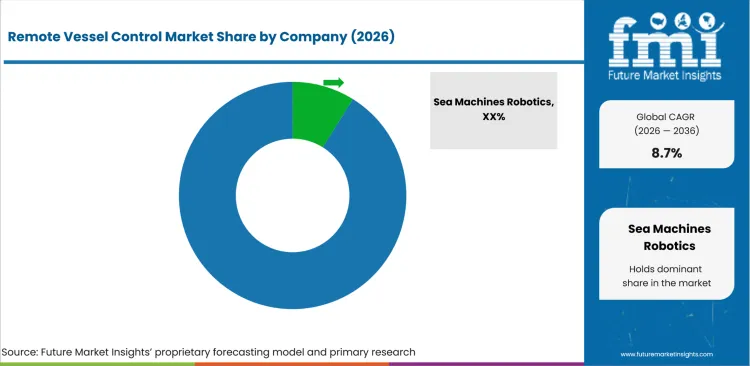
The field now separates direct control-stack suppliers from operators that prove remote workflows at fleet scale. Sea Machines Robotics, Avikus / HD Hyundai, Kongsberg Maritime, Marine AI, Buffalo Automation and Robosys Automation provide vessel-control or autonomy technology. Ocean Infinity and Fugro demonstrate shore-linked remote operations through operating fleets and remote centers. Wärtsilä divested its Automation, Navigation and Control Systems business to Solix in July 2025, removing the former ANCS portfolio from Wärtsilä's current direct position in this market.
- Vessel-control platforms: Sea Machines Robotics, Avikus / HD Hyundai and Kongsberg Maritime combine command, navigation or autonomy functions with vessel interfaces.
- Configurable autonomy specialists: Marine AI, Buffalo Automation and Robosys Automation emphasize software-led or retrofit control architectures.
- Remote operating fleets: Ocean Infinity and Fugro translate shore-control technology into commercial offshore and survey operating models.
Competitive Benchmarking: Remote Vessel Control Market
| Company | Current Market Role | Remote-Control Relevance | Operating Model | Geographic Reach |
|---|---|---|---|---|
| Sea Machines Robotics | Marine autonomy and control platform | Remote command and vessel control | Vessel-agnostic system and retrofit | USA and international |
| Avikus / HD Hyundai | Autonomous navigation/control supplier | Supervised vessel control and fleet monitoring | Crew-in-loop autonomy | South Korea and international shipping |
| Kongsberg Maritime | Integrated marine technology supplier | Remote operating-center and vessel-control capability | Newbuild and retrofit integrated systems | Global |
| Marine AI | Autonomy software provider | Remote and autonomous control stack | Retrofit and software-led | UK and international partners |
| Buffalo Automation | Marine autonomy software provider | Small-vessel autonomy and remote operation | Software and platform integration | USA and selected international markets |
| Robosys Automation | USV control and autonomy supplier | Remote wireless control and ground control | Retrofit hardware plus software | UK, USA, Canada and India |
| Ocean Infinity | Remote offshore fleet operator | Shore-linked Armada fleet operations | Fleet operator and integrator | Global offshore |
| Fugro | Remote and autonomous marine services | Remote operation centers and uncrewed surface vessels | Service-led fleet operations | Global |
Benchmarking separates control-stack depth from remote operating scale, then considers retrofit practicality, supervision model and geographic deployment reach.
Key Developments in the Remote Vessel Control Market
- In January 2025, Kongsberg Maritime delivered REACH REMOTE 1, a 24-meter uncrewed surface vessel developed for offshore survey work. The vessel was monitored and controlled from a temporary remote operations center during trials and was planned to move to land-based control in Horten. The delivery gives buyers a reference for integrating vessel design, command systems, remote operations and class review within one operational program.
- In June 2025, Avikus / HD Hyundai announced DNV Type Approval Design Certification for HiNAS Control. DNV evaluated the system against guidance covering decision support, collision avoidance and navigation functions for autonomous and remotely operated vessels. The certification does not by itself authorize every operating use. It gives shipowners and integrators a stronger technical basis for considering the control software inside a class-aligned autonomy program.
- In May 2025, Marine AI and Hefring Marine announced a partnership to integrate Hefring’s Intelligent Marine Assistance System with the GuardianAI autonomy suite. The work links real-time sea-condition insight with an autonomous vessel control stack and is intended to support further joint product development. The partnership illustrates how control suppliers are adding environment-aware inputs to improve supervised decision making rather than treating remote control as a simple command link.
- In December 2025, Ocean Infinity reported completion of the delivery phase for its fourteen-vessel Armada fleet. Twelve vessels were already in live operation and the vessels were integrated with an onshore control center for monitoring and remote control of robotic subsystems. The milestone shows how remote operations can move from a single-vessel feature into a fleet-level operating model for offshore data acquisition and robotic work.
Key Players in the Remote Vessel Control Market
Integrated Maritime Control Platforms
- Sea Machines Robotics
- Avikus / HD Hyundai
- Kongsberg Maritime
Specialist Autonomy Platforms
- Marine AI
- Buffalo Automation
- Robosys Automation
Remote Operations Fleets
- Ocean Infinity
- Fugro
Remote Vessel Control Market - Report Scope
| Coverage field | Report scope |
|---|---|
| Market breakdown | Control Type, Connectivity, Vessel Type, Operation Mode, and Sales Channel |
| Quantitative Units | USD Million |
| Market Definition | Revenue includes remote vessel-control hardware, onboard control modules, dedicated software licenses, mission or remote-control stations and control-specific connectivity interfaces sold within the defined segmentation universe. It excludes vessel hull value, unrelated propulsion equipment, general telecom service fees, downstream survey or inspection project revenue and adjacent automation products. |
| Regions Covered | North America; Latin America; Western Europe; Eastern Europe; East Asia; South Asia and Pacific; Middle East and Africa |
| Countries Covered | South Korea, USA, Japan, Norway, Finland, Netherlands, UAE, and more than twenty-five additional countries in the full report |
| Key Companies Profiled | Sea Machines Robotics; Avikus / HD Hyundai; Kongsberg Maritime; Marine AI; Buffalo Automation; Robosys Automation; Ocean Infinity; Fugro |
| Forecast Period | 2026 to 2036 |
| Approach | FMI applies a hybrid bottom-up and top-down approach that reconciles system revenue with channel pricing and adoption patterns across the defined market boundary. |
Remote Vessel Control Market - Research Methodology
| Method | Approach |
|---|---|
| Primary Research | FMI uses structured discussions with remote-control system suppliers, autonomy integrators, fleet operators, boat OEMs, public-sector buyers and technical specialists to test purchase criteria, integration barriers, pricing behavior and adoption conditions. |
| Desk Research | Research reviews maritime regulation, classification material, government programs, official technical guidance, company filings and first-party product or deployment announcements. Desk research focuses on material that clarifies market scope, operating conditions, company roles and dated developments. |
| Market Sizing and Forecasting | Market sizing evaluates revenue attributable to remote vessel-control systems and dedicated software within the defined segmentation universe. Forecasting considers retrofit and newbuild adoption, vessel mission economics, approval pathways, connectivity readiness and the transition from line-of-sight control toward supervised remote operation. |
| Data Validation | FMI cross-checks quantitative outputs against the defined revenue boundary and reconciles company, channel and country views to reduce double counting. Vessel hull revenue, unrelated navigation equipment, general communications services, downstream operating service revenue and unsupported adjacent categories are excluded. |
Remote Vessel Control Market by Segments
Remote Vessel Control Market segmented by Control Type:
- Remote helm control
- Remote engine control
- Remote docking control
- Cloud-based vessel control
- Mission control stations
Remote Vessel Control Market segmented by Connectivity:
- Cellular
- Satellite
- Wi-Fi marina link
- Radio frequency
- Hybrid connectivity
Remote Vessel Control Market segmented by Vessel Type:
- Workboats
- Unmanned surface vessels
- Yachts
- Patrol craft
- Research vessels
Remote Vessel Control Market segmented by Operation Mode:
- Line-of-sight
- Remote monitored
- Teleoperation
- Supervised autonomy
Remote Vessel Control Market segmented by Sales Channel:
- Autonomy integrators
- Fleet operators
- Defense / government
- Boat OEMs
Remote Vessel Control Market by Region:
- North America
- United States
- Canada
- Latin America
- Brazil
- Mexico
- Argentina
- Chile
- Western Europe
- Germany
- France
- United Kingdom
- Italy
- Spain
- Benelux
- Nordics
- Eastern Europe
- Poland
- Czech Republic
- Romania
- Hungary
- East Asia
- China
- Japan
- South Korea
- South Asia and Pacific
- India
- ASEAN
- Australia and New Zealand
- Middle East and Africa
- GCC Countries
- South Africa
- Türkiye
- Israel
Research Sources and Bibliography
- International Maritime Organization (2026, May 22). IMO adopts first global Code for autonomous ships.
- Ministry of Oceans and Fisheries, Republic of Korea (2025, January 10). Enactment of the Enforcement Decree of the Act on the Promotion of Development and Commercialization of Autonomous Ships.
- Sea Machines Robotics (2020, January 7). Sea Machines Receives Class & Regulator Approval of its Wireless Helm System for USA-Flagged ATBs.
- ClassNK (2025, April 7). ClassNK awards first Technology Qualification statement to JAPAN MARINE SCIENCE’s Advanced Routing Simulation and Planning.
- Finnish Transport and Communications Agency Traficom (2026, February 24). Smooth transport requires smooth radio communication.
- Kongsberg Maritime (2025, January 16). Kongsberg Maritime delivers first REACH REMOTE USV.
- Fugro (2025, June 17). BeWild achieves world’s first remote ecology survey at CrossWind offshore wind farm.
- Abu Dhabi Maritime (2026, July 28). Autonomous Marine Craft Trial - Al Jbayl Channel, Marine Notice ADM/WMCC/LMN/2026/33.
- Avikus / HD Hyundai (2025, June 5). Avikus Achieves DNV Type Approval Design Certification (TADC) for HiNAS Control.
- Hefring Marine (2025, May 22). Hefring Marine to Integrate IMAS with GuardianAI for Autonomous Vessel Operations.
- Buffalo Automation (2025, August 1). AutoMate retrofit update.
- Robosys Automation (2025, August 18). University of Plymouth Contract For USV Integrated Advanced Maritime Autonomy Solution.
- Ocean Infinity (2025, December 15). Ocean Infinity completes Armada fleet milestone with delivery of final vessel.
- Wärtsilä. (2025). Strategic steps: divestment of Automation, Navigation and Control Systems to Solix Group AB.
This bibliography is provided for reader reference and is not exhaustive. The full report contains the complete reference list and detailed citations.
This Report Answers
- How is demand for the Remote Vessel Control Market expected to evolve through 2036?
- Which vessel operating pressures support demand for remote command and shore-based control?
- Why does Remote helm control hold the leading position within Control Type?
- How does Cellular connectivity influence deployment economics and operating range?
- Why do Workboats hold the leading position within Vessel Type?
- How do country growth rates differ across South Korea, USA, Japan, Norway, Finland, Netherlands and UAE?
- Which companies provide integrated control platforms, specialist autonomy technology or remote-operations capability?
- Which approval, connectivity and integration constraints limit adoption?
- What should fleet operators and autonomy integrators evaluate before purchasing a remote vessel-control system?
Frequently Asked Questions
What is driving growth in the Remote Vessel Control Market?
Growth is driven by operators moving hazardous and repetitive vessel tasks toward shore-based command while seeking lower crew exposure and better mission continuity. Adoption improves when remote control can be retrofitted into proven workboats without replacing the vessel.
Who are the key players in the Remote Vessel Control Market?
Key players include Sea Machines Robotics, Avikus / HD Hyundai, Kongsberg Maritime, Marine AI, Buffalo Automation and Robosys Automation, with Ocean Infinity and Fugro providing important remote-operations reference models. Positions differ by control-stack depth, retrofit fit and shore-operations scale.
What notable restraint affects the Remote Vessel Control Market?
The main restraint is converting technical capability into an approved operating system with reliable communications and defined human responsibility. Buyers also need evidence for loss-of-link behavior, cybersecurity and integration with existing steering and propulsion controls.
Why should executives track the Remote Vessel Control Market?
Remote vessel control can change crew deployment, service economics and the design of offshore or workboat operating models. Executives should track it because control architecture selected today can determine how easily a fleet later adds teleoperation or supervised autonomy.
What business problem does the Remote Vessel Control Market address?
The market addresses the need to command vessels when keeping an operator at the conventional helm is unsafe, inefficient or operationally restrictive. It also lets fleets coordinate remote missions while keeping human oversight available at an appropriate control point.
What should fleet operators evaluate in the Remote Vessel Control Market?
Fleet operators should evaluate control authority and steering or propulsion integration before committing to deployment. They should also assess communications fallback, cybersecurity and class acceptance along with the remote-operator interface across planned operating modes.
What limits return on investment in the Remote Vessel Control Market?
Return can be weakened by vessel-specific engineering, approval time, duplicated onboard staffing during early trials and expensive offshore communications. ROI improves when the system removes a recurring crew or mission burden and can be reused across multiple operating modes.
What supports long-term commercial confidence in the Remote Vessel Control Market?
Confidence is supported by active offshore deployments and by a clearer international framework for autonomous and remotely operated ships. The most pronounced long-term signal is the movement from isolated demonstrations toward class-reviewed vessels, shore control centers and repeat fleet operating models.
Preview the report firsthand - request a free sample
Get SampleGet the brochure for pricing and purchase details.
Get PDFTable of Content
- Key Takeaways
- Market Size and CAGR
- Top Growth Driver
- Fastest Growing Segment
- Leading Region
- Key Companies
- Emerging Opportunities
- Executive Summary
- Global Market Outlook
- Demand-side Trends
- Supply-side Trends
- Technology Roadmap Analysis
- Analysis and Recommendations
- Analyst Perspective (What is happening? Why now? What should investors know?)
- Key Questions Answered
- How large is the market?
- What is the CAGR?
- What are key trends?
- Which region dominates?
- Who are the leaders?
- Market Overview
- Market Coverage / Taxonomy
- Market Definition / Scope / Limitations
- Research Methodology
- Chapter Orientation
- Analytical Lens and Working Hypotheses
- Market Structure, Signals, and Trend Drivers
- Benchmarking and Cross-market Comparability
- Market Sizing, Forecasting, and Opportunity Mapping
- Research Design and Evidence Framework
- Desk Research Programme (Secondary Evidence)
- Expert Input and Fieldwork (Primary Evidence)
- Tooling, Models, and Reference Databases
- Data Engineering and Model Build
- Quality Assurance and Audit Trail
- Market Background
- Market Dynamics (Drivers, Restraints, Opportunity, Trends)
- Scenario Forecast (Optimistic, Likely, Conservative)
- Impact Analysis
- AI Impact
- Sustainability Impact
- Regulatory Impact
- Technology Impact
- Consumer / Buyer Analysis
- Purchase Drivers
- Adoption Barriers
- Buyer Journey
- Opportunity Map Analysis
- Product Life Cycle Analysis
- Supply Chain Analysis
- Investment Feasibility Matrix
- Value Chain Analysis
- PESTLE and Porter's Analysis
- Regulatory Landscape
- Regional Parent Market Outlook
- Production and Consumption Statistics
- Import and Export Statistics
- Global Market Analysis and Forecast, 2021 to 2036
- Historical Market Size Value (USD Million) Analysis, 2021 to 2025
- Current and Future Market Size Value (USD Million) Projections, 2026 to 2036
- Y-o-Y Growth Trend Analysis
- Absolute $ Opportunity Analysis
- Global Market Pricing Analysis, 2021 to 2036
- Global Market Analysis and Forecast, By Control Type, 2021 to 2036
- Introduction / Key Findings
- Historical Market Size Value (USD Million) Analysis By Control Type, 2021 to 2025
- Current and Future Market Size Value (USD Million) Analysis and Forecast By Control Type, 2026 to 2036
- Remote helm control
- Remote engine control
- Remote docking control
- Cloud-based vessel control
- Mission control stations
- Remote helm control
- Y-o-Y Growth Trend Analysis By Control Type, 2021 to 2025
- Absolute $ Opportunity Analysis By Control Type, 2026 to 2036
- Global Market Analysis and Forecast, By Connectivity, 2021 to 2036
- Introduction / Key Findings
- Historical Market Size Value (USD Million) Analysis By Connectivity, 2021 to 2025
- Current and Future Market Size Value (USD Million) Analysis and Forecast By Connectivity, 2026 to 2036
- Cellular
- Satellite
- Wi-Fi marina link
- Radio frequency
- Hybrid connectivity
- Cellular
- Y-o-Y Growth Trend Analysis By Connectivity, 2021 to 2025
- Absolute $ Opportunity Analysis By Connectivity, 2026 to 2036
- Global Market Analysis and Forecast, By Vessel Type, 2021 to 2036
- Introduction / Key Findings
- Historical Market Size Value (USD Million) Analysis By Vessel Type, 2021 to 2025
- Current and Future Market Size Value (USD Million) Analysis and Forecast By Vessel Type, 2026 to 2036
- Workboats
- Unmanned surface vessels
- Yachts
- Patrol craft
- Research vessels
- Workboats
- Y-o-Y Growth Trend Analysis By Vessel Type, 2021 to 2025
- Absolute $ Opportunity Analysis By Vessel Type, 2026 to 2036
- Global Market Analysis and Forecast, By Operation Mode, 2021 to 2036
- Introduction / Key Findings
- Historical Market Size Value (USD Million) Analysis By Operation Mode, 2021 to 2025
- Current and Future Market Size Value (USD Million) Analysis and Forecast By Operation Mode, 2026 to 2036
- Line-of-sight
- Remote monitored
- Teleoperation
- Supervised autonomy
- Line-of-sight
- Y-o-Y Growth Trend Analysis By Operation Mode, 2021 to 2025
- Absolute $ Opportunity Analysis By Operation Mode, 2026 to 2036
- Global Market Analysis and Forecast, By Sales Channel, 2021 to 2036
- Introduction / Key Findings
- Historical Market Size Value (USD Million) Analysis By Sales Channel, 2021 to 2025
- Current and Future Market Size Value (USD Million) Analysis and Forecast By Sales Channel, 2026 to 2036
- Autonomy integrators
- Fleet operators
- Defense / government
- Boat OEMs
- Autonomy integrators
- Y-o-Y Growth Trend Analysis By Sales Channel, 2021 to 2025
- Absolute $ Opportunity Analysis By Sales Channel, 2026 to 2036
- Global Market Analysis and Forecast, By Region, 2021 to 2036
- Introduction
- Historical Market Size Value (USD Million) Analysis By Region, 2021 to 2025
- Current Market Size Value (USD Million) Analysis and Forecast By Region, 2026 to 2036
- North America
- Latin America
- Western Europe
- Eastern Europe
- East Asia
- South Asia and Pacific
- Middle East & Africa
- Market Attractiveness Analysis By Region
- North America Market Analysis and Forecast, By Country, 2021 to 2036
- Historical Market Size Value (USD Million) Trend Analysis By Market Taxonomy, 2021 to 2025
- Market Size Value (USD Million) Forecast By Market Taxonomy, 2026 to 2036
- By Country
- USA
- Canada
- By Control Type
- By Connectivity
- By Vessel Type
- By Operation Mode
- By Sales Channel
- By Country
- Market Attractiveness Analysis
- By Country
- By Control Type
- By Connectivity
- By Vessel Type
- By Operation Mode
- By Sales Channel
- Key Takeaways
- Latin America Market Analysis and Forecast, By Country
- Historical Market Size Value (USD Million) Trend Analysis By Market Taxonomy, 2021 to 2025
- Market Size Value (USD Million) Forecast By Market Taxonomy, 2026 to 2036
- By Country
- Brazil
- Mexico
- Chile
- Rest of Latin America
- By Control Type
- By Connectivity
- By Vessel Type
- By Operation Mode
- By Sales Channel
- By Country
- Market Attractiveness Analysis
- By Country
- By Control Type
- By Connectivity
- By Vessel Type
- By Operation Mode
- By Sales Channel
- Key Takeaways
- Western Europe Market Analysis and Forecast, By Country
- Historical Market Size Value (USD Million) Trend Analysis By Market Taxonomy, 2021 to 2025
- Market Size Value (USD Million) Forecast By Market Taxonomy, 2026 to 2036
- By Country
- Germany
- UK
- Italy
- Spain
- France
- Nordic
- BENELUX
- Rest of Western Europe
- By Control Type
- By Connectivity
- By Vessel Type
- By Operation Mode
- By Sales Channel
- By Country
- Market Attractiveness Analysis
- By Country
- By Control Type
- By Connectivity
- By Vessel Type
- By Operation Mode
- By Sales Channel
- Key Takeaways
- Eastern Europe Market Analysis and Forecast, By Country
- Historical Market Size Value (USD Million) Trend Analysis By Market Taxonomy, 2021 to 2025
- Market Size Value (USD Million) Forecast By Market Taxonomy, 2026 to 2036
- By Country
- Russia
- Poland
- Hungary
- Balkan & Baltic
- Rest of Eastern Europe
- By Control Type
- By Connectivity
- By Vessel Type
- By Operation Mode
- By Sales Channel
- By Country
- Market Attractiveness Analysis
- By Country
- By Control Type
- By Connectivity
- By Vessel Type
- By Operation Mode
- By Sales Channel
- Key Takeaways
- East Asia Market Analysis and Forecast, By Country
- Historical Market Size Value (USD Million) Trend Analysis By Market Taxonomy, 2021 to 2025
- Market Size Value (USD Million) Forecast By Market Taxonomy, 2026 to 2036
- By Country
- China
- Japan
- South Korea
- By Control Type
- By Connectivity
- By Vessel Type
- By Operation Mode
- By Sales Channel
- By Country
- Market Attractiveness Analysis
- By Country
- By Control Type
- By Connectivity
- By Vessel Type
- By Operation Mode
- By Sales Channel
- Key Takeaways
- South Asia and Pacific Market Analysis and Forecast, By Country
- Historical Market Size Value (USD Million) Trend Analysis By Market Taxonomy, 2021 to 2025
- Market Size Value (USD Million) Forecast By Market Taxonomy, 2026 to 2036
- By Country
- India
- ASEAN
- Australia & New Zealand
- Rest of South Asia and Pacific
- By Control Type
- By Connectivity
- By Vessel Type
- By Operation Mode
- By Sales Channel
- By Country
- Market Attractiveness Analysis
- By Country
- By Control Type
- By Connectivity
- By Vessel Type
- By Operation Mode
- By Sales Channel
- Key Takeaways
- Middle East & Africa Market Analysis and Forecast, By Country
- Historical Market Size Value (USD Million) Trend Analysis By Market Taxonomy, 2021 to 2025
- Market Size Value (USD Million) Forecast By Market Taxonomy, 2026 to 2036
- By Country
- Kingdom of Saudi Arabia
- Other GCC Countries
- Türkiye
- South Africa
- Other African Union
- Rest of Middle East & Africa
- By Control Type
- By Connectivity
- By Vessel Type
- By Operation Mode
- By Sales Channel
- By Country
- Market Attractiveness Analysis
- By Country
- By Control Type
- By Connectivity
- By Vessel Type
- By Operation Mode
- By Sales Channel
- Key Takeaways
- Key Countries Market Analysis
- USA
- Pricing Analysis
- Market Share Analysis, 2025
- By Control Type
- By Connectivity
- By Vessel Type
- By Operation Mode
- By Sales Channel
- Canada
- Pricing Analysis
- Market Share Analysis, 2025
- By Control Type
- By Connectivity
- By Vessel Type
- By Operation Mode
- By Sales Channel
- Mexico
- Pricing Analysis
- Market Share Analysis, 2025
- By Control Type
- By Connectivity
- By Vessel Type
- By Operation Mode
- By Sales Channel
- Brazil
- Pricing Analysis
- Market Share Analysis, 2025
- By Control Type
- By Connectivity
- By Vessel Type
- By Operation Mode
- By Sales Channel
- Chile
- Pricing Analysis
- Market Share Analysis, 2025
- By Control Type
- By Connectivity
- By Vessel Type
- By Operation Mode
- By Sales Channel
- Germany
- Pricing Analysis
- Market Share Analysis, 2025
- By Control Type
- By Connectivity
- By Vessel Type
- By Operation Mode
- By Sales Channel
- UK
- Pricing Analysis
- Market Share Analysis, 2025
- By Control Type
- By Connectivity
- By Vessel Type
- By Operation Mode
- By Sales Channel
- Italy
- Pricing Analysis
- Market Share Analysis, 2025
- By Control Type
- By Connectivity
- By Vessel Type
- By Operation Mode
- By Sales Channel
- Spain
- Pricing Analysis
- Market Share Analysis, 2025
- By Control Type
- By Connectivity
- By Vessel Type
- By Operation Mode
- By Sales Channel
- France
- Pricing Analysis
- Market Share Analysis, 2025
- By Control Type
- By Connectivity
- By Vessel Type
- By Operation Mode
- By Sales Channel
- India
- Pricing Analysis
- Market Share Analysis, 2025
- By Control Type
- By Connectivity
- By Vessel Type
- By Operation Mode
- By Sales Channel
- ASEAN
- Pricing Analysis
- Market Share Analysis, 2025
- By Control Type
- By Connectivity
- By Vessel Type
- By Operation Mode
- By Sales Channel
- Australia & New Zealand
- Pricing Analysis
- Market Share Analysis, 2025
- By Control Type
- By Connectivity
- By Vessel Type
- By Operation Mode
- By Sales Channel
- China
- Pricing Analysis
- Market Share Analysis, 2025
- By Control Type
- By Connectivity
- By Vessel Type
- By Operation Mode
- By Sales Channel
- Japan
- Pricing Analysis
- Market Share Analysis, 2025
- By Control Type
- By Connectivity
- By Vessel Type
- By Operation Mode
- By Sales Channel
- South Korea
- Pricing Analysis
- Market Share Analysis, 2025
- By Control Type
- By Connectivity
- By Vessel Type
- By Operation Mode
- By Sales Channel
- Russia
- Pricing Analysis
- Market Share Analysis, 2025
- By Control Type
- By Connectivity
- By Vessel Type
- By Operation Mode
- By Sales Channel
- Poland
- Pricing Analysis
- Market Share Analysis, 2025
- By Control Type
- By Connectivity
- By Vessel Type
- By Operation Mode
- By Sales Channel
- Hungary
- Pricing Analysis
- Market Share Analysis, 2025
- By Control Type
- By Connectivity
- By Vessel Type
- By Operation Mode
- By Sales Channel
- Kingdom of Saudi Arabia
- Pricing Analysis
- Market Share Analysis, 2025
- By Control Type
- By Connectivity
- By Vessel Type
- By Operation Mode
- By Sales Channel
- Türkiye
- Pricing Analysis
- Market Share Analysis, 2025
- By Control Type
- By Connectivity
- By Vessel Type
- By Operation Mode
- By Sales Channel
- South Africa
- Pricing Analysis
- Market Share Analysis, 2025
- By Control Type
- By Connectivity
- By Vessel Type
- By Operation Mode
- By Sales Channel
- USA
- Market Structure Analysis
- Competition Dashboard
- Competition Benchmarking
- Market Share Analysis of Top Players
- By Regional
- By Control Type
- By Connectivity
- By Vessel Type
- By Operation Mode
- By Sales Channel
- Emerging Startups
- Innovation Benchmarking
- Competition Analysis
- Competition Deep Dive
- Sea Machines Robotics
- Overview
- Product Portfolio
- Profitability by Market Segments
- Sales Footprint
- Strategy Overview
- Marketing Strategy
- Product Strategy
- Channel Strategy
- Avikus / HD Hyundai
- Kongsberg Maritime
- Wärtsilä
- Marine AI
- Buffalo Automation
- Fernride
- Robosys Automation
- Ocean Infinity
- Fugro
- Sea Machines Robotics
- Case Studies
- Success Stories
- Recent Developments
- Competition Deep Dive
- Assumptions & Acronyms Used


