

- Market Size (2026)
- USD 720.7 Mn
- Forecast (2036)
- USD 1802.4 Mn
- CAGR (2026 to 2036)
- 9.6%
How big is Autonomous Boat Controllers Market in 2026?
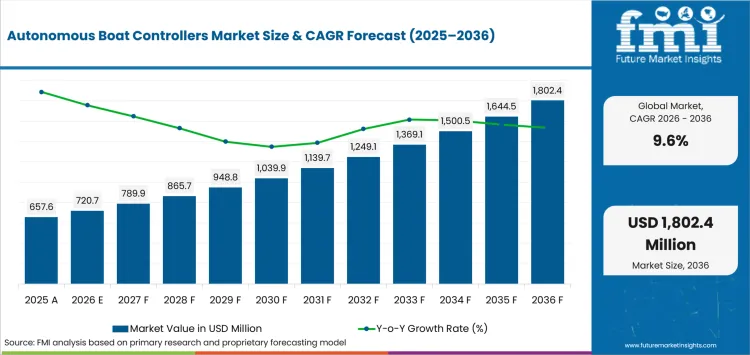
USD 720.7 million in 2026 and USD 1,802.4 million by 2036 at a 9.6% CAGR.
Autonomous boat controller revenue is projected to rise from USD 720.7 million in 2026 to USD 1,802.4 million by 2036 at a 9.6% CAGR. The commercial shift is from short autonomy trials toward controllers that carry vessel-control authority under defined supervision. In May 2026 the International Maritime Organization adopted the non-mandatory MASS Code for application from July 1. The code gives operators a common safety basis for remote operations and documented controller assurance requirements.
Public-agency contracts now place uncrewed missions inside funded data-collection programs, making controller demand easier to budget. NOAA reported in December 2025 that its Uncrewed Systems Operations Center funded six projects totaling roughly USD 10.1 million. Several projects use uncrewed surface vessels for ocean observation and mapping, expanding the installed mission base for controllers under funded programs. Purchasing still depends on communications coverage and documented safe behavior after control or sensor faults.
Key Takeaways
- Mission owners are funding uncrewed surface operations that require reliable navigation control and remote supervision beyond short technology demonstrations.
- By controller type, autonomy control units are estimated to hold 28.0% in 2026 because core navigation decisions and vessel actuation require one accountable control layer.
- USVs are projected to account for 31.0% by vessel type in 2026 owing to onboard controllers carrying navigation and fail-safe responsibility without crew intervention.
- In 2026, remote-assist is expected to hold 19.0% by autonomy level because supervised control reduces the operational change required before fleets accept automated navigation.
- Vessel-level assurance lengthens qualification as cybersecurity and fail-safe behavior are reviewed with communications plus propulsion interfaces.
- Some of the key players in this market include Kongsberg Maritime, Sea Machines Robotics, Avikus / HD Hyundai, NACOS Marine, Robosys Automation, ASV Global / L3Harris, Saildrone, and Fugro.
Analyst Perspective
"Controller value depends on proving authority through navigation, propulsion and fail-safe logic on the intended vessel. Fleet economics then depend on integration effort and shore-control fit because validation time often determines whether a pilot converts into repeat deployment."
- Nikhil Kaitwade, Principal Consultant, Future Market Insights
How is the Autonomous Boat Controllers Market segmented?
The market is analyzed by controller type, vessel type, autonomy level, interface and sales channel.
Controller type covers autonomy control units, mission computers, autopilot autonomy controllers, sensor-fusion controllers and fail-safe control modules. Vessel type covers USVs, survey boats, patrol boats, workboats and research vessels. Autonomy level includes remote-assist, semi-autonomous, supervised autonomous and fully autonomous mission. Interface covers NMEA 2000, CAN bus, Ethernet, proprietary marine protocol and cloud API. Sales channels include autonomy platform OEMs, defense / research, survey integrators and commercial fleet retrofits.
How do Autonomy platform OEMs lead the Sales channel category?
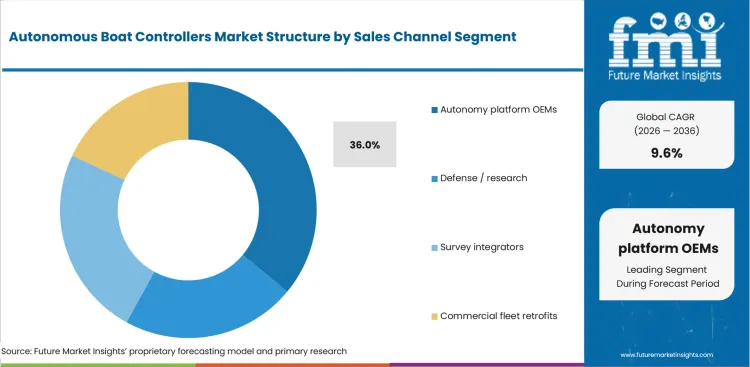
Autonomy platform OEMs take responsibility for integration where vessel interfaces and software need one commissioning authority. Eastern Pacific Shipping contracted Avikus in May 2025 to retrofit two managed vessels with HiNAS Control hardware and software alongside shore-side analytics and training.
- In 2026, autonomy platform OEMs are expected to lead the sales channel category with 36.0% share because integrated commissioning limits fragmented accountability.
- Early deployments favor one contractor that can reconcile control logic with marine propulsion systems and bridge equipment. Survey integrators remain useful for mission-specific payloads but the OEM route shortens handover because several onboard systems share control authority.
Why do Autonomy control units lead the Controller type category?
Autonomy control units carry the low-level steering and speed decisions that higher-level mission software cannot safely leave unresolved. Sea Machines made that separation explicit in September 2025 by opening selected SM300 telemetry and control functions to approved third-party C2 software.
- By controller type, autonomy control units are estimated to hold 28.0% in 2026 because they place navigation decisions and vessel actuation inside one accountable control layer.
- Defined command boundaries let retrofit teams retain preferred mission software without surrendering fail-safe authority onboard. The arrangement reduces rework in marine electronics installations and preserves clear responsibility for physical vessel control.
Why do USVs lead the Vessel type category?
USVs give the controller direct responsibility for navigation because no onboard crew can compensate for missed commands during remote missions. Kongsberg Maritime delivered the 24-meter Reach Remote 1 in January 2025 after sea trials overseen by DNV and the Norwegian Maritime Authority.
- USVs are projected to account for 31.0% by vessel type in 2026 owing to command logic and safe-state behavior being foundational systems on crewless surface platforms.
- Offshore survey operators can extend unmanned surface vehicle missions as remote operations centers take routine watch functions ashore. Stepwise autonomy lets approval advance with operating evidence instead of requiring full autonomy at the first deployment.
What supports Remote-assist within the Autonomy level category?
Remote-assist suits commercial fleets that want automated route and collision functions without removing human intervention authority during abnormal traffic situations. Avikus / HD Hyundai signed a January 2026 agreement for HiNAS Control on 40 HMM vessels as a Level 2 system that performs active vessel control.
- Remote-assist is expected to hold 19.0% of the autonomy level category in 2026 due to supervised control lowering the operating change required before fleets accept automated navigation.
- Bridge teams retain intervention authority as autonomous marine navigation software handles repeatable control tasks under declared limits. The staged route gives owners operating data before they consider deeper autonomy on additional vessels.
What are the drivers, restraints and opportunities in the Autonomous Boat Controllers Market?
Funded USV missions increase controller demand, vessel-level assurance slows adoption and integration agreements widen retrofit potential.
- Driver: Funded survey and defense missions bring autonomous control from demonstrations into repeated vessel procurement and integration programs.
- Restraint: Class and regulator review can lengthen deployment because controller software must be assessed with communications and vessel-level fail-safe behavior.
- Opportunity: Regional shipyards and systems integrators can install modular autonomy on existing vessels without requiring a complete platform replacement.
Funded USV programs bring control systems into routine procurement
Operational budgets become repeatable after uncrewed vessels enter funded mission plans that require control software beyond temporary demonstrations. NOAA awarded a May 2026 contract covering up to eight uncrewed marine systems for new charting and mapping vessels. Those vessels need direct control modes and supervised autonomy compatible with hydrographic workflows, turning unmanned marine vehicles into repeat integration work for controller companies.
Vessel-level assurance extends controller qualification
Autonomous control raises the consequence of communications loss because a software fault can affect vessel behavior without onboard intervention. Saildrone reported in August 2025 that ABS reviewed autonomous control systems and cybersecure communications before granting full class to the Surveyor USV. The review included fail-safe redundancies and structural integrity, so marine electronics testing must reach the vessel safety case before operators accept unrestricted remote missions.
Regional integration agreements widen retrofit routes
Regional integrators give controller specialists access to fleets where local shipyards already control platform integration and lifecycle support. In February 2026 Al Seer Marine and L3Harris expanded their agreement for unmanned maritime systems in the UAE and GCC. L3Harris supplies autonomy plus control-system and network integration, giving marine communication specialists a route into controller programs without owning the vessel platform.
Which country CAGRs are profiled in the Autonomous Boat Controllers Market?
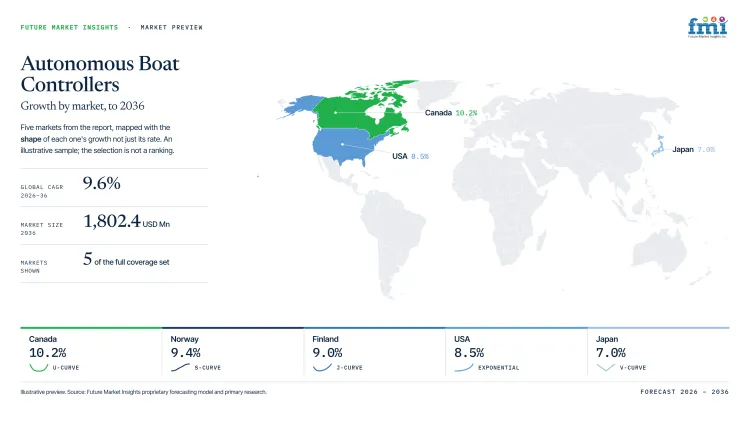
| Country | CAGR |
|---|---|
| Canada | 10.2% |
| Norway | 9.4% |
| Finland | 9.0% |
| USA | 8.5% |
| Japan | 7.0% |
How do country-level CAGRs compare in the Autonomous Boat Controllers Market?
The forecasts span 3.2 percentage points from Canada at 10.2% to the Japan at 7.0%. Canada forms an upper tier and Norway with Finland remain close behind. USA and the Japan differ by 1.5 points, making operating conditions more important than their small forecast gap.
- Canada's Arctic distances test controller fail-safe behavior during communication gaps beyond coverage near southern ports.
- Norway's offshore fleet requires marine propulsion engines and positioning systems to integrate tightly with remote control.
- Finnish Baltic routes make marine radar continuity and alternative positioning necessary during persistent satellite-navigation interference.
- United States' Coast Guard oversight enables autonomous boat trials but makes operational approval decisive before broader commercial fleet deployment.
- Japan's government-backed trials advance autonomous boat testing but make safety certification decisive before controllers enter commercial fleet operations.
The full report provides country-level CAGR analysis across North America, Latin America, Europe, East Asia, South Asia, Oceania and the Middle East and Africa.
Country-wise Analysis
- Canadian defense programs now treat uncrewed maritime systems as sovereign capabilities for Arctic surveillance and coastal missions where shore links are unreliable and cold-weather support is difficult. By 2036, Canada is projected to grow at 10.2% CAGR because mission owners need controllers that preserve safe vessel behavior beyond continuous communications and integrate with vessels operating far from major southern service centers. In July 2026 the Department of National Defence opened its Defence Drone Initiative to uncrewed maritime surface systems and future competitive work, but qualification does not guarantee a contract and controller companies still need Canadian support capacity plus cold-weather integration evidence before demonstrations convert into fleet orders.
- Remote survey work off Norway already uses autonomous and remotely operated vessels where shore control shares responsibility with propulsion and positioning systems under class oversight. The Norwegian Maritime Authority stated in May 2025 that Norway is among the countries with the most autonomous vessels in operation and remains active in IMO rulemaking for maritime autonomy. Autonomous boat controller demand in Norway is forecast to rise at 9.4% CAGR over the forecast period given this operating base despite vessel-by-vessel class acceptance that limits how quickly a proven controller transfers to another hull or offshore mission with different positioning and communications requirements.
- Persistent satellite interference on Finnish Baltic routes forces vessel operators to plan for positioning faults where commercial traffic leaves little room for unexpected autopilot behavior. In Finland autonomous boat controller demand is predicted to advance at 9.0% CAGR through 2036, tied to maritime engineering capacity and demand for resilient control under degraded positioning conditions. Traficom warned in June 2025 that GNSS disruptions had significantly increased and could cause unexpected autopilot malfunctions, so local engineering teams must prove radar fallback and alternative positioning before remote control receives more authority in congested coastal waters near heavily used commercial routes and regional ports.
- In the United States, autonomous boat controller adoption is supported by maritime technology developers, vessel operators, and Coast Guard-supervised testing that provides practical pathways for validating autonomous navigation systems. Increasing trials across commercial, survey, and port applications are creating opportunities for controller suppliers, while regulatory compliance and operational approval remain important for transitioning pilot projects into broader fleet deployment. The United States is estimated to register 8.5% CAGR over the forecast period, driven by rising investment in autonomous maritime technologies, expanding testing programs, and growing demand for reliable control systems across commercial vessels.
- Japan's autonomous boat controller market is advancing through shipbuilder-led initiatives, maritime technology partnerships, and government-supported demonstrations aimed at improving vessel automation and operational efficiency. The country's strong shipbuilding ecosystem provides controller manufacturers with opportunities to integrate autonomous systems into new and existing vessels, although safety validation and regulatory compliance remain essential for commercial deployment. Japan is estimated to record 7.0% CAGR over the forecast period, supported by increasing autonomous vessel trials, modernization of maritime operations, and continued development of advanced navigation and control technologies.
Who are the notable companies in the Autonomous Boat Controllers Market?
Kongsberg Maritime, Sea Machines Robotics, Avikus / HD Hyundai, NACOS Marine, Robosys Automation, ASV Global / L3Harris, Saildrone, and Fugro are the notable companies serving this market.
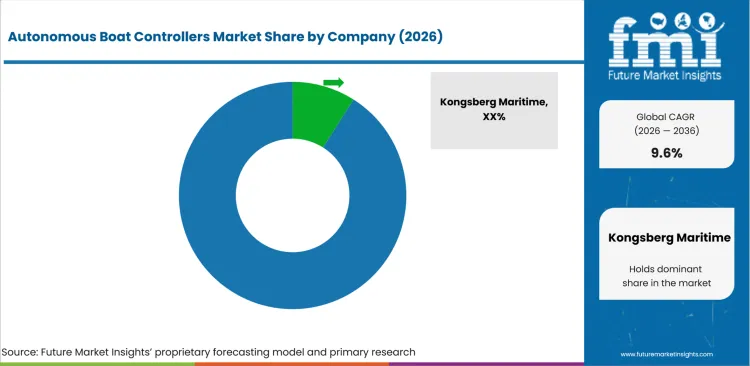
The eight-company register spans dedicated autonomy developers, integrated marine-control companies and operators that prove controller functions on working fleets. Kongsberg Maritime and NACOS Marine provide deeper vessel integration through established navigation and automation platforms used on commercial ships. Sea Machines Robotics and Robosys Automation focus on configurable autonomy for retrofit programs where vessel interfaces vary by hull. Avikus / HD Hyundai scales commercial fleet retrofit and ASV Global / L3Harris targets naval unmanned surface vessels, whereas Saildrone plus Fugro prove controller performance on operating fleets. Entry barriers rise because marine communication links and formal vessel assurance must support shore control before fleets accept wider autonomous authority.
- Kongsberg Maritime, Avikus / HD Hyundai and NACOS Marine compete through integrated navigation and vessel-control packages.
- Sea Machines Robotics, Robosys Automation and ASV Global / L3Harris focus on configurable autonomy plus remote command integration.
- Saildrone and Fugro demonstrate controller performance through operating survey and security fleets under shore supervision.
Competitive Benchmarking: Autonomous Boat Controllers Market
| Company | Vessel Control Integration | Autonomy Decision Logic | Remote Operations & C2 | Geographic Reach |
|---|---|---|---|---|
| Kongsberg Maritime | High | High | High | Global |
| Sea Machines Robotics | High | High | High | North America and Europe |
| Avikus / HD Hyundai | High | High | Medium | Asia and international shipping |
| NACOS Marine | High | Medium | High | Europe and Americas |
| Robosys Automation | High | High | High | Europe and North America |
| ASV Global / L3Harris | High | Medium | High | North America, Europe and Middle East |
| Saildrone | Medium | High | High | North America and Europe |
| Fugro | Medium | Medium | High | Global |
Scoring basis: High vessel-control integration requires documented steering or propulsion control on several vessel classes with Medium covering narrower integration and Low identifying one limited route. High autonomy decision logic requires verified perception plus route or collision decisions, whereas Medium covers fewer automated decisions and Low identifies basic assistance. High remote operations requires command capability plus shore C2, with Medium reserved for monitoring or limited control and Low for mainly onboard systems.
Key Developments in the Autonomous Boat Controllers Market
- In May 2026, NACOS Marine integrated Groke Technologies into its Finnish organization and brought Groke's situational-awareness technology into the NACOS Marine portfolio.
- In April 2026, Sea Machines Robotics formed a trading agreement with Shintoa Corporation that made Shintoa an authorized value-added reseller for sales and support in Japan.
- In March 2026, Robosys Automation partnered with Seaward Automation to integrate VOYAGER AI remote control and autonomous navigation into the enhanced Command software platform.
Key Players in the Autonomous Boat Controllers Market
Integrated vessel-control platforms
- Kongsberg Maritime
- Avikus / HD Hyundai
- NACOS Marine
Configurable autonomy and defense control systems
- Sea Machines Robotics
- Robosys Automation
- ASV Global / L3Harris
Controller-equipped remote operating fleets
- Saildrone
- Fugro
Autonomous Boat Controllers Market - Report Scope
| Coverage field | Report scope |
|---|---|
| Market breakdown | By controller type, vessel type, autonomy level, interface, sales channel and region. |
| Quantitative Units | USD Million. |
| Market Definition | Autonomous and remotely supervised vessel controllers that integrate navigation decisions, actuation, fail-safe logic and shore command with surface-vessel systems. |
| Regions Covered | North America, Latin America, Europe, East Asia, South Asia and Pacific, and Middle East and Africa. |
| Countries Covered | Canada, Norway, Finland, South Korea, Netherlands. 20+ countries included in the full report. |
| Key Companies Profiled | Kongsberg Maritime, Sea Machines Robotics, Avikus / HD Hyundai, NACOS Marine, Robosys Automation, ASV Global / L3Harris, Saildrone, Fugro. |
| Forecast Period | 2026 to 2036. |
| Approach | Primary and secondary research with market triangulation. |
Autonomous Boat Controllers Market - Research Methodology
| Method | Approach |
|---|---|
| Primary Research | FMI analysts gathered input from manufacturers, service providers, technology developers, distributors, end users, procurement teams, and subject-matter experts. Interviews examined purchasing decisions, product or service evaluation, adoption barriers, approval requirements, pricing considerations, and expectations for technical or commercial support. Respondents were also asked what evidence is required before a trial, pilot, or initial order develops into regular purchasing. |
| Desk Research | Desk research covered government statistics, regulatory publications, trade data, industry associations, technical literature, standards, company filings, product information, and official corporate announcements. Sources were reviewed for relevance, publication date, geographic coverage, and consistency with the defined market scope. Claims relating to performance, applications, approvals, capacity, investment, and commercial activity were retained only when supported by credible public evidence. |
| Market Sizing and Forecasting | The market model combined the baseline value with historical performance, segment structure, pricing and volume indicators, adoption levels, company participation, and country-level demand conditions. Forecast assumptions considered economic activity, investment trends, regulatory developments, technology adoption, purchasing cycles, supply availability, and barriers to wider market use. Segment and regional estimates were reconciled before the final market total was calculated. |
| Data Validation | Estimates were checked against multiple independent indicators, including public data, company activity, trade patterns, industry developments, and findings from primary interviews. Validation also tested whether products, services, applications, and company revenues fell within the defined market boundaries. Adjacent categories, unsupported claims, overlapping revenues, and activities without direct market relevance were excluded to reduce double counting and maintain consistency across segments and countries. |
Autonomous Boat Controllers Market by Segments
Autonomous Boat Controllers Market segmented by Controller Type:
- Autonomy control units
- Mission computers
- Autopilot autonomy controllers
- Sensor-fusion controllers
- Fail-safe control modules
Autonomous Boat Controllers Market segmented by Vessel Type:
- USVs
- Survey boats
- Patrol boats
- Workboats
- Research vessels
Autonomous Boat Controllers Market segmented by Autonomy Level:
- Remote-assist
- Semi-autonomous
- Supervised autonomous
- Fully autonomous mission
Autonomous Boat Controllers Market segmented by Interface:
- NMEA 2000
- CAN bus
- Ethernet
- Proprietary marine protocol
- Cloud API
Autonomous Boat Controllers Market segmented by Sales Channel:
- Autonomy platform OEMs
- Defense / research
- Survey integrators
- Commercial fleet retrofits
Autonomous Boat Controllers Market by Region:
- North America
- United States
- Canada
- Latin America
- Brazil
- Mexico
- Argentina
- Chile
- Western Europe
- Germany
- France
- United Kingdom
- Italy
- Spain
- Benelux
- Nordics
- Eastern Europe
- Poland
- Czech Republic
- Romania
- Hungary
- East Asia
- China
- Japan
- South Korea
- South Asia and Pacific
- India
- ASEAN
- Australia and New Zealand
- Middle East and Africa
- GCC Countries
- South Africa
- Türkiye
- Israel
Research Sources and Bibliography
- International Maritime Organization. (2026, May 22). IMO adopts first global Code for autonomous ships.
- NOAA Office of Marine and Aviation Operations. (2025, December 31). NOAA’s Uncrewed Systems Operations Center expands environmental observation footprint.
- Sea Machines Robotics. (2025, September 16). Sea Machines Launches Marine Autonomy APIs for Third-Party C2 Systems.
- Kongsberg Maritime. (2025, January 16). Kongsberg Maritime delivers first REACH REMOTE USV.
- Avikus. (2026, January 16). HD Hyundai’s Avikus Secures Industry-Record Contract to Supply Autonomous Navigation to 40 HMM Vessels.
- Avikus. (2025, May 22). Eastern Pacific Shipping and Avikus Sign Retrofit Contract for AI-Based Autonomous Navigation Solution.
- NOAA. (2026, May 6). NOAA awards $21.6M for uncrewed systems to support new charting and mapping vessels.
- Saildrone. (2025, August 27). American Bureau of Shipping Issues Full Class for Saildrone Surveyor Deep-water, Ocean-going USV.
- L3Harris Technologies. (2026, February 5). Al Seer Marine and L3Harris Deepen Strategic Agreement to Advance Maritime Unmanned Systems in the Middle East.
- Department of National Defence Canada. (2026, July 23). Government of Canada launches Defence Drone Initiative to strengthen Canada’s sovereign defence capabilities.
- Norwegian Maritime Authority. (2025, May 16). Invitation to a professional event in London.
- Finnish Transport and Communications Agency Traficom. (2025, June 13). Finland and Estonia warn vessels in the Gulf of Finland of an increase in GNSS disruptions.
- Ministry of Oceans and Fisheries, Republic of Korea. (2025, January 10). Enactment of the Enforcement Decree of the Act on the Promotion of Development and Commercialization of Autonomous Ships.
- Port of Rotterdam Authority. (2025, October 8). Premiere with unmanned sailing on Maasvlakte 2: trial with unmanned surface vessel successfully completed.
- NACOS Marine. (2026, May 13). NACOS Marine Expands Finnish Presence with Integration of Groke Technologies.
- Sea Machines Robotics. (2026, April 8). Sea Machines and Shintoa Corporation form trading agreement to serve the Japanese market, Expanding APAC Presence.
- Robosys Automation. (2026, March 25). Seaward Automation Announces Command™ Collaboration with Robosys for Remote Control and Autonomous Navigation.
- NACOS Marine. (2025, December 11). NACOS Platinum Integrated Navigation System Receives DNV Type Approval for Full 460-Network Cyber-Secure Compliance under IACS E27.
- Avikus. (2025, June 5). Avikus Achieves DNV Type Approval Design Certification (TADC) for HiNAS Control.
- Saildrone. (2026, April 20). Saildrone Unveils Spectre, a New Class of High-speed Unmanned Surface Vessel for Naval Operations.
- Sea Machines Robotics. (2026, February 18). STEAMRACER-Class Autonomous Ship Advances in Major USA Navy MASC Program.
- Saildrone. (2025, October 29). Lockheed Martin Invests $50M in Saildrone to Advance Unmanned Surface Vehicle Capabilities for US Navy.
- L3Harris Technologies. (2025, September 11). L3Harris Successfully Demonstrates Electronic Warfare Technology in the UK.
- Kongsberg Maritime. (2025, June 4). Kongsberg Maritime and offshore leaders launch groundbreaking Remote DP Operations pilot.
- Sea Machines Robotics. (2026, February 25). Sea Machines Selected to Execute Live Autonomy Vignette at Creative Disruptors in the Desert 2026.
- Avikus. (2026, July 6). KMTC Expands Deployment of Avikus’ AI-Powered HiNAS Control with Additional Three-Vessel Agreement.
- NACOS Marine. (2026, March 31). NACOS USA targets USA naval and government fleet programs through strategic partnership.
- Robosys Automation. (2025, September). Robosys Automation Secures Landmark Offshore Wind Vessel Retrofit Contract.
- L3Harris Technologies. (2025, August 20). US Military Uses L3Harris Electronic Warfare System During Bilateral Exercise.
- Saildrone. (2026, August 18). Saildrone Announces Major European Expansion with Local Production, Operations, and Business Development.
- Fugro. (2026, April 15). Fugro strengthens Atlantic Canada presence with move to COVE innovation hub.
- Marine AI. (2025, January 15). XOCEAN adopts GUARDIAN Vision by Marine AI.
This bibliography is provided for reader reference and is not exhaustive. The full report contains the complete reference list and detailed citations.
This Report Answers
- What are the 2026 and 2036 autonomous boat controller market values?
- Which missions are moving autonomous controllers into routine vessel procurement?
- Why do autonomy control units hold 28.0% of 2026 revenue?
- How do USVs and remote-assist models influence controller selection?
- Which assurance requirements slow controller qualification before fleet expansion?
- How do growth conditions differ among the five profiled countries?
- Which eight companies compete in autonomous boat controllers?
- Which recent company actions are changing autonomy integration and support?
Frequently Asked Questions
How big is the Autonomous Boat Controllers Market in 2026?
The autonomous boat controllers market is valued at USD 720.7 million in 2026 and is projected to reach USD 1,802.4 million by 2036. Funded uncrewed missions and clearer vessel-safety requirements are shifting controller purchases toward repeat operational deployment programs.
What is the CAGR of the Autonomous Boat Controllers Market from 2026 to 2036?
The autonomous boat controllers market is projected to grow at a CAGR of 9.6% between 2026 and 2036. Expansion is supported by funded survey and defense missions that require autonomous control under documented supervision and fail-safe rules.
Which controller type leads the Autonomous Boat Controllers Market?
The autonomy control units segment is expected to hold 28.0% of the autonomous boat controllers market in 2026, driven by direct responsibility for navigation decisions and vessel actuation. The segment also provides the defined onboard authority needed for fail-safe control and third-party mission integration.
Which countries are projected to record the highest growth in the Autonomous Boat Controllers Market?
Canada is projected to grow at 10.2% CAGR, followed by Norway at 9.4% and Finland at 9.0% through 2036. Their growth paths differ because Arctic missions, offshore survey operations and Baltic navigation conditions impose distinct controller-integration requirements.
Which companies are active in the Autonomous Boat Controllers Market?
Key companies operating in the autonomous boat controllers market include Kongsberg Maritime, Sea Machines Robotics, Avikus / HD Hyundai, NACOS Marine, Robosys Automation, ASV Global / L3Harris, Saildrone, and Fugro. Their positions differ through vessel-control integration, configurable autonomy, remote operations and controller-equipped fleet deployment models.
Preview the report firsthand - request a free sample
Get SampleGet the brochure for pricing and purchase details.
Get PDFTable of Content
- Key Takeaways
- Market Size and CAGR
- Top Growth Driver
- Fastest Growing Segment
- Leading Region
- Key Companies
- Emerging Opportunities
- Executive Summary
- Global Market Outlook
- Demand-side Trends
- Supply-side Trends
- Technology Roadmap Analysis
- Analysis and Recommendations
- Analyst Perspective (What is happening? Why now? What should investors know?)
- Key Questions Answered
- How large is the market?
- What is the CAGR?
- What are key trends?
- Which region dominates?
- Who are the leaders?
- Market Overview
- Market Coverage / Taxonomy
- Market Definition / Scope / Limitations
- Research Methodology
- Chapter Orientation
- Analytical Lens and Working Hypotheses
- Market Structure, Signals, and Trend Drivers
- Benchmarking and Cross-market Comparability
- Market Sizing, Forecasting, and Opportunity Mapping
- Research Design and Evidence Framework
- Desk Research Programme (Secondary Evidence)
- Expert Input and Fieldwork (Primary Evidence)
- Tooling, Models, and Reference Databases
- Data Engineering and Model Build
- Quality Assurance and Audit Trail
- Market Background
- Market Dynamics (Drivers, Restraints, Opportunity, Trends)
- Scenario Forecast (Optimistic, Likely, Conservative)
- Impact Analysis
- AI Impact
- Sustainability Impact
- Regulatory Impact
- Technology Impact
- Consumer / Buyer Analysis
- Purchase Drivers
- Adoption Barriers
- Buyer Journey
- Opportunity Map Analysis
- Product Life Cycle Analysis
- Supply Chain Analysis
- Investment Feasibility Matrix
- Value Chain Analysis
- PESTLE and Porter's Analysis
- Regulatory Landscape
- Regional Parent Market Outlook
- Production and Consumption Statistics
- Import and Export Statistics
- Global Market Analysis and Forecast, 2021 to 2036
- Historical Market Size Value (USD Million) Analysis, 2021 to 2025
- Current and Future Market Size Value (USD Million) Projections, 2026 to 2036
- Y-o-Y Growth Trend Analysis
- Absolute $ Opportunity Analysis
- Global Market Pricing Analysis, 2021 to 2036
- Global Market Analysis and Forecast, By Controller Type, 2021 to 2036
- Introduction / Key Findings
- Historical Market Size Value (USD Million) Analysis By Controller Type, 2021 to 2025
- Current and Future Market Size Value (USD Million) Analysis and Forecast By Controller Type, 2026 to 2036
- Autonomy control units
- Mission computers
- Autopilot autonomy controllers
- Sensor-fusion controllers
- Fail-safe control modules
- Autonomy control units
- Y-o-Y Growth Trend Analysis By Controller Type, 2021 to 2025
- Absolute $ Opportunity Analysis By Controller Type, 2026 to 2036
- Global Market Analysis and Forecast, By Vessel Type, 2021 to 2036
- Introduction / Key Findings
- Historical Market Size Value (USD Million) Analysis By Vessel Type, 2021 to 2025
- Current and Future Market Size Value (USD Million) Analysis and Forecast By Vessel Type, 2026 to 2036
- USVs
- Survey boats
- Patrol boats
- Workboats
- Research vessels
- USVs
- Y-o-Y Growth Trend Analysis By Vessel Type, 2021 to 2025
- Absolute $ Opportunity Analysis By Vessel Type, 2026 to 2036
- Global Market Analysis and Forecast, By Autonomy Level, 2021 to 2036
- Introduction / Key Findings
- Historical Market Size Value (USD Million) Analysis By Autonomy Level, 2021 to 2025
- Current and Future Market Size Value (USD Million) Analysis and Forecast By Autonomy Level, 2026 to 2036
- Remote-assist
- Semi-autonomous
- Supervised autonomous
- Fully autonomous mission
- Remote-assist
- Y-o-Y Growth Trend Analysis By Autonomy Level, 2021 to 2025
- Absolute $ Opportunity Analysis By Autonomy Level, 2026 to 2036
- Global Market Analysis and Forecast, By Interface, 2021 to 2036
- Introduction / Key Findings
- Historical Market Size Value (USD Million) Analysis By Interface, 2021 to 2025
- Current and Future Market Size Value (USD Million) Analysis and Forecast By Interface, 2026 to 2036
- NMEA 2000
- CAN bus
- Ethernet
- Proprietary marine protocol
- Cloud API
- NMEA 2000
- Y-o-Y Growth Trend Analysis By Interface, 2021 to 2025
- Absolute $ Opportunity Analysis By Interface, 2026 to 2036
- Global Market Analysis and Forecast, By Sales Channel, 2021 to 2036
- Introduction / Key Findings
- Historical Market Size Value (USD Million) Analysis By Sales Channel, 2021 to 2025
- Current and Future Market Size Value (USD Million) Analysis and Forecast By Sales Channel, 2026 to 2036
- Autonomy platform OEMs
- Defense / research
- Survey integrators
- Commercial fleet retrofits
- Autonomy platform OEMs
- Y-o-Y Growth Trend Analysis By Sales Channel, 2021 to 2025
- Absolute $ Opportunity Analysis By Sales Channel, 2026 to 2036
- Global Market Analysis and Forecast, By Region, 2021 to 2036
- Introduction
- Historical Market Size Value (USD Million) Analysis By Region, 2021 to 2025
- Current Market Size Value (USD Million) Analysis and Forecast By Region, 2026 to 2036
- North America
- Latin America
- Western Europe
- Eastern Europe
- East Asia
- South Asia and Pacific
- Middle East & Africa
- Market Attractiveness Analysis By Region
- North America Market Analysis and Forecast, By Country, 2021 to 2036
- Historical Market Size Value (USD Million) Trend Analysis By Market Taxonomy, 2021 to 2025
- Market Size Value (USD Million) Forecast By Market Taxonomy, 2026 to 2036
- By Country
- USA
- Canada
- By Controller Type
- By Vessel Type
- By Autonomy Level
- By Interface
- By Sales Channel
- By Country
- Market Attractiveness Analysis
- By Country
- By Controller Type
- By Vessel Type
- By Autonomy Level
- By Interface
- By Sales Channel
- Key Takeaways
- Latin America Market Analysis and Forecast, By Country
- Historical Market Size Value (USD Million) Trend Analysis By Market Taxonomy, 2021 to 2025
- Market Size Value (USD Million) Forecast By Market Taxonomy, 2026 to 2036
- By Country
- Brazil
- Mexico
- Chile
- Rest of Latin America
- By Controller Type
- By Vessel Type
- By Autonomy Level
- By Interface
- By Sales Channel
- By Country
- Market Attractiveness Analysis
- By Country
- By Controller Type
- By Vessel Type
- By Autonomy Level
- By Interface
- By Sales Channel
- Key Takeaways
- Western Europe Market Analysis and Forecast, By Country
- Historical Market Size Value (USD Million) Trend Analysis By Market Taxonomy, 2021 to 2025
- Market Size Value (USD Million) Forecast By Market Taxonomy, 2026 to 2036
- By Country
- Germany
- UK
- Italy
- Spain
- France
- Nordic
- BENELUX
- Rest of Western Europe
- By Controller Type
- By Vessel Type
- By Autonomy Level
- By Interface
- By Sales Channel
- By Country
- Market Attractiveness Analysis
- By Country
- By Controller Type
- By Vessel Type
- By Autonomy Level
- By Interface
- By Sales Channel
- Key Takeaways
- Eastern Europe Market Analysis and Forecast, By Country
- Historical Market Size Value (USD Million) Trend Analysis By Market Taxonomy, 2021 to 2025
- Market Size Value (USD Million) Forecast By Market Taxonomy, 2026 to 2036
- By Country
- Russia
- Poland
- Hungary
- Balkan & Baltic
- Rest of Eastern Europe
- By Controller Type
- By Vessel Type
- By Autonomy Level
- By Interface
- By Sales Channel
- By Country
- Market Attractiveness Analysis
- By Country
- By Controller Type
- By Vessel Type
- By Autonomy Level
- By Interface
- By Sales Channel
- Key Takeaways
- East Asia Market Analysis and Forecast, By Country
- Historical Market Size Value (USD Million) Trend Analysis By Market Taxonomy, 2021 to 2025
- Market Size Value (USD Million) Forecast By Market Taxonomy, 2026 to 2036
- By Country
- China
- Japan
- South Korea
- By Controller Type
- By Vessel Type
- By Autonomy Level
- By Interface
- By Sales Channel
- By Country
- Market Attractiveness Analysis
- By Country
- By Controller Type
- By Vessel Type
- By Autonomy Level
- By Interface
- By Sales Channel
- Key Takeaways
- South Asia and Pacific Market Analysis and Forecast, By Country
- Historical Market Size Value (USD Million) Trend Analysis By Market Taxonomy, 2021 to 2025
- Market Size Value (USD Million) Forecast By Market Taxonomy, 2026 to 2036
- By Country
- India
- ASEAN
- Australia & New Zealand
- Rest of South Asia and Pacific
- By Controller Type
- By Vessel Type
- By Autonomy Level
- By Interface
- By Sales Channel
- By Country
- Market Attractiveness Analysis
- By Country
- By Controller Type
- By Vessel Type
- By Autonomy Level
- By Interface
- By Sales Channel
- Key Takeaways
- Middle East & Africa Market Analysis and Forecast, By Country
- Historical Market Size Value (USD Million) Trend Analysis By Market Taxonomy, 2021 to 2025
- Market Size Value (USD Million) Forecast By Market Taxonomy, 2026 to 2036
- By Country
- Kingdom of Saudi Arabia
- Other GCC Countries
- Türkiye
- South Africa
- Other African Union
- Rest of Middle East & Africa
- By Controller Type
- By Vessel Type
- By Autonomy Level
- By Interface
- By Sales Channel
- By Country
- Market Attractiveness Analysis
- By Country
- By Controller Type
- By Vessel Type
- By Autonomy Level
- By Interface
- By Sales Channel
- Key Takeaways
- Key Countries Market Analysis
- USA
- Pricing Analysis
- Market Share Analysis, 2025
- By Controller Type
- By Vessel Type
- By Autonomy Level
- By Interface
- By Sales Channel
- Canada
- Pricing Analysis
- Market Share Analysis, 2025
- By Controller Type
- By Vessel Type
- By Autonomy Level
- By Interface
- By Sales Channel
- Mexico
- Pricing Analysis
- Market Share Analysis, 2025
- By Controller Type
- By Vessel Type
- By Autonomy Level
- By Interface
- By Sales Channel
- Brazil
- Pricing Analysis
- Market Share Analysis, 2025
- By Controller Type
- By Vessel Type
- By Autonomy Level
- By Interface
- By Sales Channel
- Chile
- Pricing Analysis
- Market Share Analysis, 2025
- By Controller Type
- By Vessel Type
- By Autonomy Level
- By Interface
- By Sales Channel
- Germany
- Pricing Analysis
- Market Share Analysis, 2025
- By Controller Type
- By Vessel Type
- By Autonomy Level
- By Interface
- By Sales Channel
- UK
- Pricing Analysis
- Market Share Analysis, 2025
- By Controller Type
- By Vessel Type
- By Autonomy Level
- By Interface
- By Sales Channel
- Italy
- Pricing Analysis
- Market Share Analysis, 2025
- By Controller Type
- By Vessel Type
- By Autonomy Level
- By Interface
- By Sales Channel
- Spain
- Pricing Analysis
- Market Share Analysis, 2025
- By Controller Type
- By Vessel Type
- By Autonomy Level
- By Interface
- By Sales Channel
- France
- Pricing Analysis
- Market Share Analysis, 2025
- By Controller Type
- By Vessel Type
- By Autonomy Level
- By Interface
- By Sales Channel
- India
- Pricing Analysis
- Market Share Analysis, 2025
- By Controller Type
- By Vessel Type
- By Autonomy Level
- By Interface
- By Sales Channel
- ASEAN
- Pricing Analysis
- Market Share Analysis, 2025
- By Controller Type
- By Vessel Type
- By Autonomy Level
- By Interface
- By Sales Channel
- Australia & New Zealand
- Pricing Analysis
- Market Share Analysis, 2025
- By Controller Type
- By Vessel Type
- By Autonomy Level
- By Interface
- By Sales Channel
- China
- Pricing Analysis
- Market Share Analysis, 2025
- By Controller Type
- By Vessel Type
- By Autonomy Level
- By Interface
- By Sales Channel
- Japan
- Pricing Analysis
- Market Share Analysis, 2025
- By Controller Type
- By Vessel Type
- By Autonomy Level
- By Interface
- By Sales Channel
- South Korea
- Pricing Analysis
- Market Share Analysis, 2025
- By Controller Type
- By Vessel Type
- By Autonomy Level
- By Interface
- By Sales Channel
- Russia
- Pricing Analysis
- Market Share Analysis, 2025
- By Controller Type
- By Vessel Type
- By Autonomy Level
- By Interface
- By Sales Channel
- Poland
- Pricing Analysis
- Market Share Analysis, 2025
- By Controller Type
- By Vessel Type
- By Autonomy Level
- By Interface
- By Sales Channel
- Hungary
- Pricing Analysis
- Market Share Analysis, 2025
- By Controller Type
- By Vessel Type
- By Autonomy Level
- By Interface
- By Sales Channel
- Kingdom of Saudi Arabia
- Pricing Analysis
- Market Share Analysis, 2025
- By Controller Type
- By Vessel Type
- By Autonomy Level
- By Interface
- By Sales Channel
- Türkiye
- Pricing Analysis
- Market Share Analysis, 2025
- By Controller Type
- By Vessel Type
- By Autonomy Level
- By Interface
- By Sales Channel
- South Africa
- Pricing Analysis
- Market Share Analysis, 2025
- By Controller Type
- By Vessel Type
- By Autonomy Level
- By Interface
- By Sales Channel
- USA
- Market Structure Analysis
- Competition Dashboard
- Competition Benchmarking
- Market Share Analysis of Top Players
- By Regional
- By Controller Type
- By Vessel Type
- By Autonomy Level
- By Interface
- By Sales Channel
- Emerging Startups
- Innovation Benchmarking
- Competition Analysis
- Competition Deep Dive
- Kongsberg Maritime
- Overview
- Product Portfolio
- Profitability by Market Segments
- Sales Footprint
- Strategy Overview
- Marketing Strategy
- Product Strategy
- Channel Strategy
- Sea Machines Robotics
- Avikus / HD Hyundai
- Wärtsilä
- Marine AI
- Robosys Automation
- ASV Global / L3Harris
- XOCEAN
- Saildrone
- Fugro
- Kongsberg Maritime
- Case Studies
- Success Stories
- Recent Developments
- Competition Deep Dive
- Assumptions & Acronyms Used


