

- Market Size (2026)
- USD 455.0 Mn
- Forecast (2036)
- USD 6273.0 Mn
- CAGR (2026 to 2036)
- 30.0%
How big is Autonomous Yard Trucks & Terminal Tractors Market in 2026?
USD 455.0 million in 2026 and USD 6,273.0 million by 2036 at a 30.0% CAGR.
Demand for autonomous yard trucks and terminal tractors is projected to expand from USD 455.0 million in 2026 to USD 6,273.0 million by 2036 at a 30.0% CAGR. The forecast reflects the value of consistent trailer movement between parking rows and dock doors instead of isolated driverless demonstrations. Outrider reported in July 2025 that its yard safety system uses 14 mechanisms to address more than 200,000 identified hazards. That scale of testing matters to logistics sites that need dependable mixed-traffic operation before linking autonomous tractors with retail warehouse management systems.
Commercial adoption follows different tests in the United States and Europe because site approvals and investment priorities differ. American logistics sites often justify autonomous yard tractors through throughput gains and equipment replacement, whereas European projects place heavier weight on machinery conformity and documented mixed-traffic safety. The Port of Los Angeles reported in January 2025 that it planned USD 640 million for zero-emission cargo equipment, trucks, and charging stations. The Port of Los Angeles also outlined in January 2025 a USD 500 million power upgrade for electric equipment and shore power. These investments show why vehicle choice cannot be separated from charging capacity, trailer records, and dock schedules. Autonomous vehicle systems create commercial value once the operating plan connects each tractor assignment with the correct trailer and destination.
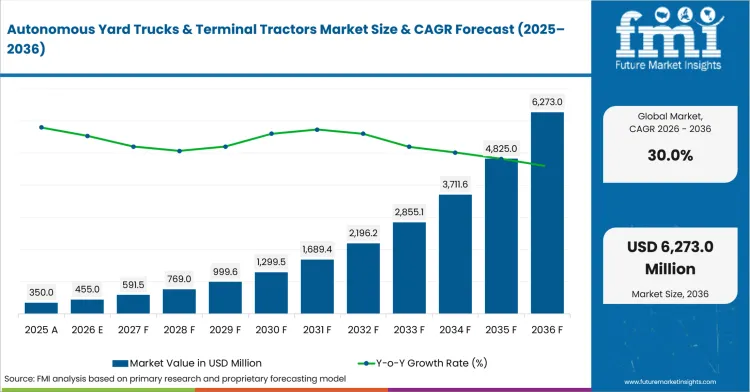
Key Takeaways of Autonomous Yard Trucks & Terminal Tractors Market
- Demand for autonomous yard trucks and terminal tractors is driven by staffing pressure at facilities struggling to cover overnight or peak receiving periods, with commercial value depending on dependable trailer completion throughout each shift.
- By technology, autonomous terminal tractors are expected to lead with 44.0% share in 2026, suited to repeated low-speed work where steering and braking behavior can be tested against known routes and payloads.
- Trailer spotting is the dominant application segment, projected to hold 40.0% share in 2026, providing clear performance measures through dispatch time and arrival accuracy.
- Vehicles are estimated to lead the component category with 60.0% share in 2026, as every simultaneous assignment requires a road-ready tractor with sensors, onboard computing, and coupling equipment.
- Electric tractor platforms remain well suited to fixed-site duty cycles, allowing charging to be planned around dispatch demand without interrupting the busiest dock windows.
- China, Japan, the United States, and India are expected to follow distinct adoption paths, shaped by port and manufacturing network scale, compact industrial site precision needs, multi-site distribution expansion, and selective demand at modern logistics parks.
- Competition centers on Outrider, FERNRIDE, ISEE, TICO, Embotech, and Terberg Special Vehicles, with vendors differentiating through integrated operating systems, factory-supported tractor platforms, and certified autonomous driving paired with electric terminal tractor hardware.
Analyst Perspective
"The autonomous yard trucks market is progressing as logistics operators shift their focus from successful pilot programs to dependable day-to-day yard operations. Commercial adoption will be influenced by task execution reliability, accurate coordination with yard management systems, and the ability to operate safely alongside conventional vehicles and personnel. Long-term market growth will depend on operational scalability, clearly defined support responsibilities, and demonstrated productivity gains under routine distribution center conditions."
- Nikhil Kaitwade, Principal Analyst at Future Market Insights
Source: FMI's proprietary forecasting model and primary research
How is the Autonomous Yard Trucks & Terminal Tractors Market segmented?
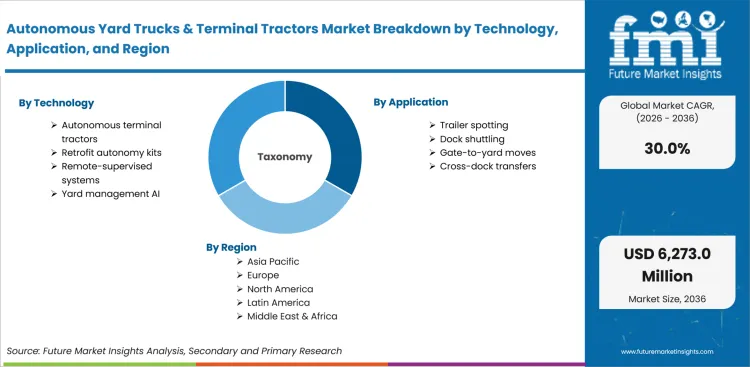
The autonomous yard trucks & terminal tractors industry is segmented by technology, application, component, end-use industry, business model, and region.
Technology shows how driving responsibility and human support are arranged, whereas application identifies the trailer task completed inside the yard. Component analysis separates tractors from software and services, and end-use coverage compares distribution centers with manufacturing sites and ports. Business models distinguish equipment purchases from leases and pilots, with recurring service contracts forming another route to operating capacity. These dimensions interact during commercial planning because a retailer may choose autonomous terminal tractors for trailer spotting through an agreement that includes maintenance and remote support. Inventory management software becomes more useful as tractor assignments reflect accurate trailer locations and dock priorities across each operating shift.
How do autonomous terminal tractors shape demand within the technology category?
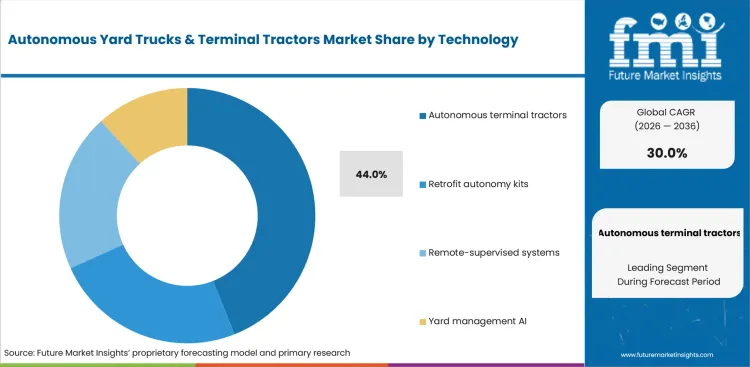
Autonomous terminal tractors give the driving system a purpose-built mechanical base for repeated yard work. Their steering, braking, and coupling functions can be tested against fixed speed rules and mapped traffic lanes. Outrider reported in January 2025 that reinforcement-learning models increased path-planning speed by ten times for its autonomous yard trucks. The improvement shows how software performance affects trailer cycle time once a fleet enters ordinary mixed-traffic work.
- By technology, autonomous terminal tractors are estimated to hold 44.0% share in 2026 owing to their fit with repeated low-speed work. A common tractor configuration gives maintenance teams consistent steering and braking behavior across mapped routes, which reduces the effort required to validate several units and maintain predictable vehicle response at one site.
- Distribution centers and manufacturing plants are expected to favor integrated tractors for routes that run throughout several shifts. Purpose-built vehicles place the autonomy system and mechanical platform under a clearer support structure for daily operations. Autonomous driving virtual simulation platforms let engineering teams test difficult yard events in a controlled setting ahead of changes to live operations.
What supports demand for trailer spotting within the application category?
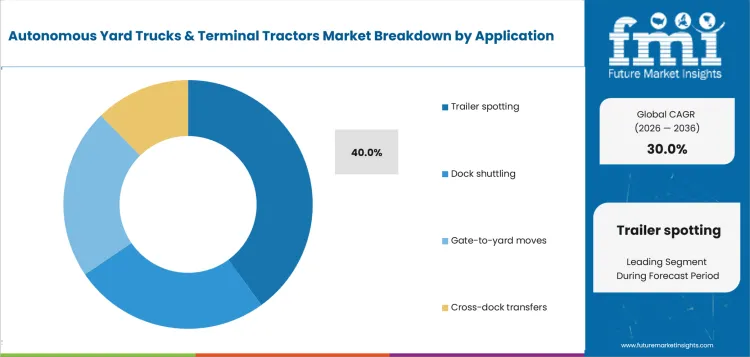
Trailer spotting links parking rows with dock doors through assignments that have a clear origin, destination, and completion time. ISEE and TICO announced in April 2025 that their integrated autonomous yard truck was operating at a Fortune 100 logistics hub and handling production assignments. That operating evidence gives logistics managers a direct way to compare autonomous cycle times with the current dispatch process.
- In 2026, trailer spotting is forecast to represent 40.0% of application demand driven by its measurable effect on dock flow. Each assignment produces a dispatch time and arrival record that lets site managers track missed assignments and empty dock periods, along with the productive transfers completed during each shift.
- Retail and third-party logistics sites are drawing demand for trailer spotting as repeated door assignments create a controlled starting point for automation. Four-way shuttle racks may accelerate warehouse retrieval, yet the yard tractor must deliver the correct trailer at the planned time to protect the connected outbound schedule and prevent idle warehouse labor.
How are vehicles positioned within the component category?
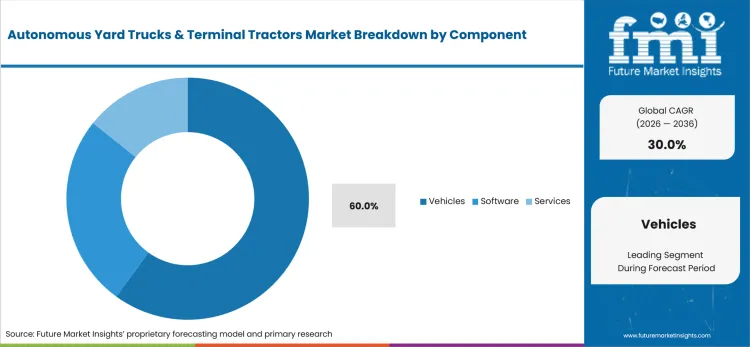
Vehicles carry the traction system and steering controls needed for autonomous trailer movement, together with the sensors and onboard computers that interpret the yard around each tractor. FERNRIDE reported in March 2025 that it was integrating Continental radar and camera systems into autonomous terminal tractors to provide a 360-degree view for remote exception handling. This full view explains why the tractor remains a substantial part of early project spending, as the vehicle must carry the hardware needed for safe exception management.
- By component, vehicles are projected to account for 60.0% share in 2026 because every simultaneous assignment needs a complete tractor. Software can coordinate paths and priorities, but additional yard capacity requires enough vehicles to handle demand without creating queues at parking rows or dock doors during busy receiving periods.
- Fleet owners are expected to spend more on software and support as the number of tractors increases across a site network. Automotive software must exchange reliable task and health data with each vehicle, and maintenance teams need clear fault information before returning a tractor to regular operation across another scheduled shift.
What are the drivers, restraints, and opportunities in the autonomous Yard Trucks & Terminal Tractors Market?
Persistent staffing gaps support demand. Mixed-traffic safety validation can slow commercial approval. Integrated service contracts create a route to wider fleet use.
- Driver: Repeated trailer transfers and limited shift coverage support autonomous capacity at distribution centers, manufacturing sites, and container terminals.
- Restraint: Mixed traffic and irregular site conditions extend validation as the tractor must respond safely to workers, manual vehicles, and temporary route changes.
- Opportunity: Integrated service contracts can combine tractors with software and technical support under measurable uptime and incident-response terms.
Yard managers need dependable tractor coverage through shift changes and late trailer arrivals, yet experienced drivers are difficult to assign to every scheduled movement. Outrider announced in November 2025 that its support services would combine remote diagnostics with technical assistance for driverless yard operations. The offer addresses a practical adoption problem because automation requires human support for unusual events rather than continuous cab-based driving. Automated material handling systems create more value once yard movement remains aligned with warehouse flow throughout the day.
Mixed traffic creates the central restraint because workers and manually driven vehicles can enter a route that appeared clear during testing. FERNRIDE reported in January 2025 that it completed more than 2,000 autonomous terminal tractor scenarios during a 14-week program in 2024. The test volume shows how much evidence is needed to cover intersections and unexpected road users. Vehicle-to-everything communication may improve awareness, but site approval continues to depend on safe local behavior during a lost connection or uncertain right of way.
Commercial opportunity grows through operating models that connect trailer inventory with dock readiness and tractor capacity. The Port of Los Angeles reported in February 2025 that January cargo reached 924,245 TEUs, up 9.5% annually. The Port of Los Angeles also reported in February 2025 that loaded imports reached 483,831 TEUs and increased transfer demand. An autonomous tractor adds little value if it receives incorrect assignments or reaches an occupied transfer point. Service contracts can link dispatch software with maintenance support and measurable response terms across operating shifts.
Which country CAGRs are profiled in the autonomous Yard Trucks & Terminal Tractors Market?
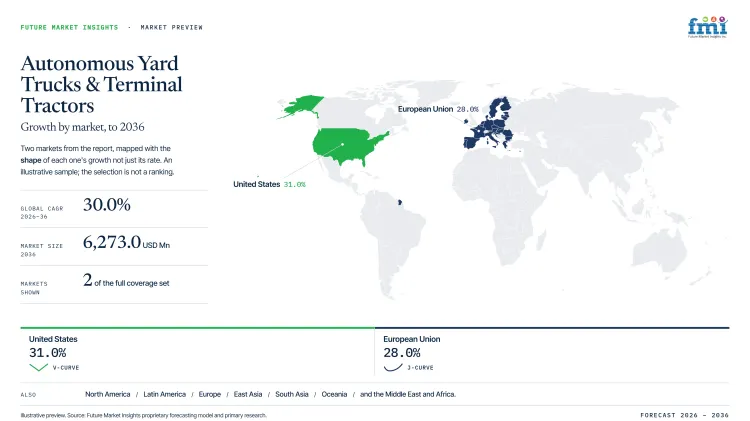
| Country | CAGR |
|---|---|
| United States | 31.0% |
| European Union | 28.0% |
Source: FMI's proprietary forecasting model and primary research
How do country-level CAGRs compare in the autonomous yard trucks & terminal tractors market?
Country growth depends on freight concentration and labor pressure, together with site design and the approval path for driverless industrial vehicles. American distribution campuses support multi-site replication, whereas European projects place more weight on machinery conformity and documented mixed-traffic safety. Autonomous mobile robots for logistics and warehousing offer a useful comparison, yet terminal tractors must manage heavier loads and trailer coupling.
- The United States has large distribution campuses that can create hundreds of repeated trailer assignments during one operating day. Demand for autonomous yard trucks and terminal tractors in the United States is projected to record 31.0% CAGR between 2026 and 2036, as enterprise networks seek consistent yard capacity across several properties. The Port of Long Beach reported in July 2026 that it handled 4,829,578 TEUs during the first half of the year and recorded a 1.7% annual increase. High freight volume makes dock waiting and missed trailer assignments visible to warehouse managers responsible for daily throughput. National operators can test one site design and carry operating lessons into another location with similar equipment. Commercial contracts will need clear uptime measures and a defined response path for unusual yard events.
- European deployment decisions place formal safety evidence beside the expected gain in trailer throughput across ports and industrial yards. Eurostat reported in March 2026 that European Union ports handled 846.0 million tonnes of goods during the third quarter of 2025, an increase of 2.4% from the previous year. The European Union sector is forecast to advance at 28.0% CAGR by 2036, supported by port automation and controlled industrial logistics. Machinery conformity and worker consultation can lengthen preparation, yet they give fleet owners a clearer basis for regular driverless operation. Projects that document mixed-traffic behavior may transfer more easily between sites that use similar machinery and safety rules. European customers will compare certification evidence with vehicle integration and local technical support before expanding fleet size.
Who are the notable companies in the Autonomous Yard Trucks & Terminal Tractors Market?
Outrider, FERNRIDE, ISEE, TICO, Embotech, and Terberg Special Vehicles are notable companies shaping autonomous yard truck and terminal tractor deployment.
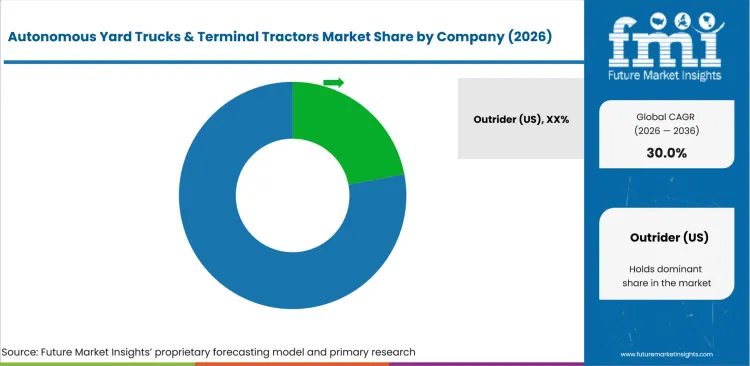
Competition is divided between autonomy developers and tractor manufacturers, with system integration determining whether a project can progress beyond a pilot. Outrider and FERNRIDE combine autonomous driving with operating software and remote support for logistics yards or container terminals. ISEE works with TICO to connect autonomy hardware with a production tractor platform designed for active logistics yards. Embotech and Terberg Special Vehicles follow a similar integration path for electric automated terminal tractors. AGV fleet controls provide useful dispatch concepts, but autonomous tractors must handle trailer coupling and heavier mixed traffic. Commercial advantage comes from one operating design that assigns clear responsibility for vehicle performance and technical support.
- Outrider and FERNRIDE focus on the complete operating system rather than vehicle hardware alone during commercial yard automation projects. Their official announcements show activity in mixed-traffic yards and container terminals, which makes safety evidence and remote exception support central parts of the commercial offer.
- ISEE and TICO compete through a factory-integrated autonomous yard truck that combines ISEE driving technology with TICO terminal tractor platforms. The partnership can shorten installation work and gives maintenance teams a clearer route for vehicle service during regular production use.
- Embotech and Terberg Special Vehicles pair Level 4 autonomous driving with electric terminal tractors for container handling. Their collaboration shows how vehicle control, certification, and production planning must align ahead of a terminal expansion from a test fleet into regular operations.
Competitive Benchmarking: Autonomous Yard Trucks & Terminal Tractors Market
| Company | Yard Orchestration | Autonomous Driving | Remote Support | Vehicle Integration | Geographic Reach |
|---|---|---|---|---|---|
| Outrider | High | High | High | High | North America |
| FERNRIDE | Medium | High | High | Medium | Europe |
| ISEE | Medium | High | Medium | High | North America |
| TICO | Low | Low | Medium | High | North America |
| Embotech | Medium | High | Low | High | Europe |
| Terberg Special Vehicles | Low | Low | Low | High | Europe |
Scoring basis: High indicates direct capability supported by official evidence, Medium reflects partial or partner-supported capability, and Low reflects limited direct evidence.
Source: Future Market Insights competitive analysis, 2026. Ratings draw on official company announcements listed in the bibliography.
Key Developments in the Autonomous Yard Trucks & Terminal Tractors Market
- In July 2025, FERNRIDE began the transition to driverless terminal tractor operations at HHLA TK Estonia following TÜV SÜD certification and approval from the Estonian Transport Administration using three FERNRIDE tractors during the change from safety-driver use.
- In September 2025, Outrider received SOC 2 Type 2 certification for the cloud software and data controls supporting its autonomous yard operations. The certification covered governance and security practices used by large logistics enterprises operating connected yard systems.
- In January 2025, Terberg Special Vehicles signed a cooperation contract with APM Terminals Maasvlakte II and Embotech for 30 electric automated terminal tractors. The partners planned a fleet that combines Terberg drive-by-wire vehicles with Embotech Level 4 autonomy for mixed-traffic container work.
- In January 2026, Embotech received a TÜV SÜD EC-Type Examination Certificate and issued CE marking for its Autonomous Tractor Solution. The approval covered industrial logistics operation and supported driverless tractor use in gated European sites.
Key Players in the Autonomous Yard Trucks & Terminal Tractors Market
Integrated yard automation providers
- Outrider
- FERNRIDE
Autonomous driving technology developers
- ISEE
- Embotech
Terminal tractor manufacturers
- TICO
- Terberg Special Vehicles
Autonomous Yard Trucks & Terminal Tractors Market - Report Scope
| Coverage field | Report scope |
|---|---|
| Market Breakdown | Technology, application, component, end-use industry, business model, and region. |
| Quantitative Units | Revenue in USD Million, CAGR in %. |
| Market Definition | Autonomous yard trucks and terminal tractors that transfer trailers or containers within controlled logistics yards, distribution centers, manufacturing sites, and port terminals. |
| Regions Covered | North America, Latin America, Europe, East Asia, South Asia, Oceania, and the Middle East and Africa. |
| Countries Covered | United States, Canada, China, Japan, India, major European countries, and more than 20 countries represented within the regional model. |
| Key Companies Profiled | Outrider, FERNRIDE, ISEE, TICO, Embotech, and Terberg Special Vehicles. |
| Forecast Period | 2026 to 2036. |
| Approach | A combined site-based and aggregate estimate using tractor demand, project activity, operating models, primary interviews, and official desk research. |
Source: Future Market Insights analysis, based on proprietary forecasting models and primary research
Autonomous Yard Trucks & Terminal Tractors Market - Research Methodology
| Method | Approach |
|---|---|
| Primary Research | FMI analysts gathered input from manufacturers, service providers, technology developers, distributors, end users, procurement teams, and subject-matter experts. Interviews examined purchasing decisions, product or service evaluation, adoption barriers, approval requirements, pricing considerations, and expectations for technical or commercial support. Respondents were also asked what evidence is required before a trial, pilot, or initial order develops into regular purchasing. |
| Desk Research | Desk research covered government statistics, regulatory publications, trade data, industry associations, technical literature, standards, company filings, product information, and official corporate announcements. Sources were reviewed for relevance, publication date, geographic coverage, and consistency with the defined market scope. Claims relating to performance, applications, approvals, capacity, investment, and commercial activity were retained only when supported by credible public evidence. |
| Market Sizing and Forecasting | The market model combined the baseline value with historical performance, segment structure, pricing and volume indicators, adoption levels, company participation, and country-level demand conditions. Forecast assumptions considered economic activity, investment trends, regulatory developments, technology adoption, purchasing cycles, supply availability, and barriers to wider market use. Segment and regional estimates were reconciled before the final market total was calculated. |
| Data Validation | Estimates were checked against multiple independent indicators, including public data, company activity, trade patterns, industry developments, and findings from primary interviews. Validation also tested whether products, services, applications, and company revenues fell within the defined market boundaries. Adjacent categories, unsupported claims, overlapping revenues, and activities without direct market relevance were excluded to reduce double counting and maintain consistency across segments and countries. |
Source: Future Market Insights analysis, based on proprietary forecasting model and primary research
Autonomous Yard Trucks & Terminal Tractors Market by Segments
Autonomous Yard Trucks & Terminal Tractors Market segmented by Technology:
- Autonomous terminal tractors
- Retrofit autonomy kits
- Remote-supervised systems
- Yard management software
Autonomous Yard Trucks & Terminal Tractors Market segmented by Application:
- Trailer spotting
- Dock shuttling
- Gate-to-yard transfers
- Cross-dock transfers
Autonomous Yard Trucks & Terminal Tractors Market segmented by Component:
- Vehicles
- Software
- Services
Autonomous Yard Trucks & Terminal Tractors Market segmented by End-use Industry:
- Retail and CPG distribution centers
- Third-party logistics yards
- Manufacturing facilities
- Ports and intermodal terminals
Autonomous Yard Trucks & Terminal Tractors Market segmented by Business Model:
- Robots-as-a-Service
- Direct purchase
- Lease arrangements
- Pilot programs
Autonomous Yard Trucks & Terminal Tractors Market by Region:
- North America
- United States
- Canada
- Latin America
- Brazil
- Mexico
- Argentina
- Europe
- Germany
- United Kingdom
- France
- Italy
- Spain
- East Asia
- China
- Japan
- South Korea
- South Asia
- India
- Thailand
- Indonesia
- Oceania
- Australia
- New Zealand
- Middle East and Africa
- GCC Countries
- South Africa
- Türkiye
Research Sources and Bibliography
- Outrider. (2025, July 10).
- Port of Los Angeles. (2025, January 23).
- Outrider. (2025, January 23).
- ISEE and TICO. (2025, April 29).
- FERNRIDE. (2025, March 20).
- Outrider. (2025, November 19).
- FERNRIDE. (2025, January 22).
- Port of Los Angeles. (2025, February 19).
- National Bureau of Statistics of China. (2026, February 28).
- Nagoya Port Authority. (2026, March 26).
- Port of Long Beach. (2026, July 14).
- Eurostat. (2026, March).
- Press Information Bureau of India. (2025, May 13).
- FERNRIDE. (2025, July 10).
- Outrider. (2025, September 16).
- Terberg Special Vehicles. (2025, January 9).
- Embotech. (2026, January 15).
This bibliography is provided for reader reference and uses primary government, standards-body, official trade body, and company sources.
This Report Answers
- How large is the Autonomous Yard Trucks & Terminal Tractors Market in 2026 and 2036?
- Which operating conditions create a practical business case for autonomous yard tractors?
- Why are autonomous terminal tractors expected to lead by technology in 2026?
- Why does trailer spotting represent significant application demand in 2026?
- Why do vehicles account for notable component demand in 2026?
- How do country growth conditions differ across China, Japan, the United States, the European Union, and India?
- Which companies compete through autonomous driving systems and integrated terminal tractor platforms?
- What safety and support evidence should a logistics site examine before commercial fleet expansion?
- How do service contracts change the financial risk of autonomous yard operations?
Frequently Asked Questions
What is driving growth in the Autonomous Yard Trucks & Terminal Tractors Market?
Repeated trailer movements create a measurable case for autonomous capacity across several daily operating shifts. Staffing pressure adds value at facilities that cannot cover every scheduled task with experienced drivers.
Who are the key players in the Autonomous Yard Trucks & Terminal Tractors Market?
Outrider and FERNRIDE provide autonomous operating systems for logistics yards and container terminals in active service. ISEE works with TICO, while Embotech integrates its driving system with Terberg electric terminal tractors.
What is a notable restraint in the Autonomous Yard Trucks & Terminal Tractors Market?
Mixed traffic makes commercial approval harder than performance inside a closed demonstration area may suggest. Each site needs evidence that autonomous tractors respond safely to workers and manually driven vehicles.
Why should executives track the Autonomous Yard Trucks & Terminal Tractors Market?
Yard delays can interrupt warehouse output even though the tractor operates outside the main building. Autonomous capacity links equipment investment with dock performance and reliable coverage across several work shifts.
What business problem does the Autonomous Yard Trucks & Terminal Tractors Market address?
The market addresses repeated trailer transfers that can delay loading and receiving work throughout the day. Autonomous tractors provide scheduled capacity for these tasks without placing a driver in every operating cab.
What should procurement teams evaluate before selecting a provider?
Evaluation should compare route fit and safety evidence with vehicle integration and maintenance needs at each site. Contracts should define technical response and responsibility for unusual operating events across each scheduled shift.
What limits return on investment in the Autonomous Yard Trucks & Terminal Tractors Market?
Poor trailer records can send an autonomous tractor to the wrong location and create avoidable waiting. Weak charging plans or slow technical support can reduce productive vehicle hours across the fleet.
What supports long-term commercial confidence in the Autonomous Yard Trucks & Terminal Tractors Market?
Consistent trailer completion across normal mixed traffic gives operators useful evidence for measured fleet expansion. Clear service ownership helps management compare performance and operating cost across several connected logistics sites.
Preview the report firsthand - request a free sample
Get SampleGet the brochure for pricing and purchase details.
Get PDFTable of Content
- Key Takeaways
- Market Size and CAGR
- Top Growth Driver
- Fastest Growing Segment
- Leading Region
- Key Companies
- Emerging Opportunities
- Executive Summary
- Global Market Outlook
- Demand-side Trends
- Supply-side Trends
- Technology Roadmap Analysis
- Analysis and Recommendations
- Analyst Perspective (What is happening? Why now? What should investors know?)
- Key Questions Answered
- How large is the market?
- What is the CAGR?
- What are key trends?
- Which region dominates?
- Who are the leaders?
- Market Overview
- Market Coverage / Taxonomy
- Market Definition / Scope / Limitations
- Research Methodology
- Chapter Orientation
- Analytical Lens and Working Hypotheses
- Market Structure, Signals, and Trend Drivers
- Benchmarking and Cross-market Comparability
- Market Sizing, Forecasting, and Opportunity Mapping
- Research Design and Evidence Framework
- Desk Research Programme (Secondary Evidence)
- Expert Input and Fieldwork (Primary Evidence)
- Tooling, Models, and Reference Databases
- Data Engineering and Model Build
- Quality Assurance and Audit Trail
- Market Background
- Market Dynamics (Drivers, Restraints, Opportunity, Trends)
- Scenario Forecast (Optimistic, Likely, Conservative)
- Impact Analysis
- AI Impact
- Sustainability Impact
- Regulatory Impact
- Technology Impact
- Consumer / Buyer Analysis
- Purchase Drivers
- Adoption Barriers
- Buyer Journey
- Opportunity Map Analysis
- Product Life Cycle Analysis
- Supply Chain Analysis
- Investment Feasibility Matrix
- Value Chain Analysis
- PESTLE and Porter's Analysis
- Regulatory Landscape
- Regional Parent Market Outlook
- Production and Consumption Statistics
- Import and Export Statistics
- Global Market Analysis and Forecast, 2021 to 2036
- Historical Market Size Value (USD Mn) Analysis, 2021 to 2025
- Current and Future Market Size Value (USD Mn) Projections, 2026 to 2036
- Y-o-Y Growth Trend Analysis
- Absolute $ Opportunity Analysis
- Global Market Pricing Analysis, 2021 to 2036
- Global Market Analysis and Forecast, By Technology, 2021 to 2036
- Introduction / Key Findings
- Historical Market Size Value (USD Mn) Analysis By Technology, 2021 to 2025
- Current and Future Market Size Value (USD Mn) Analysis and Forecast By Technology, 2026 to 2036
- Autonomous terminal tractors
- Retrofit autonomy kits
- Remote-supervised systems
- Yard management AI
- Autonomous terminal tractors
- Y-o-Y Growth Trend Analysis By Technology, 2021 to 2025
- Absolute $ Opportunity Analysis By Technology, 2026 to 2036
- Global Market Analysis and Forecast, By Application, 2021 to 2036
- Introduction / Key Findings
- Historical Market Size Value (USD Mn) Analysis By Application, 2021 to 2025
- Current and Future Market Size Value (USD Mn) Analysis and Forecast By Application, 2026 to 2036
- Trailer spotting
- Dock shuttling
- Gate-to-yard moves
- Cross-dock transfers
- Trailer spotting
- Y-o-Y Growth Trend Analysis By Application, 2021 to 2025
- Absolute $ Opportunity Analysis By Application, 2026 to 2036
- Global Market Analysis and Forecast, By Component, 2021 to 2036
- Introduction / Key Findings
- Historical Market Size Value (USD Mn) Analysis By Component, 2021 to 2025
- Current and Future Market Size Value (USD Mn) Analysis and Forecast By Component, 2026 to 2036
- Vehicles
- Software
- Services
- Vehicles
- Y-o-Y Growth Trend Analysis By Component, 2021 to 2025
- Absolute $ Opportunity Analysis By Component, 2026 to 2036
- Global Market Analysis and Forecast, By End-use Industry, 2021 to 2036
- Introduction / Key Findings
- Historical Market Size Value (USD Mn) Analysis By End-use Industry, 2021 to 2025
- Current and Future Market Size Value (USD Mn) Analysis and Forecast By End-use Industry, 2026 to 2036
- Retail & CPG DCs
- 3PL
- Manufacturing
- Ports & intermodal
- Retail & CPG DCs
- Y-o-Y Growth Trend Analysis By End-use Industry, 2021 to 2025
- Absolute $ Opportunity Analysis By End-use Industry, 2026 to 2036
- Global Market Analysis and Forecast, By Business Model, 2021 to 2036
- Introduction / Key Findings
- Historical Market Size Value (USD Mn) Analysis By Business Model, 2021 to 2025
- Current and Future Market Size Value (USD Mn) Analysis and Forecast By Business Model, 2026 to 2036
- Robots-as-a-Service
- Direct purchase
- Lease
- Pilot programs
- Robots-as-a-Service
- Y-o-Y Growth Trend Analysis By Business Model, 2021 to 2025
- Absolute $ Opportunity Analysis By Business Model, 2026 to 2036
- Global Market Analysis and Forecast, By Region, 2021 to 2036
- Introduction
- Historical Market Size Value (USD Mn) Analysis By Region, 2021 to 2025
- Current Market Size Value (USD Mn) Analysis and Forecast By Region, 2026 to 2036
- North America
- Latin America
- Western Europe
- Eastern Europe
- East Asia
- South Asia and Pacific
- Middle East & Africa
- Market Attractiveness Analysis By Region
- North America Market Analysis and Forecast, By Country, 2021 to 2036
- Historical Market Size Value (USD Mn) Trend Analysis By Market Taxonomy, 2021 to 2025
- Market Size Value (USD Mn) Forecast By Market Taxonomy, 2026 to 2036
- By Country
- USA
- Canada
- By Technology
- By Application
- By Component
- By End-use Industry
- By Business Model
- By Country
- Market Attractiveness Analysis
- By Country
- By Technology
- By Application
- By Component
- By End-use Industry
- By Business Model
- Key Takeaways
- Latin America Market Analysis and Forecast, By Country
- Historical Market Size Value (USD Mn) Trend Analysis By Market Taxonomy, 2021 to 2025
- Market Size Value (USD Mn) Forecast By Market Taxonomy, 2026 to 2036
- By Country
- Brazil
- Mexico
- Chile
- Rest of Latin America
- By Technology
- By Application
- By Component
- By End-use Industry
- By Business Model
- By Country
- Market Attractiveness Analysis
- By Country
- By Technology
- By Application
- By Component
- By End-use Industry
- By Business Model
- Key Takeaways
- Western Europe Market Analysis and Forecast, By Country
- Historical Market Size Value (USD Mn) Trend Analysis By Market Taxonomy, 2021 to 2025
- Market Size Value (USD Mn) Forecast By Market Taxonomy, 2026 to 2036
- By Country
- Germany
- UK
- Italy
- Spain
- France
- Nordic
- BENELUX
- Rest of Western Europe
- By Technology
- By Application
- By Component
- By End-use Industry
- By Business Model
- By Country
- Market Attractiveness Analysis
- By Country
- By Technology
- By Application
- By Component
- By End-use Industry
- By Business Model
- Key Takeaways
- Eastern Europe Market Analysis and Forecast, By Country
- Historical Market Size Value (USD Mn) Trend Analysis By Market Taxonomy, 2021 to 2025
- Market Size Value (USD Mn) Forecast By Market Taxonomy, 2026 to 2036
- By Country
- Russia
- Poland
- Hungary
- Balkan & Baltic
- Rest of Eastern Europe
- By Technology
- By Application
- By Component
- By End-use Industry
- By Business Model
- By Country
- Market Attractiveness Analysis
- By Country
- By Technology
- By Application
- By Component
- By End-use Industry
- By Business Model
- Key Takeaways
- East Asia Market Analysis and Forecast, By Country
- Historical Market Size Value (USD Mn) Trend Analysis By Market Taxonomy, 2021 to 2025
- Market Size Value (USD Mn) Forecast By Market Taxonomy, 2026 to 2036
- By Country
- China
- Japan
- South Korea
- By Technology
- By Application
- By Component
- By End-use Industry
- By Business Model
- By Country
- Market Attractiveness Analysis
- By Country
- By Technology
- By Application
- By Component
- By End-use Industry
- By Business Model
- Key Takeaways
- South Asia and Pacific Market Analysis and Forecast, By Country
- Historical Market Size Value (USD Mn) Trend Analysis By Market Taxonomy, 2021 to 2025
- Market Size Value (USD Mn) Forecast By Market Taxonomy, 2026 to 2036
- By Country
- India
- ASEAN
- Australia & New Zealand
- Rest of South Asia and Pacific
- By Technology
- By Application
- By Component
- By End-use Industry
- By Business Model
- By Country
- Market Attractiveness Analysis
- By Country
- By Technology
- By Application
- By Component
- By End-use Industry
- By Business Model
- Key Takeaways
- Middle East & Africa Market Analysis and Forecast, By Country
- Historical Market Size Value (USD Mn) Trend Analysis By Market Taxonomy, 2021 to 2025
- Market Size Value (USD Mn) Forecast By Market Taxonomy, 2026 to 2036
- By Country
- Kingdom of Saudi Arabia
- Other GCC Countries
- Türkiye
- South Africa
- Other African Union
- Rest of Middle East & Africa
- By Technology
- By Application
- By Component
- By End-use Industry
- By Business Model
- By Country
- Market Attractiveness Analysis
- By Country
- By Technology
- By Application
- By Component
- By End-use Industry
- By Business Model
- Key Takeaways
- Key Countries Market Analysis
- USA
- Pricing Analysis
- Market Share Analysis, 2025
- By Technology
- By Application
- By Component
- By End-use Industry
- By Business Model
- Canada
- Pricing Analysis
- Market Share Analysis, 2025
- By Technology
- By Application
- By Component
- By End-use Industry
- By Business Model
- Mexico
- Pricing Analysis
- Market Share Analysis, 2025
- By Technology
- By Application
- By Component
- By End-use Industry
- By Business Model
- Brazil
- Pricing Analysis
- Market Share Analysis, 2025
- By Technology
- By Application
- By Component
- By End-use Industry
- By Business Model
- Chile
- Pricing Analysis
- Market Share Analysis, 2025
- By Technology
- By Application
- By Component
- By End-use Industry
- By Business Model
- Germany
- Pricing Analysis
- Market Share Analysis, 2025
- By Technology
- By Application
- By Component
- By End-use Industry
- By Business Model
- UK
- Pricing Analysis
- Market Share Analysis, 2025
- By Technology
- By Application
- By Component
- By End-use Industry
- By Business Model
- Italy
- Pricing Analysis
- Market Share Analysis, 2025
- By Technology
- By Application
- By Component
- By End-use Industry
- By Business Model
- Spain
- Pricing Analysis
- Market Share Analysis, 2025
- By Technology
- By Application
- By Component
- By End-use Industry
- By Business Model
- France
- Pricing Analysis
- Market Share Analysis, 2025
- By Technology
- By Application
- By Component
- By End-use Industry
- By Business Model
- India
- Pricing Analysis
- Market Share Analysis, 2025
- By Technology
- By Application
- By Component
- By End-use Industry
- By Business Model
- ASEAN
- Pricing Analysis
- Market Share Analysis, 2025
- By Technology
- By Application
- By Component
- By End-use Industry
- By Business Model
- Australia & New Zealand
- Pricing Analysis
- Market Share Analysis, 2025
- By Technology
- By Application
- By Component
- By End-use Industry
- By Business Model
- China
- Pricing Analysis
- Market Share Analysis, 2025
- By Technology
- By Application
- By Component
- By End-use Industry
- By Business Model
- Japan
- Pricing Analysis
- Market Share Analysis, 2025
- By Technology
- By Application
- By Component
- By End-use Industry
- By Business Model
- South Korea
- Pricing Analysis
- Market Share Analysis, 2025
- By Technology
- By Application
- By Component
- By End-use Industry
- By Business Model
- Russia
- Pricing Analysis
- Market Share Analysis, 2025
- By Technology
- By Application
- By Component
- By End-use Industry
- By Business Model
- Poland
- Pricing Analysis
- Market Share Analysis, 2025
- By Technology
- By Application
- By Component
- By End-use Industry
- By Business Model
- Hungary
- Pricing Analysis
- Market Share Analysis, 2025
- By Technology
- By Application
- By Component
- By End-use Industry
- By Business Model
- Kingdom of Saudi Arabia
- Pricing Analysis
- Market Share Analysis, 2025
- By Technology
- By Application
- By Component
- By End-use Industry
- By Business Model
- Türkiye
- Pricing Analysis
- Market Share Analysis, 2025
- By Technology
- By Application
- By Component
- By End-use Industry
- By Business Model
- South Africa
- Pricing Analysis
- Market Share Analysis, 2025
- By Technology
- By Application
- By Component
- By End-use Industry
- By Business Model
- USA
- Market Structure Analysis
- Competition Dashboard
- Competition Benchmarking
- Market Share Analysis of Top Players
- By Regional
- By Technology
- By Application
- By Component
- By End-use Industry
- By Business Model
- Emerging Startups
- Innovation Benchmarking
- Competition Analysis
- Competition Deep Dive
- Outrider (US)
- Overview
- Product Portfolio
- Profitability by Market Segments
- Sales Footprint
- Strategy Overview
- Marketing Strategy
- Product Strategy
- Channel Strategy
- Fernride (DE)
- ISEE (US)
- EasyMile TractEasy (FR)
- Outrider (US)
- Case Studies
- Success Stories
- Recent Developments
- Competition Deep Dive
- Assumptions & Acronyms Used


