

- Market Size (2026)
- USD 210.0 Mn
- Forecast (2036)
- USD 6074.0 Mn
- CAGR (2026 to 2036)
- 40.0%
How big is Autonomous Ferries & Harbor Craft Market in 2026?
USD 210.0 million in 2026 and USD 6074.0 million by 2036 at a 40.0% CAGR.
Autonomous ferries and harbor craft sales are projected to increase from USD 210.0 million in 2026 to USD 6074.0 million by 2036 at a 40.0% CAGR from 2026 to 2036, driven by scheduled-route automation and shore control systems. DNV launched four functional categories within its AROS class notations for autonomous vessels in January 2025. The framework separates navigation, engineering, operations, and safety so developers can build a clearer approval case. Commercial programs can therefore draw technical lessons from the unmanned marine vehicles field without treating every vessel concept as commercially interchangeable.
Norway and Japan are moving toward commercial service through different route-specific operating models and national approval systems. Norway is building around fixed public ferry contracts, including route programs that place automated crossing and docking inside a scheduled timetable. Japan is using certified autonomous ships to prove navigation systems across passenger and cargo operations ahead of wider fleet use. Charging plans and shore supervision must be costed with hull purchases because both affect service continuity. Investment in electric ships shapes vessel economics across routes that require frequent charging and dependable reserve power. Marine power battery systems determine whether repeated crossings can meet charging windows without reducing scheduled availability.
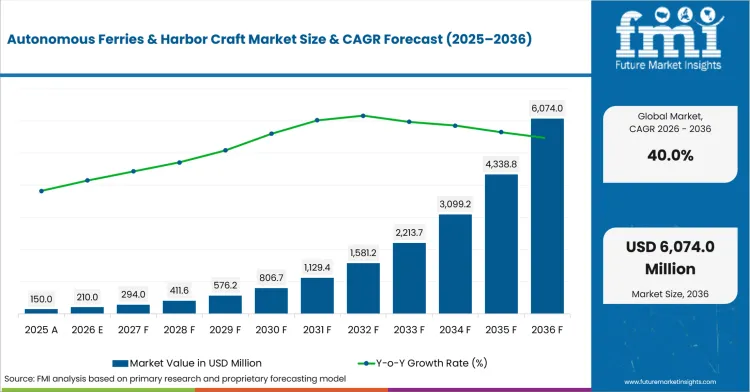
Key Takeaways of Autonomous Ferries & Harbor Craft Market
- Demand for autonomous ferries and harbor craft is driven by routes needing frequent service under crew pressure and rising operating costs, with the market forecast to expand at 40.0% CAGR between 2026 and 2036.
- By application, urban passenger ferries are expected to lead with 46.0% share in 2026, supported by repeatable routes and fixed boarding points.
- Urban waterway transit is the dominant use-case segment, projected to hold 44.0% share in 2026, attributable to frequent crossings and visible public use.
- Autonomy systems are estimated to lead the technology category with 44.0% share in 2026, owing to navigation software and control integration.
- Electric propulsion suits short crossings with planned charging windows, while fixed terminals allow repeated docking data to improve route control and energy planning across daily operations.
- China, Japan, and Norway are expected to form the higher-growth country tier, advancing at 43.0%, 42.0%, and 39.0% CAGR respectively through 2036, supported by intelligent-vessel programs, certified passenger vessels, and scheduled ferry contracts.
- Competition centers on Kongsberg Maritime, Zeabuz, Fjord1, Mitsui O.S.K. Lines, Furuno Electric, Anschütz, Wärtsilä, and DNV, with vendors differentiating through navigation control and automated docking, direct vessel-operating evidence, and vessel assurance/qualification services.
Analyst Perspective
"The autonomous passenger ferries market is being evaluated on service reliability rather than autonomous navigation alone. Operators are assessing whether autonomous vessels can sustain scheduled operations across varying weather, traffic, and harbor conditions while maintaining clear operational oversight. Market adoption will depend on proven fleet performance, well-defined remote operating models, and documented service experience under routine commercial conditions."
- Nikhil Kaitwade, Principal Analyst at Future Market Insights
Source: FMI's proprietary forecasting model and primary research
How is the Autonomous Ferries & Harbor Craft Market segmented?
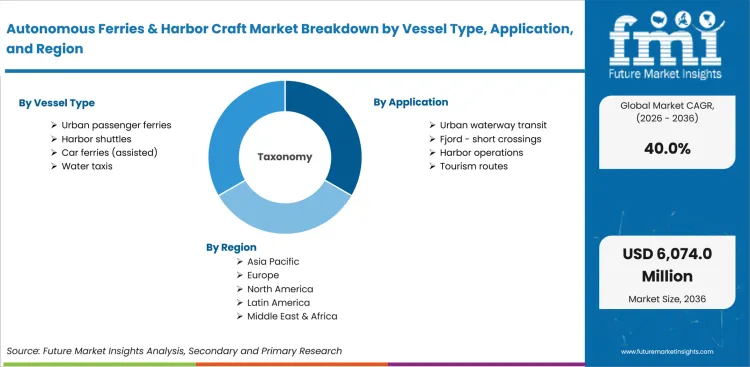
The autonomous ferries & harbor craft industry is segmented by vessel type, application, component, end-use, business model, and region.
The market separates vessel design from the operating task because each route requires a different balance of capacity and control. Vessel types cover urban passenger ferries, harbor tugs and workboats, and inter-island or coastal ferries. Application analysis covers urban waterway transit and port operations, together with inter-island passenger transport and scheduled coastal services. Component analysis separates autonomy systems from propulsion hardware and communication suites used during daily service. End-use categories cover public transit authorities, port operators, and private commercial companies that manage vessels. Business models compare operations contracts with technology licensing and direct vessel sales across commercial programs. The structure helps readers compare autonomous craft with the established passenger ferries category without overlooking the added cost of software and shore support.
What makes urban passenger ferries central to the vessel type category?
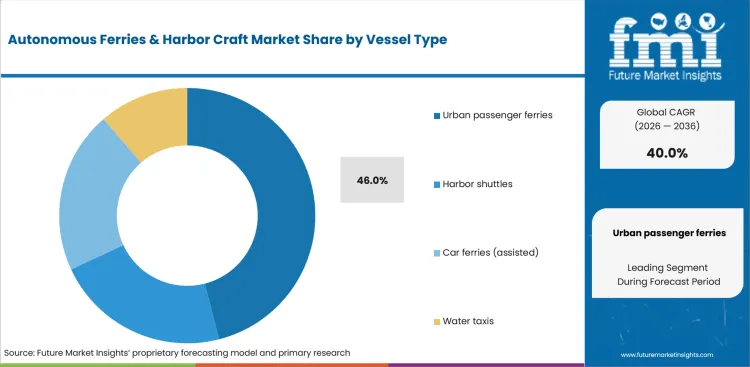
Urban passenger ferries combine fixed terminals with repeated crossings that give navigation systems a consistent operating pattern. Kongsberg Maritime reported in February 2025 that Bastø Fosen operates six ferries on the Horten to Moss route and has converted three vessels to electric propulsion. The same program uses automated crossing and docking functions across regular passenger service on the route. The operating record shows why ferry automation becomes more credible when route frequency and terminal geometry remain stable.
- By vessel type, urban passenger ferries are forecast to represent 46.0% share during 2026, supported by fixed terminals and repeatable short crossings. Their position reflects predictable docking points and frequent service intervals that produce useful operating data. Public authorities can compare performance across many trips before committing to wider route coverage or lower onboard staffing.
- Municipal waterway authorities are purchasing urban ferry systems for river crossings and waterfront links that face road congestion. The format gives service planners a defined location for charging, passenger support, and routine terminal checks. Approval work remains route-specific, yet the commercial case improves once one vessel can deliver several daily cycles without leaving terminal assets idle.
How does urban waterway transit shape demand within the application category?
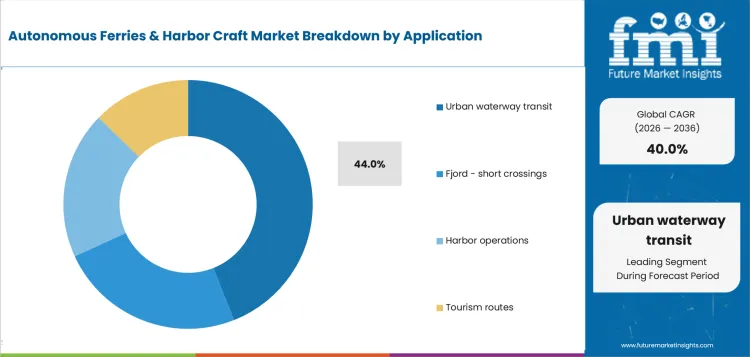
Urban waterway transit gives autonomy developers repeated trips and visible passenger use within a compact service area. Zeabuz reported in October 2025 that Stockholms Reperationsvarv selected its automated transit technology for the Neptunus road-ferry retrofit under a Trafikverket contract. The project connects an automated transit system with a working passenger vessel rather than a stand-alone research platform. Frequent crossings let operators study docking, energy use, and route control within one service plan.
- Urban waterway transit is estimated to hold 44.0% share in 2026, attributable to frequent schedules and defined terminal areas. High route frequency helps operators spread software and shore-control costs across more passenger trips over time. Cities can test service reliability on a contained corridor before extending automation into mixed traffic or longer coastal routes.
- City transport authorities are drawing attention to waterway transit because ferry links can bypass congested road corridors. Navigation decisions must account for commercial traffic and changing water conditions throughout routine daily operations. Integration with vessel traffic management systems gives shore teams better situational awareness and supports a clearer operating case for repeated urban service.
How are autonomy systems positioned within the component category?
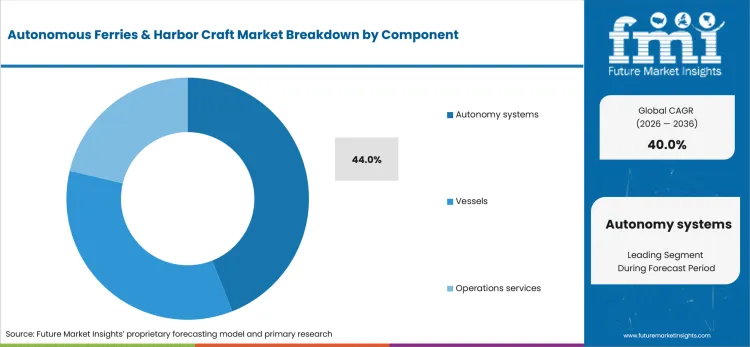
Autonomy systems connect sensors and route planning with propulsion commands and shore supervision during each commercial voyage. Zeabuz reported in January 2025 that Future Marine selected its technology for a 12-passenger autonomous electric ferry prototype in Canada. The project placed one autonomy provider across navigation software and vessel integration before certification trials. The development shows why component spending includes control logic, sensor integration, and evidence needed for passenger-service approval.
- By component, autonomy systems are projected to account for 44.0% share during 2026, owing to navigation software and integration work across sensors and propulsion controls. The share reflects the engineering needed to turn separate devices into one operating system for commercial service. Route owners need a clear update plan because control logic and safety cases change with vessel use.
- Ferry operators are purchasing modular autonomy systems that can add remote monitoring without replacing the complete vessel platform. Maritime satellite communication supports links outside port networks and gives shore teams another channel for vessel data. Modular architecture can reduce upgrade disruption, although certification still depends on the combined system and operating concept.
What are the drivers, restraints, and opportunities in the Autonomous Ferries & Harbor Craft Market?
Fixed ferry routes enable automation scale, while regulatory approvals and remote operations services shape commercialization and recurring revenue growth
- Driver: Scheduled ferry routes support automation because fixed terminals allow repeated docking and route validation across daily service.
- Restraint: Passenger-vessel approval remains a national responsibility and can extend commercial schedules beyond the technical demonstration period.
- Opportunity: Remote operations contracts create recurring service revenue by combining vessel monitoring with port data and field response.
Defined commercial routes are a factor supporting growth as they give autonomy developers a repeated service pattern and measurable operating target. Zeabuz reported in July 2025 that the Government of Åland selected its virtual cable ferry system for an established island route. The award marked the company’s first commercial delivery of that system and replaced physical cable guidance with automated control. The project gives ferry authorities a direct example of autonomy entering a working route through a funded public-service decision.
Passenger-vessel approval is a factor limiting growth because national authorities retain responsibility for route safety and operating conditions. The International Maritime Organization adopted the non-mandatory MASS Code in May 2026 and set July 1, 2026 as its effective date. The initial code applies to cargo ships under the defined international safety framework and leaves passenger ferry approval with national authorities. Ferry developers therefore need a separate national case for passenger access and emergency response before a trial can become regular service.
Remote fleet management represents an emerging opportunity for companies that can combine vessel control with port integration. The Maritime and Port Authority of Singapore sought proposals in April 2026 for an autonomous inter-gateway feeder and a remote operations center. The project requires maritime cybersecurity, traffic management, and system redundancy within one integrated operating design for commercial port service. Automated container terminals create recurring work for companies that manage shore data after vessel delivery and system commissioning.
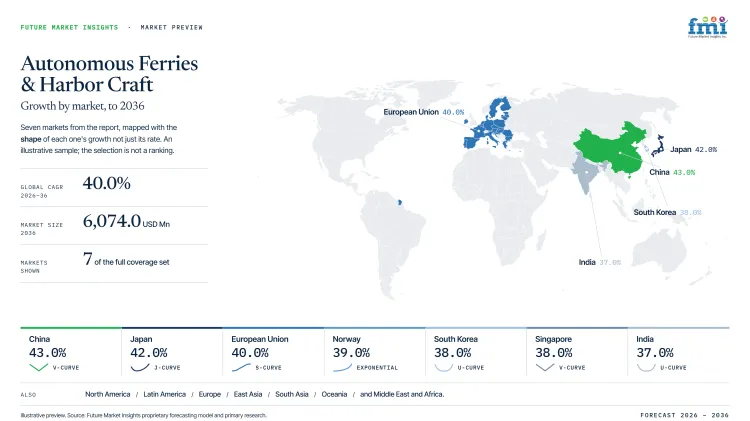
Which country CAGRs are profiled in the Autonomous Ferries & Harbor Craft Market?
| Country | CAGR |
|---|---|
| China | 43.0% |
| Japan | 42.0% |
| European Union | 40.0% |
| Norway | 39.0% |
| South Korea | 38.0% |
| Singapore | 38.0% |
| India | 37.0% |
Source: FMI's proprietary forecasting model and primary research
How do country-level CAGRs compare in the Autonomous Ferries & Harbor Craft Market?
The comparison spans 6.0 percentage points across the middle-mile autonomous delivery (B2B road) market. China records the highest CAGR at 43.0%, followed by the United States at 42.0% and Japan at 41.0%. Germany reaches 39.5%, while Eastern Europe and India post 38.0% and 37.0%, respectively. The ranking reflects different stages of commercial deployment, logistics automation and investment in autonomous freight transport.
- China leads with a CAGR of 43.0%. Logistics providers and autonomous vehicle developers are expanding middle-mile delivery programs that connect distribution hubs, warehouses and regional fulfillment centers with minimal human intervention.
- The United States follows at 42.0%, 1.0 percentage point below China. Commercial operators continue evaluating autonomous road freight systems for B2B transport routes where predictable travel patterns and scheduled deliveries support automated operations.
- Japan records a CAGR of 41.0%, 1.0 percentage point behind the United States. Market activity focuses on integrating autonomous driving technologies into commercial delivery fleets to improve freight movement between logistics facilities and distribution centers.
- Germany posts a CAGR of 39.5%, 1.5 percentage points below Japan. Logistics companies are assessing autonomous middle-mile transport to improve operational efficiency, optimize fleet utilization and strengthen industrial supply chain connectivity.
- Eastern Europe reaches a CAGR of 38.0%, 1.5 percentage points behind Germany. Interest in autonomous freight transport is increasing as logistics operators evaluate technologies that improve regional cargo movement and support modernization of commercial transport networks.
- India records a CAGR of 37.0%, 1.0 percentage point below Eastern Europe. The market reflects growing evaluation of autonomous delivery vehicles for inter-hub freight movement as logistics providers expand automated transport capabilities across distribution networks.
- Comparable CAGRs do not indicate identical market conditions. Differences in autonomous vehicle regulation, logistics infrastructure, freight network design and commercial investment priorities influence deployment strategies and long-term commercial opportunities. The full report provides country-level CAGR analysis across North America, Latin America, Europe, East Asia, South Asia, Oceania and the Middle East and Africa.
Country-wise Analysis
-
China is linking intelligent tug development with large port operations that provide real traffic and repeated harbor work. Autonomous ferries and harbor craft demand in China is forecast to rise at 43.0% CAGR over the forecast period, led by domestic navigation programs and port automation. Tianjin Government reported in August 2025 that the Jin Gang Lun 36 program completed four autonomous-navigation test stages during 2025. The four-stage sequence covered platform integration, docking logic, departure control, and full port-area operations under working conditions. Tianjin Port Group and Wuhan University of Technology can use those results to refine algorithms under working harbor conditions. Commercial selection will depend on whether the same control evidence transfers into passenger ferries and other harbor craft.
- Japan is using national vessel inspection to move autonomous navigation from demonstrations into scheduled operations. The country must prove system performance across crowded coastal waters, island passages, and regular passenger routes. Adoption of autonomous ferries and harbor craft in Japan is estimated to expand at 42.0% CAGR through 2036, reinforced by formal certification and commercial operation. Mitsui O.S.K. Lines reported in March 2026 that the 66-meter Olympia Dream Seto carries up to 500 passengers and received autonomous-ship certification in December 2025. The 66-meter ferry links Shin-Okayama and Tonosho through a busy Seto Inland Sea passenger corridor. Route owners can use that certification history to judge whether navigation systems suit other island services.
- European Union policy is placing autonomous vessel deployment inside a wider industrial strategy for shipbuilding and port technology. The European Union sector is projected to record 40.0% CAGR during the forecast period, underpinned by regulatory work and support for maritime innovation. The European Commission stated in March 2026 that its Industrial Maritime Strategy is built around six priorities. One priority addresses innovation and technological leadership across maritime manufacturing, shipping systems, and port equipment. European shipyards and port authorities can use common technical work to reduce repeated development across member states.
- Norway combines scheduled ferry automation with legal work on remote operation centers and public-service routes. Autonomous ferry demand in Norway is predicted to advance at 39.0% CAGR by 2036, supported by operating experience and a clear pipeline of route projects. Fjord1 stated in its 2025 sustainability report that four new hybrid-electric vessels will begin operating on Lavik-Oppedal in September 2026 as part of its autonomous ferry program. The fleet commitment moves route automation beyond a single-vessel trial and creates a defined maintenance program. The Norwegian Maritime Authority’s March 2026 jurisdiction study gives route owners another framework for assigning responsibility between onboard staff and shore centers. Contract value will favor systems that document control transfer and incident response before staffing levels change.
- South Korea is developing autonomous navigation as an exportable ship system supported by domestic shipbuilding and classification capabilities. South Korea is estimated to post 38.0% CAGR over the forecast period, attributable to commercial navigation platforms and formal assurance pathways. Korean Register stated in July 2025 that its revised Guidance for Autonomous Ships contains four chapters covering general rules, class survey, autonomous systems, and risk-based approval. The structure gives Korean yards a defined route for reviewing control functions and cyber resilience.
- Singapore evaluates autonomous craft through the operating needs of a congested port rather than isolated vessel demonstrations. Market demand in Singapore is forecast to rise at 38.0% CAGR through 2036, shaped by port automation and structured verification work. Zeabuz reported in April 2026 that its partnership with Singapore Institute of Technology will run through 2028 and develop Singapore-specific test scenarios and acceptance criteria. The program connects simulator evidence with local traffic and regulatory conditions before commercial deployment begins.
- India brings vessel-building experience into a market that still needs a clearer domestic route for autonomous commercial service. Autonomous ferry and harbor craft sales in India are forecast to expand at 37.0% CAGR by 2036, aided by shipyard capability and interest in electric water transport. Cochin Shipyard reported in September 2025 that it had delivered two autonomous electric vessels to ASKO Maritime in Norway. The export project gives Indian engineering teams direct experience with autonomous vessel design and integration. Domestic opportunity will depend on whether ports and inland-waterway authorities convert that export record into local operating trials and funded service plans.
Who are the notable companies in the Autonomous Ferries & Harbor Craft Market?
Fjord1 AS, Mitsui O.S.K. Lines, Ltd., Kongsberg Maritime AS, Zeabuz AS, Furuno Electric Co., Ltd., Anschütz GmbH, Wärtsilä Corporation, and DNV AS are the notable companies shaping this market.
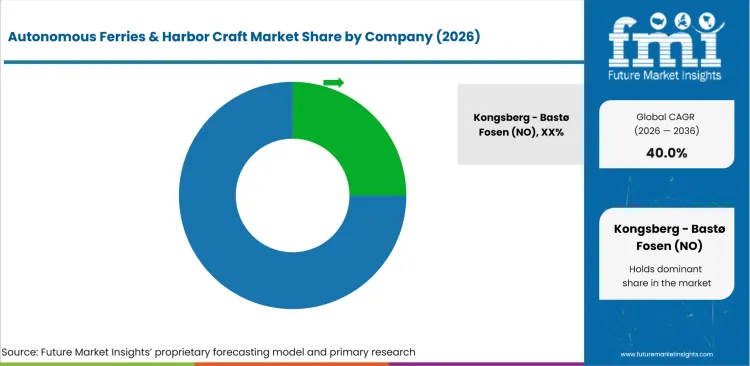
Competition joins vessel operations with navigation software and independent assurance across each scheduled commercial ferry or harbor program. Fjord1 and Mitsui O.S.K. Lines contribute route and fleet experience that system developers cannot reproduce through laboratory testing alone. Kongsberg Maritime and Zeabuz focus on ferry automation, remote supervision, and controlled docking within repeated passenger routes. Furuno Electric, Anschütz, and Wärtsilä provide navigation, docking, or control functions across commercial vessel programs. DNV defines separate assurance pathways for autonomous and remotely operated ships across vessel and shore systems. Experience in marine electronics helps route owners compare systems, but final selection still depends on proof that the complete vessel meets local passenger or harbor rules.
- Kongsberg Maritime and Zeabuz focus on ferry automation and remote-control architecture across scheduled and demonstration routes. Kongsberg brings operating evidence from repeated battery-ferry crossings, while Zeabuz focuses on compact passenger ferries and modular systems. Route owners should compare how each company manages docking data, software updates, and operational support after regular service begins.
- Fjord1 and Mitsui O.S.K. Lines contribute direct operating evidence across scheduled passenger ferry services in Norway and Japan. Their commercial value comes from joining vessel procedures with passenger responsibilities and terminal routines throughout the operating day. Technology companies need these operators to prove that navigation functions can work within daily timetables rather than controlled demonstrations.
- Furuno Electric, Anschütz, and Wärtsilä provide navigation and docking systems that depend on reliable sensors and control links. DNV provides a separate assurance role across vessel functions, shore-control systems, and documented operating procedures. Performance in marine steering systems matters because autonomous commands still require precise and documented vessel response near terminals.
Competitive Benchmarking: Autonomous Ferries & Harbor Craft Market
| Company | Ferry or Harbor Craft Scope | Autonomy Integration | Remote Operations Support | Classification or Assurance | Geographic Reach |
|---|---|---|---|---|---|
| Fjord1 AS | High | Medium | High | Low | Norway / Regional |
| Mitsui O.S.K. Lines, Ltd. | High | Medium | Medium | Low | Japan and international routes / Global |
| Kongsberg Maritime AS | High | High | High | Medium | Europe, Asia, and North America / Global |
| Zeabuz AS | High | High | High | Low | Europe and Singapore / International |
| Furuno Electric Co., Ltd. | Medium | High | High | Low | Asia, Europe, and North America / Global |
| Anschütz GmbH | Medium | High | High | Low | Europe and international marine markets / Global |
| Wärtsilä Corporation | High | High | Medium | Low | Global |
| DNV AS | Medium | Medium | Medium | High | Global |
Scoring basis: High indicates direct evidence across the named capability and regular activity in autonomous vessel programs. Medium indicates verified but narrower involvement, while Low identifies limited direct responsibility within the stated commercial capability.
Source: Future Market Insights competitive analysis, 2026. Ratings reflect verified portfolio relevance and documented operating evidence from official company sources.
Key Developments in the Autonomous Ferries & Harbor Craft Market
- In July 2025, Zeabuz: Yinson GreenTech completed smart-navigation tests on the Hydromover, Singapore’s first fully electric light cargo vessel. The system identified collision risks and proposed alternative routes under COLREG requirements during the trial. The crew can now use smart-navigation functions during regular operations under supervision. The result gives harbor craft operators a direct reference for adding decision support to an operating electric workboat.
- In June 2025, Zeabuz completed public demonstrations of the Celia One electric self-sailing ferry in Gothenburg from June 14 to June 18. Celia One used the Zeabuz Autonomy System for autonomous navigation and real-time obstacle detection during public and industry events. The program gave city transport planners direct exposure to passenger-ferry automation in an active urban waterway. The demonstrations showed how route control and obstacle detection can be reviewed before regular passenger service begins.
- In October 2025, Anschütz launched its Autonomics product line for autonomous navigation and mission automation after vessel demonstrations in Europe. The portfolio combines bridge functions with collision-avoidance logic and remote monitoring from shore control centers. The launch expands the number of commercial navigation suppliers able to address ferry and harbor craft programs that need remote supervision within one integrated system.
- In May 2026, Zeabuz: Brim Explorer selected ZeaWatch Docking Assist for fleetwide implementation, beginning with MS Bre in the third quarter of 2026. The retrofit uses cameras and 4D radar to improve situational awareness during docking in tight harbors.
Key Players in the Autonomous Ferries & Harbor Craft Market
Ferry Operators and Vessel Owners
- Fjord1 AS
- Mitsui O.S.K. Lines, Ltd.
Autonomy and Navigation Developers
- Kongsberg Maritime AS
- Zeabuz AS
- Furuno Electric Co., Ltd.
- Anschütz GmbH
- Wärtsilä Corporation
Classification and Assurance Providers
- DNV AS
Autonomous Ferries & Harbor Craft Market - Report Scope
| Coverage field | Report scope |
|---|---|
| Market breakdown | Vessel type, application, component, end-use, business model, and region. |
| Quantitative Units | USD Million, CAGR in %. |
| Market Definition | Autonomous ferries and harbor craft that use onboard navigation automation, remote supervision, or both to support passenger transport and port operations. |
| Regions Covered | North America, Latin America, Europe, East Asia, South Asia, Oceania, and Middle East and Africa. |
| Countries Covered | China, Japan, European Union, Norway, South Korea, Singapore, India, and 7+ countries within the regional model. |
| Key Companies Profiled | Fjord1 AS, Mitsui O.S.K. Lines, Ltd., Kongsberg Maritime AS, Zeabuz AS, Furuno Electric Co., Ltd., Anschütz GmbH, Wärtsilä Corporation, and DNV AS. |
| Forecast Period | 2026 to 2036. |
| Approach | Hybrid bottom-up and top-down market sizing supported by primary interviews and official desk research. |
Source: Future Market Insights analysis driven by proprietary forecasting models and primary research
Autonomous Ferries & Harbor Craft Market - Research Methodology
| Method | Approach |
|---|---|
| Primary Research | FMI analysts gathered input from manufacturers, service providers, technology developers, distributors, end users, procurement teams, and subject-matter experts. Interviews examined purchasing decisions, product or service evaluation, adoption barriers, approval requirements, pricing considerations, and expectations for technical or commercial support. Respondents were also asked what evidence is required before a trial, pilot, or initial order develops into regular purchasing. |
| Desk Research | Desk research covered government statistics, regulatory publications, trade data, industry associations, technical literature, standards, company filings, product information, and official corporate announcements. Sources were reviewed for relevance, publication date, geographic coverage, and consistency with the defined market scope. Claims relating to performance, applications, approvals, capacity, investment, and commercial activity were retained only when supported by credible public evidence. |
| Market Sizing and Forecasting | The market model combined the baseline value with historical performance, segment structure, pricing and volume indicators, adoption levels, company participation, and country-level demand conditions. Forecast assumptions considered economic activity, investment trends, regulatory developments, technology adoption, purchasing cycles, supply availability, and barriers to wider market use. Segment and regional estimates were reconciled before the final market total was calculated. |
| Data Validation | Estimates were checked against multiple independent indicators, including public data, company activity, trade patterns, industry developments, and findings from primary interviews. Validation also tested whether products, services, applications, and company revenues fell within the defined market boundaries. Adjacent categories, unsupported claims, overlapping revenues, and activities without direct market relevance were excluded to reduce double counting and maintain consistency across segments and countries. |
Source: Future Market Insights (FMI) analysis, based on proprietary forecasting model and primary research
Autonomous Ferries & Harbor Craft Market by Segments
Autonomous Ferries & Harbor Craft Market segmented by Vessel Type:
- Urban passenger ferries
- Harbor tugs and workboats
- Inter-island and coastal ferries
Autonomous Ferries & Harbor Craft Market segmented by Application:
- Urban waterway transit
- Port and harbor operations
- Inter-island transport
Autonomous Ferries & Harbor Craft Market segmented by Component:
- Autonomy systems
- Propulsion and control hardware
- Communication and sensor suites
Autonomous Ferries & Harbor Craft Market segmented by End-use:
- Public transit authorities
- Port operators
- Private commercial operators
Autonomous Ferries & Harbor Craft Market segmented by Business Model:
- Operations contracts
- Technology licensing
- Vessel sales
Autonomous Ferries & Harbor Craft Market by Region:
- North America
- United States
- Canada
- Latin America
- Brazil
- Mexico
- Chile
- Europe
- European Union
- Norway
- United Kingdom
- East Asia
- China
- Japan
- South Korea
- South Asia
- India
- Oceania
- Australia
- New Zealand
- Middle East and Africa
- United Arab Emirates
- Saudi Arabia
- South Africa
Research Sources and Bibliography
- International Maritime Organization. (2026, May 22). IMO adopts first global Code for autonomous ships. International Maritime Organization.
- DNV. (2025, January 15). DNV launches class notations to provide framework for safe development of autonomous shipping technologies. DNV.
- Kongsberg Maritime. (2025, February). Ferry operations at the push of a button. Kongsberg Maritime.
- Zeabuz. (2025, January 29). Future Marine and Zeabuz sign Letter of Intent to pioneer autonomous electric urban ferries in Canada. Zeabuz.
- Fjord1. (2026). Message from the Chief Executive Officer. Fjord1.
- Mitsui O.S.K. Lines. (2026, March 30). MEGURI2040 Stage 2 achievements announced: Four demonstration vessels obtain Japanese government certification as autonomous ships. Mitsui O.S.K. Lines.
- Zeabuz. (2025, October 15). Trafikverket Färjerederiet and Stockholms Reperationsvarv AB selects Zeabuz and Metstech to deliver automation and energy systems for net-zero ferry Neptunus. Zeabuz.
- Zeabuz. (2025, June 18). Zeabuz and Cstrider showcase autonomous ferry system in Gothenburg. Zeabuz.
- Zeabuz. (2025, July 1). The government of Åland has chosen Zeabuz to deliver Virtual Cable Ferry Solution. Zeabuz.
- Furuno Electric. (2026, April 24). Four demonstration vessels obtain Japanese government certification as autonomous ships in MEGURI2040 Stage 2. Furuno Electric.
- Anschütz. (2025, October 16). Anschütz Autonomics: A new era of autonomous navigation. Anschütz.
- Maritime and Port Authority of Singapore. (2026, April 22). MPA and PSA Singapore seek proposals for autonomous shipping to modernise port operations. Maritime and Port Authority of Singapore.
- Zeabuz. (2026, April 21). Zeabuz and Singapore Institute of Technology partner to advance simulation-based testing and verification. Zeabuz.
- European Commission. (2026, March 4). Remarks by Executive Vice-Presidents Séjourné and Fitto and by Commissioner Tzitzikostas on the EU Industrial Maritime and Ports Strategies. European Commission.
- Norwegian Maritime Authority. (2026, March 30). Study on jurisdiction for Remote Operation Centres. Norwegian Maritime Authority.
- Cochin Shipyard Limited. (2025, September). Business Responsibility and Sustainability Report 2024-25. Cochin Shipyard Limited.
- Korean Register. (2025, July). Guidance for Autonomous Ships. Korean Register.
- Zeabuz. (2026, May 6). Brim Explorer selects Zeabuz for fleetwide implementation of advanced docking assistance system. Zeabuz.
- Wärtsilä. (2023, November 9). Wärtsilä and Seaspan transform maritime operations with SmartDock autodocking system. Wärtsilä.
- Zeabuz. (2025, July 22). Successful smart navigation tests on the YGT Hydromover. Zeabuz.
The bibliography gives readers a source record drawn from government agencies and recognized standards bodies. Official trade organizations and company publications provide the remaining evidence used across the market analysis.
This Report Answers
- What market value is estimated for 2026 and 2036?
- What CAGR is projected from 2026 to 2036?
- Which vessel and application segments shape commercial demand?
- How do autonomy systems change vessel and shore-control spending?
- Which operating conditions support scheduled autonomous ferry service?
- How do country CAGRs differ across China, Japan, Norway, and other tracked markets?
- Which companies compete through vessel operations, navigation systems, or assurance?
- What should transport authorities resolve before a commercial route begins?
- How do remote operations and cybersecurity affect company selection?
Frequently Asked Questions
What is driving growth in the Autonomous Ferries & Harbor Craft Market?
Scheduled ferry routes provide repeated docking data and predictable charging windows for autonomy systems during routine service. Public programs create commercial value once successful trials become funded contracts with defined performance measures.
Who are the key players in the Autonomous Ferries & Harbor Craft Market?
Fjord1 brings scheduled passenger-ferry evidence from Norway, and MOL provides certified commercial operating evidence from Japan. Kongsberg Maritime and Zeabuz provide automation, while Furuno Electric, Anschütz, Wärtsilä, and DNV support navigation or assurance.
What is a notable restraint in the Autonomous Ferries & Harbor Craft Market?
Passenger-vessel approval remains controlled by national authorities despite the global MASS Code for autonomous cargo ships. Route owners need local safety evidence and emergency procedures before regular autonomous passenger service can begin.
Why should executives track the Autonomous Ferries & Harbor Craft Market?
The autonomous ferries and harbor craft market combines vessel investment with recurring software and shore-support contracts across commercial operations. Early route decisions shape terminal design, operating responsibility, and future fleet expansion costs for public operators.
What business problem does the Autonomous Ferries & Harbor Craft Market address?
Autonomous craft can support frequent crossings where crew availability or operating cost limits dependable passenger service. The model suits routes with fixed terminals and repeated operating patterns throughout each scheduled service day.
What should ferry authorities and port operators evaluate in the Autonomous Ferries & Harbor Craft Market?
Ferry authorities and port operators should compare route fit with passenger access and shore-control responsibility. Contracts need clear ownership of remote monitoring, maintenance response, and operational data from the first service day.
What limits return on investment in the Autonomous Ferries & Harbor Craft Market?
Returns weaken when expensive vessels operate below planned frequency or require unplanned shore staffing during service. Approval delays can leave terminal systems and remote-control assets underused across several commercial operating periods.
What supports long-term commercial confidence in the Autonomous Ferries & Harbor Craft Market?
Repeatable service records build confidence across changing traffic and weather conditions during routine passenger operations. Documented maintenance and incident procedures give route owners a practical basis for fleet expansion and contract renewal.
Preview the report firsthand - request a free sample
Get SampleGet the brochure for pricing and purchase details.
Get PDFTable of Content
- Key Takeaways
- Market Size and CAGR
- Top Growth Driver
- Fastest Growing Segment
- Leading Region
- Key Companies
- Emerging Opportunities
- Executive Summary
- Global Market Outlook
- Demand-side Trends
- Supply-side Trends
- Technology Roadmap Analysis
- Analysis and Recommendations
- Analyst Perspective (What is happening? Why now? What should investors know?)
- Key Questions Answered
- How large is the market?
- What is the CAGR?
- What are key trends?
- Which region dominates?
- Who are the leaders?
- Market Overview
- Market Coverage / Taxonomy
- Market Definition / Scope / Limitations
- Research Methodology
- Chapter Orientation
- Analytical Lens and Working Hypotheses
- Market Structure, Signals, and Trend Drivers
- Benchmarking and Cross-market Comparability
- Market Sizing, Forecasting, and Opportunity Mapping
- Research Design and Evidence Framework
- Desk Research Programme (Secondary Evidence)
- Expert Input and Fieldwork (Primary Evidence)
- Tooling, Models, and Reference Databases
- Data Engineering and Model Build
- Quality Assurance and Audit Trail
- Market Background
- Market Dynamics (Drivers, Restraints, Opportunity, Trends)
- Scenario Forecast (Optimistic, Likely, Conservative)
- Impact Analysis
- AI Impact
- Sustainability Impact
- Regulatory Impact
- Technology Impact
- Consumer / Buyer Analysis
- Purchase Drivers
- Adoption Barriers
- Buyer Journey
- Opportunity Map Analysis
- Product Life Cycle Analysis
- Supply Chain Analysis
- Investment Feasibility Matrix
- Value Chain Analysis
- PESTLE and Porter's Analysis
- Regulatory Landscape
- Regional Parent Market Outlook
- Production and Consumption Statistics
- Import and Export Statistics
- Global Market Analysis and Forecast, 2021 to 2036
- Historical Market Size Value (USD Mn) Analysis, 2021 to 2025
- Current and Future Market Size Value (USD Mn) Projections, 2026 to 2036
- Y-o-Y Growth Trend Analysis
- Absolute $ Opportunity Analysis
- Global Market Pricing Analysis, 2021 to 2036
- Global Market Analysis and Forecast, By Vessel Type, 2021 to 2036
- Introduction / Key Findings
- Historical Market Size Value (USD Mn) Analysis By Vessel Type, 2021 to 2025
- Current and Future Market Size Value (USD Mn) Analysis and Forecast By Vessel Type, 2026 to 2036
- Urban passenger ferries
- Harbor shuttles
- Car ferries (assisted)
- Water taxis
- Urban passenger ferries
- Y-o-Y Growth Trend Analysis By Vessel Type, 2021 to 2025
- Absolute $ Opportunity Analysis By Vessel Type, 2026 to 2036
- Global Market Analysis and Forecast, By Application, 2021 to 2036
- Introduction / Key Findings
- Historical Market Size Value (USD Mn) Analysis By Application, 2021 to 2025
- Current and Future Market Size Value (USD Mn) Analysis and Forecast By Application, 2026 to 2036
- Urban waterway transit
- Fjord - short crossings
- Harbor operations
- Tourism routes
- Urban waterway transit
- Y-o-Y Growth Trend Analysis By Application, 2021 to 2025
- Absolute $ Opportunity Analysis By Application, 2026 to 2036
- Global Market Analysis and Forecast, By Component, 2021 to 2036
- Introduction / Key Findings
- Historical Market Size Value (USD Mn) Analysis By Component, 2021 to 2025
- Current and Future Market Size Value (USD Mn) Analysis and Forecast By Component, 2026 to 2036
- Autonomy systems
- Vessels
- Operations services
- Autonomy systems
- Y-o-Y Growth Trend Analysis By Component, 2021 to 2025
- Absolute $ Opportunity Analysis By Component, 2026 to 2036
- Global Market Analysis and Forecast, By End-use, 2021 to 2036
- Introduction / Key Findings
- Historical Market Size Value (USD Mn) Analysis By End-use, 2021 to 2025
- Current and Future Market Size Value (USD Mn) Analysis and Forecast By End-use, 2026 to 2036
- Public transit authorities
- Ferry operators
- Municipalities
- Private operators
- Public transit authorities
- Y-o-Y Growth Trend Analysis By End-use, 2021 to 2025
- Absolute $ Opportunity Analysis By End-use, 2026 to 2036
- Global Market Analysis and Forecast, By Business Model, 2021 to 2036
- Introduction / Key Findings
- Historical Market Size Value (USD Mn) Analysis By Business Model, 2021 to 2025
- Current and Future Market Size Value (USD Mn) Analysis and Forecast By Business Model, 2026 to 2036
- Operations contracts
- System sale
- Retrofit
- Pilot programs
- Operations contracts
- Y-o-Y Growth Trend Analysis By Business Model, 2021 to 2025
- Absolute $ Opportunity Analysis By Business Model, 2026 to 2036
- Global Market Analysis and Forecast, By Region, 2021 to 2036
- Introduction
- Historical Market Size Value (USD Mn) Analysis By Region, 2021 to 2025
- Current Market Size Value (USD Mn) Analysis and Forecast By Region, 2026 to 2036
- North America
- Latin America
- Western Europe
- Eastern Europe
- East Asia
- South Asia and Pacific
- Middle East & Africa
- Market Attractiveness Analysis By Region
- North America Market Analysis and Forecast, By Country, 2021 to 2036
- Historical Market Size Value (USD Mn) Trend Analysis By Market Taxonomy, 2021 to 2025
- Market Size Value (USD Mn) Forecast By Market Taxonomy, 2026 to 2036
- By Country
- USA
- Canada
- By Vessel Type
- By Application
- By Component
- By End-use
- By Business Model
- By Country
- Market Attractiveness Analysis
- By Country
- By Vessel Type
- By Application
- By Component
- By End-use
- By Business Model
- Key Takeaways
- Latin America Market Analysis and Forecast, By Country
- Historical Market Size Value (USD Mn) Trend Analysis By Market Taxonomy, 2021 to 2025
- Market Size Value (USD Mn) Forecast By Market Taxonomy, 2026 to 2036
- By Country
- Brazil
- Mexico
- Chile
- Rest of Latin America
- By Vessel Type
- By Application
- By Component
- By End-use
- By Business Model
- By Country
- Market Attractiveness Analysis
- By Country
- By Vessel Type
- By Application
- By Component
- By End-use
- By Business Model
- Key Takeaways
- Western Europe Market Analysis and Forecast, By Country
- Historical Market Size Value (USD Mn) Trend Analysis By Market Taxonomy, 2021 to 2025
- Market Size Value (USD Mn) Forecast By Market Taxonomy, 2026 to 2036
- By Country
- Germany
- UK
- Italy
- Spain
- France
- Nordic
- BENELUX
- Rest of Western Europe
- By Vessel Type
- By Application
- By Component
- By End-use
- By Business Model
- By Country
- Market Attractiveness Analysis
- By Country
- By Vessel Type
- By Application
- By Component
- By End-use
- By Business Model
- Key Takeaways
- Eastern Europe Market Analysis and Forecast, By Country
- Historical Market Size Value (USD Mn) Trend Analysis By Market Taxonomy, 2021 to 2025
- Market Size Value (USD Mn) Forecast By Market Taxonomy, 2026 to 2036
- By Country
- Russia
- Poland
- Hungary
- Balkan & Baltic
- Rest of Eastern Europe
- By Vessel Type
- By Application
- By Component
- By End-use
- By Business Model
- By Country
- Market Attractiveness Analysis
- By Country
- By Vessel Type
- By Application
- By Component
- By End-use
- By Business Model
- Key Takeaways
- East Asia Market Analysis and Forecast, By Country
- Historical Market Size Value (USD Mn) Trend Analysis By Market Taxonomy, 2021 to 2025
- Market Size Value (USD Mn) Forecast By Market Taxonomy, 2026 to 2036
- By Country
- China
- Japan
- South Korea
- By Vessel Type
- By Application
- By Component
- By End-use
- By Business Model
- By Country
- Market Attractiveness Analysis
- By Country
- By Vessel Type
- By Application
- By Component
- By End-use
- By Business Model
- Key Takeaways
- South Asia and Pacific Market Analysis and Forecast, By Country
- Historical Market Size Value (USD Mn) Trend Analysis By Market Taxonomy, 2021 to 2025
- Market Size Value (USD Mn) Forecast By Market Taxonomy, 2026 to 2036
- By Country
- India
- ASEAN
- Australia & New Zealand
- Rest of South Asia and Pacific
- By Vessel Type
- By Application
- By Component
- By End-use
- By Business Model
- By Country
- Market Attractiveness Analysis
- By Country
- By Vessel Type
- By Application
- By Component
- By End-use
- By Business Model
- Key Takeaways
- Middle East & Africa Market Analysis and Forecast, By Country
- Historical Market Size Value (USD Mn) Trend Analysis By Market Taxonomy, 2021 to 2025
- Market Size Value (USD Mn) Forecast By Market Taxonomy, 2026 to 2036
- By Country
- Kingdom of Saudi Arabia
- Other GCC Countries
- Türkiye
- South Africa
- Other African Union
- Rest of Middle East & Africa
- By Vessel Type
- By Application
- By Component
- By End-use
- By Business Model
- By Country
- Market Attractiveness Analysis
- By Country
- By Vessel Type
- By Application
- By Component
- By End-use
- By Business Model
- Key Takeaways
- Key Countries Market Analysis
- USA
- Pricing Analysis
- Market Share Analysis, 2025
- By Vessel Type
- By Application
- By Component
- By End-use
- By Business Model
- Canada
- Pricing Analysis
- Market Share Analysis, 2025
- By Vessel Type
- By Application
- By Component
- By End-use
- By Business Model
- Mexico
- Pricing Analysis
- Market Share Analysis, 2025
- By Vessel Type
- By Application
- By Component
- By End-use
- By Business Model
- Brazil
- Pricing Analysis
- Market Share Analysis, 2025
- By Vessel Type
- By Application
- By Component
- By End-use
- By Business Model
- Chile
- Pricing Analysis
- Market Share Analysis, 2025
- By Vessel Type
- By Application
- By Component
- By End-use
- By Business Model
- Germany
- Pricing Analysis
- Market Share Analysis, 2025
- By Vessel Type
- By Application
- By Component
- By End-use
- By Business Model
- UK
- Pricing Analysis
- Market Share Analysis, 2025
- By Vessel Type
- By Application
- By Component
- By End-use
- By Business Model
- Italy
- Pricing Analysis
- Market Share Analysis, 2025
- By Vessel Type
- By Application
- By Component
- By End-use
- By Business Model
- Spain
- Pricing Analysis
- Market Share Analysis, 2025
- By Vessel Type
- By Application
- By Component
- By End-use
- By Business Model
- France
- Pricing Analysis
- Market Share Analysis, 2025
- By Vessel Type
- By Application
- By Component
- By End-use
- By Business Model
- India
- Pricing Analysis
- Market Share Analysis, 2025
- By Vessel Type
- By Application
- By Component
- By End-use
- By Business Model
- ASEAN
- Pricing Analysis
- Market Share Analysis, 2025
- By Vessel Type
- By Application
- By Component
- By End-use
- By Business Model
- Australia & New Zealand
- Pricing Analysis
- Market Share Analysis, 2025
- By Vessel Type
- By Application
- By Component
- By End-use
- By Business Model
- China
- Pricing Analysis
- Market Share Analysis, 2025
- By Vessel Type
- By Application
- By Component
- By End-use
- By Business Model
- Japan
- Pricing Analysis
- Market Share Analysis, 2025
- By Vessel Type
- By Application
- By Component
- By End-use
- By Business Model
- South Korea
- Pricing Analysis
- Market Share Analysis, 2025
- By Vessel Type
- By Application
- By Component
- By End-use
- By Business Model
- Russia
- Pricing Analysis
- Market Share Analysis, 2025
- By Vessel Type
- By Application
- By Component
- By End-use
- By Business Model
- Poland
- Pricing Analysis
- Market Share Analysis, 2025
- By Vessel Type
- By Application
- By Component
- By End-use
- By Business Model
- Hungary
- Pricing Analysis
- Market Share Analysis, 2025
- By Vessel Type
- By Application
- By Component
- By End-use
- By Business Model
- Kingdom of Saudi Arabia
- Pricing Analysis
- Market Share Analysis, 2025
- By Vessel Type
- By Application
- By Component
- By End-use
- By Business Model
- Türkiye
- Pricing Analysis
- Market Share Analysis, 2025
- By Vessel Type
- By Application
- By Component
- By End-use
- By Business Model
- South Africa
- Pricing Analysis
- Market Share Analysis, 2025
- By Vessel Type
- By Application
- By Component
- By End-use
- By Business Model
- USA
- Market Structure Analysis
- Competition Dashboard
- Competition Benchmarking
- Market Share Analysis of Top Players
- By Regional
- By Vessel Type
- By Application
- By Component
- By End-use
- By Business Model
- Emerging Startups
- Innovation Benchmarking
- Competition Analysis
- Competition Deep Dive
- Kongsberg - Bastø Fosen (NO)
- Overview
- Product Portfolio
- Profitability by Market Segments
- Sales Footprint
- Strategy Overview
- Marketing Strategy
- Product Strategy
- Channel Strategy
- Zeabuz (NO)
- Roboat - MIT-AMS (NL)
- Kongsberg - Bastø Fosen (NO)
- Case Studies
- Success Stories
- Recent Developments
- Competition Deep Dive
- Assumptions & Acronyms Used


