

- Market Size (2026)
- USD 2860.7 Mn
- Forecast (2036)
- USD 6062.6 Mn
- CAGR (2026 to 2036)
- 7.8%
How big is the Ribbon Board Display Market in 2026?
USD 2,860.7 million in 2026 and USD 6,062.6 million by 2036 at a 7.8% CAGR.
Ribbon boards are becoming sellable media space because venues need more sponsor inventory during live events. Live Nation reported sponsorship AOI of USD 845 million in 2025 and said the increase was supported by online and onsite brand activity. This is a key driver because venue operators are looking at ribbon boards as rotating sponsor surfaces. The same boards can also carry scores and safety messages without taking over the main video display.
Ribbon board projects are usually approved only after the venue team understands installation risk. Daktronics said in May 2025 that Centreville Bank Stadium opened with six LED displays and a complete Show Control system. The project included two narrow ribbon displays along the seating fascia. This shows why buyers rely on AV integrators and display suppliers to match cabinets and content timing before the venue opens.
Replacement demand is anticipated to rise as older venues need brighter displays and more content control without rebuilding the seating bowl. Daktronics said in April 2026 that Yankee Stadium upgraded two ribbon boards across the 200 and 300 Levels. The 200 Level ribbon now totals 614 feet while the 300 Level ribbon remains 1,060 feet wide. This is important because established venues are using ribbon upgrades to refresh sponsor messaging and live-event information during active seasons.
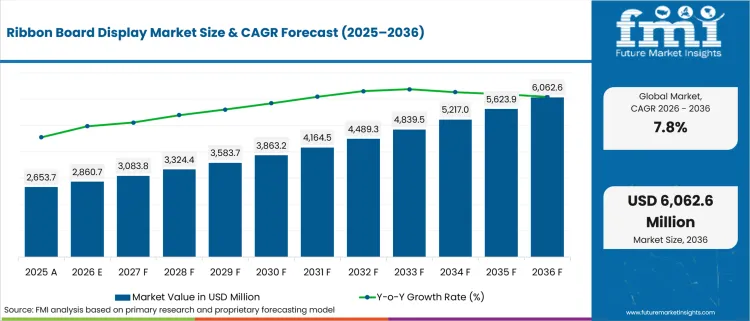
| Metric | Value |
|---|---|
| 2025 Market Size | USD 2,653.7 million |
| 2026 Market Size | USD 2,860.7 million |
| 2036 Market Size | USD 6,062.6 million |
| Forecast CAGR (2026-2036) | 7.8% |
| Display Type Focus | LED Ribbon Boards |
| LED Ribbon Boards Share (2026) | 46.0% |
| Pixel Pitch Focus | 4-8 mm |
| 4-8 mm Share (2026) | 41.0% |
| End Use Focus | Stadiums |
| Stadiums Share (2026) | 54.0% |
| Fastest-growing Country | India |
| India CAGR by 2036 | 9.0% |
Summary of the Ribbon Board Display Market
| Market Signal | Commercial Impact |
|---|---|
| Demand and Growth Drivers | Demand for ribbon board displays is expected to expand steadily through 2036 as sports venues, entertainment facilities, and multipurpose arenas invest in digital advertising and audience engagement infrastructure.
|
| Product and Segment View | LED ribbon boards, 4-8 mm pixel pitch, and stadium installations continue to lead their respective market segments.
|
| Geography and Growth Outlook | North America and Asia continue to drive market growth through venue modernization, sports infrastructure investment, and expanding digital advertising opportunities.
|
| Competitive Landscape | Competition increasingly focuses on display performance, venue integration, and long-term service capabilities.
|
| Analyst Perspective | Ribbon board displays are evolving from venue information systems into revenue-generating digital assets that support sponsorship activation, fan communication, and live event operations.
- Sudip saha, Principal Consultant at Future Market Insights |
How is the ribbon board display market segmented?
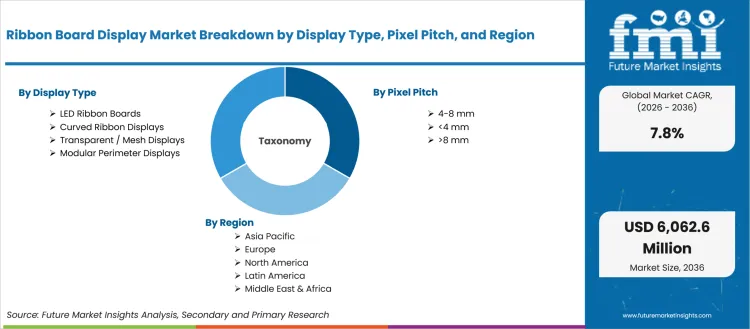
The Ribbon Board Display industry is segmented by display type, pixel pitch, end use, application, sales channel, and region.
The ribbon board display market is segmented by display type, pixel pitch, end use, application, sales channel, and region. Display type covers LED ribbon boards, curved ribbon displays, transparent mesh displays, and modular perimeter displays. Pixel pitch includes less than 4 mm, 4-8 mm, and greater than 8 mm systems. End use spans stadiums, arenas, convention centers, and entertainment venues. Application covers advertising, score or event information, fan engagement, and wayfinding. Sales channel includes direct OEM, AV integrators, and EPC or venue contractors. Regional coverage extends across North America, Latin America, Europe, East Asia, South Asia and Pacific, and the Middle East and Africa.
Why do LED ribbon boards matter within the display type category?
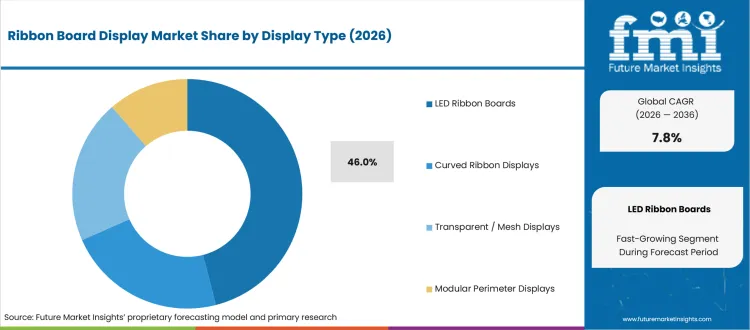
Venue buyers need display surfaces that can wrap around seating bowls and remain readable from many angles. The display type decision starts with the physical venue and then moves to media control. LED ribbon boards suit permanent fascia runs. Curved and transparent digital signage formats matter once architecture limits cabinet depth or blocks sightlines. This makes display type a construction and operations choice before it becomes a screen specification.
- In 2026, LED Ribbon Boards are anticipated to hold 46.0% share driven by their fit for fixed fascia placement and repeat sponsor loops. This position is supported by standard LED cabinets and sports control systems that already support long-run installations around seating bowls and perimeter edges in major venues.
- The executive value is revenue control for teams that sell sponsor exposure across many event moments. Buyers using LED ribbon boards can rotate sponsor messages and score prompts across the bowl. That makes the screen surface part of the commercial plan and gives operators a stronger base for sponsor reporting after events.
What supports demand for 4-8 mm pixel pitch systems?
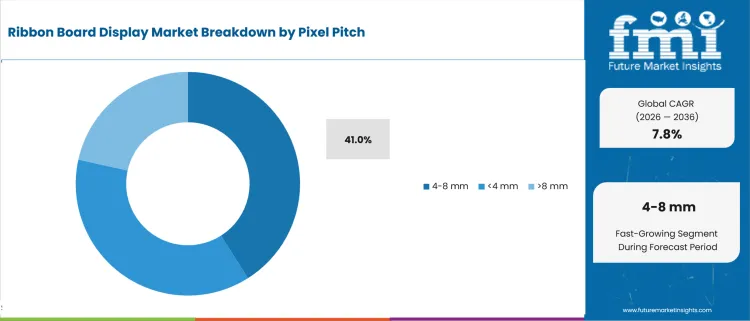
Viewing distance creates the core pixel pitch decision for ribbon board buyers. Fine pitch can improve close-range clarity in premium seating areas. Mid-range pitch often works better across stadium bowls due to longer viewing distance and lower repair exposure. The decision therefore balances sponsor readability and installed cost before cabinet selection starts. Buyers also need the pitch choice to hold up under broadcast cameras and varied seating angles.
- The 4-8 mm category are set to represent 41.0% of pixel pitch demand in 2026 supported by its balance between viewing clarity and installed cost. ADI’s MT technology references 5 mm resolution in venue projects. That keeps this pitch band relevant for mid-distance seating bowls that need readable sponsor names and score prompts.
- For venue engineers, the 4-8 mm option reduces specification risk by linking resolution to seat geometry and camera expectations. It supports procurement teams that need sponsor visibility without buying a finer pitch than the venue can practically use. The result is a clearer payback case for long fascia runs and premium seats.
How do stadiums shape end-use demand?
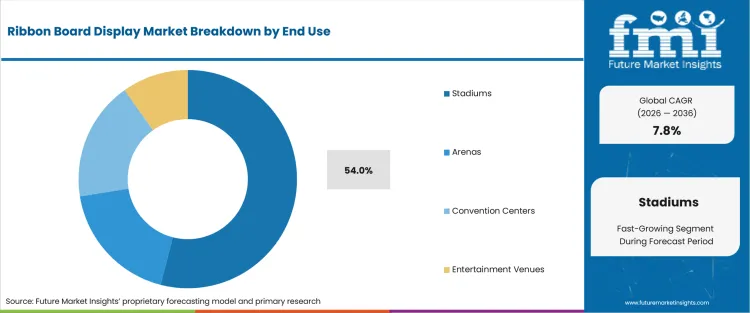
Stadium owners buy longer display runs than most indoor venues. The installation must survive weather exposure plus repeated event schedules. The same operational case appears in stadium lighting decisions as uptime and maintenance windows shape supplier selection. Ribbon board demand therefore depends on service access and event timing as much as screen size. Outdoor venues also need replacement modules that crews can reach during narrow service windows.
- Stadiums are projected to hold dominance with 54.0% share of end-use demand in 2026 attributable to long bowl perimeters and repeat sponsor exposure during sports seasons. This position reflects baseball and football plus soccer and cricket venues needing content surfaces that can serve many home events each year and remain visible from broad seating zones.
- Stadium buyers gain operating value from synchronized score information and crowd prompts across large seating bowls. That control helps production teams run sponsor messages and safety notices from one content workflow. It also reduces the need to manage separate sign systems during high-pressure match operations and weather-sensitive event windows across longer seasons.
What makes advertising the chosen application for buyers?
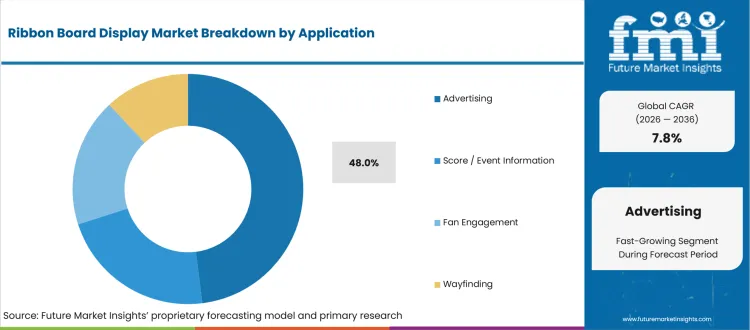
Sponsor sales teams need surfaces that can be sold in rotation and refreshed during the match. Static signs cannot change message timing or support synchronized screen takeovers. Ribbon boards make advertising useful during scoring moments and breaks. That gives application demand a direct revenue case instead of a display-only justification. The segment gains relevance once commercial teams need proof-of-play records and planned sponsor exposure.
- Advertising is predicted to account for 48.0% share in 2026 led by the commercial value of rotating sponsor messages across seating-bowl fascia. This position reflects how clubs package screen time across match phases and create higher-value inventory than fixed perimeter signs can offer during recurring home events and tournament fixtures. This improves the business case for full-bowl digital conversion.
- Sponsor teams benefit from advertising-led ribbon boards by changing creative during breaks and by coordinating messages around scoring moments. The operating value sits in proof-of-play and scheduling control. Sales teams can then align screen time to sponsorship tiers and event production plans without treating each board as separate inventory across venues.
How are AV integrators positioned within the sales-channel category?
Ribbon board projects rarely stop at the cabinet purchase. Venues need control processors and media servers plus installation planning and operator training. Integrators become important due to that project mix. Their role also overlaps with rental outdoor LED display work for temporary events and fan-zone extensions. That overlap helps buyers use one partner for screens and content workflow during live operations.
- AV Integrators hold an estimated 43.0% of sales-channel demand in 2026 supported by the need to combine hardware and media control in one project. Their role is practical due to venue owners needing synchronized boards and content workflows instead of screen supply alone across scoreboard and ribbon systems during live events. This makes integrators central to risk control.
- For executive buyers, the integrator route reduces coordination risk across contractors and event crews. Integrators can translate sponsor requirements into media templates and service plans. That helps venue owners avoid handoffs between screen vendors and production teams during live operations and major matchday changeovers across the full venue network. This reduces friction during final commissioning.
What are the drivers, restraints, and opportunities in the ribbon board display market?
Near-term purchases are being shaped by the sponsor monetization requirement, retrofit constraint, and managed-service expansion route outlined below.
- Driver: Sponsor monetization is driving spending on programmable ribbon boards that can rotate messages during event windows.
- Restraint: Retrofit complexity is limiting upgrades in older bowls that have tight fascia depth and restricted service access.
- Opportunity: Managed content and maintenance services gain traction from venues that need reliable operation across full seasons.
Sports venues are converting bowl perimeters into media surfaces that support advertising packages and live information. That behavior expands the addressable pool for ribbon boards beyond scoreboard replacement. Daktronics said the Chase Field upgrade would create more than 21,000 square feet of digital signage and 16.9 million pixels. The figure shows how venue operators now treat ribbon boards and main boards as one connected inventory layer rather than isolated display assets.
Older venues often delay projects due to mounting weight and service access limits. Suppliers convert that restraint into opportunity by offering lighter cabinets and front-service modules plus service packages that reduce disruption during seasons. ADI stated in May 2024 that MT LED modules were around 50% lighter and slimmer than modules installed five years earlier. That evidence explains why engineering support and installation planning can decide projects before price comparisons begin.
Service and content support create a growth route for companies that want revenue beyond hardware delivery. Stadium operators need calibration and media scheduling plus repair planning across full seasons. LG’s April 2025 Mercedes-Benz Stadium announcement referenced a 98-screen field-level pitch LED ribbon board. Related commercial touch display interfaces in hospitality zones make supplier software and content support more valuable. The opportunity is stronger for firms that can train operators and keep sponsor content running during dense event calendars.
Which country CAGRs are profiled in the ribbon board display market?
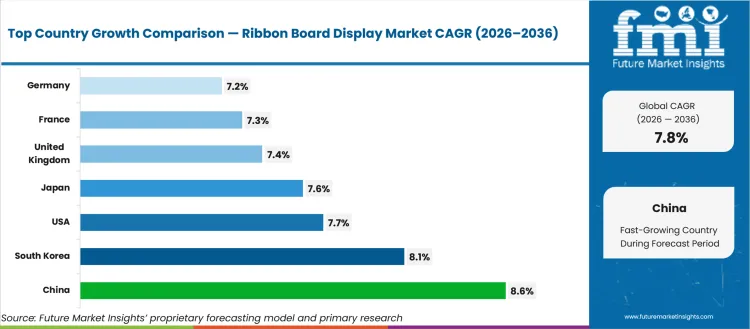
| Country | CAGR |
|---|---|
| United States | 7.7% |
| United Kingdom | 7.4% |
| Germany | 7.2% |
| France | 7.3% |
| Japan | 7.6% |
| China | 8.6% |
| South Korea | 8.1% |
| India | 9.0% |
How do country-level CAGRs compare in the ribbon board display market?
Country CAGR profiles in ribbon board displays should be read by venue replacement logic and local project timing. Established sports markets rely on stadium refresh cycles and sponsorship renewal. China and India add more new-build and public infrastructure logic. Europe reflects football-led renovation plus phased procurement. Japan and South Korea place more weight on visual quality and electronics capability. For buyers and suppliers, the comparison shows whether demand is tied to replacement payback, event infrastructure build-out or service coverage across seasons. That distinction changes partner selection and the mix of hardware, integration and support required.
- By 2036, the United States is projected to record 7.7% CAGR supported by large venue replacement cycles and professional sports attendance. MLB reported weekday average attendance rose 13% from 2022 levels in its 2024 season summary. That evidence supports ribbon board demand by increasing the value of sponsor exposure during repeat home events. The country differs from newer venue markets due to larger installed bases and more complex renovation schedules. Suppliers need evidence of uptime and coordinated control rather than screen size alone.
- The United Kingdom is expected to grow at 7.4% CAGR during the forecast period driven by stadium retrofit projects and integrator-led display delivery. ADI said its Crystal Palace project covered nearly 1,000 square meters across three stands and the pitch. That evidence shows why the UK profile depends on digital renewal inside existing stadium footprints. It differs from new-build markets due to a heavier need for local installation planning and staged work. Supplier service presence can therefore matter before hardware selection.
- Over the assessment period, Germany is forecast to advance at 7.2% CAGR reinforced by football attendance and disciplined venue refresh cycles. Bundesliga reported 11,653,239 ticket sales in the 2024/25 top division. The country profile differs from new-build markets due to buyers often justifying ribbon boards by sponsor yield and service life. Clubs therefore need clear payback from display renewal before wider bowl upgrades are approved. This favors suppliers that can document reliability during long league calendars and phased venue work.
- Through 2036, France is anticipated to post 7.3% CAGR supported by football attendance and staged venue modernization. Ligue 1 reported 329,864 spectators across nine stadiums on Matchday 2 of the 2024/25 season. That crowd base supports display upgrades by increasing visible sponsor inventory during high-attendance fixtures. France differs from the United States due to venue ownership and tender structures that can keep procurement more phased. Local project delivery therefore affects supplier shortlists and long-term service expectations for stadium display upgrades.
- Japan is likely to expand at 7.6% CAGR by 2036 shaped by fan attendance and a preference for precise installation. J.League reported 12,540,265 official-match attendees in 2024. That supports ribbon board demand in venues that need clean visual quality and dependable service response. Japan differs from India and China due to replacement programs that usually emphasize reliability and visual consistency before rapid footprint expansion. Buyers therefore value calibration and service discipline across every screen run and control-room handoff during events.
- China is estimated to rise at 8.6% CAGR between 2026 and 2036 propelled by venue renewal and domestic LED manufacturing depth. The Greater Bay Area portal said Shenzhen Sports Center reopened after a five-year renovation in 2025. That supports demand for display-ready facilities connected to major events and city venue programs. China differs from Western Europe due to public venue upgrades and local display supply moving together. Supplier competition is therefore more price-sensitive and engineering-led across multipurpose facilities and public projects.
- South Korea is projected to record 8.1% CAGR by 2036 influenced by sports entertainment culture and electronics supplier capability. The Ministry of Culture, Sports and Tourism cited a survey showing women represented 56.7% of KBO attendees in 2025. That audience shift supports fan-experience investment in baseball and football venues. South Korea differs from larger countries due to supplier credibility being shaped by domestic electronics strength. Venue buyers can reference local display expertise during upgrades and service planning for new screen networks.
- India is expected to grow at 9.0% CAGR during the forecast period driven by public sports programs and cricket-led sponsorship. India’s Press Information Bureau reported 1,045 Khelo India Centres in June 2025. That wider venue base supports future screen upgrades across sports infrastructure. India differs from developed markets due to new venue creation and sponsorship monetization expanding together. Price sensitivity still shapes pixel pitch and service decisions outside major metro venues and premium cricket facilities nationwide. This keeps suppliers focused on cost control and local support.
Who are the notable companies in the ribbon board display market?
Daktronics, Samsung, LG Electronics, Unilumin, Leyard, Absen, ADI, Nevco, LianTronics and Watchfire Signs are the notable companies shaping this market.
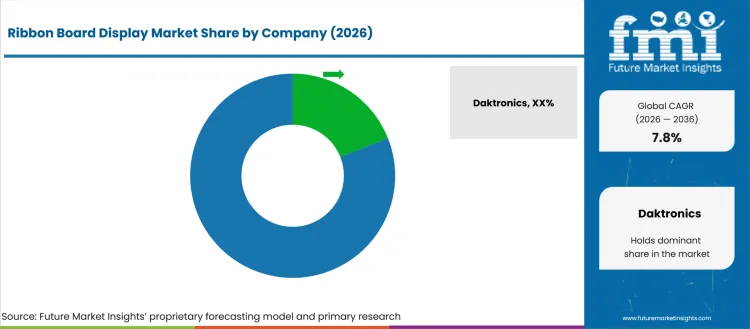
Buyer choice in ribbon board displays is structured by the venue layer that needs control. Sports-display specialists are better suited to projects that need scoring familiarity and matchday service. Commercial display OEMs become more relevant in venue-wide screen programs. LED manufacturers gain relevance in price-performance tenders. Regional specialists matter in retrofit work that depends on site surveys and local service. The practical decision is whether the buyer wants display ownership at the sports system layer, the venue screen layer or the installation-service layer.
- Sports-led accounts often evaluate Daktronics and Nevco for score-system familiarity and long venue references. Buyers choosing these suppliers are typically looking for ribbon boards that can operate beside scoring software and live-event workflows. That role is important in stadiums that cannot tolerate visible screen failure during matches.
- Venue-wide display programs place Samsung and LG Electronics in a different buying lane. These companies are relevant for owners that want main displays and ribbon boards plus hospitality screens under one ecosystem. Their fit improves in facilities that plan multi-zone display refreshes across seating bowls and concourses.
- Price-performance tenders bring Unilumin and Leyard plus Absen and LianTronics into the comparison set. These suppliers are relevant to buyers that want LED manufacturing depth and modular cabinet options. They matter in projects that separate hardware sourcing from local integration and long-term service.
- Local retrofit programs give ADI and Watchfire Signs clearer relevance for installation planning and service proximity. Their role increases in venues that need surveys and staged work around match calendars. Buyers can use these suppliers to reduce project risk before moving into media-server or scoreboard integration.
Competitive Benchmarking: Ribbon Board Display Market
| Company | Venue LED Portfolio Fit | Control-Room Integration | Sports Reference Depth | Service Reach |
|---|---|---|---|---|
| Daktronics | High | High | High | Global |
| Samsung | High | Strong | High | Global |
| LG Electronics | High | Strong | High | Global |
| Unilumin | Strong | Medium | Strong | Global |
| Leyard | Strong | Medium | Strong | Global |
| Absen | Medium | Medium | Strong | Global |
| ADI | Strong | Strong | High | United Kingdom |
| Nevco | Strong | Medium | Strong | North America |
| LianTronics | Medium | Medium | Medium | Global |
| Watchfire Signs | Medium | Medium | Medium | North America |
Source: Future Market Insights competitive analysis, 2026. Ratings reflect relative portfolio relevance, workflow or project fit, service capability, and geographic reach.
Key Developments in the Ribbon Board Display Market
- In March 2026, Daktronics announced three ribbon boards for Chase Field as part of the Arizona Diamondbacks display upgrade. The development matters to baseball venues that need long display runs for statistics and sponsorship messages. It points to continued replacement activity in major USA stadiums that are refreshing digital inventory.
- In April 2025, LG Electronics announced a multi-year Mercedes-Benz Stadium partnership that included a field-level pitch LED ribbon board. The move matters to ribbon board buyers due to the need for pitch-level advertising surfaces and portable venue formats. It supports display ecosystems that serve football and soccer events.
- In May 2024, Samsung and St. Louis CITY SC described in-stadium LED ribbon boards at CITYPARK for player stats and sponsor messages. The project matters to venue buyers that want information and advertising on the same display network. It points to screen systems that combine fan communication and commercial activation.
Key Players in the Ribbon Board Display Market
Sports Display Specialists
- Daktronics
- ADI
- Nevco
- Watchfire Signs
Commercial Display OEMs
- Samsung
- LG Electronics
LED Display Manufacturers
- Unilumin
- Leyard
- Absen
- LianTronics
Ribbon Board Display Market - Report Scope
| Coverage field | Report scope |
|---|---|
| Market breakdown | Ribbon Board Display Market Breakdown By Display Type, Pixel Pitch, End Use, Application, Sales Channel, and Region |
| Market Definition | Long and narrow LED display systems installed around stadium fascia, arena bowls, field edges, concourses, and venue perimeters |
| Regions Covered | North America, Latin America, Europe, East Asia, South Asia and Pacific, Middle East and Africa |
| Countries Covered | United States, United Kingdom, Germany, France, Japan, China, South Korea, India and 30+ countries |
| Key Companies Profiled | Daktronics, Samsung, LG Electronics, Unilumin, Leyard, Absen, ADI, Nevco, LianTronics, Watchfire Signs |
| Forecast Period | 2026 to 2036 |
| Approach | Hybrid bottom-up and top-down methodology using installed display area, venue replacement cycles, supplier evidence, pixel pitch mix, and country-level venue demand signals |
Ribbon Board Display Market - Research Methodology
| Method | Approach |
|---|---|
| Primary Research | FMI analysts reviewed inputs from venue owners, stadium operators, AV integrators, sports technology consultants, and LED display suppliers. Discussions focused on viewing distance, pixel pitch choice, service access, sponsor workflows, and contract routing. |
| Desk Research | Desk research covered official venue case studies, sports attendance indicators, public construction data, sports infrastructure releases, company product information, and display technology references. Product relevance was checked against ribbon-board placement and adjacent video wall use. |
| Market Sizing and Forecasting | The model combined installed display area, replacement cycles, average system pricing, venue type, pixel pitch selection, and country-level buying conditions. Forecast assumptions were adjusted for stadium upgrades, sponsor demand, and integrator-led procurement. |
| Data Validation | Forecasts were checked against venue project evidence, supplier portfolios, sports event indicators, and country-level infrastructure signals. Duplicate external statistics were removed before finalizing evidence allocations and source matching. |
Ribbon Board Display Market by Segments
Ribbon Board Display Market segmented by Display Type:
- LED Ribbon Boards
- Curved Ribbon Displays
- Transparent / Mesh Displays
- Modular Perimeter Displays
Ribbon Board Display Market segmented by Pixel Pitch:
- <4 mm
- 4-8 mm
- >8 mm
Ribbon Board Display Market segmented by End Use:
- Stadiums
- Arenas
- Convention Centers
- Entertainment Venues
Ribbon Board Display Market segmented by Application:
- Advertising
- Score / Event Information
- Fan Engagement
- Wayfinding
Ribbon Board Display Market segmented by Sales Channel:
- Direct OEM
- AV Integrators
- EPC / Venue Contractors
Ribbon Board Display Market by Region:
- North America
- United States
- Canada
- Mexico
- Latin America
- Brazil
- Chile
- Rest of Latin America
- Western Europe
- Germany
- UK
- Italy
- Spain
- France
- Nordic
- BENELUX
- Rest of Western Europe
- Eastern Europe
- Russia
- Poland
- Hungary
- Balkan & Baltic
- Rest of Eastern Europe
- East Asia
- China
- Japan
- South Korea
- South Asia and Pacific
- India
- ASEAN
- Australia & New Zealand
- Rest of South Asia and Pacific
- Middle East & Africa
- Kingdom of Saudi Arabia
- Other GCC Countries
- Turkiye
- South Africa
- Other African Union
- Rest of Middle East & Africa
Research Sources and Bibliography
- 1. Major League Baseball. (2024, October 1). MLB finishes 2024 season with highest attendance in seven years. Major League Baseball. https://www.mlb.com/press-release/press-release-mlb-finishes-2024-season-with-highest-attendance-in-seven-years
- 2. Federal Reserve Bank of St. Louis. (2026, June 1). Total Construction Spending: Amusement and Recreation in the United States. FRED. https://fred.stlouisfed.org/series/TLAMSEREC
- 3. ADI. (2024, July 12). Edgbaston Stadium Bowls over fans with New ADI LED Screen and Digital Ribbon. ADI. https://www.adi.tv/blog/news/edgbaston-stadium-bowls-over-fans-with-new-adi-led-screen-and-digital-ribbon
- 4. Shenzhen Municipal People’s Government. (2024, October 29). Shenzhen Sports Center sets stage for diverse events. Shenzhen Municipal People’s Government. https://www.sz.gov.cn/en_szgov/news/latest/content/post_11684145.html
- 5. Press Information Bureau. (2025, June 10). India’s Sporting Transformation. Government of India. https://www.pib.gov.in/PressNoteDetails.aspx?ModuleId=3&NoteId=154890
- 6. Bundesliga. (2025, July 17). German professional football sets ticket record in 2024/25. Bundesliga. https://www.bundesliga.com/en/bundesliga/news/german-professional-football-sets-ticket-record-in-2024-25-33434
- 7. Ligue 1. (2024, August 27). Attendances: A historic start to the season for Ligue 1 McDonald’s. Ligue 1. https://ligue1.com/en/articles/l1_article_673-attendances-a-historic-start-to-the-season-for-ligue-1-mcdonald-s
- 8. J.League. (2024). 2024 Season to-C Marketing Strategy. Japan Professional Football League. https://aboutj.jleague.jp/seasonreview2024/en/fanengagement/fa_1/
- 9. Ministry of Culture, Sports and Tourism. (2026, May). Korea’s Rise and Reinvention of Sports Culture. Ministry of Culture, Sports and Tourism. https://www.mcst.go.kr/english/policy/pressView.jsp?pSeq=458
- 10. Daktronics. (2026, March 23). Arizona Diamondbacks Bring Largest Video Display in Arizona to Chase Field from Daktronics. Daktronics. https://www.daktronics.com/news/arizona-diamondbacks-bring-largest-video-display-in-arizona-to-chase-field-from-daktronics
- 11. LG Electronics. (2025, April 17). LG and Mercedes-Benz Stadium Form Multi-Year Partnership to Elevate the Fan Experience. LG Electronics. https://www.lg.com/us/business/press-release/lg-mercedes-benz-partnership
- 12. Samsung Newsroom. (2024, May 30). Samsung and St. Louis CITY SC Team Up to Enhance the CITYPARK Experience. Samsung Electronics America. https://news.samsung.com/us/samsung-st-louis-city-sc-team-up-enhance-citypark-experience
- 13. ADI. (2024, April 30). Dynamic Digital Canvas Comes to Crystal Palace - Featured in MONDO | STADIA. ADI. https://www.adi.tv/blog/news/dynamic-digital-canvas-comes-to-crystal-palace-featured-in-mondo-stadia
- 14. ADI. (2024, May 22). Trends in Stadium Technology - Featured in FC Business. ADI. https://www.adi.tv/blog/news/trends-in-stadium-technology-featured-in-fc-business
This bibliography is provided for reader reference and uses primary government, standards-body, official trade body, and company sources.
This Report Answers
- What is the expected global value of the Ribbon Board Display Market in 2026 and 2036?
- What CAGR is forecast for ribbon board displays during the 2026 to 2036 period?
- Which display type category is used to assess LED ribbon board demand in 2026?
- Why do stadium and arena operators buy ribbon board displays for live events?
- How does pixel pitch affect ribbon board display purchasing decisions?
- Which countries are compared in the ribbon board display forecast?
- Which companies compete across sports display systems and commercial LED display portfolios?
- What capabilities are included within the ribbon board display definition?
- How does FMI size and forecast ribbon board display demand across segments and countries?
- What implementation and supplier-selection factors should venue executives assess?
Frequently Asked Questions
Why should executives track the Ribbon Board Display Market?
Executives should track this market because ribbon boards convert stadium fascia into recurring sponsor inventory that directly impacts venue revenue and fan engagement.
What business problem does the Ribbon Board Display Market address?
It replaces static signage with programmable displays that rotate advertising scores and safety messages without interrupting live events.
What should procurement leaders evaluate before selecting suppliers?
Procurement leaders should evaluate pixel pitch suitability service access uptime assurance content control compatibility and long run installation quality.
What can limit return on investment for buyers?
Return on investment can be limited by retrofit constraints poor service access and display downtime during high profile events.
How can suppliers build executive confidence?
Suppliers build confidence by proving reliability during live events delivering consistent brightness and supporting integrated content workflows across the venue.
Preview the report firsthand - request a free sample
Get SampleGet the brochure for pricing and purchase details.
Get PDFTable of Content
- Key Takeaways
- Market Size and CAGR
- Top Growth Driver
- Fastest Growing Segment
- Leading Region
- Key Companies
- Emerging Opportunities
- Executive Summary
- Global Market Outlook
- Demand-side Trends
- Supply-side Trends
- Technology Roadmap Analysis
- Analysis and Recommendations
- Analyst Perspective (What is happening? Why now? What should investors know?)
- Key Questions Answered
- How large is the market?
- What is the CAGR?
- What are key trends?
- Which region dominates?
- Who are the leaders?
- Market Overview
- Market Coverage / Taxonomy
- Market Definition / Scope / Limitations
- Research Methodology
- Chapter Orientation
- Analytical Lens and Working Hypotheses
- Market Structure, Signals, and Trend Drivers
- Benchmarking and Cross-market Comparability
- Market Sizing, Forecasting, and Opportunity Mapping
- Research Design and Evidence Framework
- Desk Research Programme (Secondary Evidence)
- Expert Input and Fieldwork (Primary Evidence)
- Tooling, Models, and Reference Databases
- Data Engineering and Model Build
- Quality Assurance and Audit Trail
- Market Background
- Market Dynamics (Drivers, Restraints, Opportunity, Trends)
- Scenario Forecast (Optimistic, Likely, Conservative)
- Impact Analysis
- AI Impact
- Sustainability Impact
- Regulatory Impact
- Technology Impact
- Consumer / Buyer Analysis
- Purchase Drivers
- Adoption Barriers
- Buyer Journey
- Opportunity Map Analysis
- Product Life Cycle Analysis
- Supply Chain Analysis
- Investment Feasibility Matrix
- Value Chain Analysis
- PESTLE and Porter's Analysis
- Regulatory Landscape
- Regional Parent Market Outlook
- Production and Consumption Statistics
- Import and Export Statistics
- Global Market Analysis and Forecast, 2021 to 2036
- Historical Market Size Value (USD Million) & Volume (Unit) Analysis, 2021 to 2025
- Current and Future Market Size Value (USD Million) & Volume (Unit) Projections, 2026 to 2036
- Y-o-Y Growth Trend Analysis
- Absolute $ Opportunity Analysis
- Global Market Pricing Analysis, 2021 to 2036
- Global Market Analysis and Forecast, By Display Type, 2021 to 2036
- Introduction / Key Findings
- Historical Market Size Value (USD Million) & Volume (Unit) Analysis By Display Type, 2021 to 2025
- Current and Future Market Size Value (USD Million) & Volume (Unit) Analysis and Forecast By Display Type, 2026 to 2036
- LED Ribbon Boards
- Curved Ribbon Displays
- Transparent / Mesh Displays
- Modular Perimeter Displays
- LED Ribbon Boards
- Y-o-Y Growth Trend Analysis By Display Type, 2021 to 2025
- Absolute $ Opportunity Analysis By Display Type, 2026 to 2036
- Global Market Analysis and Forecast, By Pixel Pitch, 2021 to 2036
- Introduction / Key Findings
- Historical Market Size Value (USD Million) & Volume (Unit) Analysis By Pixel Pitch, 2021 to 2025
- Current and Future Market Size Value (USD Million) & Volume (Unit) Analysis and Forecast By Pixel Pitch, 2026 to 2036
- 4-8 mm
- <4 mm
- >8 mm
- 4-8 mm
- Y-o-Y Growth Trend Analysis By Pixel Pitch, 2021 to 2025
- Absolute $ Opportunity Analysis By Pixel Pitch, 2026 to 2036
- Global Market Analysis and Forecast, By End Use, 2021 to 2036
- Introduction / Key Findings
- Historical Market Size Value (USD Million) & Volume (Unit) Analysis By End Use, 2021 to 2025
- Current and Future Market Size Value (USD Million) & Volume (Unit) Analysis and Forecast By End Use, 2026 to 2036
- Stadiums
- Arenas
- Convention Centers
- Entertainment Venues
- Stadiums
- Y-o-Y Growth Trend Analysis By End Use, 2021 to 2025
- Absolute $ Opportunity Analysis By End Use, 2026 to 2036
- Global Market Analysis and Forecast, By Application, 2021 to 2036
- Introduction / Key Findings
- Historical Market Size Value (USD Million) & Volume (Unit) Analysis By Application, 2021 to 2025
- Current and Future Market Size Value (USD Million) & Volume (Unit) Analysis and Forecast By Application, 2026 to 2036
- Advertising
- Score / Event Information
- Fan Engagement
- Wayfinding
- Advertising
- Y-o-Y Growth Trend Analysis By Application, 2021 to 2025
- Absolute $ Opportunity Analysis By Application, 2026 to 2036
- Global Market Analysis and Forecast, By Sales Channel, 2021 to 2036
- Introduction / Key Findings
- Historical Market Size Value (USD Million) & Volume (Unit) Analysis By Sales Channel, 2021 to 2025
- Current and Future Market Size Value (USD Million) & Volume (Unit) Analysis and Forecast By Sales Channel, 2026 to 2036
- Direct OEM
- AV Integrators
- EPC / Venue Contractors
- Direct OEM
- Y-o-Y Growth Trend Analysis By Sales Channel, 2021 to 2025
- Absolute $ Opportunity Analysis By Sales Channel, 2026 to 2036
- Global Market Analysis and Forecast, By Region, 2021 to 2036
- Introduction
- Historical Market Size Value (USD Million) & Volume (Unit) Analysis By Region, 2021 to 2025
- Current Market Size Value (USD Million) & Volume (Unit) Analysis and Forecast By Region, 2026 to 2036
- North America
- Latin America
- Western Europe
- Eastern Europe
- East Asia
- South Asia and Pacific
- Middle East & Africa
- Market Attractiveness Analysis By Region
- North America Market Analysis and Forecast, By Country, 2021 to 2036
- Historical Market Size Value (USD Million) & Volume (Unit) Trend Analysis By Market Taxonomy, 2021 to 2025
- Market Size Value (USD Million) & Volume (Unit) Forecast By Market Taxonomy, 2026 to 2036
- By Country
- USA
- Canada
- Mexico
- By Display Type
- By Pixel Pitch
- By End Use
- By Application
- By Sales Channel
- By Country
- Market Attractiveness Analysis
- By Country
- By Display Type
- By Pixel Pitch
- By End Use
- By Application
- By Sales Channel
- Key Takeaways
- Latin America Market Analysis and Forecast, By Country
- Historical Market Size Value (USD Million) & Volume (Unit) Trend Analysis By Market Taxonomy, 2021 to 2025
- Market Size Value (USD Million) & Volume (Unit) Forecast By Market Taxonomy, 2026 to 2036
- By Country
- Brazil
- Chile
- Rest of Latin America
- By Display Type
- By Pixel Pitch
- By End Use
- By Application
- By Sales Channel
- By Country
- Market Attractiveness Analysis
- By Country
- By Display Type
- By Pixel Pitch
- By End Use
- By Application
- By Sales Channel
- Key Takeaways
- Western Europe Market Analysis and Forecast, By Country
- Historical Market Size Value (USD Million) & Volume (Unit) Trend Analysis By Market Taxonomy, 2021 to 2025
- Market Size Value (USD Million) & Volume (Unit) Forecast By Market Taxonomy, 2026 to 2036
- By Country
- Germany
- UK
- Italy
- Spain
- France
- Nordic
- BENELUX
- Rest of Western Europe
- By Display Type
- By Pixel Pitch
- By End Use
- By Application
- By Sales Channel
- By Country
- Market Attractiveness Analysis
- By Country
- By Display Type
- By Pixel Pitch
- By End Use
- By Application
- By Sales Channel
- Key Takeaways
- Eastern Europe Market Analysis and Forecast, By Country
- Historical Market Size Value (USD Million) & Volume (Unit) Trend Analysis By Market Taxonomy, 2021 to 2025
- Market Size Value (USD Million) & Volume (Unit) Forecast By Market Taxonomy, 2026 to 2036
- By Country
- Russia
- Poland
- Hungary
- Balkan & Baltic
- Rest of Eastern Europe
- By Display Type
- By Pixel Pitch
- By End Use
- By Application
- By Sales Channel
- By Country
- Market Attractiveness Analysis
- By Country
- By Display Type
- By Pixel Pitch
- By End Use
- By Application
- By Sales Channel
- Key Takeaways
- East Asia Market Analysis and Forecast, By Country
- Historical Market Size Value (USD Million) & Volume (Unit) Trend Analysis By Market Taxonomy, 2021 to 2025
- Market Size Value (USD Million) & Volume (Unit) Forecast By Market Taxonomy, 2026 to 2036
- By Country
- China
- Japan
- South Korea
- By Display Type
- By Pixel Pitch
- By End Use
- By Application
- By Sales Channel
- By Country
- Market Attractiveness Analysis
- By Country
- By Display Type
- By Pixel Pitch
- By End Use
- By Application
- By Sales Channel
- Key Takeaways
- South Asia and Pacific Market Analysis and Forecast, By Country
- Historical Market Size Value (USD Million) & Volume (Unit) Trend Analysis By Market Taxonomy, 2021 to 2025
- Market Size Value (USD Million) & Volume (Unit) Forecast By Market Taxonomy, 2026 to 2036
- By Country
- India
- ASEAN
- Australia & New Zealand
- Rest of South Asia and Pacific
- By Display Type
- By Pixel Pitch
- By End Use
- By Application
- By Sales Channel
- By Country
- Market Attractiveness Analysis
- By Country
- By Display Type
- By Pixel Pitch
- By End Use
- By Application
- By Sales Channel
- Key Takeaways
- Middle East & Africa Market Analysis and Forecast, By Country
- Historical Market Size Value (USD Million) & Volume (Unit) Trend Analysis By Market Taxonomy, 2021 to 2025
- Market Size Value (USD Million) & Volume (Unit) Forecast By Market Taxonomy, 2026 to 2036
- By Country
- Kingdom of Saudi Arabia
- Other GCC Countries
- Türkiye
- South Africa
- Other African Union
- Rest of Middle East & Africa
- By Display Type
- By Pixel Pitch
- By End Use
- By Application
- By Sales Channel
- By Country
- Market Attractiveness Analysis
- By Country
- By Display Type
- By Pixel Pitch
- By End Use
- By Application
- By Sales Channel
- Key Takeaways
- Key Countries Market Analysis
- USA
- Pricing Analysis
- Market Share Analysis, 2025
- By Display Type
- By Pixel Pitch
- By End Use
- By Application
- By Sales Channel
- Canada
- Pricing Analysis
- Market Share Analysis, 2025
- By Display Type
- By Pixel Pitch
- By End Use
- By Application
- By Sales Channel
- Mexico
- Pricing Analysis
- Market Share Analysis, 2025
- By Display Type
- By Pixel Pitch
- By End Use
- By Application
- By Sales Channel
- Brazil
- Pricing Analysis
- Market Share Analysis, 2025
- By Display Type
- By Pixel Pitch
- By End Use
- By Application
- By Sales Channel
- Chile
- Pricing Analysis
- Market Share Analysis, 2025
- By Display Type
- By Pixel Pitch
- By End Use
- By Application
- By Sales Channel
- Germany
- Pricing Analysis
- Market Share Analysis, 2025
- By Display Type
- By Pixel Pitch
- By End Use
- By Application
- By Sales Channel
- UK
- Pricing Analysis
- Market Share Analysis, 2025
- By Display Type
- By Pixel Pitch
- By End Use
- By Application
- By Sales Channel
- Italy
- Pricing Analysis
- Market Share Analysis, 2025
- By Display Type
- By Pixel Pitch
- By End Use
- By Application
- By Sales Channel
- Spain
- Pricing Analysis
- Market Share Analysis, 2025
- By Display Type
- By Pixel Pitch
- By End Use
- By Application
- By Sales Channel
- France
- Pricing Analysis
- Market Share Analysis, 2025
- By Display Type
- By Pixel Pitch
- By End Use
- By Application
- By Sales Channel
- India
- Pricing Analysis
- Market Share Analysis, 2025
- By Display Type
- By Pixel Pitch
- By End Use
- By Application
- By Sales Channel
- ASEAN
- Pricing Analysis
- Market Share Analysis, 2025
- By Display Type
- By Pixel Pitch
- By End Use
- By Application
- By Sales Channel
- Australia & New Zealand
- Pricing Analysis
- Market Share Analysis, 2025
- By Display Type
- By Pixel Pitch
- By End Use
- By Application
- By Sales Channel
- China
- Pricing Analysis
- Market Share Analysis, 2025
- By Display Type
- By Pixel Pitch
- By End Use
- By Application
- By Sales Channel
- Japan
- Pricing Analysis
- Market Share Analysis, 2025
- By Display Type
- By Pixel Pitch
- By End Use
- By Application
- By Sales Channel
- South Korea
- Pricing Analysis
- Market Share Analysis, 2025
- By Display Type
- By Pixel Pitch
- By End Use
- By Application
- By Sales Channel
- Russia
- Pricing Analysis
- Market Share Analysis, 2025
- By Display Type
- By Pixel Pitch
- By End Use
- By Application
- By Sales Channel
- Poland
- Pricing Analysis
- Market Share Analysis, 2025
- By Display Type
- By Pixel Pitch
- By End Use
- By Application
- By Sales Channel
- Hungary
- Pricing Analysis
- Market Share Analysis, 2025
- By Display Type
- By Pixel Pitch
- By End Use
- By Application
- By Sales Channel
- Kingdom of Saudi Arabia
- Pricing Analysis
- Market Share Analysis, 2025
- By Display Type
- By Pixel Pitch
- By End Use
- By Application
- By Sales Channel
- Türkiye
- Pricing Analysis
- Market Share Analysis, 2025
- By Display Type
- By Pixel Pitch
- By End Use
- By Application
- By Sales Channel
- South Africa
- Pricing Analysis
- Market Share Analysis, 2025
- By Display Type
- By Pixel Pitch
- By End Use
- By Application
- By Sales Channel
- USA
- Market Structure Analysis
- Competition Dashboard
- Competition Benchmarking
- Market Share Analysis of Top Players
- By Regional
- By Display Type
- By Pixel Pitch
- By End Use
- By Application
- By Sales Channel
- Emerging Startups
- Innovation Benchmarking
- Competition Analysis
- Competition Deep Dive
- Daktronics
- Overview
- Product Portfolio
- Profitability by Market Segments (Product/Region/Sales Channel)
- Sales Footprint
- Strategy Overview
- Marketing Strategy
- Product Strategy
- Channel Strategy
- ADI
- Nevco
- Watchfire Signs
- Samsung
- LG Electronics
- Daktronics
- Case Studies
- Success Stories
- Recent Developments
- Competition Deep Dive
- Assumptions & Acronyms Used


