

- Market Size (2026)
- USD 2.9 Bn
- Forecast (2036)
- USD 5.2 Bn
- CAGR (2026 to 2036)
- 6.2%
How big is Running Track Materials Market in 2026?
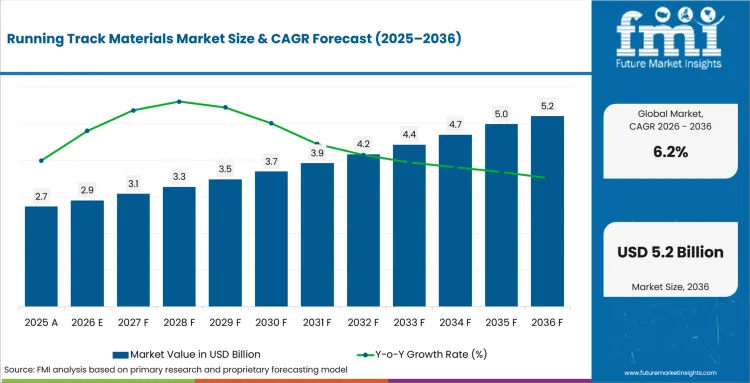
USD 2.9 billion in 2026 and USD 5.2 billion by 2036 at a 6.2% CAGR.
Demand for running track materials is projected to expand at 6.2% CAGR between 2026 and 2036, increasing valuation from USD 2.9 billion in 2026 to USD 5.2 billion by 2036. Public owners often combine running lanes with products covered by the synthetic turf market during multi-sport upgrades. Material manufacturers therefore compete through certified performance and contractor support across each completed surface system.
Facility investment increasingly links track lanes with infield work covered by the artificial turf market and shared drainage construction. The Australian Sports Commission stated in May 2025 that its planned Sport Dome will provide 24/7 all-weather track-and-field training. Continuous availability favors materials that maintain predictable traction throughout intensive year-round training schedules and facility use.
Key Takeaways of Running Track Materials Market
- Certified surface testing increases demand for material systems that preserve traction across public athletics facilities.
- EPDM rubber granules are projected to represent 28.0% share in 2026 owing to familiar wet-pour specifications and color stability.
- Full PU tracks are estimated to account for 31.0% share in 2026 due to repeatable layer construction and competition performance.
- Athletic stadiums are forecast to capture 34.0% share in 2026 driven by formal certification and concentrated project budgets.
- Drainage defects and limited specialist labor can delay resurfacing schedules despite approved capital funding and available material supply.
- Mondo, Beynon Sports, Polytan, CONICA, STOCKMEIER Urethanes, Hellas Construction, APT Asia Pacific and Ecore Athletic compete through certified systems and installation support.
Analyst Perspective
"Commercial track specifications must align surface chemistry with substrate stability, drainage capacity and proven installation methods. Manufacturers that coordinate those requirements can protect certification schedules and reduce premature retopping across heavily used facilities."
- Nikhil Kaitwade, Principal Consultant, Future Market Insights
How is the Running Track Materials Market segmented?
The running track materials market is segmented by material type, track system, application, installation type, end use, sales channel and region.
The market is segmented by material type, track system, application, installation type, end use, sales channel and region. Material type covers EPDM and SBR rubber granules, polyurethane binders, acrylic coatings, sandwich track systems and prefabricated rubber rolls. Track system includes full PU, sandwich, spray coat and prefabricated systems for distinct layer builds. Applications cover athletic stadiums, school or university tracks, community sports facilities, training centers and indoor tracks. Installation type, end use and sales channel distinguish project condition, facility ownership and purchasing route.
What makes EPDM rubber granules central to the material type category?
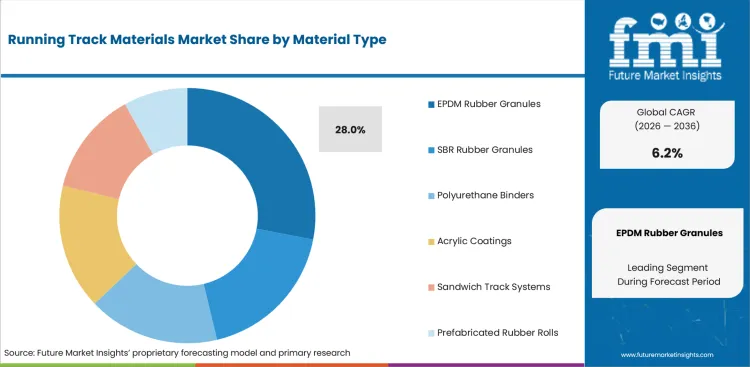
EPDM granules form the exposed wear layer that controls color consistency and weather resistance across poured running tracks under frequent competition use. Rubber compounders compare synthetic rubber inputs to balance elasticity with ultraviolet durability across outdoor installation sites.
- Based on material type, EPDM rubber granules are projected to account for 28.0% in 2026 due to stable color specifications and established wet-pour installation practices.
- Track contractors qualify granule size and binder compatibility through site trials that precede project volume commitments. Reclaimed rubber channels support economical base layers, although the exposed EPDM course must retain certified traction throughout seasonal weather exposure.
How do full PU tracks shape selection within the track system category?
Full PU tracks use continuous polyurethane layers that deliver consistent force reduction and water resistance across outdoor competition facilities. Producers active in the polyurethane coatings market already manage cure control and weather exposure across comparable poured-surface applications.
- By track system, full PU tracks are forecast to represent 31.0% share in 2026 driven by repeatable layer construction and dependable competition performance.
- Installation crews measure substrate moisture ahead of each poured layer and use products from the polyurethane adhesives market for controlled interlayer bonding that protects the final certification route across large competition facilities during specialist track construction.
What role do athletic stadiums play within the application category?
Athletic stadiums combine lane geometry and event markings within one certified performance package for major public competitions and also intersect with the flooring systems market across warm-up zones and athlete support spaces.
- Athletic stadiums are set to lead the application category with 34.0% share in 2026 due to concentrated budgets and formal event certification.
- Stadium operators compare drainage design carefully with available installer capability across the complete facility plan. World Athletics updated its certified track surfacing product list in July 2026, making current certification status a direct selection filter for major venues and championship projects.
What supports resurfacing and retopping within the installation type category?
Resurfacing replaces worn layers without removing a sound base that remains suitable for renewed traction, making installation speed commercially decisive during narrow event windows for stadium operators and specialist track contractors. CONICA demonstrated this timing requirement in June 2025 through a 9,000-square-meter retop completed at Ostrava within fifteen working days.
- By installation type, resurfacing and retopping are estimated to hold 46.0% share in 2026 owing to lower disruption than complete track reconstruction.
- Contractors test retained surfaces carefully for adhesion and moisture then select compatible renewal builds that support adjacent spaces through the flooring and carpets market without changing lane stiffness across repaired track sections.
What are the drivers, restraints and opportunities in the Running Track Materials Market?
Current certification records help engineers verify track performance and compliance, while coordinated inspections and compatible renewal layers minimize moisture-related damage, reduce closures and preserve foundations for future resurfacing.
- Driver: Current certificates narrow acceptable track systems before commercial pricing and construction sequencing begin for each project.
- Restraint: Poor drainage and weak substrates can cause adhesion failures that require costly surface removal and reinstallation.
- Opportunity: Manufacturers can pair inspection guidance with compatible renewal materials that shorten closures and preserve serviceable base layers.
Project engineers compare World Athletics certificates with the intended layer build and the installer’s completed work to protect the final certification route. This verification process helps identify deviations before they affect performance standards or approval outcomes. Consistent documentation also supports quality assurance throughout the construction phase.
Contractors test substrate and drainage conditions to prevent trapped moisture from delaying cure schedules and turning material purchases into extensive rework. Early site assessment reduces the risk of surface defects and premature deterioration. These measures help keep installation timelines and project costs under control.
Renewal programs combine inspection with compatible rubber coatings and documented maintenance guidance so facilities intervene ahead of structural damage. Regular monitoring allows facility managers to address minor surface issues before they become major repairs. This approach extends track lifespan while reducing disruptions to athletic activities.
Which country CAGRs are profiled in the Running Track Materials Market?
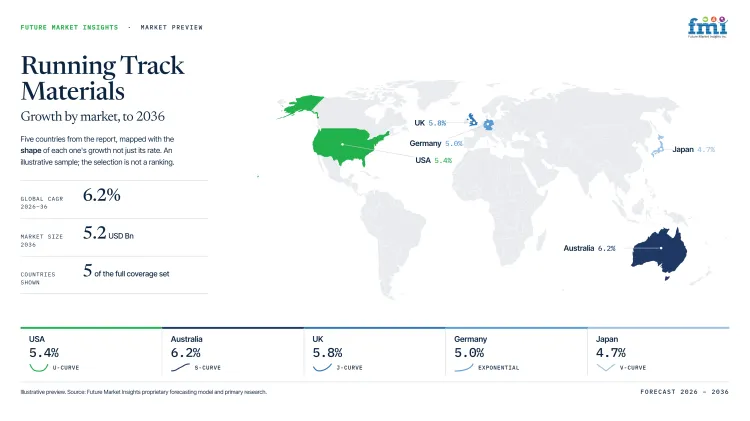
| Country | CAGR |
|---|---|
| Australia | 6.2% |
| United Kingdom | 5.8% |
| United States | 5.4% |
| Germany | 5.0% |
| Japan | 4.7% |
How do country-level CAGRs compare in the Running Track Materials Market?
The country outlook spans 1.5 percentage points with three 0.4-point gaps before the final 0.3-point interval. The spacing reflects separate funding routes and service networks rather than differences in present market size.
- Australia separates from the central group as public track projects combine surfacing with extensive drainage work.
- The United Kingdom remains near Australia through contractor networks and drainage expectations for retrofitted facilities.
- The United States occupies the central band as institutional projects depend on specialized installation and phased approvals.
- Germany stays near the central band as municipal refurbishment demand competes for limited grant funding.
- Japan records the lower displayed rate as scheduling lengthens the route from specification to installation.
Comparable CAGRs can produce different market entry conditions. The full report provides country-level CAGR analysis across North America, Latin America, Europe, East Asia, South Asia and Pacific, and the Middle East and Africa.
Country-wise Analysis
- Australian public track replacements often combine certified surfacing with asphalt foundations and stormwater upgrades across coastal sites that face narrow school-holiday construction windows. The NSW Government reported in July 2026 that Narrabeen drainage works were complete and prolonged wet weather required further ground testing. The Australian running track materials sector is projected to record 6.2% CAGR during the assessment period, supported by established local design and installation routes for complex public projects. Unstable ground and wet weather remain material frictions that require moisture-tolerant specifications and flexible schedules for final surfacing across exposed coastal locations during planned school and community closures.
- United Kingdom facility upgrades must coordinate surface-water design with long-term maintenance across older school and council sports sites that permit limited seasonal closures. England formalized that operating requirement in June 2025 through national standards covering new and retrofitted sustainable drainage systems. Constrained urban foundations and annual public budgets lengthen specification work and resurfacing schedules across active school calendars and community programs that cannot suspend access for extended periods each year. The United Kingdom is estimated to post 5.8% CAGR over the forecast period, shaped by established sports-surface contractors with accessible installation and maintenance routes nationwide across recurring annual renewal programs.
- United States institutions purchase specialized track systems through phased capital programs that preserve training access across large collegiate and municipal campuses during active academic seasons. Adoption of running track materials in the United States is estimated to expand at 5.4% CAGR through 2036, supported by domestic installation crews and established service routes. The USA Army Corps of Engineers illustrated this sequencing in September 2025 through a multi-phase field-house renovation that included a 200-meter hydraulic banked track. Substrate investigation and phased access remain material frictions that require testing allowances and detailed delivery plans for specialized materials with fixed reopening dates nationwide.
- German municipalities channel sports-facility upgrades through competitive public programs that require formal specifications and lifecycle justification across aging venues. Federal funding demand exceeds available project capacity across municipal facilities that require extensive renewal work and documented performance. An April 2026 Bundestag summary recorded more than 3,600 project outlines and demand exceeding the first call by over twenty-two times. By 2036, Germany is projected to grow at 5.0% CAGR, supported by regional manufacturers with certified polyurethane systems and established service networks. Intense grant competition delays award decisions and requires local producers to document maintenance value throughout complex municipal selection cycles for councils managing fixed annual budgets.
- Japanese athletics facilities depend on municipal booking procedures and local-language coordination across fixed competition calendars and distributed training venues used by visiting teams. Running track materials demand in Japan is forecast to rise at 4.7% CAGR over the forecast period, driven by established municipal venue networks and detailed facility planning. Pre-event coordination depends on venue communication that visiting teams can complete without local administrative support. World Athletics listed fourteen training locations in June 2025, and several facilities reported limited foreign-language support. Facility-specific approvals and precise installation windows require early service planning for imported or locally produced surfaces across scheduled municipal projects.
Who are the notable companies in the Running Track Materials Market?
Mondo, Beynon Sports, Polytan, CONICA, STOCKMEIER Urethanes, Hellas Construction, APT Asia Pacific and Ecore Athletic shape this market.
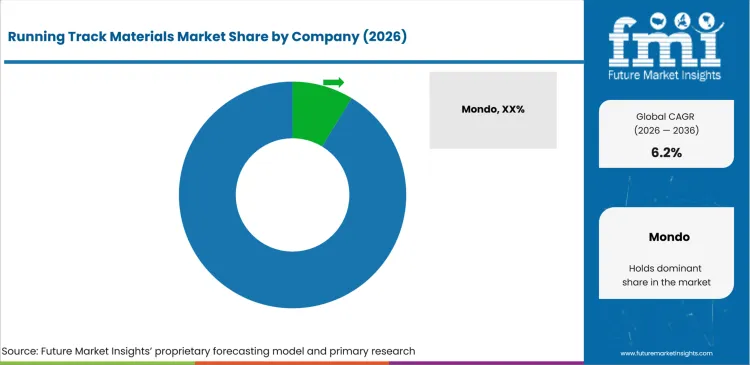
The industry combines international certified-system brands with construction specialists serving demanding high-durability surfaces across public athletics facilities. Market entry requires verified performance and crews that install or renew complete track assemblies within fixed schedules.
- Mondo, Beynon Sports and Polytan focus on broad certified portfolios and project support across athletics facilities.
- CONICA, STOCKMEIER Urethanes and Hellas Construction pair poured systems with technical guidance or installation services.
- APT Asia Pacific and Ecore Athletic use regional manufacturing or rubber-recovery capabilities for local renewal programs.
Competitive Benchmarking: Running Track Materials Market
| Company | Track System Breadth | Certification Evidence | Technical and Installation Support | Geographic Reach |
|---|---|---|---|---|
| Mondo | High | High | Medium | Global |
| Beynon Sports | High | High | High | North America and selected international markets |
| Polytan | High | High | High | Global or multi-region |
| CONICA | High | High | Medium | Global or multi-region |
| STOCKMEIER Urethanes | High | High | Medium | Global |
| Hellas Construction | High | High | High | United States |
| APT Asia Pacific | High | High | High | Australia and New Zealand |
| Ecore Athletic | High | High | Medium | North America and selected exports |
Scoring basis: Product records define High breadth as three systems, Medium as two and Low as one. Current certificates define High certification as two systems, Medium as one and Low without exact evidence. Service records define High support as installation and maintenance, Medium as one route and Low as product guidance.
Key Developments in the Running Track Materials Market
- In October 2025, Polytan integrated Melos into its brand portfolio and combined Rekortan track systems with premium EPDM granule production.
- In September 2025, Mondo supplied Tokyo National Stadium with 19,900 square meters of track surfacing and interconnected drainage channels for wet conditions.
- In June 2025, Ecore reclaimed approximately 30,000 pounds of removed track material from a Louisiana school and shipped it to Pennsylvania for processing.
- In May 2025, Beynon Sports renewed its Athletics Canada partnership and supported certified facilities through its exclusive Canadian representative Playteck Enterprises.
Running Track Materials Market - Report Scope
| Coverage field | Report scope |
|---|---|
| Market breakdown | By material type, track system, application, installation type, end use, sales channel and region. |
| Quantitative Units | Revenue in USD billion and CAGR in %. |
| Market Definition | The market covers materials and complete surfacing systems sold for running track construction, resurfacing and repair applications. |
| Regions Covered | North America, Latin America, Europe, East Asia, South Asia and Pacific and Middle East and Africa. |
| Countries Covered | Australia, United Kingdom, United States, Germany, Japan and other countries across the full report’s 30+ country coverage. |
| Key Companies Profiled | Mondo, Beynon Sports, Polytan, CONICA, STOCKMEIER Urethanes, Hellas Construction, APT Asia Pacific and Ecore Athletic. |
| Forecast Period | 2026 to 2036. |
| Approach | Primary and secondary research with market triangulation. |
Running Track Materials Market - Research Methodology
| Method | Approach |
|---|---|
| Primary Research | FMI analysts gathered input from manufacturers, service providers, technology developers, distributors, end users, procurement teams, and subject-matter experts. Interviews examined purchasing decisions, product or service evaluation, adoption barriers, approval requirements, pricing considerations, and expectations for technical or commercial support. Respondents were also asked what evidence is required before a trial, pilot, or initial order develops into regular purchasing. |
| Desk Research | Desk research covered government statistics, regulatory publications, trade data, industry associations, technical literature, standards, company filings, product information, and official corporate announcements. Sources were reviewed for relevance, publication date, geographic coverage, and consistency with the defined market scope. Claims relating to performance, applications, approvals, capacity, investment, and commercial activity were retained only when supported by credible public evidence. |
| Market Sizing and Forecasting | The market model combined the baseline value with historical performance, segment structure, pricing and volume indicators, adoption levels, company participation, and country-level demand conditions. Forecast assumptions considered economic activity, investment trends, regulatory developments, technology adoption, purchasing cycles, supply availability, and barriers to wider market use. Segment and regional estimates were reconciled before the final market total was calculated. |
| Data Validation | Estimates were checked against multiple independent indicators, including public data, company activity, trade patterns, industry developments, and findings from primary interviews. Validation also tested whether products, services, applications, and company revenues fell within the defined market boundaries. Adjacent categories, unsupported claims, overlapping revenues, and activities without direct market relevance were excluded to reduce double counting and maintain consistency across segments and countries. |
Running Track Materials Market by Segments
Running Track Materials Market segmented by Material Type:
- EPDM Rubber Granules
- SBR Rubber Granules
- Polyurethane Binders
- Acrylic Coatings
- Sandwich Track Systems
- Prefabricated Rubber Rolls
Running Track Materials Market segmented by Track System:
- Full PU Tracks
- Sandwich Systems
- Spray Coat Systems
- Prefabricated Systems
Running Track Materials Market segmented by Application:
- Athletic Stadiums
- School / University Tracks
- Community Sports Facilities
- Training Centers
- Indoor Tracks
Running Track Materials Market segmented by Installation Type:
- Resurfacing / Retopping
- New Track Construction
- Repair / Patch Materials
Running Track Materials Market segmented by End Use:
- Public Sports Infrastructure
- Education Sector
- Private Sports Clubs
- Professional Stadiums
Running Track Materials Market segmented by Sales Channel:
- Sports Flooring Contractors
- Direct Material Supply
- Distributors
- Turnkey EPC / Installers
Running Track Materials Market by Region:
- North America
- United States
- Canada
- Latin America
- Brazil
- Chile
- Mexico
- Rest of Latin America
- Western Europe
- Germany
- United Kingdom
- Italy
- Spain
- France
- Nordics
- Benelux
- Rest of Western Europe
- Eastern Europe
- Russia
- Poland
- Hungary
- Balkan and Baltic States
- Rest of Eastern Europe
- East Asia
- China
- Japan
- South Korea
- South Asia and Pacific
- India
- ASEAN
- Australia and New Zealand
- Rest of South Asia and Pacific
- Middle East and Africa
- Kingdom of Saudi Arabia
- Other GCC Countries
- Türkiye
- South Africa
- Other African Union Countries
- Rest of Middle East and Africa
Research Sources and Bibliography
- Australian Sports Commission. (2025, May 19). AIS Podium Project helping build Australia’s sporting future.
- Crawford, L. (2025, September 18). USACE Omaha District continues modernization mission at USA Air Force Academy.
- Department for Environment, Food & Rural Affairs. (2025, June 19). National standards for sustainable drainage systems.
- Deutscher Bundestag. (2026, April 8). Grüne fragen nach Sportstättensanierung.
- NSW Government Office of Sport. (2026, July 27). New synthetic athletics track at Sydney Academy of Sport and Recreation.
- World Athletics. (2025, June 17). Training Camp Information.
- World Athletics. (2026, July 1). CERTIFICATES - Certified Track Surfacing Products.
- Mondo. (2025, September 24). Rain or Shine, Mondo athletics track shows its qualities at the World Athletics Championships Tokyo 2025.
- Beynon Sports. (2025, May 29). A World-Class Foundation: Athletics Canada and Beynon Sports.
- Polytan. (2025, October 27). Stronger together at FSB 2025.
- CONICA AG. (2025, June 24). World-Class in 15 Days: CONICA Retops Ostrava’s Stadium Ahead of Golden Spike 2025.
- Ecore International. (2025, June 6). Circularity in Motion: Ecore’s TRUcircularity™ Program Powers Sustainable Running Track Renewal.
- Polytan. (n.d.). Rekortan - high-performance tracks.
- CONICA AG. (n.d.). Tracks.
- STOCKMEIER Urethanes. (n.d.). Running Track & Field Systems.
This bibliography is provided for reader reference and is not exhaustive. The full report contains the complete reference list and detailed citations.
This Report Answers
- How large is the running track materials market in 2026 and 2036?
- Which certified operating conditions support running track material purchasing?
- Why do EPDM granules and full PU tracks hold significant shares?
- How do stadium projects shape surface material and installation decisions?
- Which conditions favor resurfacing instead of complete track reconstruction?
- How do profiled country growth routes differ through 2036?
- Which companies compete across track systems and renewal services?
- What limits return on running track material investments?
- How should facility teams compare new construction with resurfacing options?
Frequently Asked Questions
How big is the Running Track Materials Market in 2026?
The running track materials market is valued at USD 2.9 billion in 2026 and is forecast to reach USD 5.2 billion by 2036. Growth is supported by facility investment linking track lanes with certified surfacing systems across athletic stadiums, school facilities, and community sports venues undergoing resurfacing and reconstruction projects.
What is the CAGR of the Running Track Materials Market from 2026 to 2036?
The running track materials market grows at a CAGR of 6.2% between 2026 and 2036, supported by certified surface testing requirements that increase demand for material systems preserving traction across public athletics facilities, school tracks, and community training centers worldwide.
Which material type leads the Running Track Materials Market?
EPDM rubber granules account for 28.0% of the running track materials market by material type in 2026, driven by stable color specifications and established wet-pour installation practices that let contractors qualify granule size and binder compatibility through site trials before project commitments.
How much will the Running Track Materials Market add between 2026 and 2036?
The running track materials market is set to add USD 2.3 billion between 2026 and 2036, growing from USD 2.9 billion to USD 5.2 billion as certified surfacing systems and resurfacing programs expand across athletic stadiums and community sports facilities worldwide.
Who are the leading companies in the Running Track Materials Market?
Eight companies lead the running track materials market, including Mondo, Beynon Sports, Polytan, CONICA, STOCKMEIER Urethanes, Hellas Construction, APT Asia Pacific, and Ecore Athletic, competing through certified track systems, technical installation support, and regional manufacturing or rubber-recovery capabilities for renewal programs.
Preview the report firsthand - request a free sample
Get SampleGet the brochure for pricing and purchase details.
Get PDFTable of Content
- Key Takeaways
- Market Size and CAGR
- Top Growth Driver
- Fastest Growing Segment
- Leading Region
- Key Companies
- Emerging Opportunities
- Executive Summary
- Global Market Outlook
- Demand-side Trends
- Supply-side Trends
- Technology Roadmap Analysis
- Analysis and Recommendations
- Analyst Perspective (What is happening? Why now? What should investors know?)
- Key Questions Answered
- How large is the market?
- What is the CAGR?
- What are key trends?
- Which region dominates?
- Who are the leaders?
- Market Overview
- Market Coverage / Taxonomy
- Market Definition / Scope / Limitations
- Research Methodology
- Chapter Orientation
- Analytical Lens and Working Hypotheses
- Market Structure, Signals, and Trend Drivers
- Benchmarking and Cross-market Comparability
- Market Sizing, Forecasting, and Opportunity Mapping
- Research Design and Evidence Framework
- Desk Research Programme (Secondary Evidence)
- Expert Input and Fieldwork (Primary Evidence)
- Tooling, Models, and Reference Databases
- Data Engineering and Model Build
- Quality Assurance and Audit Trail
- Market Background
- Market Dynamics (Drivers, Restraints, Opportunity, Trends)
- Scenario Forecast (Optimistic, Likely, Conservative)
- Impact Analysis
- AI Impact
- Sustainability Impact
- Regulatory Impact
- Technology Impact
- Consumer / Buyer Analysis
- Purchase Drivers
- Adoption Barriers
- Buyer Journey
- Opportunity Map Analysis
- Product Life Cycle Analysis
- Supply Chain Analysis
- Investment Feasibility Matrix
- Value Chain Analysis
- PESTLE and Porter's Analysis
- Regulatory Landscape
- Regional Parent Market Outlook
- Production and Consumption Statistics
- Import and Export Statistics
- Global Market Analysis and Forecast, 2021 to 2036
- Historical Market Size Value (USD Billion) Analysis, 2021 to 2025
- Current and Future Market Size Value (USD Billion) Projections, 2026 to 2036
- Y-o-Y Growth Trend Analysis
- Absolute $ Opportunity Analysis
- Global Market Pricing Analysis, 2021 to 2036
- Global Market Analysis and Forecast, By Material Type, 2021 to 2036
- Introduction / Key Findings
- Historical Market Size Value (USD Billion) Analysis By Material Type, 2021 to 2025
- Current and Future Market Size Value (USD Billion) Analysis and Forecast By Material Type, 2026 to 2036
- EPDM Rubber Granules
- SBR Rubber Granules
- Polyurethane Binders
- Acrylic Coatings
- Sandwich Track Systems
- Prefabricated Rubber Rolls
- EPDM Rubber Granules
- Y-o-Y Growth Trend Analysis By Material Type, 2021 to 2025
- Absolute $ Opportunity Analysis By Material Type, 2026 to 2036
- Global Market Analysis and Forecast, By Track System, 2021 to 2036
- Introduction / Key Findings
- Historical Market Size Value (USD Billion) Analysis By Track System, 2021 to 2025
- Current and Future Market Size Value (USD Billion) Analysis and Forecast By Track System, 2026 to 2036
- Full PU Tracks
- Sandwich Systems
- Spray Coat Systems
- Prefabricated Systems
- Full PU Tracks
- Y-o-Y Growth Trend Analysis By Track System, 2021 to 2025
- Absolute $ Opportunity Analysis By Track System, 2026 to 2036
- Global Market Analysis and Forecast, By Application, 2021 to 2036
- Introduction / Key Findings
- Historical Market Size Value (USD Billion) Analysis By Application, 2021 to 2025
- Current and Future Market Size Value (USD Billion) Analysis and Forecast By Application, 2026 to 2036
- Athletic Stadiums
- School / University Tracks
- Community Sports Facilities
- Training Centers
- Indoor Tracks
- Athletic Stadiums
- Y-o-Y Growth Trend Analysis By Application, 2021 to 2025
- Absolute $ Opportunity Analysis By Application, 2026 to 2036
- Global Market Analysis and Forecast, By Installation Type, 2021 to 2036
- Introduction / Key Findings
- Historical Market Size Value (USD Billion) Analysis By Installation Type, 2021 to 2025
- Current and Future Market Size Value (USD Billion) Analysis and Forecast By Installation Type, 2026 to 2036
- Resurfacing / Retopping
- New Track Construction
- Repair / Patch Materials
- Resurfacing / Retopping
- Y-o-Y Growth Trend Analysis By Installation Type, 2021 to 2025
- Absolute $ Opportunity Analysis By Installation Type, 2026 to 2036
- Global Market Analysis and Forecast, By End Use, 2021 to 2036
- Introduction / Key Findings
- Historical Market Size Value (USD Billion) Analysis By End Use, 2021 to 2025
- Current and Future Market Size Value (USD Billion) Analysis and Forecast By End Use, 2026 to 2036
- Public Sports Infrastructure
- Education Sector
- Private Sports Clubs
- Professional Stadiums
- Public Sports Infrastructure
- Y-o-Y Growth Trend Analysis By End Use, 2021 to 2025
- Absolute $ Opportunity Analysis By End Use, 2026 to 2036
- Global Market Analysis and Forecast, By Sales Channel
- Introduction / Key Findings
- Historical Market Size Value (USD Billion) Analysis By Sales Channel, 2021 to 2025
- Current and Future Market Size Value (USD Billion) Analysis and Forecast By Sales Channel, 2026 to 2036
- Sports Flooring Contractors
- Direct Material Supply
- Distributors
- Turnkey EPC / Installers
- Sports Flooring Contractors
- Y-o-Y Growth Trend Analysis By Sales Channel, 2021 to 2025
- Absolute $ Opportunity Analysis By Sales Channel, 2026 to 2036
- Global Market Analysis and Forecast, By Region, 2021 to 2036
- Introduction
- Historical Market Size Value (USD Billion) Analysis By Region, 2021 to 2025
- Current Market Size Value (USD Billion) Analysis and Forecast By Region, 2026 to 2036
- North America
- Latin America
- Western Europe
- Eastern Europe
- East Asia
- South Asia and Pacific
- Middle East & Africa
- Market Attractiveness Analysis By Region
- North America Market Analysis and Forecast, By Country, 2021 to 2036
- Historical Market Size Value (USD Billion) Trend Analysis By Market Taxonomy, 2021 to 2025
- Market Size Value (USD Billion) Forecast By Market Taxonomy, 2026 to 2036
- By Country
- USA
- Canada
- By Material Type
- By Track System
- By Application
- By Installation Type
- By End Use
- By Sales Channel
- By Country
- Market Attractiveness Analysis
- By Country
- By Material Type
- By Track System
- By Application
- By Installation Type
- By End Use
- By Sales Channel
- Key Takeaways
- Latin America Market Analysis and Forecast, By Country
- Historical Market Size Value (USD Billion) Trend Analysis By Market Taxonomy, 2021 to 2025
- Market Size Value (USD Billion) Forecast By Market Taxonomy, 2026 to 2036
- By Country
- Brazil
- Mexico
- Chile
- Rest of Latin America
- By Material Type
- By Track System
- By Application
- By Installation Type
- By End Use
- By Sales Channel
- By Country
- Market Attractiveness Analysis
- By Country
- By Material Type
- By Track System
- By Application
- By Installation Type
- By End Use
- By Sales Channel
- Key Takeaways
- Western Europe Market Analysis and Forecast, By Country
- Historical Market Size Value (USD Billion) Trend Analysis By Market Taxonomy, 2021 to 2025
- Market Size Value (USD Billion) Forecast By Market Taxonomy, 2026 to 2036
- By Country
- Germany
- UK
- Italy
- Spain
- France
- Nordic
- BENELUX
- Rest of Western Europe
- By Material Type
- By Track System
- By Application
- By Installation Type
- By End Use
- By Sales Channel
- By Country
- Market Attractiveness Analysis
- By Country
- By Material Type
- By Track System
- By Application
- By Installation Type
- By End Use
- By Sales Channel
- Key Takeaways
- Eastern Europe Market Analysis and Forecast, By Country
- Historical Market Size Value (USD Billion) Trend Analysis By Market Taxonomy, 2021 to 2025
- Market Size Value (USD Billion) Forecast By Market Taxonomy, 2026 to 2036
- By Country
- Russia
- Poland
- Hungary
- Balkan & Baltic
- Rest of Eastern Europe
- By Material Type
- By Track System
- By Application
- By Installation Type
- By End Use
- By Sales Channel
- By Country
- Market Attractiveness Analysis
- By Country
- By Material Type
- By Track System
- By Application
- By Installation Type
- By End Use
- By Sales Channel
- Key Takeaways
- East Asia Market Analysis and Forecast, By Country
- Historical Market Size Value (USD Billion) Trend Analysis By Market Taxonomy, 2021 to 2025
- Market Size Value (USD Billion) Forecast By Market Taxonomy, 2026 to 2036
- By Country
- China
- Japan
- South Korea
- By Material Type
- By Track System
- By Application
- By Installation Type
- By End Use
- By Sales Channel
- By Country
- Market Attractiveness Analysis
- By Country
- By Material Type
- By Track System
- By Application
- By Installation Type
- By End Use
- By Sales Channel
- Key Takeaways
- South Asia and Pacific Market Analysis and Forecast, By Country
- Historical Market Size Value (USD Billion) Trend Analysis By Market Taxonomy, 2021 to 2025
- Market Size Value (USD Billion) Forecast By Market Taxonomy, 2026 to 2036
- By Country
- India
- ASEAN
- Australia & New Zealand
- Rest of South Asia and Pacific
- By Material Type
- By Track System
- By Application
- By Installation Type
- By End Use
- By Sales Channel
- By Country
- Market Attractiveness Analysis
- By Country
- By Material Type
- By Track System
- By Application
- By Installation Type
- By End Use
- By Sales Channel
- Key Takeaways
- Middle East & Africa Market Analysis and Forecast, By Country
- Historical Market Size Value (USD Billion) Trend Analysis By Market Taxonomy, 2021 to 2025
- Market Size Value (USD Billion) Forecast By Market Taxonomy, 2026 to 2036
- By Country
- Kingdom of Saudi Arabia
- Other GCC Countries
- Türkiye
- South Africa
- Other African Union
- Rest of Middle East & Africa
- By Material Type
- By Track System
- By Application
- By Installation Type
- By End Use
- By Sales Channel
- By Country
- Market Attractiveness Analysis
- By Country
- By Material Type
- By Track System
- By Application
- By Installation Type
- By End Use
- By Sales Channel
- Key Takeaways
- Key Countries Market Analysis
- USA
- Pricing Analysis
- Market Share Analysis, 2025
- By Material Type
- By Track System
- By Application
- By Installation Type
- By End Use
- By Sales Channel
- Canada
- Pricing Analysis
- Market Share Analysis, 2025
- By Material Type
- By Track System
- By Application
- By Installation Type
- By End Use
- By Sales Channel
- Mexico
- Pricing Analysis
- Market Share Analysis, 2025
- By Material Type
- By Track System
- By Application
- By Installation Type
- By End Use
- By Sales Channel
- Brazil
- Pricing Analysis
- Market Share Analysis, 2025
- By Material Type
- By Track System
- By Application
- By Installation Type
- By End Use
- By Sales Channel
- Chile
- Pricing Analysis
- Market Share Analysis, 2025
- By Material Type
- By Track System
- By Application
- By Installation Type
- By End Use
- By Sales Channel
- Germany
- Pricing Analysis
- Market Share Analysis, 2025
- By Material Type
- By Track System
- By Application
- By Installation Type
- By End Use
- By Sales Channel
- UK
- Pricing Analysis
- Market Share Analysis, 2025
- By Material Type
- By Track System
- By Application
- By Installation Type
- By End Use
- By Sales Channel
- Italy
- Pricing Analysis
- Market Share Analysis, 2025
- By Material Type
- By Track System
- By Application
- By Installation Type
- By End Use
- By Sales Channel
- Spain
- Pricing Analysis
- Market Share Analysis, 2025
- By Material Type
- By Track System
- By Application
- By Installation Type
- By End Use
- By Sales Channel
- France
- Pricing Analysis
- Market Share Analysis, 2025
- By Material Type
- By Track System
- By Application
- By Installation Type
- By End Use
- By Sales Channel
- India
- Pricing Analysis
- Market Share Analysis, 2025
- By Material Type
- By Track System
- By Application
- By Installation Type
- By End Use
- By Sales Channel
- ASEAN
- Pricing Analysis
- Market Share Analysis, 2025
- By Material Type
- By Track System
- By Application
- By Installation Type
- By End Use
- By Sales Channel
- Australia & New Zealand
- Pricing Analysis
- Market Share Analysis, 2025
- By Material Type
- By Track System
- By Application
- By Installation Type
- By End Use
- By Sales Channel
- China
- Pricing Analysis
- Market Share Analysis, 2025
- By Material Type
- By Track System
- By Application
- By Installation Type
- By End Use
- By Sales Channel
- Japan
- Pricing Analysis
- Market Share Analysis, 2025
- By Material Type
- By Track System
- By Application
- By Installation Type
- By End Use
- By Sales Channel
- South Korea
- Pricing Analysis
- Market Share Analysis, 2025
- By Material Type
- By Track System
- By Application
- By Installation Type
- By End Use
- By Sales Channel
- Russia
- Pricing Analysis
- Market Share Analysis, 2025
- By Material Type
- By Track System
- By Application
- By Installation Type
- By End Use
- By Sales Channel
- Poland
- Pricing Analysis
- Market Share Analysis, 2025
- By Material Type
- By Track System
- By Application
- By Installation Type
- By End Use
- By Sales Channel
- Hungary
- Pricing Analysis
- Market Share Analysis, 2025
- By Material Type
- By Track System
- By Application
- By Installation Type
- By End Use
- By Sales Channel
- Kingdom of Saudi Arabia
- Pricing Analysis
- Market Share Analysis, 2025
- By Material Type
- By Track System
- By Application
- By Installation Type
- By End Use
- By Sales Channel
- Türkiye
- Pricing Analysis
- Market Share Analysis, 2025
- By Material Type
- By Track System
- By Application
- By Installation Type
- By End Use
- By Sales Channel
- South Africa
- Pricing Analysis
- Market Share Analysis, 2025
- By Material Type
- By Track System
- By Application
- By Installation Type
- By End Use
- By Sales Channel
- USA
- Market Structure Analysis
- Competition Dashboard
- Competition Benchmarking
- Market Share Analysis of Top Players
- By Regional
- By Material Type
- By Track System
- By Application
- By Installation Type
- By End Use
- By Sales Channel
- Emerging Startups
- Innovation Benchmarking
- Competition Analysis
- Competition Deep Dive
- Mondo
- Overview
- Product Portfolio
- Profitability by Market Segments
- Sales Footprint
- Strategy Overview
- Marketing Strategy
- Product Strategy
- Channel Strategy
- Beynon Sports
- Polytan
- Conica
- Stockmeier Urethanes
- Hellas Construction
- Rekortan
- Apt Asia Pacific
- Sport Group
- Ecore Athletic
- Mondo
- Case Studies
- Success Stories
- Recent Developments
- Competition Deep Dive
- Assumptions & Acronyms Used


