

- Market Size (2026)
- USD 23.0 Bn
- Forecast (2036)
- USD 98.0 Bn
- CAGR (2026 to 2036)
- 15.6%
How big is the Salesforce services market in 2026?
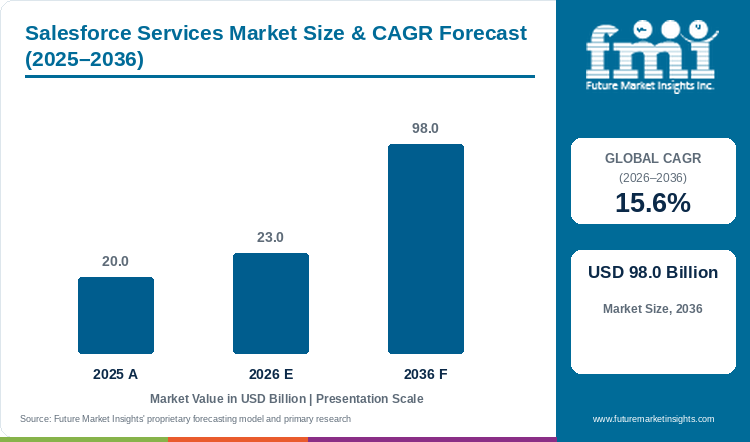
The salesforce services market is projected to expand at a CAGR of 15.6% between 2026 and 2036. Market value rises from USD 20.0 billion in 2025 to USD 23.0 billion in 2026 and USD 98.0 billion by 2036. [1]
The Salesforce services market was valued at USD 20.0 billion in 2025. It reaches USD 23.0 billion in 2026 and is forecast at USD 98.0 billion by 2036. Implementation services hold 41.7% of service demand, Sales Cloud accounts for 34.2% by application, and BFSI represents 28.9% by vertical. Enterprises purchase these services to configure customer workflows, connect data and maintain the platform as their requirements change. The Salesforce services market is forecast to expand at 15.6% CAGR over 2026 to 2036. Demand covers advisory work, implementation, integration, data migration and ongoing management of Salesforce environments. A customer relationship management system becomes useful when the records, permissions and workflows match the organization’s day-to-day work. That creates demand for partners who understand the business process as well as the platform, particularly when customer information is spread across several existing systems. [1]
AI-enabled workflows add another layer of service work. A team deploying an agent needs to define the task, determine which data it may use and decide when a person should take over. Salesforce's partner network supports customers in planning, deploying and scaling Agentforce implementations through certified consulting partners listed in its partner finder directory. [3] Accenture’s acquisition agreement for NeuraFlash and Cognizant’s expanded Agentforce services illustrate how providers are adding capabilities around these requirements. The buying decision is therefore moving beyond the initial configuration of a CRM application into how the application will operate within the enterprise. [3, 4, 5]
Key Market Trends & Insights
- Implementation Services holds 41.7% of service demand in 2026. [1]
- Sales Cloud accounts for 34.2% by application and BFSI for 28.9% by vertical. [1]
- Data migration, integration and user adoption influence how a deployment works after launch.
- Agentforce services extend implementation work into data connections and operating support. [3, 5, 9]
Regional Highlights
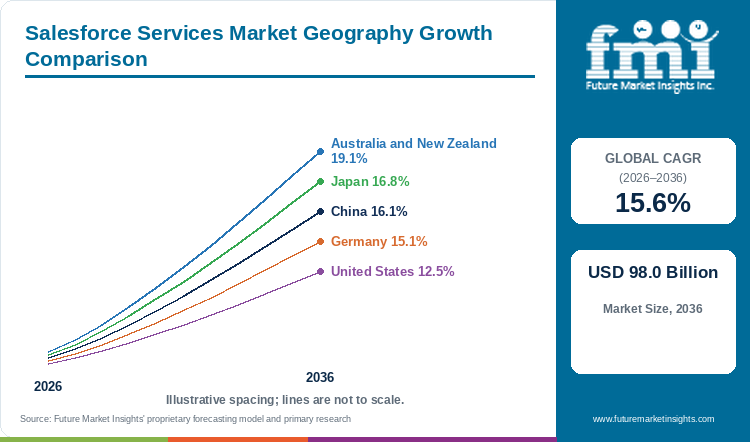
- Australia and New Zealand has the fastest profiled CAGR at 19.1%, followed by Japan at 16.8%, over 2026 to 2036. [1]
- Other profiled outlooks: China (16.1%), Germany (15.1%), United States (12.5%). [1]
Market Size & Forecast
Table 1: Market Size and Forecast for the Salesforce Services Market (USD billion and percentage), 2025 to 2036
| Metric | Value |
|---|---|
| 2025 Market Size | USD 20.0 billion |
| Estimated Market Size in 2026 | USD 23.0 billion |
| Projected Market Size by 2036 | USD 98.0 billion |
| CAGR, 2026 to 2036 | 15.6% |
| Added Revenue, 2026 to 2036 | USD 75.0 billion |
| Market Expansion Multiple | 4.3x |
Table 2: Industry Indicators for the Salesforce Services Market, 2025 to 2026
| Indicator | Data Point | Why It Matters | Source |
|---|---|---|---|
| Specialist acquisition | Accenture agreed to acquire NeuraFlash in August 2025; NeuraFlash confirmed completion in September 2025. | Adds Salesforce and agentic-service capabilities. | [4, 20] |
| Agentforce services | Cognizant announced an expanded Salesforce partnership in June 2025. | Introduces services across customer and operations transformation. | [5] |
| Enterprise-data connection | IBM described access to IBM Z information for Agentforce through Zero Copy architecture in October 2025. | Connects existing enterprise records with customer-facing applications. | [9] |
Analyst Perspective
A Salesforce project earns its value in the workflow it supports. The sales representative needs usable account information, the service team needs the right case context and the administrator needs a system that can be maintained. Partners that connect these requirements can build a continuing relationship as the customer adds applications, data sources and automated activities.
- Sudip Saha, Principal Consultant, FMI.
How is the Salesforce Services Market segmented?
The market is segmented by Service Type, Application and Vertical, covering the work delivered, the Salesforce application used and the customer industry. [1]
By Service Type: Planning & Advisory Services, Implementation Services, Integration & Customization, Data Migration, Managed Services.
By Application: Sales Cloud, Service Cloud, Marketing Cloud, Commerce Cloud, Analytics, Industry Clouds.
By Vertical: BFSI, Healthcare & Life Sciences, Retail & CPG, Media & Telecom, Manufacturing, Government, Energy & Utilities.
By Region: North America, Latin America, Western Europe, Eastern Europe, East Asia, South Asia and Pacific, Middle East and Africa.
Service types distinguish planning and advisory, implementation, integration and customization, data migration and managed services. Applications include Sales Cloud, Service Cloud, Marketing Cloud, Commerce Cloud, Analytics and Industry Clouds. Verticals cover financial services, healthcare, retail, telecommunications, manufacturing, government and utilities. A single enterprise program can involve several of these activities: an initial rollout may require data migration and integrations, followed by training and ongoing support as more teams begin using the environment. [1]
Why do implementation services lead?
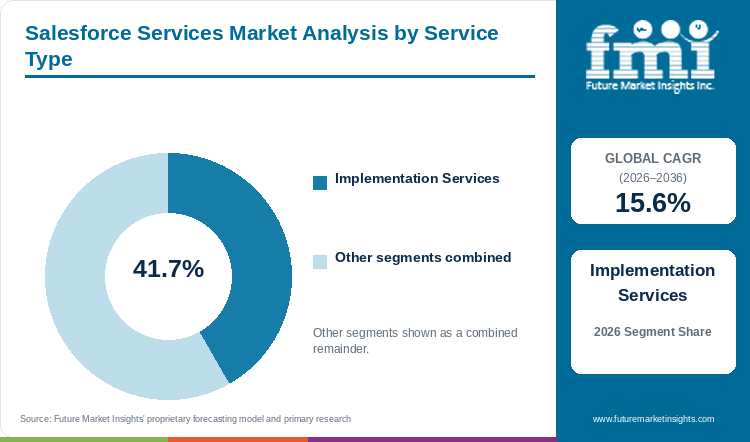
Implementation Services holds 41.7% of service demand in 2026. Delivery combines record configuration, access, workflow mapping and testing of connections before users enter the new process. [1, 6]
Table 3: Service Type Share for the Salesforce Services Market (percentage share), 2026
| Service Type | Share (2026) |
|---|---|
| Implementation Services | 41.7% |
| Other Segments Combined | 58.3% |
| Total | 100.0% |
Table 4: Service Type Focus and Market Growth for the Salesforce Services Market, 2026 to 2036
| Metric | Value |
|---|---|
| Global CAGR (2026 to 2036) | 15.6% |
| Leading Segment | Implementation Services |
Implementation turns a business requirement into a usable Salesforce environment. The delivery team configures records and access, maps workflows and tests the connections with other systems before users move into the new process. Dependencies often extend beyond the CRM team: sales operations, service managers and owners of source data must agree on definitions and responsibilities. Accenture’s Salesforce offer combines cloud, data and Agentforce capabilities, reflecting the breadth of work involved when a deployment serves several business functions. [6]
- Implementation services hold 41.7% of service demand in 2026. [1]
- Salesforce’s partner finder covers specialist implementation experts as well as global integrators. [3]
What supports Sales Cloud demand?
Sales Cloud accounts for 34.2% of application demand in 2026. Pipeline views, opportunity stages and reporting need to match the customer’s sales process and the records maintained by users. [1, 7]
The sales team needs a consistent view of its pipeline and the actions attached to each opportunity. That depends on usable stages, records and reporting rather than the software interface alone. Salesforce’s Pipeline Inspection learning resources describe how teams view opportunities by team, close date and changes over time. Partners help align those views with the customer’s sales process and connect account information from other systems. Training also matters because the quality of pipeline visibility depends on how users maintain the records. [7]
- Sales Cloud accounts for 34.2% of application demand in 2026. [1]
- Salesforce provides Pipeline Inspection setup guidance for reviewing opportunity information and changes. [7]
Why is BFSI the leading vertical?
Banks and insurers manage relationships that can involve individuals, households, businesses and several financial products. A deployment has to represent those relationships accurately while allowing the right teams to use the information. Salesforce’s Financial Services Cloud documentation describes data objects for clients, financial information and relationship groups. That structure creates implementation work around mapping, permissions and connections with source systems. IBM’s work on making mainframe data available to Salesforce also illustrates the integration requirement in enterprises with established transaction platforms. [8, 9]
- BFSI represents 28.9% of vertical demand in 2026. [1]
- Financial Services Cloud includes data-model structures for customer financials and relationship groups. [8]
What drives, restrains and creates opportunities for Salesforce services?
CRM modernization supports demand; data and integration complexity constrain delivery; AI-enabled workflows and ongoing platform management create opportunities.
- Driver: Organizations need connected customer information and consistent sales and service processes.
- Restraint: Existing data structures, integration dependencies and changes to user workflows can make delivery complex.
- Opportunity: Partners can extend engagements through Agentforce deployment, industry-specific applications and ongoing management.
Driver. An enterprise can have many systems that describe the same customer differently. A modernization program creates work to connect those records with the sales and service activities they support. Salesforce’s Financial Services data platform describes connections with banking and insurance information, while the platform’s partner resources connect buyers with implementation expertise. The service opportunity follows the work needed to make the information available to the right users and usable within an agreed process. [3, 11]
Restraint. A project can be technically complete while users still struggle with unfamiliar fields, duplicate information or unclear responsibilities. The customer needs to resolve those questions during design and testing, because they affect what happens after launch. A broader application portfolio creates more dependencies between teams and systems. Providers therefore need enough business participation to agree on the workflow, and enough technical control to manage its integrations and future changes. These requirements can constrain delivery schedules even when the platform itself is already available.
Opportunity. Agentforce creates service demand around use-case selection, data access, deployment and operating oversight. Deloitte’s Agent Advantage offer spans identifying use cases and implementing agents, while Cognizant announced a new suite of customer and operations services in June 2025. Partners can bring these activities into existing Salesforce accounts where the customer has an established sales or service workflow. The useful starting point is a defined task with appropriate data and a clear route for escalation. [5, 12]
Which country CAGRs are profiled?
The country outlook covers 2026 to 2036. [1]
| Country or Market Group | CAGR 2026 to 2036 |
|---|---|
| Australia and New Zealand | 19.1% |
| Japan | 16.8% |
| China | 16.1% |
| Germany | 15.1% |
| United States | 12.5% |
How do the country opportunities compare?
Australia and New Zealand have the fastest profiled CAGR. Japan and China follow, with Germany close to the overall market growth rate. The United States expands more slowly in the outlook. Service requirements vary with the customer’s systems, local platform availability and operating model. A global deployment can therefore need local implementation work even when the organization uses the same Salesforce application across several markets. [1]
Australia and New Zealand: AI adoption and partner delivery create demand for implementation and operating support. Japan: Local product availability and existing enterprise systems shape the deployment pathway. China: Salesforce on Alibaba Cloud introduces a distinct environment and local integration requirements. Germany: Data residency and connections with established business applications affect architecture choices. United States: Established Salesforce programs can extend through data, agents and ongoing optimization.
Country-wise Analysis
Australia and New Zealand
Salesforce announced a USD 2.5 billion investment plan for Australia over five years in February 2025, covering AI innovation, workforce development and sustainability initiatives. The plan creates a concrete backdrop for the region’s platform ecosystem. Australia and New Zealand are forecast at 19.1% CAGR through 2036. Wipro’s local services describe implementation, testing and ongoing support, showing the partner role across the deployment cycle. For customers, the service requirement is to connect AI and CRM investment with a workable operating process, including the data, users and support arrangements needed after launch. [1, 10, 13]
Japan
At Agentforce World Tour Tokyo in November 2025, Salesforce announced the availability of Agentforce 360 in Japan. Product access provides a starting point, but local enterprises still need to decide where an agent fits within existing customer processes. Japan’s Salesforce services market is forecast at 16.8% CAGR over 2026 to 2036. The work can include integrating established systems, preparing information for the selected task and supporting employees through the change. Partners that understand those dependencies can help customers move from a product demonstration to an operating workflow with clear responsibilities. [1, 14]
China
Salesforce on Alibaba Cloud is a distinct deployment context for customers in China. Salesforce lists Sales Cloud, Service Cloud and Platform among the available applications, with AI features using Alibaba Cloud models. This makes local availability and the customer’s integration needs central to project design. China has a 16.1% forecast CAGR through 2036. A multinational program must assess how its Chinese environment will exchange information with other operations and which local features support the chosen workflow. Implementation and customization services address those practical differences rather than simply repeating a global configuration. [1, 15]
Germany
For German enterprises, the location and operation of customer data can influence the architecture chosen for a Salesforce program. Hyperforce EU Operating Zone provides an EU-based option for storage and processing, with regional support arrangements. Germany’s forecast CAGR is 15.1% over 2026 to 2036. Service providers need to connect the chosen environment with the customer’s existing applications and internal requirements. In an industrial sales or after-sales program, that can involve account structures, product information and service records held outside CRM. The useful design follows the workflow and the information needed to complete it. [1, 16]
United States
The U.S. opportunity includes customers extending an existing Salesforce environment with new data and automated tasks. IBM’s October 2025 Salesforce discussion connects Agentforce with enterprise information held on IBM Z, while the platform’s consulting-partner resources offer deployment support. Such programs need integration work as well as application configuration. At 12.5% CAGR, the country grows more slowly than the other profiled markets. Providers can build account depth by maintaining continuity across enhancements, helping customers prioritize changes and supporting the business teams that depend on the operating environment. [1, 3, 9]
Who are the notable Salesforce service providers?
Accenture, Deloitte, Capgemini, IBM Consulting, Cognizant, Tata Consultancy Services, Wipro, Tech Mahindra and DXC Technology are notable providers.
Global integrators combine Salesforce delivery with broader enterprise applications and industry knowledge. The individual practices also have different documented strengths. Accenture’s NeuraFlash acquisition adds Salesforce and AI consulting, Deloitte offers Agentforce implementation through Agent Advantage, and Capgemini’s practice emphasizes industry solutions. IBM brings enterprise-data integration capabilities, while Cognizant has expanded customer and operations services around Agentforce. TCS, Wipro, Tech Mahindra and DXC also participate through established platform practices. [2, 4, 5, 6, 9, 10, 12, 17, 18, 19]
- Enterprise transformation and industry programs: Accenture, Deloitte, Capgemini and IBM Consulting.
- Application delivery and ongoing management: Cognizant, TCS and Wipro.
- Salesforce engineering and customer workflows: Tech Mahindra and DXC Technology.
Competitive Benchmarking: Salesforce Services Market
| Provider | Practice Focus | Documented Capability | Engagement Context | Service Position |
|---|---|---|---|---|
| Accenture | Cloud, data and AI | NeuraFlash acquisition agreement | Enterprise and mid-market programs | Salesforce and AI consulting |
| Deloitte | Customer and business transformation | Agent Advantage implementation | Agent use cases and deployment | Business process and platform delivery |
| Capgemini | Industry-aligned Salesforce programs | Agentforce and industry solutions | Multi-application transformation | Platform and industry delivery |
| IBM Consulting | Enterprise data and applications | IBM Z data connections with Salesforce | Established enterprise systems | Data integration and AI workflows |
| Cognizant | Customer and operations services | Expanded Agentforce offering | Customer engagement programs | Industry and workflow implementation |
| TCS | Enterprise solutions and advisory | Multi-cloud capabilities in investor presentation | Enterprise application programs | Salesforce advisory and delivery |
| Wipro | Implementation and operating support | Integration, testing and maintenance | Platform deployment and continued use | End-to-end Salesforce services |
| Tech Mahindra | AI-enabled customer processes | Agentforce center of excellence | Agent and automation programs | Salesforce engineering |
| DXC Technology | Platform and application services | Salesforce partner practice | Customer platform deployments | Implementation and support |
Key Developments in Salesforce Services
- In August 2025, Accenture agreed to acquire NeuraFlash to expand its Salesforce and AI capabilities. NeuraFlash confirmed completion of the transaction in September 2025. Its work spans agentic solutions for sales, service and field service. [4, 20]
- Cognizant announced an expanded Salesforce partnership in June 2025, introducing services built for Agentforce across customer and operations transformation. [5]
- IBM described its Salesforce collaboration at Dreamforce in October 2025, including access to IBM Z information for Agentforce through Zero Copy architecture. [9] TCS announced an agreement to acquire Coastal Cloud, a leading US Salesforce consulting firm, for USD 700 million in December 2025, with the transaction completed on January 14, 2026.
Key Players in Salesforce Services
Enterprise Consulting and Transformation
- Accenture
- Deloitte
- Capgemini
- IBM Consulting
Application Services and Managed Delivery
- Cognizant
- Tata Consultancy Services Limited
- Wipro
Platform Engineering and Integration
- Tech Mahindra Limited
- DXC Technology
Salesforce Services Market - Report Scope
| Coverage Field | Report Scope |
|---|---|
| Market Breakdown | Service Type; Application; Vertical |
| Quantitative Units | Revenue in USD billion |
| Market Definition | Commercial professional services for planning, deploying, integrating, customizing and managing Salesforce platforms. Includes application configuration, migration, testing and ongoing operating support. |
| Exclusions | Salesforce software subscriptions; standalone licenses; non-Salesforce CRM consulting; hardware; unrelated infrastructure resale; internal IT support without an external commercial contract. |
| Regions Covered | North America; Latin America; Western Europe; Eastern Europe; East Asia; South Asia and Pacific; Middle East and Africa |
| Country Profiles | Australia and New Zealand; Japan; China; Germany; United States |
| Providers Profiled | Accenture; Deloitte; Capgemini; IBM Consulting; Cognizant; TCS; Wipro; Tech Mahindra; DXC Technology |
| 2025 Market Value | USD 20.0 billion |
| 2026 Market Value | USD 23.0 billion |
| 2036 Forecast Value | USD 98.0 billion |
| CAGR | 15.6% |
| Forecast Period | 2026 to 2036 |
Salesforce Services Market - Research Framework
| Research Area | Coverage |
|---|---|
| Market Coverage | Contracted Salesforce advisory, delivery and managed services |
| Industry Evidence | Platform documentation, consulting portfolios, investor materials and dated company announcements |
| Country Analysis | Local platform availability, data environment and enterprise deployment requirements |
| Competitive Analysis | Service scope, industry approach, integration capabilities and ongoing support |
Salesforce Services Market by Segments
Salesforce Services Market segmented by Service Type:
- Planning & Advisory Services
- Implementation Services
- Integration & Customization
- Data Migration
- Managed Services
Salesforce Services Market segmented by Application:
- Sales Cloud
- Service Cloud
- Marketing Cloud
- Commerce Cloud
- Analytics
- Industry Clouds
Salesforce Services Market segmented by Vertical:
- BFSI
- Healthcare & Life Sciences
- Retail & CPG
- Media & Telecom
- Manufacturing
- Government
- Energy & Utilities
Salesforce Services Market by Region
- North America
- United States
- Canada
- Mexico
- Latin America
- Brazil
- Chile
- Rest of Latin America
- Western Europe
- Germany
- United Kingdom
- Italy
- Spain
- France
- Nordics
- Benelux
- Rest of Western Europe
- Eastern Europe
- Russia
- Poland
- Hungary
- Balkan and Baltic Countries
- Rest of Eastern Europe
- East Asia
- China
- Japan
- South Korea
- South Asia and Pacific
- India
- ASEAN
- Australia and New Zealand
- Rest of South Asia and Pacific
- Middle East and Africa
- Saudi Arabia
- Other GCC Countries
- Türkiye
- South Africa
- Other African Union Countries
- Rest of Middle East and Africa
Research Sources and Bibliography
- [1] Tata Consultancy Services (2025, December 17). Analyst Day 2025 Presentation.
- [2] Salesforce. Find a Consulting Partner.
- [3] Accenture (2025, August 27). Agreement to Acquire NeuraFlash.
- [4] Cognizant (2025, June 25). Salesforce Partnership and Agentforce Offerings.
- [5] Accenture. Salesforce Partnership.
- [6] Salesforce Trailhead. Pipeline Inspection Setup.
- [7] Salesforce. Financial Services Cloud Data Models.
- [8] IBM (2025, October 15). How IBM Is Helping Deliver Customers' Trusted Data Across Salesforce for Agentic Enterprises. IBM Newsroom.
- [9] Wipro. Salesforce Services in Australia and New Zealand.
- [10] Salesforce. Data 360 for Financial Services.
- [11] Deloitte Digital. Agent Advantage for Salesforce.
- [12] Salesforce (2025, February 26). Australia Investment Plan.
- [13] Salesforce Japan (2025, November 20). Agentforce World Tour Tokyo.
- [14] Salesforce. Salesforce on Alibaba Cloud.
- [15] Salesforce. Hyperforce EU Operating Zone Information Sheet.
- [16] Capgemini. Salesforce Partner Services.
- [17] Tech Mahindra. Agentforce Services.
- [18] DXC Technology. Salesforce Partnership.
- [19] NeuraFlash (2025, September 29). Completion of Accenture Transaction.
This Report Answers
- What was the Salesforce services market value in 2025?
- How large is the market in 2026 and what is forecast for 2036?
- Why do implementation services lead service demand?
- What supports Sales Cloud and BFSI adoption?
- How do the profiled country growth rates compare?
- Where do Agentforce and enterprise data create service requirements?
- Which provider capabilities matter across deployment and ongoing operation?
- What is included in the contracted-services market?
Frequently Asked Questions
How big is the Salesforce services market in 2026?
The market is valued at USD 23.0 billion in 2026, following USD 20.0 billion in 2025. [1]
What is the Salesforce services market forecast for 2036?
The market is forecast at USD 98.0 billion by 2036 at 15.6% CAGR over 2026 to 2036. [1]
Which service type leads?
Implementation services hold 41.7% of service demand in 2026. [1]
Which application leads?
Sales Cloud accounts for 34.2% of application demand. [1]
Which vertical leads?
BFSI represents 28.9% of vertical demand. [1]
Which profiled market has the fastest growth?
Australia and New Zealand lead at 19.1% CAGR, followed by Japan at 16.8%, over 2026 to 2036. [1]
Preview the report firsthand - request a free sample
Get SampleGet the brochure for pricing and purchase details.
Get PDFTable of Content
- Key Takeaways
- Market Size and CAGR
- Top Growth Driver
- Fastest Growing Segment
- Leading Region
- Key Companies
- Emerging Opportunities
- Executive Summary
- Global Market Outlook
- Demand-side Trends
- Supply-side Trends
- Technology Roadmap Analysis
- Analysis and Recommendations
- Analyst Perspective (What is happening? Why now? What should investors know?)
- Key Questions Answered
- How large is the market?
- What is the CAGR?
- What are key trends?
- Which region dominates?
- Who are the leaders?
- Market Overview
- Market Coverage / Taxonomy
- Market Definition / Scope / Limitations
- Research Methodology
- Chapter Orientation
- Analytical Lens and Working Hypotheses
- Market Structure, Signals, and Trend Drivers
- Benchmarking and Cross-market Comparability
- Market Sizing, Forecasting, and Opportunity Mapping
- Research Design and Evidence Framework
- Desk Research Programme (Secondary Evidence)
- Expert Input and Fieldwork (Primary Evidence)
- Tooling, Models, and Reference Databases
- Data Engineering and Model Build
- Quality Assurance and Audit Trail
- Market Background
- Market Dynamics (Drivers, Restraints, Opportunity, Trends)
- Scenario Forecast (Optimistic, Likely, Conservative)
- Impact Analysis
- AI Impact
- Sustainability Impact
- Regulatory Impact
- Technology Impact
- Consumer / Buyer Analysis
- Purchase Drivers
- Adoption Barriers
- Buyer Journey
- Opportunity Map Analysis
- Product Life Cycle Analysis
- Supply Chain Analysis
- Investment Feasibility Matrix
- Value Chain Analysis
- PESTLE and Porter's Analysis
- Regulatory Landscape
- Regional Parent Market Outlook
- Production and Consumption Statistics
- Import and Export Statistics
- Global Market Analysis and Forecast, 2021 to 2036
- Historical Market Size Value (USD Billion) Analysis, 2021 to 2025
- Current and Future Market Size Value (USD Billion) Projections, 2026 to 2036
- Y-o-Y Growth Trend Analysis
- Absolute $ Opportunity Analysis
- Global Market Pricing Analysis, 2021 to 2036
- Global Market Analysis and Forecast, By Service Type, 2021 to 2036
- Introduction / Key Findings
- Historical Market Size Value (USD Billion) Analysis By Service Type, 2021 to 2025
- Current and Future Market Size Value (USD Billion) Analysis and Forecast By Service Type, 2026 to 2036
- Planning & Advisory Services
- Implementation Services
- Integration & Customization
- Data Migration
- Managed Services
- Y-o-Y Growth Trend Analysis By Service Type, 2021 to 2025
- Absolute $ Opportunity Analysis By Service Type, 2026 to 2036
- Global Market Analysis and Forecast, By Application, 2021 to 2036
- Introduction / Key Findings
- Historical Market Size Value (USD Billion) Analysis By Application, 2021 to 2025
- Current and Future Market Size Value (USD Billion) Analysis and Forecast By Application, 2026 to 2036
- Sales Cloud
- Service Cloud
- Marketing Cloud
- Commerce Cloud
- Analytics
- Industry Clouds
- Y-o-Y Growth Trend Analysis By Application, 2021 to 2025
- Absolute $ Opportunity Analysis By Application, 2026 to 2036
- Global Market Analysis and Forecast, By Vertical, 2021 to 2036
- Introduction / Key Findings
- Historical Market Size Value (USD Billion) Analysis By Vertical, 2021 to 2025
- Current and Future Market Size Value (USD Billion) Analysis and Forecast By Vertical, 2026 to 2036
- BFSI
- Healthcare & Life Sciences
- Retail & CPG
- Media & Telecom
- Manufacturing
- Government
- Energy & Utilities
- Y-o-Y Growth Trend Analysis By Vertical, 2021 to 2025
- Absolute $ Opportunity Analysis By Vertical, 2026 to 2036
- Global Market Analysis and Forecast, By Region, 2021 to 2036
- Introduction
- Historical Market Size Value (USD Billion) Analysis By Region, 2021 to 2025
- Current Market Size Value (USD Billion) Analysis and Forecast By Region, 2026 to 2036
- North America
- Latin America
- Western Europe
- Eastern Europe
- East Asia
- South Asia and Pacific
- Middle East and Africa
- Market Attractiveness Analysis By Region
- North America Market Analysis and Forecast, By Country, 2021 to 2036
- Historical Market Size Value (USD Billion) Trend Analysis By Market Taxonomy, 2021 to 2025
- Market Size Value (USD Billion) Forecast By Market Taxonomy, 2026 to 2036
- By Country
- United States
- Canada
- Mexico
- By Service Type
- By Application
- By Vertical
- By Country
- Market Attractiveness Analysis
- By Country
- By Service Type
- By Application
- By Vertical
- Key Takeaways
- Latin America Market Analysis and Forecast, By Country
- Historical Market Size Value (USD Billion) Trend Analysis By Market Taxonomy, 2021 to 2025
- Market Size Value (USD Billion) Forecast By Market Taxonomy, 2026 to 2036
- By Country
- Brazil
- Chile
- Rest of Latin America
- By Service Type
- By Application
- By Vertical
- By Country
- Market Attractiveness Analysis
- By Country
- By Service Type
- By Application
- By Vertical
- Key Takeaways
- Western Europe Market Analysis and Forecast, By Country
- Historical Market Size Value (USD Billion) Trend Analysis By Market Taxonomy, 2021 to 2025
- Market Size Value (USD Billion) Forecast By Market Taxonomy, 2026 to 2036
- By Country
- Germany
- United Kingdom
- Italy
- Spain
- France
- Nordics
- Benelux
- Rest of Western Europe
- By Service Type
- By Application
- By Vertical
- By Country
- Market Attractiveness Analysis
- By Country
- By Service Type
- By Application
- By Vertical
- Key Takeaways
- Eastern Europe Market Analysis and Forecast, By Country
- Historical Market Size Value (USD Billion) Trend Analysis By Market Taxonomy, 2021 to 2025
- Market Size Value (USD Billion) Forecast By Market Taxonomy, 2026 to 2036
- By Country
- Russia
- Poland
- Hungary
- Balkan and Baltic Countries
- Rest of Eastern Europe
- By Service Type
- By Application
- By Vertical
- By Country
- Market Attractiveness Analysis
- By Country
- By Service Type
- By Application
- By Vertical
- Key Takeaways
- East Asia Market Analysis and Forecast, By Country
- Historical Market Size Value (USD Billion) Trend Analysis By Market Taxonomy, 2021 to 2025
- Market Size Value (USD Billion) Forecast By Market Taxonomy, 2026 to 2036
- By Country
- China
- Japan
- South Korea
- By Service Type
- By Application
- By Vertical
- By Country
- Market Attractiveness Analysis
- By Country
- By Service Type
- By Application
- By Vertical
- Key Takeaways
- South Asia and Pacific Market Analysis and Forecast, By Country
- Historical Market Size Value (USD Billion) Trend Analysis By Market Taxonomy, 2021 to 2025
- Market Size Value (USD Billion) Forecast By Market Taxonomy, 2026 to 2036
- By Country
- India
- ASEAN
- Australia and New Zealand
- Rest of South Asia and Pacific
- By Service Type
- By Application
- By Vertical
- By Country
- Market Attractiveness Analysis
- By Country
- By Service Type
- By Application
- By Vertical
- Key Takeaways
- Middle East and Africa Market Analysis and Forecast, By Country
- Historical Market Size Value (USD Billion) Trend Analysis By Market Taxonomy, 2021 to 2025
- Market Size Value (USD Billion) Forecast By Market Taxonomy, 2026 to 2036
- By Country
- Saudi Arabia
- Other GCC Countries
- Türkiye
- South Africa
- Other African Union Countries
- Rest of Middle East and Africa
- By Service Type
- By Application
- By Vertical
- By Country
- Market Attractiveness Analysis
- By Country
- By Service Type
- By Application
- By Vertical
- Key Takeaways
- Key Countries Market Analysis
- United States
- Pricing Analysis
- Market Share Analysis, 2025
- By Service Type
- By Application
- By Vertical
- Canada
- Pricing Analysis
- Market Share Analysis, 2025
- By Service Type
- By Application
- By Vertical
- Mexico
- Pricing Analysis
- Market Share Analysis, 2025
- By Service Type
- By Application
- By Vertical
- Brazil
- Pricing Analysis
- Market Share Analysis, 2025
- By Service Type
- By Application
- By Vertical
- Chile
- Pricing Analysis
- Market Share Analysis, 2025
- By Service Type
- By Application
- By Vertical
- Germany
- Pricing Analysis
- Market Share Analysis, 2025
- By Service Type
- By Application
- By Vertical
- United Kingdom
- Pricing Analysis
- Market Share Analysis, 2025
- By Service Type
- By Application
- By Vertical
- Italy
- Pricing Analysis
- Market Share Analysis, 2025
- By Service Type
- By Application
- By Vertical
- Spain
- Pricing Analysis
- Market Share Analysis, 2025
- By Service Type
- By Application
- By Vertical
- France
- Pricing Analysis
- Market Share Analysis, 2025
- By Service Type
- By Application
- By Vertical
- India
- Pricing Analysis
- Market Share Analysis, 2025
- By Service Type
- By Application
- By Vertical
- ASEAN
- Pricing Analysis
- Market Share Analysis, 2025
- By Service Type
- By Application
- By Vertical
- Australia and New Zealand
- Pricing Analysis
- Market Share Analysis, 2025
- By Service Type
- By Application
- By Vertical
- China
- Pricing Analysis
- Market Share Analysis, 2025
- By Service Type
- By Application
- By Vertical
- Japan
- Pricing Analysis
- Market Share Analysis, 2025
- By Service Type
- By Application
- By Vertical
- South Korea
- Pricing Analysis
- Market Share Analysis, 2025
- By Service Type
- By Application
- By Vertical
- Russia
- Pricing Analysis
- Market Share Analysis, 2025
- By Service Type
- By Application
- By Vertical
- Poland
- Pricing Analysis
- Market Share Analysis, 2025
- By Service Type
- By Application
- By Vertical
- Hungary
- Pricing Analysis
- Market Share Analysis, 2025
- By Service Type
- By Application
- By Vertical
- Türkiye
- Pricing Analysis
- Market Share Analysis, 2025
- By Service Type
- By Application
- By Vertical
- South Africa
- Pricing Analysis
- Market Share Analysis, 2025
- By Service Type
- By Application
- By Vertical
- United States
- Market Structure Analysis
- Competition Dashboard
- Competition Benchmarking
- Market Share Analysis of Top Players
- By Regional
- By Service Type
- By Application
- By Vertical
- Emerging Startups
- Innovation Benchmarking
- Competition Analysis
- Competition Deep Dive
- Accenture
- Overview
- Product Portfolio
- Profitability by Market Segments
- Sales Footprint
- Strategy Overview
- Marketing Strategy
- Product Strategy
- Channel Strategy
- Deloitte
- Capgemini
- IBM Consulting
- Cognizant
- TCS
- Wipro
- Tech Mahindra
- DXC Technology
- Tata Consultancy Services Limited
- Tech Mahindra Limited
- Accenture
- Case Studies
- Success Stories
- Recent Developments
- Competition Deep Dive
- Assumptions & Acronyms Used


